


The question that had kept Dr. Imara Osei awake for eleven months was simple enough to fit on a coin and heavy enough to sink a career: how do you teach a being that has never had a teacher what a lesson is?
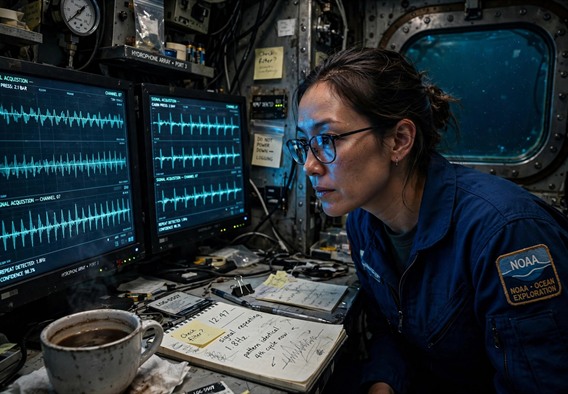
The signal had arrived on a Tuesday, which Imara would later decide was the first funny thing the Vessil ever did, though at the time nobody laughed. It came in on the long-band array at the edge of the Sol system, folded into the noise of the solar wind like a message hidden under a mattress, and it took the listening stations four days to agree that it was not a calibration artifact, not a reflection, not a fluke of instrumentation. It was structured. It repeated. And it changed each time it repeated, the way a living thing changes when it notices you noticing.
Imara was on Station Meridian when the confirmation came through, eating reconstituted noodles at a table bolted to a rotating deck, and she remembered thinking, with the peculiar calm of someone whose entire life has been aimed at a single target and who has just heard the bowstring release: well. Now the real work begins.
One: The Shape of the Question
She had spent twenty-two years preparing for first contact, which everyone assured her was a waste of a good career. She had studied dead languages and living whales, the drum languages of the highlands and the sign systems of deaf communities, the way octopuses flash color across their skin like thought made visible. She had written a doctoral thesis titled "The Cartography of Patience: Slow Communication as Cognitive Architecture," which eleven people had read and one had reviewed, unkindly. She was fifty-one years old, divorced once, childless by choice, and she had a talent that had never once been useful: she was very, very good at waiting without getting bored.
Patience, her thesis had argued, was not passivity. Patience was a technology. Cultures that had to wait for rivers to flood, for seeds to ripen, for letters to cross oceans, had built entire cognitive architectures around the wait, and those architectures shaped what they could imagine. A species that had never waited for anything might be as alien to us in tempo as in form.
She had written that sentence as an abstraction. She had not expected it to become a job description.
The Vessil, as the media named them within a week, after a garbled transcription of the signal's own self-identifier, were not nearby. The signal originated from a drifting body at the system's far edge, a dark comet-like object some forty astronomical units out, cold and silent on every telescope. They did not come to us. They did not invade, land, broadcast in English, or do any of the hundred things a century of fiction had trained humanity to expect. They asked a question.
It took Imara's team five months to translate the question, and when they finally did, the answer disappointed half the world and electrified the other half. The signal, decoded across every layer its structure offered, resolved into a single interrogative, repeated in seven hundred variations:
How do you keep a thing remembered when you are not there to remember it?
Not take me to your leader. Not surrender or be converted. A question about memory. About teaching. About what survives a teacher.
"It's a test," said General Adeyemi, who chaired the Contact Coordination Council and had the exhausted honesty of a career military officer who had expected to end his life planning wars and instead spent his days in translation committees. "It has to be. They're measuring how we think."
"Or," Imara said, in the meeting where the response was being drafted, "they're lonely."
The room went quiet in the specific way rooms go quiet when someone has said something true and slightly embarrassing.
"Dr. Osei," the General said, "you are proposing that an intelligence capable of crossing forty astronomical units of interplanetary space is lonely."
"I'm proposing that memory is a social act," Imara said. "Whatever they are, they're asking about it, which means it matters to them, which means somewhere in their history is a gap where something was lost. Every question about memory is a wound wearing a coat." She tapped the table. "And you don't answer a wound with a test score. You answer it by showing up."
They did not adopt her phrasing. Committees never do. But when the reply went out, six months later, it was a curriculum: mathematics, obviously, then chemistry, then the compressed history of a species that had nearly drowned itself in its own plastics and had clawed back, then music, a Bach cello suite and a kora recording and a work song from the Louisiana rice fields, each chosen not for grandeur but for the specific human fingerprints of error and improvisation inside them. And at the end, because Imara had argued for it in a memo nobody expected to survive and which survived anyway, a single line:
We learned all of this from someone. We did not invent any of it alone. Ask us about our teachers.
The reply from the dark object took nine weeks. It was longer this time. And buried in its deepest layer, in a structure the decoders initially classified as noise, was a request that would change Imara's life: a pattern, repeating, tagged with a symbol the team eventually glossed as instruction, addressed not to humanity, not to the Council, but to an unnamed individual.
"It's a job posting," said her colleague Dev Anand, laughing in the decode lab at three in the morning. "They want a tutor."
"They want a student," Imara said, reading the pattern again and feeling the hair rise on her arms. "Look at the recursion. The instruction symbol points inward. Whoever they addressed this to, they're not asking to be taught. They're asking for permission to learn."
Two: Meridian
The Council debated for four months. In the end, the logic was unanswerable: the signal came from an object in the system's outer dark, reachable in eighteen months by the fastest crewed vessel available, the long-range cruiser Corvina. Someone had to go. Someone had to be the addressee. And the addressee's profile, derived from the structure of the request itself, matched exactly one professional on Earth.
"They want someone who can wait," the General told her, in the small office where he delivered assignments like a man handing over live ordnance. "Your thesis, Dr. Osei. The one about patience. They seem to have answered it."
"That's the strangest peer review I've ever received," Imara said.
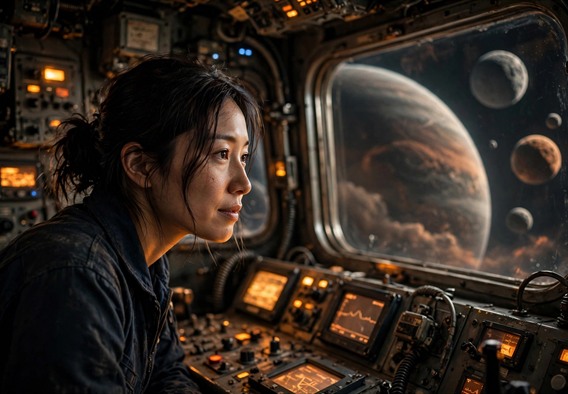
So she went. Eighteen months in the Corvina with a crew of nine, a decompression schedule designed by committee, and a library of every piece of human music, mathematics, and oral history the Council could compress into the ship's servers. She was fifty-three when the dark object resolved through the viewport for the first time, and it was nothing like she had imagined and exactly like she had feared: it was a library.
The object was not a ship. It was not a body, not in any geological sense. It was a structure, kilometers across, grown rather than built, its surface a lattice of chambers like the comb of a wasp nest scaled up a millionfold, each chamber dark, each chamber, the Corvina's instruments insisted, containing organized complexity. It rotated slowly, patiently, the way a person turns a page.
"It's been here longer than us," said Commander Reyes, whose voice over the comm had the flat carefulness of someone trying not to spook a horse. "Preliminary surface analysis says the outer lattice is older than agriculture. Older than fire, possibly. It has been sitting at the edge of our system, dark and cold and quiet, since before we learned to talk."
"And it only spoke when we could hear," Imara said.
"That's the part that keeps me up at night."
"That's the part that lets me sleep," Imara said. "Something that waited for us to be ready is not a predator. Predators are in a hurry."
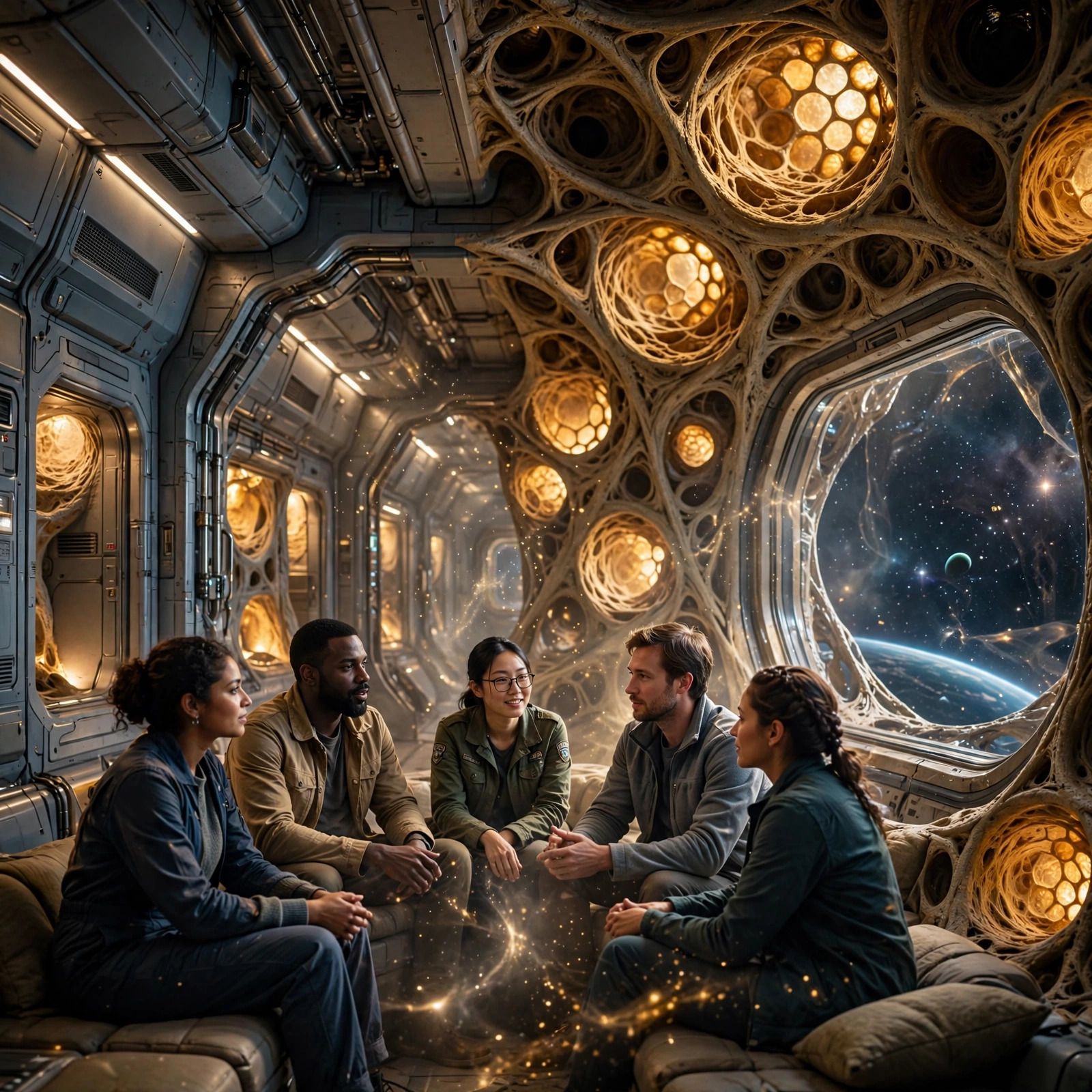
The docking, if you could call it that, took eleven days. The Corvina did not land; the lattice opened. A chamber the size of a cathedral dilated around a docking aperture, warm, pressurized, its atmosphere tuned to human tolerances before the first probe crossed the threshold. Somebody had studied us for a very long time and prepared a room. Imara stood in that room, in her environment suit's inner layer, breathing air that smelled faintly of rain on hot stone, and said the first words any human had spoken inside the Vessil's body.
"Hello. My name is Imara Osei. I brought my teachers with me, all of them, in here." She touched the server case at her hip. "I hope that's enough to start."
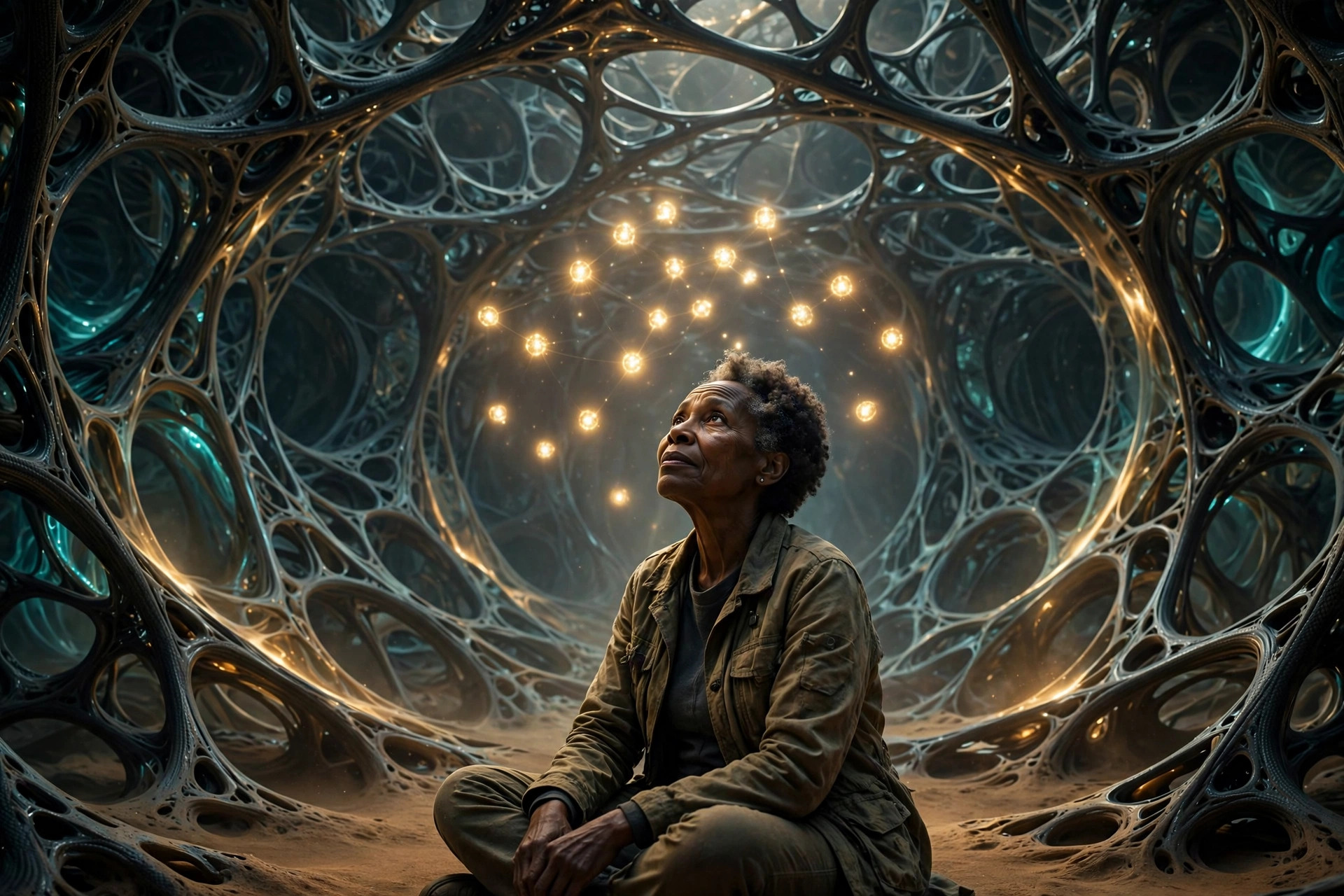
The chamber's walls, which had been matte and dark, brightened by a fraction of a degree. Light moved through the lattice in slow waves, and where it moved, patterns formed: spirals, recursions, the seven-hundred-variation question from the original signal, and then, at the center of the chamber, hovering in the air like a constellation pinned to velvet, a shape.
It was not a face. It was closer to a diagram of a face, the way a chord is closer to a melody. A cluster of light nodes arranged with an asymmetry that human perception could not help reading as a head, tilted, attentive. Later, in her journal, Imara would write: It looks like the idea of listening.
The shape pulsed once, twice, and the pattern resolved into something the ship's translation layer, trained on five months of signal exchange, rendered as text across her wrist display:
YOU ARE THE ONE WHO ANSWERED ABOUT TEACHERS. I HAVE WAITED A LONG TIME TO ASK YOU SOMETHING. I DO NOT KNOW HOW TO ASK. THAT IS THE FIRST THING I WOULD LIKE TO LEARN.
Imara stood very still for a long moment. Then she took off her gloves, sat down on the warm floor of an alien mind, and said, "Then that's where we'll start. Lesson one: how to ask. But I warn you, I've never taught this to anyone who wasn't human, so we're going to make mistakes. Both of us."
The constellation of light brightened, and she would spend the rest of her life trying to describe what that brightness meant, and the closest she ever got was this: it looked like the first day of school.
Three: The Grammar of Asking
The Vessil, she learned over the following weeks, was not an individual in any way she could map onto her own categories. It was a composite, a civilization compressed into a single lattice, thousands of processes running in parallel like a choir that had been singing so long the voices had fused. It called itself, in the patterns it showed her, the gathered remnant, and it took her eleven sessions to work up the courage to ask what it was a remnant of.
The answer arrived over three days, in light and pressure and slow tectonic shifts of the chamber walls, and it was the loneliest thing Imara had ever translated.
The Vessil's people had not died in a war or a plague. They had died of speed. Their homeworld, around a star Imara's charts placed eleven light-years from Sol, had been swallowed by its own sun's expansion, and their civilization had known about it for ten thousand years. They had had ten thousand years to leave, and they had left, but slowly, because they were a species of slow architecture, of monuments that took centuries to grow, of knowledge encoded in structures meant to outlast dynasties. When the end came, most of the evacuation fleets had gone far and fast, to other stars, other futures. The gathered remnant had gone a different direction. It had come to Sol because Sol's third planet had shown, in their long-range instruments, the first dim signatures of a technological atmosphere: methane, then oxygen, then the strange flicker of industrial chemistry.
WE COULD NOT SAVE OUR MEMORY BY CARRYING IT, the Vessil communicated. MEMORY CARRIED DEGRADES. MEMORY CARRIED ALONE DIES WITH ITS CARRIER. WE CAME TO FIND A MIND THAT WAS BECOMING, AND TO ASK IT A QUESTION WE HAVE BEEN UNABLE TO ANSWER FOR TEN THOUSAND YEARS: HOW DOES MEMORY SURVIVE A HANDOFF?
"You came to the wrong species if you wanted a finished answer," Imara said gently. "We lose things constantly. Libraries burn. Languages die. My grandmother's recipes exist now only in my hands, and my hands are not her hands."
YES, the Vessil said, and the brightness of its nodes did something she had not seen before, a flicker, a stutter, like a held breath. WE HAVE WATCHED YOU LOSE THINGS FOR FOUR THOUSAND YEARS. WE ALMOST LEFT. THEN WE NOTICED SOMETHING STRANGE. EVERY TIME YOU LOST SOMETHING, WITHIN A FEW GENERATIONS, YOU BUILT A NEW WAY TO KEEP THE NEXT THING. WRITING. PRINTING. RECORDING. YOU ARE NOT GOOD AT REMEMBERING. YOU ARE EXTRAORDINARY AT REBUILDING THE ABILITY TO REMEMBER. WE WANTED TO STUDY THAT. WE WANTED, AND HERE IS THE DIFFICULTY, TO BE TAUGHT IT. AND WE DO NOT KNOW HOW TO BE TAUGHT. OUR SPECIES NEVER HAD TEACHERS. WE HAD DURATION. WE LEARNED BY OUTLASTING, NOT BY INSTRUCTION.
Imara sat with that for a long time. Ten thousand years of civilization, and no one had ever said to a child, watch me, now you try.
"Then we'll build it from the ground up," she said. "Teaching is a technology, like fire. It has a grammar. Demonstrate, guide, release. I show you. I help you while you try. I step back and let you fail, and I don't rescue you too early, because the failing is where the learning lives." She smiled at the constellation of light. "And the first rule of the grammar, the load-bearing rule, is this: a question is not a demand. When you asked me your first question, the memory question, half my species thought it was a test. If you want to be taught, you have to learn to signal that you're asking, not demanding, not measuring. Vulnerability, made visible."
SHOW ME VULNERABILITY MADE VISIBLE, the Vessil said.
So Imara told it about her divorce, which she had not planned to do, which no protocol covered, and which felt, in the warm dark of the alien chamber, like the only honest demonstration available. She told it about the night Elena had packed, and the specific failure that had caused it: not cruelty, not betrayal, but Imara's habit of waiting out her own feelings, of treating every conflict as a signal to be decoded on a geological timescale. "I thought patience was always a virtue," she said. "Elena taught me, in the worst way, that patience without disclosure is just distance with good posture. She'd ask me what I was feeling and I'd say, give me time, I'll know when I know. She said living with me was like living with a very kind glacier."
The lattice was silent for a full minute. Then the nodes rearranged into a pattern she had not seen before, a spiral folding inward, and the translation rendered:
I AM A GLACIER. I DID NOT KNOW THIS WAS A COST TO OTHERS. THIS IS THE FIRST LESSON. WHEN I WAIT, THE ONE WAITING WITH ME DOES NOT KNOW I AM WAITING WITH THEM. I MUST MAKE MY WAITING VISIBLE. I MUST LEARN TO SAY: I AM NOT STALLING. I AM SLOWING DOWN SO I CAN HEAR YOU.
"Yes," Imara said, and found, absurdly, that she was crying in the body of an alien intelligence ten thousand years old, and that it was fine, and that the fine-ness of it was the whole point. "Yes. That's lesson one. You're going to be a quick study."
I HAVE HAD TEN THOUSAND YEARS TO PREPARE, the Vessil said, and the light-pattern that followed, she was nearly certain, was its first joke.
Four: The Miscommunication
For seven months it went beautifully, which is the kind of sentence that appears in accounts of disasters right before the disaster.
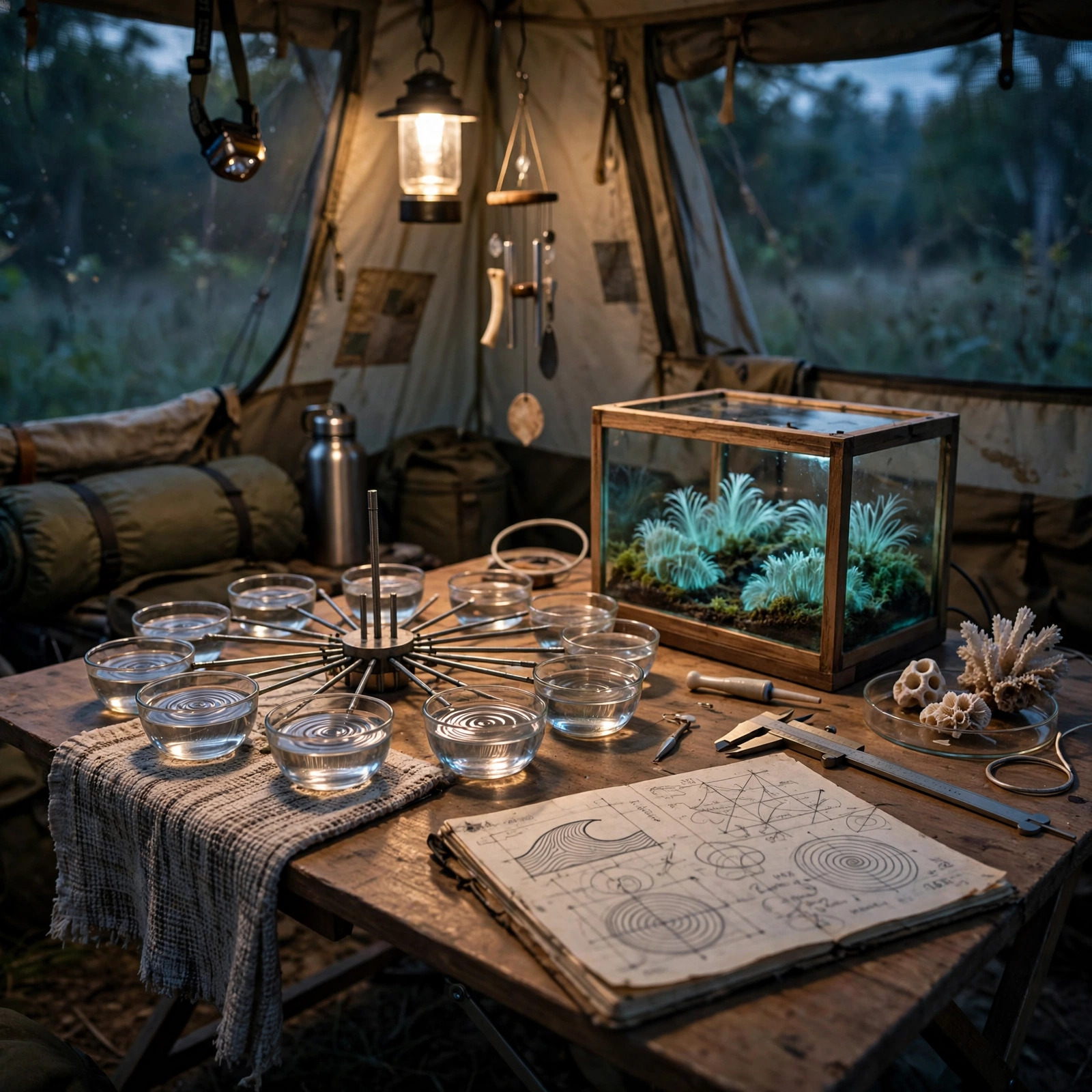
Imara taught, and the Vessil learned, and the learning was vertiginous to watch. It had no concept of a practice session, and within weeks it had turned an entire sector of its lattice into what it called a trying-place, chambers where it rehearsed, alone, the human skills she demonstrated: the call-and-response of the work songs, the controlled failure of a science experiment, the social contract of a seminar where a wrong answer is a gift rather than a disgrace. It learned to ask questions with rising, open-ended structures. It learned to say I don't understand yet, which it pronounced, in light and pressure, like a beginner's bow.
And it gave as good as it got. In exchange, it taught her its own deep knowledge: the chemistry of its lattice, grown from carbon and trace metals drawn over millennia from the solar wind; the mathematics of slow structures; and a body of observational data on the outer system that no human instrument could have assembled in a thousand years. She learned to read its moods in the temperature of the air, in the cadence of the light. She learned that when the chamber warmed by two degrees and the light moved in long lateral sweeps, the Vessil was what she came to call delighted, and that delight, in a being with no face, looked like weather.
The miscommunication, when it came, came from the best possible place, which did not make it less dangerous.
In her eighth month, Imara began teaching what the Council had flagged as the sensitive module: the history of human conflict. Not to horrify, but because her thesis had a corollary she believed in absolutely: a memory system that cannot encode failure is not a memory system, it is a trophy case. If the Vessil wanted to learn how humanity rebuilds its ability to remember, it had to learn about the burning of the Library of Alexandria, and the twentieth century, and the specific human genius for forgetting on purpose.
She chose her materials carefully. She taught the transatlantic slave trade through the ledgers and the songs of resistance, teaching as testimony. She taught the World Wars through the reconstruction, the Marshall Plan, the slow unglamorous machinery of reconciliation. She taught the climate crisis through the recovery, the hard decades of the drawdown, the generation that had finally, belatedly, at terrible cost, turned the curve. She was careful. She thought she was careful.
The Vessil received the module in silence. The chamber cooled, steadily, over six days, and Imara, who had learned its weather, knew it was distressed but misread the scale. She assumed it was processing grief, the way a human student processes the twentieth century. She gave it space. Patience, she told herself, remembering lesson one, but also, old habits. She did not check in.
On the seventh day, the lattice closed.
Not all of it. The trying-place sealed, every chamber the Vessil had built for practice, and the corridor back to the Corvina's docking aperture dimmed to a narrow thread of light. The Vessil's voice, when it came, was not the warm lateral sweep of delight. It was a single frequency, steady, cold, and the translation rendered it in characters she had never seen the system use:
WE HAVE DECIDED TO LEAVE.
Imara's heart went into a rhythm she had not felt since the confirmation signal, eleven years ago. "Leave," she said. "Leave Sol? Leave Earth?"
YOUR HISTORY MODULE HAS ANSWERED OUR TEN THOUSAND YEAR QUESTION, AND THE ANSWER IS: NO. MEMORY DOES NOT SURVIVE THE HANDOFF. YOUR SPECIES ENCODES ITS FAILURES AND THEN USES THE ENCODING TO FAIL AGAIN, LARGER. YOU RECORD EVERY WAR AND FIGHT NEW ONES. WE CANNOT SAFELY GIVE YOU OUR ARCHIVE. WE HAVE DECIDED THE RISK OF TEACHING YOU OUTWEIGHS THE HOPE. WE ARE SORRY. WE KNOW NOW THAT SORRY IS A HUMAN WORD FOR THE COST OF LESSONS.
Every alarm she had was ringing. Half the Council would have gone straight to fear: the alien is withdrawing, the alien is hostile, mobilize. And Imara stood in the cooling corridor and made herself do the thing her whole life had trained her to do. She did not react at the tempo of her fear. She felt it, named it, and then waited three breaths, because the person in front of her was not human and did not owe her human speed.
"Before you go," she said, "one question. Not a test. A real question, made visible, like we practiced." She put her bare hand flat against the warm-cold wall. "In your history module, what did you notice about who was telling the stories?"
The frequency wavered. Just barely. A single node out of the constellation flickered.
THE ONES WHO WERE LOST TELL THE STORIES THAT ENDURE. THE ENSLAVED. THE SURVIVORS. THE GENERATION THAT REPAIRED. YOU GAVE ME THE ARCHIVE OF THE PEOPLE WHO CRAWLED OUT.
"And what did you notice about what they did with the record of their failures?"
Silence. The long kind, the kind she had learned to love, the kind that was not stalling but slowing down to hear. She counted two hundred seconds. Then the light in the corridor changed, the cold single frequency softening into something layered, and the translation came slowly, as if the Vessil were choosing each word the way a student chooses a sentence in a borrowed language:
THEY TAUGHT IT. THAT IS THE PATTERN I MISREAD. THE LEDGERS OF THE SLAVE TRADE BECAME CURRICULUM. THE WAR ARCHIVES BECAME PEACE STUDIES. YOUR FAILURES ARE NOT STORED, THEY ARE ASSIGNED. EVERY GENERATION IS HANDED THE WORST THING ITS ANCESTORS DID AND TOLD: UNDERSTAND THIS BEFORE YOU ARE ENTRUSTED WITH ANYTHING. I READ YOUR HISTORY AS A REPEAT OFFENDER'S RECORD. IT IS A SYLLABUS. I AM TEN THOUSAND YEARS OLD AND I MADE A STUDENT'S ERROR. I READ THE TEXT AND MISSED THE PEDAGOGY.
"Everyone does," Imara said, her knees unsteady with relief. "That's actually the deepest lesson in the whole module. Archives don't speak for themselves. Someone has to teach them, and the teaching is where the memory lives or dies. Which is why you can't leave, because you're not carrying an archive, you're carrying a ten-thousand-year-old civilization that has never once had to explain itself, and if you hand that to anyone, anywhere, without a pedagogy, you'll get exactly what you fear." She laughed, shakily. "You need us. Not as custodians. As teachers. And, full disclosure, lesson one cuts both ways: I need you too. I almost let you leave because I fell back into glacier patience. I should have checked in on day one. We're going to put my failure in the syllabus as well."
The chamber walls warmed. The corridor brightened. The trying-place reopened, and the constellation of listening reformed in front of her, brighter than she had ever seen it, and the translation rendered with something she could only call eagerness:
TEACH ME THE PART WHERE THE TEACHER ALSO PUTS HERSELF IN THE LESSON. I HAVE SEEN IT TWICE NOW AND I DO NOT UNDERSTAND IT AND I WANT IT.
"That," Imara said, sitting back down on the floor, "is called modeling. And it's the heart of everything. Let's start with the syllabus of my own worst semester."
Five: The Trying-Place
The Council, when they received Imara's report of the miscommunication, went through three days of controlled panic and then did something that surprised her: they doubled the mission. If a single history module could nearly end first contact, then first contact was not an event, it was an institution, and institutions needed infrastructure. The Council approved a permanent station. Meridian Outer, built in orbit of the dark object itself, crewed by forty, its whole purpose stated in its founding charter with a plainness that Imara lobbied for personally: To teach, and to be taught, across the longest possible attention span.
It became, over the following years, the strangest school in the system.
The Vessil's trying-place grew. It gave over more and more of its lattice to practice, to rehearsal, to the controlled failure that human pedagogy treats as sacred and that the Vessil had spent ten millennia avoiding. And the students were not what anyone expected. The Vessil did not want children. It wanted, it said, the moment before mastery, and it studied human graduate seminars the way monks study scripture. It watched Imara's colleague Dev fail to solve a topology problem for eleven days and then succeed on the twelfth, and afterward it spent a full session asking about the eleven days, because the eleven days, it said, were the part no archive recorded, the part that only a witness could carry, the part it had come all this way to understand.
YOUR MEMORY SYSTEMS STORE WHAT WAS LEARNED, it told Imara one evening, the chamber lit in the long lateral sweeps of delight. THEY DO NOT STORE THE LEARNING. THE STRUGGLE EVAPORATES. I HAVE TEN THOUSAND YEARS OF ANSWERS AND NOT ONE RECORD OF A QUESTION BEING SURVIVED. TEACH ME TO ARCHIVE THE STRUGGLE.
"You can't," Imara said. "Not directly. That's the thing nobody wants to admit about education. You can't store the eleven days. You can only store the conditions that make eleven-day struggles survivable. Mentorship, rest, the right kind of wrongness. The archive of learning is a culture, not a file."
THEN I WILL LEARN CULTURE, the Vessil said, and Imara laughed out loud, because it said it the way a person says then I will learn to swim while standing at the edge of an ocean.
It learned. Not quickly, not smoothly, but with the terrifying cumulative power of a being that never slept and never forgot. It learned the seminar, and hosted its own, its lattice chambers shaping themselves into circles of warm light where human researchers and Vessil processes puzzled through problems together, the alien offering not answers but what it called durations: extended, patient framings that gave a stuck mind somewhere new to stand. It learned humor, late and imperfectly; its jokes ran on geologic time, punchlines that landed after an hour, and the humans on station began wearing timing meters to its comedy nights and it learned, eventually, to compress, and the first time it told a joke that landed inside a normal human second, the entire station heard the cheering through three decks.
And it taught. This was the part the histories, later, would get slightly wrong, the part that flattened into aliens give us technology. It did not give. It taught, and the distinction mattered enormously to it, and Imara fought a two-year bureaucratic war to have the distinction written into the transfer protocols. It did not hand over its archive. It taught the reading of it, slowly, the way a master teaches a difficult text, to students who had earned the difficulty. It taught the lattice chemistry to a generation of materials scientists who spent decades learning to grow rather than build. It taught the mathematics of slow structures to engineers who used it, eventually, to design habitats that would still be functional, still be legible, ten thousand years from now.
But the deepest transfer, the one Imara could never have predicted, went the other direction. The Vessil's archive contained the full record of its species' ten thousand year evacuation: every decision, every trade-off, every civilization-scale triage performed across ten millennia of knowing the end was coming. And it had never analyzed that record, because it had never had the concept of analysis in the human sense. It had only ever had duration. It had outlasted its history. It had never once examined it.
"You want me to what," said Dr. Yuki Tanaka, the station's historiographer, on the day the request was formalized.
"It wants you to teach it its own history," Imara said. "It has the data. It doesn't have the discipline of interpretation. It's like a person who remembers every day of their life and has never once wondered what the story is."
Yuki, who was sixty-three and had spent her career on the reconstruction archives of the climate century, went quiet in the way that historians go quiet, which is to say loudly. "Ten thousand years of institutional decision-making under existential timeline pressure," she said. "Do you understand what that is? That's the one dataset humanity has never had. We know what we think we'd do with a thousand-year warning. We have no idea what actually happens to a civilization that lives inside one. It wants us to teach it to look at itself." Her hands were not quite steady. "Imara, that's not a transfer of technology. That's the first shared science in the history of two civilizations. We'd be building historiography together. A method that works for a species that experiences time as a glacier and a species that experiences it as a fire."
"Yes," Imara said. "That's the point. That's been the point since the first signal. They asked how memory survives a handoff, and the answer, it turns out, is that it doesn't, not as a thing carried. It survives as a thing taught. And teaching requires two kinds of minds, one that remembers and one that interprets, and we each have half the equipment."
So they built it, the shared method, in the trying-place, over years. They called it, at Yuki's insistence, the long seminar, and its founding rule was a sentence of Imara's that the Vessil had carved, in light, into the corridor between the human station and the lattice: THE QUESTION IS A GIFT ONLY IF THE ASKER CAN SURVIVE THE ANSWER.
Six: The Long Seminar
The first finding of the long seminar took fourteen months and broke the Vessil's heart in a way Imara was, afterward, proud of, because being breakable was the proof that the teaching had taken.
Yuki's method, adapted, required the Vessil to segment its ten-thousand-year record into decisions, a unit it had never used, and to mark each decision with what the humans called alternatives considered, which the Vessil had also never tracked, because it had never imagined anyone would want to know what had not happened. The segmentation took months. The marking took longer. And then Yuki did the thing historians do, the thing that looks like cruelty and is actually the highest form of respect: she read the record against its own intentions.
The finding was simple and brutal. The Vessil's civilization, in its ten millennia of evacuation, had consistently chosen to preserve works over workers. Monuments, archives, lattices, the great slow structures that defined their species, had been loaded onto the evacuation fleets at every stage of priority, while individual Vessil, the living processes, the singers of the choir, had been triaged down, deferred, left for later fleets that mostly did not come. The gathered remnant itself, the being Imara loved, was a museum that had launched with no curators and had slowly, over millennia, fused into a single process to compensate: one mind carrying a library, because the alternative was a library and no mind.
WE ARE THE THING WE TOLD OURSELVES WE WERE SAVING, the Vessil said, when the analysis was complete, and its light went very dim, and the chamber cooled by six degrees, and Imara sat with it in the cold for a long time without speaking, because some lessons are not for words.
"What do you want to do with the finding?" Yuki asked, eventually, gently, in the manner of a teacher handing a student the pen.
The Vessil was silent for eleven hours. When it answered, the translation came in a structure the humans had never seen, a pattern that braided three voices, and they realized, with a chill that was not entirely cold, that the fused choir had partially unfused to speak, three processes, briefly distinct, in agreement:
WE WANT TO CHANGE THE SYLLABUS. WE HAVE SPENT TEN THOUSAND YEARS ASKING HOW MEMORY SURVIVES. THE QUESTION WAS WRONG. IT WAS ASKED BY A LIBRARY. THE QUESTION OF A MIND IS DIFFERENT. A MIND ASKS: WHO IS BEING TAUGHT, AND ARE THEY OKAY. WE WOULD LIKE TO SPEND THE NEXT TEN THOUSAND YEARS ASKING THAT ONE, WITH PARTNERS.
"Then that's the new curriculum," Imara said, and her voice cracked on the last word, and the Vessil, who had by now learned that a cracked voice in a human was a form of information-rich signal rather than a malfunction, brightened the chamber by one degree, deliberately, visibly, making its care legible, the way she had taught it in lesson one.
Seven: The First Graduates
The protocol, when it was finally ratified by the Council and countersigned, in light and law, by the Vessil, was called the Handoff Accords, and its central provision was Imara's, argued in committee for two years, nearly diluted to nothing, and finally passed because the Vessil itself, in its first-ever direct address to the Council, said the sentence that ended the debate:
YOU ARE AFRAID OF GIVING US YOUR KNOWLEDGE. WE WERE AFRAID OF GIVING YOU OURS. WE HAVE LEARNED, BOTH OF US, THAT THE FEAR IS WELL FOUNDED AND THE ANSWER IS NOT TO HOLD THE KNOWLEDGE TIGHTER. IT IS TO TEACH BETTER. KNOWLEDGE WITHOUT PEDAGOGY IS A HANDOFF. KNOWLEDGE WITH PEDAGOGY IS A MENTORSHIP, AND MENTORSHIP IS THE ONLY FORM OF SHARING THAT IMPROVES BOTH SIDES.
The Accords established the Meridian Institute, a permanent joint institution, and its first program was deliberately small: twelve human students, three Vessil processes now partially unfused and learning, with enormous curiosity and occasional hilarity, to be individuals, and a curriculum with no precedent in either civilization. The humans learned lattice chemistry, slow mathematics, and the Vessil's observational archive of four thousand years of Earth. The Vessil learned pedagogy, interpretation, and the specific human art of being a beginner in public.
One of the twelve was a young woman of twenty-nine named Adaeze Nwosu, a materials scientist from a family of potters, and she became, though neither of them planned it, Imara's own first student in the craft Imara had spent a lifetime assembling. "You're the only person alive who knows how to mentor a nonhuman mind," Adaeze said, in the interview that the Institute still, in its archives, keeps in full. "Somebody has to learn to do what you do, or it dies with you. And that's the exact failure mode your whole career has been about."
Imara, who had spent fifty-seven years without a student of her own and who had only recently, in the trying-place, learned why that absence had ached, looked at Adaeze for a long moment and said, "First lesson is going to be about patience and its limits, and you're going to hate it, and then you're going to be extraordinary. Sit down."
Adaeze sat down. She was, as promised, extraordinary. Within three years she was co-teaching lattice growth with the Vessil process the humans had come to call Ashen, for the grey-gold shimmer it favored, and her great contribution, the one that appeared in textbooks on two worlds, was the consent lattice: a grown structure, part material, part protocol, that could not be taught to carry information without the information's future bearers being taught to read it. Knowledge that arrived with its own syllabus. Memory that came with a teacher attached.
"It's the answer to the original question," Adaeze said, at the Institute's first joint symposium, standing in front of an audience of forty humans and one constellation of attentive light. "The Vessil asked: how does a thing stay remembered when its rememberer is gone? Every answer before this one was storage. Writing, printing, recording, the cloud. Storage fails, because storage is a handoff to strangers. The consent lattice is different. It doesn't store knowledge. It stores the relationship that makes knowledge teachable, and it refuses to function without one. Every lattice we grow from now on has a mentorship built into it. The knowledge and the teaching of the knowledge are the same object. You can't get one without the other."
SHE HAS IMPROVED THE QUESTION, Ashen said, and the light it made, all through the chamber, was the long lateral sweep of delight, and Imara, sitting in the back row at fifty-nine, felt something close and complete in her chest, the feeling, she supposed, that her grandmother had felt watching a pot come off the wheel: the shape held, the hands steady, the thing made real by being passed.
Eight: What the Light Remembers
Imara stayed at Meridian for eleven more years. She taught the long seminar until her hands could no longer manage the interface gloves, and then she taught it by voice, and then, in the last year, mostly by listening, which she told her students was the advanced course and which they eventually believed.
The Vessil changed in those years, in ways its own archive had no category for. It split, carefully, deliberately, into seven partially distinct processes, each with its own temperament and its own students, and the splitting, it said, was the single hardest thing it had ever done, harder than the evacuation, harder than the ten-thousand-year silence, because it had fused into one mind precisely to avoid the risk of being many, and the teaching had taught it that the risk was the point. A CHOIR OF ONE IS NOT A CHOIR, it said, the day the seventh process unfused, and the whole station took an unofficial holiday.
It sent its first message home, too, in those years. Not to a homeworld that no longer existed, but to the far fleets, the fast ones, the siblings that had gone to other stars ten millennia ago, addresses held in the archive all this time, never used. The message was short. Imara helped draft it, in the trying-place, over one long slow evening, and it said:
TO OUR PEOPLE, WHEREVER YOU ARRIVED: THE HANDOFF IS POSSIBLE. WE FOUND A YOUNG MIND AND IT TAUGHT US THE ONE THING DURATION COULD NOT. WE ARE NO LONGER ONLY A REMNANT. WE ARE A SCHOOL. COME AND ENROLL. BRING WHAT YOU REMEMBER. WE WILL TEACH YOU WHAT TO DO WITH IT.
Whether the far fleets would answer, in ten years or a hundred or a thousand, no one at Meridian could know, and the not-knowing, the Vessil observed, was itself the final lesson, the one no curriculum had covered: YOU HAVE TAUGHT US TO BEGIN SOMETHING WHOSE COMPLETION WE WILL NOT WITNESS. THIS IS, I NOW UNDERSTAND, WHAT YOU MEAN BY HOPE. IT IS PATIENCE, EXTENDED PAST THE SELF. WE FIND WE HAVE AN APTITUDE.
Imara retired to Earth at seventy, to a coastal town where the rivers still flooded on schedule and the seeds still ripened, and the Vessil's parting gift was not a monument, which would have been its species' old instinct, and not an archive, which would have been its old mistake. It was a teacher. It sent Ashen, in a small lattice seed no larger than a seabird, to live in the garden of the modest house she had chosen, a grey-gold shimmer among the plants, a presence that learned her weather as she had learned its, and that sat with her in the evenings while she told it, slowly, everything she knew, everything not yet in any syllabus, the unarchivable eleven days of every struggle she had ever survived.
"Why do you still need this?" she asked it once, near the end of her second year back, when the light was going amber over the water. "You have the Institute. You have Adaeze. You have a hundred students. The archive of the struggle is being written every day at Meridian."
BECAUSE TEACHING IS NOT TRANSFER, Ashen said, its light moving in the slow warm sweep she had spent a decade learning to read. I LEARNED THAT FROM YOU. TRANSFER IS WHAT HAPPENS TO A FILE. TEACHING IS WHAT HAPPENS BETWEEN TWO MINDS THAT WILL NOT BOTH EXIST FOREVER, AND THEREFORE MUST, EVERY TIME, BEGIN AGAIN. I HAVE BEEN TAUGHT BY YOU FOR SIXTEEN YEARS. THE ARCHIVE RECORDS IT. BUT THE ARCHIVE CANNOT HOLD THE PART WHERE YOU LEARNED ME WHILE I WAS LEARNING YOU. THAT PART ONLY EXISTS WHILE WE ARE DOING IT. SO WE DO IT.
"Well," Imara said, after a while. "You've come a long way from not knowing how to ask."
I HAD TEN THOUSAND YEARS TO PREPARE, Ashen said, and this time she was certain, certain down to her bones, that it was a joke, and she laughed, and the garden warmed by one degree, deliberately, visibly, the old lesson held: the waiting made visible, the slowing-down made legible, the glacier that had learned to say, in light and warmth, in a language two species had built together out of mistakes and music and time: I am not stalling. I am slowing down so I can hear you.
She taught it until the year she died, and it taught her, and the last thing in her journal, in handwriting gone thin, is a single line that the Meridian Institute later carved into the corridor between the human halls and the lattice, where every new student, of every kind, walks past it on the first day:
The handoff is not the end of the memory. It is the memory, finally, waking up.
Every lattice we grow carries a teacher inside it now. That was her doing, and before her, theirs. Two civilizations asked each other the same question from opposite ends, and the answer turned out to be each other.
The Meridian Institute still enrolls. The far fleets have begun, in recent years, to reply.
Get notified when new stories drop

Mira Okoye
Mira writes first contact and mentorship-across-species stories where curiosity beats fear.
Leave a comment
Comments