





Morning Rounds
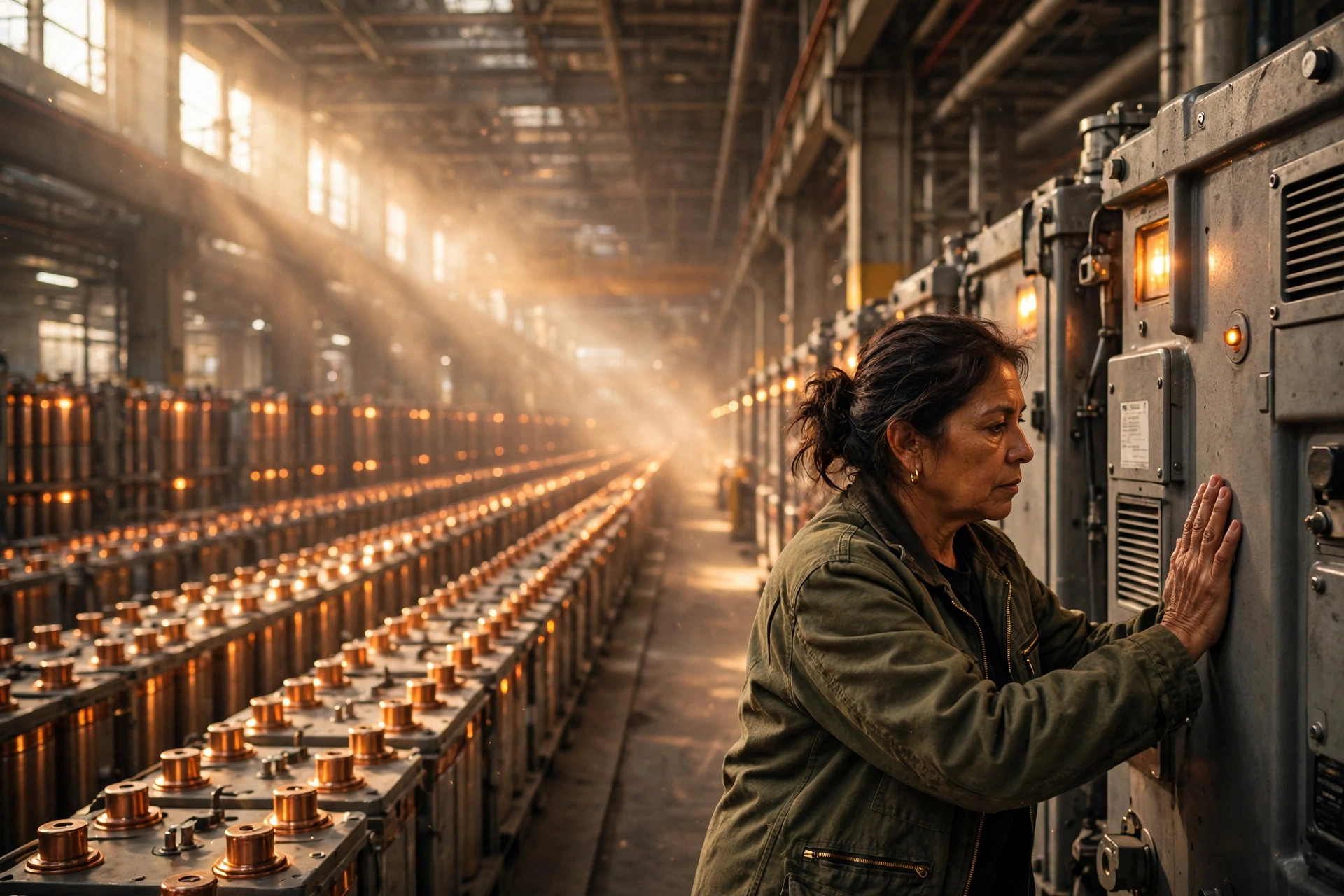
Marisol Vega took the stairs to the battery hall two at a time, which she regretted by the landing, and then did again anyway because Pablo had texted her the overnight numbers with an exclamation point, and Pablo Reyes did not use exclamation points. The stairwell smelled of warm rain and cut grass, the way Linden Yards always smelled in the hour after the courtyard sprinklers shut down. She pushed through the door at the bottom and found him standing in front of stack four with his hand flat against the casing like a doctor listening to a chest.
"Ninety-one percent," he said, without turning around. "Overnight. Ninety-one."
"It's suspicious news." He tapped the display glass with one knuckle. "The wind was low, the clouds were thick, and every household in the Cassia District that draws from us cooked dinner. We should have drained to eighty-two, maybe eighty-three. Instead we're at ninety-one. Either the new cells on stack three are better than I rated them, or something upstream is lying to us."
Marisol pulled the hand ledger from her jacket pocket, thumbed to the page with yesterday's date, and wrote 91 in the overnight column before she could lose it. The ledger was a fat canvas-bound book with a cracked spine and a pencil shoved through the wire binding, and it was the only record of the commons that had never once crashed. Four hundred and twelve households. She knew the number the way she knew her own pulse, because she counted it every month, door by door, with Junie walking the other half of the district so they could finish in a single long afternoon.
"Stack four's holding," Pablo said. "Stack two is the one I don't like. Come feel it."
She put her palm where his had been. The casing hummed, an even low note, the sound of four hundred homes running their rice cookers and their hot water heaters and their children's nightlights all at once. But under the hum, faint as a moth against a window, there was a stutter. A skip. It came and went before she could be sure she'd heard it.
"Will it even out?"
He wiped his hands on a rag that had once been green. Pablo was fifty-eight and had maintained the battery hall since before the courtyard had trees in it, and he had the particular calm of a man who had watched a great many things fail slowly and gracefully. But there was something careful in the way he said it, some hesitation she filed away for later.
"Nothing evens out on its own, Marisol. Things just get quieter until they break loudly. I'll figure the schedule. Give me a week to think about when."
The copper key to the cell housings sat on his tool bench, on its hook, where it had sat every morning of her tenure. She looked at the bench a moment longer than she needed to, at the rows of labeled drawers and the soldering station with its coiled cord, and then the courtyard bell rang the eight o'clock chime and the day's work pulled her upward.
Junie Okafor was already on the rooftop rows when Marisol came up the east stair, kneeling between the third and fourth row of thermal collectors with a rag and a bottle of algaecide and the expression of someone who had lost an argument with a pigeon. Junie ran the solar and water side of the commons, had for eleven years, and kept her hair tied back with whatever wire was closest to hand. Today it was red.
"Panel forty-one," Junie said, pointing with the bottle. "Somebody's bird has opinions about our glazing. Third time this month. I'm telling you, it knows I clean here on Thursdays."
"Maybe it likes a predictable adversary." Marisol crouched beside her and looked down the long slope of the roof. From up here the Commons Courtyard spread out below them like a held breath released: the bean rows and the tomato frames, the laundry lines strung between the young lindens, the wide shallow steps where the district's old men played dominoes before the heat came on. Steam rose off the community bathhouse roof in a clean white plume. A pair of kids, home from the night shift by the look of their boots, were asleep in the hammock under the pergola with the shameless completeness of the young. Somewhere below, someone was playing a radio badly tuned, and the music arrived at the roof as a rumor of itself.
"Throughput yesterday?" Marisol asked.
"Full draw on the water side, ninety-four on the electric side. The new tilt on rows six through nine bought us six points in the afternoon. I want to do the rest in the fall." Junie scrubbed at the glazing, frowned at it, scrubbed again. "You did the battery numbers already. I can tell. You've got the ledger face."
"I've got a ledger face?"
"You get a very particular squint. It's the same one Pablo gets when a stack lies to him." Junie sat back on her heels and looked at her, head tilted. "Ninety-one overnight, wasn't it. He texted you with a punctuation mark."
"He did." Marisol told her about stack two, about the stutter and the five days and the three days of reserve, and watched Junie's mouth thin. They both knew what three days meant. Three days was the difference between an inconvenience and an emergency. Three days was the whole margin their little civilization ran on.
"If we schedule it right," Junie said slowly, "we could ask the district to go lean for a week. Cold meals, shorter baths, the domino players to complain slightly louder than usual. We've done it before."
"We've done it in autumn. Not at the height of summer with the bathhouse full." Marisol stood and put the ledger away. "He wants a week to think. He can have it."
It was on the stairs back down, at the half-landing where you could see through the louvers into the courtyard, that Marisol first saw the stranger. He stood at the gate of the Commons Courtyard with a satchel over one shoulder, waiting, not entering, the way a man waits who has been told to wait but is trying to make it look like patience. His coat was too fine for the district. Even from half a floor up she could see the seams.
She came down into the courtyard light and he turned to her with a smile that arrived a half-second before the rest of his face did.
"Marisol Vega," he said. "Teodor Brandt. Helio Consortium. You're a difficult woman to find an appointment with, so I've committed the cardinal sin and simply appeared. I hope the courtyard forgives me."
"The courtyard forgives a lot," Marisol said. "It's the people you have to watch."
He laughed as though that were charming, and maybe it was, and maybe he practiced it in a mirror. He was tall, sun-browned in the way of men who golf rather than men who work outdoors, and when he set his satchel on the domino table and drew out the tablet, he did it with the flourish of a waiter presenting a bottle.
"I'll be direct, because your time is valuable and mine is expensive." He woke the tablet and turned it toward her. "This is a live model of the Cassia District's energy flows. Every meter, every load, every hour of the past two years, simulated forward. Helio's automated microgrid platform delivers a nineteen percent efficiency gain over your current arrangement. Same households, same heat, same hot water, one fifth less waste. And the district's maintenance obligations transfer to us. No more hand-rebuilt cells. No more five-day rebuilds."
She did not ask how he knew about the five days. She noticed that she did not ask, and she noticed that he watched her not asking.
The model was beautiful. She would give it that. The district rendered in amber and gold, the flows moving like weather, the waste heat curling off the buildings in gray ribbons that the model helpfully subtracted. It was the commons as she had never seen it: clean, frictionless, and entirely without people in it.
"What does it cost?" she asked.
"Migration is subsidized for the first decade. After that, a standard service agreement. And the battery hall would be decommissioned in the transition, of course, consolidated into our regional storage node. It's the heart of the efficiency gain, actually. Your hall is admirably maintained, but hand-balanced cells will always trail an automated system."
"The hall is maintained by a man who has touched every cell in it with his own hands," Marisol said.
"Which is exactly my point," Brandt said, gently, as if agreeing with her. "His knowledge lives in his hands. Ours lives in the model. One of those scales."
Below the louvers, the courtyard went on with its morning. The radio found its station at last. One of the hammock sleepers rolled over and said something that made the other laugh. Steam climbed off the bathhouse in its unhurried column, carrying the heat of four hundred households up into a sky that was doing its ordinary work of turning blue.
"The district council meets on the twenty-sixth," Brandt said. "I'd like an answer before then, and I'd like it to be yes, but I'm told I can't have everything. Take the proposal. Read it at your leisure. I'll come by for it in a few days." He slid the tablet into its sleeve and set it on the domino table, then placed his card on top of it like a lid. "You've built something lovely here, Ms. Vega. I mean that. Helio isn't here to break it. We're here to take it off your hands so you can finally rest."
Marisol picked up the tablet without answering him. It was heavier than she expected, cool as a stone from the shade, and it did not hum. She carried it through the commons office door, past the corkboard with its shift rosters and its lost-cat notices and its hand-drawn map of the district with all four hundred and twelve households inked on in Pablo's careful drafting hand, sixty-three of them marked with a little star because their meters were analog and had to be read by walking there.
She set the tablet on the shelf between the bathhouse keys and the jar of pencils. Then she took out the ledger, opened it to the day's page, and wrote the numbers that were true: ninety-one overnight, ninety-four electric throughput, panel forty-one fouled, stack two stuttering, five days to rebuild, three days of reserve. She wrote them in pencil, in her own hand, in a book that had never once crashed.
The tablet sat on the shelf with its screen gone dark, holding its beautiful frictionless district, and she left it there, unanswered, and went back out into the morning.
The Shorted Stack
The heat came up out of the south on day nine like something spilled, and by noon the Cassia District was running its fans and its cold baths and its ice grinders all at once, and the commons grid was carrying every amp of it. Marisol felt the change before she heard it: a thickening in the air of the stairwell, a smell of hot varnish, and then the alarm, a flat brass bell that Pablo had salvaged from a decommissioned ferry years ago and wired to the battery hall so that it rang for the hall and no other nonsense. It rang now. She took the stairs down two at a time with Junie Okafor behind her, and the door at the bottom was already warm on its handle.
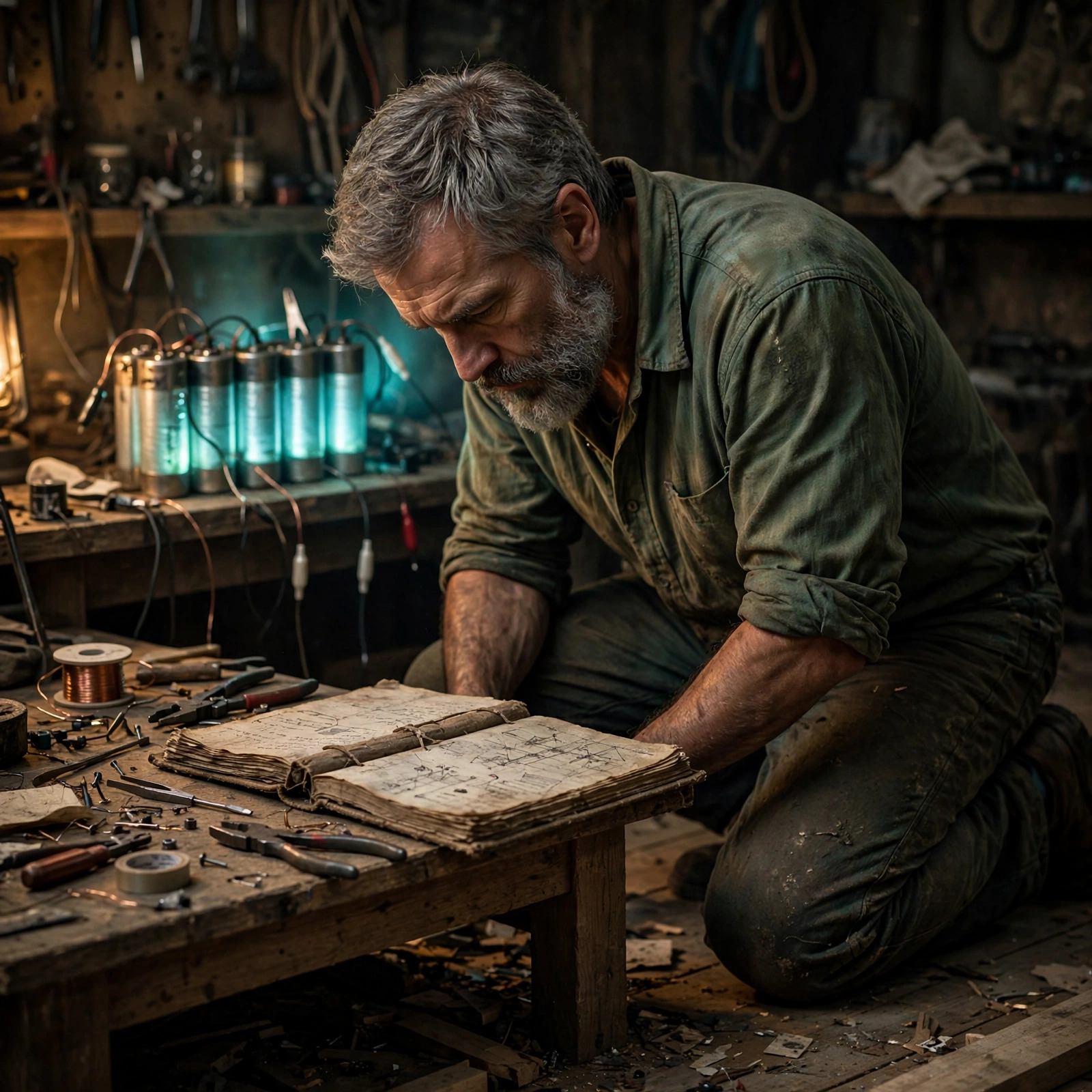
The battery hall under the Linden Yards courtyard was a low vault of brick, forty meters end to end, and its cells sat in ranks like loaves in a baker's rack, each stack cased in copper mesh, each mesh grounded to a bus bar that ran the length of the ceiling. Pablo was at the A stack with his meter prods in both hands, and the smoke was thin and gray and smelled of scorched insulation, not of fire, not yet, and that distinction was the whole morning.
"A stack," he said, without turning. "Cell four shorted, and four took five and six with it. The surge did it. Thirty-eight degrees outside and every compressor in the district kicking at once."
"How bad?" Junie had gone straight to the breaker panel, her hand hovering but not touching, because Pablo had a rule about hands and panels, and the rule was his.
"Bad enough." He set the prods down on the bench, carefully, the way he set everything down. "I can isolate four through six. The stack loses a third of its capacity until I rebuild it. Five days of work, and I know what our reserve is, so don't say it."
Marisol said it anyway, quietly, because someone had to keep the true numbers in the room. "Three days."
"Two now." He wiped his hands on a rag that had no clean corner left. "The surge ate the morning's charge and a piece of the afternoon. We're at two days of carry if the heat holds, and the heat will hold through Thursday. So we shed load tonight. Bathhouse on cold only. The courtyard lights go to every other lamp. And Junie, love, the ice grinders come off the commons feed entirely, I don't care what the queue looks like."
Junie wrote it on the wall slate in her square capitals, and the capitals got smaller as the list got longer, and Marisol watched the reserve drop from a number she could live with to a number she could not.
They worked the triage until mid-afternoon. Marisol pulled the isolation switches on the dead cells herself while Pablo talked her through each one from the bench, because his rule was also that no one else's hands went inside a stack, and she was the sole exception, grandfathered in by a decade of Sunday maintenance. The bus bar cooled. The bell stopped. The smoke thinned to nothing. And when she came up out of the vault into the courtyard, the sun was still leaning on everything, and Teodor Brandt was standing at the gate of the commons courtyard with his satchel over his shoulder and two cold drinks from the market in his hands, holding them out like an offering to whoever would take one.
"I heard the bell from Meridian Row," he said. "I was on my way anyway."
"Were you," Marisol said. It wasn't a question, and she let it lie there.
"Ms. Vega." He gave one of the drinks to Junie, who took it because it was cold and she had been in a hot basement for four hours, and he didn't seem offended that she drank it without thanking him. "I'm not here to gloat. I want to say that first, and I mean it, and I know how it sounds."
"Say the rest anyway."
"The rest is that I've been running the numbers on your district since our meeting, and today I ran them again. A stack shorted on a heat surge. Thirty-eight degrees. That's not an anomaly anymore, that's a forecast. Every summer is going to ask this of your hardware, and your hardware is maintained by hand, by one man, and today it showed you the gap." He set his satchel on the domino table, the same table, and did not open it. "Our automated grid would have isolated that cell in nine hundred milliseconds. Nobody coughs. Nobody climbs. Nobody spends five days."
Neighbors had begun to gather at the courtyard's edge, the way they did. Not a crowd, a dozen people, drawn by the bell and held by the argument. Adeyemi Cole stood with his arms folded near the bathhouse door, and the hammock sleepers had woken and come down, and a woman Marisol knew from the laundry co-op held her kid on her hip and said, loudly, so it would carry: "Two days, Marisol? Two days of what, exactly?"
"Two days of full carry," Marisol said. "If we shed load tonight, we stretch it. Pablo's rebuilding the stack. Five days."
"Five days is longer than two days," Adeyemi said. "I'm not being clever. I'm arithmetic."
"He can work faster than five," Junie said, and then she stopped, because she had seen Pablo climb out of the vault stairs more slowly than he'd gone down, and she looked at Marisol, and Marisol looked away first.
Brandt waited through all of it. That was the thing about him that made him difficult: he waited, and he listened, and when he spoke again his voice had dropped to something meant for Marisol alone, though the courtyard was quiet enough now that everyone heard it. "I'm not asking you to concede today. I'm asking you to look at the calendar. The council meets on the twenty-sixth. Seventeen days from now. You could spend those seventeen days rebuilding a stack and praying the heat breaks, or you could bring your ledger to the council and I could bring my model, and the district decides with everything on the table. I'd rather lose that vote fairly than win it because your infrastructure collapsed in August."
"You'd lose fairly," Marisol said. "You believe that."
"I believe my model is nineteen percent better and I believe it doesn't short." He shrugged, and the shrug was honest. "I've also read enough of your district to know that nineteen percent isn't the only number in the room. That's why I want the vote rather than the forfeiture clause. Forfeiture is faster. I asked them to take it out."
She had not known that. She filed it, and hated how much it improved her opinion of him.
"The twenty-sixth," said Adeyemi. "That's a long way off when you've got two days in the tank, Marisol."
"The twenty-sixth is when the council meets," she said. "I'm not going to stand in this courtyard tonight and make policy with a bell still ringing in my ears. If we're going to compare his model to our ledger, we do it in the Council Hall on Meridian Row, on the record, with every household in the district able to come and yell at us both. That's how the commons works. Slowly, and out loud." She turned to Brandt. "You'll get your answer on the twenty-sixth. Not before."
"Fair," he said. He picked up his satchel, and then he paused, and looked at the vault door, and something in his face was almost gentle. "The man who maintains your stacks. Is he all right? He came up those stairs like the stairs were winning."
"He's fine," Marisol said, and the lie sat in her mouth the way the tablet had sat on the shelf, heavier than it should have been.
Brandt left the second cold drink on the domino table for Pablo and walked out through the gate, unhurried, past the laundry and the hammocks, and the dozen neighbors dispersed in ones and twos, and the argument dispersed with them, and the courtyard went back to being a courtyard in the late heat.
Marisol found Pablo at the vault door, sitting on the bottom step with his back against the brick, and he was coughing. Not the small cough of dust. A deep one, bent-over, one that went on long enough that she had time to sit down beside him and put a hand flat on his back and feel the wrongness of the rhythm under her palm. The smoke had been thin, and he had been in it for four hours, and he was the color of the mortar between the bricks.
"Pablo."
"It's the smoke," he said, when he could. "It's nothing I haven't."
"You climbed into an isolation pull today with a chest that sounds like that. You talked me through every switch. You knew." She didn't ask it as a question because it didn't need to be one.
"I knew the stack was stuttering on day one," he said. "I wrote it in your ledger. Stuttering, I said. Not shorted. I gave it the kindest word I had."
She laughed, one dry note, because the alternative was worse. "The kindest word. Pablo, five days of rebuild, and you can't take the stairs."
"Five days if I pace myself. Seven if I'm sensible, and we don't have seven, so we have five." He worked his hand into his jacket, and brought out the copper key to the battery hall, the original, the one that predated every electronic lock in the district, and he pressed it into her hand and folded her fingers over it with both of his. His hands were shaking, fine, fast, and he held them steady by holding hers. "In case," he said. "In case a night comes when the bell rings and I don't hear it. You know the switches. You know the order. You're the only one who does."
The key was small and warm from his pocket and heavier than any key had a right to be, and Marisol sat on the step with it in her fist and understood, with a clarity she would have paid to avoid, exactly how much she had been letting slide. The stutter she had written in pencil and never followed up. The stairs he took more slowly each month. The five days she had entered in the ledger as though it were a fact about the world instead of a fact about one man's heart. She had been keeping the true numbers in the room for everyone except the one person whose numbers were going out of true, and he had made it easy for her by never once asking to be counted.
"I'm taking the first shift tonight," she said. "The isolation checks. All of them."
"Marisol."
"You're going to sit on that bench and talk, and I'm going to put my hands where you tell me, and tomorrow we start the rebuild at whatever pace keeps you upright. That's not a negotiation. You gave me the key. It's my hall tonight."
He looked at the key in her hand, and then at her, and something in his shoulders let go, a fraction, like a man setting down one item from a very heavy load. "The A stack first," he said. "Cells one through three are sound. I'll show you how to check them so you can do it without me by Thursday."
She stood, and put the key on the string with the bathhouse keys, where it had never hung in all the years of the hall, and went down into the cool of the vault to learn her own building.
Pablo's Bench
Five days of rebuild, Pablo had said, and this was day five, and the A stack was still open on the bench like a patient nobody had closed up. I came down the battery hall stairs on Tuesday morning carrying two thermoses and the ledger in my jacket pocket, and I knew before I reached the bottom step that something had gone wrong overnight, because the fans were running loud. Loud fans meant the hall was drawing from the reserve to cover what the wounded stack could not give. Loud fans meant we had burned through another day of stored power while Pablo triaged cells by hand, waiting on the replacement busbars that were still, as of Monday evening, sitting in a depot two districts over.
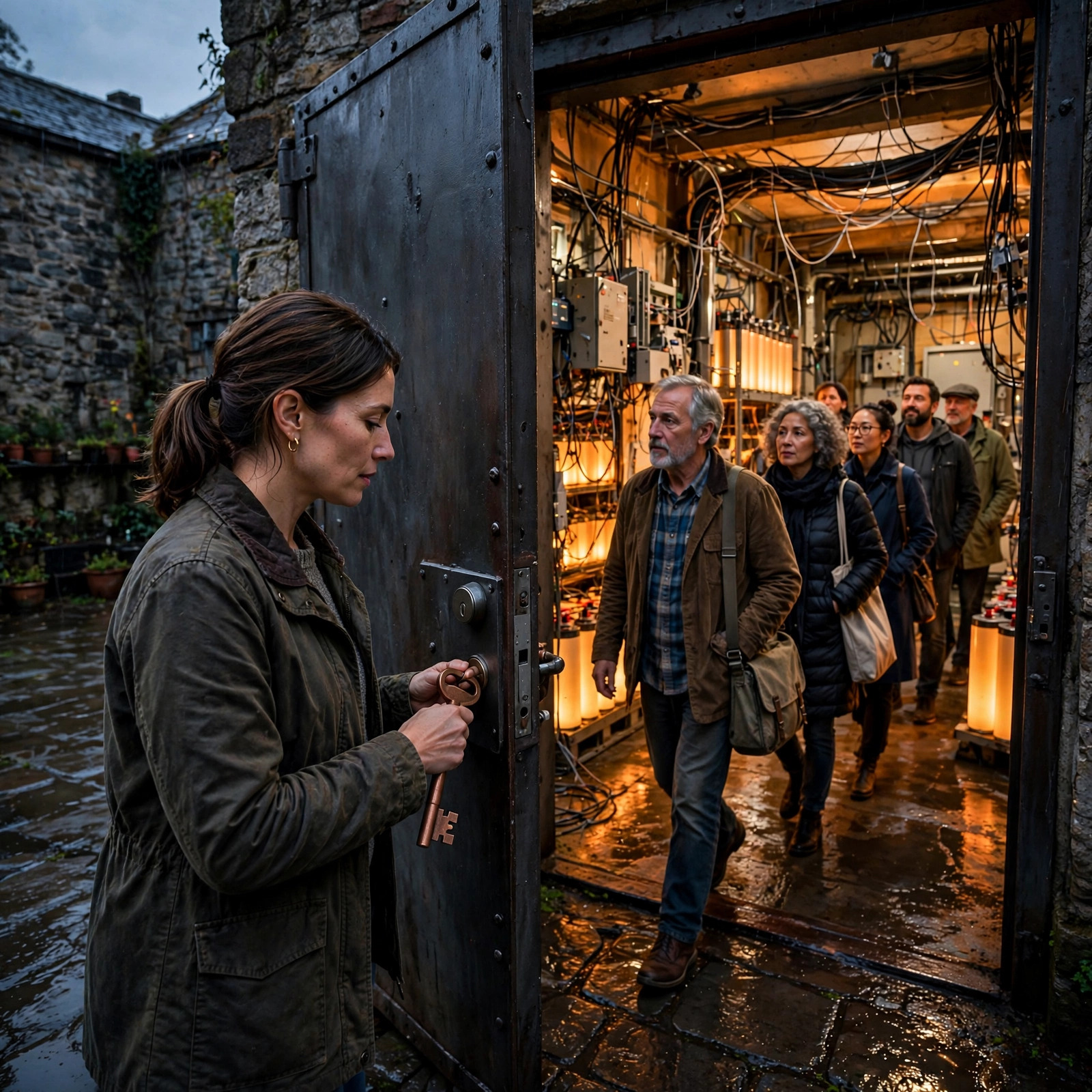
He was at his bench, which was not where I had left him. I had left him asleep on the cot behind the inverter room at midnight, with instructions, written on a napkin and taped to the bench where he would see them, to wake me if the third cell ran hot. The napkin was still taped there. The third cell had run hot. He had not woken me. He was gray the way ash is gray, not pale the way people go when they are tired, and his hands were moving over the open cell with the terrible patience of a man doing something he knows he should not be doing because no one else can do it.
"Pablo."
"Almost," he said, not looking up. "Ten minutes."
"You said that at midnight."
"I said it at midnight and it was true at midnight." His voice had a rasp under it I had been not-hearing for months, the way you not-hear a stair that creaks every day. "The busbars come today. Teodor's fetching them himself, he called the depot supervisor at six. So today the stack closes, and tomorrow we charge, and by the weekend we're back to..." He stopped. His hands stopped. He had a torque driver in his right hand and it drifted, very slightly, off the bolt it was meant for, and he set it down on the bench with the exaggerated care of a man who does not trust his own fingers.
"Pablo."
"I'm fine."
"You're gray."
"It's the lighting down here."
"I've been in this hall eleven years," I said. "The lighting's the same color it's always been. Sit down."
"When the cell's seated."
He reached for the torque driver again and his reach went past it, or the driver went past his reach, and then he was not reaching for anything. He went sideways off the stool, not fast, not dramatic, just a slow subtraction of himself from the upright, and I was too far away across the hall, and Junie was not. Junie Okafor had come down the stairs behind me with the morning's isolation readings under her arm, the way she had every morning since the rebuild started, and she crossed the floor in four strides and caught him under the arms before his head found the edge of the bench, and lowered him the rest of the way to the concrete like it was a thing she had practiced.
Maybe she had. She worked the bathhouse boiler, the big one, and boilers and hearts are both pressure systems with maintenance schedules people ignore.
He was out for maybe fifteen seconds. I counted them. I have never counted anything so carefully. When he came back his eyes found the open cell on the bench above him first, before they found either of our faces, and he said, "The third cell," and Junie said, "The third cell can wait five minutes, Mr. Reyes, and so can you," and he laughed, a small dry sound with no strength in it, and let his head rest against her shoulder.
"Marisol," he said. "Get my jacket."
His jacket was on the cot. In the inside pocket, folded into a square soft with handling, was a clinic paper. Not this year's. Three years old, the date at the top worn almost to nothing. I recognized the clinic stamp because the same stamp was on my mother's papers, the ones I had signed for in a hallway like that one, and I did not want to unfold his, and I unfolded it.
A valve, the paper said, in the plain language they use when they want you to understand that the machine of you has a part that no longer opens all the way. A replacement, the paper said, was available, and schedulable, and it had been available and schedulable for three years, and there was a line at the bottom where the patient signs, and the line was blank. The line had been blank for three years.
I brought it to him. He read it upside down on Junie's shoulder, which is how you read a thing you already know by heart.
"Three years," I said.
"Two and a half, if we're honest about when I decided." He put his hand out and I gave him the paper and he folded it back along its old creases without looking at it. "There was a rebuild on the C stack that winter. Then the flood year. Then Teodor's first letter from Helio arrived and it seemed like a bad season to be unconscious for six weeks." He shrugged against Junie's shoulder. "The valve doesn't hurt. It just rationing. Everything gets ninety percent. You learn to live on ninety percent."
"You collapsed on a concrete floor."
"I sat down too fast," he said, and even Junie's arm tightened around him at that one, and he felt it tighten, and he was quiet for a moment, and then he said, quietly, to the ceiling of the hall he had kept lit through two floods and a blackout winter, "No. All right. No. I collapsed."
Junie got him water. She held the cup so he wouldn't have to prove anything lifting it. I sat on the floor with my back against his bench, under the wound he'd left open in the stack, and for a while nobody said anything, and the fans ran loud, one day of reserve, maybe less, cycling into the morning's laundry and the bathhouse and the four hundred and twelve kettles of Cassia District.
"Here's the arithmetic," Pablo said finally. "The busbars come today. The stack closes tonight if I work until tonight. Tomorrow it charges. Two days of reserve carrying us, one day of reserve, tonight's the floor of it. If I stop now, we ride the reserve down to nothing by Thursday and the district office calls Helio before Friday, because a dark commons is an easy argument. If I keep going, the lights stay on and the council vote on the twenty-sixth actually means something." He turned his head and looked at me. "So tell me to stop, Marisol. You have the key. It's your hall. Tell me to sit on the cot while the stack bleeds out, and I'll do it, and I'll watch you do what I did at midnight, which is trade a night of power for a man's week of strength, except you'll be trading mine, and I won't even get to choose."
He was not being cruel. That was the worst of it. He was laying out the numbers the way he always laid out the numbers, honestly, with the decimals showing.
Junie said, "There's a third arithmetic." She set the cup down on the bench. "The busbars arrive today. Teodor's driving them himself. Two hands on the stack, one of them yours, one of them mine, and mine have been watching you torque bolts for four days while you pretended not to notice. Mr. Reyes. I do the boiler. I do pressure, valves, seating, and I do it at five in the morning so the baths are hot by six. Seat me." She pulled the stool over and sat on it and held out her hands, palms up, and they were steady, and scarred in the useful places. "You talk. I torque. You collapse again and I carry you up those stairs myself, and I'm telling you now I can, so it's no threat to you, only to my back."
Pablo looked at her hands for a long moment.
"The third cell," he said, "seats at forty newtons, no more. There's a trick to it."
"There's always a trick to it."
"That's the whole trade, you know," he said, while she took up the torque driver and he wrapped his fingers, briefly, around hers to set the angle. "That's what Helio's model doesn't have. Not a trick. A someone who knows where the tricks live." He was talking to keep himself upright as much as to teach, and we let him. "Their plan is good. Nineteen percent, and I believe the nineteen, I've read the model, it's honest math. But you open the drawings to the page with the battery hall." He nodded at the floor, the courtyard above us, the whole footprint of it. "Automated. Sealed. No bench. No maintenance access that a person with a key can walk through. And I looked up what their sensors count, Marisol. Their model reads the district through the smart meters, and the smart meters only cover the homes that signed the lease upgrade. There are sixty-three houses on the east rows still on analog meters, because the lease upgrade cost money those houses didn't have. Helio's model sees no draw from those houses. So it classifies them as vacant. Vacant land gets rezoned in phase two. Nobody at the district office will ever see a name, because there's no name in the data. There's just an empty lot where a number should be."
My hand went to my jacket pocket before he finished the sentence.
"They're in the ledger," he said. "Every one. I know, because I'm the one who read the meters, all those years, before you were old enough to hold the clipboard. Four hundred and twelve households. Sixty-three of them the district has already erased, on paper, without ever needing a vote to do it. That's what the nineteen percent buys." He leaned back against Junie's arm, spent, done with the speech, and looked at the ceiling. "I kept the lights on for all of them, every one of those names, for years, on ninety percent of a heart. I'd do the valve next month if I thought there'd still be a hall worth coming back to."
Junie torqued the bolt. Forty newtons. The driver clicked, a small precise sound, the sound of a thing done right by the right hands.
They worked, the two of them, Pablo's voice and Junie's hands, while the fans ran and the reserve ticked down, and I sat on the floor where a bench used to hold one man's whole working life and did the thing I had been avoiding since the day Helio's letter arrived, which was to stop deferring.
I took out the ledger. The analog homes were the last pages, the oldest entries, the ones in Pablo's early handwriting, before mine took over the book. Amara on Third, whose meter I had read myself last spring and written down in pencil. The Boakye house. The corner house on Del with the fig tree. Sixty-three names, sixty-three households, hot water and evening light, and every one of them a line in my book and a blank in Helio's model.
By the time the stack's third cell clicked into its seat under Junie's hands, I had read all sixty-three names, out loud, quietly, one by one, while Pablo nodded at each like a man counting his own herd coming home, and I had written at the top of the page, in ink, the four words I would read to the council on the twenty-sixth: these homes are not vacant.
Then I closed the ledger, stood, and pulled the copper key off the string with the bathhouse keys, and went up the stairs to wait for Teodor's truck.
The Last Cells
Teodor's truck arrived at Linden Yards before the dew had burned off the courtyard, and I was standing in the middle of The Commons Courtyard with the ledger in one hand and the copper key in the other when he climbed down from the cab.
"You came alone," I said.
"You asked me to count houses. Crowds don't count." He set his satchel on the rim of the fountain and took out the tablet, and I watched him do it, the way he squared the device on the stone like a man setting a level. "Marisol, before we walk. I read the letter your council sent. I read your counter-filing. I want you to understand that I didn't come to be shamed."
"Good. I didn't ask you here to shame you. I asked you here to do arithmetic."
He almost smiled at that. Almost. "Then show me where my numbers are wrong. That's all I've ever asked of anyone."
I held up the ledger. "Sixty-three households in the Cassia District that your model lists as vacant lots. Analog meters, no telemetry, no data. Your algorithm read silence as absence. It's a reasonable mistake. It's also a mistake that would leave sixty-three families off any grid Helio builds, because you can't wire a house you've already deleted."
"The model doesn't delete," he said. "It prioritizes."
"From where those families sit, the view is identical."
He looked at the ledger, then at me, then at the fountain, and I could see him doing what he always did, which was turning an argument into a data problem. That was the thing about Teodor Brandt I had never managed to hate. He genuinely wanted to be right more than he wanted to win.
"Walk me," he said. "Every name. I'll carry the tablet and I'll mark what I find."
We walked. Junie caught us at the corner of the courtyard with a thermos and a roll of paper, and Pablo's list of bench hands, which she had been writing since dawn in her square, no-nonsense print. The morning was cool yet, the bean rows on the south trellis still dark with wet, and the neighborhood did what neighborhoods do at that hour: it woke up around us and proved it existed.
The first house on Pablo's oldest pages belonged to the Boakye family, four generations deep on Third, and the meter was bolted to the wall beside the gate where it had been since before I could read. I put my palm flat on the glass. The dial turned, slow and steady, the small honest wheel of a household drawing hot water for breakfast.
"That's a load," I said. "Right now. A real one. Read it."
Teodor stood in front of the meter for a long moment. Then he opened the tablet and typed, and I watched the light of the screen move across his face while the wheel turned behind him.
"The cadence is domestic," he said finally. "Morning spike. Water heater." He looked at the dial, then at his screen, then at the dial again. "My model has this parcel flagged as an empty lot. There's a polygon error in the cadastral layer from the consolidation. Sixty-three of them, you said?"
"Sixty-three."
"Consolidation-era parcels with pre-analog service points." He said it like a man finding a crack in his own foundation with his fingers. "I built the vacancy layer on the cadastral map because it was the fastest available proxy. I never cross-checked against physical metering because I assumed there wasn't any." He looked at me. "That was lazy. I'll say it plainly. It was lazy, and it was fast, and it looked like rigor."
"It looked like nineteen percent," I said.
"It looked like nineteen percent," he agreed. "And nineteen percent of a district that doesn't include those homes isn't nineteen percent. It's a rounding error with a body count." He paused. "I don't like that I almost shipped it."
We walked the whole of it. Third, then Del, where the fig tree at the corner house had dropped overnight fruit onto the walk and a woman was gathering them into her apron before the wasps found them. She offered us each one, and Teodor ate his standing in the street with the tablet under his arm, and I watched him mark the house real while the juice ran down his wrist. By eleven we had done thirty-one homes. By early afternoon, all sixty-three, and Teodor's tally matched my ledger line for line, and he had stopped saying the word "proxy" somewhere around the fortieth.
The last one was Amara's place on Third, and her meter turned like all the others, and Teodor stood there the longest of all.
"I had this one as a garden plot," he said. "Vacant, green space, no load." He closed his eyes briefly. "There's a person in there making tea."
"There always was."
He nodded. He typed. He marked it real.
We walked back to Linden Yards in the heat of the afternoon, and the courtyard had changed while we were gone. Junie had been busy the way Junie is busy, which is to say completely. Twelve neighbors sat at folding tables under the trellis, and the tables held what she had dragged out of the storage corridor: busbar stock, torque drivers, the crimp kit, gloves in four sizes. Twelve people, some I knew well and some I knew only as faces at the market, all of them bent over practice joints on scrap copper while Junie moved behind them like a foreman who had been waiting her whole life for the whistle.
"Bench school," she said, when she saw me looking. "Pablo can't hand-torque forty cells alone, and he shouldn't have to. We train on scrap until three o'clock, then we take over the low cells. He directs. Nobody touches the stack without his sign-off."
"Junie." I kept my voice low. "His hands. His heart. He hides how bad it is."
"I know how bad it is," she said, simply. "I've been carrying his tool bag up the stairs for two years so he doesn't have to. Why do you think I'm doing this?" She snapped a glove. "He rebuilds the stack with his voice. We supply the hands. Twelve of us, today, and I can find twelve more tomorrow if the first twelve hold up."
I found Pablo at the Battery Hall door, sitting where the stair met the cool of the underground, and I gave him the copper key back and he weighed it in his palm.
"Five days, I told you," he said. "By myself, five days. Twelve hands at the benches, and the bench work is half the hours." He did the arithmetic the old way, in his head, the way he'd taught me to. "Four days. Maybe three and a half if Junie keeps the line moving, and Junie keeps every line she starts moving."
"Four days puts the rebuild done on the nineteenth," I said. "The vote is on the twenty-sixth. You'd have a week of climbing reserve behind you when the council walks through."
"If," he said, and turned the key over. "If there are cells to rebuild with."
And there it was, the thing I had been circling all day. I had spent the morning proving to Teodor that the district was real. Now I had to prove to my own bookkeeping that I believed it too.
The commons kept its last spare cell inventory in the cage at the back of the Battery Hall, thirty cells in their crates, and every planner in the district had told me the same thing about those crates: hold them. Hold them for the vote, hold them as proof of prudence, hold them as the thing the commons still had that Helio wanted, a bargaining position, leverage, a chip. The reserve was down to one day. The neighborhood was running on one day of stored power, and the spares in the cage could carry us through the crisis if everything else failed. Every rational reading of the situation said: keep the cage locked.
But a bargaining chip is only worth what it can buy, and what I needed to buy was time I couldn't purchase any other way. Four days of Pablo's rebuild needed cells under torque now, and cells under torque meant pulling the cage.
I did it in front of everyone. I brought the ledger out to the courtyard, and the twelve at the benches, and Junie, and Pablo in his chair by the trellis, and Teodor with his tablet, and I opened the book to the inventory pages and did it out loud, the way the commons had always done its business.
"Thirty spare cells, commons inventory, last of the reserve stock," I said. "I'm signing all thirty over to the battery rebuild, effective now. Not half. Not the ones we can spare. All of them. If anyone wants to tell me why that's reckless, say it now, in front of the ledger."
Pablo said, "It's reckless."
"I know."
"It's also the only math that finishes before the vote." He took the pen from the spiral binding, held it out to me across the table, and his hand was steady enough for that, at least. "Sign it, then. I've watched you defer for two weeks. Don't defer in ink."
I signed. Marisol Vega, commons coordinator, transfer of thirty cells to the rebuild, day fifteen, witnessed, and Junie took the page and read the number back to the courtyard the way you read back a dose of medicine, and twelve people put down their torque drivers and started carrying crates down the stairs.
Teodor stayed. He had every reason to go, and he stayed, and near dusk he sat on the fountain rim with the tablet and I watched him do the thing I had thought I would have to fight him for. He opened the model. Not the marketing copy, the model, the layers under it. And he began to amend it, quietly, in the last light, adding sixty-three service points one by one, cadastral layer corrected, vacancy flag cleared, each home entered with its meter cadence and its morning load and its family name from my ledger, which he asked me to read to him twice when his own notes ran short.
"The efficiency number will drop," he said, while he typed. "Fourteen percent, maybe less, once the real load is in. It'll be the honest number, which is worse on paper and better everywhere else." He glanced up at the windows going gold around the courtyard. "I'll present the amended model to the council on the twenty-sixth myself. It's my model. My error. My correction."
"They may not thank you."
"Good models rarely get thanked. They get used." He typed the last name, Amara on Third, and set the tablet down on the stone. "Sixty-three households, real. Four hundred and twelve served. That's the district. That was always the district."
Below us, in the Battery Hall, the benches had started. I could hear the torque drivers through the stairwell grate, a staggered clicking, twelve hands learning Pablo's forty newtons, and by the time full dark came, Junie had called up the first numbers and Pablo had called back the corrections, and the reserve meter on the courtyard post, which had held at one day for a week like a held thing finally let go, ticked upward: one day and a fraction, climbing.
Two days, the board would say by morning. Two days, and rising, and four days of work left, and I stood in the courtyard with an empty cage and a signed page and a lighter ledger, listening to the commons spend everything it had on itself.
Council Hall
The line outside the Council Hall on Meridian Row went around the corner before the doors opened, and I counted it the way I counted everything now, out of habit, out of fear of losing one. Amara from Third Street had her three grandchildren with her because she had no one to leave them with, and because, as she put it, they were the reason she was in the line at all. The analog meter on her house had never once reported her existence to Helio's model, and she intended to correct that personally, in a room where the model's owners had to look at her while she did it.
I carried the ledger in my jacket pocket, left side, where I could feel its weight against my ribs with every step up the stairs. Four hundred and twelve households. Sixty-three of them invisible to the consortium's software, their meters old brass, their homes off-lease and off-book, their hot water and their winter heat drawn from the commons for years without a single line of code ever noticing.
Inside, the hall was built for a hundred and forty people and there were more than twice that many trying to come in. The council staff gave up on the overflow room and opened the side doors, and the crowd folded itself into the aisles and along the back wall, quiet in the way people are quiet when they have walked somewhere on purpose. Pablo sat in the second row with Junie beside him. He had insisted on coming. He had also, I noticed, brought his oxygen monitor in his coat pocket with the wire run inside his sleeve so no one would see the clip on his finger, and I noticed it because I had spent eleven days learning to notice.
"You should be in bed," I whispered, sliding in beside him.
"I should be at the bench," he said. "The bench is one day from finished. I can be in two kinds of wrong place, so I picked this one."
He reached into his coat and pressed the copper key into my palm. It was warm from his hand and worn smooth at the bow from years of his own grip.
"Night shift finishes the last rows tonight," he said. "They'll need the door. I'd rather be there to turn the key myself, but since I'm being stubborn in this direction instead, it's yours. You've earned a key that opens something."
I closed my hand around it and did not trust myself to answer, so I didn't.
Adeyemi Cole sat at the center of the council table with his papers squared in front of him and his reading glasses low on his nose. He had spent two weeks as the man everyone in the Cassia District wanted a piece of, and it showed in the careful flatness of his voice when he called the session to order. He was not unkind, Adeyemi. He was exhausted, and he was responsible, and those are different things that can look identical from across a room.
"The question before the council," he said, "is the Helio Consortium's proposal to assume operation of the Linden Yards microgrid and decommission the commons battery hall in favor of consolidated automated storage. The consortium's model projects a nineteen percent efficiency gain over current commons operation. I have with me today Teodor Brandt, the engineer of that model, who has asked to speak to the council before the vote. Mr. Brandt."
Teodor stood, and I watched him set the tablet down on the council table without opening it, which I understood to be a choice, and which I think the room understood too.
"Councilor. I built the Helio model," he said. "I want to say the plain version first, and then the numbers. The model is wrong. Not in its arithmetic, in its ground truth. It was built on cadastral and meter data that classifies sixty-three occupied homes in this district as vacant, because those homes run analog meters that report nothing. The model has been serving a district that does not exist."
A woman from the consortium's delegation, seated to his left, said, "The variance is within tolerance for a planning model, and Mr. Brandt knows that."
"It's within tolerance if the missing households don't use power," Teodor said. "They do. I spent eleven days reading them into the ledger with the commons coordinator, household by household, meter cadence, morning load, family name. When the real load is entered, the efficiency gain is fourteen percent, not nineteen. And the fourteen is the honest number. I'll answer for it, and I've submitted the amended model to the record."
Adeyemi looked at him for a long moment over the glasses. "You are testifying against your own employer's bid."
"I'm testifying for my own model. The first version was mine and the error was mine. The correction is also mine." He turned slightly, not to the council table but to the hall. "Four hundred and seventy-five households. That's the district. It was always the district."
Then it was my turn, and I walked to the table with my heart going hard, and I took the ledger out of my pocket and set it down in front of Adeyemi, open to the page Junie had ruled and I had signed.
"This is eleven years of entries," I said. "Every household, every draw, every repair, every night the reserve got thin and every morning it came back. It's not a model. It's a record. The sixty-three homes your software can't see are in here with their names, and the people attached to those names are in this room, and I'd ask them to stand so the council can see the size of what it's about to vote on."
They stood. Not all at once, Amara first, then the family from the dye works row, then the rest, down the aisles and along the back wall, sixty-three people standing in the Council Hall on Meridian Row because a woman with a paper ledger had written them down. The hall was not silent. It made a sound, the small shifting sound of that many people getting to their feet, and I heard it the way you hear a number you have carried in your pocket finally spoken out loud.
Adeyemi did not rush them to sit. He let them stand while he turned the ledger pages himself, slowly, and the consortium delegate said something to him that I didn't catch, and he said, "I heard you the first time," without looking up.
The debate after that was real, and it was not gentle. The delegate argued, and argued well, that a fourteen percent gain was still a gain, that automation reduced single points of human failure, that no district should be held hostage to one man's hands and one woman's notebook. And she was right about the parts she was right about. Pablo sat very still in the second row while she said his name, twice, as the single point of failure, and I watched his thumb move against the clip on his finger, and I knew what the monitor was telling him, and he knew that I knew, and neither of us said a word.
When the roll came, the council split even. Even, with Adeyemi left to vote last, and he took his glasses off entirely and set them on the table and rubbed the bridge of his nose, and the whole hall waited, and I thought about how many nights he must have spent on this, and how reasonable he had tried to be with everyone, and how being reasonable with everyone is its own kind of cage.
"I'm not going to decommission a working battery hall with one day of rebuild left in it," he said finally. "That would be vandalism with a spreadsheet. And I'm not going to turn down fourteen honest percent and the software that found it, either, because that would be pride with a ledger. So here is what I'll move, and if it fails, we vote the original question. The commons keeps the battery hall and the hands. Helio supplies the software layer, integrated with the amended model, on a commons-held license, renewable annually against the ledger. Funding split accordingly. Motion to that effect."
The delegate looked at him, then at the standing sixty-three, then at Teodor's tablet lying closed on the table, and she sat back and did not object, which from the Helio Consortium was, we would all understand later, a kind of concession speech.
The vote carried. Not unanimously. Two councilors against, one abstaining, and Adeyemi's own aye the difference, and that is how the thing I had fought for arrived: partly, imperfectly, with a license that has to be renewed every year by people who will have to keep showing up. Junie grabbed my arm. Amara hugged me so hard the ledger nearly went back into my ribs. Pablo stood, carefully, on his own, and only then did I see that he had gone gray around the mouth, and I took his elbow and said, "Hospital. Tomorrow. No negotiation," and he looked at me for a second and said, "After the last row," and I said, "Tomorrow, Pablo," and he said, "Tomorrow," and gave my hand one squeeze, which was his way of signing.
The crowd spilled out into Meridian Row in the blue hour, and I walked Pablo to the tram stop and got him seated on the bench, and Junie stayed with him, and then I walked home alone through streets I knew by load curve and by name.
At the courtyard stairwell of Linden Yards, the reserve meter on the post read four days, holding, the highest it had stood since the summer. Down the stairs, through the lower passage, the battery hall door was shut and behind it I could hear the night shift, the staggered clicking of torque drivers, someone laughing, someone calling out a cell number, the work going on without Pablo and because of him.
I turned the copper key in the lock. The bolt drew back with the particular sound of a thing kept and opened, and I pushed the door wide, and the hall was there in front of me, half the rows dark and finished and done, and the last rows still open and glowing, cell by cell, a soft amber constellation that sixty-three invisible households had come down here to finish with their own hands.
"Evening, coordinator," someone called from the benches.
"Evening," I said, and I stepped inside, and I let the door stay open behind me.
Get notified when new stories drop

Leo Stranek
Leo specializes in solarpunk abundance and near-future progress: livable futures, bright cities, and practical wonder.
Leave a comment
Comments