




Deck Three
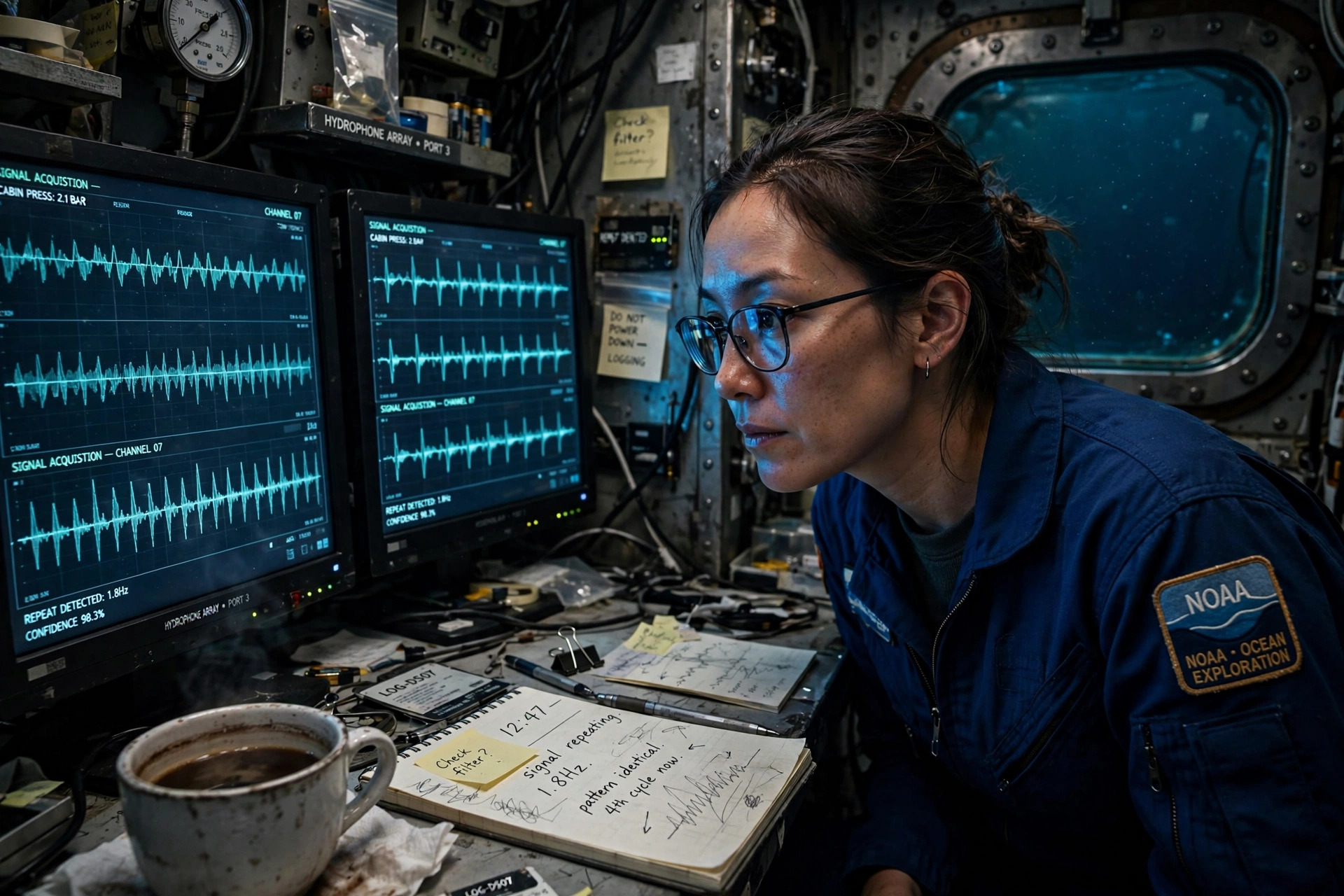
The coffee had gone cold in the cup at Amara's elbow when the hydrophone array started drawing something that was not a whale.
She had been in Deck Three's lab since 0500, running the monthly calibration sweep out of habit more than hope, watching the flat green line of the Tangaroa Deep Station's ambient noise profile do exactly what it always did, which was almost nothing. Shrimp. Current. The distant, patient grinding of the escort vessel's props somewhere above them in Pohnpei Harbor's outbound lane. She had half a page of a paper on thermocline drift open on the second monitor when the line shivered, gathered itself, and folded into a shape.
Amara set the cup down without drinking. She pulled her chair in, magnified the window, and let the sound come through the desk speakers at low volume, because in the deep ocean the first rule of listening is that you never turn anything up until you know what it is.
It was quiet. That was the thing that stopped her breath, figuratively and then, for a second, literally. Everything loud in the ocean was either weather, geology, or something with a body and an appetite. This was none of those. A thread of tone, thin as fishing line, rising through a quarter-tone and settling, pausing the length of a held note, then doing it again. And again. Not an echo of anything human, not machinery, not the station's own hull chatter.
She counted the repetitions with a pencil mark on the margin of her notepad, because some habits deserved to survive the age of the touchscreen. Nine rises. Nine falls. Then a longer phrase, four syllables of it, almost a word, and the whole pattern began again from its first breath.
She checked the array's bearing solve twice. The source sat eight hundred meters off the hull, stationary within the instrument's ability to say so, in the water column where nothing had any business being stationary. She pulled up the week of passive logs, and there it was, buried under station noise for at least two days: the same pattern, faint, patient, repeating on no schedule a biologist would recognize and no schedule she could call random either.
Amara keyed the lab's intercom with a finger that was steadier than she expected it to be.
"Yusuf. Are you awake?"
"Define awake." His voice arrived ahead of him by a few seconds, sandpapered with sleep. Then he was in the doorway in a sleep shirt with a tablet under his arm, and he looked at her screen, and he stopped defining anything. "That's not geological."
"No."
"That's not biological."
"I don't think so. Nine-and-four structure, exact repetition across two days of log. Nothing that lives out here repeats with that little drift. Even a cricket lets the tempo wander."
Yusuf leaned over her shoulder, and she could hear him breathing change as he counted the same rises she had. "Amplitude?"
"Barely above the noise floor. If they're shouting, this is a shout from something very far away and very large, or a whisper from something close. The array puts it at eight hundred meters, and the array does not gossip."
"Eight hundred meters," he repeated, as if saying the number out loud would make it more survivable. Then he straightened. "We should ping it. Full broadband sweep, get a return, at least learn whether we're looking at a structure or a, I don't know, a body. A wreck."
"No."
"No?"
"No ping."
"Amara, we have a contact of unknown origin sitting in the water column next to a station with sixty days of consumables left on a good count, and you want to sit here with our hands folded listening to it hum?"
"I want," she said, "to not be the species that answered a whisper with a shout."
He crossed his arms, which Yusuf did when he was constructing an argument rather than losing one, and she gave him the respect of waiting for it.
"A broadband ping is standard protocol for any unidentifiable contact," he said. "It's how we've looked at every unknown thing in the ocean for a century. Nothing in the water has ever taken offense at a sonar sweep."
"Nothing in the water has ever spoken to us first, either." She turned the speaker volume up one careful notch, and the thin phrase filled the lab again, four syllables of rising tone, patient as a knock on a door by someone who had been standing there for days. "Yusuf, listen to the structure in it. It has syntax. It's not a signal the way a beacon is a signal. It's addressed. Something out there is saying the same thing over and over because it is waiting for an answer, and the only question left is what it thinks a reply looks like."
"And your answer to that question is to do nothing?"
"My answer is to do the smallest thing." She pulled up the transmit console, the one that drove the array's emitters, the one that had never in her tenure carried anything but calibration tones. "If we fire a full broadband pulse at eight hundred meters, that's a wall of sound. To a thing that talks at this amplitude, it isn't a question. It's either a greeting or a weapon, and we don't get to choose which way it's read. We send one tone. Soft. Matched to its own register, matched to its own duration. A hello at a whisper, in its own voice, so the only ambiguity left is whether we're polite."
The door chimed. Petty Officer Chu came in with a tray of ration coffee, took one look at the two of them, and set it down on the far end of the bench like someone feeding two animals that might turn on each other.
"Ma'am. Sir. I was bringing the morning watch log, and then the whole ops bay is arguing about whether the bearing solve is a glitch, so I thought I'd rather be here."
"You're the only person on this station with sense," Amara said. "Close the door."
Chu closed it and stood with her hands behind her back, watching the line on the screen with the particular stillness of someone who had grown up around water and knew it did not usually organize itself.
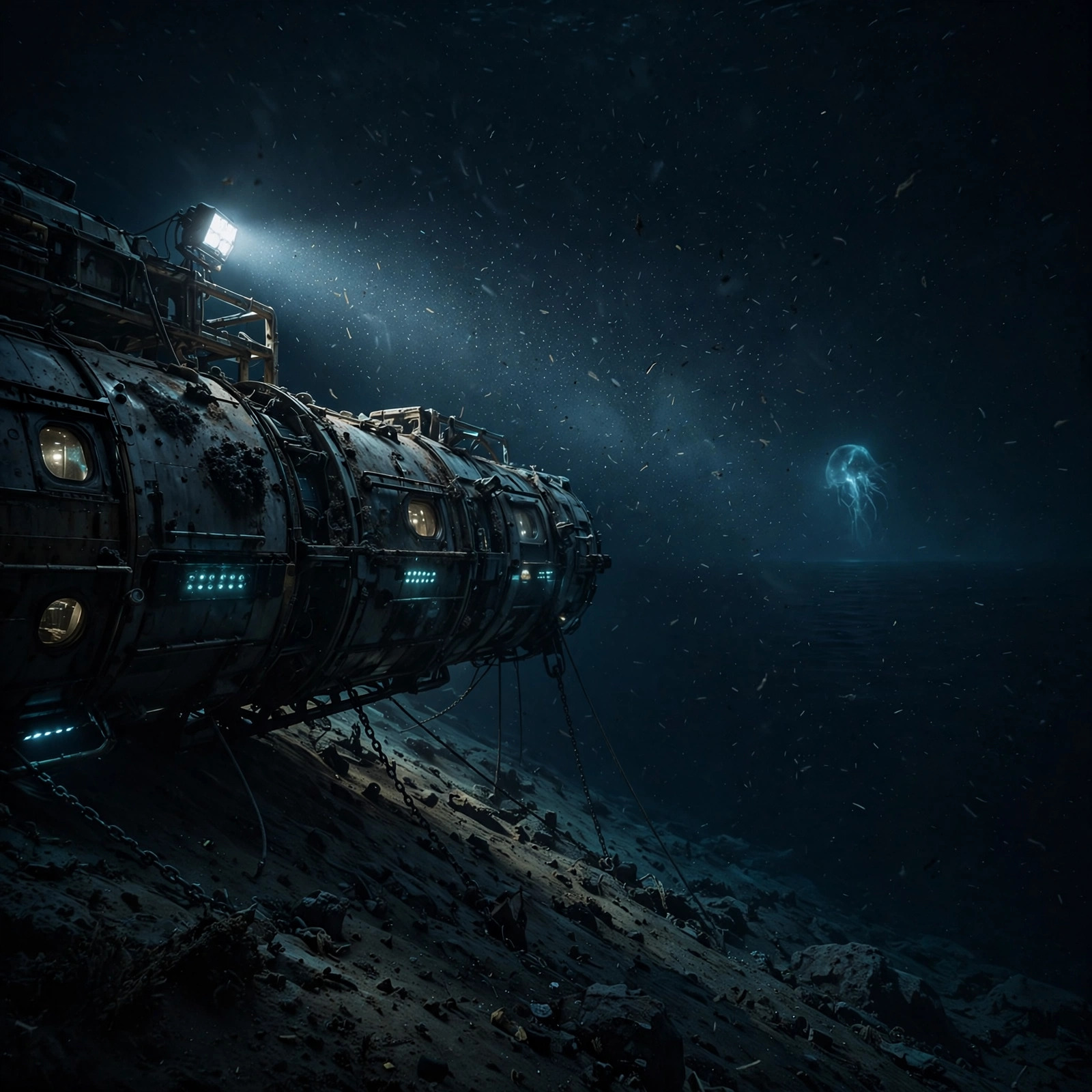
"It's a lattice, ma'am. The passive returns, the little bit of scatter we get off it. Not a hull, not a body. Some kind of open framework, maybe forty meters across, holding position like it's anchored to nothing."
"Forty meters," Yusuf said quietly. "Of lattice. Whispering."
"Forty meters of lattice whispering in a nine-and-four phrase that has not varied by more than a hair in two days," Amara said. She opened a new log entry and typed the header by hand, because some things deserved a human's typos in their provenance: First structured detection, Tangaroa array, contact bearing 078, 800 m, amplitude nominal. No symbols agreed. Lexicon count: zero. The zero sat on the screen looking larger than it was.
"Reyes will want the ping," Chu said. "The Commander's going to be up here inside an hour wanting to know why we haven't imaged it."
"Reyes can read my log. And when he proposes running the escort's acoustic charge rack at some absurd yield to force a response, Yusuf, you're going to help me explain why that's how you end a conversation before you know you're in one."
"I'll help," Yusuf said, though he said it to the window, not to her, and she marked the reservation for later use.
She spent the next hour building the reply by hand instead of trusting the console's automation. One tone. She measured the lattice's own carrier from the logs, matched the frequency to the third decimal, trimmed the envelope so its rise and fall lasted exactly as long as one syllable of the alien phrase, and dropped the amplitude until it was barely distinguishable from the station's own hum. She played it into the lab speaker once, twice, and Chu, without being asked, said, "It sounds like one note of theirs. Like the first note."
"That's the idea. If it has a first note, it has a first word. We answer with what we were given."
Yusuf watched her hands on the console. "And if it doesn't answer at all?"
"Then tomorrow we try a different smallest thing. There's no clock on this except the consumables count, and sixty days is a long time to be patient if patience is what works."
She looked at the two of them, then at the water beyond the viewport, which showed nothing, because at this depth it never did, and eight hundred meters out something was waiting to learn whether it was alone. She keyed the transmit.
The single tone left the hull, and the station went quiet around it, the ventilation and the pumps and even the three of them seeming to hush out of courtesy. On the screen the emitted pulse moved out and out and shrank to nothing, and then there was nothing to do but wait, because a reply from that distance, at that amplitude, would take its time coming home.
Forty-two minutes, by the array's math. Amara drank the cold coffee in one swallow and made a fresh cup, and Chu stood the watch with her without a word, and Yusuf fell asleep for ten of those minutes in the chair and woke up embarrassed, and the green line stayed flat and the minutes went by the way minutes do when they are all you have.
At minute forty-two, exactly, the line folded.
The lattice came back with one phrase. One tone, matched to theirs, in their register, their duration, and then, before Amara's heart had finished with its own small percussion, a second tone, one they had never sent, one that rose where theirs had fallen. A mirrored answer, and then an addition.
"It heard us," Chu said, barely aloud.
"It answered us," Amara said. She was already writing, hand first, log second, marking the exchange in her own handwriting while the pencil still worked. The lexicon count on the screen still read zero, and she let it. They had no shared symbols yet. What they had was something rarer, and more fragile, and she knew it: they had a reply, and it had come back soft.
She reached over and turned the speaker up one more careful notch, and the lattice said its new phrase again, patient, waiting, and this time it varied the ending, as if trying a second door.
Tuning Plates
By Day 10 the brass plates had taken over Amara's lab bench, ten of them in a graduated row, each no bigger than her palm, each stamped with a frequency in her own pencil. She had carried them aboard for a calibration job she'd finished in her first week and never touched since, and now they were the most important equipment on the station, which was either science or desperation depending on which of the two people in the lab you asked.
Hana Sorensen had come down from Pohnpei Harbor Surface Base on the supply run, two days before the escort vessel was due, and she had not stopped arguing since she ducked through the hatch.
"You're teaching it music," she said, for the third time that morning, watching Amara lay the plates face down on the bench deck and strike the smallest with a rubber mallet. "That's what this is. You've invented a piano lesson for something with no ears we can confirm."
"It confirmed them. It answered our tone in our register." Amara lifted the mallet again. "Ears are optional. Structure is not. Yusuf, ready."
Yusuf sat at the console with his hand flat on the transmit key, the way he'd sat for nine days, and the way he would probably sit for whatever came after. "Ready. And for the record, I'm with her. Not against you, Amara. With her about the risk, with you about the method. It's an uncomfortable place to stand."
"Then stand near the plates. I need a striker who can keep time."
Chu was in the listening chair with the hydrophone feed split across two screens, one for the raw line and one for the analysis window she'd built herself out of station software meant for hull-crack diagnostics. She had her boots off and her feet up on a stowage crate, which was her way of saying she'd been here all night. "It's live," she said. "Same holding pattern. The phrase it ended with on Day 1, it's been repeating it every forty-odd minutes like a heartbeat. It never varies the ending anymore. It just waits."
"Then it's bored," Hana said. "Or it's done being curious."
"Or it's polite," Amara said. "We're about to find out which."
The idea had come to her on Day 4, in the shower, where most of her ideas arrived uninvited. The lattice spoke in low-amplitude structured sound, and every attempt to answer it with station equipment had meant transmitting through a hull transducer rated for industrial signaling, a tool like a shout. The brass plates were different. Struck and held against the hull mounting stud, they gave off pure tones with clean harmonics, quiet, exact, and reproducible, and a reproducible sound was a symbol you could both agree on. A lexicon wasn't built from vocabulary. It was built from agreement, and agreement needed sounds that meant the same thing twice.
She struck the smallest plate, a 520 hertz fundamental, and Yusuf keyed the transmit for exactly one second. The tone left the hull. Then they struck the next, and the next, five tones in a rising ladder, each one second long, each separated by three seconds of silence, and the station held its hush around them the way it had on the first night.
Then they waited. Forty-two minutes, by the array's math, out to the structure and back.
"Eight hundred meters," Hana said, reading the same display Amara had read a hundred times. "It's been sitting at eight hundred meters for ten days, and nobody on the surface believes that number, which is why there's a warship parking overhead tomorrow with an acoustic charge rack bolted into its Hold Two. You know that, right? You know what Reyes is bringing."
"I know what he's bringing," Amara said. "I also know what he's proposing, and I've told him in writing that a 190 percent yield pulse aimed at a thing we can barely talk to is not a handshake, it's a detonation with a greeting card attached."
"He'd say it's a handshake at a volume it can't ignore."
"He'd say that, yes." Amara set the mallet down. "And he'd be wrong, and I intend to prove him wrong before he gets a vote."
Chu held up a hand. "Inbound."
The green line folded. The lattice came back with five tones, and Chu's analysis window lit with five clean peaks, and the room leaned toward the screen at the same moment, all four of them, like plants toward a window.
"It matched the ladder," Yusuf said. "Same five fundamentals. Same order."
"Same order," Chu confirmed, "and then it added a sixth. Six-twenty hertz. The next step in the series. It did the math."
Hana had gone quiet in a way that Amara had learned, over nine days of shared meals and shared arguments, meant she was recalibrating. "All right," Hana said slowly. "All right. That's not an echo. An echo doesn't extrapolate. Play me the sixth tone."
Amara struck the sixth plate, the one she'd tuned on Day 6 in anticipation of exactly this, and the sound it made was thin and bell-like and absurdly small against the size of what they were doing with it.
"Send it back," Hana said. "One second."
Yusuf sent it. They waited. The minutes went by the way they had gone by for nine days, and Amara made coffee and didn't drink it, and Hana paced the six steps of deck three's lab and back, and Chu didn't move at all.
The reply came at minute forty-two, and it was the sixth tone plus a seventh, and after that the work stopped being an argument and became a shift, all four of them on it in rotation, plates and mallet and key and screen, days blurring into nights. They built the ladder to eleven rungs. Then Amara did the thing she'd been saving: she struck two plates at once, a chord, a deliberate ambiguity, and the lattice answered with the same two tones and then a third tone that completed a triad none of them had predicted, and Hana said a word in Danish that Yusuf pretended not to hear and Amara wrote down as harmonic inference confirmed.
By Day 12 the count on the lexicon tablet read nineteen. Nineteen agreed symbols, each one a sound both sides had produced and both sides had answered to, verified by Chu's software and logged twice, once in Amara's handwriting and once in the machine. Nineteen was enough to say simple things. They had a symbol for yes, which was the ladder's first rung repeated. They had one for again. They had, after a bad hour on Day 11 that Amara still felt in her stomach, a symbol for stop, which the lattice had produced on its own when Chu's test sweep had gone out too loud, and which it had never once aimed at them since.
"It has a word for stop," Hana said, on the morning of Day 13, standing over the tablet. "It invented a word for stop on its own, the first time anything we did hurt or startled it, and then it kept using that word for us. Politely. Amara, do you understand what that means for Reyes's plan? The man wants to fire a pulse at a thing that has a word for stop."
"I understand," Amara said. "Write that down. Not in my words. In yours. He asked for a briefing and he'll get one, and I want the surface base's own linguist on record saying the target has demonstrated boundary signaling."
"I've been on record since Day 5. Nobody reads records. They read slides." Hana pulled the tablet toward her and started writing anyway, fast, because a record you didn't make didn't exist.
It was Chu who noticed the change, and she noticed it because her feet came down off the crate.
"Doctor Voss. The reply time."
Amara was at her side before the sentence finished. The analysis window showed the last exchange, and the interval between their transmission and the lattice's answer, which had held at forty-two minutes through every one of the exchanges for nine straight days, was now thirty-six.
"Six minutes shorter," Yusuf said. "That's not drift. That's not software."
"No," Amara said. She was smiling, and she could feel it and couldn't stop it. "It moved. It moved its listening nodes closer. It pulled its ears in toward us because we started saying things worth hearing faster." She turned to the room. "Twenty-three. We're at twenty-three symbols and it just shortened the conversation. That's interest. That is a learner leaning in."
Hana set the stylus down. "Or it's reconnaissance," she said, flat and immediate. "Same behavior, Amara. Something closes distance to a source for two reasons, and one of them is targeting. I'm not saying that's what this is. I'm saying you can't tell the difference from inside the signal, and neither can I, and Reyes definitely can't, and he's arriving overhead today with a rack full of decisiveness."
The words took the smile off Amara's face, and she let them. She looked at the plates, ten pieces of brass in a row, each one stamped in her pencil, twenty-three symbols between her species and another one, six minutes of newly closed distance that could mean curiosity or could mean a knife coming closer to know where to land.
"Then we get more symbols before he gets a briefing," she said. "Twenty-three today. If we can reach forty, we can ask it. That's the whole point of a lexicon, Hana. At some number of words you stop guessing."
Chu's headset crackled, and she held up one finger, listening, and the room stopped for her the way it had stopped for the lattice a hundred times. She looked up.
"Dr. Sorensen. Surface base relay. The escort vessel's on station overhead, directly above us now. Commander Reyes requests a briefing, both leads, at the earliest window." She paused. "He's asking for it before the next exchange completes."
Hana closed the tablet's cover. "Then the window he gets," she said, "is right after we finish this reply. Amara, pick your plate."
The Standoff
Reyes came down the access trunk on Day 14 with his helmet under one arm and his orders in the other, and the first thing he did in Amara's lab was not salute or shake hands but put a printed hardcopy of the message from Pohnpei Harbor Surface Base flat on her bench, next to the brass plates, as if it were also a piece of evidence.
"Read the last line," he said.
She read it. Establish intent of the structure by any available means within available consumables. The words were ordinary and the room went quiet around them anyway. Hana stood by the tablet with her arms folded. Chu was at the hatch with her headset on, relaying to Yusuf, who was holding the listening watch alone on deck two while every lead in the water was in this room.
"By any available means," Amara said.
"By any available means," Reyes agreed. He was not a large man, but he stood like one, weight back on his heels, the way people stand when they expect to be argued with. "I have a charge rack in Hold Two tuned to a hundred and ninety percent yield. One pulse. Full spectrum, structured like your plates but at amplitude. The structure answers everything we send. So we send something it can't mishear."
"Or something it can't survive hearing."
"Or that," he said, without flinching from it, and she gave him credit for that even as she hated it. "Doctor Voss, three hours before I came down, the structure tremored. A real one, not a signal event. Physical displacement. It dented the casing of one of my escort probes at eight hundred meters range. My crew stood there and watched a hull plate deform. Pohnpei Harbor wants to know if that was a shot across the bow, and I am required to tell them something other than 'the linguist is making progress.'"
"Then let me tell you what it actually was." Amara pulled the lexicon tablet across the bench and woke it, and her hands were steadier than she expected them to be. "The tremor came eleven minutes after our last exchange. Watch the waveform. It's not noise. It has structure. It has the same nested periodicity as symbol forty-one through forty-six, which we settled on Day 11. It's scaled up, Commander, not different in kind. It's the same grammar at higher amplitude. It said something loud because it thought we hadn't heard it."
Reyes looked at the screen for a long moment. He was not a man who pretended not to understand, which made him harder, not easier.
"Scaled up," he said. "That's your reading. Mine is that a probe at eight hundred meters took a dent, and the thing that dented it is the thing you're calling a learner. Doctor Sorensen. You've been quiet."
"Because I've been counting," Hana said. "Amara, tell him the symbol count."
"Twenty-three agreed. Out of what we hope is two hundred."
"Twenty-three," Hana repeated, to Reyes. "That's what a lexicon looks like when it's working, and it's also what one looks like when it's a coincidence engine. I'm not against her. I want that on the record in this room. I'm against certainty, and she's certain, and you're certain in the other direction, and the structure is the only party here not certain about anything."
"Then we remove the ambiguity," Reyes said. "One hundred ninety percent. A structured pulse at that amplitude is unambiguous in exactly one way. If it's a greeter, it greets back and we learn more in one exchange than in a month of tuning forks. If it's something else, we know that too, and we know it while we still have fifty-one days of air to do something about it."
"And if a greeting at that volume is, to them, a scream in the face," Amara said, "you've answered the question by killing the conversation. Commander, listen to the sequence. When we sent the paired tones on Day 9, it echoed them back inverted. Inversion is a correction. Something corrected us. You don't correct a target, you correct a student. And the latency dropped from forty-two minutes to thirty-six. It moved its listening nodes closer to hear us better. That's not a knife. That's someone leaning across a table."
"Or closing range," Hana said, quietly.
"Or closing range," Amara conceded, because conceding it was the only honest move and she needed every scrap of honesty in this room. "Both readings fit. I know that. But only one of them is testable without a detonation, and it's mine."
The argument might have gone on for an hour, and part of it did, circling through amplitude thresholds and response envelopes and what Pohnpei Harbor would accept as intent established. It was Chu, again, who stopped it, and she stopped it by not saying anything. The whole lab felt it first through the floor. A shudder, low and rolling, like a train passing under a house. The coffee cup at Amara's elbow walked itself to the edge of the bench and she caught it without looking, because she was already reading the hydrophone feed, and the feed had gone white.
"Surge," Chu said. "Array's clipping. No, array's, Doctor Voss, the housing."
The readout told it plainly enough. The lattice had put out a pulse of its own, unsolicited, and the external array housing on the hull had taken the pressure wave and cracked along a weld seam. Water was getting in behind the elements. Every minute it stayed open, their only ears filled with the sea's own noise.
"I can seal it," Chu said. She was already pulling the exterior kit from the locker by the hatch. "Forty minutes, two of us, the clamp collar and the resin."
"Take me," Hana said.
"Take me," Amara said at the same time, and Chu looked at them both and then at the suit rack and made the call the way she made every call, fast and without ceremony.
"Sorensen. Voss stays on the plates, because if the structure pulses again while we're outside, I want the person who can read it at a keyboard, not in a suit. Commander, you're on the tether."
Reyes went. That surprised Amara, and then didn't. Whatever he was, he was not a man who sent others where he wouldn't go.
They were outside for fifty-one minutes, and Amara spent them doing the only useful thing available to her: she kept the exchange going. When the surge's echo faded, she sent the greeting sequence, the whole known lexicon, twenty-three symbols strung together in the order the lattice itself had first used them. And the lattice answered. It answered while Chu's lamps were visible through the viewport, moving along the hull. It answered while the resin cured. It answered eleven times, and each answer carried new structure, and Amara worked with her heart going like a hammer, transcribing, matching, testing, and the count on the tablet climbed: thirty, forty, fifty, and the symbols were not random, they were systematic, they were a lesson, they were a teacher repeating itself louder and slower for a student it plainly thought was slow.
When the seal team came back through the airlock, Chu was favoring her left arm. The clamp collar had shifted on the second pulse, a smaller one, mid-seal, and the housing had kicked against her before Reyes got the tether hauled in. The bruise ran from her elbow to her shoulder, purple already, blooming under the suit liner in the airlock light. Hana made her sit and cut the sleeve away and did not let her stand again.
"It's sealed," Chu said. "Holding at ninety-four percent sensitivity. We lost the low band on three elements." She said it the way she said everything, and only the set of her jaw said the rest.
Amara looked at the medical readout, then at the work order Hana was already filing on the tablet, then at the consumables ledger, and did the arithmetic she had been refusing to do all day. The seal, the element rebuild, the suit rotation, the medical hold on one of four technical crew. Hana watched her arrive at it and nodded once.
"Four days," Hana said. "Call it what it is. Fifty-one down to forty-seven."
"Then the margin is thinner," Reyes said, "and the argument is shorter." He pulled a chair around and sat down at the bench across from Amara, which he had not done before, and which she understood to be its own kind of message, one she could actually read. "Pohnpei Harbor wants intent established. I have a charge at a hundred and ninety percent and forty-seven days of air. Convince me why I shouldn't arm it now."
Amara turned the tablet around and pushed it across the bench to him, the way he had pushed his orders across to her.
"Eighty-four," she said. "While you were outside holding the tether, the lexicon went from twenty-three symbols to eighty-four. It taught us sixty-one words in under an hour, Commander, and it did it in response to a greeting, after it cracked our ears with a shout we misread as a tremor. It's not answering a threat. It's escalating a conversation. The dent on your probe was the first word we couldn't hear. This," she tapped the screen, and the waveforms nested and repeated and resolved, "is the same word, said slowly."
Reyes read. He read for a long time, long enough that Chu's breathing beside the medkit was the loudest thing in the room. When he looked up, his face had not softened, but it had settled, the way a man's face settles when he has stopped arguing with a fact.
"It's elegant work," he said. "It is not proof. Eighty-four symbols of pattern is still a pattern I can read two ways, and I have a dented probe that says the loud thing was physical."
"Then give me the next exchange window," Amara said. "One. Before you arm anything. Latency is thirty-six minutes, so one full exchange is a little over an hour of your forty-seven days. With eighty-four symbols I can ask it a question with structure, not just echo one. I can ask it what the tremor was, in its own grammar, and get an answer we can verify against the probe damage. If it answers wrong, or answers like something that's probing us, arm the charge and I'll hold the door for you."
He looked at her, then at Chu's arm, then at the plates, ten pieces of brass in their row, penciled now past the edges with more symbols than the metal had room for.
"One exchange window," he said. "It completes, or I go up to Hold Two and start the arming sequence. And Doctor Voss, if the answer takes a form you don't like, you say so out loud, in this room, before I have to find it in the waveform myself. Agreed?"
"Agreed."
He stood and put his helmet back under his arm. "Then pick your question carefully," he said, "because it's the first one your species has ever asked out loud." He nodded once to Hana, once, oddly gently, to Chu, and went up the trunk toward the escort vessel, and Amara was already reaching for the plates before his boots faded off the last rung.
One Narrow Hour
Day nineteen, and the question was finally written. Amara had spent two of her forty-seven days building it, and now the brass plates lay in their row on the lab bench with the new symbol clusters penciled along every edge, the lexicon tablet propped against the rack where she could touch it without looking down. The question was small. Structurally, it was the most complicated thing she had ever assembled: a paired phrase, symbol eighty-one beside the tremor-shape they had recorded on the probe's damaged hull, wrapped in the interrogative marker the lattice had taught them on day nine.
"What was the loud thing," she said aloud, testing the translation against Hana's spread. "Said in its own grammar. Not ours."
"You've checked the pairing four times," Hana said. She was at the far end of the bench with her hands flat on the table, which was what she did when she wanted to pace and wouldn't let herself. "If you check it a fifth, the hour we bought is the hour we burn."
Reyes came down the trunk at 0900 with Yusuf behind him, and neither of them had slept by the look of it. Yusuf carried the compressor log under one arm like a man carrying evidence he wasn't sure he wanted to submit. He set it down next to the tablet without a word.
"The escort's drive is cold," Reyes said. "Hold Two is shut except for the arming trunk. Every pump on this deck that can be spared is spared. You have your quiet hour, Doctor. Quarter power on the transmitter, narrowband, nothing else in the water. And I will be in this room when the answer comes back, because thirty-six minutes each way means I have time to second-guess you and then second-guess the second-guess."
"Then stand where you can see the plates," Amara said. "Because you're going to watch me ask it, and you're going to watch what comes back, and you're going to make your call with the rest of us."
He pulled a stool to the bench. He didn't argue, which from him was a kind of consent, and Yusuf took the compressor station at the bulkhead with his headphones half on, one ear free.
They opened the window at 0940. Amara keyed the sequence by hand, one plate at a time, because the auto-driver had a fan and the fan had a voice and the channel was that narrow. Quarter power. The hydrophone array on the hull drank the signal in and put it into the water, and eight hundred meters down, the lattice took it.
Then they waited. Thirty-six minutes is not long enough to do anything and too long to do nothing. Hana recalibrated the receiver twice. Yusuf watched his pressure trace. Reyes read the lexicon tablet from symbol one to symbol eighty-four without speaking, twice through, and the second time Amara watched his finger move and saw him stop at the tremor-shape both passes.
At 1016 the answer began to come back.
It was wrong.
Amara knew it in the first three seconds, before the pattern had even resolved, because the lattice's voice had a texture to it, a grain like wet sand, and what was coming up the channel was grainy and wrong, blurred at every edge, with a low mechanical rasp riding underneath the signal like silt in a water glass. Hana's head came up. Yusuf tore his headphones off.
"Compressor," he said. "Line three. It's bleeding into the channel, that's the return loop cooling the transmitter rack, it shouldn't even be running, I shut it, I shut it this morning, you saw me shut it."
"It's running," Hana said, flat.
The waveform on the main display smeared and folded. The lattice was still transmitting, but its structure was drowning, the paired shapes dissolving into the rasp, and then, eleven seconds into the return, it stopped. Not faded. Stopped, mid-symbol, and the channel went to the flat gray hiss of open water, and Amara felt the silence come up off the screen and into the room like cold coming through a hull seam.
"It went quiet," she said. "It's never gone quiet."
"It heard its own answer come back mangled," Hana said, "and it stopped to listen. Or it stopped because we shouted noise at it. Pick your reading, Commander, they're both bad."
Reyes was already standing. "That's the window. That's the hour. If it won't complete, the terms were, I go up to Hold Two and I start arming."
"The hour isn't spent." Amara put her hand flat on the tablet, on the interrogative marker, and heard her own voice go thin. "We have forty-one minutes of window left and it stopped answering because we broke the channel, not because it broke the conversation. Give me the channel back and it comes back. I am staking everything I have on that. My authority, the window, the whole exchange. But I need the line quiet, and I need it now."
"Yusuf," Reyes said, not loudly.
Yusuf was already at the panel. "Line three's isolation valve is fouled. It won't close from here. It'll close at the manifold, the manual one, deck four, but the manual's behind the return shroud and the shroud's hot because the compressor's been running against a shut head all morning, and I don't have time to depressurize the loop first. The hour doesn't have thirty minutes for procedure."
"Then you don't put your hands in a hot shroud," Reyes said.
"Then the rasp keeps riding the channel and she loses her exchange. Sir." Yusuf pulled the shroud pins and looked at no one while he said it.
Amara watched the clock. 1024. 1025.
"Vent the loop into the ballast drain instead," Hana said. "It's the cold side. It's a thirty-second job at the manifold, only you have to crack the bleed by hand, the servo's on the same fouled line."
Yusuf went down the trunk and they heard his boots on deck four through the hull, and Amara did not watch the channel because she could not watch it be empty, so she watched the clock instead, and Reyes watched the channel, and Hana stood exactly between them. At 1027 the rasp in the waveform thinned. At 1028 it broke apart entirely, and the channel was clean, clean as it had been at 0940, and from somewhere below them Yusuf's voice came up the trunk, tight with pain and entirely too calm.
"Loop's vented. Bleed's open. Somebody bring the medkit and don't anybody touch that panel, the shroud took the skin off my palm and I'd rather it didn't take the rest of me."
Hana went down. Reyes looked at Amara across the bench, and for a moment neither of them said anything, and the hiss of the open channel filled the room.
"Now what," he said.
"Now we say it again. The same question, exactly. Quarter power, narrowband, and this time the water is clean. If it heard anything of the first attempt, it heard a question. We ask it again and it knows we're still asking."
"And if it stays silent?"
"Then you arm the charge and I hold the door. Same terms. But it isn't going to stay silent, Commander. It stopped to listen. Things that stop to listen are things that intend to answer."
He nodded once, and she keyed the plates again, by hand, one at a time, 1031 on the clock, and the array put the question into the water at a quarter of what the equipment could do, and the channel hissed, and they waited.
Thirty-six minutes. Yusuf came back up with his right hand wrapped to the wrist, sat down at the bench, and put his headphones back on with his left. "Don't," he said, when Reyes looked at the bandage. "It's a burn, it's a palm, and the hour's still running."
At 1107, nine minutes early, the lattice came back.
The voice had its grain again, wet sand, water over structure, and it came back slow, deliberate, the way a speaker repeats something when the listener has once asked "say that again." It answered the question first. The tremor-shape returned wrapped in a marker they had only half-understood until that moment, a marker of self-report: not "the loud thing," but "this one, this voice, when it was loud." The shout that had dented the probe had been the lattice's own first attempt at contact, made before either species knew what the other's ears could bear. It was an apology, or the nearest thing its grammar had to one, and Yusuf wrote the gloss on the tablet in clumsy capitals with his left hand while Hana read the waveform aloud.
And then, after the apology, it sent something new.
"Symbol ninety-five," Hana said quietly. "That's new. Ninety-five, and it's a pair."
Amara leaned in. Two shapes, mirrored, each one a smaller edition of the other, bound by the interrogative marker from her own question. The lattice had taken the pairing structure out of her question and built something with it, and it built it in real time, in a single return, and the shape of the thing was unmistakable to anyone who had spent nineteen days learning this voice. Two utterers. Two speakers. The mirrored pair was not a description of the compressor and the lattice, and it was not a complaint. It was a proposal. It meant: this. This arrangement. Two voices, saying things to each other, at volumes each one can bear.
"It's naming the conversation," Amara said. "It's naming us. Both of us, together, as one symbol."
She turned the tablet so Reyes could see it, and she watched him read it the way she had watched him read the eighty-four, and when he looked up his face had gone through settling into something past it, something that took him a moment to find words for.
"That's the answer to your question," he said. "Not what the tremor was. What this is." He stood, and his stool scraped back, and he looked at the clock, and at Yusuf's hand, and at the plates, and last at Amara. "You had it right and I nearly didn't give you the hour for it. I'm going up to Hold Two. Not to arm it." He lifted his helmet from the deck. "To seal the rack. Coded lock, my hand and Doctor Sorensen's, and then I'm calling Pohnpei on the surface link to tell them the pulse is suspended pending the completion of a conversation I can now show them the first word of."
"They'll ask you to justify suspending a two-hundred-day contingency," Yusuf said.
"They'll ask me for forty seconds of justification and I'll give them ninety-five symbols of it. Ninety-five of two hundred," Reyes said, "which by my math means you have a hundred and five more words to earn, Doctor Voss, and forty-five days to earn them in. I suggest you start immediately."
He went up the trunk. Two minutes later his voice came down over the room speakers, thin with distance, reading a designation code into the arming trunk, and the seal clanged shut somewhere above them, a sound like a bell struck once underwater.
"Pohnpei, this is Tangaroa. Commander Reyes. The acoustic charge is sealed and the pulse is suspended. I repeat, suspended." A pause, long enough that Amara could hear the surface wind in the link. "Yes. I'll stand by to transmit the waveform. It's ninety-five symbols and it says two voices. You'll want to hear it."
Hana reached across the bench and pulled the lexicon tablet back to the center, and turned to a fresh column, and at its head, in her narrow hand, wrote ninety-five, and beside it the mirrored pair, and under that: two-voices. Yusuf, holding his bandaged palm against his chest, watched her do it, and then reached out with his left hand and steadied the tablet so it wouldn't drift on the bench while she wrote.
"Sixty-one words in an hour, the first time," he said. "A hundred and five to go. At quarter power, in clean water, with two voices." He smiled around the pain in his hand. "We should tell it about the compressor. It probably thinks we growl when we're nervous."
Amara was already penciling the next question along the edge of the nearest plate, symbol ninety-five first, the pair, then the interrogative, asking the lattice what the two voices should say to each other next. The hydrophone array hummed against the hull above them, patient, listening, and eight hundred meters down in the dark the lattice was listening too, and this time, when the signal went out, it went out clean.
Two Voices
Day twenty-one began with the lattice moving. Lena Chu reported it first, from the hydrophone shack on deck two, her voice flat over the intercom in a way that told Amara more than any alarm would have. "Ma'am. The structure's range line is walking. Six hundred meters and closing, at about four meters an hour. It's not drifting. It's tracking a bearing."
Amara ran the length of deck three with the lexicon tablet under her arm and found Hana already in the shack, headphones around her neck, watching the ranging trace crawl across the plotter. Reyes came in behind them, still in his surface-link jacket, and stood at the bulkhead with his arms folded. He had spent the night, Amara knew, on the open channel to Pohnpei Harbor Surface Base, explaining a suspended pulse to men who had rehearsed firing it for two hundred days. He looked like a man who had won an argument and was waiting to find out what he had won.
"It's coming to meet us," Hana said.
"Or to finish the sentence," Amara said.
The lattice had answered the overnight question at 0340, while the station slept in shifts. What it had sent back was not a reply in the ninety-five symbols. It was a reply in their own two voices, hers and Hana's, taken from the training exchange and re-woven, and under it, one new figure she had not heard before: a bearing, and a closing speed.
"It's telling us it's coming," Lena said. "That's what you tell someone when you want them to leave the door unlocked."
"Or when you want to see if they slam it," Reyes said.
By noon the structure had passed five hundred meters, and Amara understood what the closing meant in numbers she could feel in her teeth. The signal ran both ways along the same path. At eight hundred meters, a question and its answer had taken thirty-six minutes to cross the dark and come back. At three hundred, the round trip would fall to seventeen. She said it out loud, and Hana wrote it on the plotter margin without looking up. Seventeen minutes. A conversation, instead of a correspondence.
"Then we have a decision to make before it arrives," Reyes said. He said it quietly, and Amara noticed that he had positioned himself, without seeming to, between the shack's console and the trunk that led up toward the escort vessel's docking collar. "Pohnpei wants the pulse option preserved. They've accepted the suspension, they have not accepted the cancellation. If it closes to three hundred meters and turns out to be a mouth instead of an ear, we will not get a second chance to be loud."
"If we're loud first, we won't get a second chance to be anything," Hana said. "That's not a figure of speech. A hundred and ninety percent yield at three hundred meters would put a compressive front through the lattice like a hammer through a window. And through every hydrophone we own, and half the pressure hull."
"I know what my own charge does, Doctor."
"Then you know the rack is sealed," Amara said. "You sealed it."
"I sealed it," Reyes agreed. "And I still have the code in my head, and Pohnpei has a man on the surface link twice a day asking me whether I still do." He let that sit. "I'm not asking you to arm it. I'm telling you what the room looks like from where I stand."
Lena had been checking a weld lead, coiled over her shoulder, and now she set it down on the console. "Ma'am. If I can say the thing nobody's saying."
"Say it," Amara said.
"The problem isn't the charge. It's that anything with a louder voice than ours can take the channel whenever it wants. Surface fleet, next survey vessel, some private outfit with a towed array and a bad idea. First loud signal in that register owns the conversation." She shrugged, apologetic. "I grew up on boats. Whoever's loudest gets believed."
The room went quiet in the specific way rooms do when someone has said the true thing. Amara looked at the plotter, at the range line walking down through four hundred and eighty, and then she looked at the coil of weld lead on Lena's shoulder, and the whole shape of it arrived in her head at once, the way the lattice's answers arrived, whole.
"No," she said. "No, they don't. Not if the channel is already occupied. Not if the voice in that register is fixed, permanent, and ours."
Hana turned. "Amara."
"The brass plates. On the bench, deck three. Twelve of them, tuned to the paired tones." She was already moving as she said it, and Lena fell in beside her with the weld lead, catching the idea the way good petty officers catch things, half a stride ahead of the explanation. "Welded to the outer hull. Free-flooded, open to the water. The plates don't need power. The lattice reads structure-borne vibration, it's read our hull since the first day, that's why the compressor confused it. A fixed pair of plates in the lattice's own register, broadcasting the station's standing tone, every minute, forever. The paired voice. Not a message. The channel itself. Occupied. Nobody can claim it louder, because it isn't a transmission anymore, it's a fact of the seafloor."
"That's irreversible," Reyes said.
"Yes."
"Pohnpei will call it a provocation or a monument, and they will not be able to unbuild either one."
"Yes."
He stood there a moment, one hand resting flat on the sealed rack's remote trunk housing, the way a man rests a hand on a door he has decided not to open. Amara watched him do the arithmetic she had already done: a welded voice could not be recalled, but it also could not be outshouted, and a thing that could not be outshouted could not be seized. She watched him arrive at the same place she had arrived.
"Chu," he said. "How long to weld twelve plates to a flooded exterior?"
"With the exterior sled and a second pair of hands, four hours. Maybe five if the current's ugly."
"Doctor Sorensen's hands are going with you. I'll keep the surface link busy." He looked at Amara, and for the first time in twenty-two days he looked, to her, like a man and not like a rank. "You get one voice, Doctor Voss. Make sure it says what you mean, because you will be saying it for the rest of this station's life."
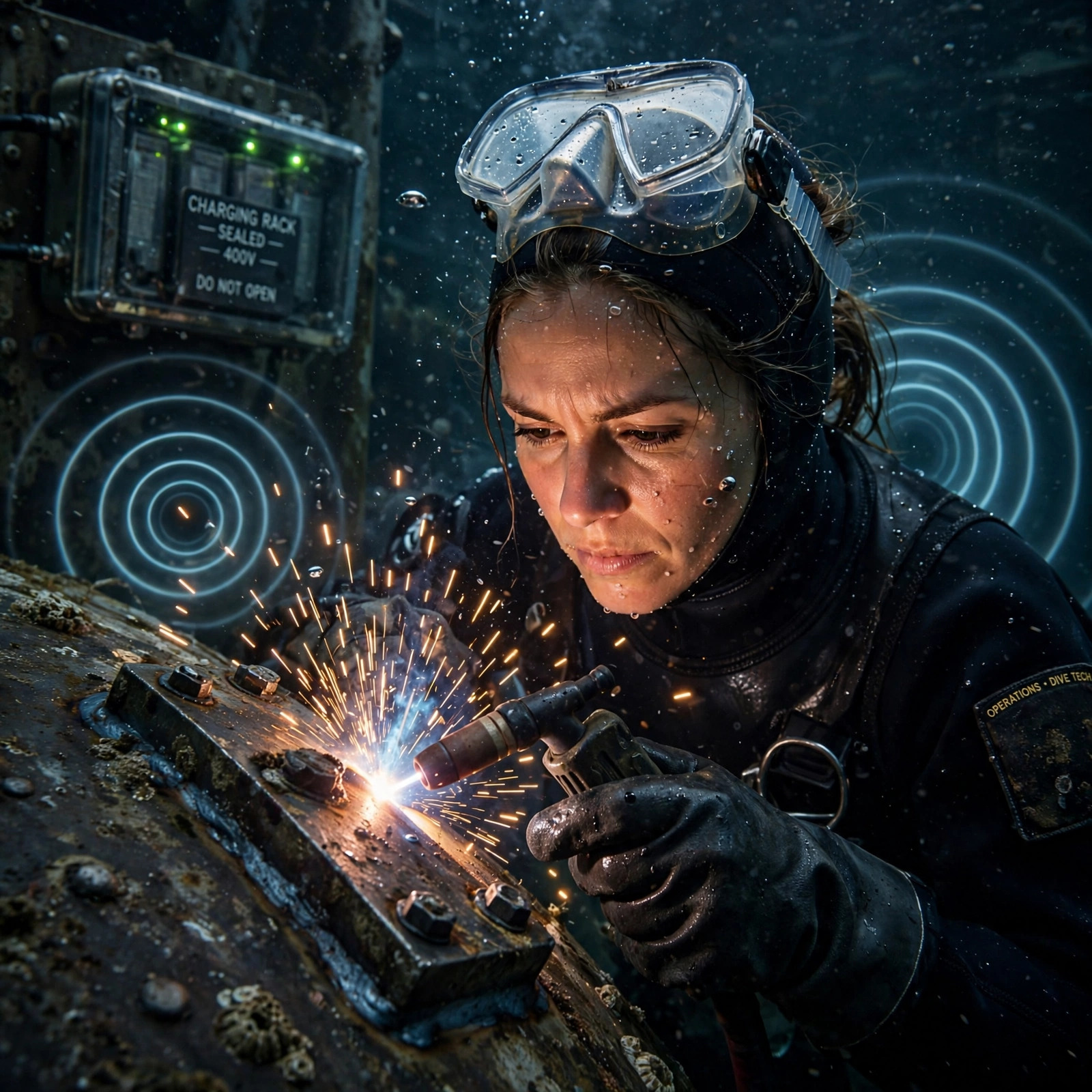
They went out through the sled bay on Day twenty-two at first light, while the range line walked through three hundred and forty. Amara rode the sled's frame with the twelve brass plates strapped in a rack beside her, each one stamped with its tone pair, and Lena worked the welder in short, clean bursts while Hana held the sled steady against the current and read the tones off the tablet. The plates went onto the hull below the hydrophone array, in a line, paired, each weld a bright coin of light in the dark. Amara chose the pattern herself and penciled it onto the plate backs before Lena ever struck an arc: ninety-five first, then the mirrored pair, then the new word the lattice had taught them overnight, one hundred and one. Two voices, woven.
The lattice reached three hundred meters as Lena struck the last weld. Amara heard it arrive not as sound but as pressure, a slow fold in the water, and the hydrophone feed over the sled's suit link changed character entirely. Seventeen minutes, the ranging plot now said. Seventeen minutes, round trip.
Amara reached out and pressed her palm flat against the hull, against the line of welded brass still warm from the arc, and the paired tone rolled out through her glove and into the water, fixed, permanent, the station's own voice in the lattice's register. Lena killed the welder. Hana's hand found the sled rail. Reyes, watching from the bay trunk with one hand flat on the sealed rack housing, said nothing at all.
They waited in the dark with their lights doused, seventeen minutes, while the current combed the sled lines and the brass sang its two notes into the black. Amara kept her palm on the hull the whole time, counting nothing, hearing everything.
The answer came back at seventeen minutes exactly. Not a question. Not a figure. A phrase, and the phrase was built out of the paired tones, hers and Hana's, taken and rewoven, and it came through the hull into her palm before it reached the hydrophones, and what it said, in one hundred and seventeen symbols the tablet would confirm an hour later, was the same two voices, no longer two. Woven into one.
Lena's welder hung dark at her hip. Nobody reached for anything louder.
Get notified when new stories drop

Sasha Quill
Sasha writes bold exploration and cosmic wonder with lyrical scale and grounded character work.
Leave a comment
Comments