




Ordinary Ice
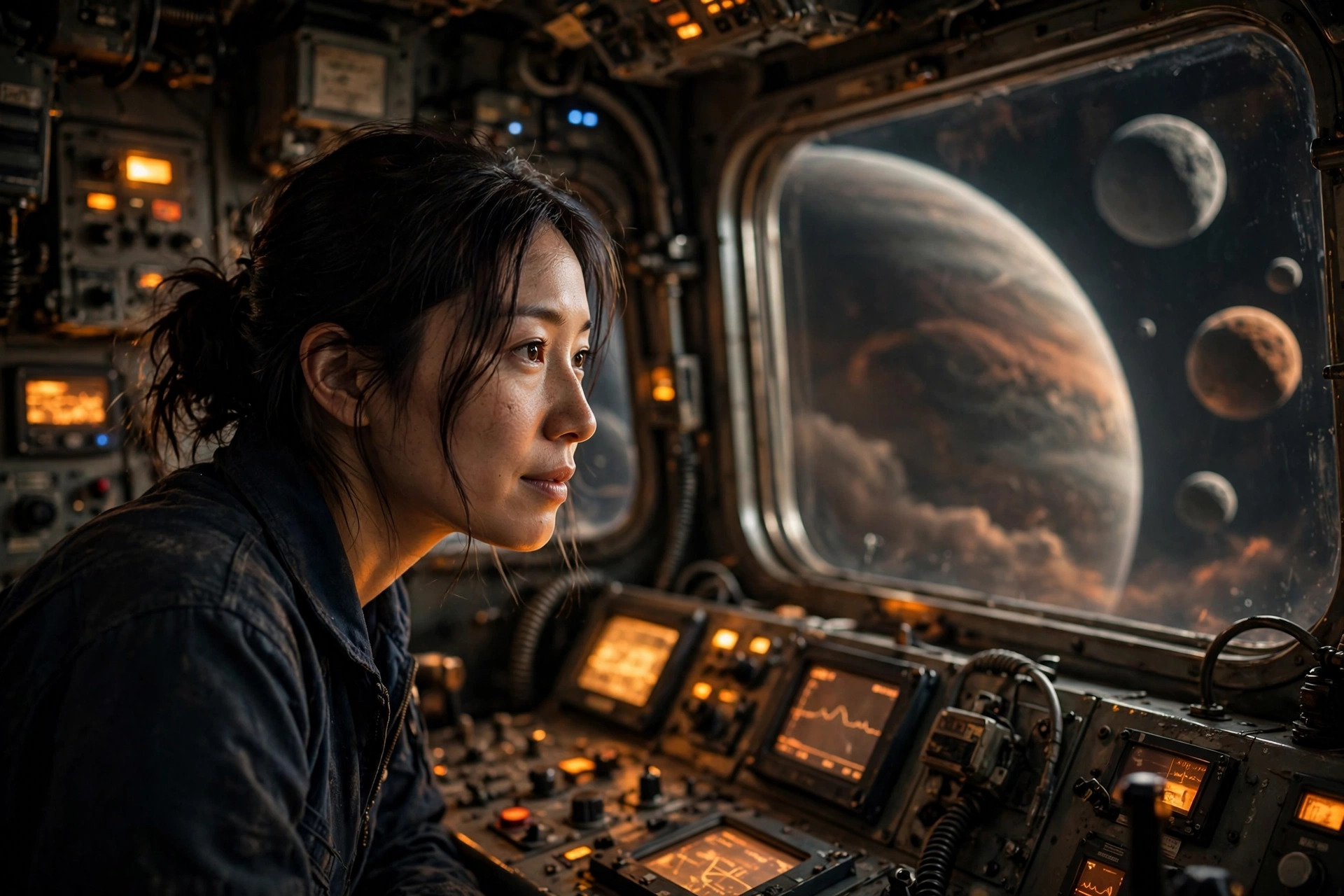
The calibration tone came through the bridge speakers as a low, patient hum, and Dagny Reyes let it run while she counted the drift on her display. Day 141 of the survey. The number sat in the corner of her console like a debt she preferred not to look at directly.
The mass spectrometer lived on the ventral pallet, four decks down and outside the hull skin, a silver drum the size of a shipping crate that she had babied across four systems. Every twenty days it demanded its ritual: burn a reference standard, sweep the intake, compare. She had done it seven times before on this run. The eighth was supposed to be unremarkable.
"Reference peak's clean," she said, mostly to herself, but Ondine Kaczmarek was on the sensor bench two meters to her left and answered anyway.
"Of course it's clean. You built the intake yourself."
"I rebuilt it. There's a difference."
"Mm. Rebuilt it twice, then."
Dagny grinned and keyed the sweep. The spectrometer drew a thread of vacuum through its chamber and told her, in the language of mass-to-charge ratios, exactly what was in it. Hydrogen, a whisper of helium, the usual metal outgassing from the chamber walls. Ordinary. She logged it and moved to the passive readings, the ones the instrument collected continuously while Kestrel crawled along its catalogued pass over Heidrun's outer moons.
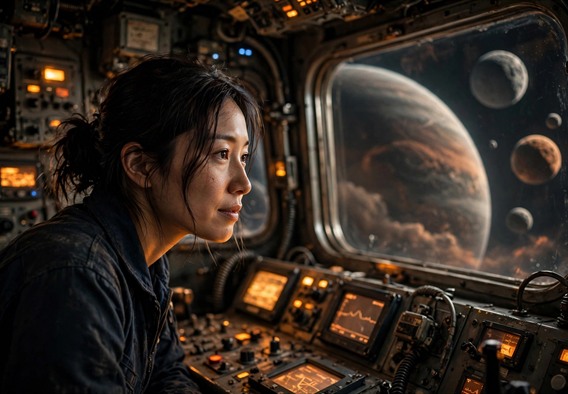
Outside the viewport, if she leaned far enough to her right, she could see the moon shell: a scattered necklace of gray and rust-colored bodies, none of them larger than a mountain range back home, all of them catalogued, numbered, and in most cases dismissed. Heidrun was a middling gas giant in a middling system, and the survey existed to close the file on it. Nobody had expected the moons to be interesting. That was, in a way, why the mission had been funded at all; certainty was cheaper than surprise.
Ondine had her own console angled toward the long-range plume survey, which was her particular obsession and, Dagny privately thought, a slightly morbid one. Ondine hunted for cryovolcanism the way other people hunted for shipwrecks. She kept a running tally on her slate of every body in the catalog that had ever coughed ice into space, and she read the passive plume data the way a doctor reads an EKG, with an attention that bordered on superstition.
The console chimed. Not an alarm. A flag.
"Huh," Ondine said.
Dagny kept her eyes on her own sweep. "Huh good or huh bad?"
"Huh nothing, probably. Stray reading. Plume signature off J-9."
"J-9's inert."
"I know it's inert. That's the huh." Ondine pulled the reading apart on her screen, and Dagny heard her chair creak as she leaned in. "It's a small plume. Nine hundred meters, maybe, above the fracture line on the trailing side. Very cold, very thin. The water-to-methane ratio is..." A pause. "Three percent over anything in the catalogued data."
"Instrument noise."
"Probably instrument noise."
"It's a moonlet the size of a gravel quarry, Ondine. There's no heat source, no tidal flex worth naming. Nothing to drive a plume."
"I know what's in the catalog," Ondine said, without offense. She never took offense at this kind of thing, which was one of the reasons Dagny could argue with her for years. "I'm telling you what the raw pass shows. Want to look?"
Dagny did want to look. That was the problem with her, and she knew it. She pulled her console out of calibration mode, left the reference standard simmering in its chamber, and mirrored Ondine's channel.
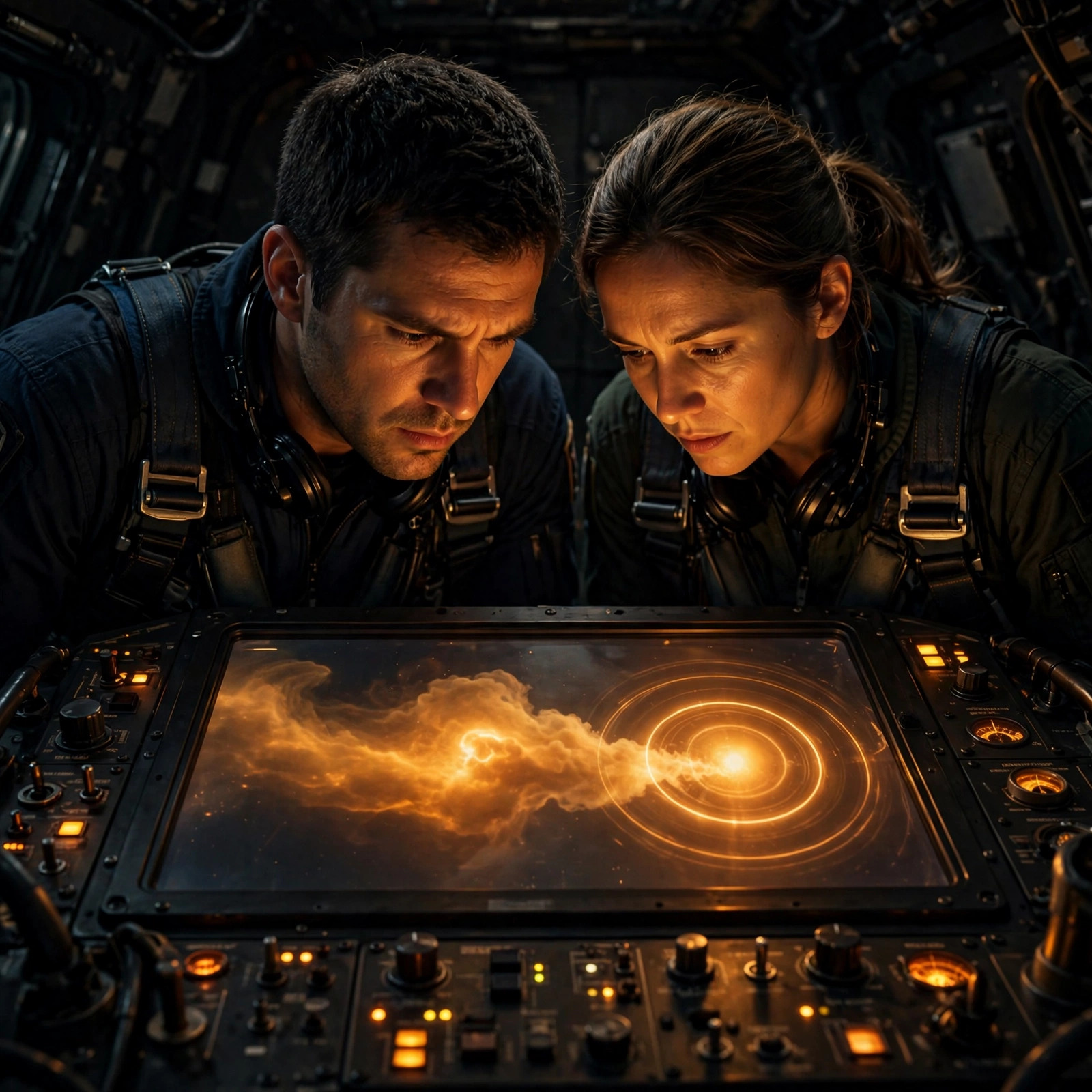
The plume was there in the passive data, faint but coherent, a thread of vapor standing off the moonlet's fracture line like breath over a crack in winter pavement. Nine hundred meters was nothing, as plumes went; Heidrun's inner moons threw geysers ten kilometers tall on their best days. But J-9 was supposed to be dead. A body that small, that far out, that cold, had no business exhaling anything at all.
And the ratio was wrong. Water and methane, in a proportion three percent richer in water than anything the catalog had ever recorded out here. Three percent didn't sound like much. Dagny had spent enough years staring at spectrometer output to know it could sound like everything.
"Run it again," she said.
"I ran it twice already."
"Run it against the instrument noise floor. Properly. Not just the flag threshold. I want the full error analysis, channel by channel."
Ondine's hands moved. The bridge was quiet enough that Dagny could hear the tape hiss of the raw feed, and somewhere below them the ventilation cycling through its hour. On the far side of the compartment, Ilya Voronin sat with his flight plans spread across the command console, and she could feel him listening without turning around. He had the stillness of a man who had learned to eavesdrop professionally.
The noise analysis took four minutes. Dagny watched the confidence bands tighten around the plume signature like a hand closing around a coin.
"It holds," Ondine said. "Three percent excess, plus or minus point four. That's not noise. That's not noise twice over."
"Run it a third time."
"Dagny."
"Humor me. Third pass, different integration window. If it's real it survives the window change. If it's a sampling artifact it doesn't."
Ondine ran it a third time. The integration window slid, the bands recalculated, and the excess stayed exactly where it was, sitting in the data with the smugness of a fact. Three percent. Water over methane, in a proportion that no catalogued body in the Heidrun system had ever produced.
Dagny sat back. She was aware of a small, bright feeling in her chest that she recognized and did not entirely trust. It was the feeling that had gotten her onto this ship in the first place, and it had a history of costing her sleep.
"All right," she said. "That's a real reading."
"It's a real reading off a dead moonlet," Ondine said. "Which makes it either the most interesting thing we've seen in this system or the most expensive calibration error of my career."
"It's not an error. Not after three passes."
"No," Ondine agreed. "Not after three."
Ilya's chair turned. He didn't say anything at first; he just looked at the shared screen with his arms folded, and Dagny watched him do the arithmetic she was trying not to do herself.
"Distance to source?" he asked.
"Four megameters," Ondine said. "Call it four million meters, give or take our own position error."
"Transit time?"
"At safe thrust, round trip, nine days. Assuming we don't loiter." Ondine said it carefully, like someone laying a card on a table she knew was going to be an argument.
Ilya unfolded his arms and pulled up the flight plan chit from the console in front of him, the physical one, printed on card stock because he didn't trust a plan that couldn't survive a power failure. Dagny watched his thumb move down the margin where he kept his figures.
"We are at day 141," he said. "The survey window is two hundred days, and the return burn is not a suggestion. It's a wall. Fifty-nine days remain, and twelve of those days are margin I do not surrender. Not for water, not for methane, not for you two."
"Nobody's asking you to surrender the margin," Dagny said.
"No. Not yet." He set the chit down flat, pinning it under two fingers. "But you've both gone quiet in a particular way, and I've been on ships long enough to know what that quiet costs. So let me say the numbers out loud, and then we can all pretend we weren't thinking them. Nine days of transit. A close pass at J-9 means crossing the trapped-proton belt, forty minutes of it, on top of a crew that has already burned through sixty-two percent of its radiation allowance. And to resolve the chemistry to anyone's satisfaction, you'd want a close mass-spec pass. Seventy-five minutes at range."
"At minimum," Dagny said.
"At minimum. So the real number isn't nine days. It's nine days plus dose plus seventy-five minutes of instrument time plus whatever goes wrong, because something always goes wrong, and it goes wrong at four megameters from help." He tapped the chit once. "The primary survey closes in fifty-nine days. The catalogued moons are the mission. J-9 is not on the manifest."
"It's three percent, Ilya. In a system where everything else is uniform to a tenth."
"Yes. And if it were day 40, we'd go look, and I'd be the one pushing us out the door. But it's day 141." He said it without heat, which was worse, in Dagny's opinion, than saying it with heat. "The anomaly is logged. Flag it for the follow-up mission, if one is ever funded. That's the correct procedure."
"Procedure," Ondine said, very mildly.
"Procedure," Ilya confirmed, and turned his chair back to his flight plans, which was his way of ending a meeting he had already decided the outcome of.
Dagny looked at the plume signature on her screen for a moment longer. Nine hundred meters of vapor over a fracture line on a moonlet that was supposed to be frozen solid and silent, exhaling water in a proportion nothing out here had any business producing. Three percent. It held through three passes and it would hold through thirty, and every one of those passes would say the same thing: nobody knows why.
She keyed the log entry. Anomalous plume signature, J-9, trailing fracture line. Water-to-methane ratio 3% above catalogued system range. Verified three passes against noise floor. Source distance 4 Mm. No deviation authorized from primary flight plan. Her hands were steady on the keys. She made them be.
"Logged," she said aloud, for the record and for the two of them.
"Logged," Ilya echoed, already back in his figures.
"For the follow-up mission," Ondine said, and there was something dry in it, but she said nothing further, and Dagny didn't blame her. There was nothing further to say that would change the arithmetic.
The ship held course. On the display, Kestrel's track ran on in its clean catalogued arc over the outer moons, and J-9 fell away behind them at four megameters and change, a gray gravel quarry with a breath of vapor standing over it that no one would explain today.
Dagny shut down the calibration suite, set the reference standard to cool, and began closing out the console. Then she paused, and, without quite deciding to, opened the raw J-9 channel again, all three passes of it, the full unprocessed feed with timestamps and instrument telemetry, everything. She routed the copy to her personal slate, the one that lived in her jacket pocket and went where she went. It wasn't against any rule. Raw data was raw data, and a survey scientist keeping her own working copies was ordinary practice, unremarkable, the kind of thing no one would ever ask about.
The transfer bar crawled and finished. She watched the file close itself, small and quiet on the slate, and then she shut the console down.
The bridge lights dimmed toward the sleep shift. Somewhere behind them, J-9 kept breathing its cold plume into the dark, patient as a held secret, and Kestrel flew on without it.
The Margin
Two days later, Dagny came to the bridge carrying the proposal on a chit, an actual physical chit, because Ilya had a rule about formal requests: they arrived in a form he could hold. She had spent the two days since the J-9 pass doing the arithmetic until the arithmetic was the only thing she could see when she closed her eyes. Nine days round trip. Fifty-nine days left in the window. Twelve days of margin that existed for exactly one purpose, and it was not this.
She knew all of that. She came anyway.
Teodor was already at the navigation station when she arrived, which surprised her until she saw the display and understood he had been running the numbers himself. Ilya sat at the command console with the flight plan chit in its cradle, the primary track drawn out to the return burn in a thin amber line. Ondine drifted in a few minutes later with a bulb of tea, hooked a foot under a rail, and said nothing. She looked at Dagny's chit the way you look at weather arriving.
"Formal request for flight plan deviation," Dagny said. She set the chit on the console beside the flight plan so the two of them lay together, her detour and his clean arc, occupying the same few centimeters of deck. "Nine days. Transit to J-9, close-range mass-spec pass, transit back to the primary track. We rejoin the return plan with the margin intact on paper."
"On paper," Ilya said.
"On paper, yes. That's the point of paper." She kept her voice level. "Two hundred days in this system. We've used a hundred and forty-one of them, and everything catalogued on those moons is consistent with everything we catalogued on the way in. Except one reading. Three percent over system range, verified three passes, holding on a moonlet the survey already lists as inert. Nine hundred meters of vapor standing over a fracture line. That's not noise. That's geology happening right now, four megameters from where we sit, and we are the only ship that will be here for a decade."
Ilya didn't answer right away. He picked up her chit, turned it over as if the back might contain something different, and set it back down.
"Teodor," he said. "You ran it. Tell her what it costs."
Teodor rotated his display toward the table. The trajectory bloomed out of the amber track, dove inward across the system, and crossed a shaded band most of them usually pretended wasn't there: Heidrun's trapped-proton belt, a lopsided torus of charged particles the gas giant had collected and hoarded like everything else in its orbit. The outbound leg cut straight through it.
"The delta-v works," Teodor said. "That part's real. If we burn tonight, we can make J-9, hold station long enough for the pass, and rejoin the primary track with nine days spent. I wouldn't have run it at all if the numbers fell apart at the first step." He tapped the shaded band and the display obligingly lit it up, a sickly green. "But there's no way around this. J-9 orbits inside the belt's outer edge. Any approach crosses the torus. Forty minutes in, forty minutes out at our safe thrust profile, and forty minutes again on the far side coming home. Each crossing is dose. The belt doesn't care why we're there."
"How much dose," Dagny said. She made it not a question.
"For the crew total, it depends on shelter time. If we take the crossing in the storm shelter, worst case it puts our cumulative exposure somewhere in the seventies. Percent of allowable." Teodor looked at her, then at Ilya, then back at his display. "We're at sixty-two today. Sixty-two percent of the mission dose budget consumed at day one forty-one of a two-hundred-day window. That's already ahead of the curve because of the solar proton event on the way out, the one we didn't choose. Nobody in this room chose that event either, and it still counted."
"The pass itself," Dagny said. "Seventy-five minutes at close range to resolve the chemistry. That part's outside the belt?"
"J-9's orbit dips under the worst of the torus, yes. The scan window is comparatively clean. It's the transit that pays." Teodor pulled the belt shading down a notch, then left it up, as if he'd decided they should all keep looking at it. "I want to be clear that I'm not saying it can't be done. I'm saying the flight dynamics are the easy sentence in this proposal, and I wrote the easy sentence, so I'd know."
Ondine unhooked her foot from the rail and drifted a half-meter closer to the display. She had been quiet in a way that was almost noisy. Now she looked at the belt, and at the little moonlet tucked behind its edge, and she spoke carefully, the way she did when she was about to hand over something she hadn't finished examining herself.
"I'll tell you what the ratio means, since we're being formal," she said. "Water at three percent above anything in the Heidrun catalogue. Not richer in methane, not a different isotope mix, not a contaminant in our own line, though I have checked our line twice and will check it a third time tonight. If it's real, and I believe it is, then J-9 is venting water from a reservoir that didn't form the way the other reservoirs out here formed. Different formation history. Possibly different era. A moonlet that size should have frozen through billions of years ago. It's a gravel quarry. It has no business holding liquid anything, and yet the plume chemistry says something down there stayed warm or stayed wet long past the point where it should have stopped." She let that sit. "I'm not going to stand here and tell you I know why. I'm going to tell you that I don't, and that the not-knowing is the largest thing I've found in this system."
"How large," Ilya said quietly. "Give it a number."
"You can't give it a number. That's the honest answer. That's also the whole argument for going."
"No," Ilya said. "It's the whole argument for wanting to go. I want to. I want you all to hear that plainly, because I'm about to say no and I don't want the no to sound like indifference." He picked up her chit again, and this time he held it, and Dagny watched his thumb move over the proposal summary as though he were reading it for the first time rather than the fifth. "Twelve days. That margin covers a failed thrust unit on the return burn. It covers a medical event. It covers the kind of anomaly where the ship tells us something is wrong and we need time to answer it. It does not exist to buy certainty for a reading we already have at three-sigma confidence from four megameters. That's what Teodor's pass would buy us. Certainty, and a sample, and dose in the seventies, and a return burn with the margin spent on curiosity."
"Curiosity," Ondine said, and there was an edge on it.
"Discovery," Ilya said, meeting it. "Same thing here, and I'm not insulting it. I'm ranking it. Fifty-nine days remain. Nine for the detour, and the scan at seventy-five minutes, and every one of those minutes belongs to the mission's science objectives only if the ship comes home with a crew that's still inside its dose budget and a burn it can still perform. If we cross that belt three times and the return thrust unit hiccups on the far side, the next survey gets a memorial plaque instead of a follow-up mission. I've signed the safety case for this crew twice, Dagny. I read the crewed-mission casualty reports from the Kyivska chain every year on the anniversary. All of them. Every one of those commanders spent their margin on something that seemed worth it from inside the moment." He set the chit down on the console, square in front of her, deliberate. "The answer is no. I'm sorry. The answer is no and it stays no, and if the follow-up mission gets funded, Ondine writes their targeting brief herself and I will write the letter recommending it."
There was a long moment where nobody spoke and the ship did the speaking for them, the hum of the coolant loop, the tick of the attitude thrusters making their small corrections, everything carrying on with the indifference of machinery that had already been told what to do.
"Logged formally, then," Dagny said. "With the dissent noted."
"Noted and attached. You're entitled to that, and I'd be worried about you if you didn't file it." He keyed the command console and the log entry filled itself across the main display, line by line, the formal words arriving in the order the regulations prescribed. Formal request for nine-day deviation to J-9 close survey. Reviewed with flight dynamics and payload leads. Delta-v feasible via trapped-proton belt transit, three crossings, cumulative crew dose projected into the seventieth percentile of allowable. Request denied. Contingency margin of twelve days to be preserved in full for return burn and system anomalies. Dissent of science lead recorded herewith.
He turned the console toward her. The acknowledgment field waited at the bottom, a small box with her name beside it.
Dagny looked at it. Two days of arithmetic, and it came down to a box. She thought about the raw feed on her slate in her jacket pocket, all three passes with timestamps and telemetry, and she thought about J-9 four megameters aft, breathing its cold plume into the dark with the patience of something that had waited a billion years and could wait a decade more. It would still be there when the next ship came. She believed that. She made herself believe it.
She reached out and signed. Her hands were shaking slightly, a fine tremble she could see in her own fingers and could not order away, and she signed anyway, her name coming out steady in the box because a signature is a thing you can force even when the hand doing it is not. The acknowledgment took. The console chimed once, soft and final, and the entry closed itself into the permanent log, where no one could take it back and no one was meant to.
Ilya put the flight plan chit back in its cradle and left her proposal chit lying on the console between them, unclaimed, hers to carry away.
Forty Minutes
The flare warning arrived on Day 144 as a string of numbers on the space-weather feed, proton flux climbing in a curve that bent the wrong way, and Ilya read it twice before he said anything at all. What he said was, "Everyone aft. We're going behind the planet." So Kestrel had spent two days tucked into Heidrun's own shadow, the ship rolled nose-down into the dark cone the planet threw across its orbit, instruments dark, the crew quartered in the sheltered core between the water tanks where the mass did the work no hull could. Dagny had spent those two days listening to the reactor's drip and the soft counting of the dosimeters, each one keeping its patient ledger of what the sun had charged them for the privilege of hiding.
Now it was Day 146, and the flare had passed, and Priya Sundaram stood at the wardroom table with her slate flat on it and her dose books open, three of them, the paper ones she kept because she trusted paper to stay where it was put.
"Sit down," she said. "All of you. I'm only saying this once and I want witnesses."
Dagny pulled a chair. Teodor Brandt came in from the flight deck with his tie-down strap still clipped to his belt, and Ilya came last, hands in his pockets, standing at the end of the table the way he stood in every meeting, at the far end, where he could see everyone's face at once.
Priya laid her finger on the first line of the tally. "Before the flare, we were at sixty-two percent of allowable crew dose. That was Day 141. Two days in the shadow, the hull still leaks. The tanks stop most of it, not all. We're at sixty-eight now."
Nobody said anything. Sixty-eight percent. The number sat on the table among them.
"Here's the part that matters." She turned the slate toward them, and the projection rose off it, thin green lines, the belt, the orbits, the little red diamond that was J-9. "The detour we argued about needed three crossings of the trapped-proton belt. Forty minutes each, cumulative dose projected into the seventieth percentile. That was the wall. That was the thing Ilya wouldn't sign." She looked down the table at him, not unkindly, only the way you look at someone you're about to take an argument away from. "The flare cost us more than the belt would have. Twice over. The sun reached into the shadow and took the price of both crossings out of our hide, and we got nothing for it. No moon. No plume. No data. Just hiding."
"Priya," Ilya said.
"I'm not finished." She tapped the tally again. "The marginal cost of the belt now is small. We're going to be at seventy percent either way, give or take, because the flare already put us there. The detour's radiation price, which was the deciding obstacle on Day 143, is no longer the deciding obstacle. It's arithmetic. I did it three times and it comes out the same each time."
Teodor had unclipped his strap and was leaning over the table, tracing one of the green lines with a knuckle. "She's right about the dose," he said quietly. "I ran it from the flight deck side. The belt crossing costs us minutes of exposure we've already been charged for. It's like paying for a meal you watched someone else eat."
Dagny watched Ilya. He hadn't moved, but something in his jaw had set, and she knew that set. It was the set of a man whose reasons were being taken away one at a time while the conclusion stood there needing new ones.
"The margin," he said. "Twelve days. That has not changed. The flare took two days out of the reserve on its own. You want me to spend nine more on top of it. That is eleven of twelve gone, and the return burn doesn't care what the sun did to us."
"No," Teodor said. "You're right, and I wouldn't have come down here if that was the whole of it. Give me the console for ten minutes."
Ilya gestured, the flat permission of a man who suspects he is about to lose in a way he'll have to live with. Teodor pulled the flight plan chit from the cradle on the command console and brought it to the wardroom table, set it down, and began building the trajectory right there in front of them, nodes blooming one by one, his fingers quick and certain.
"Here's the primary survey as filed." A chain of waypoints, the catalogued moons of Heidrun, each one a name and a number and a pass geometry. "We've done the work on the first batch. One moon remains in the catalogue sequence. K-6. Outer shell, ice-dust regolith, spectrally boring, and I mean that as a technical term. It is the last named objective of the primary survey. The plan as written gives it three days of close passes."
He pinched the K-6 node and pulled it out of the chain. The trajectory re-solved itself around the gap, the green line bending, settling, and where it had once wandered out to the cold far orbit of K-6 it now bent inward, clean, toward the little red diamond.
"Drop K-6. The nine days for the J-9 round trip come out of the days K-6 was going to consume and the transit between it and everything else. We reach J-9, we do the survey, we come back, and the twelve-day reserve is untouched. Whole. The flare's two days are already spent, that's true, and I can't give those back. But the reserve as you defined it on Day 143, the twelve days for the return burn, that number survives. It's on the page. Look at it."
He turned the chit so the margin line faced Ilya. Twelve days. The same twelve days.
Dagny felt something open in her chest and was careful not to let it show on her face, because she had learned on this ship that hope, displayed too early, is a kind of pressure, and pressure was the last thing this table needed.
Ilya looked at the trajectory for a long time. Then he said, "K-6 is a named objective."
"Yes."
"It's in the mission plan that a hundred and forty people wrote over four years. It has a section number. There are people in Toulouse who have built their careers on K-6's regolith stratigraphy, and when we come home without it they will ask me why, and the honest answer will be that we traded their moon for a plume nobody predicted."
"The honest answer will be that the plume's water-to-methane ratio exceeds the catalogue by three percent," Priya said, "and that we were four megameters away from it with a working mass spectrometer and a crew that could use it."
"That's your honest answer. Mine has to hold up in a review room full of people whose names are on K-6." He said it without heat, which was somehow worse. "You're asking me to abandon a published objective. Not postpone. Abandon. There is no second pass, no window later in the mission where we swing back and pick it up. If we drop it, it's gone, and the crew that planned this mission watches it go."
"The crew that planned this mission also planned for anomalies," Dagny said. She hadn't meant to speak. The words were out before she'd decided on them. "There's a whole annex in the plan about reallocating survey time for targets of opportunity. It's why the annex exists."
"The annex assumes the trade is roughly equal. A moon for a moon. This is a moon for a plume, and a plume is not on anyone's list."
"It's nine hundred meters tall," Dagny said. "It's erupting right now, as we sit here arguing about it. Whatever is coming out of that fracture has more water in it, relative to the methane, than anything we've catalogued in this system. That's not a curiosity, Ilya. That's a chemistry we can't explain with the data we have, and the next ship that could explain it hasn't been funded yet."
Ilya was quiet. On the table between them, the trajectory held its shape, the green line patient, the red diamond waiting.
Dagny watched the two of them, Priya and Teodor, and understood, slowly, what she was seeing. Priya had come down here with her dose books and had torn up her own strongest argument, the wall she'd spent Days 142 and 143 building against the detour, the seventieth percentile she had brandished, and had laid the pieces out for everyone to see. And Teodor, who had spent the whole mission defending the primary survey against every suggested trim, who had once argued forty minutes for a single extra K-6 pass geometry, had reached into the plan and cut out his own moon, his own clean line, and handed the wound to Ilya on the chit. Each of them had put something down on the page. Nobody had asked them to. It had simply become, somewhere in the last five days, the kind of crew they were.
Priya closed one of the paper books. The sound was small in the wardroom, a soft knock of cardboard.
"I'd rather the dose buy a real answer," she said. Quietly, to the table more than to anyone. "We've paid seventy percent of what we're allowed to pay for being alive out here. That's spent whether we go or not. I'd rather it bought something than that it bought nothing, and K-6 was always going to buy nothing we can't get from a telescope in orbit."
"That's not fair to K-6," Teodor said. "And it's true anyway."
He reached across and keyed the trajectory to the secondary display, where it hung above the table, larger, the dropped moon shown as a gray ghost of its former line. The room looked at it. Even the ghost looked reasonable, a small, dull, honest orbit that simply wasn't worth as much as the fire coming out of a crack in a moon nobody had named a section for.
Ilya took his hands out of his pockets.
"Get Ondine," he said. "This is a crew decision and it gets made in front of the crew."
Dagny went to the intercom herself. Ondine came from the sample bay with sealant still on her gloves, and the five of them stood around the wardroom table, and Ilya stood at the end of it, and he looked at each of them in turn, the way he always did before he made something formal.
"Here's what I will sign," he said. "One scan pass. Seventy-five minutes of close-range mass spectrometry, one crossing of the belt each way, no second approach, no sample attempt, no extension for anything we find when we get there. We drop K-6 from the primary survey and I write the letter to Toulouse myself, with my name on it, before we ever reach J-9. The twelve-day reserve stays whole. If the pass doesn't resolve the chemistry, we come home with what it did resolve, and nobody argues for a second pass. That's the whole of it. One pass. Nothing more."
He put out his hand, palm up, toward Dagny, and in it was her proposal chit, the one he'd left lying on the console three days ago, hers to carry away. She had carried it. She'd kept it in her jacket, next to the raw feed, the whole time.
"Rewrite it," he said. "For one pass. I'll be at the console."
Pass Over J-9
The belt crossing took its forty minutes the way a debt collector takes a payment, quietly and in full. Kestrel ran through the trapped-proton belt with her belly armored toward Heidrun and her crew dosimeters ticking upward in the corner of every display, and Dagny watched the numbers climb and did not look away from them, because looking away had never once made a number smaller. Sixty-two percent of the crew's allowable lifetime exposure had been spent by day 141, and the belt took its share on top of that, and there was nothing to be done about any of it except to know it.
"Belt exit in ninety seconds," Teodor said. He flew the approach from the port station, his hands loose on the interface, his voice carrying the flat calm he reserved for phases where the ship did the work and the work was already decided. "J-9 acquisition on optical in three minutes."
"Spectrometer's warm," Ondine said. She sat at the science console with her harness double-locked, which she only did when she expected a moment she didn't want to miss. "Pallet pointing is nominal. I've got the aperture scheduled to hold the fracture line for the full pass."
Dagny stood behind the two consoles where she could see both, which was where she had stood for the whole transit. Ilya sat at the command console with the flight plan chit in front of him, the rewritten one, the one that said one pass, seventy-five minutes, nothing more. His signature was on it in ink. Ink, on a ship where everything else was light.
J-9 came up on the forward display a small gray nothing at first, a speck with a number, and then the optics resolved it and it stopped being a number. It was a rough-edged body forty kilometers across its long axis, tumbling slowly, its surface the ancient dark of ice that had been sitting in cold for a billion years, and down its equator ran a fracture two kilometers long, a black seam in the gray, and out of that seam rose a plume.
Nine hundred meters of it. A column of fine bright particles climbing off a body that had no business climbing anything, straight up from the fracture line and bending back down along itself in the almost-nothing gravity, falling back to the surface along the seam, feeding itself, a fountain that had been running long enough to have dug the vent it ran from. Ondine made a sound that wasn't a word.
"Confirm the height," Dagny said.
"Nine hundred and six meters at the current frame, plus or minus four." Ondine's hands were already moving. "Dagny, a body this small radiates away any internal heat in, in thousands of years, not millions. It's outgassing now. Today. Something is warm down there right now, or it was warm ten thousand years ago at most, and ten thousand years is nothing, that's, that's a rounding error on a moon."
"Range four megameters and closing," Teodor said. "Pass geometry is set. We hold four Mm off the ventral face for the full seventy-five minutes."
"Spectrometer acquisition," Ondine said. "I have the plume. I have the plume, it's resolving, first frames on the water line, and the ratio is running high, it's running three percent over the whole catalogued Heidrun set, it's not drift, it's not calibration, it's real, it's in the gas itself."
The bridge speakers carried the mass spectrometer's data tone, a low steady note that rose fractionally as each compound came up resolved. The water line came through strong. The methane line came through. Then the organics began, the long slow ladder of heavier fragments, and the tone began to climb through them one rung at a time, and Dagny listened to it the way she had learned to listen to instruments, which is to say with her whole attention and none of her hope.
Twenty-two minutes into the pass, something struck the ventral pallet.
It was not loud. A micrometeoroid at those velocities is never loud; it is only final. There was a single flat knock through the hull, felt in the deck more than heard, and the spectrometer's tone stopped mid-rung, and the pallet pointing readout on Ondine's console went from a green arc to a red flatline, and the aperture, which had been holding the fracture line with the steadiness of a held gaze, began to drift.
"Pointing motor," Teodor said, already pulling the ship's nose to compensate, sliding Kestrel herself to track what the pallet could no longer track. "Strike was small. No pressure loss, no hull signature. The motor's gone, or its driver is. I can carry the aperture on attitude for a while, but the pass geometry's degraded, we're inside our own shadow now."
"How long can you hold it?" Dagny asked.
"Minutes. Not seventy-five. The drift is accelerating, the motor was doing active correction and now I'm hand-correcting a ship around a dead motor, and I'm good but I'm not the motor."
Ondine was pulling data. Her fingers moved fast and then stopped moving fast, and that stopping was the worst thing Dagny had seen all day. "I have the water ratio to three percent confidence," Ondine said. "I have the methane. What I don't have is the organic ladder past the fourth fragment. The tone stopped at the fourth rung, Dagny. The interesting chemistry, the part that tells us whether this is serpentinization, whether there's a warm rock under that ice, whether this little nothing moon is a vent for something worth crossing a system to look at, all of that lives above the fourth rung. I have half an answer and the half I have is the half we could have gotten from a telescope."
"We agreed," Ilya said. He didn't raise his voice. He never raised it, and it carried anyway. "One pass. Nothing more. That's signed, and it's signed with my name on it, and I signed it because I meant it."
"I know what we agreed."
"Then you know what I'm about to say. The pass ends in fifty-three minutes whether the motor is alive or dead. Teodor recovers the pallet when we're clear of the worst debris risk, we burn for the primary line, and we go home with a three percent anomaly on a moon nobody expected anything from, and that is a publishable result, Ondine. It's a good result. It is not the answer, and it is a result."
"There's a second geometry," Teodor said quietly, and everyone on the bridge turned, because Teodor flying the ship was Teodor not taking sides, and Teodor taking a side was an event. "A return pass, coming back over the pole with the pallet facing the plume for the full seventy-five minutes, letting the drift carry the aperture instead of fighting it. The motor's dead but the drift is steady, and the drift is the only pointing system we have left. It would work. It would use the last of the maneuvering budget to set up, and I mean the last, there's nothing after it, and the return window holds only if everything after that burn goes perfectly. Any failure, any delay, and we're past the window, and past the window means waiting for the next alignment, which the consumables don't cover. So it works, and it costs everything left."
The tone on the speakers was silent. The plume stood on the display, nine hundred meters of bright climbing out of the dark seam, patient as only something geological can be patient.
"Ask for it," Dagny said to Ondine.
Ondine looked up from her console. "What?"
"You're the one who'll read the ladder. Ask for it."
Ondine's hands were flat on the console, pressing down slightly, as if the console needed holding. When she spoke her voice cracked, once, in the middle, and she didn't try to cover it. "I want the second pass. I want the fifth rung and the sixth and every rung above them, because this moon is venting heat that shouldn't exist and I can see it and I can't reach it and I have spent, I've spent my whole career being told the small cold bodies are finished, and there's a warm one four megameters away with a crack in it and I can almost hear what it's saying. Ask me to go home with half and I'll go, I signed the same agreement you did. But you asked, so I'm asking. Give me the second pass."
Nobody spoke. Ilya looked at Dagny for a long moment, and then he turned his console toward her, the authorization field blank and waiting, and he sat back from it.
"It was your anomaly," he said. "Your three percent, your chit, your detour. I signed for one pass and I'd sign for one pass again tomorrow. But I'm not going to spend the ship's last maneuvering budget on a broken motor and a hope, and I'm not going to tell you no on the only thing in this system that's surprised us. So it's yours. Your thumb on the burn or your hand on the recovery, and either way the crew stands behind it, and either way it's your name under the decision in the log, and I mean that as the truth and not as a comfort."
Dagny looked at the blank field. The crew rotation home was scheduled by seniority of claim, and her claim was senior, bought with eleven years of survey work and the first pick she'd earned on the Heidrun manifest, the early slot, the one that got her home before the winter. A second pass that ran long would eat the schedule that early slot lived inside. She thought about saying so, and then she thought about what the eleven years had been for, and she found, examining it honestly, that she had not spent them for the early slot. She keyed her personal rotation file open, reassigned her slot to the bottom of the rotation, and pushed the change to the manifest where everyone on the bridge could see it take.
"Teodor," she said. "Set up the polar geometry. Ondine, program the drift-carry acquisition, full seventy-five minutes. Log the decision as mine, and log the rotation change with it, so the record shows who paid." She put her thumb flat on the authorization field, and the field read her print, and the burn authority lit green across the board. "Second pass begins."
The maneuvering thrusters opened, low and even, and Kestrel began to turn toward the pole of the small warm moon, and on the forward display the plume stood in the fracture, climbing and falling, climbing and falling, waiting the way the answer had waited, for someone willing to come back for it.
Eighteen Kilograms
The second pass began the way the first one had, with the pointing motor grinding through its damaged range in short, ugly increments while Ondine rode the pallet console with both hands, walking the mass spectrometer's bore across the fracture line one corrective nudge at a time. Kestrel hung pole-down over the little moon, four megameters out and closing along the drift line Teodor had threaded through the debris shell, and on the forward display the plume stood up out of the fracture and fell back, a white column nine hundred meters tall, breathing.
"Seventy-five minutes," Ondine said. "That's what the acquisition needs, and I mean seventy-five clean minutes, no slewing corrections in the middle or we start the integration over. The motor will hold. I'm holding it."
"You'll get them," Dagny said. "Teodor, geometry."
"Clean," Teodor said. "I flew us in on the residual budget and I've got the polar track locked. We burn nothing for seventy-one minutes, and then we have four minutes of margin to open the scoop run before the window for the return track starts to slide."
Four minutes of margin on a seventy-five-minute scan. Dagny looked at the number and decided not to say anything about it, because saying it would not make it larger, and because Ilya was standing two meters away with his arms folded, watching the same figure on his own readout, and he had already signed his opinion of it in the way he had turned his console over the night before.
The spectrometer's first integration column built slowly, a histogram growing one bin at a time across Ondy's screen, and the bridge went quiet the way it did when the data was coming faster than anyone wanted to talk about it. Water. Methane. Ammonia. Carbon dioxide. Then, in the bins between the shoulders of the big peaks, smaller peaks, and Ondine sat forward in her harness.
"Hold on."
"Hold what," Ilya said.
"The ratio's holding. Three percent over catalog on water to methane, same as the first pass, that's not the news." Her cursor moved down the column. "These are the news. Formaldehyde. Hydrogen cyanide. Glycolaldehyde. There's a whole ladder of it, small oxygenated compounds, and the ratios aren't equilibrium, they're kinematic. This stuff was cold when it froze and it stayed cold. Nothing cooked it and nothing reworked it."
"Meaning what," Priya said from the engineering station, where she had been running the dose tallies for the belt crossing they had already paid for.
"Meaning the fracture is a window," Ondine said. "That plume isn't surface frost sublimating. It's interior ice, from under the crust, and the chemistry in it is prebiotic-relevant. Not life. I'm not saying life. I'm saying these are the compounds you find in the catalogs next to the word 'pathway,' and they're coming out of a moonlet that by every formation model we catalogued shouldn't have them, because Heidrun formed hot and this stuff never was."
Nobody spoke for a moment. On the display the plume climbed and fell, patient as weather.
"Run the isotopes," Dagny said.
"Running." Ondine pulled the deuterium column up, then the oxygen-18, then the argon, and Dagny watched her go still in the harness, watched her check the numbers, and then, carefully, check them again against the catalog baseline. "Dagny. The deuterium enrichment is wrong for Heidrun. Way wrong. And the argon-36 to argon-40 ratio is wrong for Heidrun, and it's not wrong in any direction I can fix with a formation model. This ice didn't condense in this system."
"Say it plainly," Ilya said.
"The isotope clock in this ice is older than Heidrun. Older than the primary. This moonlet didn't form here. It's a captured body. Something from outside, further out, colder, older, and J-9 is the only piece of it any survey has ever caught venting interior material." She looked up from the screen. "Every formation model we filed in the primary survey is wrong about this system, and we're four megameters from the evidence."
Dagny felt the bridge change around her, the way a room changes when a number lands. Ilya unfolded his arms. Priya pulled her dose book off the shelf without being told. Teodor said, very quietly, "Well," and then didn't finish it.
"Thirty-one minutes left on the acquisition," Ondine said. "The chemistry is resolved to certainty at this point whether we stay or not. The question is the sample."
"The sample costs the four minutes," Teodor said. "And the four minutes cost the return track if anything runs long."
"Nothing runs long," Dagny said. "We planned it at nine days round trip and we flew it in eight. The detour is paid. Teodor, how much margin does the return window hold right now, honestly, not comfortably?"
Teodor worked the console, and Dagny watched him not soften the answer. "Twelve days of contingency left against the return burn, minus what the scoop run spends. The scoop run spends under one. If we fly the fringe, open the canister, take the ice, and seal it, we come home with eleven days of margin in hand and the window still open. That's the arithmetic. It's tight because we already spent the rest being right."
"Priya."
Priya turned the dose book around so the bridge could see the columns. "Sixty-two percent of allowable crew dose was on the books before we ever turned for J-9. The belt crossing added the four millisievert share of the storm transit, forty minutes of proton flux, and I logged every gram of it. We're inside limits. Spent, and nobody's dose book is pretty anymore, but inside. Nobody sleeps in the storm shelter tonight. Nobody has to."
"Then we fly the fringe," Dagny said. "Ondine, keep the spectrometer on it through the descent. Teodor, the scoop run. Ilya—"
"I'll take the canister deck," Ilya said. "Somebody has to stand next to it."
The scan ran its remaining thirty-one minutes while Teodor bent the track down out of the polar hold and into the long shallow dive toward the fracture, and the plume grew on the display from a white feather into a wall. Nine hundred meters of erupting ice, backlit by Heidrun's primary, and at the fringe altitude the particles came aboard as individual sparks on the collision logger, grains of it, frost and clathrate and the dark dust of the fracture, striking the open mouth of the collection scoop on deck two faster than the logger could name them individually.
"Canister open," Ilya said from the sample bay. "Forty centimeters of throat on the scoop and the capture bed reads accumulating. Mass flow nominal. Temperature holding. It's coming in dirty, Dagny. It's coming in full of the dark grains, the same fraction the spectrometer flagged."
"Good. That's the fraction we want. Let it load."
The minutes went by in the noise of the flow meters. Sixteen kilograms. Seventeen. The scoop ran along the fringe of the plume, deep enough to feed and shallow enough to live, and Teodor flew it by hand with two fingers on the trim, and at seventeen point nine Ilya said, "Bed's at mass. Eighteen kilograms. Close it or tell me why not."
"Close it," Dagny said.
She heard the bay doors through the hull, the scoop retracting, and then the softer sound of the canister coming off its cradle into Ilya's gloves. On the bridge Teodor let out a breath and ran the return numbers one more time, all the way through, and turned his console so the crew could read them from where they were. "Return window holds. Eleven days of margin on the burn, the track is clean, and we go home on schedule. Nobody's winter gets shorter but Dagny's."
"I traded it," Dagny said. "Log stays as logged."
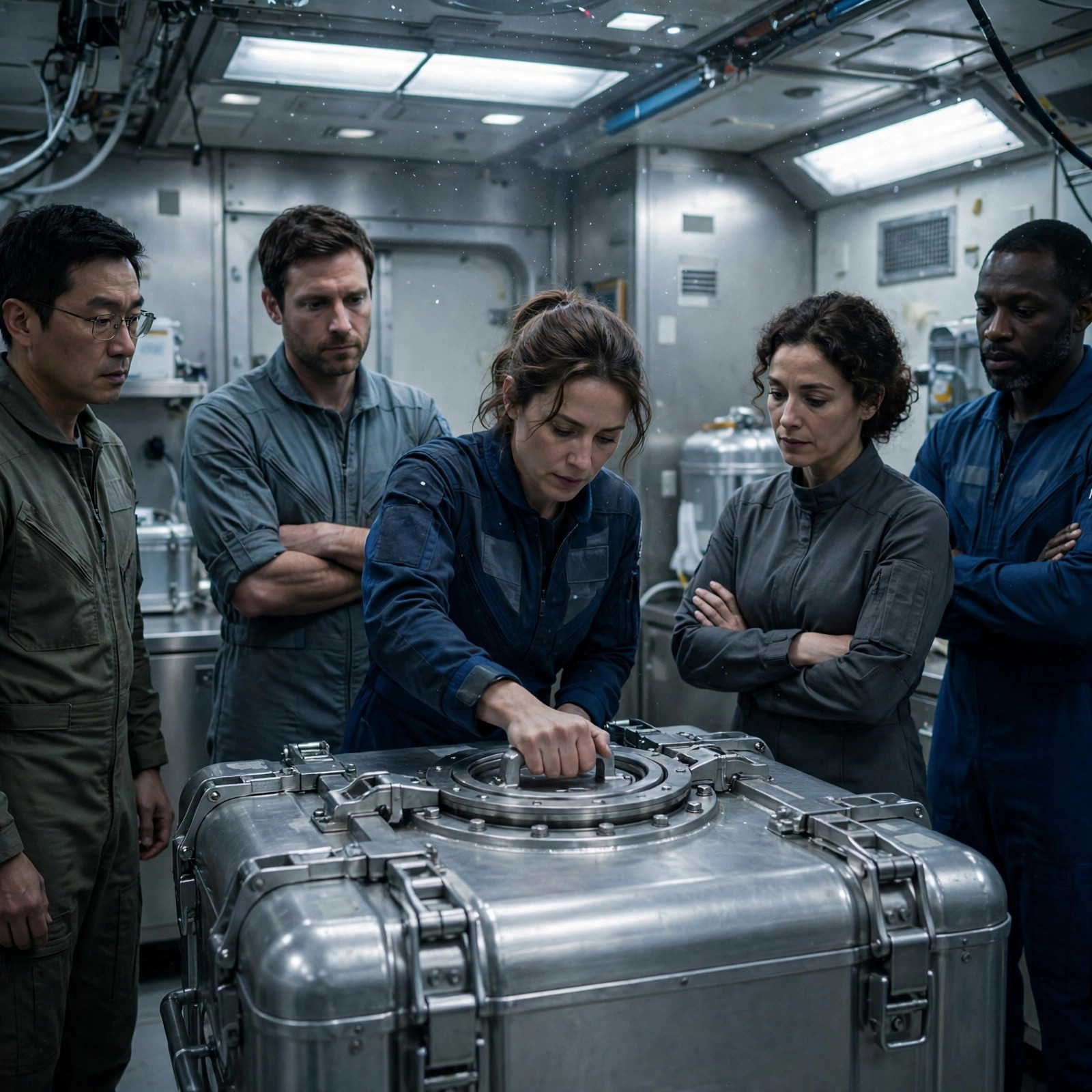
She went down the ladder to deck two with the others behind her, and the sample bay was crowded with all five of them in it, the canister on its bench under the work lamp, eighteen kilograms of another system's interior sealed inside forty centimeters of flight steel. Frost had already formed on the outside of the lid where the cold of it reached through. Ondine had a preliminary tag printed from the acquisition, the isotope column and the chemistry ladder, and she laid it on the bench beside the canister without fastening it down.
"The record wants the seal witnessed," Priya said. "And it wants coordinates on the tag."
"I know what it wants." Dagny took the etcher off its hook.
Ilya moved in beside her at the bench, close enough that his shoulder was against hers, and he did not say anything about formation models or maneuvering budgets or the one pass he would have signed for again tomorrow. He looked at the frost on the lid for a while.
"I fought you the whole way out here," he said. "I want that in the log too, next to your rotation change. Both true things, side by side."
"It's already there," Dagny said. "I wrote it myself."
She pressed the seal with the flat of her hand, felt the lid seat and the lock take, and the bay lamp caught the frost as it smoothed over under her palm. Then she etched the tag: the J-9 fracture coordinates, the date, the mass. Eighteen kilograms. She fastened the tag to the canister's handle and stood back, and one by one the crew came in and put a hand on the closed lid, Teodor and then Priya and then Ondine, who had found the whole thing first and who lingered longest, and Ilya last, his glove flat on the steel over the seal she had pressed.
"First sample of an extrasolar body's interior," Ondine said. "In a forty-centimeter can, on a survey ship that almost didn't come for it."
"Almost is a word for the log," Dagny said. "Not for the can."
They stood around it in the small warm bay, five people and the ice, and up through the hull the plume was still climbing and falling out there in the dark, patient as it had ever been, and Dagny left her hand where it was.
Get notified when new stories drop

Mira Okoye
Mira writes first contact and mentorship-across-species stories where curiosity beats fear.
Leave a comment
Comments