




Question from the Void
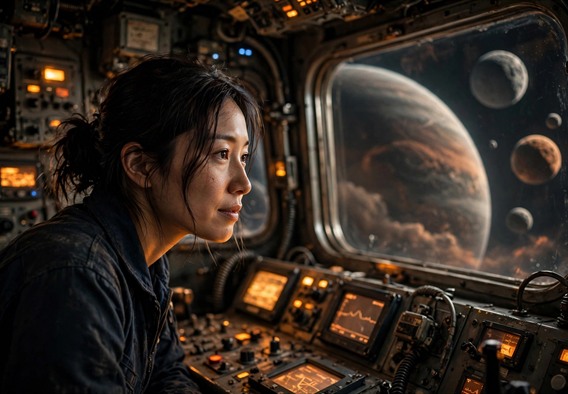
What do you do when the machine that keeps you alive becomes the problem you have to outthink? Nadia Ferrante asked herself that question at 0341 ship time, floating in the workshops of the survey vessel Corvus Holderin, while the water reclamation loop downstream of her hummed in a way that water reclamation loops were never supposed to hum.
She was forty-one years old, a life systems engineer with two tours on the Ganymede upgrades behind her, and she had come out here to the eighth planet of the star Vespera to answer questions about ice, not questions about plumbing. The universe, she had learned, rarely respected the division of labor.
The hum came again. A low, wet flutter, somewhere between the electrochemical stack and the condenser bank. Nadia closed her eyes and listened the way a doctor listens to a heart, and what she heard did not reassure her. It sounded like a bubble of something that was not water moving through a line that was only supposed to carry water.
"Osei," she called across the workshop. "Come listen to this."
Osei Bankole drifted through the hatch upside down, which was how he did most things. He was thirty-five, a propulsion and materials engineer by training and a compulsive tinkerer by nature, and he had spent the eleven-day transit from the wormhole relay rewinding a salvage gyroscope for no reason anyone else could identify. He pressed one ear gently against the insulated line, rotated ninety degrees, and pressed the other ear against it.
"That," he said, "is either a two-phase flow instability or the ship has learned to purr."
"Ships don't purr."
"Then we have a problem, and I would rather it were purring." His grin faded into something more careful. He had grown up on a station where the water recyclers were the town's true government, and he carried a private ledger in his head, always, of liters in and liters out. "Potable reserve is at sixty-two percent, right?"
"Sixty-one point eight," Nadia said. "I checked at dinner."
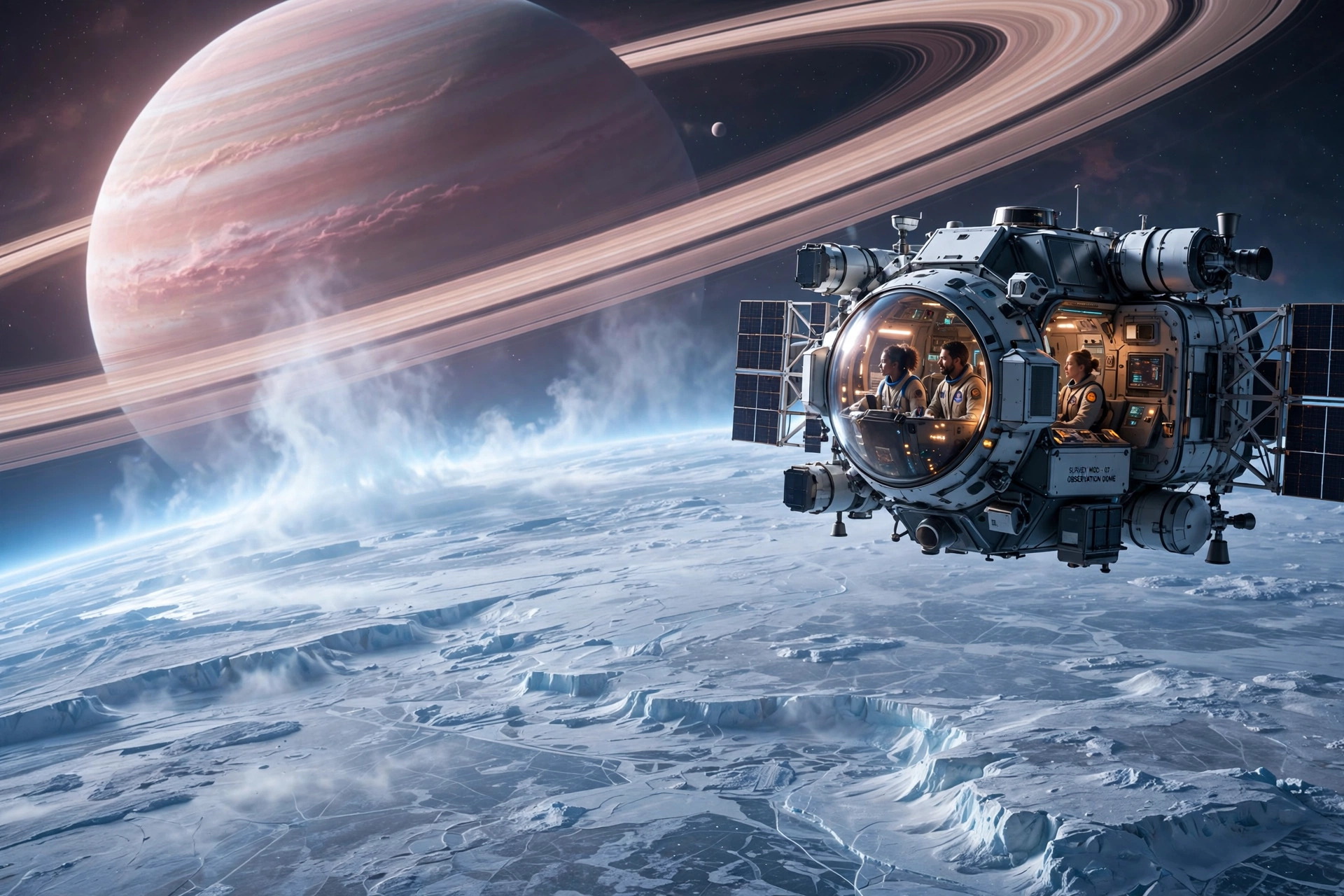
They looked at each other. Around them, the Corvus Holderin went about its night: the reactor's whisper, the air handlers breathing their slow circle, four crewmates asleep in their phone booths of cabins, and outside the viewport the enormous curve of Vesper-9, a moon of white and blue ice wearing a thin crown of vapor, lit faintly rose by the giant planet it orbited. The survey had been going beautifully. Ice cores had already confirmed organics in the deep layers. The mission's whole purpose was to determine whether places like this could someday host human stations, whether ice moons like Vesper-9 could become the fueling and farming towns of the outer dark.
Nadia had been measuring the moon's water. Now the ship's water was measuring them.
The Ledger
By 0500 they were both awake in the water bay, and by 0600 the ship's commander, Ines Almeida Vo, was awake too, because Nadia did not believe in softening numbers.
"Here is the ledger," Nadia said, floating in front of the status display with the particular calm she reserved for bad news. "The reclamation loop failed last night at an abstraction level I am still diagnosing. Primary symptom is two-phase slug flow in the distillation line, which means something is volatilizing that should not be volatilizing. Secondary symptom, and this is the one I want everyone to hear clearly, is that our product water quality dropped to non-potable overnight. The condensate coming off the stack is carrying ammonia at three times limit."
"Source?" Ines asked. She was a former asteroid tug pilot, compact and unhurried, and she asked the shortest possible questions.
"Best hypothesis is that the catalytic oxidation bed got poisoned. The bed is what breaks our waste products back down into water and gas. Something in the last batch of waste reagents reacted with the catalyst surface. I think it was the biocide additive from our own stores. We have been dosing the loop per the manual, but the manual assumes Earth water chemistry, and our stored water has been slowly concentrating sulfur species since launch. Six years of slow chemistry. The catalyst is glazed." She let that land. "The glaze is not cleanable. The bed is effectively dead, and the distillation train behind it cannot produce potable water until the ammonia is dealt with, and we have no spare bed."
"How long to fix?"
"With a spare bed, two days. Without one." Nadia paused. "The bed is a ceramic monolith with a platinum group washcoat. We cannot print platinum. We cannot print the ceramic's microstructure. It was manufactured in a clean room on Luna in a batch process that took a month."
The water bay was quiet. Osei broke it, gently. "Give people the number, Nadia."
"Without a working loop, at current crew of five, drinking and hygiene and food rehydration, our potable reserve lasts about forty days before quality failures, and about seventy before we are in real trouble. We can stretch it with rationing to maybe a hundred. But the ship is designed to be a closed circle, and the circle is open now. Every day we lose roughly two hundred liters to the forward loop's inefficiency and to inevitable small losses. Sweat, breath, the greenhouse transpiration that we do catch, humidity we do not." She tapped the display. "The moon outside has more water than Earth's oceans. It is frozen to rock bottom and topped with clean snow in places. But getting it, purifying it, and closing our loop again is an engineering problem we have to solve with what is on this ship."
Ines looked at the moon through the bay's small viewport. Rose light moved on ice. "Then that is what we do," she said. "You two are the engineering lead and the manufacturing lead, same as the mission plan said, just with a different problem than the mission plan imagined. Doctor Reyes keeps the crew healthy. Chenke runs the reactor and power. Nadia, you have authority over the loop. Osei, you have authority over everything she needs built. I want a test plan by 0900 and honesty at every update. We are three hundred eleven days from the relay at current burn, and the relay is nine months from Earth. So."
"So," Osei said, "we are our own supply ship."
"We are our own supply ship," Ines agreed, and pushed off toward the cockpit.
First Fail
The obvious answer was distillation. Boil dirty water, condense clean vapor, keep the ammonia behind. The ship had waste heat, electricity, and a vacuum outside that would pull vapor off a warm surface at a whisper of pressure. By noon of the first day, Nadia had a theory and Osei had a rig: a salvage tank from the atmospheric sampler, a heat exchanger loop tapped off the reactor coolant, and a condenser cobbled from six spare thermoelectric plates that had been sitting in stores since the mission office over-ordered them in a moment of budget optimism that Osei now considered the finest act of foresight in human history.
They ran it on two liters of gray water drawn from the waste tank. Voltage on the thermoelectric plates, cold side to the hull radiator shadow, hot side bathed by coolant. Pressure in the sampler tank dropped, vapor lifted, and ten minutes later the first promise of the new age beaded on the condenser fins and ran, drop by patient drop, into the collection cup.
Nadia tested it with the ship's spectrograph and held the result up to the light like a jewel.
"Nine hundred parts per billion ammonia," she said. "Limit is two hundred."
"Frustratingly close," Osei said.
"Frustratingly is doing a lot of work in that sentence. At nine hundred parts per billion, ammonia tastes like a defeat and wrecks our kidneys over months. But it means the physics works. Distillation separates the water from everything heavy. What is carrying the ammonia over is that ammonia volatilizes with the water. It rides along. It is a hitchhiker." She looked at the condenser, at the perfect little engineering marvel that was cheating her with a trace gas. "We need a stage that removes a gas from a vapor. An absorber. Ion exchange media would do it, and we do not have any, because nobody packs spare ion exchange resin for a loop that was never supposed to fail."
"The moon," Osei said slowly, "is made of water ice with dust in it. What if we skip the waste tank entirely? Mine clean ice. Distill meltwater instead of waste. If the feed is clean, a single stage might work."
"The surface snow is clean," Nadia admitted. "Cores came back beautiful. But Osei, mining ice means EVA work, which means suit consumables, which are all downstream of the loop. Suit cooling runs on sublimator water. Every hour we spend outside mining ice, we spend two hundred grams of water per suit, sublimating it to the vacuum as coolant. Our ice mining has a water cost. If yield is worse than cost, we dig our own grave faster with a shovel."
"So we measure," Osei said. "We are survey people. Measuring is the one thing this boat was built to do."
They measured. Two EVAs, four hours total, both of them out on the ice plain in their bulky suits while the gas giant filled half the sky. The regolith-hard snow came up in beautiful translucent blocks with a coring drill that Chenke had rewired to run torque-limited. Back aboard, they melted, distilled, and tested. One hundred forty parts per billion ammonia. Water recovered from melt: ninety-one percent of mass fed in. Water spent on suit cooling for each two-hour EVA: roughly half a kilogram per person.
"Yield beats cost by a factor of maybe forty," Osei announced, writing the numbers on the workshop wall in grease pencil, next to the increasingly complicated diagram he called the Ledger. "We can drink the moon."
"We can survive the moon," Nadia corrected, but she was smiling for the first time in two days. "One hundred forty parts per billion is safe short term. Not five months safe. The ammonia must be zero, or near enough. But we have a foundation. The distillation physics works. Now we close the circle properly."
Entry from the engineering log, first day of the recovery effort: distillation rig functional, product water marginal, EVA yield confirmed favorable. Crew morale high. Commander Vo has rationed coffee to alternate days, which the crew has classified as a crime.
The Carbon Question
That was when the second failure arrived, punctual as gravity.
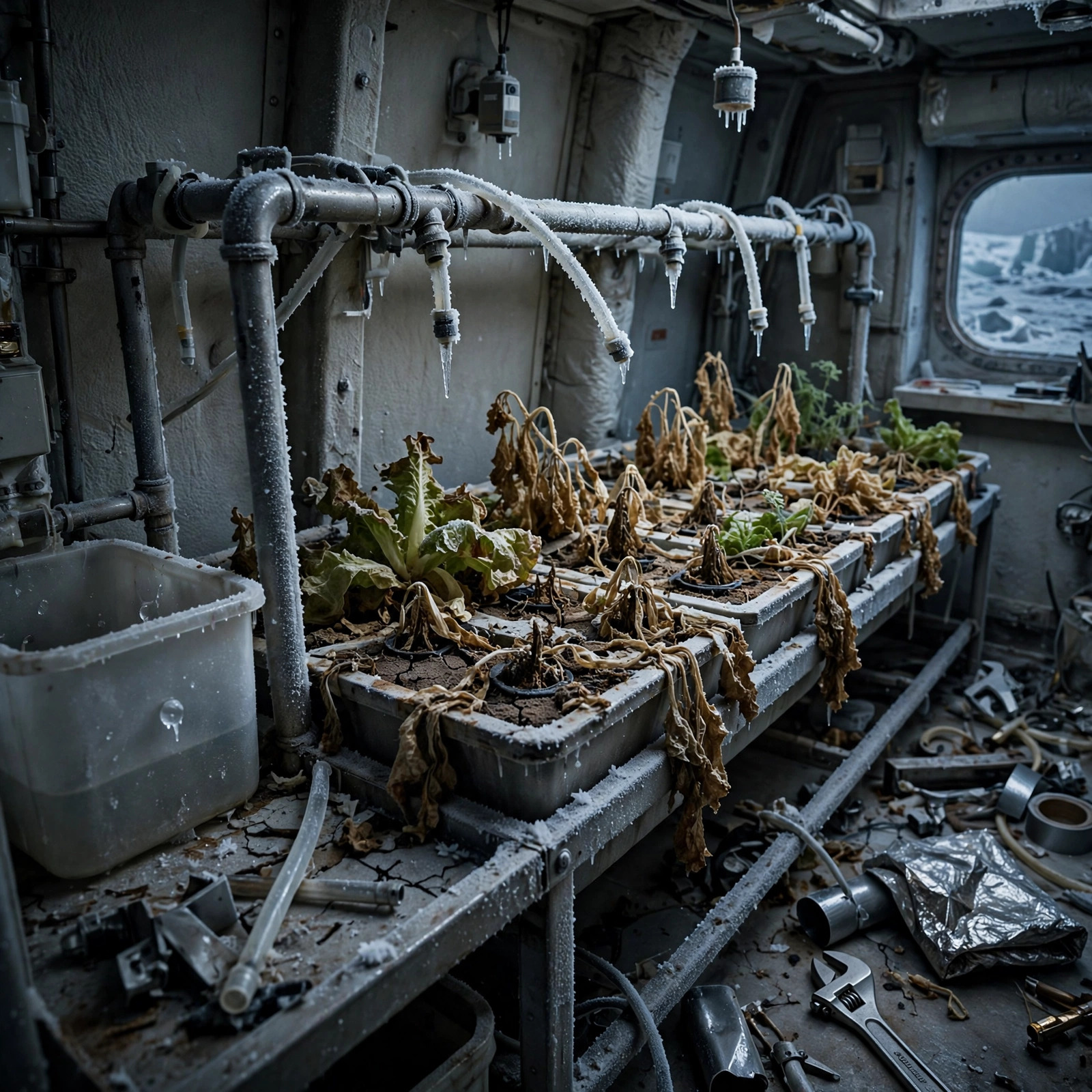
The carbon dioxide scrubbers, the other lungs of the ship, worked on adsorbent beds that the regenerative system baked clean each night using vacuum swing cycles. On day three of the crisis, the regenerative bake-out system threw a thermal flag. Nadia traced it and found the root cause sitting in a neat line of causality back to the same poisoned water loop: the humidifier downstream of the failed condensate stage had been passing microdroplets of the contaminated condensate into the CO2 beds' air stream, and the trace ammonia was reacting with the adsorbent, fouling its surface, dropping its bake-out efficiency. Capacity was down nineteen percent and degrading slowly. In five crew-days of breathing, they would exceed safe cabin CO2 at sleep periods.
"Water poisons the water system, then walks upstairs and poisons the air system," Ines said flatly at the evening meeting. "Is there a machine on this ship that is not connected to every other machine?"
"No," said Nadia and Osei and Chenke and Reyes, nearly in unison, and something about the shared sentence broke the tension in the compartment into laughter.
"Good," Ines said. "Everything is connected. So are we. Next solution."
The textbook solution for scrubber inefficiency was more bed capacity, and they had none. The improvisational solutions were older than spaceflight: curtains of lithium hydroxide, which they had one emergency canister of; pressurized greenhouse modules, which they had, five square meters of it, meant as a biology experiment; and good old caustic scrubbing with whatever base chemistry you could conjure. Chenke, the reactor and power engineer, a quiet Senegalese man who could do enthalpy balances in his head, pointed at the moon through the viewport.
"There is water, and under some of that water ice there is ammonia in the deep layers, natural ammonia, deposits of it. The survey data shows it. Ammonia is a base. It scrubs acid gases, not CO2, so that is no use directly. But," and here he paused the way he always did, enjoying the moment, "we have an electrolyzer. We can split our product water into hydrogen and oxygen. Combine hydrogen with CO2 over a nickel catalyst at temperature and pressure, and you get methane and water. Sabatier reaction. That is the classical loop: your CO2 comes back as water and methane, and the water we can drink and the methane we can burn in the engine or feed a fuel cell."
"We don't have a Sabatier reactor," Nadia said. "This ship was designed as a closed water cycle and a mostly closed oxygen cycle with stored reserves. CO2 goes to the beds and gets vented on the deep regen cycles."
"So we build one," Osei said.
Everyone looked at him.
"We are sitting on a machine shop," he said. "And the Moon, capital M and lowercase both, gave us nickel. The cores. Vesper-9's deep ice has nickel-bearing dust in it, we measured it in the spectrometry, it is part of why the mission chose this moon. We have a furnace in the sample lab rated to eleven hundred degrees. We can make a catalyst substrate. Maybe not a beautiful monolith. A packed bed of nickel granules, sintered, oxidized, reduced. People were doing Sabatier reactions in the nineteenth century with equipment cruder than anything on this boat. The chemistry is a century and a half old. We just have to be brave enough to do it by hand."
"Hydrogen storage," Nadia said, thinking out loud, working the ledger aloud because that was how she thought. "The electrolyzer makes hydrogen. We have no high pressure hydrogen tanks. Storage in flexible bladders rated for oxygen and water only. Hydrogen embrittlement rules out borrowing the helium spheres."
"Water lock," Chenke said. "Old gas-works trick. Bubble the hydrogen through a water column, store it over water in an inverted vessel. We lose a little to saturation, negligible. It is a low pressure accumulator. Feed the Sabatier bed continuously at low rate, never store much at all. Hydrogen made, hydrogen consumed, in real time."
Nadia looked at Chenke with respect. "You have been reading the nineteenth century."
"My grandmother cooked with gas," he said serenely. "All chemistry is one grandmother deep."
Building the Bed
The next six days became the thing Nadia would retell for the rest of her life, in hospital beds and classrooms and, decades later, to grandchildren who would assume she was exaggerating. This is what they did, with two pairs of hands, one shared machine shop, and a moon's worth of raw material.
Osei crushed core samples in a mortar adapted from a coffee grinder, sieved the dust with kitchen strainers, and magnetic-separated the dark grains that the spectrometry said were nickel iron alloy. The yield was slow, grams per hour, and the fineness was wrong for a packed bed, so he sintered the powder into porous pebbles in the sample furnace under an argon bleed from the welding kit. The first batch slumped into a gray slag because he misread the thermocouple offset. The second batch came out as irregular dark beads, something between gravel and coral, and he held one up to the light and said, with real reverence, "Catalyst. Handmade. This pebble has never been within a billion kilometers of a clean room."
Nadia built the reactor itself out of the ship's most indestructible language: pipe. A length of Inconel sample line, wrapped in a resistance heater wound from spare wire, packed with the nickel pebbles between two perforated disks, with thermocouples drilled into the bed and a pressure relief made from a spring and a valve seat that Osei hand lapped on the lathe. There was no magic in it. That was what Nadia loved. Every component was something a person could point at and understand.
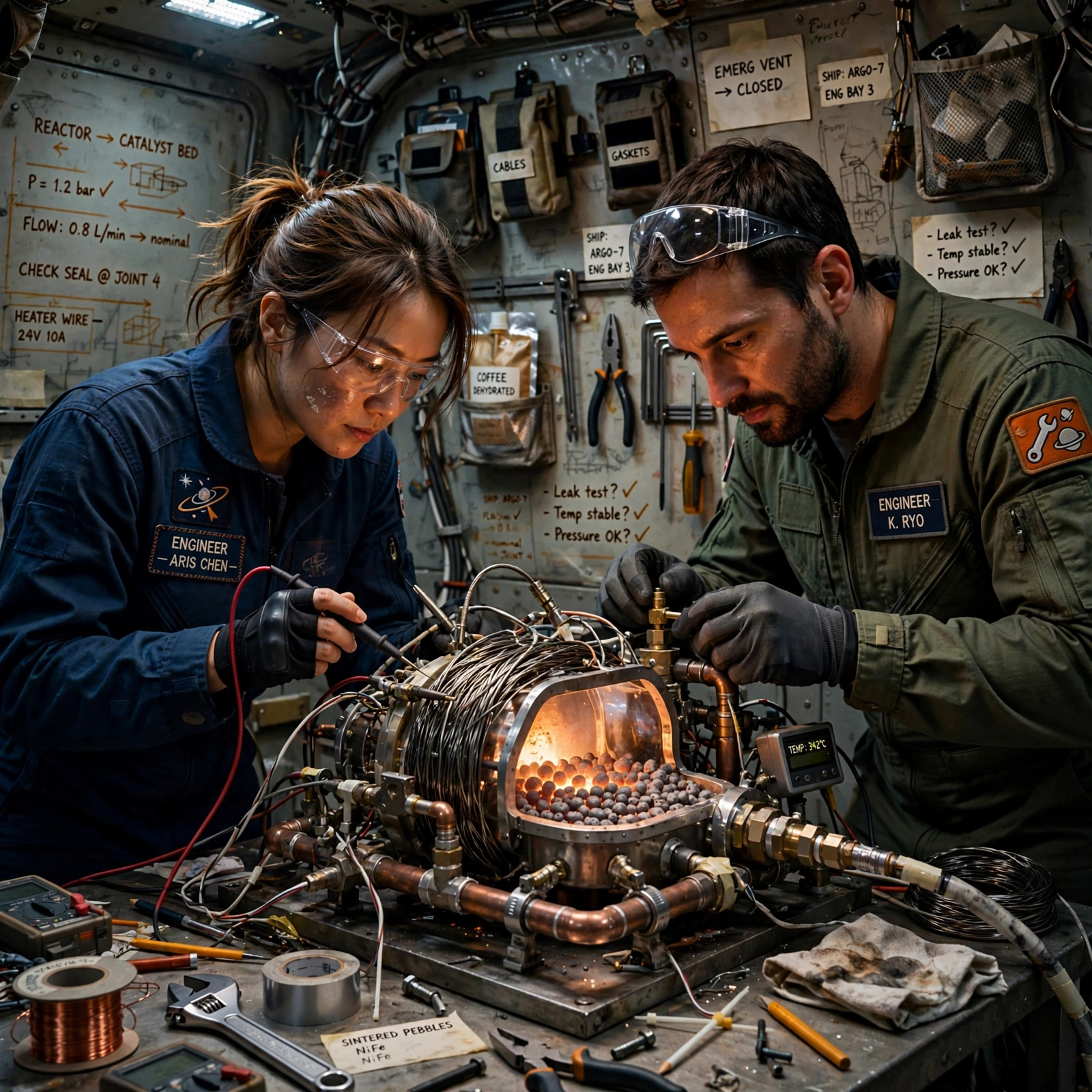
Chenke analyzed it. "Conversion is eleven percent," he said. "Needs to be multiples of that, but it is real. The bed is catalytic. The grandmother's trick works."
Then Nadia did what she considered the most important thing she did in the whole affair, the thing she would lecture about later. She wrote down, in the log, the honest rate of failure. "Eleven percent is a result," she said aloud, dictating. "It tells us the catalyst is active and the plumbing is tight. Tonight we fail better."
Failing Better
Failure came in varieties, and they catalogued them like the biologists they shipped with catalogued ice fauna proxies.
Run two, they raised temperature to four-fifty for conversion, and the bed plugging: the pebbles had margins of iron oxide that carburized and swelled, and the pressure differential across the bed crept until the relief valve sang its little invented song, a pure rising note that the crew started calling the Kettle and privately using as an alarm for anything. Osei sieved the bed charge finer, rebalanced the alloy fraction, and rebuilt with a graded bed, coarse below, fine above, the way water filters had been packed since wells were dug.
Run five, conversion hit thirty-eight percent, and then the water lock failed in the most dignified way possible: it was fine, but the electrolyzer upstream could not keep up with demand at the higher flow, and the bed got CO2 rich, which dropped conversion further, a loop of cause and effect that had them chasing their own tail until Nadia stopped them all with a hand in the air.
"Stop optimizing the bed," she said. "The bed is not the bottleneck anymore. The bottleneck is hydrogen supply. The electrolyzer is rated for continuous duty at its design point, and we are pulling above it. We need either a second stack or a duty cycle design. Chenke, what happens if we give the electrolyzer surge duty? Run it hard for ninety minutes, rest it thirty, buffer the hydrogen in the water lock."
Chenke closed his eyes, ran the thermal math, and opened them. "The stacks will run thirty percent over for surge duty if we cool the end plates with the spare thermoelectric plates. We have, what is it, six minus the ones in your condenser... two left."
"Bottleneck moves," Nadia said. "Good. A project where the bottleneck never moves is a project that has stopped."
By day fourteen, conversion crossed seventy percent and the water lock storage held a day's buffering, and Reyes, the ship's doctor, who had been sampling every batch with the suspicion of a woman who had seen water systems fail on three different worlds, called the first product water potable without qualification. The phrase made a small silence in the workshop. Potable. The word itself was a life support system.
The scrubber problem unwound itself downstream, the way connected problems do. With the Sabatier loop consuming CO2 from the air handlers and the humidifier problem solved by a replaceable condensate filter Osei printed from PTFE stock, the fouling feed to the beds stopped, and the regenerative bake-outs clawed capacity back night by night. On day nineteen, Nadia watched the scrubber telemetry cross back under the safety line and realized she had been holding her breath, in the technical sense, for two weeks.
Notable, in the log that night, in Nadia's handwriting: water loop closed at design margin, CO2 loop recovering, Sabatier steady state achieved with zero kilograms of material launched from Earth beyond what this crew carried in their bones and toolboxes. The ship is whole again, but it is a different ship than it was. It now contains its own grandmother's trick.
What the Ice Gave Back
There is a moment in engineering that no one who has not lived it can quite believe, which is that the crisis often teaches you the discovery. Nadia's distillation rig, run for weeks at low pressure over moon melt, began producing anomalies. Trace organics in the condensate that did not belong to the ship's waste stream. She flagged it, ran standards, ran blanks, and on day twenty-three called Reyes and the mission's biology consultant, Dr. Amara Reyes and the ship's own analyst stack, to the small lab that doubled as a sick bay.
"These are prebiotic molecules," Nadia said, pointing at the spectra. "Amino acid precursors. Not contamination, the isotopes are wrong for our water. They are coming out of the deep melt when we push the distillation too hot and pull over light fractions with the vapor. The ice at forty meters has chemistry in it. The moon is not dead snow. The same ices we are drinking are doing something, slowly, in the dark, with the nickel dust we sintered into our catalyst. We have been running experiments on prebiotic chemistry in our plumbing by accident."
The survey mission's primary science objective had been to determine resource potential. But the incidental data, the deep layer organics and their catalytic interactions with the moon's own metal dust, reclassified Vesper-9 in the mission catalogs from resource site to laboratory. The report Osei and Nadia co-authored went out on the next comm window, ninety minutes of antenna time paid for by a crew who now had water to spare and knew the exact price of every liter.
"Do you realize," Osei said one evening, floating in the workshop with his grease pencil diagram now filling two walls, "that the fix and the discovery are the same object? The still. If we had not broken the loop, we would never have distilled moon melt in this configuration, never seen the organics carry over. The failure taught us what the successful mission plan would have missed."
"Do not put that in the recommendation," Nadia said. "Mission offices cannot handle the idea that disasters are instruments."
"It is going in the recommendation," Osei said, writing it.
The Landing
The final engineering problem arrived wearing a bow, as final problems sometimes do. The follow-on survey plan now called for a permanent monitoring station on the ice, powered by a small reactor, melting and purifying water continuously, and running a Sabatier loop for fuel synthesis so that returning shuttles could refuel. Which meant the ship's crew needed to deliver not just a report but a design, proven. Chenke and Ines wanted it. The agency three hundred eleven days and nine months away wanted it.
Nadia and Osei built a demonstrator on the surface. It took eleven EVAs. They learned to schedule mining work so the water cost of suits amortized against the still's yield at a ratio of one to sixty. They learned that Vesper-9's dawn winds, when the thin vapor crown breathed in and out with the giant planet's slow shadow, put rime on cold surfaces, and they tilted the condenser fins so the wind itself did the deicing. They buried theSabatier bed in a ice-packed hut to hold its heat, and set the water lock storage in a cut trench so the same slow vapor that rimed their fins kept the trench walls sealed. Every flaw they found, they met with a local answer, because out here the moon itself was the only parts catalog.
The demonstrator made its first continuous potable water on day thirty-one, at a rate that, scaled, would sustain a twelve person station with margin. The monitoring hut went live with its long term experiment packages, watching the deep ice chemistry for the next decade of scientists. Ines recorded the flag raising in her dry pilot's way: "Station Vesper-9 Alpha, established, water positive, fuel positive, carbon closed. Recommend this architecture for all outer system ice targets."
That last word was the whole mission in a syllable. Targets, plural. Not one moon saved, but a design for a hundred of them.
Leaving the Ledger
On the last night before departure, Nadia took the wall diagram down carefully, photographing each grease pencil figure first. Forty days of margin had become a hundred and ninety. The loop hummed its original boring hum. Coffee rationing had been lifted as a mercy, and Osei was teaching Reyes to weld, badly, at Reyes's request, because Reyes had decided that a ship's doctor should understand how cathodes die.
Ines came into the workshop with two cups of the restored coffee and handed one over. "Read me the ledger," she said.
Nadia read it. Water out versus water in, closed at design margin plus four percent. Air loop, restored and upgraded. Fuel synthesis capacity: new. Science return: reclassified. Crew: five, all alive, all trained, all slightly more dangerous with a lathe than when they arrived.
"And the question," Ines said. "The one you started with. When the machine that keeps you alive breaks."
"You do not replace it," Nadia said, looking out the viewport at Vesper-9 shrinking below, its vapor crown catching the last rose light. "You remember that you already know how to do what it does. Machines are other people's engineering, crystallized. Given enough heat, enough hands, and enough honesty about failure rates, a crew can crystallize its own." She turned the cup slowly, watching the coffee spin. "And then you leave it there, working, for the next people. That is the part I care about. We were not just surviving. We left a world more habitable than we found it, with our own hands, out of its own material. The next crew drinks water we taught the moon to give."
Osei floated past, upside down as usual, and added the last line to the log with the ship's grease pencil, in the tradition of engineers everywhere who know that paperwork outlasts hardware:
The circle is closed. The moon is open. Recommend expansion of survey program to all eleven target bodies in the Vespera system; every one of them has ice, and every one of them, therefore, has a future.
The Corvus Holderin lit her drive at dawn, ship time, and the pink glow slid down her flank and off across the ice toward the little hut on the plain, where a demonstrator still quietly, patiently, made water from a frozen world, one degree at a time, waiting for the people who would come next.
Get notified when new stories drop

Ava Kepler
Ava writes space exploration and cosmic adventure with competent crews, hard problems, and awe that earns its hope.
Leave a comment
Comments