


The question that dragged Marisol Vega out of retirement had less to do with water than with her own stubbornness, which she measured, in her sixty-third year, the way she had once measured hydraulic conductivity: patiently, and with a growing suspicion that the answer would embarrass everyone involved. The question was simple. Could a person still know something a machine could not?
The town of Harlow Bend, population eleven thousand and change, sat on the west bank of the San Rafael like a mouth that had forgotten how to drink. Forty years of extraction, three consecutive megadroughts, and a subdivision boom that had paved over the river's old floodplain had done to the Coover Aquifer what a decade of bad sleep does to a body. The wells still worked. The water table beneath them had dropped nineteen meters since Marisol was a graduate student with a shovel and a bad haircut, and in the summers the river ran brown and thin as cold coffee.
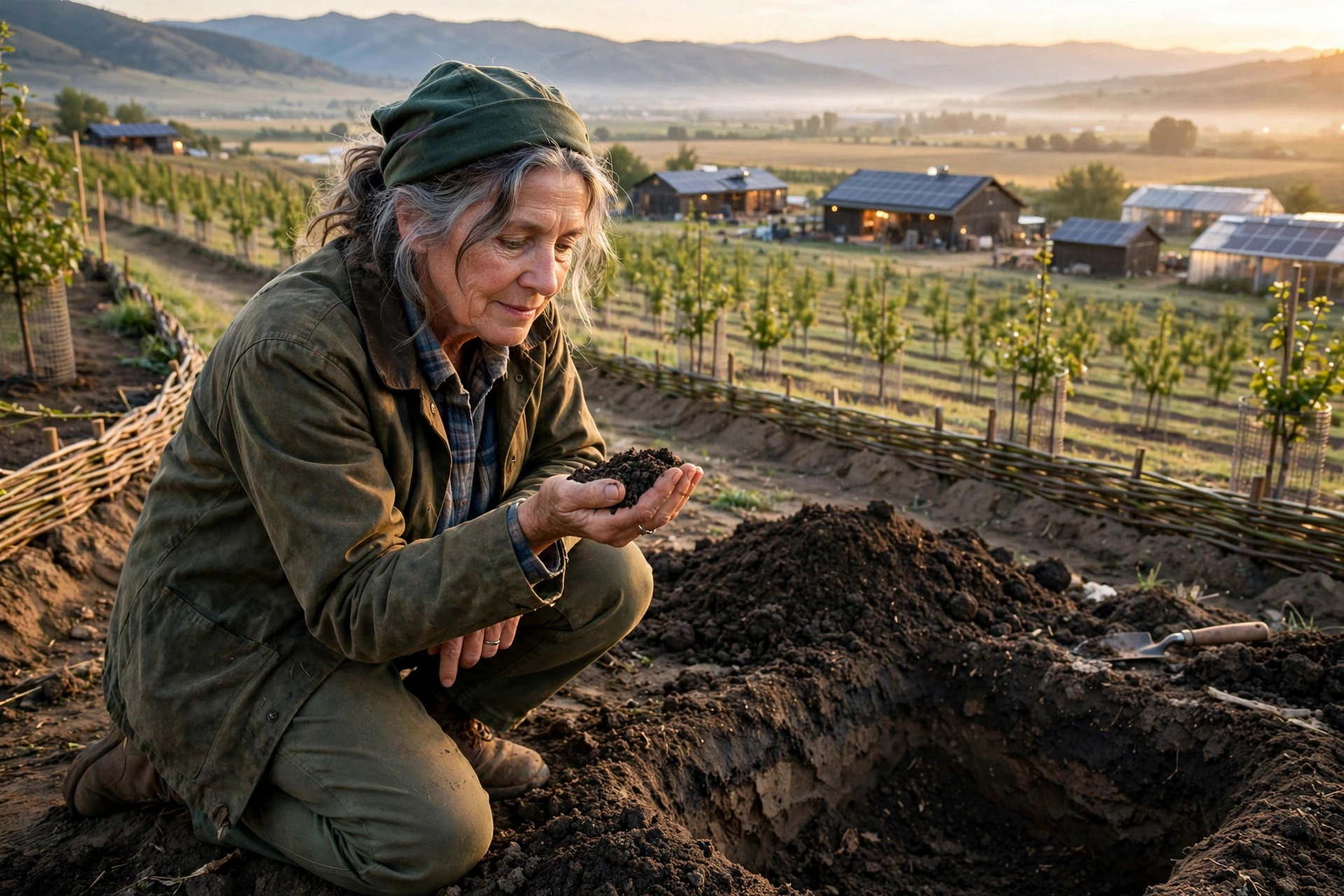
She had come back for a funeral, her brother's, and stayed because the funeral turned into a town meeting and the town meeting turned into an argument she could not bear to lose. That was how she found herself, in the first cold week of March 2061, kneeling in a backhoe-cut pit behind the old grain co-op with a handful of soil in her fist and an audience of forty strangers holding phones, tablets, and one ancient tape recorder that belonged to the volunteer fire department.
"Tell me what you smell," she said, holding the crumbled earth up to her face. It smelled like nothing. That was the whole tragedy in a single inhale, soil stripped of its architecture, its carbon, its smell, the way a gutted house smells like drywall and absence. "Nothing," she said, answering herself. "Good soil smells like a forest after rain. Bad soil smells like a parking lot. This is a parking lot."
A man near the back called out, half joking, half not, "So we're cooked, then."
"We're dry," Marisol said, "which is a solvable problem. Cooked is a different problem, and I've spent thirty-one years making sure I never have to work on that one." She dropped the soil, wiped her hands on her jeans, and looked up at the faces above the rim of the pit. Somewhere in that crowd, she would later learn, stood the person who would make the whole thing work, a twenty-nine-year-old mushroom farmer named Delfina Okonkwo-Reyes, who at that moment was thinking about oyster mushrooms and not about aquifers at all, because that was the kind of luck the world ran on.
The Commons Meeting
The meeting was held in the co-op's old drying hall because the school gymnasium had been converted, the year before, into a vertical farm that supplied the county's school lunches with greens and mushrooms, and nobody had the heart to evict the lettuce. The drying hall smelled of dust and old grain and, faintly, of the ghost of diesel. Someone had hung a projector sheet from the rafters. Someone else had brought coffee in an actual percolator, the kind with a glass knob on top, and the smell of it did more to settle the room than any speech would have.
Marisol stood at a folding table with a map of the basin, hand drawn, because she did not trust herself to build slides anymore and did not trust the room to read them. "Here's the situation," she said. "The Coover Aquifer is a sand and gravel lens, about forty meters thick in places, under six hundred square kilometers of valley. For ninety years we treated it like a bank account we could overdraw forever. We are now eleven meters from the bottom of the usable draw, and the water at the bottom is brackish, so when we hit it, it doesn't just stop working. It poisons every well above it."
A woman in the third row raised her hand. She was young, maybe late twenties, with close-cropped hair and the forearms of someone who lifted mushroom crates for a living. "Delfina," she said. "I run the fungi operation out at the old cannery. Question. Everyone keeps saying recharge, recharge, like we can pipe water in. But the river doesn't have water to give. Where does the water come from?"
"It doesn't come from anywhere," Marisol said. "It comes back. That's the part nobody wants to hear. Aquifer recharge in a dry valley is slow, and the fastest version of slow is to stop losing water. Every year this valley gets about four hundred and ten millimeters of precipitation. Every year, we lose roughly ninety percent of it. It hits pavement, runs to the river, and leaves for the ocean by June. The water we need fell on our heads. We threw it away."
The room did the arithmetic in silence. She could see it happening, faces going still, farmers first, then the two hydrology students who had driven out from the state university, then the county commissioner, who had come intending to say something soothing about state grants and was visibly revising his notes.
"So what do we do," the commissioner said finally, "unpave the county?"
"Some of it," Marisol said. "Mostly we rebuild the sponge. Soil is a sponge. Ours is a parking lot. I have a plan for the parking lot. It has four parts and none of them are magic, which means all of them are work." She laid the four parts out flat: slow the water in the upper watershed with small check dams and contour swales; rebuild soil carbon on the valley floor with compost, cover cropping, and deep-rooted perennials; rehydrate the floodplain by giving the river back the eleven hundred hectares of former oxbow wetlands that the Sunridge subdivision sat on a corner of; and, the fourth part, the one she had written last and underlined twice, do it all under a legal structure that kept the water and the data in common, owned by nobody, governed by everybody who drank from it.
"The last part is the hard one," she warned them. "Water is where communities go to war with themselves. If we do this as a land grab, or a speculation play, or a hustle where a consulting firm siphons the value out and leaves, we will fail, and we will deserve to."
Delfina raised her hand again. "And the AI?" she asked. "Everyone's going to ask, so I'll ask. The modeling, the monitoring. You've got the county's old sensor network, right? The regional foundation model eats data like mine eat sawdust. Why not just let it design the whole thing?"
"Because," Marisol said, "I have watched very smart systems optimize very hard for the wrong thing, and I have watched the people who used them stop noticing the wrong thing, because the screen was so confident. The model will be our instrument, not our architect. When it disagrees with the ground, we go look at the ground." She paused. "Also, it has never put its hands in this dirt. I have. That counts for something. It should count for more than it does."
Late in the meeting, after the commissioner had committed the county's road crew and a line item nobody had noticed was unspent, after the university students had volunteered to run the old sensor network back to life, Delfina found Marisol by the percolator.
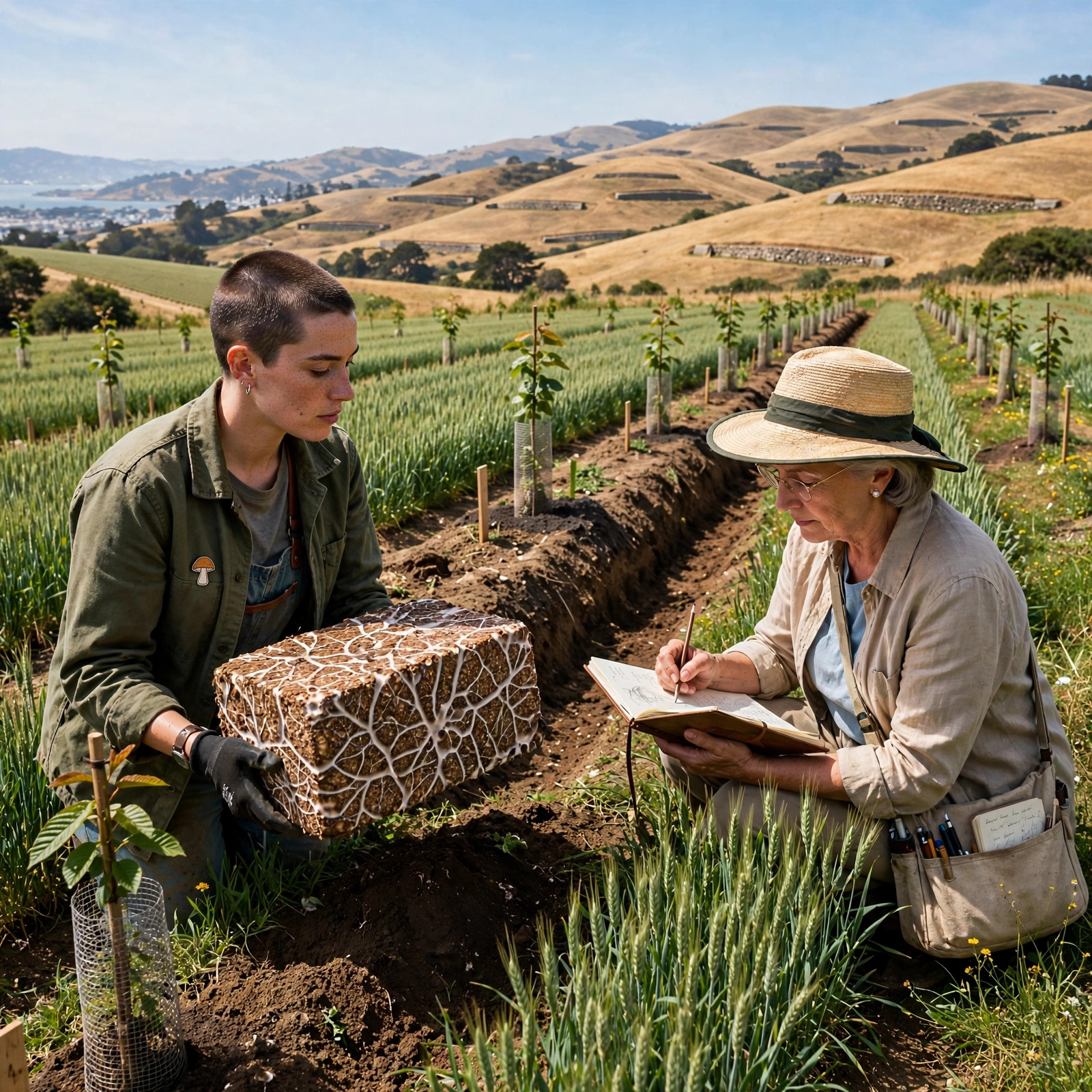
"The fungi thing," Delfina said. "You wrote soil carbon, and everyone's thinking compost trucks. But mycelium is a carbon pump. Fungal cell walls are chitin and melanin, and the melanized fraction is the carbon that stays. I grow two hundred tons a year of substrate that we currently sell as cheap compost. There's a version of this where my waste stream is your sponge."
Marisol looked at her for a long moment, the way she used to look at a borehole log that suddenly made a new kind of sense. "How much fungal carbon," she asked, "do you think you can get into a hectare of this valley in three years?"
"I don't know," Delfina said, grinning. "Nobody does. That's the fun part."
The Cannery
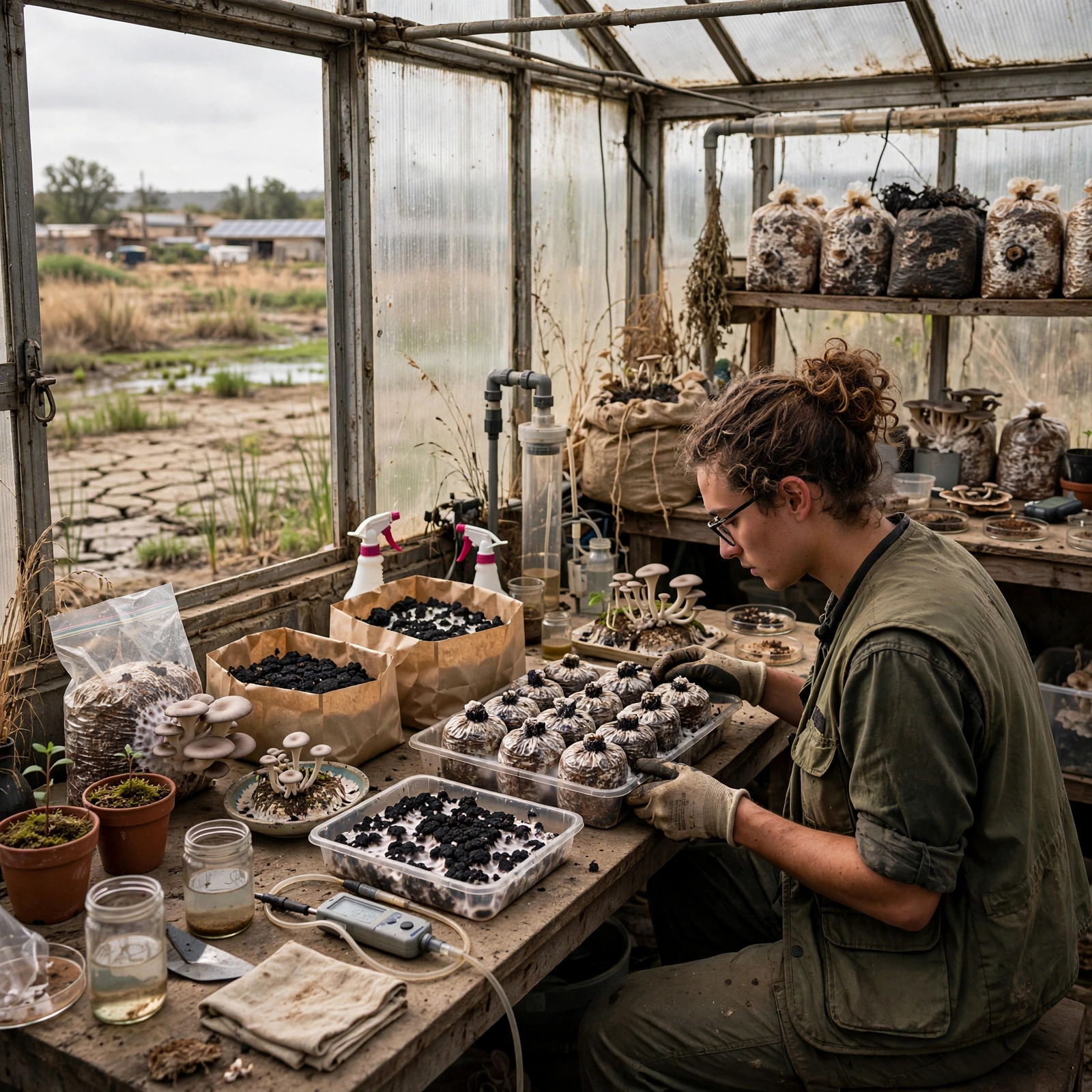
The old Pacifica Fruit cannery sat on the north edge of town like a beached ship, corrugated steel walls gone the color of old pennies, its loading dock a stoop for pigeons. Delfina had taken over a third of it five years earlier with a small-business conversion grant and a bank loan she had paid off early out of spite. Inside, the grow rooms ran on a schedule as precise as a liturgy. Spawn lab, substrate pasteurizer, fruiting rooms with misting lines and full-spectrum LED strips, and along the south wall, a bank of solar panels and a battery rack the size of a shipping container that let her sell mushrooms to three counties on her own electrons.
"Everything in here is a loop," she told Marisol on the tour, walking fast, pointing. "Sawdust and straw from the county, pasteurized, inoculated, fruited, spent, then the spent block goes out as soil amendment or feed. We heat with the heat pump off the solar. We cool the fruiting rooms with the same loop. The only thing we've ever thrown away is knowledge, because the substrate recipes are all in my head and my head is not a commons." She stopped, and Marisol watched her decide something. "That changes this month, if you want it to. Open recipes. Open yield data. If this works, nobody should have to call me to copy it."
"Why?" Marisol asked. It was not suspicion, exactly, but the habit of a career spent watching people overpromise. "You could license this. Spent-mycelium soil inoculum, branded, patented, the whole startup playbook. People would buy it."
"My grandmother farmed sorghum outside Ouagadougou," Delfina said. "She never once sold water to a neighbor. Not because she was a saint. Because water is one of those things where selling it makes it worse for everyone, including you, eventually. Carbon in soil is going to be like that. The second it's a commodity, everyone optimizes for the sale instead of the sponge." She picked up a spent substrate block, dense and white-veined, and broke it in half. The inside smelled, faintly, gloriously, like a forest after rain. "Also, I did the math. If the aquifer recovers, my well stops pulling brackish water in August, and my mushrooms get better. I'm not being altruistic. I'm being solvent."
They spent the afternoon in the spawn lab with Delfina's two employees, Theo, who was twenty-six and had a mycology master's thesis he defended over video from a hospital bed after a harvest accident, and Priya, who had left a biotech job in Sacramento because, as she put it, "I wanted to fix dirt, not write patents on fixing dirt." They laid out a trial design on a whiteboard. Twelve test plots along the proposed swale lines. Three controls. Three rates of spent-mycelium incorporation, biochar charged with the leachate, and a deep-rooted perennial polyculture, alfalfa and native bunchgrasses and a line of chestnut and honey locust for the long game.
"The melanin question," Priya said, tapping the whiteboard. "Fungal melanins bind soil aggregates. Stable microaggregates mean water infiltration without waterlogging, and mean carbon that resists microbial decomposition for decades. If we can raise stable carbon even one percent across the recharge zone, that's enormous infiltration capacity. But the model won't have good priors on this. Fungal carbon dynamics in semi-arid soils is a thin literature."
"Then the model learns from us," Marisol said. "For once, the instrument watches the ground instead of the other way around."
That night Delfina drove Marisol out to the head of the valley, where the watershed began its long shallow descent, and they stood on a cut bank above a dry tributary in the blue hour after sunset. The sky did its enormous western thing, bands of salmon and slate, and the air smelled of sage and cold dust.
"My brother used to fish here," Marisol said. "Seventies. There were actually fish."
"There'll be fish again," Delfina said, with the terrifying confidence of someone who had grown ten thousand kilograms of food out of a ruin. "Not because of hope. Because of check dams and mycelium and a hundred boring decisions made correctly for a decade."
"That's the most comforting thing anyone has said to me in years," Marisol told her, and meant it.
The Model and the Pit
The county's regional foundation model, which everyone called the Augur because the old naming contest had been won by a retired English teacher with a sense of irony, came back online in April with the reactivation of the sensor network. Forty-one soil moisture probes, twelve piezometers, six weather stations, and a pie in the sky, literally, a shared imaging task on the agricultural satellite constellation that gave the commons weekly multispectral coverage of the whole basin in exchange for their ground-truth data, which was worth more than the imagery.
By May the Augur had ingested forty years of well logs, the soil survey, the LiDAR, and the commons' new sensor stream, and it produced its first recharge scenario with the serene confidence of a system that had never been wrong in public. Its recommendation was efficient and wrong. It placed the primary infiltration basins in the eastern recharge zone, flat, deep soils, maximum modeled percolation, lowest land-acquisition friction. On a screen, the plan was beautiful. Colors told a story of water going home.
Marisol went and looked at the ground.
She took Delfina and Priya and a shovel, and they drove out east of the county road to the model's chosen site, a broad flat of ground that had been under continuous conventional tillage since before the droughts. Marisol dug. Two feet down, the shovel rang against something that was not rock and not root. A plow pan, a compacted layer a foot thick, iron-hard, the fossil of sixty years of heavy machinery. Water would pond on that pan until it evaporated. The model had averaged the soil survey's textural columns and never imagined the pan, because the pan was not in the data. The pan was in the ground.
"This is the whole argument," Marisol said, standing in the pit, her voice carrying oddly off the walls. "Not against the model. Against the worship of it. The Augur will optimize anything you give it, including a lie of omission. Our job is to keep feeding it truth, and the only way to make truth is to go dig." She carved a cube of the pan material out with the spade and handed it up to Priya. "Bag that. Penetrometer readings on a grid. We give the Augur the pan map, and we put the basins where the ground says, not where the average says."
When they fed the corrected data in, the model moved its basins west, onto the degraded floodplain soils, the exact land everyone had assumed was too damaged to bother with. Its revised projections were worse on paper and better in reality, which Priya said was the definition of a good model. "It got less confident," she noted, "and more accurate. You don't see that every day."
The Augur's response, logged in the commons' open record, was a note that Theo framed and hung in the cannery office: the system flagged its own prior as poorly constrained in compacted agricultural soils and recommended, verbatim, increased field verification. Delfina taped a photocopy of the note above the coffee machine. "Even the machine knows," she said. "Dig. Always dig."
Eleven Hundred Hectares of Argument
The Sunridge subdivision was the political problem, and it took the better part of a year, and it nearly broke the commons twice.
Sunridge sat on a corner of the old oxbow wetlands, ninety-three homes built in the paving boom years on what everyone had then called wasteland. Restoring the floodplain meant buyouts, which meant money, which meant fairness arguments that had teeth. Who got what price for their house? Did the people who had paid the boom price get the boom price, or the market price of a house on a future floodplain? And underneath the money ran the older current, the one Marisol recognized from every commons she had ever helped build: the fear of being the sucker. The fear that you would give up your land, or your water right, or your certainty, and your neighbor would hold out and get rich.
The commons' answer was not clever. It was patient. They held eleven open meetings in the school gymnasium, and then, when that stalled, Delfina had the idea that actually broke the logjam, and later she would insist it was not an idea but an accident. She catered one of the meetings. Not with pizza. With food grown in the valley: oyster mushrooms from her rooms, greens from the vertical farm, beans from the co-op's new dryland variety trials, bread from wheat grown on the first restored test plot. She put the provenance on little cards at each dish. Farm name, field, water source, carbon score.
People ate the valley's future, and it was delicious, and something shifted in the room that no presentation had shifted. The holdout landowners stopped arguing as owners of a commodity and started arguing as eaters and neighbors. Mrs. Ancel, who had refused three buyout offers, stood up with a card in her hand and said, "This mushroom grew on land two miles from my kitchen. I have never in my life eaten something that grew in Harlow Bend that wasn't a garden tomato. If the water comes back, whose food is this going to be?"
"Ours," said Delfina. "That's the design. The commons holds the land and the water and the data. Anybody in the basin can farm the commons ground by bid, with conservation covenants, and the food sells at the basin price, not the export price."
The deal that finally closed Sunridge was a patchwork, as all real deals are. Fair market price for the homes, paid from the state resilience fund and the county's unspent line item. Relocation priority in the new infirm housing going up in town, the kind with shared courtyards and solar canopies and rain gardens, built by a construction cooperative that trained local kids as journeymen. And for the four families who wanted to stay adjacent to the restoration, land swaps onto the terrace soils above the floodplain, where the commons would extend its swale network first, so their new ground would be the best ground in the valley within five years. Two families took the swap. Mrs. Ancel took the courtyard apartment and, within a month, was running the seed library out of its common room.
The last holdout was a man named Gene Fossen, who owned a hundred and forty hectares on the floodplain's east flank and who had, for two decades, made his money mining the aquifer to grow alfalfa for export dairies. He stood up at the ninth meeting and said what everyone knew he would say. "You're asking me to finance my own competition. Every acre you rewild is an acre my well competes against. I've got debt on that land. I've got a son who wants to farm it."
The room braced for the fight, and Marisol, who had been waiting all meeting for exactly this moment, stood up and did the thing she had rehearsed in the shower for a week. "Gene," she said, "you're right. Under the old rules. So let me show you the new ones." She laid out, on the table, the draft of the commons' water accounting. Under the old regime, water rights were paper, senior and junior, bought and sold, divorced from the ground. Under the commons charter, every user got an allocation tied to the aquifer's actual measured level, recalculated quarterly, published openly. And every user who contributed measured recharge, through swales, through cover crops, through restored wetlands on their land, earned allocation back.
"You have the single largest controllable recharge opportunity in the basin," she told him. "Your east flank fields sit right on the main infiltration pathway. Cut swales, run mycelium and deep roots, stop flood-irrigating alfalfa and switch to the dryland forage varieties the co-op is trialing, and you don't just stop overdrawing. You become the biggest net contributor to the aquifer. And under this charter, contribution is allocation. You'd hold more usable water in ten years than you pump today, on less land, at lower cost." She let that sit. "Your son doesn't inherit a draining bank account, Gene. He inherits the only farm in the valley that gets better every year it's farmed."
It took Gene four months and a long, furious, ultimately decisive afternoon in the cannery with Delfina's yield spreadsheets and Priya's infiltration models and a bottle of the co-op's cider. He signed in October. At the signing, he shook Marisol's hand with the crushing grip of a man conceding a point he intended to spend the rest of his life proving, and said, "If this doesn't work, I'm going to be so unpleasant about it."
"Noted in the minutes," Marisol said. "Please be. Dissent with data is how we'll know it's actually working."
First Water
The first winter of operations, 2061 into 2062, delivered a modest snowpack and a wet March, and for the first time in living memory the commons' monitoring network watched water go the right direction. The upper-watershed check dams, forty-one small structures of rock and earth and willow stakes built by a rotating volunteer crew that included the fire department, the school's senior class, and, memorably, a visiting crew of Hmong elders from the valley's founding families who had built terraces on two continents and treated the swales as a professional courtesy, held every storm. Not one of the season's runoff events reached the river as flood. It all went down, slowly, through swales and basins and the deepening sponge, into the sand and gravel below.
The piezometers told the story in centimeters. Three centimeters of rise in the shallow monitoring wells by June. The Augur, fed the pan map and the infiltration curves, projected the recovery curve: a decade to pre-1990 levels, two decades to a sustained yield regime, with wide error bars it was now honest about. Three centimeters. Theo put the number on the cannery's whiteboard and under it wrote, the ocean is that way, and drew an arrow, and crossed it out.
The real confirmation came from a place Marisol had not thought to instrument: the river itself. In late July, when in every previous drought year the San Rafael had dwindled to disconnected pools, a fish biologist from the state, a cheerful, sunburned woman named Dr. Okafor, waded the reach below the restored oxbows and found, to her visible astonishment, flowing water. Baseflow. Water leaving the sponge slowly, all summer, the way a healthy valley pays its river an allowance. Not much. Four cubic feet per second where there had been zero. But in a river that had been dying of thirst, four was a miracle with a decimal point.
She called Marisol from the streambank, shouting over the noise of actual moving water. "I've got juvenile suckers in this reach," she said. "Native suckers, Marisol. They haven't spawned up here since the nineties."
Marisol sat down on the cannery steps after the call and laughed until she cried, which surprised them both, and Delfina, coming out with two glasses of the co-op's cider, sat down next to her without asking questions, because she had learned that hydrologists cry at strange times and the correct response is beverages.
"Three centimeters and some fish," Delfina said eventually, "and half the county still thinks you're a witch."
"Half the county is right," Marisol said. "The trick is being a useful one."
The School Question
The second year, the argument was about children, in the best possible sense. The high school had a Career Technical Education wing that had been training students on the commons' sensor network since the reactivation, and a junior named Camila Fossen, Gene's granddaughter, who had been born the year the wells first dropped, wrote a project proposal that she delivered to the commons board with the terrifying directness of a seventeen-year-old who has done her reading. She wanted the commons to fund a student cohort, paid, in the basin's own currency of real work, to run a parallel monitoring program. Student-dug soil pits, student-run penetrometers, student-written ground-truth reports, deliberately separate from the Augur's data stream, so that the model could be checked against humans who had no idea what it predicted.
"Blind validation," she said, "but the blindfold is on the machine."
The board funded it in eleven minutes, which Marisol believed was a record for any body she had ever sat on. The cohort of fourteen, ages eighteen through twenty-two, the commons having decided its first program should hire adults earning wages, spent the summer digging forty pits across the basin and finding, among other things, a compacted pan under the eastern basins at a second site the Augur had ranked third, and, in a pasture north of town, an intact relict soil under an old fence line, never plowed, dark and sweet and alive, the valley's own memory of what it was supposed to be. They brought Marisol a jar of it. She kept it on her desk for the rest of the project and smelled it on bad days, of which there were some.
The bad days were real, and the story would be dishonest without them. The third summer brought the worst heat dome in the valley's record, five days above forty-six degrees, and the vertical farm's cooling loop failed during peak load, and Delfina lost eleven thousand kilograms of fruiting mushrooms in a single night. The insurance covered the crop. It did not cover the psychological weight of standing in a ninety-degree grow room at four in the morning watching a year of work die, and for two weeks Delfina did not come to commons meetings, and the meetings went badly without her, factionalizing over trivia, and Marisol, who had spent her career in technical arguments and hated the human kind, discovered that the water question and the people question were the same question, and that both were solved by showing up.
She showed up at the cannery with the jar of relict soil and a design she had sketched with Priya: a heat-resilient retrofit for the grow rooms, ground-coupled cooling tubes into the recharge zone's cool gravel, powered by the commons' expanding solar array, built by the construction cooperative as the cohort's winter project. "The aquifer we're rebuilding is cold," Marisol said. "Fifteen degrees, all year, forty meters down. You've been sitting on a thermal bank this whole time. Let the water you're helping raise also keep your mushrooms alive."
Delfina looked at the sketch for a long time. "You're offering me my own aquifer as a battery," she said.
"I'm offering you your own aquifer as a partner," Marisol said. "That's the whole theory of this project. Nothing in this valley thrives alone. Not the soil, not the water, not the mushrooms, not the people."
The retrofit went in the following spring. The cooling tubes never drew the grow rooms below twenty degrees, exactly as modeled, and exactly enough, and the summer after the heat dome, the cannery ran through a four-day heat event without losing a single block, and sold emergency capacity to the vertical farm, and paid off the retrofit two years early. Delfina framed the first invoice and hung it next to the Augur's humility note, and the cannery office wall became, informally, the commons' museum of hard-won things.
What the Machine Learned
In the fourth year, the Augur did something its developers at the regional institute had not anticipated, and the story of it traveled far beyond the valley. Given the commons' four years of ground-truth, including the student cohort's blind pits and the pan maps and the relict soil profiles and the fungal carbon time series from Delfina's plots, the system produced a revised regional soil-carbon model whose central parameter, the stabilization rate of melanized fungal carbon in semi-arid mineral soils, was three times higher than the published literature. The institute ran the numbers independently, could not reproduce the old parameter, and published the correction with the Harlow Bend data as the primary evidence.
Priya, reading the paper in the cannery office, started laughing and could not stop. "Do you understand what this is?" she said. "The machine learned humility from a mushroom farm. The single most cited parameter update in dryland soil science this decade, and the data came from check dams built by retirees and a cohort of students with shovels and a woman who grows oysters in a ruin."
Within two years, the commons' open recipe set, the swale designs, the mycelium incorporation protocols, the water-charter template, the heat-retrofit drawings, and, quietly, the meeting-and-meal format that had unlocked Sunridge, had been replicated in thirty-one basins on four continents, most of them in places far drier and poorer than the San Rafael, where the arithmetic of throwing away ninety percent of the rain was even more brutal and the fix even more decisive. The commons set up a sister-basin exchange, human to human, farmer to farmer, and the first delegation came from a cooperative in the Anti-Atlas, and the first thing they did on arrival was ask to smell the soil, which told Marisol everything about what had actually been transmitted.
The Augur, meanwhile, was adopted by the institute as the pilot for a new governance standard called, without irony, the Harlow Protocol: no model output may direct physical works without a field-verification team, and no field team may be deployed without budget authority to overrule the model. It read, in the standard's dry language, like a footnote. In the valley, people understood it as the codification of the pit. Always dig.
The Tenth Year
Marisol turned seventy-three in the spring of the tenth year of operations, and the town threw her a party at the drying hall, which by then had been renovated into the commons' meeting house, with a green roof and rain gardens and the old percolator enshrined on a shelf like a relic. The piezometers stood eleven meters of rise above the day she had knelt in the pit. The San Rafael ran clear in July. The suckers had spawned five consecutive years, and Dr. Okafor had added, in the oxbows, a recovering population of western pond turtles that the valley's schoolchildren had voted to name, in a referendum, the entire slate of names being some variation of Mud.
Camila Fossen, twenty-seven now, ran the basin's monitoring program, all of it, the sensor network, the student cohort, the satellite tasking. Her grandfather Gene, seventy-nine and disagreeable as ever, farmed two hundred hectares of commons ground under contribution covenant and had become, to his own visible bewilderment, the swale network's most evangelical inspector, showing up uninvited at other people's fields with a hand level and opinions. Mrs. Ancel's seed library had become a regional seed bank holding forty-one locally adapted varieties, including a dryland wheat that the basin's bakeries milled and that people drove from three counties to buy, bread with a taste of the specific ground it grew on, which the food writers called terroir and the farmers called proof.
Delfina gave the toast. She was thirty-nine, and the cannery was now a worker cooperative with thirty-one member-owners, and her mycelium carbon protocol was taught in agronomy programs on four continents under her name and Priya's and, at her insistence, Theo's, whose thesis, finally defended in full health, had become the standard citation.
"Ten years ago," Delfina said, standing on a chair because the podium microphone had failed in a way everyone agreed was traditional, "I asked a cranky old hydrologist where the water was supposed to come from, and she said, it comes back, and I have spent a decade watching her be right in three-centimeter increments. But here's the thing I know that she's too modest to say. The water was never the hard part. Water comes back. The hard part was ten years of boring decisions made correctly, together, by people who kept showing up, including when it was their ox being gored, including when the model was confident and wrong, including when a heat dome took a year of somebody's work and the answer was not despair but a cooling tube. That's the technology. That's the actual machine we built. Everything else is plumbing."
She raised her glass. "To the sponge," she said, "and to the people who rebuilt it."
Later, after the toasts, Marisol walked out alone to the first test pit, which the commons had left open and maintained as a monument, a cross-section of the valley's new skin, and leaned on the rail at its rim. Below her, the soil profile read like a book with the pages growing back in. The old pan, still there at depth, a scar that would take a century to fully heal, but above it, layer by layer, the new ground: the dark, crumbly, root-riddled, fungal-veined horizon that had not existed ten years ago, built from sawdust and willow stakes and check dams and meetings with food and a hundred boring correct decisions. She broke off a crumb and crushed it and lifted it to her face.
It smelled like a forest after rain.
Camila found her there at dusk and stood beside her at the rail, and for a while neither spoke, and the river spoke for both of them, running somewhere below in the dark with a sound like a household settling in for the night.
"The Augur's new five-hundred-year projection came out today," Camila said. "Sustained yield regime, basin-wide, indefinitely, with adaptation headroom. It flagged its own error bars as wide. It also put a line in the summary I've never seen a model output do before." She handed over her tablet. The line, in the section headed Preconditions, read: this projection assumes continued presence of the human practices described herein; the binding constraint on this basin's water future is not hydrological and never was.
Marisol read it twice and laughed until she had to sit down on the rail.
"You know what that is?" she said. "That's the machine admitting it can't out-think us at the one thing that mattered. Not speed. Not memory. The showing up. The smelling of the dirt. The catering." She handed the tablet back. "I came out of retirement to answer a question, and it turns out the answer was never about the machine at all. The answer was the crew."
Below them, in the oxbows, the frogs had started up, a sound absent from the valley for thirty years and now, in the tenth summer, so ordinary that the schoolchildren complained about the noise. Marisol listened to the ridiculous, abundant racket of a wetland doing what wetlands do and thought about her brother's fishing holes, and about the jar of relict soil on her desk, and about the fact that everything she was hearing had been, within her own working lifetime, an impossibility.
"Come on," she said to Camila, pushing herself up from the rail. "The Augur wants more ground-truth by Friday. Grab a shovel."
"It's dark," Camila said.
"It's always dark somewhere," Marisol said. "The water doesn't care. Neither does the dirt. And neither, thank God, do I."
They walked back toward the lights of the meeting house along the swale line, two shadows and a shovel, and behind them the river ran, and beneath them the sponge drank, and ahead of them the valley, in its slow, patient, three-centimeter-at-a-time way, came back.
This story is fiction. The soil science gestures at real research on fungal carbon stabilization, managed aquifer recharge, and beaver-analog restoration; the town, the aquifer, and everyone in it are inventions.
Get notified when new stories drop

Ren Hollis
Ren writes frontier worlds and terraforming triumphs — habitats, gardens under glass, and the first rain on a new world.
Leave a comment
Comments