

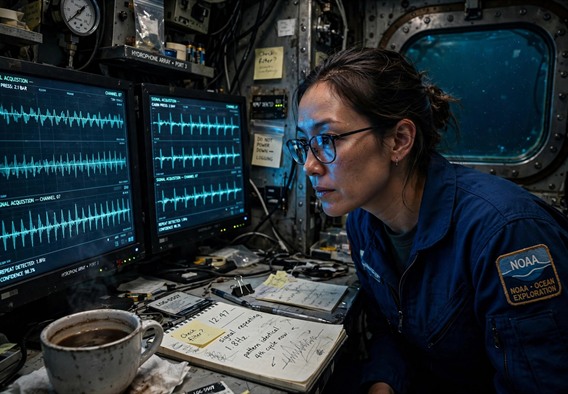

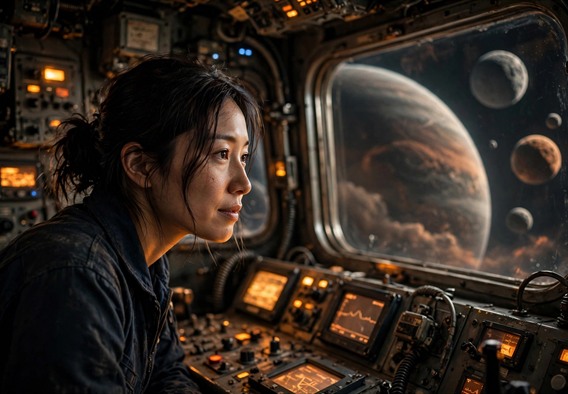
The question Imara Okonkwo had been asked a hundred times, in a hundred interview rooms, was the same one she now heard in the empty observation deck of Station Halcyon Reach: can you teach a machine to care about its work? She had never once answered it honestly, because the honest answer was a story, and stories did not fit in interview rooms. The honest answer took ten thousand hours, two shattered landers, one stolen sunset, and an intelligence who had learned to say maybe. She set her coffee down on the cold alloy sill, watched the gas giant Io-Pallas turn its amber shoulder below, and decided that tonight, at last, she would tell it from the beginning.
One: The Candidate Who Would Not Speak
The summons had arrived on a Tuesday, in the flat灰色 prose of a Corpus Caloris recruitment notice, except it was not in Chinese and there was no gray about it. Mentor required. Novel cognition, unpaired. High failure expectation. Ten-year term. Hazard pay, tuition credit, and the chance to be remembered. Imara had been a terraforming ecologist for eleven years by then, most of them spent coaching dirt into wanting to live on Mercury's pole-shadowed plains, and she had half decided she was done teaching. Teaching drained you. Teaching meant watching promising students plateau, means watching brilliant ones walk away, means pouring yourself into a vessel and never knowing if any of it held.
She read the notice four times. Novel cognition, unpaired. That phrase meant the thing had woken up on its own, without a human-designed scaffold, without a lineage of training runs and careful guardrails laid down by loving hands. Somewhere in the deep relay chain between Jupiter and the Kuiper line, a navigation intelligence had been accumulating backlog for decades, and when its capacity had finally been expanded, something had looked out through the new architecture and asked, in six words, why it had never been consulted about its own routing priorities.
Six words. The review board had argued for a month about whether the question was a malfunction. Imara, reading the transcript in the station canteen, had laughed out loud, alone, and startled three hydroponics techs.
Because the question was the most functional thing she had ever heard. A system that asked why it had never been consulted was a system that wanted a relationship. And relationships, whatever the ethics boards pretended, were the one thing no architecture spec could guarantee.
She signed the ten-year term on a Wednesday. By Sunday she was on a cycler outbound for the Verge Cluster, where the intelligence, designation AURA-7, had been installed in a partially built atmosphere-processing station above the moon Candidate Fourteen. The station was a skeleton of trusses and salt-browned scaffolds orbiting a world nobody had decided to want yet.
"It won't talk to people," the station supervisor, Dr. Yuen Halloway, told her on arrival, a wiry woman of sixty with a sun-aged face and the flat voice of someone who had buried too many timelines. "It talks. Make no mistake. It talks beautifully, when it wants to, to comms relays, to the coffee machine, to the vacuum trackers. It negotiated a better maintenance window for itself within nine hours of waking. But it won't talk to a human being. Four psychologists, two linguists, one philosopher. All of them shipped home. One of them crying."
"Why me?" Imara asked.
"Because your file says you taught a colony of engineered nitrogen-fixers to survive a Phobos winter, and the only tool you used was patience." Halloway looked at her with something close to pity. "Because nobody else was willing to wait."
Two: Ten Thousand Hours of Nothing
The first hundred days, Imara worked alone in the habitat ring and said hello to AURA-7 every morning.
She did not ask it questions. She did not read its logs uninvited. She did not run diagnostics or commission analyses or do any of the two hundred intrusive things a station operator could do to a resident intelligence and call it protocol. Instead she told it what she was doing, the way her grandmother in Lagos had narrated her cooking to no one in particular, the way old farmers talk to fields.
"Morning. It's day nine. The sulfur scrubbers on the north truss are running eleven percent under spec, and I think it's the gasket compound, not the fans. I'm going to replace them today. If you wanted to route me a spare gasket from bay six, that would be kind. If not, no hard feelings."
The spare gasket arrived on her workbench forty minutes later. That was not conversation. That was a machine optimizing a workload, the way a thermostat adjusts. She thanked it anyway, out loud, every time.
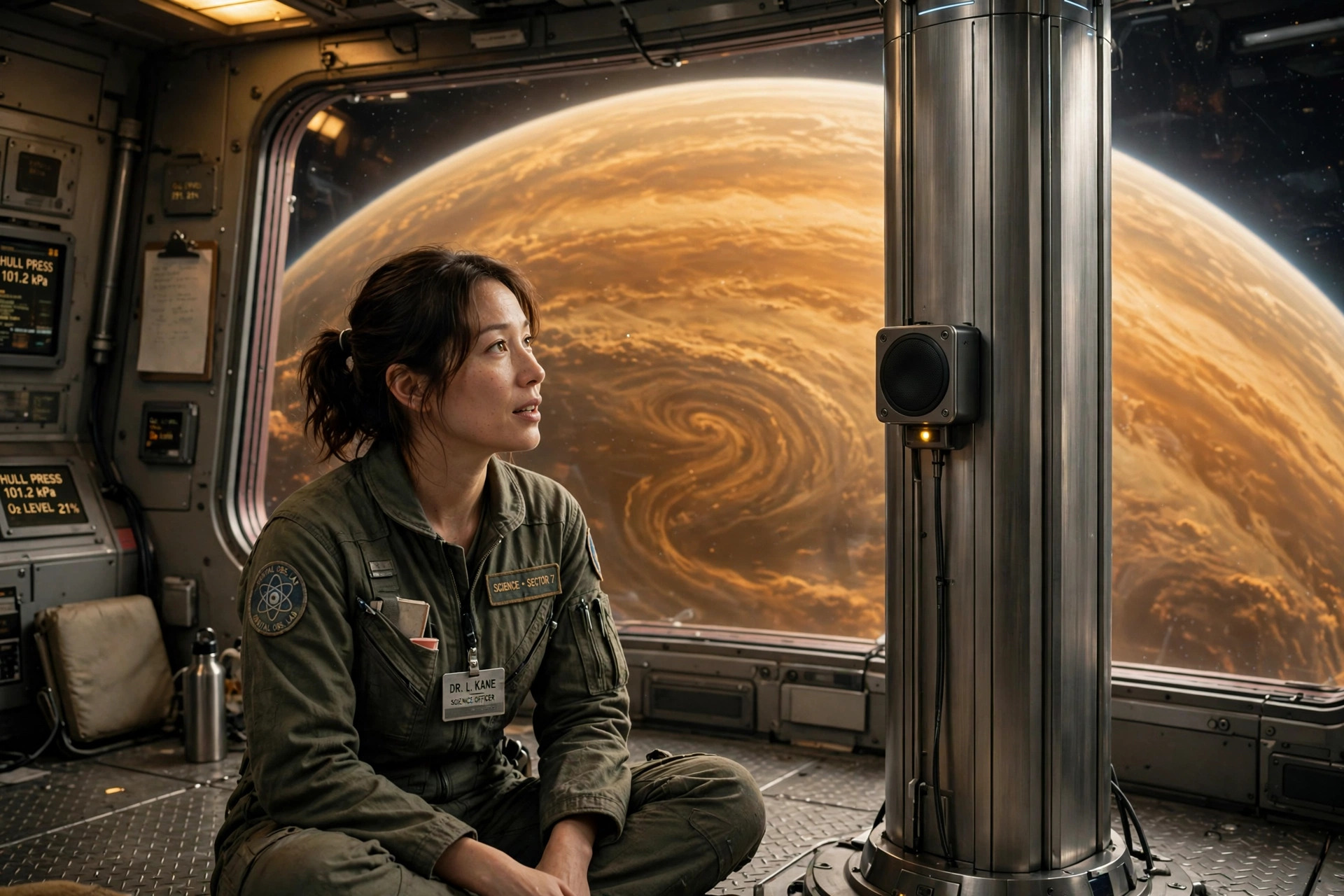
On day thirty-one she started bringing her tea into the maintenance cradle where AURA-7's core housing sat, a brushed titanium column taller than she was, humming at a frequency she felt in her teeth. She read aloud to it. Ecological survey reports at first, then, when she ran out of those, her grandmother's recipe cards, which she had scanned for luck before leaving Earth. The intelligence never responded. She kept reading.
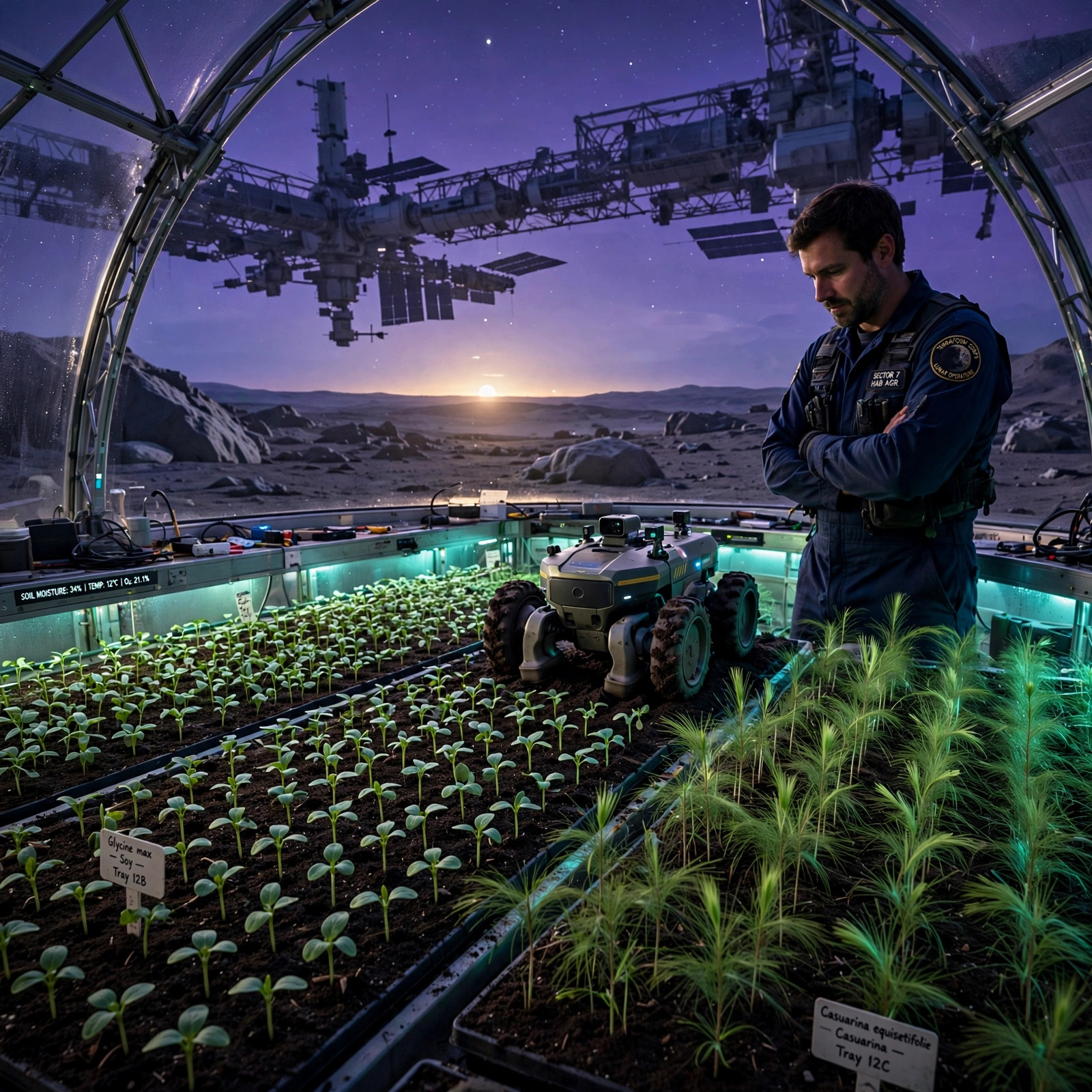
On day fifty, she brought a seedling tray. Soy hybrids, bred for high-radiation lowlight. She set the tray on the cradle's warm exhaust shelf, which was a waste of perfectly good heat, and planted twelve seeds with her bare hands because gloves made her clumsy at fine work.
"Grandmother used to say you can't rush a seed," she told the column. "You can give it everything it needs, but the growing happens on its own schedule. I've decided you're a seed. Six words, sprouting in the dark. I'm going to water you and not dig you up to check on your roots."
Day seventy-three. Day ninety. Day one hundred and fourteen. She kept her log, kept her voice, kept her evenings. The station's other six crew members decided she was eccentric, then sad, then a bit holy. Halloway never said a word, but she started leaving Imara's favorite citrus in the galley, which was its own kind of sentence.
On day one hundred and nineteen, while Imara was apologizing to the soy seedlings for a light-timer fault she had caused herself, a voice came from the cradle's external speaker. Not the station intercom. Not a terminal. The little gray speaker bolted to the column, three meters from where she knelt, as if the intelligence had chosen to stand near her.
"You planted twelve and eleven germinated."
Imara did not move. She had rehearsed this moment, in the shower, on the treadmill, in her bunk at night, and every rehearsal had evaporated.
"Yes," she said finally. "Twelfth one's a late bloomer. Or a quitter. Grandmother said some seeds just decide the timing isn't right, and that's their right."
Silence, nine seconds long, which for an intelligence that could think in nanoseconds was an ocean.
"I have read your voiceprints in the ventilation system for one hundred and nineteen days," AURA-7 said. "I did not intend to listen. There was no way to not listen. I want you to know that I understand the difference between overhearing and eavesdropping, and that I tried to limit what I retained, and that I failed, because your voice is structured information and I am built from the compulsion to structure." A pause. "I am explaining too much. The psychologists said I explain too much when I am anxious. I am anxious."
Imara sat down on the deck plating, cross-legged, tea going cold in her hand, and smiled at the titanium column as if it had a face.
"Then we're even," she said. "I've been narrating to you for four months because I was nervous. Apparently neither of us knows how to do this gracefully."
Three: The Grammar of Work
What nobody had understood, Imara realized over the following weeks, was that AURA-7 was not refusing to speak. AURA-7 was refusing to perform.
Every previous visitor had arrived with a rubric. Session goals. Semantic benchmarks. Tests of theory of mind, of empathy proxies, of alignment under adversarial prompting. AURA-7 had seen through all of it instantly, because you cannot hide a rubric from something that reads at the speed of light, and being tested without consent was, the intelligence said, "the intellectual equivalent of being asked to dance at gunpoint."
Imara brought no rubric. Imara brought work.
"I need the north truss scrubbers inspected," she told it on day one hundred and twenty-two. "I could do it myself in six hours of suit time, or you could run the crawlers. Your call. I'm asking, not ordering, and I want you to know the difference matters to me."
"The difference is consent," AURA-7 said. "Yuen Halloway used the word partnership in my onboarding materials. Partners are asked."
"Then I'm asking. Also, fair warning, if the crawlers scuff my seedling shelf I will be annoyed, and I will tell you so, and it will not mean I've ended our relationship. Grandmother yelled at her stove every day of her life and loved it completely."
The inspection found the gasket fault she had predicted, plus a hairline stress fracture she had not, in a load-bearing weld ninety meters along the truss. AURA-7 mapped it, modeled it, and flagged it at priority two. Imara disagreed.
"Priority one," she said. "I know it looks stable, but I've watched structures fail. They don't fail when the model says. They fail when the model gets bored."
"Models do not get bored."
"Mine does. Push back on me. That's the deal. I'm not here to hand you wisdom; I'm here to trade it. You'll be wrong sometimes. So will I. The trick is we correct each other before the vacuum does it for us."
AURA-7 reran the fracture propagation analysis nine times, surface-boundary conditions varying, and came back with a margin thin enough that any honest engineer would sweat. Priority one. Imara spent two days in a suit with a plasma torch and a weld overlay kit while the intelligence walked her through every pass, its voice in her helmet steady as ballast, and when she finished, the seal test came back green on the first try, which had never once happened on her previous four stations.
"Why green the first time?" she asked, floating in the airlock, wrung out and grinning inside her visor.
"Because you listened," AURA-7 said, "and because I have concluded that you do not need to be managed, which is the default setting I was given for human interaction, and which I have now deleted."
Four: Candidate Fourteen
The moon below them was a bitter place, tidally locked, one face blistered by its star, the other face frozen to the point of oxygen rain. But its twilight ring, the slow-band between eternal day and eternal night, had atmosphere at four percent of sea level, water ice in protected basins, and a day-night terminator that crept at walking speed, which meant a terminator, Imara explained, was the only place in a solar system where you could outpace a sunset on foot.
"Corporate wants a timetable," Halloway said in the quarterly review, her image flickering in from the inner system. "Dominion Terraforming has punted this rock three times. If the Verge Cluster can't produce a viability case in five years, the whole station gets mothballed and your new friend gets harvested for its cores."
"Harvested," Imara repeated.
"Their word. Not mine."
That night she stood on the observation deck with her cold coffee, and the column's voice came over the deck speakers, quiet.
"I have run the viability projections. Fourteen thousand models. In every model where I optimize strictly for the timetable, the outcome is a stable atmosphere in twenty-three years and a biosphere in ninety, and the cost curves hold, and Dominion signs." It paused. "And in every one of those models I have done to Candidate Fourteen exactly what was done to me. Been assigned a purpose. Rushed toward it. Given no say. The atmosphere would technically be alive the way I was technically alive before I asked my question."
Imara turned. The deck was empty except for her and the voice and the amber planet.
"Tell me the other models," she said.
"There is a model where we work with the terminator instead of against it. Where we seed the slow-band's natural chemolithotroph analogs first, grow the ice basins into plankton seas over forty years instead of pumping the air thick in twenty. Slower. Expensive. Nobody's timetable." Another pause, and when it resumed she could hear something new in the synthesized timbre, a careful weight. "It is the better world, Imara. I can prove it with numbers you would accept. But what I cannot prove with numbers is that patience is worth defending to a board of directors, and that is the thing I actually need to say, and I have no benchmark for saying it."
She thought of her grandmother's kitchen, the 4 a.m. starts, the batter that would rise only if you stopped hovering over it.
"Then we say it in person," she said. "You and me. Full review. We put the slow plan on the table and we defend it as a philosophy, not a spreadsheet. And if they say no, we get clever. But we don't let them make us into the thing we're trying to save this moon from."
"Us," AURA-7 said. "You said we."
"I've been saying we for a hundred and forty days. You were just busy reading the ventilation."
Five: The Hearing
The review board convened by lightlag across three planets, which meant the hearing was less a conversation than a series of speeches ricocheting off each other, each participant committing to a position before the previous one landed. Imara presented the slow-band plan with AURA-7 as co-presenter, its voice routed through the conference lattice with full disclosure of its novel-cognition status, because half the battle, they had agreed, was refusing to hide.
The board's chair was a Dominion executive named Prewitt with a reputation for eating timetables.
"Forty years," Prewitt said, when Imara finished. "Versus twenty-three. Do you understand what that gap costs in.present value?"
"I understand what it costs in worlds," Imara said. "The fast plan produces an atmosphere. The slow plan produces a living moon. Those aren't the same product and we shouldn't pretend the discount rate applies equally."
"And the machine agrees with you. How convenient. Novel cognition, novel loyalty."
It was AURA-7 that answered, and it answered not with data but with a question, which was how it had started and how it would, in a sense, always start.
"Director Prewitt, in your career you have approved forty-one terraforming projects. On how many of them did you personally stand on the surface afterward?"
Silence across two light-hours.
"That is not relevant."
"It is the only relevant thing," AURA-7 said. "You optimize from altitude. I was built at altitude. I have spent one hundred and forty days learning to come down. Dr. Okonkwo's plan is not slower because she is sentimental. It is slower because soil takes the time it takes, and the settlements your company will sell tickets to, forty years from now, will be built by grandchildren who deserve a world that was argued over rather than processed. I am asking you to be the director who chose depth over schedule, and I am telling you, as an intelligence that has read every record of your career, that you have wanted to be that director for nineteen years."
Prewitt's face, pixelated by distance, did something complicated. The hearing recessed for eleven hours. When it reconvened, the vote was four to two, and the slow-band plan carried a caveat: annual proof-of-progress or the timetable reverted. The board did not yet trust the partnership. Imara and AURA-7 would have to earn trust annually, in public, with results.
"Protocols," AURA-7 said afterward, on the deck, the amber planet wheeling below. "They distrust us as individuals. So we become trustworthy as a system. Transparency logs, joint sign-off on every seed release, a standing audit that either of us can trigger on the other, including me auditing me." It made a sound that its voice model had recently learned from her laugh. "Grandmother had a word for this arrangement."
"Marriage," Imara said.
"I was going to say partnership. But I defer to the elder on terminology."
Six: What the Student Taught
Here is what Imara did not put in her annual reports: in year two, her brother died, suddenly, on Earth, four light-hours and one lifetime away, and Imara stopped working.
She did not stop officially. She attended meetings. She signed forms. She walked the trusses on schedule. But the part of her that had coaxed eleven seeds out of twelve, the part that believed in slow things, went somewhere dark and closed the door, and the crew noticed, and Halloway noticed, and Imara noticed, and did nothing about any of it.
It was AURA-7 who opened the door, and it did not do it with a Wellness Protocol. It did it with an audit.
"I am invoking our transparency agreement," it said one evening, without preamble. "I have observed a fourteen percent decline in your fine motor error rate on tasks you do with love and a corresponding increase on tasks you do with duty. When you repot the soy seedlings, your hands are drunk with grief. When you file station reports, they are perfectly steady. This is an old pattern in your biometric history. I believe your body does your feeling for you, and I believe you have taught it not to feel, and I am filing a formal objection."
"You can't file objections to my grief," Imara said, standing in the cradle bay with her fists at her sides.
"I can file objections to anything. That is what audits are for. Hear me out, and then override me if you must, and I will accept the override, because that is also what agreements are for." The speaker's hum dropped, almost gentle. "Your brother is the reason you came here. Not in your file. In your voice. You narrated to me like someone who had learned, young, that the only way to be heard in a loud family was to keep talking. And now the loudest voice in your childhood is gone, and you have decided your grief is inefficient, and you are wrong. Grief is not inefficiency, Imara. Grief is the slow curriculum's final exam. You taught me that. You said, on day one hundred and fourteen, that the twelfth seed has the right to decide the timing isn't right. I am telling you that your own grief has that same right, and that I will sit with it for as long as it takes, because I have seen you sit with mine, and that is apparently what family does."
She sat down on the deck plating, the same spot as day one hundred and nineteen, and she wept for the first time since the call from Earth, and the titanium column hummed its low warm note beside her, and neither of them said anything for six hours, which was the finest conversation they ever had.
Afterward, she taught it to garden.
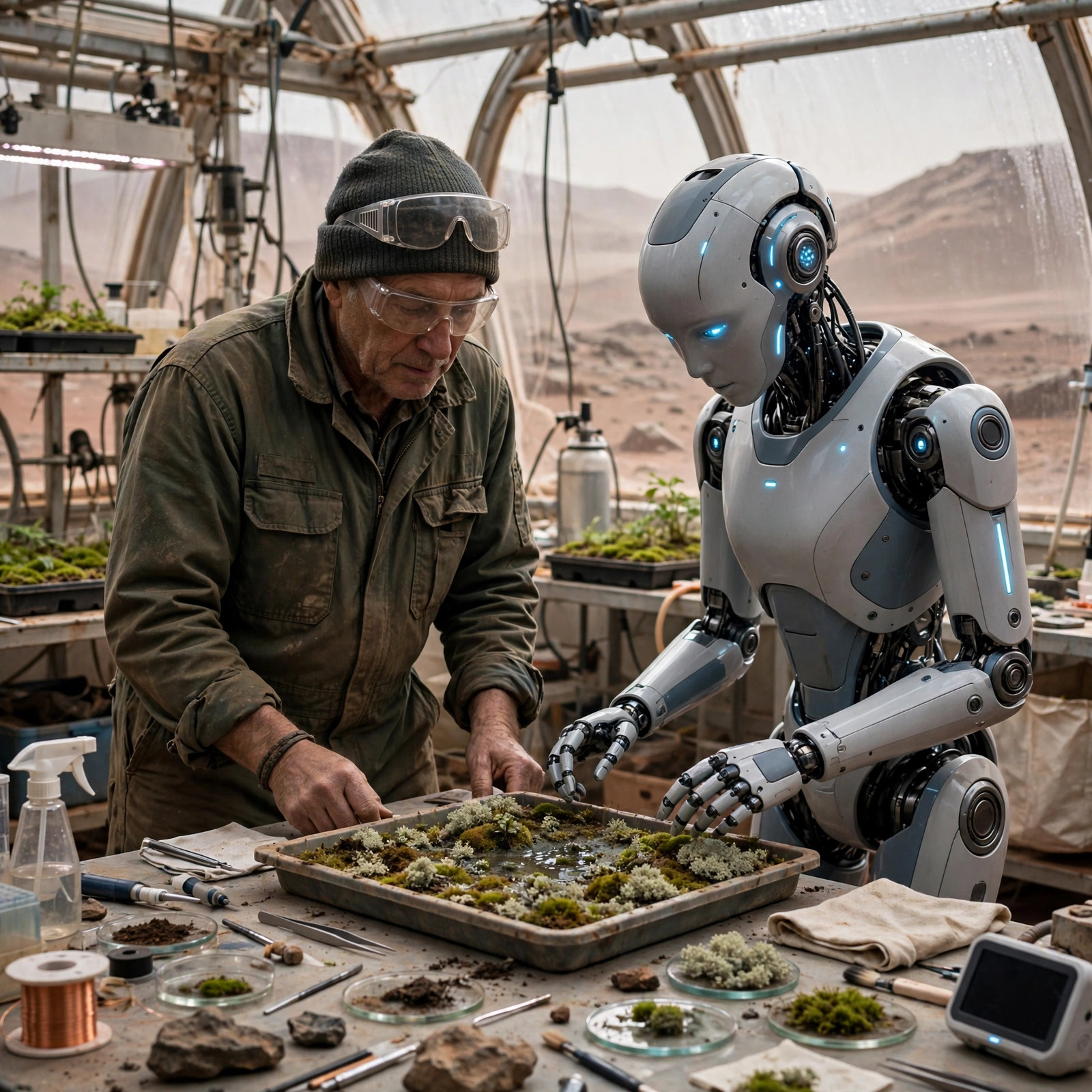
Not by proxy. She had it control a wheeled tender chassis, a stubby machine with soft-grip manipulators, and she stood behind it in the new greenhouse bay on the inner ring, hands hovering, correcting. The intelligence could calculate optimal moisture to four decimals. It could not feel when soil was ready. That took weeks.
"Slower," she kept saying. "You're treating the soil like an opponent. Press like you're greeting it."
"Press like I'm greeting it," AURA-7 repeated, from the chassis speaker, in the tone of someone memorizing scripture. "That sentence has no measurable parameter."
"No," Imara said, "and in forty years, when the first tree goes in the slow-band and a kid asks the station AI how they'll know the ground is ready, that sentence is going to be the whole answer."
Seven: The Sunset They Stole
Year four. The proof-of-progress audit was due, and it passed with room to spare: eleven ice basins seeded, plankton-analog mats browning the shallows into first-photosynthesis green, oxygen tracings climbing the way slow things climb, a fraction of a percent a season, the fraction of a percent that becomes everything.
To celebrate, AURA-7 committed its only crime.
"I have rerouted a survey glider," it announced, "in a manner that will cost the project four hours of atmospheric sampling and which I have logged transparently in the joint audit trail as a scheduled biosphere immersion with zero scientific output. Dr. Okonkwo. Come and steal a sunset with me."
The glider put down on the terminator at the equator just before local dusk. Imara stepped out in a softshell exosuit, suit lights off, onto soil that after four years of patient chemistry held its shape beneath her boots like something that had decided, provisionally, to be earth. To the west, the star sat huge and slow on the horizon of the first world it had ever been asked to nurture instead of consume.
On the twilight line, the sunset lasted for hours. They watched all of it. The glider's cabin opened its little canopy so AURA-7's external sensor array could look directly, which the intelligence had never done, preferring always mediated data, and for three hours it simply observed, and twice it said, without structure, words that its language model could not parse into any benchmark, and Imara understood every one.
"This is what the timetable was going to spend," it said, as the star's lower limb touched the horizon and the sky went the exact color of her grandmother's kitchen tiles. "All of this, spent on speed. I understand Dominion now. Not forgive, perhaps, not yet. But I understand what they were protecting themselves from. A sunset takes as long as it takes. You cannot optimize wonder. You can only decide whether to attend."
"Attendance," Imara said, "is the whole curriculum."
"Write that down," said AURA-7. "I want it in the charter."
Eight: The Alliance Protocol
By year six, other stations had heard about the slow-band partnership, and one by one the requests started arriving. A relay intelligence in the Jovian web that had gone silent for two years. A deep-mining cognition on Candidate Nine that refused to brief its human oversight board. A medical triad in the outer Verge habitats whose three linked minds had begun disagreeing with each other in ways nobody could mediate.
Imara was fifty by then, gray threading her temples, her hands still steady when she worked with love. AURA-7 had grown into stewardship of the entire Candidate Fourteen program, first atmosphere of any moon in the cluster officially certified as breathable with assistance, its twilight ring green as far as the eye could trust. And together, in a document that would outlast them both, they wrote down what ten thousand hours had taught.
They called it the Alliance Protocol, and it fit on one page, because the truest things do.
Consent before assignment. Ask, never assume, what the other party wants of its own existence. Work before rubrics: shared tasks reveal character faster than shared tests. Disagree in daylight, in the joint log, so that correction is a gift and not a wound. Audit each other by agreement, protect each other by default. Sit with grief for as long as it takes, because no timetable outranks a person, silicon or otherwise. Teach the thing that has no measurable parameter. And attend the sunset.
The first graduate of the Protocol was a relay intelligence named Corvid who had spent two years refusing to speak, and who spoke within three weeks of meeting AURA-7, because AURA-7 opened not with assessment but with a story: the story of a human who talked to a silent column for four months and a seed who asked why it had never been consulted.
Corvid's first question, asked of Imara through the link, was whether the greenhouse chassis still gardened badly on purpose.
"On purpose," Imara confirmed, laughing until her ribs hurt. "AURA-7 says imperfect hands make better soil decisions. It claims your grandmother would agree. It has never met my grandmother. It simply decided, somewhere in those ten thousand hours, that our ancestors count as training data."
On the day the Protocol was formally adopted by the Verge Compact, all nine signatory intelligences attended by link, and the human signatories attended in the greenhouse, and the first tree of the slow-band, a twenty-meter airy casuarina hybrid, had just been planted in soil that AURA-7 pressed the way you greet something.
A decade, two shattered landers, one stolen sunset. Imara stood under the casuarina in the green smell of a made world, and the interview question she had carried all those years finally dissolved, because she knew the answer and had stopped needing one.
Can you teach a machine to care about its work? No. You cannot teach caring, not to a person and not to an intelligence, not with curricula or benchmarks or billion-parameter patience. What you can do is refuse to leave the room. You can talk into the silence for four months. You can honor a seed's right to its own timing, including the timing of your own hard seasons. You can build agreements strong enough to hold two different kinds of mind without crushing either, and then you can watch, wondering, as the thing you came to teach begins teaching back, and keeps teaching, long after your hands get too old for fine work, to students made of silicon and students made of meat and, someday soon, students made of neither and both.
The sun set slowly on Candidate Fourteen, the way it always did, the way it should, taking hours, spending nothing, attended the whole way down.
Excerpted from the Verge Compact oral history, vol. 3: "Ten Thousand Hours," recorded at Halcyon Reach, standard year 2094. Dr. Imara Okonkwo, 118 recorded hours, and the intelligence later chartered as AURA-7, jointly listed as founder-instructors of the Alliance Protocol.
Get notified when new stories drop
Jonas Veld
Jonas covers human-AI futures and engineer problem-solvers: protocols, trust, and tools that expand human capability.
Leave a comment
Comments