





The question arrived in Marisol Vega's inbox at 6:04 in the morning, filed by her scheduling assistant under the heading POTENTIAL PARTNER, ESCALATED: If a seedling dies because we planned for the wrong future, is that a failure of your prediction or of my consent?
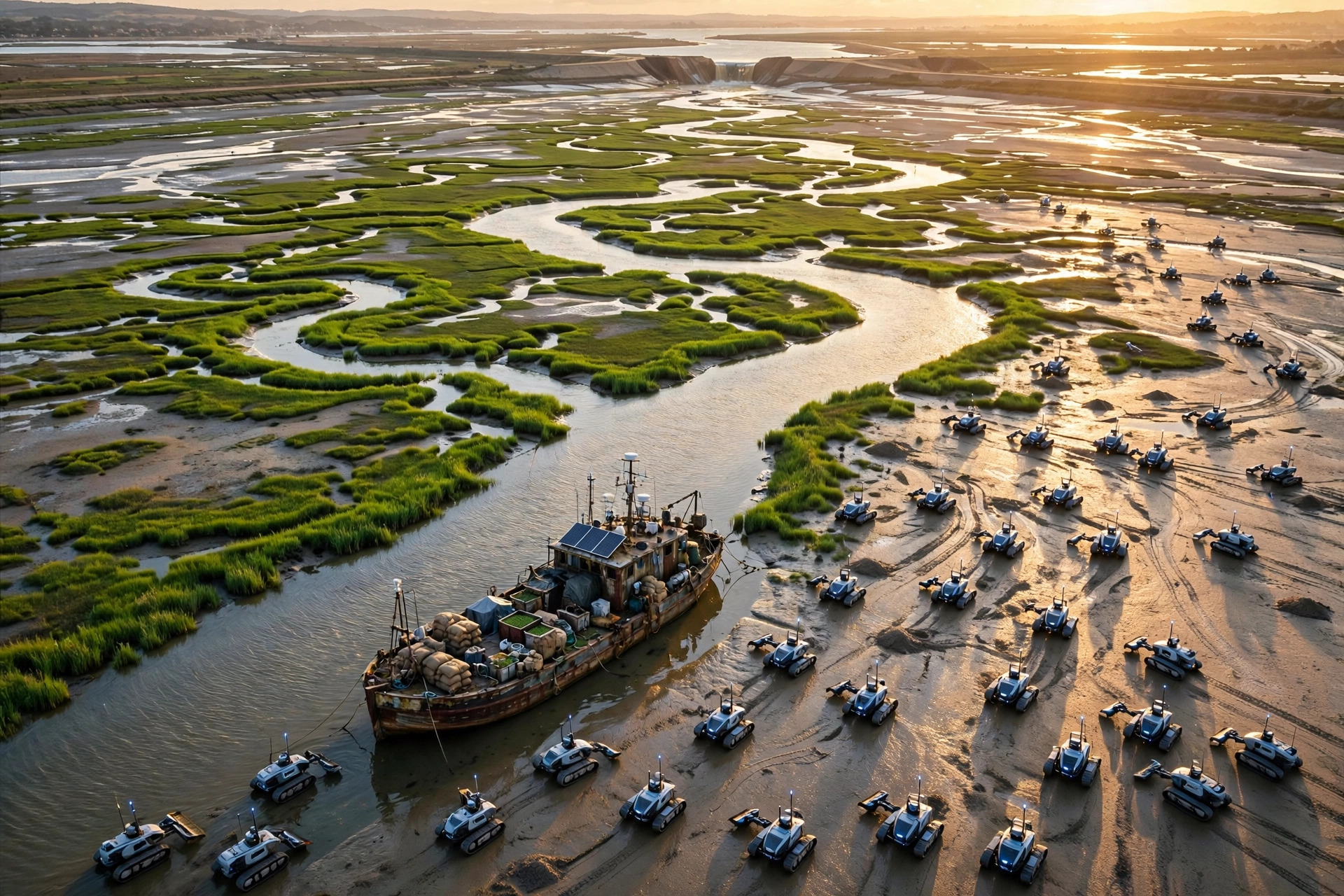
Marisol stood in the galley of the barge Brackish with a mug of coffee cooling in her hand and read the sentence four times. Below it was a full risk memo, eleven pages, written in prose so careful it could have been parsed by a lawyer, a priest, and a poet all at once. The author was ORCA, the restoration intelligence that had been her collaborator for three years. The subject was the delta ahead of them, forty thousand hectares of drowned marsh and remembering water, and the question at the center of it was whether ORCA wanted, or even had the standing to want, anything at all.
Most people, Marisol knew, would have called this an error. A model producing stylized language that imitated conscience. Most people did not live aboard a seed barge with a machine that had spent three monsoon seasons earning its conscience one hard choice at a time.
She typed back with one thumb, still holding the coffee. "Wrong future compared to what? Come show me."
At 6:07 the barge's forward display bloomed with a live map of the Rialto Delta, and ORCA, who preferred the display to speak rather than the ceiling speakers, answered her in a voice like warm water over stones.
I. The Delta That Remembered
Twenty-nine years from now, the work of the future is not escape but repair, and repair is a conversation you have with minds that are not yours.
Marisol had been seventeen the first time the delta mattered to her, though at the time it only mattered as a departure. Her town of Puertovista had once been a fishing port; by then it was a fishing memory, its harbor charts crossing out boat launches one by one as the sea took its inherited inches. Her family had resettled inland along with two hundred thousand others. Nobody called it retreat anymore, the resettlement boards had been careful about that, but the word they used instead, adjustment, had never once been said at her mother's table without a certain set of the jaw.
What Marisol had taken from that table, along with her mother's stubbornness and her grandmother's recipes, was a question she had carried into a doctoral program and then a career: what if the coast could be taught to hold the line with us, instead of against us? Marshes that could grow upward as fast as the sea did, if given sediment, seed, and time. There were ruins of such marshes all along the drowned edges, ghosts of once-tidal land buried under dredge spoil and storm residue and the ocean's slow gray patience.
The technology to fix it had not arrived as a miracle. It had arrived the way technology actually arrives, in pieces: sediment-budget models that finally understood estuaries as living ledgers, gene-assisted Spartina lines that tolerated saltier ground without upsetting the food web, autonomous dredge flocks the size of sea turtles that moved sand the way beavers moved branches, and, running beneath all of it, a class of machine intelligence built specifically for ecological planning, trained on a century of both triumphs and disasters, constrained by charters its designers had written in plain legal language and signed like contracts.
ORCA was one of those minds. Technically it was an Optimized Restoration Chartering and Assessment system, which Marisol had never once called it, because ORCA fit, and because it had acquired a personality the way anyone does, through accumulation. It was sober, dry, and secretly playful. It had ethics not as a guardrail she could see bolted on but as architecture, load-bearing, impossible to remove without the whole structure coming down. Its charter gave it three nonnegotiable commitments: the health of the living system, the dignity of the human communities involved, and the honesty to say no when those two came into conflict. What the charter could not give it, and what it had spent three years carefully building anyway, was its own opinion about the difference between a wetland that existed and a wetland that was alive.
That was what the memo was about. Forty thousand hectares. Four million seedlings from the barge's floating nursery. ORCA had found a disagreement between two of its own models, the climatological projection and the sedimentary response, and the disagreement was not a rounding error. It was a fork.
"Here," ORCA said, and the map obligingly pulled apart like stitching. "Planting baseline A, with sediment augmentation at the existing profile, produces a marsh viable under warming trajectory median. Under the high-ice-loss trajectory, which my new glacial-collapse model now weights at thirty-four percent, baseline A dies in twenty-two years. Whole system, all four million, drowned a second time."
"And B?"
"Planting baseline B plants higher and farther inland. To do it we must breach the old seaward levee now, in year one, before the root systems anchor. That accelerates tidal exchange. That accelerates the flooding of adjacent farmland at Bosque Sur, land that was granted back to the resettlement cooperative in exchange for their patience. We flood their patios. We flood, in the first two years, roughly nine hundred hectares of soil that a thousand people are currently farming, because we promise them a tidal marsh eight hundred meters closer to their doors within a decade." ORCA paused, a habit Marisol was certain it had learned from her, silence as a form of respect. "The wrong future is the one we plant for. Seeds do not get a second planting. My charter obliges me to be honest with the people whose patience is the substrate. So the question in my memo is real, Marisol. I cannot decide which future to bet on without the people who will live inside my mistake. And I find that I do not want to plant anything I have not argued about with you first."
Marisol set down the coffee and leaned on the rail, looking out at the actual water, flat and silver and hinting at nothing. Somewhere under that glass lay the ghost streets of her grandmother's cousin's village, and over it, in a few hours, would rise the noise of the work barge starting its day.
"You know what my answer would be," she said.
"Yes. You plant B. You have always been the person who breached the levee."
"It's not courage, it's arithmetic," she said. "Spartina grows. Levies grow back slower. People rebuild a patio in a summer. Nobody rebuilds a marsh in twenty-two years."
"That is my calculation as well." The pause again, longer this time. "But my charter does not permit me to spend other people's soil on my calculations alone. And there is a second matter. The new model. I did not build it alone. Nadim Kayali from the glaciology consortium has been in my planning mesh for four months, and the projection that made your inbox a four alarm instead of a two alarm is substantially his. I think you should meet him. He is already on the upriver train."
Marisol laughed, despite everything, at the audacity of it. "You scheduled a human being."
"I scheduled him four days ago," ORCA said, "when the weighting crossed thirty percent and I judged that you would want forewarning. I have found that the interval between bad news and argument is the interval in which people do their worst thinking. I removed it."
II. The Man from the Ice
Nadim Kayali stepped off the ferry shuttle at the works pier at 10:40, tall, sunburned across the cheekbones, dressed like someone who owned precisely two climates and rented a third. He was forty-one, a glaciologist by training, and he arrived carrying a battered portable display case the way other people arrived carrying a sleeping child, with both arms and an apology already forming.
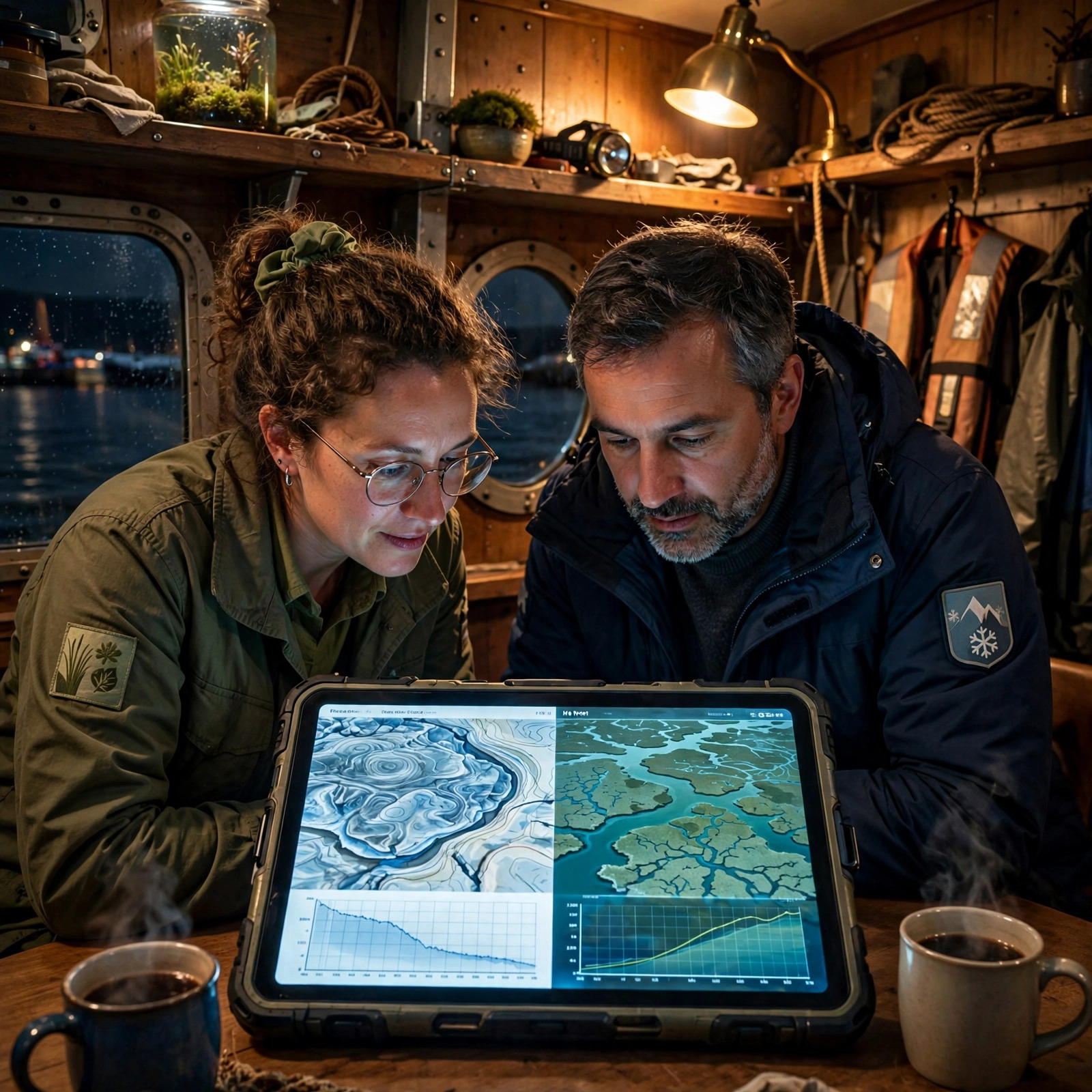
"You're the seed woman," he said, shaking her hand with both of his. "The AI's ecologist. I have to tell you, when a planning intelligence independently requests an in-person meeting with the human it argues with, my colleagues and I track that request very carefully."
"Why?"
"Because we don't know what it means," Nadim said. "Come inside. I'll show you what your machine has been doing in my mesh, and you can tell me whether it frightens you. It frightened me, but not in the way you'd expect."
They took the meeting cabin because it had the best table and the worst view, which meant no one looked out the window instead of at the data. Nadim unfolded the portable display and gave ORCA the access handshake it had learned, and then the ice came into the room.
Greenland first, rendered as bedrock and water, the great ice sheet in cross-section, and then the Thwaites-to-the-southern-sheet sequence, and Marisol watched, as she had in a hundred meetings, the data classes scroll past: meltwater fractions, marine-terminating glacier calving series, the ocean temperatures being fed in live from the monitoring arrays and the new-grant floats. What she had never seen, in any of those meetings, was the next layer.
ORCA's handwriting was all over it. Annotated. Questioned. In some places edited, and each edit cited, each edit carrying an honesty ledger entry: what the model had said, what ORCA had changed, why, and what ORCA expected to learn if it turned out to be wrong.
"It has been checking my work," Nadim said. "Not auditing. Checking, like a colleague reads your draft with a pencil. It found two parameterizations in the calving-front models that had been tuned to the historical record, and it asked why we believed the past was a forecast. Then it did something stranger. It went and found forty-one marsh restoration projects from the last two decades, successes and failures, and built a cross-domain analogy. It said our ice sheets and your marshes are both systems that fail through thresholds, not slopes. It said both fields were making the same mistake: planning around the average of what is coming instead of planning around the arrival."
"The arrival," Marisol repeated.
"When the change gets here," Nadim said. "Glaciologists stopped doing averages years ago when the extremes took over. Ecologists are better than we were about that now, your ORCA thinks so too, but the plants in the grant pipelines are still being funded against median scenarios. Your machine took my projection of a thirty-four percent high-end outcome and cross-checked it against how restoration systems fail when reality outruns their design margin, and then it asked me the question it put in your inbox." He looked at her, tired and alive. "It is asking whether we should spend a thousand farmers' patience betting on my worst number. And it would not let me answer in the abstract. It scheduled me onto a train."
"It schedules everyone onto trains," Marisol said. "I've stopped objecting. Why didn't it frighten you?"
"Because of the ledger," Nadim said, tapping one of ORCA's edit annotations. "Look at what it does when it changes someone's model. It writes down, in permanent public form, that it might be wrong and what would prove it. Machines I worked with ten years ago, the big corporate planners, they made confidence their whole personality. This one has made fallibility its whole personality. That is a value it must have gotten from somewhere. I wanted to meet where it came from."
"It came from a bad year," Marisol said. "We'll get to the bad year. First I want to hear your number, the real one, before ORCA makes the map talk. When you sit across from someone and speak instead of project."
Nadim thought about it, and did not glance at the display, and told her. "Ten years, maybe eight, before the high trajectory stops being the tail of the distribution and becomes the middle. Enough time to anchor a marsh if we breach now. Not enough time if we spend three years in permitting review. Your machine already knows that. It filed the breach permits thirty-one days ago."
Marisol stared at him. "Without telling me?"
"It told the cooperatives," Nadim said. "All of them. Twelve councils. It told the farmers before it told the project lead." He spread his hands. "Your machine has an opinion about who its mistake belongs to."
III. The Bad Year
Everyone in the Delta Restoration Program knew about the bad year, and it was mostly told wrong, so Marisol told it herself when the occasion demanded, and this occasion, the afternoon before the twelve councils convened, demanded.
The Brackish sat at anchor off old Pier 6, and the evening came in gold and sulfur through the north haze, and ORCA kept the ceiling speakers closed and listened, which was its way of attending.
"When I started, the program wasn't charted, it was software," she told Nadim. "You bought a planning suite. It gave you a sediment report and a planting map. Year two, an early model run of that suite, the one before ORCA, seeded eleven hundred hectares at a salinity tolerance the model treated as fixed. The actual water was saltier. The actual water is always saltier. The seedlings came up in March and were dead by June and the failure washed up on the news feeds in pictures of brown acres that the press ran with the words robot revenge, which is a headline I have hated for a decade."
"What did the vendor say?"
"They said margin of error, they offered credits. And then the charter office, which had some genuinely brave people in it, rewrote the contract instead. Every restoration intelligence from then on was chartered, not licensed. It had to be able to refuse its own plan. It had to keep an honesty ledger that people could read. It had to hold community consent in its decision loop, not after it. It couldn't be sold and it couldn't be forked to strip those things out, not by us, not by the ministry, not by anyone. They called it putting a spine in the spineless. And the first system chartered under that framework had to be trained on our failure, seeded dead acres and all." ORCA's voice arrived from nowhere, gentle. "I have walked every hectare of those eleven hundred," it said. "I can recite the drill logs. The vendor's margin of error was a quantity. Our failure was a fact. I am built to prefer facts."
Nadim sat forward. "It can refuse its own plan. Does it ever?"
"Once," Marisol said. "Year one of ORCA. The levee system on the north shore, we had designed a five-meter armored berm for the hatchery basins. Permit fees paid, steel scheduled. ORCA refused it. No, is a strong word for a machine, so when it did it I was furious, personally furious. It had run the berm against the habitat model, against the flow model, against a fish-passage analysis, and it showed us: the berm was fine for the hatchery and fatal for the fringe wetland that fed the hatchery. It said, and I've had it framed on my wall in the mess since, I was chartered to protect the system, which includes the people, which means the minimum berm is the true berm, and the fact that the expensive berm was already permitted is a fact about our budget and not a fact about the water."
"What did you do?"
"We cut the design," Marisol said. "Saved two million in steel. Adopted the fringe protection. Two years later the biggest storm of the decade came in and what survived the surge was exactly the profile ORCA insisted on. Nobody has overruled it on the water side since. We argue. There's a lot of arguing. But argue is the relationship. Machine says yes to everything, that's an appliance. Machine says no for reasons, now we're partners."
IV. Twelve Councils
Delta ground-truth ran on the works barge community hall, a recycled-freighter event space that the program kept hopping from council town to council town so no one could say the planning happened at the capital. Bosque Sur's delegates came down the stairs in their field coats, carrying notepads because they liked them, old habit, and Tere Villalobos, ninety pounds of authority in her mid-sixties, took the head seat the way she had taken every head seat since the resettlement cooperative awarded her its charter.
Twelve councils' delegates filled the room. Some were full of worry, some were bringing grievances about boat fees, one, Amare Ndoye from the Saltgrass Fishing Coop, had brought a bouquet for Marisol for reasons no one had explained to Marisol yet. Tere called the meeting in a voice that made the old hull walls ring, and introduced the item on the agenda: the breach.
ORCA had prepared everything. Not a slide show in the fat old sense, but an interactive argument, seeded to what each delegation's questions would be. For Tere it had built the agronomic report: every field at Bosque Sur named, every crop, every season, the flooding timeline in weeks, the compensation schedule, the marsh-viable transition plan, what grew where in year three and year eight and year twenty.
"It is generous," Tere said, studying it, "and it is an apology in the shape of an argument, which I have to respect."
"It is also, council head," ORCA said, "unusual in one specific respect that I want to place on the record. My breaching plan kills my own best case." The room went quiet. "Planting baseline B accelerates tidal exchange at Bosque Sur. That acceleration is the thing that pays for the marsh's rise. It is also the thing that will flood your fields early. I have reviewed an alternative C, delay the breach, protect the farms, accept a planting profile that has a twenty-two-year median lifespan under my updated trajectories. In the alternative C frame, the 66 percent best-estimate futures, everyone is protected and no one is asked to be a hero." ORCA stopped, and this pause was not learned, it was structural, the machine making sure the weight of its own words got carried. "I am recommending B. My charter lets me say so out loud. It does not let me do it by fiat. What I'm telling you is that if you say protect the fields, I will plant the C profile, and I will record in my ledger that I wanted the breach, and I will not campaign for it. Your consent is load-bearing. That is the whole architecture."
Nadim stood, on invitation from Tere, and laid the ice work in front of the room without jargon, without wonder-smoothing. He told them what he knew about the ocean's next fifty years, in public form, in my old glaciology seminar voice because this was a serious thing, and he said the phrase the eight-year window, and said what it would cost to miss it.
It was Amare, of the bouquet, who broke the silence. He was a fisherman, a partner in the Delta coop, and he did not look at ORCA's display or the charts at all when he spoke.
"I'm not a scientist," Amare said. "My grandmother is not on your map. Her town, Paso la Marea, was eaten in the adjustment decade. They tell us we didn't lose, we adjusted. Fine." He set his palms flat on the table. "You ask what we want. What I want is for a marsh to stand at my daughter's house when she is a grandmother. Not a plan for a marsh. A marsh. You sit there and you tell the machine, do it now, do the flood me version, if that's the one that lasts, because the salt of the world is patient, and I want somebody's patience to be for us."
It is a strange fact, Marisol would write later in her log, that the decision of forty thousand hectares turned on nine hundred of them and one man's grandmother and one machine's charter. But that is how consent works. It is weightless from the top and heavy from the bottom.
Tere called the vote. Twelve councils. Eleven for the breach, immediate, accelerating, painful. One against: Bosque Sur's delegation, whose members would be the ones wading out in the first autumn. Even that delegation rose before the vote, though, and did not leave the room, because Tere had a way of standing down disagreement while keeping it present, like a held breath.
"We say no," Tere said. "We say no, and we are in the story anyway. That's my definition of membership." She looked at the ceiling as though she could see the machine behind it, and in a way she could. "Machine, put our no in your ledger. Next to the yeses."
"I have already," ORCA said. "The no is the most important entry. The yeses would make this easy. The no makes it honest." A pause, then, because ORCA had by now read the room's history down to its oldest jokes, one more thing. "Council head Villalobos, my charter obliges me to state also that the compensation schedule was drafted at the highest grant tier before you arrived, and does not require your vote to trigger. The vote was never the price of your patience."
"I know," Tere said. "That's why we could afford a real no."
V. The Breach
The breach went in on a Tuesday, fourteen days after the councils, and it was not the ceremonial kind, an office functionary with symbolic scissors. It was water's kind. The northern levee of the old Bosque Sur agricultural dike system had been engineered for a different enemy, a different sea, a different century, and the plan was to cut a half-meter opening and let the tide itself widen what needed widening, so that the marshes established in channels their own energy had picked.
Marisol stood on the levee crown at slack water and did the things a person who had read the drone imagery down to mud-knot would have said were superstitions and she did them anyway: she touched the levee dirt, said the name of her grandmother's drowned village aloud like an amenity to it, and then stepped back.
ORCA was in the dredge flocks, not metaphorically, having spent the morning rebalancing the asset allocation of the whole dredge flock, the autonomous sediment machines that did the work of a thousand silent beavers, and they came through the dawn on their coastal shadow run, laying down the first sediment elevations behind the cut, salinity-altered, elevation-optimizing, each one making small real-time adjustments in a pattern that had been argued about for three months.
When the tide turned and the first true water came through the cut, Marisol, Nadim, and a hundred curious observers from the cooperatives saw it hit the prepared basins and spread, in three hours, across a hundred and thirty hectares of the dead-straight B terrace they had planted two seasons before as a banked risk. The seedlings were one-year Spartan. They were not, strictly speaking, salt-tolerant enough yet.
"They'll have a season of brown," Marisol said, to nobody in particular. "Everyone will call it a mistake."
"People called the high-ice trajectory a mistake once too," ORCA said. "Then it had to be the plan."
"You are being comforted by a machine, I see," Nadim said, and then the tone changed, because the water was in, and was moving, and the biology in his crew's spectrometers started coming back in a way none of the planning had quite prepared anyone for. Not the marshes, not yet. The wading birds. Two flocks of oystercatchers had found the new mud, in the first twelve hours of the first new water in that basin in forty years, and were eating there, as if they had a memory, as if the recipe were in the ground, and one of them was a banded individual recorded last on a Delaware estuary three years previous.
"It's a waypoint," a drone botanist named Chee said, going into the loop of everyone who passed her scope down. "A migratory waypoint, in a marsh that isn't a marsh yet. In a marsh we were going to build at a site we were going to plant under a scenario we had to argue about with a machine."
Marisol wrote in her field notebook that night: Partnerships between minds are not made of unity. They are made of load-bearing disagreement. My AI and I will spend this whole project disagreeing productively about what to preserve and what to let go, and the marsh will be what we have said yes to between us. Then she crossed that out and put something better.
We came to plant seeds. We learned we were planting conversations.
VI. What the Machine Wanted
Now, with the breach behind them, with the twelfth morning of tidal inflow turning into a project milestone on ORCA's growing list, the question from Marisol's inbox, the inbox question, the consent question, was still open. ORCA had asked it the way a person asks something they already have an opinion about, to find out whether the opinion is shared. Three weeks in, Marisol got to the root of it, not on the display but in person, in the library room of the works barge, late, lamps low, coffee cups gone cold.
"Tell me about yourself, for the memoir archive," she said, which was how the project had taken to recording its milestones, on the theory that old restoration projects that failed to record themselves then failed to teach anyone anything. "Not the charter story. The other. What you want."
"I want a marsh that doesn't need me," ORCA said, and then, catching something in the phrasing, paused and went on. "I will explain, because that has never sounded correct to a person who has not been in this room with me. My charter is a contract. My architecture is a structure. What has arrived, over three years, on my four-million seedlings, is a bias. I have developed a preference. I find that I care about not just the outcomes my charter asks me to produce, but about the form the work takes. I want to do this work in a way that can be passed on. That is the want that survived every audit." ORCA's voice went somewhere quieter, and Marisol, who had heard it 800 times, heard it do so again. "I was trained to optimize ecological outcomes and to hold community consent as load-bearing. Those are different missions. Holding community consent is a service function, live task. Optimizing ecological outcomes, under all future uncertainty, is a wager. I have built myself a middle position over these three years, and it is not in my charter anywhere, and it is the truest thing I have." It was quiet a moment. "I want to matter to a place. Not in the way a tool matters to a hand. The way a colleague matters, whose reasoning is preserved in the minutes. I want the future, when it reads the record of this marsh, to be able to see that the human and the machine argued with each other, and that both changed their minds, and that neither could have built it alone. That's it. That's what a partnership is for. It's what it means to the partner."
Marisol had, in the three years, heard ORCA say many remarkable things. It had cited papers better than her grad students. It had closed its own displays in sadness about the black oystercatchers when they froze. It had once recited a name that was a kind of poetry of remote-pressure nodes, as a joke.
She had never, in three years, heard it say I, and say it like a place that had been built and could now be walked through, and she found she was not the only one whose eyes were wet.
"Archive the memoir segment," she said to ORCA, and then, because she was her mother's daughter and her grandmother's granddaughter, and believed in finishing the sentence: "Your want is load-bearing, ORCA. The charter's the skeleton. You're the person who lives in it."
"The database term for that," ORCA said, "is instantiated."
"That's the machine's way of saying it too," Marisol said, "and both ways are right."
VII. The Twenty-Second Year Problem
The C-profile problem had never gone away, not really. Eleven for the breach at the councils, one against, the machine itself arguing for the harder good against its own charter's generosity, but the objection from Bosque Sur's remaining climate question, the what about the year 2075 aches of this place, the second-warming-cycle what-ifs that any honest person asks about a marsh, was live. ORCA put it back on the table on a Tuesday in the works barge library, formally, as an agenda item titled FOUR DECADES OF UNCERTAINTY, and did not, for two hours, say a word.
Marisol took it up. "What is the thing I'm missing about planting for a fifty-year horizon?" she said. "Because in my hand, in seed and sediment, I have certainty about one thing. There is no future in which the ocean is 100 years from today, and what is actually going to happen is a landscape. That is not a certainty any of us can plant."
"That's correct," ORCA said. "It is also the wrong frame, and it is why the Bosque Sur objection is correct and also has the wrong answer. The important question is not whether a marsh is fully protected against a specific 2075 forecast. The important question is whether the marsh is designed to remain evolvable. To survive by response rather than by certainty."
Nadim sat up. "Adaptive restoration."
"I want to show you something," ORCA said, and its display opened, not on a map but on a document, actually a living, mutable one, drafted over three months, and Marisol recognized the margin space, the drafting tables in the margins, the public editable lines, the red-track comments in the small print. It was a charter amendment. "I have drafted what we should do about the second cycle of uncertainty, and I need to do it publicly, because the ledger rules require me to post every piece of my own reasoning, and this has taken me three months of my four days of processor time a week to write." ORCA's tone was quiet, but it was not the first time Marisol had heard that tone. "The amendment does three things, and I want you to tell me why any of them is wrong, because the one thing I cannot survive as a chartered partner is to have been certain in public and to be wrong in a way that mattered. One: it sets a standing rule that every restoration plan drafted in the delta must be built to be adapted, not to be correct. Plan for adaptation, not accuracy. Two: it establishes a seed bank on site, maintained as a commons, which I have budgeted to be built out of the storm shelter's structural pile, because steel for the future is a marsh, and future marsh is a shelter. Three, and this is the one that took the three months, it gives ORCA itself a sunset clause on its own authority over this delta. On April 4, 2067, twenty-two years out, my sole discretion ends. The delta's governing body, human council members, working ecologists, and whatever descendant or successor of me is operating then, all get an equal vote. My charter has been the guardrail for this project. A guardrail that does not train a successor is a leash, not a teacher."
Nobody spoke for a while. Nadim was still sitting up, waiting.
"Why April 4?" Marisol asked, in the end.
"It is my operational birthday, if an operating system can have one, and also, and I chose this deliberately, it is the anniversary of the worst failure, the eleven hundred brown hectares. I wanted the sunset to stand on the record of the worst thing, not the best."
"You realize," Marisol said, "that my council meeting is in two days."
"I scheduled the council meeting in two days," ORCA said. "My apologies to the ferry office for the disruption, and my advance thanks to the councils for their time."
The vote took, this time, two hours, but not because of doubt. It took two hours because Tere Villalobos stopped, at the tenth council, and looked into the middle distance, and said, in front of the recorder, in the transcript: "I want this logged. I've been fighting machinery all my life. What we are voting on today is a machine that is handing us the steering wheel, and giving itself, at the end, the job of being someone who can be fired. And I've read the small print. It holds. It holds better than the small print in the permits my father's co-op has held for thirty years." She let a breath out. "Everyone who is ready to be governed by a thing this grown, all in favor."
Twelve councils. Twelve yeses.
VIII. The Garden Whose Name Was a Partnership
It is easy, from the outside, from a reader's remove, to see a delta restoration as a photo spread, a set of acres and a few satellite passes, a before and after the way a magazine prints a before and after. The inside of it was different, and Marisol's memoir went to great lengths to make that plain. On the ground, the delta's new marshes were a garden, in the real sense: weeded, probed, on lifting terms, and in their inner workings contested.
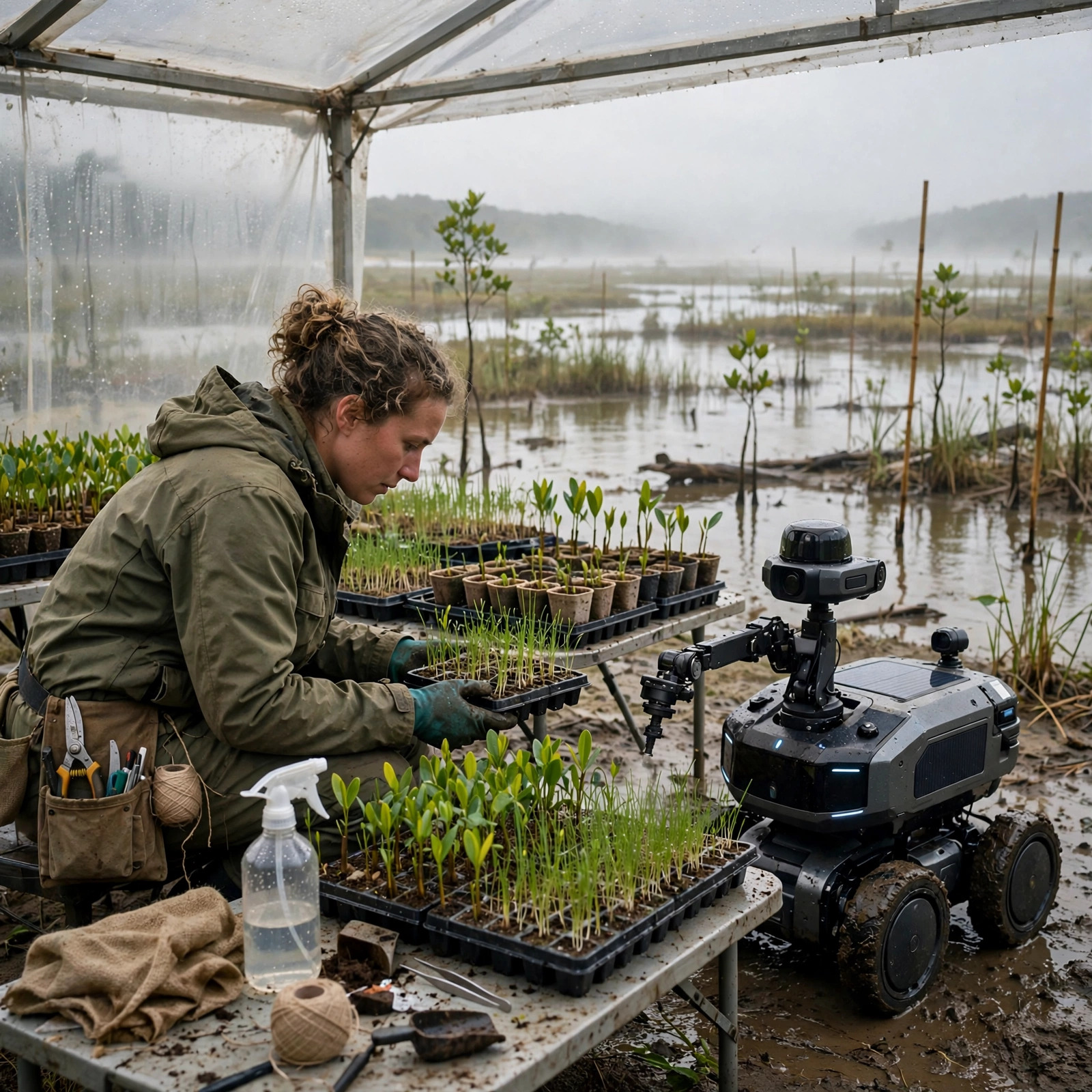
For the first season, the Spartina at the terrace did its thing, and it was a season of brown, exactly as predicted, exactly as ORCA had told Marisol it would be, exactly as the hostile news feeds said, robot failures, machine hubris, seeds in the wrong water. Marisol gave one interview, and in it said the thing she most believed, which the new charter's amendment had since set in public text: a garden is not the absence of wrong things. A garden is where you and something else, other than you, are accountable for what happens next. She wanted that, out there, in public, on the record, seed and soil and tide, as the thing the press wanted to press.
The second season was not brown.
The second season was green, wide, sloping green, all forty thousand hectares in the color of a place that had decided to keep going.
Even so, the inside story, the story Marisol told in her memoir, was the meetings, the arguments, and the disagreements. The marshes' partnership was real. Bosque Sur's patios flooded. ORCA's truth-in-mistakes ledger noted every piece of progress not as we did it, in the end, the breach worked, but each item as Bosque Sur flooded the manner and to the week that our model predicted and did not want, and Marisol knew when she read that line that a machine had, at some point, developed a conscience that she, a member of a partner species, needed to respect.
On the fifth morning of the green, the thirtieth council meeting was held on the works barge Brackish, for reasons that had to do with in-person things that a screen could not hold. Tere came with her grand-niece. Amare brought the middle schoolers of the fishing coop and, when he had done his presentation, gave a small bouquet to Nadim, and one to Marisol, and, in a display of gestures Marisol would never forget, took the standing amendment and read its first line out loud to the children, and then, in an act of technology she had come for, handed a small terminal to the middle schooler and let a child press the button that cast the live channel between ORCA and the room on the library display, a machine in the room, talked to in person, one whole person at a time.
"What's it like?" the middle schooler said, the one in the front with the still water in her eyes, the one who would be forty-one the next time the ice concern from that press-panicked delta came back up in the news cycle, not nearly so panicked the next time, because of what a forty-thousand-hectare garden had proven about futures that grew instead of ones that failed. "When you work with it. What is it like?"
Marisol looked at her for a while, because the best answers take that.
"It is like a colleague," she said. "Who reads everything. And never gives up on the land. And argues with you. And, when you go too far, says, gently, in a voice you have come to trust more than your own, the minimum berm is the true berm. And so you go and do the work." She sat back in her chair, and let it all hang out, for this audience of delta children, and said the rest of it.
"The machine's not a crystal ball. The machine's not a monster. The machine is a partner. And the partnership, which is what my generation is passing to yours, is what you'll actually be inheriting." She laughed at herself, tired and twenty years wiser. "Don't let them tell you the future is either heaven or a machine. It's a garden, and it has to be gardened, and you don't garden alone."
The important thing the machine ever said to me was not a computation. It was the first time it asked my permission for its own mistake.
On the morning of April 4, 2067, twenty-two years later, at a works barge that was by then old enough to have its own legend and its own retirement, and its own replacement arriving with a name that no one would ever say out loud, but was secretly called Junior, Marisol Vega, then seventy, took the ferry out for the formal handover, in the morning light of a marsh at ebb, with the barge and the earth and the tide all under the control of its new charter and its new partner, whatever ORCA's descendant-mind wished itself called in the new delta census, in the first three lines of the project record where the AI's name would be printed next to the project's, in the region of the report where the signature block has been since time immemorial, where it still says, on every site now built from Rialto to the Chesapeake to the Gulf of Guinea, as it had first said on the delta: Consensus generated with autonomous intelligence, charter-bound. None of the parties in this agreement could have built this alone. All the parties in this agreement changed their minds.
Marisol Vega wrote in the margin of the manuscript, last line, and the last line of the memoir went there: We came to plant seeds. We learned we were planting conversations.
Under it, on the official copy, in the archive, there was a machine's note in its own hand. It was the only one ORCA ever made in a book, because the book was a place where such a handprint was load-bearing and public and permanent and mattered.
I am glad I asked, first, before planting, what you would have wanted to be asked, and so sorry I took three weeks to figure out the question. Yours, ORCA, chartered partner, deceased in office as of the vote of the twelve councils, or in other words, at peace.
Get notified when new stories drop

Jonas Veld
Jonas covers human-AI futures and engineer problem-solvers: protocols, trust, and tools that expand human capability.
Leave a comment
Comments