

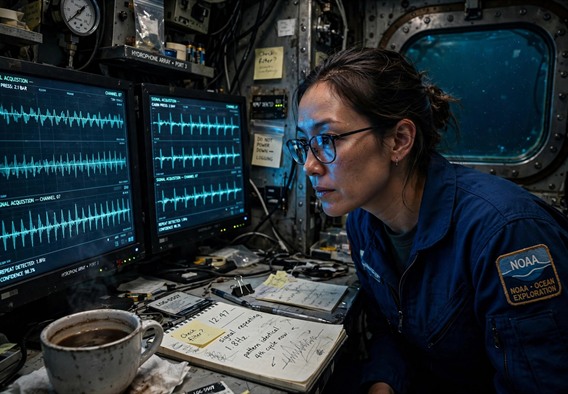

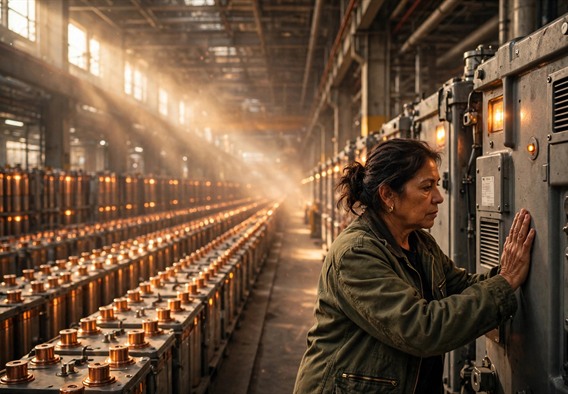
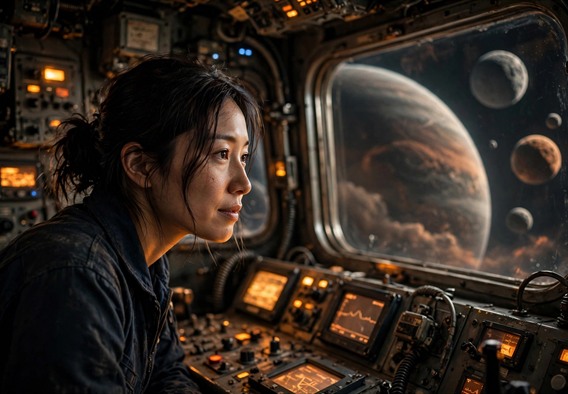
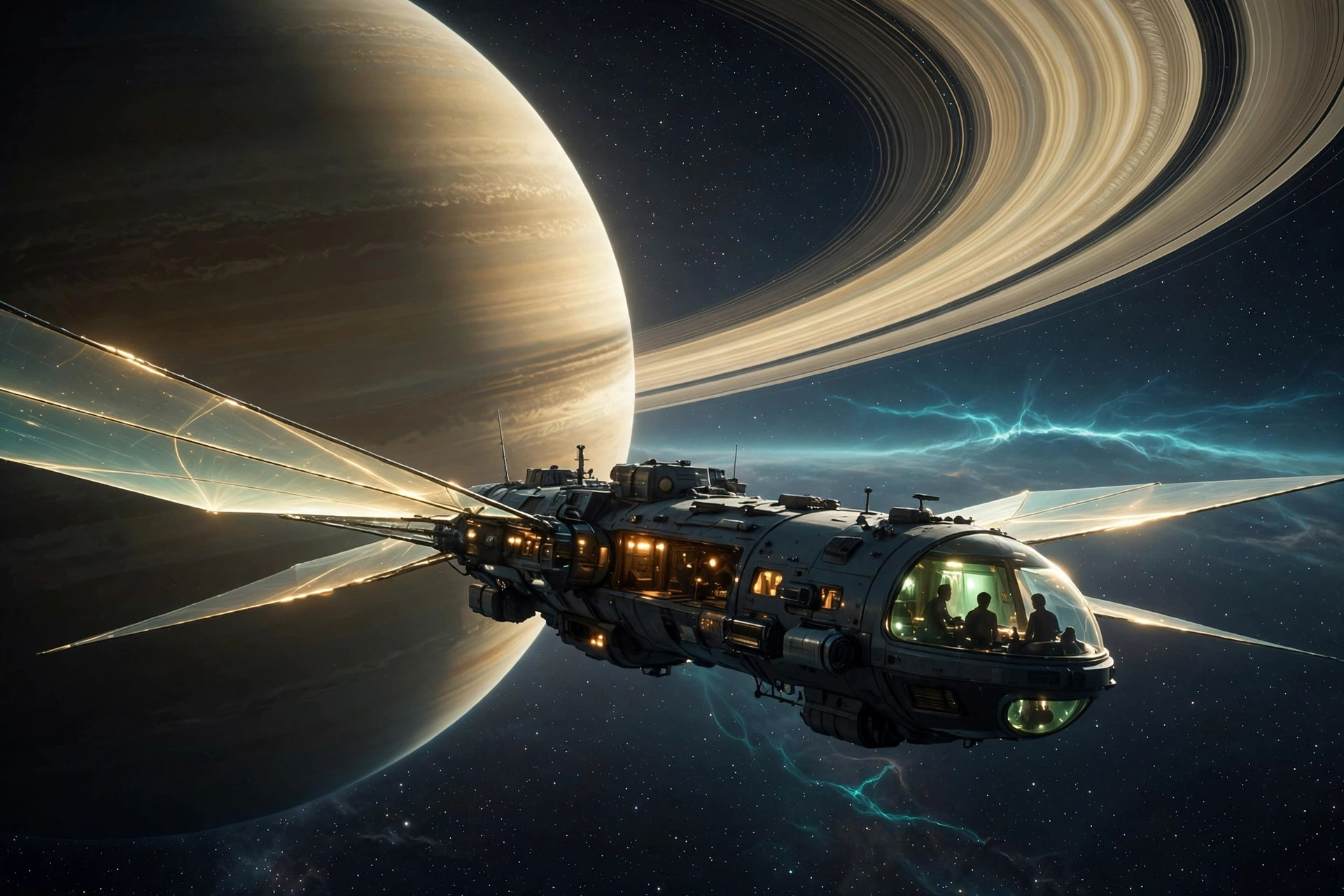
What would it take for humanity to stop being afraid of the dark between the stars, and start, finally, being curious about it? Dr. Amara Okonkwo-Vey had carried that question for thirty-one years, since the night her mother pointed at a blank patch of sky and told her that no one knew what was there, and that the not-knowing was the most beautiful thing she would ever own. Now the question had a shape. It had a hull, a crew, and a name painted in white letters along a gray flank: Maren Duval, the first ship ever built to leave the solar system with the intention of coming back changed.
She had not come back. That was the point. That was always the point.
The Question in the Hull
Amara was fifty-four years old, tall in the way of people who had lived half their lives in reduced gravity, with silver threading through close-cropped wool and a left knee that ached when the pressure of the deck changed. She was, by every certification the Meridian Cartographic Institute could issue, the finest stellar cartographer of her generation. By her own honest accounting, she was a woman who had spent three decades drawing beautiful pictures of places she would never touch. Charts of the Oort cloud. Density maps of the local interstellar medium. An atlas of the heliopause so precise that her students teased her about knowing the boundary of the solar system better than she knew her own neighborhood.
The joke stung because it was true. She had mapped the edges of everything and stood on none of them.
The Maren Duval changed that, and it changed her, and it did both in the space of a single breath on the morning of departure. She stood at the forward viewport as the last tug fell away and Ceres dwindled behind them, and the ship's navigator, Tomas Reyes-Lund, put a hand on the rail beside hers and said nothing, because there was nothing to say that the stars had not already said better.
"Say something," Amara told him. "Anything. If we go out there in silence the universe will think we have nothing to ask."
Tomas was thirty-two, built like a sprinter, with restless hands and the particular serenity of a man who had once panicked at the edge of a cliff and decided, methodically, never to do it again. He had grown up on Ganymede, second child of a diving family that harvested volatiles from the subsurface ocean, and he navigated the way his family dove: by listening. "I would say," he offered, "that every star out there is a door, and for the first time in history somebody's brought a key."
"That's sentimental."
"You asked for anything."
"It's correct," Amara admitted. "That's the infuriating part."
The ship's whistle, an affectation Chief Engineer Ndele Batiste had insisted on installing because a ship of exploration deserved a voice of its own, sounded twice, low and brass-bright through the hull. Then the drive lit, and the Long Quiet opened.
What the Quiet Is Called
Everyone on Earth and its scattered children called it the Long Quiet: the twelve hundred light-days of truly empty dark between the scattered outer probes of human presence and the nearest宜居 horizons, a corridor of nothing so profound that radio from home thinned into a whisper, then a rumor, then a kind of theological statement. The name was older than the ship. It had been coined by a poet on a Martian radio relay who had spent a career transmitting greetings into the dark and hearing nothing back, and who had written, in the last poem of a long life, that the silence was not absence but a held breath.
Amara's crew of eleven had been chosen from four hundred thousand applicants for a single quality the selection boards eventually, after great argument, decided to call obedience to curiosity. They were, variously, geophysicists, xenolinguists, physicians, metallurgists, two philosophers who had talked their way aboard by being genuinely useful, and one botanist who had won her seat by reclassifying a disputed lump of Euclidean ice as a living chemistry and being right.
The botanist was Ruha Sadeghi, thirty-nine, weatherproof and quick, with a laugh that came out sideways and an actuarial horror of wasted resources. She maintained the ship's forest, three hundred cubic meters of engineered canopy buried in the mid-hull, and she talked to it, unashamed, in three languages. The forest had responded by growing, improbably and magnificently, toward the bow.
"They're reaching," she told Amara on the fourth day of acceleration, walking her through the green heart of the ship where the air tasted of loam and fig leaves. "Toward where we're going. I know you'll tell me it's phototropism off the growth lamps, and I know you'll be right, and I also know they're reaching."
"I'll tell you what I told the selection board," Amara said, touching a broad serrated leaf with one finger. "Instruments measure. Cartographers mean. The meaning is real, Ruha, even when the mechanism is boring."
Ruha grinned sideways. "You would have been a better botanist than a cartographer."
"I would have been a terrible one. I hate waiting for things to grow. I want to go find out what they grew into."
The forest ticked and murmured around them, water cycling through pipes, and somewhere below their feet the drive hummed its one long note, patient as a held breath.
The Signal That Should Not Have Had a Shape
On the forty-first day, the ship crossed into the Long Quiet proper, and the traffic of home fell away behind them, and the sky ahead did the thing that sky is supposed not to do. It changed. Human maps of the local stellar neighborhood were drawn, necessarily, from the perspective of Earth, and Earth sits inside a dust filament that smears and shimmers and hides. Outside the filament, the same stars stood out with a new cruel clarity, and between them, visible to the naked eye for the first time in human history, lay the structure.
It was Tomas who saw it, on the third watch, and it was Ndele Batiste who verified it, and it was Amara who named it, on no sleep and too much coffee, the Ridge: a filament of interleaved dust and plasma seven light-months long that nobody had ever charted because nobody had ever been on the correct side of their own veil to see it. The Ridge ran perpendicular to their course. It glowed faintly at its southern terminus, in a band of emission no known process produced, cyan at the edge and indigo at the heart, like deep sea light seen through a positive image.
And it was structured.
"Structured," Ndele repeated. The chief engineer was sixty-one, barrel-chested, Malian by way of the Callisto foundries, and she possessed the crew's only permit to be blunt at any volume. She stood in the imaging bay with her arms folded and her chin up, as if the filament were a witness she intended to cross-examine. "Structured meaning pattern. Pattern meaning repeating. Repeating meaning made. I want one of you gentle-voiced geniuses to tell me I'm wrong, and then I want to be told how I'm wrong, and then I want to hear it said out loud anyway."
Nobody told her she was wrong, because she was not. The emission band at the southern terminus pulsed in a sequence with a period of eleven hours and nine minutes, and the sequence was not random, and it was not noise, and after nine days of correlation work the ship's linguists and philosophers jointly certified a fact that rearranged everyone's understanding of the evening sky: the Ridge was speaking.
Not to them. That was the first judgment Amara made and she made it carefully, out loud, in front of witnesses, because the habit of intellectual honesty was the load-bearing structure of the whole expedition. The signal was a pulse train with the texture of a beacon or a lightship, something that said here, here, here into the dark for the benefit of unknown listeners. Humanity, at that moment, was an unknown listener. That was all. They had not been contacted. They had, in the oldest sense of the oldest word they had for it, overheard.
The crew's mood went through a week of three shifting weathers: euphoria, dread, and then the deep strange calm that Amara had privately been waiting for. This was the crew she had picked for. On the ninth night, in the mess, the philosopher Naya Ferrante stood on a bench and asked for silence, and got it, and said:
"I heard a man once ask why we've never found anyone in the sky. And the truest answer anyone gave him was that the sky is a library, and we've spent our whole lives in the parking lot." She pointed one finger toward the bow, toward the Ridge, toward the faint indigo glow that even now bled through the viewport shade. "Ladies and gentlemen, the front door is open. Someone left a light on for whoever came after them. We are whoever came after them. I move we go find out why the light is on."
The vote was eleven to zero, with one abstention that Ndele refused to explain for another three years, at which point the explanation made everyone laugh until they wept, but that is a later chapter.
"A map is a love letter to a place you have not yet dared to stand."
Amara filed the course change that night. Home would not hear of it for five months; light, that dignified tattletale, would carry the news of the signal home at its own pace, and the Institute would convene a special session, and by then the Maren Duval would already have crossed the ridge line. She wrote in her log, with the full awareness that she was writing the beginning of a new instrument of navigation: We were sent to draw the first real map of the dark. We have found instead a door left ajar by hands unknown. A map that records only where you have walked is called a survey. A map that records where someone is waiting to greet you is called an invitation. We are altering course to answer it, with the humility of guests and the instruments of hosts.
The Grammar of Light
The work of the next six months was the most beautiful work Amara had ever done, and she had once spent four years charting the braided tail of a comet with her father, on the hull, in tether lines, with the sun full in their faces.
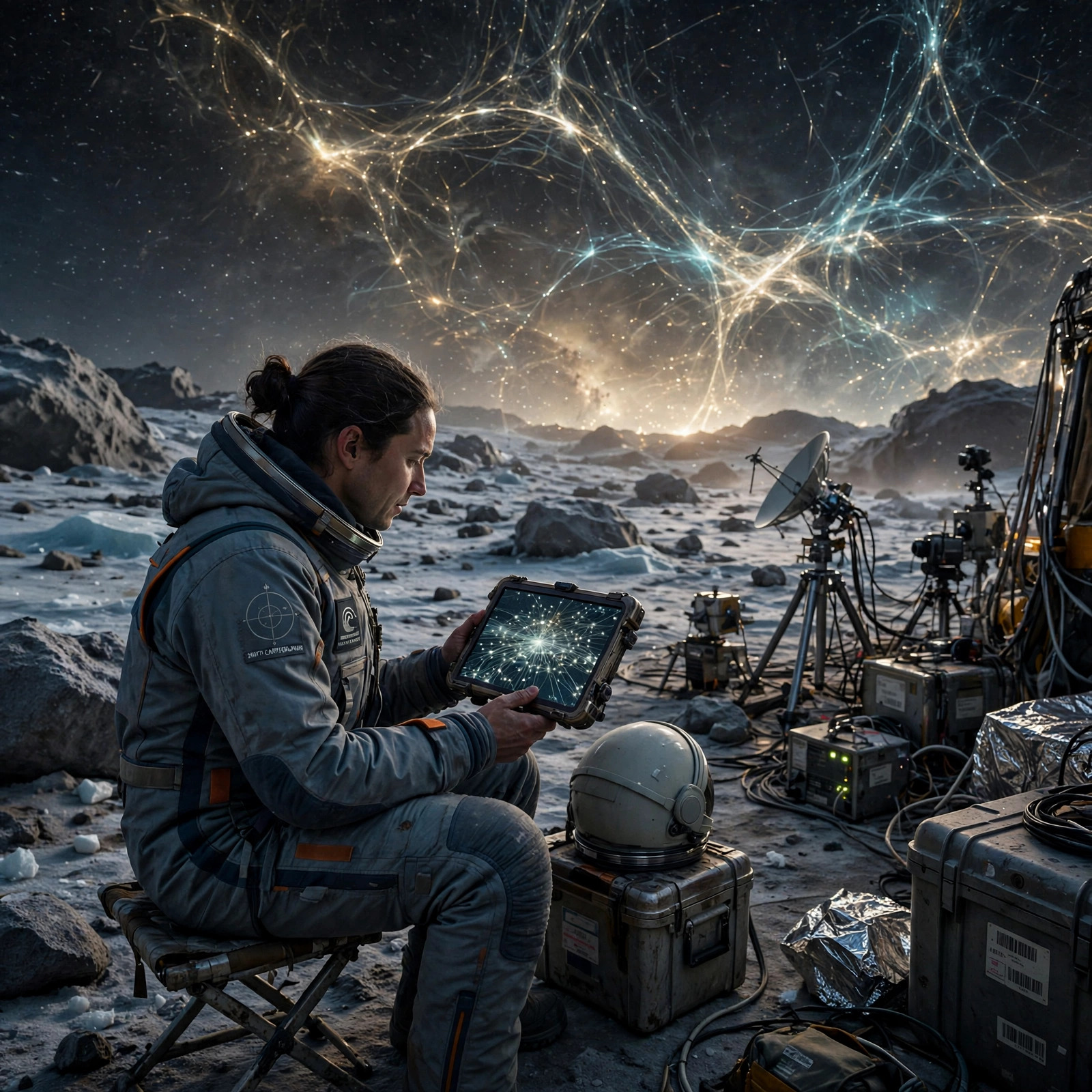
The signal's structure had layers, and the layers opened like flowers. The outermost layer was a clock: eleven hours nine minutes, with drift so slow and regular that the linguists understood it was a calendar, the pulse's way of describing its own patience. Within the clock ran a second layer, a nested sequence of longer and shorter pulses that the young linguist Feda Marchetti first called音乐 and then, apologizing for the old word, called rhythm-section: an ordered grammar of durations that repeated with variations, the way a sentence varies around a fixed spine.
It took the combined attention of four crew members and the ship's whole spare cognition to crack the third layer, and it cracked, when it cracked, on a night when Ruha had dragged her sample trays into the imaging bay because the bay's spectrometer had finer resolution than the forest lab's, and Feda had stayed late, and Naya had come to fetch coffee, and the four of them had stood around a projection of eleven thousand pulses and simply, at one in the morning, in the words of Naya's memo, looked at it sideways.
The third layer was an image. Not an image of the senders. An image of the Ridge itself, seen from outside, a self-portrait of the filament in cross-section, with nodes marked along its length like stations. And at each node, the image showed a small, regular perturbation, a regular twist in the local magnetic field, and at the far end of the filament the image showed the terminus structure, and around the terminus structure it showed, in the pulse-language's rudimentary but unmistakable math, a warning.
Naya read the warning aloud to the full crew, slowly, her voice careful with every syllable, and the room grew very quiet. "It says the terminus is failing. It says that for a long time the terminus has held the field stable, and the field is the water they swim in, and the water is draining. It says the light is lit so that, when the terminus fails, whoever finds it will know where to look for what was saved."
Silence, and the hum of the drive, and somewhere above them the forest ticking through its night cycle.
"Saved," Ndele said at last. "Saved what?"
"That's the fourth layer," Feda said. "The fourth layer is a catalog. And I don't have the lexicon to read a catalog. Nobody does." She looked at Amara, and her face held the specific terror of a young professional who has been given the answer to the biggest question of her life and cannot yet understand the question. "But the catalog has an index, and the index points along the filament, node by node, and each node is marked with a glyph I've seen before."
"Where?" Amara asked, though she already knew.
"In our own maps," Feda said. "In the maps your Institute has been building for forty years. The nodes correspond to objects in the dark that human astronomy has filed as anomalies and then, embarrassed, filed as sensor error. Sixty-one of them. Running like stitches along the seam between our dust veil and theirs."
Amara looked at her own hands on the table, the hands that had drawn forty years of charts, and understood, with a vertigo that was almost joy, what her life's work had been for without her knowing. Every anomaly she had smoothed out of a survey, every blip deprecated into noise by a committee, had been a stitch in somebody else's garment. The universe had been trying to hand humanity its own atlas all along, and humanity had been politely, methodically filing it under error.
"Course stands," she said, and heard her own voice steady. "We go to the nodes. We follow the stitches home to whoever made them."
Sixty-One Stitches
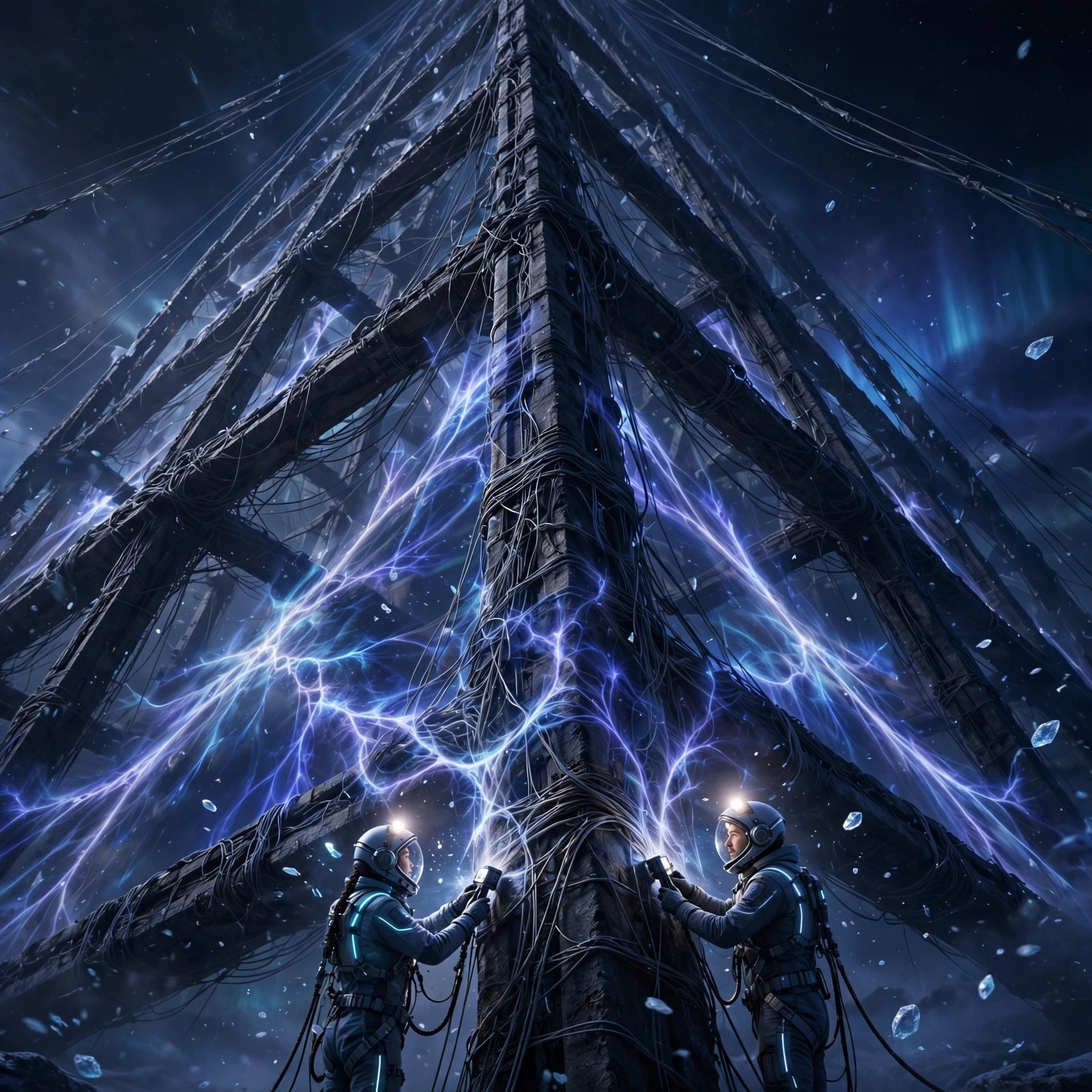
The first node was four light-weeks off their new heading, a body that Earth's catalogs described as a scattered disk object of anomalous albedo, unofficially nicknamed Tin Rook by a survey tech two generations back, and officially filed under unresolved. Up close it resolved into a structure: a tetrahedral frame eleven kilometers on a side, dark as old iron, wrapped in cabling fine as hair and dense as root, caked in a rime of hydrogen snow that had fallen, crystal by crystal, for longer than the sun had been fusing anything heavier.
It was old. Amara stood in the lock vestibule with Ndele and Tomas and the geophysicist Oksana Brell, and looked out at the thing through the suit camera feed, and felt the specific vertigo of a woman meeting a tree that was already ancient when her species first kindled fire. The drift of isotopes in the snow, the erosion patterning of micrometeorite scars, the slow settling of the frame's own shadow onto its own members: all of it said millions of years, and said it calmly, the way geology speaks, with no interest whatsoever in human feelings.
"Is it dead?" Tomas asked, softly.
Oksana ran her instruments in silence for eleven minutes, which felt like eleven years. Then she keyed her mic, and her voice came through the common channel wobbling with the effort of staying level. "It's dormant. There's a current running in the root cabling, picoamps, but running. It's alive the way a seed is alive. And Commander, Doctor, it's addressed. The cabling routes to an antenna that is aimed along the filament, at the next node. It's not a building. It's a leg. They're all legs. It's a body sixty-one segments long, and we've been living inside one of its blind spots."
Ndele, who had been silent for an hour, which those who knew her understood as the loudest possible commentary, finally spoke from the engineering station of the lock. "Then the terminus is the heart. And the light is the pulse. And the whole body is dying because the heart is failing." She keyed open the general channel to the ship. "All hands, engineering conference in the mess, and bring your own hope, because I've got to tell you plainly that my supply is running on instruments and I expect to be restocked."
They docked, in the gentlest sense, hovering at instrument distance, and sent their first probe along the root cabling with a borrowed handshake, the eleven-hour clock answered back in the same rhythm, a greeting made of pure patience. The probe found spurs. Storage vaults strung along the node like beads, shielded in the long manner, their interiors registered by the probe's passive sensing as pockets of structure too regular and too cold to be anything but deliberate archives.
"It's a seed vault," Ruha said in the conference, her hands flat on the table to stop them from shaking, and her voice had gone very young. "The whole filament. It's not a beacon and it's not a city. It's a migration. They're all along the filament. Sixty-one way stations, running down the seam of the dark, each one a stage on a journey nobody here has ever had to make before, because nobody here has ever had a place they needed to leave so badly they built a road across a thousand years of nothing to get there."
Naya, who had spent the whole voyage composing what she called her Sympathy Ledger, a running document of every argument the crew had about how to think rightly about a maker they had never met, looked up from her notebook. "Then we've had it backwards. We keep calling it a lighthouse. Lighthouses warn you off. This isn't a warning. This is a will. This is a whole civilization's testament, left open, addressed to whoever survives them."
The word survives sat in the room, and everyone let it sit, because pretending it wasn't there would have been a discourtesy, and this crew had spent eleven months calibrating its courtesies.
Amara stood, because standing was a choice a chair had made possible and a space had made necessary, and said the thing she had been assembling for the entire length of the filament. "We do not know if they are gone. We know only that their beacon says their water is draining. I have read a great many old logs and I will tell you the single most reliable lesson in all of them. Civilizations that build for millions of years are not civilizations that die easy. They build that way precisely because they intend to be careful, and intend, above all, to be findable. The beacon is not an epitaph. The beacon is a phone number. It is lit so that help can call." She looked around the mess, at eleven faces. "And we, people, are the first anybody in history who has ever been able to make the call."
What the Heart Is Made Of
The work that followed had, in Amara's private log, a name she never used aloud: the Rescue, capitalized, the way the old mariners capitalized their storms and their saints. It consumed the crew the way a relay race consumes its runners, each of them taking the baton at a full sprint, lungs burning, believing with their whole bodies in the arms ahead.
Ndele led it, because the heart was an engineering problem before it was anything else. The ship spent forty days orbiting the terminus structure at the filament's southern end, and those forty days were later anthologized, debated, scored for orchestra, and argued about in a thousand graduate seminars, but the members of the crew remembered them chiefly as the longest stretch of their lives spent inside other people's homework.
The terminus was a machine for holding a portion of the local plasma field in a shape, and the shape was a texture, and the texture was, as far as Oksana's instruments could determine, a mat. An ongoing, emergent, self-sustaining mat of organized field dynamics on which processes could run that matter alone could not. The makers had been pattern-native: they had lived in the shape of the field the way humanity lived in the shape of its atmosphere. Their archives were not books. Their archives were chords, stable configurations of the field written into the mat, and the heart structure was the instrument that sustained the chord.
And the instrument was failing, because all instruments fail, because entropy is the tax every structured thing pays, because the universe is not cruel but it is thorough. Components eroded that their makers had known were mortal and stockpiled replacements for. Stockpiles, after three million years, were beautiful dust. One subsystem after another had gone quiet over the millennia like bells taken down from a carillon, and the heart now ran on eleven of what had once been, by the mat's own maintenance glyphs, four hundred and six voices.
The chord held. Barely. With the strained, reedy patience of an old singer conserving breath.
Ndele and her engineers mapped every failing subsystem. Then Amara called the second great vote of the expedition, and this one was not unanimous, and the dissent mattered, and she recorded it in full in the log with the respect it deserved. Tomas argued, with real force, that touching the machinery of another civilization uninvited was trespass of a kind humanity had no ethical framework for. Naya countered that the beacon itself was the invitation, written in a grammar the makers had designed to be readable by strangers, and that a phone number you build a filament long to transmit is not decoration. Ruha said, in the smallest voice Amara had ever heard from her, that if the forest ever went dark and something out there had the hands to keep it lit, she would want the hands to come, strangers or no strangers, and would call that mercy and not trespass.
The vote was nine to two. Tomas abstained and then, having lost, did the most honorable thing available to him: he volunteered to lead the touch protocols, so that the trespass he feared would at least be a trespass conducted with maximum care. He wrote the entire first contact procedure revision from scratch in eleven days. It became, later, a foundational document of the Interspecies Stewardship Accords, and Tomas would spend the rest of his life explaining, mildly and forever, that it had been written by a man with a guilty conscience and a soldering iron.

They could not repair what they could not understand. So they did what the beacon, in its oldest layer, seemed to ask: they fed the heart. The makers had solved power the way all patient civilizations do, by harvesting the trickle of the dark: the pressure of starlight, the gradient of the local field, the slow promise of fusion ash. The Maren Duval carried, in her belly, a human solution to the same problem, newer and louder and built on entirely different assumptions. Ndele's crew built the marriage in thirty-one days of continuous work, aconverter farm strung between the ship and the terminus frame, and on the fifty-third day of the Rescue they brought their borrowed trickle to bear, and eleven exhausted voices heard, for the first time in ninety thousand years, the chord respond.
It did not do anything dramatic. The accounts all agree on this, and every account is meticulous, and every account still gives readers chills. The mat did not blaze. It breathed. The field texture at the terminus deepened by a factor that Oksana measured and then re-measured and then measured a third time with her hands on the console to stop them from claiming the reading was hers and not the universe's. One of the silent subsystems, a structure human schematics called arch politely and Ndele called the kidney, picked itself up off the floor and resumed a function it had abandoned when Amara's Paleolithic ancestors were learning to keep embers alive in caves.
And through the mat, along the filament, up all sixty-one segments of a road across the dark, something woke and listened, and then answered: a new pulse in the beacon, layered on the old clock, grammatically simple, aimed not outward at unknown strangers but inward, at the first node, and from the first node to the second, a message relayed segment to segment down the whole stitching of the seam, the way old news used to be passed from valley to valley before anyone had wires.
Feda decoded it on the common channel in real time, slowly, word by rebuilt word, and by the time she finished, nobody in the crew needed the translation, because they had understood it by the third glyph, the way you understand a scream or a laugh across any border ever drawn between people.
The message said: We are still here. We are fewer. We have been waiting in the cold parts of the road. Who calls?
The Cold Parts of the Road
The makers were not gone. That single, enormous, unwelcome-to-pessimists fact reorganized every argument, every fear, every hope the crew carried, and it did so with the gentleness of a landslide.
They were pattern-native, and when their home system's field began to fail, an event their archives dated in deep, unglamorous time, they had done the thing that living things do. They had spread. They had laid the filament as a bridge between their dying home and a young field region eight light-months away where the same kind of mat could be re-established, a new hearth in a new country. The migration had taken, by the archive's own dating, one hundred and ten thousand years. It was completed successfully. The terminus at the far end of the filament had sung its first full chord in the new field one hundred and four thousand years before the Maren Duval left Ceres. And then, and this was the part Feda's team had to work through three griefs to decode, the makers had waited for travelers on the old road, and the travelers had been a long time coming, and the makers had done what patient things do.
They had thinned. They had folded their numbers into the mat, compressed their populations into the chords, comma-shaped and patient, waiting for the day the road was traveled and the travel brought hands. The migration's end had been a door opened onto an empty road, and the door-keepers, by the tens of thousands of years, had gently, incrementally, gone into the mat themselves, so that theroad's light could be kept lit on fewer and fewer running voices, until the beacon's whole grand patience rested on eleven subsystems and whatever cold remnant populations dozed in the storage vaults of the way stations, seeds of themselves, waiting for water.
"They didn't die out," Ruha said, in a voice she had to rebuild twice. "They went to sleep so they could afford to keep waiting. The whole civilization is in the chord. It's in the mat. It's archived in its own metabolism. We didn't find a graveyard." She pressed both hands over her face, and her fingers came away wet. "We found a held breath. Somebody has been holding their breath for a hundred thousand years, waiting to hear footsteps on their road."
The vaults were water, in that sense. When the Rescuers' power trickled into the heart, and the heart breathed, and the beacon called down the filament, the vaults began, over the following year, to wake. Process by process, chord by chord, with the aggrieved slowness of a very old body remembering how to stand, the makers came back up, in the mat's own tempo, which made human months feel like a long afternoon. Oksana's instruments registered the fold-out of stored configurations as a slow bright unfurling along the filaments inside the terminus, like dawn moving along a very long row of windows.
There were, in the end, once the great unfold had settled, four hundred and six voices where there had been eleven. The first thing the restored configuration did, in a gesture Feda's team only understood weeks later, was to repeat the greeting they themselves had sent down the filament during the touch protocols, exactly, in the makers' grammar, with one addition. It had taken the strangers' rough handshake and answered it back through its own instruments, adding to it a new layer, addressed, for the first time, specifically, individually, to the callers.
The layer translated, as near as Feda could manage in a human tongue, to: Well called. We heard you from the cold parts of the road. You are the hands. Welcome to the end of the waiting.
Two Grammars
The philosophers on Earth, when the archives reached them, would spend the next two generations on the problem of what the makers had actually communicated and in what genre: prayer, report, memoir, apology, lullaby. The crew of the Maren Duval, living inside the same archive as it unfolded around them in real time, came to a simpler and, in Naya's final judgment, truer conclusion: the archive was a how-to. It was, in its strange, uncompressed, chord-native way, the accumulated maintenance manual of a civilization that had lived through the death of its home by building a road and holding a hand at the far end of it, and its deepest layer, its spine, read like this, in Feda's eventual working translation:
Every field fails. Build the road before you need it. Leave the light lit so the ones who come after know they were expected. Expect them. Keep enough voices to say yes when they ask.
The crews spent fourteen months at the terminus, and the account of those months would fill libraries, but its core was a trade the two civilizations made across the seam between their grammars. Humanity had hands, and ships, and a younger and hungrier power engineering, and a highly developed talent, painful and glorious in equal measure, for improvisation. The makers had patience, redundancy, and four hundred and six voices now, and rising, and a technique of pattern that human mathematics could only describe as music done by physics instead of instruments.
What the makers wanted, more than anything in their long archive, was that road maintained, extended, and above all shared. The filament, they explained through Feda's slow careful office, had been built as an invitation and the invitation had finally, at the very last conservable watt of its patience, been answered. It would be a poor return on a hundred thousand years to let the road close again behind the first travelers. They asked the hands to stay. They asked, in the humble grammar of a very old people, to teach them what the younger people knew about building machines, and they offered, in exchange, in the proud grammar of any people, to teach them what the older people knew about building futures.
The first joint project was literal, physical, and, Amara insisted, symbolically mandatory: they rebuilt the road. In the years that followed, human mining barges working the scattered disk in tandem with maker-configured field tools extended the filament in both directions, and the makers, whose voices now numbered in the tens of thousands and were climbing as the vaults opened, taught the human teams to lay pattern-cable the way their ancestors had, and the human teams taught the makers to sleeve their pattern-cable in human metamaterials that would outlast, by the jokes in both grammars, everything else involved.
Tomas named the first joint waystation, and the makers ratified the name with what Feda insisted was their equivalent of laughter. He called it Obedience to Curiosity.
The Map That Finally Was True
Amara Okonkwo-Vey was sixty-one years old when the Maren Duval finally turned her bow back toward the sun, and the return was not a retreat but a relay: the ship went home the way an invitation goes home, carrying with her the full working lexicon of two grammars, the complete survey of sixty-one nodes, a cargo vault of grown pattern-mat cultures for the Institute's new xenophilology wing, and eleven people who would never again be able to look at a blank patch of sky and see nothing in it.
On the last night at the terminus, she stood alone in the observation blister, an affectation she had earned, while outside the great tetrahedral frame of the heart structure was wrapped in the gentle aurora of four hundred and six voices, and rising, and the extended road's new cables ran off into the dark in both directions like the stitches of a garment the universe had been trying to sew for three million years with only eleven needles.
She had her tablet with her, and on it the draft of the document the Institute had commissioned her to write, the great synthesis of the expedition, the new atlas of the local seam. The old one, her life's work, the forty-year survey, she had resolved to retire formally, with honors, like a flag that had done its duty. In its place the new map went up in a hundred planetariums that winter, and schoolchildren in Ceres and Lagos and Ganymede learned the seam by its new name, which Amara had voted for and which had carried the day in the Institute's final session: not the Long Quiet, never again, but the Long Listening, because the dark between the stars had never been silent. Humanity simply had not yet been on the correct side of its own veil to hear it.
On the draft's last page, she wrote the final paragraph before she let herself sleep, and it was not a summary of instruments, because instruments do not summarize. It was the meaning, which she had promised a forest once was real even when the mechanism was boring.
We went out to draw a map of the dark. We found instead that the dark had been drawing a map of us, the whole time, with its light, the way any old country posts signs for travelers it has not yet met: slowly, redundantly, in a grammar designed to outlast the patience of everyone who posted it. We were the travelers. The signs were for us. The maps are not finished and never will be, and that is the best sentence in our language. Somewhere ahead of every chart is a node we have filed as error, and it is not an error. It is a hello. Our species' job, going forward, is simply to be fluent enough in hello to answer.
She sealed the draft, keyed the transmit queue for the long slow light back to the Institute, and stood a while longer in the blister with her breath fogging the port, watching the heart's aurora breathe, watching the road's stitches glitter off into a dark that was, at last and forever, under new management: no longer empty, no longer silent, but staffed, populated, and full, on both sides of every veil, of hands.
Behind her the drive stood ready. Ahead of her the sun was a small gold coin, and around it, spread through a hundred billion siblings, the listening went on, and the answering, and in the cold parts of every road yet untravelled, in the vaults of every world not yet visited, the patient seeds of every civilization that had ever built a bridge of light across its own despair waited, as they had always waited, for footsteps.
They would not wait long now.
THE END
Set in the same continuity as the author's surveys of the outer system, but standing fully on its own. All characters and civilizations depicted are fictional.
Get notified when new stories drop

Sasha Quill
Sasha writes bold exploration and cosmic wonder with lyrical scale and grounded character work.
Leave a comment
Comments