




One: The Question Everyone Asks
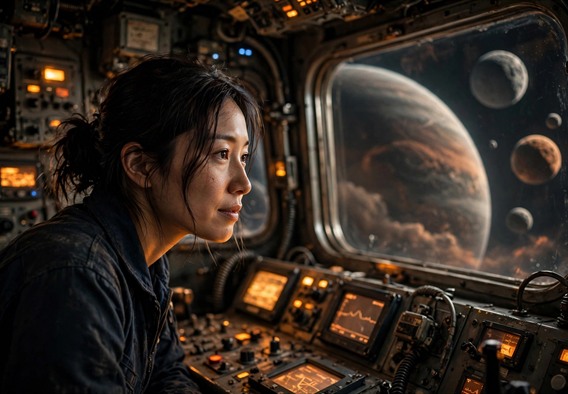
How long can a town hold its breath? That was the question Priya Nkomo asked herself every morning of her ninth year on Anthea Prime, and it was the question she was asking now, standing in the intake gallery of the Meridian Habitat's air plant, watching a pressure gauge do something a pressure gauge should never do.
The needle was falling. Slowly, the way a lake drains through a crack you cannot find, but falling all the same. Meridian held forty-one thousand people under a membrane of engineered glass and polymer, and every one of them breathed at a rate the air plant was designed to match, breath for breath, molecule for molecule. There was no surplus. There had never been surplus on a frontier. There was only enough, and the slow daily work of turning enough into tomorrow's enough.
Priya pressed her palm against the cold ceramic wall and did the arithmetic she had hoped not to do. Atmospheric losses that the regenerators could not account for: four hundred kilograms of oxygen a day, rising on a curve. At the current rate, the buffer tanks would be at reserve threshold in sixty-three days. After that, rationing. After rationing, if the cause stayed hidden, the thing no colony ever said out loud.
She had come down the gallery expecting a sensor fault, a dirty filter, a paperwork error. Instead she had found the opening chapter of a crisis, and she was the only one who knew it yet.
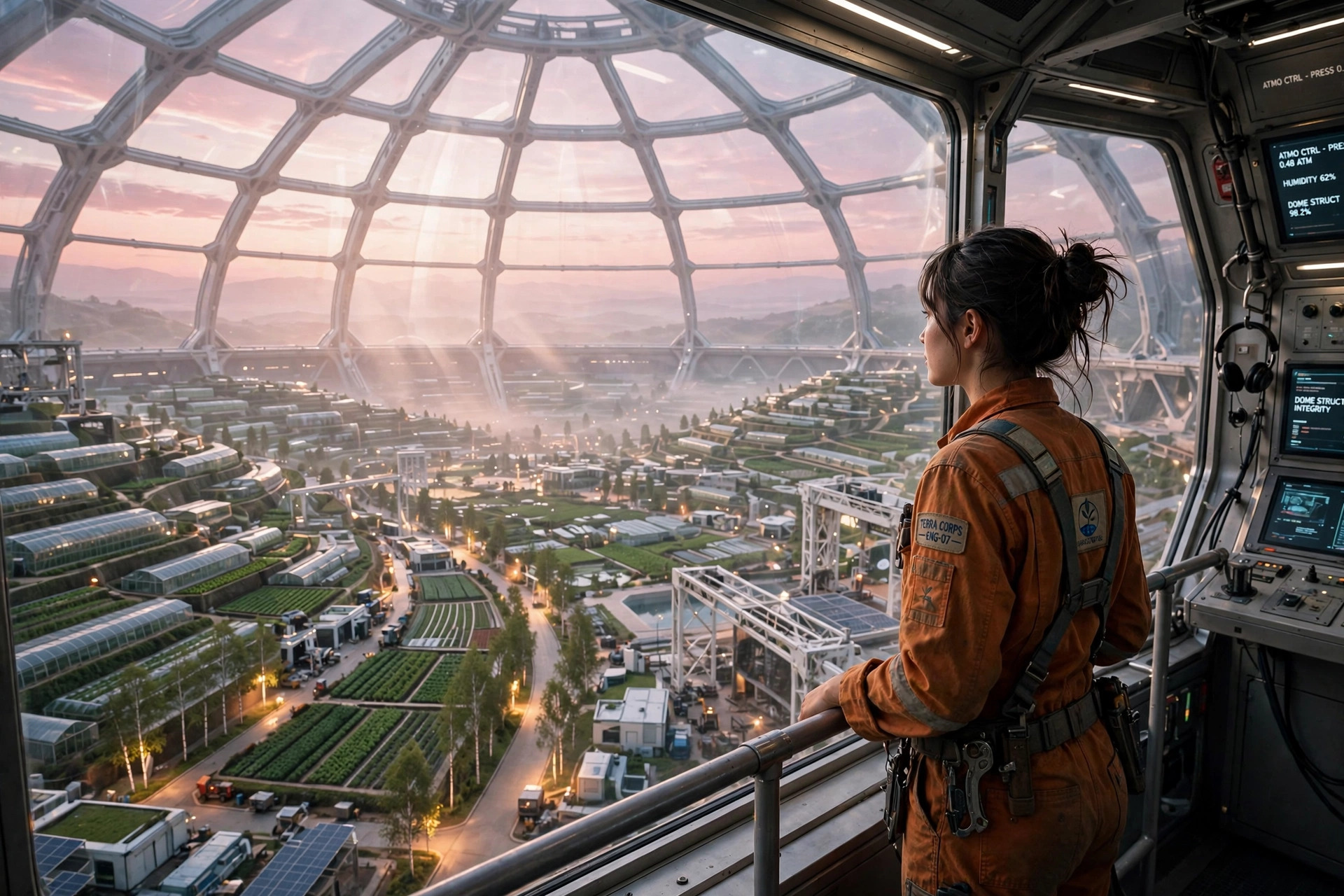
She was forty-four years old, broad-shouldered and calm in the way of people who had spent a decade arguing with weather, and she wore the faded orange of the Meridian Works, the guild that kept the town's air, water, and heat running. Her tool kit rode her hip like a second skeleton. Her badge read CHIEF OF ATMOSPHERICS, a title she privately considered half honor and half hostage situation.
She keyed her wrist comm. "Yusuf. You busy?"
"I am elbow deep in pump three," said Yusuf Adeyemi, her senior mechanical tech, from somewhere acoustically unfortunate. "Pump three is also elbow deep in me. What's up?"
"We have a mass balance problem."
The line went quiet. On a colony, mass balance problems were the problems. "Define problem," he said.
"Four hundred kilos a day of oxygen, unaccounted. Rising trend for at least three weeks, probably longer. I want you in the gallery in twenty minutes, and I want nobody else told until we know what we're looking at."
"Copy," he said, and then, because he was Yusuf and had been her friend since the landing ships, "Priya. Are we okay?"
"We are going to be," she said. "That's a promise, not a status report. Gallery, twenty minutes."
Two: The Ledger of Breath
Meridian Habitat sat in the floor of Verity Basin like a pearl in a gray palm: a dome of layered glass and self-healing polymer two kilometers across, ringed by terraced greenhouses, wind fences, and the skeletal white gantries of the terraforming works. Beyond the membrane, Anthea Prime went about its business of being almost a world. Thin carbon dioxide sky, rust and ochre plains, a salt sea slowly, gloriously filling itself in the southern basin where the comet-impact engineers had spent thirty years delivering water by the megaton.
Inside the dome, there were birch trees on the boulevard and a bakery that sold actual wheat bread, and children grew up thinking rain was a normal thing that happened on Tuesdays, because the cloud seeding crew had a schedule and kept it. The colonists had built all of that in nineteen years. Priya had helped lay the first greenhouse glass herself, back when the dome was a promise and the air was a rumor.
Which was why the ledger offended her personally.
The air plant occupied the northern rim, a cathedral of pipes and regenerator columns and the great spinning banks of the carbon dioxide scrubbers, all of it humming at the pitch of a working heart. Oxygen came in from the electrolysis plant at the ice fields, forty kilometers east, riding the pipeline like blood in an artery. It went into buffer tanks, out into the dome, and eventually came back through the scrubbers as carbon dioxide, which the greenhouses ate and the electrolysis plant split again. In theory the loop was nearly closed. In practice, every system leaked a little. The ledger existed to catch the difference between the leaks you knew and the leaks you didn't.
By the time Yusuf arrived, Priya had the last ninety days of telemetry spread across three display panels, and she had highlighted the trend line in red, which on Meridian meant only one thing.
"Okay," Yusuf said, pulling off his gloves. He was fifty-one, lean, gray at the temples, with hands that looked like they had been assembled from good rope. He studied the line the way other men studied faces of people they loved. "That's not a fault. A fault wiggles. That's a trend."
"I know."
"And it's oxygen specifically, not total pressure?"
"Total pressure holds. Nitrogen and the carrier gases balance out. It's the oxygen fraction that's sliding. Something is preferentially eating or removing O2." She tapped the panels. "Electrolysis output is nominal, verified against the plant flow meters. Dome consumption is normal for population and metabolism. Greenhouse uptake is logged and matches the crop plan. Scrubber efficiency is fine. So either we're producing less than we think, consuming more than we think, or we're losing it somewhere the instruments can't see."
"Three hypotheses," Yusuf said. "I like a small universe. Which one do you bet on?"
Priya looked out through the gallery window, across the dome, at the soft lights of the evening streets, the bakery sign, the school with its windows full of ferns. "Neither of the first two. Instrument verification was my first pass, and it's clean. That leaves the third, and the third is the one with a clock on it."
"Sixty-three days?"
"Sixty-three days to reserve threshold. But that's the deadline for rationing, not for disaster. The real deadline for disaster is whenever the trend finds its natural limit, and I don't know what the limit is. Could be a chemical sink that saturates and stops. Could be something that keeps going until we're on masks." She heard her own voice flatten into the tone she used for incident briefings and made herself soften it. "We find it, Yusuf. That's the whole job this quarter. We find it."
He nodded slowly, then surprised her by grinning. "You know what this is?"
"A leak."
"It's a hunt," he said. "Best kind of engineering. The kind where the answer exists and is just being rude about it."
She laughed despite everything, which was one of the thousand small reasons they had survived nineteen years together on this rock. "Get some sleep. Tomorrow we start at the pipeline and walk every meter of the system until the ledger and the pipes agree."
"The air we breathe is not a given. It is a ledger, and every breath is a line item somebody balanced for you. Say thank you by learning to balance it yourself."
Three: Walking the Artery
The pipeline east to the ice fields was the colony's aorta, a hundred millimeters of composite pipe sheathed in insulation and regolith, carrying high pressure oxygen and, in a parallel line, hydrogen. Two hundred people worked the corridor: pipeline riders, electrolysis techs, the crews who tended the solar fields that powered the splitting of water into the two gases that, kept apart, were industry, and allowed together, were fireworks.
Priya rode the maintenance rail out with a survey kit and a young instrumentation specialist named Tomás Reyes, who had come up from the second generation, born on Anthea, twenty-six years old, and so fluent in sensor networks that he talked about them the way his grandmother's generation talked about weather.
"The flow meters all cross-check," Tomás said as the ochre plain slid past. "I re-derived the calibration from raw counts, not the smoothed feed. Production is real. If anything, the plant is making half a percent more than it reports."
"Then production is exonerated," Priya said. "Consumption?"
"I audited the dome meters the same way. Population respiration estimate comes from the medical census, and it matches the activity multipliers. Greenhouse uptake is directly metered at the grow beds. Scrubber capture is metered. Everything downstream of the buffer tanks adds up within two percent, and the two percent is explainable." He glanced at her. "Which is the scary answer, right? Because it means the loss is between the plant and the tanks, or at the tanks, or in the distribution we don't meter."
"It means the loss is in the part of the system we trust most," Priya said. "Because it's the part we've never had a reason to distrust."
They stopped at each valve station and did the unglamorous work: pressure drop tests across every isolation valve, acoustic surveys with the pipe pressurized, listening for the hiss of gas escaping through a microfracture into the insulation void. Yusuf, riding the western leg with two other techs, did the same on the dome-side distribution. For six days they walked the artery, and for six days the pipe told them the same thing: tight. Within specification. Boring, even.
"I'm starting to root for a leak," Tomás admitted on the sixth evening, in the rider bunkhouse at station nine, drinking reconstituted coffee that tasted like a rumor of coffee. "At least a leak is an address."
"Leaks are addresses," Priya agreed. "Chemistry is a rumor." She had spent the evenings reading, and she said now, carefully, what had been growing in her notes. "Tomás, what do we know about the regolith under the east terraces?"
He blinked. "The new subsoil? The aeration zone under the park expansion? It's imported, processed, inoculated with the soil biota from the third-generation cultures. Why?"
"Because the loss curve has a shape," she said, pulling up the display. "Look. It's not linear. It accelerated in week three, and it's accelerating more slowly now. That's not a hole. A hole gives you a straight line until it fails. That's an activation curve. Something woke up, ramped, and is approaching some kind of limit. That's biology or chemistry with a population dynamic."
Tomás sat back. "You're saying the ground is breathing our oxygen."
"I'm saying the ground might be eating it," Priya said. "And I want to know who's doing the eating."
Four: The Soil Congress
The terraforming biology group occupied a low, greenhouse-crowned building on the southern rim, and its director was a woman named Dr. Amara Okonkwo-Boyd, sixty-two, who had written the book on regolith microbiology for two worlds and treated every new colony's soil like a symphony she was conducting for the first time. Priya had known her since the landing. They had buried a friendship quarrel years ago over irrigation priorities and had never fully dug it up; it lived between them like a stone under a floorboard, mostly forgotten, occasionally stepped on.
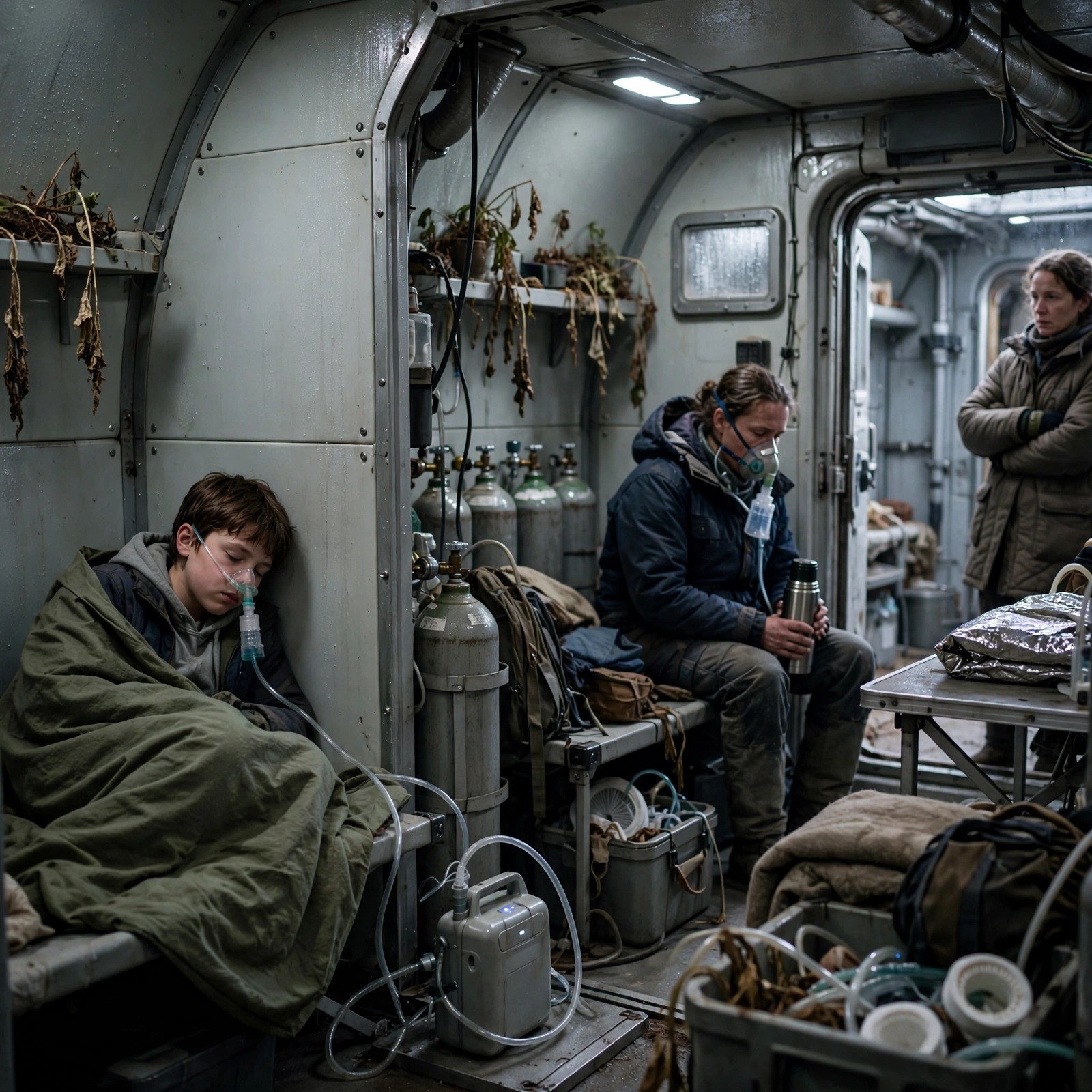
"Priya Nkomo," Amara said, in the doorway of her lab. "You want something. You always want something. Last time it was headroom over my fungal beds."
"And you got it," Priya said, "and your fungal beds made the wheat harvest, and the bakery named a loaf after you."
"The loaf is dense," Amara said. "Come in. Tell me why the atmospherics chief is visiting soil people with a face like a closed valve."
Priya laid out the ledger. The trend. The activation curve. The elimination of the pipes. Amara listened with her arms crossed and her whole attention, which was a physical force, like standing in a wind tunnel.
"Oxygen sinks," Amara said at last. "In a young regolith, the usual suspects are oxidation of reduced minerals. Ferrous iron. Sulfides. But we assay for those before emplacement, and the east terrace subsoil was assayed twice. Unless." She paused. "Unless the sink is biological. An aerobic population bloom, feeding on something we gave it. Priya, what did the park expansion crews use for bedding amendment?"
"Standard processed tailings plus the third-generation biota," Priya said. "Why?"
"Because the third-generation cultures were built for carbon processing," Amara said, and Priya watched the thought arrive on her face in real time, watched forty years of expertise assemble a suspect. "We engineered them to be hungry. We never fully characterized what happens when they meet a substrate we didn't anticipate. There is a chemoautotrophic strain in that consortium, the one we tagged G-7, that under stress conditions can shift its metabolism. It is supposed to be oxygen limited, self-regulating. Supposed to be."
"Supposed to be," Priya repeated. "Amara, I need to know if it isn't. Sixty-three days."
"Then I need samples from the east terrace today, and I need your gas flux data by stratum, and I need you to not tell the town a ghost story until I have data." Amara was already moving, pulling sample corers from a rack, and then she stopped, and the stone under the floorboard shifted. "You could have gone to the council first. Made it a spectacle. Gotten your headroom by alarm."
"I could have," Priya said. "I'd rather solve it. Headroom by alarm costs more than it pays, every time. You taught me that, actually. 2031 colloquium. You said fear is a currency that inflates."
Amara looked at her for a long moment. "You remembered that."
"I remember most things you said," Priya said. "The useful ones and the annoying ones."
The old woman smiled, brief and real. "Then take the corer on the left. And Priya. If it is G-7, we will fix it. Not because we are clever. Because we built it, and builders repair what they build."
Five: What the Cores Said
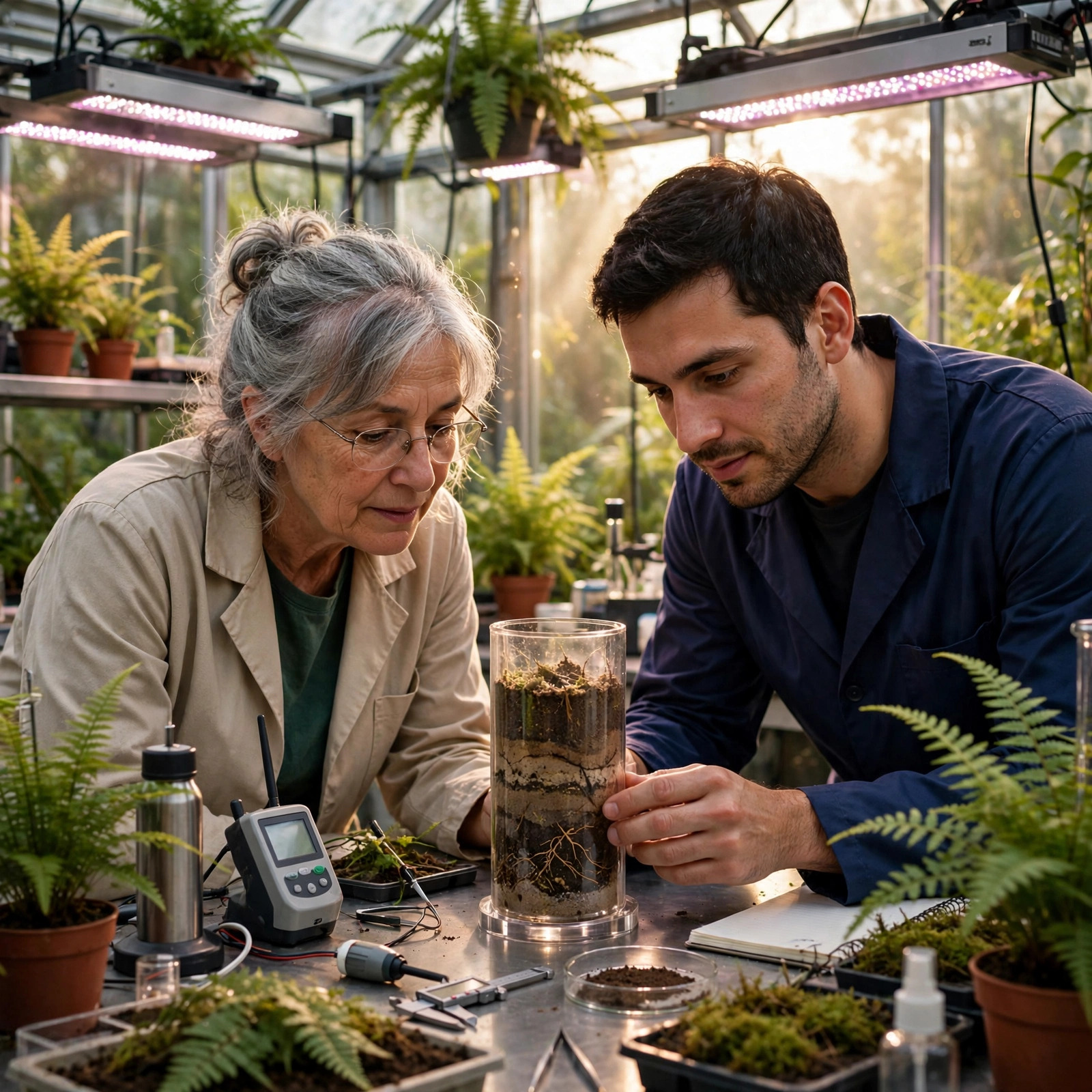
The cores came back that night, cold-packed from the east terrace aeration zone, and the soil lab lit up like a festival. By the third morning, Amara stood in front of Priya and Yusuf and Tomás with a display that looked, to Priya's untrained eye, like a city map of something alive.
"It's G-7," Amara said. "Modified behavior, exactly as feared and worse than modeled. Here is the story. The park expansion subsoil was amended with the processed tailings from the new electrolysis plant expansion. Those tailings carry trace reduced sulfur compounds. Not enough to trip a chemical assay alarm. Plenty to feed a population of G-7 that we engineered to scavenge sulfur under low-nutrient stress. The population bloomed. Aerobic metabolism, sulfur fueled, oxygen hungry. Your missing four hundred kilograms a day went into their cell mass and their waste water."
"Eating our air," Yusuf said. "Out of everything on this world, the ground itself."
"Out of everything," Amara agreed. "And here is the part that matters for your clock. The bloom is sulfur limited. The tailings amendment is a finite pulse. Based on the population dynamics, the growth rate is already slowing. The curve will flatten in roughly forty days as the accessible sulfur exhausts, and the population will crash, and the sink will close. Left alone, this self-resolves."
"Left alone," Priya said slowly, "we still spend forty days at the edge of reserve, and if the model is wrong by thirty percent, we ration. And if it's wrong by more, we don't."
"Correct," Amara said. "Left alone, we probably survive. Probably is not a word I like for forty-one thousand people."
"So we don't leave it alone," Priya said. "Options. Give me options."
Amara counted on her fingers. "One: sterilize the zone. Heat treatment, gas sterilant, whatever. Kills the bloom fast, kills half the soil biota we spent nine years building, sets the park and the terrace ecology back years, and risks the same failure mode in any zone where G-7 meets sulfur again. Two: flood the zone with sulfur scavengers, bind the substrate, starve the bloom without killing the rest. Slower, gentler, but the binding chemistry has to be tested, and we have never tested it at scale. Three: accept the sink and out-produce it. Boost electrolysis, run the buffer above plan, outlast the bloom on surplus."
"Three needs the plant expansion," Yusuf said. "Which is online in what, fifty days?"
"Fifty-two," Priya said. "Cutting it under the curve. Option three alone is gambling that commissioning goes perfectly, which nothing on a frontier has ever done." She looked at the display, at the living city map of the bloom, and something in her, the part that had laid greenhouse glass in the wind, refused to let a solved problem remain unsolved just because the solutions were all imperfect. "We don't pick one. We stack. Tomás, can we accelerate any part of the expansion?"
"The second electrolysis train is mechanically complete," Tomás said. "It's the control software certification that's slow. Six weeks of staged testing. I could compress it to two if we accept parallel manual verification."
"Then we compress it," Priya said. "Yusuf, option two. Amara, design me the sulfur scavenger treatment and test it on cores. If it works on cores by next week, we apply it to the terrace while the bloom is still ramping, knock the curve down early, and buy option three the margin it needs. We starve the fire and build the pump at the same time."
"Stacking risks," Amara said. "If the scavenger chemistry has a surprise, we've spent materials and attention we might need elsewhere."
"If we do nothing, we've spent forty-one thousand people's margin," Priya said. "I'll take the risk we choose over the risk we drift into. That's the whole difference between engineering and luck."
Amara studied her, and then, quietly, extended her hand, and Priya took it, and the stone under the floorboard of their long friendship finally, gratefully, dissolved. "Builders repair what they build," Amara said. "Let's go build the repair."
Six: Failing Forward
The scavenger, when Amara's team designed it, was almost embarrassingly simple: a granulated iron oxide compound, red as brick dust, that bound reduced sulfur into inert form and took the bloom's dinner off the table. On the bench it worked beautifully. On the first field plot, on the east terrace under a gray afternoon sky, it failed.
Not completely. It reduced the sulfur flux by sixty percent instead of the modeled ninety. The cores told the story: the granules were reacting, but the bloom had formed its populations in microcavities and pore networks the granules could not reach. The dinner wasn't all on the table. Some of it was in the walls.
"Sixty percent," Yusuf said that night in the works break room, surrounded by cold noodles and whiteboards. "Is sixty enough?"
Priya ran the numbers, and the numbers said maybe, and maybe was a word she had already outlawed for the week. "Not with the expansion slip risk. We need the curve down by eighty percent to hold reserve threshold with a full week of commissioning margin."
"So we iterate," Tomás said. He had not slept much and it showed, but his eyes were bright. Failure, Priya had learned, did different things to different people. To some it was a wall. To Tomás it was a door with the hinges revealed.
They iterated. Version two milled the granules finer, which raised surface area and raised cost and raised dust, and the dust clogged the applicator on the second field plot, and the coverage pattern came out in stripes, like a badly mowed lawn, and the sulfur flux under the stripes dropped ninety percent while the flux between the stripes didn't drop at all. Yusuf stood over the striped plot in the wind and laughed until he had to sit down.
"What," Tomás demanded, "is funny?"
"The stripes," Yusuf said, wiping his eyes. "Don't you see it? Version two didn't fail. Version two told us the chemistry is right and the delivery is wrong. Ninety percent where it lands. We don't need better chemistry. We need it everywhere."
So version three was not a chemistry problem at all. It was a plumbing problem, which meant it was Priya's home turf. The applicator became an array: a tram-mounted grid of injectors on thirty-centimeter spacing, pushing the granules down into the aeration zone as a metered slurry instead of a surface dust, wet enough to wick into the pore networks where the bloom hid. Tomás wrote the tram's control loop in two days and a night. Amara's team mapped the bloom's density across the whole terrace with a hundred cores and gave the tram a prescription, denser treatment where the bloom was dense, lighter where it wasn't, the first prescription map ever written for a sickness of the ground itself.
The first tram pass went out on the eighteenth day of the sixty-three. The cores that came back from behind it showed sulfur flux down eighty-four percent. The second pass, ninety-one. On the twenty-fourth day, Priya stood on the east terrace in the wind, watching the tram walk its grid under a sky going violet with evening, and let herself feel, for exactly one minute, something like hope with a data point attached.
The loss curve on her display, when she checked, had bent. Not flat yet. Bent. Four hundred kilograms a day had become two hundred and ten, and the trend arrow, for the first time in three weeks, pointed the right way.
Works incident log, day 24: scavenger tram operational, terrace treatment 40 percent complete, atmospheric loss trend declining, no rationing measures initiated. Logged by P. Nkomo, chief of atmospherics.
Seven: The Expansion and the Slip
It was, of course, at the moment the ground problem bent that the plant problem broke.
Day twenty-nine: a coolant loop valve in the new electrolysis train's second stage seized during a certification spin, sheared its actuator stem, and dumped two hundred liters of glycol loop fluid into the containment tray. Nobody was hurt. The schedule, however, bled. The replacement actuator was in the spares inventory, but the spares inventory, a physical audit revealed, contained the wrong revision, a part that fit everything except the one thing it needed to fit. The machinists could adapt the old revision in four days. The next resupply from the orbital freighter was nineteen days out.
Priya convened the works crew in the pump hall, and for the first time in the whole incident, she felt the old fear try to speak. Four days for the adapted part, against a curve that was bent but not broken, against a commissioning that had just lost its fat margin. She let the fear say its piece. Then she looked around the room.
"Okay," she said. "Fact one: the curve is bent, and every day of treatment bends it more. Fact two: we have four days of machining and we have nineteen days of patience, and we only need one of them. Fact three:" she looked at Tomás, "your compressed certification had manual verification checkpoints, yes?"
"Every stage," Tomás said. "Two-person sign-off. Why?"
"Because I want to hear the argument for running the first train at partial load while we finish the second."
The argument took two hours, and it was the kind of argument Priya loved most in the world: four competent people taking opposite positions on purpose, stress-testing each other's assumptions, nobody protecting their ego because the town was bigger than any of them. The case for partial load was that the first train alone, run at seventy percent with manual oversight, could cover the remaining deficit even if the scavenger treatment stalled. The case against was that an unfamiliar operating mode was its own risk. They resolved it the way frontier engineers always resolve it: they wrote a test plan. Run the first train at thirty percent for one day under full manual watch. If every deviation stays inside the envelope, step to fifty. Then seventy. Never skip a checkpoint. Never let optimism sign the log.
It worked the way careful things work: unglamorously. The first train came up at thirty percent on day thirty-one and the dome's oxygen fraction, which had drifted down two tenths of a point, stabilized. It came up to fifty on day thirty-three, seventy on day thirty-five, and Priya signed each log line herself, and each signature felt like laying another pane of that first greenhouse glass, decades ago, in the wind.
On day thirty-eight, the machinists delivered the adapted actuator, milled with a fixture one of them, a quiet woman named Halla Bjornsson, had designed overnight, a fixture that turned a four-day job into three because it eliminated two setups. On day forty, the second train spun up for certification, and the buffer tanks, for the first time since the ledger went red, began, slowly, to refill.
"We're going to make it," Tomás said, watching the tank level rise a fraction of a percent an hour, which was the speed at which hope actually moves, if you watch it honestly.
"We're making it," Priya corrected. "Present tense. That's the only tense builders get."
Eight: What the Bloom Left Behind
The strangest discovery came last, and it came from Amara, who arrived at Priya's office on day forty-four carrying a core sample and an expression Priya had never seen on her: pure, undiluted scientific delight.
"Look at this," Amara said, setting the core down. "The east terrace, post bloom, post treatment. The G-7 population crashed when we starved it, as predicted. But look at the layer where it lived. The pore structure is changed. The bloom's waste water carried carbonates and it cemented the fines into stable microaggregates. Priya, do you understand what that means?"
Priya looked, and did not understand, and said so, which was a habit she recommended to everyone.
"It means the accident built soil," Amara said. "That layer holds water four times better than untreated subsoil. Root penetration is deeper. The biota we inoculated after the crash is colonizing the new aggregates faster than it colonized the raw regolith. Our oxygen thief turned the dead ground under the park into living, structured soil, and then, having eaten its fill, it died and left its house to the crops."
Priya sat back. "You're telling me the disaster was a gift."
"I'm telling you," Amara said, "that this world is not a machine we operate. It is a system we are joining, and it keeps its own ledger, and sometimes its ledger pays us back in currencies we hadn't thought to invoice. The engineering lesson is that we caught it, we fixed it, we did the work. The humility lesson is that the work left something better than we planned. Both lessons are true. Builders hold both."
They held both. The council was briefed in full, in the open, the way the colony had always handled its crises: the ledger, the hunt, the failures, the fixes, the fixture Halla machined, the soil that had accidentally been born. There was no panic, because there had been no secrecy. There was, instead, at the next town meeting, a standing ovation for the soil lab, which embarrassed Amara so thoroughly that she retaliated by naming the new soil horizon the Nkomo Layer, which embarrassed Priya more, and the town enjoyed both embarrassments immensely, having paid for them in four hundred kilograms a day.
Nine: The Breathline Monument
By day sixty-one, the buffer tanks stood at full operating level, the second electrolysis train was certified and online, the scavenger tram had finished its grid, and the atmospheric ledger closed for the first time in three weeks at a surplus of eleven kilograms, which was nothing, and was everything.
The town, being a town of builders, did not merely exhale. It built.
They built it on the east terrace, on the ground that had eaten their air and then given back soil: a low wall of rammed earth and glass, a hundred meters long, curved like a breath drawn in and held. They called it the Breathline. Inside its curve they planted the first stand of poplars on Anthea, rooted in the Nkomo Layer, watered by the improved ground that held the rain four times better than the old subsoil ever had. A single bronze line inlaid in the wall traced the loss curve of those sixty-three days, rising, rising, and then bending, and then falling, and at the point where the curve first turned, a small brass plaque with Amara's inscription:
"Here the ground took our breath away, and here we took it back, not by victory over the world but by partnership with it. The air you are breathing now is the work of many hands. Add yours."
Priya went there on the evening of day sixty-three, the day the ledger had said would have been the beginning of rationing, and instead it was the day the poplars got their first deep watering. Tomás was there with his partner, spreading a picnic on the new grass. Yusuf was there with his grandchildren, who were riding the curved wall like a wave, frozen in place. Amara stood at the plaque, reading her own words as if checking them for errors, and Priya came and stood beside her.
"Any corrections?" Priya asked.
"One," Amara said. "I wrote 'many hands.' It should say 'many hands and one tram and a fixture Halla machined and a stubborn atmospherics chief who remembers things I said in 2031.'"
"The plaque is too small."
"Then the rest of us will have to be the footnote," Amara said, and they watched the light go long and gold across the terrace, across the tram parked in its bay, across the greenhouses and the dome and the bakery sign coming on down in the streets below, forty-one thousand people breathing without thinking about it, which was the whole point, which had always been the whole point: to make a world where breath was not a question but a gift, passed hand to hand, ledger balanced, day after day after day.
The wind came up the terrace, as it did every evening, and moved through the young poplars, and the leaves made the sound that Priya had waited nine years and sixty-three days to hear on this world: the sound of somewhere becoming home.
How long can a town hold its breath?
It doesn't have to. That's what the builders are for.
Get notified when new stories drop

Ren Hollis
Ren writes frontier worlds and terraforming triumphs — habitats, gardens under glass, and the first rain on a new world.
Leave a comment
Comments