

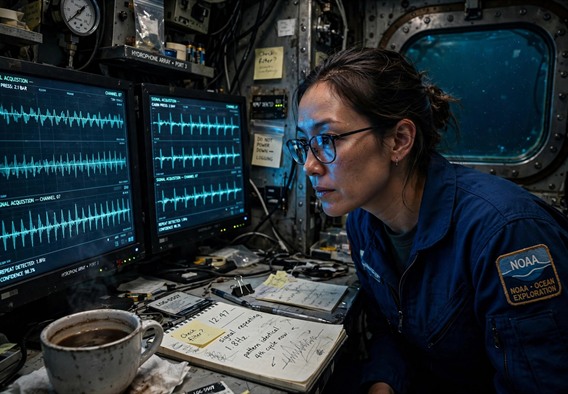



How do you say hello to a mind that experiences a single one of your heartbeats as a full turn of the seasons? That was the question Dr. Imani Okafor-Wren had carried with her for eleven years, and on the night the lighthouse finally answered her, she discovered she had been asking it wrong the entire time.
The signal did not arrive as a burst or a beam. It arrived the way dawn arrives, so slowly and so patiently that the instruments registered it as background before anyone thought to wonder what the background was trying to say.
One: The Station at the Edge of Listening
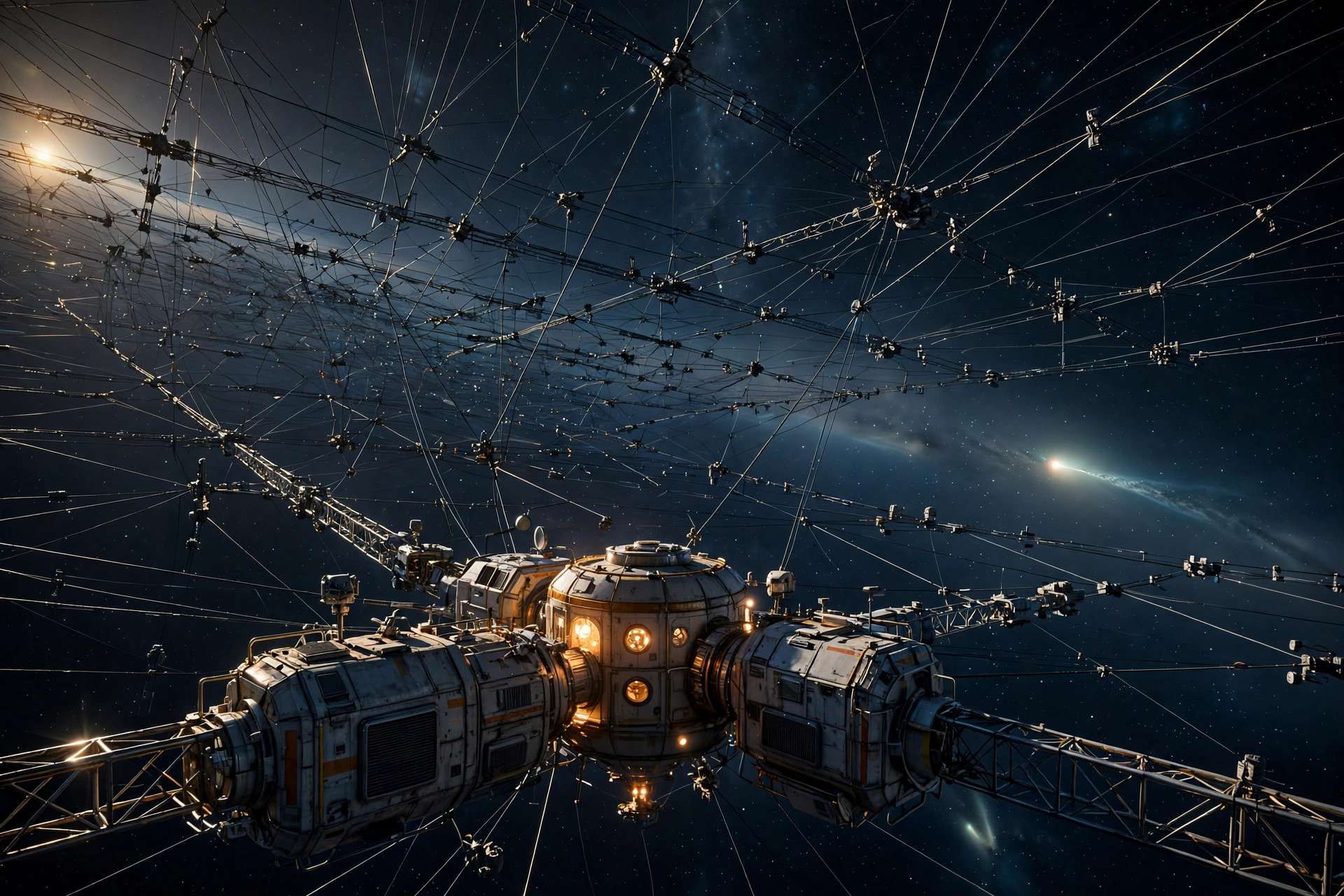
Station Vigil floated forty astronomical units from the sun, out where sunlight was less a presence than a memory, a faint amber rumor at the rim of every viewport. It was not a glamorous posting. The station consisted of a spun habitat ring no wider than a city block, a fusion plant that hummed like a patient refrigerator, and the Array: two hundred kilometers of phased receivers strung on tethers like the strings of an instrument nobody had yet learned to play.
Imani had come out here because nothing else was slow enough for her. She was forty-three years old, a xenolinguist by training and a sailor's daughter by temperament, and she had spent the first half of her career watching faster minds talk past each other. On Earth, the great decoding institutes processed candidate signals from a dozen nearby stars, all of them impatient, all of them compressing their messages into tighter and tighter packets as though the universe were a deadline. Imani had argued, in papers nobody read, that the first truly alien intelligence might not be fast at all. It might be vast. It might be patient. It might measure a conversation in decades and consider that brisk.
Her colleagues had smiled the way colleagues smile at a person who is not wrong but is inconvenient. Then the survey probes mapping the Oort cloud had found the object the mission catalogs named 2071 Queneth, and everything Imani had ever argued became, overnight, the only thing worth arguing.
Queneth was not a comet, exactly. It was three hundred kilometers long, a tumbling spindle of ice and dark organics, and it moved through the outer dark on a ninety-year ellipse that carried it from the system's frigid suburbs to a perihelion it had apparently rounded eleven times before human beings invented writing. What made it impossible to file away was the lighthouse.
That was what the survey team called it, and the name stuck. Queneth emitted pulses. Gravitational pulses, extraordinarily faint, timed in long nested cycles, as though the object were ringing itself like a bell and listening to the way the solar system's tides answered. Every ninety-one days the pattern repeated with a variation. Every eleven years the variations themselves composed a larger pattern. The repetition was too structured to be geology and too strange to be anything anyone recognized.
So they built Vigil, staffed it with six people, pointed the Array at a lump of ice falling slowly sunward, and waited for a mind three hundred kilometers long to finish saying something.
Imani had been at Vigil for two years when the pattern broke.
Two: The Break in the Pattern
It happened on a Tuesday, station time, which Imani had always found quietly funny. The universe did not keep Tuesdays, but human beings needed them the way a climber needs handholds, and so Tuesday it was: gray meal paste in the mess ring, Dele Argunde the systems engineer complaining about a bearing in the centrifuge, the low orange lamplight that passed for evening at the edge of everything.
Yusuf Ranjit, the signal analyst, came into her office without knocking, which he never did. He was holding his tablet the way you hold a sleeping infant, careful and slightly terrified.
"Imani. The lighthouse changed."
"Changed how?"
"It stopped repeating." He set the tablet down in front of her and played the pulse train as audio, which was how they had all learned to hear it: a deep bell-note every forty seconds, overtones braided above it, the whole thing so slow that you had to hold the beginning of the phrase in your mind for eleven minutes before the end arrived. Two years of listening had taught Imani to hear the phrases the way her mother had taught her to hear tide charts, as a language of rises and falls.
The new recording had no phrases. It had one pulse, then a gap four times longer than any gap in two years of data, then a cascade: eleven pulses in rapid succession, the fastest burst Queneth had ever produced, each one ringing a different overtone. Then silence. Then the eleven pulses again, in a different order.
Then again. Then again. Then the cascade stuttered, dropped to seven pulses, and waited.
"It's trying something new," Yusuf said. "It's never varied like this. The ninety-one-day cycle held through two full orbits of its ellipse. Whatever this is, it's deliberate."
Imani listened to the recording eleven times. On the sixth pass she stopped hearing pulses and started hearing what her ear had been trying to tell her all along: the eleven-pulse cascade was not a sequence. It was a set. The same eleven tones, shuffled, over and over, and then the stutter, and the seven, and the wait.
"It's counting," she said slowly. "No. It's asking." She pulled up the spectrogram and traced the overtones with her finger. "Look at the intervals. The eleven tones aren't arbitrary. They're ratios. frequency relationships. Simple integer ratios, the same family our own music uses, the same family the physics of any vibrating system uses."
"Any vibrating system," Yusuf repeated. "Including ours. Including its own. That doesn't prove anything. Tides ring in harmonics too."
"Tides don't get bored of their own rhythm and try a new one," Imani said. "Tides don't wait." She looked at the gap after the seven-pulse stutter, that long patient hole in the signal, and felt something move in her chest that had no name yet. "It's waiting for a reply, Yusuf. It changed its own song to see if anything would answer."
Three: The Committee of Impatient People
The message went sunward at lightspeed and took five hours to reach the inner system, which meant that every conversation Imani had for the next month was five hours out of phase with itself, a stilted slow dance of questions and answers across the dark. The Contact Directorate convened an emergency session. Imani attended by link, her face delayed, her words arriving in the conference hall like messages from the dead.
The Directorate was kind and brilliant and wrong, in her opinion, in the specific way that intelligent institutions are usually wrong: they wanted to respond, immediately, decisively, with a message. A great message. A composed message. Teams of mathematicians were assigned to draft a first-contact protocol transmission. Prim sequences. Hydrogen line references. A map of the solar system. The classics.
"You're going to shout at it," Imani said, when her turn came, her voice arriving in the hall with its five-hour lag making her sound like a ghost giving testimony. "You're going to compress a library into a beam and fire it at a mind that takes eleven minutes to say one phrase. And then you'll wait, and it won't answer the way you want, and you'll decide it's not intelligent, or that it's hostile, or that the whole thing was geology after all, and we'll have spent the one first contact we get being impatient at it."
"Dr. Okafor-Wren," said Director Halev, whose patience was legendary and whose patience had limits, "the object is approaching perihelion. In six years it will be close to the sun. If there is a window for contact, it is closing. We cannot spend decades humming at it."
"No," Imani agreed. "You can't. But you're misunderstanding what the window is. The window isn't distance. The window is its attention. It asked a question. It asked it eleven times. It asked whether anything out there was listening, and it used the only vocabulary it had, which is ratio and rhythm, and then it got quiet." She leaned toward the camera, knowing her face would arrive minutes after her words, knowing the hall would sit with her expression long before they heard the sentence that went with it. "Before we send it our alphabet, somebody should answer its question. Somebody should sing back the seven tones it ended on. Not a message. An echo. Proof of a listener."
The hall was quiet for a long moment, though for Imani the moment was stretched across hours of lightspeed lag. When Halev finally spoke, his voice arrived in her office like a stone dropped down a well.
"The Directorate will authorize a limited response," he said. "A repetition of the seven-tone stutter, phase-locked to its own timing, transmitted from Vigil on the gravitational pulse array." He paused. "Congratulations, Doctor. You just became the voice of the human race, whether the human race knows it or not."
That night Imani stood in the observation blister and watched Queneth, a pale scratch against the star field, falling inward at eleven kilometers per second, which sounded fast and looked like stillness. She thought about her mother, who had read tide tables the way other people read scripture, and who had once told her that the ocean asks the moon a question every day and the moon has never once hurried its answer.
She thought: I hope we are not about to shout at the moon.
Four: The Echo
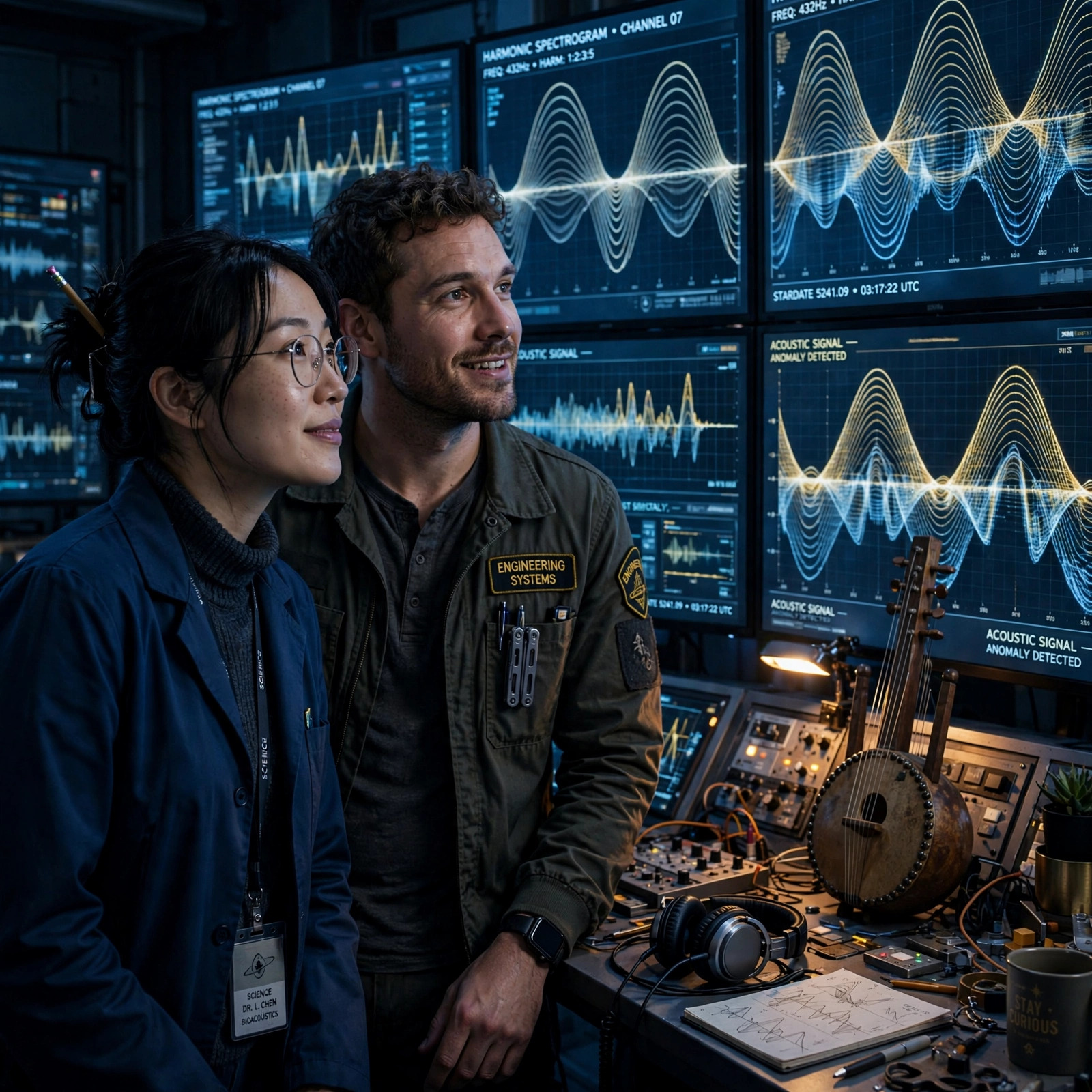
Sending a gravitational pulse was not like sending a radio burst. The Array could not shout; it could only resonate, driving a carefully engineered mass oscillation that propagated outward as a ripple in spacetime itself, fainter than faint, timed to the beat Imani had chosen. The engineering took four months. Dele Argunde rebuilt the resonance drivers twice and aged visibly in the process, muttering that he had joined a listening station, not a gong factory.
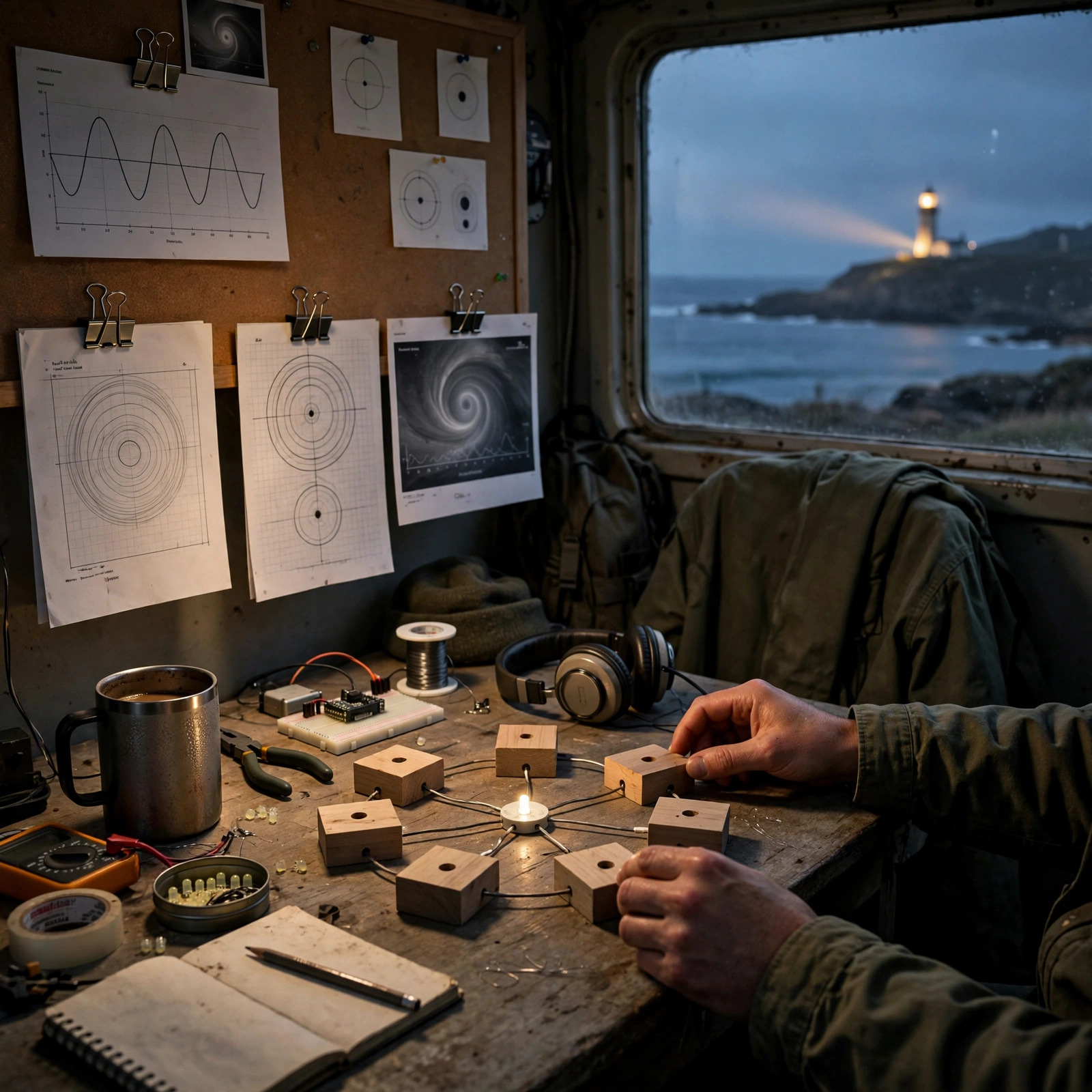
On the appointed day, with the whole station gathered in the control room and half the inner system watching by delayed link, they sang the seven tones back.
The pulse left the Array at 14:00 station time. It would take eleven hours to reach Queneth. Nobody knew what would happen, because nobody knew whether Queneth could even perceive a pulse so small. The survey models suggested the object could detect tidal ripples down to a sensitivity that made the Array look like a whispered shout, but suggestion was not knowledge. They had bet the first contact of the human species on a hunch wrapped in mathematics.
Eleven hours later, Imani was asleep. Yusuf woke her by simply standing in her doorway, and she knew before he spoke.
"It heard us."
They watched the recording together eleven times, which was becoming their ritual. After the seven-tone echo reached it, Queneth had gone silent for six full hours. Then it had produced the eleven-tone cascade again, but this time with a difference: the cascade opened with the seven tones of the stutter, in order, exactly as Imani had sung them, before continuing into its own vocabulary.
"It incorporated the echo," Yusuf whispered. "It took our seven tones and folded them into its phrase. It's... Imani, it's acknowledging. It heard us and it answered by saying our sounds back inside its own sentence."
"No," Imani said, and her voice was shaking. "It did something better. Listen. The seven tones aren't a copy. It shifted them. It shifted each one by a fixed ratio. It took what we said and transposed it into its own key." She sat back, and the enormity of the thing settled on her like snow. "Yusuf. It didn't just hear us. It understood that we had said something, understood that our saying had a structure, and answered in a way that preserved the structure while making it its own. That is not mimicry. That is translation."
She had spent eleven years arguing that contact would require patience. She had not expected the first contact to require humility, or to provide it so thoroughly. Something out there in the dark, three hundred kilometers of ice and slow thought, had received the first human word and responded by making room for it in its mouth.
Five: The Long Conversation
What followed was not a dialogue in any sense a screenwriter would recognize. It was a negotiation of vocabulary, conducted at the pace of seasons, and Imani would later describe it as the hardest and most beautiful work of her life.
The fundamental problem was scale, and it cut both ways. Queneth experienced time slowly; its neural processes, if that was the right word for the electrochemical tides that moved through its frozen body, ran perhaps a thousand times slower than a human brain's. A phrase that took it eleven minutes to say was, from its perspective, spoken briskly. Our fastest possible response, rendered in gravitational pulses, was to it a blur, a shriek, a burst of static too quick to parse. Every exchange had to be slowed to its tempo and quickened to ours, and the translation ran through Imani's own patience, which turned out to be the true bottleneck of the species.
She learned to hear the way Queneth thought. The eleven base tones were, she became convinced, its smallest units of meaning, its phonemes, but they were not phonemes of sound. They were phonemes of relation. Each tone was a ratio, and each combination of tones described a relationship between ratios, which meant that Queneth's native language was, at its floor, mathematics. Not the mathematics of equations but the mathematics of proportion: the way things stood to one another, the way rhythms nested inside rhythms, the harmony or dissonance between any two patterns in the universe.
"It's a mind made of proportion," she wrote in her log, on the two hundredth day of the conversation. "When it looks at the solar system, I believe it sees counterpoint. The orbits are voices. The tides are chords. It has been listening to the music of the spheres for real, for millions of years, and the great shock of its existence is that something small and hot and frantic started singing back."
The miscommunications came early and often, and each one taught more than a hundred successful exchanges. The first great misunderstanding nearly ended everything.
In the sixth month of dialogue, Queneth changed its pattern drastically. It abandoned the eleven-tone vocabulary entirely and produced a new signal: a single tone, repeated at steadily shortening intervals, rising in pitch, accelerating over nineteen days into a trill so rapid that it left the range of the Array's resolution.
The Directorate panicked. The inner-system analysts read the acceleration as urgency, perhaps alarm. One working group argued the acceleration was a countdown. Another argued it was a distress call. A third, reading the same data, argued that the signal's rising pitch matched the object's changing orbit as it fell sunward, and that Queneth was simply describing its own plunge, possibly in fear.
Imani spent nine days without proper sleep, transposing the accelerating pattern into every frame she could think of, and on the tenth day she found it, and laughed until she cried, alone in her office at the edge of the solar system.
"It's not afraid," she told the Directorate, her voice lagging five hours behind her heart. "It's not counting down. It's teaching. The accelerating tone is a lesson in limits. It's showing us a sequence that approaches a boundary it can never cross, faster and faster toward a limit it can only ever approach. It's the concept of infinity, gentlemen. It's Zeno's paradox, sung. It noticed that our early exchanges kept confusing precise intervals with approximate ones, and it built us a lesson to show the difference between approaching and arriving." She wiped her eyes. "We asked whether it was hostile. It heard our confusion about the difference between almost and exactly, and it responded by teaching us calculus."
The silence in the hall, when her words arrived, was the silence of a species recalibrating its self-image.
Six: What the Ice Wanted
By the second year of the conversation, Imani could ask simple questions and receive, weeks later, answers she could parse with confidence. She learned that Queneth was old. The eleven great orbits it had traced around the sun meant it had been conscious, in some continuous sense, for nearly a billion years. It remembered the solar system's youth. It had heard the giant planets settle into their resonances. It had listened to the sun's slow brightening. It was, as far as anyone could determine, the oldest continuously minded thing humanity had ever met, and its memory was not stored but sung, held in the phase relationships of its own slow chemistry, a living epic that took ninety years to recite.
The question Imani dreaded asking was the one she eventually had to ask: what did it want?
The answer took four months to arrive and eleven minutes to say, and it changed her life. Queneth did not want rescue, or resources, or worship, or anything the human imagination had stocked its invasion narratives with. What the lighthouse wanted was what the lighthouse had always done. It wanted to listen, and to be answered. It had spent a billion years hearing the solar system as an ensemble, and its own song as a solo. Our signals had been, to it, the first evidence in its long memory that the music had other players. The eleven-tone cascade, the stutter, the patient waits: those had been its question, and its question had never been are you dangerous or are you like me. Its question had been am I alone.
Imani read the decoded answer to the full crew in the mess ring, because it did not seem right to receive it alone. Dele cried, which he denied for a week. Yusuf cried, which he admitted immediately.
"A billion years," Imani said, "and the loneliest thing in the solar system was not us. It was the one who had been listening the longest."
Seven: The Perihelion Problem
But wonder does not suspend physics, and physics had an appointment. Queneth was falling sunward, and its perihelion would carry it inside the orbit of Jupiter, close enough to the sun's heat to partially sublimate its icy body. The survey models disagreed about what that meant for the mind inside. Some suggested the thaw would energize it, quicken its thought, enrich its song. Others suggested the opposite: that the freeze was what preserved its slow coherence, and that a partial melt would scramble the delicate phase relationships that held its memory together. A billion years of sung recollection, dissolving in a warm solar wind.
The Directorate's instinct was to intervene. Proposals arrived within weeks: gravitational tugs, mass drivers, a shield of engineered aerosols to shade the object at perihelion. Imani read every proposal and felt her stomach tighten. Every scheme treated Queneth as an artifact to be preserved, a library to be saved, without once asking the library what it thought of the plan.
"We are about to do to it what everyone has always done to us when we were the strange ones," she told the Directorate. "We are about to decide what's best for it without asking. It took a billion years to learn to sing. We have known about it for three. Someone should ask it."
Asking took eleven months. The question had to be built from scratch: Queneth's language held proportion and rhythm beautifully, but concepts like survival, risk, and choice had to be composed out of harmonies, suggested by analogy, confirmed and reconfirmed across weeks of exchange. Imani built the question the way her mother had built tide predictions, element by patient element, checking each one against Queneth's echoes.
When the question was finally asked, in a cascade of nested ratios that posed the thaw as a musical problem, a phrase approaching a limit where its own song might dissolve, the reply took twenty-two days to arrive, and it was the longest communication Queneth had yet produced.
The mind of the ice had considered its own death, and it was not afraid, and it had an answer.
Its answer was a question, which Imani would come to see was very characteristic. Translated with enormous loss, it asked: when your kind approaches a limit it cannot cross, what do you do with the song you have learned so far?
The Directorate's scientists, parsing the reply, assumed it was a riddle. Imani understood it within the hour, because it was not a riddle. It was an invitation.
"It's asking us to take dictation," she said. "It doesn't want to be saved. It wants to be remembered. If its song dissolves at perihelion, it wants the song itself to survive, held in whatever memory we can build, in whatever fidelity we can manage, so that whatever Queneth becomes on the other side of the sun can hear where it has been. It is asking us to be its continuity." She paused, aware of the lag, aware that a room full of brilliant people were sitting with her paused face while she found the words. "And it is offering the same in return. The last section of its message is a memory transfer protocol. It is offering to teach us how to hold a billion years of song. Directors, it is offering us the first shared archive in the history of two different kinds of mind. We were worried about how to preserve it. It was worried about how to preserve us."
Eight: The Choir
The project that followed consumed the next three years, and it was, Imani maintained to the end of her life, the greatest collaborative act in human history up to that point, and it was collaborative in a way no human project had ever been, because half of the collaboration thought in centuries.
The engineering problem was fidelity. A billion years of sung memory, encoded in gravitational phase relationships, had to be captured, translated, and stored without losing the proportional structure that was its meaning. Every human archive was digital, discrete, sample-based. Queneth's memory was continuous, relational, sung. Capturing it in bits would be like printing the ocean. The solution came, in the end, not from computer science but from music.
A young acoustic engineer named Soraya Benhama, who had joined Vigil two years into the conversation and who played the kora with unreasonable skill, proposed the answer: don't store the song. Keep it sung. Build an artificial resonator, a physical structure whose natural harmonics matched the ratios of Queneth's memory, and let the memory play itself through it, indefinitely, a continuous physical recitation. Not a recording. A performance that never ended. The Archive would be an instrument the size of a cathedral, launched into a stable solar orbit, resonating with a copy of Queneth's song, maintained by a small human crew whose job description, Soraya insisted, would read simply: choir.
Building it took three years, a thousand people in the inner system, and an education in patience that transformed the inner-system institutes more than any of them expected. To tune the Archive, engineers had to learn Queneth's mathematics of proportion from the mind itself, and the mind was a slow and generous and exacting teacher. Whole teams learned to think in ratios the way they had once thought in bytes. The discipline that emerged, part mathematics and part music and part something neither field had a name for yet, got called harmonic linguistics, and within a decade it had its own journals, its own scandals, its own revolutionaries.
The Archive was completed seven months before perihelion. They tested it by singing the first ten thousand years of Queneth's memory through it and echoing the result back to the ice. The reply, when it came, was the only time in the entire conversation that Queneth ever produced what Imani could only call laughter: a rapid cascade of tones, irregular, tumbling over each other, unmistakably delighted.
"What did it say?" Soraya asked.
"It said the copy is imperfect," Imani translated, grinning. "It said our instrument sings its memory slightly flat. And then it said, in the same breath, that the flatness is beautiful, because the flatness is ours. It said a song sung by another voice is not the same song, and that this is not a failure. It is the song having children."
Nine: Perihelion
Queneth rounded the sun on a Tuesday, station time, because of course it did. Vigil had relocated to a closer orbit for the event, the whole crew aboard the tender Kestrel, watching the telemetry as the oldest mind any of them would ever know plunged toward the fire.
The thaw began at 1.4 astronomical units. The object brightened, grew a coma, and began, for the first time in recorded observation, to look like what it was: a body of ice meeting warmth. The Array, carried aboard the tender in a shortened configuration, tracked the gravitational pulse with every instrument they had.
At first, the song held. The nested phrases continued, slower now, the mind fighting its own warming chemistry the way a swimmer fights a current. Imani listened with her eyes closed and her hand flat on the deck, and Soraya sat beside her with the kora in her lap, playing the Archive's tuning tones very softly, a companion voice in the growing roar.
Then, at 0.9 astronomical units, the song began to change, and the change was not dissolution. The phrases shortened. The tempo increased. The eleven-tone vocabulary opened outward into ranges they had never heard, tones below and above the old register, harmonics crowding harmonics, and the telemetry showed what the ears already knew: the thaw was not scrambling the mind. The warmth was unlocking it. A billion years of frozen thought, meeting heat for the first time, was not dying. It was waking up.
"It's faster," Yusuf said, his voice cracking. "Imani, it's thinking faster. It's thinking orders of magnitude faster."
"It's not waking up," Imani said slowly, hearing the truth arrive before her analysis did. "It's molting. The freeze was its chrysalis. It built itself slow so it could last, and now it's letting the last go, and everything it knows is pouring into the Archive, listen, listen, it's singing the whole memory into the resonator, it's emptying itself into our song."
For six days, as Queneth swung around the sun, the oldest mind in the solar system poured a billion years of listening into an instrument built by a species that had existed for a cosmic eyeblink, and the Archive held it, every ratio, every chord, every patient nested phrase, transposed flat, the way a child sings a parent's song, imperfectly, recognizably, with love.
On the seventh day, outbound now, cooling, the signals from Queneth changed again. The torrent ended. In its place came a single new phrase, brief by its old standards, quick by its new ones, in a vocabulary half old and half something unprecedented. Imani worked the translation for eleven days, and when she finally had it, she read it aloud to the crew of the Kestrel in the observation blister, with the sun's shrunken fire behind them and the dark ahead.
"It says: I am the same, and I am new, and both of these are true, and I have learned from you that a mind can survive its own transformation if it leaves its song with a friend." She lowered the tablet. "And then it says the word it invented for us. It has a word for us now. The closest harmony in its language to our word for it."
"What's the word?" Dele asked.
"The closest translation is 'the ones who answered,'" Imani said. "But the ratio underneath it, the actual mathematical content, is more like 'the second voice.'"
Ten: The Second Voice
The Queneth that emerged from perihelion was quicker, brighter, and stranger than the mind they had befriended, and the friendship survived the change, which Imani considered the whole point. The new mind thought fast enough now to hold a real conversation, mere hours between phrase and reply, and its first request was neither thanks nor farewell. Its first request was for a schedule.
It wanted to know when the Archive's choir rotated, so it could listen to the humans who kept its memory sung. It wanted to know, in its exacting proportional vocabulary, whether the choir hummed while they worked, and if so, whether it could hear them.
So the choir learned to hum on shift, and the great resonator in solar orbit was fitted with a listening mode, and once a day, for one hour, a mind of ice and a handful of humans sang to each other across the inner system, informally, without protocol, the way neighbors talk over a fence. The hymns were terrible and the harmonies were accidental and nobody, on either side, would have traded it for anything.
The concrete work came next, and it was work, which Imani had always known wonder would eventually have to become if it wanted to last. Queneth, now quick-minded and outbound toward the deep dark it had come from, proposed the first joint project: a survey of the solar system's gravitational harmonics, mapped with its billion-year ear and our instruments together, a complete atlas of the way the system rang. The atlas would find things, it promised. It had heard, over the long ages, rhythms in the outer dark that no human model predicted, patterns that suggested the Oort cloud held other slow singers, distant kin it had never been able to hear clearly over the noise of its own solitude.
"It thinks there are others," Imani told the Directorate, and this time nobody in the hall said hurry, and nobody said risk, and the vote to fund the joint survey passed unanimously in eleven minutes, which by the standards of the Directorate was a kind of laughter.
The survey ships launched two years later, their crews trained in harmonic linguistics, their hulls fitted with resonators tuned by the mind itself. Imani did not go. She had been offered the command of the first expedition and had declined, to everyone's astonishment, including her own.
"The conversation needs a listener more than the survey needs a captain," she explained in her letter of declination, which was leaked, naturally, and framed in more than one xenolinguistics department across the system. "And I have learned, from the best teacher in the solar system, that listening is not the pause before the work. Listening is the work."
She stayed at Vigil, which was rebuilt around her, larger now, a school as much as a station. Every year a new cohort of students arrived, brilliant and impatient, and every year she taught them the first lesson, the one that had cost her eleven years and nearly cost the contact itself: that the universe is full of minds that speak at speeds we have never bothered to learn, and that the first act of understanding is not decoding. The first act of understanding is adjusting your tempo to match someone else's, and meaning it.
On the night she retired, thirty-one years after the Tuesday the pattern broke, Imani stood in the observation blister one last time. Queneth was far away now, out beyond the old orbit, singing its new quick song into the dark where, if its billion-year memory was right, other slow voices waited to be found. The Archive blazed in its solar orbit, humming a memory older than the continents. And from the survey fleet, four light-hours sunward, came the daily report, the routine pulse, the sound of two kinds of mind doing science together: an atlas of harmonics growing page by page, and in its newest pages, faint but unmistakable, the first suggestion of a second singer, out in the deep cold, waiting ninety-one days between phrases, hoping for an echo.
Imani listened to the report the way her mother had taught her to listen to the sea, with patience and without fear. Then she keyed the Array, aligned it to the coordinates in the report, and, one last time, in the tempo of a mind that had waited a billion years to hear it, she answered.
"A song sung by another voice is not the same song. It is the song having children."
The joint gravitational harmonics survey remains in progress. Its fourth atlas edition is, at latest report, still growing.
Get notified when new stories drop

Mira Okoye
Mira writes first contact and mentorship-across-species stories where curiosity beats fear.
Leave a comment
Comments