





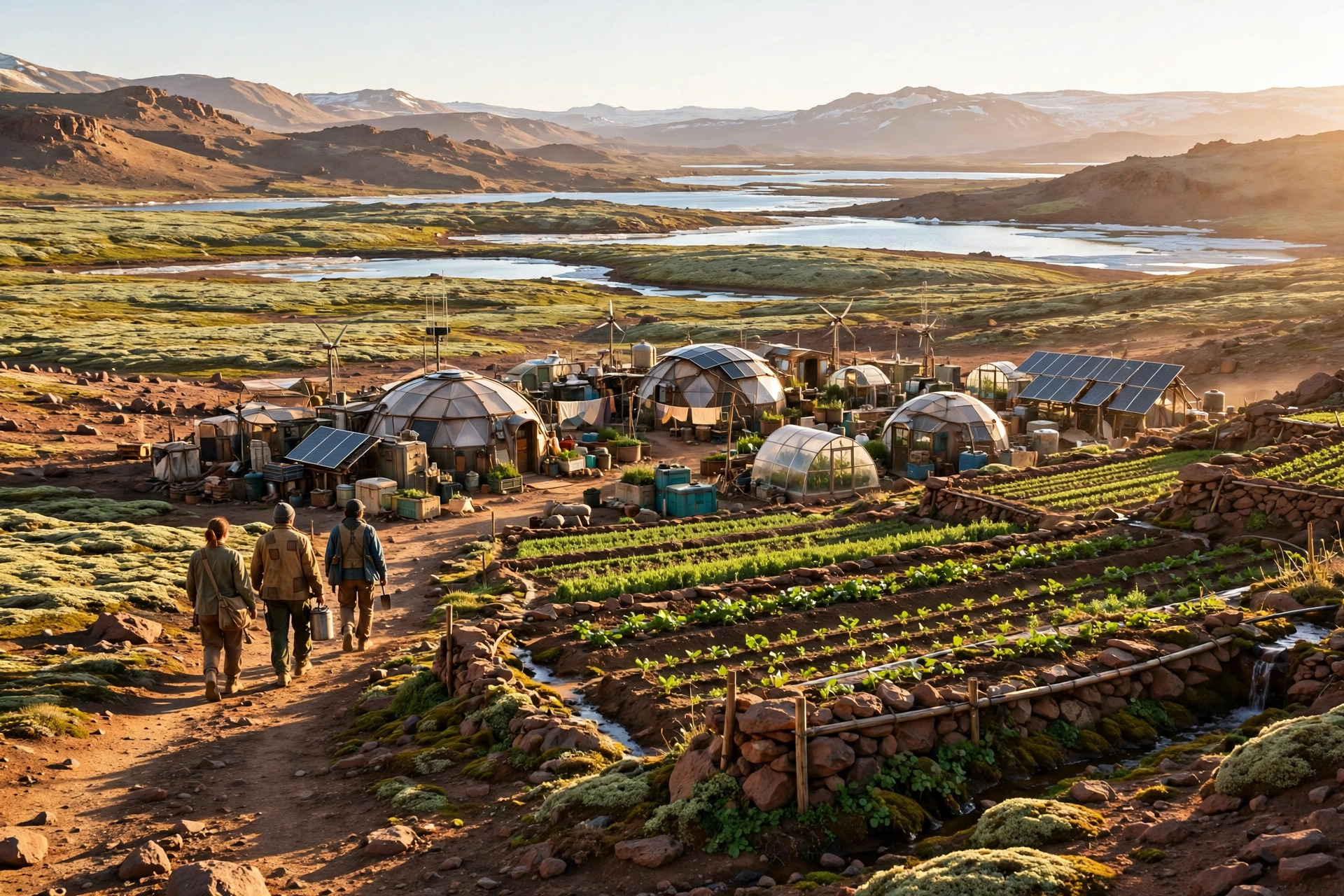
The question Amara Okafor carried with her across the whole of the Ashfield Plain was the same one the settlement council had put to her the night before: how do you measure a world getting better when the instruments keep telling you it is dying? She had no good answer yet. She had a sample case, a failing nitrogen map, and eleven kilometers of pink-gray dust between her and the only grove of living trees on the moon of Perdita.
She walked it because the rovers were needed elsewhere, and because walking let her count things. Counting was how she prayed. Fourteen lichen colonies in the first kilometer, each no bigger than a dinner plate, each a small green argument against the sky. Two dust devils spinning lazily in the thin carbon dioxide air, which at 640 millibars was finally thick enough to carry sound and, if you were generous, almost thick enough to carry a whisper of scent. She smelled wet stone when she passed the seep at Marker 9, and the smell made her eyes sting, and she let them sting, because on Perdita water that had escaped containment and made it to the open air was not a failure. It was a rumor of rain.
I. The Ledger
Settlement Verge had a ledger, and Amara kept it. Not a paper ledger; a distributed record stitched into the settlement's lattice network, open to anyone, updated every sol, and signed with the initials of whoever had done the measuring. It had been started thirty-one years ago by the first landing crews, back when Perdita's atmosphere was a vacuum and the ledger's first entry read, in the handwriting of a woman long since returned to Earth: Pressure: 0. Nothing. We begin.
Amara had inherited the ledger the way you inherit a lighthouse. The old keeper retires, the light still has to burn, and nobody thanks you for it because everyone assumes the light simply burns on its own. She was thirty-four now, chief soil systems engineer, and every evening she entered the numbers that told Verge whether it was winning or losing against an entire moon.
The numbers had been winning for three years straight, and not in the direction anyone wanted.
The problem had a name everyone used and nobody liked to say above a murmur: salt creep. The terraforming consortium, decades back, had chosen speed over patience. They had seeded Perdita's regolith with engineered nitrifying bacteria and ammonium feedstock to build soil fast, because soil was the bottleneck for everything, and for twenty years it had worked like a miracle. Then the byproducts had come home. Chloride and perchlorate salts, concentrated by the same capillary action that lifted water to thirsty microbes, were wicking upward through the new soil columns and crystallizing at the surface in pale ugly crusts. The lichen plates were dying at their edges first, going white like old scars. The wheat terraces under the domes were yielding less every season even as the inputs went up. The founding generation had built a garden on a loan, and the interest was coming due in sodium and chlorine.
That was the ledger's other column. Amara opened it in her visor overlay as she walked and looked at the trend line she had been staring at for three years: salinity in the top ten centimeters, up 0.4 percent annually, compounding. In nine years, extrapolated, the open-air lichen plains would cross the threshold where nothing photosynthetic survived without shell and glass over it. Thirty-one years of planetary engineering, and the moon was quietly pickling itself.
She closed the overlay and kept counting lichen. Twelve. Thirteen. Fourteen. One of them, at Marker 11, had a new lobe of growth, a sliver of green no wider than her thumbnail, reaching into ground that the map said should already be too salty for it. She knelt, took a core sample the size of a pencil, sealed it, and let herself feel the small unreasonable hope she had trained herself to distrust. Something was alive down there that did not care what the model said.
II. The Mycologist
The grove at the end of the plain was called the First Planting, and it was less a forest than a promise: forty-one poplar hybrids and six ironwood analogues inside a cracked open dome that the terraforming authority had abandoned as surplus, now held at ambient pressure because the trees had earned it. They were eleven meters tall. They were the tallest living things for four hundred million kilometers, and children from Verge came out on shuttle weekends just to put their hands on the bark and stand there, not saying anything, the way you stand in a cathedral.
The keeper of the grove was Danil Reyes, sixty-one, ex-terraform authority, a founding-generation man with forearms like cable and a reputation for treating new ideas the way his trees treated frost: by enduring them without comment until they went away. Amara had argued with him for six years. She had also, though she would have denied it under oath, learned more soil from him than from her entire doctoral program.
He was waiting at the grove airlock with two cups of chicory substitute, which meant he wanted to talk, which meant the council had already called him.
"They showed me your proposal," he said, handing her a cup. "The fungus one."
"The mycorrhizal amendment."
"The fungus one." He drank. "You want to tear out the ammonium feedstock infrastructure. Forty years of capital, Amara. The consortium built those injector grids to last a century."
"The injector grids are the problem," Amara said. "They are the reason the salt is coming up. We have been force-feeding nitrogen into dead mineral for three decades and the chemistry has been telling us to stop since year twenty. The bacteria we brought cannot finish the job because they were designed for speed, not for living. They don't build structure. They don't aggregate. They don't hold water. They convert and they leave." She took a breath. "Something else does build structure. Something we already have."
"The lichen."
"The lichen, and under the lichen, the thing I found at Marker 11. A fungus. Native to the engineered biome, technically, descended from the spore bank we scattered in year nine, but it has gone feral and it has gone good. It forms hyphal networks that bind salt-stressed regolith into aggregates. It fixes nitrogen at a quarter the rate of the injector bacteria and it holds it, Danil. It holds it in the soil instead of leasing it. I have three field seasons of data."
"Three field seasons is not forty years," Danil said, and there it was, the whole cultural fault line of Verge in a single sentence. The founders trusted what had been tested to destruction. Amara's generation trusted what had been tested and then watched for a while, because on a moon that was still deciding what it wanted to be, watching was the only honest instrument.
"You're right," Amara said, and watched surprise flicker across his face. "Three seasons is not forty years. So we don't bet the plains on it. We bet one hundred hectares. The Ashfield pilot block, the one with the worst salinity readings on the map. If I'm wrong, we lose a hundred hectares we were losing anyway. If I'm right, we have a method."
Danil looked at her for a long moment. Then he looked past her, through the grove's scratched canopy glass, at his trees standing in air that had not existed when he was young. "You know what nobody tells you about planting the first forest," he said. "Everyone assumes the hard part was the chemistry. The hard part was convincing four hundred people to spend their children's ration surplus on trees that would not shade anyone for a decade. The chemistry was easy. The chemistry just needed time." He drained his cup. "I'll second your pilot. Don't make me regret it."
"I'll make you proud of it," Amara said. "Regret is a low bar and I don't jump low bars."
He laughed, the first time in months, and it sounded like wind through the poplars, which on Perdita it very nearly was.
III. The Council of Counters
Verge's council met in a room with no chairs facing forward, an architectural joke from the founders meant to prevent anyone from presiding. There were nine members, elected for three-year terms, and their deliberations were broadcast to the whole settlement, because the founders had believed that a community that could not hear its arguments did not own its decisions.
Amara presented the pilot for two hours. She showed the salt trend lines, the core samples, the microscopy of the feral fungus binding gray regolith into dark crumb like chocolate cake, the water retention curves that made two of the hydrologists sit forward. She showed the ledger entry she had drafted: projected salinity reversal of 0.2 percent per year in the pilot block within four seasons, contingent on feedstock withdrawal and fungal inoculation at 400 grams per square meter.
Then came the questions, and they were good ones, because Verge had survived on good questions.
"If we pull the ammonium injectors," asked Councilor Yasmin Traor, who managed the food systems, "our dome yields drop before your fungus catches up. How do we eat during the gap?"
"We don't pull them," Amara said. "We taper. Ninety percent in season one, sixty in season two, thirty in season three, zero when the pilot's aggregate stability index crosses 0.7. The gap is covered by expanding the aquaponic bays, which run on fish waste, which is exactly the slow nitrogen your question implies we need."
"And if the fungus is a mirror of the bacteria," asked the eldest councilor, old Petrov, who had landed in year one and whose signature was on the ledger's first page. "Engineered, feral, untested at scale. What happens when it meets a wet season it has never seen?"
"We find out on a hundred hectares," Amara said, "instead of on a moon."
Petrov was quiet for a while. When he spoke, his voice had the texture of the old recordings, the accent of Earth's second wave of emigration, worn smooth. "In year nine we scattered the spore bank over the northern plains and nothing came up for six years. Six years. People left over that. My wife wanted to leave over that. I told her, we did not come four hundred million kilometers to quit on a germination delay." He looked at Amara. "Your fungus came up on its own, out of our spore bank, after we stopped looking. That is either luck or it is the moon telling us something. I have learned to vote for the second one."
The vote was seven to two. The Ashfield pilot was funded for five seasons, reviewed annually, all data public in the ledger. Amara walked out of the chamber into the long amber evening and stood on the terrace overlooking the domes, and she did not celebrate. She made a list. Inoculation schedule, taper schedule, monitoring grid, the eleven people she would need to ask for help, and the one of them she was most afraid to ask, which was her own former mentor, Dr. Sun-hi Bae, who had designed the original injector protocol and whom the pilot would, in five years, render partially obsolete.
IV. The Inoculation
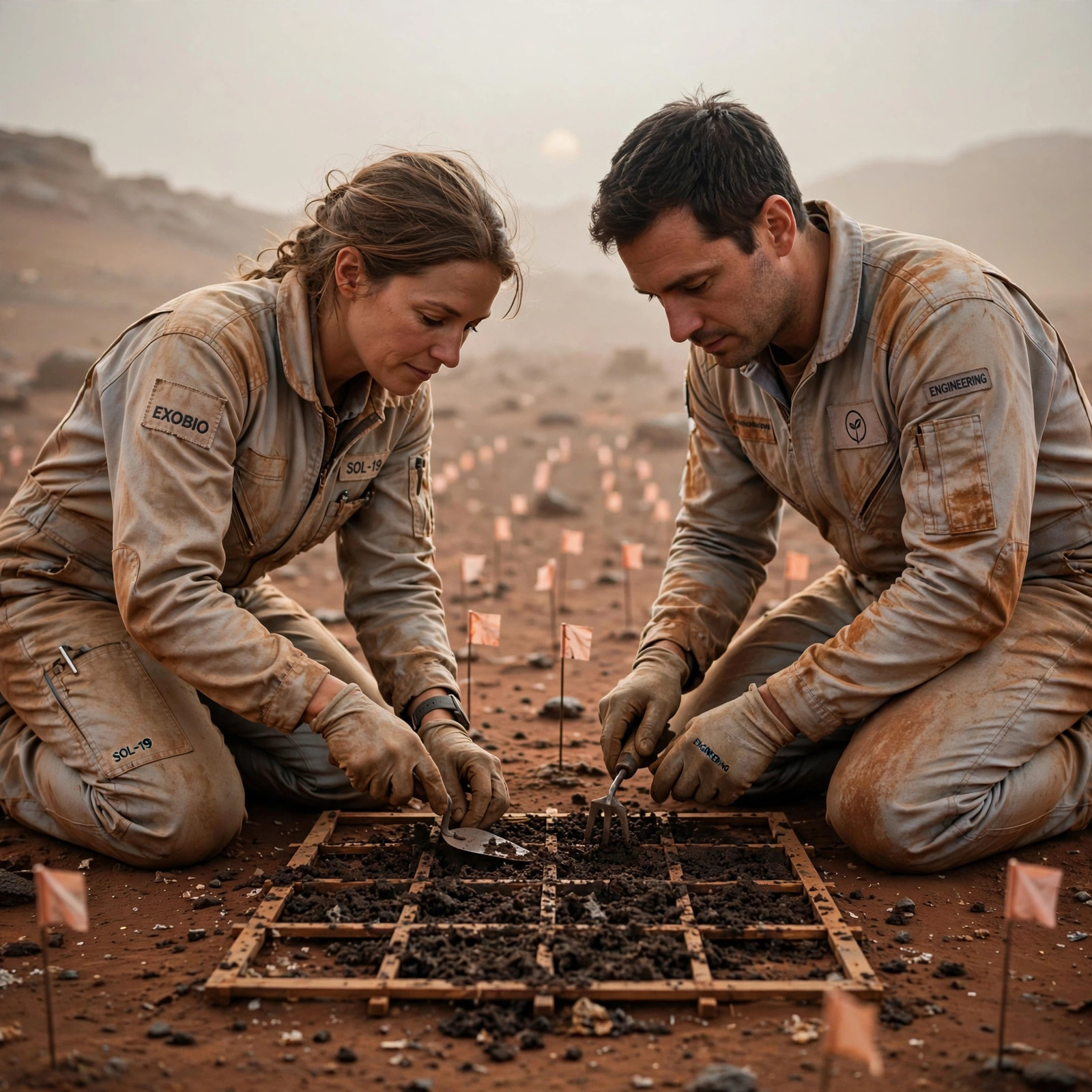
They applied the fungus by hand, on purpose. Amara could have rigged the seed drones to do it in a tenth of the time, but she had watched enough founding-generation failures to know that the difference between a deployment and a ceremony was whether people touched the ground. Eleven volunteers, three sols, one hundred hectares gridded into plots, each plot getting its measured 400 grams of substrate: spent grain from the aquaponics, sterilized regolith, and the feral fungus cultured to density in Verge's smallest fermenter bay, which smelled like a bakery that had opinions.
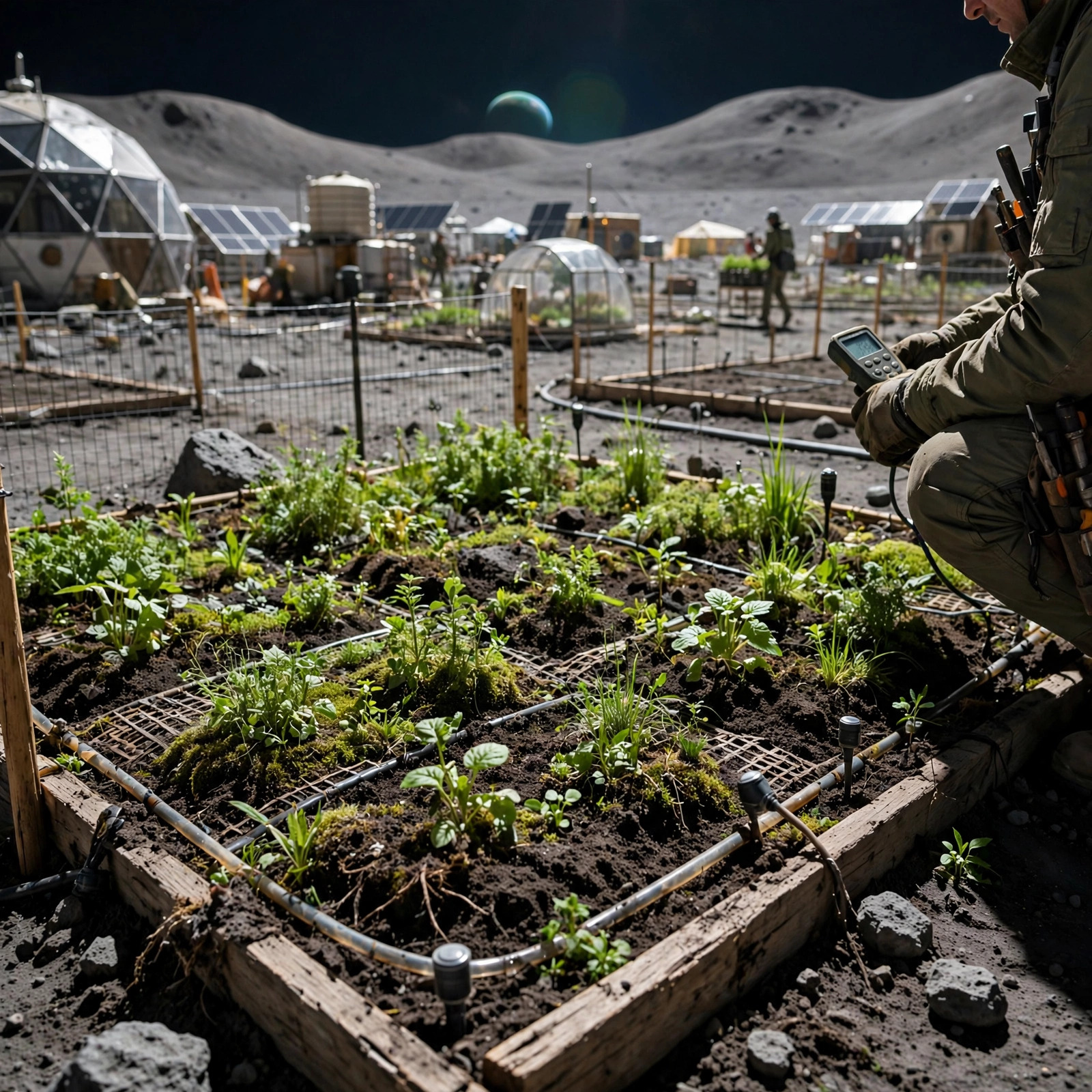
Dr. Bae came out on the second sol. She was seventy now, small and precise, and she walked the grid with her hands behind her back saying nothing while Amara's crew worked, and Amara rehearsed speeches she would never deliver. At the end of the sol Bae picked up an injector wand from the old ammonium grid, the kind she had designed, turned it over, and set it down in the tool crate like a surgeon retiring a scalpel.
"The feedstock chemistry was correct," Bae said, without preamble. "For the goal we had. Fast nitrogen, fast canopy, fast oxygen. We were racing the solar particle events. We were racing our own lifespans." She crouched, pressed one finger into a freshly inoculated plot, and held it there as if taking its pulse. "Correct for the goal and wrong for the world. I have been writing a paper for two years explaining why, and I could not finish it until I watched someone else build the correction." She stood. "Your monitoring grid has a spacing error at the northwest corner. Forty meters, not sixty. Fix it and I will run your statistics, because your last paper had error bars that embarrassed me."
Amara fixed the grid. Bae ran the statistics. The ledger gained a new signature.
The first season was uneventful, which Amara had learned to treat as the highest form of good news. The fungus established on 94 percent of plots. Aggregate stability in the topsoil rose measurably by the end of the season, small but real, the first reversal of that metric in the ledger's history. The lichen plates at the pilot's edges put out new green lobes. The salt trend line, for one season, went flat.
Flat. Amara stared at it some nights longer than she stared at the gains. Flat meant the bleeding had stopped. Flat meant it was now possible, in principle, to get better.
V. The Storm
The setback, when it came, came in the third season, and it came out of a sky that had only recently learned to have weather.
Perdita's storms were not Martian dust storms; the thicker atmosphere and the young seas of meltwater in the southern basin had given the moon real convective weather, and the models were still learning it. The storm that came up the Ashfield Plain on day 212 of season three was a haboob, a wall of fine pale dust two kilometers high, born off the dry lakebeds to the north where the terraforming authority's meltwater program had run out of budget before it ran out of lakebed. It hit the pilot block at ninety kilometers an hour and buried it.
When the crews dug out, eight centimeters of sterile dust lay over everything. The dust was not just burial; it was inoculation in reverse, a layer of unweathered regolith carrying its own perchlorates, smothering the fungal surface network and resetting the salinity at the interface. Amara walked the block afterward in a gray-brown world where every marker had vanished, and she did the thing she had trained herself never to do in the field: she sat down on the ground and put her face in her hands.
Danil found her there. He had come out from the grove with a crew and shovels, unasked.
"In year fourteen," he said, sitting down beside her in the dust, "a microburster came through the First Planting and snapped eleven of my forty-one trees. Snapped them like pencils. I lay in the dirt for an hour. Then Petrov came out, and he did not say anything encouraging, because there was nothing encouraging to say. He just started propping the broken trees with splints and tape. Nine of the eleven lived. They are crooked. You can see the scars when the light is low. Children ask about the scars and I tell them the truth: the trees are stronger at the break than anywhere else. Callus wood. Look it up."
Amara lifted her face. "Eight centimeters of sterile overburden."
"So we remove eight centimeters of sterile overburden," Danil said. "And then we do the thing you are too proud to have thought of yet, so I will think of it for you. The dust is sterile and perchlorate laced. That is a resource, if you are a person who thinks in resources. Wash it. Bioremediate it in the settling ponds. It is pre-ground regolith with a known chemistry. It is literally your growth medium, delivered to your door by the weather."
Amara looked at the gray-brown plain, and the plain looked different, the way a problem looks different after someone has loved you in front of it. She got up. She called the crew together. By nightfall the ledger had a new entry: Storm day 212. Loss: 8 centimeters overburden, est. one season delay. Recovery plan: overburden harvest, pond bioremediation, replant of 61 percent of plots with reserve culture. Signature: AO, DR, and 23 others.
The recovery took fourteen months instead of one season. The crooked plots, when they came back, came back denser than before, because the replanting had used a mixed inoculum, four fungal strains instead of one, redundancy where there had been elegance. Bae's statistics showed the mixed plots outperforming the originals by 30 percent on water retention. The storm, logged honestly, had taught the pilot something the calm seasons never could.
VI. What the Instruments Could Not Count
There were things the ledger could not count, and Amara began keeping a second, unofficial record of them, in a notebook she had bought from a Verge woodworker who had begun carving, of all things, when the settlement finally had wood scraps to carve.
She recorded that in season four, a woman named Ines, who had come to Perdita as a pressure-hull welder and had never touched soil in her life, started volunteering at the pilot block every restday and could now identify nine soil invertebrates by feel through her gloves. She recorded that the pilot block, in its fourth spring, smelled different from the surrounding plain, a smell several people independently described as "rain on a garden," and that when she mentioned this in the settlement broadcast, sixty-three people showed up the next restday to smell it, and stood in the plots in a slow reverent circuit like pilgrims, and one of them wept, and no one found it strange.
She recorded that Verge's school, which taught a class called Planetary Systems, had changed its final project from "model a terraforming schedule" to "adopt a pilot plot," and that the students' plots were outperforming the adults' plots on two metrics because the students checked them every single day and talked to them, which Bae refused to include in the analysis and Danil insisted was the actual variable.
She recorded the argument, too, because the ledger was honest and so was she: the two dissenting councilors had spent season four building a shadow report arguing that the pilot's gains were statistical artifacts of favorable microtopography. The report was good. It was rigorous. It forced the pilot team to re-run three years of analysis with terrain corrections, and when the corrections were applied, the gains held, slightly larger. Amara entered the shadow report into the public ledger herself, with a note: Opposition analysis, adopted. This is what the numbers are for. One of the two councilors, a quiet geologist named Ferro, withdrew his dissent in the next session and asked to join the monitoring team. The other kept dissenting, usefully, for two more years.
VII. The Threshold
Season five ended on midsummer's day, and the review that had been promised every year came due, and this time Amara did not present alone. She presented with Bae's statistics, Ferro's monitoring, Ines's invertebrate census, the students' plot data, and Danil's crooked-tree wisdom about patience, which he delivered in one sentence and then sat down.
The numbers, for the first time in the ledger's thirty-four years, were unambiguous. Pilot block salinity: down 0.3 percent per year and accelerating, because the fungal aggregates were now deep enough to hold water in the root zone and the capillary wick that had carried the salt upward was, in effect, being rewired. Aggregate stability index: 0.78, past the 0.7 threshold that had been set as the trigger for feedstock withdrawal. The ammonium injector grid over the northern plains was formally powered down that midsummer, its pipelines drained and, by council vote, left standing as a monument, because Verge did not pretend its history had not happened; it simply stopped paying interest on it.
The council approved expansion: a thousand hectares, then the full northern plain in phases over fifteen years. But that was not the moment Amara remembered. The moment she remembered came three days later, when she and Danil and Ines and two of the students walked out to the pilot block's center for the season's final measurement, and Danil, who carried things in his truck that he never explained, unloaded four saplings from the grove, poplar hybrids, third generation, and said, "Well. It's your soil now."
They planted them without ceremony because ceremony had already happened, in the sixty-three pilgrims and the restday volunteers and the arguments in the chairless chamber. The saplings went into ground that had been, five years ago, the worst salt-crusted dirt on the moon, and their leaves, when they unfurled over the following weeks, did something no engineered leaf had done in open Perditan air before: they transpired, measurably, and the moisture they exhaled drifted downwind and condensed on the cool morning regolith as a film of dew that the monitoring station recorded, disbelieving, at 0.2 millimeters per dawn.
Dew. The moon was learning to have dew.
VIII. The Lived-In Landmark
Ten years later, Amara Okafor, forty-four, chief restoration officer of the Northern Plain, walked out of Settlement Verge on a morning she would have recognized at twenty-four only as a hypothesis.
The air was 720 millibars and you did not need a suit, only a filter scarf for the pollen season, which was new, and which made people sneeze, and which everyone complained about with enormous pride. The plain she crossed had been renamed by council vote, over Amara's objection that names should be earned by the ground and not the people, and the council had overruled her with the argument that the ground had earned it through her and there was no honest way to separate those. It was called Okafor Plain, and it was green in the way that young steppes are green: not a forest, not a lawn, but a continuous low canopy of lichen, moss, and grass sward broken by wind-cropped shrubs, crossing eleven kilometers to where the First Planting's descendants, thousands of them now, stood in wind rows along the old injector pipeline monument.
The dew film at dawn ran 1.4 millimeters. The morning fog, in the cool season, was thick enough to have a name in the settlement's dialect: the gray light, the hour when the plain disappeared and you walked by sound, by birdsong, because the plain had birds, small engineered finches and their feral descendants, whose song the children could identify and whose nesting disputes the school's ecology class adjudicated with more seriousness than most courts.
Amara walked to the pilot block, which was no longer a pilot block. It was the Okafor Plain's core preserve, fenced in nothing but tradition, and at its center stood the four poplars from the first planting, now twenty-two meters tall, scarred by the storm of their second year in callus wood stronger than the unbroken grain. A bench had been built under them, by the woodworker, who was old now and whose granddaughter ran the shop. On the bench sat a student with a tablet, taking dawn measurements, and she waved at Amara without getting up, which was exactly the correct amount of reverence.
Amara opened the ledger. It was on her overlay, as always, thirty-one years of entries now, and she scrolled not to the trend lines but to the signatures, hundreds of them, generation after generation, because she had learned, in the end, what the ledger had been for all along. It was not a record of a moon getting better. Instruments could count that. It was a record of who had shown up to do the counting, and the fact that there were always more of them than the season before.
She made the morning's entry with the student's data, signed it, and sat on the bench under the trees while the fog burned off and the plain came back into the world a piece at a time: first the sound of the finches, then the smell of wet lichen, then the green, all the way to the horizon, where the meltwater seas the old authority never finished were now lakes with shores, and on the nearest shore, if you knew where to look, the first reeds.
The question the council had asked her twenty years ago, how do you measure a world getting better, had an answer now, and it was not a number. It was a morning when the counting had become so ordinary, so woven into breakfast and school runs and restday walks, that nobody thought of it as measurement anymore. They thought of it as tending. And the world, tended, kept getting better, the way a garden does: not because the work ever ends, but because the people who do it never do.
"Pressure: 720. Green to the horizon. We begin, still, every morning."
Get notified when new stories drop

Leo Stranek
Leo specializes in solarpunk abundance and near-future progress: livable futures, bright cities, and practical wonder.
Leave a comment
Comments