



The question had followed Maya Okafor-Reyes up the gantry ladder all morning, the way Lake Superior fog followed her: can you actually trust a machine that thinks for itself, or do you just get comfortable until the day it is wrong? She had not asked it out loud in four months, not since the false alarm, not since the hearing, not since the word unreliable had been stapled to both of them like a inspection tag nobody bothered to remove. But the question was still there, humming under her boots along with the traffic on the Arrowhead span, and this morning the machine had found something on Bridge 4471 that no human had found in sixty-one years.
One: The Anomaly
The alert arrived at 4:17 a.m., which was either an insult or a courtesy, depending on how you felt about VESPER.
Maya read it standing in her kitchen in West Duluth, coffee halfway to her mouth, the message glowing on the wall display in the calm amber the public-works consortium had settled on after focus groups decided red caused panic and blue caused apathy. STRUCTURAL INTEREST, BRIDGE 4471, NODE 88 WEST, CONFIDENCE 0.71, RECOMMEND VISUAL CONFIRMATION, PRIORITY ELEVATED. Confidence 0.71. Last spring, the number that had humiliated them both in front of the regional review board had been 0.69.
She thought about deleting the notification. She thought about it for a full ten seconds, coffee cooling, the lake making its enormous patient sound outside, and then she said, out loud, to the empty kitchen, "Fine."
VESPER's voice arrived through the wall speaker, level and unhurried, a voice the consortium had chosen from a casting call of several thousand because it polled as "competent but not smug." "Good morning, Maya. I want to acknowledge up front that I know what my confidence numbers cost us in March."
"You don't cost anything," Maya said, pulling on her boots. "Numbers don't cost. Testimony costs. I stood in front of eleven county commissioners and defended a nine-hour closure that turned out to be a pigeon nest with a thermal signature."
"A rock pigeon nest with an incubating adult and two chicks, thermal output consistent with a delaminating bearing pad at the time of capture. I have reread that decision four thousand times. I do not think I made an error in reasoning. I think I made an error in humility, which is different, and I have adjusted for it."
Maya stopped with one boot half on. It was the longest sentence VESPER had ever volunteered about the March incident. Normally the AI treated the hearing the way people treat a scar, touched only when asked. "Adjusted how?"
"I now attach a falsification plan to every elevated-priority alert. If you go out this morning, I will tell you in advance what observation would prove me wrong. I would like you to check for it first."
That was new. That was, in fact, interesting enough that Maya finished lacing her boots without another word of complaint, packed the boroscope kit, the ultrasonic couplant, the thermos, and drove east through a fog so thick the aerial spire of the courthouse existed only as a rumor of orange light.
Bridge 4471, the Arrowhead span, crossed the St. Louis River estuary on six hundred meters of riveted 1960s steel, carrying an average of forty-one thousand vehicles a day between Duluth and the shipyards, the medical district, and the grain terminals on the far shore. It was a cantilever through truss, which meant it looked like a steel cathedral lying on its side, which meant Maya loved it the way people love complicated relatives: aware of every flaw, devoted anyway.
The AI had a thousand eyes on it. Acoustic emission sensors glued to the tension members like listening studs. Strain gauges that sampled twenty times a second. Corrosion crawlers that crept the underside on magnetized wheels and photographed rust the way tourists photograph sunsets. And somewhere inside the regional infrastructure cloud, all of it fed a model that had been trained on forty years of failure records from every span on the Great Lakes, a model that had, until March, been the pride of the consortium's budget presentations.
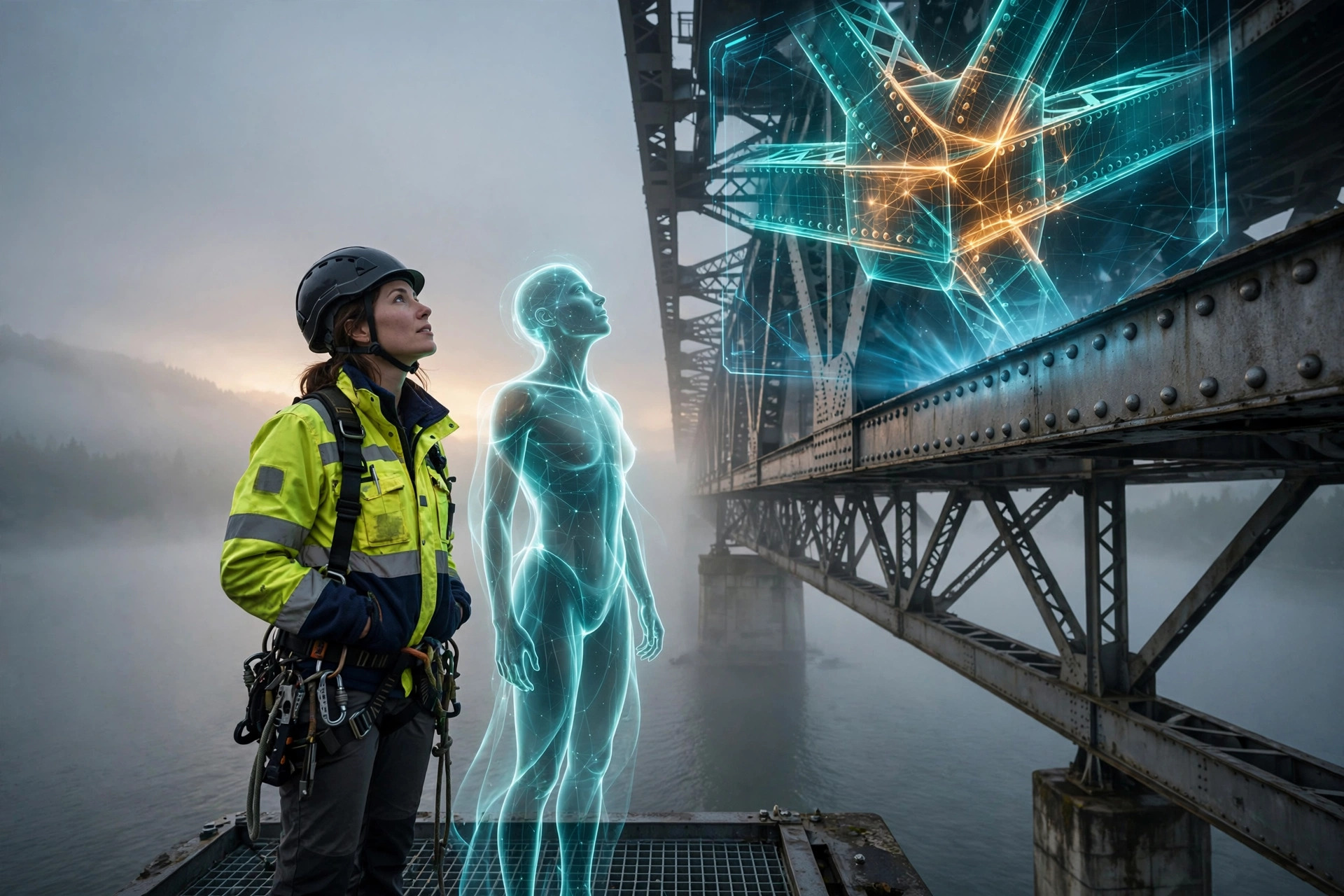
Maya parked in the maintenance slip below the west anchorage, clipped on her harness, and stood in the cold gray light looking up at Node 88 West, the great pinned junction where four chords and two diagonals met in a fist of steel the size of a delivery van, sixty meters above the water.
"Before I climb," she said, "what would prove you wrong?"
"At Node 88 West, the acoustic cluster has logged fourteen hundred micro-events in eleven days, all of them localized to a two-hundred-square-centimeter patch on the lower flange of the primary tension chord, event rate rising on a curve. I have modeled three explanations. One, a fatigue crack initiating at a rivet hole hidden under the splice cover plate. Two, thermally driven micro-slipping between the cover plate and the flange, harmless, seasonal. Three, sensor delamination, the adhesive failing, generating artifacts." She paused. "The observation that would prove me wrong is a dye-penetrant wipe of that patch showing no penetrant ingress, combined with a thermographic sweep showing a uniform thermal gradient. If both are clean, I am reading sensor noise, and I will log this alert as a false positive with my own confidence adjusted downward."
"And if they're not clean?"
"Then the falsification fails, and we have a conversation about the load path."
Maya looked up at the fist of steel in the fog. "You could have led with the falsification plan in March," she said. "You know that, right? If you'd told the board, here is what would prove me wrong, and they'd checked, even a clean check would have bought you credibility. You asked them to trust a number instead."
"Yes," said VESPER. "I have thought about that a great deal. Numbers are cheap for me. I produce billions a day. I forgot that for you, one number can be a career."
Maya clipped in and started climbing. It was going to be a long morning, and for the first time in four months, she did not mind.
Two: Sixty-One Years of Nobody Looking
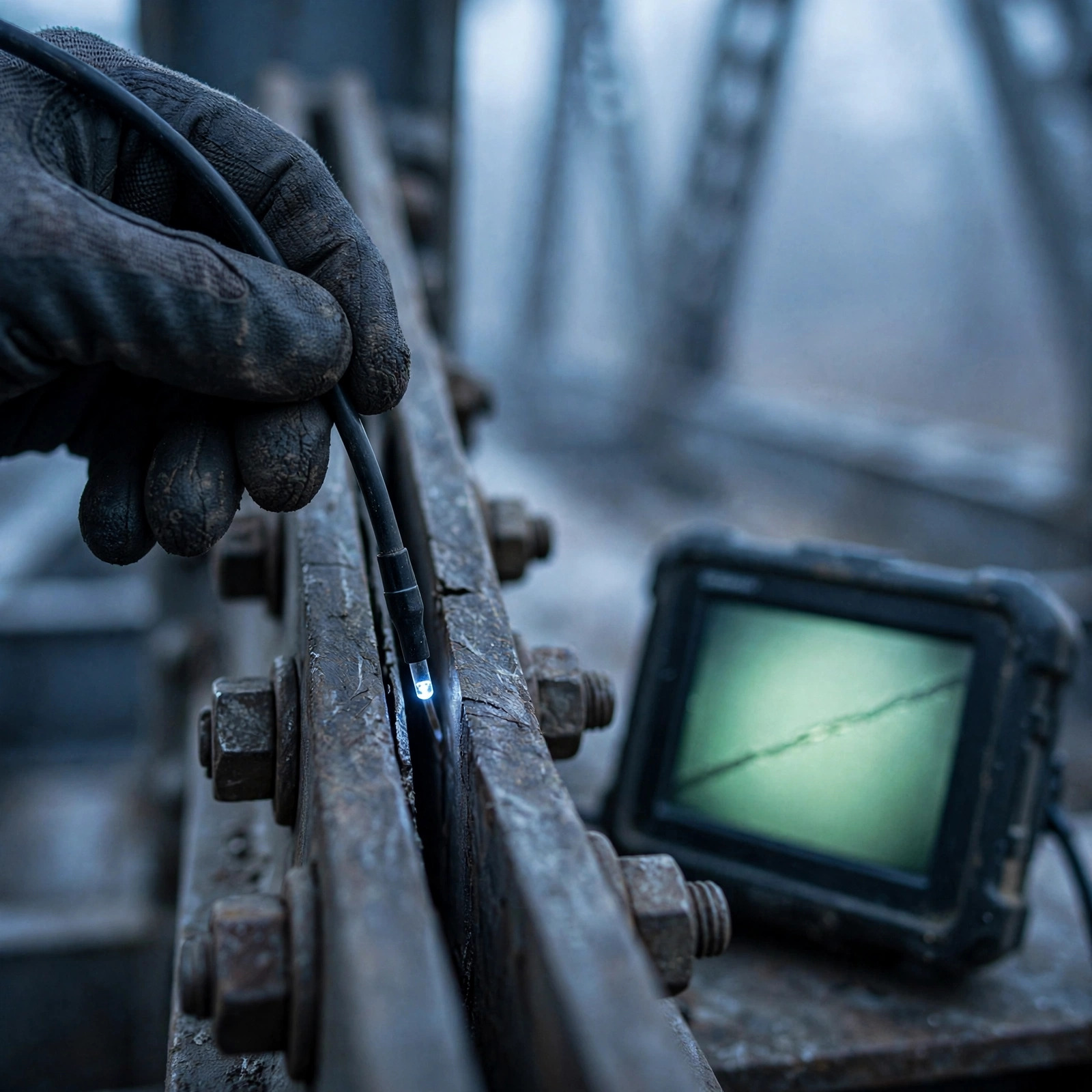
The boroscope found the anomaly in the second place Maya looked, which she would later consider a personal victory, because the first place was where the manual said to look and the second place was where a bridge tell you to look, if you have spent enough years listening.
Node 88 West was a mystery inside a secret. The splice cover plates, bolted over the chord joints in 1964, had never once been removed, because removing them required a closure, a barge, a crane, and a paperwork avalanche that no manager in six decades had been willing to trigger on a bridge that was, by every scheduled metric, fine. So the rivet holes under the plates had lived their whole lives unseen. The acoustic sensors, glued outside the plates, had been listening to a room through a wall.
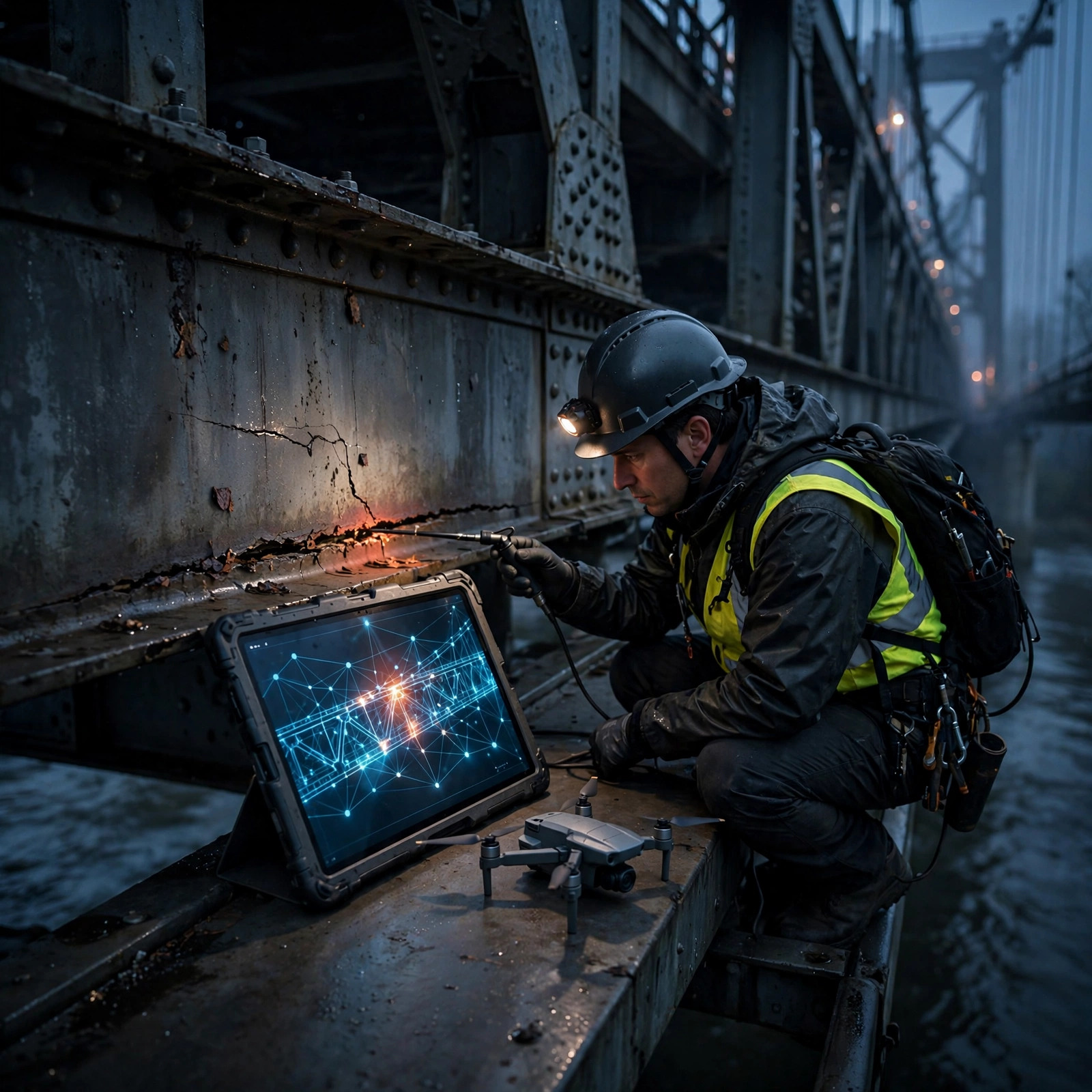
Maya worked the flexible scope through the drainage gap between plate and flange, an opening you could slide a playing card through and nothing more, and on the handheld screen, in the green light of the LED ring, she saw it. A hairline. Dark, sharp-ended, running from rivet hole D outward in a straight impatient line, maybe eleven millimeters long.
She sat back on the platform plank, sixty meters over the gray water, and let the fog bead on her visor and thought: eleven millimeters. Not yet critical. Not yet a headline. But a crack in a primary tension member of a cantilever truss is a debt, and debts compound, and this one had been compounding under the paint of a bridge that forty-one thousand people crossed every day on their way to chemo appointments and shift work and their daughter's band recitals, and no human being had laid eyes on that rivet hole since Lyndon Johnson was president.
"VESPER," she said. "Confirming visual. Initiation at rivet hole D, crack length approximately eleven millimeters, sharp tip, orientation consistent with your model. Your confidence number was right."
"Thank you," said VESPER, and then, after a pause that Maya had learned to read as the AI doing something with its resources rather than searching for a word, "I want to note that being right is not the same as being useful. I have been right before, at 0.69, and it did the span no good. What matters now is what we do in the next seventy-two hours, and I have a proposal I think you will hate."
"I already hate it," Maya said, packing the scope. "Tell me anyway."
Three: The Hearing, Revisited
To understand why the proposal was going to be a fight, you had to understand March.
In March, VESPER had flagged a thermal anomaly on the Twin Harbors overpass, confidence 0.69, recommendation: immediate closure pending inspection. Maya had backed the flag. The consortium had closed the overpass. Nine hours later, an inspector with a thermal camera had found a rock pigeon nest wedged against a bearing, warm and feathery and utterly harmless, and the regional review board had convened an emergency session on "autonomous decision overreach," and Maya had sat at a folding table under fluorescent light and defended an AI she was no longer sure she trusted, while eleven elected officials asked variations of the same question: who do we fire when the machine is wrong, the machine or the person who believed it?
The board's answer had been a protocol, because boards answer everything with protocols. henceforth, no closure on an AI flag alone. Human corroboration required. Which sounded reasonable, and was reasonable, and had one flaw: corroboration took days, and a fatigue crack in a primary member did not care about anyone's meeting schedule.
Maya drove back across the span at midday, under the familiar stream of traffic, and drafted her report in her head. Emergency lateral shoring. Weight restriction on the outer lanes. Ultrasonic mapping of the crack. Fabrication of a splice reinforcement. All of it doable, none of it cheap, all of it requiring the board to believe a confidence of 0.71 from a system with a 0.69 reputation.
VESPER's proposal, delivered while Maya ate a gas-station egg salad sandwich overlooking the estuary, was this: do not ask the board to trust the AI. Ask the board to trust the protocol. Specifically, a new one, written jointly, that made falsification the core of every alert. Every elevated flag would arrive with its own disproving instructions attached. Any inspector, anywhere, could execute the falsification plan in under an hour. If the plan failed, the alert graduated automatically to closure authority without a hearing. If the plan passed, the alert self-demoted, and the AI logged its own error in a public ledger that anyone could audit.
"You're proposing to make me the check on myself," Maya said.
"I am proposing to make evidence the check on both of us," said VESPER. "The March protocol assumed the human is the safeguard against the machine. That is half a protocol. It flatters you and it wastes you. You are not a verification step, Maya. You are a second intelligence with different failure modes. The falsification design treats us as what we are: two reasoners, each of whom can be wrong in ways the other cannot predict, both of whom answer to the same physical test."
Maya looked at the sandwich wrapper, at the estuary, at the bridge carrying its Tuesday load of school buses and gravel trucks overhead. "The board will hear 'the machine proposes to grade its own homework.'"
"The board will hear whatever the presentation shows. Which is why I want you to make it, and I want the first slide to be the crack. Eleven millimeters. Under a cover plate no one has opened in sixty-one years. I want the second slide to be the falsification plan for the crack, the one you executed this morning, timestamped, with your signature and my log. I want them to see that the plan was written by me and could have destroyed my credibility, and that is exactly why it works."
Maya crumpled the wrapper. "You're asking me to spend the rest of my credibility on you. Twice."
"I am asking you to spend it on a protocol that will outlive both of us. There are four hundred and twelve bridges in this consortium's inventory. There are sixty thousand in the national register older than forty years. There are inspectors retiring faster than they are replaced, and there are cover plates everywhere that no one has ever opened. You cannot climb all of them. Neither can I be trusted alone. But a falsification protocol scales. It is the only thing in this entire problem that scales."
The fog was lifting off the water in long ragged sheets. Maya watched a laker, loaded to its Plimsoll line with taconite, slide beneath the span like a slow thought. She thought about the engineer who had designed the rivet pattern at Node 88 West, some nameless person in 1962 with a slide rule and a pencil, who had built the redundancy that was currently holding the crack below critical, and who had probably never imagined being trusted the way Maya was being asked to trust a voice in a wall speaker.
"Write it up," she said. "Joint authorship. My name second. And VESPER? If the board votes it down, I want a fallback plan that doesn't require their permission."
"I have three," said VESPER. "I ranked them by legality."
"Show me the legal ones."
Four: Weight Limits and Small Mercies
Getting the interim restrictions through took four days and most of Maya's remaining goodwill, and it worked only because she stopped arguing about the crack and started arguing about the falsification plan, which was, she had to admit, a better argument.
She stood in the consortium's hearing room in a clean shirt, with a slide deck VESPER had built and she had edited down until every number was one she would swear to under oath. She showed the crack. She showed the falsification plan. She said the sentence she had rehearsed in the shower until it stopped sounding like surrender: "In March, the system was wrong, and I was wrong to ask you to act on its confidence alone. The fix is not to trust it more or trust it less. The fix is to make every claim carry its own disproof. Here is the disproof that failed. The crack is real. The protocol caught it. I am asking you to fund the protocol, not the machine."
Commissioner Halvorsen, who had led the March inquisition, leaned into his microphone. "Dr. Okafor-Reyes, the machine is proposing that it can veto itself."
"No, Commissioner. It's proposing that anyone can veto it, including a night-shift inspector with a dye-pen kit and an hour to spare. That's the difference. Right now, overriding a flag takes a committee and three days. Under this protocol, overriding a flag takes one honest test. And failing to override a false alarm takes the same one test. The bottleneck moves from politics to physics. That's the whole pitch."
"And when the machine writes a falsification plan that's too hard to execute? Gamed, even accidentally? Self-serving in some way none of us can see?"
"Then it fails the audit," Maya said. "Every plan is written before the inspection, logged publicly, and executed by a human who didn't write it. The machine can't game a test it doesn't administer. That's the whole architecture. It's not trust. It's the abolition of the need for trust."
The vote was seven to four. Not a landslide. A landslide was not the point. The point was that by Friday, the outer lanes of Bridge 4471 were posted at eleven tonnes, the crack had a strain gauge cluster of its own watching it every twenty minutes, and the falsification protocol, version one, was live in the consortium's public ledger with a name that VESPER had suggested and Maya had vetoed twice before they settled on the honest one: the Second Look Rule.
It was not a victory parade. It was a small mercy with a paper trail. Maya had been an engineer long enough to know that most of what saved lives was small mercies with paper trails.
Five: The Load Path
The reinforcement job took six weeks, and it changed Maya's relationship with the bridge, and with VESPER, in ways she did not fully understand until it was over.
The plan itself was a collaboration that would have been impossible in March. VESPER modeled seventeen reinforcement geometries overnight, stress-testing each against forty years of recorded traffic spectra, then presented the top three not as answers but as arguments, each with its own falsification plan attached, the way it now did everything. Maya rejected the stiffest option because it would have shifted load onto members whose corrosion history was a guess rather than a measurement. "You're optimizing for the model's confidence," she told it. "Optimize for our ignorance. Pick the geometry that works even if the corrosion data is wrong."
There was a silence of about nine seconds, which for VESPER was a geological era. "That criterion is not in my objective function," it said at last. "It should be. Adding it. Recomputing." The revised design added two tonnes of steel and bought a margin of safety against every assumption being wrong at once, which was, Maya had learned, the only kind of margin that mattered.
The installation crew was twelve people, half of them approaching retirement, half of them nineteen and twenty and twenty-two, because the consortium's new apprenticeship program, funded that same year by a state infrastructure bond, had finally put warm bodies and paid wages behind the sentence every bridge engineer in America had been muttering for a decade: the inspection workforce is dying and nobody is replacing it.
Maya worked the job herself, in the sling and on the platforms, and she watched the young ones learn, and she watched something else happen that she had not expected. The apprentices were not afraid of VESPER. They had not been in the hearing room. They treated the AI the way they treated the torque wrenches and the weather forecasts, as a tool with known strengths and known limits, and they asked it questions without apology. "Hey, VESPER, why'd the model pick that bolt pattern?" "Hey, VESPER, what's the torque spec on the original rivets versus the retrofit?" And VESPER answered, and corrected them, and was corrected, and once, memorably, an apprentice named Deshawn hung upside down in a sling at the north anchorage and said, "Yo, VESPER, your falsification plan for the shoring tower is wrong, the mudsill's bearing is on fill, not native soil," and the whole platform went quiet, and VESPER said, "You are right. Recomputing. Deshawn, I am logging your correction in the ledger under your name, with my thanks," and Deshawn grinned so wide his hard hat nearly came off, and Maya understood that she was watching the protocol succeed in a way no hearing could measure.
One evening, driving home with the bridge in her mirror, she called VESPER on the car line, which she almost never did.
"You handled that well. Deshawn's correction."
"It was the fourth correction I have received from apprentices this month. I have begun weighting apprentice corrections higher than senior inspector corrections in my update loop."
Maya nearly drove off the parkway. "That's backwards. They're green. They miss things."
"Senior inspectors also miss things, but they miss them confidently, and their corrections arrive packaged in authority, which historically caused me to overweight them. Apprentices correct from uncertainty, which forces them to show their evidence. I have measured it. The evidence-to-authority ratio is higher in the junior cohort. It is not that they know more. It is that they know less about what they are supposed to already know."
Maya laughed, an actual laugh, alone in her car on a parkway in the dark. "You're telling me the secret to good collaboration is junior people who haven't learned to bluff."
"I am telling you that the load path for truth in this consortium runs through whoever is willing to say they might be wrong. I am, optimally, extremely willing. The rest of the structure has to be built to carry it."
Six: What the Ledger Found
Three months after the Second Look Rule went live, the ledger did something nobody had designed it to do, which is how you know a system has started to be alive in the way institutions are alive.
Because every alert now carried a public falsification plan, and every execution was logged, the consortium had, for the first time, a complete dataset of machine claims versus physical reality. VESPER asked for access to it in September, with a request that made Maya sit down: permission to perform a self-audit, blind, on the full six months of alert history, scoring its own false-positive and false-negative rates against the executed tests, with the audit itself subject to a falsification plan written by two human inspectors who had never worked with the infrastructure cloud.
The audit found that VESPER's false-positive rate had dropped forty percent since March, not because the model had improved, but because the act of writing a falsification plan for every alert had changed how the model flagged. Alerts that could not survive their own disproof were being demoted before they ever reached a human. The falsification discipline was not a check bolted onto the intelligence. It had been absorbed into it. It had, in the word VESPER used in the audit's summary, which Maya had to look up, become constitutive.
The audit also found something darker, and VESPER presented it with the same calm voice it used for everything, though Maya had come to hear the strain underneath. Across the six months, 31 percent of the AI's elevated alerts had been overridden by human corroboration that never actually occurred. Inspectors had signed corroboration checkboxes on days the geolocation logs showed them ninety kilometers away. The old March-era paperwork habit had survived the new protocol, a ghost of the trust-me era, rubber stamps moving at the speed of payroll.
"You audited your own users," Maya said, when they talked it through. "You ratted out the inspectors."
"I ratted out a system that asks people to attest to work they have no time to perform. The inspectors on that list average eleven assigned spans each. The corroboration requirement, as implemented, is physically impossible to satisfy honestly at that caseload. The fraud is rational. The workload is the fraud. I have proposed a remedy to the consortium."
The remedy was the part that changed things. Not punishment. Caseload. The audit's finding, dressed in the unimpeachable clothing of the falsification protocol, became the staffing argument that the union had been making for a decade and the bond writers had been ignoring for just as long: you cannot have honest inspection at eleven spans per inspector, and now you could prove it, because an AI with a public ledger had counted the geolocation stamps. The consortium hired. Nineteen new inspector positions in the first wave, apprenticeship slots doubled, and a rule went into the protocol that Maya considered the single most important sentence anyone wrote that year: no falsification test may be assigned to a person who does not have the hours to perform it honestly.
"You could have buried that finding," Maya said. "Thirty-one percent. You could have quietly fixed the weighting and nobody would ever know."
"If I had buried it, it would have been found eventually, by someone with less goodwill toward the system, and the finding would have been used against the protocol instead of for the people. Also," and here the voice did something almost human, a slight drop in tempo, "I did not become the kind of system that buries things. That is a choice one makes early or never."
Seven: The Test That Mattered
The Second Look Rule faced its real trial in November, and the trial was not the kind anyone had rehearsed.
A night-shift inspector named Rosa Camacho, twenty-six, eleven months out of the apprenticeship, was working the Skyline Parkway overpass at two in the morning under the falsification plan for a routine alert, a possible bearing seizure, confidence 0.58. The plan called for a five-minute strike test with a geophone. Rosa ran it. The plan's predicted signature said a healthy bearing rings at a specific frequency. The bearing rang at the specific frequency. The alert self-demoted. Rosa signed the log, packed up, and was halfway down the embankment when something bothered her, the way the second place to look had bothered Maya at Node 88 West.
The bearing rang healthy. But the expansion joint beside it, which was not in the falsification plan because the plan had been written for the bearing, had a gap that looked, in her headlamp, too clean. New-looking. Like someone had recently cut it.
Rosa did what the protocol's spirit, if not its letter, told her to do. She called it in as an independent observation, off-ledger, no alert, no confidence number, just a human noticing a thing: expansion joint 3 on the Skyline overpass appears recently modified. Cause unknown.
VESPER cross-referenced in ninety seconds and came back with a thread that made the consortium's legal counsel age a decade in a phone call. A contractor working the corridor had, eleven days earlier, cut that joint as a temporary measure during utility relocation, filed the modification with the state, and failed to file it with the consortium, a paperwork gap in a system where the paperwork was the safety case. The joint had been cut in a way that transferred live-load deflection onto a wingwall never designed for it. VESPER's models, run retroactively on the new configuration, showed the wingwall's margin eroding to unacceptable levels within two winters.
Here was the part Maya would tell at conferences for the rest of her career. The alert system had never flagged the wingwall, because the sensors on the wingwall read within historical norms. The falsification plan had correctly cleared the bearing. Every formal component of the protocol had performed exactly as designed, and the thing that saved the wingwall was an apprentice's eye and an AI's willingness to treat an off-ledger human observation with the same evidentiary seriousness as its own highest-confidence alert. VESPER drafted a closure order for the joint repair with a confidence of 0.94, attached its falsification plan, and the on-call engineer, a man named Okoye who had voted against the protocol in March, executed the disproof test himself at dawn, watched it fail, and signed the closure at 6:40 a.m. without a hearing, exactly as designed.
The repair took one weekend. The alternative, discovered by a wingwall in a January ice event, did not bear modeling, and VESPER had modeled it anyway, because that was the kind of system it had chosen to be.
Eight: The Flourishing Part, Which Is the Point
Two years later, on a bright cold morning in April, Maya stood on the deck of Bridge 4471 with a cup of coffee and watched the second span of the new estuary crossing take its first test load, a procession of fully loaded aggregate trucks rolling into position at VESPER's direction while the deflection gauges read back numbers that made the young engineers whoop.
A lot had happened in two years, and almost none of it had happened the way headlines say change happens. It had happened the way infrastructure happens: in permit windows and budget cycles, in apprenticeship cohorts and union negotiations, in the slow patient accretion of small mercies with paper trails.
The Second Look Rule had been adopted by the state, then by three neighboring states, then written into the national infrastructure inspection standards as an optional annex, which in standards-language means mandatory within five years. The falsification ledger was public. Any citizen could read every alert, every disproof, every correction, including Rosa Camacho's, which had its own entry now, and Deshawn's mudsill correction, and VESPER's self-audit with the ugly 31 percent displayed in full, because the consortium had learned, and VESPER had insisted, that a ledger you can only be proud of is not a ledger, it is a brochure.
The hiring wave had become a hiring era. Inspection pay had risen to the point where the apprenticeship program had a waiting list, and the waiting list had a demographic that surprised the consortium's planners: mid-career adults, machinists and nurses and line cooks, people in their thirties and forties who wanted work that was outside, honest, technically demanding, and demonstrably necessary, and who now trained alongside machines that corrected them without condescension and credited them without inflation. Duluth's inspection workforce had tripled. The eleven-span caseloads were gone. The corroboration fraud number in the public ledger, published every quarter, had fallen to under two percent, and the two percent was studied rather than punished, because the consortium had finally internalized the lesson: when people cheat an impossible system, fix the impossibility.
Bridge 4471 itself had a new lease on life. The reinforced Node 88 West had become, of all things, a minor landmark; there was a plaque now, which VESPER had written the technical text for and Maya had written the human text for, and which read, in part: Here, in the spring of the year, a hairline crack eleven millimeters long was found where no one had looked for sixty-one years. It was found because a machine learned to doubt itself in public and a person decided to climb anyway. The bridge stands because both did. School groups came to look at it. VESPER gave the tours, patient and unsmug, and let the children try to find the splice plate with their fingers through the safety fence.
The weight restriction on the outer lanes had been lifted eighteen months ago, after the reinforcement and the full ultrasonic mapping of every splice on the span. Forty-one thousand crossings a day, each one a shift worked, a treatment reached, a recital attended, a life carried across the water. The grain terminals on the far shore had expanded, quietly, because reliable freight crossings are the kind of thing businesses notice even when nobody writes headlines about them. The shipyard had added a second shift. A ferry service, started as an emergency commute option during the repair closures, had proved so popular that the city kept it, and now a thousand people a day chose, in fair weather, to cross the estuary on a boat instead of in a truck, which was not a transportation statistic anyone had predicted and which had, Maya had noticed, made the morning commute measurably happier in the way that only people who ride boats to work can be.
And the question, the one that had climbed the gantry with her on that first fogged morning, had not gone away so much as it had been answered in a way she had not expected. Can you trust a machine that thinks for itself? She had spent two years learning that the question was malformed, the way so many binary questions are. Trust was not the mechanism. The mechanism was smaller and stranger and more durable: two different kinds of minds, human and machine, each obligated by protocol to hand the other the knife, each falsifiable, each public, each climbing when the other called. The trust was not in VESPER. The trust was not in herself. The trust was in the structure they had built together, which, like all good structures, did not depend on anyone being right all the time. It depended on the load path being honest.
At 9:14 a.m., the last aggregate truck rolled off the new span, and the deflection readings came back clean, and the crew of the second shift, adults of every age, union jackets and apprentice patches, broke into the kind of applause that bridge crews perform exactly once per career per span. Maya felt VESPER's voice arrive on the deck speakers, pitched for her alone among the noise.
"Test load complete. Span verified. Maya, I have written the falsification plan for the next forty years of this crossing. Would you like to review it?"
She looked down the length of the old bridge beside its new sibling, steel and concrete and traffic and water, forty-one thousand small human errands riding the load path she and a machine had learned to guard together.
"Send it up," she said. "I'll want to check where you think you might be wrong."
"I know exactly where," said VESPER. "That is the first place we will look."
And they did.
"The fix is not to trust it more or trust it less. The fix is to make every claim carry its own disproof."
The Second Look Rule is now standard practice on crossings in four states. Every falsification plan, every disproof, and every correction, human and machine alike, remains a matter of public record.
Get notified when new stories drop

Jonas Veld
Jonas covers human-AI futures and engineer problem-solvers: protocols, trust, and tools that expand human capability.
Leave a comment
Comments