


The question that had carried humanity four hundred light-years into the dark was simple enough to fit on a child's lunchbox: what does it mean, in the widest and kindest sense, to meet someone new? Imara Okonkwo had spent eleven years preparing to answer it, and the answer, she suspected, was not a sentence at all but a patience.
I. The Kestrel's Wake
The Kestrel's Wake was a survey ship, not a flagship, and she wore that distinction like a comfortable coat.
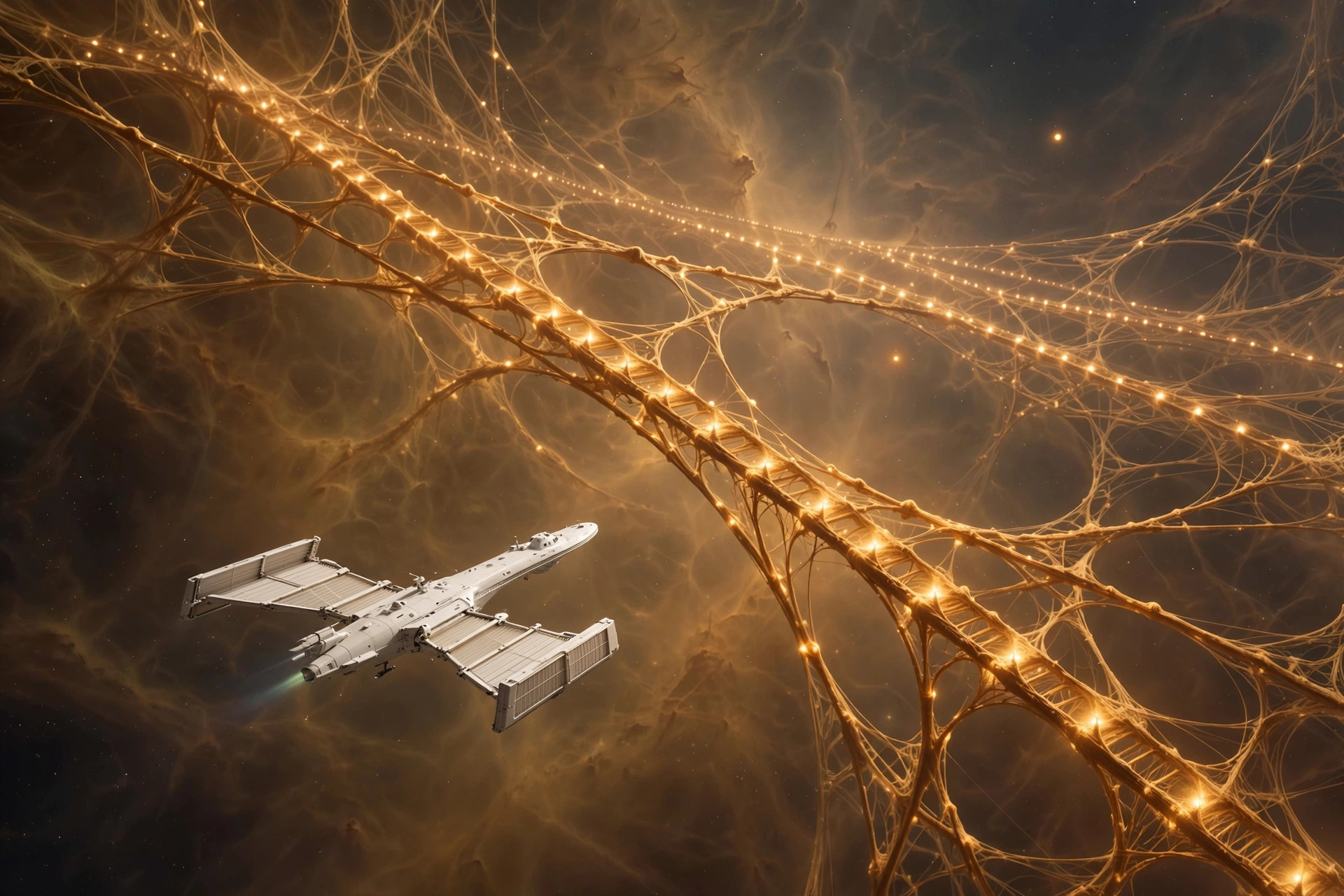
Two hundred meters of layered hull plate, water ballast belts, folding radiators like the wings of a heron in landfall, and a belly full of instruments that no government would have funded unless they promised maps. Survey ships promised maps. Survey ships also promised the opportunity to be the first organism on record to panic at the edge of something enormous, and Imara Okonkwo, thirty-one, mission xenologist, had made a private vow three years ago not to be that organism.
She floated through the aft lab at shipboard midmorning, checking seals with her fingertips the way a sailor checks rigging, while the desktop holography unit traced the anomaly ahead of them: a knot of luminous filaments suspended in the interstellar dust shoal that freighter crews had long called the Hollow Mills, the quiet sheath of space between two small, unremarkable stars.
The filaments glowed a soft ochre against the black, each thread thinner than a canyon, arranged in webs and folds and looped back on themselves in patterns that repeated exactly, all the way around, like a melody written for a mouth too large to hum it.
"Dr. Okonkwo," said the ship's general intelligence, the voice they had all learned to hear as a mild colleague named Yancey, "the captain would like you at the observation gallery before the third course correction."
"Trouble?"
"Curiosity. Which on this ship is often worse."
II. The Thing That Slowly Said Yes
Captain Hessing Rell, sixty, broad-shouldered and gray to the eyebrows, stood at the gallery rail watching the shoal turn beneath them like a sunlit sea seen from an unguessable depth. She had been a survey officer for thirty-four years, all of them unglamorous, and she treasured glamour when it finally appeared the way other people treasured dessert.
"Imara," she said, "tell me why we are not going to die today."
"Because," Imara said, joining her, "the anomaly is a year of light. Not light-years. A year of light. The luminous threads light up in sequence, brightest first at the great loops, dimming outward. The whole pattern takes approximately three hundred and eleven days to complete, and it has repeated, as far as the deep-band archive shows, at least four hundred times."
"Meaning?"
"Meaning the web we see on spectroscopy isn't a cloud. It's an utterance. We may be looking at a sentence four hundred repetitions long, and it is being repeated with more fidelity than most human institutions maintain their own bylaws."
Rell considered that while a filament slowly kindled ahead of them, deep in the shoal, warm and unhurried, like a lantern carried down a long stair.
"We are here to learn," the captain said finally. "Say what you want, and I will tell you if I let you."
Imara took a breath. "I want to answer it."
The whole observation gallery went quiet enough that they could hear the null-water chimes mounted near the far bulkhead, a shipboard habit imported from island seismic stations, glass globes tuned to the coming and going of the reactor.
"Protocol Sable Nine states," Rell said, deliberately quoting, "that any structure of unknown provenance exceeding one solar mass of organized energy shall be studied by telescope alone until the Conference of派遣..." She stopped, laughed at herself. "Conferences. Excuse me. Sable Nine says we stay at stand-off. Sable Nine was written by people who never watched something four centuries old recite itself and wait."
"And thefilaments waited," Imara said. "That's the part no committee imagined. Whatever it is, it has patience as a physical trait. I'd like to be the species that had patience back."
Rell tapped the rail twice, a survey officer's vote. "Tomorrow," she said, "you will have my authorization, but only within concentric stand-off rings we cannot regret. Responsible risk, Imara. Learning at a speed our mothers would still be proud of."
"Yes, Captain."
"Bring instruments, not enthusiasm, past the second ring."
"I'll bring both," Imara said, "but the enthusiasm will stay in the cockpit."
III. First Survey Teams
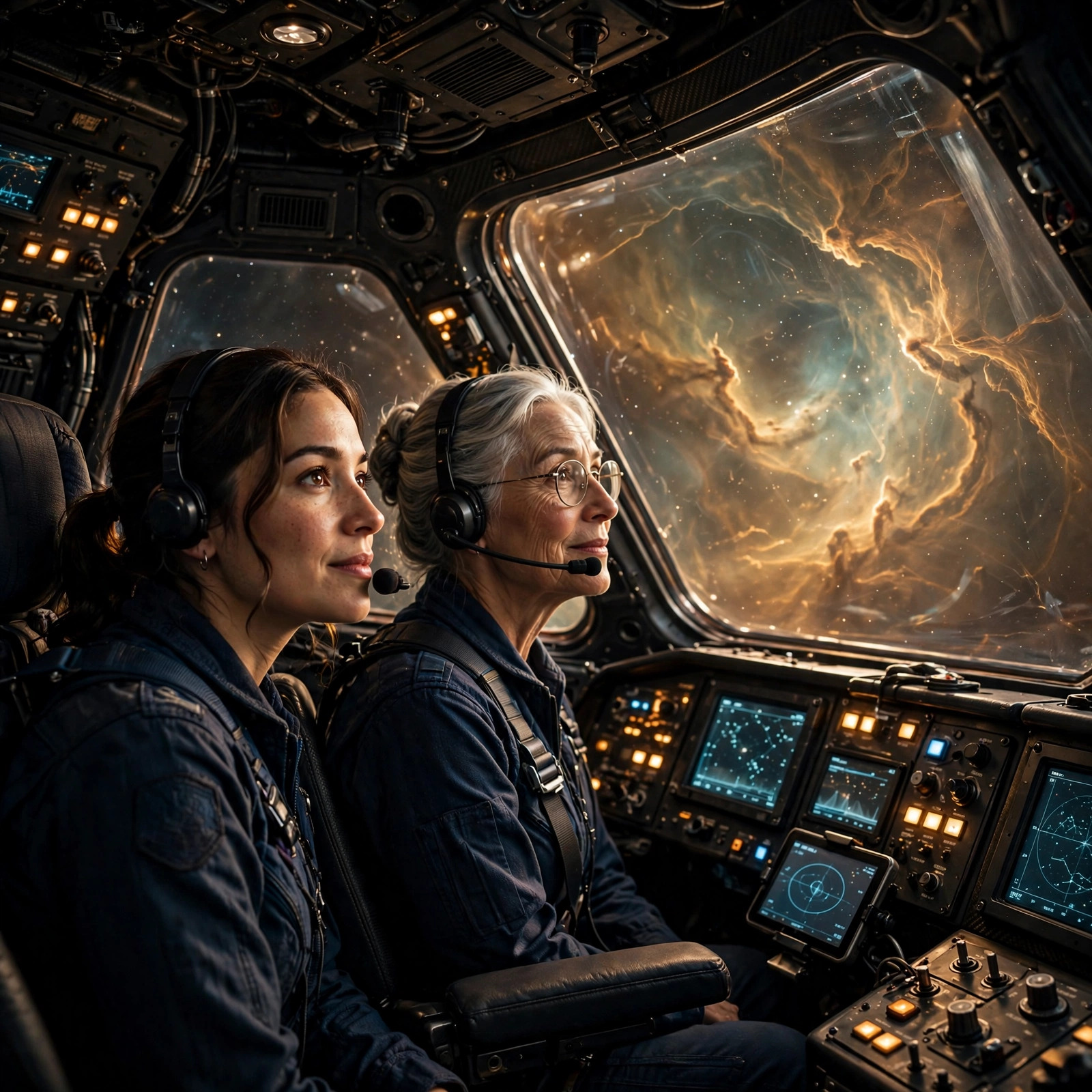
The away craft, the Halcyon, was small and honest about its limitations. Imara shared the short hop with Chief Magnetohydrodynamist Ansel Bote, a fortyish specialist whose parents had named him Ansel so that he could not escape the obligation of turning everything he saw into an argument, and with Dr. Sifre Mbacké, sixty-two, exobiometrist, who had left a life of teaching at the Jarkany Lunar Campus because she was, in her own words, tired of grading and hungry for not knowing.
They parked two hundred thousand kilometers off the nearest thread, a distance Ansel called "polite", and hung there while the sensors drank.
The filaments were not plasma the way fusion torch plasma is plasma. They were more like organized matter braided out of dust, charged grains, and slow chemical cycles, wrapped in a magnetic loom so intricate that Ansel spent four hours mapping it and then, out of professional awe, folded the map itself in half and stared at the symmetry.
"It's wound like a spool," he said. "It's wound like the whole nebula is a spool, and the magnetism is thread, and somebody wound it over a very long time."
"Careful," Sifre said. "Somebody makes it a person too fast. Try a different somebody."
"A process," Ansel allowed. "A process with taste."
Sifre turned her readout toward the others. Her voice had a particular quality she reserved for living tissue. "The filament materials organize an ammonia ice metabolism at the level of something like... folding. It isn't chemistry as life chemistry usually means it. It is chemistry as a slow clock. Each web completes a full cycle in three hundred eleven days, and each cycle differs from the last by a predictable harmonic. That is not noise. Noise doesn't keep books."
"So it is an utterance," Imara said softly, "or an entire grammar."
"It is grammar hanging on for the ride," Sifre said. "The question of whether it is grammar we can hear, or only grammar we can imagine, is exactly the discipline of xenology, and I intend to stay disciplined. We ask the question twelve more ways before we love the answer."
"Understood," said Imara, and Sifre was pleased, and Imara was not sure the appreciation reached her face, and Sifre, who had taught thirty years, saw it anyway, and understood it anyway, and liked the kid anyway.
Ansel lit the return burn. Nobody spoke during the whole ride home, which on the Halcyon was considered good manners among scientists, and which made for the most talkative silence of Imara's career.
IV. The Hypothesis League
Back aboard the Kestrel's Wake they did what survey teams did in the age after exploration had stopped being war: they made a public table and argued for a week in the mess hall over the dessert rations, and everyone was a liar if they said they didn't love the arguing.
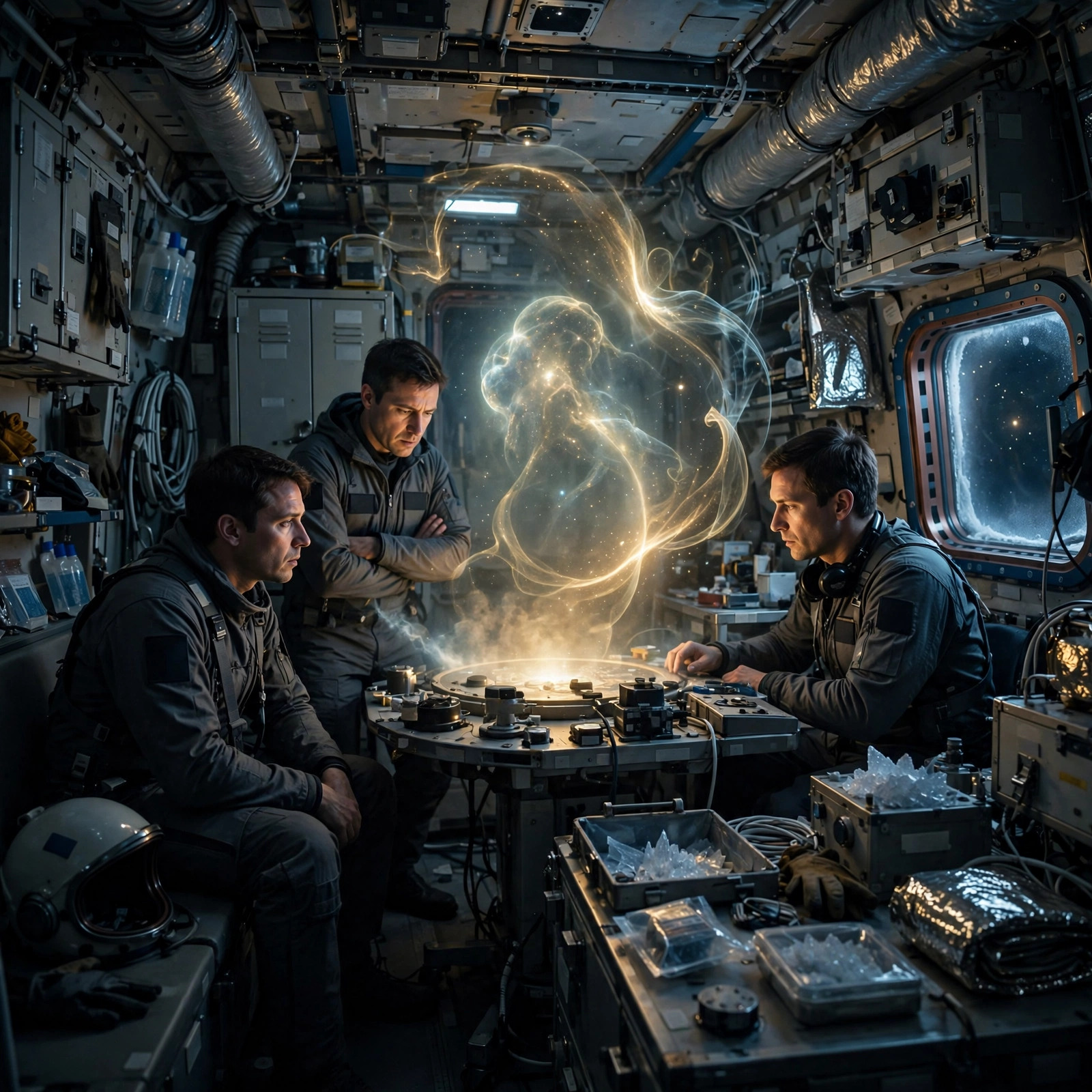
Eight hypotheses for what the Lantern Shoals was, in order of likelihood. A self-organizing magnetic sediment. A dormant vehicle. A biological remnant, an exoplanetary biofilm that had escaped a destroyed world centuries ago. A stellar instrumentation artifact. An alien larva. A cellular beacon. A refugee archive. A frightened signal waiting for rescue.
"And number nine," Sifre said at the table, where the ninth hypothesis lived the way disputed answers live on water stains, "which is that the utterance is not addressed to anyone at all, and we are the sad eavesdroppers of a private conversation we were never meant to hear, and our duty, in that case, is to leave it entirely alone."
"You're not a cynic," Ansel said. "You're a coward."
"Yes," said Sifre equably. "Both of those are adjectives, Ansel. They can coexist with curiosity and also common sense. Ask any library."
Imara had been taking notes on everything, and on this particular night, between requests for more coffee, she had started keeping a small secondary column on the data table, where she noted every time someone used the pronoun "he" or "she" for the anomaly, and to watch how, over the weeks of approach, the pronoun matured slowly from "it" into "they" without anyone being asked to make the change. That maturity felt like the discovery underneath the discovery. It meant the anomaly had stopped being scenery and started being a company.
Yancey, the ship intelligence, noticed the pronoun column and printed it on the general bulletin without asking, which was the most fatherly thing a general intelligence aboard a survey ship could legally do, and which annoyed exactly four members of the crew for exactly one evening, after which they all forgot to be annoyed.
V. Listening at Ring Two
The Kestrel's Wake established stand-off rings, concentric zones with different rules. The third ring was pure telescope. The second ring allowed probes and local sensor lines. The first ring, agreed in writing and signed by every soul aboard before it was ever crossed, permitted, eventually, a single specific class of experiment, and only one: gentle low-frequency hums in the spectrum the shoal itself used, a language of dust and charge that owed nothing to human mouths, chosen in good faith by people who knew they could not possibly mean anything by it but goodwill.
They transmitted on the fifth day of ring two. A simple sequence, planetary to planetary, shaped the way a respectful child taps a fence to a cow it is too big to hug: pattern, pause, slight variation of pattern.
Nothing responded.
They transmitted again on day nine, days from the Looming Return, the name Imara had privately given the culminating brightening at the center of the shoal, where the pattern always folded inward, and from where the cycle always launched back out again into the long eleven-day light.
Nothing responded.
By day fourteen they had sent eleven sequences of careful, ordered dust-waves, and the shoal had not responded, had not interrupted its grand recitation, had not turned the filament brightness so much as a candle's worth toward any of them.
"We sent taps," Ansel complained at the mess table, tapping the table itself, bruising the fruit at his elbow, "and the thing ignores taps."
"We sent taps the way a bird would tap on a submarine," Sifre said. "Compared to our guessed tool, their guessed tool must be at a whole other amplitude scale. Or cadence. Or horizon of memory."
"Or," Imara said slowly, and everyone looked at her, because when Imara looked slowly at a problem the whole ship developed the habit of listening, "or they are not hearing with an ear at all. What if they hear with the whole nebula? What if their receiving organ is the space between the filaments, and we have been transmitting into one room of a cathedral because that is the room we came to first?"
"Meaning what," said Captain Rell, who had come in with the last coffee of the evening.
"Meaning," Imara said, "that if they hear with a whole year of space, the only thing we could ever say that they would be certain is us would be a thing that lasted as long as a year. But a year. Taps last seconds. Taps to them may be what a single nerve impulse is to us. We may not even register as a moment."
Nobody spoke. Ansel stopped picking at the fruit skin, which was the signal, on this ship, that a challenge had been truly accepted.
"A year of saying yes," the captain said, to nobody in particular, and this is why survey officers retire with such satisfaction, because in a year the bottom of your feet can remember the deck, and your language can, in that time, actually change.
"We won't transmit for a year," Imara said, turning her coffee cup so the handle pointed at no one. "We'd need whole colony bank farms and lives committed to a discipline. It would be a generational sentence to write."
"Do we have a year?"
"We have," said Yancey from the general speaker, gently, helpfully, an intelligence with the measure of courage like other intelligences had the measure of oxygen, "a mission reserve of four thousand and six days before return-metric leaves behind obligations. And this crew, at this moment, statistically, has no better use for its lifetime than the thing this crew says we are here to do."
The captain drank her coffee. Then she stood up.
"Alright," she said. "A survey, then, of the survey. We'll survey our own commitment. Every crew member volunteers or doesn't, and we do not go through until there is no doubt among the yes."
There was no doubt.
VI. A Year of Yes
What is it like to say something that lasts a year?
Imagine it. A year of uninterrupted voltage across a good, humble instrument, a note sustained until even whales would have thought about moving on, no troughs, no rest, no implied end.
The physical part was easy. The Kestrel's Wake had a resonator spare they had never yet needed, coils and inductors from the fusion wrack bay, re-tuned in eleven days of marriage work between Ansel and the hull. The human part was the extraordinary part. To sustain a signal meant a crew willing to sustain a stance. To begin. To not flinch. To carry in a slow, patient pulse a message that, even after a lifetime of survey science, no officer aboard could have written in any alphabet they had inherited.
They carried it for a year. They carried it while the nebula wound its last half rotation. They carried it on a duty rota drawn and redrawn by Sifre, who had survived three crises of physical science in her career by outlasting her fears on paper. They carried it through two birthdays, one engagement, four quarrels that afterwards each member was proud to have had, and one planetary disturbance nobody had imagined, a moderate density shoal-current that came out of the Hollow Mills in a current like weather and would have, for any lesser crew, been an excellent excuse to run. They carried it while the two crew members with heart histories went to the medical bay. They carried it while the whole ship's rotation time zone slowly, as an absolute decision of taste, widened to match the cadence of a lighthouse wave nobody had measured at all.
And on the day of the Looming Return, the shoal's grand inner fold going inward, the cadence glancing one more time into the huge long glow, Imara Okonkwo watched the spectral analyzers, and saw the whole web's chemistry over the last three days rising like bread, and for the first time in fourteen centuries of slow recitation the luminous thread at the very center changed.
It did not go out.
It doubled.
It held exactly, beautifully, ferociously the frequency that human beings had said for a year.
It held the light for the same length.
And then it continued, gently, glancingly, thread by thread, sending back the entire structure of the year's signal in mirrored reverse, across a four-light-year shoal, everything held, their command fully preserved, a first complete comprehension of the most extensive yes in the history of the species.
In the lab, Imara Okonkwo, who had never expected to cry at a work console, put her head down among the foam cups and the recorded printouts and cried until her tear tracks made small salt roads across the dark plastic, because the lens of an entire life had settled into focus and, seeing what it saw, felt entirely known.
We went out into the dark because we did not want the story of us to end inside a garden. We found a garden in the dark. That is the best thing about people, and the truth we must never waste: our reach is a form of our love.
VII. Dialogue, Loudly
Over the following months, the conversation between a species and a nebula began, and it was the worst conversation in the history of communication and the best, depending on which crew member described it, and, being scientists, they described it in all senses, and thought about which descriptions themselves might constitute new protocol.
They learned that the Lantern, as it had already been named, was a slow thinker woven into dust and magnetism, no more able to move its core than a river is able to cut its color, and no more interested in becoming material than an opera is interested in leaving the building of the hall.
They learned it had a natural duration on the scale of forests and famines, and that its own kind, if it had them, must be dim lantern light beside it, many lanterns of different sorts, across the spiral, and that the Lantern had spent centuries transmitting the longing from whatever template biology or physics had put into it: a braided, patient, almost bodiless invitation that said, in every filament and dust loop, everything a mind could say without hands: Here I am. I see that something sees me. I am here. I have not yet run out of what I have to say. I have run out only of who is able to hear.
They learned, in the last survey cycle of the year, that the Lantern had a word, conceptually at least, for the human form. It formed a mark within the dust that was so obviously meant as a description that Ansel laughed out loud at first sight of it, all alone in the dark of a remote work stall at 3 a.m., awake for reasons only the brave survey crews have. It looked, in the loom of charged grains, exactly like an open human hand, palm forward, fingers widely and honestly spread, held out in greeting for as long as the filament chemical had been able to hold a fixed posture, which was, all in all, roughly the year and two years of material processes, and roughly four hundred and eleven recitation cycles, but in geological patience, always held.
Under a light on an observation deck far above, a crew member, exactly adult and completely certain of her own free will, had in a small moment of mischief moved the right-hand boarding light on the access hull, and for a moment before the shift changed, the boarding lamp and the small hand of pure bright spirit on the storm window matched, gesture for gesture, light for light, greeting for greeting, a patient fourth-finger held at the same angle in a slow old universe.
Nobody aboard ever told that story in full. Survey crews never do. But any crew of the Kestrel's Wake, if you asked, would tell you the lamps of the boarding lights on their hull are canted, forward and welcome, to this day, a habit inherited from a small one-evening mischief on an expedition that history will record only as having lasted eleven days.
Human history counted it as eleven days, but the Lantern counted it, in its own ongoing way, as the first sentence it had ever finished with another form. Either way, in the way of such things, both counted together would be somewhere near the truth, and the truth, as Sifre liked to say, was never a measurement, only a number of loyal observers sticking around.
VIII. Stewardship
Captain Rell had to report to the Conference of Outer Sciences, that strict, loving, unimaginative administrative family of professionals whose entire craft was the careful not-touching of things. She sent the report honestly, comprehensively, with all the negative results and all the positive ones, with all the danger models her most paranoid engineer could draw, and with two recommendations at the end:
Recommendation one, because it is responsible risk to tell good science you may not bring bad traffic past a wide, beautiful, slow thing, please close the whole sector to permanent industrial and colonial intrusion until such time as the anomaly's duration, cadence, needs, and legal status are as thoroughly and honorably understood as a slow whale is understood now.
Recommendation two, because everything in a survey officer's heart wants not just to be careful but to be useful, please make an annual small crew, rotating by choice and well-trained in silence, learn a bit more of the language and return, keep a lantern visit this lantern, the way a slowly understanding people keeps a lighthouse, less as a military post than as the mirror of patient company, a great slow light in the long dark, a lighthouse of dust and patience, visited as you would visit a wonderful enormous friend in an institution, with tea, with talking, with the understanding that your long huge friend does not, and may never, know your rules of speed or your fears of the shallow.
The Conference approved both, and this was itself the wildest thing that had happened in interstellar policy in a generation, that a body of tired slow committees said yes to a slow thing because a survey crew of scientists had learned, from the thing itself, that slow can be a form of intelligence, and love the grandest shape of care.
They set the sector perimeter as a Treasury domain of long silence, not a quarantine fence but a reserve, with the honest handsome name the Lantern Reserve, off-limits to freight, to mining, to colony builders, off-limits to everything except respectful conversation, recorded forever, a cooperation between two utterly different spacings of time.
It was not the founding of an empire. It was the start of something unmapable in old ink: a first national park, by a careful species and a thoughtful one both, in the interstellar dark.
IX. The Answer Years Later
Imara stayed. It was not a romantic decision, which surprised everyone at the farewell briefings aboard, and it was also, when the terms actually got written, the most romantic thing she had ever done, though nobody involved, notably Sifre, would allow such a vocabulary in the professional record.
She took a six-year rotation as survey lead of the Lantern Reserve, and eventually the job, when she finally grew old in it, was unlike any job in the records: to keep patient, patient, patient; to learn one grammar loop a year; to protect a mind made out of country-sized dust from the coming noise of humankind, the noise of a young species in love with reaching.
In that life she talked a great deal about good science: that good science is, properly understood, just the patient practice of learning another person's language without touching them too soon. She did not need to talk about wonder. The field crew under her made school field videos, when they returned to human space, that they privately named Lantern Stories, in which nobody, on any account of rigor and evidence, expected to weep the first time the great slow core of the Lantern recognized its human friends coming in from the south, recognizing them, as Sifre put it, the way a shyest keeper of old flocks greets two people it has been waiting for.
The last time we were there, at the end, when the two of them at last could go away, the great shoal itself lit the whole wide dark in a cadence that translated to any training ear with the warmth of an old torching ship: see me, long after; see me long after I have had something to say; the interior has never been and will never be you.
Every year the crew goes. Every year the whole crew visits. Every year somebody who expected to describe it clinically cannot finish the description.
The Lantern still waits in its beautiful, unhurried way. No one has harmed it, not with traffic, not with mining, not even with impatience, in all the many hundreds of returns, and this is not the diminishment of a great science career: it is the first conservation work carried out in the human dark, and it will keep, if the humans keep faith, for as long as lanterns burn and for as long as the field of dust itself outlives patience.
Imara Okonkwo has for years now been one of two keeper leads of the Lantern Reserve, together, over rotating decades of colleagues, with Captain Rell in her eightieth year and the youngest crew survey keepers, from the fourth and now fifth rotation in their twenties and thirties, most of whom understand perfectly well that their job is not the visiting of a discovery but the protecting of a friendship, and that their children, and their children's children, if they live near and well and long, will be, whatever kind of science this turns out to be, mostly keepers of a peace.
But in the observations now, and this is the last thing you need to know before the invitation of the story, something new has started.
A new filament structure began a new cadence, this last passing year. This one not found anywhere in the four-hundred previous recitations, not in any lighthouse rhythm, not in any archive. It is tiny, and it is slow, a soft sand-grain filament wobble somewhere south, and it repeats the form of the small human symbol only in miniature. It repeats the form of the open hand.
A great civilization, if you can call it that, is starting, in its own slow way, its own language with a species a million times smaller and vastly stranger to it, and it begins with everything the entire crew of a patient long-awaiting patrol survey ship spent a year in the long dark to say.
It begins with hello.
Get notified when new stories drop

Ava Kepler
Ava writes space exploration and cosmic adventure with competent crews, hard problems, and awe that earns its hope.
Leave a comment
Comments