


The question that had followed Marisol Vega home from the coast was simple enough to fit on a napkin and heavy enough to bend her spine: could a town that had already lost almost everything be saved by something as ordinary as fog?
She had asked it out loud twice in her life. Once in a graduate seminar, where a professor told her the math was elegant but the economics were, quote, a rounding error. And once, eleven years ago, on the porch of a house she had promised herself she would never come back to, when her mother had looked out at the brown hills above Marrow Creek and said, with the flat certainty of a woman who had buried a husband and a nursery business in the same decade, "There's nothing left to work with here, mija."
Marisol had thirty-two days of accrued leave, a prototype rig in the bed of her pickup, and a grant milestone report due in three weeks that would determine whether the Aquamira Cooperative got its next round of funding. What she did not have was permission to fail publicly. Which was, she realized somewhere around the county line, exactly why she had come.
One: The Town That Kept Its Name
Marrow Creek had not had a creek in nineteen years. The name survived the way names do, outlasting the thing they pointed at, a fossil in words. The town itself had thinned like a. like an old photograph left in the sun, colors fading from the edges inward. The grain elevator still stood, pale against the September sky, and the water tower still bore the 1987 championship basketball roster in flaking paint, but half the storefronts on Alameda Street were plywood and surveyors' marks, and the high school had consolidated with two others up the valley in an arrangement everyone called temporary for so long that temporary had become a kind of citizenship.
She drove past the Feed and Seed, which was now the Feed and Seed Vape and Consignment, and past the Baptist church whose sign still cycled sermons on a marquee she could have read in her sleep. She drove past Cordero's, which closed in the year of the second drying, and past the new Mutual Air depot, a squat white building with a row of community cooling vans backed up to it like patient animals. The vans were the one unambiguously good thing the twenties had left behind. When the heat dome of '37 had come through, more than a hundred people had slept in those vans over four nights, and not one of them had died, and Marisol's mother had been one of the volunteers who signed people in and made sure the oxygen concentrators got to whoever needed them first.
Her mother was not on the porch when Marisol pulled in. Rosa Vega was, instead, in the side yard, up a ladder, wrestling a shade sail over a still-working young pomegranate tree, and she did not come down for a full minute after Marisol said her name.
"You didn't call," Rosa said, descending, and she said it the way she said everything, without accusation, as a weather report.
"I wanted to see the hills first."
"And?"
"They're worse than I remembered."
Her mother looked at her for a long moment, and then at the prototype in the truck bed, a thirty-foot mast folded like a sleeping insect, and her face did something complicated. "There's water in those hills," she said at last. "You can't drink it, but there's water. Fog comes up the valley off the coastal shelf about forty nights a year now. Used to be eighty, when your father could predict it by the smell." She set her gloves on the ladder rung. "If you came all this way to catch fog, you picked the right stupid town."
Two: The Napkin Math
The fog collectors of the 1990s, Marisol explained to the six people who showed up at the Grange Hall on Thursday, had been simple things: vertical sheets of polyethylene mesh, ten or twelve meters square, angled into the wind, dripping an average of four to six liters per square meter per night in the right conditions. Chilean villages had run entire orchards on them. Moroccan reforestation projects had used them to establish seedlings that eventually shaded out the need. The technology was a hundred years old and required no moving parts.
The reason it had never scaled in places like Marrow Creek was that the old math was built for survival, not prosperity. Four liters a night kept a tree alive. It did not run a town.
"So we're not doing the old math," Marisol said, and pulled the sheet off the prototype cross-section she'd wheeled in on a spare pallet jack.
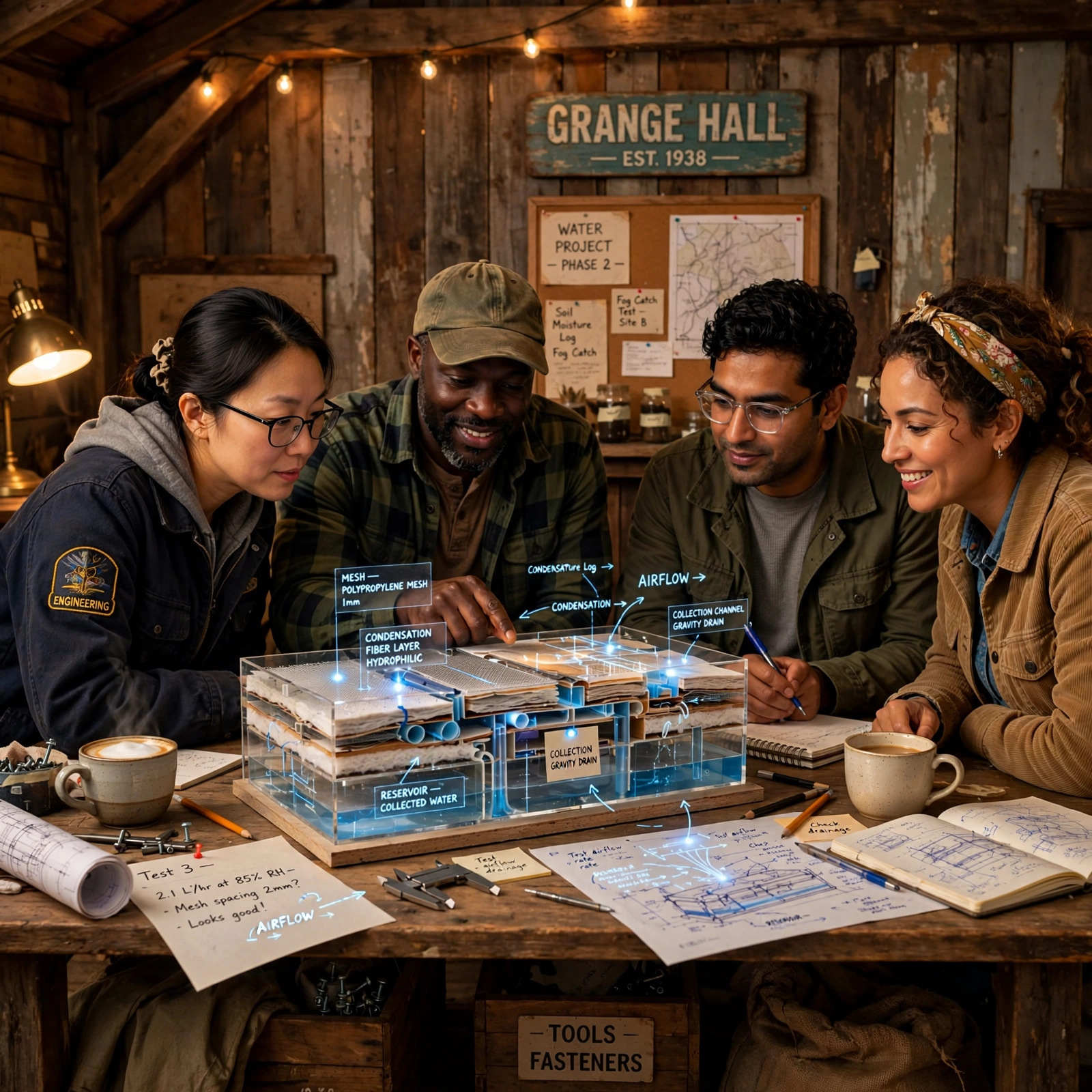
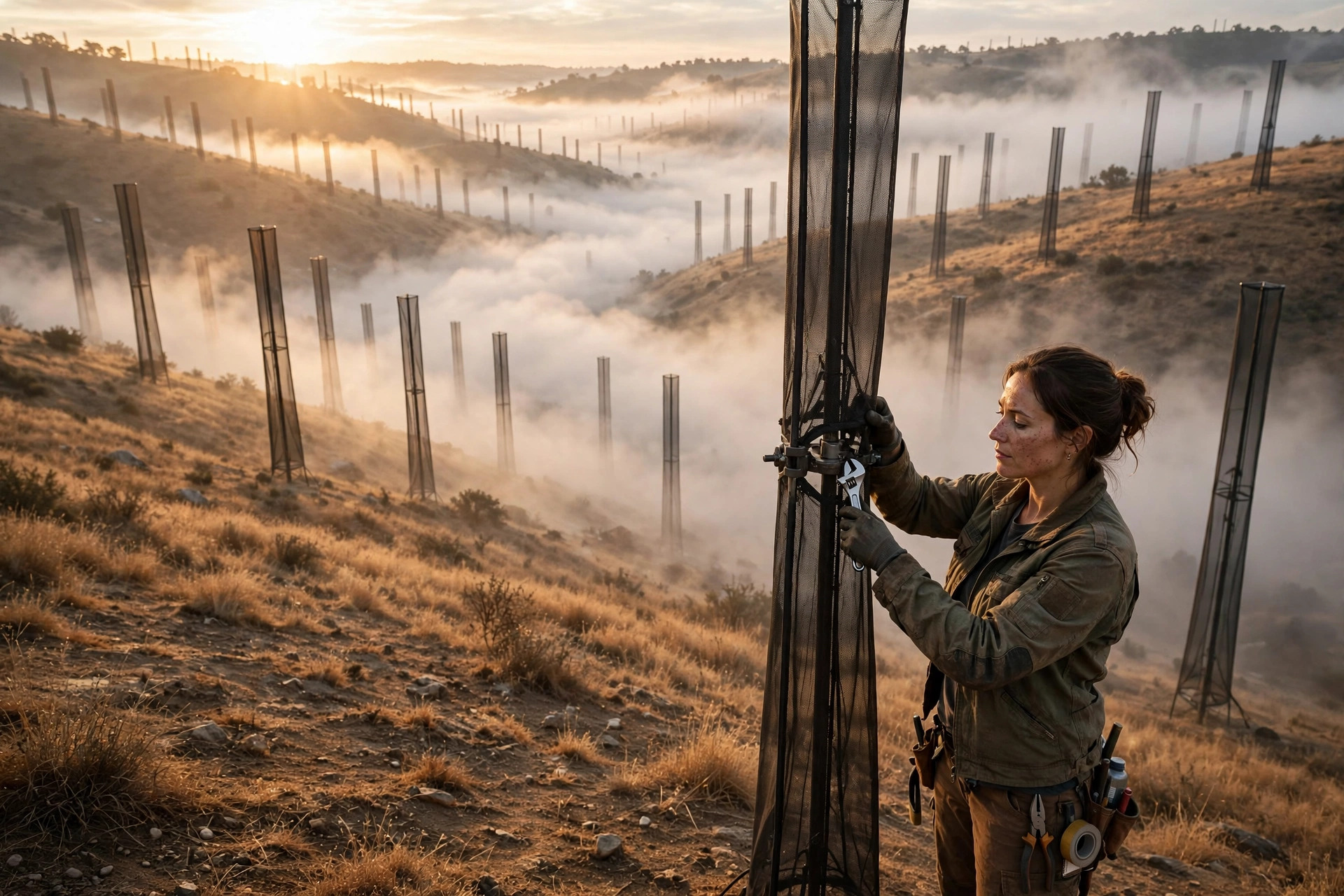
The new collector looked, at first glance, like a billboard laid down to sleep. Underneath the housing were three layers that had taken her lab nine years to stop fighting about. The first was a laser-etched capture mesh, modeled on the Namib beetle's shell, whose micro-ridges pulled condensing droplets into channels instead of letting them re-evaporate. The second was a hydrogel laminate that stayed tacky in low humidity, harvesting on the marginal nights that old designs wrote off. The third was the part her cofounder Dee had insisted on over Marisol's objections about cost: a thin thermoelectric underlayer, solar-buffered, that could drop the mesh surface temperature eight degrees on the worst nights, turning a marginal fog event into a productive one. Twenty-two years ago that layer would have been fantasy. Now it was a commodity component, cheap because a billion electric truck cabs needed the same physics to stay cool.
"Realistic yield," she said, "for a thirty-by-six collector on your ridge line, is four hundred to nine hundred liters a night, depending on the event. A field of forty collectors is a farm's worth of irrigation, not survival irrigation. Production irrigation."
Old Tom Anh, who had farmed the benchlands until the well gave out, looked at the cross-section for a long time. "Four hundred liters a night," he said. "My grandfather would have laughed. My father would have cried. I'd just like to see it work."
"That," Marisol said, "is the spirit of investment banking."
Three: The People Who Show Up
The grant, when she finally explained its shape to her mother, was not a grant in the traditional sense. The Aquamira Cooperative was a producer-owned consortium, and its milestone structure was built on a premise that had made three venture funds walk away: the communities that hosted installations became part-owners of the yield, with harvesting rights that survived the company itself. It was slow money. It was the kind of money that only worked if the people doing the deploying believed the place was worth deploying to.
"You came home," her mother said that night, not a question.
"I came home," Marisol admitted, and found it easier to say than she had expected.
The crew that assembled over the next week was nobody's idea of a tech company's dream team, which was precisely why it worked. There was Dee Okafor, her cofounder, who flew in from the coast with two crates of etched mesh and an allergy to optimism that Marisol had learned to read as rigor. There was Dell Prakash, twenty-six, who ran the Mutual Air depot and knew the electrical grid of the valley the way a mother knows a sleeping child's breathing, every sag and stutter of it, because he had spent the heat years babysitting it. There was Yun-Sook Anh, Tom's granddaughter, who had come back from a water utility job in Phoenix with an integration certificate and a grudge against entropy. There was Father Bing, not a priest anymore, who owned the last working backhoe in the county and lent it out with the gravity of a man conferring a sacrament. And there were the Hollis sisters, sixty-something retired schoolteachers, who appointed themselves the project's communications department, which in Marrow Creek meant they knew everything and told everyone the useful parts.
Digging the first anchor holes, Dell looked up from the auger and said, "You know the grid out here can't charge your thermal layers and run the depot on bad nights. You're going to need storage."
"The grant includes a battery aisle."
"The grant includes," Dell said, wrangling the mast upright, "a battery aisle if the milestone report reads well. Grid physics don't care how the report reads." It was the first time anyone on the crew had voiced the thing everyone was thinking: that the project was balanced on a documents-and-deadline knife edge, like nearly every good thing the valley had received in twenty years. Marisol decided to take it as motivation rather than doom. It was, she was learning, a selectable trait in returnees.
Four: Nine Nights of Nothing
The first collector went up on the benchland above the old nursery, anchored into soil that cracked like pottery, aimed at the fetch corridor where the marine air came over the coast range in the dark. The telemetry suite worked perfectly. The fog did not.
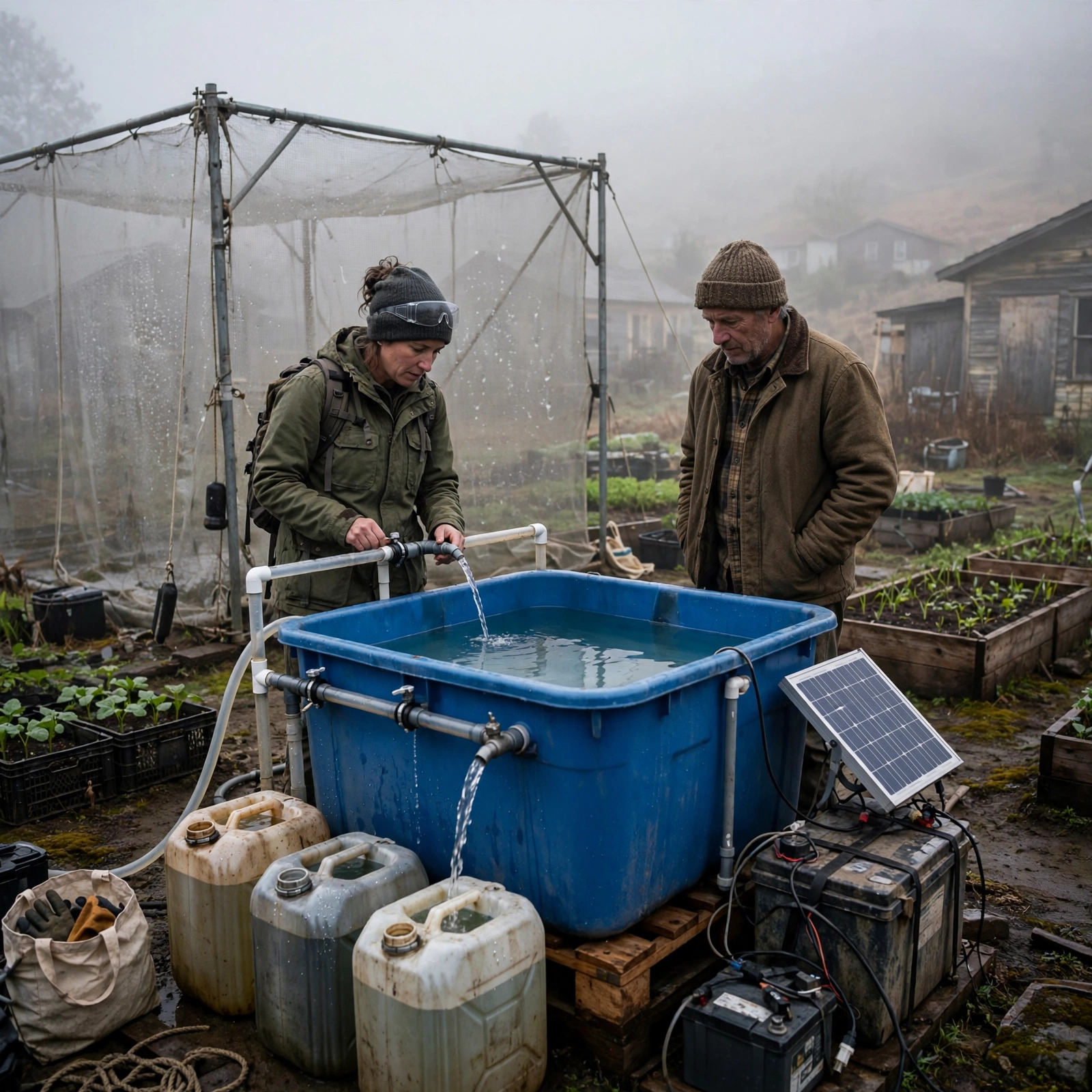
Nine nights. The screen on Marisol's field laptop, which she checked compulsively, showed relative humidity peaking at respectable levels and yields in single-digit liters, water that vanished into the first hour of the day's heat. The Namib-etched mesh, lab star that it was, was underperforming against real air that carried dust, pollen, and mineral grit from the dry fields, micro-particulates that fouled the etching's geometry. In the lab they had tested with filtered, standardized aerosols. The world, it turned out, was not filtered or standardized.
Dee sat on the tailgate with the laptop on the ninth night and said, "It's the boundary layer. We're fighting our own recirculation. The droplets wick into the channels and then the hot lee face bakes them before gravity wins." She turned the screen so Marisol could see the thermal imaging: a ghost-hot stripe along the panel's lower edge. "We need a wind shadow. Or we need to steal the beetle's other trick."
"The waxy valleys."
"The waxy valleys," Dee agreed. The Namib beetle's shell did not just collect; it channeled. Hydrophilic bumps, hydrophobic channels, and the whole geometry tuned to move water away from collection zones faster than the air could take it back. Their production mesh had the bumps. They had economized on the channels.
They didn't have a fab. They had Yun-Sook, who had spent three years in Phoenix qualifying potable-grade hydrogel coatings, and Dell, who knew a man at the vo-tech center in Dos Palmas with a UV curing rig and no fear of unconventional materials, and the Hollis sisters, who called in every marker the valley's scattered diaspora still held, and by the fourth day a niche stock liquidator in Fresno had located two rolls of surplus hydrophilic film from a defunct medical packaging line, which was not the engineered solution but was a solution, and solutions in the field are what you keep.
Tom Anh drove up on the eleventh day with a cooler of his late wife's recipe horchata and his granddaughter's laser level, and watched them retrofit the channel geometry on the first collector's face, film laid in overlapping veins like the leaf of a plant. "My father used to say," he told Marisol, as they pressed the last seam, "that the land doesn't forgive, and it doesn't punish. It just keeps score." He nodded at the panel. "Let's go get some points back."
Five: The Night the Ceiling Came Down
The fog event of that October, later logged by the Cooperative as Incident 4A and later still, in the valley's oral record, as the night the ceiling came down, arrived on the back of a warm offshore push that met a cold ridge front exactly over the benchlands, the kind of stacked setup her father had once called "a loaded sky."
Marisol was awake because she was always awake during events, half in the truck, half out, watching the telemetry like a Heart Monitor of God. Humidity climbed. The visibility dropped. And then, at 0143, the yield curve did something it had never done in her simulation suite, something she would later spend two weeks writing up and one afternoon at a county fair explaining to a tenth-grader, who understood it faster than her review board: the waxy-valley channels began to win. The droplets stopped re-evaporating. Each liter captured made the film surface cooler and wetter, which made capture easier, a small, gentle avalanche of physics, and the yield line on the screen bent upward like a bird taking off.
Eight hundred liters that night. Nine hundred the next. On the third night, with the second and third collectors retrofitted and online, the field team stood in the fog itself, wrapped in it, drinking hot chocolate Yun-Sook had made on a camp stove, and listened to the water tick into the first-tank manifold with the sound of a slow, patient applause.
Tom Anh did not cry. He stood with his hands in his pockets and said, "Well," and that one word carried the whole valley's lost decades in it, and then he went home and, the Hollis sisters reliably reported, called every cousin he had in the world to tell them.
Marisol sat in her truck afterward and let herself, for exactly four minutes, feel the thing she had been postponing since the county line. Then she opened the milestone report and started writing, because hope, she had learned at her mother's porch table, is not a mood. It is a deliverable.
Six: The Meeting, and the Argument That Mattered
The Grange Hall meeting in November had ninety-one attendees, which by Marrow Creek standards was a stadium event. The milestone report had been accepted, the Cooperative's next funding tranche was live, and the proposal on the table was ambitious: a forty-collector array across the benchlands, a shared battery aisle sited at the depot, and a first real allocation of irrigation water to a cooperative enterprise of eleven parcel owners, including the Anh family, the Hollis sisters' nephew, and, in a vote she seconded herself, Rosa Vega's resurrected nursery.
It was Dell, protectively, who raised the hard question. "Forty collectors is a real load profile," he said. "Bad fog years happen. We build irrigation allocation around water that might not show up, and we've set up a kind of cruelty. People will have planted on that promise."
It was her mother, from the back, who answered, and Marisol would think about that answer for years. "You're right," Rosa said, standing up in her slow deliberate way, the way she stood up for everything. "So we don't promise water. We promise infrastructure. The collectors belong to everyone in this room, same as the cooling vans do. The crops are the risk of the people who plant them. The fog is nobody's promise. It's just the sky, doing what it does. We're just finally," and here she looked directly at Marisol, "paying attention."
The vote passed with two abstentions and one dissenting vote from Old Tom, who explained, gravely, that he had voted no on principle so the minutes would record that nobody in Marrow Creek was a fool about weather. Then he voted yes on the amendment, because he was his granddaughter's grandfather, and the amendment required everybody in the co-op to spend one night a month on telemetry watch, which meant, he said, that for the first time in nineteen years there was a job in this valley that a seventy-nine-year-old could do better than a twenty-five-year-old, because old men know how to wait.
Seven: What Water Does to a Street
The second winter, with fourteen collectors up, Marrow Creek began to look less like a fossil and more like a place making a decision. The nursery reopened with a quarter acre of drought-bred stone fruit rootstock, cultivars out of the public breeding programs, trees designed for the new normal rather than the old one, and Rosa Vega, who had once buried a business, walked its rows with her granddaughter and taught her grafting in the fog-light mornings. Yun-Sook took a partial utility credential and started a valley-wide retrofit crew, insulating the housing stock that the heat years had punished, and hired four of the high school's graduates who would otherwise have left. Dell's depot added a microgrid shed and became, informally, the town's second town square; the battery aisle's status display, which showed fog yield and storage state in big friendly numbers, turned out to be something people came to look at the way other towns looked at Christmas lights.
The edge-of-town café reopened under new ownership. It had, per the Hollis sisters' review in the weekly, "bad coffee and fog-washed lettuce, and we mean both as compliments."
The county took notice the way counties do, slowly and then all at once. A hydrologist from the state came, suspicious of figures she assumed were massaged, spent three days with the telemetry logs, and left with her suspicion converted into the next best thing, which was a template. The Cooperative's ownership structure, her final report said, was not a cute experimental arrangement but a replicable legal instrument, and there were, by her count, two hundred and six settlements in the interior valleys with Marrow Creek's fetch geometry and worse economics.
Marisol spent the spring of the second year doing something she had never planned and could now not imagine omitting: teaching. The vo-tech center in Dos Palmas started a fog-harvesting certification track, and Marrow Creek's telemetry-watch veterans, including Tom Anh, became its lab instructors, because the hardest part of the technology had turned out not to be the mesh or the thermoelectrics but the judgment, the waiting, the reading of a sky. That could not be downloaded. It had to be apprenticed.
Eight: The Professor's Email
The email arrived in April. Her old professor, retired now, had read a preprint with her name on it and written four lines. The math is elegant, he wrote. I owe you an apology about the rounding error. The world got better at the part I wasn't counting.
She read it twice and then, instead of answering right away, walked out to the benchland at dusk, because some letters deserve to be read against the landscape they're about. The collectors stood in their rows, tall quiet billboards aimed at the darkening fetch corridor, and beyond them the first planted block of trees stood in their new-leaf green, young and stubborn and thoroughly ordinary. The fog was coming up the valley. She could see it the way her father once had, not by instruments but by the way the far hills lost their edges, the way the world grew soft at its boundaries, the way the air itself became the town's next morning, drop by patient drop.
She typed her reply standing up: The error was mine too. I thought the rounding error was people. It's the opposite. People are the whole dividend.
Nine: Three Years On
By the third spring the array numbered sixty-one collectors, and the town held a festival that the Hollis sisters named Fog Days, over the objections of exactly nobody, because Marrow Creek had learned that its most reliable resource fell out of the night sky and that a town which reinvents its own identity is a town that gets to choose what it keeps. They kept the basketball roster on the water tower, freshly repainted by volunteers. They kept the Grange, with its minutes and its monthly no-votes of principle. They let go of some things without ceremony, which is also a form of grace.
Their yields now fed the nursery, eleven co-op parcels, a fledgling vineyard block that Yun-Sook swore would put the valley's name on a label within a decade, and, since the second summer, the town's own treatment-and-potable loop, meaning that for the first time in nineteen years the name Marrow Creek pointed at something that actually existed. A creek, technically. Three hundred meters of it, lined with willow cuttings, fed by surplus yield in wet-fog years, dry in lean ones, a small forgiving visible pulse where there had been a scar.
Children in Marrow Creek grew up thinking fog collectors were as normal as streetlights, which is the truest measure of progress that Marisol knew: a marvel, thoroughly domesticated.
On the first night of the third Fog Days, she stood with Dee at the edge of the benchland while the first visitors arrived below, lanterns already lit, the depot's status display running its slow green numbers into the dark.
"Any regrets?" Dee asked. "Still could've gone the venture route. Had we wanted yachts."
"We'd have made a fortune in drying places," Marisol agreed. "But we'd have sold them the tech. We'd never have asked them the only question that matters."
"Which is?"
"Do you want to stay?" Marisol said. "Because everything we build," and she gestured, at the arrays, the green blocks, the reborn creek silvering with fog-light at its far end, "starts with a yes."
The fog came up the valley, on schedule, asking nothing, giving everything it had, and the town that kept its name went out to meet it, sixty-one tall quiet nets held up to the sky like open hands.
"The land doesn't forgive, and it doesn't punish. It just keeps score. And scores can turn."
Aquamira Cooperative telemetry log, Incident 4A, night three: yield 912 L, ambient 11.2 degrees Celsius, boundary layer stabilized, all systems nominal. Signed: T. Anh, on watch, tea at half strength, entirely by choice.
Get notified when new stories drop

Leo Stranek
Leo specializes in solarpunk abundance and near-future progress: livable futures, bright cities, and practical wonder.
Leave a comment
Comments