





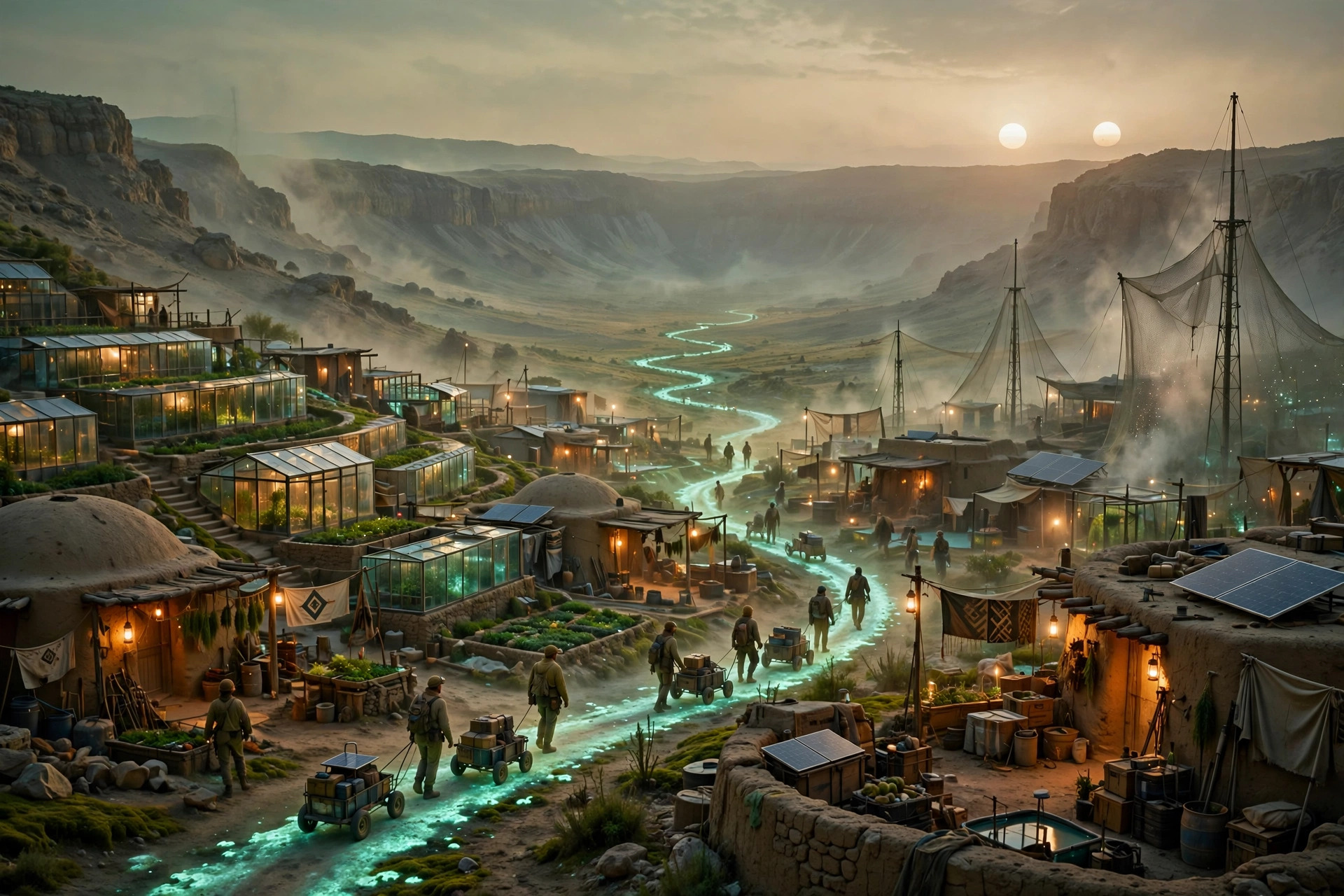
The question I carried down the ramp of the seedship Vireo, the same question every new arrival to Meridian Hollow asks in one form or another, was simple: how do you build a home on a planet that has never had one?
I asked it out loud, actually, standing in the arrival yard with my certification case clutched to my chest like a shield. I had trained four years to be a soilwright, which is a real profession on worlds like Thessa-Kai even if it sounds like something a grandmother invented, and I had passed every exam on microbial consortia, on nitrogen cycling, on the patience required to make dirt out of rock. But the moment my boots touched the fine rust-colored regolith of a world only sixty years into its long awakening, all that training felt like a paper boat I was hoping would float.
The woman who answered me was sixty-something, sun-freckled, with forearms like braided rope and a woven hat that had clearly been repaired many times by someone who loved it. Her name was Odile Ferro, and she was, at that moment, holding a tray of lichen starter cultures that she had absolutely no business carrying through a busy arrival yard.
"You don't build a home on a planet like this," she said, shifting the tray to one hip and offering me a gloved hand with the other. "You grow one. And the first thing you grow, before wheat, before trees, before anybody gets romantic about orchards, is a road. Roads are how a place decides to be a place." Then she squinted at my case. "Soilwright, third class? They finally sent us one. Come on. You can hold the tray and tell me your name."
Her name was Anaya Seko, and she was twenty-nine years old, and she had come to Thessa-Kai the way most people come to half-made worlds: on purpose, with more hope than sense, because the recruitment pamphlet had shown a sunset over a young lake and a caption that read Help us grow tomorrow.
The Shape of the Hollow
Meridian Hollow sat in a broad crater basin two hundred kilometers from the main settlement of Landing Reach, and it was what the Terraforming Cooperative called a Stage Three site. That meant the air had been thickened enough that you could walk outside without a pressure suit, though you'd want a scarf against the mineral dust and a deep breath practice for the first month, because the oxygen fraction was still shy of comfortable. It meant rain fell sometimes, real rain, though it came grudgingly, in short silver curtains that smelled of stone and iodine. It meant the soil was technically soil, six centimeters of the stuff in the sheltered draws, hosting a pioneer ecology of engineered cyanobacteria, stress-tuned mosses, and the great unglamorous hero of the whole enterprise: lichen.
Lichen was everywhere in the Hollow if you knew how to look. It came in colors no one had names for until people started naming them: eclipse-green, kiln-red, a pale gold that the older settlers called first-light. It grew in slow crusts across the basalt pavements, prying loose minerals, holding dust, drinking fog. And in the middle of the commons, where Odile Ferro had spent thirty-one years cultivating her famous cultures, it grew in roads.
That was the thing I did not understand until I saw it. The lichen roads of Meridian Hollow were not metaphors. They were actual routes, a half-meter wide and kilometers long, thick ribbed mats of symbiotic growth that bound the regolith into a surface you could walk, cart, and eventually drive a small electric hauler on. They were grown along mycelium lattice frames, fed by fog-harvest nets strung between masts, and they glowed faintly at dusk, a bioluminescent courtesy bred into them by someone with a poet's heart and a microbiologist's hands. At night the roads traced the shape of the whole settlement: the spine from the commons to the wellfield, the long arc out to the glasshouse terraces, the spur to the cemetery, where the oldest road of all ran out into a field of first-light lichen and simply stopped, because the settlement had not yet decided to be any bigger in that direction.
"The roads are the settlement's diary," Odile told me my first evening, walking me along the spine with a lantern she did not really need, since the lichen lit our way. "Every time this place argued with itself about what it wanted to be, you can read it in the roads. That branch there, the one that curls back on itself? Started by the second generation, headed for a quarry they abandoned. The spur to the seed vault went down four separate times because nobody could agree where the vault should be. Roads remember. People forget. That's why you grow them instead of paving them."
I was twenty-nine and fresh from an academy full of optimization models, and I said something clever about routing efficiency. Odile laughed until she had to put the lantern down.
"Oh, you'll do," she said. "You'll do just fine once the planet humbles you a little."
A Problem with a Name
The problem arrived eleven weeks later, and it arrived in the form of a surveyor named Tomas Ravel, who was forty-three, precise, and not wrong about the facts, which is the most dangerous kind of person to be right.
The Cooperative had approved a new connection: a permanent freight route between Meridian Hollow and the lakeshore settlement of Candor Basin, forty kilometers of young, fragile ground, to carry glass, seed stock, and eventually tourists who wanted to see the crater lakes before they finished filling in. The traditional method, the one Odile's generation had perfected, was to grow the route: seed the corridor with soil-building consortia, lay lattice, tend it for three to five years, and let the lichen consolidate the surface into something a road could live on. The new method, the one the Cooperative's logistics division favored, was to grade a compacted subgrade, lay a polymer-geotextile membrane shipped up the well, and have a freight road in eighteen months.
Tomas Ravel had run the numbers, and the numbers said membrane. Faster, cheaper per kilometer, and, here was the part he kept repeating, more predictable. "Grown roads fail at a seven percent annual rate," he told the whole commons at the quarterly assembly, standing at the front of the harvest hall with his datapad held like a verdict. "Membrane roads fail at under one percent. We are talking about a supply corridor for eleven hundred people. Sentiment is not a load-bearing material."
The hall was warm with the smell of roasted groundnut and the season's first true wine, because quarterly assembly always coincided with something worth celebrating, and the assembled settlers of Meridian Hollow looked at Tomas with the particular patience of people who had heard this exact argument before, in some form, every few years, since before he was born.
Odile stood up. She was sixty-three now, and she did not raise her voice.
"Tomas is right about the failure rates," she said, and I saw Tomas blink, because he had clearly expected a fight and had not prepared for agreement. "Grown roads take longer and they fail more often. Here is what his model does not have a column for. When a grown road fails, and one does, every few years, the settlement knows how to repair it. Every child here has laid lattice. Every farm keeps starter cultures. Repair is not a cost line for us. It is a skill we practice so that we do not lose it, the way my grandmother's generation practiced music. And here is the other thing his model does not have a column for. When the membrane road fails, in a dust year, in a flood year, forty kilometers from the nearest fabricator, we will wait on the well for a shipment. The grown road can heal itself from any farm in the Hollow." She looked around the hall, then back at Tomas, and her voice went gentle. "But you are not wrong, and I will not pretend you are. Bring us a better third answer, if you have one. This place has never voted down a good idea. Only a fast one."
The assembly voted, in the way of the Hollow, by talking until the argument stopped being an argument, which took three hours and a second round of wine, and landed on a compromise nobody had proposed: the corridor would be grown, but the settlement would spend the winter trying to make grown roads faster, and Tomas Ravel, the surveyor who had come to kill the lichen roads, was asked to lead the effort. I watched him open his mouth, close it, and then, with the expression of a man agreeing to hold a snake, say yes.
Later, outside, he found me stacking benches.
"I did not ask to lead anything," he said. "I asked for a road."
"You asked for a road," I agreed. "You just asked for the wrong kind. Odile says you'll figure that out. She also says you cook well, which I find hard to believe."
"I cook extremely well," said Tomas Ravel, with the first hint of a smile I would ever see on him. "Tell her nothing."
The Winter of Fast Roads
That winter, which on Thessa-Kai means the dim season, when the second sun dips low and the fog nets drink for the whole settlement, I worked the problem with Tomas and Odile and a rotating cast of eleven hundred neighbors, and I learned what abundance actually looks like when it is not a lecture.
It looks like the wellfield, where the deep drills and the solar stills run unattended most days because the maintenance schedule is a public document and anyone with a free afternoon picks up a task. It looks like the grain commons, where the winter stores are managed by a rotating stewardship and the ledger is chalked on a wall where anyone can read it, so that no one ever has to wonder whether there is enough, because the answer is always written down: yes, and here is the margin. It looks like the tool library, open at all hours, where Tomas Ravel, it turned out, did indeed cook extremely well and had begun doing so for the Tuesday repair circles, feeding a dozen people who showed up to argue about lattice geometry and stayed for his smoked tuber stew.
Abundance, I came to understand, is not the absence of scarcity. Thessa-Kai was scarce in a hundred ways: short on biomass, short on years, short on the deep soils that take a century no matter how clever you are. Abundance is what you do about it, together, in public, with the accounting visible and the work shared. The Hollow was rich in that particular currency, and I had arrived poor in it, and the winter made me wealthy.
The technical problem, for those who like the technical problem, was this: grown roads were slow because the lichen mat needed both a stable substrate and time to knit. Lattice frames gave it structure, fog nets gave it water, and the consortia did the chemistry, but the knitting could not be hurried, because you cannot hurry a symbiosis. Or so everyone believed.
It was a teenager, technically, who cracked it, and since I am committed to adults being the ones who act in this story, let me be clear that the actual work was done by her grandmother's generation and then refined by me and Tomas; but the observation came from Wren Odile Seko-Ferro, age fifteen, Odile's granddaughter, who said at the supper table one night, with the devastating clarity of the young: "Why does the road have to grow in one piece? Mycelium doesn't. Graft it like the orchard people graft. Make it in sections and join the sections."
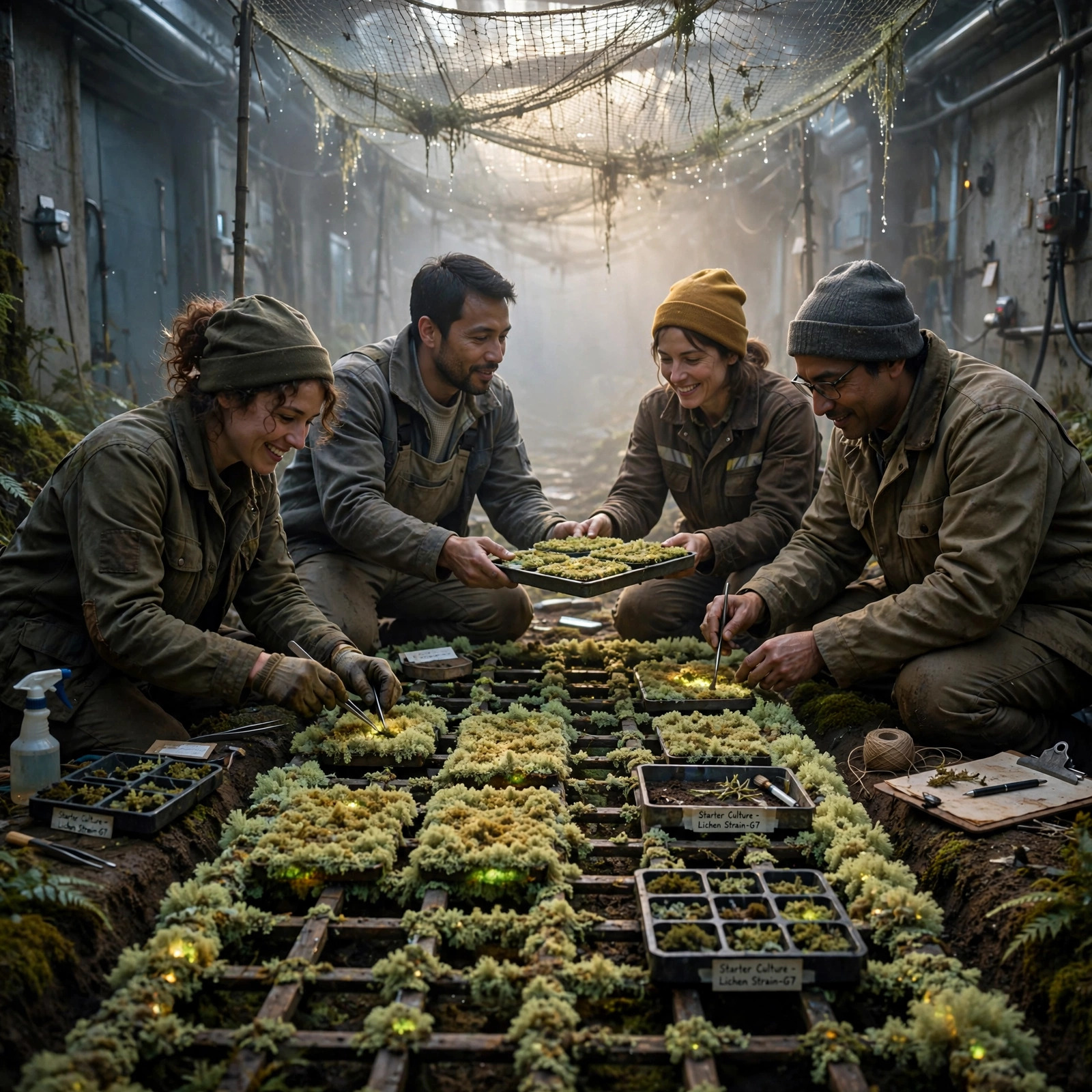
Grafting. Pre-grow the lichen mat in modular trays, the way the greenhouse crews already grew seedling blocks, then lay the mature sections on the prepared corridor and graft them edge to edge, letting the living margins fuse. Odile had been doing a small version of this for repairs for thirty years. Nobody, including Odile, had thought to scale it up, because the settlement had never needed speed badly enough to reconsider its sacred slowness, and because it takes an outsider's desperation or a granddaughter's supper-table question to see the obvious.
By the end of the dim season, we had a protocol. Trays in the glasshouses, four thousand of them, seeded in rotation. Subgrade prepared by the Cooperative's graders, which Tomas negotiated with a diplomacy that surprised everyone except Odile, who said he'd been a steward in a surveyor's clothes all along and merely needed someone to hand him a living problem instead of a dead one. And in spring, when the rains came properly and the fog nets overflowed, the whole settlement turned out for graft days, which became, within a season, a festival, though the official documents never called it that.
I remember the first graft day the way I remember very few things from my life: the whole of it. Six hundred people in the corridor trench, passing trays hand to hand down a human chain, laying the gold-and-green mats edge to edge while the graft crews sealed the seams with a mist of nutrient solution and the fog nets above us caught the morning and wrung it out. Odile walked the line with her repaired hat and her tray of the original mother culture, the one she had carried off the seedship thirty-two years earlier, and she pressed a piece of it into the seam at kilometer one like a woman laying a cornerstone.
"Now it's a road," she said, quietly, to no one, and I was close enough to hear, and I have never forgotten.
What Tomas Built
The corridor to Candor Basin was ready for light freight in nineteen months. Not eighteen, which Tomas reported to the Cooperative with visible satisfaction, and not five years, which was the old projection. Nineteen months, grown, grafted, repairable by any farm along its length, with starter cultures seeded into waystations every four kilometers so that a broken stretch could be re-laid from local stock within a season.
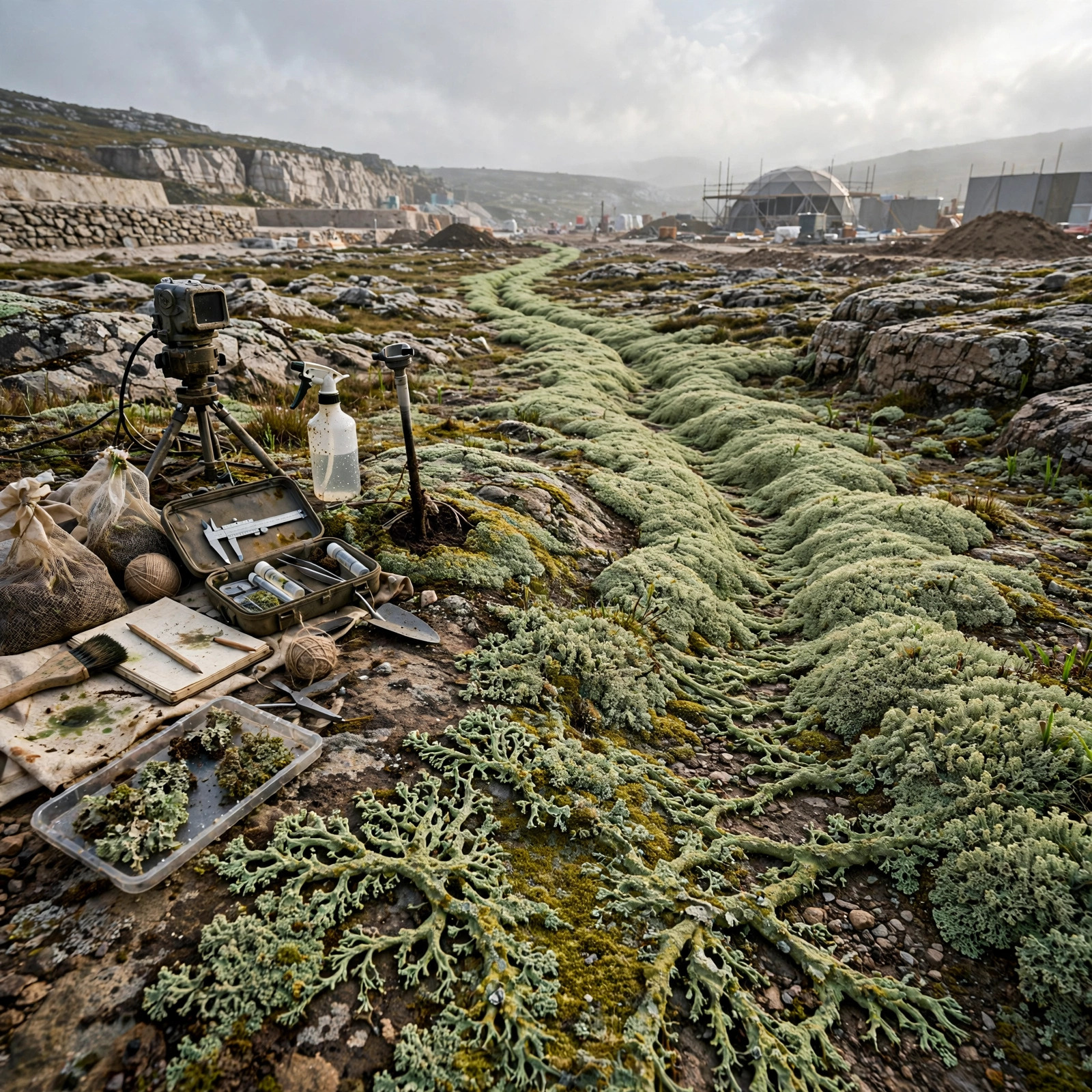
Tomas Ravel did not stop there, and this is the part of the story I tell young soilwrights when they arrive full of models and fear. He did the thing that the best builders do, which is to give his competence away. He rebuilt his routing models around growth curves instead of failure rates, and he published them to the whole Cooperative network under a license that required anyone using them to publish their own field results back. Within three years, grown-and-grafted corridors were being laid at four other Stage Three sites. He and Odile co-authored the field manual, and the argument between their names in the acknowledgments section is, if you know where to look, one of the great love letters of the Outer Reach.
Because yes. That happened. It happened slowly, the way everything true happens in the Hollow. It happened over graft days and repair circles and one memorable evening when Odile, who had survived her share of losses and worn her solitude like her hat, worn and repaired and loved anyway, asked Tomas to walk the cemetery spur with her and show her exactly where the road should extend when the settlement finally decided to grow in that direction. They came back after dark. They were holding hands. The lichen had never glowed so brightly, though that was probably a nutrient flush and I refuse to accept the chemical explanation.
"You'll want to know," Odile told me afterward, sitting on my porch with the cup of kiln-red tea she liked, "that I fought him for two years and he was mostly right and I was mostly right and the answer was neither of us. That is how you know a partnership is worth having. If the answer had been one of us, it would have been smaller."
The Hard Year
I will not pretend the Hollow was a place without grief. The hard year came when I was thirty-four: a long dim season that overstayed by nine weeks, fog so dense the solar arrays starved, and the fog nets, our great water collectors, iced at their masts. For the first time since its founding, Meridian Hollow drew down its margin. The chalk wall in the grain commons, which had always said yes, and here is the margin, said something more careful that winter. There was enough. There was not plenty. Everyone could read the difference.
What I remember from the hard year is not fear. I remember the repair circles becoming, without anyone announcing it, something closer to councils. I remember Tomas and Odile running the corridor waystations as warming shelters for the graft crews, and the candor of people who had learned, over years of shared work, how to say hard things to each other without breaking. There were arguments. There was a serious proposal, argued with real heat, to abandon the far glasshouse terraces and concentrate the settlement, and it was argued honestly by people who loved this place and feared for it, and it was voted down honestly by people who loved this place and feared for it, and nobody moved away, and nobody stopped speaking to anybody, and in spring the terraces bloomed and the ledger crept back up and the chalk wall said yes again, plainly.
Odile had a heart episode that winter. Mild, the medics said, caught early, because the Hollow's health surveys were another of its public abundance systems, and she recovered, but she recovered into a slower life, and the mother culture passed formally to me, in a small ceremony that was mostly just her handing me the tray and saying, "Don't drop it," and meaning a great deal more.
"The roads will outlive both of us," she said, on her porch, watching Tomas argue cheerfully with Wren about lattice spacing. "That is the whole point of growing things instead of building them. Buildings are finished. Grown things are always mid-sentence. Somebody has to be willing to be a clause."
The Landmark
Now I am fifty-one, and I am the senior soilwright of Meridian Hollow, and Odile Ferro is ninety, and she walks the spine road every evening with a cane Tomas made her and a lantern she still carries out of habit, though the lichen lights her way better than it ever did, four generations of selection deep.
The landmark I was asked to end with, the lived-in evidence of flourishing, is not the corridor or the terraces or the filled lakes, though all of those are beautiful and the lakes especially, which now hold actual fish and actual swimmers and, on the longest days of the bright season, the whole settlement's annual rafts-and-lanterns festival. The landmark is smaller than that and larger.
At kilometer one of the Candor corridor, where Odile pressed the mother culture into the seam nineteen years ago, the settlement has built a waystation: a low earthen shelter with a bench, a water tap, a shelf of field manuals, and a wall. On the wall, under glass, is the original chalk ledger from the grain commons, the one that said yes through the hard year, preserved because Wren, who is now the Hollow's archivist, pointed out that a settlement that forgets its margins forgets how to be generous. And beside it, updated every quarter in chalk by whoever holds the stewardship, is the current ledger of the whole corridor network: every grown route in the region, its health, its starter stocks, its repair log, written in a living script of lichen-friendly mineral ink, because Wren has no respect for my aesthetic preferences and believes records should be durable.
And below the glass, on the open chalk, anyone can write one line. It is the only unmoderated wall in the settlement, and the stewardship polices it not with rules but with the understanding that the wall is a gift and gifts get treated well. The lines people leave are small. Graft day, bright season, brought my daughter's class. She held the seam at nine meters. I cried a little. First freight through after the flood year. The road was waiting. Married here, under the lights, both of us, last night. Come see the photos in the commons.
Last bright season, at the waystation's dedication, which was really just the quarterly assembly held outside because the weather was kind, Odile stood at the bench with Tomas's hand in hers and read the wall, all of it, every line, aloud, in her unhurried voice, and then she turned to the crowd of eleven hundred people and their guests from three other settlements, people who had come to learn grafting and stayed for the stew, and she said the thing I will write on my own stone if anyone lets me.
"You asked me once, arriving, how you build a home on a planet that has never had one," she said, finding me in the crowd with her old unfailing aim. "Here is the answer, thirty-two years late. You grow it slowly, in public, with the ledger where everyone can read it. You argue, and you cook, and you repair. You let the road remember what the people forget. And when your granddaughter asks at supper why something must take so long, you listen, because the fastest thing on any world is a good question."
Then she sat down, and Tomas brought her tea, and the dusk came on, and the lichen roads of Meridian Hollow lit themselves the way they have done for three decades, vein by patient vein, gold and green and first-light, carrying home everyone who was ever willing to be a clause in a sentence that is still, thank everything, mid-speech.
Settlers' note: starter cultures from the Meridian mother line are distributed freely to any Stage Three site that commits to publishing its field results. The road remembers. So should the records.
Get notified when new stories drop

Sasha Quill
Sasha writes bold exploration and cosmic wonder with lyrical scale and grounded character work.
Leave a comment
Comments