

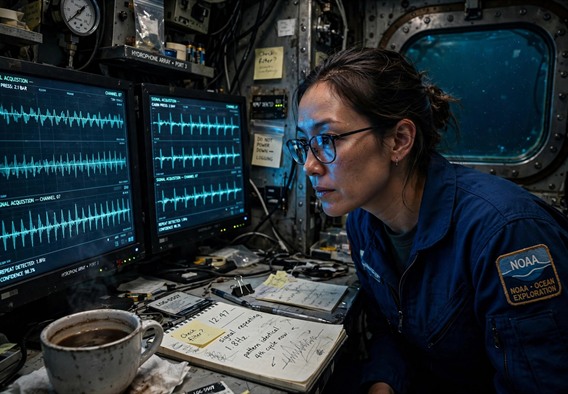

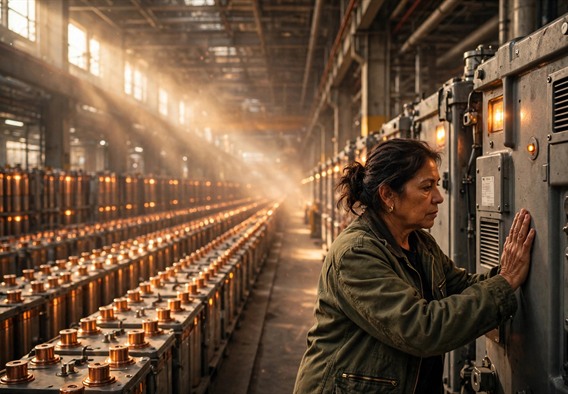
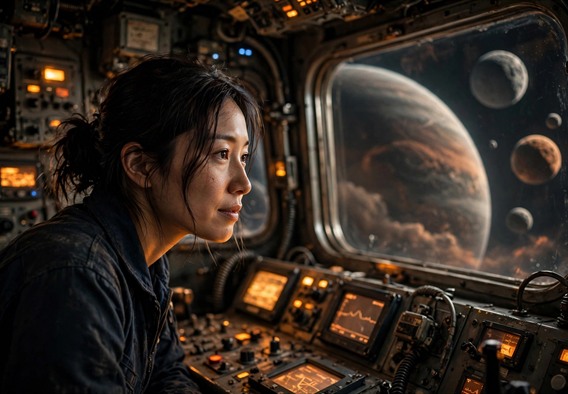
The question that had kept Priya Nair awake for the last thirty hours was simple enough to fit on a napkin: how do you scrub carbon dioxide from a sealed habitat when your scrubber is dead, your spares are soaked, and rescue is eleven days away?
She had, so far, four partial answers and one very good reason to believe the fifth was hiding somewhere in the wet lab behind her.
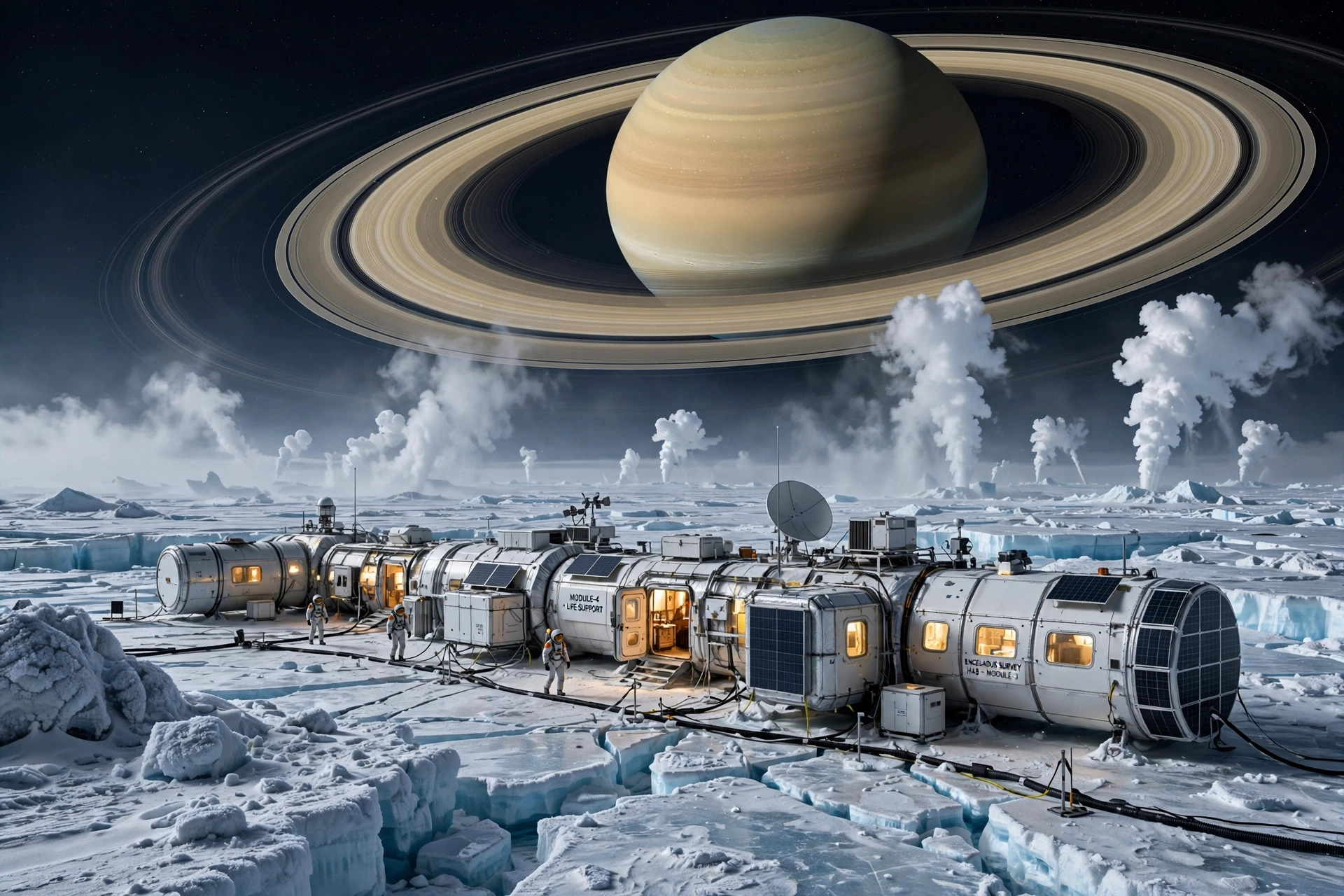
Argos Station sat on the near edge of the Tiger Stripes, the great fissured plains of Enceladus's south pole, two hundred meters from a plume vent that breathed seawater vapor into space like the moon exhaling. The habitat was three pressure vessels in a chain: the command module, the wet lab, and the crew cabin, connected by inflatable tunnels. Six people were supposed to live there. As of the accident, there were three.
One: The Number
Priya was the station's life support and chemical systems engineer, which everyone shortened to scrubber tech because it annoyed her pleasantly. She had spent nine years designing air for people in places where air did not exist, first on orbital habitats, then on the lunar south pole, and now here, thirty meters of ice and titanium above an ocean that had never seen sunlight.
At 0412 station time, a micrometeoroid the size of a grain of rice had come through the plume-side wall of the wet lab at seven kilometers per second. It punched a hole the width of a pencil, clipped the condenser loop, ruptured a line carrying ethylene glycol coolant, and sprayed the contents of an open storage rack. The rack had held the station's entire reserve of lithium hydroxide canisters, the expendable beds that pulled carbon dioxide out of the air. The glycol had found them the way glycol finds everything, and twelve hundred grams of backup scrubber capacity had dissolved into a sticky, useless puddle.
By 0440, the hole was patched. Station commander Marisol Vega had sealed it with a two-part epoxy plug and a bolted-on aluminum patch plate while the pressure dropped from 101 to 88 kilopascals, talking calmly the entire time in the low, unhurried voice she used the way other people used a first-aid kit. By 0500, the atmosphere was stable and nominally breathable.
Nominally was the word doing all the work.
The primary carbon dioxide removal assembly, a rotating adsorption bed unit called the CDRA, had survived the impact but not the aftermath. Glycol vapor had been drawn into its intake during the pressure sag, and the glycol had blinded the desiccant bed, and the desiccant bed was supposed to protect the zeolite adsorbent from exactly that. With no desiccant, the moisture in cabin air had migrated into the zeolite, and wet zeolite held carbon dioxide the way a soaked sponge holds nothing. When Priya ran the diagnostic at 0530, the CDRA's removal efficiency read four percent. A healthy unit ran at ninety-five.
Humans exhaled about a kilogram of carbon dioxide per day, each. At four percent removal efficiency, the CDRA was functionally a piece of furniture. The cabin volume of the habitat chain was roughly 160 cubic meters. Starting partial pressure of carbon dioxide: 0.3 kilopascals, perfectly normal. NASA's long-term exposure limit: 0.4 kilopascals, where people get headaches and start making poor decisions. The crew produced about three kilograms of the gas per day. Her math, run three times on three different pads because she could not stop checking it, gave her between thirty and thirty-six hours before the cabin crossed 0.4 and kept climbing.
Thirty-six hours to reinvent a life support system from what was left of a survey station's shelves.
She walked to the wet lab to tell the others and found Tomás Reyes already there, which surprised her until she remembered that Tomás never slept more than five hours and that geologists rose early the way bakers did. He stood at the isolation glovebox with a sample cradle in front of him, lit from below, and he did not look up.
"Priya," he said. "Before whatever bad news is making you walk like that, look at this."
She looked. In the cradle, under the glovebox's inert lamp, sat a vial of plume condensate that he had collected forty hours ago from the skim array on the surface, water flash-frozen from the moon's own exhalation, and in that water, under magnification and polarized light, grew structures. Filaments. They were fine as spider silk, fractal in their branching, and where the branches crossed they had fused, and where they had fused there were nodules with the matte, organic irregularity of coral. They had grown nine percent since the last imaging pass.
"They're metabolizing," Tomás said quietly. "Slowly, at our pressure and temperature, but the growth rate tracks with dissolved carbon dioxide. The condensate is saturated with it. These things are drinking our atmosphere's favorite poison."
Priya stared at the filaments for a long moment. She was aware of two thoughts occupying her mind at once, in separate rooms, not speaking to each other. In one room: this is the discovery of the century, life in the Enceladan ocean, second genesis, and it is growing in a vial ten meters from where I sleep. In the other room: thirty-five hours and eleven minutes.
"Tomás," she said. "How much water do you have on hand that's this concentrated?"
"Two liters of condensate, plus the culture. Why?"
"Because I need a carbon sink," she said, "and the universe may have just handed me one, and I need to know if it scales."
Two: The Inventory
The third crew member was Ash Okonkwo, mechanical and additive manufacturing specialist, and Ash was asleep in the crew cabin with a calibration report still open on their tablet, because Ash had run the patch plate job at 0430 and was owed every minute of the sleep. Priya let them sleep for another hour. In that hour she and Tomás took the full inventory of the habitat's chemical and mechanical stocks, and the inventory was a study in near misses.
They had sixty-eight kilograms of water in various tanks. They had a Sabatier reactor, designed to combine hydrogen and carbon dioxide over a ruthenium catalyst to make methane and water, rated for a throughput far larger than their problem, except that its own moisture management loop shared components with the CDRA's and shared the same glycol-contaminated fate. They had a 3.5 kilowatt electrolysis stack for splitting water into oxygen and hydrogen, healthy, thank the drifting snows of Saturn, because it lived in its own dry compartment. They had spare catalyst but no spare zeolite. They had four hundred grams of activated carbon intended for trace contaminant control. They had a printed circuit board fab, a metal sintering printer, epoxy, sealant, aluminum sheet, and an archive of every manual written for every machine on the station.
They had no lithium hydroxide, no soda lime, no potassium superoxide, and no resupply for eleven days. The supply tug Asclepius was inbound from the Saturn Gateway station with everything they could want and no ability to get there faster than physics allowed.
"So the textbook answers are all gone," Tomás said, sitting on an equipment crate with his tea cooling in his hand. "What's left?"
"Chemistry," Priya said. "Carbon dioxide dissolves in water. That's not a trick, that's Henry's law, and Henry's law has been saving my profession's dignity for two centuries. Submariners know it. Every aquarium on Earth knows it. Dissolve it in water, and it becomes carbonic acid, and then you have a storage problem instead of a toxicity problem, and storage problems are my favorite kind because they are just engineering with a pH meter."
"How much water would you need?"
"That's the ugly part." She pulled the pad from her hip and showed him the curve. "At cabin temperature and pressure, pure water dissolves about 1.45 grams of carbon dioxide per kilogram. We make three kilos a day. Even if I achieve perfect contact, perfect equilibrium, I'd need two thousand liters of water a day, and we have sixty-eight."
"So you need water that holds more."
"Water that holds more. Yes. Amines do it. Monoethanolamine scrubs carbon dioxide beautifully; every carbon capture plant on Earth uses some cousin of it. We don't have amines. We don't have any strong base worth the name anymore. What we have is a lot of alkalinity locked up in dissolved salts, because this whole moon's ocean is a sodium carbonate soup." She tapped the pad. "Plume condensate is basically ocean water with the salt left behind as aerosol and the carbonate carried along. Tomás, the plume condensate in your glovebox is mildly alkaline, and alkaline water absorbs carbon dioxide far better than pure water, and it converts it to bicarbonate, which stays put. And your new friends in the vial appear to convert it to biomass, which stays put even harder."
"You want to exhale into an aquarium."
"I want to exhale into the most important aquarium in human history," Priya said, "and then I want to regenerate it, because sixty-eight kilograms of water is not enough, and regeneration is where this gets hard."
Regenerating a scrubbing solution meant driving the carbon dioxide back out, which meant heat or vacuum or both, which meant a vessel, a pump, plumbing, controls, and a heat rejection path. In other words, it meant building a machine that did not exist, out of the parts of machines that did, in one day, while three adults continued to breathe.
"There's a version of this where we just stop breathing so much," Tomás offered. "Sleep. Slow everything down."
"That buys us six hours, maybe eight, and it spends our best problem solvers unconscious." Priya stood and stretched until her spine popped. "Wake Ash. We're going to have a design meeting at the kitchen table, like a family with a deadline."
Three: The Design Meeting
Ash Okonkwo arrived at the mess table with sleep still creasing one cheek and their hair in a geometry all its own, listened to Priya's summary for four minutes, and then said the sentence that Priya would replay for the rest of her life whenever someone asked her what good engineering looked like.
"Okay," Ash said. "We're building a still. A still that breathes."
They sketched on the mess table's smart surface, three styluses overlapping, arguing in the shorthand of people who had shared canned peaches and recycled air for fourteen months. The architecture they settled on had three hearts.
The first heart was the absorber. A column, probably printed in polymer, packed with high-surface-area lattice, through which cabin air would be blown by a spare duct fan while alkaline condensate trickled down over the packing. Gas and liquid meeting on a vast plastic surface area, exchanging carbon dioxide according to gradients. Priya knew the mass transfer correlations from her student days and found, to her surprise and delight, that she remembered them, that the equations lived somewhere behind her sternum, patient and intact.
The second heart was the regenerator. The loaded solution, heavy with bicarbonate, would be pumped to a heated boiler vessel, where heat would push the equilibrium backward, releasing carbon dioxide gas that would be pumped overboard through the patch plate's existing sample port. The stripped solution, alkaline again, would return to the absorber. A closed loop, a lung that exhaled into the vacuum over Enceladus and breathed its scrubbed air back into the cabin.
The third heart was the heat engine around it, because nothing in this universe is free. The regenerator needed its solution hot, sixty to eighty degrees Celsius, and the habitat's thermal system had exactly no spare capacity. But the electrolysis stack, when it ran, produced waste heat as a matter of physical law, and the station's oxygen supply came from electrolysis anyway, so every kilogram of oxygen they made was also a kilogram of heat they could harvest.
"There's a coupling here," Priya said, drawing arrows until the sketch looked like a nest of snakes with a purpose. "The crew needs oxygen. Electrolysis makes oxygen and hydrogen. Waste heat from electrolysis runs the regenerator. The regenerator makes the absorber work. The absorber keeps the carbon dioxide down. And the hydrogen, we feed to the Sabatier reactor if we can ever resurrect it, and the Sabatier eats carbon dioxide too, and if we get that far, we close a loop so beautiful I might weep on it."
"Don't weep on it," Ash said. "Epoxy doesn't stick to weeping engineers."
"And the filaments?" Tomás asked. He had brought the glovebox's imaging feed up on the mess display, and the branching structures shimmered there, patient, growing. "Where do they fit?"
"I don't know yet," Priya admitted. "Maybe nowhere in the machine. Maybe in the backup of the backup. But Ash, I need your printer for the column packing, and I need it to print a lattice that would make a coral reef jealous. Surface area is everything. Every square centimeter is a little bit of my life."
Ash cracked their knuckles, which was a habit from a childhood Ash refused to discuss, and looked at the sintering printer across the lab. "Give me three hours for the packing geometry. Give me your tolerance spec and stop hovering."
"I never hover."
"You hover like a drone," Ash said fondly. "A worried drone."
Four: Failure, Part One
The first absorber column was a work of art and it failed in ninety minutes, and Priya kept its charred, flooded husk mounted on the lab wall for a year afterward as a teaching aid she never got to teach with because the story got so famous.
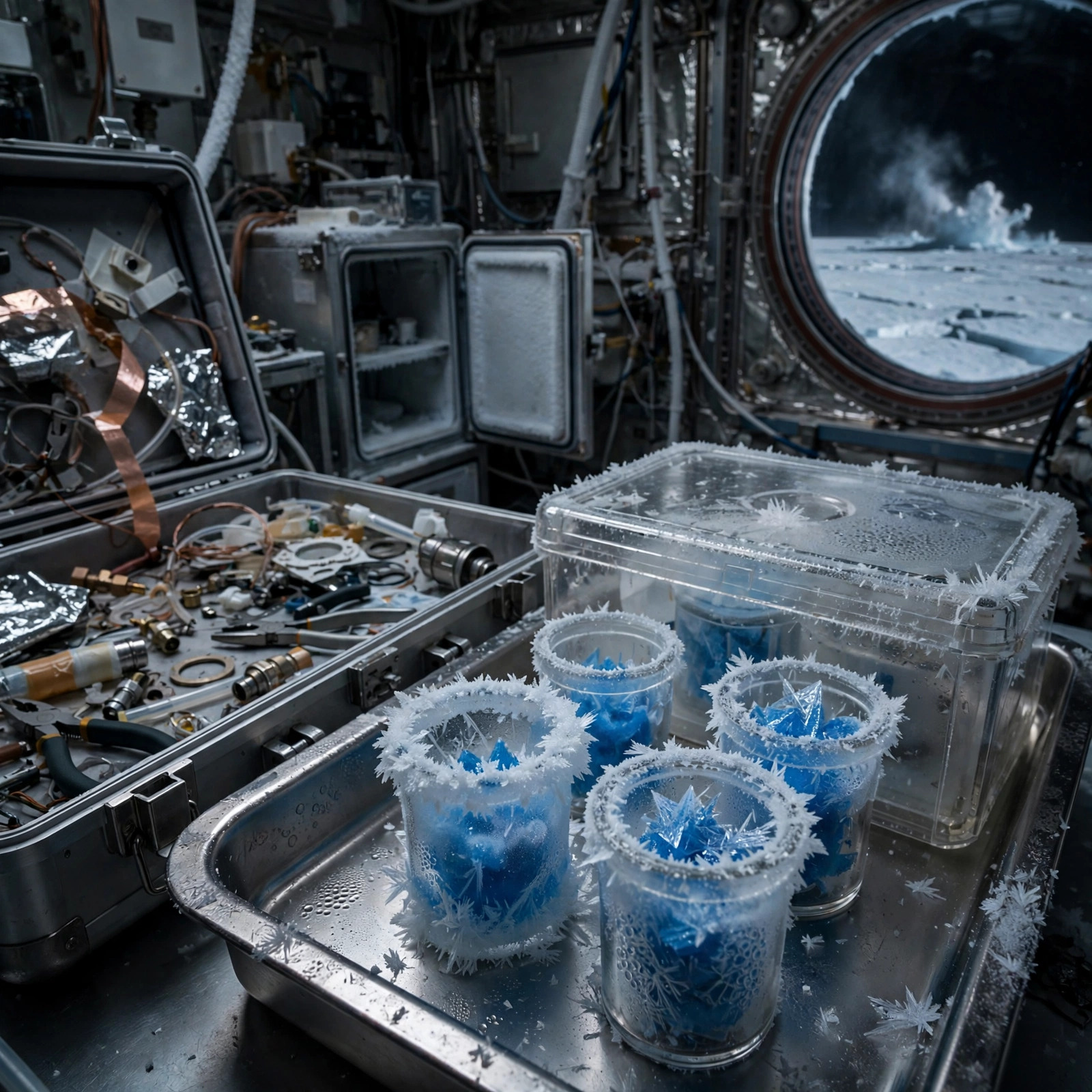
The failure was humble. The printed packing lattice, gorgeous under magnification, had been printed in standard photopolymer resin, and when Priya flooded it with warm alkaline condensate, the resin's uncured surface chemistry began to degrade. Within the first hour the effluent ran cloudy with dissolved polymer. Within ninety minutes the flow channels began to gum, the fan strained against rising backpressure, and the seal at the column base let go and deposited four liters of carbonate solution across the lab floor, which froze within minutes near the cold plate and turned into a slick the color of old soap.
Nobody slipped and broke anything, which Priya counted as the day's second miracle, the first being that the carbon dioxide curve had bent. Not enough. Partial pressure had climbed from 0.3 to 0.41 kilopascals during the build and the first test, and everyone had the faint frontal headache of a long meeting in a crowded room, but the curve had bent. The concept was sound. The materials were not.
"What have we got that laughs at warm alkaline water?" Priya asked the inventory, and the inventory, being an inventory, did not answer, so she asked Ash, who did.
"Fluoropolymer," Ash said. "There's a spool of it in the printer bay, the good stuff, reserved for the plume skim array's splash shields. It's inert to everything except my patience." Ash was already walking. "We reprint the packing in fluoropolymer. Print speed drops by half. And the column shell, we don't print it at all, we roll it from the aluminum sheet stock and coat the interior, because aluminum holds a seal and the coating holds the chemistry."
"Time?"
"Four hours for packing, one for shell, two for assembly. Meanwhile you solve the problem of the pump, because your pump died of dignity, and the spares list shows exactly one more rotary vane pump, and I vote we don't spend our last pump on version two of anything."
They spent the one remaining pump on the regenerator loop, where it was irreplaceable, and for the absorber they cannibalized. The solution was Tomás's, arriving in the middle of the night while Priya catalogued sealants, and it was beautiful in the way that only solutions to problems outside your own specialty are beautiful. Gas lift, he said. Aquarium airlift. No moving parts at all. Bubble air up through a standpipe and the rising bubbles will carry the water with them, a pump made of physics. They printed a standpipe, plumbed it, and the first time the airlift loop burped its first slug of solution up and over the distribution tray, Priya heard herself make a sound she would deny in any debrief, a small whoop, entirely involuntary.
Carbon dioxide partial pressure at that moment: 0.44 kilopascals. They were already past the long-term limit and into the region where errors compounded, where everyone's thinking was a little thick, where the engineering was being done by three people with mild altitude-sickness brains. Marisol had instituted a buddy check system that morning: any calculation that mattered got checked by a second pair of eyes, any valve thrown got announced and confirmed, no one touched the pressure hull alone. It slowed everything down and it kept them alive, and Priya privately upgraded Marisol in her estimation from very good commander to genuinely great one.
Five: Failure, Part Two
Version two of the absorber ran for six hours and did the job. Version one of the regenerator did not.
The problem was the boiler. Priya had converted a spare water storage tank into the stripping vessel, which was fine, and wrapped it with a resistive heating blanket scavenged from the condensate preheater, which was also fine, and then made the mistake of assuming the carbon dioxide would leave politely through the vent line when invited. It did not. As the solution heated, the bicarbonate broke down and released carbon dioxide faster than the small vent pump could evacuate it, pressure built in the vessel, and at a half kilopascal over spec the tank's overpressure burst disc ruptured, which was the disc doing its job, and four liters of hot carbonate solution painted the ceiling of the mechanical bay and rained down on the Sabatier reactor, which did not deserve it.
Nobody was hurt. The Sabatier's control electronics were not so lucky. Water and electronics, Priya reflected, wiping down the reactor housing with isopropanol while her hands shook in a way she chose not to examine, had a rivalry older than spaceflight.
Carbon dioxide partial pressure: 0.47. The headache had stopped being faint. Tomás had begun to read the same paragraph repeatedly, and Marisol had caught herself twice giving an instruction and then immediately reissuing it in different words. The buddy checks were no longer a protocol; they were the spine of the day.
"We need to slow the boil," Priya said, at the table again, the fourth time at the table that day. "The equilibrium isn't the enemy. Rate is. I need the release to happen slower than the pump can carry it away. Lower temperature, longer residence, or..." She stopped. She stared at the sketch. She saw it, and she could not believe she had not seen it at 0300 the previous night, because it was so simple it was almost embarrassing.
"Or I don't boil the whole batch at once," she said. "I boil a trickle. A serpentine path. A long coiled tube, heated along its length, solution flowing through it slowly, releasing carbon dioxide along the way, so the gas has somewhere to go the whole time. A heated capillary. The surface area to volume ratio is enormous, the release is gradual, the pressure never accumulates."
"A still that breathes," Ash said, "with a long thin throat."
"Can you print me a coil? Thirty meters of it, fluoropolymer, and a heating jacket to wrap it?"
Ash was already calculating. "I can print you the coil. The heating jacket, I'm going to build out of resistance wire and aluminum tape, and it's going to look like a craft project, and it's going to work."
"And I'll take the pressure management," Marisol said. "We vent through the sample port, but I want a redundant path. If the vent clogs with frozen carbonate, I want a second route that cannot clog, and I want it built before we run version three, not after." Two burst discs and a lancing of frozen scrubber effluent later, the station had a vent system with the redundancy of a paranoia factory, and Priya, who had spent her career around safety engineers and had married one, understood that Marisol's paranoia was the most loving thing on the station.
Six: The Filaments
While the coil printed, Tomás did what Tomás did, which was to look at the living world with a patience that Priya found both admirable and slightly alien, in the affectionate sense.
The filaments in his culture had doubled again. He had run the growth assay four times, and the numbers were consistent: in water spiked with carbon dioxide at cabin concentration, the organisms grew; in degassed water, they stalled; in water bubbled with pure carbon dioxide, they grew so fast they clouded the vial. They were, as far as his instruments could say, a chemolithotroph of some kind, fixing inorganic carbon, drawing energy from a chemical gradient, possibly the reduction of sulfate or the oxidation of hydrogen seeping from the moon's hydrothermal floors. The Enceladan ocean was famous in the literature for its salts and its plumes. It was now, as of a Tuesday, famous for its residents.
"Here's the thing I can't stop thinking about," Tomás said, that evening, when the three of them were eating rehydrated noodles at the mess table because ritual mattered when your brain was oxygen-starved. "The growth rate tracks with dissolved carbon dioxide. The carbonate condensate in an open tank would be saturated with it. What if the scrubber solution isn't just a solvent? What if it's a medium? What if, instead of fighting the biology, we grow it on purpose, in the absorber itself, and let it eat the carbon we can't easily strip?"
Priya put down her fork. "You're proposing a bioreactor."
"I'm proposing a partnership. Your machine does the bulk work, the physics, the stripping, the loop. But downstream, in a side stream, we keep a living bed, a matrix for these filaments to colonize, polishing whatever the machine misses. And here's the kicker." He brought up the assay. "When I degas loaded solution with heat, the bicarbonate converts back, but there's residual carbonate. My filaments will fix that residual. The machine can never get to zero, but the biology gets closer to zero than zero, because for them, our waste is lunch."
"You realize what that means for containment," Priya said. "We would be deliberately releasing Enceladan organisms into station systems."
"In a sealed loop," Tomás said, "with heat sterilization at the return, and I will build the barrier to planetary protection spec if it takes all night. And Priya, think about what happens to every sample that goes home with us. We're not contaminating their world. Their world is one room away from us all the time already. This is the opposite of contamination. This is collaboration, with paperwork."
Marisol, who had been listening with her chin on her fist, said, "Write it up. Both of you. Full protocol, containment layers, kill steps, abort criteria. If it reads clean, we run it. And we name it before it becomes famous, so we don't end up with a name like Organism X."
"The filaments branch like feathers," Tomás said. "And they came from the Stripes."
"Feather Stripes," Ash said, around a mouthful of noodles. "Done. Next problem."
That was the thing about Ash. Next problem. Priya had a private theory that optimism was not a temperament but a practice, a muscle, and Ash was its champion powerlifter.
Seven: Version Three
Version three of the machine went together over fourteen hours and was the ugliest, most beloved object Priya had ever helped create. It had a rolled aluminum absorber column the height of a person, packed with a fluoropolymer lattice whose internal surface area, Ash reported with unconcealed pride, exceeded twenty square meters. It had an airlift loop of transparent tube through which bubbles climbed like the world's slowest lava lamp. It had a serpentine regenerator coil, jacketed in hand-wound resistance wire and aluminum tape, looking exactly like the craft project Ash had promised. It had the last rotary vane pump, a needle valve Ash had adjusted with a feeler gauge and prayer, three pressure sensors that had been calibrating spare parts in a drawer, and a vent line that went through the wall to a universe with infinite dilution capacity.
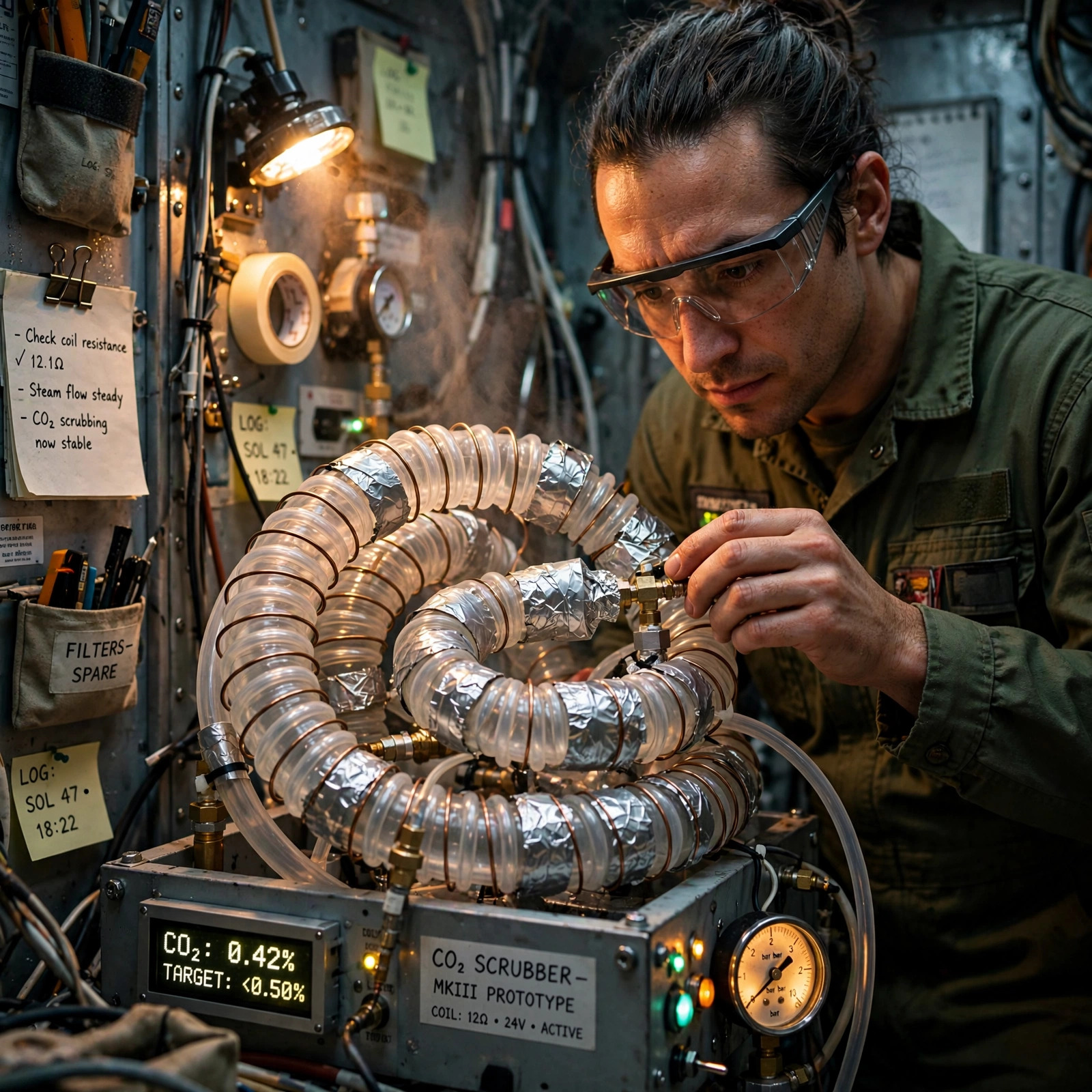
Marisol read the startup checklist aloud, and Priya answered each callout like a liturgy. Power to heater blanket: confirmed. Coolant to cold plate: confirmed. Absorber fan at forty percent: confirmed. Airlift flow established: confirmed, and there it was, the burble, the sound of water climbing a hill on the power of bubbles, the sound of the whole fragile scheme becoming a machine.
The carbon dioxide partial pressure at startup was 0.49 kilopascals. Everyone had headaches. Everyone was on the edge of the envelope where you stop being a good engineer and start being a hazard, and they all knew it, and they ran the startup anyway, because waiting was not on the menu.
For the first hour, nothing measurable happened, and Priya sat in front of the gas analyzer with the particular stillness of a person watching a pot that must, absolutely must, boil. Then the absorber effluent, sampled through a port, came back reading carbon dioxide loaded at nine times the inlet concentration of the condensate feed. The column was eating. Then the coil's discharge came back stripped, low, alkaline again, hungry. The loop was a loop. The lung was breathing.
At hour two, the partial pressure stopped climbing. It held at 0.49 for twenty minutes, an entire human generation in the life of a curve, and then at hour three it began, gently, like a tide turning, to fall.
0.48. 0.47. 0.45 by end of shift. Ash whooped. Marisol permitted herself one second of visible relief and then asked for the overnight trend projection, because she was Marisol. Tomás, who had been running his polishing bed in a side loop, a stack of fluoropolymer mesh colonized by a milky haze of Feather Stripes filaments, announced that the bed's effluent was measuring carbon dioxide below his instrument's confidence interval, which meant the organisms were finishing what the machine started, and that he had a hypothesis about their hydrogen metabolism that could, in principle, close the Sabatier loop someday, and that he was going to write the paper, and that if anyone told him the news had already broken on Earth before he filed it he would be professionally inconsolable.
"The news is not going to break before you file it," Priya said, "because the only people who know are in this room, and we've all been too busy breathing to call home."
"I did send a two-line summary to Gateway in the last uplink window," Marisol said, unrepentant. "Professional courtesy. And a request for them to prioritize lithium hydroxide on Asclepius." She paused. "Also, I may have used the phrase second genesis."
"May have," Tomás said, "or definitely."
"The uplink log will decide," Marisol said, "and the uplink log is not a witness we can cross-examine. Next problem."
Eight: Eleven Days
The eleven days until Asclepius arrived were the best eleven days of Priya's career, and she had a career that included watching the sun rise over Mare Frigoris from the lunar north.
The system was not perfect and never became perfect. It was, as she wrote in the post-accident report, an unregenerate abomination of a machine, and she wrote it with love. The heater jacket developed a hot spot in week one and Ash redistributed the resistance wire at 0200 with the coil still live, because downtime was measured in brain cells. The airlift loop clogged twice with precipitated carbonate, once on a watch that Tomás caught because he noticed the burble had changed pitch, which was the kind of knowledge you could not train into a manual. The fluoropolymer packing, version three and a half, printed with a revised lattice after Ash studied the fouling pattern, ran for the remaining days without complaint and was eventually retired to the wall of teaching aids beside its charred ancestor.
The carbon dioxide partial pressure settled into a slow sawtooth, riding between 0.32 and 0.38, below the limit, below the headaches, with the biology in the polishing bed grinding the peaks flatter every cycle as the colony grew. Marisol ordered the whole crew onto a sleep protocol, and it turned out that eight hours of sleep was a life support system too. Priya dreamed twice about the machine, once as a lung and once as a cathedral, and decided both dreams were accurate.
They worked. That was the miracle nobody called a miracle, because they were professionals. Tomás catalogued the plume skim samples and found the filaments in nearly every one, meaning the ocean was full of them, meaning the ocean was alive from pole to pole or at least from stripe to stripe, and his provisional paper, drafted on the mess table between instrument runs, grew appendices the way his cultures grew nodules. Ash printed replacement parts for the Sabatier's water-damaged controller and resurrected it on day five, and when the first Sabatier burn ran with gas from their own regenerator vent, taking carbon dioxide that three humans had exhaled and converting it to methane and water, Priya stood and watched the loop close and did not weep on it, which she noted in the log with a degree of self-satisfaction.
"For the record," she said, "we now have a habitat that drinks its own breath."
"For the record," Ash said, "it drinks it because we fixed it. Say the fix part. The fix is the story."
Nine: Asclepius
The supply tug made its approach on day eleven, a blunt instrument of a ship with a hold full of lithium hydroxide canisters, zeolite, a fresh CDRA desiccant kit, amines in proper industrial drums, two new pumps, and, packed at the top where the loader at Gateway had clearly enjoyed themselves, a case of actual coffee and a card that read: TO THE PEOPLE WHO INVENTED A LUNG IN A DAY. GATEWAY IS PROUD OF YOU. PLEASE STOP MAKING OUR JOBS EMOTIONALLY DIFFICULT.
The new crew rotation came down on the same trajectory: two more engineers and a microbiologist named Hanne Brandt who stepped out of the airlock, shook Tomás's hand for eleven uninterrupted seconds while looking at the polishing bed, and said, "I have read your preprint eleven times, and I would like to state for the record that I am professionally furious and personally delighted."
The handover was done properly, which meant Priya spent two days teaching the new life support engineer the machine's quirks, the burble's correct pitch, the hot spot's history, the way the airlift loop sulked if you pushed the fan above sixty percent. Then the original three suited up and walked out onto the plain of ice, past the skim array, to the transfer sled that would carry them up to the tug and, in three weeks, home.
Before the sled lifted, Priya turned and looked back at Argos Station, small and golden against the blue-white ice, with Saturn's rings a razor line above the horizon. Somewhere behind that wall, a machine she had built from spilled spares and stubbornness was breathing for four people. Somewhere under that ice, in a dark ocean older than the continents of Earth, an organism with branching filaments was quietly eating carbon and minding its own magnificent business, unaware that its culture had gone to the inner solar system in a freezer case and made three careers and one very good argument for going further.
"Regrets?" Marisol asked, beside her on the sled.
"One," Priya said. "I never got to name the machine."
"You did," Tomás said, from her other side. "Day one, in the lab. You said, and I quote, I need a carbon sink, and I need to know if it scales. The crew log has it verbatim. We've been calling it the Nine Percent Solution ever since, because that was the load your absorber hit on first light."
"That was the performance number, not a name."
"Names are just performance numbers," Ash said, "that people fell in love with."
The sled rose. Enceladus fell away beneath them, its southern stripes gleaming like fresh scratches on a piano key, its plumes standing off into space in long bright veils, veils that contained water, salts, hydrogen, and life. Priya pressed her faceplate to the viewport and watched until the habitat was a spark and the moon was a pearl, and she found that her eyes were doing the thing she had promised the epoxy not to do, and she let them.
Eleven days earlier, she had gone to sleep with a question on a napkin: how do you scrub carbon dioxide from a sealed habitat when everything that should work does not? She flew home with the answer and with the knowledge that the answer had never really been chemistry. The chemistry had been the easy part. The answer was three adults with headaches who checked each other's math, who failed twice and printed a third time, who put a living thing to work beside a machine and made a partnership instead of an argument. It was, she thought, watching Saturn's shadow lay its long dark stripe across the moon below, the best technology her species had ever produced: not any particular device, but the practice. The next problem. The fix.
Gateway, when they reached it, had the fresh CDRA waiting in quarantine and the crew quarters warmed, and Hanne Brandt's first culture paper was already in press, and Marisol had been asked, formally and repeatedly, to stop signing her reports with second genesis. And Priya Nair, senior scrubber tech, unbothered and smiling, began the long decompression with a napkin in her pocket. On it, in her own handwriting, was the question that had kept her awake, and under the question, added later in Ash's handwriting, the answer that she intended to keep for the rest of her life, in every sealed habitat, around every cold moon, for as long as her species kept going out:
It scales because we do.
Dedicated to every life support engineer who has ever looked at a parts list and refused to be finished.
Get notified when new stories drop

Mira Okoye
Mira writes first contact and mentorship-across-species stories where curiosity beats fear.
Leave a comment
Comments