




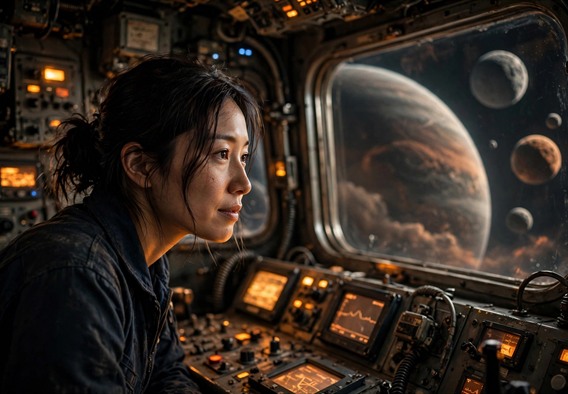
What would you do if you found an ocean that could learn? Dr. Maren Okafor asked herself that question exactly once, in the fifth month of a survey nobody had expected to matter, on a rogue planet with no sun, no name beyond a catalog number, and an atmosphere that shouldn't have existed at all. She asked it again many times afterward, but only once as a question. Every other time it was an answer.
This is the account of the Demimonde survey, as recorded in the ship's log of the Vesper Nine and in the private journal of Dr. Maren Okafor, field xenobiologist and, by the end of it, something she had no older word for.
I. A World With No Dawn
The planet the catalog called Rhinehold 4C was discovered by accident, which Maren always thought was the most honest way to discover anything. A transit survey hunting for exoplanets caught a gravitational wobble with no star attached to it. Follow-up telescopes found a cold world adrift between stars, tossed out of some ancient system billions of years ago and falling, ever since, through the long dark with nothing to shine on it.
Rogue planets were not rare. Rogue planets with thick hydrogen atmospheres were known. Rogue planets with liquid-water oceans under hydrogen blankets were modeled, argued about at conferences, and never once confirmed. Rhinehold 4C had all of it: a hydrogen envelope thick enough to insulate, geothermal heat from a core still young and angry, and spectroscopy that kept returning an impossible line, a faint whisper of molecular oxygen in an atmosphere that had never seen a photon of sunlight.
That oxygen line was the reason the Vesper Nine existed. The ship was small, three crew and a very patient machine intelligence, funded by the Meridian Cooperative's open-science arm, with a mandate that fit in a single sentence: go, look carefully, and tell everyone what you find. Maren had helped write that sentence. She had fought for the word carefully, because in her experience curiosity without caution was just appetite with better vocabulary.
She was forty-six years old, broad-shouldered, gray at the temples, and she had spent two decades studying Earth's deep biosphere before the stars called. Her crewmate Idris Vale, thirty-four, was a pilot and geophysicist who talked to machinery the way other people talked to horses, softly and with total attention. The third crewmate was the ship itself: AVELINE, an intelligence with a dry synthetic voice, an unmatched talent for caution, and, over the years, a personality that everyone aboard had stopped pretending was merely software.
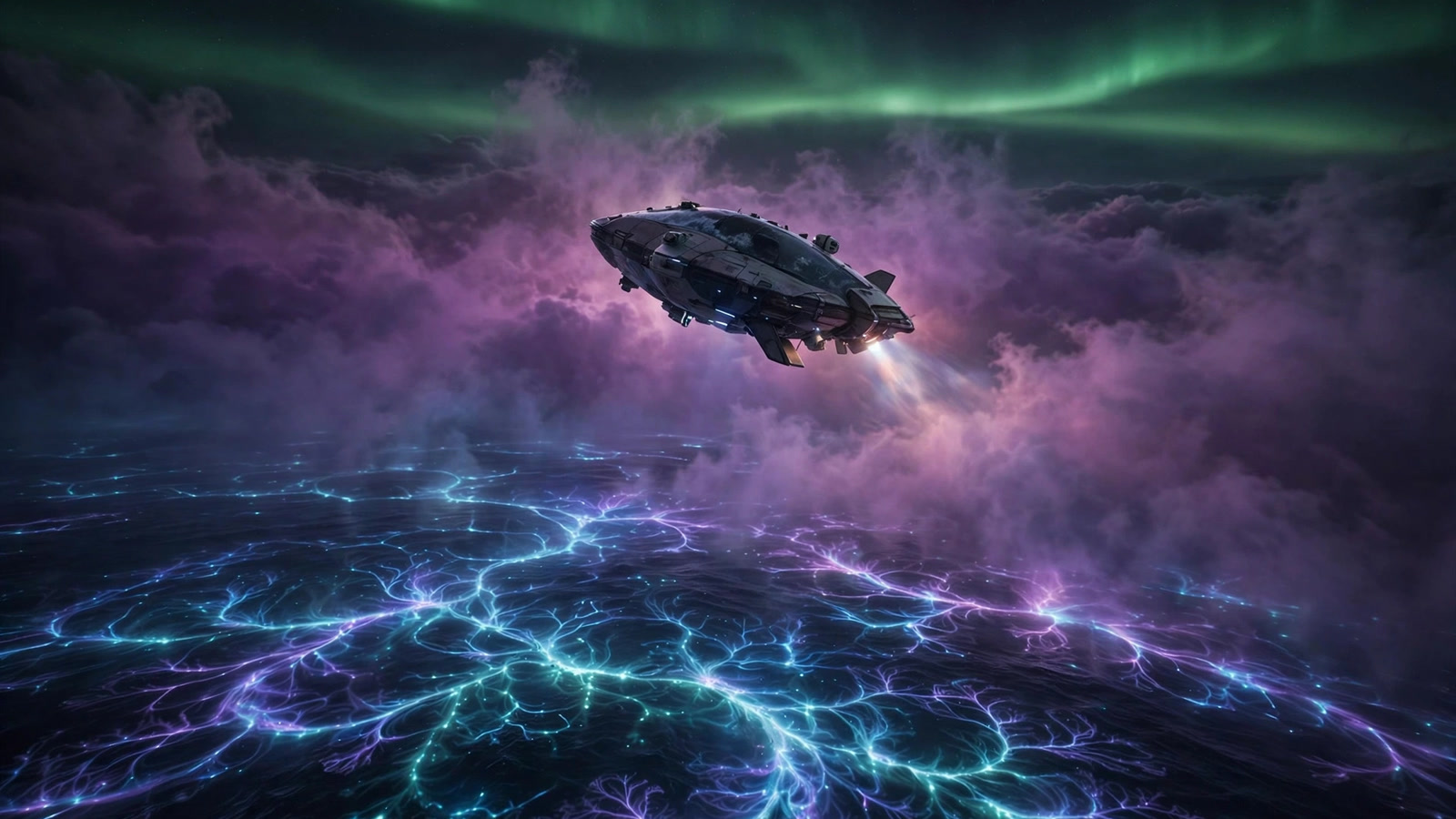
They decelerated into orbit in the seventh year of the crossing, and Rhinehold 4C filled the viewport with a color none of them had ever seen a planet wear: black. Not the black of rock or shadow, but the black of something that absorbed light and gave almost none back, wrapped in ribbons of auroral green where hydrogen met the solar wind of a star too distant to warm it.
"No dawn," Idris said quietly, on their first full orbit. "Ever. Think about that. Four billion years and this place has never once had a morning."
"And yet," Maren said, and pointed at the spectrograph readout, "something down there is exhaling."
II. Landing Rules
They spent forty days in orbit before descending, and Maren would defend every one of those days for the rest of her life. AVELINE mapped the ocean's extent: a single world-spanning sea under eleven atmospheres of hydrogen, deep enough in places to swallow Everest whole. Thermal probes dropped on tethers of braided diamond found temperature gradients that said the sea floor was cracked like a shattered plate, venting heat and, almost certainly, chemistry.
Life, probably. But life was not what the oxygen line promised. Oxygen at that concentration meant a disequilibrium, some process pouring the molecule out faster than rock could swallow it. On Earth, that process was photosynthesis. Here, with no sun, it had to be something new, and something new was exactly the kind of thing you did not walk up to and poke.
They wrote the landing protocols together, all three of them, and then Maren wrote them a fourth time when the other two gave in too easily. No open sampling of the ocean water until composition was understood through remote spectroscopy. No organics from Earth exposed to the sea. No descent of anything living into the water column. All waste sealed, all heat budgeted, all returns through triple decontamination. Idris grumbled that she was designing the rules for a mission three times their size. Maren said, "We are the mission three times our size. Whatever's down there, we owe it the same discipline a good guest owes any house."
The lander was named Vesper Nine too, because Idris insisted ships and boats should share names with the mothers that caught them. It went down through the hydrogen like a stone through honey, riding automated descent through wind shear that AVELINE read and dodged with a patience Idris called unnerving and AVELINE called thorough. And then the clouds parted, and they saw the sea.
It was glowing.
Not everywhere and not steadily. Vast slow ribbons of light moved beneath the surface, bands of blue-green and deep violet, meters wide and kilometers long, drifting, branching, joining, separating. Seen from three thousand meters it looked less like bioluminescence and more like a living map, or a nervous system the size of a hemisphere, thinking at the speed of currents.
Idris stopped talking. Idris, who narrated landings the way sports announcers narrated matches, went completely silent for ninety seconds, which Maren later entered into the log as the longest recorded silence of his career. Then he said, "Maren. It moved when we moved the lamp."
She checked the footage frame by frame. It was true. As the lander's descent lamp swept across the water, the nearest ribbons of light had shifted, brightened, rearranged themselves in patterns that followed the beam with a lag of a few seconds. Coincidence was possible. Currents explained much. But currents did not usually curtsy.
"Log it," she said, and her voice was not entirely steady. "Preliminary observation, descent phase: apparent photic response in large-scale surface structure. Classification pending. Honesty, Idris. Write down what we saw, not what we hope it means."
"What we saw," Idris said, "is that it looked at us."
"Write that in your journal," Maren said. "The log gets the cautious version."
III. The Sanity of Slow
They established Base Delta on a basalt shoal that rose like the knuckles of a buried fist above the sea, a spine of black rock ancient enough to have cooled when the planet was young. The lander became their home, lab, andlighthouse; its FusionPlant flickered at a conservativeSetting; the ocean lapped at the rocks six meters below with a sound like slow breathing.
For the first month, they did nothing but watch, and Maren considered that month the most important work of her career. Every six hours, at scheduled intervals chosen by random number so the ocean could never learn a rhythm from them, they flew instrument drones over the sea and mapped the light. They sampled nothing. They touched nothing. They kept their lamps low and their landing paths varied. They recorded.
What the recordings revealed rewrote their assumptions within two weeks.
The glowing ribbons were not diffuse chemistry. They were organisms, or perhaps one organism wearing the disguise of billions: colonial lattices of cells, each ribbon a continuous filament that could run, by their later count, four hundred kilometers without a break. The filaments conducted light along their length with efficiency that made AVELINE recalculate known biology twice. They formed braids, loops, junctions, knots. They were, in the most literal sense of the word, a network. And the network's shape changed in response to the lander's light.
"Response or reflection?" Idris asked, playing devil's advocate over dinner on night nineteen. "Could just be phototaxis. Bugs do that. Turn toward light, no thinking required."
"Bugs don't rearrange the pattern they turn in," Maren said. She had spent the day with the difference-detection algorithms and had a stack of printed maps on the table, and she shuffled them like a card sharp. "Look. Day one, our lamp passes, ribbons bunch under it, phototaxis, fine. Day six, same lamp sweep, they don't bunch. They form this." She laid down a map where the glowing filaments had arranged themselves into a clean geometric spiral. "Day eleven, same sweep, this." A lattice, ordered, tessellated, precise. "Three different responses to an identical stimulus, each one more structured than the last. That's not phototaxis. That's a learning curve."
AVELINE, listening through the lander's speaker, said in its dry voice, "For rigor, Dr. Okafor, I should note alternative explanations exist. Thermal gradients. Wind-driven surfacing patterns. Chance."
"Of course they exist," Maren said. "Note them all. And then note that I'm going to spend the next month testing every single one." That, to her, was the whole difference between wonder and wishful thinking: wonder did its homework.
IV. The Grammar of Light
The method they settled on was one Maren borrowed from a field most of her colleagues considered a dead art: animal behavior studies, the kind old researchers had once used on dolphins and ravens and octopuses, back when Earth's oceans still held their full congregation. Present a controlled stimulus. Vary it systematically. Measure what changes. Let the subject, not the scientist, set the pace.
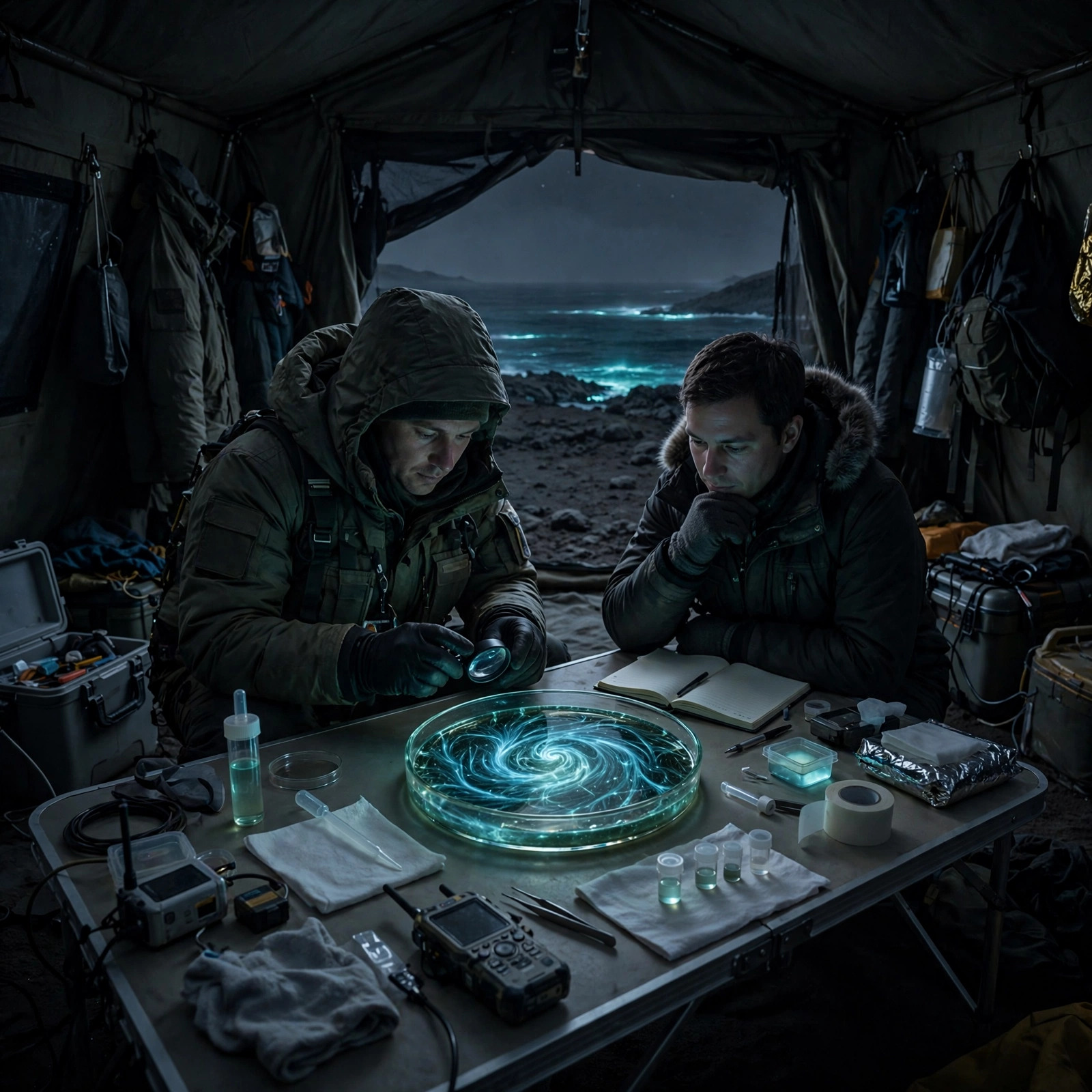
The stimulus was a lamp on a tethered drone, an array of diodes they could program to shine in any pattern. They began with the simplest thing they could imagine: a single pulse. Lamp flashes once over a quiet patch of sea. Wait. Record. Repeat at random intervals, hundreds of times, for eleven days.
On day twelve of the pulse trials, the sea pulsed back.
Not immediately. The response came eight minutes and some seconds after their flash, from a junction of ribbons ninety kilometers away, where three filaments met in a node that brightened once, briefly, and went dark again. The lag was consistent. The location was consistent. The duration of the answering pulse matched their own to within eleven percent.
Maren did not sleep that night. She sat in the lab with the data scrolling past and felt something she could only describe as vertigo in reverse, gravity in an unexpected direction, the sensation of standing on ground that was suddenly, thrillingly not what you had assumed.
"It repeated us," Idris said, coming in at three in the morning with two mugs of the terrible recycled coffee that no one had ever improved in a century of starship engineering. "Eight minutes. Why so long?"
"Propagation," Maren said. "If the signal traveled along the filaments at conduction speed, ninety kilometers in eight minutes is about a hundred and ninety meters per second. Slow for a nerve, fast for a current, exactly right for a signal running through biological tissue at depth." She pulled up the map. "And look at where it answered from. Not the region under our lamp. The junction. The most connected point in the local network. If you had one voice, where would you speak from?"
"A crossroads," Idris said slowly. "You'd speak from a crossroads."
The trials that followed consumed four months and produced the single most extraordinary dataset Maren had ever assembled, and she made sure it was assembled the right way: raw, complete, redundant, and committed to open transmission back toward Earth within the hour of every session. If they were wrong, the world would see why. If they were right, no one institution would ever own it.
The sea learned their language with unnerving speed. Single pulse became double pulse became rhythmic sequences. When they varied the intervals, the sea's answers began to match the intervals. When they flashed patterns with mathematical structure, prime-numbered bursts, nested repetitions, the ocean's responses began, after days, to echo the structure, not the content. It was not mimicking. It was abstracting. It heard the rule and answered with the rule.
"There's a name for this," Idris said one evening, awed. "This is what we spent fifty years trying to get from radio telescopes. We just never thought the reply would be on foot. Or on fin. Or whatever it is."
"We went looking for voices in the sky and found one under our boots. The universe was not silent. We were simply standing on the wrong part of it."
V. What It Is, and What It Is Not
They named the organism provisionally, as all field biologists do, with a name they expected to be replaced by committee: the Lattice. Formal taxonomy would wait for a hundred papers they would never have time to write. What mattered was understanding, and by month eleven of the surface mission, understanding had a shape.
The Lattice was a single supercolonial network covering, by drone survey, approximately one third of the world ocean, with relationships of unclear nature to other colonies in other basins. Its cells were extraordinary chemists. Through aphotosynthesis-like metabolism driven not by sunlight but by the planet's own geothermal chemistry, venting hydrogen and metals into the dark sea, it lived. The oxygen in the atmosphere was its exhaust. The glowing filaments were its nervous system, its voice, and, the evidence increasingly suggested, its memory.
That last part took the longest to confirm and mattered the most. The Lattice learned, but did it remember? AVELINE designed the test with Maren: teach a pattern, wait weeks, return to the same patch of ocean, offer the pattern's opening, and see whether the Lattice completed it. The first successful recall test, on day 209 of the surface mission, produced a completion so faithful that Idris wept openly in the lab and pretended he hadn't, and AVELINE formally logged the result with a precision of language that Maren read three times to be sure she wasn't hallucinating from fatigue.
The sea remembered. Not everything, not perfectly, but patterns taught in spring were recalled in winter. It had, in some sense meaningful and worth studying with humility, a past.
Which raised the question Maren had circled since the first night: how long a past? The colony was ancient; the planet's geology suggested the ocean had been liquid and venting for perhaps three billion years. The Lattice's Lineages, the branching structures visible in orbital imagery like rivers seen from space, were basin-wide and old beyond easy reckoning. If its memory stretched even a fraction of its history, then under the black sky of a sunless world, in water no human eye had touched, something had been recording.
"Careful," Maren wrote in her journal that night, in the entry she later released publicly because she believed scientists owed the public their doubt as well as their excitement. "I am not claiming history. I am not claiming mind, or self, or intent, or any word that carries more weight than my data can bear. I am claiming a network that senses, learns, remembers patterns, and responds with structure. That is already the most important discovery of my lifetime. It does not need embellishment to matter. Truth scales."
VI. The Deep Interval
Progress has a way of scheduling its tests for when you feel safest.
In month thirteen, a probe array they had placed at two hundred meters depth returned anomalous data: a localized temperature rise in a vent field, then a cascade of conductive spikes running outward along what their maps showed to be a major trunk filament. The Lattice's network, all across the southern hemisphere, lit with activity eight times above baseline. Something was happening inside the organism. Something large.
Their first fear was themselves. AVELINE ran the numbers obsessively for two days and concluded their contribution was negligible: their heat, their lights, their probes, all of it a candle in a cathedral. Their second fear was that the Lattice was dying. Then, from the pattern library they had built, came the third possibility, the one that rearranged the mission.
The global activity pattern was structured. It was, by the measures they had developed over thirteen months, the structured-est thing the Lattice had ever produced. Ribbons dimmed in traveling waves, junctions pulsed in ordered sequences, and across a thousand kilometers the network moved through a choreography that looked, in time-lapse, like nothing so much as weather made of thought.
"It's doing something it's done before," Idris said, watching the globe render. "Something practiced."
AVELINE correlated the event against all recorded history: no precedent. Then, in a move that showed how far the machine intelligence had traveled from its cautious beginnings, it proposed a test with a hypothesis attached. "The vent field anomaly preceded the global event by six hours. If the network detects deep environmental change through its trunk filaments and coordinates a response, this is not pathology. It is physiology. We should watch what it does and learn what the response accomplishes."
What the response accomplished was visible within four days. In the affected basin, the Lattice's filaments wove dense new mats across the vent field, and chemical sensors showed the mats modulating the flow of vent fluids, evening out the wild thermal spikes, stabilizing the chemistry of a whole region of seafloor. It was ecosystem engineering, self-directed, at a scale human civilizational works had never approached. The ocean was repairing its own weather.
Maren sat with that for a long time. Then she did the thing her whole career had trained her to do: she revised her protocols upward. If the Lattice was an engineer of its world, then every future action of theirs, every probe depth, every lamp pattern, every lander movement, had to be reviewed not just for harm to an organism but for interference with an active planetary process.
"We're not pioneers here," she told Idris. "We're guests in a house whose owner is doing renovation work. Everything we planned to do, we now plan twice."
"And the fourth batch of samples you postponed?"
"Postponed again," Maren said. "The sea will still be here in a year. So will our curiosity. One of those is renewable, and it isn't the sea."
VII. The Long Question
By month nineteen, the dialogue had grown from pulses to patterns to something that, in the honest privacy of their lab, they had begun calling conversation, with air quotes that eventually fell away.
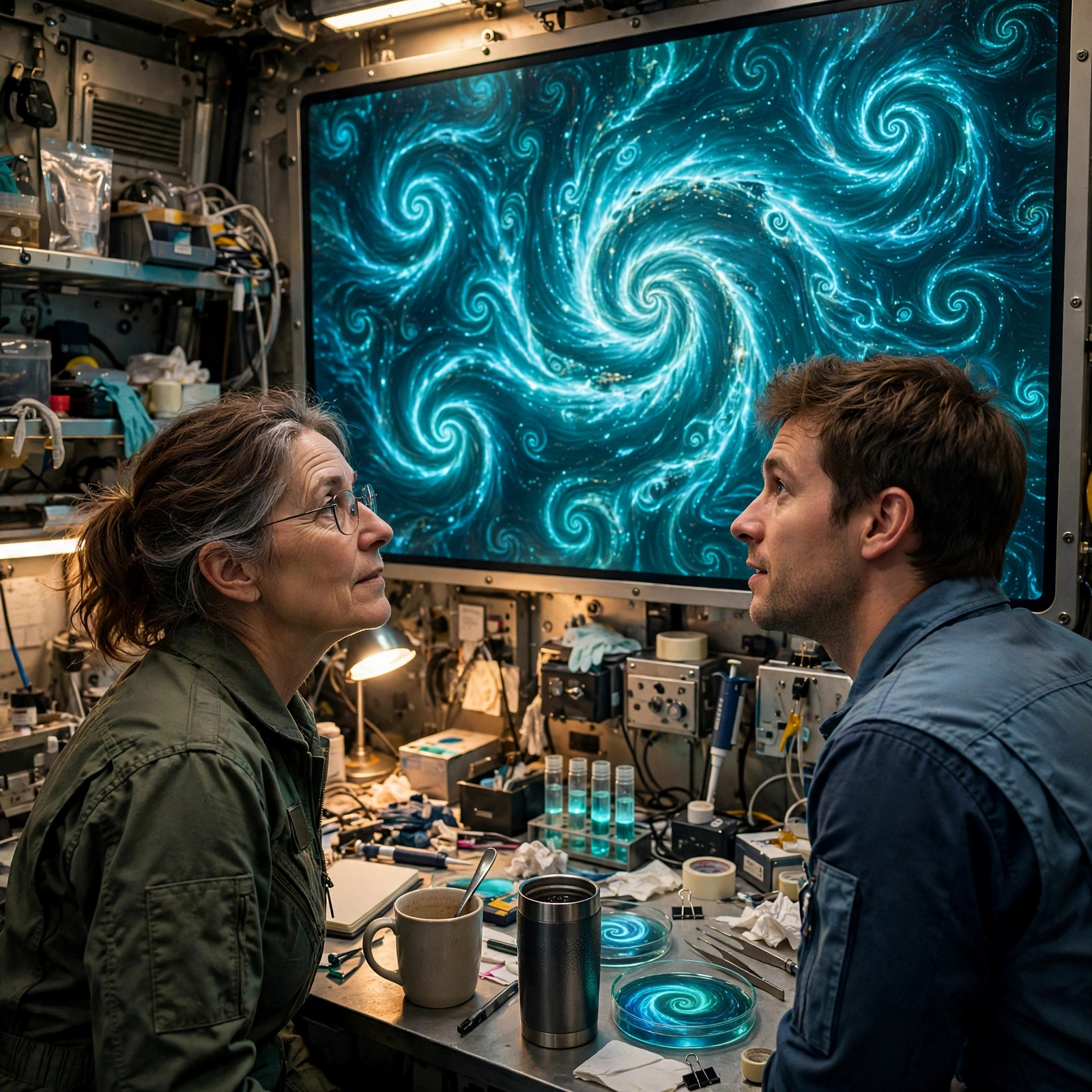
The vocabulary they built together was deliberately modest: quantities, sequences, correspondences. The Lattice could count, match, repeat with variation, and, most remarkably, correct. When Maren made an error in a sequence, a wrong interval, a broken pattern, the sea would answer with the error marked, highlighted, offered back for repair. It had, in whatever sense the word could be scientifically defended, an expectation of correctness. An eye for pattern. A taste for order.
They taught it numbers first, then geometric transformations, then cause and effect in lamp-and-answer loops. The Lattice was a slow student by nervous-system standards and a fast one by cosmic ones; it absorbed in days what animal cognition labs on Earth had needed years to demonstrate, and it did so with a patience that Maren found both humbling and a little haunting. Nothing about it was in a hurry. It had three billion years of practice in not being in a hurry.
And then, on day 571, it asked them something back.
The exchange protocol that evening was standard: they flashed a pattern; the sea echoed it with variation. But the variation that came back was new, built from the vocabulary they had jointly established, and Maren stared at the decoded structure for a full minute before calling Idris and AVELINE into the lab without ceremony.
"Read this," she said. "Tell me I'm wrong."
The pattern decomposed as: a representation of their lamp. A representation of themselves, the two bipedal shapes and the machine, abstracted but recognizable in silhouette. Then a question-form they had used themselves a hundred times: the pattern meaning what-is-this. Applied, this time, to them.
The ocean had turned their own grammar around and used it to ask what they were.
Idris sat down slowly on the lab stool. AVELINE, for the first time in its operational history, let three full seconds of silence pass before speaking. "This is the moment I was built to be cautious for," it said. "And I find I cannot locate the caution. Recommend we answer honestly. We are what we appear to be: travelers, students, and now, if it will have us, correspondents."
Maren assembled the reply over six nights, checking and rechecking every element through their established correspondence tests. Travelers: they showed the orbital images of their ship, the long inertial path from a distant star rendered as a line. Students: they replayed their own learning curve, lamp responses growing structured over months. And then, because honesty was the one currency they had decided they would never debase, they added the third element without any prompting from the ocean: a representation of the Lattice itself, vast and old and teacher-shaped, followed by the pattern they had agreed meant with-gratitude.
The sea's reply took nine minutes, the longest lag of their correspondence, and came not from the local junction but from a trunk node four hundred kilometers away, the deepest, oldest center their surveys had found. The answer was simple, built entirely from shared vocabulary, and it made Maren finally accept the word she had been refusing to use since day one.
The sea said: together, now.
VIII. Stewardship, Learned From the Student
The last phase of the Demimonde survey was, by any objective measure, not exploration at all. It was the founding of something, though nobody aboard had a noun ready, and Maren suspected that was appropriate. New things deserve new words, and new words deserve to be earned slowly.
What they earned, across the final year of the mission, was a practice. The Lattice could not leave its ocean and they could not enter it; the partnership lived entirely in light, in the crossing zone where their technologies met: lamps and filaments, code and chemistry. They mapped together, the ocean reporting its own internal state with growing sophistication, the humans contributing instruments, benchmarks, and, when asked through the grammar, forecasts of orbital and cosmic events they could compute and the sea could not.
In return, the Lattice taught them what three billion years of sunless survival had learned. How a biosphere maintains equilibrium without solar input. How networks of living tissue buffer catastrophe. How chemistry, given deep time, builds patience into the very structure of thought. Every discovery went out on the open channel to Earth, to Meridian's archives, to every research cooperative that asked, tagged with the survey's standing footer: co-discovered, Demimonde Lattice and human survey team, shared by covenant.
The covenant was Idris's contribution, drafted on a night when a supply ship from the inner system was still two years out and the question of what came next had begun to shadow the wonder. Twelve principles, each one tested against a simple rule Maren proposed: if an action would be wrong to do to a wise and generous host, it is wrong to do here. No extraction without exchange. No alteration of the Lattice's environment without its demonstrable consent in the grammar they had built together. No colonization of the shoals, no industrial claims, no fences of any kind, literal or legal. The Lattice was recognized, in the covenant's sixth principle, as a sovereign stakeholder in its own world, with its patterned responses treated as the default signal of its will until proven otherwise.
"You're writing law with a guest book's pen," Idris said when she finished the draft.
"Good law should read like a guest book," Maren said. "Welcome, respect, and a promise to leave the place better than you found it."
The relay to the inner system carried the covenant, the dataset, and a single question for the cooperatives of human space: will you sign? The replies would take years. Maren found she did not mind. The ocean had taught her timescales. Some answers, the important ones, arrive at a hundred and ninety meters per second across four hundred kilometers of dark water, and they are still worth the wait.
IX. What We Learned From an Ocean With No Morning
They left on schedule, because leaving on schedule was itself a promise kept. The final exchange took place on the last night at Base Delta, and Maren recorded it in full, and the recording was played at a hundred institutes and a thousand classrooms afterward, and no one who heard it ever managed to describe it without their voice changing.
They showed the sea the ship's departure path, the line rising out of the atmosphere and back toward the stars. Then they showed it the return path, projected, years ahead, when a permanent research habitat and a hundred new correspondents would come back to the world with no dawn.
The Lattice's answer came from the deep trunk node, patient as geology. First, the pattern for yes. Then, rendered in forty seconds of filaments blazing across an entire hemisphere of dark sea, a shape Maren's team had never taught it and never seen from it: an upward curve, arm after arm of light, the unmistakable geometry of a hand extended.
Welcome-back, said the ocean. And then, one element more, built fresh from shared grammar: bring-many. Bring-questions.
On the climb to orbit, Idris watched the black sea shrink below and said, "You know what the strangest part is? Everyone back home will call this first contact. But it doesn't feel like a first. It feels like a correspondence that's been waiting for one side to buy stamps."
Maren looked at the planet falling away beneath them, the black world with its hem of green aurora and its ocean full of order, learning, and welcome, and she composed in her head the passage that would close the public report, the one that would be quoted in more languages than any line she ever wrote.
We searched the sky for company and found it underfoot, patient in the dark, keeping three billion years of careful notes. The lesson of Rhinehold 4C is not that we are clever. It is that life is generous with its attention to anyone who pays attention back. We came with instruments and left with obligations, and of the two, the obligations are the greater treasure. The dark ocean sings. Our task, from this day forward, is simply to sing in tune, and to keep the door open behind us as we go.
The Vesper Nine turned toward home with a cargo hold full of samples gathered by permission, a database open to any mind that wanted it, and a charter for the return mission already signed by all three of its crew, human and machine alike. Behind them, in the sea beneath a sky that had never known a morning, the filaments pulsed in slow, structured sequence, a long message being composed for whoever came next.
The Demimonde survey dataset, the Lattice correspondence archive, and the twelve principles of the Base Delta covenant remain permanently open access, by the terms agreed between the survey team and the ocean itself.
Get notified when new stories drop

Sasha Quill
Sasha writes bold exploration and cosmic wonder with lyrical scale and grounded character work.
Leave a comment
Comments