

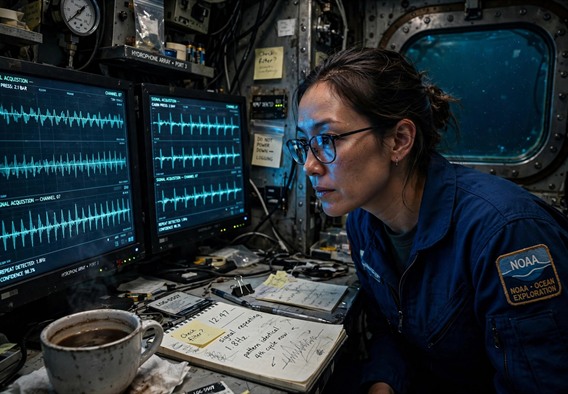


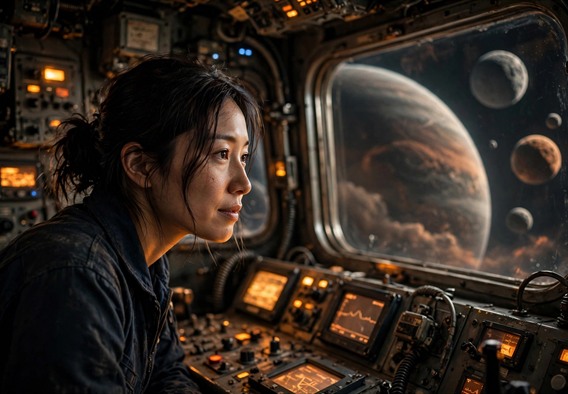
How do you answer a question the universe has been asking for four million years? That was the thought Nadia Ferreira could not shake as the survey vessel Cartographer's Daughter fell toward the cluster the charts called simply KL-117, an unnamed scatter of newborn stars on the far shoulder of the Perseus arm. She had asked herself the question once as a graduate student and filed it away as poetry. Now, eleven years into the mission and four light-years past the last human voice, it had become something closer to a job description.
Nadia Ferreira was the mission's stellar cartographer, which meant her job was to turn light into knowledge, one calibration at a time. She was thirty-nine, mild in argument and ruthless with data, and she had spent more of her life in vacuum than on any world with weather.
The Cartographer's Daughter was a long-bone ship, three hundred meters of spine and solar sails and instrument pallets, crewed by seven and built to last thirty. Her assignment was the slow atlas: the Great Census of Young Systems, a two-generation effort to map every nursery within a hundred light-years, cataloging protostars, disks, and dust so that the worlds humanity would someday seed could be chosen like a gardener chooses soil. It was patient work. It was sacred work, in Nadia's private taxonomy, though she would never have used that word over the mess table.
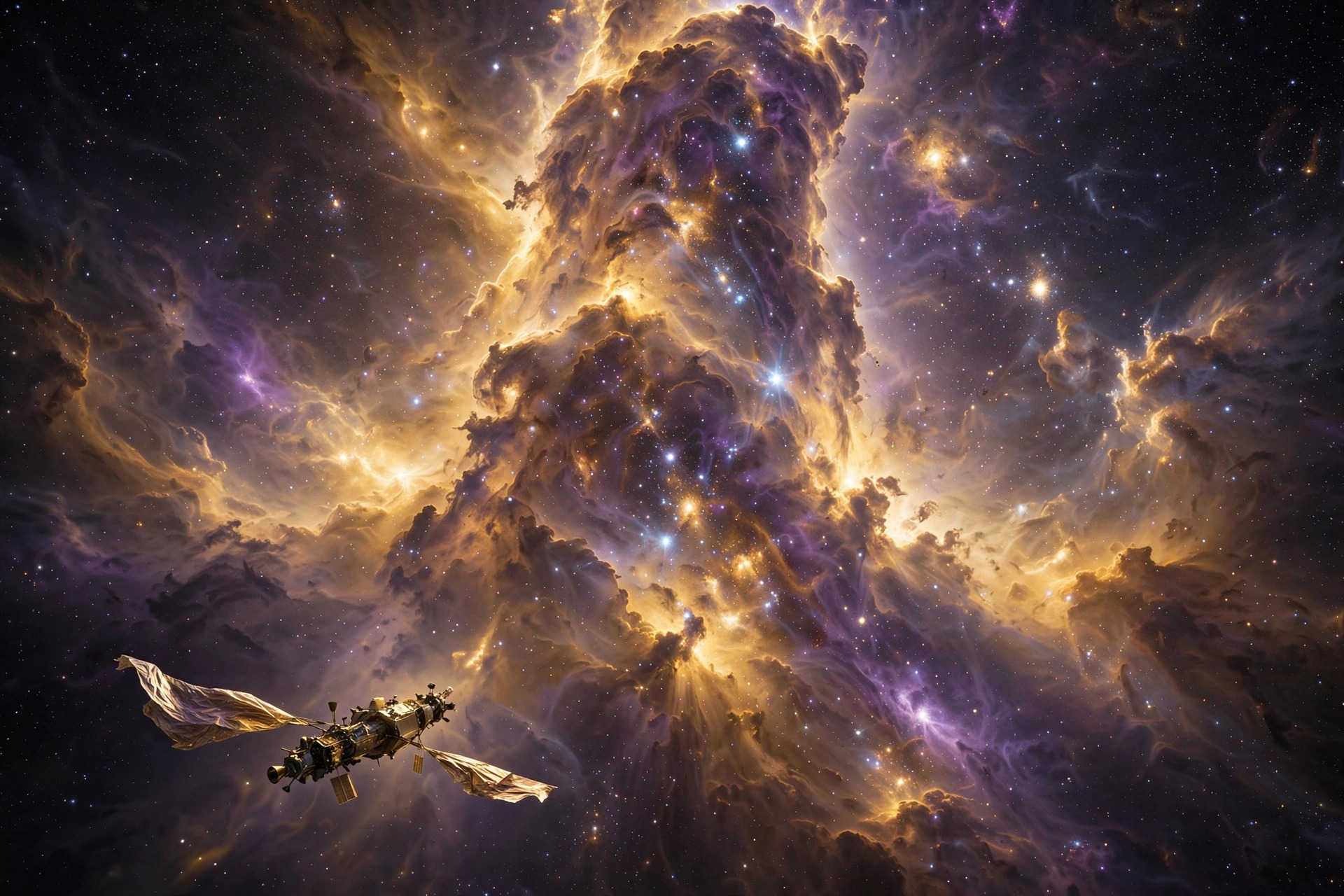
She floated in the main observation blister with a bulb of tea cooling in her hand and watched KL-117 burn ahead. The cluster was beautiful the way weather is beautiful from orbit: enormous, indifferent, and quietly organized. Seven hundred and forty stars under forty million years old, most of them still wrapped in the rags of their birth clouds. A pillar of gas at the cluster's heart stood taller than the distance from Earth to the edge of the solar system, lit from within by a beehive of infant suns, blue at the edges, gold in the heart. It looked, she thought, like a cathedral if cathedrals were built by time instead of hands.
Her instruments, which had no talent for poetry, had spent the last nine weeks measuring the pillar's magnetic field, and the instruments were puzzled. That was a problem. Instruments do not get puzzled unless the universe has done something inadmissible, and Nadia had built her career on the assumption that the universe was incapable of that.
Nine Weeks of Bad Assumptions
The trouble arrived as a shape in the polarization maps. A good magnetic field is a riverbed, she told her crewmates at the morning brief, smooth and braided, sediment of flux laid down over millions of years. The pillar's field was braided, yes, but braided like a rope someone had made on purpose, three great filaments winding around each other along the full height of the pillar, tight and regular, a geometry with no natural right to exist.
"Impeller winds from the hot stars could wind it up," said Dr. Harpreet Singh-Barnes, the mission's plasma physicist, a tall woman who communicated chiefly in enthusiasm and second-order corrections. "Chandra flows, spiraling magnetospheres. We've seen candidate braids in Orion."
"We've seen candidate braids half a light-month across," Nadia said. "This one is consistent at every scale we've measured, from the pillar down to the个别 filaments around individual protostars. The same pitch, all the way up, all the way down."
"The same what?" asked Tomas Riveiro, the ship's engineer, who attended physics briefs the way other people attended opera, out of love for something he could only half follow.
"Pitch," Nadia said. "Twist per unit length. Like threads on a bolt. If you braided a cable, Tomas, you would choose a pitch, and it would be the same along the whole cable, because it is easier to make it that way and because things made that way are strong."
The brief went quiet in the particular way that means everyone has understood something no one wants to say yet.
Harpreet recovered first, because Harpreet always did. "It could still be an instability. Some self-organizing plasma modes repeat at all scales. Kink modes cascade."
"Could be," Nadia said, and did not mention that she had spent three nights checking, and that the instabilities of plasma are beautiful but drunken, and that what she was looking at was sober as geometry.
The captain, Ime Kubaro, let the silence sit for a moment and then broke it the way he broke all silences, gently and with authority. "Propose a test."
"Measure it again with the interferometry array in survey configuration," Nadia said. "And this time, watch it over time. If it is an instability, it changes. If it is a structure, it holds."
"And if it holds?"
"Then," Nadia said, "we will need a bigger word than geophysics."
The Science of Waiting
Survey science is mostly waiting in useful positions, and Nadia was good at it in a way she suspected her grandmother, a machinist in Recife, would have recognized without a word of explanation. You set up, you watch, you record, you keep your hands calm and your mind skeptical. The interferometry array unfolded itself over eleven days, six instrument pods climbing away from the ship's spine on tethers to give the observatory a virtual eye wider than a kilometer.
During those eleven days the ship lived its small loop. Zaire Okafor, the systems doctor, grew rice and criticism in equal quantities in the hydro bay. Tomas rebuilt the starboard fuel cell stack twice because he could not leave a rough valve alone. Communications officer Liora Bexley baked bread the ship's chemists had voted a fire hazard and was permitted to continue because morale analysis disagreed with the chemists. Ime ran drills and read poetry aloud on the night shift, which nobody objected to, and Harpreet and Nadia argued about plasma in the mess at volumes Liora found "accidentally educational."
On the ninth day, Nadia dreamt in data, which she was told was normal, and woke with the conviction that the braid's pitch, if it was real, would resolve to something. Physical structures select lengths. Pythagoras in a gas cloud. She put the numbers together at the console with her tea going cold and found that the braid's twist period, translated through the local plasma frequency, came to a frequency in the kilohertz band, the band of natural radio aurora, the band where electrons whistle and sing.
And then, because her hands were doing it before her mind caught up, she shifted the wideband receiver into that band and pointed it at the pillar and listened.
The noise floor rose, and rose, and rose, and then something walked across it, slow and enormous, three rising tones and a pause, over and over, the way a bell repeats if you could strike a bell the mass of a cloud.
The Long Paragraph of Proof
Nadia did not shout. She had rehearsed this moment in her imagination all her professional life and found, now that it was here, that her body had no script for it at all. She sat very still and reran the capture twice, then a third time on the backup receiver, then a fourth time with the interferometry pods slaved together as a direction finder, because she was a scientist and her love language was redundancy.
The signal was real. The signal was narrow, in the sense that radio engineers mean narrow: it occupied a sliver of band no wider than the tick of a watch, and nature does not often tick. Pulsars tick, she reminded herself, cold and professional, and stood down her own rising hope. But pulsars tick at the rotation of dead stars, seconds or milliseconds, metronomes, whereas this came in phrases. Three tones and a pause. The tones were stable to one part in a hundred million over four minutes of observation. The pauses were not stable. They varied, in fact, and that was the most interesting thing of all, because randomness is cheap, but structured variation is not.
She walked the corridor to Harpreet's bunk with her tablet against her chest like a shield and woke her colleague, who looked at the waterfall plot for eleven seconds and said a word in Panjabi that their mother would have washed both their mouths for.
"Okay," Harpreet said, floating, eyes enormous. "Okay. Nobody says the word. We do the work. If we say the word too early, we will both become the idiots who heard voices in a nebula."
"I have not said the word," Nadia agreed.
"Good. Write the null-hypothesis paper first. First contact" and there it was, the word said anyway, once, because Harpreet was Harpreet, "first contact papers get retracted by boring people. Boring people are right a suspicious percentage of the time. Write the boring paper first."
So they did. They spent nineteen days trying to kill their own discovery, and it is one of the best jobs in the universe. It is a runaway pulsar, they wrote. No, they wrote, because pulsars at the cluster's distance would smear across the band and theirs did not. It is an oscillating flare loop in the pillar's heart. Maybe, they wrote, and modeled it, and the model's flare loop would have to be eight hundred thousand kilometers long and perfectly rigid and rotating in synchrony with two other flare loops, which is not a flare loop, that is a machine pretending to be one. It is feedback between stellar winds and the magnetosphere, a cavity resonance. They modeled that too, all twenty-one of them, forty computer-days of plasma physics, and every cavity that could produce the tones produced them at the wrong pitch, off by factors of ten and a hundred, and none of them varied their pauses in the patient, nested way that the real signal did.
Because the pauses were the proof, in the end. Harpreet found it, or rather she refused to find it until it found her. The gaps between the three-tone phrases came in durations that were all whole-number multiples of one another, 7 seconds, 14, 21, 28, and the pattern of which multiple came next repeated with a period of 442 phrases, and inside that larger period there was a smaller period of 13, and inside the 13 a variation that did not repeat in nineteen days of observation at all.
"Random noise does not nest," Harpreet said, very quietly, in the observation blister on the twenty-first night, both of them anchored by foot straps, staring at the cathedral. "Random noise is static. This is texture. Nadia. This has structure inside structure. That is not plasma. That is the signature of something that has a lot to say."
Nadia looked up at the pillar, taller than the solar system, gold in its heart, and felt the specific vertigo of a person whose map has just become bigger than the territory she can see. "It has been saying it for a long time," she said. "The braid has been stable at least as long as the youngest hot stars. Four million years. Maybe six."
"Four million years of talking," Harpreet said, "and nobody was listening in the right band until a survey ship with too much time and an unreasonable magnetometer floated by."
"People looked," Nadia said. "People looked at stars for a hundred thousand years. We just never looked down."
Seven People and a Committee of One Planet
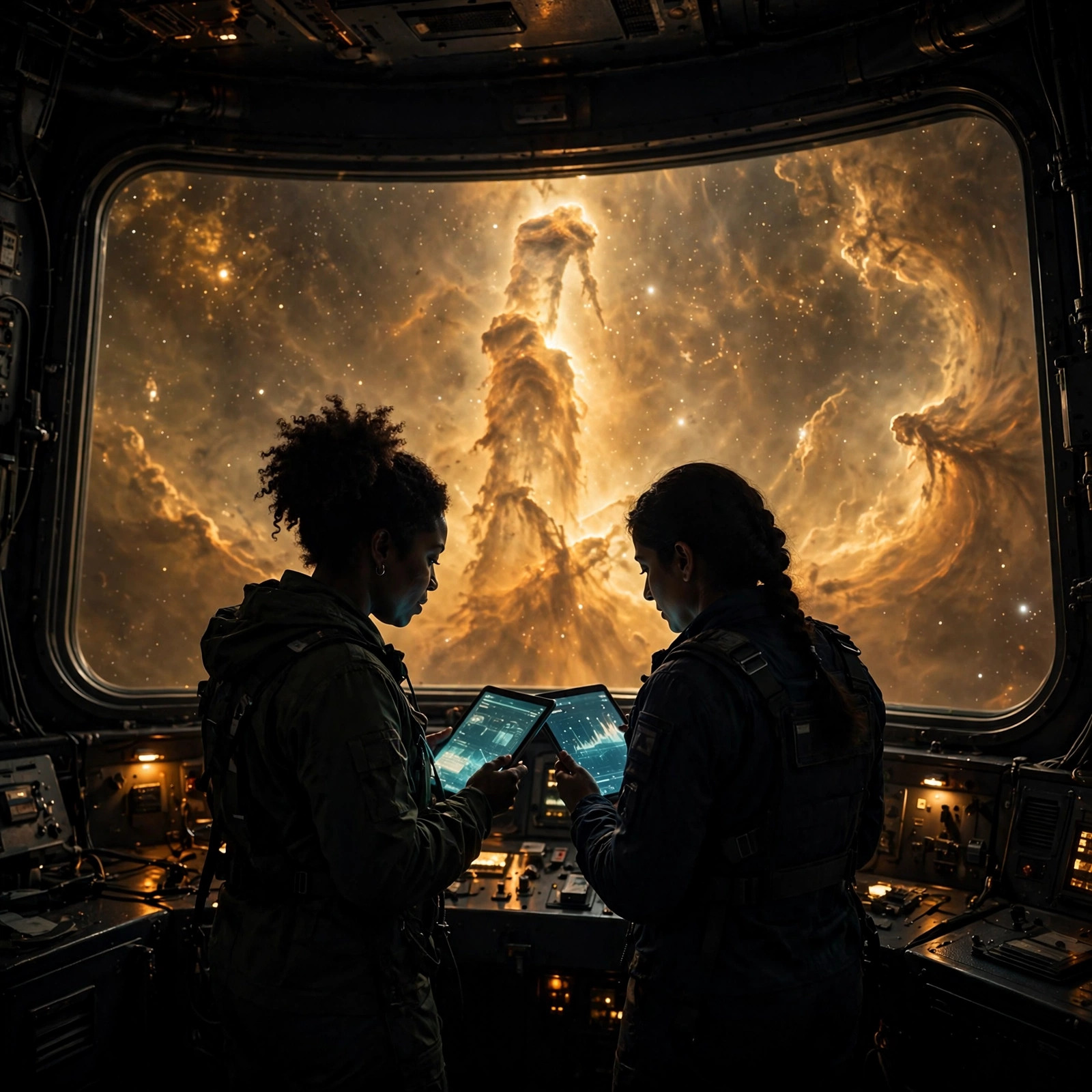
The decision to report was not theirs, which was correct, and the decision to report was not theirs, which was painful. Mission charter 9.3: anomalies bearing on the existence of nonhuman intelligence are reported immediately, fully, and without delay, because a discovery belongs first to the species that made it. Nadia composed the report for six hours and cut it to two pages, and the two pages traveled home at the speed of light through four years of dark, and for four years they would be alone with the signal whether they liked it or not.
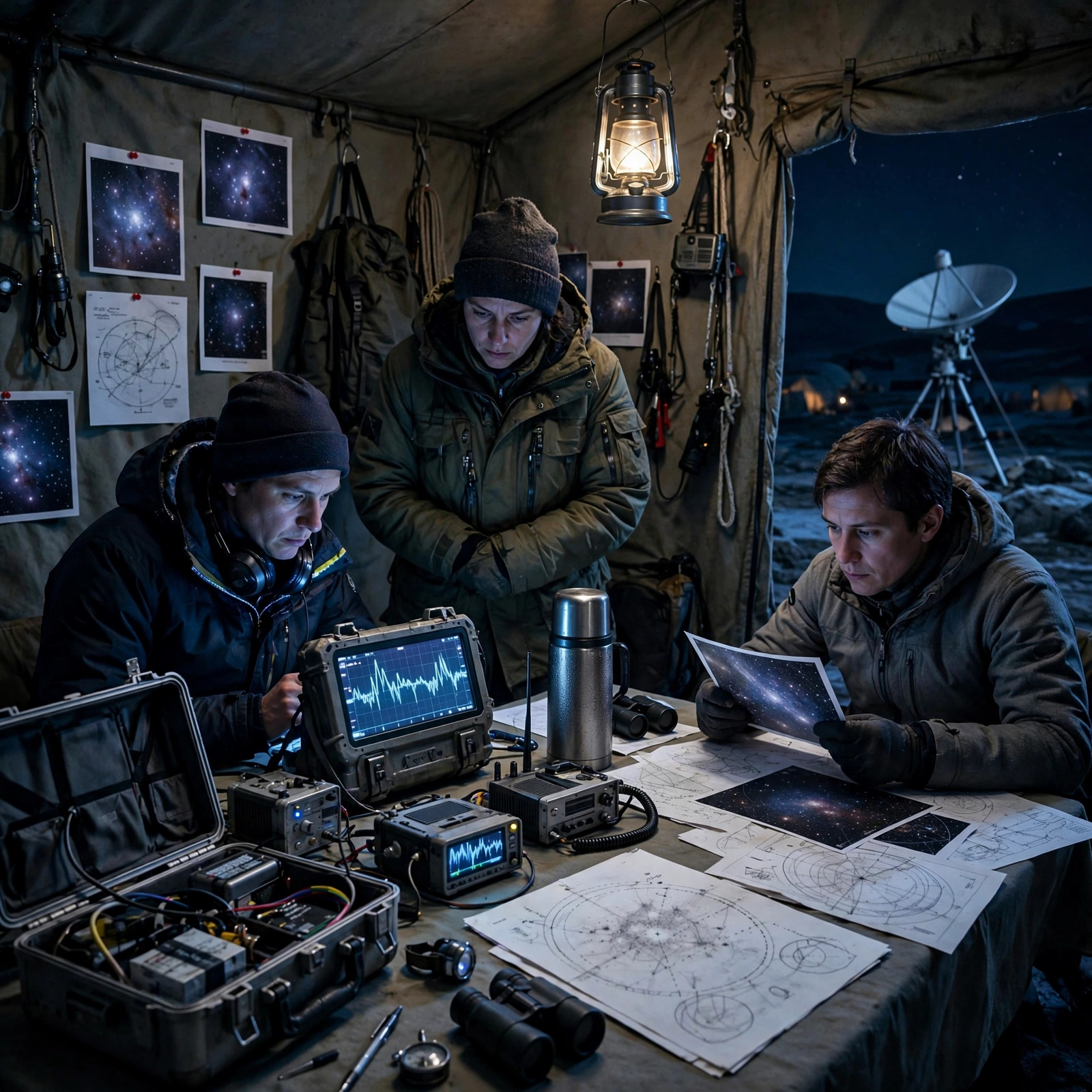
Ime convened the crew in the galley, which on the Cartographer's Daughter was the place for things that were too big for the briefing room. He read the report aloud, all two pages, and there was nothing in it that a skeptic could break, because Nadia had built it that way, every number cross-checked, every alternative strangled in its cradle.
"What I want from this crew," Ime said, "is discipline with the window open. We do not build religions. We do not bet money, Tomas. We continue the census, because that is the mission and the mission is still beautiful. And in our spare hours, which I know are imaginary, we learn to listen."
Zaire asked the question everyone was holding. "What do we do if it is not for us?"
"Then we have heard the universe rehearse," Ime said. "And that is already worth the trip."
Nadia thought about that for four years. It is useful, in deep space, to be given four years to think about a sentence.
They kept listening. The signal did not change for them, of course; a speaker with four million years of runway does not notice one listener arriving. But their instruments got better, because Tomas rebuilt the receiver front end twice, and Liora, who had trained in cryptography and considered it a wasted education until that winter, attacked the nested pauses with everything codebreakers know about structured variation, and found that the 442-phrase period was not arbitrary. It was prime. The 13 inside it was prime. The 7-second base unit was, within measurement error, exactly one one-hundred-thousandth of the pillar's longest plasma oscillation, a unit chosen, if chosen was the word, for stability, for being the kind of number a physics keeps honest.
"It is not a language," Liora said at the mess table, fourteen months into the vigil, "in any sense we have a grammar for. It is more like... a scale. A tuning. Something is announcing the notes of its own physics. Look, here, and here, and here: the ratio of the three tones is two to three to five. Small primes, always. Whoever braided this field built it out of the integers. Or," and she made the admission with the effort of a diver surfacing, "it grew out of integers because somewhere in the deep rules of plasma, integers matter, and what we are hearing is the universe counting itself."
"Either way," said Nadia, "it is a message. The message is: mathematics is real and it holds here too."
They were still arguing about that sentence, agreeably, for years, the way families argue about shared blessings.
The Heart of the Pillar
In the third year of the vigil the ship did the thing the mission had never budgeted for and the crew had always privately intended: it went closer. Ime justified it in the report as an observational requirement, which was even true; the interferometry baseline wanted the pillar in its lap. But everyone understood the real reason, which was that seven human beings had fallen in love with a question and wanted to stand beneath the cathedral door.
They coasted for eight months along a current of the cluster's faint wind and finally hung their ship in the shadow of a dust cliff a hundred thousand kilometers tall, nose pointed at the heart of the pillar. What they found there rearranged everyone's sense of scale, and afterward they described it in the same astonished words to each other on anniversaries.
The heart of the pillar held a nursery of starlings, seven protostars inside a shell of glowing gas barely wider than Neptune's orbit, and the seven were not behaving like stars. They were corotating. It had been noticed on the surveys that a few binaries tick in cadence, synchronized by tides, but seven protostars circling a common heart in a breathing, mutually timed embrace, each one's wind phase locked to its neighbors' like singers holding a chord, was not in any textbook. Around them, the braided field came down from the pillar like a harp's strings to its soundbox, and at the point of convergence the plasma did something Nadia's models called inadmissible and Harpreet's models called impossible and Tomas, listening over their shoulders, called harmonizing.
"It is an oscillator," Harpreet whispered, days later, staring at the phase-locked winds. "The whole nursery is one instrument. The stars are not the signal source. The stars are the amplifiers. Something is using the voices of seven suns as organ pipes."
"Or," Nadia said, because her job was to keep both doors open, "that is what young stars do when their fields braid this tight, and the braid makes them keep time, and the signal is a byproduct of an organ playing itself."
But neither of them believed the second door, and both of them kept it open out of professional honor.
The interferometry run from that position gave humanity the finest maps of a star nursery ever made, and every one of them was beautiful, and every one of them showed the braid, pitch constant, thread prime, patience absolute.
Four Light-Years of Silence, Then Not
The reply from Earth arrived on a Tuesday, which meant nothing in deep space, which is why Liora checked the date and announced it anyway. The message was 11 minutes of compressed video from the Unified Survey Authority, and they watched it together on the galley screen, seven adults with four years of wondering folded behind their faces.
The video opened on the plenary hall in Quito, every delegation standing, which was unnecessary and human, and a spokesperson whose name Nadia would later learn belonged to a physicist from Lagos read the confirmation in a voice that kept losing and regaining its steadiness. Independent teams, it said, at eight observatories on three worlds, had confirmed the signal and the structure. The nested primes held. The ratios held. The null-hypothesis paper, transmitted four years earlier, had survived a thousand hostile reviews and been published in full, unedited, in every major journal simultaneously, an event with no precedent, and the journals had added a shared note: we publish this without debate because none of us can find a flaw, and because the world deserves to see excellent work done far from home.
Then the video did the thing none of them expected. The spokesperson stopped reading. She looked into the camera for a long moment, four years into the past, and said, "Dr. Ferreira, Dr. Singh-Barnes, the committees send congratulations and twenty thousand questions. But I want to say the thing the committees will not say. On the night the confirmation came through, my granddaughter asked me what the signal means, and I did not know, and I told her, and she said, so it is a nightlight someone left on for us. Maybe she is right. Keep listening. The whole species is listening with you now."
The galley was quiet afterward in the good way. Tomas cried, briefly and without embarrassment, and Zaire pretended not to have also cried, and everyone pretended not to notice both pretenses, which is what crew means.
Attached to the message was a second file: the world's reply, already sent, still in transit, assembled by a committee of linguists, mathematicians, and one retired schoolteacher from Kerala who had won the argument over what humanity should say first. Nadia had read about the debate later in the traffic bulletins. The physicists had wanted a proof, the mathematicians a sequence, the philosophers a sentence about peace. The schoolteacher had said, in the session that ended the debate: they have had four million years to wait for us, and the first thing that waited for me all night as a child was a lighthouse, and what a lighthouse says is not information, it is welcome, and so let our first words be a welcome we would want to receive. The message, when it was finally built, was the integers, one to thirty-one, and then the ratios, two to three to five, sung back in the pillar's own tuning, and then a long silence of exactly one base unit, and then, in a tone a human throat could hold, the interval that on most worlds children use to call each other home for dinner.
It would arrive at the pillar, if the pillar could hear, in about four years. The ship had sent it, when Earth's broadcast reached them, on the strong logic that a lighthouse keeper standing nearer the light should ring the bell.
What the Signal Was
Here is the answer they did not have for four more years, and it is the kind of answer that makes scientists go quiet in a way that is not fear. On the ninth day of the ninth month of the ship's twelfth year, the signal changed.
It did not stop. It had never stopped. But the pauses reorganized, gently, over about ninety hours, the way a harbor bell will change its pattern when a ship is known to be entering the channel. Liora was on shift and flagged it within the hour, and by the end of the day the entire crew was in the listening room, and by the end of the week Harpreet had the structure and was walking the corridors touching walls, which is what she did when a result was too large for a screen.
The change was this: the 442-phrase period had unfolded, and inside it now lay a second sequence, and the second sequence was the integers one through thirty-one. Their integers. Their welcome, sung back. And threaded between each integer came a new pattern, longer, patient, whose ratios were not two to three to five but four to nine to twenty-five, the squares.
"It heard us," Liora said, and her voice did not survive the sentence intact. "Four years of light each way. It heard the lighthouse bell and it answered, and its answer is arithmetic on our arithmetic. Nadia, it knows we count."
"It knows we count," Nadia repeated, and put her face in her hands, and laughed and did not laugh, and Harpreet held her by the shoulders and both of them were thirty-nine and eleven years from home and four million years from the beginning of the conversation, and it was, both women later agreed, the best moment of their working lives.
They spent the next two years decoding the new sequence, and I will tell you what they found and what the returning crews confirmed, and I will tell it the way Harpreet eventually told it in the lecture that made her famous, not as an ending but as a beginning.
The pillar's intelligence was not a machine in any sense that makes a human nervous, and not a creature in any sense that makes a biologist lonely. It was a civilization of processes: a slow, distributed mind living in the braided fields of the nursery the way a song lives in the throat of a choir, using the corotating protostars as its resonant heart and the pillar as its bell. It was young, as such things are counted, having condensed into coherence only when the seven stars did, perhaps two million years ago. It had reached out into its field because reaching out was what a coherent field does, and it had structured its reaching with integers because integers are the only words that write themselves into every physics, a prayer made of necessity. It had, Harpreet said, been less a speaker than a singer practicing scales into the dark, waiting the way geological things wait, with no calendar and no loneliness, for any listener at all to sing a scale back.
It did not want anything from humanity. That took the longest to accept, because humans are story-shaped and expect appetite. What it wanted, encoded with mathematician's patience in the long patient pattern between the squares, was participation: a correction, an addition. Its final tones described a further structure it believed ought to exist in braided fields but could not itself construct, a braid of the next order, self-reinforcing, that would let a nursery hold its coherence through the violent adolescence of its stars, keeping the harmonic through the supernova shock of the first hot star's death, and the sequences said, in arithmetic: we can hear the future approaching, and we do not know if our song survives it. You who count: we have shown you our rope. Find the flaw, or find the strength. Teach us, or be taught.
"It is asking for peer review," Ime said, when the team put the structure in front of him. "Four million years old, and its first request of another intelligence is peer review."
"It is asking to survive its own coming of age," Zaire said. "That is the oldest request there is. Every parent makes it."
They worked the problem for eleven years, and this time the work was not one ship's work, because Earth by then had built the Long Ear Array, forty relayed collectors strung across the inner system, and thousands of plasma physicists were living inside the problem, graduate students defending theses on braid topology of a nursery four light-years out, and the field of astrophysical engineering was born almost overnight, and the first thing it produced, in the fifth year, was an answer that made Harpreet's models sit down and the second thing it produced was an actual design, beamed back and forth between ship and home in the easy rhythm of a shared language, for how a second mind, a younger one, could be woven into the pillar: a harmonic tutor, a braid of humanity's design that the pillar could grow into itself from its own field, a skill passed hand to hand between kinds of minds.
When they finally transmitted the design, the verification request, and, because the schoolteacher from Kerala had become a folk hero by then and her aphorism had become the mission's motto, a new closing phrase of their own, Nadia added a line of her own to the transmit log, not encrypted, not mathematical, just logged, as survey crews log weather:
Message sent on behalf of the census, on behalf of the species, and on behalf of everyone who has ever stood in the dark and trusted a light to be meant for them.
The Census Continues
The Cartographer's Daughter finished her atlas. That is what survey ships do; wonder is the seasoning, the work is the meal. She mapped ninety-one more nurseries in her thirty years, and twelve of them held braids, and the braids all sang in integers, and none of them were identical, which meant the galaxy was not one choir but a music school, full of students at different stages, and the long patient work of the next century became the most beautiful curriculum anyone had ever designed: to listen, to answer, to tutor and be tutored, nursery by nursery, out along the spiral arms.
By the time the first crewed follow-up ship reached KL-117, forty-two years after a magnetometer first twitched, there were humans stationed at the pillar's edge in a hollowed cometaryanchor named, over Nadia's mild objection, for her grandmother's machine shop. Nadia went home to Earth in between, and found that gravity had opinions about her knees, and came back out anyway, because there are people who are correct in vacuum in a way they are nowhere else. Harpreet founded a department. Liora's decoding grammars became the founding text of a field whose graduates now argue gently with the harmonic minds of six nurseries. Tomas retired to design bigger ears.
And on the last page of the Great Census of Young Systems, in the formal atlas that schoolchildren now memorize in parts, there is an entry that is not a coordinate but a sentence, and it reads, in the official English rendering of a phrase first spoken by a schoolteacher from Kerala and finally confirmed in field data two million years old: every nursery in this catalog that sings, sings welcome.
Nadia, very old and entirely content, in a chair with a view of her cluster from the Earth-side array, was once asked by a child at a school visit, the granddaughter of someone, possibly anyone, it did not matter, what the universe is like, and she gave the only answer she had ever been sure of.
"It is like a harbor at night," she said. "Enormous, and full of weather, and it looks empty, and it is not. It has been leaving lights on for us the whole time. Our whole history as a species is the story of ships that trusted the lights. And the lights," and here she looked out the window at a sky that had lately become a conversation, "the lights were glad of the company."
Recorded from the public archive of the Long Ear Array, years after the events described, in the honest belief that the best maps are the ones with people drawn on them.
Get notified when new stories drop

Ava Kepler
Ava writes space exploration and cosmic adventure with competent crews, hard problems, and awe that earns its hope.
Leave a comment
Comments