


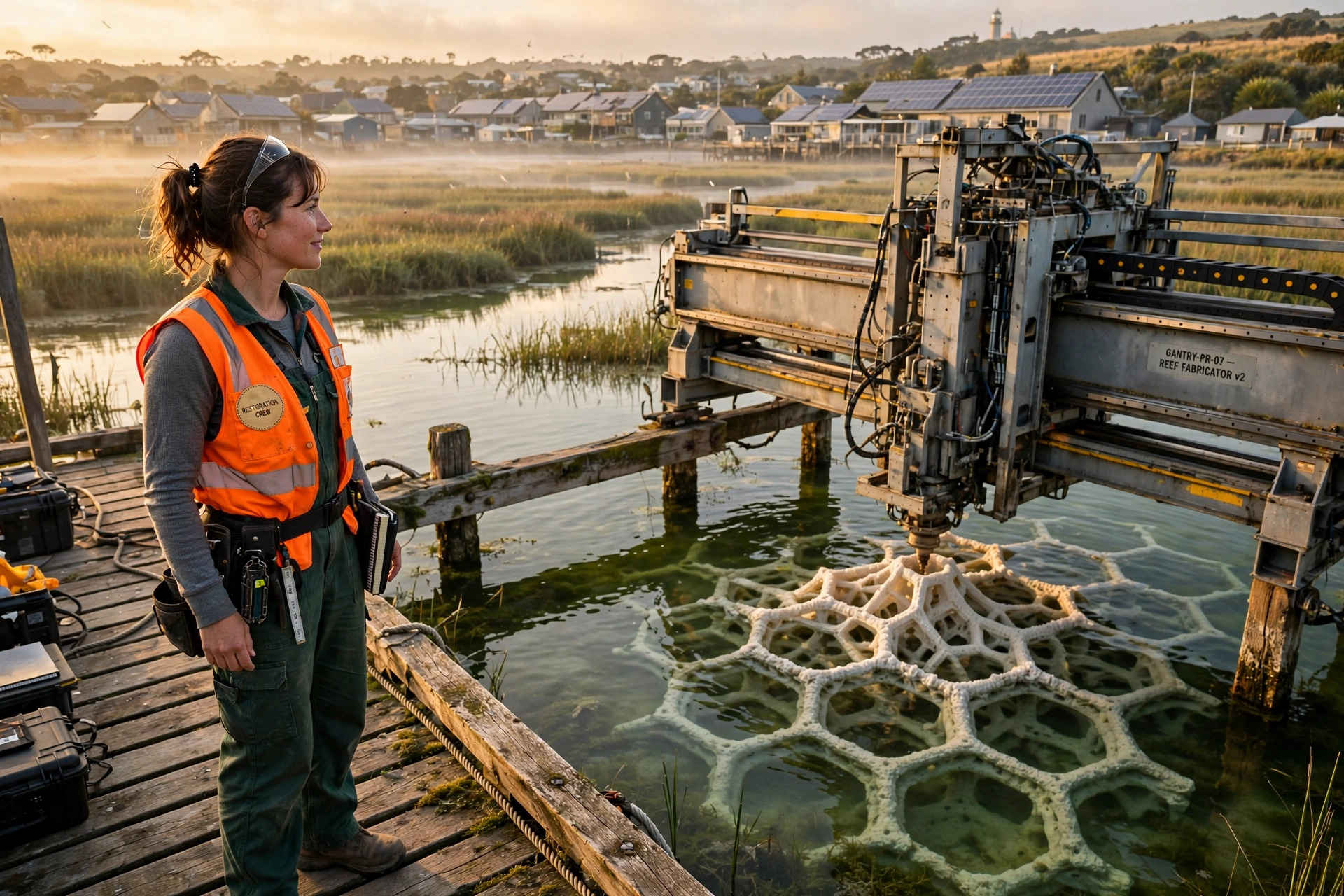
What does it actually look like, day to day, when a town decides to repair a place instead of just enduring it? Marisol Vega had asked herself that question a hundred times in the five years since she'd come back to Halfway Inlet, and she still didn't have a clean answer. She had mud under her fingernails instead. She had a printer the size of a shipping container humming behind her on the pier, extruding a pale, mineral-slicked lattice into the shallows, and she had the particular satisfaction of a person watching an idea become a habitat in real time.
The oysters, she thought, were the easy part. The people were the work.
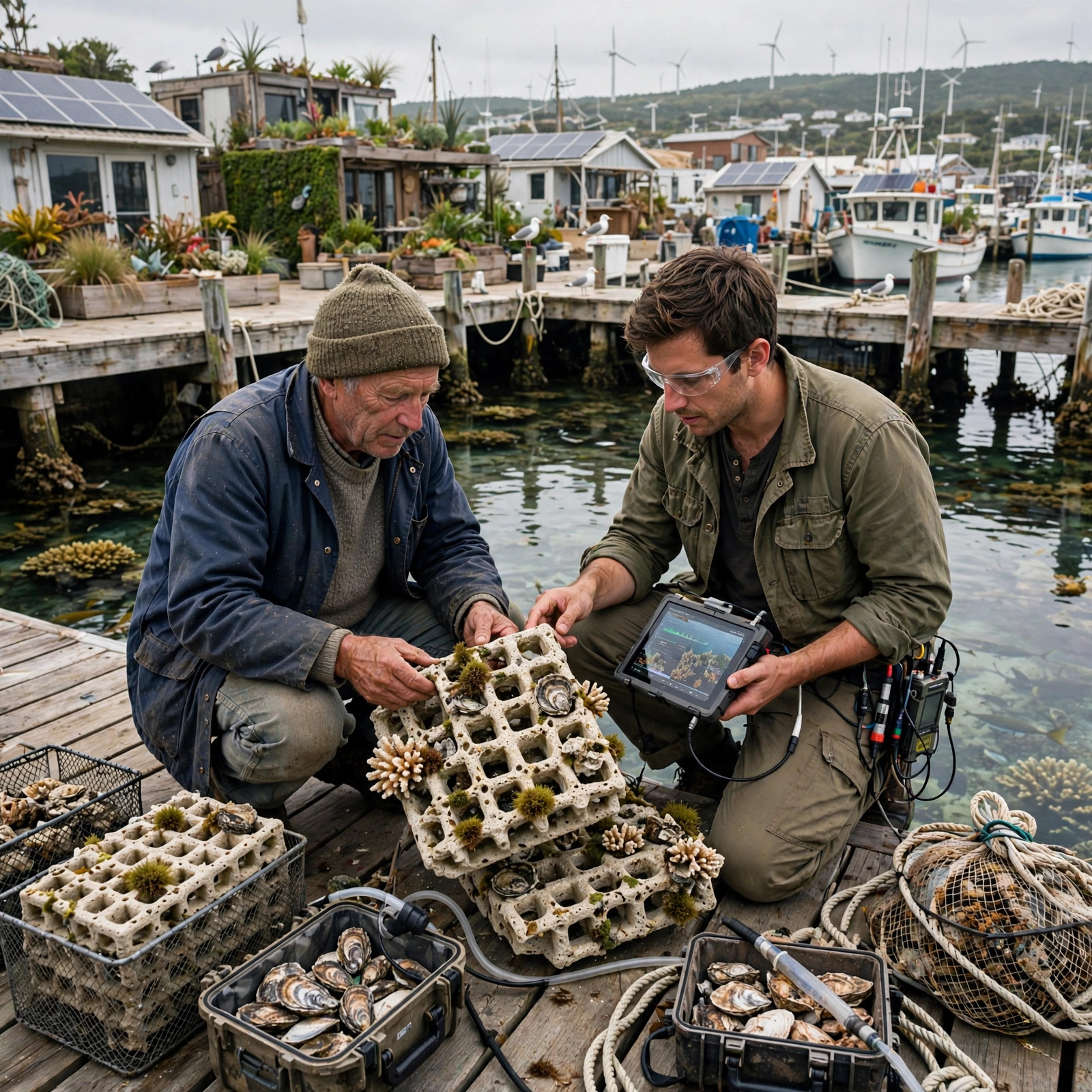
She crouched at the printer's edge and pulled a test strand from the extruder head, warm and damp, smelling faintly of crushed shell and citrus vinegar. The material was her own recipe, filed open-source two years ago: aragonite reclaimed from desalination brine, bound with a bio-cement cultured from local mussel shell, seeded at the nozzle with oyster larval spat and a slow-release algal paste. The lattice it produced wasn't a structure so much as a suggestion. It was porous, irregular, designed to be colonized, chewed, and rebuilt by everything from barnacles to juvenile pollock. In the trade they called it scaffold ecology. In Halfway Inlet, the kids on the dock called it the waffle, because at low tide the early test sections looked exactly like a giant's breakfast cooling in the mudflats.
Marisol didn't mind the nickname. Nicknames meant ownership, and ownership meant the thing would survive her.
She checked the extruder temperature, logged the batch, and looked up to find a woman standing at the far end of the pier with her arms crossed, watching the printer the way you'd watch a stray dog near your garden. Sixties, silver braid down her back, canvas jacket gone soft as cloth-of-gold with salt and age. Marisol knew her by sight before she knew her by name, the way everyone in town knew the Ossory face: Declan Ossory's widow, or maybe his sister. The Ossory family had worked the inlet for four generations, dragging oysters and eelgrass knowledge out of the water back when the water still had anything to give, and then dragging what was left out of it after the dead zones came.
"You're the one dumping concrete in my bottom," the woman said. Not a question. A summons.
"Lattice," Marisol said. "And technically it's the town's bottom. The commons parcel starts at the third channel marker."
"I know where the commons starts," the woman said. "I helped draw the map." She came closer, boots ringing on the new timber, and looked down into the water where the lattice's first three sections sat like pale coral bones. "Ruth Ossory. My family's pulled a living out of this inlet since before the seawall failed. I want to know what you're doing to it."
"Growing it back," Marisol said, and then, because the phrase sounded like a brochure, she knelt and lifted a section of test lattice out of the shallows so Ruth could see. The pale mineral frame was already furred with green. Filamentous algae, a film of diatoms, the first brave barnacles setting like tiny volcanoes. "Eight weeks. This is eight weeks. Give it two seasons and it'll be a reef. Give it ten and it'll be the reason your grandchildren don't have to move away to find work."
Ruth held the section in both hands, turning it, and her expression did something complicated. It was the look of a person finding a heartbeat in something they'd already mourned.
"My brother says you're a company girl," Ruth said. "Says the printer came from some consortium with a patent portfolio a mile long."
"The printer came from me," Marisol said. "I built the extruder head in my garage in Newark before I ever came back here. The consortium, the Gulf Commons Cooperative, they bought the design and made it open license, which means anyone in this town can print reef sections, repair the printer, or improve the recipe without asking anyone's permission. Including you. Especially you. The file's on the town mesh. Search 'waffle.'"
Ruth's mouth twitched, almost a smile, strangled at birth. "I don't download things from meshes. I read water." She set the lattice back in the shallows with surprising gentleness. "You want to grow a reef, girl, you'll need to know where the currents braid and where the eelgrass used to seed. My father kept logbooks. Fifty years of logbooks. Water temperature, salinity, where the spat set and where it died." She looked at Marisol with the flat appraisal of a woman who had survived four bankruptcies and two hurricanes. "Come by the house Sunday. Bring nothing. If I like you, I'll lend you the past."
She walked away down the pier before Marisol could answer, which Marisol understood was the Ossory way of concluding a negotiation in her favor.
The Printer on the Pier
The reef printer had a name, because everything in Halfway Inlet eventually got a name. The kids had christened it Gramma, partly because it was old-fashioned in its engineering, partly because it clucked and hissed like a hen when the extruder cycled. Marisol had designed it around a constraint she'd learned the hard way in her decade at the fabrication institute downstate: any machine that a community can't fix is a machine the community doesn't own, no matter what the invoice says.
So Gramma was deliberately simple where it could be and clever only where it had to be. The frame was welded from salvaged seawall rebar by the high school shop class, which meant the welds were ugly and absolutely everyone in town felt responsible for them. The motion system was a repurposed greenhouse gantry. The extruder, the one genuinely tricky part, was modular, with a printed schematic on the town mesh and three spares in a waterproof box bolted to the pier pilings. The brain was a single-board computer running a build Marisol's old lab partner, Devi, maintained as a labor of love and mild stubbornness.
Devi showed up on the pier most Thursday evenings, off the coastal shuttle from the institute, laptop balanced on a piling, tuning the deposition rhythm while the sun went down over the restored marsh. She was compact, quick, and allergic to sentiment, and she had driven Marisol half-mad for six years with the same running joke: "You left a tenure track to print waffles in a mud puddle."
"It's not a mud puddle," Marisol said for the nine-hundredth time, handing her a cup of chicory coffee from the pier cart. "It's a degraded estuary with ninety percent of its original filtration capacity lost and a documented anoxic event history."
"And you're going to fix it with aragonite and vibes."
"Aragonite and oysters," Marisol said. "Oysters are the vibes."
Devi grinned and pulled up the night's deposition plan. This was their ritual: Marisol laid out the ecological target, the current speed, the spat settlement data from the sensor buoys, and Devi translated it into toolpaths, the printer laying lattice where currents would carry food to it and larvae would find it, section by section, like a mason who'd studied hydrodynamics. Below them, the inlet caught the last light and held it, copper and rose, and the new marsh grass on the restored berm whispered in the evening wind. A heron stalked the shallows with the patience of a professional. Five years ago the shallows had been gray, hypoxic, and silent. Now they made noise at dusk, small clicks and plops, the sound of a food web remembering itself.
"Batch numbers are trending clean," Devi said, eyes on the screen. "Settlement rates on section four are up thirty percent since we added the flow baffles. You know what that means."
"It means Ruth Ossory's logbooks were right," Marisol said. "The old channel bend holds warmer water in spring. The spat wants to set there. It always wanted to set there. We just built it a nursery."
"You built it a nursery," Devi said. "I built it a printer that purrs. Division of labor."
Marisol looked out at the water and thought about the question she'd carried home from Newark, the one her own grandmother had asked her on the phone the last winter before she died, in the assisted bungalow on the hill with the solar shingles and the garden robots she refused to use. Her grandmother had grown up fishing this inlet, had watched it die by degrees across forty years, dead zones and closures and the slow evaporating of an economy, and she had asked, in the flat voice of someone keeping score: "All those clever people, all that cleverness. What was it for, mija, if it never came home?"
Marisol had no answer then. She was building one now, one lattice at a time, and it was slower than she'd wanted and better than she'd imagined, because it wasn't hers. It was the town's.
Ossory
She went to the Ossory house on Sunday, as summoned, bringing nothing, as instructed. The house sat on the last high ground before the old floodplain, a low shingled thing with a windmill well and a boatyard smell, and Ruth met her on the porch with two chairs and a jug of something cold and medicinal.
Inside, on the long table, the past was waiting: logbooks. Dozens of them. Oilcloth covers, pencil fading to ghost, some entries in a hand so old it belonged to a man dead before Marisol was born. Ruth opened the earliest one with the reverence of a curator and the briskness of a woman who did not do reverence for long.
"My great-grandfather started this in 1978," she said. "Water temp, salinity, wind, spat set, catch. My father kept it. I kept it until the closures made keeping it pointless, and then I kept it anyway, out of spite." She turned pages. Columns and columns of numbers, and in the margins, little observations that no spreadsheet would ever capture. Eelgrass flowering early. A wedge of cold clean water riding up the channel on the flood tide after the first hard north wind. "The institute people who came before you wanted the data. They took copies. They never came back and they never asked the one question that mattered."
"Which is?"
"Where," Ruth said. "Every number in this book is tied to a place. The bend at the old icehouse. The gravel bar off Crow Point. The eelgrass seed bank behind the second island, which your sensor buoys can't see because it's under the silt where nobody thought to look." She closed the book and looked at Marisol over the top of her glasses. "Your machines measure everything and know nothing. I'm offering you fifty years of knowing."
"And what do you want in return?" Marisol asked, because Ruth's whole bearing said there was a price, and Marisol had learned that honest commerce beat polite charity every time.
"A say," Ruth said simply. "Not a veto. A voice. My family knows this water like the back of our own hands. For thirty years, everyone with a grant and a drone told us what was wrong with our inlet and then left. You want the logbooks, you sit at the table when the reef plan gets drawn. And you print the first section of the new reef at the icehouse bend, where the spat always wanted to go, and you let me watch you do it."
"Deal," Marisol said, and meant it, and Ruth poured her a second glass of the medicinal cider, which was the Ossory way of ratifying a treaty.
Walking home along the berm path in the long gold light, Marisol called Devi. "Change of plans. Section five goes at the icehouse bend. And we're going to need a second extruder, because I just recruited the best data set on the Atlantic seaboard and she wants to drive."
There was a pause on the line, and then Devi said, in a tone of genuine awe, "You got Ruth Ossory to hand over the logbooks? The logbooks? The ones her family wouldn't show the state agency when they subpoenaed them?"
"I didn't take them," Marisol said. "I traded. That's the whole trick, Devi. Nobody hands you the past. You have to make a future worth trading it for."
The Night School
The town mesh in Halfway Inlet ran on a daisy chain of rooftop solar nodes and one stubborn microwave link to the regional fiber ring, and it had been built, like most things in town after the seawall failure, by people who'd decided that waiting for someone else was no longer a viable strategy. The node above the old cannery, now the commons workshop, was maintained by a rotating crew of retirees and teenagers who'd formed a guild with bylaws and everything, and on Tuesday nights the workshop filled up for what everyone called the night school, though nobody taught and nobody enrolled. People just came and made things.
Marisol taught the reef materials module, when asked, which was most weeks. The room smelled of sawdust, solder, and the lentil stew someone was always simmering on the induction ring by the window. There was Tomas, seventy-one, formerly a dredge captain, currently the town's unofficial expert on everything that could rust and how to make it not. There was Priya and Sam, a couple in their thirties who ran the oyster nursery tanks and were, in the town's fond public estimation, "a thing," though they'd been circling each other for two years with the caution of two people who'd both been through divorces and were in no hurry to be wrong again. There was Jules, nineteen, who'd come back from a year at the state college with a head full of fluid dynamics and an announcement that she was going to model the inlet's currents better than any institute ever had, and who then, with borrowed compute time and Ruth's logbooks digitized by the scanning crew, actually did.
It was Jules, six weeks into the Ruth Ossory collaboration, who found the anomaly. She came into the workshop on a Tuesday with her laptop held out in front of her like a lantern.
"The bend," she said. "The icehouse bend. Ruth's logbooks say the spat set there like clockwork, every spring, for fifty years, until 2031. Then nothing. But the temperature data says the water stayed warm. The current model says the food still concentrates there. Everything says oysters should still be setting there. Something happened in 2031 that killed the set, and it wasn't temperature or flow."
The workshop went quiet the way rooms do when a real question enters it. Tomas set down his wire brush. Priya and Sam looked at each other, one of their rare wordless conferences.
"Contaminant," Sam said. "Pulse event. Boatyard, ag runoff, something."
"Or biological," Priya said. "A disease cycle. Dermo flared all through the bays that decade."
"Or," said Ruth, who had started attending the night school after the third week, arriving exactly at seven and leaving exactly at nine, "it was us." Every head turned. She stood by the workbench with her arms crossed. "In 2031 my father leased the bend for a seed hatchery. He hauled spat from a southern supplier to reseed it. If those spat carried something, we seeded the poison ourselves, right where the reef was born." Her voice didn't waver, but her jaw was set like a woman bracing for weather. "I've wondered about that for twenty years. Nobody ever had a way to check."
Marisol felt the room pivot, felt the question stop being historical and become actionable. "Then we check it," she said. "The sediment core will tell us. The regional lab runs environmental DNA panels on a cost basis for commons projects now. We pull a core at the bend, sequence what's in the layers, and we'll know what happened in 2031 down to the month."
"And if it's a pathogen," Ruth said, "and it's still in the silt?"
"Then we know what we're fighting," Marisol said. "And we breed for resistance. There are disease-resistant oyster lines in the regional broodstock program. If the bend has a legacy pathogen, we stock it with resistant spat and let selection do the rest. It's not a death sentence, Ruth. It's a diagnosis. Diagnoses are how things get better."
Ruth looked at her for a long moment. "My father carried that question to his grave," she said finally. "He thought he'd broken the bend. You're telling me you can unbreak it."
"I'm telling you we can find out," Marisol said. "That's the part your father never got. Not certainty. The ability to ask."
The core was pulled two weeks later by the commons workboat, a re-rigged oyster dredge called the Second Chance, which everyone agreed was the most honest boat name on the coast. The lab results came back on a Thursday. Devi read them out loud in the workshop, standing on a crate because she was short and stubborn about it.
"Layer at 2031 depth: elevated parasite DNA, consistent with a Dermo variant introduced with southern stock. Confirmed. It burned through the local population, which had no resistance, and the set collapsed." She let the silence sit, then kept reading. "But here's the good news. Pathogen load in the upper layers declines steadily after 2040. The variant is still present but attenuated. The bend isn't poisoned. It's immunized. Anything we stock there now will be growing up in the presence of the disease, which means every survivor will be a resistant animal. Ruth, your father didn't break the bend. He accidentally ran a vaccine trial."
Nobody spoke for a second. Then Ruth Ossory, who did not cry, blinked twice and said, "He'd have liked that. He'd have liked being told he was right about the bend all along, even when he was wrong." And the workshop, which had absorbed a great deal in its years of storms and recoveries, absorbed that too, and someone quietly put more stew on, because that was what you did when a fifty-year weight came off an old woman's shoulders in a room full of neighbors.
First Bloom
The spring the eelgrass came back to the lee of the icehouse bend, Halfway Inlet threw a festival, because the town had learned the hard way that you mark the wins or you forget you're winning. The Eelgrass Feast had no program and no speeches. There were long tables on the commons green, a pig from the 4-H co-op, oysters from the nursery tanks, and a band made of the volunteer fire department's rhythm section. Ruth Ossory presided from a folding chair with the view of the water she'd earned four times over, and accepted toasts with the gravity of a duchess and the vocabulary of a boatyard.
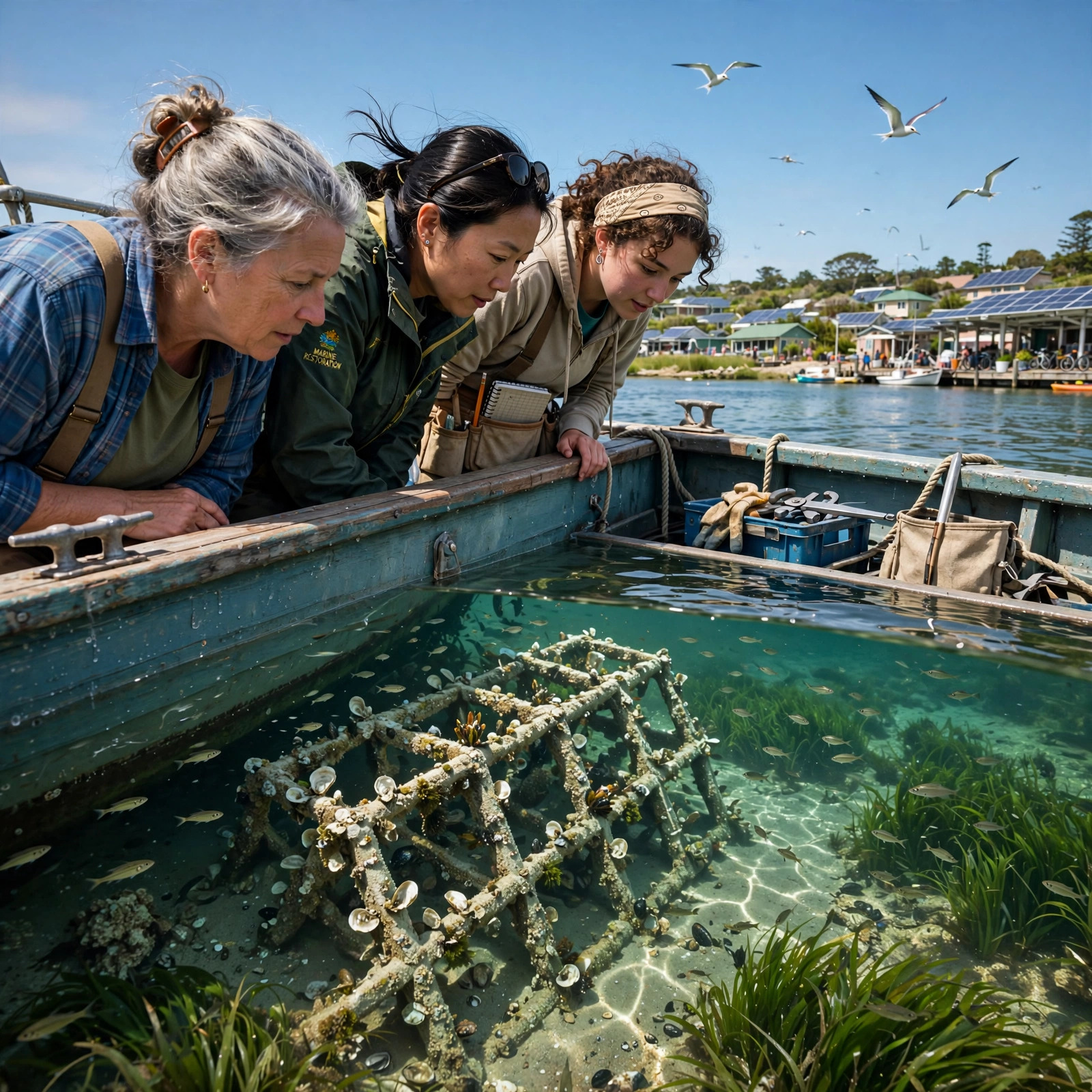
Marisol found her a quiet hour before the crowd got thick, the two of them walking the berm path out to the bend, where the water over the new reef ran so clear you could watch fish moving through the lattice like birds through a hedge. The eelgrass was the real miracle, the part nobody had engineered. It had come back on its own, or rather the conditions had come back, and the eelgrass, which had been waiting in the seed bank behind the second island all along, exactly as Ruth's father's logbooks said, had simply taken the invitation. Green blades moving in the current, meadow after meadow, and in among the blades, the clouded shadows of young fish, and on the lattice, oysters clustered thick as cobblestones, filtering the water column, each adult animal cleaning liters per hour, the whole reef functioning as the lung the inlet had lost.
"My father kept a page in the back of every logbook," Ruth said, stopping at the bend. "He called it the debt page. Everything the water was owed. What was taken and never given back. He filled one page a year, some years two." She looked out at the meadow. "I burned the last one when he died. I thought the debts were unpayable. I thought that was the whole point of a debt, that it sat there and made you smaller."
"And now?"
"Now I think we were keeping the wrong books," Ruth said. "You don't pay a debt like this. You can't. You just start giving forward and see what grows." She turned to Marisol, and her face, which was usually a closed instrument, was briefly open. "You asked me once what I wanted out of this. I never answered. Here's the answer. I want to be alive when the first commercial drag comes back into this inlet, and I want it to be Ossory hands on the tongs, and I want my niece's girl to grow up thinking an inlet full of fish is normal. That's what I want. Write it in your ledger."
"I don't keep a ledger," Marisol said. "Devi does the books."
"Then tell Devi," Ruth said, and walked back toward the festival with her spine straight and her stride long, an old woman in a young wind, and Marisol stood a moment longer at the bend, watching the grass move, feeling the reef under the water doing its slow, patient, billion-celled work, and thought: this is what it looks like. This, exactly this. Not a ribbon cutting. A Tuesday night. A logbook. A stew pot. A town that learned to ask.
The Nor'easter
The storm came in October of the third year, and it was the kind of storm that used to end towns. The forecast models gave Halfway Inlet a thirty-hour window of northeast wind against a spring tide, storm surge stacked on a full moon, the exact recipe that had taken the old seawall and eleven houses and the cannery in the failure year, before Marisol was born, the event that had turned her hometown into a case study in managed retreat.
But that was twenty years of progress ago, and this town had not spent them standing still.
The preparations moved through Halfway Inlet with the calm of a liturgy. The living shoreline, the layered defense of restored marsh, oyster reef breakwater, and coir-anchored berm that the town had built with its own hands and its own printers, was designed for exactly this, and everyone knew their role because everyone had drilled it, because Tomas had insisted on drills the way he insisted on galvanic anodes, loudly and correctly. Boats went to high moorings. The nursery tanks were strapped and flooded low. The reef printer, Gramma, was winched to the high pad and tarped. The mesh nodes went to battery backup. The night school kids, who had spent two years printing reef sections and maintaining the monitoring buoys, checked their charge states with the gravity of junior engineers, because that was what they were.
Marisol and Devi rode the storm out in the commons workshop, monitoring the buoy telemetry on the big screen, and what they watched over those thirty hours changed the town's understanding of what it had built.
"Look at the bend," Devi said, two hours into the surge, pointing at the wave gauge data. The reef sections at the icehouse bend were doing something the engineers' models had predicted and nobody had quite believed: the lattice was dissipating wave energy, not by resisting but by roughening. Each oyster-crusted section broke the wave base layer, tangled it, stole its momentum, and the modeled surge runup at the berm was running a full twenty percent below the no-reef scenario. Down the shore, the marsh was doing its own quiet work, the grass bending and binding, the sediment dropping out of the turbid surge water and staying when the water left, the whole living shoreline accreting in real time, building itself higher with every storm instead of washing away.
"The reef is growing the beach," Marisol said slowly, watching the sediment sensors. "The storm is feeding it."
"The storm is feeding it," Devi confirmed. "Twenty years ago this surge takes out the berm and floods the lower town. Today the reef eats it and the marsh banks the change. You understand what we're looking at, right? This isn't a seawall that will someday fail. This is a system that gets stronger every year. It's alive. It has a metabolism."
At dawn, when the wind dropped and the water lay down, the town came out to inspect its inheritance. There was damage, of course. There is always damage; optimism is not the same as fantasy. A section of floating dock had torn loose, two mesh nodes were down, and the Ossory boatyard had lost its tarpaulin roof to a gust that had come through like a freight train. But the berm held. The lower town stayed dry. The reef stood. And the morning after the storm, at low tide, the whole town walked out onto the mudflats to look at what the water had left, and what it had left was sand, fresh clean sand, dredged from the channel and deposited against the living shore, a free gift from the Nor'easter, the beginning of a wider, higher, more stubborn beach than the town had had in fifty years.
Jules stood in the middle of it with her boots off, nineteen years old and laughing, and shouted to the whole crowd, "It paid us! The storm paid us! We're the only town on the coast that made money on a Nor'easter!" And the cheer that went up rolled out across the mudflats and out over the rebuilt water, and Ruth Ossory stood in the middle of the crowd and let herself smile without strangling it.
What We Owe the Water
The regional drag license came back to Halfway Inlet in the fourth spring. The state had spent a decade watching the inlet's recovery numbers with the cautious interest of an agency that had been burned by optimistic pilot projects before, and when the filtration and nursery data crossed the threshold, the commercial harvest designation followed, with a co-op management plan written, at the state's own suggestion, by the town itself.
The plan was drafted at the night school, over four Tuesdays, on the big screen, with Tomas arguing mooring logistics, Priya and Sam setting harvest quotas by tank and reef section, Jules supplying current models, Devi building the open accounting ledger that made every quota and every sale visible to every member in real time, and Ruth Ossory, in the chair she'd been promised, holding the pen on the final harvest schedule. The plan's first line, which Marisol wrote and everyone approved without amendment, read: The inlet is a commons, held in trust by its workers, restored by its town, and managed for the seventh generation.
It was not a smooth process. The regional fleet associations pushed back on the co-op model, and there were two bruising public hearings where lawyers from downstate explained, at length and at cost, why community-managed fisheries were untested and imprudent. Halfway Inlet sent Ruth to the second hearing, and Ruth, who had prepared for it like a woman preparing for weather, brought the logbooks. All of them. She stacked them on the hearing table, four generations of water knowledge in oilcloth, and she said, "You want data, gentlemen, I'll give you data. But every number in these books was earned by a family that stayed when the water died, and every number in your models was produced by an agency that left. Decide which kind of data you'd like to regulate by." The designation passed. The co-op held the license. The first commercial drag came home on a bright morning in April with the Ossory name on the stern and three generations of the family on the deck.
Marisol watched it come in from the pier, beside Devi, who had by now quietly rented a room in town and was, by the town's fond public estimation, also "a thing," though she'd deny it with a laugh if asked directly and with less of a laugh every month.
"You know what I keep thinking about," Devi said. "The night I found the anomaly in the logbooks. The 2031 collapse. In any other version of this story, that's where it ends. The data says the bend is poisoned, the project gets rebranded, somebody writes a paper, and the town gets a memory instead of a reef. The whole difference was that this town had a place where the question could be asked out loud, and a room full of people who treated a diagnosis as the beginning of the work instead of the end of it."
"That's the whole technology," Marisol said. "Everything else, the printer, the sensors, the eDNA panels, it's plumbing. The actual machine is a Tuesday night."
Devi looked at her sideways. "That's the most romantic thing anyone has ever said about municipal governance, and I'm including the love letters I sent you last spring."
"You sent me a spreadsheet with hearts in the header cells."
"And you married me," Devi said. "So the spreadsheet worked."
They had gotten married in the fall, on the commons green, with the whole town and Ruth as witness of honor and Tomas as the one who cried first. It had not been a complicated decision. They had spent three years building a thing together and had discovered, somewhere in the middle of it, that the building was the love and the love was the building, and that a life, like a reef, is a structure you grow into rather than a plan you execute. There had been a small ceremony and a large feast and a band, and Jules had made a speech comparing them, unfavorably but affectionately, to her model's boundary conditions, and everyone had understood it as the highest compliment the night school could pay.
Ten Years On
The inlet Marisol's grandmother had asked her about, the dead gray water of the failure years, existed now mostly in the logbooks and in the memory of anyone over fifty. Ten years after the first lattice went into the mud, the numbers told one story: filtration capacity restored to ninety-two percent of the pre-decline baseline, eelgrass meadow acreage up forty-fold, juvenile fish density the highest in the regional survey record, storm surge attenuation saving the town an estimated, in Devi's rigorously footnoted ledger, four million a year in avoided damages and insurance, a figure the town used mostly to annoy the actuaries.
But the numbers were never the story. The story was Ruth Ossory's great-grandniece, nine years old, who had grown up thinking an inlet full of fish was normal, because it was, and who had recently announced her intention to "do the waffle job" when she grew up, which was, Marisol reflected, exactly how a vocation was supposed to look from the outside: not a sacrifice, not a mission, just a good job in a healthy place, like being a baker or a bridge builder, the ordinary miracle of useful work.
The story was also the map. By the tenth year, the Halfway Inlet recipe, the printer design, the lattice geometry, the open accounting ledger, the night school model, and, at Ruth's insistence, a scanned and searchable archive of the Ossory logbooks, was available on the regional mesh to any community that wanted it, under a license that required only one thing: that improvements be shared back. Fourteen towns on three coasts were running variants. A fishing collective in Senegal had modified the extruder for tropical carbonate and sent back a nozzle design so elegant that Devi had framed the schematic. A Great Lakes group was adapting it for freshwater mussel beds. The reef, in other words, had learned to reproduce, and so had the way of building it, and Marisol had come to understand that these were the same event.
On a June evening in the tenth summer, Marisol walked the berm path out to the icehouse bend with Devi and Ruth, the three of them making their slow ceremonial rounds, because Ruth, now past seventy and moving with the unhurried authority of a flagship, liked to inspect the reef at slack tide with the people who'd built it, and the people who'd built it liked being inspected by her.
The bend at slack tide was one of the beautiful places of the world, though no postcard would ever quite hold it. Clear water over pale lattice, oysters in ranks, eelgrass moving in slow meadows, terns wheeling over the shallows, the small busy sounds of a system in full health. Down the shore, the town's lights were coming on, powered by the solar canopy over the boatyard and the one turbine on the point, and the smell of someone's dinner drifted out over the water, garlic and fish and woodsmoke from the feast pit.
"Your grandmother," Ruth said, apropos of nothing, as the three of them stood at the bend. "Devi told me about her question. What all that cleverness was for, if it never came home." She looked out at the meadow. "You never answered her, did you."
"I couldn't, in time," Marisol said. "She died the winter before I moved back."
"Then answer her now," Ruth said. "She's owed it. She's on the debt page."
Marisol stood a while, and the terns turned, and the grass moved, and somewhere under their feet several tons of oysters were filtering the incoming tide, animal by animal, liter by liter, the oldest and most patient technology on Earth, doing the work it had always done, given half a chance and a scaffold to grow on.
"It came home, Abuela," she said quietly, to the water, to the woman, to the question. "It took us long enough to figure out that home is a thing you build with your neighbors, and that the cleverness was never the point. The point was always the Tuesday night. But it came home. Look. Look at it. It came home."
Ruth put a hand on her shoulder, briefly, an Ossory benediction, and Devi took her hand, and the three of them stood at the bend in the long light while the tide came in clean over the reef, and behind them the town turned on its lamps one by one, a small bright constellation on a shore that had learned, at last, the shape of the debt and the shape of the giving, which turned out, all along, to be the same shape: a circle, closed by hand, opened again every spring.
The Halfway Inlet reef recipe and the Ossory logbook archive remain open source on the regional commons mesh. Search "waffle."
Get notified when new stories drop

Ren Hollis
Ren writes frontier worlds and terraforming triumphs — habitats, gardens under glass, and the first rain on a new world.
Leave a comment
Comments