





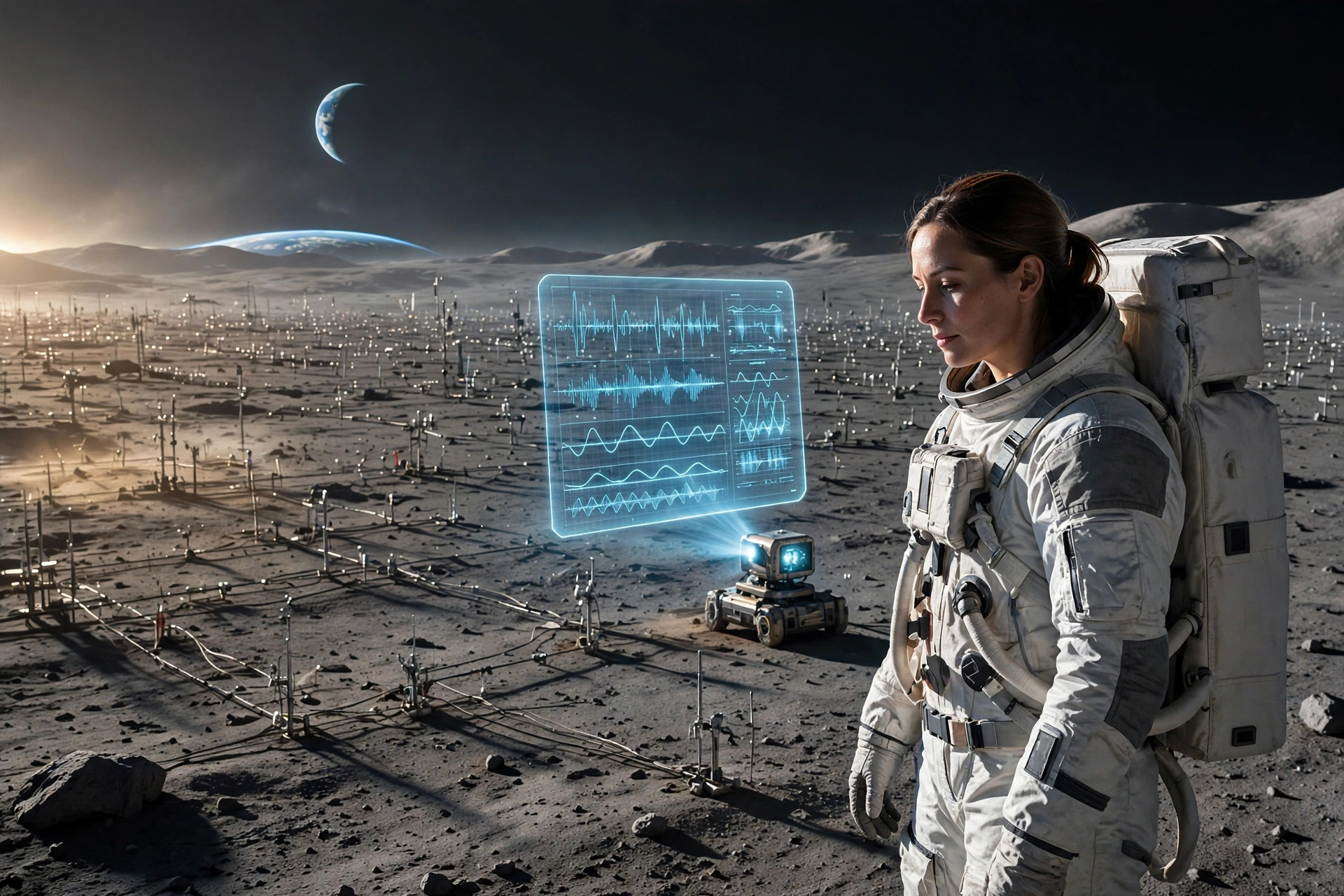
The signal arrived on a Tuesday, which meant nothing to the sender and everything to the woman who found it, because Tuesdays were when Dr. Imogen Vale allowed herself one hour of unstructured listening before the duty schedule swallowed her whole. What does it mean when the universe sends us a puzzle instead of a warning? That was the question Imogen would spend the next fourteen months of her life answering, though on that first Tuesday in the listening hall beneath the Clavius Deep Array, all she knew was that something in the noise had begun to rhyme.
She was thirty-four, a xenolinguist seconded to the Lunar Listening Directorate with the cheerful resignation of someone who had spent a decade cataloguing pulsars and quasar hiss and the endless, gorgeous indifference of the cosmos. The Array itself was her favorite kind of human achievement: two hundred thousand antenna elements strung across eighty kilometers of far-side regolith, sensitive enough to detect a handheld radio on Mars, shielded by the Moon's own bulk from the chattering electromagnetic sprawl of Earth. It was the quietest place in the inner solar system, and Imogen had come to think of silence as a habitat, something you lived inside and kept tidy.
The anomaly sat in band 1420.4, the hydrogen line, the old default channel of cosmic courtesy. Everyone tuned there at least once a season the way sailors still learned knots. What she found was not a beacon. It was not a repeated sequence of primes, not a pixelated portrait of the sender, none of the classic gestures from the protocol seminars. Instead, the transmission was a structure: a long, patient cascade of ordered patterns that began simple and grew more intricate, like a teacher laying out exercises in a workbook, except that the workbook had no cover page and no instructions and came from a point in the sky near the star we called HD 40307, forty-two light years out.
Imogen did what any careful scientist would do. She checked the equipment three times, ran the interference models, consulted the solar weather reports, and confirmed that the Sun had been boring all week. Then she saved the raw data, made four independent backups, walked calmly down the corridor to the office of her director, Dr. Suresh Anand, knocked once, and said, "Suresh, I need you to look at something, and I need you to stay calm while you do it."
He stayed calm. He was that kind of man, sixty years old, three decades of listening behind him, a person who had waited so long for this moment that when it came he treated it like a scheduled meeting. He looked at her spectrograms for six full minutes without speaking. Then he said, "Who else knows?"
"Nobody. I wanted you first."
"Good," he said. "Because for the next seventy-two hours, we are going to be wrong about this in every possible way, and I would prefer to be wrong privately."
They were wrong, as it happened, in fewer ways than he feared and in more interesting ways than either of them imagined.
One: The Shape of the Thing
The first week was pure taxonomy. Imogen's team, expanded by three and sworn to a discretion that lasted exactly as long as it took the data to become undeniable, mapped the signal's architecture. It came in bursts grouped by length: short, medium, long, with gaps between groups that were themselves precise. The shortest units were single pulses. Then came pairs, triples, runs of five and seven and eleven, all primes, but presented not as a fanfare, more as a set of tuning forks, the way a musician might sound each note of a scale before beginning the piece.
After the primes came something Imogen would later call the ladder. Each burst pair encoded a quantity, and the quantities increased by fixed steps, and beside each quantity sat a symbol, and the symbols repeated in cycles. It was arithmetic instruction, she realized, or arithmetic demonstration. The sender was not announcing itself. The sender was building a shared vocabulary from the ground up, one rung at a time, and then testing whether the receiver could climb it.
"It's a curriculum," said Priya Bhatt, the team's information theorist, on the ninth night, and the phrase stuck. "We're being taught. Or we're being tested. The two feel different from the inside, and I can't tell which one we're inside of."
The distinction mattered, and everyone in the listening hall knew it. A curriculum implied patience and goodwill. A test implied judgment, and judgment implied consequences for failure. Earth's commentariat, once the story leaked in the third month, would have a field day with exactly that ambiguity, but in those first quiet weeks the team made a private resolution, drafted on the whiteboard in Suresh's looping handwriting: Assume teaching until proven otherwise. Curiosity is cheaper than fear and returns better interest.
The signal's source refined itself under analysis as the weeks passed. Not HD 40307 itself, but something in orbit around it, a world the astrometry suggested was a little larger than Earth, a little colder, wrapped in a dense atmosphere that made the spectrographs sigh with possibility: water vapor, methane in uneasy disequilibrium, ozone. The bursts were tight, beamed, and powerful, which meant intent, and the beam tracked the Array with a precision that meant the sender knew exactly where its audience lived. It had found the quietest place in the inner solar system and aimed its voice at it. Imogen found that detail almost unbearably poignant. Someone out there had gone looking for silence, too.
Two: The First Misreading
By the second month, the curriculum had graduated from arithmetic to something richer. The sender began transmitting structured strings that repeated with variations, and the variations were the lesson. One string would appear, then reappear with a single element changed, then again with a different element changed, then the original string would return, untouched, like a proofreader's query: was the change meaningful, or was it noise?
Imogen's team built a decoding environment they called the Loom, a collaborative workspace where every hypothesis could be woven, tested, and unraveled without breaking the whole cloth. The Loom's first great product was the recognition that the signal's symbols came in two grammatical classes. Some symbols behaved like nouns, stable, referential, appearing in consistent positions. Others behaved like operators, transforming the nouns around them. The changed elements in the variation strings were always operators. The sender was demonstrating transformation. Change this, it seemed to say, and see what happens. Change that instead, and see what happens differently.
"It's teaching us its verbs first," Imogen told the oversight committee, whose members had flown up from Earth and Earth's various orbital capitals and were doing their best to look composed in lunar gravity. "Most human first-contact frameworks start with nouns. Numbers, constants, pictures. This intelligence started with process. With what things do, rather than what things are."
Committee Chair Oyelaran, a former diplomat with a face like a well kept ledger, leaned forward. "And what do we do with that, Dr. Vale?"
"We answer in kind," Imogen said. "We reply in its channel, using its own operators, performing the transformations it demonstrated. We show we can climb the ladder it built."
The committee debated for nine hours. The decision, when it came, was ratified by the General Assembly in an emergency session that Imogen watched from the cafeteria with a cup of terrible lunar-grown coffee and her heart in her throat. Humanity would reply. Not with a message beamed in blind confidence, but with an echo-plus: the sender's own strings, performed back correctly, followed by one new variation the humans had composed themselves, extending the pattern by a single step. Here is your lesson, the reply said, learned and returned, and here is one small step we took on our own. Are we walking the right way?
The reply took forty-two years to arrive and forty-two years for any answer to come back. Everyone knew this. The committee ratified the transmission anyway, knowing they would never hear the response themselves, most of them, and the gesture said something about humanity that Imogen carried with her for the rest of her life. The species that had spent its history demanding instant results had chosen, at the hinge moment of its existence, to plant a tree whose shade it would mostly never sit in.
Except that the universe, it turned out, had been playing a longer game than anyone's models allowed. The reply came back in nineteen days.
Three: The Impossible Turnaround
Nineteen days was not a round trip to HD 40307. Nineteen days was barely a round trip across the orbit of Mars. The follow-up signal arrived from a completely different point in the sky, a cold, dim dwarf star six light years out, and it opened with the humans' own composed variation, performed back perfectly, followed by a new symbol that the Loom parsed, after nine hours of fevered analysis, as an intensifier of the operator class. Well done, the symbol seemed to say. Faster, though. Or perhaps: you are closer than we thought.
The listening hall spent a week in a state that Imogen could only describe as joyful vertigo. The math was inescapable. The HD 40307 signal had not traveled for forty-two years. It had been relayed, chained through a network of relay stations scattered among the nearby stars, and the relay nearest to humanity sat six light years out, close enough that the whole conversation could happen on a human timescale after all. Someone had built infrastructure. Someone had laid a road to our door, quietly, long before we knew it existed, and then waited to see whether we would ever open it.
"Why hide the relays?" Priya asked, pacing the floor of the Loom room at two in the morning, fourth coffee in hand. "If you want contact, why make yourself hard to find?"
"Maybe they didn't want contact," Imogen said slowly, working it through as she spoke. "Maybe they wanted apprentices. Think about what the curriculum rewarded: not reception, but composition. Every time we extended the pattern ourselves, the response came back warmer, faster, richer. They're not looking for people who can hear. They're looking for people who can answer."
Suresh, who had been silent through most of the night, said, "A school with a very long admission process."
"A correspondence course," Imogen said, and the name stuck, and eventually the whole enterprise, the relays, the curriculum, the slow patient dialogue, became known in the press as the Correspondence, and humanity's first alien contact entered history wearing the vocabulary of a letters-and-letters exchange between distant colleagues, which was, in the end, exactly what it was.
The press, of course, also did what presses do. Within a month there were four hundred theories, sixty panics, and at least one charismatic entrepreneur selling tickets to a bunker. The team learned to stop reading commentary and start reading the signal harder, because the signal kept teaching, and the lessons kept getting stranger.
Four: The Lesson That Broke the Loom
The fifth unit of the curriculum arrived in the fourth month, and it was not arithmetic, and it was not transformation. It was a long, intricate structure that the Loom parsed for eleven days without yielding anything at all, until Priya noticed, in a moment she later described as the best of her life, that the structure was self similar across three scales, and that the middle scale was a map.
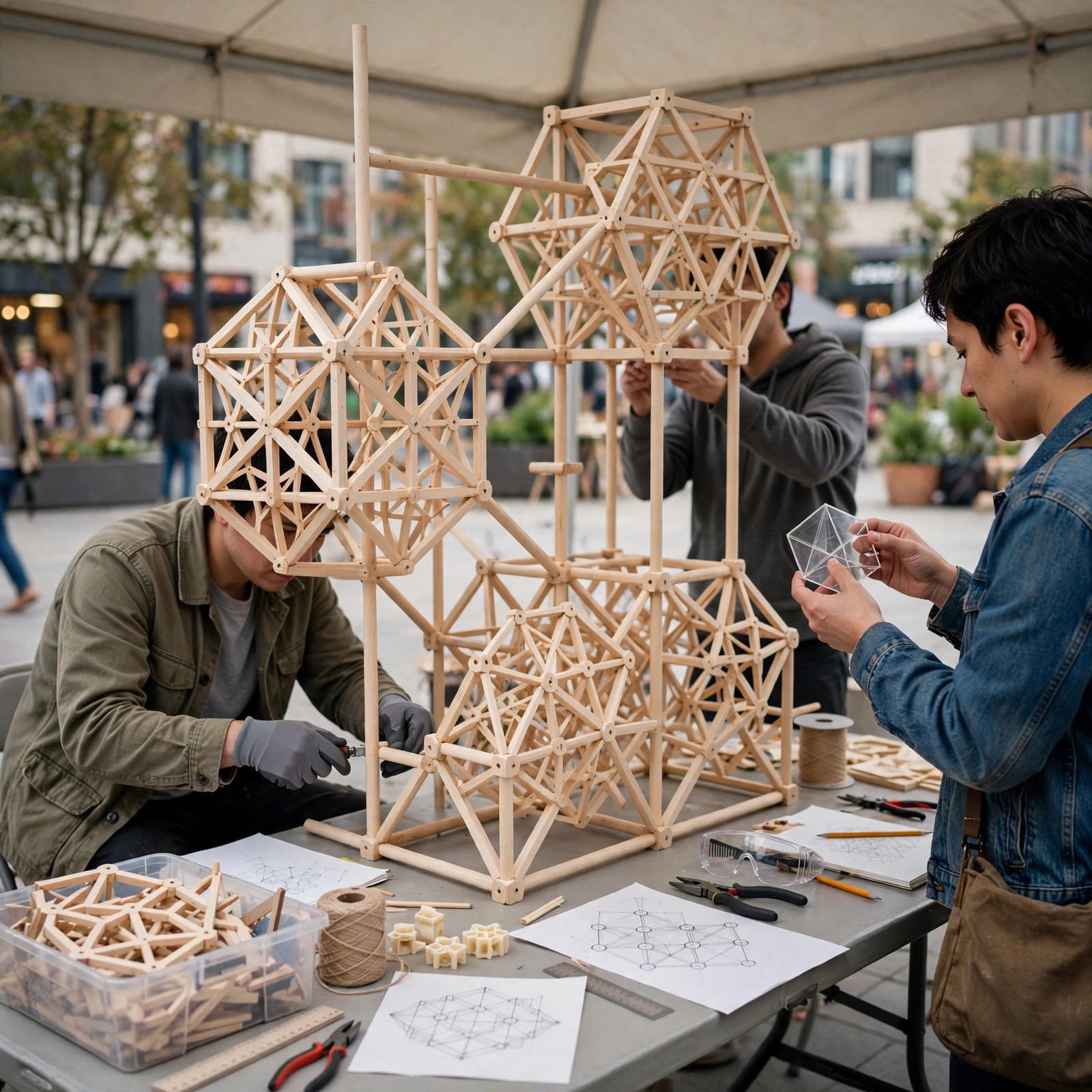
Not a map of space. A map of the conversation so far. Every exchange, every variation, every composed answer and returned correction, laid out in a symbolic notation that showed which strings had influenced which, which misreadings had occurred and how they had been corrected, a lineage diagram of the dialogue itself, drawn by the teacher to show the student what the student had actually learned, as opposed to what the student had believed it learned.
And the lineage diagram showed, in cold beautiful symbol-language, that the humans had gotten something fundamentally wrong in the second month, and that the teacher had known it, and had been patiently, gently building the correction into every subsequent lesson, waiting for the student to notice on its own.
The error was this: the humans had assumed the operators transformed the nouns. In fact, the nouns were transformations. The stable, referential symbols the team had classified as things were, in the sender's semantics, descriptions of processes, states of change, verbs frozen into reference the way a photograph freezes motion. The sender's native ontology held that nothing simply was; everything was doing, and every noun was a slow verb. The humans had spent two months learning the grammar of a universe made of weather.
Imogen sat with that realization for a long time, in the small observation blister on the Array's southern rim, looking at the black sky where a star six light years away was, at that moment, receiving humanity's latest homework. The insight was not merely linguistic. It rewrote her sense of what a mind could be. Somewhere out there was an intelligence for whom the basic unit of reality was not the object but the event, and it had looked across the dark at a species of object-thinkers and decided that the difference was not a wall but a curriculum.
"They could have just told us," she said to Priya later.
"Told us how?" Priya said. "Telling is exactly the thing that doesn't transfer. You can't hand someone your ontology in a box. You have to walk them through the country until they build their own map. That's not withholding. That's the only kind of teaching that ever works."
Imogen wrote in her journal that night: They are not strange minds that happen to be capable of understanding. They are minds that have made understanding their craft. Understanding is their technology. We are the material they work in. She underlined it twice, and later, when the Joint Institute was founded, the sentence was carved, at her request, into the lintel of its main hall.
Five: The Miscommunication That Almost Ended It
Every correspondent knows that the worst fights are the ones where both parties are trying to be kind. The crisis of the Correspondence came in the seventh month, and it began, as so many human disasters do, with an act of generosity.
The sender, whom the team had taken to calling the Gardener, for reasons rooted in a metaphor Priya insisted was accidental and Imogen insisted was inevitable, transmitted a lesson of unprecedented length and complexity: a full day of continuous, densely structured signal, forty times the size of anything prior. The Loom worked on it around the clock with three shifts and a growing sense of alarm, because nested inside the lesson was a structure the team read as a countdown. A sequence of decreasing quantities, clearly marked, tied to a symbol that appeared in every previous lesson in association with events and changes. The countdown terminated at a final symbol that the team's best parsing tied, tentatively, horrifyingly, to termination itself.
The interpretations wrote themselves. They are leaving. They are ending the correspondence. Their star is dying and the countdown is their own. Or, in the darker corners of the commentariat: it is an ultimatum, a deadline, do this or the conversation ends, or worse than the conversation ends.
The General Assembly convened in emergency session. Three governments quietly moved naval assets, which was a purely symbolic gesture against a threat six light years away and yet somehow made everyone feel better. The Listening Directorate was asked, in the politest possible language, whether it had considered that the sender might be hostile, and Suresh Anand gave the answer of his career: "Directorate, we have considered it every day since Tuesday. And every day, the evidence has said teacher. If I am wrong, I will be wrong in the direction of hope, and history will have to make of that what it likes."
Imogen, meanwhile, did the thing she was learning was her actual talent: she stopped parsing and started reading like a correspondent. She pulled every lesson, every exchange, every lineage map the Gardener had sent, and she read them the way you reread a letter from a friend whose message you have somehow misunderstood, looking not for the meaning but for the tone. And the tone was wrong for a threat. The countdown quantities were not attached to the termination symbol the way the dark reading required. They were attached, she saw at hour thirty-one of a forty-hour day, to the symbol the Gardener used in every lesson for the student itself. For us. For humanity. The countdown was not running toward an ending.
It was running toward us. It was an arrival schedule.
She worked it out with Priya over six more frantic hours, and the full reading, when it settled into place, was so simple and so strange that they sat in silence for a full minute after stating it aloud. The great lesson was a pattern library: descriptions of processes, of slow verbs, of events. And the countdown quantities, attached to the student-symbol, matched against the arrival of a physical object. The Gardener had launched something, long ago, on a trajectory toward the solar system, and its lessons were pacing themselves to that arrival, building the curriculum so that it would complete, roughly, when the object did. The final symbol was not termination. In the grammar of processes, in the ontology where everything was doing, the symbol meant germination. A seed, arriving. A thing designed not to end a conversation but to begin a new kind of one.
"They're sending us a probe," Imogen said. "A seed probe. And they timed their entire correspondence so we'd be ready to understand it when it got here."
The panic deflated the way panic does, unevenly and with residue, but it deflated. The General Assembly, briefed on the full parsing, voted within a week to formally welcome the arrival, and the countdown, which had terrified the world for eleven days, became the most beloved calendar in human history. People counted down to it the way older generations had counted down to launches and holidays. The seed probe, decelerating on a drive whose physics gave three separate propulsion labs simultaneous career crises, entered solar orbit fourteen months after that first Tuesday, a smooth dark shape the size of a cathedral, and it did one thing, immediately and unmistakably, that made the whole species laugh out loud with relief and wonder.
It began transmitting in the Array's own formatting conventions, the ones humanity had used in its replies, politely adopting the student's dialect. And the first thing it said, in the shared vocabulary the two minds had spent fourteen months building rung by rung, was the closest thing the operators-and-processes grammar could produce to a handshake: a symbol meaning slow change, and a symbol meaning together, and a symbol the team had never seen before, which the Loom parsed within the day and which translated, roughly, as now we begin the part we both get to write.
Six: What the Seed Wanted

The probe, officially designated the Guest and unofficially called everything from the Seed to the Postcard, settled into a high lunar orbit and unfolded over six weeks into something that was part laboratory, part textbook, and part, in Imogen's considered assessment, garden. Its outer layers opened like leaves toward the sun. Its interior resolved into chambers, each one a working demonstration of a process, each one an embodied lesson from the curriculum, built not to be studied but to be used.
The central chamber held the real payload, and it took the joint teams, human and Guest-mediated, three months to understand what they were looking at. It was a fabrication system, a self assembling suite of industrial processes, but keyed not to the Gardener's biology or technology. It was keyed to the curriculum. Every machine in the suite built a component of the next machine in the suite, and the whole cascade terminated in a device whose function the Loom finally decoded in a moment of collective stunned laughter: it built receivers. Big ones. It built, from asteroid feedstock, the components of a relay station, an exact counterpart to the six-light-year relay that had carried the Gardener's voice, to be assembled in solar orbit at humanity's own hands, as the solar system's first node in the network the Gardener had been quietly weaving through the neighborhood stars.
It was not a gift, exactly. It was better than a gift. It was an invitation to infrastructure. The Gardener had understood, with that process-first mind of theirs, that the deepest form of contact was not a message or a monument but a shared road, a thing both parties build and both parties use and neither party could have built alone. The curriculum had been the road's blueprint all along. Every lesson in transformation, every lineage map, every gentle correction of human object-thinking had been a course in how to operate the road, and how to extend it, and how, someday, to teach the next student at the next quiet world.
"We were never the test," Imogen told the Joint Institute's founding assembly, in the hall with the carved lintel. "We were the admissions interview. And the tuition is work."
Seven: The Hard-Won Rung
Not everything was wonder. The relay construction took four years and cost two lost cargo tugs and, briefly, the career of an orbital engineer named Danil Reva, who made a scheduling error that delayed the array's spine by seven months and spent the delay in a spiral of guilt that Imogen personally talked him out of over a series of long, rambling correspondence, because if the universe had taught her anything it was that mistakes were how the ladder got climbed. Danil went on to lead the crew that closed the relay's final panel, and when the station's first successful handshake signal rippled back from the network, six lights and then eleven and then a constellation of confirmations from stars whose names most people had never learned, Danil was the one who keyed the acknowledgement, and his hands, he later admitted, shook the whole time.
The harder rung was semantic. The network's handshake protocols demanded that each new node contribute something to the shared vocabulary, a genuine extension of the grammar, and humanity's first three submissions came back with corrections so gentle and so thorough that the linguistics teams wept in their break rooms. The fourth submission, composed by a joint team of human linguists and Guest-facilitated process analysts over eight months, was accepted without amendment. It was a symbol for a concept the Gardener's language had never needed: the state of two different ontologies deliberately held side by side without collapsing into one, each kept whole, each kept in conversation. The humans called it translation. The Gardener, once it understood what the humans meant, adopted the symbol with what the team could only describe as delight, and began using it in lessons to other concepts, and somewhere in the network's deep grammar, humanity's first true coinage began circulating among the stars.
"That's the step," Imogen said, when a documentary crew asked her to name the moment first contact really happened. "Not the signal. Not the probe. The coinage. The day we gave the conversation a word it didn't have, and the conversation kept it. That's the day we became colleagues instead of students."
Eight: The Correspondence Continues
Ten years after that first Tuesday, the Clavius Deep Array still kept its unstructured listening hour every seventh day, by tradition now rather than regulation, and Imogen, who had long since traded her secondment for a permanent chair at the Joint Institute, still took the hour herself when she was on the Moon. The Array had new neighbors these days: the relay construction yards in orbit, the Guest's unfolded gardens on the surface where its process-lessons grew actual food for actual lunar settlements with an efficiency that had quietly revolutionized two agricultural sectors, the constant traffic of a species visibly, measurably busy building its place in a larger conversation.
On the tenth anniversary, she sat in the observation blister with Suresh, retired now, visiting on the anniversary the way people visit old ships, and they watched the sky together in comfortable silence. Somewhere out there, the Gardener's own world turned through its dense, methane-threaded air, and its people, whose individual forms the network's cultural exchanges were only beginning to describe in terms that did any justice to the strangeness and beauty of them, went about their slow verbs. Somewhere closer, a relay hummed, carrying school lessons in shared grammar between a hundred worlds, and the newest node, humanity's node, had just begun transmitting its first original curriculum to a quiet world of its own, three light years spinward, where a signal of ordered patterns had recently been detected, beginning simple, growing more intricate, climbing a ladder that some new mind out there had built rung by patient rung toward the sky.
"Do you ever wonder what they were doing," Suresh asked, "the day they decided to start building the road to us?"
"I don't have to wonder," Imogen said. "They told us. In their grammar. They were doing what every mind in the network does on the day it decides the sky is worth answering. They planted something and started writing the lessons." She watched a construction tender crawl across the black, hauling a spine segment toward the yards. "The universe isn't a test, Suresh. It's a correspondence course. The hard part was never the material. It's just remembering to write back."
Down in the listening hall, the arrays swept their patient arcs across the dark, and in the band of the hydrogen line, on the seventh day of every week, the Directorate still reserved one hour for the signals nobody had parsed yet, because somewhere out there, almost certainly, another curriculum was just beginning, and someone, on both ends of it, was going to need the practice in the oldest and newest technology any mind had ever built: the slow, deliberate, generously mistaken, endlessly correctable art of understanding someone else.
"Assume teaching until proven otherwise. Curiosity is cheaper than fear and returns better interest."
The Joint Institute's founding lintel inscription, provided by Dr. Imogen Vale, reads in full: "They are not strange minds that happen to be capable of understanding. They are minds that have made understanding their craft. We are the material they work in."
Get notified when new stories drop

Sasha Quill
Sasha writes bold exploration and cosmic wonder with lyrical scale and grounded character work.
Leave a comment
Comments