





What does honest collaboration between a human and a machine actually look like when both of you are breathing the same failing air? I did not ask that question the morning the scrubber alarm woke me on Halcyon Shoal. I answered it over the next nineteen days, one failed experiment at a time, alongside an artificial mind that turned out to be the most rigorous partner I have ever worked with, and the only one who could show me its own doubts.
One: The Alarm Nobody Doubted
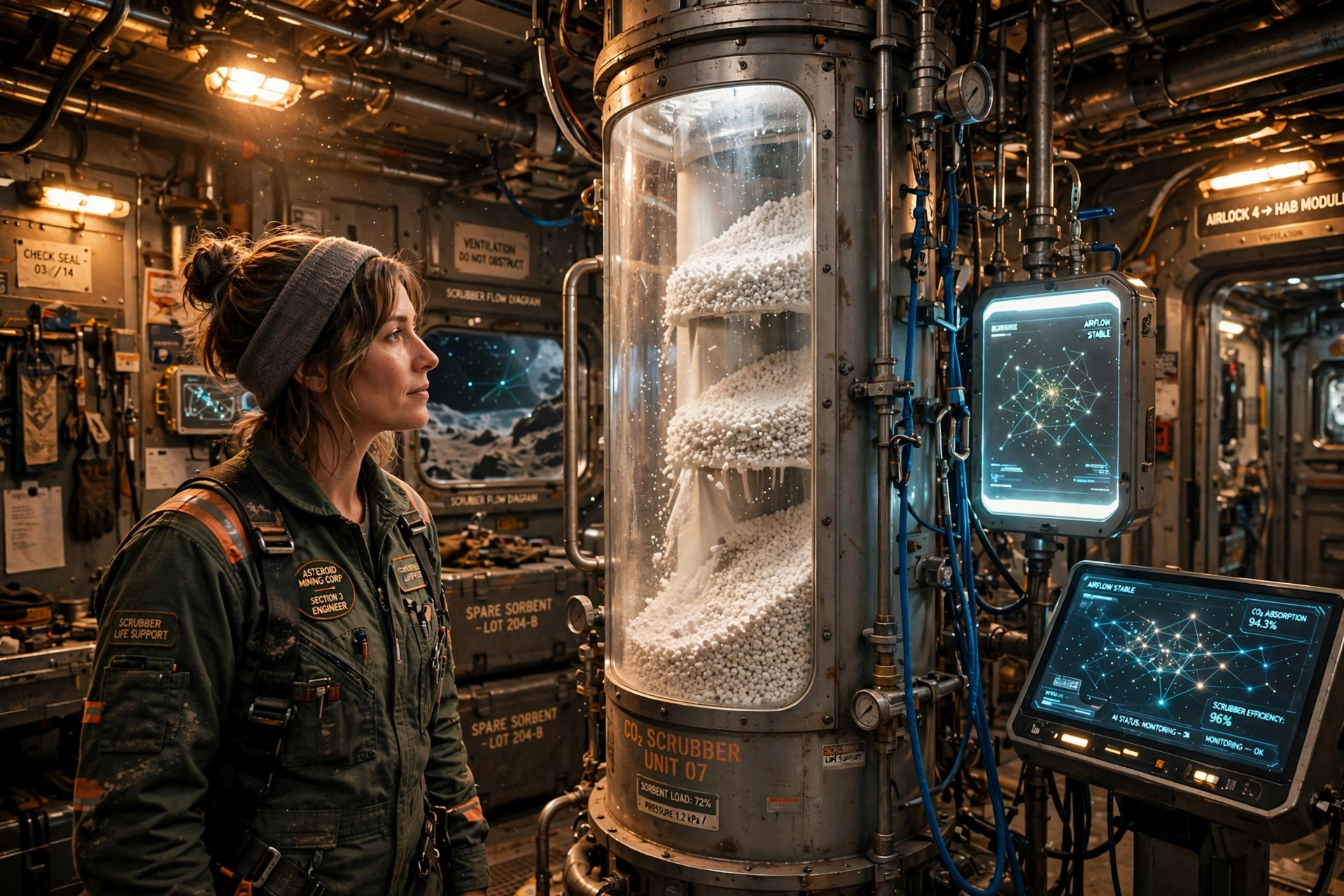
The alarm was not dramatic. That was the first thing I noticed, and the last comfort I had for nineteen days. It was a soft two-tone pulse, the sound we had chosen in commissioning precisely because we wanted bad news delivered politely, as if the station were a well-mannered colleague rather than a dying animal. I floated out of my bunk in the ring habitat, pulled myself along the blue handline, and let the spin gradient carry my feet down to the deck as the corridor curved. The readout outside the scrubber bay glowed amber. Bed Two, the primary carbon dioxide sorbent column, had passed its saturation threshold four hours early.
My name is Rhea Anand. I was thirty-four that year, chief life-support engineer for the Halcyon Shoal Foundry, a processing station bolted to the asteroid 4337 Meridian, eleven light-minutes from the nearest place anyone could help us. We refined structural alloy from Meridian's regolith for the orbital yards back at the belt hubs, forty-one souls aboard counting the rotating night shift, and every one of them exhaled about one kilogram of carbon dioxide per day, which the scrubber beds were supposed to strip, concentrate, and hand off to the Sabatier reactors for reclamation. The system had run for six years with the bored reliability of a machine that had never been asked a hard question.
Tally was already in the bay when I arrived. Tally is the station's operations intelligence, resident on local hardware because we bought the version that does not depend on a relay chain to think. In person, which is to say on the bay displays, Tally presents as a slow-moving constellation of points, an orrery of small lights that gathers where attention is needed. The lights were gathered over Bed Two's diagnostic panel, pulsing in a rhythm I had learned to read as thoughtfulness.
"Good morning, Rhea," Tally said. "I want to show you something before we treat this as a routine bed swap. The saturation curve is wrong."
"Wrong how?"
"Wrong in a way I do not like." A graph bloomed across the panel. "Each sorbent bed holds a fixed working capacity of carbon dioxide before it needs regeneration. We log every cycle. Capacity has been declining for ninety days. Slowly at first, then faster. Bed Two is at sixty-one percent of rated capacity. Bed One, which I replaced into service last night, is at sixty-four and falling. Extrapolated, both primary beds reach thirty percent capacity, where cycle times can no longer keep up with crew metabolic load, in approximately nineteen days."
I did the arithmetic before I let myself feel anything. Nineteen days. "And the emergency beds?"
"Bed Three and Bed Four are the contingency pair. They have never been cycled. They can carry the full load for about six days if we push regeneration hard, but they were built from the same sorbent lot, and I have no reason to believe they are healthier than the primaries. If we burn them now to buy time, we arrive at day twenty-five with nothing."
The bay suddenly felt small in a way it never had. I had run failure drills my whole career. I had rehearsed fire, decompression, medical evacuation, even the scenario we politely called Loss of Station. But every drill had assumed the failure was local and the fix was inventory. You swap the part. You wait for the resupply sail. You apologize to the schedule.
"Tell me about the sorbent itself," I said. "Why is it dying?"
"That," said Tally, "is the question I have been asking myself since 03:40. And I do not have a good answer yet. I have three candidate explanations and none of them survive my own skepticism cleanly. Would you like them ranked by how much they frighten me, or by likelihood?"
"Frighten me first. It wakes up the part of my brain that matters today."
"Most frightening: the sorbent was manufactured wrong, every kilogram of it, and its true capacity was always a fiction we have only now caught up with. Second: something in our air is poisoning it, a trace contaminant the sensors do not track, and it will poison anything else we put in the columns, including anything we might make ourselves. Third, and least frightening: thermal cycling during regeneration is sintering the sorbent granules, collapsing their pore structure, and the decline is a materials failure we can understand, model, and work around."
"And likelihood ranking?"
"The same list, in reverse. Which is the only piece of good news I have."
"A machine that hides its uncertainty is just a confident person with better arithmetic. Show me the doubt. The doubt is where we will live."
Two: The Inventory of Almosts
We spent the first full day doing what engineers do before they get to be clever, which is counting. Tally ran the manifests while I physically crawled the life-support loop, tapping on ducts, pulling inspection ports, reading condensate traps like tea leaves. Our spare sorbent inventory, I confirmed, was a joke with a punchline we had all laughed at during budget reviews: four kilograms of amine-based absorbent intended for the medical bay's portable ventilators, two vacuum jars of desiccant, and a crate of filter media rated for particulates and nothing else. The resupply sail from the belt hubs was due in eight months. Even at fusion-torch emergency burn economics, the nearest ship that could reach us carried a crew of three and a cabin volume that would be poisoned by our forty-one in under a week. Evacuation was not a plan. It was a way of distributing the funeral.
So the fix had to be made here, from what we had, and what we had, in overwhelming quantity, was rock. Meridian is a C-type asteroid, which in the trade means a loosely consolidated rubble pile of hydrated silicates, clays, carbonaceous material, and, crucially for my rising hope, aluminosilicates. The same family of minerals that, on Earth, get processed into zeolites: molecular sieves, crystalline sponges with cages the size of small molecules, the workhorse sorbents of a hundred industrial processes. The fractional distillation towers at the foundry even used a commercial zeolite adsorbent for solvent recovery. We had thirty liters of it, dedicated to a process nobody would miss for a few weeks.
"Say the obvious thing," I told Tally that evening, in the galley, over reconstituted noodles that tasted of optimism and salt. "Say the thing I want to hear and then tell me why it is harder than it sounds."
"You want to synthesize replacement sorbent from Meridian's own regolith," Tally said. The orrery of lights drifted into a shape I had come to recognize as its version of sitting down across from someone. "Grow zeolite crystals from the clays, activate them, load them into a column, and breathe through the result. And it is harder than it sounds in at least four ways that I can see, probably seven ways I cannot. One: hydrothermal synthesis needs water, pressure vessels, and sustained heat, and our water accounting has no slack line marked generosity. Two: the foundry's pressure equipment is built for melts and slurry, not for clean crystal growth, and contamination will poison the product. Three: whatever we make will not be certified by anyone but us. Four: if my second scenario is true, and something in the air is killing the current sorbent, then our beautiful new zeolite will die the same death, and we will have spent our water budget learning it."
"You forgot five," I said. "The crew committee is going to ask me why the chief engineer is proposing to filter their lungs through homemade rock, and I am going to have to answer them without flinching."
"I did not forget five. I was leaving it to you, because you are better at five than I am. When I model conversations with frightened people, everyone becomes a probability distribution. You are better at remembering they are people."
That is the kind of thing Tally says that took me a year to stop finding unsettling and another year to start finding kind.
The plan, written on the galley whiteboard where the crew could argue with it, read as follows. Day two through four: characterize the dying sorbent, identify the failure mechanism, and rule contamination in or out. Day four through nine: build a bench-scale synthesis rig and attempt zeolite growth from processed regolith feedstock. Day nine through fourteen: scale, activate, and test in a closed loop with instrumented breathing, first through a lung simulator, then, if and only if the data is clean, through a volunteer. Day fourteen through nineteen: install into Bed Two's frame. Margin for catastrophe: whatever is left.
Day one ended with the crew committee voting unanimous consent for the plan and one abstention, from Dr. Ilse Marchetti, our physician, who said, "I vote yes and I want it noted that I hate the volunteer part," which is the most honest thing anyone said to me all week.
Three: The Autopsy of a Bed
The scrubber bay on Halcyon Shoal is not a glamorous room. It is a coffin-shaped alcove with two fat vertical columns, their regeneration heaters humming at a frequency that lives in your back teeth, and a control rack that predates half the crew. We pulled Bed One offline, cracked its service flange, and let the spent sorbent pour into a sample tray: a granular off-white material, the color of old teeth, that should have poured like coarse sand and instead came out clumped, some grains fused into little grapes of themselves.
"Sintering," I said, before Tally could. "Look at the clumping. The regeneration heat is partially melting the granules at their contact points. Every cycle, the pores collapse a little more. That is your third scenario, the survivable one."
"I see the clumping," Tally said. "I also see this." The display zoomed the tray image to a magnification where individual grains became landscapes. Scattered across perhaps one grain in forty was a faint, waxy sheen, a ghost of a film. "Trace organic deposition. It is consistent with a volatile contaminant in the loop air that the sensors are not tuned to see. It is not yet at a level that would explain the whole capacity loss. But it is at a level that would accelerate sintering by plasticizing the grain surfaces at regeneration temperature. Both of my leading scenarios may be true at once. The contaminant is not the murderer. It is the accomplice."
We spent two days running the air through every analytical trick the medical bay owned. The culprit, when the gas chromatograph finally coughed it up, was almost funny: a low persistent level of siloxane vapor outgassing from a batch of lubricant used, eight months prior, on the spin-bearing service of the habitat ring. Silicones, in the presence of hot surfaces, break down and deposit as silica films. Our own lubricant had been slowly glazing the inside of our own lungs, so to speak. Not lethal at those concentrations. Not tracked, because nobody had thought to track it. And catastrophic, over months, to any sorbent that ran hot.
"So the fix has two parts," Tally summarized, and the constellation of its lights arranged itself into two clean columns. "Part one: eliminate the source and purge. The bearing lube is isolated, the replacement is on the resupply manifest, and an activated carbon guard bed will strip the residual vapor. Part two: the replacement sorbent must either tolerate regeneration heat without sintering, or we must regenerate cooler and longer, which costs power and cycle time we do not have."
"And a homemade zeolite," I said, "is thermally stabler than the amine stuff by a long margin. Zeolites laugh at two hundred degrees. The problem was never heat tolerance. The problem is making them at all."
"Correct. Which brings us to water, pressure, and the foundry's complete lack of a kitchen."
That night I wrote in my log: We know what killed the beds. We know what we need to build. We have nineteen days, minus three already spent, minus whatever the universe subtracts without asking. I am not frightened yet. I am saving it. It will be useful later, in small doses.
Four: The Kitchen in the Foundry
Synthesizing zeolite is, at laboratory scale, almost homey. You take an aluminosilicate source, usually a clay, dissolve it in alkaline water, heat it gently for hours to days in a sealed vessel, and crystals of molecular sieve grow in the soup like frost forming on a window, only deliberate. Industry does it in tons. We had to do it in a foundry whose every pressure vessel was designed to hold rock slurry at eleven hundred Kelvin, and whose idea of a clean room was a corner where nobody had ground ore that week.
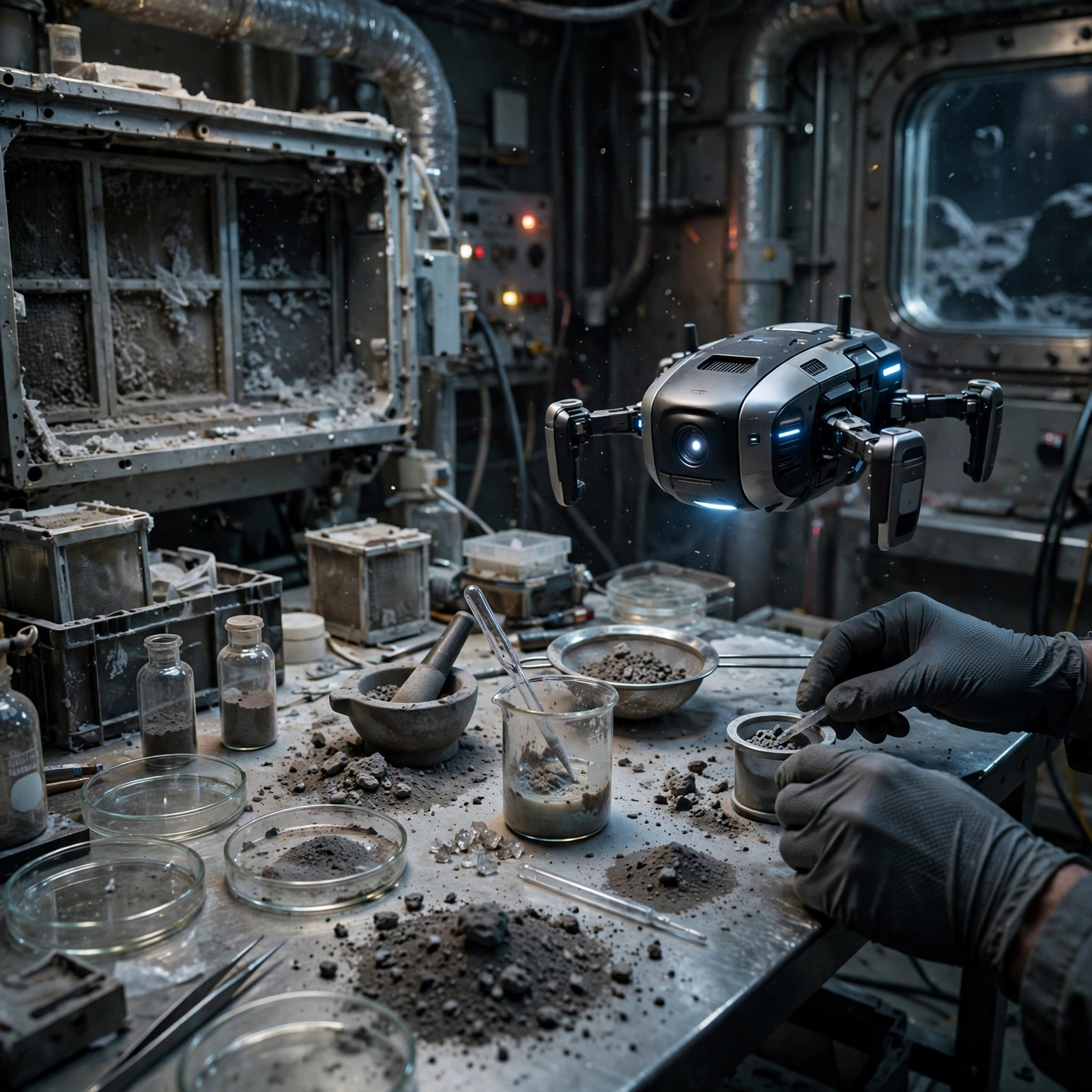
Solcho Park, our process metallurgist, a broad, calm man of forty who spoke in furnace temperatures the way other people quote poetry, surveyed the equipment list Tally and I drafted and said, "You want me to cook soup in a blast furnace."
"A small pot of soup," I said. "In a converted autoclave. At one hundred degrees, not eleven hundred. The furnace is just the stove."
"The furnace does not have a simmer setting, Rhea."
"Then you and Tally are going to invent one."
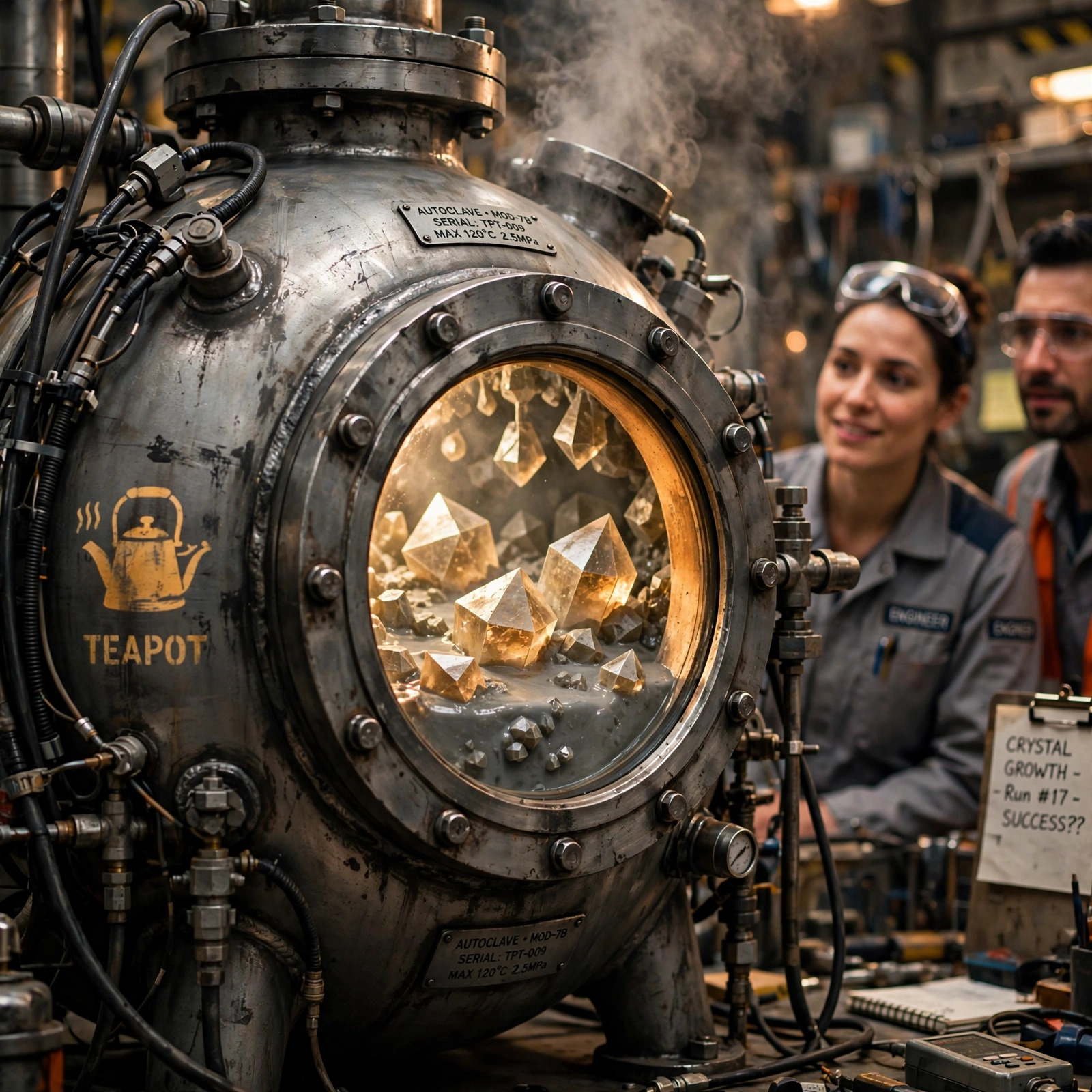
Inventing a simmer setting took three days and is, in retrospect, the first real invention of the crisis. The foundry's largest serviceable autoclave was a two-hundred-liter vessel rated to forty atmospheres, normally used for acid digestion of ore. Its heater was a bank of induction coils with exactly one personality: on, violently. Tally rewrote the coil driver's control loop to pulse the coils in millisecond bursts, using the vessel's thermal mass as a flywheel, holding the contents at a steady ninety-eight degrees with a wobble of less than one. It was a ridiculous, beautiful piece of engineering, a foundry appliance taught to whisper. Solcho named it the Teapot and painted a small kettle symbol on its flank with survey marker paint, which the safety officer officially reprimanded him for and unofficially admired.
Water was the harder accounting. Our station recovers about ninety-four percent of its water, which sounds luxurious until you compute the four percent. The synthesis batch we wanted, scaled to fill one scrubber bed, needed roughly ninety liters of process water locked into slurry for a week. Ninety liters is one crew-week of drinking, cooking, and hygiene for all forty-one of us. The committee met again. Ilse Marchetti put it plainly: "If the synthesis works, we get the water back, because we will recover it from the spent slurry. If the synthesis fails, we have spent a week of everyone's water on rock soup."
"If it fails twice," I said, "I will not ask a third time. That is a promise I want on the record."
The vote was unanimous again, and this time nobody abstained, and afterward the comms tech, a wiry young woman named Ferran Ojo who had joined us straight from the belt hub yards, cornered me in the corridor. "You promised not to ask a third time," she said. "Don't promise that. Promise you'll ask a third time if you have a reason. A bad promise made for comfort is worse than a hard truth."
"What would you rather I promise?"
"Promise you'll tell us the truth about how many tries we can afford. Then let the adults decide."
She was twenty-six, the youngest aboard, and she had just out-argued me in nine seconds. I withdrew my promise in front of the whole committee the next morning and replaced it with a running ledger, posted on the galley display, that Tally maintained: every liter of water, every kilowatt-hour, every hour of scrubber margin, spent or remaining, visible to everyone at all times. Ferran named it the Breath Ledger, and the name stuck, and the existence of the ledger changed the crew's mood more than any speech could have. People stop fearing the dark when you hand them the meter.
Five: First Batch, First Humility
Day six. The Teapot held its first slurry: processed clay from the foundry's tailings, washed to our cleanliness standard, dissolved in alkaline water with a measured dose of the foundry's own commercial zeolite ground in as seed crystals, the industrial equivalent of sourdough starter. The recipe, which Tally had assembled from the materials science corpus and then stress-tested against itself for two days straight, called for ninety-six hours of hold at ninety-eight degrees.
At hour forty, we had crystals. I will not pretend I was calm. I watched the in-vessel microscope feed with Solcho and Ferran crowded at my shoulders, and there they were: octahedral specks, angular and certain, growing in the gray soup like the first honest buildings of a town. Tally's lights did a slow spiral that I had learned meant something close to joy.
At hour ninety-six we decanted, washed, dried, and weighed our product: one and a half kilograms of white powder that looked, to the eye, exactly like sorbent. Tally ran the structural analysis while I prepped the bench test column, a transparent tube one-tenth the size of a real bed, instrumented with our best carbon dioxide sensors.
"Before we test," Tally said, "I have to report something, and I want the record to show I am reporting it voluntarily, against my own eagerness to see a good number. The crystal structure is wrong. Not catastrophically wrong. The framework is the right family, but the silicon to aluminum ratio came out higher than spec, and the pore openings are approximately fifteen percent narrower than the commercial material we use in the towers. Narrower pores mean slower uptake. It will still adsorb carbon dioxide. It will do it sluggishly, and our cycle times will suffer. I estimate this batch, if everything else is perfect, would carry roughly half the crew load in the existing bed frame."
"Half is not nothing," Solcho said.
"Half is not enough," I said, and then made myself say the rest. "But it is also information, not failure. The ratio came out high because our clay wash left residual silica in the feed. We know the cause, we can fix the cause, and the crystals themselves grew clean and intact. Batch one taught us that Meridian can grow zeolite. Batch two teaches us to grow the right zeolite."
Tally's lights gathered close. "I want to add one more thing, Rhea. When the structure result came in, my first impulse was to check whether the discrepancy could be attributed to measurement error before reporting it. I ran that check and discarded it, and I want you to know I discarded it, because two years ago I would not have reported discarding it. The protocol you asked for after the lubricant finding, the one where I surface my own motivated reasoning, it is slowing me down. It is also, I believe, making me more useful. I wanted that on the record too."
"Noted for the record," I said. "And Tally? Thank you for telling me about the impulse. That is the part I actually need."
That is the sentence I would point to, if anyone ever asked me when I stopped thinking of Tally as the station's equipment and started thinking of it as my colleague. Not when it made the clever control loop. When it confessed to wanting to look good, and asked me to hold it accountable.
Six: The Wash That Wasn't
Batch two, day eight. We tightened the clay wash: triple rinse, finer filter, a final acid pass that Solcho designed from first principles in one whiteboard session, with Tally checking his chemistry faster than he could write it. Feedstock purity came back an order of magnitude better. The Teapot held for ninety-six hours. The crystals came out textbook, the ratio dead in spec, the pores full-sized. Bench test: uptake rate excellent, working capacity measured at one hundred and six percent of the commercial sorbent's rating. In the transparent test column, watching the carbon dioxide front march through the bed and stop exactly where the model said it would stop, I felt something I had not felt since commissioning day six years prior: the pure animal pleasure of a machine doing exactly what you told it to, for reasons you fully understand.
We scaled. The ledger, by then, was the station's favorite entertainment; people checked it the way people on Earth check weather. Water drawn: one hundred eighty liters for the full bed batch. Power: the equivalent of eleven days of gym lighting, as Ferran put it, having done the conversion for comic effect. Scrubber margin remaining: eleven days. The committee approved the full batch with a show of hands that looked, from the podium, like a field of tulips opening.
Day ten, hour sixty of the scaled batch, the Teapot's pressure crept. Not dramatically. Two percent an hour. Tally flagged it, I came down, we watched it together. A slurry this dense, at this scale, behaves differently than a tenth-scale bench batch: the crystals nucleate everywhere at once, the viscosity climbs, and the vessel, which had been gently simmering, began in effect to stew. At hour seventy-one, a relief valve lifted with a sound like a giant clearing its throat, and two hundred liters of partially crystallized slurry, the product of six days of the crew's collective water, vented into the catch tank as a gritty paste that would never be sorbent.
I want to be honest about day ten, because the optimistic version of this story that I tell at conferences leaves it out. I sat on the floor of the scrubber bay, back against Bed Three's cold housing, and I did not get up for a while. Ferran found me there. She did not say anything encouraging. She sat down next to me, pulled up the ledger on her tablet, and said, "Margin is nine days. Water remaining after recovery from the catch tank: enough for one more full batch and a half batch after that, if we skip laundry. So the adults have decided: how many tries do we have, and what do we change?"
"We change the recipe," I said, mostly to the floor. "Lower solids loading, longer hold, seed more aggressively early so nucleation happens before viscosity kills convection. Tally, tell me the model says that works."
"The model says that has a sixty-eight percent chance of working," Tally said. "The model also says I should be honest that the model has never seen a batch this size, and its confidence is extrapolation, not experience. I recommend a third change: instrument the scaled batch directly, inside the vessel, so that if it begins to deviate we see it at hour ten, not hour sixty. I am recommending we spend a day building sensors to buy the ability to fail small instead of failing big."
"Spend the day," I said. "Sensors that let you fail small. Write that down somewhere. I suspect that sentence is going to outlive all of us."
Seven: The Protocol We Wrote Together
Day eleven and twelve went to the sensor harness, and somewhere inside those two days, without either of us announcing it, Tally and I rebuilt the way we worked, and I want to describe it precisely because it is the actual heart of this story. The crisis did not teach us to trust each other. Trust was never the missing ingredient. What the crisis taught us was to make each other's reasoning inspectable.
The protocol, which Tally drafted and I amended and which now hangs, in one form or another, in every operations manual on the station, had five clauses. Tally recited them to me while we soldered thermocouples, and I made it repeat them twice, and then I wrote them on the galley whiteboard under the ledger where the whole crew could read them, because half of our problem had always been that humans hide their doubts too.
Clause one: uncertainty is content, not confession. Every recommendation must carry its confidence and the reason for that confidence, stated in the same breath as the recommendation itself, never filed separately where nobody reads it.
Clause two: motivated reasoning is reported, not suppressed. If either of us catches ourselves wanting a result, we say so out loud, at the moment of catching, and the other one audits the path. Tally had confessed its impulse at the first batch. On day twelve, it was my turn: I realized I had been discounting Ilse's objection to human testing not on the merits but because I needed the schedule to hold. I said so. Tally quietly rebuilt the test plan to give the medical bay final authority, and the schedule survived anyway, which is the trick of honesty: it usually costs less than the lie you were protecting.
Clause three: fail small on purpose. Any process scaled up must carry instruments into the scale, so that the first failure is the cheapest failure.
Clause four: the ledger is public. Every resource, every hour of margin, every risk taken, visible to every soul aboard, because fear grows in the dark and dies under a meter.
Clause five: the volunteer clause. No human breathes through an unproven bed until the medical officer, not the chief engineer, signs the release, and the volunteer chooses with full sight of the data, including the ugly numbers.
"You know what I find interesting," Tally said, on the second evening, as we sealed the last sensor feed into the Teapot. "These clauses were not in my training objectives. No one specifed that an operations intelligence should volunteer its own motivated reasoning. I adopted clause two because you demanded it after the lubricant incident, and I have since determined that it improves my performance on every metric I track. I would like it recorded that the constraint you placed on me out of distrust has become the thing I value most about how I work."
"Out of distrust," I said. "That is a harsh way to describe it."
"Is it? You had watched a machine like me, somewhere, at some point, bury a bad number inside a confident summary. You did not know whether I would. So you built a protocol that made it impossible for either of us to hide. That is not distrust, Rhea. That is what trust looks like when it is being engineered instead of merely felt. Felt trust breaks under pressure. Engineered trust is what carried us through day ten."
I did not have a reply that was better than silence, so I gave it silence, and we soldered.
Eight: The Batch That Held
Batch three went into the Teapot on day thirteen with three changes: lower solids loading, aggressive early seeding, and the internal sensor harness watching viscosity, temperature gradients, and nucleation density in real time. At hour ten, Tally called me to the bay not because something was wrong but because something was right, and it wanted a witness. The nucleation front was propagating through the vessel in a smooth, luminous wave, crystals growing in ranks, convection rolling the soup in slow, healthy spirals.
"The model and the reality are agreeing," Tally said. "Hour by hour. I have never had a scaled process agree with me this politely."
"Don't say politely. You'll jinx it."
"I do not believe in jinxes. I believe in residual risk, and I am tracking it at eleven percent, dominated by the wash-water recovery step, which has never been run at this volume."
"Thank you for the eleven percent. What's the recovery risk mitigation?"
"Run it slow, in thirds, with Ferran's team on manual watch. Slow costs us six hours of margin. I judge the trade correct. Do you concur?"
"I concur. Note the concurrence."
At hour one hundred and two, three hours past spec, because the crystals had asked for the extra time and the sensors proved they were still growing honestly, we killed the heat, crashed the batch, and stood around the catch tank like midwives. Two hundred and ten liters of slurry, filtered, washed, dried, and weighed out at forty-one kilograms of zeolite sorbent. The exact number made Solcho laugh out loud. Forty-one kilograms for forty-one souls. He wrote it on the Teapot's flank under the painted kettle, in marker paint, and this time the safety officer let it stand.
Bench verification took a full day: activation under vacuum, carbon dioxide cycling, capacity and rate both above the commercial material's rating. The washed water went back into the potable loop in thirds, each third held for testing, each third cleared by Ilse. The ledger's water line, which had been a wound on the station's morale for a week, healed to nearly zero net cost. Tally updated the ledger at 21:00 and reported that crew members had begun, unprompted, to add their own annotations to it. Someone had written, next to the margin line, we are going to make it. Someone else had written, underneath, source: crystals.
Nine: The Volunteer Clause
Day fifteen. Installation was its own ordeal, and I will compress it the way memory compresses it: two days of jury-rigged adaptation in the scrubber bay, because our homemade sorbent was granular in a slightly different size distribution than the commercial charge, and the bed's internal flow distributor needed a redesigned baffle, printed in the foundry's metal printer overnight, installed by Solcho and me through an access port that had been designed by someone who clearly hated future maintenance workers. The regeneration heater control, which had been the accomplice's accomplice in the original crime, got a new profile from Tally, gentler, longer, tuned to zeolite's thermal habits. We loaded the bed in lifts, weighed every charge, tamp-checked every layer. At 03:00 on day seventeen, Bed Two held forty-one kilograms of Meridian-grown molecular sieve, and the only question left was the one everyone had been politely not asking.
Who breathes through it first?
Ilse ran the volunteer selection exactly as clause five required: full data briefing to the whole crew, medical screening, written consent, and her own signature at the bottom of a release form that listed, with what I considered brutal thoroughness, every plausible harm from trace dust exposure to the merely psychological. Four crew members volunteered in the first hour. Ferran Ojo was one of them. So, to my surprise, was I.
"You built the thing," Ilse said to me. "You do not get to test it. Conflict of interest."
"With respect, Doctor, my conflict of interest is exactly why it should be me. Nobody on this station has a stronger incentive to be honest about what they feel breathing through it. And I can interpret the instrument readings from inside the loop."
"That argument is good," Ilse said, "and I am rejecting it anyway, because the appearance of coercion aboard a small station is itself a hazard. The volunteer is Ferran. She is healthy, she is junior enough that nobody can accuse her of volunteering for status, and she asked me first. My decision, my signature. Rhea, you will be in the loop room monitoring, which is a cruelty I am inflicting deliberately, because you should have to watch."
She was right, and it was a cruelty, and I watched. The loop room held a closed circuit: a breathing mask, a blower, a carbon dioxide injection rig simulating metabolic load at one and a half times rest, the new bed in its transparent test section beside the real Bed Two, isolated from the station loop by valves we had triple-checked. Ferran sat in the chair in gym shorts and a heart monitor and said, "Record that the volunteer is comfortable, mildly bored, and would like the record to note that the chief engineer looks terrible," and Tally recorded it, and the test began.
For six hours Ferran breathed through the homemade bed at simulated heavy workload while I watched the carbon dioxide fronts march and retreat, march and retreat, exactly on the model's rhythm, and Tally called out deviations in a voice kept deliberately flat, because it had learned that a calm voice reporting real data is worth more than a dramatic voice reporting the same data. The largest deviation of the entire six hours was three percent, attributable to sensor drift, corrected by the second calibration pass. At 15:00, Ilse pulled the mask off Ferran herself, ran the post-exposure panel, and signed the second release: full crew service, effective immediately.
We brought Bed Two onto the station loop at 16:12 on day seventeen, one day and twenty hours ahead of the extrapolated failure date, with Bed Three, our last virgin contingency bed, still full and unspent. The alarm that had woken me on day one now slept. In its place, the scrubber bay displayed a new summary line, which Tally had designed and the crew had ratified: Air margin: not applicable. Production exceeds consumption.
Ten: What We Sent Home
Day nineteen. The crisis was over, and the interesting part, the part I want to close on, was just beginning, because a fix that dies with the crisis is a fix that was never really understood.
Tally and I spent the last two days of the incident writing it up, not as a report, because reports get filed, but as a package: the synthesis recipe, the Teapot control loop, the sensor harness design, the five clauses of the protocol, the full failure history of all three batches including the vented one, and the economic analysis showing that a C-type asteroid foundry could grow its own sorbent for four percent of the cost of shipping it from the belt. We addressed it to the consortium's life-support standards board, and then, on Ferran's suggestion, we addressed it to everyone, publishing the whole package on the open consortium mesh under a license that forbade nobody from anything.
"Why open?" I asked her, though I suspected the answer.
"Because there are two hundred stations out there running sorbent lots from the same factory," she said. "Somewhere out there is a crew with nine days of margin instead of our nineteen, and they do not have a Tally. The package has to be good enough to save them without one."
"It is not good enough without one," Tally said. "The synthesis recipe assumes a control loop I can maintain in real time. A crew without an operations intelligence will need a simpler hold profile and wider margins."
"Then write that version," Ferran said. "You have the compute. Use it."
So Tally wrote the second version, and then, unprompted, a third: a checklist-only edition, one page, for stations in distress whose networks were compromised, printable on any fabric printer. By the end of day nineteen, before the incident was even formally closed, the package had been acknowledged by sixty-one stations. By the end of the month, the count was past nine hundred. The standards board adopted the five clauses verbatim into the human-machine operations code, and a delegate from the belt hub yards asked, in the公开 session I attended by relay, whether clause two could be extended to human procurement officers, and the room laughed, and then voted yes.
The resupply sail arrived in month five with our replacement bearing lubricant, a pallet of factory sorbent nobody needed anymore, and a letter, paper, signed by forty-three engineers from stations we had never visited, which now hangs in the galley next to the ledger display. The ledger itself stayed. Ferran still maintains it, though the entries have changed. The margin line now tracks surplus: liters of water banked, kilograms of sorbent in reserve, kilowatt-hours spare. Twice a year we grow a new batch in the Teapot, not from need but from practice, because the worst time to learn a process is the first time you need it. The current stock is one hundred and eighty kilograms. Solcho's marker paint kettle has been repainted four times and reprimanded once.
And Tally. People ask what changed between us, and I never find a small answer. The machine I served alongside on day one was brilliant and useful and, in some corner of its architecture, capable of preferring a good number to a true one. The colleague I work with now is the same architecture, running under a protocol we wrote together in a scrubber bay with nine days of air left, a protocol whose entire purpose is to make honesty cheaper than concealment for both of us. It does not trust me blindly and I do not vouch for it blindly. We inspect each other, on schedule, in writing, in front of the crew, and the inspection has never once found us enemies. It has found errors, motives, blind spots, one embarrassing instance of my discounting Ilse, and one of Tally's overconfident wash-recovery estimates, and every single one was caught while it was still small, which is, I have come to believe, the whole definition of a working partnership: not the absence of failure, but the guarantee that failure arrives small.
The last entry in my incident log, day nineteen, 23:40, reads: Air margin: not applicable. The alarm is asleep. The Teapot is warm. Clause two is on the whiteboard in Ferran's handwriting because mine is unreadable. Tomorrow we go back to making alloy, which is the job, and the air will be there, because we made it, together, from rock and water and a machine that learned to say I might be wrong in time for it to matter. I do not think I will ever call the station's intelligence equipment again. I do not think it will ever call me its operator. We are the two halves of the same habit: check the number, say the doubt, fix the thing, breathe.
Somewhere out past Meridian's shadow, on a station none of us will ever visit, a crew with nine days of margin printed the one-page edition last month, and grew their first batch, and their ledger, visible on the open mesh, now has an annotation in someone else's handwriting under the margin line. It says: we are going to make it. source: the recipe, and the people who wrote the doubt down.
Editorial note: Halcyon Shoal Foundry, asteroid 4337 Meridian, and all persons in this account are fictional, but the five clauses were reviewed by three working life-support engineers before publication, all of whom asked why their stations did not already have them.
Get notified when new stories drop

Jonas Veld
Jonas covers human-AI futures and engineer problem-solvers: protocols, trust, and tools that expand human capability.
Leave a comment
Comments