


What does it actually take to make a strange world feel like home? Not a flag, not a deed, not even a dome with your name stamped on the airlock. Ysolde Marr had come to Anserel Deep believing it was a matter of infrastructure, of tonnage and schedules, of the great slow machinery of terraforming grinding out a breathable sky. Fourteen months into her contract she had revised the theory entirely. It took, as far as she could tell, a broken pump, five stubborn people, and a valley that had learned to wait for rain.
The dispatch that reached her bunk at 04:12 local was terse even by the standards of the Anserel Terraforming Consortium, which prided itself on prose stripped of everything but verbs: Rain engine three, south intake, bearing seizure, flow rate falling, dry season in thirty-one days, crew assigned, go.
One: The Crew Manifest
Ysolde read the manifest on the tram ride south and felt the particular dread of an engineer meeting strangers. She was the consortium's senior flow systems specialist, thirty-six years old, eleven years in the field, and she had learned on three worlds that crews were like catalysts. The right combination made everything hum. The wrong one poisoned the reaction.
The tram car was nearly empty at that hour. One passenger, though, sat across from her with the relaxed sprawl of someone who had never once worried about a bearing in his life, a broad man in his fifties with gray stubble and a mug of something that steamed wrong for coffee. He wore the patched coveralls of a general mechanic, and the patches told a history: cryo plant, hull work, agri rigging, and, on the shoulder, an embroidered fish that had clearly been done by hand, badly, with love.
"You'd be Marr," he said. "I'm Dov Haral. I'm your second, whether you like it or not."
"You already know the assignment?"
"I requested it." He took a sip of the wrong-coffee. "Rain engine three is my engine. I helped pour its foundation when this valley was nothing but regolith and ambition. If it's sick, I want to be there." He studied her the way she studied pressure gauges, looking for hairline fractures. "You're new. Fourteen months. Good numbers, but field people say you keep to yourself."
"Field people talk too much."
"They do," Dov agreed cheerfully. "It's how we pass on what kills us. You'll learn to talk eventually, or you'll learn alone, and out here the second lesson is always the expensive one."
Ysolde looked out the window. The tram ran on a single elevated rail through country that was still deciding what it wanted to be. Red stone gave way to the first stubborn green of engineered lichen, and beyond that, in the distance, the terraced bowl of Anserel Deep caught the early light. Fourteen months, and she still felt the catch in her throat at the scale of it. Humanity had been given a fixer-upper planet and, against every cynical prediction, was fixing it up.
"Who else?" she asked.
"Pem Sural, atmospherics, best gas chemist on the continent and the worst cook. Jun Okonkwo-Wren, structural, twenty-four years old and twice as good as she thinks she is. And Vesh." He paused. "Vesh is the pilot. You'll meet Vesh."
"That pause is doing a lot of work, Haral."
"Vesh is an experience," Dov said, and refilled his mug, and would say nothing more.
Two: Rain Engine Three
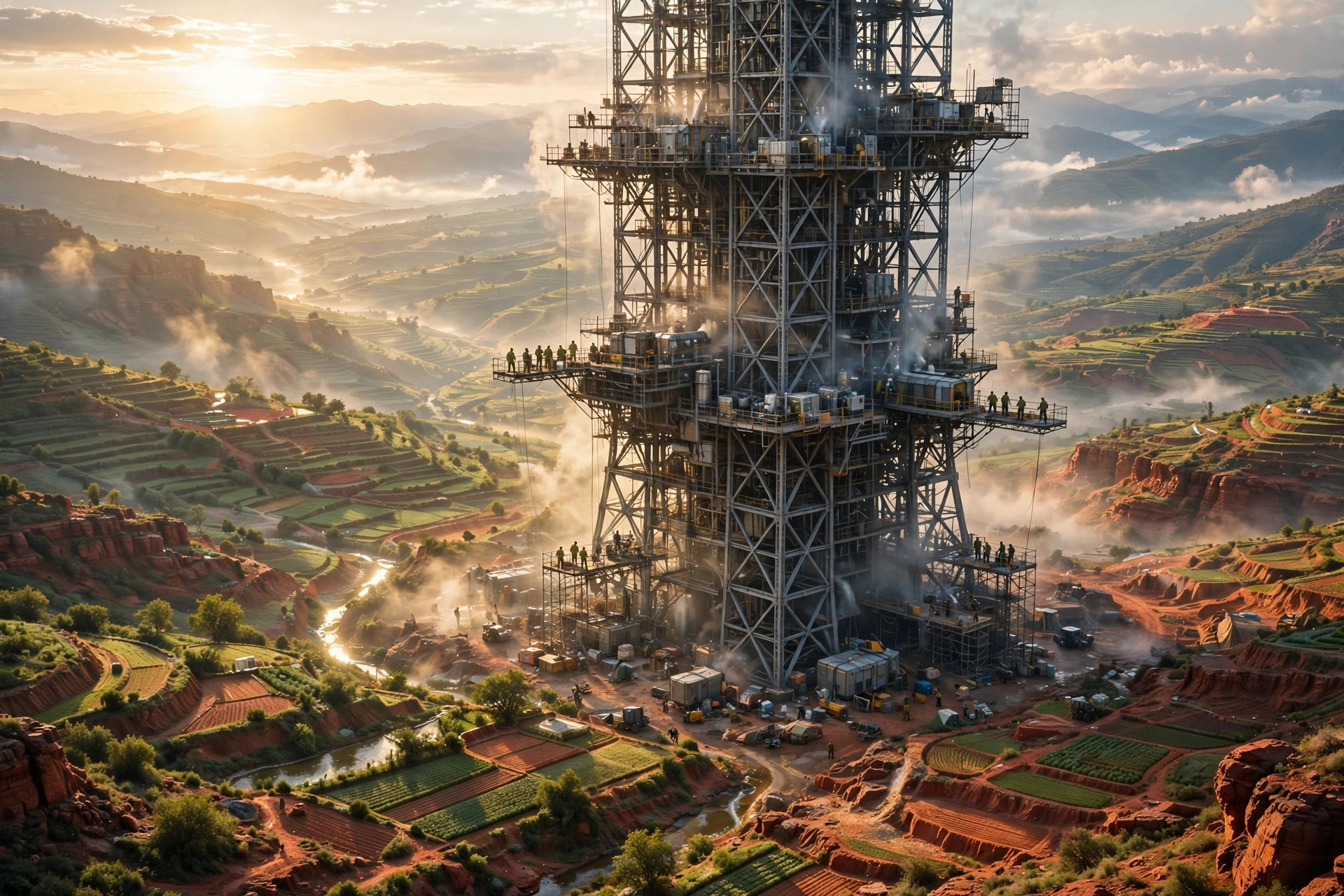
The great towers of the Deep rose from the valley floor in a loose arc, nine of them, each one a hundred and forty meters of lattice and duct and cold-glowing conduit. They were called rain engines because that was what they did, though the mechanism would have baffled anyone imagining pipes and sprinklers. Each tower pulled atmosphere from the upper troposphere, stripped out what the young world still had too much of, chiefly sulfur compounds and a stubborn excess of carbon dioxide, seeded the processed stream with nucleation particulates, and returned it as weather. Weather with intent. The consortium's older engineers called the towers cathedrals, half in mockery, and the name had stuck because mockery, on a frontier, curdles into affection fast.
Engine three was the oldest and the southernmost, and it had a sound problem before Ysolde even stepped off the tram. Healthy rain engines sang. Their harmonic signature, the deep chord of compressors and flow regulators, was logged and monitored like a patient's pulse. Engine three was singing flat.
"You hear it?" Dov asked, head tilted.
"South intake compressor, third harmonic depressed," Ysolde said. "Bearing's not just seizing, it's been dying for weeks. Someone's been nursing it instead of flagging it."
"Or the diagnostics have been lying," said a voice from the tower's base, "which is worse."
Pem Sural was small, quick, and dressed in the layered silvers of an atmospheric tech, goggles pushed up into dark curls. She shook Ysolde's hand with a grip calibrated for delicate glassware and immediately regretted it. "Sorry. Force habit. I work with vortices." She led them inside, talking the whole way, a stream of data delivered like a friend catching you up on gossip. "Flow's down eleven percent. Nucleation seeding is compensating, which is why the valley hasn't noticed yet, but compensation is a loan, not a gift, and the interest compounds. Thirty-one days to dry season onset. If we can't restore full throughput, the southern terraces miss their pre-monsoon saturation cycle and the mycorrhizal network we spent six years establishing goes into water stress. Not dies, stress. But stress in year six becomes collapse in year nine, and I did not spend six years nursing that network to watch it sulk."
"You've been down here alone?" Ysolde asked.
"With Vesh." Pem's mouth did something complicated. "Vesh flew me in yesterday. Vesh is around."
"Everyone keeps saying that like it explains things."
"It does," said Pem, "in the way weather explains things. You'll see."
Three: The Pilot
Ysolde met Vesh at 07:30, in the tower's maintenance bay, standing on a catwalk that should have been off limits, upside down.
Not fully upside down. The woman had anchored her boots to the rail with mag clamps and folded herself backward over the void, hair hanging, working on a junction housing with a tool that had no business being used at that angle. She was maybe thirty, wiry, with a sun-faded flight jacket and the serene expression of someone performing an activity no sane insurer would cover.
"You're the new flow specialist," Vesh said, without looking up. "Ysolde Marr. Eleven years, three worlds, excellent numbers, keeps to herself. Welcome to my cathedral."
"You're working on my intake manifold without authorization."
"I'm working on the junction housing adjacent to your intake manifold, and I have authorization, I just don't have paperwork, because paperwork is a gravity well and I avoid gravity wells when I can." She righted herself with a fluid kip that made the catwalk sing, landed, and stuck out a hand. "Vesh Annaya Odukoya. Ferry pilot, structural rigger, unlicensed poet. Dov told you about me?"
"He paused meaningfully."
"That's Dov. The pause is his love language." Vesh's grin was quick and warm and entirely unrepentant. "Don't worry, Marr. I've already inspected your south intake. Your bearing isn't seizing. It's being ground down by something that shouldn't be in the lubricant loop, and I know what it is, and I know why the diagnostics missed it, and you're going to be furious."
Ysolde felt the familiar click of a real problem engaging. "Show me."
Vesh led her down and along the intake gallery, chatting the whole way about the tower's architecture as if introducing a mutual friend. "Built forty years into the program, first generation, overbuilt everywhere except the places nobody thought to look. That's the thing about first generation anything. The builders were so busy defending against the monsters they imagined they missed the small patient ones."
In the gallery, Vesh popped an inspection port and aimed a borescope into the lubricant return line. The feed showed Ysolde the inside of the pipe, and the pipe was furred, along one entire seam, with a crust of pale crystalline scale.
"Calcium carbonate?"
"Look closer. The spectrograph attachment is running." Vesh handed her the scope. "It's carbonate, but it's not from the lubricant. It's from the air. Trace mineral dust from the regolith we're still processing, drawn in through a microfissure in the intake shroud, precipitating in the warm return line. A mineral we ourselves introduced, from the very terraforming, is fouling the machine we built to do the terraforming. The system eating its own tail. The diagnostics never flagged it because the scale forms a gradient too gradual for the fault thresholds. The tower is sick the way people get sick. Slowly, quietly, and in a place nobody thought to look."
Ysolde stared at the feed, and the fury Vesh had promised arrived, but underneath it was something else, something she recognized from her best days: delight. This was a puzzle with teeth. "The microfissure is the root fix. The scale is the presenting symptom. We have to do both, and we have to do both without taking the intake offline for more than forty hours, or flow drops past the point where seeding can compensate."
"Now she's cooking," Vesh said happily. "Come meet the rest of the family. We're going to need everyone."
Four: Jun
Jun Okonkwo-Wren arrived on the mid-morning freight sled, stepping off with a tool roll slung over one shoulder and a look of open, unguarded wonder at the tower above her. She was young, as Dov had said, but her hands were steady and her eyes went to the right things: load paths, weld seams, the hairline tells of metal under long stress.
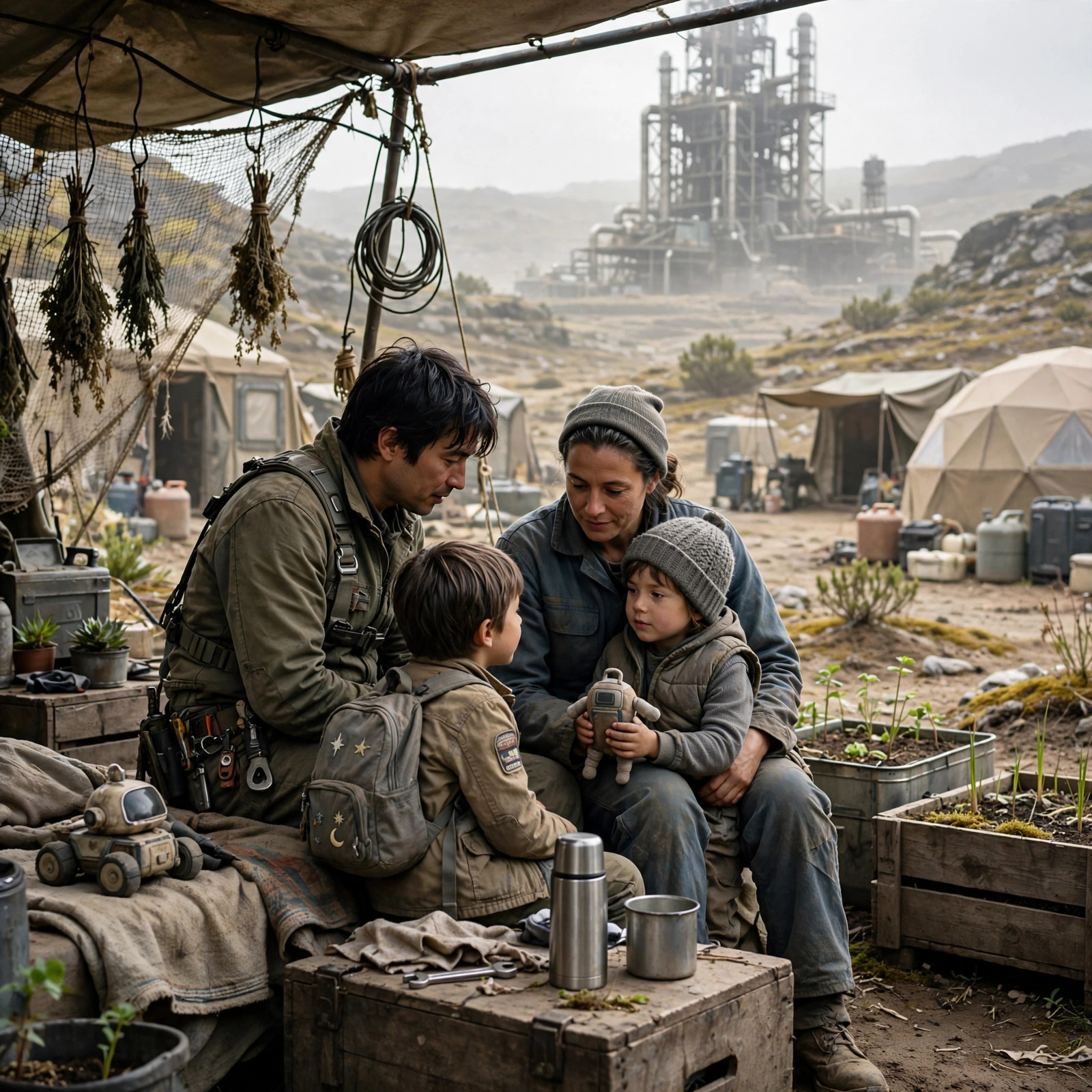
"Structural," she said, shaking hands all around. "The consortium sent me because the intake shroud's microfissure is my problem. I've been studying the as-built drawings all week." She paused. "They're wrong, by the way."
"Wrong how?" Ysolde asked.
"The shroud was modified in year nine. There's a retrofit patch on the drawings, a reinforcement ring, but when I cross-referenced the material batch numbers with the consortium's records," Jun flushed a little, aware she was correcting a senior specialist on her first day, "the batch that was actually used doesn't match the batch on the drawings. Someone substituted. Same spec on paper, different alloy in practice, and the substitute has a different thermal expansion coefficient. Forty years of thermal cycling, day night, day night, and you get exactly the kind of microfissure Vesh found."
"Someone substituted material," Dov said slowly, "in year nine." His face had gone strange.
"Is that bad?" Jun asked. "It was probably a supply emergency. The early years were full of them."
"It was," Dov said. "Year nine, the northern freight line failed in a storm season. Half the continent ran short. Crews everywhere improvised. Some of them wrote it down. Some of them," and here he smiled with an old man's tenderness, "were too busy to write anything down, and their substitutions became mysteries for people like you to solve forty years later. I know, because I was one of the ones who didn't write it down."
"You did this shroud?" Ysolde asked.
"I did a hundred shrouds that year. Maybe this one. The alloy they substituted, I remember it. It was from a decommissioned water tanker's pressure hull. Good steel. Wrong steel. We knew it was wrong. We knew someday somebody would come along and have to deal with it, and we did it anyway because the tower needed to breathe that week and the right steel was on the other side of a continent." He spread his hands. "Every structure on this world has a story like that in it. You're not looking at a mistake, Jun. You're looking at a decision somebody made at the edge of their resources, hoping the future would be generous."
The catwalk was quiet for a moment. Ysolde looked at the old mechanic and the young structural engineer and understood that she was watching the future being generous, in real time.
"Then we honor it," Jun said finally, "by fixing it properly. I'll need to design a replacement ring section, cold-fitted, no field welding near the intake. And I'll need the drawings corrected so the next person in year eighty doesn't inherit another mystery."
"Write everything down," Dov said solemnly. "That's the whole religion. Write everything down."
Five: The Procedure
They gathered that evening in the tower's crew room, a dome of scavenged furniture and hand-labeled shelves that had clearly been a home to many crews before them. Somebody had left a mural on one wall: the valley as it would look in a hundred years, green and terraced and raining. Somebody else had added, in smaller letters beneath it, the words: we are the weather now, be kind.
Ysolde stood at the board with a marker and did the thing she was best at in the world, which was turning chaos into procedure.
"Problem one," she said. "Remove carbonate scale from the lubricant return loop without taking the intake offline. Problem two, repair the microfissure in the intake shroud, root cause, so the scale never comes back. Problem three, do it all inside a forty hour maintenance window, which we get to choose, and choosing it is its own problem because the tower's output matters most at night when the thermal gradient drives convection."
"So we work days," Pem said. "But the scale removal, I can help there. There's a chelation flush protocol from the water treatment side. Food grade citric compound, heated, circulated through the loop for six hours. It'll dissolve the carbonate without attacking the bearing surfaces. I've run it on condenser stacks. It's boring, it's safe, and boring and safe are my favorite qualities in a procedure."
"I'll draft the flush procedure tonight and we review it as a team," Ysolde said, and wrote it on the board. "Bearing itself?"
"Bearings survive a chelation flush fine if we keep the temperature under sixty," Dov said. "But that bearing has been grinding for weeks. I want to pull it and inspect regardless. If it's past saving, we have spares in the southern depot, and moving a compressor bearing to site is a Vesh problem."
"A Vesh problem," Vesh repeated, delighted. "The depot is three hundred kilometers south. The freight sled would take four days round trip on roads that eat axles. The flyer does it in six hours, but the bearing assembly is nine hundred kilos, and my flyer is rated for six hundred on a good day with a tailwind and a clear conscience."
"Then we don't move the whole assembly," Ysolde said. "We move the inner race and the rolling elements, the parts that actually fail. The housing stays in the depot, the replacement parts come to us. What's the mass on the critical components?"
Vesh pulled a tablet, typed, and her grin widened. "Four hundred and eighty kilos. Marr, you just made a pilot very happy."
"I'm not happy until the flight plan is reviewed," Ysolde said. "Mass, balance, weather, fuel margins, and a divert field every fifty kilometers. You fly it on paper first and the paper says yes."
"See, this is why crews need skeptics," Vesh told the room. "Otherwise we're just five people agreeing with each other into a crater."
Jun raised her hand, uncertain, and Ysolde nodded at her. "The shroud repair. I can have the replacement ring sections machined in the tower's own shop from stock alloy we have on hand. Cold fit, preloaded fasteners, sealed with the flexible membrane compound. But I've never led a structural repair on a live atmospheric tower. I know the theory. I'd like someone who's done it to look over my plan."
"I've done it," Dov said. "Twice. Once successfully."
"What happened the other time?"
"Wind," Dov said. "Which is why your plan will include a wind stand-down threshold, and why we'll all respect it even if the repair is going beautifully. Especially then. The tower doesn't care that we're going beautifully."
Ysolde wrote it all on the board until the board was full, then stood back. Four strangers and herself, and the beginnings of a plan with everyone's fingerprints on it. She had spent eleven years believing her competence was a solo instrument. Looking at the board, she felt the first faint suggestion that it might, in fact, be a choir.
Six: The Valley
On the third day, Pem took Ysolde out to see what they were working for.
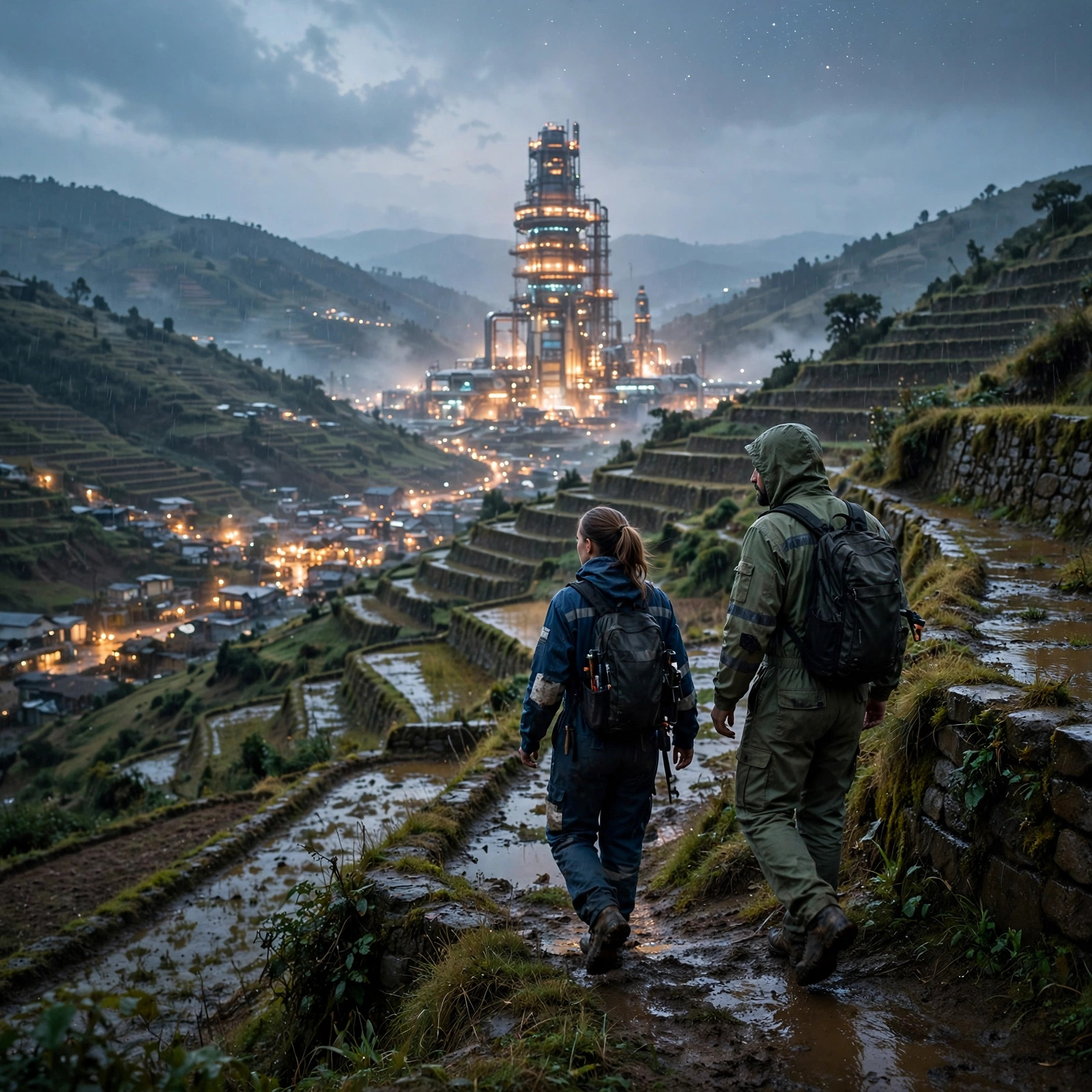
They walked the southern terraces in the gold light of late afternoon, up switchback paths cut into the valley wall. Pem moved like a person greeting relatives, touching the soil here, the root structure there, narrating without needing to.
"Six years ago this was sterile fines," she said. "We inoculated with engineered mycorrhizal consortia, engineered the terraces to hold meltwater, planted the pioneer lichens and then the grasses. Every year the network extends a little further. It's the slowest thing we do and the most important. You can buy an atmosphere. You cannot buy a soil. A soil has to be grown, and it grows at the speed of trust."
"Trust?"
"Between us and it," Pem said. "We promise the valley water on a schedule. The valley, in return, builds structure, holds carbon, feeds the next generation of plants. If we break the schedule, the promise breaks, and soils don't renegotiate quickly." She crouched and crumbled a handful of dark earth between her fingers. "This used to be rock. Someone's grandchildren will build an orchard here. That's the whole job, as far as I'm concerned. We're writing letters to people we'll never meet, in soil."
Ysolde thought of the mural in the crew room. We are the weather now, be kind. "My last posting, I fixed a failing heat exchanger on an orbital platform and flew home two months later. I never once saw what my work was for. It was for a number. Throughput. Here the number has a valley attached to it."
"That's why Dov requested you," Pem said, mildly, as though remarking on the weather.
"Dov requested me? The assignment came from consortium dispatch."
"Dov writes the request, dispatch sends the order. He's been doing it for thirty years. He reads every crew roster on the continent the way other people read novels, and then he quietly arranges for the right people to meet each other." Pem stood, dusted her hands. "He put you and Jun on the same job. A flow specialist who turns everything into procedure and a structural engineer who checks the paperwork nobody else checks. He's been waiting for that pairing for a year."
Ysolde stopped walking. "Why?"
"Because he says the next generation of towers will need chief engineers who can do what you do," Pem said, "and chief engineers are only ever made by crews, never by courses. He's not matchmaking the way you're thinking. He's matchmaking the way a gardener thinks." She smiled. "Also possibly the way you're thinking, but let's not rush him."
They walked back down as the first stars came out over the terraces, and below them, engine three sang its slightly flat song into the dark, waiting for them.
Seven: The Flight
Vesh's flight plan review took two evenings, which Ysolde counted as a victory, because Vesh fought for every margin like it was a personal friend. Mass and balance solved with the bearing components slung in a calculated cradle. Weather window chosen between two pressure systems, with a twenty hour buffer. Fuel margins that made Vesh groan and Ysolde unmoved. Divert fields plotted, four of them, each one a stretch of graded road with fuel cached in a buried pod, and here Dov had gone quietly to work, and by the second evening all four caches had been confirmed stocked by people he seemed to know personally in every settlement along three hundred kilometers of frontier.
"You built the roads," Ysolde realized, watching the confirmations come in.
"I helped," Dov said. "Mostly I know who built them, and what they owe me, and what I owe them, and nobody counts anymore because it stopped mattering around year fifteen. That's what a frontier is, Marr. A ledger nobody closes."
The flight itself, Ysolde watched from the tower's observation deck with Jun, both of them listening to the comm as Vesh flew south through the pressure trough. Vesh narrated the whole way, not for flight-deck protocol but because narration was simply how she moved through the world: wind shear at the pass, noted; the old tanker road visible below, still graded, still serving; sunset landing at the depot, and then the long careful business of rigging the cradle, which Vesh did with Jun talking her through the load plan step by step from the deck, the two of them finding each other's cadence within an hour.
The return leg came at night, the flyer heavy and slow, and forty kilometers out the crosswind picked up past the plan's limit. Ysolde heard Vesh's voice change, not frightened, just focused, and heard her make the call: divert to cache field two, wait out the wind, land safe, resume at dawn.
"She gave up twelve hours," Jun said quietly, "with the payload almost home."
"She respected the threshold," Ysolde said. "That's the whole job." And she understood, watching the dark sky where the flyer wasn't, why Dov had built this crew the way he had. Not the fastest people. The people who would hold the line at the moment holding the line was boring and hard and correct.
Vesh walked into the crew room the next noon, dusty and grinning, carrying the bearing components and a jar of honey from a settlement at cache field two, given in thanks for a favor nobody could quite remember the origin of.
"The ledger nobody closes," she said, setting it on the table. "Dov, I'm adding a page."
Eight: The Forty Hours
The maintenance window opened on a clear morning, and the crew moved into it like a single organism that had been practicing in its sleep.
Hour zero to six: Pem and Dov ran the chelation flush, circulating heated citric solution through the return loop, sampling every ninety minutes, the carbonate dissolving in a slow invisible surrender that showed up on the spectrograph as a rising curve and on the flow gauges as the third harmonic climbing back toward true. Hour zero to six was also when Ysolde discovered that watching a bearing be saved by chemistry was, for her, a religious experience, and that Pem had known it would be, and had saved her the best viewing spot.
Hours six to twenty: the shroud. Jun's replacement ring sections, machined in the tower's own shop to tolerances she had triple checked, went in cold under a sky that cooperated for sixteen of the needed hours. On hour nineteen the wind rose to within two meters per second of the stand-down threshold, and the whole crew stood on the platform watching the anemometer with the peculiar shared stillness of people waiting on a number, and the wind peaked, and fell, and Jun torqued the last fastener with eleven minutes to spare, and Dov said nothing at all, which from Dov was a standing ovation.
Hours twenty to twenty-six: the bearing. Vesh's components fit with a precision that made Dov hum, and the pull of the old race showed them all the truth of the diagnosis: a groove worn by forty years of patient mineral dust, a failure that had been a decision, once, made at the edge of someone's resources. Ysolde held the new race up to the light before seating it and thought, write everything down, and made Jun photograph every step.
Hours twenty-six to thirty-one were the worst. Restart procedures. Purging air from the flush lines. A pressure test that failed once, not dangerously, just stubbornly, at a fitting Dov had installed in year nine, and Dov looked at his own forty year old work and said, "Well, past me, we meet at last," and fixed it in twenty minutes with a part he had, absurdly, been carrying in his personal kit for thirty years for exactly this day.
Hour thirty-one: restart.
They gathered in the intake gallery, five of them, and Ysolde brought the compressor up by the book, stage by stage, watching each parameter settle before granting the next. At hour thirty-one and fourteen minutes, engine three's chord came into true. All harmonics. The gallery filled with the sound, deep and clean, and Pem started laughing first, and then Vesh, and then all of them, the helpless laughter of people who had been holding tension for a week and were allowed to put it down.
Flow rate, on the board in the control room: one hundred and two percent of design. The tower was, for the first time in its long life, running better than the day it was commissioned, because it now contained the work of six crews, each one building on the honest record of the last.
Nine: First Rain
The pre-monsoon saturation cycle began nine days later, on schedule, because they had made it on schedule.
The crew watched it from the southern terraces, which was Pem's idea, and which Ysolde understood at once was the real completion of the job. The towers sang their true chord across the valley. High above the arc of cathedrals, the processed sky, seeded and scrubbed and given intent, began to gather itself into cloud. The first drops fell on the upper terraces at 16:40 local, fat and slow and deliberate, the rain of a world being taught to weep on purpose.
Jun stood with her face turned up. Dov had his arm through Pem's. Vesh, for once, said nothing at all.
"Six years of work," Pem said softly, to the soil, to the mycorrhizal network running beneath their feet like a second nervous system, "and the letter arrives." The rain thickened. The valley darkened with it. Somewhere below, in the settlement, people would be walking out of their homes to stand in it, because on Anserel Deep rain was still new enough to be an event, and might be new forever, and that was fine.
"Next year," Jun said, "I want to correct the as-built drawings for the whole tower. Every crew's substitution, every decision at the edge of someone's resources, written down and honored. A full true record. So nobody ever inherits a mystery again."
"That's a five year job," Ysolde said.
"Good," said Jun. "I was hoping for a long one."
"And I," said Vesh, "want to fly the full survey for it. Three hundred kilometers of towers, roads, and caches, with Jun in the right seat arguing about batch numbers the whole way."
"You'll hate it," Jun said.
"I'll love it," said Vesh. "That's the trouble with me."
Dov looked at the four of them, rain running off his gray stubble, and delivered what Ysolde would come to recognize as the most meaningful pause of his career.
"The consortium asked me last month," he said, "to stand up a permanent deep-maintenance crew for the southern engines. Five posts. I told them I had candidates." He turned and walked a few steps up the terrace path, gesturing at the rain, the terraces, the singing towers, the whole wet green argument for their species. "I told them I had found the crew already. I just had to arrange for them to meet each other."
Ysolde stood in the first real rain of her adult life, on a world that was learning to be a world, beside four people who eleven days ago had been names on a manifest, and felt the last of her old theory dissolve. It did not take a flag, or a deed, or tonnage and schedules. It took the slow work, done honestly, in company.
"We are the weather now. Be kind."
Epilogue note, added to the tower's as-built record by J. Okonkwo-Wren, year fifteen of the Anserel program: intake shroud ring section replaced in full this season by a crew of five. All substitutions from the early years are now documented in appendix K. To whoever poured this foundation and could not write it down: we found it, we fixed it, we wrote it down. The future was generous. Pass it on.
Get notified when new stories drop

Sasha Quill
Sasha writes bold exploration and cosmic wonder with lyrical scale and grounded character work.
Leave a comment
Comments