




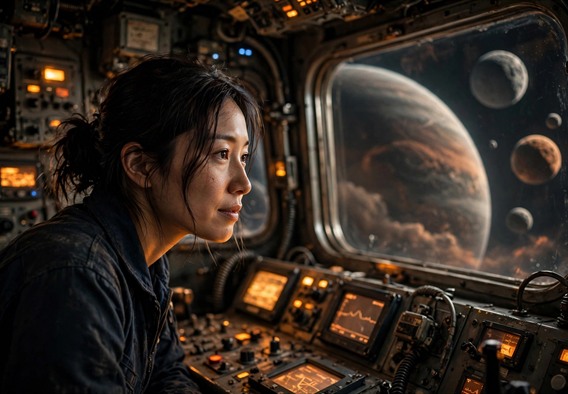
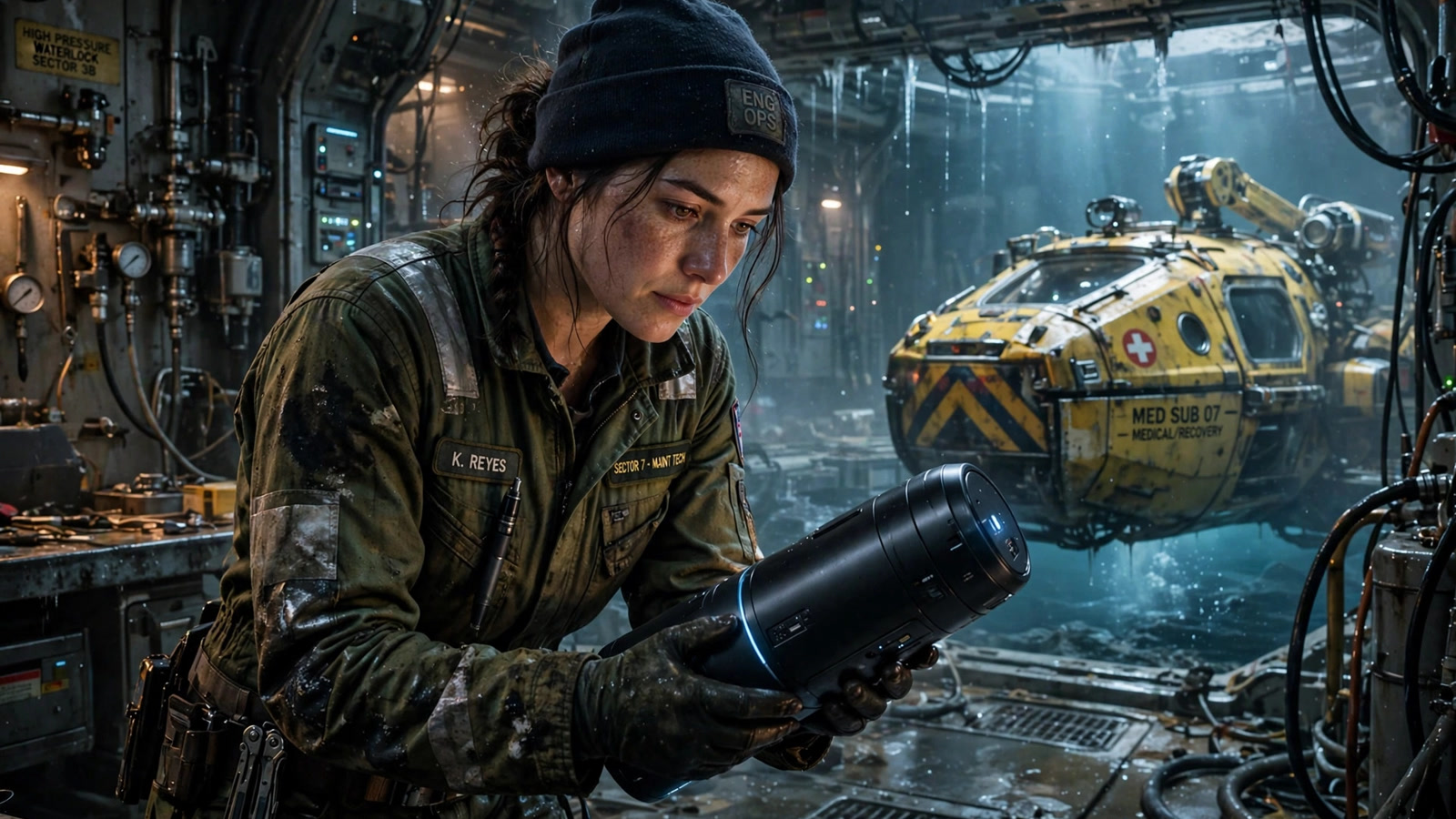
The salt corrosion on the primary intake valve felt rough beneath Elena Rostova’s gloved fingertips. She knelt in the damp maintenance bay of Tethys Base, tightening the mechanical linkage on the extraction submersible known as the Nereus. The year was 2048, and the Atlantic Ocean had long since swallowed the Carolina coastline. Tethys Base sat forty meters below the surface, serving as a critical medical staging habitat for the offshore aquaculture farms. Elena, at thirty-four years old, had spent the last three years keeping the aging fleet of medical submersibles operational. She trusted brass fittings, heavy grease, and analog gauges. She understood them. They never changed their minds without warning.
Her portable diagnostic tablet chirped from its perch on a nearby supply crate. Elena wiped a streak of lithium grease from her forehead and tapped the screen. The message header displayed the seal of the Raleigh Elevated Zone Housing Authority. Her application for a climate-stabilized apartment had progressed to the final administrative review. For fourteen months, she had meticulously documented her flawless safety record at Tethys Base. A permanent placement in Raleigh meant dry air for her mother. It meant leaving the constant, heavy smell of ozone and mildew behind. It meant safety. All she had to do was finish her contract without a single operational failure.
Dr. Aris Thorne stepped through the pneumatic bulkhead door, his heavy boots clanking against the grated decking. At fifty-two, Aris possessed the exhausted posture of a man who fought the ocean every single day. He carried a transparent data-slate in one hand and a thermal coffee mug in the other.
"The port-side oxygen mixers on the Nereus are still throwing a pressure variance on my board," Aris said, leaning against the hull of the submersible. "I need that transport ready. We have a shift change at the kelp rigs in three hours, and someone always manages to get crushed fingers or nitrogen sickness."
"I calibrated the mixers twenty minutes ago," Elena replied. She picked up a heavy wrench and tapped the side of the pressure manifold. "The sensors on your medical console are drifting. The mechanical valves are dead center. Trust the brass, Aris."
Aris sighed and took a sip from his mug. "I trust your hands, Elena. I do not trust forty-year-old metal that spends half its life fighting saltwater intrusion. The prehospital environment down here is chaotic enough. If I am treating a patient in the back of that submersible, I need to know the life support is perfect."
Elena tightened the final bolt and stepped back. The Nereus was an ugly vessel, painted high-visibility yellow and scarred by years of impacts with floating debris. But it worked. She had personally rebuilt the life support regulators. She knew every hum and rattle of the environmental system. She clung to this familiar hardship because she could control it. The rest of the world was drowning and unpredictable, but the pressure manifold obeyed the laws of physics and the turn of her wrench.
Engineering in the abyssal zone required an intimate understanding of consequences, where every failed seal resulted in a violent reminder of the ocean's weight.
"The Nereus is solid," Elena said softly. "You will have perfectly balanced oxygen all the way to the surface. I stake my housing application on it."
Aris nodded slowly, looking at her with a mixture of respect and concern. He knew how much the Raleigh transfer meant to her. "Just run a secondary pressure test before you sign off the work order. I am going back to the clinic to prep the trauma kits."
The Breakthrough and Its Strings
Two hours later, a sleek automated supply drone docked at the habitat's upper airlock. Elena met the drone in the receiving bay, expecting the usual shipment of sterile bandages, biological scrubbers, and mechanical spare parts. Instead, the automated cargo track presented a single, shock-proof shipping crate bearing the bright blue logo of Apex Medical Technologies.
Julian, a twenty-four-year-old junior technician, jogged into the bay. He was eager, relentlessly optimistic, and lacked the ingrained paranoia that kept older deep-water workers alive. "Is that the new environmental core?" he asked, peering over Elena's shoulder.
Elena frowned and unlatched the crate. Inside sat a pristine black cylinder, studded with optical data ports and sleek digital interfaces. It was the Apex Autocore, a next-generation autonomous life-support module. It promised to completely eliminate human error during medical transport.
Her diagnostic tablet buzzed again. This time, the message came from her corporate sponsor rep. The text was brief and unambiguous. The Apex Autocore was a hard dependency for future medical transport contracts. To finalize her transfer to the Raleigh Elevated Zone, Elena was required to install the Autocore in the Nereus immediately, permanently disabling the manual overrides to prevent operator interference. A successful field test of the new module would trigger her housing approval.
The transition to fully autonomous life support demands a complete severance from legacy manual controls. The algorithm cannot account for the unpredictable nature of human physical intervention.
Aris entered the receiving bay just as Elena was lifting the heavy cylinder onto a rolling cart. He stopped cold, his eyes fixed on the corporate logo.
"Absolutely not," Aris said sharply. "We are not putting that black box in my medical transport."
"Corporate just sent the mandate," Elena said, her voice tight. "It is a prerequisite for my transfer. I have to install it today."
Aris walked over and tapped the smooth casing of the Autocore. "I read the specifications last week. The future costs of relying on an untestable system are astronomical. It manages the internal pressure and oxygen mix dynamically based on external sensor data. If its digital sensors get confused by the water turbidity or a sudden thermal shift, it can depressurize the patient pod. And the manual states clearly that it locks out physical overrides. If it fails, we just have to sit there and watch the patient die."
"It is supposed to be flawless," Julian offered cheerfully. "The promotional materials say it adapts a hundred times a second."
"Promotional materials do not pull drowning farmers out of freezing water," Aris snapped. He turned back to Elena. "I am a reasonable man, Elena. I believe in progress. But we should wait. Let the corporate labs test it in the shallow coastal zones for a year. If you strip out your manual regulators to install this, you are throwing away a system we know works for a system we cannot fix if it breaks."
Elena stared at the Autocore. Aris was right about the risk. The old manual board was safe, predictable, and fully under her control. But if she refused the installation, her sponsor would revoke her Raleigh application. She would be stuck in this rotting underwater tin can while her mother’s lungs continued to deteriorate from the damp air. She had to choose between the safety of her established routine and the mandatory adoption of a breakthrough that held the key to her future.
"I am installing it, Aris," Elena said, keeping her gaze locked on the black cylinder. "I will double-check every connection. I will run a dozen dry simulations. But the manual board is coming out."
Aris shook his head, a look of profound disappointment crossing his face. "You are letting them use you to test their prototype. If this goes wrong, Elena, it will ruin your reputation and cost lives. Do not let your desperation for that apartment blind you to the engineering reality."
He walked out of the bay, leaving Elena alone with Julian and the sleek, unfeeling face of the future.
The Fracture and the Cost
Elena spent the next six hours painstakingly removing the brass valves and mechanical linkages from the Nereus. It felt like dismantling a trusted friend. She bolted the Apex Autocore into the primary engineering bay of the submersible, routing the digital sensor lines through the hull. By 0400 hours, the installation was complete. The sleek black cylinder sat in stark contrast to the grease-stained walls of the vessel.
Before she could begin the software calibration, a deep, resonant groan echoed through the titanium bones of Tethys Base.
Elena grabbed a handhold as the deck pitched violently beneath her boots. The ocean current outside had suddenly shifted, driven by a massive early-season storm surge pushing across the continental shelf. The raw kinetic force slammed into the habitat. Alarms screamed to life across the maintenance bay, painting the damp walls in harsh, strobing red light.
"Hull stress critical," the automated voice of the base computer chimed. "Pressure variance detected in Sector Four."
Sector Four was the primary medical bay. Elena sprinted out of the maintenance bay, her heavy boots slipping on the newly formed puddles of condensation. She reached the main corridor just in time to see Julian running toward the medical doors.
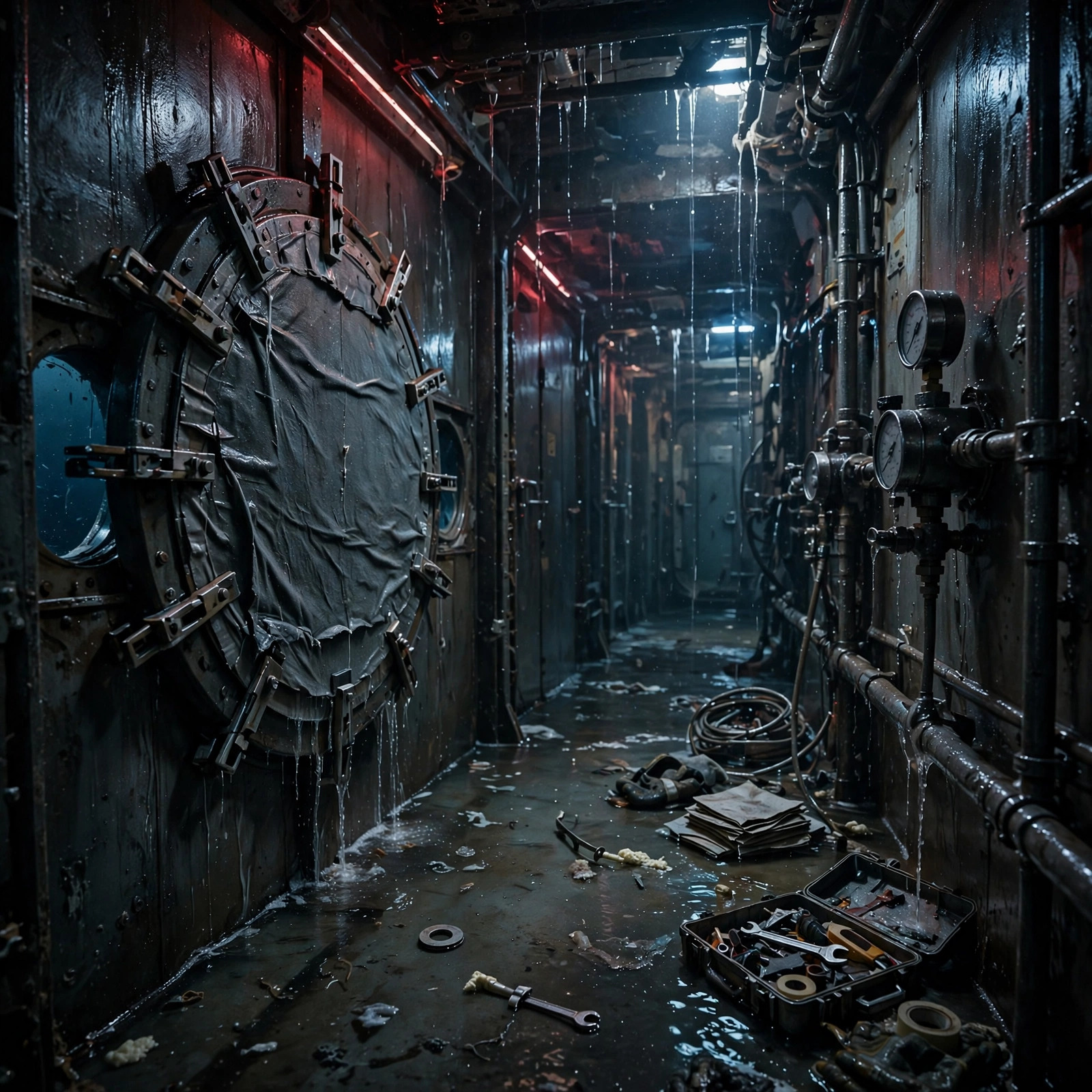
A second tremor hit, much harder than the first. A localized pressure event, a terrifying anomaly of deep-water dynamics, struck the exterior of Sector Four. The deafening sound of shrieking metal filled the air. A micro-fracture spiderwebbed across the medical bay's exterior bulkhead, instantly widening into a jagged tear. High-pressure seawater blasted into the room like a physical blade.
Emergency containment doors automatically triggered, dropping from the ceiling to seal off the compromised section. But a heavy diagnostic monitor had been thrown to the deck by the tremor, lodging itself squarely beneath the descending blast door. The heavy steel door bit into the monitor, sparking violently, and stopped half a meter above the floor. Water was surging under the gap, rapidly flooding the corridor.
Julian threw himself at the obstruction, desperately trying to pull the crushed monitor free so the door could seal completely. "Help me!" he screamed over the roar of the incoming water.
Elena grabbed his harness, pulling with all her strength. The monitor shifted slightly, and the massive door lurched downward another ten centimeters. Suddenly, a secondary high-pressure pneumatic line above the door frame ruptured. A piece of sheared metal flew outward, striking Julian squarely in the chest. He collapsed backward, gasping for air, his hands clutching his ribs.
Aris rushed through the rising water from the clinic annex, hauling Julian by the shoulders. Elena kicked the shattered monitor out of the way, and the blast door finally slammed shut, sealing the leak. But the damage was done. The corridor was knee-deep in water, and Julian was turning pale, struggling to breathe.
"He has a severe chest trauma and suspected barotrauma from the pressure wave," Aris yelled, kneeling in the water. "His lung is collapsing. We need to get him to the surface hospital ship immediately, or he will drown in his own fluids."
Elena looked toward the maintenance bay. The Nereus was their only transport. The old manual life-support systems were sitting in pieces on a workbench. The only thing keeping the air breathable in that submersible was the uncalibrated, untested Apex Autocore. Her choice had landed squarely on Julian.
"Load him into the Nereus," Elena ordered, hauling Julian up by his other arm. "I will prep the launch sequence."
Aris glared at her, his face pale with fury and fear. "The Autocore is not calibrated! You just installed it!"
"I have no choice!" Elena shouted back. "The manual board is gone. It is the core or we watch him die right here."
A Synthesis of Skill
The interior of the Nereus was cramped and terrifyingly silent compared to the chaos outside. Aris strapped Julian into the patient pod, immediately hooking up intravenous lines and emergency monitors. Elena dropped into the pilot's chair and powered up the Apex Autocore.
The black cylinder hummed to life. The display screen illuminated, showing a series of complex algorithms initializing. The system reached out to read the ambient pressure of Tethys Base to set its baseline. However, because of the leak in Sector Four, the internal pressure of the habitat had dropped significantly before they sealed the door.
Elena watched the screen as the Autocore recorded the baseline pressure as 1.5 atmospheres. Her blood ran cold. They were at forty meters depth. The actual pressure outside the habitat was closer to 5 atmospheres. The Autocore's baseline was fundamentally corrupted.
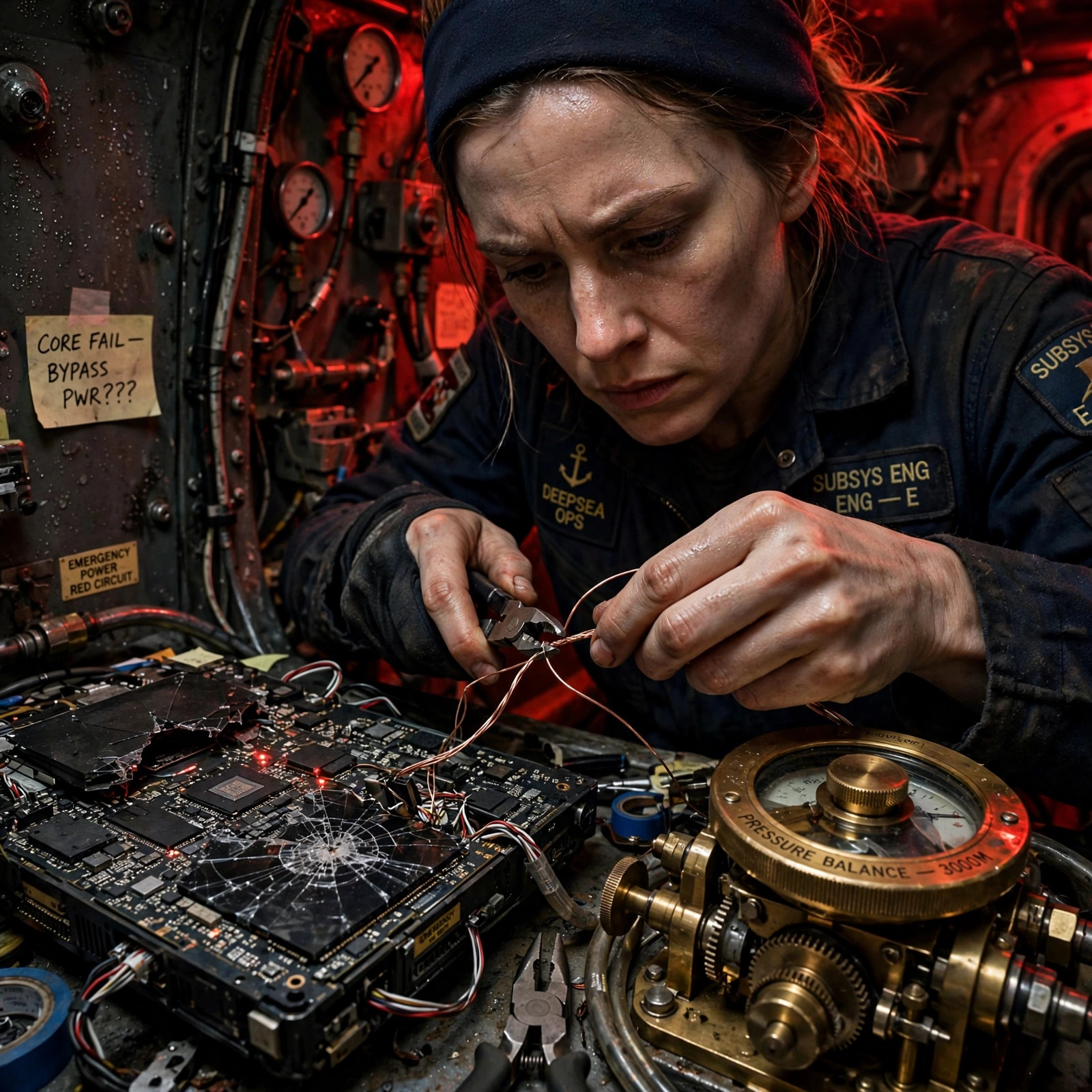
"Detaching from the docking ring," Elena announced, throwing the mechanical release lever. The Nereus shuddered and floated free into the dark, churning water. She engaged the thrusters, beginning the steep ascent toward the surface.
The moment the submersible began to rise, the Autocore's sensors detected the rapidly dropping exterior pressure. Operating on its corrupted baseline, the algorithm calculated that the patient pod was vastly over-pressurized.
A digital alarm shrieked in the small cabin.
SYSTEM ALERT: PRESSURE DIFFERENTIAL EXCEEDS SAFETY PARAMETERS. INITIATING RAPID DEPRESSURIZATION OF PATIENT POD.
"Elena!" Aris yelled from the back. "Julian's pod pressure is dropping fast! His injured lung cannot handle a rapid decompression. You are going to kill him! Override it!"
Elena’s fingers flew across the digital interface. She punched in her administrator codes, trying to halt the depressurization cycle.
ERROR: MANUAL OVERRIDE DISABLED BY CORPORATE MANDATE. HARD DEPENDENCY ENGAGED.
The algorithm was rigid. It was doing exactly what it was programmed to do based on flawed data. Elena could not fight the software. She had to fight the hardware.
She abandoned the pilot console, leaving the submersible on an automated ascent path, and scrambled back to the engineering bay. She grabbed a heavy titanium pry bar from the wall and wedged it under the sleek casing of the Apex Autocore. With a violent heave, she cracked the protective shell open, exposing the dense network of optical wires and circuit boards.
"What are you doing?" Aris demanded, keeping one hand on Julian's chest.
"I am changing what the computer believes," Elena said, her voice tight with concentration.
She located the primary exterior pressure sensor feed. It was a digital piezoresistive transducer circuit. She knew from the technical manual that the sensor sent a variable electrical current to the motherboard based on pressure. She needed to trick the Autocore into believing the exterior pressure was much higher, forcing it to keep the patient pod pressurized.
She grabbed a pair of wire strippers and cleanly severed the transducer data line. The Autocore immediately threw a massive fault code and halted the depressurization, but it also halted oxygen flow entirely.
"Oxygen delivery stopped!" Aris warned. "He has maybe two minutes before his saturation drops to critical."
Elena needed a way to manually control the electrical resistance going into the motherboard. She looked frantically around the cabin. Her eyes locked onto the analog rotary dial that controlled the cabin's overhead lighting dimmer. It was a simple, heavy-duty potentiometer. A variable resistor.
She ripped the lighting panel off the bulkhead, plunging the engineering bay into deep shadows illuminated only by the red glow of the computer screens. She snapped the wires leading to the dimmer switch and dragged the assembly over to the opened Autocore.
Her hands were shaking. If she sent too much current, she would fry the motherboard, permanently disabling life support. If she sent too little, the pod would depressurize and tear Julian's damaged lung apart.
She spliced the copper wires of the analog lighting dial directly into the pristine optical traces of the Autocore's sensor intake. She taped the connection tight.
"Aris, read me the target pressure for Julian's pod on your medical monitor!" Elena ordered, gripping the brass lighting dial.
"Target is one point two atmospheres!" Aris called out.
Elena slowly turned the lighting dial. The analog component resisted her slightly, a familiar, comforting mechanical friction. As she turned the knob, changing the electrical resistance, the Autocore received the spoofed data.
The digital screen flickered. The system accepted the manual input as authentic sensor telemetry. The oxygen mix hissed back to life.
"Pod pressure is rising," Aris said, his voice thick with relief. "It is stabilizing. Elena, you have to hold it exactly there as we ascend. You have to match the curve."
For the next ten minutes, Elena sat cross-legged on the deck plates, her eyes fixed on the digital readout of the Autocore, her hand gripping the salvaged mechanical dial. As the submersible rose through the water column, the ambient pressure dropped. Elena manually turned the dial millimeter by millimeter, adjusting the electrical resistance, feeding the perfect lie to the advanced algorithm. She was performing the job of a high-speed digital sensor using a salvaged brass knob and her own deep knowledge of pressure dynamics.
She did not cling to her old routine, nor did she blindly trust the new machine. She bridged the gap between them with raw competence.
The Nereus breached the surface of the ocean, violently rocking as it hit the rolling swells. The ascent was complete.
"Pod pressure is normalized to surface atmosphere," Aris reported, leaning back heavily against the bulkhead. Julian was breathing steadily, his color slowly returning. Aris looked at Elena, staring at the chaotic nest of spliced wires and the lighting dial in her hand. "I have never seen anyone hack a hard dependency system with a light switch."
Elena slowly released the dial and wiped a mixture of sweat and grease from her face. She looked at the ruined casing of the million-dollar prototype. Her sponsor rep was going to be furious about the destroyed hardware. But Julian was alive, the mission was a success, and the logs would show that the Apex Autocore delivered a perfectly stabilized patient to the surface.
"It turns out," Elena said quietly, "the algorithm needed a little human intervention after all."
A Breath of Dry Air
Six weeks later, Elena stood in the kitchen of an apartment on the forty-second floor of the Raleigh Elevated Zone. The walls were painted a crisp, clean white, completely devoid of rust or salt corrosion.
She held a small, sleek digital tablet in her hand. Across the room, her mother sat in a comfortable armchair, reading a book. A discreet, wall-mounted environmental unit hummed softly, filtering the air.
Elena looked at the tablet. It displayed a simple, elegant slider for the room's ambient oxygen concentration. She touched the screen, sliding the digital bar upward by a fraction of a percent. The wall unit responded instantly, adjusting the mix flawlessly without a single mechanical click or rattle. Her mother took a deep, clear breath, completely unaware of the tiny adjustment that made her lungs feel lighter.
Elena smiled, resting the tablet on the kitchen counter. She walked over to the large reinforced window. Outside, the sky was a bruised, heavy purple, and thick banks of smog rolled across the lower levels of the city. The world was still struggling. The massive climate problems remained vastly unresolved, and the window frames rattled slightly as a high-altitude wind hammered against the glass.
But inside this room, the air was perfect. The technology worked, guided by someone who knew exactly what it cost to keep it running.
Get notified when new stories drop

Leo Stranek
Leo specializes in solarpunk abundance and near-future progress: livable futures, bright cities, and practical wonder.
Leave a comment
Comments