



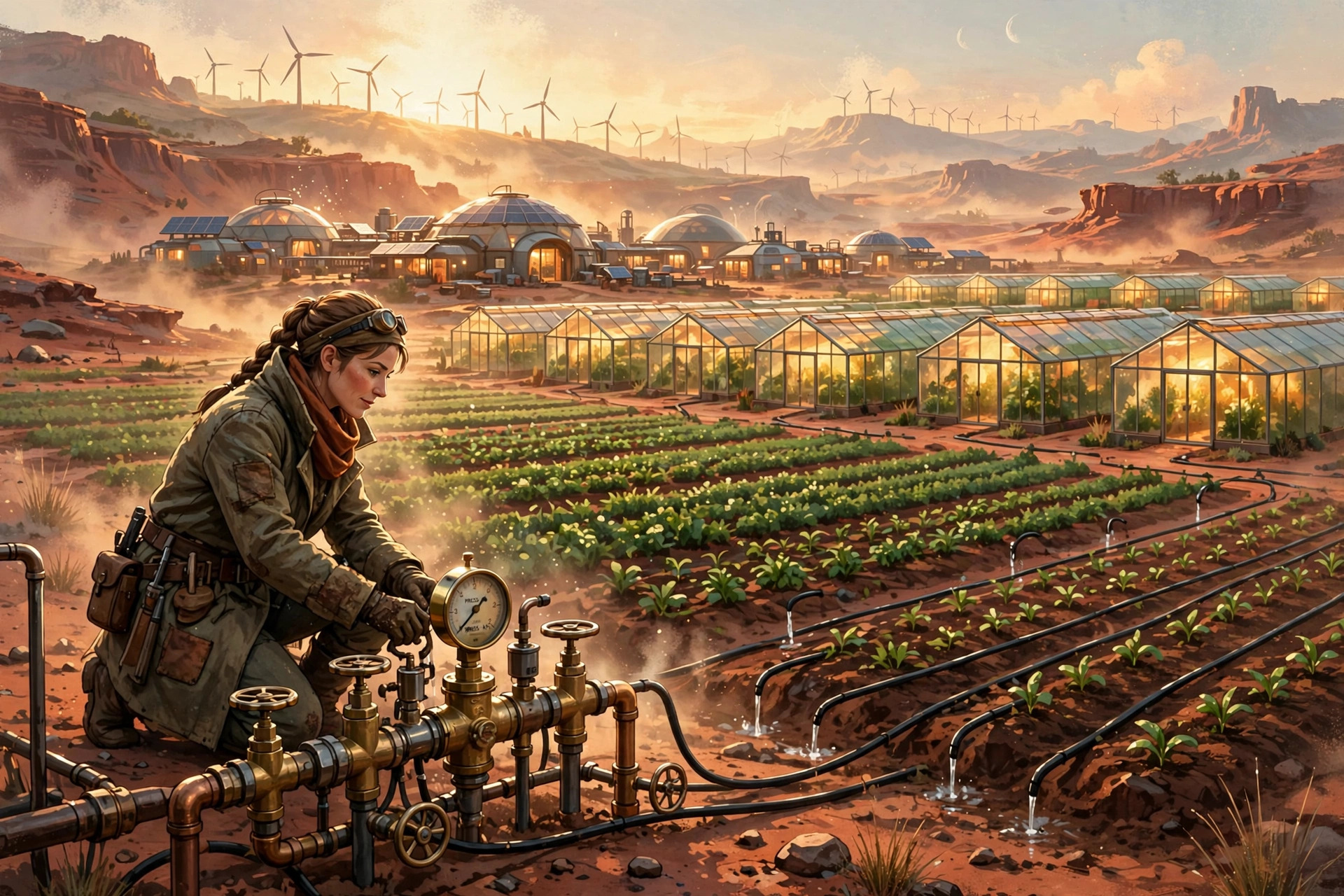
The pressure gauge on Line Six had a habit of breathing. Tamsin Oyelaran had spent eleven years learning its rhythm, the way it climbed through the cold hours before dawn and sagged, satisfied, when the drip emitters opened at first light. She knelt in the grey dust of the Grey Beds with the gauge at eye level and watched it breathe, and she thought: this is what a home looks like from the inside. Not the greenhouses, not the orchard rows, not the long bright spine of the common hall with its bean-vines trained up the south glass. Home was the sound of water moving through pipe at four in the morning, doing its work where nobody could see it.
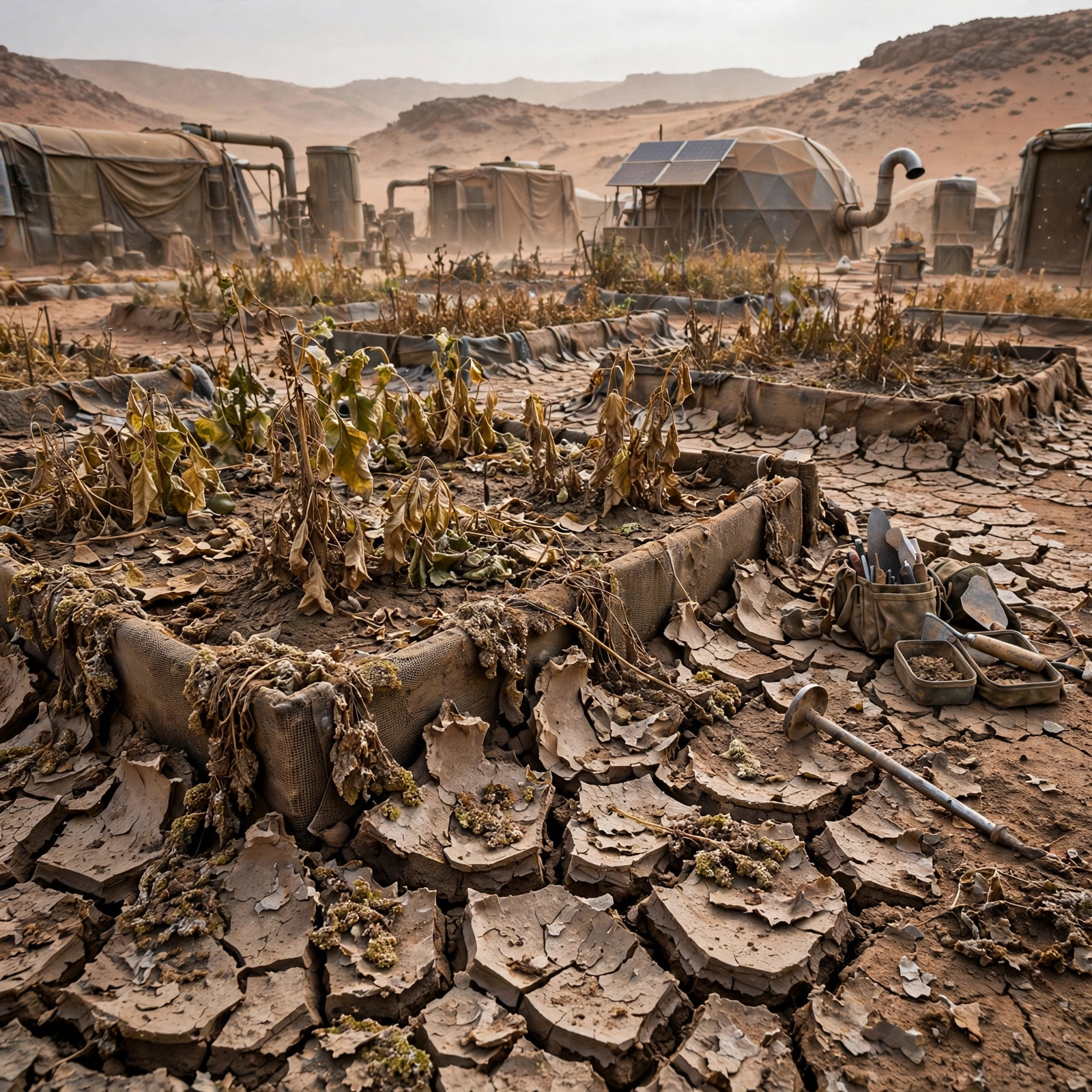
Sable Ford sat at the bottom of a basin on the planet the charts called Wren-3 and everyone who lived there just called Wren, four thousand people and their orchards, their loam fields, their mycelium sheds, their repair cafés and tool libraries and the great grey expanse of the basin floor, where the dust had been dead as bone when the first settlers landed twenty-two years ago and was now, in patches, alive. Those patches were Tamsin's life's work. She had come out at twenty-six with the third wave, a hydrologist with a doctorate she never mentioned and a stubbornness everyone mentioned, and she had spent eleven years teaching water to move through ground that had never held any.
The trick, if you could call eleven years of failure and adjustment a trick, was to go slow. The shallow aquifer under the basin was thin and fragile, a lens of meltwater perched on clay like a coin on a wet table. Draw from it gently, return more than you took, and it thickened year over year. Draw hard and the clay compacted and the lens shrank and the ground above it began to die. Tamsin had helped design the system that governed every liter: soil-moisture webs that whispered to the emitters, recharge ponds that caught the rare rains, a water bank that kept each family's saved surplus in a shared ledger. Abundance on Wren wasn't a gift. It was a discipline, built drop by drop, and the discipline was written into the ground itself.
She logged the gauge reading, wiped the dust film off the dial with her thumb, and started walking the line. The emitters ticked softly in the dark, forty meters out into the loam field, and the loam field breathed back: the faint yeasty smell of working soil, the smell that had taken eight years and three failed inoculations to establish. Twenty-two years ago this had been alkali pan. Now a crust of dark, damp, self-mulching ground lay over four hundred hectares, and the mycelial mat under it held water the way a held breath holds air. Her partner, Rhea, could read that mat the way Tamsin read gauges. Rhea said the loam dreamed. Tamsin had never argued.
The comm in her ear chimed. Rhea, voice scratchy. "You're up at the field already. I can tell because you didn't leave any tea."
"I'll bring the thermos back full. Go back to sleep."
"Can't." A pause, and then the small cough Tamsin had been pretending for two months she hadn't heard. "Dust's bad again. The filter in the bedroom shed rattled all night."
Tamsin closed her eyes for one gauge-reading's worth of time. The dust season had come early and hard this year, the basin's dry rim sloughing grit across the settlement, and the filters were working, mostly, but the alkali in the rim dust got into everything—lungs included—when the storms ran long. "Take the good mask today," she said. "The one with the diaphragm pump. And do the inhaler at the shed, not out in it."
"Yes, steward." Rhea's smile was audible. "Love you. Come home before the wind does."
Tamsin walked the line as the sky went from black to the color of an old bruise, then to the flat amber Wren gave them every morning, and she thought about the day's work: the recharge pond inspection, the ledger reconciliation, the afternoon assembly where the settlement would hear, for the third time, the proposal that was slowly splitting Sable Ford in half.
The Tap
Devrim Kassa arrived at the assembly hall with charts on a slate and a year of drought behind his argument, and Tamsin had to admit, watching him set up, that he was good. He didn't promise miracles. He promised water.
He was the basin's water engineer for the Combine Cooperative—the off-world supplier consortium that had financed the third wave's equipment in exchange for mineral options nobody had exercised in twenty years. He was forty, unhurried, and he had spent the drought year flying the rim with a survey drone and mapping something the old geologic scans had only guessed at: a deep confined aquifer, three hundred meters down, sealed in fractured basalt under the basin's eastern escarpment. Enough water, he said, to green the whole basin in a decade instead of a century.
"I'm not here to sell you anything," Devrim said, and it was mostly true; the Combine had no stake in the water itself. "I'm here because you're running a margin of four percent. One more season like the last one and you'll be rationing drinking water. I've seen it happen on four worlds. It starts with the orchards and it ends with the children leaving." He let that sit. "The deep tap changes that. Six boreholes, closed-loop extraction, three years of abundance while your shallow lens recovers. It's been done on Hesperine. It's been done at Kettle."
"It's been done," Tamsin said, from the floor, "and the ground at Kettle subsided forty centimeters and they lost their soil crust."
"Kettle drilled a different formation," Devrim said, calm. "Their basalt wasn't fractured the way ours is. I've run the models. Draw at my rates and the deep pressure holds for eighty years."
"The models don't include the mat," Rhea said. She stood near the front, mask hanging at her chest, and the hall quieted because Rhea rarely spoke in assembly. "The mycelial network in our loam is eleven species deep and four of them exist nowhere else. It holds forty percent of our field water. It's why our emitters can run at the rates they run. If the deep tap drops the shallow lens even half a meter, the capillary fringe collapses and the mat desiccates. We don't lose water. We lose the ground that learned to hold water."
Devrim nodded, which was the disquieting thing about him; he never dismissed anyone. "That's the risk I want to study. I'm proposing one pilot borehole, at the rim, three kilometers from your fields. Six months of data. If the shallow lens so much as trembles, we cap it and I buy the hall a round of whatever it is you ferment here."
"The pilot is the camel's nose," said old Bahati from the orchards. "Once there's a borehole, there's a pipeline, and once there's a pipeline, we're all drinking from it and nobody remembers what the lens was for."
"Or," Devrim said, "once there's a borehole, the drought stops being an emergency and you get to argue about soil with the luxury of full cisterns."
That was the trouble. He was reasonable. Half the settlement had families who had come out on the thin years, who remembered rationing, whose kids had grown tall and wanted to stay and needed work that wasn't dirt and drip lines. The deep tap meant a bigger greenhouse, a second settlement cell, a food-processing co-op, a margin fat enough to absorb a bad year. The slow plan meant everyone's grandchildren eating well, and it required faith in a ground truth that lived under the surface and spoke only in gauges.
The assembly voted on the pilot and the pilot passed, 2,113 to 1,874. Tamsin stood at the tally board and understood, with a coldness in her hands, that she had spent eleven years building a system so good that people had forgotten what scarcity felt like—and that a man with charts had reminded them in a single afternoon.
The Rim Borehole
They drilled through the summer. Tamsin monitored the shallow lens with a network of sixty piezometers she installed herself, three weeks of sixteen-hour days, sleeping in the survey truck while the drill ate its way down through escarpment basalt. She and Devrim fell into a rhythm that she hated for how easy it was: he'd bring coffee to the truck at shift change, they'd argue draw rates, they'd argue capillary pressure, and once, at two in the morning with the drill roaring and the stars hard overhead, he'd said, "You know I'm not your enemy, Tamsin. I'm the man who arrives when the slow plan is one dry season short."
"Then be the man who leaves when it isn't," she'd said, and he'd laughed, and neither of them had meant harm, and the bore went deeper.
The pilot data, at first, was clean. The deep aquifer flowed under artesian pressure. The shallow lens, three kilometers away, held steady. Devrim's models ran true. Tamsin checked her piezometers twice a day and found nothing, and the nothing made her sleep worse, not better, because ground water moved on the scale of seasons and six months of nothing was a data point, not a promise.
Then the storm season came, and Rhea got sick.
It started as the cough that wouldn't fully clear, the one from the dust, and Tamsin told herself it was the dust, because the rim dust was genuinely bad—the storm cells that year came off the escarpment with the drill pad's fresh tailings mixed into them, grey-white alkali powder that the settlement's filter banks caught at ninety-six percent and let the last four percent through. Rhea worked the mycelium sheds at the field edge, closest to the rim. In the fourth week of the storms she came home with her fingertips blue-grey from handling the dust-caked sampling cores, sat down at the kitchen table, and couldn't finish the sentence about her day.
The clinic's scanner showed the beginnings of alkali fibrosis in the lower left lobe. Early, treatable, the doctor said, if the exposure stopped. If it didn't stop, it would scar.
"The tailings ponds," Rhea said that night, lying with her head in Tamsin's lap, the inhaler on the table beside them. "The drill pad's ponds aren't lined. The storm cells come off the escarpment, pick up the fines, and drop them on the sheds. I've been charting it. Three storms, three deposition events, all over the eastern fields." She paused. "It's in the loam, Tamsin. The pH in the test rows is drifting. The mat is stressed. If the pH crosses seven-eight—"
"It won't."
"You don't know that."
"I know the piezometers are flat. Whatever the drill is doing, it isn't touching our water."
Rhea sat up, and her face in the low light had the expression she wore when a culture plate came back wrong. "You're watching the water," she said, "and I'm watching the ground. One of us is going to be the early warning, and it's going to be me."
Tamsin filed the deposition data with the settlement's environmental board the next morning. The board ordered the tailings ponds lined within ninety days. Devrim, to his credit, didn't fight it; the Combine crews started laying geomembrane within two weeks. But the storm season had six weeks left in it, and the fines already laid down didn't blow away on order.
Then, in the eighth week of the pilot, piezometer forty-one moved.
Fourteen millimeters down. One gauge, at the field edge, closest to the escarpment. Within its error bar. Tamsin drove out at midnight and knelt in the wind and read it four times and drove home and ran the whole network's history back through three months of data, and there it was—not in the levels, which were flat, but in the gradients. The gentle, seasonal sway of the shallow lens across the whole field had changed phase. Slightly. By a fraction of a fraction. Like a coin on a wet table when someone else puts their hand on the table's edge.
She took it to Devrim the next day. He ran his models while she watched. The models said the phase shift was consistent with a two-millimeter drawdown influence from the deep tap, negligible, self-limiting, well within tolerance.
"Your models don't have the mat," she said. "The mat is why the lens behaves like it does. You changed the boundary condition and you're measuring with the old physics."
"Then give me the new physics," Devrim said, not unkindly. "Tamsin, I have a settlement vote for full extraction in six weeks and a drought forecast for next year that says your margin is negative. If you can show me the mat dies at two millimeters, I'll cap the bore myself. Can you show me that?"
She couldn't. Not yet. Rhea's pH data showed stress, not death; the phase shift showed influence, not collapse. She had eleven years of process and no smoking gun, and the vote was coming, and the wind was coming, and Rhea was coughing in the next room.
The Storm
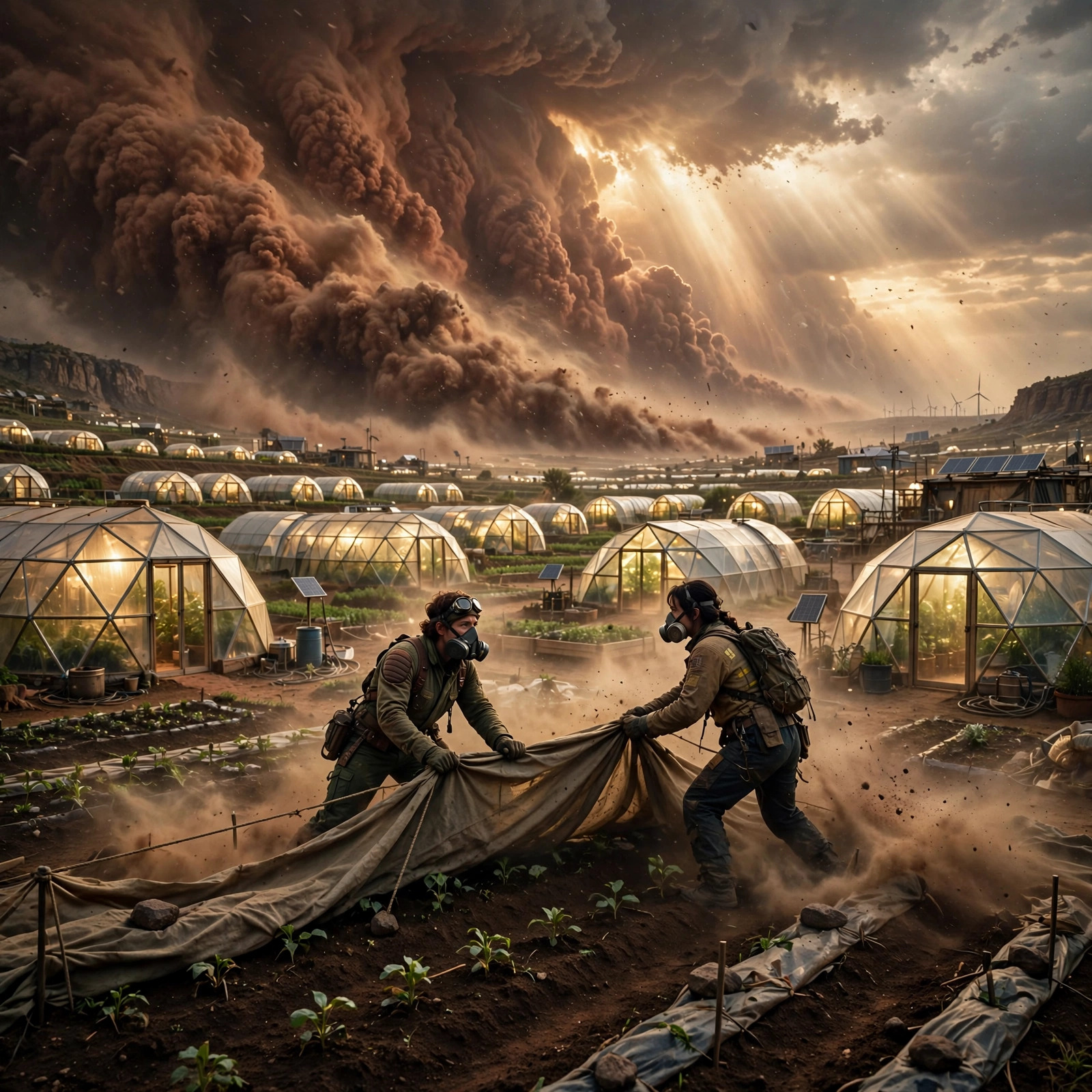
The fifth storm cell was the kind the settlement's old-timers called a rooster: red-brown at the top, black at the base, two hundred kilometers wide, and it came off the escarpment on the fourth of the ninth month with the drill pad's last unlined pond still forty percent full of fines. The warning came six hours out. Sable Ford buttoned down—shutters, filters, the greenhouse braces, the storm curtains on the sheds—and Tamsin spent four of those six hours at the field edge with Rhea and two of Rhea's techs, tarping the open test rows, and the last two hours arguing by comm with the drill pad about pumping the pond down before the front hit.
They pumped it to sixty percent. Then the storm took the escarpment.
Tamsin rode it out in the shed's storm room with Rhea and six others, listening to the building flex. The wind instruments topped out at a hundred and thirty. When the roar finally dropped to a mere howl, twelve hours later, they went out into a world rearranged. Dunes where paths had been. The eastern test rows buried under thirty centimeters of rim fines. And the pH—Rhea took core samples with her mask fogging and her hands shaking, and Tamsin watched the reader and watched Rhea's face and knew before the number came up: seven-point-nine. Two full points in a single deposition event, because the storm had dropped its load directly on the most sensitive ground the settlement owned.
The mat in the test rows was dying. Not stressed—dying. The pale hyphae that should have shown white against the dark loam came up grey and crumbling, and Rhea knelt in the buried rows with the cores in her hands and made a sound Tamsin had never heard from her in eleven years.
Over the next three days, the settlement counted its costs. The test rows: gone, four hectares, the most advanced loam on the planet. The clinic logged eleven new cases of dust exposure, three of them children of field techs. Rhea's fibrosis markers rose and the doctor moved her off field work entirely—six months minimum, desk work at the culture archive, and Rhea, who had taught her hands to speak to the ground for fifteen years, sat in the archive with her hands folded and her lungs full of the thing that had come off the drill pad. Tamsin visited every evening and brought tea and didn't say what she was doing the rest of the day, because what she was doing the rest of the day was building the case that her own processes had failed to build in time.
She had the deposition data. She had the pH collapse. She had the phase shift, and now she had its consequence: with the mat in the test rows dead, the capillary fringe over half the eastern field was unraveling, and the piezometers there had dropped, in ten days, more than they'd dropped in eleven years. The ground was losing its grip on its own water. It was exactly the mechanism she'd warned about, arriving sideways—through dust instead of drawdown—and she could prove it now, all of it, and she stood in her office with the complete dataset on the wall display and felt no triumph at all. Because the vote on full extraction was in nine days, and the drought forecast was worse than last month's, and the proof that the deep tap's presence was killing the loam would arrive in the assembly as an argument for the one thing the settlement needed most: water, now, from somewhere.
Devrim came to her office himself. He looked at the wall for a long time.
"The tailings killed those rows," he said finally. "Not the tap. The tap's drawdown contribution is two millimeters."
"The tailings are the tap," Tamsin said. "You can't separate the hole from what comes out of the hole. And the phase shift is real, and now the mat's dying and the lens is going to follow, and my piezometers are going to show drawdown you can't model away by next season, and by then there won't be a loam left to save. I'm not asking you to admit fault, Devrim. I'm telling you the physics is finished. Whatever you decide to do with it is yours to carry."
He was quiet. Then: "The forecast came out this morning. Next year's recharge is forty percent of normal. If we cap the bore, Sable Ford rations drinking water by autumn. Not orchard water. Drinking water. You know that."
"I know that."
"Then what are you offering? Because I'll stand up in that assembly and kill my own proposal if there's a single number in this room that keeps four thousand people in water next year without that bore. Is there?"
And there it was. The question she'd been circling for two weeks like water around a stone.
"Yes," she said. "But it isn't mine alone to offer."
The Ledger
Every settler at Sable Ford had a water account. You earned credit by returning water to the system—roof catchments, greywater reclamation, the condensers on the greenhouse roofs—and you spent it on your household, your workshop, your share of the commons. Most accounts ran thin. Tamsin's did not. Tamsin Oyelaran, steward of the recharge ponds, had spent eleven years putting every liter she personally reclaimed into her account and spending almost none of it, and the ledger, which was public, showed her balance: enough water, at drought-year draw rates, to hold the whole settlement's drinking margin for fourteen months. It was supposed to be the down payment on a farm of her own. She and Rhea had picked the parcel out seven years ago, the bench above the western pond, and they'd drawn the house on napkins and argued about the orchard mix and Rhea had said, more than once, "when the account fills," and the account had filled, and the farm was the next year of her life, and everyone knew it.
She called the assembly for the night before the vote. She stood at the front with the wall display behind her: the dying rows, the phase shift, the forecast, and one more slide, which she put up last.
My account holds fourteen months of settlement drinking margin. I move that the commons absorb it as a bridge: cap the bore, run the drought year at reduced draw, let the lens and the mat recover, and rebuild the eastern rows from the surviving mat stocks. If the margin runs out before the recharge does, I'll stand here and say so.
The hall didn't cheer. It went quiet in a way that was worse than argument, because four thousand people were doing arithmetic at the same moment, and the arithmetic included what everyone knew the account was for. Bahati stood up first. "You'll not spend that alone, Tamsin. My orchard co-op will match you at twenty percent of our accounts." Then the repair café, at ten. Then the school's families, at five, and Tamsin tried to wave them down and the moderator wouldn't recognize her, and by the end of the evening the bridge fund held nineteen months of margin, and her farm was in it, and she found she couldn't look at Rhea across the hall and didn't have to, because Rhea had seconded the motion before Tamsin finished reading it.
Devrim spoke last, before the vote, and he did not fight. "I've seen the numbers," he said. "The bridge works on paper. I'll say the honest thing, which is that the bridge works on paper the way my drawdown models worked on paper, and we both know what paper is worth. But the difference is that this plan fails by running out of a surplus you built, and mine fails by running out of ground you can't rebuild. I withdraw the full-extraction proposal. I'll keep the pilot capped and stay on to line every pond on that pad if you'll have me." He paused. "And I'd like to see the piezometer data as it comes in. If the lens drops faster than projected, you'll need someone arguing the other side, and I'm told I'm good at it."
The vote to cap the bore and adopt the bridge passed, 3,201 to 1,690. Not unanimous. Tamsin noted the margin and the names of the districts that voted no—two of the new cells, the ones with the young families, the ones who had come for abundance and been handed another lean year—and she wrote them at the top of her work list, because the bridge would only hold if the people standing on it believed it would.
The next morning the storm curtains came off the sheds and the settlement went back to work. Rhea, exiled to the archive, built a culture plan for reseeding the eastern rows from the surviving mat stocks—a three-year program, started in trays under lights, her hands busy again. The drill pad's ponds got their geomembrane. The dust kept blowing, because the rim was the rim, but it blew over ground that was being fixed, which Tamsin knew was not the same as ground that was safe, and was still not nothing.
She caught Devrim at the piezometer shed a week later, reading her boards without permission. "Forty-one's recovering," he said.
"Half a millimeter. Don't get sentimental."
"Tamsin. The farm on the bench. Was it—"
"The bench will still be there." She checked a fitting that didn't need checking. "Ground's patient. I learned that from somewhere."
Row Nine
The drought year did what drought years do. It was hard. The commons drew down at nine percent above projection in the eighth month, because the wind came off the rim all summer and the condensers underperformed, and Tamsin stood at the assembly in the ninth month and said the margin would hold for eleven more months, not the six remaining ones, and she'd been right that she'd stand there and say so. The settlement ate from the greenhouses and argued about the orchards and voted twice on tightening household draw, and both votes passed, and neither passed unanimously, and the dust season came and went and the clinic logged four exposure cases instead of eleven because the ponds were lined and the pad was capped and the ground-up fines had finally stopped coming.
The mat came back. Slowly, the way everything here came back—Rhea's trays went out into the eastern rows in the second spring, pale threads on dark loam, and the pH eased back below seven-point-four, and the capillary fringe knitted itself together one hypha at a time, and the piezometers at the field edge climbed for the first time since the storm. Rhea's lungs cleared enough that the doctor let her back to field work half-days. On her first morning back she came home with loam under her fingernails and didn't wash her hands until dinner, and Tamsin watched her hold them up, grey crescents under every nail, and laugh until she coughed, and then laugh again.
They broke ground on the bench in the third spring. Not the farm—there wasn't the margin for a farm yet, and Tamsin had stopped pretending the timeline was hers. What there was margin for was the settlement's ninth greenhouse row, the one the second-wave families had been promised through two droughts, and the bench was the best site for it, and Tamsin had stood at the assembly and moved that the commons build there, on the parcel she'd spent eleven years filling, and the vote had passed with the two young districts voting loudest for it, and Rhea had held her hand under the table the whole time.
On the morning they brought the water line online, the wind was blowing the ordinary way, dust-devils walking the basin floor, and the crew was short one because Marta had a shift at the clinic, and the connector wrench had gone missing twice, and Osei from the repair café had jury-rigged a gasket sealant tray out of a food-service pan because the proper one had cracked. Tamsin knelt at the new manifold on the bench with the gauge from Line Six's granddaughter breathing under her palm, and behind her eleven people in dust-streaked workwear sat on crates eating flatbread, and Rhea sat on the crate nearest the valve with a sampler kit in her lap because the first water into new ground was always the interesting kind of dirty.
Osei looked at her. She looked at the gauge. The needle sat where it was supposed to sit.
"Row Nine," she said. "Opening."
She turned the valve. The line took the water with a knock and a shudder and a long hiss, and the first emitters along the row began to tick, and the dark ground drank, and Rhea was already on her knees with a core tube, calling out the moisture numbers, and the dust blew and the flatbread went cold and the water went in, drop by drop, into ground that was learning to hold it.
Piezometer 41, eastern field, logged a net rise of 0.6 millimeters that season—the first sustained recovery recorded since the storm.
Get notified when new stories drop

Sasha Quill
Sasha writes bold exploration and cosmic wonder with lyrical scale and grounded character work.
Leave a comment
Comments