




Morning Rounds
The liner talked back if you knew how to ask. Ama Ilunga-Sorensen asked with a rubber mallet, a dead-blow hammer filled with lead shot that she had carried on her belt for eleven years. She tapped the curved wall of Segment Four at shoulder height, listened, took two steps, and tapped again. A good stretch of liner answered with a short, dull tock, like knocking on a loaf of dense bread. A delaminated stretch rang. She had found perhaps forty ringing patches in her career, and she remembered every one.
Behind her, Bex Hollande walked with the strain reader slung across her chest. It was a gray brick with a cracked screen, and it pulled numbers out of the fiber-optic threads buried in the liner every half meter. Bex was twenty-seven and had come up through the spray crew. She had the broad, scarred hands of somebody who'd spent her first years on the Gallery pushing a nozzle across raw basalt at three in the morning.
“Joint Four-Seventeen's at twelve microns,” Bex said. “Same as Tuesday.”
“Mark it anyway.”
“I always mark it.”
“I know. I like hearing you say so.”
Bex snorted and tapped the screen. Ama moved on, mallet swinging loose from her wrist on its lanyard.
The Sounding Gallery was a lava tube, three point two kilometers long, eighteen meters wide at its narrowest and forty at the great bulge they called the Commons. Some ancient river of molten rock had drained out of it before the first single-celled thing had ever thought about living on Teoma, and left behind a hollow so smooth in places that the walls still showed the ripple marks of the last flow. Nineteen years ago the first landing crew had walked into its mouth with headlamps and gas monitors, and Ama, twenty-two years old and newly licensed, had been the most junior person in that line. She still remembered the hiss of her own suit and the way her lamp had found the ceiling and kept going up.
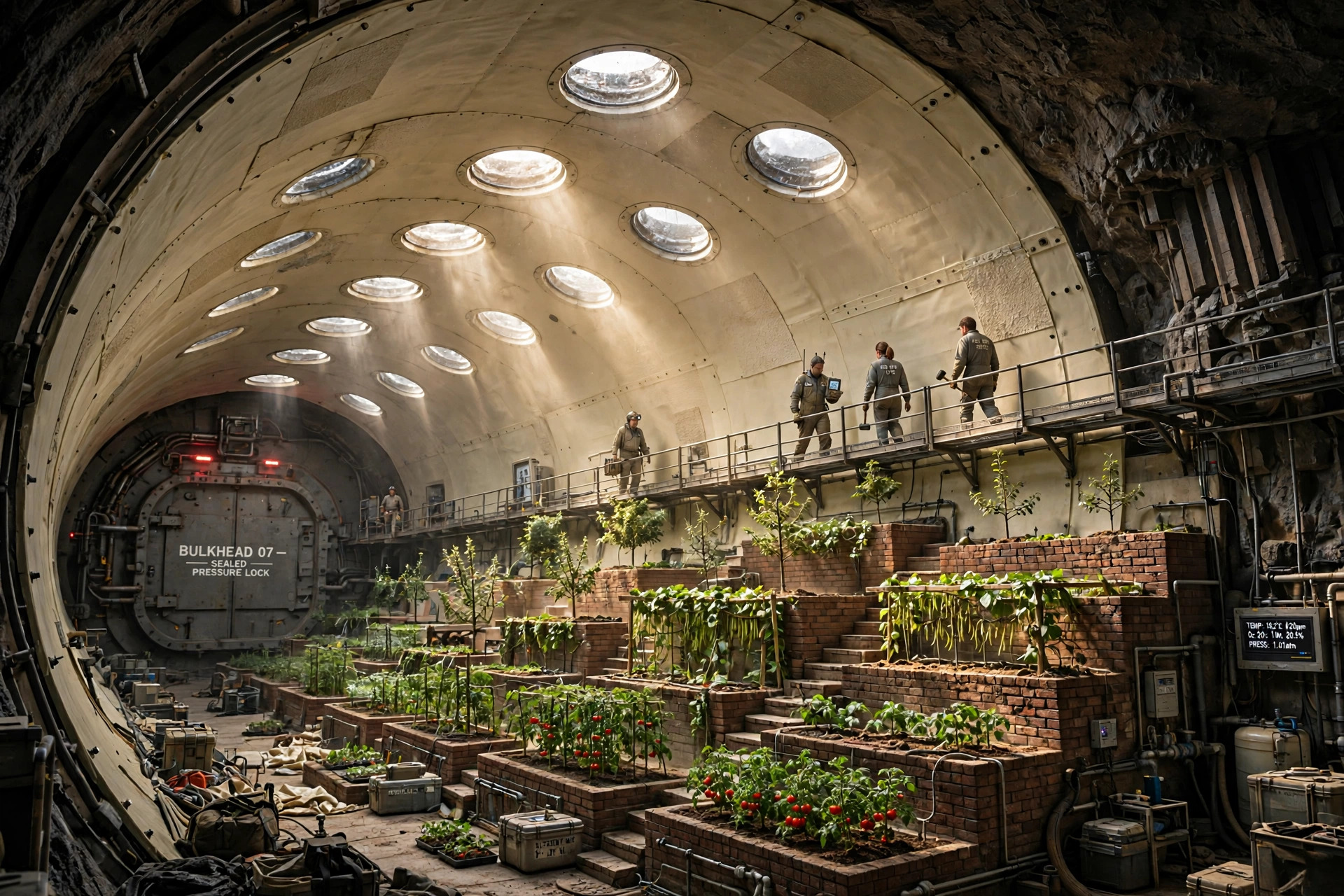
Now the tube held nineteen hundred people behind five bulkheads. The basalt had been sintered smooth where it was rough and sprayed with four centimeters of fiber-polymer liner, cream-colored and faintly glossy, so that walking through the Gallery felt like walking through the inside of a shell. Seven of the old collapse skylights had been capped with glazed domes. The colonists called them oculi. At this hour the sun came through the eastern ones at a steep angle and laid columns of light down onto the floor, so solid-looking with suspended dust that people sometimes walked around them without meaning to.
In Segment Four the light fell on the terraces.
They climbed the south wall in eleven steps, each one a planter box of sintered brick a meter and a half deep. Six years ago there had been nothing in them but crushed regolith washed free of perchlorate, inert as kitty litter. Joaquim Reyes had stood on the bottom step with a bucket of compost tea in one hand and a jar of red worms in the other and announced to nobody in particular that he was going to make dirt. It had taken him four years before he was willing to call it soil. Now tomatoes sprawled over the edges of the third step, and the seventh step was all beans on strings, and the top step held a stand of dwarf apple trees that had fruited for the first time last autumn. Fourteen apples. The colony had held a lottery.
Joaquim was on the fifth step with his sleeves rolled, kneeling in the dirt beside a seed tray. He looked up when he heard the mallet.
“The inspectors are here,” he called. “Everybody look busy.”
“You're always busy,” Ama said.
“I'm always dirty. It's a different thing.” He climbed down the brick steps two at a time, forty-four years old and still moving like he expected the ground to be uneven. He kissed her on the cheekbone, which was the only part of her face not covered in liner dust, and then frowned at Bex. “You're letting her work you through breakfast again.”
“I ate,” Bex said.
“A protein bar is not eating.”
“It is on the spray crew.”
Joaquim pulled a cloth bundle out of his apron pocket and unwrapped three cherry tomatoes, still warm from the lamps. He held them out on his palm. Bex took one and Ama took one. They stood in a column of sunlight eating tomatoes and listening to the Gallery.
It was always making some sound. The air handlers in the ceiling ducts breathed in long slow cycles. Water moved in the pipes. People in Segment Three were arguing cheerfully about something, their voices bouncing along the curved walls until the words came apart. And underneath all of it, if you stood still long enough, there was the ticking. The basalt around the tube sat at fifty-five degrees below zero a meter past the liner, and the habitat inside it ran at a comfortable nineteen. Every day, as the sun warmed and then left the surface above them, the rock flexed by a few millionths of its length. It ticked like a cooling engine block. The first crew had heard it on their second night and named the place for it.
Ama had spent nineteen years learning what the ticking meant. Most of it meant nothing. Some of it meant the cooling joints were breathing.
Cooling joints were the cracks that formed in basalt when lava hardened and shrank. They ran through the Gallery's walls in rough hexagonal patterns, some tight as a sealed envelope, some wide enough to slide a fingernail into. The liner bridged them. The fiber threads in the liner measured them. Every morning Ama and Bex walked a segment and checked that each joint was doing what it had done the day before. Segment Four's joints, for reasons nobody had ever fully explained, ran mostly north to south and dipped toward the old flow channel under the floor. They were the ones she watched hardest.
“Pell's presenting tonight,” Joaquim said. He said it lightly, but he was watching her face.
“I know.”
“Odile says he's got slides. Animations.”
“He's an extraction engineer. Of course he has animations.”
“Are you going to speak?”
“I've already submitted my analysis to the review committee.” She swallowed the tomato. “The structural numbers are in the record. They'll see them.”
Joaquim wiped his hands on his apron. There were seed casings stuck to his knuckles. “Committees don't vote, Ama. People do.”
“The committee advises the people.”
“Sure. And the people listen to whoever's standing in front of them.”
She didn't answer. Bex pretended to be very interested in her strain reader.
The thing was, Ama understood the problem Pell was trying to solve. Everyone in the Gallery understood it. The colony ship Ardent Tern was fourteen months out, carrying six hundred people who had sold everything they owned on two planets to come here. They would need homes, and homes in the Gallery meant liner, and liner meant water. Water meant food. It meant the thermal buffer tanks that kept the tube from freezing during the dust season, when the solar fields went dim for three months and every joule had to be hoarded. The colony recycled nearly ninety-six percent of its water, which was very good and not good enough. Building Segment Six to hold the newcomers would need roughly fourteen thousand cubic meters of fresh water before they landed. The Gallery had a reserve of eleven hundred.
At the mouth of the tube, past the airlock the colonists called the Lip, three of Ama's warm needles sat in boreholes eighty meters deep. They were long segmented heater rods, each with eight independently controlled zones, and they were slowly melting a cavity out of the clathrate ice lens that lay under the Gallery like a frozen lake. They made about five and a half cubic meters of water a day. It was clean, cheap, and gentle on the rock. At that rate the colony would have its fourteen thousand cubic meters in roughly seven years.
Ama had built the needles herself over a decade of off-shifts. She had calculated that with twelve of them, and the power to run them, the Gallery could get there in time. She had also calculated that nobody was going to give her the power for twelve of them while Pell Mirzoyan was offering the same water in eight months.
“Joint Four-Twenty,” Bex said. “Fourteen microns. Up two.”
Ama stepped close to the wall and tapped. Tock. She tapped again a hand's width over. Tock.
“Daily cycle,” she said. “It'll be back to twelve tonight.”
“Probably,” Bex said.
Above them the light through the oculus had shifted a few degrees. Dust turned in it like slow snow. On the fifth step, a seed tray Joaquim had left in the sun was starting to steam faintly as the lamps cycled up. Somewhere deep in the rock, the Gallery ticked twice, paused, and ticked again.
The Arithmetic of Six Hundred
The Commons held nine hundred people when they sat close, and that night they sat close. The rest watched on screens in the segment kitchens. The Assembly was every adult in the Gallery, and the vote would run on everyone's handsets for two hours after the presentations closed. Odile Fenwick, the chair, stood at the low stage in front of the big curved wall with her reading glasses pushed up into her white hair and asked everybody to please, for the love of all that was decent, stop eating peanuts during the presentations, because the shells got into the air handlers.
Nobody stopped eating peanuts.
Pell Mirzoyan was fifty years old, wide through the shoulders, with a gray beard trimmed close and an orange extraction-crew jacket he wore to every Assembly whether he was presenting or not. He had come on the second ship along with Joaquim. He'd spent twelve years running the mining co-op at the depot and the regolith pits on the plateau, and he was good at it. Ama had worked beside him on the Segment Five excavation. He had never once lied to her about a schedule.
He put the clathrate lens up on the wall in blue. It hung under the Gallery in his animation like a cloud of frozen breath, two kilometers across, between sixty and a hundred and ten meters down.
“That's about nine million cubic meters of ice locked in a cage of methane and carbon dioxide,” Pell said. “More water than this colony will need in a century. The problem has never been whether it's there. The problem is getting it out fast enough.”
He showed the warm needles. He showed them fairly. He said Ama's name and said they were beautiful work, and the room murmured agreement, and Ama felt her face heat. Then he put up the numbers. Five and a half cubic meters a day. Fourteen thousand needed. Fourteen months.
“I don't need to do the division for anyone in this room,” he said.
Then he showed the pulse fracture.
It was elegant in its way. A ring of eight boreholes four hundred meters east of the Gallery, out on the plateau, drilled down into the lens. Shaped thermal charges lowered to the bottom of each. Fired in sequence, the charges would shatter the clathrate cage in a broad zone, and the ice would release its gas and slump. Heated collection wells would draw the meltwater up. In his animation the blue cloud cracked like a dropped plate, and little arrows of water flowed upward.
“Fifteen thousand cubic meters in eight months,” Pell said. “Margin for error. Margin for the dust season. The rigs need daylight power, so we need to start within three weeks and run through the next five months before the dust comes. My sister's on the Tern. Her name's Anoush. She's a pediatric nurse, and she's bringing two kids. I'd like there to be a room with a door for her when she gets here.”
He didn't make more of it than that. He didn't have to.
Odile called on Ama because Ama had filed with the review committee, and the rules said a filed objection got three minutes. Ama walked to the stage with her tablet and stood in front of nine hundred people and felt her throat tighten. She'd never liked this part. She liked the part where you measured a thing until it told you the truth.
She put up the joint map of Segment Four. The cooling joints showed in red against the cream outline of the tube.
“These joints run north-south and dip east,” she said. “Toward Pell's drill site. They're the oldest fractures in the Gallery, and they're connected to the surface through the rock above us. We know that because Segment Four has always had the highest background leak rate in the tube. It's small. It's well within tolerance. But it means there's a pathway.” She swallowed. “Shock waves from the charges will travel through the basalt. I don't know exactly what they'll do to these joints. Neither does anybody else. Nobody has fired charges this size this close to a pressurized lava tube.”
Somebody in the back said, “So what do you know?”
“I know how to measure them,” Ama said. “I'm asking for a monitoring threshold. If any joint in Segment Four opens more than fifty microns above its baseline, pulses stop until the structural committee reviews.”
Pell stood up from the front row. “I'll take that,” he said. “Gladly. Put it in the motion.”
That was the moment, though she didn't know it then. The room relaxed. Something that had been a fight became a procedure, and a procedure was something everybody could vote for. Ama sat down feeling, absurdly, that she had won.
The motion carried twelve hundred and six to three hundred and thirty-one, with the threshold written in.
The first pulse came nineteen days later, at eleven at night.
Ama was in bed in their apartment in Segment Three, half asleep with a strain log open on her tablet. She felt it before she heard it. A shove came up through the mattress, gentle and unmistakable, like somebody had bumped the far side of the bed. Then a low sound arrived, more pressure than noise, a thump she felt in her sternum. The water glass on the shelf rang once.
Joaquim sat up beside her. “That's it?”
“That's one charge. There are seven more.”
They came at four-minute intervals. Each one a little farther away, as the sequence moved around the ring. Ama watched the strain numbers on her tablet. Joint Four-Seventeen went from twelve microns to fifteen. Four-Twenty went from fourteen to nineteen. Over the next hour, they eased back down. Not all the way.
Every three nights after that, the pulses came. By the second week the colonists had stopped waking up. Children in Segment Two made a game of guessing the count. In the kitchens people set their mugs down on folded towels at eleven and picked them up again at eleven thirty.
In Segment Four, things were stranger. Joaquim came home on the tenth day and stood in the shower for a long time, and when he came out he said his ears had been popping all afternoon.
“The air handlers in Four are compensating for leak rate,” Ama said. “Background leak's up eight percent.”
“Is that a lot?”
“It's within tolerance.”
He looked at her with water still running off his hair. “You keep saying that like it's a comfort.”
On the twelfth day he brought her a bean leaf. It had a fine gray dust on it, gritty between her fingers. She took it to the lab under the Commons and put it under the scope and found sintered basalt, the particles angular and fresh. It was falling from somewhere overhead, from the liner or the rock behind it, shaken loose by the pulses and sifting down through the column of the oculus.
She wrote that up. She attached it to the weekly filing.
By the end of the fourth week, Joint Four-Seventeen sat at forty-four microns above baseline. It no longer eased back after the pulses. It held.
“It's not linear,” Bex said. They were in the strain lab at one in the morning, the overhead lights on half, both of them grimy from the day. Bex had plotted the joint's history in a tight blue line. Each pulse made a sharp jump upward. Each recovery went only partway back down. It looked like a staircase.
“It's ratcheting,” Ama said.
“Why would it ratchet?”
Ama pulled up the temperature logs and stared at them for a long time. Then she said, “Because there's ice in it.”
There was always a little ice in the joints. Humidity from the habitat migrated through microscopic flaws in the liner, found the cold rock, and froze there. Normally it did nothing. But a pulse could open a joint a few microns, just for a moment. Moisture would wick into the gap. It froze. When the shock passed and the rock tried to settle back, the new ice held it open like a wedge. Every pulse drove the wedge a little farther.
“Ice jacking,” Bex said quietly. “Like frost heave in a road.”
“Exactly like that.”
“So the threshold's fifty. And it'll cross fifty by…”
“Two more pulses. Three at most.” Ama rubbed her eyes. “And it won't come back down when they stop.”
She called the structural committee chair at seven the next morning. His name was Haruto Lindgren, and he'd been on the committee since its founding, a meticulous and gentle man who printed his agendas on recycled paper. He listened. He said the threshold in the motion was fifty microns and the joint was at forty-four. He said that he took her ratchet model seriously, that the committee would meet Thursday and review it in full, and that he would add it to the agenda as the first item.
“It's Monday,” Ama said.
“I know,” Haruto said. “If it crosses fifty before Thursday, the threshold triggers automatically. That's what it's there for.”
She couldn't argue with that. She'd written the threshold. She spent all of Monday and most of Tuesday rewriting the ratchet analysis so it would stand up in front of the committee, with error bars, with the temperature correlations laid out joint by joint, with every assumption flagged.
On Tuesday night Joaquim found her at the kitchen table in Segment Three with three empty mugs. He sat down across from her.
“Go talk to Pell,” he said. “Tonight. Go to his door.”
“The committee's Thursday.”
“Go talk to Odile, then. Go to the Commons kitchen at dinner and tell people what you just told me. They trust you. You walked into this tube before most of them were out of school.”
“If I go around the committee, I'm telling everyone the committee doesn't matter. Then the next time somebody has a real objection, there's no committee left to hear it.” She heard how tired she sounded. “Thursday is two days.”
He looked at her for a long moment. Then he got up and kissed the top of her head and said he was going back over to Four, because the pulse tonight would shake the frost-tender seedlings off their heating mats again and he wanted to tape them down.
“Come to bed after,” she said.
“After,” he agreed.
Forty Kilopascals
The alarm came at 2:14 in the morning, and it was not the right alarm.
Ama had trained for the pressure alarm for nineteen years. It was a falling two-tone whoop, designed to cut through sleep. This was the long flat bray of the bulkhead fault alarm, the one that meant a door had been told to close and couldn't. She was out of bed before she'd fully understood that Joaquim's side was still cold.
She ran barefoot. She didn't think about it. The corridor out of the apartment block opened into Segment Three's main hall, and the hall was full of people in their nightclothes looking toward the far end, where the bulkhead to Four stood. Its big amber fault lamp was turning. The air was moving. She felt it on her ankles first, a cool steady draft flowing toward the door. It was flowing out of Three. Segment Four was losing pressure, and it was pulling Three's air after it through a gap that should not have been there.
She got to the bulkhead with her lungs burning. The door was a sliding slab of sintered basalt faced with steel, a meter thick, riding a track sunk in the floor. It had closed to within twenty centimeters and stopped. In the gap she could see the track, and in the track she could see dirt.
Dark, rich, crumbled soil. Worms in it.
The pulse had come at two. It had been the biggest of the sequence, and the shock had toppled one of the lower terrace planters. A wedge of Joaquim's soil had slid across the floor of Four and packed into the door track. The door had sensed the falling pressure and tried to close and couldn't.
Through the gap she saw him.
He was on his knees on the Four side, digging at the track with his bare hands. Faraz Qadiri was beside him, sixty-eight years old, who'd tended the bean step since the terraces began. Faraz was digging with a seed trowel. Behind them the air of Segment Four had gone white. It was fog. The leaking air expanded as it rushed toward the crack, and expanding air cooled, and the cold wrung the moisture out of it. The terraces were vanishing into a cloud.
“Pressure!” Ama shouted at the panel beside the door, and the panel told her. Segment Four: 52 kilopascals. Falling. Segment Three: 67. Falling slowly.
Normal was seventy.
“Ama!” Joaquim's voice was thin and strange in the low pressure. “There's a rock in it. In the track. Under the soil.”
She dropped flat on the Three side and put her arm through the gap. The air whistling past her was so cold it ached. She found the track by feel and found the soil, packed hard as clay by the door's push, and under it the rounded edge of something: a fist-sized chunk of sintered brick from the broken planter.
The protocol was very clear, and she had helped write it. If a segment was losing pressure and its bulkhead could not close, the responsible steward was to seal the next bulkhead back, the one between Three and Two. That would trap the leak in Three and Four together. It would also trap everyone in them.
She did not even look at the panel for Three-Two.
“Bar,” she said to whoever was behind her. “Pry bar. Emergency locker.” Someone ran. She was digging with her fingers now on her side, Joaquim and Faraz digging on theirs, all three of them clawing soil out of the track. The steel was frosting. Ice formed on it in feathers where their breath touched. She felt her fingertips go numb and then hot.
Four: 47.
The pry bar came, slapped into her palm. She worked its tip into the gap beside the brick. On the other side, Joaquim got his fingers around it. “On three,” she said, and counted, and they heaved together. The brick shifted and stuck.
Faraz made a small sound. When she looked up through the gap, he was sitting back on his heels with one hand pressed flat to his chest and his face gone the color of the fog.
“Faraz,” Joaquim said. “Faraz, sit down. Lie down.” He was already pushing him toward the gap. The old man was thin, but the gap was twenty centimeters. Joaquim got his shoulders turned, his head through. Ama pulled him by the collar of his shirt and someone else pulled his arms, and he came through onto the Three side gasping, his lips blue.
Four: 43.
Somebody was shouting for a medic. Ama put the bar back into the gap.
“Joaquim,” she said. “Come through. Now. Come through and we'll seal Three-Two and figure it out from—”
“If I come through, the door's still open.” He was breathing in fast shallow gulps. A dark line of blood had started from one nostril and was freezing on his lip. “Bar. Push when I pull.”
They heaved. The brick cracked. Half of it popped free and skittered away into the fog behind him. The other half stayed wedged.
Four: 41. Three: 64.
At forty kilopascals the colony's oxygen-enriched air still held enough to stay conscious. Ama knew the numbers the way she knew her own address. She also knew how fast it fell from there, and she knew what the cold was doing to the man on the other side of the door, kneeling on frozen steel in a cotton shirt.
“Again,” Joaquim said.
They heaved again.
The last of the brick came free all at once. Joaquim fell forward. The door felt the track clear and began to move, the way it had been told to, at its full emergency speed, and Joaquim threw himself into the narrowing gap with his arms first. Ama grabbed both his wrists. She pulled with her whole back. His shoulders scraped through and then his ribs and then his hips. His boot caught on the door's edge. Then he was through, and the slab slid shut behind him with a deep sound she felt in her teeth, and the draft on her ankles stopped.
The fault lamp went dark. The panel read: Segment Four: 39. Seal confirmed.
Joaquim lay on his back on the floor of Segment Three with his eyes open, breathing. His hands were white to the second knuckle. Blood ran from his nose and from one ear in a thin bright line down his neck.
“Did it close?” he said, too loudly. “Ama. I can't hear. Did it close?”
She put her face where he could see it and nodded and nodded.
By sunrise, the pressure in Segment Four had fallen to twelve kilopascals and stabilized. That was as low as it would go. The leak path had choked down as the pressure difference shrank, and the remaining air in Four sat thin and still at forty degrees below zero.
Faraz was in the clinic with a heart that had stopped for nine seconds and then, under the medic's hands, started again. He would live. He would not climb terrace steps again for a long time.
Joaquim was in the next bed. Both eardrums had ruptured during the pressure swings. The right one would heal. The medic was less certain about the left; there was bleeding in the inner ear. Three fingers on his left hand and two on his right had frostbite from the steel. He would keep them. Whether he would keep the feeling in them was a different question, and the medic said it would take months to know.
He slept. Ama sat beside him until she couldn't, and then she went to put on a suit.
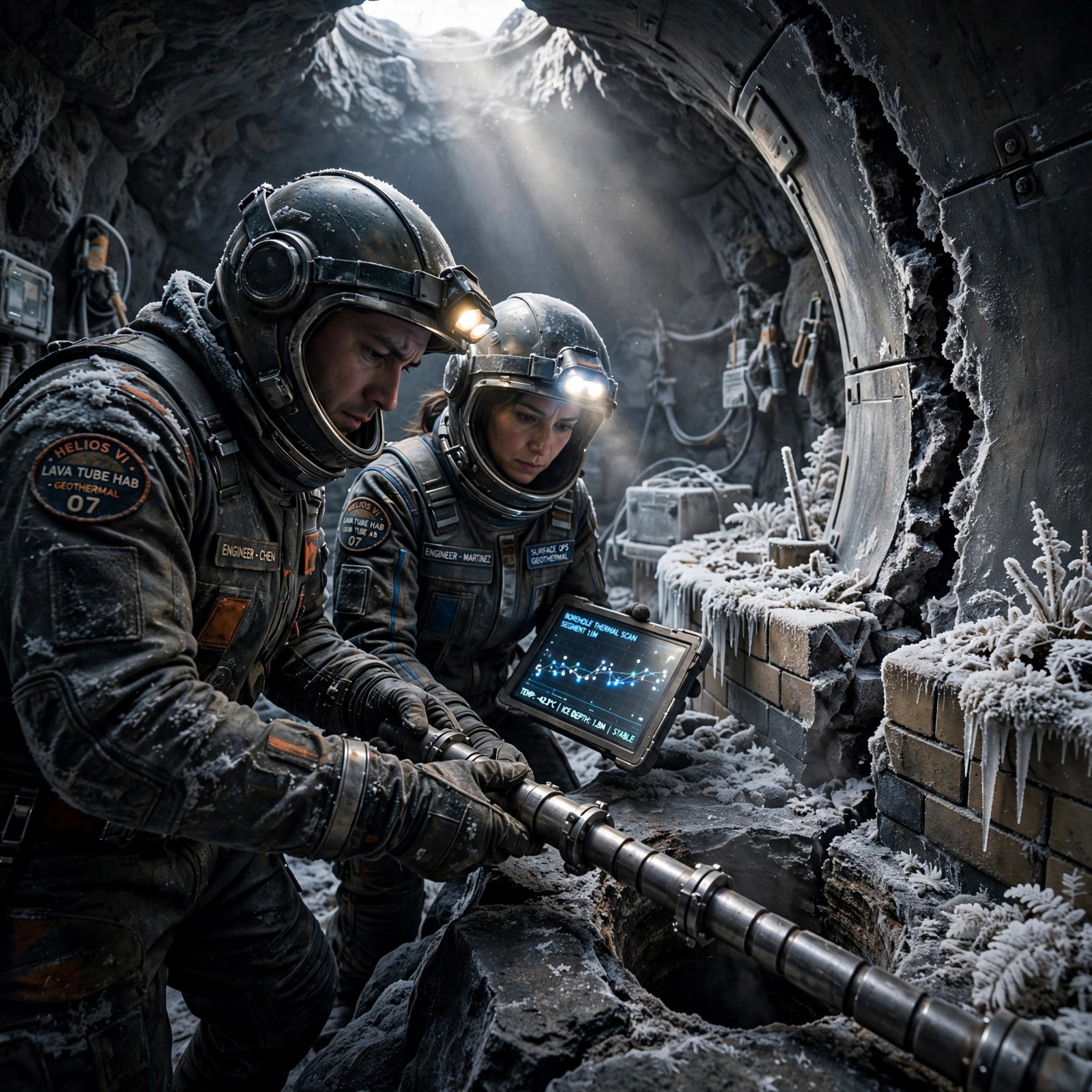
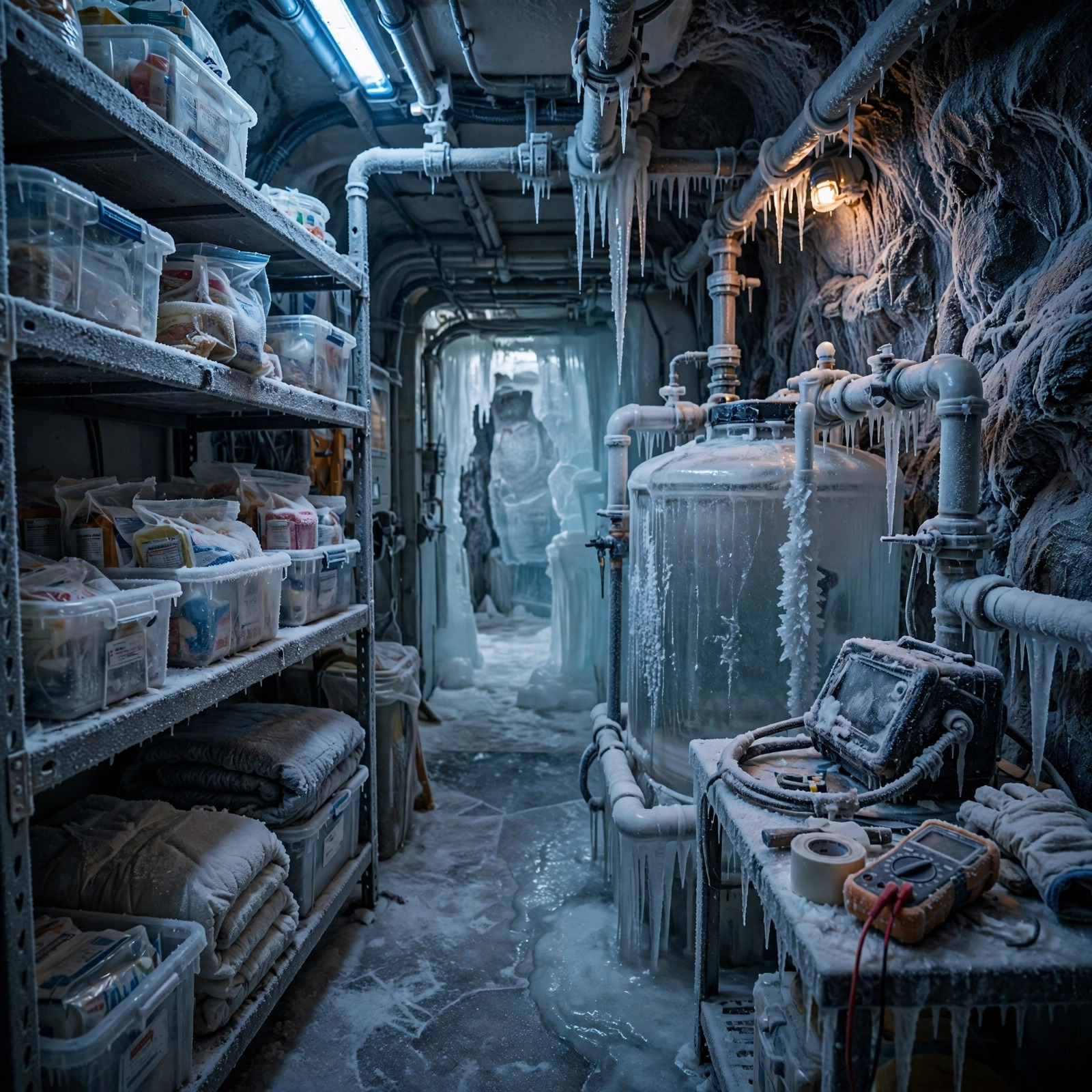
Segment Four looked like a photograph of itself. The fog had settled as frost on every surface, a white fur two centimeters thick on the terrace bricks, the bean strings, and the railings. The tomatoes had frozen solid and burst. The apple trees on the top step stood rimed and motionless in the light from the oculus. The light was still beautiful. It made everything glitter.
She climbed to the fifth step and brushed frost off the soil with her gloved hand. Underneath, the soil was frozen hard. She dug with a trowel until she reached a worm, curled and stiff and perfectly preserved. Six years of soil biology. The fungal threads Joaquim had coaxed out of his compost, the bacteria, the nematodes, the whole living invisible structure that had turned crushed rock into dirt. Frozen solid. Some of it might survive. Most would not.
Bex was waiting at the north wall with the strain reader, her own suit scuffed and her faceplate fogged at the edges. She pointed up without saying anything.
The crack ran along Joint Four-Seventeen for eleven meters. The liner had split cleanly along its length, the edges curled back like a peeled label. Behind it the basalt showed dark and wet with frost. The gap was three millimeters wide at its widest point. That was all. Three millimeters, along eleven meters, connected through the rock above to the surface and the thin cold air of Teoma.
“It went from forty-six microns to two thousand nine hundred in one pulse,” Bex said over the suit channel. “The ratchet just… let go.”
Ama stood under it with the mallet hanging from her wrist. She didn't tap anything. There was nothing to listen to.
The suit radio clicked. “Ama.” It was Pell. “I'm at the Four-Three lock. Can I come in?”
She said yes. He came in through the emergency lock in a borrowed suit that was too narrow for him, moving carefully on the frosted floor, and stood beside her and looked up at the crack for a long time.
“I'm sorry,” he said. “Joaquim. Faraz. I'm sorry.”
“I know.”
“I've halted the sequence. Odile's called an emergency Assembly for tonight.” He breathed out, and the sound came harsh over the channel. “I'm going to propose we seal Four permanently. Spray the bulkheads, write it off. It's eight percent of our food production, and we can make that up with lamps in Five over the next year. Then we restart the pulses at reduced charge. We still have four months before the dust season.”
“You can't restart.”
“Ama, there are six hundred—”
“I know how many there are.” She pulled up the joint map on her wrist display and turned it so he could see. “Joint Four-Seventeen doesn't stop at the bulkhead. It runs under the bulkhead and continues into Segment Three. Forty more meters. It's tighter there. The liner's newer. But it's the same joint, and it's already at eighteen microns, and it's got ice in it.”
Pell stared at the map.
“If you fire again,” Ama said, “it happens in Three. Three's got four hundred people sleeping in it.”
Pell was quiet. Behind his faceplate his face was very still.
“Then show me,” he said finally. “Show the Assembly. Show me something better, and I'll listen. But I need it to actually be better, and I need it fast. Because if it isn't, I'm going to stand up tonight and argue for pulses at a different site, and I'm going to win.”
Ice in the Joint
She invoked the hold at the Assembly that night. Odile read the clause aloud from the charter, because the charter required that it be read aloud, and the Commons went very quiet while she did.
The structural steward may declare a hold on any activity she judges to threaten the integrity of the habitat. The hold shall stand for thirty days and may not be lifted by the Assembly during that period. Within ten days of the declaration, the Assembly shall vote on its confidence in the steward.
The founders had written it that way on purpose. A hold was the strongest thing a steward could do, so it had to cost her something. Ama had always thought that was wise. She still did.
Odile caught her by the elbow afterward, in the crush at the Commons doors. “You know you could lose the vote.”
“I know.”
“Pell's people are already talking about it. Not unkindly. They're saying you were right about Four and wrong about everything else. That you'll hold up the water for a month and then the dust comes and the Tern lands into a tube with no room in it.” Odile's eyes were tired and sharp. “What are you going to do about that?”
“Fix the crack,” Ama said. “And then go talk to people.”
Odile looked at her for a moment. “Do it in the other order,” she said. “Or at the same time. Don't leave it.”
The idea had come to her at four in the morning in the clinic, watching frost melt off Joaquim's hand under the warming blanket.
Ice had broken the Gallery. Ice could hold it together.
The basalt around the crack sat at fifty-five below. Any water pushed into that crack would freeze there. Ice was not a perfect seal; it crept, it sublimated in low pressure, it cracked under strain. But wedged into a three-millimeter gap and backed by a fresh liner patch on the habitat side, it could plug the leak path through the rock. More important, it would fill the joint completely. A joint packed solid with ice from end to end could not ratchet. There would be no gap left for new frost to wedge open. If the method worked in Four, they could flood the rest of Joint Four-Seventeen under Segment Three before it ever split.
If it worked in Four, it would also show something else: that the joints could be locked against shock. That would change what Pell could do on the plateau.
Bex had the spray crew drill injection ports along the crack on the first day of the hold. They were small holes, eight millimeters wide, angled up into the rock every thirty centimeters. Into each one they threaded a steel tube with a check valve on the end.
On the third day they tried it.
The crew worked in suits, in the twelve-kilopascal cold of Segment Four. They used fresh water from the reserve, warmed to five degrees and pumped through a heated line from the Three-Four lock. Ama watched the flow meter. She watched the pressure behind the injection head climb and then hold.
Then it climbed again. Sharply.
“Port six is refusing,” Bex said. “Port seven. Ama, they're all refusing.”
Ama shut the pump down. They pulled the injection head off port six and shone a light into the hole. Twenty centimeters in, a plug of clear ice sealed the borehole like a cork in a bottle. The water had frozen the instant it touched the rock. It had sealed its own entrance and gone no farther.
On the strain reader, the leak rate through the crack had not changed at all.
“Fourteen cubic meters,” Bex said, reading the meter. “That's what we just put into twenty centimeters of borehole.”
Ama made herself write it down. Trial one. Fresh water, five degrees. Freezing at entry. No penetration. Fourteen cubic meters of reserve used.
Structural log, Hold Day 3: Fresh-water injection fails by entry freeze. Water must travel before it sets. Options: higher temperature (risk thermal shock to joint), freezing-point depression (brine), or controlled heating of the channel. Testing brine next.
That afternoon she went to the clinic. Joaquim was sitting up. He had a temporary hearing aid in his right ear and a bandage over his left, and his hands were wrapped in gel gloves that made them look like oversized paws. He listened to her explain the ice cork, his head tilted so his good ear faced her.
“So it needs to stay liquid longer,” he said. “Salt it.”
“That's what I'm trying tomorrow.”
“How's Four?”
She told him. He didn't say anything for a while. Then he said, “The compost bins on the bottom step. Did you check them?”
“They're frozen.”
“Frozen's not dead. Not for everything. Thermophilic bacteria spore. Some of the fungi spore.” He flexed his gloved hands and winced. “When you get the pressure back, don't let anybody dump them out.”
“I won't.”
“Go talk to people,” he said. “You've got a vote in seven days.”
So she did. She did it badly at first. She stood in the Segment Two kitchen at dinner with a tray of lentils going cold, and she explained the ratchet to a table of hydroponics techs, and she watched their eyes slide off her charts. She tried again at the next table. She tried it shorter. By the third night she'd stopped bringing the charts. She told them about the soil in the door track and the brick under it. She told them that the same joint ran under their beds. Some of them listened. Some of them told her that their cousins were on the Tern and asked where those cousins were supposed to sleep, and she told them the truth, which was that she was working on it.
One woman, a welder from Segment Five whose name Ama didn't know, listened to the whole thing and then said, “You should have been doing this a month ago.”
“Yes,” Ama said.
The woman nodded slowly and went back to her food.
Trial two used brine.
They mixed calcium chloride from the chemistry shop into reserve water until it would stay liquid down to minus thirty. They injected it through new ports drilled beside the corked ones. This time the pump pressure stayed low. The brine flowed. Bex read the meter as it climbed past twenty cubic meters, thirty, forty, and the leak rate on the strain reader began to fall.
“It's going in,” Bex said. “It's actually going in.”
Ama watched the leak rate. It dropped forty percent and stopped.
It stayed stopped. They pumped another twenty cubic meters and nothing changed. She sent a surface crew up through the Lip with thermal cameras to walk the plateau above Segment Four. They found what she'd been afraid of. Forty meters above the tube, a seam of fractured rock was steaming faintly. The brine had traveled all the way up the joint and out to the surface, where the pressure was almost nothing. There it had boiled into vapor and drifted away.
“It didn't freeze in the crack,” Ama said, looking at the thermal image. “It stayed liquid long enough to go straight through.”
“So fresh water freezes too fast and brine doesn't freeze fast enough.” Bex sat down heavily on the second terrace step in her suit. “Great. Goldilocks.”
And the brine that did freeze in the joint would be weak, full of salt pockets, the way sea ice was weak. Ama had known that going in. She'd hoped it wouldn't matter.
Pell came that evening. He'd started coming every day, standing at the edge of the work with his helmet light off so he wouldn't interfere with the crew's cameras. He never interrupted. He watched, and he read Bex's logs over her shoulder when she let him, and sometimes he asked a question so precise that Ama suspected he'd been up half the night reading about ice mechanics.
“You've used a hundred and ten cubic meters of the reserve,” he said.
“I know.”
“That's ten percent. In six days.”
“I know, Pell.”
“The dust season comes whether you've sealed this crack or not, and we'll need that reserve for the thermal buffer.” He wasn't angry. He sounded the way she felt. “What happens on day thirty if it doesn't work?”
“Then the hold ends, and you do whatever the Assembly tells you.”
“And the joint in Three?”
She didn't answer that. He didn't make her.
The answer was in the problem's shape, and it took her another night to see it.
Fresh water froze too fast because the cold rock pulled heat out of it at the entrance. Brine froze too slowly and ran out the far end. What she needed was water that stayed liquid until it reached the end of the joint, then froze from the far end back toward the habitat. Like a metal casting cooling from the tip toward the pour. If the freeze front started at the outer end and marched inward, the ice would seal the surface path first. Then each new centimeter of freezing would be pushed against solid ice behind it. No trapped pockets. No cork at the entrance. No brine.
To do that, she'd need to keep the whole joint warm while it filled. Then she'd need to cool it in order, from deep to shallow, one section at a time.
She needed long heaters, segmented, with independently controlled zones.
She needed the warm needles.
She sat at the kitchen table in Segment Three at three in the morning with the design open in front of her and thought about the three needles at the Lip. They were eighty meters down in their boreholes, melting five and a half cubic meters of water a day. They were the only water production the colony had during the hold. They were also the whole of her alternative to the pulse fracture. If she pulled them, production went to zero. If the freeze failed, she'd have spent the reserve, killed her own project, and handed Pell the only remaining option.
And the needles might not survive it. They had been designed for slow, gentle melt in clathrate ice. Nobody had ever cycled them hard in fractured basalt.
She sent Bex a message at four. Pulling the needles. Need a drilling crew at the Lip at seven.
Bex's reply came within a minute, which meant she hadn't been asleep either. Thought you'd get there. I've already got the rig prepped.
It took two days to pull the needles, haul them through the Lip, and walk them into Segment Four on carts in suits. Bex's crew drilled three long boreholes parallel to the crack, thirty centimeters above it, angled up into the basalt to follow the joint toward the surface. Each needle was nine meters long. The deepest zone reached almost to the rock where the brine had escaped.
On the ninth day of the hold they threaded the first needle into its hole. Ama stood with her hand on the steel casing as it slid in, feeling the slight hitch every time a heating zone's junction crossed a ridge in the borehole wall. She'd built these rods with her own hands in the fabrication shop over four years of evenings. Joaquim had sat beside her for some of those evenings, repotting seedlings and asking her what each part did.
He came back to work on the tenth day of the hold, against the medic's advice. He came to the Four-Three lock in a suit with his gel-gloved hands and his hearing aid, and he brought a crate.
“Soil moisture probes,” he said. “From the terraces. I've got sixty of them. They measure capacitance between two electrodes. Liquid water has a very different capacitance from ice.”
Ama stared at the crate.
“You need to see your freeze front,” he said. “You need to know where the water's liquid and where it's set. These are cheap, they're small, and they'll fit down your injection ports.” He lifted one in his clumsy glove. “I've been using them for six years to tell me when my beds froze. They're good at it.”
They threaded the moisture probes down the old injection ports on thin cables, one every thirty centimeters, deeper and deeper along the joint. Bex built a display on the strain reader. It showed the crack as a long gray bar with sixty points along it, each one blue for liquid and white for ice.
The vote came on the tenth day.
Ama didn't go to the Commons for it. She stayed in Segment Four in her suit, watching the needles come up to temperature one zone at a time, the rock around them slowly warming from fifty-five below to minus five. The count came over her suit radio from Odile, who read it out the way she read everything, plainly and without comment.
Fifty-eight percent no confidence. Forty-two percent in favor.
Bex, beside her, swore under her breath. Joaquim put one gloved hand on Ama's arm and said nothing.
“The hold stands,” Odile said. “Twenty days remain. The Assembly will elect a new structural steward on Friday. Ama, the chair would like to note for the record that you've done nothing wrong under the charter.”
“Thank you, Odile,” Ama said.
She turned off the radio and went back to watching the needles. Her hands felt very steady and very far away. After a while she noticed that Bex had stopped working and was looking at her.
“I'm fine,” Ama said.
“You're not.”
“No,” Ama agreed. “Zone eight on needle two is lagging. Check the connector.”
On the thirteenth day of the hold, they flooded the joint.
The needles had kept the rock around the crack just above freezing for three days. They pumped fresh water this time, no salt, warmed to five degrees. It went in smoothly. On Bex's display, the sixty points along the crack turned blue one after another, from the habitat side outward. When the deepest probe showed blue, Ama ran the pump another two minutes to be sure and then shut it down.
Above them, on the plateau, a surface crew reported a faint new steam plume. A little of the water was escaping. The rest of the joint was full.
“Okay,” Ama said. “Zone eight. All three needles. Shut down.”
Bex keyed it. Deep in the rock, the three needles' outermost heating zones went cold.
Nothing happened for twenty minutes. Then the deepest probe flickered white.
They watched it for six hours. Then the next probe in turned white. The steam plume on the plateau faded and stopped.
“Surface path's sealed,” Bex said. Her voice cracked a little.
“Zone seven,” Ama said.
It went on for four days. Zone by zone, she shut the needles down and watched the white creep toward the habitat. She slept in the Three-Four lock on a fold-out cot in her suit liner. Joaquim brought her food and sat with her, and they watched the display together. He could hear better now, in his right ear at least, and sometimes he hummed tunelessly under his breath the way he did when he worked the beds. On the second night, the freeze front stalled at probe thirty-one. It stayed blue for nine hours while the probes beyond it had long gone white.
“Trapped pocket,” Bex said. “Damn it. If that freezes without a path, it'll expand and crack the ice behind it.”
Ama had planned for that. She'd left injection ports open at every third probe. She had Bex open port thirty and push five liters of water into the pocket, just enough to relieve it. Then they waited. Probe thirty-one turned white just before dawn.
On the seventeenth day, the last zone shut down. Bex's crew sprayed a new liner patch over the full length of the crack, eleven meters, and Ama walked it with the mallet. Tock. Tock. Tock.
Every point on the display showed white.
They brought Segment Four up to pressure on the nineteenth day of the hold.
It took eight hours. They bled air in from Three slowly, a few kilopascals an hour, watching the leak rate. Twenty kilopascals. Thirty-five. Fifty. At sixty-two, the strain reader showed the joint flexing under load. It opened three microns, which was exactly what Ama's model said it would do with the ice holding firm. At seventy, she held the pressure and started the clock.
The test was seventy-two hours. The charter said so.
Imre Castellanos, who had been elected structural steward on Friday by a comfortable margin, came to watch. He was a quiet engineer from Segment Five, thirty-eight years old, who had worked under Ama for six years. He stood beside her at the Four-Three window on the first night and said, “I'd like you to keep running the liner crew. If you're willing.”
“I'm willing,” she said.
“Good. I'd have had to beg otherwise.” He watched the display a moment. “The Tern is going to need a lot of liner.”
At hour thirty, something cracked.
It was a sharp sound, not the slow tick of the rock. Everyone in the lock heard it. Bex jerked upright on her stool. On the display, the pressure in Four dipped from seventy to sixty-nine point six, and Ama's heart dropped through the floor.
“Where?” she said. “Bex, where?”
“I'm looking. I'm looking.”
Ama suited up. She went through the lock into Segment Four, where the air was thick and warm again and the frost had long since melted into mud. She walked under the crack with her helmet light on the new liner patch, and she tapped.
Tock. Tock. Tock.
At the seventh meter, a hairline had opened in the fresh liner. It was barely visible in her light, a thin dark thread maybe twenty centimeters long. She put her glove over it and felt nothing. She held a strip of tissue to it and watched the tissue lie still.
“It's the liner,” she said over the radio. Her voice wasn't steady. “It's the patch settling over the ice, not the ice itself. There's no flow through it.”
“Pressure's holding at sixty-nine point six,” Bex said. “It's… holding.”
It held. The new crack in the liner was a curing shrinkage line. It needed nothing but a skim of resin the next morning. The pressure in Four climbed back to seventy as the handlers caught up, and stayed there.
At hour seventy-two, the leak rate in Segment Four was lower than it had been on the day the colony first sealed it.
Pell came to the Assembly the night the hold expired. He stood at the front of the Commons in his orange jacket and put Ama's joint data up on the wall, with her freeze-front logs beside it, and walked the room through them carefully, the way he did everything.
“I was wrong about how the rock would behave,” he said. “Ama wasn't. I also still need water, and so do you, and so does my sister.”
His new proposal was not the old one. The pulse ring would move two kilometers east, to a site where the cooling joints ran away from the Gallery instead of toward it. The charges would be cut to thirty percent. Every joint in the Gallery would be monitored, and any of them opening past twenty microns would halt the sequence automatically, without a committee. The power that would have run the full rigs would go instead to nine more warm needles. Ama's freeze method would be used first to pre-seal the rest of Joint Four-Seventeen, under Segment Three. After that, the method would be applied to any joint that showed ice-ratchet behavior.
By the numbers, the colony would have about eleven thousand cubic meters by the time the Tern arrived. That was not fourteen thousand. The newcomers would double up in the first months. Segment Six would be finished late.
It passed by about the same margin that had removed Ama from her post. Some of the same people voted for it. Ama voted for it too.
Line Four
Seven months after the crack, the new water line came through.
The dust season was ending. Outside the Lip, the plateau was still coated in the fine rust-brown powder that blew down from the northern basins every year, and the solar fields were only now being swept clean by crews in suits pushing wide brooms. Inside the Gallery, the dust got everywhere it always did. It worked into door tracks and the cuffs of coveralls and the gaps between floor plates. The air handlers had filtered it all season and still lost.
Segment Four smelled like wet compost and fresh resin.
The terraces were half rebuilt. The bottom four steps held soil again, dark and raw and only a few months old, made from Joaquim's compost bins and the composted remains of everything that had frozen. He'd been right about the spores. The thermophilic bacteria had come back first, then the fungi, then slowly the rest. He'd seeded new worms from the Segment Two greenhouses. The fifth step held tomato seedlings ten centimeters high under grow lamps. Steps six through eleven were still bare brick, swept clean. A new apple seedling had been planted on the top step. It stood alone in its bed, knee-high, with three leaves.
Faraz sat on a folding chair at the foot of the steps with a blanket over his knees. He wasn't supposed to climb yet. He was supposed to be in his apartment resting. He'd come anyway, as he had every day for a month, and given everyone advice about beans.
Overhead, along Joint Four-Seventeen, Bex's crew had left one stretch of the liner patch clear instead of cream. It was a window thirty centimeters long, set into the seventh meter of the crack. Through it you could see the dark basalt and, in the joint, a seam of pale ice catching the light of the oculus.
The water line ran along the base of the north wall, a fresh white pipe in steel brackets. It came from the Lip, where the nine new warm needles had been melting clathrate for six weeks. It joined the reconditioned three at the far end of the array, now back in their original boreholes after their months in Segment Four. Two of them had come out with cracked heating zones. Ama had spent the dust season rebuilding them in the fab shop, one zone at a time. She'd had more evenings free than she used to.
The pipe ended at a valve at the foot of the terraces. From the valve, a manifold of thin drip lines climbed the first five steps.
Bex was on her knees beside the valve, tightening a last fitting with a wrench. Her coveralls were brown with dust to the elbows. She'd come straight from sweeping the solar fields. Imre stood behind her with a pressure gauge and a tablet, frowning at a number. Two techs from the spray crew sat on the second step, eating protein bars, too tired to talk.
Ama stood at the north wall with her mallet. She'd walked the segment that morning out of habit, though it was Imre's walk now, and he'd let her because he knew she'd do it anyway. Every joint was within its baseline. Four-Seventeen sat at three microns.
Joaquim came down from the fifth step, pulling off his gardening gloves. His left ear had healed better than the medic had expected. He wore a small hearing aid in it most days. The feeling had come back to most of his fingertips. Two of them still went numb in the cold, and he rubbed them now, absently, the way he did when he was thinking.
“Pressure?” he said.
“Line's at four hundred kilopascals,” Imre said. “Holding.”
Bex sat back on her heels and wiped her forehead with her wrist, leaving a long smear of dust. “Fittings are good.”
Joaquim looked at Ama. She nodded at the valve.
He crouched and put his hand on the wheel. His fingers flexed once on the steel. Then he turned it, a quarter turn, and another.
The pipe knocked, a single deep note, as the air in it was pushed ahead of the water. Then a hiss came along the drip lines. On the first step, water beaded out of the emitters, hung for a moment, and dropped. The pale gray surface of the new soil darkened in small circles, spreading wider, joining. On the second step. The third. A thin sound of dripping filled the segment, overlapping, faint, everywhere at once.
Faraz leaned forward in his chair to watch. One of the spray techs stopped chewing.
Nobody said anything. Bex stayed on her heels with the wrench in her hand. Imre looked at his gauge and then stopped looking at it. Joaquim stayed crouched by the valve, his numb fingertips resting on the wheel.
Ama stepped up to the north wall, under the little clear window where the ice showed in the rock. She lifted the mallet and tapped the liner once.
Tock.
On the fifth step, water reached the roots of the tomato seedlings, and the soil around them turned black.
Get notified when new stories drop

Sasha Quill
Sasha writes bold exploration and cosmic wonder with lyrical scale and grounded character work.
Leave a comment
Comments