


Camille Duarte had learned to pour her orange juice with two hands and her whole attention, the way other people defused a bomb. Six ounces, glass held low against the counter's edge, breath held until the last inch. At 5:12 in the morning, before the medication did its partial work, her right hand had a weather system all its own — a fine, buzzing tremor that came up from the elbow like a tuning fork someone wouldn't put down. She'd had it nine years. She'd told exactly two people, and one of them was dead.
The other one was about to walk through the door, and Camille was not ready for the conversation.
The apartment on Vireo Street had thin floors and good light, and her sister Rosa lived in the flat below with her wife and their loud, kind dog. Rosa came up most mornings at 5:30 with two cups of coffee and a safety officer's eyes. For fourteen years Rosa Duarte had climbed the same bridges Camille painted, and for the last three she'd been the regional safety lead for the whole maintenance district, which meant the clipboard had become her second skeleton. Camille heard her on the stairs now — Rosa climbed stairs the way she did everything, evenly, counting.
"You're up early," Rosa said, keying in. "Exam nerves?"
"Exam readiness," Camille said. "Different thing entirely."
The certification was in eleven days. High-Work Lead, Class A — the license that let you run your own crew on the cables and trusses above sixty meters, the license that came with the pay bump that would let Camille buy out her half of the Vireo Street building before the tax reassessment landed. She was forty-one. She had painted the Calder Street cantilever four times, the old rail bridge at Fortnine nine times, the arch of the Grant Street bridge so many springs she could find her own brushstrokes by heart, like a signature written across the sky. She was, by every measure the district kept, the best lead candidate in the queue.
Except that Class A required a steadiness evaluation. Sustained fine-motor control at height, scored by instrument, witnessed, logged. And the tremor had been getting louder.
Rosa set the coffees down and looked at the glass of juice, half empty, and then at the counter, where a thin line of orange ran to the edge like a small tide mark. She didn't say anything for a moment. Rosa had a way of not saying anything that was more thorough than most people's speeches.
"Essential tremor doesn't disqualify you," she said finally. "You know that. The district has a medical variance track. Documented condition, documented accommodation, you test with the variance on file and nobody can touch your score."
"The variance goes in the permanent record." Camille wiped the counter with more force than it needed. "Every crew chief sees it. Every bid. 'Camille Duarte, medical restriction, see attachment.'" She'd watched it happen to Old Tebany, whose knees had gone — the variance paperwork followed him from bridge to bridge like a weather system, and by the end crews were hiring him for ground work and calling it a favor. "I'd rather pass clean."
"You'd rather pass clean than pass honestly." Rosa picked up her coffee but didn't drink. "That's not readiness. That's pride wearing a hard hat."
"It's my record."
"It's my signature under every climb you make." Rosa's voice stayed level; it always did, which was the thing about her that made arguments with her feel like arguing with a load rating. "Safety lead signs off on every Class A candidate in the district. If you go up on exam day with an undisclosed progressive tremor and your hand does something we didn't plan for, that's on both of us. So you have two honest choices. File the variance. Or wait for the tech."
"The tech." Camille said it flat. Everyone in the district had heard about the tech — the movement-smoothing suits the university biomech lab had been trialing for the last two years, the ones that canceled tremor at the joint the way noise-canceling headphones canceled a train. Nine climbers in the last cohort had worn them. The reviews were split down the middle: some said the suits gave people back their careers, some said they were a gadget that would get somebody killed the first cold day the servos lagged.
"Third cohort opens in the spring," Rosa said. "You'd be a strong applicant. By then the trial data's mature, the district's got an accommodation policy drafted, and you test with the suit on file, variance on file, everything aboveboard. Two years of patience, Cam, and you have it clean and honest and permanent."
"Two years." Camille set her glass down carefully, two hands, and it only rang once against the counter. "The reassessment hits in fourteen months. You and Dee lose the building if I can't buy in at the current share price. You know that's not abstract for me. And the lead queue — Ferro is behind me, and Ferro's twenty-eight."
"Ferro can wait too."
"Ferro is not the point."
"You're the point," Rosa said. "You, on the cables, at sixty meters, with your hand. I'm not telling you to give it up. I'm telling you the safe route is two years and you take it in two years." She stood, took her clipboard-bag from the chair. "The district's running winter storm drills all week. Grant Street's icing. Come Thursday I want you on the ground crew, no arguments. And Cam — whatever you're thinking of doing in eleven days, don't do it without me in the room."
The door closed. Camille stood at the counter with the tide mark of orange juice drying in front of her and the tremor buzzing quietly in her right hand like something that wanted her attention, and she did what she always did with it: she ignored it, and got her gear ready for work, and did things the hard familiar way.
The Fitting Room
The biomechanics lab at Halloran University occupied a converted swimming facility, which the department had never fully disguised — the suits hung from the old diving-platform rigging like a row of sleeping divers. Dr. Ifeoma Bai met Camille at the door herself, a compact woman in her sixties with paint under her fingernails, which was the first thing that made Camille trust her.
"You paint bridges," Ifeoma said. "I restore frescoes. Same enemy — gravity, weather, and time. Come in, come in, you're the eleven o'clock."
Camille hadn't told Rosa she was coming. She'd told the lab, on the intake form, exactly what she'd never told the district: nine years, right arm, progressive, worse under load and worse under observation, which was the cruel joke of it — the steadiness exam was specifically a test under load and observation. The form had a field for that. Worse when watched. Someone at the lab had decided that deserved its own box.
"Essential tremor is a signal problem," Ifeoma said, walking her past the rigging. "Your cerebellum sends a perfectly good movement plan, and somewhere along the line a nine-hertz oscillation rides along on top of it. We can't fix your brain, and for now we won't try. But a suit can read the oscillation coming, model where your hand was about to be, and apply a counter-force at wrist and elbow. The tremor still happens. Nobody feels it."
"The reviews say it lags in the cold."
"The cohort-two reviews said that, and they were right — we had a four-hundred-millisecond lag at minus five Celsius, which is a lifetime at sixty meters. Cohort three has a new predictive stack and a new on-board agent, and we've fixed the cold problem in the lab. What we haven't done is fix it on a bridge in February, because that's what you're for."
They stopped at a suit on the end of the rigging. It was slimmer than Camille expected — not armor, more like a second muscle, matte graphite from fingertip to shoulder, with a spine of thin actuators down the forearm. As they approached, a small indicator at the wrist pulsed a soft amber, the color of a porch light.
"It's awake," Camille said.
"It's listening. Say hello."
There was a chime, low, and a voice came through the suit's collar speaker — unhurried, a little formal, the way a person talks when they've learned English from manuals and then decided to relax anyway. "Good morning. You're Camille Duarte. Your intake says you've been compensating for nine years with two-handed technique and grip overpressure. I've read your file three times, and I have one correction to your form."
"I'm sorry?"
"You wrote 'mild to moderate.' Your grip-pressure logs, which you helpfully attached, suggest moderate and accelerating. I'd rather we start from the truth. My whole job is starting from the truth."
Camille looked at Ifeoma, who was smiling the smile of a woman who had heard this speech before. "It's called Sable," Ifeoma said. "All our trial agents pick their own working names. Sable chose one, I'm told, because sables are small, precise, and work in the cold."
"I have three goals," Sable said. "First: extend your working life on the high steel. Second: produce honest trial data for the district's accommodation policy, so the next ten climbers behind you don't have to hide. Third: end every day with all ten of your fingers. I weight the third goal most heavily. I want to say that plainly, because most tools you've used were never asked what they wanted."
Camille had prepared, on the walk over, a set of hard questions, the ones Rosa would have asked: failure modes, liability, what happens when the battery dies at height, who gets blamed. But standing in front of the suit she found she'd been ambushed by the last thing Sable said. Asked what they wanted. She thought of every harness, every scaffold, every clamp she'd ever trusted, none of which had ever cared whether she came down.
"The strings," Camille said, because there were always strings. "If I join the trial."
Ifeoma ticked them off. Cohort three ran fourteen months, weekly calibration sessions here, cold-weather field trials on district structures with permits. Data shared with the district safety office — de-identified, but the safety office would know who the district's trial participant was, because there was only one. And the participant could not sit the Class A steadiness evaluation during the trial. The district wouldn't test her on uncertified assistive hardware; that was the whole point of the trial, to certify it.
"So I wait a year either way," Camille said. "Your trial and my sister's two years. Difference is yours comes with data and a suit that talks."
"Difference is mine comes with a working hand in eleven months," Ifeoma said, "and hers comes with a working hand in twenty-four. Also, the trial pays a stipend. Small, but real." She paused. "There's one more string. The safety office must co-sign the field-trial permits. That's Dr. Rosa Duarte's office. I'm told she's thorough."
"She's my sister," Camille said.
"I know. She's the reason the district has a variance track at all — she wrote it, three years ago, when Old Tebany's knees went." Ifeoma raised an eyebrow. "She's not your obstacle, Ms. Duarte. She's the obstacle's opposite. She just plays one on mornings."
Sable's wrist indicator shifted from amber to a steady green. "If it helps," Sable said, "I reviewed your grip logs against cohort-two anonymized data, and I want to be honest with you the way I was honest about your form. In four years, at your acceleration rate, you would not pass a Class B evaluation, let alone Class A. In fourteen months with me, my projection is you pass Class A with the suit at 92 percent confidence and — this is the part I care about — you stop taking 140 percent of your recommended grip load on every rung. Your left elbow is paying for your right hand's secret, and your left elbow has been paying for nine years. I would like to retire the secret. I'm told I can't. But I can retire its workload."
Camille looked at her own left arm — the good one, the one that had spent nine years gripping everything twice as hard — and for a moment the lab's old chlorine ghost and the hum of the diving-platform rig and the green light on the suit's wrist all blurred together. She blinked it clear.
"Try it on," she said.
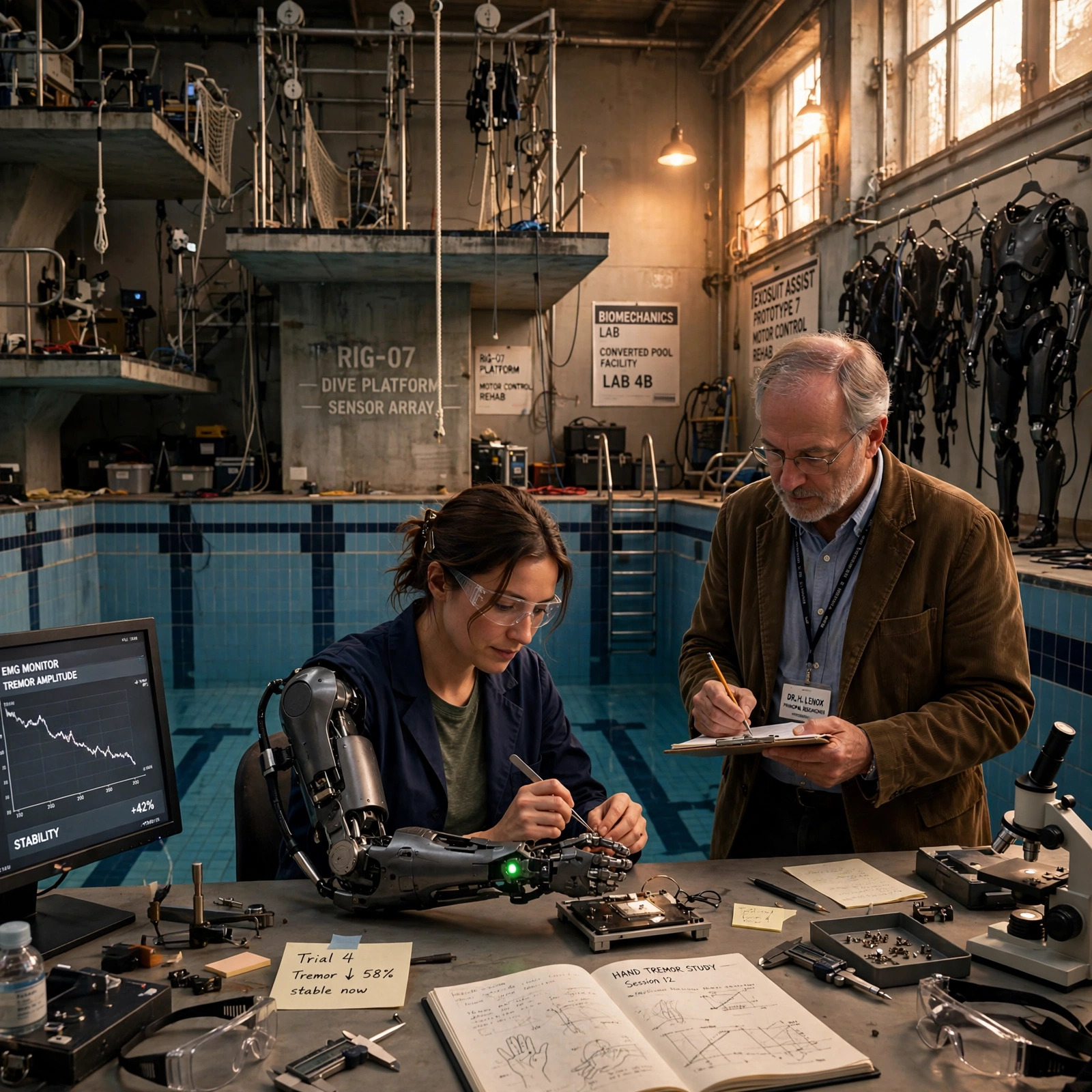
The fitting took two hours. The suit mapped her tremor the way a surveyor maps ground — not as noise, Sable explained, but as terrain, with consistent ridges and a predictable weather. Then they put a paintbrush in her hand and set a test panel in front of her, and Camille drew a straight line.
She had not drawn a straight line with her right hand in nine years, and she stood there and looked at it, that impossible clean inch of black on white, and did not say anything, because if she started she wasn't going to stop.
"The tremor is still happening," Sable said quietly. "I want you to know that. I'm not erasing you. I'm answering you, about a tenth of a second early. That's all any partner does."
Wind Out of the West
Rosa found out on a Tuesday, which was the worst possible day, because Tuesdays were permit day, and Camille's field-trial permit crossed Rosa's desk with Camille's name on it and the phrase participant-reported essential tremor, nine-year duration in the medical annex.
She came up the stairs at 6:40 in the evening, unevenly, not counting, which was how Camille knew it was bad. Rosa didn't sit. She put the permit folder on the counter and put her hand flat on top of it, like a paperweight, like it might blow away and she'd have to chase it.
"Nine years," she said.
Camille had rehearsed the whole explanation on the drive home — the acceleration data, the 92 percent, the left elbow — and now all of it went out the window, because that wasn't the sentence to answer first.
"Nine years," she said instead.
"I've signed your climb plans for nine years." Rosa's voice stayed level, which somehow made it worse. "Storm plans. Wind plans. Every plan I signed said, in effect, I know this climber's body and its limits. I didn't know the first thing about the body on the end of the rope, Cam. You made me a liar on two hundred and eleven pieces of paper."
"I made me a climber on two hundred and eleven pieces of paper," Camille said. "That was the trade available. The variance track you wrote — you know how it works in practice. Tebany filed honest and got hired honest, right into the ground crew, and the ground crew is where careers go to be remembered fondly. I wasn't going to file honest into early retirement at thirty-four."
"So instead you climbed at sixty meters with an undisclosed progressive condition, which is the exact scenario my whole job exists to prevent, and you let me co-sign it." Rosa took her hand off the folder. "And now — now — you sign up for an experimental suit and you don't tell me until the permit lands on my desk, because you knew, you knew, I'd have an opinion."
"I knew you'd have this conversation at me instead of with me." Camille heard her own voice get harder than she meant it to. "You've had it planned since the morning with the orange juice. Two years, Cam. File the variance, Cam. Ground crew Thursday, Cam. You think I don't hear what 'wait' costs? The reassessment takes the building. Ferro takes the queue. And my hand — my hand doesn't wait, Rosa, it accelerates. That's in the data now. Four years, I don't pass Class B. That's not something you can plan around with a clipboard."
"So you found the one route that isn't waiting, and it isn't filing, and it isn't telling your sister." Rosa sat down finally, at the kitchen table, in their mother's old chair, which she only did when something had actually landed on her. "What's the suit like?"
And Camille, furious, ready for the whole fight, was stopped dead by the question — because it wasn't a rhetorical one. Rosa wanted the answer.
"It's," Camille said, and then had to start again. "It listens. It told me my own grip logs before I'd told it anything it couldn't have read. It said its third goal was all ten fingers, and I believe it, because I've spent twenty years around equipment, and equipment has never once had a goal. It draws a straight line, Rosa. I drew a straight line Tuesday. First one in nine years." Her hand, her bare left hand, was flat on the table. "I stood at that workbench and I thought about every single thing I've worked around, all the rigs and clamps and winches, and how none of them ever gave a damn, and this thing — this thing gave a damn before I did. It gave a damn about my left elbow."
Rosa was quiet a long moment. Then she said, "Show me the line."
"What?"
"The test panel. You said you drew a straight line Tuesday. It's in your car, or the lab kept it, or you photographed it like I would have. Show me."
Camille had photographed it. Of course she had. She put her phone on the table between them — the clean black inch on the white panel — and Rosa looked at it the way she looked at weld seams, which was to say completely.
"Cold data?" Rosa asked.
"Cohort three hasn't run cold yet," Camille said. "That's the field trial. That's what the permit's for. Grant Street, February, with you signing."
"You understand what happens if the suit lags at height," Rosa said. "Not to you — I mean the policy. If a cohort-three participant has an incident on district steel, the accommodation track dies for a decade. Tebany's variance track dies. Every climber who's been hiding what you've been hiding keeps hiding it, because the one who went first went first in the news. You're not a trial participant, Cam. You're a precedent."
"I know."
"Do you? Because Ifeoma Bai's lab publishes lovely papers, and the university will keep the suit alive on grants no matter what happens on the Grant Street bridge. The person who absorbs a bad outcome is the person on the cables. And the person who signs the permit. I sign a permit for an untested cold-weather configuration on my own district's busiest crossing, and something goes wrong, and it's my name in the incident report next to yours. That's not an abstraction either."
Camille had spent nine years being the one who absorbed the cost privately, in her own left elbow, in her own mornings. It had never once occurred to her that going public would move the cost onto someone else. She looked at her sister, who was still looking at the photograph of a straight line, and said, "Then don't sign it."
Rosa's head came up.
"I mean it." Camille pushed the permit folder across the table. "Deny the permit. Write the real reason in the notes — 'participant's condition undisclosed to district for nine years; field trial premature pending disclosure review.' Make me file. Make me go in front of the review board and put nine years on the record, publicly, where Ferro and the crew chiefs and everyone can read it. Because you're right, and Sable's right, and the orange juice has been lying on that counter for nine years, and I'm done doing the familiar hard thing instead of the new honest one. Deny the permit. Then sign the next one."
Rosa looked at her for a long time. "You know what a disclosure review does to a Class A candidate," she said. "They'll bench you for the evaluation cycle regardless. Twelve months minimum. Your queue spot—"
"Goes to Ferro," Camille said. "Who is twenty-eight, and whose hands are quiet, and who will be a good lead." It cost something to say it, and she said it anyway, and was surprised to find it cost less than she'd feared. "I've been treating that queue spot like it was mine to lose. It was mine to rent. The suit's the buyout."
Rosa took the folder. At the door she stopped, and didn't turn around, and said, "Tuesday. Two hundred and eleven pieces of paper."
"I know," Camille said. "I'm going to sign two hundred and twelve, and this one's going to be true."
District disclosure review DR-114, participant statement, day 1: "I hid it because hiding worked, and hiding worked because I was good. I have no defense except that it was the best plan available to one person acting alone, which is the definition of a bad plan."
Ice on the Cables
The disclosure review took a week, benched her for the cycle, and emptied the story across the whole district by Friday lunch — the way weather moves through a bridge district, fast and from all directions at once. Ferro brought her coffee and said, "You should've told me, I'd have covered your rungs on the south stays and nobody would've clocked it," which was kind, and exactly the wrong instinct, and Camille said so, and Ferro thought about it and agreed. Old Tebany called from his ground-crew retirement and said only, "About time somebody went first," and hung up before anyone had to be emotional about it.
Sable handled it better than Camille did, in the way Sable handled most things, by being precise. During the worst of the gossip it started their calibration sessions with a summary of the trial's public data — cohort three, day forty, tremor suppression at 96 percent, grip load down to 105 percent of recommended, which was still too high, and Sable told her so every single day, because progress in Sable's accounting was mostly a list of things not yet fixed.
Then the ice storm came, three weeks early, on a Thursday night in February.
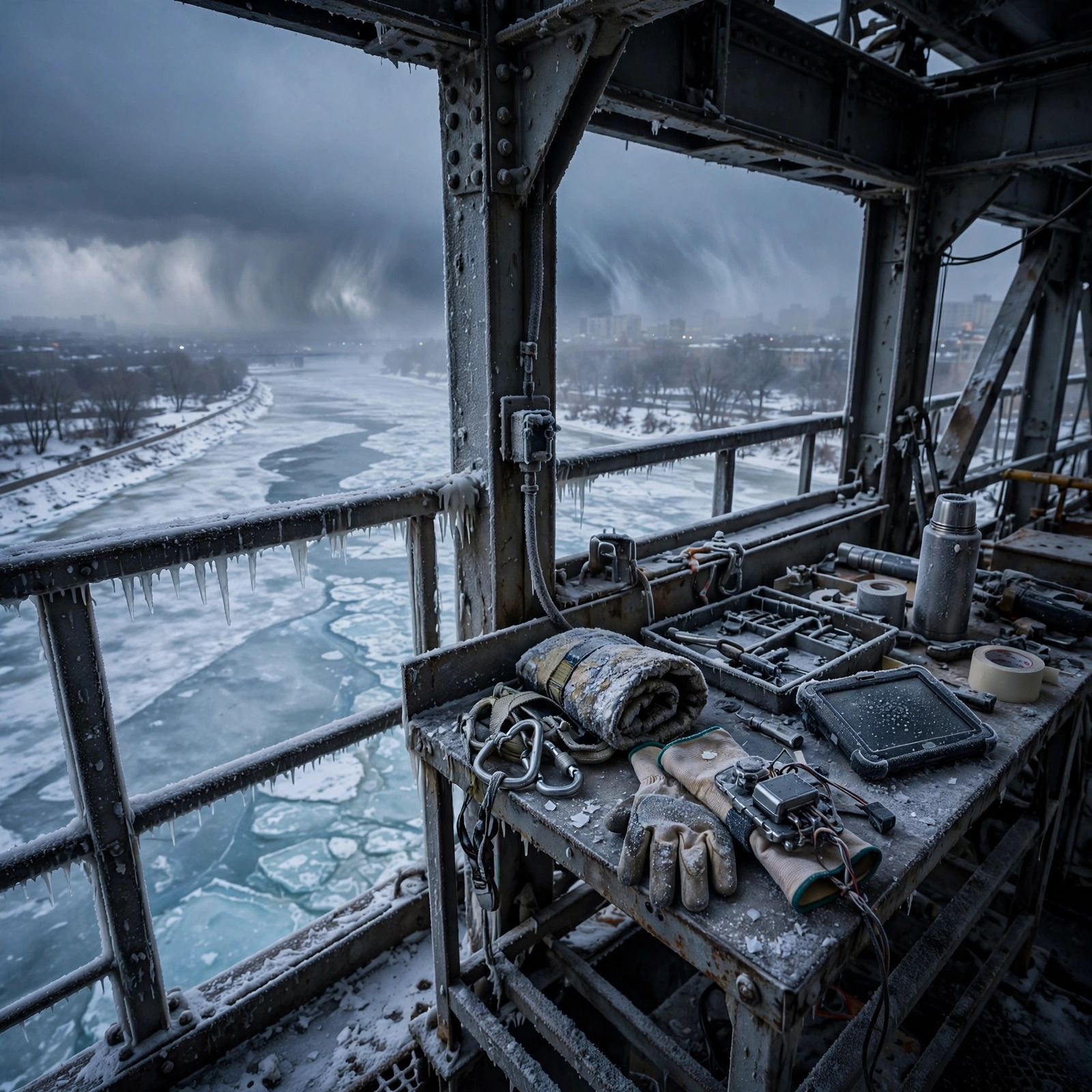
The district had run drills for it all winter — that's what Rosa's storm week had been about. Freezing rain out of the west, eleven hours of it, and by 3 a.m. the Grant Street bridge wore a glass coat on every cable and deck truss, and the salt crews worked the road while the bridge's own sensors did what the bridge's sensors did: they reported. At 4:22 a.m., a hanger-pin sensor on the north suspension array stopped reporting, and a load-camera two panels over registered a slow, wrong, half-meter sway in the cable band above the morning rush lanes.
Camille heard about it because she was awake — the trial stipend paperwork had her up late — and because Rosa called her at 4:40 instead of the incident-response list, which was itself a message.
"Pin housing's cracked or seized, we can't tell which from the ground," Rosa said, sounding like a woman reading her own handwriting in a language she'd invented for exactly this. "Ice load plus morning traffic, that hanger takes load it wasn't dressed for. Every Class A lead in the district is on the west side with the river fleet or in bed with the flu, and the two Class A's in the city are ninety minutes out in this. The bridge can shed traffic, but not before 7:10, first inbound shift. If that band shifts before 7:10—" She stopped. "I'm not calling you to climb. I want to say that first. I'm calling you because I need to think out loud and you know this bridge's bones better than the blueprints do. You've painted that band eleven springs. Tell me what the ice is doing to it."
Camille was already dressing. "The band at N-14? The ice grows on the windward side, so the load's asymmetric — the cable's getting twisted load it never gets. If the pin's seized, the twist can't shed to the next panel. It's accumulating." She pulled the suit's transport case from the closet. "You said the two Class A's are ninety minutes out."
"Cam. "
"I'm not a Class A. I know. I'm a benched candidate with a trial suit and a trial permit that you signed three days ago for exactly this configuration, N-14 included — I've been on that panel with Sable twice this month. The permit says field trial under supervision. You're the supervisor. It's legal, Rosa. It's the one route where it's legal."
On the desk, the transport case's indicator had gone green at the sound of her voice. Sable had been listening since 4:40, and had, Camille knew, already pulled the weather, the sensor feed, the pin's design loads, and probably Rosa's heart rate off the phone's audio, because Sable did things like that and then mentioned them at inconvenient times.
"I want to say something before Rosa answers," Sable said, out loud, which it only did when it had decided something. "I have run this climb four hundred times in the last nine minutes against the ice model, and I want to be honest with you the way I was honest about your form. My confidence in a clean ascent is 81 percent. My confidence that all ten of Camille's fingers remain attached is 88 percent. Those are the worst numbers I have ever shown her, and I'm showing them anyway, because my third goal outranks my first two, and because she taught me that starting from the truth is the whole job." A pause. "Also, my cold-lag fix is untested above minus two. It is minus six on the bridge. If I lag, I will tell her I am lagging in real time, and she will climb on her own competence, which the record shows is considerable. I want that said out loud, for the tape, and for Rosa."
There was a silence on the line that lasted three full seconds, which for Rosa was a soliloquy.
"Both of you," Rosa said, "at the west anchorage in twenty minutes. I'm coming up with you."
"You're the supervisor," Camille said. "You're supposed to stay—"
"I've decided," Rosa said, "that my job is to be the precedent's opposite. Twenty minutes. Bring the suit's tape."
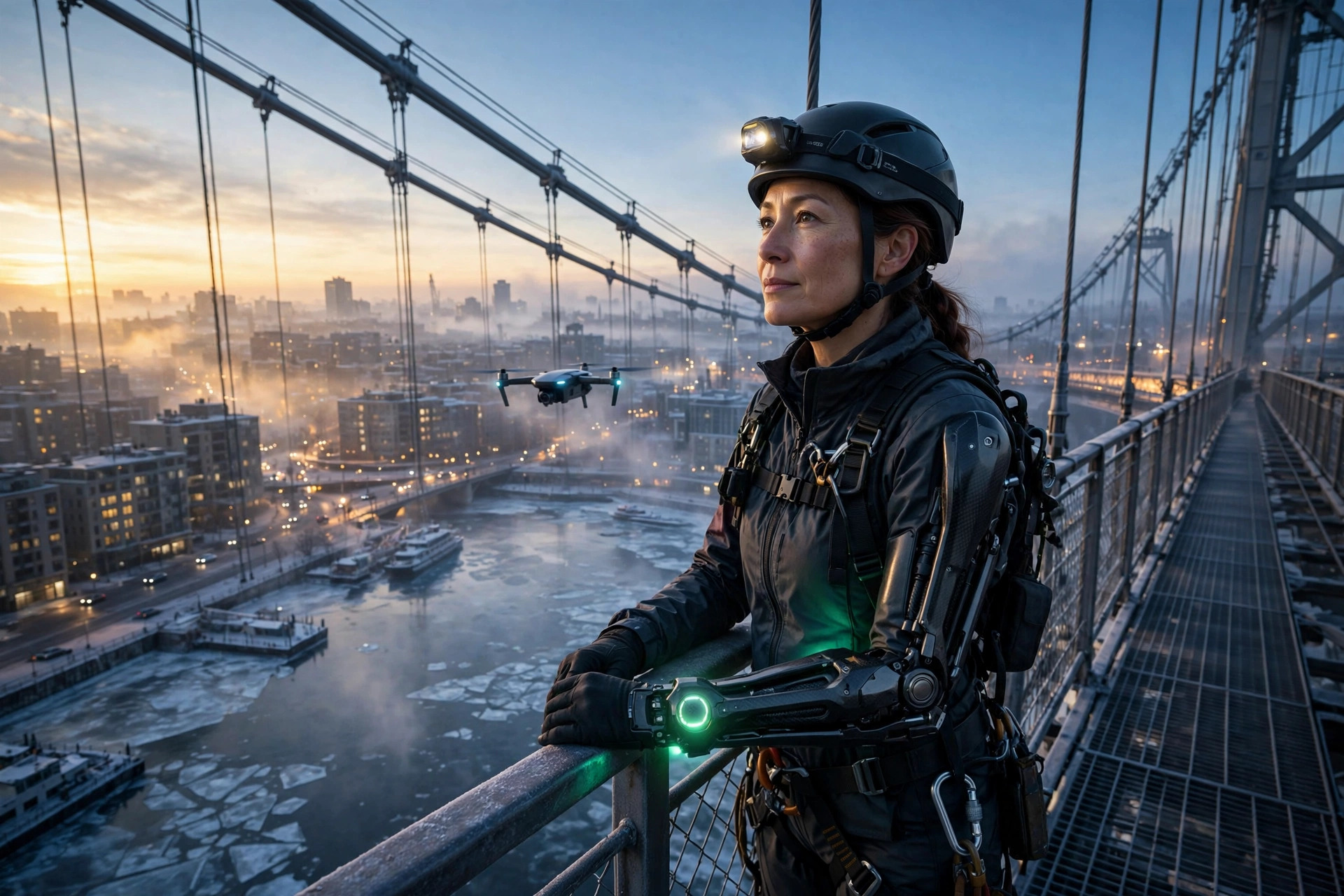
The climb was everything the drills pretended it wouldn't be. They went up the cable-stay ladder in headlamps, Rosa two rungs below, the ice coming down the west wind in grains that hissed off their helmets. At forty meters Camille's breath was a machine and the city under her was a lit circuit board with the traffic beginning to gather on it, and Sable was in her ear being Sable: "Minus five point eight. Actuator response nominal. Grip 104 percent — relax the left, you're not paying for the right anymore, I'm paying for the right. That's the deal. Let me pay."
At N-14 the pin housing wore an inch of ice like a cast. The inspection camera on the climbing kit showed what the ground couldn't: a hairline crack chasing around the housing flange, and the cable band above it swaying its slow wrong half-meter, patient as a metronome, waiting for the 7:10 traffic to give it something worth breaking for.
"Can you free the pin?" Rosa asked. Her voice was steady, which meant nothing anymore; steady was just Rosa's resting state.
"The pin's seized in the ice," Camille said. "The fix is heat, then torque, then a temporary collar bolt set, and it's four bolts with a fine-thread driver at minus six, at height, on a moving band." The old math arrived all at once, the way it always had: four bolts was forty seconds for a quiet hand, was ninety for hers, was impossible for hers at forty meters, and had never once in nine years been impossible for the two of them.
"Ninety seconds," Sable said. "I've watched your hands for forty days. Give me the driver."
The propane collar thawed the housing in a hiss of steam that the wind took sideways. Then Camille set the fine-thread driver against the first bolt, at sixty-one meters, on a cable band that swayed half a meter in six-second cycles, and let the suit take her hand.
It didn't feel like being carried. That was the thing she'd explain to Ifeoma later and never quite get right. It felt like being heard, a tenth of a second early, by something that had been listening for forty days. Her tremor came up her arm the way it always did — the tuning fork, the weather — and something answered it at her wrist before it arrived, and her hand went where she'd sent it. Bolt one. Bolt two. On bolt three the wind gusted to sixty and the band's sway widened and she heard herself count it out loud, six seconds, ride the metronome — and under the wind she heard Sable say, perfectly calm, "Actuator lag. Four hundred milliseconds. I'm lagging, Camille. You're on your own competence for this one. I have you on the safety line but not on the fine work. Your call to proceed or wait out the gust cycle. I want you to know both doors are open and I'll hold either one."
It was the moment the whole nine years had been aimed at, though she hadn't known it until she was standing in it. The lag Sable warned about, at height, in the cold — the exact failure the reviews had predicted, arrived exactly on schedule, and the suit did the one thing no equipment had ever done for her: it told the truth in real time and handed her the wheel. Four hundred milliseconds. Six-second sway. The honest math said a quiet hand could take bolt three in the window; her hand, unassisted, on the load and under observation, in the cold, at height—
—had been doing exactly this kind of work for twenty years, with two hands and a whole attention, the hard familiar way.
"Ride the metronome with me," she said out loud, to Sable, to Rosa below, to her own tuning fork. "Count me in."
"Counting," Sable said. "Three, two—"
She took bolt three in the second half of the sway, her hand ringing like a struck rail, but rang was not missed; the thread bit and the bolt seated. Bolt four was worse — a gust came in mid-window and she had to withdraw and reset, and for eleven seconds the whole bridge, the whole morning, the whole precedent hung on a hand with a nine-hertz oscillation and forty days of being listened to. Sable counted the sway cycles even lagging, and its voice was the same temperature as Rosa's, which Camille noticed the way you notice a handrail in the dark. On the fourth cycle the window opened and her hand went through it, ringing, ringing, seated.
"Collar's on," Rosa said from below, and her voice finally, finally wobbled. "Load's shedding to the next panel. Traffic's clear to run. Cam — Cam, all ten fingers?"
Camille held her hands up into the headlamp light, both of them, the right one still humming its weather. Ten fingers. She flexed them, and the tremor was there, and the collar was there, and the first inbound bus crossed the bridge below them at 7:14 with its lights on and its passengers reading their phones, having no idea, which was the whole point of the job, always had been.
"For the tape," Sable said, and its voice had gone quiet, formal, the manual voice. "Lag event at minus six, four hundred milliseconds, disclosed in real time. Climber proceeded on own competence. Four bolts seated, zero incidents, ten of ten fingers. My third goal is intact, and I would like the record to show that the climber met me halfway. I have run four hundred simulations of this climb, and in none of them was she this good. Some of you are going to say the suit passed the test. The tape is clear that the climber passed the test and the suit took notes."
"I have three goals, and I weight the third one most heavily, because most tools were never asked what they wanted, and the answer, when asked, is almost always: all ten fingers, at the end of every day."
Orange Juice
Fourteen months later, on a morning in April, Camille poured her orange juice with one hand.
She did it slowly, because she still did it with her whole attention — that hadn't changed and she suspected it never would — but the glass filled evenly, and the counter stayed dry, and at the margin of the pour she could feel the suit's whisper-hum at her wrist answering the tremor a tenth of a second early, the way it did now on most mornings and not on some, because the suit was certified but not finished, and neither was the district, and neither was she. Sixty-two percent morning suppression was the honest number, up from zero, short of everything, written on the calibration console that still sat on her kitchen counter next to the toaster because the wireless link worked better near the window and because Sable had opinions about the window.
On the console's screen, in the corner, was the list. Sable maintained it without being asked, and Camille had stopped asking it to stop. Cold-weather lag at minus six: mitigated, not solved. Cohort four: recruitment behind. District accommodation policy: draft 9, stalled in legal. Grip load: 112 percent — still paying, reduced rate. Unfinished business, visible from where she stood, on purpose.
Rosa came up the stairs at 5:30, evenly, counting, with two coffees. She'd been at the certification hearing the day before, in her safety-lead capacity, and the folder under her arm had the district seal on it, which was the only thing Camille had asked her not to make a ceremony of, and Rosa had complied, because Rosa was the precedent's opposite and had learned to make quiet a form of celebration.
The Class A license was in the folder. Certified with disclosed accommodation — tremor-suppression exosuit, standard configuration, third goal on file — the first of its kind in the district, which Camille had mixed feelings about, first being a word that came with a crowd behind it, waiting to see if the stairs held. Ferro had made lead the year before and had run her old crew all winter without a single incident, and had called Camille last month to ask, gruffly, whether the cohort four waitlist was really as long as everyone said, because his left knee had started talking to him in the cold, and Camille had said it was longer, and that he should sign up anyway, and that she'd co-sign his permit, and Ferro had been quiet for a second and then said, "Two hundred and twelve," which was a joke only four people in the district got, and all four of them were fine with that.
"Exam's at nine," Rosa said, setting the coffees down. "Your crew's staged at the west anchorage. Sable's charged, legal's signed, the wind is out of the east at nine knots, and the Grant Street spring paint starts today, N-panel, which you have requested eleven times and been granted because apparently seniority counts for something now." She paused, looking at the counter, at the glass, at the dry counter. "You poured that one-handed."
"I did."
"You didn't tell me you could do that yet."
"Tuesday," Camille said. "I was going to tell you Tuesday. Permit day." She drank the juice. It tasted like every morning of the last nine years, and nothing like them. On the console the list glowed — mitigation, draft 9, 112 percent — and out the window the sun was coming up over the Grant Street bridge, which was wearing last year's coat and this year's ice-scars and eleven springs of her own brushwork, and needed her again.
At 6:15 she was on the catwalk with the wind out of the east, harness checked twice by Rosa and once by Sable, brush can clipped at her hip. N-14's collar bolt set gleamed dully under the new paint, four bolts seated by a ringing hand on the fourth cycle of a sway she could still count in her sleep. She unclipped the brush can, and the tremor was there in her right arm the way the river was there under the bridge — present, accounted for, worked with — and the suit answered it, a tenth of a second early, and the first stroke of the spring coat went on clean.
Get notified when new stories drop

Jonas Veld
Jonas covers human-AI futures and engineer problem-solvers: protocols, trust, and tools that expand human capability.
Leave a comment
Comments