


Hatch Seven
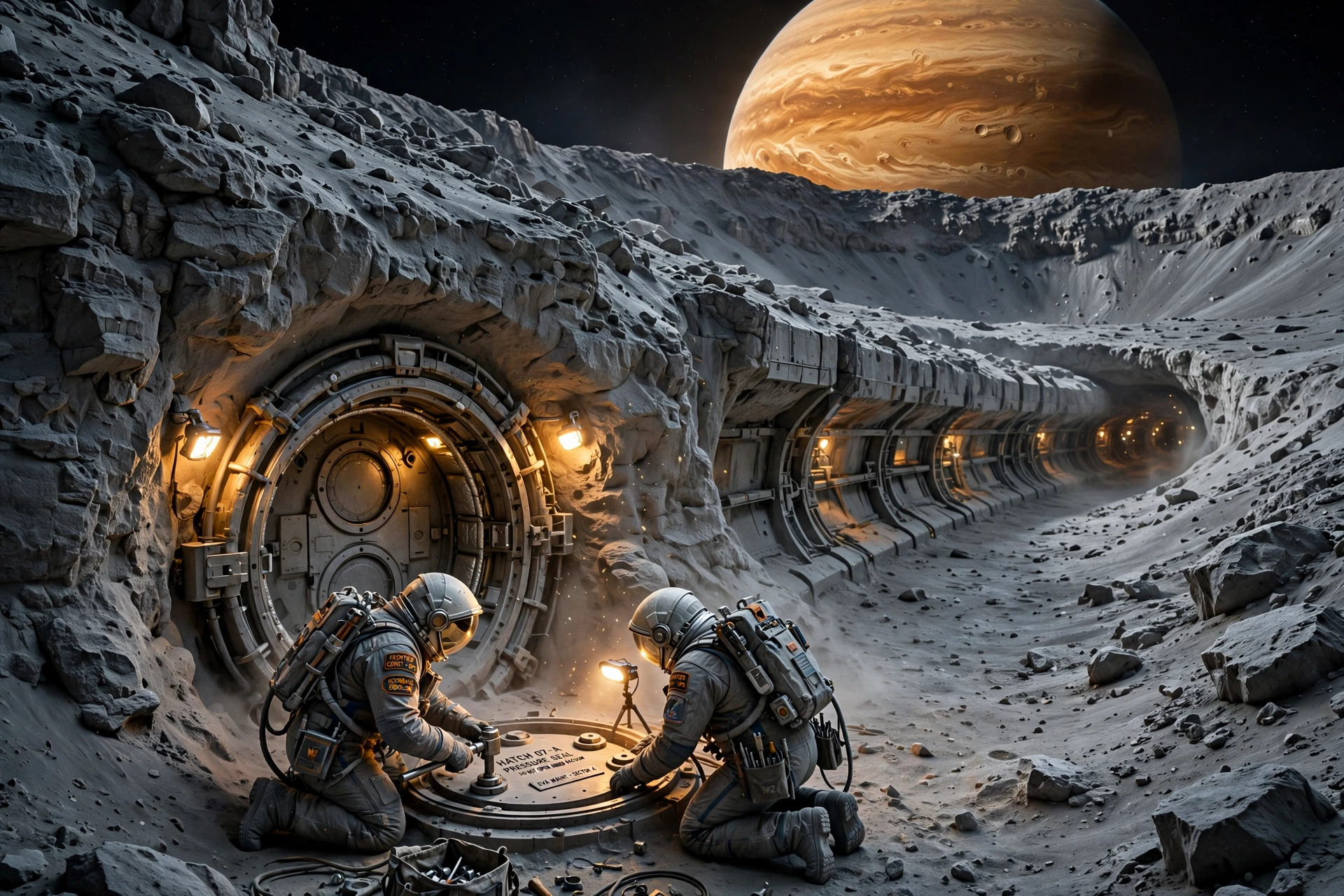
The hatch at the far end of the Long Gallery had been forged on Earth forty years before anyone thought of Halde. In six years of trying, Hester Nwosu had never once seated it on the first attempt.
She knelt in the grey dust with the torque wrench braced against her thigh and waited for the feel of it. A good seal didn't make a sound so much as a change, a soft settling that traveled up the handle and into the small bones of her wrist. This one squealed in her suit mic like a gull.
“That's not it,” Ade said. He was holding the work lamp at the angle she liked, a little low, so the gasket threw its own thin shadow across the flange.
“That's not it,” she agreed. She backed off the dogs a quarter turn each, all eight, counting under her breath.
Behind them the Gallery ran in a long, gentle curve, four hundred and ten meters of tunnel bored into the north wall of Tarrow Crater, double-skinned the entire way. Between the inner and outer skins was a gap of ninety centimeters. For six days pumps had been filling that gap from the colony reserve, a few tonnes an hour, slowly enough that the skins could take the weight without flexing. When the gauge on Hester's wrist read full, the Gallery would be wrapped in eleven hundred and forty tonnes of water. That was enough to drink most of what Brannoc's radiation belts threw at it.
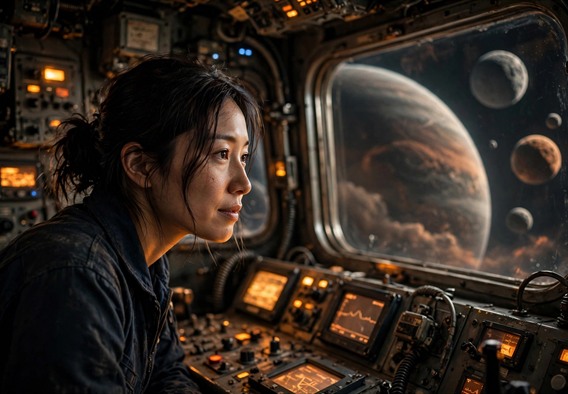
Then she could pressurize. Then the forty people who currently slept in stacked bunks in the old Core could have doors that closed. They could have windows of a sort, periscope tubes that brought the banded amber light of the gas giant down into every room.
She had drawn those rooms on the back of a ration sleeve during her first year on Halde, when she was thirty-five and still getting nosebleeds from the recycled air. Eleven years later she still had the sleeve. It was pinned above her bunk, soft as cloth now, the pencil smudged at the corners where she'd touched it.
“Try it with the lower dogs first,” Ade said. “Bottom four, then top four. It's sagging. The frame's been sagging since we hung it.”
“The frame is not sagging.”
“It's sagging two millimeters, Hester. I measured.”
She looked up at him through two faceplates. Ade Okafor was twenty-nine and had arrived on Halde four years ago with a fitter's certificate and hands that shook on a weld bead. She had spent the better part of his first year standing behind him in the fabrication bay saying slower, slower, let the puddle tell you. Now he ran cleaner beads than she did and was insufferable about it. He also measured things she forgot to measure, which was worse.
She did the bottom four first. Then the top four.
The wrench went soft in her hand, and the soft drop came up through her wrist like a held note finally released.
Ade whooped loud enough to clip the mic. Hester sat back on her heels in the dust and didn't say anything, because if she said anything it would come out wrong. Six years. The bore crews had cut this tunnel, and the printers had laid the skins, but she had specified every rib and every weld schedule. She had walked the curve with a laser level on nights when the rest of the colony was asleep.
“Gallery, Mireille.” The hydrologist's voice came over the general channel, dry and a little too close to her mic, the way it always was. “Are you two near a speaker?”
“We're in suits at Hatch Seven,” Hester said. “We've got our ears.”
“Then I'm piping it to you. It's doing it again. Deeper this time.”
There was a click, and then the tide-note.
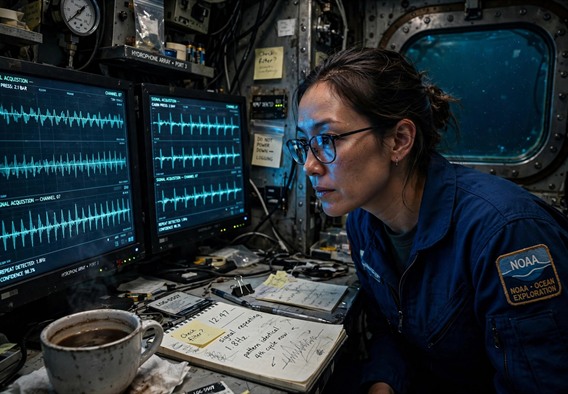
Halde's orbit around Brannoc was a little eccentric. Every three point one days the giant squeezed the moon and then let it go. Nine hundred meters beneath the floor of Tarrow Crater, the squeeze rang the Mere like a struck bowl. The Mere was a lens of warm brine thirty kilometers across, sealed under a cap of frozen gas hydrate and basalt. Mireille's hydrophones hung in old survey holes along its edge, and twice a week they picked up the sound of an entire buried sea flexing against its lid.
It came through the suit speakers as two tones, very low, the second just under the first. Then a long swell that wasn't quite a third tone, more like a pressure in the ear. Hester always felt it in her back teeth. Ade had stopped grinning. He stood with the lamp hanging from one hand and his head tilted, the way people did in the Core commissary when Mireille put it on the big speaker during dinner.
The Mere was the reason anyone had come to Halde. The Long Plan was a two-hundred-year document, and Hester had read every page. It used the brine's tidal heat as the colony's thermal anchor. Over generations, through slow and careful vents, it would let the Mere rise into the crater as a shallow, steaming sea. By then people would have soil to put beside it. Nobody alive would swim in it. Hester had made her peace with that a long time ago. Her job was the part you could build now.
“Lovely,” Mireille said, when the swell faded. “You can have your channel back. Hester, you're needed in the Core. Lisbet's calling an all-hands at nineteen hundred.”
“What for?”
A pause on the line. Mireille Dufresne was sixty-one and had never in Hester's hearing hesitated before giving bad news. She considered bad news a form of data.
“The Mule's relay came in an hour ago,” she said. “I'll forward it. Read it before you walk over. You'll want to have your face arranged.”
Hester pulled it up on her wrist display while Ade packed the tools. It was short. Rosalind Teague never wasted words, and at that distance even text cost power.
Patient Mule to Tarrow. Drive bell two cracked on the deceleration burn, cause still unclear, probably fatigue at the throat weld. We've isolated it and are running on bell one at thirty percent rated thrust. Revised arrival is day one-ninety, not day forty-one. Cargo is intact but strut four on the cage took a shock load and I don't trust it for release. All crew fine. I'm sorry. We'll send the burn plan.
Hester read it twice. Then she did the arithmetic standing in the dust, because she couldn't not.
Fourteen days ago, Bed C in the main water recycler had cracked down its long axis. The repair crew had saved most of the media, but the colony was now running at seventy-eight percent recovery instead of ninety-four. The difference walked out of the system as vented brine and wet filter cake. The reserve had been built to bridge a few lean weeks until the Mule arrived with nine thousand tonnes of ring ice in its cage. Instead it would have to bridge a hundred and ninety days.
It couldn't. Not with the greenhouse rows at full draw. Not with the reactor's tertiary loop. Not with eleven hundred and forty tonnes sitting in the walls of the Gallery.
“How bad?” Ade asked.
“Eighty days,” she said. “Maybe eighty-five if we're careful. Then we start shutting down rows.”
He was quiet. Ade spent his off-shifts in Row Nine with Aurelio Pinto, who had coaxed eleven apricot saplings out of a seed vault meant for a world with real winters. The first fruit had set three weeks ago, hard and green and the size of a thumbnail. Ade had sent Hester a picture of one at two in the morning with no caption at all.
The gauge on her wrist read ninety-eight percent full. She looked at it for a long moment. Then she turned off the pumps.
Emergency Authority
The Core commissary had been designed for sixty and held a hundred and twelve that night. People sat on tables and on the counters by the tea urns. They stood three deep along the curved back wall where the old mural of Earth's moon had faded to the color of weak broth.
Provost Lisbet Haraldsen did not like crowds and did not pretend to. She stood at the front with her hands flat on a folding table and waited until the room got quiet on its own. That took a while. Then she put the numbers on the screen behind her, the same ones Hester had worked out in the dust, only cleaner.
“We have options,” Lisbet said. “I want to be honest that none of them is good. I'm going to let Josef present the one I think is least bad. Then I want to hear objections. I expect to hear them.”
Josef Kranz was the colony's drilling lead, a big quiet man from a family of North Sea well engineers. He had come to Halde with a rig and a contract to sink geothermal probes, and he had sunk them all on schedule. Hester respected him. She had once watched him spend nine hours patiently fishing a broken bit out of a probe hole rather than abandon it and drill a new one. That was the kind of engineer he was.
He put up a cross-section of Tarrow Crater: the regolith, the basalt, the white band of hydrate cap, the long dark lens of the Mere beneath it.
“A single pilot bore,” he said. “Here, in the crater floor near the old survey line, two kilometers from the Core. We go down to just above the cap, then a controlled penetration into the upper brine. Eight-inch casing, full blowout prevention stack, a pressure tent over the wellhead. We pump brine up, run it through the desal skid, and the salts go to the fabricators. First water in about twenty-five days. Twenty tonnes a day once it's running.”
Somebody near the urns let out a breath. Twenty tonnes a day closed the gap. It more than closed it.
“The Mere's under Charter protection,” Hester said. She hadn't meant to speak first, but the room had turned toward her anyway. Everyone knew who held the stewardship for the Long Plan structures. “Article nine. No penetrations of the cap without a full review.”
“Article nine has an emergency clause,” Lisbet said. “Which I'm invoking. I'm aware of what that means, Hester. I'm aware it's on me.”
“Then I want my objection on record.” Hester stood. Her knees ached from the hatch. “The cap isn't just rock. It's hydrate, frozen gas, under nine hundred meters of pressure. The brine underneath is carrying dissolved carbon dioxide at saturation. We've known that since the first core samples. You open a hole in that, you're opening a bottle that's been shaken for a few million years.”
“We'd be opening it with a stack rated for four times the pressure Mireille's models predict,” Josef said. He wasn't defensive. He said it the way he'd say a bolt torque. “And we'd bleed it slow.”
Every head turned to Mireille, who was sitting on the end of a table with her tea and her reading glasses pushed up into her white hair.
“My models,” Mireille said, “are built on four core samples and a lot of listening. I'd say seventy percent the cap behaves exactly as Josef wants it to. I'd say thirty percent we find a gas pocket I haven't mapped. I can't make it better than that without six months of seismic work we don't have.”
“Thirty percent is a lot,” Hester said.
“So is eighty days,” said Lisbet.
Hester had come prepared for that. She brought up the plan she'd built in the forty minutes between Hatch Seven and the commissary, sitting in the suit locker with her helmet still on her knee. Kas Oduya had run the orbital numbers over the comm. He'd sounded half asleep and then, very quickly, not asleep at all.
“The Wren,” she said.
The Wren was the colony's only deep-space craft, a stubby fission-thermal tug that mostly ferried survey packages to Halde's inner sister moons. Its reactor heated water into a white-hot exhaust. It was slow to fuel and sweet to fly. Kas had flown it for seven years and talked about it the way other people talked about a difficult cat.
“The Mule's coming in on a long low-thrust spiral,” Hester said. “Kas thinks we can meet it on the outbound leg in eleven days, spend three at rendezvous, and be home in thirteen. That's under four weeks. The Wren's cargo frame can carry one of the big ice blocks, three hundred and eighty tonnes. That alone gets us forty extra days. And Rosalind can spin the Mule's arrival forward if she isn't hauling the full cage.”
Kas, sitting by the door, put up his hand like a schoolboy. “Small thing.”
“Go on.”
“To push the Wren out there with the frame, and to brake home with three hundred eighty tonnes of ice strapped to her belly, I need five hundred and twenty tonnes of propellant. Propellant is water.” He shrugged. “We'd be spending water to fetch water. I like the trip. But I said all that to Hester in the locker. I'm saying it again so nobody thinks I'm hiding it.”
Lisbet looked at the screen. Then at Hester. “Five hundred and twenty tonnes takes the reserve under the floor. If anything goes wrong on that rendezvous, we lose the water and we don't get the ice. Then we're not shutting down rows in eighty days. We're shutting them down in thirty.”
“And if the bore goes wrong—”
“Then I'm the one who opened the bottle,” Lisbet said. “Yes.” She didn't raise her voice. She looked tired, and older than fifty-three. “Hester, I've read the Long Plan. I sat on the committee that ratified it. I'm not trying to hurt the Mere. I'm trying to keep a hundred and twelve people fed until the ice comes. Josef's plan has a seventy percent chance of no harm at all and a near-certain chance of water. Yours has a real chance of leaving us dry. I'll approve the bore under emergency authority. I'll also approve your objection going to the Charter review. That's how it's meant to work.”
The review board sat once every quarter. The next session was in twenty-four days.
Hester sat down. She had the formal objection drafted by midnight, eleven pages with Mireille's core data appended and her own calculations on cap stress in an annex. She filed it with the board clerk. Then she lay in her bunk and looked at the ration sleeve pinned above her face until the pencil lines blurred.
She had always believed in the review. It existed precisely so no single tired person, in a single bad week, could undo two centuries of planning. She believed in it the way she believed in weld schedules. You didn't eyeball a structure that would outlive you. You wrote down what it needed, and you checked it against what someone else had written down, and you trusted that.
She didn't let herself think about the Gallery. Not yet. The Gallery was not part of anybody's plan for this, including her own.
Three days later Josef's crew trucked the rig out to the survey line. On the seventh morning they spudded the bore.
Ade told her the evening after that, in the fabrication bay, with his welding hood pushed back on his head and his eyes not quite on her.
“Josef's short a floor hand,” he said. “Malik broke his wrist on the casing truck. He asked if anyone with pressure-tent hours wanted to rotate on. I've got a hundred and forty from the Gallery.”
“I know how many you've got. I signed them.”
“It's double ration credit. Not that I care about that.”
“Ade.”
“Somebody's going to stand on that floor,” he said. “If it's going to be anybody, it should be somebody who's actually afraid of it.” He did look at her then. “I'm not doing it to spite you. You know that, right? I read your objection. I think you're probably right. But Aurelio's going to have to start pulling the saplings in forty days if nothing changes. I'd rather be on the rig than sitting in Row Nine watching him do it.”
She thought of a dozen things to say, all reasonable. She said none of them. He had seen her face at the hatch. He had stood behind her through six years of welds. There was no argument she could make that he hadn't already made to himself.
“Wear the heavy suit,” she said. “Not the light one. And you keep a hand on the tent line every time you cross the floor.”
“Yes, Steward.”
He only called her that when he was being kind and didn't want it noticed.
Six Hundred Forty Meters
On the nineteenth day of drilling, two days before the review was due to sit, Hester drove out to the survey line. She wanted to look at the mud log with her own eyes.
She told herself it was for the board. She'd want to give them the most current numbers. That was true and also not the whole truth. The whole truth was that she hadn't slept well in a week. When she closed her eyes she saw the white band of hydrate in Josef's cross-section, and the black hole going down into it.
The crater floor was flat and grey, scoured into ripples by four billion years of micrometeorites. Brannoc hung above the far rim, swollen and banded, a quarter of the sky. Its light made the pressure tent glow the color of weak tea. Inside, through the translucent wall, she could see the rig mast and the shapes of four suited workers moving around the rotary table. One of them, tall with a blue stripe on his helmet, was Ade.
Josef met her at the doghouse, the pressurized cabin bolted to the rig skid where the logging screens lived. He'd been expecting her. He had a bulb of coffee waiting.
“Six hundred and thirty-one meters,” he said. “We're in the transition zone above the cap. Hydrate's starting to show in the cuttings. Very small. Gas readings are low and steady.” He tapped a screen. “If you want my honest opinion, it looks good. Better than Mireille's models.”
Hester looked. He was right. The gas trace was a low, lazy line. The mud weight was holding. The drill string's torque was smooth. She found she was almost disappointed and hated herself for it.
She stayed anyway. She sat in the corner of the doghouse with the coffee going cold in her hand and watched the trace. Josef went out and came back. The crew changed out a stand of pipe. Ade waved at her through the doghouse window, a big exaggerated wave, and she waved back. Six hundred thirty-four. Six hundred thirty-seven.
At six hundred and thirty-nine meters the gas trace twitched.
It wasn't much. A spike of carbon dioxide in the returning mud, up from a background of two percent to four, then back down. Josef saw it at the same moment she did and leaned in.
“Hydrate dissociation in the cuttings,” he said. “It happens. They warm up coming up the annulus and fizz.”
“Or there's a pocket.”
“Or there's a pocket.” He keyed the floor channel. “Floor, doghouse. Slow the rotary to forty. Watch your pit levels.”
Six hundred forty. The trace went to six percent and stayed there.
“Pit's up,” said a voice on the floor channel. Bohdana, the driller. “Up half a cubic. Up one.”
Pit gain meant the mud tanks on the surface were filling faster than they should. It meant something down the hole was pushing fluid up. Hester was on her feet before she knew she'd moved.
“Josef—”
“I see it.” He was very calm. He had been trained for this since he was nineteen. “Floor, we're taking a kick. Pick up off bottom. Stop the pumps. Close the annular.”
Through the window Hester watched them do it, crisp and fast. Bohdana lifted the drill string. Someone on the panel hit the annular preventer. A big rubber doughnut deep in the stack squeezed closed around the pipe. The pit level stopped rising. Josef watched the pressure gauge on the casing climb, slow and steady, exactly as it should. For one long moment, Hester thought it was done.
Then the casing pressure kept climbing past where it should have stopped. Ten megapascals. Twelve.
“It's not a pocket,” Josef said, very quietly. “It's charging. The cap's—” He didn't finish.
Fifteen.
Hester was already in her helmet. She didn't remember deciding to put it on.
“Floor, doghouse. Close the blind rams. Everybody off the floor. Now.”
The blind rams were the last line, two steel blocks that would slam shut and shear the pipe if they had to. She heard the hydraulics fire, a deep shuddering thud that came up through the skid into her boots. The pressure trace paused. Then it jumped.
The annular let go.
From inside the doghouse it looked almost gentle. A white plume came up out of the rotary table like a blossom opening, carbon dioxide gas and brine flashing to frost in the low pressure of the tent. Then the tent wall nearest the rig bellied out and split from floor to seam, and the whole thing went white.
Hester went through the doghouse airlock without cycling it properly. The alarm screamed at her. She ignored it.
Outside was a blizzard. Gas was venting through the torn tent into Halde's near-vacuum and freezing as it came. Fine crystals of dry ice and salt hissed against her faceplate. The pressure drop had sucked dust up off the crater floor in a churning grey wall. She couldn't see the rig. She could see her own hand if she held it against her visor.
“Floor, call off,” she said. Her voice sounded strange to her, very level. “Floor crew, call off.”
“Bohdana, off the floor, by the mud tanks.”
“Wen, here, I've got Petra.”
Nothing else.
“Ade,” she said. “Ade, call off.”
Static. A wet crackle. Then his voice, thin and too fast. “Hand's caught. Hester, my hand—the slips, the slips came up and—suit's—”
She found the tent line by walking into it. She clipped on and went in hand over hand along it, into the white. The ground shook under her. It was not a tremor exactly. It was more like something very large rolling over in its sleep. The rig mast groaned above her somewhere in the murk.
She nearly stepped on him. He was on his knees beside the rotary table with his left arm pinned to the wrist in the slips. The heavy steel wedges that gripped the drill pipe had kicked up when the string jumped, and they'd closed on his glove. His suit's cuff seal was hissing. Frost was crawling up the sleeve. His suit alarm was shrilling on the shared channel. She could see his face through the faceplate, grey and wet-eyed and furious.
“Okay,” she said. “Okay. I've got you.”
The slips were held by a pneumatic release, and the rig's air was gone with the tent. She got her shoulder under the slip handle and heaved. Nothing. She braced her boots against the table frame and heaved again, and something gave, a few millimeters, a few more. Ade screamed and pulled. His glove came free with a sound she felt rather than heard.
The glove was crushed flat across two fingers. The cuff was leaking hard.
She had pressure tape in her thigh pocket, as she always did, because she had once spent nine minutes waiting for someone to bring her some. She wrapped his wrist above the breach four times, hard, crushing the fabric down onto the cuff ring. The hiss dropped to a whisper. His suit alarm changed pitch.
“O-two's at forty percent,” he said. “There's CO2 in the suit. I can taste it.”
“Then breathe slow.”
“I'm trying.”
She got him over her shoulders in a fireman's carry, which at Halde's quarter gravity was easy and also stupidly hard, because everything wanted to bounce. She walked them back along the tent line, one hand on the line and one on his leg, counting steps because counting was something to do. Behind them the well roared. The ground rolled again under her boots, longer this time.
Josef had the doghouse airlock open and waiting. They went in together in a tangle of limbs. He slammed the outer door and hit the cycle. Hester pulled Ade's helmet off the instant the light went green.
His face was blue around the mouth. His eyes were wide open.
“Hey,” he said, slurred. “Your seal was good. At the hatch.”
“Shut up,” she said. “Shut up and breathe.”
The Wren was the closest thing the colony had to an ambulance. Kas brought it down onto the crater floor eleven minutes later, on a column of white steam, closer to the venting well than any sensible pilot should have dared. They flew Ade to the Core infirmary in eight minutes more.
Dr. Sato took two of his fingers, the fourth and fifth on the left hand, at the middle knuckle. The cold had gotten into them through the crushed glove and there was nothing left to save. The hypoxia hadn't done lasting damage that they could find, although Sato wanted to watch him for a week. When Hester was allowed in, Ade was asleep. His bandaged hand rested on his chest like something he'd been given to hold.
She sat by the bed for a long time. Then her wrist chimed and she looked at it, because she couldn't not.
The heave had raised the crater floor eleven centimeters in a ring two kilometers wide around the bore. The Core sat on bedrock in the crater wall and had barely felt it. The greenhouse rows didn't. They were built out on the floor on cheap printed footings, because the floor had been stable for four billion years.
Row Nine was the farthest out.
She found Aurelio there that evening, sitting in a pressure suit on an upturned crate in the dark. The heave had cracked the row's frame along two ribs and torn the inner membrane. By the time the breach alarms got the row sealed, it had dropped to a third of an atmosphere and minus forty. The apricot saplings stood in their beds with their leaves frozen grey and curled. Each tiny green fruit was furred with frost.
Aurelio was sixty-eight. He had grown things in four different hostile places in his life, and he didn't cry. He was holding a frozen leaf between his gloved fingers and turning it slowly to the light from Hester's lamp.
“Wood might be alive,” he said. “Sometimes the cambium makes it. I'll know in a few weeks if we get the heat back.”
“We'll get the heat back.”
He nodded. He didn't ask what that would cost. That was a courtesy, and they both knew it.
When she got back to the Core, Mireille was waiting in the corridor outside the hydrology lab with a tablet held against her chest.
“I need you to hear this,” Mireille said. “I'm sorry. I need somebody else to hear it.”
She played the evening's tide-note.
It was the right hour. Halde was swinging toward Brannoc again, and the squeeze was coming on schedule. But the two tones were wrong. They were thinner, and higher than Hester remembered, and the long swell after them never came. There was only a ragged hiss under everything, like a radio between stations.
“It's the cap,” Mireille said. “Every gram of gas that comes out of that hole drops the pressure on the lens. Drop the pressure and more gas comes out of solution. If it keeps venting, the cap goes on dissociating. It won't stop. It'll get worse.” She took off her glasses and pressed her thumbs into her eyes. “Seventy percent. I said seventy percent. I should've said I didn't know.”
“You did say it,” said Hester. “Everyone heard you.”
It didn't help either of them. It wasn't supposed to.
Kill Weight
The blind rams had closed most of the way. That was the first thing Josef told them at six the next morning in Lisbet's cramped office, with the four of them and Kas standing because there were only two chairs. The rams had sheared the pipe and sealed nearly all of the bore. Nearly.
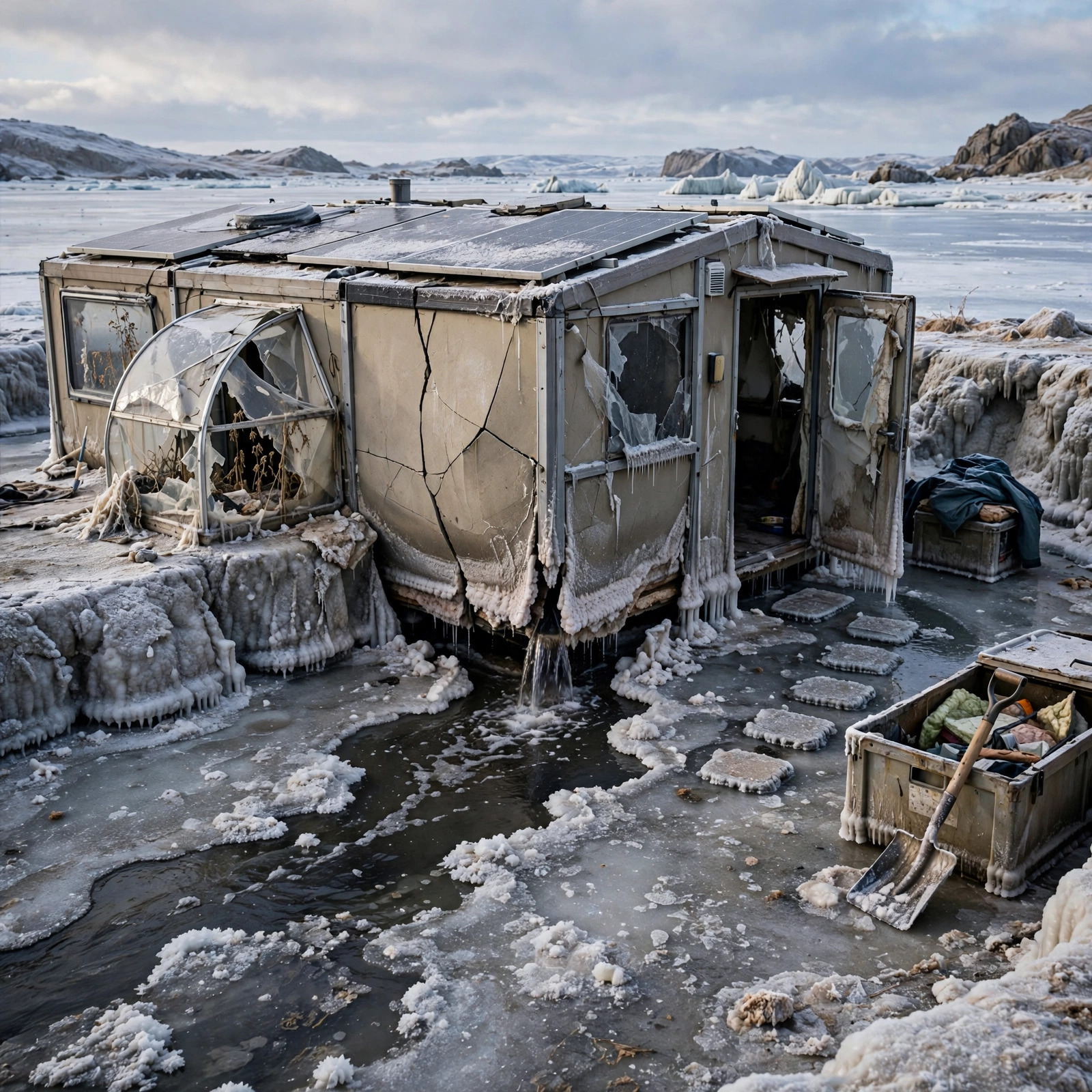
“There's a gap,” he said. He hadn't slept. None of them had. “The sheared pipe's lying across the ram faces where the string jumped. Maybe ten square centimeters of opening. It's venting about four tonnes of gas an hour and a lot of brine with it. The brine's freezing in the stack, which is good and bad. Good because it's partly plugging the gap. Bad because it's freezing the hydraulic lines, so I can't cycle the rams.”
“How do we stop it?” Lisbet said.
“We kill it.” He put up a schematic of the stack. “There's a kill line into the stack below the rams. We pump heavy mud down it. Water, bentonite, ground barite from the fab stores. Enough of it to outweigh the gas pushing up from the Mere. When the column's heavy enough, the flow stops, and we cement the bore shut behind it. Then we never touch that hole again.”
He paused. Nobody spoke.
“To make the mud,” Josef said, “I need water. Two hundred eighty tonnes for the first kill if it goes clean. More if it doesn't. And it won't go clean. The cap's fractured now. We'll lose mud into the cracks.”
Lisbet looked at the reserve figure on her wall screen as if it might change.
“We don't have two hundred eighty tonnes,” she said. “Not without shutting down four rows tomorrow. And if we don't stop it…” She looked at Mireille.
“If we don't stop it,” Mireille said, “the heave keeps going. Not fast. Centimeters a week, getting faster. In a year the floor rows are rubble. In ten the cap's fractured to the point where the Mere boils off what gas it has left and freezes from the top down. The Long Plan doesn't survive that. Nothing on the crater floor survives that.”
Hester had been looking at the reserve figure too. She had been looking past it, actually, at a different number. It lived on her own wrist and had read ninety-eight percent for the last twenty days.
It was strange, how a thing could be invisible for weeks and then be the only thing in the room.
She thought of the ration sleeve above her bunk. She thought of forty people in stacked bunks who had been promised doors that closed. She thought of Ade at the hatch saying bottom four, then top four. Then she thought of Ade's hand.
“The Gallery,” she said.
Lisbet turned.
“The shielding. Eleven hundred and forty tonnes, near enough. It's colony reserve water. It's just sitting in walls instead of tanks.” Her voice was steady, which surprised her. “I'm the Charter steward for the Gallery. Releasing it is my call. I'm releasing it.”
The office was very quiet. Kas, leaning on the doorframe, stopped fidgeting with his cuff.
“Hester,” Lisbet said, carefully. “If you drain the walls, the Gallery can't be occupied. Not with Brannoc's belts. Not until the Mule lands and we refill it. And the Mule's ice is spoken for first by the rows and the reactor and the recycler, because it has to be. It could be two years before that tunnel holds a single person.”
“I know.”
“You've spent six years—”
“I know how long I've spent.” It came out sharper than she meant. She made herself breathe. “It's a tunnel, Lisbet. It'll still be a tunnel in two years. It'll be the same tunnel. If the floor goes, there's nothing to come out of it and walk on.”
Lisbet held her gaze. Then she nodded once. That was the thing about Lisbet. She never made you argue past the point where the argument was won.
“And the rest?” Kas said, from the door. He said it softly. Everyone in the room heard what he was asking. “Two-eighty for the kill. Call it four hundred with losses. That leaves seven hundred and some. The Wren needs five-twenty.”
“No,” said Lisbet. “One thing at a time. We kill the well. Then we talk.”
“Lisbet—”
“I said we'll talk, Hester, and we will. That's not a no. I'm not deciding a deep-space rendezvous in the same breath as a blowout. That's how I got here.”
It wasn't what Hester wanted. It was fair. She found that she could hold both those things at once now, in a way she couldn't have a week ago.
She drained the Gallery herself.
Nobody asked her to. She simply went, and Kas went with her without being asked, and they stood in the valve gallery at the near end while the hoses were run out to the bowsers. There were twelve valves, one for each wall section, set in a neat row at waist height. She had specified the handwheels herself. They were wide and knurled, so that someone in heavy gloves could turn them without slipping. She put her hand on the first one.
“I can do it,” Kas said. “If you'd rather.”
“No,” she said. “Thank you. No.”
She opened them one at a time, in order. She listened to the rush of water leaving the walls, a long falling sound through the pipework, like someone pouring out a bath in another room. The level on her wrist ticked down. Ninety-eight. Ninety-one. Eighty-four. Kas stood beside her and didn't say anything, which was the kindest thing he'd ever done.
The first kill started at fourteen hundred.
They pumped from a skid parked a hundred meters back from the wellhead, behind a berm the dozers had thrown up overnight. The mud went through a hardline to the kill port on the stack. Hester was in the doghouse with Josef and Mireille. Bohdana ran the pumps. On the screens the kill line pressure climbed steadily as the heavy mud went down. The venting at the wellhead began to thin.
“That's it,” Josef said, under his breath. “Come on. That's it.”
At ninety tonnes pumped, the casing pressure began to drop, which was right. At a hundred and fifty, the vent at the stack slowed to a feather of white. Hester realized her hands were clenched so hard on the bench that her fingers ached.
At a hundred and eighty tonnes, the casing pressure went on falling. It fell too fast, past where it should have held. The vent came back.
“Losing returns,” Bohdana said. “Pressure's dropping, I'm not getting anything back. It's going somewhere.”
“Into the cap,” Mireille said. “Into the fractures. Damn it.”
They stopped the pumps at two hundred tonnes. The well hissed on, almost as hard as before. Two hundred tonnes of Hester's walls had gone down the hole into broken hydrate and were gone.
Josef sat back. For the first time since the blowout, he looked defeated.
“We need lost-circulation material,” he said. “Something to bridge the fractures so the mud stays in the hole. On Earth we'd use ground walnut shells. Cottonseed hulls. Mica flakes. I've got about two tonnes of mica in stores. We'd need twenty.”
Hester was already thinking. That was the one mercy of a problem: you could put your hands on it.
“Fiber,” she said. “Does it have to be flakes? Could it be fiber?”
Josef looked at her. “Fiber's good. Fiber's better if it's stiff. Why?”
“Basalt wool. The Gallery's outer skin is lagged with it. Chopped basalt fiber, six to twelve millimeters. There's thirty tonnes left in the fab store. It was for the next section.”
Mireille started laughing, a short, slightly hysterical sound. “Of course it was.”
They mixed the second batch through the night. Basalt fiber went into the mud in long grey drifts, Hester and Kas and three of the fab crew shoveling it into the hoppers by hand because the auger kept clogging. At four in the morning Mireille came down with tea in a thermos and drank it with them sitting on sacks of barite. Kas fell asleep against a hopper. Nobody woke him for twenty minutes.
They started the second kill at oh-nine-hundred.
This time the pressure behaved. The fiber went down with the mud, caught in the fractures, and wove itself into a mat. At a hundred and twenty tonnes they were getting returns. At a hundred and seventy the vent at the stack thinned to a whisper. At two hundred and ten tonnes it stopped.
Nobody cheered. They had all seen it stop once already.
“Now we close the rams,” Josef said. “Properly, before the mud gels and the pipe stub settles. We get them closed and locked and we can cement.”
“Hydraulics?”
“Still frozen. I've had heaters on the lines all night. They're not clearing.”
“Then we close them by hand,” said Hester.
Every preventer stack had manual locking screws, long threaded rods that came out the side of each ram bonnet. You could crank them to drive the rams shut if the hydraulics failed. Everyone knew about them. No one ever expected to use them, because using them meant standing at the wellhead of a live well with your hands on the stack.
Josef looked at her for a long moment. “It's my rig,” he said.
“It's my objection,” she said. “And you can't crank and watch the gauges at the same time. Your hands are better on the panel.”
He didn't argue. He handed her the ram key, a T-handle as long as her arm.
The cellar under the stack was a concrete pit two meters deep, rimed with salt frost from two days of venting. She climbed down in her heavy suit with a lamp clipped to her shoulder. The stack loomed over her, a column of red-painted steel as tall as a person, beaded with ice. She could feel the well through the soles of her boots, a deep, uneasy trembling. It was like standing on the deck of a ship that hadn't quite decided which way to roll.
The locking screw for the upper blind ram stuck out of the bonnet at shoulder height. She fitted the key. She leaned on it.
It didn't move.
“It's frozen in the threads,” she said.
“Torch,” Josef said, from somewhere above her. “Don't put any heat near the bonnet seals. Just the screw.”
Kas handed down a heat gun. She played it over the threads for a minute, two, watching the frost bead and run. She tried the key again and felt it give, a fraction. She leaned. It turned.
“Forty-two turns to full close,” Josef said. “Count them for me.”
She counted. One. Two. It was stiff, grinding, and every turn sent a shudder through the key into her shoulders. Seven. Eight. At twelve the trembling under her boots got worse, and the stack ticked loudly, a sound like a cooling engine.
“Pressure's coming up below the rams,” Josef said. His voice was very even. “The mud's gelling. It's settling. Gas is starting to migrate up through it.”
“How long do I have?”
“Keep going.”
Twenty. Twenty-one. Her arms were burning. Salt frost had crept up the stack and was beginning to spit from a seam somewhere above her, little bright puffs in the lamp light. Twenty-six. Twenty-seven.
“Hester,” Mireille said. She'd never heard Mireille use her name like that. “If it kicks while you're in there—”
“Then I'm in there.” Thirty. “Talk to me about something else.”
A pause. Then Mireille said, “The tide's due in four hours. Halde's coming back in toward Brannoc. If the cap's holding, we should hear it.”
“What should we hear?”
“I don't know,” Mireille said honestly. “I don't know what it sounds like when it's hurt and healing. Nobody does. We'll find out.”
Thirty-six. Thirty-seven. The spitting from the seam stopped.
Forty-one.
Forty-two. The key stopped dead in her hands with a solid, final weight, like a door closing in a house with good bones.
“Ram locked,” she said.
“I see it,” said Josef. Then, after a moment, in a voice she'd never heard from him: “Pressure's holding. Pressure's holding. Pressure's flat.”
She stayed in the cellar a minute longer with both hands on the key, her forehead against the inside of her faceplate. Kas climbed down and stood next to her. He didn't say anything. He just put a hand flat between her shoulder blades.
They poured cement until midnight. Four hours later, in the hydrology lab, they heard the tide.
It was faint, so faint that Mireille had to filter it twice. But it was there: the two tones, a little higher than they used to be, a little roughened. Then, after a long silence that had all five of them leaning toward the speaker, there came the very beginning of the swell. It was brief. It didn't build the way it once had. It was a pressure in the ear and then it was gone.
Ade was there. He'd talked Sato into letting him out of the infirmary for an hour with his hand in a sling. He listened with his eyes closed. When it ended, he opened them.
“That's better than nothing,” he said.
“It's a great deal better than nothing,” said Mireille, and she put her glasses back on so she could look at the trace and nobody could see her face.
Lisbet called them into her office the next afternoon. She'd had the bowsers metered. The kill and the losses had taken four hundred and ten tonnes. There were seven hundred and thirty left in the bowsers and tanks that had once been the Gallery's walls.
“Kas,” she said. “Give me the trip again. The real one. Every risk.”
He did. He didn't sell it. He told her how a three-hundred-eighty-tonne block of ice strapped under the Wren would move her center of mass. He told her what that would do to the braking burn. He explained that strut four on the Mule's cargo cage was cracked, and that someone would have to go out and re-rig the release by hand. Hester sat beside him and answered every structural question before Lisbet finished asking it.
At the end, Lisbet sat for a long time with her hands folded.
“If this fails,” she said, “I'll have spent water on a chance. That's exactly what I told you I wouldn't do.”
“Yes,” said Hester.
“And you're going.”
“Somebody has to cut that strut. I've cut more strut than anyone else on this moon.”
Lisbet looked at the reserve figure one more time.
“Go, then,” she said. “Bring me back a block of ice.”
Strut Four
The Wren left Halde on the thirty-third day after the Mule's message, on a column of steam so white it hurt to look at.
Hester had flown in her before, short hops to the sister moons, but never this far, and never with the cargo frame bolted to the hull. The frame changed everything. The Wren normally flew like a dart. With the frame she flew like a dart with a shopping trolley taped to it, and Kas spent the first twelve hours muttering at the attitude thrusters. The thrusters bickered with each other over every correction.
“She hates it,” he said. “Listen to her.”
Hester listened. She heard thrusters. “She sounds fine.”
“She sounds offended.”
They settled into a rhythm. Kas flew. Hester did the structural work, walking through the frame calculations every eight hours, checking the strain gauges she'd bonded to the frame's main beams before departure. They ate together at the little fold-down table in the cockpit with their knees touching under it, because there was no room for them not to touch. Kas cooked. It turned out he was a ferociously good cook given only rehydrated beans, salt and a squeeze bottle of chili oil. He'd been hoarding the oil for two years.
On the fourth day, Ade called on the lag. He was back in the fabrication bay, one-handed, running the printer queue. He'd figured out how to hold the welding hood with his bandaged hand tucked against his ribs. He showed them proudly, as if it were a trick at a party.
“Aurelio says the cambium's green on six of the eleven,” he said. “Six. He scraped the bark with his thumbnail. Says that's how you check.” A pause. “Also Mireille made me eat soup. I don't know why I'm telling you that. She came to the bay with soup and stood there until I ate it.”
“That's how you know she likes you,” Kas said, and then they both had to wait forty seconds for the lag. Ade's reply was a rude gesture with his good hand.
On the seventh day they made the big burn: a long, steady push that bent their trajectory out toward the Mule's slow outward spiral. Kas flew it by hand for the last twenty seconds. The autopilot didn't like the frame's mass distribution and kept trying to correct for a wobble that Kas swore wasn't there. Hester sat in the right seat watching the strain gauges and called the numbers.
“Beam two at sixty percent. Sixty-two. Holding.”
“Ten seconds.”
“Beam three's creeping. Sixty-eight.”
“Five seconds. Four.”
“Seventy-one.”
“Cut.” The roar stopped. The silence afterward was very large. Kas let out a long breath. “That,” he said, “was a very good burn. I'm going to remember that burn when I'm old.”
On the eleventh day they saw the Mule.
At first she was only a point of light that didn't twinkle, moving slowly against the stars. Then she was a shape, long and rangy, a drive section at one end and a cargo cage at the other. The cage was a lattice of carbon-composite struts fifty meters on a side. It held nine thousand tonnes of ice from the Tethys ring in twenty-four great blocks, each the size of a house. They gleamed in Brannoc's light with a faint blue cast. Hester had seen pictures. They didn't prepare you. It looked like a cathedral someone had built out of frozen sky.
Rosalind Teague's voice came over the short-range channel with no lag at all, for the first time in eleven months.
“Wren, Mule,” she said. She was a small woman with grey braids and a scar through one eyebrow, and on the video she looked exhausted and delighted. “You lot are a sight. Come in slow. We've got coffee. Real coffee, not the printed stuff. I've been saving it.”
Kas brought them in slow, matching the Mule's gentle thrust in a long patient approach. Hester had always thought of docking as a single event, a thing that happened. Watching Kas do it, she understood it was a hundred tiny choices. He made each one as carefully as she'd ever set a weld. At forty meters he held them on station for twenty minutes while he watched the relative drift. At ten meters he took his hands off the controls entirely and let the Wren coast.
The docking collars met with a click so gentle that Hester didn't feel it. She saw the light on the panel go green.
They drank Rosalind's coffee in the Mule's galley. It was bitter and wonderful. The Mule's other two crew, a soft-spoken engineer named Teodor and a navigator named Yuki who couldn't stop smiling at new faces, crowded in with them. The galley was built for three and held five. Everybody's elbows were in everybody's ribs. After eleven months alone, Rosalind's crew seemed to find this the best thing that had ever happened to them.
Then Hester went to look at strut four.
It was worse than the pictures. The strut was one of the long diagonal members bracing block eleven, the block nearest the cage's open face. It was the one they meant to take. When the drive bell cracked, the shock had run through the whole cage, and strut four had taken it at a bad angle. A crack ran a third of the way through it at the lower node. The node itself, the titanium fitting where four struts met, had twisted. The release clamp that should have let block eleven slide free was now jammed against it at an angle.
“You can't release the clamp without moving the node,” Hester said, floating beside it in her suit with Teodor. “You can't move the node without unloading the strut. If you unload the strut with that crack in it, it might just snap.”
“That was my assessment,” Teodor said. He sounded relieved that someone agreed with him. “Rosalind wanted to try anyway. I talked her out of it.”
“Good,” said Hester. “Okay. So we don't unload it. We build it a friend.”
It took her two days.
The Wren had carried a kit she'd packed herself: spare composite tube, clamp fittings, a portable cutting torch and a bonding rig. She designed a jury strut that bridged the cracked section, parallel to the damaged one, picking up load at two sound points above and below. It was ugly. Ade would've made fun of it. She drew it on the Mule's galley table with a grease pencil while Rosalind fed her coffee and Kas and Yuki argued about burn plans behind her.
Then she went out and built it. She worked in four-hour shifts with Teodor as her second. The cage creaked around them in the slow shifting of the Mule's thrust. Each ice block caught the light of Brannoc and threw it back in long blue shafts. Her hands ached in her gloves. Her neck ached from looking up. Once, during a rest break, she found herself clipped to a cross-member with her helmet resting against a wall of ancient blue ice from a ring four billion years old. She could hear, very faintly through the suit, the tiny creaking of it as it moved.
On the third day she bonded the last fitting, let it cure, and checked it against her gauges twice. Then she cut strut four.
The torch went through the composite in a slow, bright line. When it parted, the load shifted to her jury strut with a sound she felt through her gloves, a deep groan up through the lattice. She held her breath. The gauge on the jury strut climbed. Sixty percent. Seventy. Seventy-four.
It held.
The node eased back. A centimeter, then three. The jammed clamp came free with a bang that rattled her teeth.
“Clamp's clear,” she said. Her voice cracked a little.
“I heard it,” said Rosalind, from the Mule's bridge. “I heard it through the hull. Well done, Steward.”
Easing block eleven out of the cage took six more hours. Three hundred eighty tonnes of ice didn't have weight out here, but it had every gram of its mass. It wanted to keep going whatever way it started. Kas brought the Wren around below the cage on its cargo frame, a few centimeters per second. Hester and Teodor guided the block out with winches and lines. At one point it started a slow rotation, a few degrees, that nobody had planned. For a long minute everyone was very quiet. Hester played out line from the forward winch. Teodor took up line on the aft one. The rotation slowed, and slowed, and stopped.
They strapped it down with twelve composite bands. Hester tensioned every one herself.
Rosalind came over to the Wren's airlock before they undocked. She'd brought the last of the coffee in a sealed bulb. She pressed it into Hester's gloved hands.
“We'll be home in a hundred and twenty days now,” she said. “Lighter cage, less mass, we can push harder. I'll bring the rest.”
“We'll have a dock ready,” Hester said.
The trip back took thirteen days. It was slower and harder than the trip out. The Wren had three hundred eighty tonnes of ice under her belly and her center of mass in the wrong place, and she complained the whole way. Kas slept in four-hour stretches and flew everything that mattered by hand. Hester watched the strain gauges and called numbers until she could do it in her sleep, and sometimes did. On the braking burn into Halde orbit, beam three went to eighty-four percent and stayed there for nineteen seconds. Neither of them said a word until it was over.
Then Kas put his head back against the seat and laughed, helplessly, for a long time. She laughed with him, though neither of them could have explained what was funny.
Row Nine
They brought block eleven down to the crater floor in pieces.
The Wren couldn't land with it. Nothing on Halde could. So Kas parked it in low orbit, and over nine days the fab crew cut it into sixty-tonne sections. The colony's two landers brought them down one at a time to a melt pit dug beside the old survey line. It was well back from the cemented bore, which nobody went near now except Josef, once a day, to check the pressure gauges. They were still flat. He said so every evening at dinner, unprompted, as if reporting the weather.
The melt pit used the reactor's waste heat. It ran slow and steady, and the meltwater came up clean and cold and faintly blue. Mireille tested it four times and pronounced it the sweetest water she'd ever had through an instrument. The first sixty tonnes went straight into the recycler and the reserve tanks. The second went to the rows. The third went to Row Nine.
Hester had rebuilt Row Nine's frame herself during the nine days of cutting, with whoever had a spare hour. The new footings went down past the regolith into the basalt, the way she'd always said they should have gone in the first place. She had written that once, eight years ago, in a memo about greenhouse foundations. Nobody had read it. She'd filed it and forgotten it. This time she didn't file anything. She found Lisbet in the commissary, showed her the drawing on her tablet, and waited until Lisbet said yes.
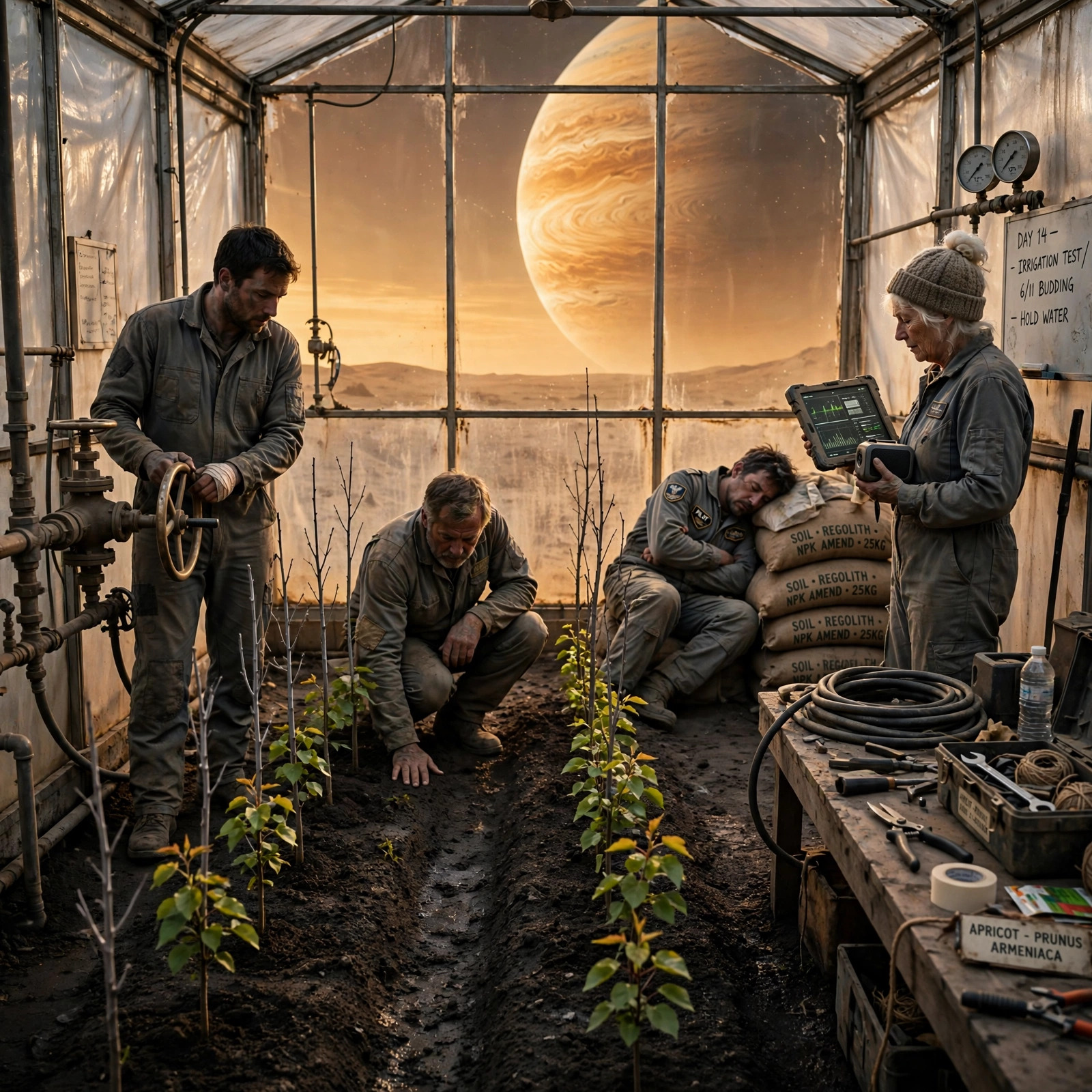
Now it was late in the evening shift and the new frame stood up out of the crater floor, pressurized, faintly warm. It was still filthy from construction. Grey dust lay over everything. It was on the beds and on the floor and on the long benches where somebody had left a heap of coiled hose and a crate of fittings. It was in the folds of Hester's coverall and the creases of her knuckles. Two sets of spanners lay on the bench beside a roll of pressure tape and a thermos of Mireille's tea. Someone had forgotten a welding hood on top of the water heater.
The eleven apricot saplings stood in their beds in a double row. Five of them were bare grey sticks. Aurelio had decided to leave them where they stood until spring, whatever spring meant on Halde, just in case. The other six had put out new leaves in the last two weeks. They were small and very bright, and so green they looked lit from inside. Aurelio stood among them with his gloves off. He was touching the leaves one by one with a fingertip as if counting them, and maybe he was.
Mireille sat on a crate by the door with the tablet on her knee. She'd brought the small speaker. It was nearly the hour.
Kas was asleep against a stack of soil bags with his mouth open. He'd landed the last section of block eleven at sixteen hundred, then come straight to the row to help lay irrigation line, then sat down for a moment. That had been an hour ago. No one had the heart to move him.
Ade knelt at the head of the row by the new manifold, where the drip line came off the main feed from the melt pit. His left hand was still wrapped, though the bandage was smaller now. He'd learned to use the three fingers he had left as a clamp, and he held the manifold body steady with it while his right hand fitted the last coupling. He'd insisted on doing it. When Hester had offered to hold the manifold he had given her a look so withering she'd sat down on the bench and let him.
“Coupling's in,” he said. “Seals are dry. You want to check it?”
“No,” she said.
He looked at her. Something in his face eased.
He put his good hand on the main valve, a wide knurled wheel she had specified for the Gallery and pulled out of stores because it fit. He turned it. One turn. Two.
There was a gurgle in the line, a cough, a hiss of air working out ahead of the water. Then a sound so ordinary Hester almost didn't hear it, a soft ticking from the beds. It was the sound of drip emitters, two hundred of them down the length of the row, each letting out a single drop. Dark spots bloomed one by one in the grey dust around the roots of the six living trees and the five bare ones.
Aurelio crouched down and put his bare palm flat on the wet soil and held it there.
Behind Hester, very quietly, Mireille's speaker came on. Two tones, low and a little roughened, the second under the first. Then a pause. Ade sat back on his heels with dust on his knees and his bad hand cradled against his chest. In the pause, Kas snored once and turned his face into the soil bags.
Then the beginning of the swell came, a pressure in the ear, very faint. This time it lasted a little longer.
Hester picked up the nearest spanner and wiped the dust off it with her thumb and went to check the far end of the line.
Get notified when new stories drop

Ren Hollis
Ren writes frontier worlds and terraforming triumphs — habitats, gardens under glass, and the first rain on a new world.
Leave a comment
Comments