




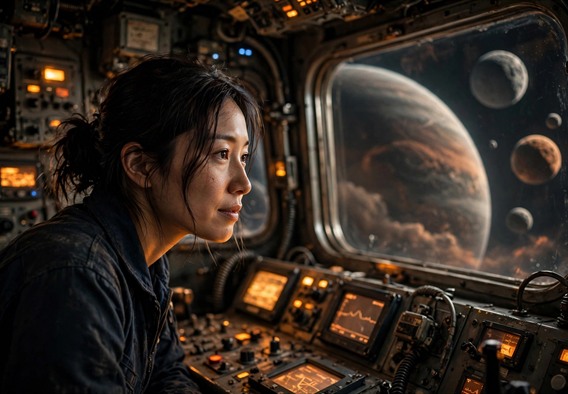

The Far Field
The far field was supposed to be the dull part. Nine days out from the end of the map, with the survey essentially complete and the schedule folded into a neat stack of approach checklists, Reza Amiri sat in the observatory blister of the survey ship Magpie and photographed the dark. His charter said to sweep the space around scattered-disk object 2037 RX9 for debris that might scratch the ship on arrival. It did not say anything about the object itself misbehaving.
Every survey charter carried one question that never made it into print: when an instrument whispers something impossible, how much of the mission do you spend to listen twice? Reza had signed three charters and never once had to answer it. Fourteen years of reading rocks, from the Shackleton rim pits to the trojan camps of Jupiter, and the universe had always been exactly what the models promised. Which was the job. Which was, if he was honest at two in the morning, the quiet wound of the job.
Mission day 731 · 60.9 AU from the Sun · one-way light-lag eight hours, twenty-six minutes
The blister was his favorite cubic meter of the ship, a faceted bubble of glass and composite stuck out on the boom like a soap bubble on a straw. From here, with Magpie's cabin lights behind him and the radiator wings angled away, he could pretend he was alone in the universe with the far field camera. The camera was a meter-class infrared eye on a twenty-meter truss, cold-soaked to within a degree of the void. It cost more than a lunar habitat block. It could find a kitchen oven turned on in the dark from the orbit of Mars.
Tonight it was looking at a dwarf planet nobody had bothered to name. Object 2037 RX9, forty-one hundred kilometers of ice and rock, discovered twelve years back by the Trieste deep field, flagged for the Stepstone program because its orbit crossed a useful plane and its spectrum said water, ammonia, methane. Feedstock, potentially, for a depot that might never be built. Magpie's charter covered forty bodies in four years; RX9 was the last and the farthest, three days past the point where the Sun had shrunk to a very bright star among stars. Two years past its perihelion of 60.4 AU, it was climbing back toward the dark it had come from. Nobody expected it to do anything interesting for the next two and a half centuries.
Reza ran the sequence the way he had run it four hundred times: twelve dithered exposures, dark slides between, a calibration lamp at either end. He drank coffee from a bulb gone lukewarm and listened to Magpie breathe. Somewhere aft, the coolant loops hummed through their pumps. The ship's night shift belonged to machines and to him.
The anomaly arrived as six pixels. On the third dither of the second set, a cluster at the edge of the disk read warm. Not hot. Two and a half kelvin above the nightside baseline, which at thirty-four kelvin was the difference between dead cold and dead cold plus a whisper. The warm spot sat inside the big dark basin on the trailing hemisphere, a feature the Trieste catalog listed only as a probable impact structure, unnamed.
His first thought was a cosmic ray strike on the array. You did not fly for fourteen years without learning that instruments lied in interesting ways. He dumped the raw frames, pulled the dark slides, ran the calibration lamp. Clean. He swapped to the redundant sensor, re-pointed, and watched the same six pixels bloom again, tracking with the body and not with the starfield. He checked the moonlet — Tick, an eighty-kilometer pebble named by some graduate student — and ruled out its shadow. He checked geometry, phase angle, stray light from the radiator wings. He checked the catalog twice for background objects and found nothing that could sit there and glow.
There had been a morning at Shackleton, eleven years ago, when his neutron spectrometer had sworn there was a glacier of hydrogen under a dry rim wall. He had written it up, briefed the crew, spent two days of everyone's schedule on it. It had been a dead amplifier channel, an eleven-hundred-dollar part. He still remembered the sound of his own voice in that briefing room, confident and wrong. He had promised himself he would never again wake a crew for a ghost.
So he stayed in the blister and watched. Six hours after the first rise, the basin had cooled back to baseline, exactly like a body cooling by radiation and nothing else. Then, at six hours, eleven minutes, and twenty-two seconds after the first peak, the six pixels began to climb again.
He watched it happen in real time, the numbers ticking upward in the corner of the display, and his heart went with them. He was forty-four years old, old enough to know better, and his hands were shaking on the stylus.
Through the deck came the ordinary sounds of the ship's small hours. Dani's cello recordings leaked through the ventilation ducting, something slow and sad she only played when she thought everyone slept. Aft, Kez was running on the treadmill again, a soft thudding in the hull like a second heartbeat. In the lab, Ines kept her basil drawer on a grow timer; it clicked over at 03:00 sharp and bathed the galley corridor in violet light for an hour. Four people, twenty-six months into a four-year charter, moving around each other in a can a hundred and twelve meters long. You learned to be careful with each other's sleep.
Crew rule, written on the whiteboard in Kez's handwriting on day three: flags get filed before coffee. Reza opened the survey log, tagged the frames, and wrote it up dry as he could make it: periodic thermal anomaly, trailing-hemisphere basin, rise 2.6 kelvin over baseline, period six hours eleven minutes twenty-two seconds, two observations, instrument causes eliminated to first order. He hesitated over the colloquial name field, then typed: pending.
Ines found him at 03:40, barefoot, hair loose, coming down the corridor for water and stopping when she saw the blister light.
“You're not sleeping,” she said.
“It's keeping me up.” He moved aside so she could see the trace. She leaned on the back of his couch and read for a long moment, her doctor's face doing the arithmetic.
“Thirty-four kelvin doesn't do that by itself,” she said at last. “Not on a clock. Cryovolcanism is a sputter, not a metronome. What's the third peak?”
“Due in forty minutes.” He rubbed his eyes. “If it comes, I wake the captain.”
“And if it doesn't?”
“Then I've wasted one night of my own sleep and nobody else's.” He said it lightly. It did not feel light. The mission window sat in his mind like a stone: departure geometry closed on day 758, hard, written by Neptune and arithmetic. Every hour of attitude and propellant was already spent in his head three different ways. Crying wolf out here did not cost a two-day delay. It cost the last target of a four-year charter and the last reserves in the tanks.
While they waited, he stacked the blue channel frames for the debris survey, and the hair appeared. A vertical thread of scattered light above the basin, four hundred kilometers tall, gone on the next stack. A plume, tenuous as breath on cold glass, catching the pinpoint sun. He played it three times. Ines said nothing, which from Ines was closer to shouting than she usually got.
The third peak arrived at six hours, eleven minutes, twenty-one seconds. The trace climbed. The little world below them kept its own time.
Reza toggled the captain's cabin. “Dani. Sorry. I need the board at 0500.”
A pause, and then her voice, rough with sleep and already, somehow, awake. “That bad?”
He looked at the numbers climbing their patient ladder. “That interesting.”
Six Hours, Eleven Minutes
“Discovery is not an emergency. Treat it like one and people die. Ignore it and the mission dies. Balance is the job.”
The galley table was the only surface on the ship big enough to be called a board. Dani Voss sat at the head of it in a gray flight suit gone soft with washing, fifty-seven years old and built like the rowing machine she used with religious violence. Kez Boateng slouched at her left with a bulb of tea and the grease of yesterday's maintenance still under two fingernails. Ines took the corner seat, wrapped in a blanket against the galley's honest cold. Reza stood by the display and laid it out.
“Two peaks became three overnight. It's now four. Period is locked, six hours eleven minutes twenty-two seconds. Rise is two-six over baseline, decay curve consistent with surface frost re-radiating. The plume showed twice in twelve hours of stacked frames, column height about four hundred klicks, and it's coming from inside the basin.” He brought up the relief map. “Nothing in the Trieste survey predicted this. The models for a body this size at this distance say it should have frozen to the core before the Sun finished forming planets.”
“Models,” Dani said, in the tone of a woman filing the word away.
“Models are what we've got,” Kez said. “They're right a boring amount of the time.”
“Which is why this matters.” Ines kept her voice level, but she was sitting up straighter than Reza had ever seen her at a board. “A persistent heat source at that depth means one thing that we know of. Liquid water. If there's liquid water under that ice, sixty AU out, everything we wrote about where oceans can live goes in the shredder.”
“Six hours eleven minutes,” Kez said, turning the number over. “It tocks.” She looked up. “If the moon's Tick, that one's Tock. Sorry. It's done now.”
Nobody objected. By the end of the meeting the name had infected every display on the ship, and Reza, filing the updated log, changed colloquial: pending to colloquial: Tock and let it stand.
Dani put her elbows on the table. “Options.”
Reza had spent the night on them. “Plan A is the charter plan. Brake into the four-hundred-klick mapping orbit, nine days of survey, drop Iris and Herald, light the drive by day 752. Reserve at wheels-up: two point seven percent. Safe, complete, and we learn the anomaly is real from orbit but never taste it. Mass spec at four hundred klicks through a plume that thin is a coin toss.”
“Plan B?”
“Direct low orbit. Eighty to a hundred and twenty klicks, three plume transits, full chemistry, radar sounding for the ocean interface.” He took a breath. “Costs one-nine of reserve and every drop of attitude margin I trust. If anything breaks, we're asking the ground for a rescue geometry that doesn't exist.”
“Plan C,” Dani said, because she knew her survey lead and had watched him build three-option slides for two years.
“Four-hundred-klick mapping orbit, one low pass. A single dive through the plume at ninety klicks, radar sounding on the same pass, one shot, burn back up. Iris still lands, Herald still relays. Reserve at wheels-up, two point four. It spends the safety I came here to spend and no more.”
Dani was quiet a moment. The cello recordings had stopped; the ship seemed to be listening too.
“The Gate closes the morning of 758,” she said. “Miss it and the next geometry is in four years, and we carry eleven weeks of margin in the pantry. My first duty is this crew and this drive. Say the true thing, Reza. Why does it have to be us, now?”
That was the part he had dreaded, because the true thing sounded like ambition wearing a lab coat. He gave it to her anyway.
“Tock passed perihelion two years ago. It's climbing back into the cold. Ines ran the freeze-out models last night, unasked. The plume-fed haze collapses within a decade. The vent lid refreezes and thickens. A probe launched in eight years arrives over a body that's sealed itself, and radar can't see through what ten more years of freeze lays down. After that, the next chance is two hundred and fifty-one years from now.” He kept his eyes on the captain. “I won't pretend the follow-on office will fund a mission to a corpse. It's us, now, or it's nobody in any lifetime we're part of.”
Ines nodded once. Kez studied her tea. Dani looked at the numbers on the display for a long count of ten.
“Plan C,” she said. “One dive, one shot, no heroics. Kez, I want your honest read on the ship at a ninety-klick pass before we commit the burn. And we file the plan change with the ground tonight, all seventeen lagged hours of it, so nobody can say we snuck it past them.” She stood. “We have an autonomy clause. We'll use it like adults.”
Four days later, on the morning of mission day 740, Magpie made her insertion burn.
Reza rode it from the blister, strapped in, watching Tock grow from a disk to a world. Aft, the drive was a long low push in the bones, hydrogen howling through a reactor that never made a sound you could hear, only feel. Kez's voice came up the loop in the liturgy of her trade.
“Chamber temp nominal. Loop one flow one-oh-two percent. Twenty minutes in. This old girl likes to run.”
At twenty-one minutes fourteen seconds, the pump current spiked.
Reza saw it on the engineering page an instant before Kez said anything: a hard vertical jag on the primary loop trace, then oscillation, the flow number stuttering between eighty and forty percent. Ammonia temperature began to climb at the pump outlet. The oscillation went jagged, a scream rendered as mathematics.
“Loop one fault,” Kez said, all the music gone out of her voice. “Bearing's gone, I can hear it in the telemetry. It's chewing itself.”
“Safing,” Dani said, and the computer agreed with her in the same tenth of a second. The drive coughed once and shut down at forty-one percent of the planned impulse. The push out of Reza's bones stopped so abruptly that he swayed against the straps. In the new silence, the reactor scrammed itself with a series of clunks he felt through the deck, control drums rolling home like a door closing on a lit room.
Nobody spoke for a while. Tock hung in the blister glass, bigger than before, indifferent.
“Orbit check,” Dani said finally.
Reza read the numbers. “Captured. Nineteen-hour ellipse, safe perigee. We're not falling on it.”
“Small mercies. Kez?”
“Going down there now.”
She worked the rest of the day and half the night, crawling the pump bay with a borescope, and the crew gathered in the galley at 02:00 to hear it. The primary loop pump had seized, shaft galled, bearing cage ground into glitter. It was, Kez said, the second-worst pump failure she'd ever seen, and the worst had been on a test stand with the building around it.
“So we change it,” Ines said. “We carry a spare.”
Kez looked at Reza, not at Ines, and he understood before she spoke. The knowledge came up out of a memory seven years old: a mass-budget review in a windowless room at Luna, a spreadsheet, a spare pump skid at forty-one kilograms sitting on the cut list, and Reza arguing that Iris the lander needed eleven more kilograms of descent propellant, that her science return justified it, that the primary pump had a flawless service record across the whole fleet. He had signed the trade. He had been so persuasive.
“The spare,” Kez said gently, “is in a warehouse in Tycho. We traded it for landing propellant. No fault to anyone in this room. But there's no spare aboard.”
The Pump Skid
Magpie in a scram was a quieter, more anxious animal. The reactor sat cold but not silent, shedding decay heat into the secondary loop, which now carried every thermal load the ship owned: the core, the cabin, the avionics, the water plant. The primary loop stood empty and useless, its radiator wing drooping idle in the dark. Dani put the ship on a power diet. Lights dimmed to amber, the gym was closed, and Ines's basil drawer went from a violet hour to twenty minutes, a rationing that seemed to sadden the whole corridor.
The galley glass got their options in Kez's blocky writing.
“One: restart on the secondary alone. It'll cool the core, but it can't carry the drive's load at full thrust. Best case, forty-five percent. That stretches the departure burn past two and a half hours, and hydrogen says no. We run dry before we make the Gate.” She drew a line. “Two: go home now. Window's safe, we keep two and change in reserve, and the anomaly stays unverified until somebody's great-grandchild files a grant.” Another line. “Three: we graft.”
She turned the marker in her fingers. “Iris carries an ECLSS cooling pump for her landing phase. Rated a third of primary pressure, but she doesn't have to beat the whole load. I put her pump in parallel with the auxiliary glycol pump, replumb both into the primary return through a printed manifold, and I get maybe seventy percent flow. That derates the drive to the mid-eighties. Burn times go up by a third. Margins get thin and stay thin. But it flies.”
“Iris,” Dani said.
“The lander gives up her pump,” Kez said, “or the ship gives up the Gate. Those are the options I have.”
Nobody looked at Reza, which was how he knew they were all thinking about him. Iris was eight years of his life. He had argued her into existence against three funding cuts, designed her sampling arm over one long Luna winter, fought for her mass budget with the pump trade that had put this crew in this room. His sister's kid had painted the iris on her fairing, an unruly purple flower, days before encapsulation. The landing was scheduled for day 745, the capstone of his career, a probe with his fingerprints all over her touching down on the last world of the survey.
“Take her pump,” he said. His voice came out level. He was proud of that. “Herald still flies, the dive still happens if the graft works. The ocean is the story now, not my lander. Take it.”
Dani held his eyes for a moment, and what was in hers was not pity but something closer to a salute. “File it,” she said. “Iris is struck from the plan of record. Kez, you're approved to cannibalize.”
They built the graft in seventy-one hours.
The sinter printer ran six hours on the manifold, growing it out of titanium dust in a slow violet snowfall of laser light. Kez broke Iris open on a workbench in the cargo airlock with the tenderness of a surgeon, lifted the little pump out of her belly, and whispered something to the machine that Reza chose not to hear. Fittings came from every corner of the ship: braided line from the spares locker, root valves from the decommissioned drill kit, a pressure gauge Ines donated from her medical bench, washed and re-certified with a straight face.
On the evening of day 741, Ines brought the news that put a clock on all of it.
“Helios watch upgraded the CME. The shock accelerated. Particle arrival is now day 742 at 06:10, plus or minus an hour.” She let that land. “Everything outside the hull has to be finished by midnight tonight. After that, anyone out there is standing in the rain.”
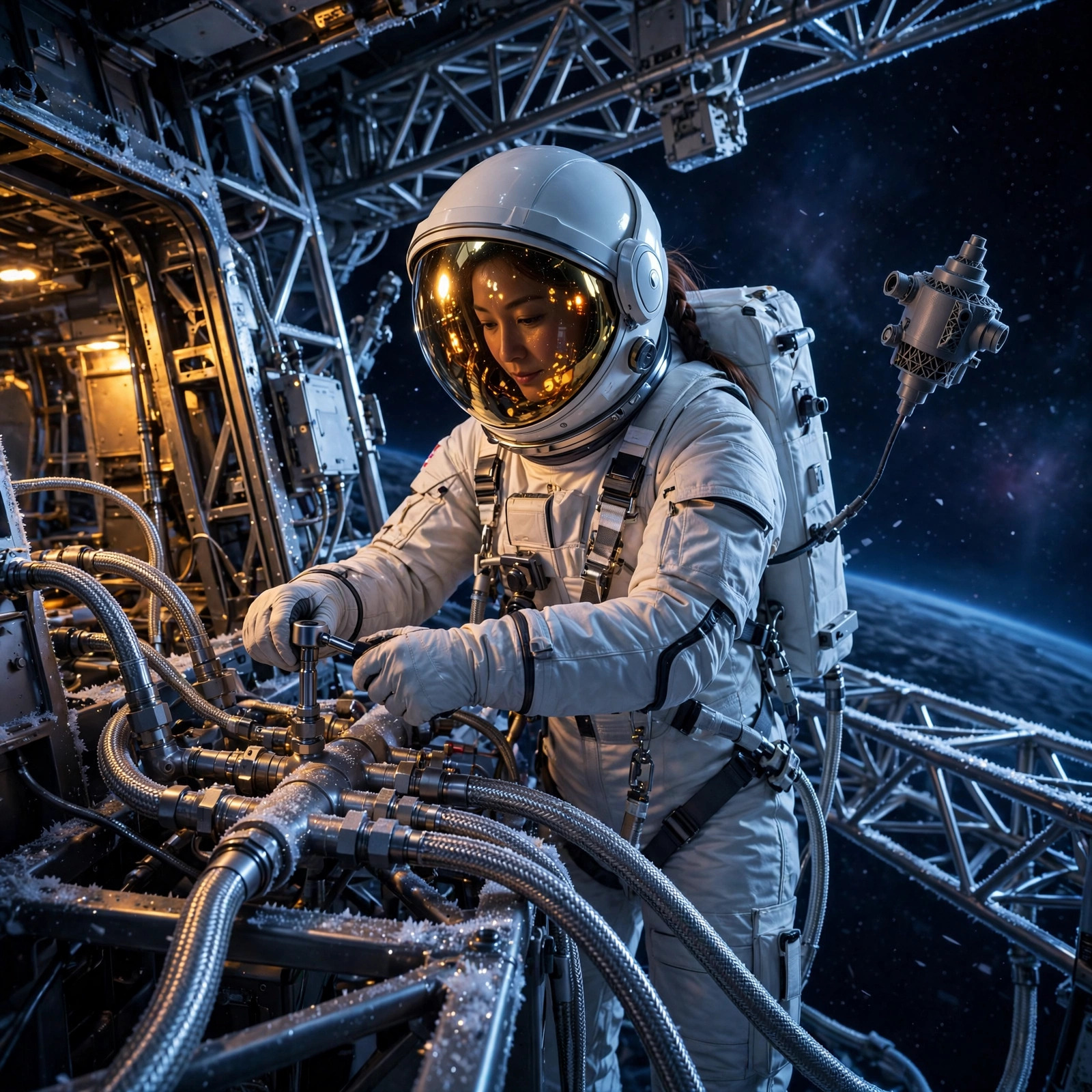
Kez went out at 14:20.
Reza rode the airlock comm as her second set of eyes, procedure cards on his lap, while Dani held the ship and Ines held the dosimetry. Through the external camera he watched Kez move along the truss, white suit against absolute black, her gold visor catching the ship's work lights. The primary loop's isolation valves came first, then the vent — ammonia vapor blew out of the line in a glittering jet that froze to frost on every surface it touched. Then the seized skid came off its mounts, four bolts, a hundred and nine kilograms of dead machinery that she muscled onto the disposal rail with her boots braced and her breath going ragged on the open channel.
“Skid's clear,” she panted. “Manifold going in.”
The graft bolted up like it had been born there, because Kez had measured it three times and once more after that. Then the fittings: twelve of them, each cleaned, seated, torqued, and pinged with the ultrasound wand while Reza read the response curves back to her. Dose climbed on the channel ticker in the corner of his display: 720 millisieverts, 760, 810, all of it ambient, the slow tax of deep space that she would never get back.
At 17:40, with three fittings left, Ines's voice changed.
“Kez, the front's early. I'm seeing the leading edge in the counts. Your read is 9-4-0.”
“Plenty of room to a sievert,” Kez said. Torque, ping, torque.
“Kez.” Ines again, four minutes later. “9-6-0. Two fittings left. I can call this right now, and we'd finish it after the storm passes. We'd lose the day, maybe two, testing late.”
The channel was very quiet. Reza found he was gripping the edge of the console. Two days meant the dive geometry died; they had run the schedule six ways and there was no slack left in it anywhere. Kez knew that better than anyone. It was her schedule.
“Twelve minutes,” Kez said. “That's all I need. Ines, it's my career math and my arithmetic, and the number says twelve minutes. Let me finish my ship.”
“Finish your ship,” Ines said, in a voice with something buried under it.
She torqued the last fitting at 18:31, cycled the airlock at 18:52, and stood in the suit bay grinning through her own sweat while Reza helped her unlatch the helmet. Her final read was one thousand thirty-four millisieverts.
The joke she made was about glow-in-the-dark jokes being tasteless, and it landed the way those jokes do, everyone laughing a little too gratefully. The quiet came later, in the galley, when Ines sat down across from her and said, not unkindly, what the rules said. One sievert was the agency's lifetime flight cap. The medical board back home would pull her flight status the day the dosimetry arrived. Magpie was Kez Boateng's last ship.
“Then we'd better make this flight worth the ticket,” Kez said, and picked up her tea, and her hand was not quite steady, and Reza had to look at the table.
That night the loop filled and came alive. At the fifty-percent integral test, the graft ran clean for twenty minutes, except for a murmur, a faint fast vibration localized at the polymer flange where the new manifold met the wing root line. Kez killed the test, scoped the joint, and found the beginnings of a stress crack in the printed polymer. She re-printed the flange in titanium overnight, a nine-hour run, and the crew retired to the water-jacketed shelter core to sleep while the storm front arrived, particles pattering against the hull in a soft, endless, invisible rain. Reza lay awake in the dark between Dani and the water tank and thought about all the things he had spent without asking anyone else's permission: a pump skid, a lander, an engineer's career, all of it riding on six pixels and a hair of light.
“Reza,” Dani said quietly, out of the dark. “I can hear you thinking. The graft will either hold or it won't. Sleep.”
“Yes, ma'am,” he said, and eventually did.
Through the Breath
The storm passed in the small hours of day 742, and by mid-morning the titanium flange was in and the loop was buttoned up for its real exam. Kez ran the pressure up in stages, fifty, sixty, seventy percent, the whole crew watching the engineering page like a jury. At eighty-eight percent, the graft began to sing.
It was not a metaphor. A rising howl came through the deck, the two pumps in parallel beating against each other, their frequencies sliding into resonance, the whole return line shuddering. Kez killed the test with her hand already moving before the callouts finished.
“They're fighting,” she said, half to herself. “Two pumps, one line, chasing each other's phase. I should have seen it.”
“Fix?” Dani asked.
“Two ways. Software: I stagger the drive speeds so they never lock. Hardware: I print a restrictor orifice for the small pump's outlet so it stops trying to win.” She was already sketching. “Forty minutes for the orifice. An hour to retest. It'll hold, or I'll know why it won't.”
The orifice plate came out of the printer at noon, no bigger than a watch face, and the retest at 90 percent ran steady for ten full minutes, temperatures flat, vibration a smooth hum you could lay a coin on. Kez stood back from the console with her arms folded, watching her patchwork pump two-thirds of a warship's cooling loop.
“She'll hold a dive,” she said. “I certify my own work, which is irregular, but the inspector general is eight hours away by light and I outrank him on this truss.”
So they came to the second board, the one Reza had been both dreading and dreaming about for eleven days.
He laid out the numbers without decoration, the way he would want them given to him. Reserve sat at two-point-one percent against a red line of one-point-eight. The dive cost another third of a point if nothing went wrong. If the graft failed mid-sequence, in the worst geometry, they would not miss the Gate by hours.
“We'd miss it by a geometry,” he said. “By four years. I want that said out loud, by me, before anyone votes. I'm the man who asked for the spare pump to be cut and for the low pass to be flown, and you should all price my judgment accordingly. I've filed for unverified before. I can live with it. If anyone here isn't willing, we don't go, and I will write the log entry myself and never mention it again.”
The galley was quiet. Tock rolled beneath them, nineteen hours to a lap, keeping its slow appointment with nothing.
“You're asking the wrong crew member,” Kez said at last. “Ask the loop. The loop says yes.”
“It's not a vote,” Dani said. “It's mine.” She looked around the table anyway, a captain reading her people. “Ines?”
“A second ocean, in the dark, at the edge of everything,” Ines said. “It changes what my students' students get to look for. I am willing.”
“Kez. Your ship, your honest word.”
“Eighty-four to ninety percent thrust, temperatures in the green, abort gates set at plus five degrees on the manifold. It'll fly, Captain. I'd fly it to Luna.”
Dani nodded once, the decision settling onto her shoulders where she carried all of them. “We dive at 04:00 tomorrow, one pass, per the plan of record. Abort gates go into the flight computer tonight, and we fly the gates, not the hope. If the numbers say stop, we stop, and no one in this room argues with the machine.” She stood. “Go to bed early. All of you. Doctor's orders,” and she looked at Ines, who nodded solemnly as if she had prescribed it.
The dive began in the dark over Tock's nightside.
Magpie came down out of her stretched ellipse on a burn that ran long at the derated thrust, twenty-four minutes of steady push, the graft humming its single contented note. Reza rode the blister with his instruments awake and his nerves wired into the engineering page. The world below filled the sky: a hemisphere of ancient ice, crater on crater, the long shadows of the pinpoint sun raking across ridges that had stood unlit for a billion years. And on the terminator, the basin. The crew had started calling it the Hearth, and the registry would make it official. From four hundred kilometers it was only darkness. From ninety, on the downward leg, it was darkness that glowed, faintly, warmly, six pixels' worth of impossible heat.
Then he saw the plume with his own eyes: backlit at the limb, a hair of light standing up out of the world, so faint he was sure his mind was helping. The spectroscope was surer. The neutral mass spectrometer, already tasting the exosphere, began to drink.
“Contact in forty seconds,” Dani said. “Everything green. Reza, your show.”
They crossed into the column at eight and a quarter kilometers per second, and for one hundred and thirty-one seconds Magpie flew through the breath of a frozen world.
The instruments talked over each other in their synthetic calm. Water vapor, dominant. Sodium chloride grains, flash-frozen, the salt of a sea. Hydrogen. Methane. And the ratios — Ines read them aloud off the lab feed as they came, her voice climbing despite itself.
“Delta carbon-thirteen in the methane, minus sixty-one per mil. Reza, that's fractionation, that's chemistry running hard and preferring the light stuff. Ethane, propane, traces of tholins. Hydrogen sulfide, a whisper of ammonia. These are hydrothermal numbers. This is vent water, circulated, worked, alive with reactions. Not life. Not proof of life. Proof of a kitchen.”
“Radar,” Reza said, his own voice strange. The sounder pulses were coming back stacked and coherent, and the inversion ran in front of him like a miracle being typeset. A bright, flat reflector, twenty-eight to thirty-four kilometers down, spanning the whole basin and beyond it. Liquid, kilometers of it, an ocean under a shell of ice on a body that should have been stone-frozen since before the Earth had continents. And under the vent field, a conduit, cyclically reloading — the radar caught it swelling, its period already matching, six hours eleven minutes twenty-two seconds, the ocean exhaling on schedule.
“Manifold temp plus three point four,” Kez said, tight. “Pump two's cavitating a little. Throttling to eighty-four, extending the burn ninety seconds. She's fine. She's fine.”
Nobody argued with the machine. The abort gate sat at plus five; the number held at three point eight, then began, slowly, to come back. One hundred and thirty-one seconds after entry, Magpie crossed out of the column and into clean dark, her collectors heavy with the matter of an ocean no human eye would ever see in daylight.
The climb burn came clean. The graft held at a steady hum. And in the blister, Reza Amiri watched three independent instruments agree with one another on the timeline display, the trace of the fourth pulse rising on the world below, right on time, the radar echo of its conduit swelling in rhythm. He opened the survey log with hands that shook only slightly, set the flag on the anomaly record, and typed, in plain capitals, the word that fourteen years of patience had earned: VERIFIED.
They drank tea in the galley afterward, all four of them, too wrung out for anything louder. Dani drafted the registry entries at the table: Hearth Basin, and for the vent field under it, over Kez's mortified protest, the Boateng Fields. “The first name in the book of a new ocean,” Dani said, “belongs to the engineer who got us there. There is no appeal.”
“I'll have to learn to dive,” Kez muttered into her tea, and then caught her own words and went still for a moment, and the galley was gentle with her.
The report went into the queue for Earth, seventeen hours of lag and then, Reza knew, a slow rolling detonation through every planetary science department alive. He found he could wait. The data was patient. It had waited two hundred and fifty-one years already.
The Sealed Entry
They stayed nine more days, and Tock gave generously. Herald the relay went into its long slow orbit on day 745, unfolding its panels like a bird testing wings, and began the patient watch that was its whole purpose: a year of pulses, then five, then however many the cold allowed, squirting each one inward to anyone who cared to listen. The radar built its tomography of the ocean line by line. Ines coaxed the collector grains into telling her the order of their chemistry. Kez's graft ran the whole survey at partial load without a murmur, and she polished nothing and checked everything, an engineer in love with a repair.
On the evening before departure, Ines found Kez in the suit bay and, with the directness that was the whole of her bedside manner, delivered the message that had come up the queue from the medical board. Flight status: retired upon return, effective already, retroactive to a timestamp in the middle of a spacewalk sixty AU from home.
Reza, passing with a crate of sample canisters, heard Kez laugh. It was a real laugh, with something broken off in it.
“You know what the funny part is,” Kez said. “There's a follow-on being sketched already, you can smell it through the lag. Ocean-class orbiter, lander, the works. They're going to need someone who knows how to keep a pump alive in the deep cold, on the ground, running the teams. I can be good at that. I will be good at that.” She turned a wrench over in her hands. “I just wanted to go, is all. One more time.”
“You did go,” Ines said. “Further than anyone in the program. And the first vent field on the map of the new ocean is yours.”
“Boateng Fields,” Kez said, trying the name on. “My mum is going to be insufferable. Good.”
Departure came on the morning of mission day 752, six days inside the Gate, and Magpie went home the way she had flown the whole survey: competently, at a derated hum, the graft carrying the long burn for forty-one minutes while Neptune grew from a concept into an appointment. Tock fell behind them, a dark disk, then a point, then a catalog entry again, except that it would never be only that again.
When the burn was done and the ship was quiet, Reza went down to the cargo bay to finish the last of it. The plume-grain collector sat in the sample vault, its canisters sealed in nested sleeves of nitrogen, a few millionths of a gram of a hidden ocean resting in the dark. He checked the manifest twice, logged the seals, and dogged the vault hatch by hand, eight dogs, a quarter turn each, the old honest way, feeling the ship's long push through the metal into his palms.
Then he went up to the blister one last time and wrote the closing entry of the survey.
“Anomaly record 2037 RX9-A closed and verified. Periodic thermal venting confirmed, period six hours eleven minutes twenty-two seconds. Subsurface liquid ocean confirmed by radar sounding, interface twenty-eight to thirty-four kilometers. Plume chemistry consistent with an active hydrothermal system; carbon fractionation in methane indicates sustained disequilibrium chemistry. No claim of biology is made. Relay Herald on station and streaming. Recommend immediate follow-on. Survey complete. Proceeding for the Gate.”
He signed it, and sealed it, and felt the archive hash lock like a second, smaller hatch.
On the console beside him, the live feed from Herald glowed. It was eight-hour-old light, a message from a world they had already left, and it was rising again, right on schedule: the slow warm breath of an ocean in the dark, the first of a year's worth of pulses that no one would ever have to argue about anymore. The work was unfinished. The work had begun. Somewhere ahead of them, behind seventeen hours of lag, a program office was about to wake up to a very good morning.
Reza put his palm flat against the cool glass and watched the trace climb, and let the little world behind them keep its time.
Get notified when new stories drop

Mira Okoye
Mira writes first contact and mentorship-across-species stories where curiosity beats fear.
Leave a comment
Comments