

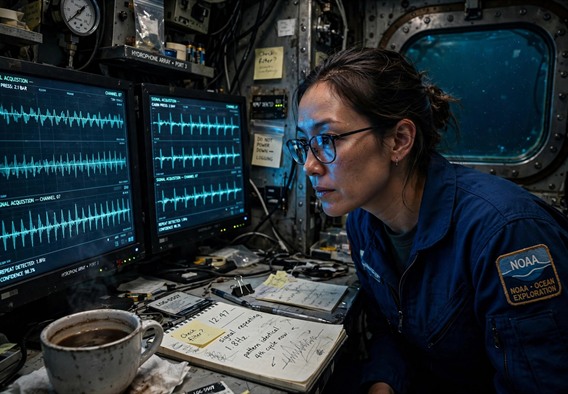

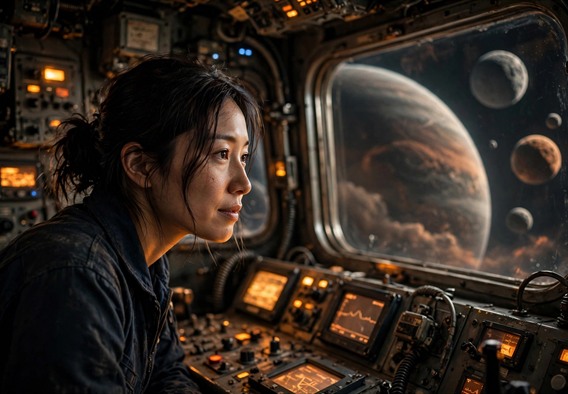
Dara Osei calibrated the magnetometer at 0411 ship time because that was when the noise floor was lowest, and because she had not yet found a better reason to be awake. Twelve years of survey work had taught her that the universe mostly declined to be interesting. Stars burned. Dust drifted. Moons sat where the orbital mechanics said they should sit, doing nothing worth the antenna time.
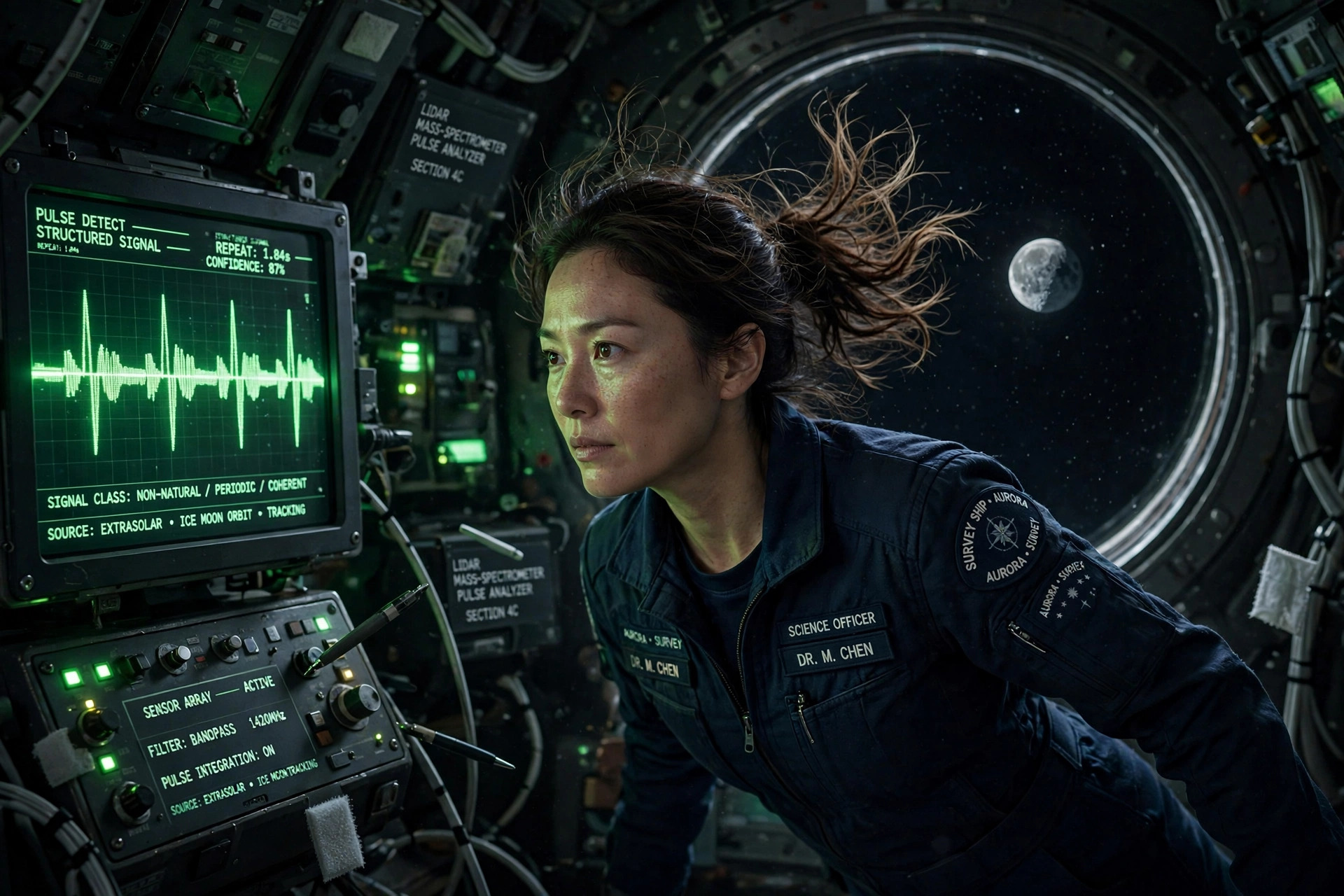
The Cartographer's Debt hung nose-down relative to the ecliptic, sixty thousand kilometers above the third planet of Voss 441, a K-dwarf that had been catalogued, filed, and largely forgotten until the survey consortium sent a ship. Day 212 of a 300-day window. Forty-eight days of fuel, food, and patience left, in roughly that order of scarcity.
Dara pulled the night's passive sweep onto her console and ran it through the standard sieve. Most of it was Jupiter-grade static from the gas giant they'd tagged Thole, a banded brown-orange mass with a magnetosphere that made every instrument aboard squawk like a startled bird. She filtered Thole out. What remained was the debris belt, the system's four inner rocky worlds, the wide family of moons -- and one narrow spike at 1.42 gigahertz that should not have existed.
She ran the sieve again. The spike stayed.
"Rhea," she said toward the cockpit. "Are we pointed at anything unusual?"
Rhea Sun-woo's voice came back through the open hatch, amused and slightly nasal, the way she got when she'd been flying on coffee substitute for six hours. "Define unusual. I'm holding station with the reaction wheels because I got bored. Why, did the universe finally return one of your calls?"
"Maybe." Dara expanded the spike. It wasn't noise. Noise spread. This was a channel a few hundred hertz wide, and inside it, structure: a train of pulses, on and off, with gaps between them that she could count. Seven pulses. Then a pause. Then three. Then seven again.
Her hands went still on the console, which was her body's way of telling her mind to slow down before it sprinted. Pulses at those separations were prime. Seven, three, eleven, five. She counted them twice. Primacy meant nothing by itself -- rotating neutron stars made periodic signals, malfunctioning relays made periodic signals. But neutron stars didn't live in K-dwarf systems, and the Debt was the only human machine within four light-years, and she'd built half of its comm stack herself.
"Tomas," she called down the aft trunk, "did you touch the receiver chain today?"
A pause, then the clang of a tool being set down, then Tomas Brandt's gravel voice. "I greased the antenna gimbal bearing at 1400, like the schedule says, like I've done every hundred days for eleven years. The electronics I have not touched, because unlike some people I respect them."
"Check the chain anyway. Everything from the feed horn down."
"Because?"
"Because I'm seeing a structured signal and I need it to be your fault."
That got him up the trunk fast. Tomas was fifty-one, built like a crate of spare parts, and he distrusted miracles the way farmers distrust weather that's too good. He wedged himself into the sensor bay beside her and pulled the diagnostic cable from the bulkhead without asking, which was his version of asking.
Dara triangulated while he worked. The signal was coming from the second moon of Thole -- the crew called it Anvil, because that was what it looked like: a flattened, cratered lump of ice and rock, forty-one hundred kilometers across, tidally locked, geologically dead by every prior reading. Dead moons did not transmit.
"Feed horn's clean," Tomas said. "LNA's clean. The cable impedance is within a hair of spec. Your ghost is real, Dara. Or it's in the software, and you wrote the software, so."
"I know what I wrote."
"That's what worries me."
Rhea drifted into the bay, bare feet catching a handhold, and looked over Dara's shoulder at the pulse train scrolling past in green. "Okay," she said slowly. "That's not interference. That's somebody's homework."
"Don't," Dara said. "Don't say it yet."
"Say what? That it might be--"
"Don't." She heard how sharp it came out and softened it by a degree. "Primes are a pattern, and the universe makes patterns for stupid reasons. Before anyone on this ship says the word, I want the source localized to a hundred meters and the signal confirmed by two independent chains. That's the job. That's the whole job."
But her chest had gone tight in a way it hadn't since she was a graduate student holding her first real observation, the night she'd understood that the data was a letter from a place no one had ever read. She was thirty-eight years old and she had spent the last decade confirming that rocks were rocks. Now there was a spike on her screen with arithmetic inside it, and every cell in her wanted to believe.
Which was exactly why she made herself sit on her hands, literally, while Tomas ran the second receiver chain off the backup dish in the cargo bay.
Forty minutes later the backup dish caught the same train: seven, pause, three, pause, eleven, pause, five. Then silence. Then, on a fresh clock reading, the whole sequence again.
"Repetition period," Dara said quietly, "eighteen hours, fifty-one minutes. It's a beacon. Something down there is transmitting on a schedule."
Rhea whistled. Tomas didn't. Tomas was staring at the moon's file on the side display: Anvil, mean density 1.9 grams per cubic centimeter, surface temperature 96 kelvin, no magnetic field, no atmosphere worth the word.
"Ice shell over a saltwater ocean," he said. "We've known that since the flyby in month two. Thermal flexing from the resonance with Thole keeps the interior liquid. Nine, ten kilometers of ice on top, best model."
"Which means," Rhea said, "that if the source is under the ice, it's in the ocean."
Nobody said the word. The bay hummed around them -- air scrubbers, pump vibration, the small domestic noises of a working ship that was, for the moment, the closest thing humanity had to a witness.
Dara wrote the finding into the survey log with a steady hand, timestamped it, and then sat looking at the entry. Day 212, 0538: narrowband structured emission, 1.42 GHz, source co-located with Anvil (Thole II). Prime-indexed pulse train, period 18h51m. Nature undetermined.
Undetermined. It was the most honest word she had and the least satisfying one she'd ever typed.
She wanted to know. The want was physical, a hand around her sternum. She also had a crew of three, a fuel margin of 340 meters per second, and a mission directive from Annelise Kirsch at Meridian Station, four light-hours away, that said, in the flat bureaucratic poetry of all directives: complete the resource survey of designated bodies; anomalies of no commercial significance may be logged for later study.
Anomalies of no commercial significance. Dara looked at the green pulses marching across her screen, seven-three-eleven-five, over and over, patient as tide, and thought: you'd better hope you're commercially insignificant, because otherwise somebody's going to come and mine you.
"Get some sleep," she told the other two. "Both of you. I'll watch it through the next cycle. If it repeats at 0029 like it should, I'll wake you. If it doesn't, we all got excited over a hot amplifier, and Tomas gets to say he told me so."
"I already told you so," Tomas said. "Preemptively. It's on the schedule." But he went aft, and Rhea went forward, and Dara stayed in the bay with her hands around a mug of tea that cooled untouched while she watched the moon turn.
Anvil crawled across the stars, a gray coin, unremarkable. Under its ice, if the numbers were right, an ocean older than humanity's whole genus held its warmth against a cold that should have killed it. And somewhere in that dark water, something had learned to count.
Or hadn't. She made herself hold both possibilities with equal weight, which was the discipline that had kept her alive and employed for twelve years. The discipline felt, tonight, like holding a door shut with her shoulder.
At 0029 ship time, four days of analysis compressed into one held breath, the signal returned. Seven, three, eleven, five. Right on schedule. Dara watched it repeat three times, verified the timing against the station clock to the millisecond, and only then, in the dark of the sensor bay, allowed herself to say the word out loud, once, quietly, to no one.
Then she opened a channel toward Meridian Station, four light-hours out, and started composing the message that would change the shape of her remaining forty-eight days.
The Delta-V Ledger
The reply from Annelise Kirsch arrived at 1030 on day 216, which meant she'd answered within twenty minutes of receipt, which meant she'd read the whole packet standing up. Dara gathered the crew in the wardroom to play it on the main display, because bad news traveled slower in company.
Kirsch's face was fifty-two days old by the time they saw it -- that was the light-lag arithmetic, the tyranny that made every conversation in this profession a correspondence. She was forty-five, silver at the temples, and her expression was already set in the particular clay of a person managing a budget.
"Osei. Beautiful work. The signal characterization is exactly what I'd expect from you, which is to say I believe the data and I don't believe the conclusion, not yet. Now the part you won't like." She looked down at something off-frame. "A rendezvous with Anvil is not in the mission plan. It's not close to the mission plan. Run the numbers yourself: plane change plus transfer from your current orbit is a hundred and ninety meters per second of delta-v, round trip, and your reserve is three hundred and forty. That leaves you a hundred and fifty for contingency, and my flight rules say two hundred minimum. Add fourteen days of transit and station-keeping you'd spend out of a window that has forty-four days left in it, and you'd return to the inner-system survey with thirty days to do eighty days of work."
She paused, and something in her face softened by a few degrees, a crack of the professional clay. "I'm not telling you it's nothing. A structured signal from a subsurface ocean would be the finding of the century, and I'd rather be the director who approved it than the one who logged it for later. But I have a crew of three on that ship and a consortium that wants its platinum assays, and later is a real mission with real funding. Send me your consumables margin, your abort options, and your justification for why a robotic follow-up can't do it in five years. I'll ask for the extension. Don't make me regret asking. Kirsch out."
The wardroom went quiet. The Debt ticked and hummed around them.
"She's not wrong," Rhea said at last, which from Rhea was a significant concession; she'd spent the morning flying manual station-keeping burns purely to stay sharp. "One-fifty of reserve is thin. If we lose an engine on the way back, we limp. If we lose two, we don't."
"We're not losing engines," Tomas said. "Engine one has a haircut of a flaw in the injector plate, I've been babying it since month six, and it will hold for the missions of two more crews after us. The margin question is real, though. And the radiation." He pulled up the trajectory plot on the table display. "Look. Any transfer to Anvil takes us through the outer belt, in close to Thole's magnetosphere, for eleven hours. Thole's a degraded Jupiter. That's a deep-dose day for every one of us, plus the electronics take a beating we can't fully shield against. I can harden the racks, buy us maybe forty percent reduction, but it costs me two days of prep."
Dara looked at the plot. The belt glowed on the display in false-color amber, a fat torus of trapped particles wrung out of Thole's field, and their transfer line crossed it like a thread through a needle's eye. Eleven hours. On Earth it would have been a career-limiting exposure. Out here it was a roll of dice with dosimeters.
"And the science?" she asked. "Say we go. What do we actually do when we get there? We can't drill through nine kilometers of ice with a rock hammer."
"We don't have to drill," Rhea said. "We listen. We get a baseband record from low orbit with the main dish and the backup cross-polarized, three baselines if we use the relay cubesat as a third. That gives us a source localization down to -- what, Tomas, tens of meters? If the signal originates at a fixed point under the ice, if it has any spatial structure, if it changes when Thole's field rotates, we learn what it is without touching it. We're a survey ship. Surveying is the one thing we're built for."
"And if it's a thermal vent cluster ringing like a bell," Tomas said, "we'll have spent a hundred and ninety meters per second and a sievert apiece to listen to geology."
"If it's a vent cluster with prime-number rhythm," Dara said, "I'll write the paper myself and dedicate it to you."
"That's what worries me," Tomas said again, and this time nobody laughed.
Dara spent the afternoon alone in the sensor bay with the ledger open on her console: mass of the ship, 612 metric tons wet; propellant remaining, 4.1 tons; specific impulse, 3,340 seconds; reserve delta-v, 340.6 meters per second. She built the transfer burn by burn. Plane change, 61. Transfer insertion, 74. Arrival trim, 22. Departure, 68. Return trim, 15. Total, 240 by her numbers, not 190 -- Kirsch had been generous or optimistic, and Dara knew her own ship better. That left 100 meters per second. Not 150. A hundred.
She could trim it. Drop the arrival trim by aerobraking the return leg -- no, there was no atmosphere at Thole worth the name. Drop the plane change by accepting a longer transfer, twenty-two days instead of fourteen -- no, that ate the window twice over. Fly the whole thing on engine two and shut engine one down to baby the injector -- that saved nothing in propellant and everything in risk, and risk was the currency she was already overdrawn in.
There was one honest lever: consumables. They carried oxygen reserves for forty days beyond the planned return. A crew of three could stretch that by sleeping more, scrubbing harder, canceling exercise they couldn't afford to cancel. It didn't change the fuel. Nothing changed the fuel. Physics kept its ledger with a colder hand than any director.
At 1940 she was still there when Rhee came aft with two bulbs of tea and handed one over without a word. They drank in silence for a while, watching Anvil's gray coin slide through the forward camera's field of view.
"You've already decided to ask her," Rhea said. "I can tell. You've got your asking face on."
"I've got my numbers face on. There's a difference." "There isn't. I've known you nine years." Rhea tapped the ledger. "The hundred meters per second. That's the whole argument, isn't it? Kirsch says two hundred reserve. You'd be going with half that, and if anything goes wrong on the return leg -- a stuck valve, a miss on the departure window -- we don't make the inner-system rendezvous, and then it's a rescue calculus question, and rescue calculus doesn't work out here." "I know what it is." "Do you want me to tell you it's fine? Because I'll fly it. You know I'll fly it. I'm just -- I want you to say the cost out loud, once, to somebody, before you put it in a message to Kirsch like it's a rounding error."Dara set her tea down. In the display, the moon hung there, cratered and mute, keeping whatever it kept.
"The cost," she said, "is that if engine two fails during departure, we don't have the delta-v to make the return window, and we end up in a drifting orbit around Thole with eleven days of consumable margin, waiting for a station that can't reach us. The cost is that I'd be betting your life and Tomas's on an injector plate and my arithmetic. That's the cost. It's not a rounding error."
Rhea nodded slowly. "Okay. Now the other side. Out loud."
"The other side is a signal from under the ice of a dead moon, and either it's the first evidence of something alive out there, or it's physics nobody has ever seen, and either way the next ship that comes -- five years, ten years, whatever Kirsch's later looks like -- goes knowing where to point. Or it goes blind, because we logged it as an anomaly of no commercial significance." She heard her own voice climb and brought it back down. "I've spent twelve years confirming rocks are rocks, Rhea. I'm good at it. I'm the best boring scientist in the consortium. And I have never once had a night like Tuesday, when the thing repeated on schedule and I sat here and couldn't breathe."
"You could breathe. You were breathing. I checked." "Figuratively." "Figuratively." Rhea floated a moment, thinking, then pushed off toward the cockpit. "Send the message. Ask for the hundred. But Dara -- ask, don't engineer the answer. If Kirsch says no, she's not being a coward. She's doing her ledger too."Dara opened the channel to Meridian Station and drafted for two hours, cutting every adjective until the message was numbers and one plain sentence at the end: I am requesting authorization to divert to Anvil orbit under a reduced reserve of 100 m/s, with a radiation mitigation plan attached, on the grounds that characterization of this source cannot be deferred without permanent loss of information about its nature.
Permanent loss of information. It was the truest thing she'd written all year. The signal might stop. Beacons stopped. Whatever counted primes under nine kilometers of ice had been doing it on a schedule for at least the four days they'd been listening, and possibly for ten thousand years, and possibly it was about to finish.
She sent the message at 2217, day 216. The light crawled outward at its fixed, indifferent pace. The reply would come at 0630, day 218, if Kirsch answered fast.
Dara strapped into her bunk but did not sleep. Through the mesh of the viewport, Anvil was a smudge among the stars, forty-one hundred kilometers of ice and rock with, perhaps, a heartbeat. She had a vision of the ocean under the shell -- black water, thermal warmth, pressure like a fist -- and something in it, or nothing in it, and no way to know which without burning a hundred meters per second and a friendship with the truth.
Her mother had been a hydrographer, back on Earth, mapping the floor of the Atlantic one boring transect at a time. The sea doesn't owe you a shipwreck, she used to say when Dara came home disappointed from the shoreline. You go out anyway. That's the whole craft.
Day 218, 0630. The crew gathered again in the wardroom, unshowered and quiet. The message from Meridian Station took ninety seconds to play. It was four sentences long.
"Authorization denied at current margins. Authorization granted if you can show reserve at 150 m/s or better at the time of departure from Anvil, and a consumables margin of thirty days at return, and crew concurrence on the record. I can extend your window twelve days against next year's plan if all three conditions hold. Don't fudge the numbers, Osei. Kirsch out."
Denied and granted in the same breath. A door opened onto a stairwell made of arithmetic.
"Okay," Rhea said into the silence. "So we need to find fifty meters per second that isn't there."
Tomas cracked his knuckles, one hand then the other, a sound like small caliber fire in the quiet wardroom. "Then let's go find it," he said. "Because I've been listening to that signal for four days now, and I'll tell you all a secret: I don't think it's a vent cluster either."
Eleven Hours of Amber
They found the fifty meters per second in the mass of the ship itself, which was the only place it could have been hiding.

Tomas's idea, on day 219, over a breakfast of reconstituted eggs nobody praised: drop the lander. The Cartographer's Debt carried a 2.4-metric-ton surface sampler in the ventral bay, designed for the inner-system rocks they were supposed to be surveying, and by the directive's own accounting those rock assays were now never going to happen. Two and a half tons less dry mass was worth roughly 31 meters per second over the whole maneuver set, by Dara's figures. Jettison the sampling drill and its consumable sleds -- another 400 kilograms of stuff whose only future was a museum or a slag heap -- and the ledger climbed to 143.7.
"Six and a half short," Dara said, staring at the number like it owed her money.
"Then we fly the return on the ion thrusters for the first eight days," Rhea said. "Low thrust, but it's free delta-v if we're patient, and patient is the one thing a transfer window lets us be on the way home. I've been wanting to cross-check the ion model against real burns for two years anyway."
"You want to flight-test the ion system on our only trip home," Tomas said.
"I want to use the equipment we're carrying. That's not a test, that's a Tuesday."
It came to 151.2 meters per second projected reserve at Anvil departure, with the ion assist, with the error bars Rhea refused to hide. Dara wrote it up with the error bars first and the conclusion second, exactly the order Kirsch would look for, and the crew concurrence went onto the record at 1440, day 220: three signatures, Dara's own hand steadier than it had any right to be.
They spent days 221 and 222 preparing. Tomas hauled the lander out of its bay on the arm, working in a suit for six hours while Rhea flew formation a kilometer off, and released it into its own slow orbit around Thole -- a small silver seed drifting away, eleven years of consortium property becoming a footnote in the mission log. Dara caught herself feeling nothing about it, which bothered her, and then decided it was the correct feeling: the lander was a tool for a mission that no longer existed. The mission that existed now was a thread through a needle's eye of amber.
They hardened the electronics racks in water-wall sleeves -- every kilogram of the potable reserve doing double duty as a radiation blanket, which was the kind of economy Tomas loved because it made the universe pay for its own cruelty. They stowed everything that could shift. They pre-positioned the relay cubesat with its little dish on a drift trajectory that would, in nine days, happen to pass within eleven thousand kilometers of Anvil: a third listening ear, small and cheap and far from Thole's noisy field.
On the morning of day 224, Rhea burned the plane change, 61 meters per second, smooth as poured cream, and the Debt swung its nose out of the ecliptic and fell toward the gas giant's dim amber country.
The belt crossing began at 0317, day 226, and lasted eleven hours and nine minutes.
They rode it out in the water-walled core compartment, the three of them strapped into couches surrounded by their own drinking supply, dosimeters clipped to their collars, the ship's sensitive systems wrapped in their wet armor and most of its eyes closed. On the console, the radiation rate climbed and climbed and then climbed past the point where the number meant anything to a body.
"Rates are four hundred times surface background," Rhea reported, her voice deliberately level, a pilot reading instruments because reading instruments was how you didn't feel things. "Peak will be around hour six. Comms are degraded -- I'm getting hash from the main dish. Backup's holding."
"Tomas?" Dara said.
"Racks are warm but inside limits. The gimbal drive faulted once and came back. I'm watching it." A pause, the crackle of a suit mic. "Dara. My dosimeter says I've taken forty percent of my career limit in the last three hours."
She looked at him across the narrow core. Fifty-one years old, eleven years on this class of ship, and the career limit was a number every spacer knew and no spacer talked about, because past it you were grounded, and grounded meant desk, and desk meant the end of the only life Tomas Brandt had ever wanted.
"The plan assumed a third of that," she said.
"The plan assumed a quieter belt. Thole doesn't read our plans." He flexed his gloved fingers, watching the console like a man watching a pot he didn't trust. "It's my call, and I'm making it: we stay the course. But if the rates hold past hour eight, I want us to pitch the ship and put the water wall broadside, and that costs you pointing on the dish for an hour. Your signal can wait an hour. My blood can't.""Do it at hour six regardless," Dara said. "The peak's the enemy. I'd rather lose an hour of listening than a year of you."
At hour six they pitched. The ship rolled ponderously and presented its wet flank to the storm, and the rates on the console stopped climbing, hovered, and began -- slowly, grudgingly -- to fall. Dara watched the backup dish's signal strength drop to a whisper as it swung off-target, and she watched the radiation counter more, and she made herself not calculate what the science was missing.
It was Rhea, in hour nine, who paid first on the page of the mission log, though none of them knew it yet. A single-event upset, a heavy ion through the wrong gate in the flight computer's watchdog, and the attitude control system dropped offline for four minutes and eleven seconds. The ship drifted. When the system recovered, Rhea's hands flew -- manual control, dead-reckoning the drift back, a burn of 2.9 meters per second she hadn't budgeted, spent out of the reserve like blood, to recover the attitude and the transfer trajectory.
"Two point nine," she said when it was done, her voice flat, soaked in sweat inside her suit. "I'm sorry. The watchdog tripped and I couldn't get it back on reaction wheels alone."
"You did it right," Dara said. "Trajectory's recovered?"
"To the meter. We're still making Anvil. But the ledger says 148.3 now, and Kirsch's line was 150 at departure." She looked at Dara, and her face had the particular gray of someone delivering arithmetic that was somebody else's decision. "We're short again. Point eight."Point eight meters per second. The width of a door.
They came out of the belt at 1426, day 226, dosimeters reading what they read, the ship's racks warm but alive, the crew exhausted and irradiated and alive, and Anvil ahead of them growing from a coin to a country, its craters resolving into terraces and scarps, its southern hemisphere laced with the brown stains of ancient brine extrusions, and under all of it, nine or ten kilometers down, black water holding its warmth against the night.
"I'll find the point eight," Dara said.
"How?"
"I don't know yet. But there's a lever in every ship. There's always one more lever." She unstrapped, stiff and aching, and pulled up the arrival plan. "First we listen. Then we worry about the door home."
At 0550, day 228, the Cartographer's Debt braked into a 380-kilometer polar orbit over Anvil, and the moon rolled beneath them, ice and rock and mystery, and the main dish opened its eye.
Under the Ice
The first full listening pass from orbit lasted nineteen hours, and Dara did not sleep through any of it.
The signal was there, exactly on the 18-hour-51-minute schedule, and from low orbit with three baselines -- the main dish, the cross-polarized backup, and the little relay cubesat eleven thousand kilometers out -- the source resolved from a blur covering half the southern hemisphere to a point. A point 300 meters across, give or take, at 71 degrees south latitude, in the middle of a chaotic terrain the catalog called Conamara-style rubble and the crew, after seeing it up close, started calling the Knuckles: ridges of shattered ice heaved up like the backs of frozen fists, stained brown with salts that had come up from below and frozen where they landed.
Salts from below meant the shell had cracks that reached the ocean. Salts meant exchange. And the point source sat between two of the ridges, in a shallow basin, not moving.
"Not moving is the headline," Rhea said. They were crowded into the sensor bay, day 229, watching the interferometric solution refine on the display. "A swimmer would smear. A current-borne transmitter would drift with the tide. This is fixed. It's either anchored on the seabed, or it's embedded in the ice shell itself, on the underside."
"Embedded in the shell," Dara said slowly, and felt the idea arrive the way she felt weather change, in the back of the neck. "The shell cracks. The cracks reach the ocean. What if the signal is a resonance? What if something in the water sings, and the ice carries it up, and the shell acts like -- like the face of a speaker?"
"Or it's a rock formation with piezoelectric properties stressed by the tidal flex, ringing at its natural frequencies, and the prime gaps are harmonics of the crack geometry," Tomas said. "I'm not being a pessimist. I'm being the guy whose job it is to keep the list of boring explanations alive, because the universe has never once been caught being interesting on my watch."
"Then this is your lucky month," Rhea said.
It was Dara who found the door into the question. Day 230, hour forty of the listening campaign, running a correlation she'd built on a whim at 0300 with cold tea at her elbow: the signal's timing against Thole's rotation. The gas giant's magnetosphere swept around every nine and a half hours, and its particle flux at Anvil rose and fell on that clock. When she laid the beacon's pulse train against the flux curve, the correlation wasn't zero. It was 0.81, and it inverted: when the particle rain was heaviest, the beacon's pulses stretched, each one longer by microseconds, the gaps fractionally wider.
"It's responding," she said. Her voice came out wrong, small, and she cleared it. "The source changes its rhythm with the radiation environment. It slows down when the flux is high. No rock does that. No crack geometry does that. That's regulation. That's something measuring its conditions and compensating."
Tomas looked at the correlation plot for a long, long time. The bay hummed. When he spoke, the gravel in his voice had gone quiet. "Or a very strange electrochemistry. But no. I've seen electrochemistry. Electrochemistry doesn't keep time like that under load." He rubbed his jaw. "All right. It's not nothing. You were right to come. I'm putting that on the record before you ask."
"I wasn't going to ask."
"You were going to look at me until I said it. Same thing."They worked the characterization hard through days 231 and 232. The signal was narrowband but not a pure tone -- it had sideband structure, a fine comb of frequencies around the carrier, and the comb's spacing was itself structured: the same primes, seven-three-eleven-five, mapped into frequency instead of time. Two channels, two encodings, one message. Whatever it was, it was redundant, which was what you built when you wanted to be heard through noise. And it used a frequency near the hydrogen line, the quiet channel every radio astronomer in the galaxy would think to check.
Dara wrote all of it down in the log with timestamps and error bars, and then she wrote the sentence she'd been circling for twenty days: The evidence is consistent with a designed, self-regulating transmitter of non-human origin, embedded in the ice shell of Thole II, powered and modulated by mechanisms not yet determined.
Consistent with. The two most load-bearing words in science. She sat back and looked at them and felt the weight go through her like a keel.
Then, on day 233, the signal changed, and everything after that happened fast.
It was Rhea who caught it -- she'd taken the watch while Dara slept her first four hours in two days. At 0214 the beacon transmitted its sequence, and then, instead of silence until the next period, it transmitted again. A different train. Not seven-three-eleven-five. The new train was: one, two, three, five, seven, eleven, thirteen -- the primes in order, ascending, a child's version of the same idea, simplified. It repeated four times over forty minutes, and then the beacon went silent for a full period, eighteen hours fifty-one minutes, before resuming its old rhythm as if nothing had happened.
"It was teaching," Dara said when she'd played the recording three times. She was standing in the bay, though there was nowhere to stand to that made it more likely. "We've been transmitting our own intermod products every time we run the dish, our own noise signature, for weeks. Something down there noticed it was being listened to by something new, and it dumbed down its message. That's -- that's a diagnostic. That's what you do when you're trying to establish whether the other party understands."
"Or it's a malfunction with excellent timing," Tomas said, but he said it gently, and his heart wasn't in it, and everyone in the bay knew it.
"We can't answer," Rhea said. "Right? Tell me we're not going to answer. Kirsch's authorization was to listen and characterize. Transmitting at an unknown -- that's a whole different box of authority. That's the kind of thing that gets a mission recalled."
"We're not answering," Dara said. "Not because of Kirsch. Because we don't know enough to say anything worth saying, and the one thing we must not do is teach a poorly understood intelligence our worst habits by accident." She looked at the gray ridges of the Knuckles scrolling past below, 380 kilometers down, and then at the ledger line that had been squatting in the corner of her display like a toad: 148.3 m/s projected reserve at departure. Condition: 150.
"Rhea. The point-eight. I found the lever."
Rhea's eyebrows went up.
"The return trajectory assumes we depart Anvil at full maneuver capability with margin for a plane-change abort case. But the abort case assumes we might need to dodge the inner belt debris on the way in-system -- and we just crossed that belt, we have current density maps of it, I can re-plan the return to fly the gap we already used. The abort reserve for debris avoidance is 1.4 meters per second. I can reassign it. That puts us at 149.7."
"That's not 150."
>"No. And then we drop the cubesat relay into a disposal trajectory that aerobrakes -- no. No atmosphere." Dara pressed her palms into her eyes. "Fine. Then the last 0.3 comes out of the arrival trim at the inner-system rendezvous. We arrive at the assay platform a little rough, and the platform's tugs close the last few meters per second for us. I checked the docking contract. Tug assist is standard for damaged ships. It's not standard for cheap ones, but the contract doesn't distinguish. Kirsch will scream.""Kirsch will scream," Rhea agreed. "And then she'll sign it, because the alternative is us not coming home, and every director since the beginning of the profession has signed the not-coming-home-prevention clause first." She pulled up the numbers herself and checked Dara's arithmetic line by line, because that was her way of saying yes. "151.0 at departure, projected, with honest error bars. It works. It's ugly, and it works."
"Everything worth doing on this ship has been ugly," Tomas said. "Ugly and on schedule. Speaking of which." He nodded at the display, where the beacon's next transmission window was counting down: 4 hours 12 minutes. "Last full listening pass before the departure window opens on day 235. What do we want to have in hand when we go?"
Dara looked at her list. Localization: done, 300 meters. Timing: done, to the microsecond. Regulation behavior: done, correlation 0.81. The simplified transmission: recorded, archived, timestamped. One thing missing.
"The shadow," she said. "We've never listened from the far side, with the whole bulk of the moon between us and Thole. If the signal strength doesn't change when the radiation environment is fully blocked -- if it doesn't care at all -- then the correlation we saw is something subtler. But if it changes in a way that tracks the shielding, that's the strongest evidence yet that it's sensing its environment. That's the closest thing to proof we can get without drilling."
"The far-side pass puts us out of line of sight of the relay cubesat for ninety minutes," Rhea said. "And it costs 0.2 in station-keeping to hold the orbit geometry. Your ledger just went to 150.8."
"Then that's the price," Dara said. "I'll spend it."
"You're the boss," Rhea said, and there was nothing sarcastic in it at all.
The Far Side
The far-side pass came at 1744, day 234, with Anvil's whole 4,100-kilometer body between them and the amber storm of Thole, and Dara watched the display with her heart behaving in a way she'd have failed a medical for.
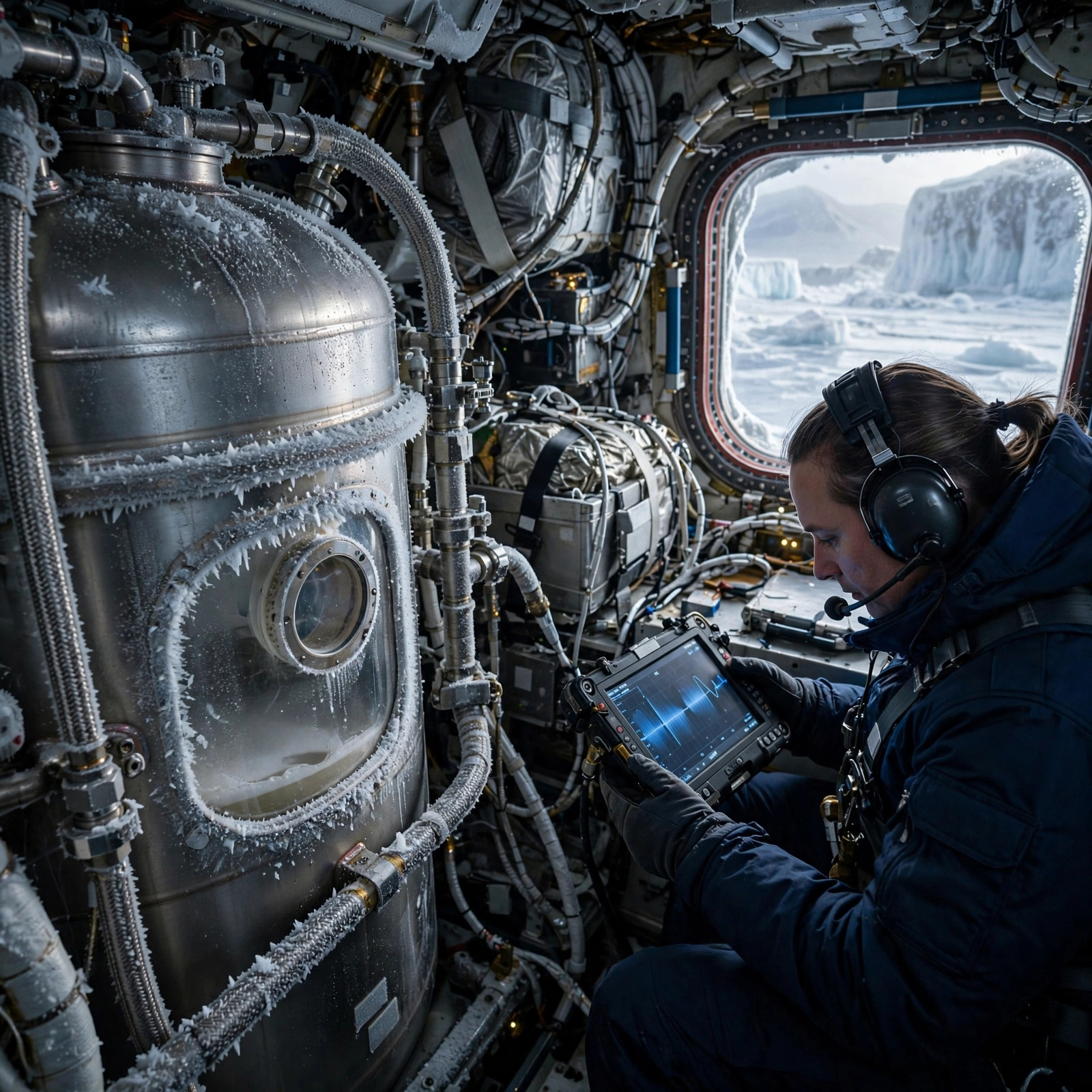
The particle flux at the ship fell to background within minutes of crossing into the moon's shadow. The beacon's window opened at 1803. Seven, three, eleven, five -- the old sequence, on time, and the pulse widths snapped back to their low-flux baselines as if the moon's shadow had reached down through nine kilometers of ice and rested a hand on something that had been straining.
The correlation was 0.93 through the shadow crossing. Clean. Almost cruel in how clean it was.
"That's the strongest evidence yet," Dara said quietly. "It feels its environment. It compensates. It simplified its message when it noticed us." She was aware she was cataloguing the attributes of a mind, or the closest thing to one she'd ever met, and she made herself stop and just record.
Then, twenty minutes into the pass, the beacon did something new.
The carrier shifted. Not much -- 400 hertz, a whisker in radio terms -- but the shift persisted through the next full sequence, and the sideband comb restructured around the new carrier, and Dara, watching the waterfall display, felt her scalp crawl as the pattern resolved. The new sideband spacing encoded a different number set. Not primes. It was a repeating count: 1, 1, 2, 3, 5, 8, 13, 21. Then a long gap. Then the primes again, and the Fibonacci train embedded in the sidebands, alternating, over and over.
"Two sequences," Rhea said. Her voice had gone very careful. "Primes in the time domain, the new one in frequency. It's layering channels. That's -- that's not a beacon anymore. That's a conversation scaffold. It's showing us it can carry more than one message at once."
"Or it's showing us that its transmission is richer than we assumed," Tomas said, "and the second layer was always there and we're only now resolved enough to see it." He was staring at the display, and his gruffness had entirely left him. "Either way, whoever designed that is someone I'd like to have a beer with. Or whatever they have."
They recorded until the far-side geometry took the signal away, and Dara spent the last hour of the pass with her hand on the console edge, doing the discipline: holding both possibilities, mind and mechanism, at equal weight, while every cell in her wanted to run down the corridor of the beautiful one.
But the discipline bent, that night, and she knew it bent, and she was honest enough with herself to log the bend.
Because at 0100, day 235, with the departure burn window nine hours away and the return trajectory loaded and checked twice, Dara sat alone in the sensor bay and did the arithmetic she'd been refusing to do for two days. The beacon's next transmission window was 0447. The departure burn was at 0900. If she delayed the burn by four hours -- a mere four hours, 0.4 meters per second of extra station-keeping, dropping the ledger to 150.4 -- she'd catch one more full listening pass, including the far-side segment, including whatever the layered signal did next in the shadow. And if the layered signal did something new -- if it added a third layer, or changed its simplified teaching sequence again -- the characterization would be materially, permanently richer.
Four hours. Point four of a meter per second. Against a condition Kirsch had set at 150, and the whole ship now balanced at 150.8 like a coin on its edge.
She ran it every way. Delay cost 0.4, leaving 150.4, still above the line. But the error bars on the return trajectory were plus or minus 0.6, and Rhea had refused to hide them, which meant the honest statement was: we might arrive at departure with a projected reserve of 149.8, and Kirsch's condition broken, and the mission technically out of authorization, and the only person who'd know in time to matter was the three of us.
She sat with it for an hour. In the forward camera, Anvil turned beneath them, gray and ridged and secret, and she thought about her mother's boring transects of the Atlantic floor, the forty years of them, the maps nobody thanked her for, and the one wreck she'd found at the end, right where the arithmetic said it would be, because she'd gone out anyway every single morning.
Then Dara Osei got up, walked forward, and knocked on the cockpit frame where Rhea was running the departure sequence through its pre-checks for the third time.
"I need to tell you what I almost did," she said. "And then I need you to tell me if it's worth it, because I don't trust my own answer."
She laid it out. The four hours, the point four, the error bars, the possible third layer in the signal. Rhea listened all the way through without moving, her hands resting on the sequence display, and when Dara finished, the cockpit was quiet for a long moment.
"Okay," Rhea said. "Here's my answer. If you'd come to me with the numbers and asked for permission, I'd have flown it, and I'd have resented you a little for the rest of my life. You came and told me it was a temptation instead. So now it's not a decision about the signal anymore. It's a decision about us." She turned in her harness to face Dara fully. "And my answer is no. Not because of Kirsch. Because the whole reason that thing down there is worth hearing is that we came out here honest. We burn at 0900 as authorized, and whatever it says next, the next crew hears it with their own clean ledger. That's the only way this stays worth doing."
Dara nodded. Something in her chest let go of a weight she hadn't fully felt herself carrying. "Burn at 0900. I'll write it up."
"And Dara," Rhea said, as Dara pushed off toward the bay, "for what it's worth: I think you just did the hardest thing a scientist can do. You stopped at the edge of knowing more."
"Don't make it a plaque," Dara said, and Rhea laughed, and that was the end of the temptation, sealed in a joke the way the best seals are made.
She told Tomas too, because he'd earned the same knowledge. He heard her out, wiping his hands on a rag he didn't need. "You know what I did once?" he said. "Year six, on the Pelagic. There was a flaw in a valve I wanted to bypass to save a day. I told the captain before I touched it, exactly like you just did. He said no. I hated him for a week." He folded the rag into a neat square. "The valve would've held, probably. But probably is where crews die. Good on you. Now let's go home before I get sentimental and someone has to fix me with a wrench."
At 0900, day 235, the Cartographer's Debt burned out of Anvil orbit -- 68 meters per second, smooth, engine two steady as a heartbeat, Tomas's injector plate holding like the stubborn piece of machined metal it was. Anvil shrank behind them, a gray coin again, and then a smudge, and then a point among points, and the beacon's window came and went at 0447 while they were still close enough to hear the first seconds of it before the range took the signal below their noise floor. Seven, three, eleven, five. Patient as tide.
The return was fourteen days of quiet flying, ion thrusters murmuring, the crew sleeping off their amber crossing, the signal's archive -- 214 hours of recording, three baselines, the layered sequences, the shadow correlation -- backed up in quadruplicate across the ship's stores and twice more in the transmission toward Meridian Station, crawling ahead of them at the speed of everything.
Kirsch's reply to the full science packet arrived on day 241. Four sentences again. "The consortium has reviewed your preliminary findings. A dedicated mission is being drafted with a drilling payload, launch window thirty months out. Your crew is requested for its planning board, if willing. Well done, all of you. Kirsch out."
And then the last day, day 249, the inner system ahead of them like a harvest, the assay platform's beacon blinking ahead, and the ship's tanks reading 149.6 meters per second spent-down and spent-well, within Rhea's honest error bars of every number they'd promised, and the tugs, as contracted, closing the last rough meters.
Day 249, 2300
They docked at 2140, station time, day 249 -- a firm but undramatic contact, the kind Rhea pronounced "boring," which from her was the highest praise docking could receive. The assay platform's crew of nine met them at the berth with the contained excitement of people who had read a four-light-hour-old summary of the greatest discovery in the history of their species and were trying very hard to behave like colleagues instead of children.
There were handshakes, and rehydrated champagne that tasted of its pouch, and a comm queue eleven hours deep with messages from Earth that nobody had opened yet. Dara let the others take the celebration. She had one piece of unfinished business, and it was small, and it was hers.
At 2250 she pulled herself back through the docking adapter into the Cartographer's Debt, alone. The ship was powered down to caretaker mode, warm and dim, the smell of eleven months of three human lives baked into its fabric. It would be refit for the drilling mission, if the funding held, or cannibalized for parts if it didn't. Either way, this night was the last one it would spend as her ship.
She went aft to the sensor bay, where it had all started at 0411 on day 212, and she opened the mission log.
The log was the master record, the legal and scientific spine of everything the crew had done, and it had one function Dara had never used in twelve years of survey work: the final entry, the seal. When a survey ended, the lead wrote the closing line, hashed it, and pushed the hash to the station chain, and the log became immutable -- a fixed, timestamped object, a letter posted to the future that could never be quietly edited. She'd sealed forty-one logs in her career. They had all said some version of survey complete, all designated bodies characterized.
She pulled up the entry field and sat there for a while in the dim bay, her tea cooling against the velcro of the console edge the way it had on the first night, when a spike at 1.42 gigahertz had refused to be filtered out of an ordinary survey of an ordinary moon.
On the console beside the log, she'd left the live feed from the station's big receiver running -- the deep-space listening array that the platform kept pointed down Thole's gravity well, because the platform director had reprioritized it within six hours of reading the packet, and because nobody aboard the station had been able to think of a single better use for it. The array was bigger than the ship's dish. Bigger than the ship's dish and the cubesat and the backup together, by a factor that made the signal, still faint, still patient, arrive with new authority.
At 2301, the feed refreshed. The beacon's next window had come. Seven, pause, three, pause, eleven, pause, five -- the green pulses marched across her screen, steady as they had been for every day she'd known them and, presumably, for a very long time before. Then the gap. Then, when she'd have sworn she was done being surprised, the layered structure resolved again: the primes in time, the Fibonacci count threaded through the sidebands in frequency, the two sequences braided together, still teaching, still patient, still addressed to anyone at all.
Still there. Eleven days after they'd stopped listening, it was still there, and now there was an array listening that would not stop, that could not be repointed away by any single schedule or budget or person, because the platform crew had signed a watch rotation that ran to the end of their contracts and the drilling mission's launch window thirty months out.
Dara typed the final entry. She kept it in the plain language the seal deserved. Survey of designated bodies complete with exceptions as logged. Primary anomaly at Thole II (Anvil) characterized to the limits of ship capability: fixed source, 300-meter localization, 71°S latitude, embedded in ice shell overlying liquid ocean. Signal is structured, redundant, self-regulating, and responsive to its radiation environment. Nature undetermined. Strongest available evidence is consistent with a designed transmitter of non-human origin. Characterization incomplete. Follow-up mission in planning. All crew returned alive.
Her hand hovered. She read it once more, every clause, every hedge she'd left in place because the hedges were the truth and she had promised Rhea -- promised all of them -- that she'd come out here honest and come home the same way.
Nature undetermined. The two most load-bearing words in science, holding the door between known and next. Thirty months from now, a ship with a drill would arrive in orbit over the Knuckles, and the planning board would have her name on it, and Rhea's, and Tomas's, filed under the crew-concurrence line where they belonged. Someone would melt through nine kilometers of ice with instruments her log entry had justified, and find the black warm water, and find whatever in the black warm water had learned to count -- or find the machine that had been left there to count on someone's behalf, some visitor older than the genus that had just noticed, and either answer would be the greatest ever written down.
She hashed the entry and pushed it to the chain. The console confirmed the seal in small green type: LOG CLOSED, DAY 249, 23:04 STATION. HASH 8F2C...41D. IMMUTABLE.
Immutable. A letter posted. Not an answer -- she was more certain than she'd ever been that no single person alive would live to write the last line of this one -- but a beginning, fixed in place so that no one could ever quietly make it smaller.
The beacon's pulses kept coming on the live feed, green and steady, and she watched them a while, seven-three-eleven-five, and let herself feel, for one unlocked minute, everything she'd kept at equal weight for thirty-seven days. Then she reached out and, with two fingers, the way you'd close a sleeping child's door, shut down the console's live feed -- but not before the screen caught one more pulse train mid-march, frozen in the last frame, still glowing.
Dara unclipped her dosimeter and set it on the console edge, a career's worth of amber crossing written in its small sure numbers, next to the cooling tea she'd finally, deliberately, drunk. Then she pulled the sensor bay hatch closed behind her -- firm, sealed, the dogs engaging one by one with a sound like a final chord -- and went forward through the dark and sleeping ship to where her crew was waiting, and the work, unfinished and begun, went on without her, patient as tide.
Get notified when new stories drop

Ava Kepler
Ava writes space exploration and cosmic adventure with competent crews, hard problems, and awe that earns its hope.
Leave a comment
Comments