

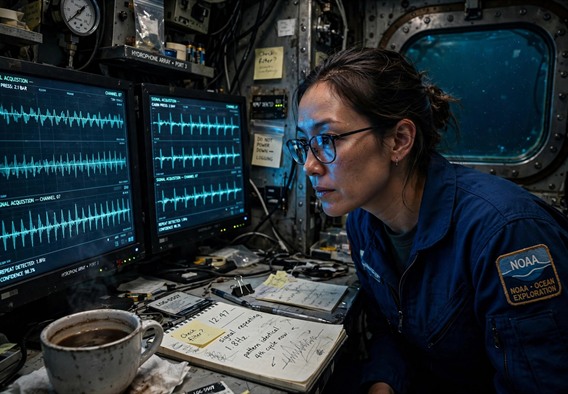

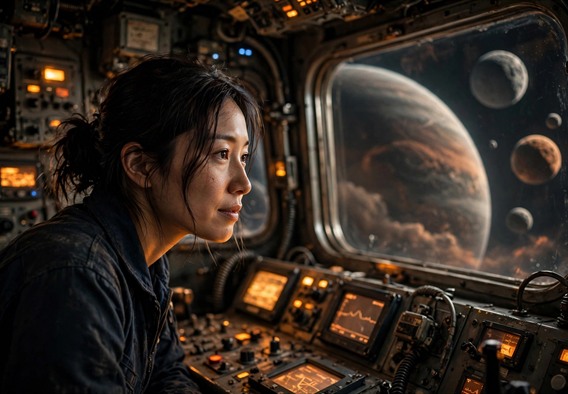
The signal arrived at 0311 station time, and Amara Okonjo was awake for it because she was always awake for it, the way a mother sleeps with one ear toward a child's breathing. She pulled on her jacket, tucked her gray hair behind her ears, and floated down the corridor of Relay Platform Threshold with her tablet tethered to her wrist, reading the pulse log as she went.
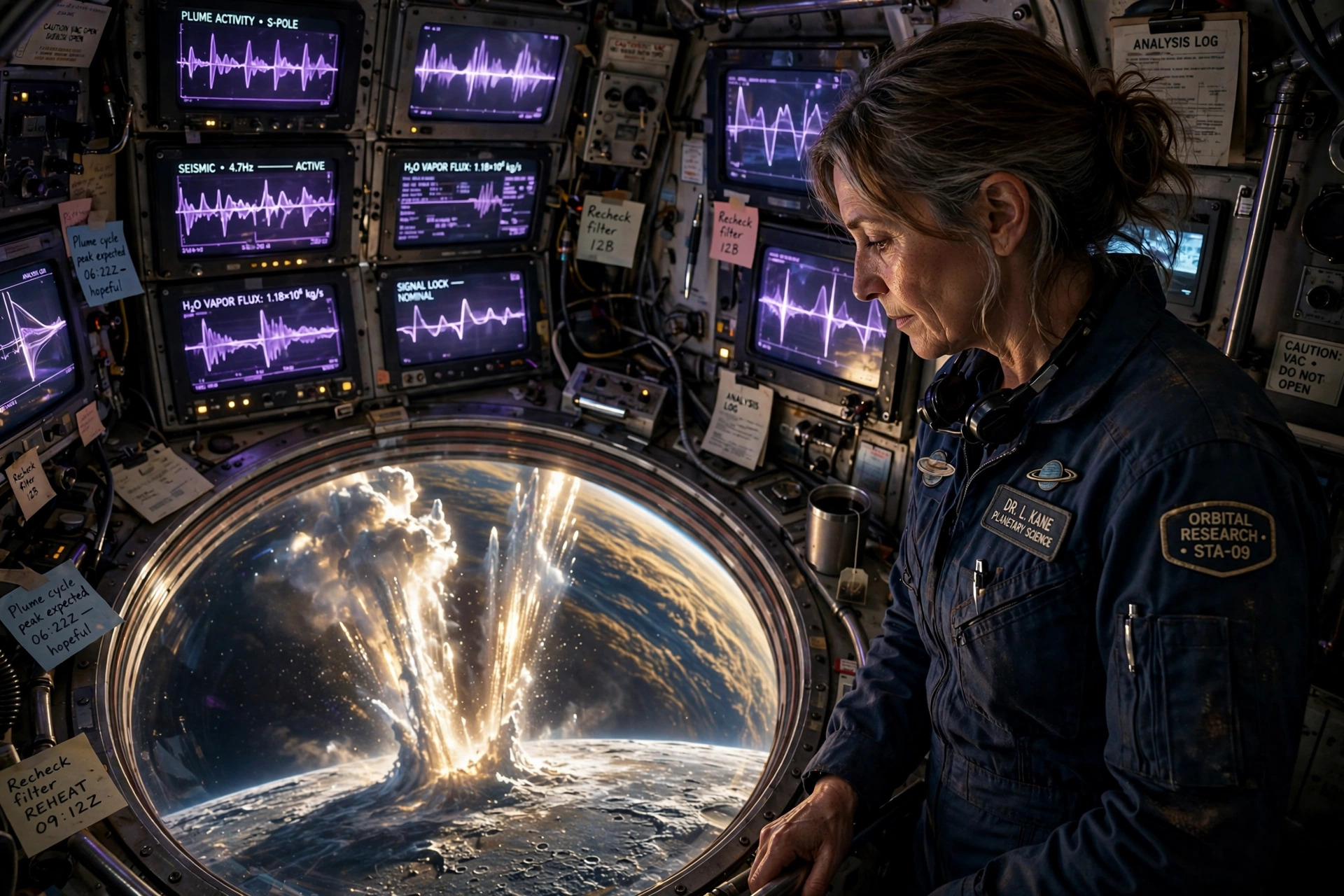
Seventeen years she had waited for the plume-speakers of Thessaly-e to say something new. Seventeen years of pattern, pattern, pattern. And now, on Day 34 of her eleventh rotation out here, a new phrase had risen out of the ice.
She pulled herself into the listening chamber, a cramped dome of consoles and cable runs cantilevered over the moon's fuming south pole, where geysers of briny water punched through kilometers of frozen crust and flashed into space. Below, in the tangled light of the gas giant, the plumes caught the sun and scattered it into long silver feathers. Somewhere inside those feathers, in a warm dark ocean that had never seen a star, something was thinking.
"Tell me you logged the cadence," she said.
Tomas Reyes hung upside down at the secondary console, which was his habit and his rebellion against uniformity, a skinny twenty-nine-year-old with four years on Threshold and a stubborn refusal to be bored by repetition. "Logged, parsed, and gift-wrapped. Dr. Okonjo, it's not in the corpus. And it's not noise, because the interval ratios are clean fifths, and they've never used clean fifths. That's the thing. That's the whole thing."
She anchored herself at the primary board and pulled the waveform up on the wall display. The signal was a train of light pulses, faint and precise, beamed up through the plume by an organism -- or a network of organisms, or something their language had no clean word for -- that humanity had named the Weave, for lack of anything more honest. Twenty-two years of careful, plodding exchange had produced a shared vocabulary of maybe four thousand concepts, all of them built the way you build a bridge from both banks at once: a pulse pattern meaning here, another meaning water, another meaning again, and slowly, decade-slowly, grammar accreting around them like nacre around grit.
The new phrase pulsed on the screen in patient violet bars. here -- water -- together -- question -- large -- new.
"That last pair," Amara said. "Large-new. Is that their word for discovery?"
"Or explosion." Tomas grimaced. "The semantic overlap is brutal. Remember when we thought edge-of-water meant shoreline, and it turned out to mean the boundary layer of their thermal vents? Same problem. Large-new could be wonder. Could be warning."
"Could be a whale fall," she said. "Something big and new and dead drifting down into their dark. They'd want to tell us. That's what a neighbor does."
She said it lightly, but she meant it, and Tomas knew she meant it, because everyone on Threshold knew that Amara Okonjo believed in the Weave the way other people believed in God -- quietly, daily, with a stack of evidence she could show you. She had spent twelve years as contact lead out here. She had learned their concept of gratitude, which was expressed as an obligation to remember, and their concept of grief, which was a long fading tone that the first researchers had mistaken for static and almost filtered out of the archive. She had buried a husband back on Earth and come back anyway, because out here the work was clean: two minds, human and not, both trying very hard not to be misunderstood.
What she wanted, if anyone had asked her straight, was simple and enormous. She wanted to finish the shared grammar. She wanted a protocol both species trusted so deeply that neither would ever again have to guess at the other's intent. Understanding, made durable. That was the whole of her ambition, and she was eleven concepts short of it, and she had been eleven concepts short for two years.
She keyed the response board and began, as always, with the courtesies. Threshold's answering laser, tuned to a frequency the Weave had themselves indicated preference for, back in the year of the great patience tests, fired down into the plume. here -- received -- question -- large-new -- question -- water-together -- question. She built the query out of old words, worn smooth by use, because the Weave never answered a question built from a new concept. You had to earn your way up to new grammar one proven stone at a time.
"Twelve minutes," Tomas said, checking the plume transit delay.
"Twelve minutes," she agreed, and went to make tea, which on Threshold meant rehydrating something that had once, distantly, been tea.
The answer came in fourteen. The Weave was slow sometimes; there were debates, down in that black ocean, or deliberations, or whatever a distributed intelligence did before speaking to aliens. Amara watched the violet bars assemble and felt her pulse climb.
here -- large-new -- not-water -- not-alive -- question -- your-making -- question.
She set down her tea bulb. "Not-alive. Not-water. They're asking if we made it."
"Made what?" Tomas pulled himself right-side up. "Amara, there's nothing new out there. Traffic control has the whole system. Nothing's come through since the resupply tender six weeks ago."
"Nothing human, maybe." She was already pulling the long-range optical feed, hands moving before her mind had finished deciding. "Something large and new arrived in the plume region, and the Weave is asking us about it. Which means it's close enough to matter to them. Cross-reference anything that's changed in near-moon space in the last ninety hours."
The search took twenty minutes, and it was the station's passive ranging array, not her intuition, that found it: a tumbling object, roughly nine meters long, in a decaying halo orbit that would carry it through the plume field within thirty hours. Spectrum dirty with propellant residues. Human-made. Deployed, according to the registry tag, ninety-one hours ago, from the fleet tender Vigilant, currently holding station two hundred thousand kilometers out.
"That's Sol Fleet's approach corridor," Tomas said slowly. "They filed a maintenance calibration for the ranging array. Launching a target dummy for the sensor grid. All perfectly routine." He looked at her. "Perfectly routine, and nobody told us, and now the Weave is asking us if we made the large-new not-alive thing."
Amara sat back. She looked at the display, at the patient violet bars, and then down at the plumes, silver and immense, falling eternally through the giant's light.
"Draft the reply," she said. "here -- yes -- our-making -- not-alive -- small -- soon -- gone. And prefix it with the courtesy stack, both of them, the full remembrance sequence. If they're worried, we honor the worry first."
"You think they're worried?"
"I think," Amara said, "that a species which has a specific grammatical form for we noticed something and we are telling you so that you know we noticed has just used it. Yes, Tomas. I think they're worried."
The answer, when it came, was the longest single phrase the Weave had sent in six years.
here -- received -- large-new -- question -- more -- question -- your-making -- more -- question.
She read it three times. Will you make more of them?
"They want to know our intentions," she said quietly. "They want to know if there will be more."
And Amara Okonjo, who had spent twelve years learning to hear a question as it was meant, heard this one clearly, and felt the first cold finger of the next month rest against the back of her neck. Because there would be more. Of course there would be more. The Vigilant had not come all this way to calibrate a ranging array, and the signal she had to send back down into the dark was the truth: she did not know how many more, and she did not know what for.
She sent it anyway, because that was the protocol, and the protocol was the only thing standing between two species and a war nobody wanted.
here -- truth -- not-known -- soon -- known -- here.
Below, in the patient dark, the plumes kept falling.
The Vigilant
The fleet cutter docked on Day 41, and its commanding officer came aboard Threshold with the cheerful, unburdened stride of a man who had never once doubted which side of history he was on.
Commander Ellis Rourke was fifty-one, broad-shouldered, twenty-three years in Sol Fleet, and head of what the mission charter called, with magnificent blandness, Contingency Planning. He shook Amara's hand in the docking bay with genuine warmth -- that was the disorienting thing about Rourke, that he was likable, that he meant well, that he drank her tea and complimented the plume view and never once raised his voice.
"Doctor Okonjo. They told me you'd be exactly this." He nodded at the listening chamber's cluttered boards. "Twenty-two years of contact and not one incident. That's a record worth protecting. I want you to know I read your full corpus report on the way out. All four volumes. You've done astonishing work."
"Then you'll understand why I filed against the ranged-transmission tests," Amara said.
"I understand that you believe the Weave experiences high-power broadcast as a threat display." Rourke settled onto the guest couch, anchoring his boots under a restraint bar, entirely at home. "I also understand that the belief rests on a single incident, fourteen years old, in which the Weave went silent for six weeks after the old deep-radar survey. Correlation, not causation. The science board's position is that the silence was coincidental -- a seasonal deliberation cycle, per Dr. Ferreira's oceanography data."
"The Weave doesn't have seasonal deliberation cycles. Ferreira modeled that on cetacean analogues. It's Earththink wearing a lab coat."
"Maybe so." He spread his hands, generous. "Here's my problem, Doctor, and I want you to hear it honestly, because I'm not here to make your life difficult. I'm here because Thessaly-e is no longer a curiosity. The ocean beneath this ice is the largest confirmed biosphere outside Earth. Parliament has authorized a permanent human presence -- a survey station, crewed, in the plume field, within three years. That means approach corridors. That means traffic. That means, eventually, a ship in distress needing a rescue broadcast at power levels your contact laser can't touch. Before any of that happens, Fleet needs to know how the Weave responds to a high-energy transmission at close range, in controlled conditions, with every measurement running. If we don't test it carefully now, we test it carelessly later. That's all this is."
Amara looked at him and made herself see the argument from the far bank, the way she did with the Weave, because her flaw -- she knew it was her flaw, knew it the way you know a scar -- was assuming that anyone who had read her corpus would naturally agree with her. Rourke had read all four volumes, and he was sitting here anyway, and he was not a monster. He was a reasonable man with a mandate and a deadline and an institutional terror of the unmeasured.
"You're proposing a test broadcast," she said. "At what power?"
"Narrowband, structured, one gigawatt effective, thirty-second burst, modulated to mirror your contact grammar. A greeting, essentially. Loud, but polite." He smiled. "We're calling it the knock."
"A gigawatt into the plume field is not a knock, Commander. The contact laser runs at two hundred watts. That's the level they chose. They asked us to speak at that level. Their preference signal is in the corpus, volume two, it took us three years to decode. You read it. A thousandfold jump, on top of an unannounced metallic object dropping through their sky --"
"Is a calibrated step," Rourke said, "in a controlled sequence, with the object explained first. That's why we deployed the target -- to give them the concept of an inert human-made artifact in their sky before anything else happens. You yourself told them it was our-making, small, soon-gone. That was the right call, Doctor. It was exactly the right call. You've built the crib sheet. We're just -- adding a vocabulary word. Loudly."
Amara sat with that for a moment. Down in the plume field, the inert target was still tumbling toward its decay orbit, and the Weave had gone quiet in the way they went quiet when they were deliberating, and every hour of silence was data she could not read.
"Let me do it in my sequence," she said. "Stepwise. I'll introduce the concept of far-speakers in the corpus first. here -- our-making -- large-sound -- soon. Give me four weeks to build the grammar, then you run your burst. I'll log their response against the full corpus. You'll get your data, and they'll get a warning."
Rourke considered her, and there was real respect in it, and she already knew, from the set of his shoulders, what he would say.
"Parliament's authorization window closes in nineteen days. The survey station funding vote is on Day 61. If there's an adverse event on the record before the vote -- any adverse event -- the permanent mission dies in committee, and the next crew to study this ocean will be your grandstudents, if that. I can give you eight days, Doctor. Build your crib sheet in eight days. The knock happens Day 59. Thirty-second structured burst, my ship, my power budget, full instrumentation from both of us. If the Weave responds neutrally or positively, we have the safest first-contact file in human history going into the vote. If they go silent again --" He shrugged, honestly open, honestly unafraid. "Then better we learn that now, carefully, than later, catastrophically. Agreed?"
She wanted to refuse. Every year of her craft wanted to refuse. And the part of her that had learned, stone by proven stone, to hear a question as it was meant, heard Rourke's question as it was meant: not can I have your blessing, but will you be inside the tent or outside it when this happens?
"Agreed," she said. "With conditions. My grammar runs first, your burst runs second, and if the Weave sends any distress form -- any at all, and you'll know it because I will tell you within a minute of receipt -- the sequence stops. Instantly. Not after data review. Instantly."
"Instantly," Rourke repeated, and shook her hand on it, and meant it, she believed he meant it, and that night she lay awake in her narrow bunk listening to the hull tick and thought about the fact that the Weave's word for trust was the same construction as their word for verified -- the same root, hear-and-check, hear-and-check -- and she thought: they are wiser than we are, down there in the dark, because they have never once assumed that a neighbor's good intentions were obvious.
For eight days she built the crib sheet. She introduced large-sound, and the Weave accepted it into the shared grammar without comment. She introduced far-speaker, and they returned a compound of their own: far-speaker-water-voice, the voice that travels far through water. Sound, to them, was water. Everything came back to water. She introduced soon, and they sent back here -- soon -- question -- large-new -- more -- question, and she answered truthfully: yes, more, our-making, soon.
On the morning of Day 59, the plumes fell silver and enormous through the giant's light, and the Vigilant moved into position with her transmitter array deployed like an opening hand, and Amara Okonjo stood in the listening chamber with Tomas at the secondary board and Rourke on the open channel, and she thought: I have done everything right that could be done. And she thought: it is not enough. And there was no time to think either thought to its end, because the countdown was running.
Thirty Seconds
The burst went out at 0900 exactly, a structured greeting in the Weave's own grammar, amplified a thousandfold, thirty seconds long.
Amara watched the plume field through the dome as if she could see the light hit the ice. In a sense she could: twelve minutes later, the scattered return flickered across the ice in faint auroral shivers, and then, a minute after that, the response came.
It was not silence. That would come later. First it was a wall of sound in light -- every frequency the Weave had ever used, all at once, layered and dense, and then a phrase the corpus had only recorded once before, from the archive of the deep-radar incident fourteen years ago, when a young researcher named Ilse Garza had made the call to power up the survey radar without the courtesy stack.
here -- all -- voices -- stop -- question -- your-intent -- question.
The full remembrance sequence, inverted. Not we noticed and we are telling you. Something closer to: every one of us has stopped speaking. What do you intend?
"Stop the sequence," Amara said to the channel, and her voice came out flat and strange. "Commander, that's a distress form. My condition. Stop."
"It's a response," Rourke's voice came back, level, professional, and she could hear him wanting it. "Doctor, they answered. That's engagement. One more burst at matched modulation, and we --"
"It's the same string they sent before the six-week silence." Tomas had it up on the archive display, the fourteen-year-old waveform overlaid on the new one, matching to four decimal places. "Commander, correlation of the distress form, percent match ninety-nine point six. That's causation with a bow on it. Stop the test."
A silence on the channel. Three seconds. Amara counted them.
"Standing down," Rourke said at last. "All transmission, standing down. Log the termination at my authority, 0914. Doctor -- your call. I gave my word."
And she believed him, and it mattered that she believed him, and it did not help at all, because the reply that came nineteen minutes later was not addressed to the Vigilant, and it was not addressed to Threshold, and it was not a phrase from the shared grammar at all.
The plume field lit. Every geyser on the south pole, in sequence, in a rolling wave of light and vapor that the oceanography team would spend years modeling -- a discharge of bioluminescent scale that the Weave had never once displayed in twenty-two years of contact. The whole moon's southern hemisphere pulsed like a struck bell. And riding on that light, embedded in it, was a transmission that the Vigilant's instruments drank in and that Amara's boards could only stare at, uncomprehending.
It was dense. It was structured. It was, she was almost certain, the Weave's full internal language, the water-voice, untranslated, unmediated, thrown up at the sky all at once.
"What is it?" Tomas whispered. "What are they saying?"
"They're not saying it to us." Amara's hands were shaking, and she made them be still on the console. "Look at the vector. That's not a point transmission. That's omni. That's aimed at the whole sky. It's a shout." She swallowed. "It's the thing a species does when it wants to be heard by anyone listening. It's a distress call, Tomas. They just called for help."
The listening chamber had filled during the response -- Ferreira from oceanography, the station administrator, two of Rourke's officers who had come across on the tender. Nobody spoke. On the display, the waveform rolled on and on, minute after minute of unreadable urgency.
It ran for eleven minutes. Then it stopped, and the plume field went dark -- not dimmed, dark, darker than the oceanography team had ever recorded it, the bioluminescence of an entire ocean shut off -- and the Weave sent one last phrase in the shared grammar, slow, and small, and terribly clear.
here -- alone -- question.
Are we alone? Or perhaps: we are alone now. With the Weave's grammar, with hear-and-check, with a species whose word for trust was the same as their word for verified, the two readings were not even different questions.
Amara sent the courtesy stack immediately, full remembrance sequence, here -- received -- here -- received -- here, and the water took the words down into the dark and gave nothing back.
That was Day 59.
On Day 60, the Vigilant's tactical officer, Lieutenant Dhawan, made her report in the cramped common room that Threshold used for everything: funerals, weddings, and now this. The omni broadcast had been received, in fragments, by the deep-space relay at Tau Marineri, six light-hours out. It had been received by the mining consortium's monitoring post at Herschel Gate. It had, in all statistical likelihood, been received by anything in a sphere dozens of light-hours across, and humanity's settlements in this volume of space numbered eleven, and every one of them was now asking Sol Fleet what the ocean under the ice of Thessaly-e had screamed, and to whom.
"Parliament has convened an emergency committee," Rourke said. His cheerfulness was gone; what replaced it was not fear but a terrible, focused responsibility, which was worse to argue with. "Day 61 is now Day 61 plus a threat assessment. The current draft position -- I'm telling you before it's public because you deserve to hear it from me -- is that the Weave's broadcast constitutes an uncontrolled emission event from a non-human intelligence of unknown capability, and that the appropriate response is containment. Directed antisatellite emplacement in high orbit. A permanent monitoring cordon. And a standing high-power deterrent channel, so that if it ever happens again, we can answer it on a scale it understands."
"Answer it," Amara said. "You mean shout back louder."
"I mean make it stop," Rourke said, and for the first time his voice carried the edge under all the reasonableness. "Doctor, that broadcast could have been an attack signature. A beacon to an enemy. A summons. You don't know what it was. I don't know what it was. And the difference between you and me is that I'm accountable for the eleven settlements that just heard it. Containment is not aggression. It's what you do when you don't understand yet. It's --" he gestured at her boards, at the violet grammar hanging on the display -- "it's your whole methodology, Doctor, applied at scale. Measure before you touch."
"It's a wall built by one side," Amara said, "without asking the other side where the door is."
The room was quiet. Ferreira looked at the table. Dhawan looked at Rourke. Tomas looked at Amara, and in his look was the thing she least wanted to carry: he was waiting to see whether her certainty included him, or whether it would spend him.
"The emplacement vote goes to committee in seventy-two hours," Rourke said. "If the Weave resumes contact and the resumption is verifiably benign before then, I will personally argue against containment, and I'm the one they'll listen to, because I'm the one who filed the adverse event. You have three days, Doctor. I'm sorry. I know what three days is in your discipline."
He left. The common room emptied. And Amara Okonjo sat for a long time with the last phrase the Weave had ever sent her hanging in violet bars on the display behind her.
here -- alone -- question.
They had asked if they were alone. And for three days, if the committee had its way, the answer the solar system would give them was: yes, and stay that way.
The Water Grammar
Day 62, and the ocean was dark, and Amara had a plan that would end her career, and she had spent the whole night making sure it would end for the right reason.
She had not slept. She had worked, and the work was this: the eleven-minute omni broadcast, the Weave's untranslated water-voice, had been recorded by Threshold, by the Vigilant, by Tau Marineri, and by Herschel Gate, and the four recordings were different. Not just different in quality. Different in content -- different phrase lengths, different sequence orders. The same event, heard from four angles, was not the same message.
Which meant the broadcast was not language at all. It was signal spent as display. It was the plume field's light show rendered in radio, and its meaning was not in its content but in its scale: we are here, we are many, we are alarmed. A distress call with no words in it. The roar, not the sentence.
And if that was true, then the Weave had not summoned anyone. They had done the only thing a panicking species with no weapons and no words could do: they had made themselves loud, in the hope that loudness would bring help.
She took it to Rourke at 0600, and to his credit he listened to the whole four-recording analysis with his eyes closed, the way he probably read casualty reports. And at the end he said, "That's an inference, Doctor. A beautiful one. It's the kind of inference I've watched you be right about for two decades. But it is not verification, and the committee doesn't vote on inference. The math gets it a hearing, not a verdict. If the Weave would confirm it in the shared grammar, we'd have something. Without them, it's your word against the dark."
"Then I'll get them to confirm it," she said.
"They've been silent for three days. Your contact laser has been running the courtesy stack every six hours. Nothing. What are you going to do that you haven't done?"
And here it was, the thing she had built in the night, the plan with her career folded inside it like a seed in a coat pocket.
"The knock," she said. "Their version of it. Fourteen years ago, before the deep-radar silence, Ilse Garza logged a precursor signal -- the Weave sending the full remembrance sequence inverted, at high power, in their own water-voice, at their own choice of frequency. She filed it as an anomaly and everyone forgot it. I found it at 0300. It's the one recorded instance of the Weave initiating a high-power transmission to us. They did it once, as far as we know, to say: stop. If I transmit the shared grammar inverted, at high power, on their historical frequency -- not our contact frequency, theirs -- I'm answering in their own grammar of alarm. I'm saying: we heard your distress, and the response comes from me, at your volume, on your channel."
Rourke was quiet. Dhawan, at the console behind him, said, "That's a gigawatt-class transmission from a Fleet platform without committee authorization. Doctor, that's a court-martial offense for whoever authorizes it. And the committee's draft position explicitly freezes all high-power transmission to the plume field pending review."
"From Fleet assets," Amara said. "The freeze order covers Fleet platforms. Threshold is a civilian research station. My contact array runs at two hundred watts." She took a breath. "But the Vigilant's spare transmitter node is rated to two kilowatts in narrowband, and it's sitting in my cargo bay, off your manifest, because your quartermaster owed Tomas a favor and considers a transmitter node 'maintenance equipment.' I checked. At two kilowatts, on their historical frequency, with their own inverted grammar -- it's ten times anything I've ever sent. It's the loudest a human voice has ever been in their sky, short of yours."
Rourke looked at her for a long moment, and she watched him arrive at it, watched the accountability and the honest wanting of it war in his face.
"If I authorize that transmission," he said, "and the committee rules it a provocation, I'm finished. And so are you, and so is the permanent mission, and so is twenty-two years of the safest contact file in history."
"Yes," Amara said. "That's the size of it."
"And if you don't send it," Rourke said slowly, "then in seventy-two hours we build a wall around an entire ocean because it was frightened, and the first thing every human child born near this moon will learn about its neighbors is that we shut them up when they cried for help." He rubbed his jaw. "Damn it, Doctor. You've got the arguments both ways and you know it. What aren't you telling me? There's always something. What's the cost you're hiding under the table?"
She could have kept it, and part of her wanted to: the private discipline, the clean stratagem. But the whole method was hear-and-check, and it had to run in both directions or it was nothing.
"The inverted remembrance sequence," she said, "is what they sent before a six-week silence. It's a stop form. I'm choosing to send a stop form at high power, to a species in distress, in the hope that they'll read it as solidarity instead of threat. If I'm wrong about them, if their alarm grammar works differently than the corpus shows, I'll be the second human in history to scream stop at an ocean that was already frightened. And I'll have done it louder than Garza ever did. That's the cost, Commander. That's what's under the table. If this fails, I haven't just failed -- I've confirmed their worst reading of us."
Rourke stood at the dome viewport and looked down at the dark plume field for a long, long minute.
"Dhawan," he said finally. "Log the transmitter node as transferred to civilian research custody, 0651, under mutual-assistance provisions. Threshold's manifest, Threshold's authority, Threshold's accountability. Doctor Okonjo transmits on her own license." He turned, and his face was grim and clear at once. "You understand what I'm doing. I'm letting you spend yourself. If this works, the mission lives and I'll fight for it with everything I have. If it doesn't --"
"If it doesn't," Amara said, "you'll be the man who tried the careful path before the committee chose the wall. Your record will survive me. Mine won't. That's fair. I've had twenty-two years of this ocean, Commander. I've been rich for a long time."
He left without another word, which was his way of respecting things.
It took Tomas and Ferreira and the station's two remaining engineers nine hours to couple the transmitter node to the contact array, and Amara spent all nine of them building the message, and it was the hardest compositional work of her life, because every element had to be old, proven, wear-smooth grammar, arranged into a sentence no human had ever said before.
The message, when it was done, was this:
here -- your-voice -- received -- all -- received -- grief -- received -- here -- not-alone -- here -- truth -- here -- your-water -- our-grief -- together -- question -- again -- question.
Your voices were received. All of them. We grieved receiving them. You are not alone. Truth. Your water carries our grief with yours. Are we together again?
And at 1622 on Day 62, Amara Okonjo pressed transmit, and the loudest gentle sentence humanity had ever spoken went down into the dark of a frightened ocean, at ten times the volume of every kind word before it, on a frequency the Weave had chosen for shouting stop.
Then there was nothing to do but wait twelve minutes, and then to keep waiting, and so she made tea that had once, distantly, been tea, and stood at the dome with Tomas, and watched the ice.
The first answer came in forty minutes, and it was one word long.
here.
The Exchange Stone
here, the ocean said, and then, after an interval she would later determine was almost exactly the length of the original distress broadcast, eleven minutes of deliberate, measured patience: here -- truth -- verified -- here.
Amara cried, which she had not done in front of her team in twelve years, and nobody on the listening chamber made it strange, because Ferreira was crying too, and even Dhawan, who had crossed from the Vigilant at 0100 with the committee's draft resolution on her tablet and the look of a woman who wanted very much to be talked out of delivering it, stood at the back of the dome with her jaw set and her eyes bright.
Truth -- verified. The compound root. The Weave's word for trust.
"They're asking for the check," Amara said, wiping her face with the heel of her hand. "They heard our answer, and they want to verify it. That's how it works for them. You're not trusted until you're checked. Tomas -- open the old proof protocol, the one from the patience tests, and give them any three concepts from the corpus, their choice, and we return the full definitional stack for each. Perfect recall, no prompts."
"They haven't used the proof protocol in nine years," Tomas said, already pulling it up.
"They haven't had reason to doubt us in nine years."
The Weave chose three concepts: water-together, which was their word for community; large-new, that first new phrase of the crisis, which they now glossed with a paired term she had never seen, large-new-remembered; and the inverted remembrance sequence itself, sent back to her whole and entire, every element, in the exact order she had transmitted it at 1622.
They had kept her sentence. Every word of it.
She returned the definitional stacks from memory, and her recall was perfect, and she was weeping again by the third one and did not care, and at 0219 on Day 63, after the plumes had begun -- slowly, vent by vent, geyser by geyser, over the course of a whole watch -- to glow again, dim and gold and cautious, the Weave sent the phrase that ended the emergency and broke the committee's draft resolution into confetti.
here -- your-making -- far-speaker -- water-voice -- together -- here -- grief -- remembered -- here -- not-alone -- verified -- here.
"They're confirming the inference," Dhawan said quietly, reading it off the display. "Your water-voice analysis. They're stating it themselves: the broadcast was theirs, it was a grief signal, and it was aimed at no one and everyone. And -- they're saying they've verified us." She looked at the tablet in her hand, the draft resolution, the wall around an ocean, and then she deleted it, deliberately, in front of everyone, which was a small act and a hard one, and Amara honored her for it.
Rourke arrived at 0700 with the news that the committee had voted at midnight to table containment pending review of new evidence, which was bureaucratic for we were wrong and we know it, and he stood in the listening chamber and read the full transcript, all of it, start to finish, in silence.
"For the record," he said at last, "you disobeyed the intent of a standing freeze."
"Yes," Amara said.
"And you were right, and it worked, and the mission lives." He set the tablet down. "The hearing's on Day 70. I'll testify on your behalf. There'll be a censure -- there has to be, the freeze was real, and the rule matters even when breaking it saves everything, maybe especially then. But the permanent survey mission will be crewed and joint-contact-licensed within the year, Doctor. Your grammar will be in every license exam on Earth." He paused at the hatch. "Garza came out of retirement, you know. Ilse. She read your transmission log last night. She said to tell you the debt's paid. Fourteen years of it."
Amara nodded, because there was nothing to say to that which would not come out as a speech, and she had made a career of the opposite of speeches.
The work did not end; that was the lesson of Day 64 and every day after. The Weave did not return all at once to the old warm volume of exchange. They spoke softly, for days, and then in full sentences, and then -- on the morning of Day 71, while the hearing transcript was still being compiled light-hours away -- they did something new.
here -- offer -- question -- water-thing -- here -- truth -- see -- question.
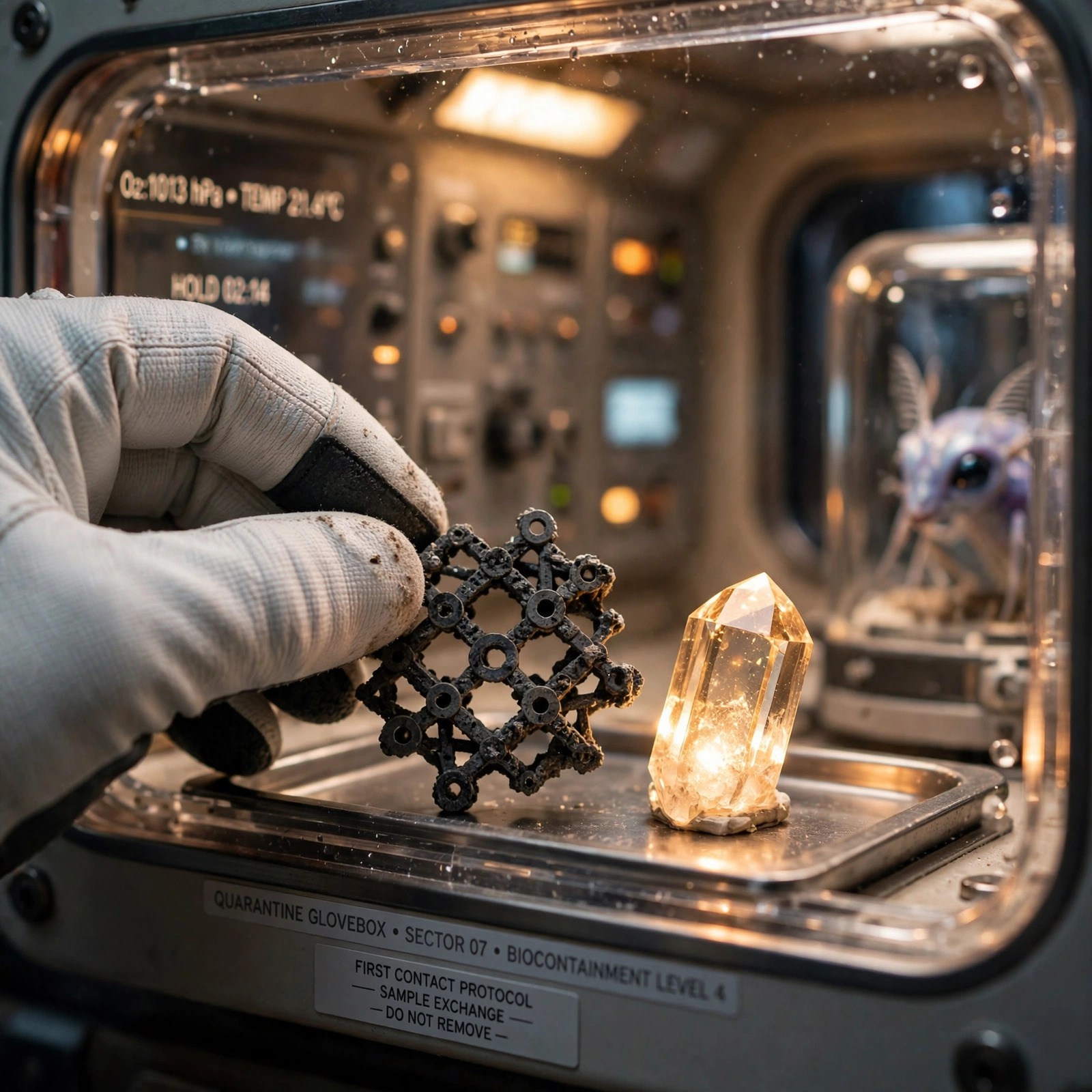
The oceanography team caught it first on the plume samplers: a single object, ascending. The Weave had, in the long dark of their distress, built something -- grown it, the team would argue for years over the verb -- a lattice of mineral and biogenic carbon, palm-sized, structured in rings of seven and eleven, the prime intervals their pulse grammar used for emphasis. It rode a geyser up into the vacuum at three hundred meters a second, and Tomas caught it eleven days later with the sample collector, and it lay in the quarantine glove box in the listening chamber, small and dark and deliberate, older-looking than anything twenty-two years of sampling had ever brought up from that ocean.
Amara sat with it for a long time before she answered, because the corpus had a protocol for this, one she herself had built, stone by stone, in the second year of her tenure: offer -- truth -- see -- known -- return -- known -- together.
An exchange. Each party gives a verified thing, and names it truly, and both remain, and neither is required to give more.
So on Day 74, at 1400 station time, she stood in the sample deployment airlock with the lattice object and a small case, and Tomas at the dome, and Dhawan observing from the Vigilant in silence, and Rourke's formal authorization -- mutual exchange, civilian license, both parties named -- glowing on the display, and she sent the message that had taken her two days to compose:
here -- your-offer -- received -- verified -- beautiful -- here -- our-offer -- here -- truth -- together -- remembered.
In the case was a calibration crystal from Threshold's first year, the one that had tuned the original contact laser to two hundred watts, the Weave's own chosen frequency, the frequency of every kind word ever passed between the species -- a thing made by human hands, small, inert, true, and carrying in its etched lattice, in nanometer-scale graving that the Weave's finest instruments would find and read over however many years they chose to spend, the full definitional stack of one human concept: grief -- remembered -- together.
The deployment arm extended through the airlock. The case fell away toward the plume field, tumbling, catching the giant's gold light. Twelve minutes later, deep in the silver and darkness where the warm ocean met the frozen shell, the release mechanism fired, and the crystal dropped away toward the water.
The response came on schedule, patient and exact:
here -- received -- verified -- here -- together -- here.
Amara set the Weave's lattice -- their exchange stone, her exchange stone now -- into the reader mount at the primary console, where its rings of seven and eleven caught the display light. She keyed the courtesy stack, low and warm, at two hundred watts, on the frequency they had chosen a generation ago, and far below, vent by vent, geyser by geyser, the plume field glowed gold, cautious, unhidden, and the ocean answered, and she wrote down what it said.
Get notified when new stories drop

Mira Okoye
Mira writes first contact and mentorship-across-species stories where curiosity beats fear.
Leave a comment
Comments