





Marisol Vega woke to the sound of the tool library opening without her, which was exactly how she had designed it, and which still made her get dressed faster.
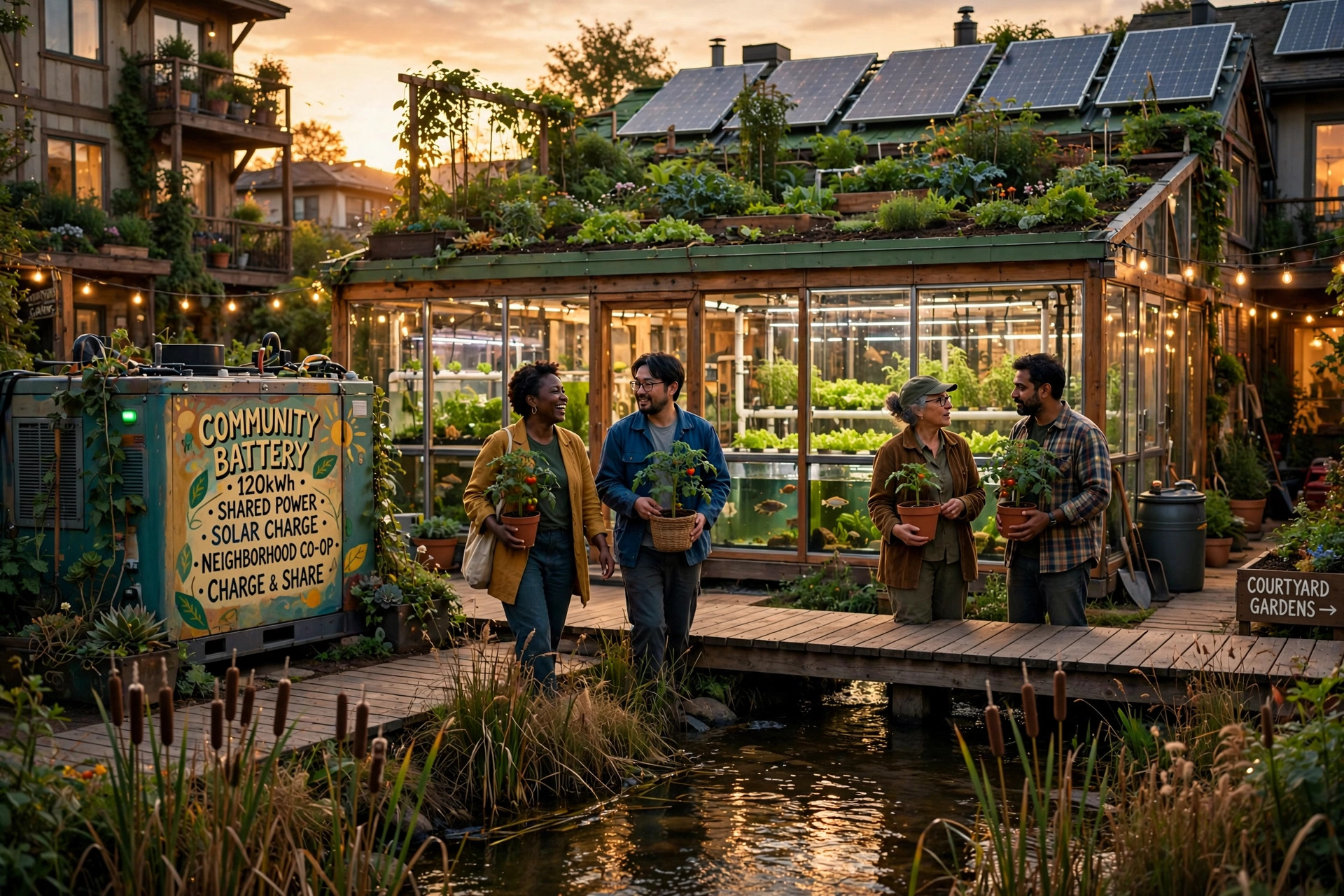
By six-forty she was crossing the courtyard of the Hollow Creek Commons in the gray-gold light, past the rain gardens still dripping from the overnight thunderstorms, past the bicycle repair bay where Tomás already had three bikes upside down on their stands, past the big painted board where someone had chalked BEANS IN! over the seed library drawer. The district around her was doing its ordinary morning thing: delivery trikes on the greenway, the bakery's oven vent breathing warm flour-smell into the street, kids' scooters clattering on the boardwalk over the restored creek that gave the place its name. Fourteen years ago the creek had been a concrete ditch that flooded every spring. Now it had cattails, herons, and a grudge against Marisol personally, but that was fine. Grudges meant it was alive.
She climbed the stairs to the operations room above the tool library, where the walls were a live map of the commons: eleven rooftop gardens, the greywater loop that fed them, the aquaponics greenhouse, four hundred and six households with a stake in the shared battery the neighborhood had nicknamed Big Ruth, and Big Ruth herself, a 3.2 megawatt-hour second-life battery assembled out of retired bus packs by people who had learned soldering in this very room. The screen showed her the night's numbers. The commons had covered 71 percent of its own consumption from rooftop solar and the small creek turbine. Fine. The district grid had soaked up the surplus. Also fine.
What was not fine, and had not been fine for three weeks, was the letter on her desk.
She read it again anyway, because avoiding a thing twice was at least consistent. It was from the District Efficiency Office, signed by an engineer named Ivo Sandoval, and it said, in polite and confident language, that the Hollow Creek Commons had been selected as a study site for the Meridian Grid Modernization Project, and that a full presentation would occur at the district council on the forty-first day of the season, during the heat wave, when everyone would be tired and sweaty and inclined to hand their problems to anyone with a chart.
Okay. It didn't say that last part. That was Marisol's own editorializing, which she did in the margins in red pencil, a habit she'd borrowed from her grandmother, who had run a union hiring hall and taught her that the first draft of any official document is written by people who have never had to fix anything with their hands.
What the letter actually said was that modeling showed a centralized Meridian retrofit could cut district energy emissions by 22 percent, and that the commons, quote, presented an opportunity for consolidation, unquote.
Consolidation. She put the letter face down on the desk like it could be socialized that way.
Downstairs, Remy Ostrowski banged through the door with a bucket of tilapia feed and the expression of a man carrying news. Remy ran the aquaponics greenhouse, was twenty-nine, had shoulders like a man who moved fish tanks for a living because he did, and had opinions about everything Marisol did, which she had come to understand was his love language.
"You got the letter," he said.
"I got the letter."
"And?"
"And I'm reading it in the margins, like a normal person."
"Marisol." He set the bucket down. "My cousin works at the Efficiency Office. She says Meridian is real. She says they've got a model that says our little setup is the problem. That rooftop stuff is, uh--" he squinted, quoting, "--'fragmented and maintenance-intensive, with suboptimal load behavior.'"
"Suboptimal load behavior," Marisol repeated. "Big Ruth is going to be so hurt."
"You're doing the thing. The joke thing. The thing you do instead of being scared."
"I'm not scared. I'm annoyed." That was the second lie of the morning, and it wasn't even seven yet. She stood up. "What's the fish situation?"
"The fish situation is the fish are fine. The tomatoes are the ones with feelings." He followed her down the stairs and out into the greenhouse heat, where the smell hit like a friendly wall: green water, wet gravel, basil going feral in the corner bed. Eleven hundred tilapia in the tanks, their waste feeding the grow beds, the grow beds filtering the water back, the whole loop powered off the commons' roof and Big Ruth. It was the kind of system that looked like chaos and ran like a heart. "But here's the thing," Remy said. "If Meridian consolidates, my loop becomes their loop. Their model probably doesn't have a line item for eleven hundred fish that die if the power hiccups for six hours in August."
"Their model definitely doesn't. I've seen their model. Well. I've seen the summary of their model."
"There's a summary?"
"There's a slide deck." She pulled her tablet out of her back pocket and showed him: eleven clean slides, blue and white, the district rendered as a smooth diagram with tidy nodes. It was a beautiful deck. It was so beautiful it made her teeth ache. Somewhere under all that blue, she knew, was her courtyard, her tool library, her heron-harboring creek, rendered as a node.
Remy scrolled with one thumb, feeding bucket forgotten. "Where are the people?"
"The people are load behavior."
"Where's Tomás?"
"Suboptimal."
"Where's Mrs. Adeyemi and her blood pressure fridge with the insulin in it?"
"Fragmented."
"Where's the guy who teaches soldering on Sundays?" "Maintenance-intensive," she said, and had to stop, because the joke had stopped being funny. The Sunday soldering guy was a retired substation worker named Bart who had, in year nine, rebuilt the charge controllers for free for three straight months while Marisol hid the failing budget from everyone, including herself.
The day filled up after that the way workdays did, which was the whole point of the commons and also the thing the letter was about to make her defend. She helped the greywater crew swap a filter membrane. She arbitrated a genuinely vicious dispute between two households about who had rights to the fig cutting. She sat with Priya Chao, who was sixty-one and had just come back from her mother's funeral in Manila and didn't want to talk, so they didn't talk, they just repotted seedlings until Priya's hands stopped shaking, and then Priya said, "You know the first thing I thought when I landed? I thought, good, the lights will be on when I get home. Your lights. I thought of them as mine."
Marisol thought about that all the way to the creek turbine, where she waded in rubber boots to clear a snag of plastic bags off the intake screen, the cold water pushing at her knees, the heron on the far bank giving her the flat look of a landlord. Fourteen years. She'd been twenty-four when she started, a wastewater tech with a petition and a bad attitude about how the flood kept taking the same six blocks. The petition had become a cleanup, the cleanup had become a creek, the creek had become a garden, the garden had become a commons, and somewhere in there she had become the woman everyone called first, which was the thing she wanted, and also the trap.
Because here was the truth she hadn't said to Remy: she'd known about Meridian for three weeks. She'd known, and she hadn't called a meeting, because calling a meeting meant standing in front of six hundred households and saying the sentence out loud. Someone wants to take this. And if she said it and then lost, she'd be the woman who lost the commons. Worse: if she fought dirty, if she made Sandoval into a villain and it turned out he was right, she'd be the woman who put her ego above the climate, the villain of her own neighbors' progress. Her grandmother had a word for that kind of fear. She called it being too proud to lose small.
Marisol pulled the last bag off the screen. The turbine's hum evened out. Water kept doing what it did.
That evening, the heat wave's first hot night, she sat on the ops room floor with the deck printed out around her in a paper snowdrift, and she made herself do the slide deck the honor of taking it seriously. Sandoval's numbers, as far as she could check them, were real. Centralized dispatch was more efficient than distributed chaos. She found one slide where he'd even flagged it: distributed assets, it said, carry maintenance and coordination costs not captured in headline figures. He was being honest. That was the worst part. He was being honest in eleven-point font on slide seven where nobody would ever read it.
She texted him. It took her forty minutes to write two sentences, which was its own kind of data about herself. Deck received. I have questions about slide seven. Can we talk before the council meeting?
He wrote back in four minutes, at ten at night, which told her something too. Yes. I'd like that. I'll bring the model, not the deck. The deck is for people who don't ask.
She put the tablet face down on the desk, next to the letter, so they could be alone together.
Day one of the heat wave ended with the commons at 78 percent self-consumption, Big Ruth at 60 percent charge, and Marisol awake at one in the morning on the roof, watching the district's air conditioners shimmer the air above six thousand rooftops, thinking: he's going to walk into that meeting with a better chart than mine. He's going to be reasonable. And I'm going to have to beat a reasonable man without becoming a liar, or let him win without becoming a coward.
The heron, or its cousin, was on the creek bank even at this hour. It looked up at her. She looked back.
"Not yet," she told it.
Slide Seven
The meeting with Ivo Sandoval happened on day three, in the greenhouse, because Marisol wanted home advantage and also because the greenhouse was the only place in the commons with air conditioning, which was the fish, who required it, and who did not care about anyone's feelings.
He was not what her fear had drawn. Mid-thirties, sunburn line from a hard hat, a canvas bag with a patched shoulder strap, and when he shook her hand he did it like someone who'd been on the receiving end of a lot of anger about power bills and had decided to keep showing up anyway. He looked around the greenhouse the way she looked around other people's systems: greedily, item by item.
"The grow beds are tilapia tanks from a defunct aquaculture co-op," she said, because if he was going to inventory her, she'd narrate. "The raft frames are from a playground teardown. The glazing was municipal surplus that was going to landfill. Bart found it."
"Bart is?"
"Substation tech, retired. He teaches soldering on Sundays."
"Ah," Ivo said. "Maintenance-intensive."
She stopped. "You're quoting my own mockery of your deck back at me."
"I'm quoting slide seven back at you. I wrote that slide at eleven at night after my third site visit here, because your numbers made my model throw errors." He set his laptop on the fish tank lid and opened something that was very much not a slide deck: a working model, layered, live, with the commons in it as actual components instead of a node. "Your greywater loop displaces about forty megawatt-hours a year of pumped municipal supply. Your tool library displaces consumption I can't even measure properly, because my model counts purchases, and people here don't purchase, they borrow. Your battery does load-balancing for the district for free every evening peak, and the district's own accounting doesn't pay you for it or even notice it. You are, in the language of my office, a rounding error that is secretly load-bearing."
Marisol sat down on a fish food barrel. "Then why does Meridian erase us?"
"Meridian doesn't erase you. Meridian's headline erases you." He turned the laptop so she could see the district as he saw it: four hundred megawatt-hours of demand, a proposed central retrofit, a 22 percent emissions cut. "That number is real. It's checked, it's honest, and it's the number that gets funded, because the ministry funds numbers, not neighborhoods. And if I present a complicated number and someone else presents twenty-two percent, I lose, and the district gets the worse project. I know how this goes. I've watched it go. I am not," and here he rubbed his sunburn, "new to being the man with the chart at the meeting where people are angry."
"So present the complicated number."
"I intend to present the honest one I can defend. Which is why I'm here. I need your data, and I need it in a form I can defend, and I need it before the council on day forty-one. Your systems aren't in the district ledger. If I can't show what they do, the model treats them as zero, and zero gets consolidated."
It was a fair ask, and it landed like a threat, and Marisol made herself sit with both of those facts at once. "You understand what you're asking. Our data is a mess. We've had two audits in fourteen years. Our books include a year where I personally paid for charge controllers and hid it from the board because I didn't want anyone to worry."
"Why are you telling me that?"
"Because you're going to find it anyway, and I'd rather you hear it from me than discover it like a gotcha." She hadn't meant to say it. It came out anyway, the way true things did when you were tired and hot and a reasonable man was being reasonable at you. "I'm not going to sand our numbers. If you audit us, you audit us. Everything."
"Everything is the only thing I can defend," Ivo said.
Remy came in with the feed bucket, clocked the mood, and did not leave, which was his way of taking a side. "So what happens to the fish in your model?"
"Honestly?" Ivo scrolled. "In the consolidation scenario, the greenhouse goes on the central feeder with automated load management. There's a scheduled shutoff profile for demand response. It's very efficient."
"Scheduled shutoff," Remy repeated. "In August."
"The model says the risk is acceptable."
"The model," said Marisol, "doesn't know what acceptable means to eleven hundred fish, or to Mrs. Adeyemi's fridge, or to Priya Chao coming home from her mother's funeral at two in the morning."
"No," Ivo said quietly. "It doesn't. That's not a defense of it. That's what it doesn't know."
The silence after that had weight. A tilapia splashed. Somewhere down the row, the tomatoes transpired.
"Day forty-one," Marisol said. "Heat wave. Everyone's tired. You present twenty-two percent, someone else presents a mess, the mess loses."
"That's the usual ending."
"Not here." She stood up. "I want a working session. You, me, Remy, Bart, whoever we need. Your model, our ledger, one week. If our numbers belong in your model, we put them there ourselves. And if some of your Meridian pieces genuinely beat what we do, I want to know that too, before I stand up in front of six hundred households and defend a thing just because it's mine."
Ivo looked at her for a long moment. "You'd open the books. All of them."
"All of them."
"Even the bad year."
"Especially the bad year."
He closed the laptop. "My office will say I'm working too slowly. They've said it twice already."
"Tell them you're doing load research," Remy said. "Tell them the load has opinions."
They shook on it, and Marisol went out into the heat thinking that she had just handed a stranger the map of every mistake she'd made in fourteen years. On the way home she stopped at the tool library and signed out a pressure gauge, because the greenhouse water line had been reading low and she didn't want to think about anything else for one hour. The gauge was, like half the tools in the library, one she'd donated herself in year three. The tag still had her handwriting on it. Bring it back or tell me why not.
She'd written that at twenty-seven, back when she thought the rule was for other people.
The Six-Hour Window
The trial run happened on day nine, and it happened because the ministry did not, in fact, work at the speed of honest models.
Marisol was in the greywater room elbow-deep in a filter housing when Priya came in at a run, which for Priya meant a very fast walk with her hand pressed to her chest. "The alert," she said. "Look at your phone. Everyone's calling everyone."
The alert was from the district utility, and it was polite and confident and it said that as part of Meridian pre-integration testing, an automated demand-response shutoff would occur this afternoon across selected distributed assets, from two to eight, a six-hour window, during which the heat wave would peak at forty-one degrees.
"They can't," Marisol said. "It has to come to council. That's--" and then she stopped, because she knew exactly what it was. It was a test. A small one, on paper. Six hours, selected assets, selected buildings. On paper it was nothing. On paper, the commons was a node.
She called Ivo. He answered on the second ring, and she could tell from the noise that he was in a car. "I know," he said. "I found out an hour ago. I filed an objection yesterday when I saw the schedule. I was overruled. I want to be clear that I'm telling you that as an explanation, not as an excuse, because I watched them overrule me and then I got in the car to come do my job, which is to be there when it happens."
"It's August, Ivo. My greenhouse is on your selected list."
"I know."
"There are eleven hundred fish and four hundred households and a woman with insulin in a fridge that runs off Big Ruth."
"I know. I put all of that in the objection." A breath, road noise, the sound of him doing the thing she did, which was thinking out loud in a crisis. "I can't stop the test. I can get you an exemption for the medical loads, I've already started that paperwork, but the greenhouse--"
"The greenhouse is not a rounding error."
"No. It's a selected asset. Marisol. Listen to me. The shutoff is automated. It reads the central feeder. If your battery exports during the window to cover your own loads, the system will read it as non-compliance and it will isolate you for the full duration plus a penalty review. If you island the whole commons, you're violating the interconnect agreement. If you let it happen--"
"The fish die."
"--the fish probably die," he said, and she hated him a little for saying probably, because it meant he'd run it through the model, because he was the kind of man who would, and because probably was worse than definitely, it left room for hope, and hope was expensive.
She was already moving. Down the stairs, across the courtyard, the heat like a hand on her neck. Remy was in the greenhouse doorway with his phone in one hand and a headlamp on, which meant he'd already been in the tanks. "Two o'clock," he said. "Six hours. Water temp's already at thirty-one. Without circulation and cooling, by hour four we're cooking them. By hour six, everything above the waterline is gone and the biofilter crashes and then it doesn't matter what we do after."
"Options."
"Generator. Bart's got the old biodiesel unit, but it's forty kilowatts and the greenhouse peak is sixty-five, and we'd have to run it inside the window, which is your non-compliance problem."
"The medical loads are getting exempted. Ivo's on it. That part's handled." She was pacing the aisle between the grow beds, past the fish who were, at this moment, just fish, doing fish things, unaware that a slide deck had scheduled them for two o'clock. "What if we don't cover the greenhouse? What if we cover the water?"
Remy went still. "Say that again."
"We can't power the whole greenhouse for six hours. Can we keep the circulation pumps and the heat exchanger running on a smaller circuit? Island just that loop off Big Ruth, physically, with a transfer switch, so it doesn't read as export? It's not the building. It's a load inside the building that we service locally. Every house on this block does that with a solar panel and a fridge."
"The pumps are nine kilowatts. The exchanger, if we only chase temperature and not full climate control--" Remy was already doing it, muttering, "twelve, maybe fifteen with losses. Big Ruth can do that for six hours in her sleep. But the fish still take the heat. Thirty-four, thirty-five degrees water, they'll survive it, stressed, if the oxygen holds. We'd lose the tomatoes. We'd lose the basil. We'd lose maybe ten percent of the fish to heat stress instead of a hundred percent of everything."
"Do it."
"The tomatoes, Marisol. Two hundred plants. The whole season."
"I know what we're losing." She said it harder than she meant to, and then made herself say the rest. "I'm choosing it. Write down that I chose it. If anyone asks, it wasn't the shutoff that killed the tomatoes, it was me, so that eleven hundred animals and a biofilter and a woman's insulin fridge all stay alive. I'm not going to let them make this look like weather."
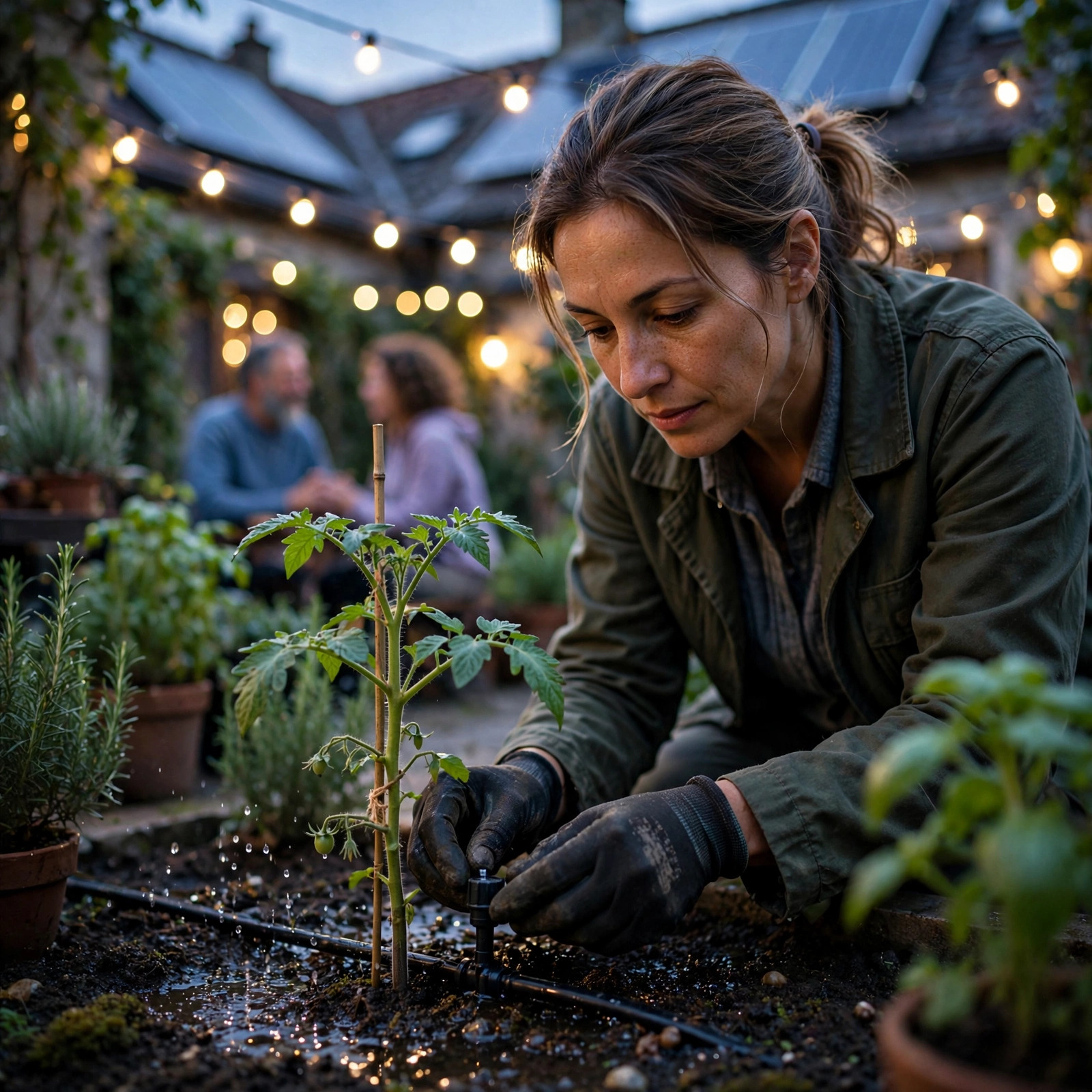
Word went out the way the commons did things, which was a phone tree with actual trees in it, people on porches, kids on bikes. By one-thirty there were thirty volunteers in the greenhouse. Bart arrived with the transfer switch from his own garage before anyone asked him to. Mrs. Adeyemi came down with her insulin in a cooler and a face like a thunderhead and let Priya walk her to the community kitchen where the exempted circuit was already humming. Someone brought a battery bank for the fans. Someone else brought, inexplicably and gloriously, four hundred popsicles from the bakery, and the greenhouse filled up with neighbors sweating and eating popsicles and hauling tomato plants out of the beds into the shade of the courtyard awning, a bucket line of adults passing plants hand to hand like it was a flood and the plants were furniture.
At two o'clock exactly, the feeder shutoff hit. The greenhouse lights went down. The fans died. The air went instantly, awfully still, and four hundred people's worth of heat started sitting in the air where it lived.
And the pump loop, on its own little islanded circuit, kept running. Water moved. Oxygen held. The fish milled and sulked and survived.
Marisol stood in the still, hot, basil-scented dark of the greenhouse with her hand on the pipe, feeling the pump's pulse through the metal, and let herself cry for about four seconds, which was the allotment, before Tomás yelled that the transfer switch was heating up and Bart had to rebuild the contactor on a card table with a headlamp and a volunteer holding a popsicle against the housing to keep the solder from slumping in the heat, which worked, which was the commons in a single image, and which Marisol later made Bart write down for the record.
At eight o'clock the power came back. The fans spun up. The survivors, human and otherwise, were counted. The fish came through at a loss of one hundred and forty, which Remy took personally for a week, and the tomatoes were gone, the whole season's fruit, cooked on the vine in six hours by a decision that had been made on paper somewhere, by people who would never smell this greenhouse.
That night Marisol sat in the ops room and wrote the thing she'd been avoiding for fourteen years, which was a full public account: what was lost, what was saved, who decided, and the fact that the decision had been forced by a test that had been scheduled over the objection of the one engineer who understood what it would cost. She posted it on the commons board at nine p.m. with all the numbers, including the ugly ones. Including the bad year.
By midnight, four hundred people had read it, and the council had moved the Meridian vote to day forty-one as planned, and Marisol Vega was, for the first time in fourteen years, not the only person in the district who knew exactly what the commons was worth.
She slept four hours. She dreamed of water moving through metal. When she woke, the first message on her phone was from Ivo Sandoval and it said only: I read your account. I'm revising slide one. Come to the council with me.
Day Forty-One
The district council met in the old transit hall, a cathedral of a room with a glass roof that made the heat wave's forty-one degrees into a personal experience for everyone present, which Marisol privately considered the room's only honest feature. Six hundred and some chairs. Most of them full. The commons turned out, and so did everyone else in the district, because everyone had gotten one of those polite, confident letters, and because the story of the six-hour window had gone everywhere.
Marisol had spent the last week in a state she could only describe as being on trial by her own spreadsheet. Ivo and Bart and Remy and a rotating cast of volunteers had rebuilt the commons' fourteen years of messy, handwritten, occasionally dishonest books into something a model could eat. She'd learned more about her own project in seven days than in the previous seven years, which was humbling, and some of it was bad. The tool library's energy accounting was a mess. The creek turbine's fish screens were underbuilt and she'd known it. The bad year was in there, in full, in red: year nine, charge controllers, 8,200 district credits, funded personally, concealed from board, disclosed day 33.
She'd wanted to cut that line a hundred times. She'd left it in, because cutting it would mean she'd learned nothing.
Ivo presented first. Not the deck. The model. He stood up in front of the whole district and said the sentence Marisol would never have believed an engineer would say in public: "The twenty-two percent figure is real and I'm withdrawing it, because it's also wrong. It's wrong because it counts the cost of building the Meridian retrofit and razing working systems as zero. When we count the embodied carbon of ripping out fourteen years of functioning infrastructure, and when we count what the commons actually does--the battery balancing, the greywater, the tool library, the fact that this district consumes forty percent less per household than the district average--Meridian's advantage over a merged system drops to four percent. Four. And four percent does not survive the words 'six-hour window.'"
He put up the six-hour window on the screen. The fish. The tomatoes. Mrs. Adeyemi's cooler. The popsicle on the transfer switch housing. He had, Marisol realized with a jolt, put the account in the deck. Her account. Her numbers, her bad year, her decisions, presented by the man who'd been sent to erase her.
Then it was her turn, and the hall was not friendly, and it was not hostile either. It was worse. It was six hundred people who had read everything and wanted to know what their neighbor was going to say about their own home.
"I'm not going to tell you the commons beat Meridian," she said. "It didn't. On paper, four points is four points, and on paper is where money lives. So here's what I'm asking for, and I want you to hear the whole thing before you decide how you feel." She'd practiced not rushing. "Meridian's central dispatch is better than ours. It should run the district backbone. We should take it. And the distributed assets--our roofs, our battery, our water, our tool library, our greenhouse--should stay under commons governance and be paid, actually paid, for the balancing they do, with a contract, in the district ledger, where the next model can see them. And to make that real, the commons books go public. Everything. The audit, the bad year, the fish screens I should have fixed in year eleven. All of it, every quarter, posted on the board by the stairs."
A hand went up. Kwame Kessler, who ran the bakery and had been at every council for a decade and had never once let her off a hook. "You're asking us to trust the same office that ran a test over its own engineer's objection."
"Yes."
"And you're asking us to accept that some of what we built loses to their system."
"Yes. The dispatch. The backbone. Not the governance. Not the people."
"And what do you lose, Marisol?"
The hall went quiet. It was a good question. It was the question, and she'd known it was coming for six days, and she'd written her answer on the back of an envelope and then left the envelope at home on purpose.
"Control," she said. "If this passes, I don't get to be the one who decides things anymore. There's a joint operations seat--commons and Efficiency Office together, and I'm not taking it. Remy takes the commons seat for the greenhouse and water systems. Bart takes infrastructure. Priya takes community loads. I go back to what I actually am, which is a wastewater tech who started a cleanup. I'll stand for election to the commons board like everyone else, and I'll probably lose some, and that's the point. Fourteen years of one woman's phone number being the district's emergency contact is not a system. It's a single point of failure with good PR."
Someone laughed. Then someone didn't. Remy was staring at her from the second row with his arms crossed, and she could see him mouthing you absolute something at her, and she loved him and she'd deal with that later.
Kwame looked at her for a long moment. "Objection withdrawn," he said. "Motion's on the floor."
The vote was not unanimous. It should not have been. It went 61 to 39 with a stack of amendments, some of which Marisol thought were wrong and said so, out loud, into the record, including one that capped the commons' liability in a way she thought would bite them in year three. The hall argued for two more hours in the heat, and the glass roof turned gold, then amber, then blue, and at some point Tomás fell asleep on three chairs and nobody woke him because he'd earned it.
What passed, at the end, was a hybrid: Meridian's backbone, the commons' assets, real payment for real balancing, public books, an elected board, and a sunset clause on the whole arrangement that forced everyone to re-argue it in five years, which Marisol considered the most solarpunk thing in the entire document: a law that scheduled its own fight.
Ivo found her by the water table afterward. He looked wrung out and ten years older and, she thought, lighter. "My office is furious," he said. "Delighted and furious. Mostly furious. I've been reassigned to the integration project, which is the job I was trying to get fired from, except now it's our project instead of their project."
"Congratulations."
"Your bad year is in the public ledger now. People are going to bring it up at every meeting for a decade."
"Good," said Marisol, and meant it, and was surprised how much.
He hesitated, then held out the old canvas bag, the one with the patched strap. Inside was a pressure gauge, new in its box, with a library tag on it. Blank. "For the tool library," he said. "You sign it. It should be your handwriting. That's the rule, right?"
She took the pen he offered and wrote, in the last of the blue light through the glass roof, Bring it back or tell me why not.
The Drip Line
Two months later, on an evening in the first cool week of the season, Marisol knelt in the courtyard garden with a roll of drip line and a bad attitude about emitters, which was the correct attitude about emitters, since they clogged.
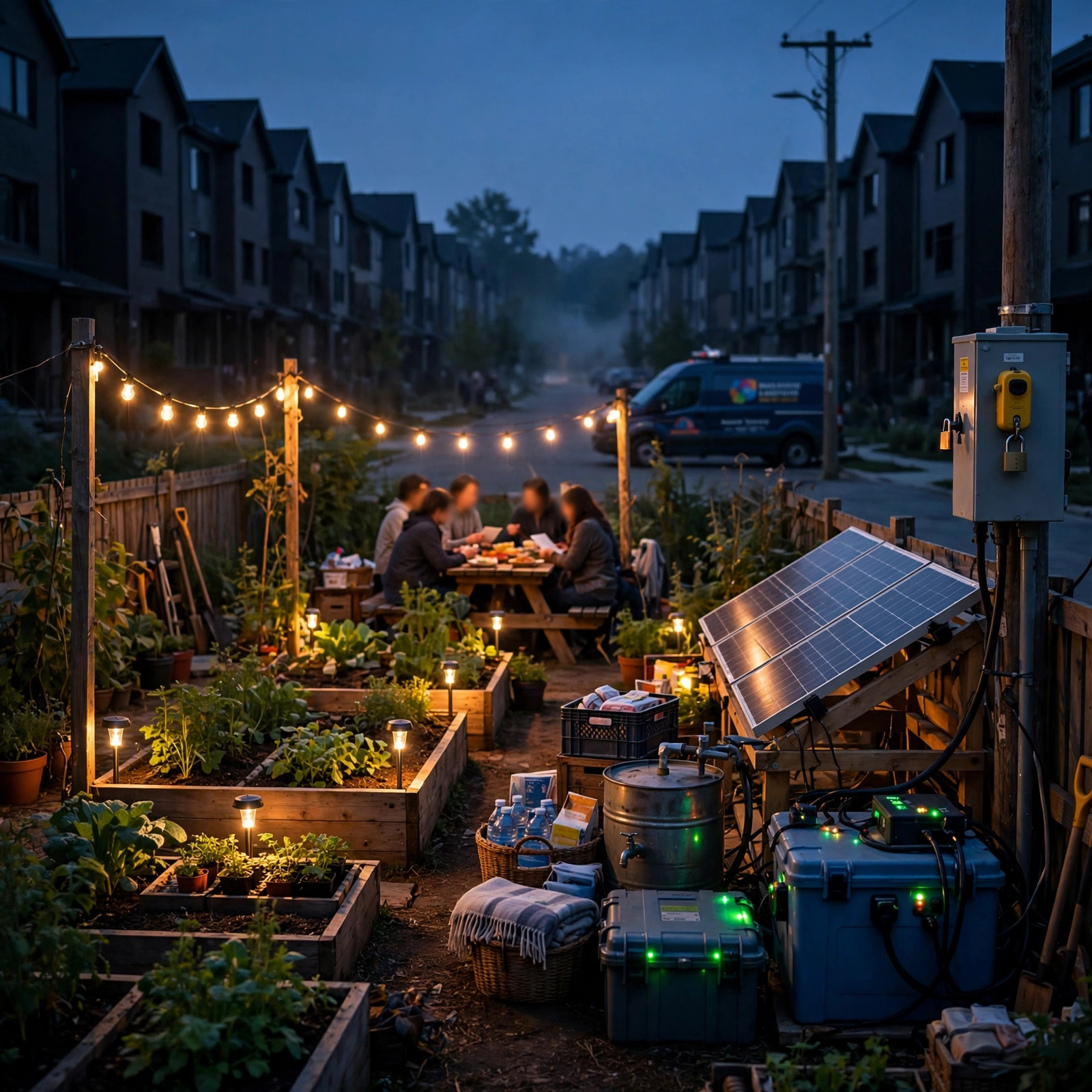
The new tomato plants were small and green and stupid with health in their fresh beds, which had been rebuilt with the greenhouse's composted losses and a great deal of ceremony. The fish were fine. Big Ruth was at 70 percent, breathing with the district's evening load, getting paid for it now, line item and all. Above the courtyard, the string lights were on, because it was that hour, and the tool library was closing in the way it always closed, which was Tomás telling people to go home for an hour before they actually did.
Remy dropped onto the bench beside her with two glasses of something cold. "Board meeting's Thursday," he said. "You're on the agenda. Again."
"I saw. What is it this time?"
"The creek screens. Your fish screens. The ones you knew were underbuilt in year eleven, which you put in the public ledger, which means the public read it, which means the public would like a word."
"The public can have several."
"The public has prepared remarks." He clinked his glass against hers. "They're not bad. Mostly they want to know why the woman who invented the transparent books doesn't trust them to fix a screen with her."
Marisol worked the emitter loose, cleared it with a pick, and felt the line shudder as the pressure evened out. Water found the roots. That was the whole job, really: clear the clog, feel for the shudder, keep the pressure honest.
"I'll be there," she said. "I'll even sit on the public side."
"Growth," said Remy. "Actual growth. I'm noting it in the minutes."
Across the courtyard, Priya was arguing with Bart about something, hands going, Bart smiling in the way he did when he was right and enjoying it. Ivo was up on the operations balcony with a tablet and a sunburn, showing a teenager from the soldering class where the evening peak was, the kid's finger tracing the graph like it was a map of somewhere worth going. The lights stayed on. The argument stayed going. The district breathed in and out.
Marisol pressed the emitter back into the line, checked the shudder one more time, and stayed kneeling there in the dusk a while longer, hands in the wet at the root of things, doing the small work that kept the pressure even, while everyone she could name went on arguing, working, and staying.
Get notified when new stories drop

Ren Hollis
Ren writes frontier worlds and terraforming triumphs — habitats, gardens under glass, and the first rain on a new world.
Leave a comment
Comments