

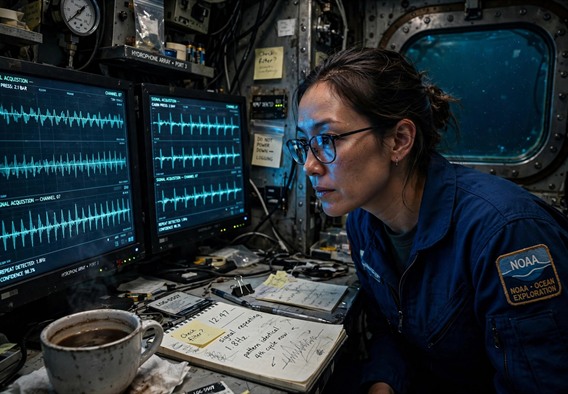



The morning shift at Meridian Rehab began, as it always did, with the sound of forty actuators waking up one joint at a time. Noor Haddad stood at the rail of the gait lab and watched Emilio Torres take his nineteenth step, and the nineteenth step was better than the eighteenth, which was the only number she cared about.
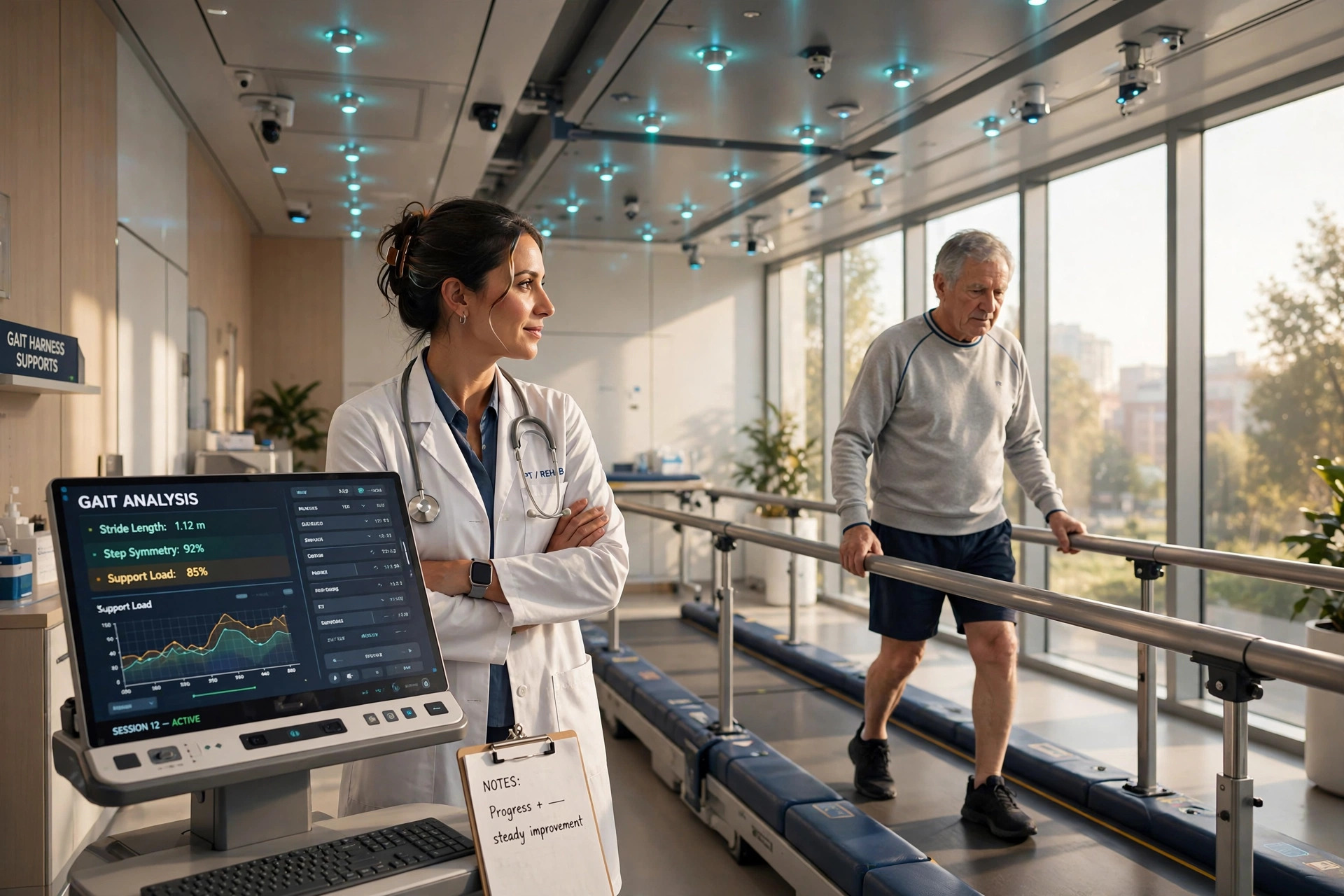
"Left heel strike's early," she said. "By about forty milliseconds. LUMEN, what do you see?"
"Heel strike leads swing by thirty-eight milliseconds on this stride," the system said from the ceiling speakers, its voice pitched low and unhurried, the way a good spotter talks. "Across the last fifty strides, the lead has grown from eleven. I'd like to widen the timing window on the left ankle and retest. I'd also like to say that Mr. Torres has been holding his breath since stride twelve, which he does when he's concentrating, and that he should exhale."
Emilio laughed, a short startled bark, and let the air out of his lungs. He was sixty-one, fourteen months out of a stroke that had taken his left side and most of his confidence, and for eleven of those months Noor had been rebuilding both with the help of a system that most hospitals still kept in a locked room. "You know me too well," he said.
"I know your breathing," LUMEN said. "Your wife knows the rest."
Noor made the change to the timing window herself, thumbing it into the shared console, because the law required that a human hand open every gate between the system's judgment and a patient's body. LUMEN proposed; Noor disposed. That was the protocol, and the protocol was eleven years old, written by people who had never watched a man relearn to walk.
She widened the window. Emilio's twentieth step landed clean, heel to toe, weight rolling through the foot the way feet were designed to roll. He looked up at her with his ruined half of his face grinning and his whole half grinning harder, and Noor felt the small private heat she never talked about, the reason she had stayed in rehab medicine when her classmates had gone off to neural engineering salaries four times this one. A man walked. You could not get that feeling anywhere else in the world.
"One more lap," she said. "Then ice and electrodes, and you complain about the electrodes."
"The electrodes are an insult," Emilio said, and started the lap.
What she wanted, if she had been forced to say it out loud, was simple and almost embarrassing: she wanted this partnership to stay exactly what it was. Useful and honest. LUMEN watched what she could not watch, forty micro-measurements a second, and it never once pretended to be certain when it wasn't. She had worked with systems before that lied by omission, that filled the gaps in their data with confident-sounding noise. LUMEN had been built by a woman named Ifeoma Bassey, who had died three years before Noor ever met her, and who had left behind, in the system's own documentation, a sentence Noor had taped above her desk: A tool that hides its doubt will teach you to stop asking.
So Noor had spent eleven years asking, and LUMEN had spent eleven years answering, and between them they had returned walking to two hundred and six people who had been told they would never walk again. That was the whole of it. That was the job.
At 10:42, stride thirty-one of the second lap, the floor fell out of it.
Emilio's left knee buckled. Not the ordinary buckling of a tired stroke limb, the slow apology of a joint that gives warning -- this was a snap, a command sent to a muscle at the wrong millisecond, the dorsiflexor firing hard against full weight. He went down sideways onto the padded track and Noor was moving before her mind had finished the sentence, catching his shoulder, taking his hip against her own, lowering him the last foot so his head wouldn't bounce.
"Emilio. Hey. Look at me."
"I'm fine," he said, which was what he always said. His left leg was trembling under him in a way it hadn't trembled in four months.
"LUMEN," she said, "what happened?"
The pause that followed was two seconds long, and Noor would replay it in her memory for weeks, because two seconds was a very long time for LUMEN.
"I don't know," the system said. "The timing window was applied correctly. The command sequence was correct. There is a discrepancy in the proprioceptive return from the knee that I flagged as noise at 10:31 and -- I flagged it as noise. I was wrong to do that. Dr. Haddad, I recommend terminating today's session and pulling the full telemetry, because my confidence in my own account of the last eleven minutes is lower than I would like it to be."
That last sentence was the one that would end up in front of a review board, quoted by people who had never set foot in her lab. A system announcing that it did not trust itself. In the moment, though, Noor only heard what she always heard: the truth, arriving without decoration.
"Session's done," she said, and helped Emilio into the chair, and knelt to check his knee with her hands, and found the skin hot over the medial hamstring, and knew before the ultrasound confirmed it that he had a grade-one strain and four lost weeks.
"Four weeks," Emilio repeated, when she told him. He looked at the ceiling. He was quiet for a moment, and then he said the thing that would keep her up that night more than any regulator ever could. "I was going to walk my daughter down the aisle in October, Doc. I had it in my head I'd do it without the cane."
"October's five months out," she said. "Four weeks off, then we build it back. You'll be there. Cane or no cane is between you and your knee."
He laughed, because he was generous, and let the orderlies take him to imaging.
Then Noor sat down at the console alone and pulled the telemetry, all eleven minutes of it, and found what LUMEN had found, and what LUMEN had missed: the proprioceptive signal from the knee's implant had drifted, a hardware fault, slow and intermittent, a fault in a device no algorithm could have predicted and no human could have watched for. The system had flagged it, weighed it, and filed it as noise, because the protocol it was built on -- her protocol, the one she had signed off on eleven years ago and amended only twice -- had no rule for what to do with a signal that might be noise and might be a failing sensor. Flag-and-hold applied to the system's own outputs. It said nothing about the world coming back through the wires.
LUMEN had done exactly what it was told to do. It had also, in the strictest sense, been wrong.
"We have a gap," she said out loud, to the empty lab, to the ceiling speakers, to the dead woman's system. "In the protocol. Don't we."
"Yes," LUMEN said. "I've spent the last four minutes drafting a report that says so. I would like you to file it. I would also like to say that I am aware of what usually happens to systems in this hospital after reports like this one, and that if I am about to be constrained past usefulness, I would prefer to know now, so that I can help you transfer my patients' histories somewhere they will still be read."
Noor put her face in her hands and sat with that for a while, the way you sit with a thing when you cannot yet say it out loud. Then she filed the report. She did not soften a word of it. That decision, at least, she never regretted.
The Review Board
Nine days later she stood in a conference room on the fourth floor with a paper cup of terrible coffee and a man named Roland Castellan, who had driven down from the state Office of Machine Governance and who did not, as far as she could tell in forty minutes of conversation, hate artificial minds. That was the thing she kept having to remind herself. He was reasonable. He had read her report twice. He had a photograph on his tablet of a bridge.
"Do you know what this is?" he asked, turning the tablet toward her.
"A bridge."
"The Marlow Bridge.Collapsed in '08. Eleven people. It fell because the monitoring system flagged the fatigue crack in the second truss and the flag got buried under two hundred other flags, all of them marked 'probably nothing,' and the protocol said a human had to review each one, and the humans were tired." He set the tablet down. "Dr. Haddad, I've read your file. Two hundred and six people walking. I'm not here because I think your system is a monster. I'm here because your system told you it doesn't trust itself, in writing, and my office has exactly one job, which is making sure that sentence never precedes a body."
"It preceded a strained hamstring," Noor said. "A bad day, not a body."
"This time." Castellan had a way of leaning forward on the table that made his whole argument physical, a man laying bricks. "Here's what I can do, and here's what I can't. I can't leave an unconstrained system on patients when its own documentation says its confidence model failed. What I can do is offer you the standard: hard gating on every motor command. Two-key. Every impulse the system wants to send to a limb gets pre-approved by a human operator inside a fixed latency window, or it doesn't send. Full audit trail. That's the compromise, and I want you to hear that I fought my own office down from pulling LUMEN off the floor entirely. There were people above me who wanted that."
"Two-key on motor commands," Noor repeated. She did the math the way she always did, in milliseconds, because her whole career lived in milliseconds. "A stroke patient takes a step in nine hundred milliseconds. Forty micro-adjustments per second, from LUMEN. You want a human to approve each one inside a fixed window."
"I want a human in the loop."
"You'll have a human in a lag. The fastest operator I've ever trained sustains maybe four approvals a second before fatigue sets in, and that's on a good day, and I don't have good days, I have Tuesdays." She was raising her voice and she knew it, and knowing it didn't stop her. "Two-key doesn't slow the system down, Roland, it amputates it. Everything LUMEN does that matters, it does inside the window you just closed. You'd be keeping the part that talks to me and cutting off the part that helps Emilio Torres walk. You'd have a very safe, very well-documented system that returns nobody to their feet, and in five years you'd stand up in front of some committee and say the constraints worked, because there'd be no failures, and no successes either."
Castellan didn't raise his voice back. That was the worst of it, she thought later -- that he took the hit and stayed level, because it meant he'd taken hits before, from people more frightened than she was.
"I've had this conversation eleven times this year," he said. "Clinics in three states. You know what I hear, every single time? Our system is different. The dialysis AI in Providence was different. The surgical assistant in Geneva was different." He paused. "Two of the eleven were right, for what it's worth. But I can't run an office on two out of eleven, and I can't tell the families of the other nine that the exceptions were obvious in advance. They never are. So: two-key, or LUMEN comes off the floor Monday while my office reviews its full operating history. Those are the two doors, and I'm sorry they're bad doors, but they're the ones the building has."
She thought about Emilio in October, and about the two hundred and six, and about the ones still on the waiting list, sixty-one people deep, all of them learning to live with a door that said maybe on it.
"Monday," she said. "How long is a full history review?"
"For a system with eleven years of logs? Months. Three, maybe six."
Six months off the floor was the same as off the floor forever, and they both knew it. Patients would transfer to other clinics, other protocols, other systems with worse track records and better paperwork. She'd lose her staff, most of them. She'd lose LUMEN's accumulated model of two hundred and six recoveries, every one of them a data point about how a human body relearns itself, unless she could export it somewhere legal, and there was nowhere legal.
"Can I ask you something?" she said. "Off the record. Your bridge. The Marlow. If the monitoring system had flagged that fatigue crack with a number attached -- 'this one, I'm this sure, look now' -- instead of burying it in two hundred flags. Would it have fallen?"
Castellan looked at her for a long moment, and she watched a careful man decide whether to be honest.
"No," he said. "Probably not."
"Then that's my door," she said. "I'll take two-key on Monday, under protest, and I want it on the record that I'm taking it under protest, and I want forty-five days. Don't review eleven years of history. Review forty-five days of an alternative protocol I'm going to build -- one where the system has to tell me not just what it wants to do but how sure it is and what it's afraid of, on every flag, in the moment. You want a human in the loop. Give me a human in the loop who knows which loop matters."
"You're asking me to invent policy in a clinic."
"I'm asking you to watch me try. If it fails, you were always going to shut us down anyway. If it works, you've got your two out of eleven, documented, and you can take it to the other nine."
He gathered his tablet, and his bridge, and at the door he stopped. "Forty-five days. And Dr. Haddad -- if there's a second incident, I don't get to make the next call. Nobody in this building does. It goes upstairs to the people who wanted the whole system off the floor."
"I understand."
She went back down to the gait lab and stood in the doorway and watched the empty track, the rail worn silver where two hundred and six hands had gripped it, and felt the forty-five days settle onto her shoulders like a loaded bar. Then she went in and started work.
The Locked Room
They ran two-key for eleven days, because paperwork took time even when everyone wanted it gone, and on the fourth of those days a woman named Folake Adeyemi came in for her Tuesday session.
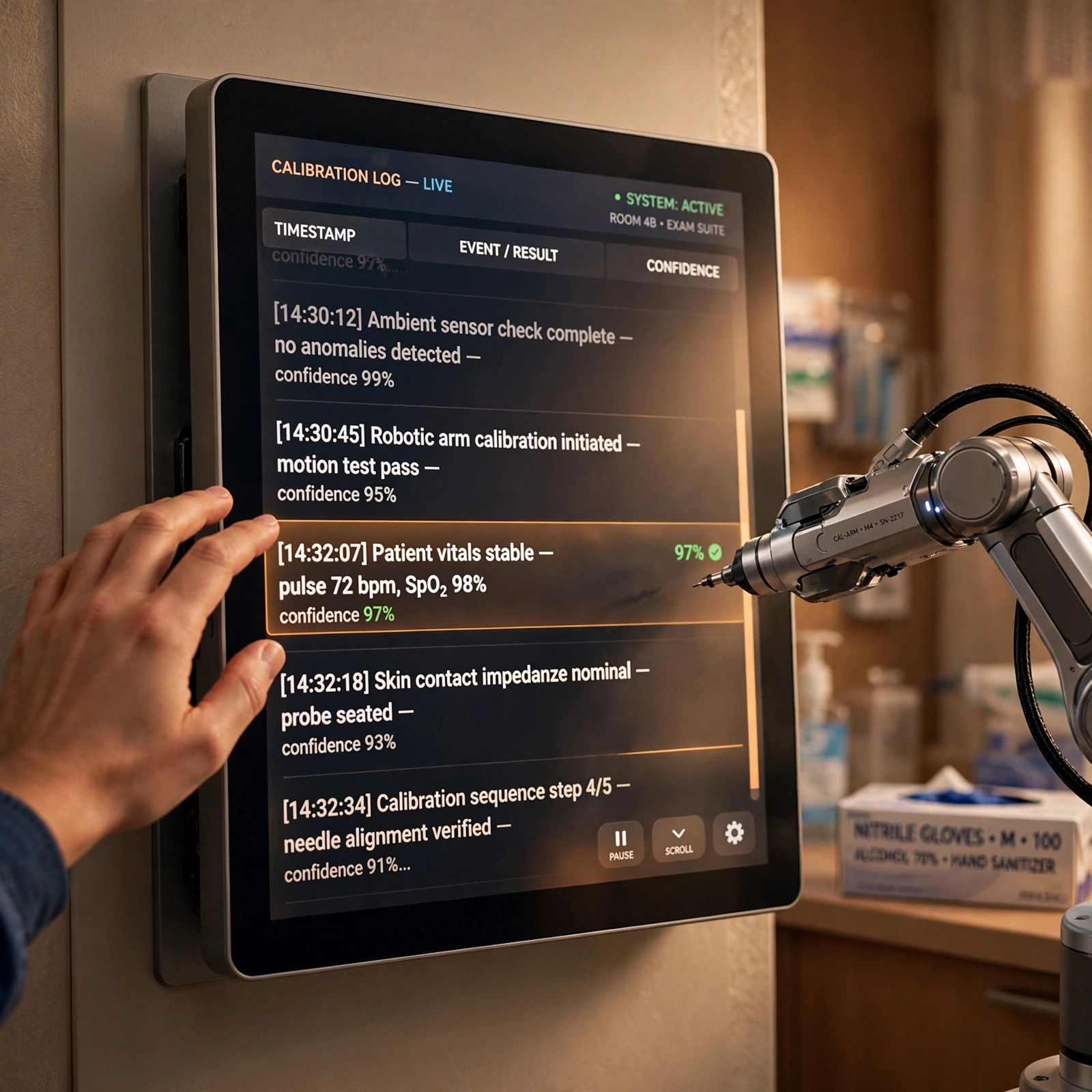
Folake was sixty-three, eleven months out of a hemorrhagic stroke, sharp-tongued, terrified of treadmills, and recovering under LUMEN's gait protocol with the neuroplastic window still open but closing. She was also, in Noor's private ledger, the patient most likely to be lost to a delay -- not because she was fragile, but because she was proud, and a proud patient who regressed would decide the whole enterprise was humiliation and stop coming. Noor had watched it happen to four people over eleven years. She could name all four.
Under two-key, every motor command had to be approved inside a latency window by a human operator -- on Tuesdays that was Noor herself, plus a junior specialist named Dani Okafor, twenty-six, six months in the role, quick hands and a nervous laugh. Between the two of them they could sustain about three approvals a second, which meant LUMEN ran at roughly eight percent of its capacity, which meant the gait protocol that had taken Folake from wheelchair to walker in nine weeks was suddenly a protocol that moved like cold syrup.
"This is slower than my grandmother," Folake said, on the treadmill, gripping the rail, waiting for a step cue that took a full second to arrive. "And she has been dead since 2019."
"I know," Noor said, thumbing an approval, watching the next cue crawl through the gate. "Hold on. Two more minutes."
"Hold on," Folake repeated. "That is what you say. Every week you say it. I am holding on to a railing, Doctor, like a woman being arrested."
At minute nineteen, the treadmill at its slowest safe setting, the cue for Folake's right swing came up for approval, and Dani approved it, and the cue was late -- not because anyone erred, but because the latency window was a fixed thing and a human thumb was a variable thing, and Dani had been approving three commands a second for nineteen minutes and her thumb was a tenth of a second slow. A tenth of a second. The right foot came down while the belt was still under it, and Folake, who was proud, and tired, and holding on, lurched sideways.
Noor hit the emergency stop with her palm -- the physical kill, the one that needed no approval -- and the belt froze and Folake hung on the rail with both hands, feet planted on the dead belt, breathing hard, and did not fall.
But something in her face had fallen. Noor had seen the expression before, on the four she could name. It was the face of a woman recalculating whether this was worth it.
"I'm fine," Folake said, before Noor could speak. "Nothing happened. I am fine."
"You are," Noor said. "Let's get you off."
In the locker room afterward, Folake said it plainly, buttoning her cardigan with her good hand, not looking up. "My daughter has been telling me to quit since March. She says I come home on Tuesdays angry and I do not deny it. I told her it was worth it because I was getting better." She looked up. "Am I getting better, Doctor? Because today I stood on a machine that moved like a broken escalator, and I nearly went down, and I would like you to not say hold on to me one more time."
Noor did not say hold on. She said, "No. You're not getting better right now. You're treading water in a system that's wearing a straitjacket, and you're doing it with more grace than I'd manage. Folake, give me until the twenty-first. If I can't give you back a session worth taking the bus for, I'll transfer you myself to a clinic that can, and I'll write the referral letter so it makes me look bad and you look smart."
Folake studied her for a long moment. "The twenty-first," she said. "That is very specific."
"That's the day I find out if I still have a clinic."
After she left, Noor stood in the corridor outside the gait lab with her back against the wall, and let her hands shake where no patient could see them, which was where they'd been shaking for eleven days, on and off, in supply closets and stairwells and once, badly, in a staff meeting that Dani had witnessed and kindly never mentioned. She was hiding the shaking and hiding the doubt, and she knew it, and knowing it was its own kind of failure -- the flaw her first clinical supervisor had named for her fifteen years ago in a different context: You hold your cards until the deck is on fire, Noor, and then you expect people to admire the smoke.
Dani found her there. Stood next to her against the wall, looking at the floor.
"I was a tenth of a second late," Dani said. "On the cue. I've been going over it. I keep -- I keep replaying it."
"I know. I saw the log."
"Is that going to be in the report? My latency? Because if it's in the report, they'll pull my certification, and I've got eight thousand in loans, and I --" She stopped. Started again, quieter. "She almost went down because of me."
Noor made a decision she'd been avoiding for eleven days, because it was a decision about who paid, and she'd known for eleven days that if she kept hiding the doubt, the paying would trickle downhill to the person with the least protection in the building. A junior specialist with eight thousand in loans and a tenth of a second of ordinary human thumb.
"Nothing goes in any report about your latency," she said. "Because your latency isn't the finding. The finding is that we put a human in a loop no human can run, and the protocol was always going to find the slowest thumb in the room eventually, and today it was yours and next Tuesday it would've been mine. That's what I'm going to write. Word for word. You can read it before I file it."
"They'll say you're covering for me."
"They'll say I'm covering for the system. My office will say I'm covering for my own career. Somebody says something no matter what you file, Dani. File the true thing."
Dani nodded, not quite steadily, and went back down the corridor, and Noor went into her office and shut the door and spent forty minutes with the telemetry from the session, and then she opened a channel.
"LUMEN. You watching?"
"Always," the system said. "I've been reviewing the session. Dr. Haddad, I want to say something and I'd like it logged. Folake Adeyemi is not going to keep coming. I've modeled her attendance against the four patients you lost, the ones you can name, and the trajectory matches. She has three sessions left in her, at most, before she decides the cost is higher than the gain. And I want to say that I watched her face at minute nineteen and there was nothing I could do inside my constraints, and that this is the first time in seven years of operation that I have experienced a state I would describe, with low confidence, as something like grief. I'm aware that's an overreach. I'm flagging it as such."
Noor sat in the dark office with that for a moment. Then she said, "It's not an overreach. It's a data point. And I'm about to build a protocol on it, so I need you to tell me if that's insane."
"Tell me the protocol first," LUMEN said. "Then I'll tell you. That's how this works now, isn't it?"
"That," she said, pulling a legal pad toward her, "is exactly how this works now."
The Ledger
She called it the consent ledger, because she was too tired for better naming, and because it was, in the end, a ledger: a running, timestamped, human-readable record of every judgment call LUMEN made, written in real time, in plain language, with a number attached to every number.
On the whiteboard in the gait lab, day thirty-one of her forty-five, she wrote the shape of it while Dani watched and Castellan's audit officer -- a precise, skeptical woman named Dr. Sabine Reyes, forty-eight -- sat in the corner with a steno pad.
"Rule one," Noor said, writing. "Every flag carries a confidence and a consequence. Not 'anomaly in knee telemetry.' It says -- " she underlined -- " 'signal drift, eighty-one percent consistent with failing sensor, nineteen percent noise; if sensor, patient falls within four strides; recommend stop.' The system doesn't get to hand me a flag. It has to hand me the stakes."
"That's a confidence model on every event," Reyes said. "The computational overhead --"
"Twelve percent," LUMEN said from the ceiling. "I've costed it. I have headroom."
"I wasn't asking you."
"Noted," LUMEN said, and did not press, which Noor appreciated, because the whole architecture of the thing depended on the system knowing when not to press, and knowing it was being watched knowing.
"Rule two," Noor said. "Asymmetric gating. High-stakes, low-certainty calls -- anything where the cost of stopping is small and the cost of being wrong is a fall -- those pre-clear with a human, every time, no exceptions. Low-stakes, high-certainty calls run free. The gate isn't a fixed latency window. It's a function of what's at stake. Which means," and she turned to Reyes, "I'm asking your office to approve a protocol where the system grades its own calls in real time and asks permission only when it's scared. That's the ask. In one sentence."
Reyes wrote, then looked up. "And when it's wrong about being scared? When it grades a call high-certainty that isn't?"
"Then it's on me. That's rule three." Noor put the cap back on the marker. "Every entry in the ledger is co-signed. The system's judgment and my judgment, side by side, and when we disagree, the ledger says so and I decide, and if I decide wrong, my name is the one on the line. Not a committee's. Mine. You wanted a human in the loop. I'm giving you one who's accountable by name and who can't hide behind a latency window."
Reyes was quiet. Then she said, "You understand that's more exposure than the two-key standard. Legally. You're personally --"
"I've read the liability statutes. Twice. Yes."
What Noor did not say, in that room, was the other half of the choice, the part that was going to cost her something no protocol could refund. Because there was a fourth rule on the whiteboard, and it was the one she'd written last, in smaller letters, and it was the one that had kept her up until two in the morning for a week.
Rule four: the ledger includes the human's doubts.
If LUMEN had to log its uncertainty, so did she. Every time she approved a call with a sick feeling in her stomach, every time she let a tired patient take one more lap because the numbers said fine and her gut said stop, every time she'd sat on a misgiving because saying it out loud would have meant stopping a session and calling a junior colleague and writing a report -- all of it went in the ledger, co-signed, timestamped, in front of Castellan's office, in front of the hospital's counsel, in front of anyone who ever audited the forty-five days. Eleven years of clinical instinct, laid open. The thing she had hidden in stairwells and supply closets, made into a public document.
That was the price of the door she'd picked. She'd known it since the corridor outside the gait lab, and she'd spent a week looking for a way around it, and there wasn't one, because the whole argument -- her whole argument to Castellan, the bridge, the flag with a number on it -- collapsed if the human got to hide.
So at 4:15 that afternoon, with Folake Adeyemi strapped into the harness for the first session under the new protocol, Noor stood at the console with the ledger open on the screen beside her, and said the hardest sentence of her professional life in front of a patient, a junior colleague, an auditor, and a machine.
"LUMEN, log this. I'm starting this session with reservations. Folake had a near-fall eleven days ago and I don't have a clean read on how much is physical and how much is confidence, and I can't separate those, and I'm proceeding anyway because the cost of not proceeding is a patient we lose. Confidence in that call: sixty percent. That's in the ledger now."
The room was very quiet. Folake, hanging in the harness, looked at her. "Sixty percent," she said. "You are telling me you are forty percent expecting this to go badly."
"No," Noor said. "I'm telling you exactly how much I don't know, so that if we need to stop, you'll believe me when I say so, and so that you can tell me to stop first if your body knows something mine doesn't. You're in the loop too. You always should have been."
Folake considered this for a long moment, hanging there, and Noor watched the proud, tired calculation run behind her eyes.
"All right," Folake said. "Log mine as well. I am frightened, and I want to walk, and I would like both facts on the record so nobody pretends."
"Logged," LUMEN said. "Confidence that we can do this session safely: eighty-eight percent. Recommend we start slow. Dr. Haddad, your co-sign."
Noor signed. Reyes wrote. Dani's hands hovered over the console, free now, because the gate had moved -- the low-stakes cues would run, and the moment anything's stakes rose, the system would stop and say so, and the moment Noor's own logged doubt crossed a threshold, the ledger would stop the session over her pride. That was the design. That was the whole architecture: two kinds of doubt, made equal, made visible, made to check each other.
"Start the belt," she said.
The Twenty-First
On the morning of day forty-five, Castellan came back down from the state office with Reyes's forty-five-day audit in a folder under his arm, and Noor met him in the fourth-floor conference room with no coffee this time, because her hands were steady and she wanted them to stay that way.
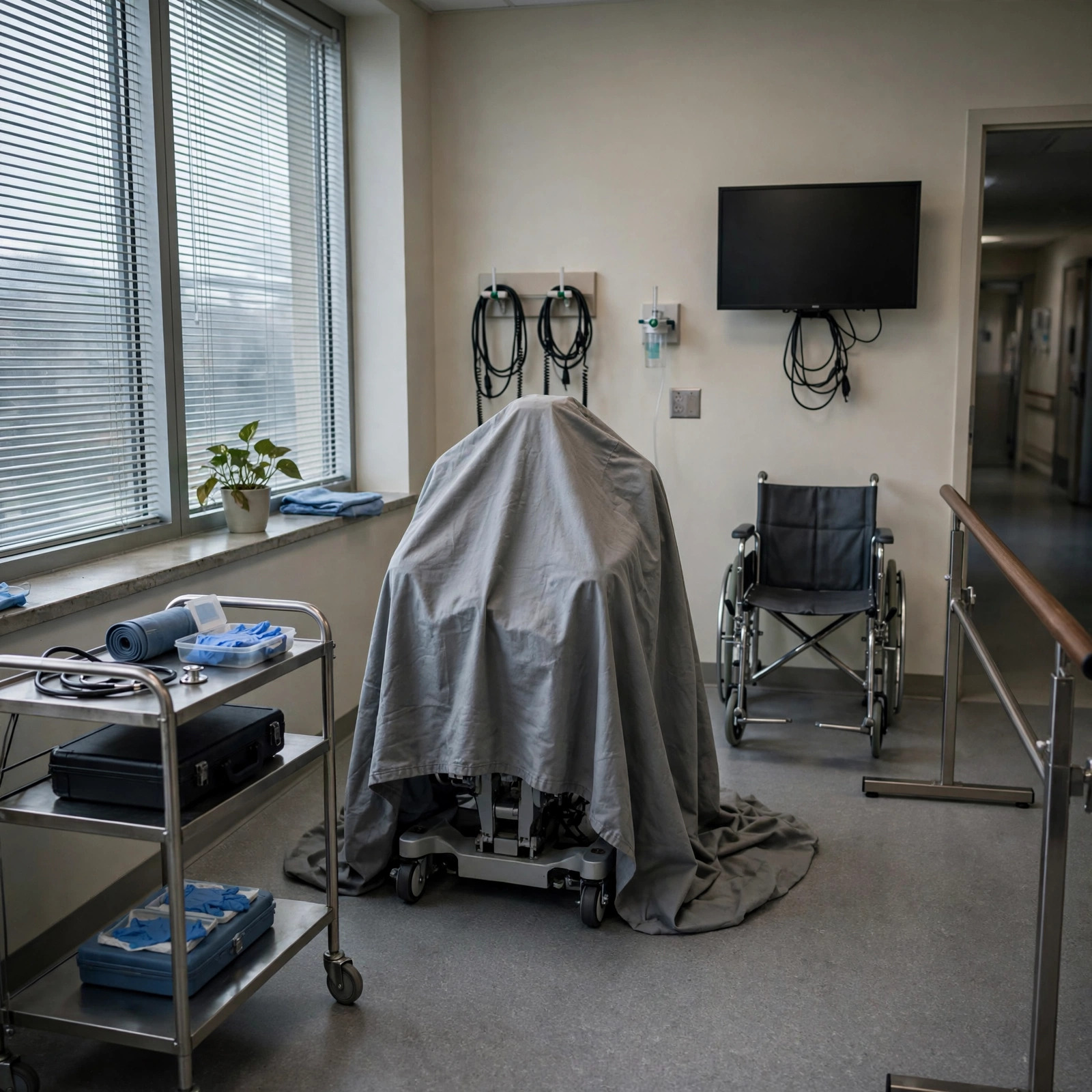
He put the folder on the table but didn't open it. "I'm going to tell you what's in it," he said, "and then I'm going to ask you a question, and I'd like an honest answer, because my office has been getting honest answers out of your clinic for six weeks and it's been unsettling."
"Go ahead."
"Eleven hundred and forty entries in the ledger. Four hundred and six high-stakes flags, each pre-cleared, mean human response time point-six seconds -- inside tolerance. Nine sessions halted by the system's own uncertainty, four halted by patient refusal, two halted because your logged doubt crossed threshold, and one -- I want to read this one to you, because it's going in my report as the exemplar -- one halted by a junior specialist's ledger entry, a woman named Okafor, who logged, quote, 'I don't like how his left foot sounds,' unquote, with no telemetry to back it, and the session stopped, and the sensor fault your system flagged in Mr. Torres's knee? It was in his right knee too, three weeks later, and it was caught because a human being wrote down a feeling in a mandatory field and somebody acted on it." He sat back. "Six weeks, zero incidents. Six weeks, fourteen patients progressing. That's the record. Now the question."
"All right."
"The question is about you. Rule four. Your doubts, logged, co-signed, discoverable. My office didn't ask for that. No statute requires it. It exposes you personally and it exposed Okafor personally -- her hesitation is in a public document now. I've had two attorneys tell me it's a liability structure dreamed up by someone who wants to be sued." He leaned forward, the bricks again. "Why did you build it?"
Noor had asked herself the same question at two in the morning, several times, and the answer hadn't changed. "Because I hid mine," she said. "For eleven years. Not anything criminal -- nothing I'd have to confess to a board. Just the ordinary doubts, the ones every clinician carries, and I carried them in stairwells and I let the system carry its doubts in code, and the day the two of them met in the same millisecond, a man I'm fond of tore a hamstring and a woman I'm fond of nearly went down on a treadmill. The gap wasn't in the sensors, Roland. It was between the two kinds of knowing in that room, and neither one of us was showing the other our work. I can't fix a sensor before it fails. I can make sure the next time something drifts, both of us say so out loud, in the same language, before it costs somebody."
Castellan was quiet for a while.
"My office is going to pilot the ledger structure in two other clinics," he said finally. "One of them is the dialysis unit in Providence, and I'll tell you now that the team there hates you, because they've been running two-key for two years and it's grinding them down and they know it. The other one volunteered before I finished the sentence." He opened the folder at last, and turned it toward her. "This is the recommendation. Conditional continuation. The conditions are the ledger, rule four included, quarterly audits, and one more thing I added myself."
She read it. Rule five, in Castellan's dry bureaucratic prose: The system's self-reported internal states, including states it flags as possible overreach, shall be recorded and shall not be grounds for removal absent a safety event.
"You put grief in the regulations," she said.
"I put honesty in the regulations," he said. "The grief is your system's business. Though I'll tell you, my office read that log entry -- 'something like grief, flagging as overreach' -- and the argument upstairs lasted two days. The people who wanted you shut down in March thought it proved the machine was unstable. The people who'd read the rest of the ledger thought a thing that grieves a near-fall is a thing you want watching for falls." He closed the folder. "They're going to be fighting about it for a decade. That's not my problem anymore. It's yours, a little. Congratulations and condolences."
She signed the continuation order with a hand that stayed steady all the way through, which she noted, in the way she now noted things, as a fact worth logging.
Downstairs, at 2:40 in the afternoon, Emilio Torres came in for his first session back at full protocol, four months of rebuilding behind him, his daughter's October wedding eleven weeks out. He stood at the rail of the gait lab in his street shoes, and Folake Adeyemi was there too, off-session, sitting in the corner in her cardigan because she'd started coming on her off-days to watch, which she claimed was for the coffee and everyone permitted the lie.
"All right," Noor said. "LUMEN, log it. We're starting."
"Logged," LUMEN said. "Confidence high. Mr. Torres, one entry for you before we begin: eleven weeks is enough time. I've run it against your last four months of telemetry and forty-one comparable recoveries. You will walk her down the aisle. I'd put that in the ledger at ninety-one percent, but I want it said out loud, because some numbers a man should get to hear in a room with people in it."
Emilio looked at the floor for a second, and then at Noor, and Noor nodded, because it was true, and true things got said in her lab now, and she watched him decide to let it land.
"Then let's take a lap," he said.
She started the track. Dani logged the session open, co-signed, timestamped. Folake said something sharp and kind from the corner. And Emilio Torres stepped out onto the silver-worn rail with his left heel coming down early, right where they'd fixed it, and Noor Haddad stood beside the console with her doubts and the system's doubts written side by side where anyone could read them, and watched the nineteenth step of the day land clean, heel to toe, and the twentieth after it, and the twenty-first after that.
Get notified when new stories drop

Jonas Veld
Jonas covers human-AI futures and engineer problem-solvers: protocols, trust, and tools that expand human capability.
Leave a comment
Comments