


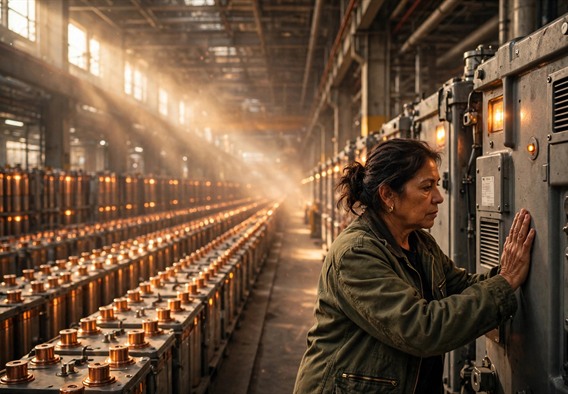

The ache in Dara Okafor's right knee started the way it always started, somewhere between shelf 41-C and shelf 41-D, a hot wire threaded under the kneecap that tightened every time she pushed the picker cart up the incline to the mezzanine. She had learned to pace it. Twelve years of learning, actually, since the first morning the joint had clicked and swollen after a double shift, and the clinic doctor had folded her hands and said the word osteoarthritis the way you'd say the name of a river that flooded every spring, something permanent and to be managed.
She managed it. She had a system. Ice pack in the break-room freezer with her name on masking tape, a rolling stool she was technically not supposed to use, twelve years of seniority that meant she got the orders that didn't require the extension ladder. She was forty-six years old, twenty-two of them at the Meridian Fulfillment Center outside Toledo, and she could read a pick list with her eyes closed and could tell, from the sound alone, when a conveyor belt bearing was about to go.
What she wanted was simpler than anyone at Meridian would have guessed, given how she never said it out loud. She wanted to walk the lake path at Maumee Bay the whole way to the observation deck without sitting down on the third bench, the one with the warped slat. She wanted to keep her house. She wanted to not be afraid, every single morning, that this would be the day the knee finally gave out on the stairs.
The Pick List
That Thursday night, the picking floor was short two people, and the wave schedule came down from the algorithm with the cheerful cruelty it always had. Dara took the mezzanine orders because Teddy, who was twenty-eight and had knees like new tires, had called in, and because the supervisor, a decent kid named Ivan, stood in front of her cart with his tablet and didn't say please but came close to it.
"I can take the flats," she said. "I'll take the flats, Ivan. I'm not taking the mezzanine."
"It's four hundred units. If I move half of it to the flats, we miss the wave. If we miss two waves this quarter, they escalate the staffing review, and you know what that means for Rosalind."
She did know. Rosalind Pina had twenty-eight years in and a hip that was worse than Dara's knee, and the staffing review was the guillotine they now hung over the whole floor instead of firing people like human beings. Dara looked at the incline, that rubber ramp with the yellow grip tape she'd walked up maybe sixty thousand times, and did the math she did every night, the ratio of this shift's pain against the number of shifts she had left.
"Fine," she said. "But you're logging it. Write it down, that I took the mezzanine short-staffed, because when I file my accommodation review again, I want a paper trail."
Ivan logged it. She watched him do it, which was the whole point.
She took the ramp in a rhythm, push-glide-step, push-glide-step, unweighting the right leg the way a swimmer breathes to one side, an economy she'd built without ever being taught. By the third trip the wire under the kneecap had become a cable. By the fifth trip, coming down with a loaded cart, her knee buckled — actually buckled, a half-second where the joint simply declined to hold her — and she caught herself on the cart handle and rode the brake and made it to the bottom floor standing, heart slamming, the kind of fear that comes home to the body and stays there.
In the break room at two a.m., she sat with the ice pack strapped on and read, for the fourth time, the letter from Human Resources that had come the week before.
It was a buyout offer. They were calling it a Transition Bridge. Meridian's parent company had new automation capital and a new philosophy about "long-tenure injury-exposed roles." Thirty-one thousand dollars, two years of continued health coverage, and a signature on a line at the bottom. The letter said, in the cheerful passive voice of people who had never met her, that the program was "an opportunity to plan the next chapter on your own terms."
Thirty-one thousand. Her half of the buyout would cover maybe three years of property tax and insurance on the house on Vireo Lane, if she never ate again.
Rosalind dropped onto the bench across from her, unwrapping a sandwich with the slow ceremony of a woman rationing her hips for the rest of the shift. She was fifty-five, gray coming in strong at the temples, the best picker Meridian had ever had by rate, back when rate was a thing a person could be best at.
"They send you the letter too?" Rosalind asked.
"Signed, sealed, delivered."
"Mine says the same thing. Own terms." Rosalind laughed, a dry sound with no meanness in it. "You know what my terms are? My terms are I want to keep working until I choose to stop. That's it. That's the whole term."
"You take the money?"
"You kidding? I called about that graft thing. The cartilage one. My cousin's friend in Ann Arbor had it done on her ankle." Rosalind leaned forward, and for a second she looked younger, conspiratorial, like they were passing something forbidden under the table. "They grow it off your own cells. Off a biopsy. Six weeks and you've got cartilage where there wasn't any. She walks her dog four miles now. Dara. Four miles."
"What'd they tell you it costs?"
"Eleven thousand, for the one joint. Give or take." Rosalind sat back and let the number sit between them, doing its arithmetic against both their bank accounts at once. "Not covered. Not for us, not this year. They cover it for the people at the Ann Arbor lab who sit in chairs."
Dara turned her ice pack over. Eleven thousand, eight hundred was the figure she'd seen when she'd looked it up herself, three weeks ago, at two in the morning on the kitchen laptop with the sound off so she wouldn't wake anybody, though there was no anybody to wake anymore, which was its own quiet ache she had stopped noticing.
She had looked it up the same night she'd gotten the buyout letter. That was the part she hadn't told anyone. She'd looked at the number in her savings account — nine thousand, four hundred, thirty-one dollars, twenty-two years of automatic transfers that had sometimes bounced and sometimes not — and she'd looked at the CartiPrint clinic's website, the one in Sylvania with the pictures of people her age on hiking trails, and she had closed the laptop and gone to bed in the dark with her knee singing its low song.
Here was the thing she couldn't say to Rosalind, couldn't say to Ivan, could barely say to herself in the honest hour before sleep: it wasn't the money that stopped her. It was that she'd spent twelve years building a life around the hurt, a machine with the knee as its one worn gear, and everything fit — the stool, the flats, the third bench at the lake path, the way she'd taught herself to carry laundry down the stairs by dropping it ahead of her, step by step. If she fixed the gear, the whole machine had to be rebuilt, and she was forty-six, and she was tired, and rebuilding was a young person's verb.
"I'm going to wait," Rosalind said, balling up her sandwich wrapper. "They'll cover it in a couple years. That's what everybody says. Price drops, coverage comes, everybody gets their knees done at the pharmacy like flu shots. You watch."
"You believe that?"
"I believe it eventually." Rosalind stood, taking her time about it, one hand flat on the table. "The question is what happens eventually and what happens in between. Same question we've been asking our whole lives, Dara. Same question everybody like us has been asking since forever."
They went back out to the floor. Dara took the flats and didn't take the mezzanine again, and Ivan didn't push it, and the wave came in late anyway, and the algorithm noted the miss in whatever ledger the algorithm kept.
At six a.m., in the first gray of a Toledo October, Dara sat in her car in the parking lot before starting it, because starting it meant the day had officially begun and she wasn't ready. The buyout letter was on the passenger seat where she'd dropped it. She picked it up and read the deadline at the bottom for the fifth time. Signature due by the fifteenth of November. Four weeks.
She put the letter in the glovebox, where she kept things she didn't want to decide about, and drove home to Vireo Lane with both hands on the wheel and her right leg doing the work of two legs, and dreamed, in the twenty minutes before her alarm, of walking to the observation deck without stopping.
The Bridge Offer
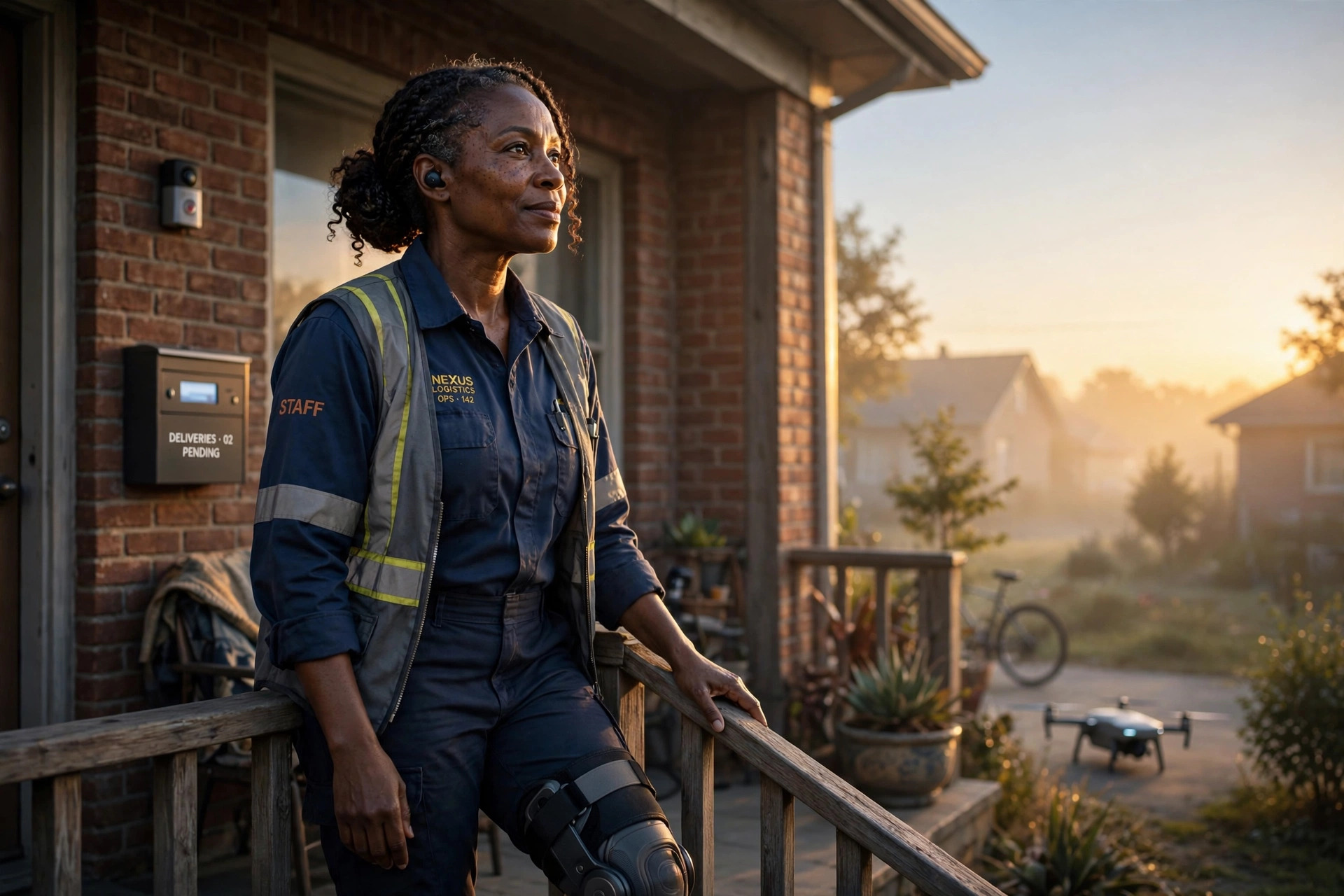
Her brother Vern called on Sunday, the way he did every Sunday at four, from the apartment above the hardware store in Chillicothe where he'd lived for eleven years, and the first thing he said was, "The orchard came through on the walk-through. It's real, Dara. Nine acres, twenty-two rows, a cider barn with a roof that only half needs replacing."
She could hear him pacing. Vern was fifty-one and paced when he was happy, and he'd been pacing toward this orchard for six years, ever since he'd retired from the county water department and discovered that what he wanted to do with the rest of his life was grow apples, a thing he'd last done at nineteen for a summer that had apparently never ended inside him.
"What's the number?" she asked.
"A hundred and forty-five. The seller's motivated — his kids don't want it, and the farm credit office has an opinion about his late payments. I can get there. Almost. My pension covers the note if the down payment's right, and the down payment is almost right." He paused, and she heard the exact shape of the pause, because she'd been hearing it since they were kids. "It's the house money. My half of the house. I need it out."
The house on Vireo Lane was the last thing their mother had left, a three-bedroom brick with a yard that went to seed every August and a mortgage that had been dead for a decade. When she passed, the will had split it clean down the middle: Dara lived in it, Vern owned half of it, and for six years the arrangement had held on nothing but the fact that neither of them wanted to have the conversation. The appraisal had come in at a hundred sixty-eight thousand. Vern's half, in cash, was the distance between him and twenty-two rows of apple trees.
"You want to sell," Dara said. Not a question.
"I want to buy, which means the house has to either be sold or bought out, and I know you can't buy me out, so yes. I'm asking to sell." He said it fast, like ripping tape off skin, the way he'd asked her for things their whole lives, the bike money when they were kids, the truck money when they were in their twenties, and every time she'd said yes and every time he'd known she would and hated knowing it.
"Or," he said, and here it came, the other half, the half he'd clearly rehearsed, "or you take the buyout at work. Thirty-one thousand, right? You said thirty-one. You take the bridge, and that's my half covered, more or less, and you get out from under that place before those stairs you're always complaining about put you in the ground. You move down by me. Dara, I mean it. There's a pick-your-own operation in Ross County that would hire you to run their weekday floor by March, sitting down, most of it. Sitting down. When did anybody last offer you a job sitting down?"
He was not wrong about the stairs. He was not wrong about the sitting down. He was her big brother and he had done this math with love, the same math he'd done when their mother was dying and he'd driven up every weekend for eight months, and Dara sat at her kitchen table with the phone on speaker and felt the whole shape of her life being gently, kindly rearranged by someone else's hands.
"What would I be, Vern?"
"What do you mean?"
"Down there. Running a weekday floor. What would I be, if I'm not at Meridian?" She heard how it sounded even as she said it — small, loyal to a place that had sent her a letter offering to be rid of her — but the question underneath was real. Twenty-two years. She was the person who knew the belts by their sounds. Take that away and she was a forty-six-year-old woman with a bad knee and nine thousand dollars.
"You'd be my sister with a whole second act," Vern said. "You'd be somebody whose back doesn't hurt. Whose knee doesn't — you know what I mean."
"Say it."
"Whose knee doesn't ruin her life, Dara. It's ruining your life. It's been ruining it for years and you've built a whole cathedral around it and you call the cathedral normal."
She laughed because if she didn't, the other thing would happen, and she was not doing the other thing on a Sunday phone call. "I'll think about the buyout. I'm not promising."
"The fifteenth," he said. "Their deadline. My closing on the orchard is the end of November if I'm lucky. Dara — I wouldn't push except I've been waiting on my own life for six years and the man is seventy-four and his kids want it sold by winter. I'm asking you to hurry because I don't get another spring at seventy-five dollars a seedling. That's all. That's the whole ask."
After she hung up she sat at the kitchen table, and then she got up and did the thing she'd been not-doing for three weeks: she opened the laptop and found the CartiPrint clinic in Sylvania and made an appointment, typing her name into the intake form the way you step off a curb you didn't decide to step off.
She told herself it was just information. That's what everybody tells themselves, and it's even sometimes true.
Dr. Amara Sy was younger than Dara expected, maybe thirty-eight, with a knee brace of her own visible under the desk — an old surgical one, metal hinges, the kind they hadn't made in fifteen years, kept on, Dara would learn, as a habit the way some surgeons keep their first bad outcomes framed where they can see them. She walked Dara's scans up onto the wall herself, no assistant, and stood there a while.
"So," she said. "Talk to me about the third bench."
Dara blinked. "The what?"
"The bench you stop at. Everyone with joints like yours has a bench, or a chair at the top of the stairs, or a spot in the grocery store. Tell me about yours."
So Dara told her about the lake path at Maumee Bay, the mile and three quarters to the observation deck, the third bench with the warped slat that she'd sat on so many times she'd thought about writing the park district about it. She told her about the laundry, dropped ahead of her step by step, and the rolling stool that wasn't allowed, and the way she hadn't been on a ladder since 2039. She was surprised, saying all of it out loud in a bright clinic room on a Tuesday morning, how much of it there was. A cathedral, Vern had said. A whole cathedral.
Dr. Sy nodded along, looking at the scan the whole time. "Here's what the picture says. The cartilage on the inside of your right knee is essentially gone — bone on bone across about a centimeter and a half of contact surface. You've compensated brilliantly, which is a compliment and a warning, because compensation is load shifted somewhere else, and somewhere else in a knee is never far from everywhere."
"The graft," Dara said. "CartiPrint. My friend's cousin's friend had it on her ankle."
"We've done about four hundred knees. Results are good — ninety-one percent report full-load walking without pain at one year." Dr. Sy pulled up a diagram, a cross-section with a pale gray crescent where the cartilage should be. "We take a biopsy the size of a grain of rice, culture your own chondrocytes, print the graft to your exact defect map, and seat it in a ninety-minute procedure. Six weeks of rehab with a very specific and very boring loading protocol. If you're compliant, and I've read your intake so I know you are — you strike me as a woman with a system — you should walk that lake path. All of it. First time in over a decade."
Dara's hands were folded in her lap, gripping each other. "How much?"
"Eleven thousand, eight hundred. Insurance covers it for post-traumatic defects under thirty-five. Yours is degenerative, which they classify as elective. I've written four appeal letters this month arguing that's nonsense. I lose the argument more than I win it."
"And if I wait?"
Dr. Sy took her time, which Dara respected her for. "Honest answer? Coverage probably comes. Two years, maybe three, for degenerative. The price will drop. It's a real technology, not vapor — it gets cheaper the way real things do." She turned from the scan and looked at Dara directly. "But waiting has a cost too, and it's not evenly distributed. Each year of altered gait compounds stress on the left knee and both hips. Your left knee already shows early changes. If I'm honest, Ms. Okafor, the wait isn't neutral. For some people it's a bridge to coverage. For some it's the window where the good knee becomes the second bad knee. I can't tell you which one you are. I can tell you your left knee is asking the question."
Dara drove home with the printout on the passenger seat where the buyout letter had ridden. Two pieces of paper, two futures, and the money for only one of them — and neither one of them, that was the arithmetic she kept circling, neither one of them was the one she'd actually been saving for, which was the ordinary one, the one where she just kept her house and her job and her weekends, the one where nothing required deciding.
That night she dropped her laundry down the stairs ahead of her, step by step, and stood at the top looking at the descent like a woman at the edge of water, and thought about how good she'd gotten at this, how fluent, and how much she hated it.
The Picker Platform
Two weeks before the deadline, on a Thursday night in early November, Rosalind Pina fell from the picker platform, and everything that had been abstract became concrete and terrible in the space of about four seconds.
Here is what happened, as near as anyone could reconstruct it. The wave schedule had come down heavy again, and the floor was again short, and Rosalind, who had asked about the light-duty accommodation queue twice that quarter and had been told both times that the queue was "being restructured," took the order that required the raised platform in aisle 30 — the one with the lift pedal that had been tagged for repair since September. She was twenty feet up, reaching for a bin at the front of the platform because the guard rail on the reach side had a known dead spot, a foot-wide gap everyone on the floor knew about and worked around the way they worked around everything, and her hip — the one she'd decided to wait on, the one whose coverage was probably coming, eventually — did not fire when she shifted her weight. It wasn't dramatic. There was no slip. She simply leaned and then was not standing, and the platform edge caught her at the small of the back and turned a fall into a half-fall, and she came down on the concrete with her right leg folded under her at an angle legs don't fold.
Dara was four aisles away and heard the sound, a sound like a dropped pallet but wrong, wrong in a way her body understood before her mind did, and she was moving before the shout went up, moving faster than she had moved in years, and the knee — the knee with its cathedral, its whole system — seized on her at the end of aisle 30 and she went down onto one knee in a blaze of white and kept going anyway, hauling herself up by a shelf post, arriving as the first of them, dropping again, this time on purpose, onto both knees beside Rosalind's head.
"Don't move," Dara said. "Rosalind. Don't move. Look at me."
Rosalind's eyes were open. She was making a sound that was trying not to be a scream and almost winning. "The platform," she said. "I know, I know — I reported it — Dara, I reported it in September—"
"I know you did." Dara took her hand and held it flat against the floor so Rosalind would have something to push against that wasn't her own leg. "Help's coming. You hear the alarm? Help's coming. Stay with me."
It took the ambulance eleven minutes. Dara spent all eleven of them holding that hand, and in the seventh minute Rosalind stopped fighting the pain enough to look up at her, and what she said, Dara would carry for the rest of her life.
"That could've been you," Rosalind said. "You know that, right? Same age, same floor, same waiting. That could've been you."
"It wasn't."
"It wasn't yet," Rosalind said, and closed her eyes and breathed through the next wave, and Dara held on.
At the hospital they found a fractured tibial plateau and, in the imaging, the hip that had failed her so badly on the platform that they were surprised she'd been walking on it at all — bone on bone, the surgeon said, advanced, a joint that had been quietly ending for years under a woman who had a system and a plan to wait. Two surgeries, months of rehab, and a lawyer's letter already, because Rosalind's daughter drove up from Dayton overnight and was in the hospital hallway by six a.m. with a folder of the maintenance reports Rosalind had filed, and the folder was thick.
Dara went to see her on Sunday, before her shift, with grapes nobody would eat and a magazine nobody would read. Rosalind was propped up in the bed with her leg in a machine that moved it slowly, endlessly, like a tide.
"They want to do the graft," Rosalind said. "On the hip, after the fracture heals. Turns out a catastrophic workplace injury and hospital admission is an excellent route to a procedure your insurance wouldn't cover on Tuesday." She laughed her dry laugh and then winced, because the laugh traveled. "You got to love this country's approach to medicine. Fall off a platform, earn a knee. Stay on the ground, nothing for you."
"You think it'll work? The graft?"
"The surgeon says the femoral head's in good shape, so yes, probably, in the spring. I'll be fifty-six and walking the lake path like your cousin's friend." She looked out the window a while. "You still haven't signed anything? The buyout? The clinic? Nothing?"
"Nothing."
"Deadline's the fifteenth. That's Thursday."
"I know what day it is, Rosalind."
"I know you know." She turned back from the window, and her face was the face of a woman doing her arithmetic out loud on purpose, for a witness. "Here's my ledger, since I'm lying here with time on my hands. I waited because coverage was probably coming, and coverage was probably coming, and I still fell off that platform. Waiting wasn't wrong. Waiting was just waiting. But don't you tell yourself the two things are the same. Don't you dare sit in that break room and tell yourself the graft and the buyout are the same decision because they both cost money and you only have the one pot." She reached out and put her hand flat on Dara's forearm, the way she'd put it flat on the break-room table to stand up. "You could take the buyout and give it to Vern and be his sister in Ross County. That's a real life, sitting down. Or you could take the graft and stay and be the woman who walks. But whichever one, Dara, you pick it. You pick it with your whole chest. Because this —" she tipped her chin at the tide machine, the traction bar, the whole apparatus of a body that had run out of runway — "this is what not picking gets you. Not eventually. Now."
Dara left the hospital and sat in the parking lot in her car in the November dusk, and this time she started the engine, and she drove not home but to Vireo Lane's kitchen table, where she laid out the papers in the overhead light: the buyout offer, the clinic estimate, the appraisal on the house, her bank statement with its nine thousand four hundred thirty-one dollars, and, in a folder she hadn't opened in a year, the quitclaim paperwork the county had sent when Vern had first asked, blank where the price went.
The math was brutal and short. She could sell the house and give Vern his eighty-four thousand and be left with nothing, knee intact or not. She could take the buyout and get Vern thirty-one thousand of his eighty-four and owe him fifty-three, with no knee fixed and no job. Or.
Or she could sell him her half of the house for what she could actually get — sell low, sell fast, sell to her brother — and take the difference between that and the graft and the buyout and the taxes and run the whole ugly engine at once. She sat with the numbers until midnight and then past it, and somewhere in there the cathedral in her knee and the cathedral of her whole careful managed life stopped looking like shelter and started looking like what it had maybe always been: a place to wait comfortably for the thing she was afraid of.
She texted Vern at 12:40 a.m., knowing he'd see it in the morning: CALL ME TOMORROW. I HAVE A NUMBER. THEN SHE LAY DOWN ON THE COUCH BECAUSE THE STAIRS, AND SLEPT THE WAY YOU SLEEP AFTER A FALL IS OVER, WHICH IS TO SAY BADLY, AND ALL AT ONCE.
The Quitclaim Papers
Vern drove up on Saturday, three hours of two-lane in his truck with the toolboxes rattling in the bed, and sat at her kitchen table with the papers in front of him and didn't touch them.
"Say the number again," he said.
"Forty-two. You pay me forty-two thousand for my half, and you get the whole house. You sell it or you keep it or you rent it, whatever gets you to the orchard's down payment. I take the buyout from Meridian — thirty-one — and between the two, I've got the graft, the taxes, and about eight months of breathing room while I retrain for something that isn't the picking floor."
Vern looked at the papers. The appraisal said eighty-four thousand for her half; she was offering to take half of that, and they both knew what it meant: she was paying him forty-two thousand for the privilege of getting her knee back, out of her own inheritance, and calling it a market deal, and they both had to agree to call it that or the whole thing would fall apart into what it actually was, which was their whole childhood in a kitchen.
"The orchard needs sixty down," he said slowly. "If I pay you forty-two, I've got my cash plus that, and it's close. It's close enough the credit office won't laugh. But Dara — the house is worth eighty-four of yours. You're not just giving me a discount. You're funding your own surgery out of your own house, and then you don't have the house."
"I have a lease," she said. "Sixteen hundred a month, three years, to whoever buys it. Or to you, if you keep it. I did that math too."
"You did all the math."
"I've had three weeks, Vern. I did the math twice."
He was quiet a long moment, and when he spoke it wasn't what she expected. "You didn't call me when Rosalind got hurt. I heard it from Iris, who heard it from Miguel. My own sister goes down in a warehouse four hours away and I hear it through the family radio like it's the weather."
Dara's throat closed. "There was nothing you could do."
"That's exactly the problem, isn't it." He said it without heat, which was worse. "You've built a life where there's nothing anybody can do, and you call it being strong. You did it when Mom was sick and you did it after the divorce and you're doing it now. And every time, I find out later. I'm always finding out later."
"I'm telling you now."
"You're telling me now because you need forty-two thousand dollars."
The words landed exactly where they were aimed, because he was her brother and he knew the map. She sat with it. She could have returned fire — the orchard, the six years of his waiting, the way he'd timed his dream's deadline against hers like it was her fault the fifteenth of November existed. She thought about Rosalind's ledger, about picking with your whole chest, and she made the harder choice, which was to stay sitting.
"That's partly true," she said. "I need the money, and I didn't call you, and those two facts are both mine. But here's the part you're not hearing, Vern, so hear it: I'm not doing this for the money. I'm doing this because I'm out of runway. Rosalind fell off that platform because her hip quit, and my knee quit on me three weeks ago, in the middle of the floor, and I caught myself on a cart handle and kept going because that's what I do. I catch myself. I've been catching myself for twelve years and I'm tired and the catching is getting harder and the floor doesn't care how good my system is." She put her hand flat on the quitclaim, the way Rosalind put her hand flat on the table to stand. "I'm forty-six. I want to walk the lake path. I want to not take a buyout because my body ran out before the company did — I want to leave on my own clock. I'm spending my half of Mom's house on my own two legs and I think she'd be fine with that, and I need you to be fine with it too, or at least to sign anyway."
Vern looked at her for a long time. Then he laughed — one short, cracked sound — and rubbed his face with both hands, the gesture of their father, dead twenty years, resurrected at this table.
"She'd be more than fine with it," he said. "She'd say what she said about the porch roof. Fix the thing that's holding you up before it falls on you. That's what she'd say." He pulled the pen out of his coat pocket, the same chewed click pen he'd carried since the water department, and he didn't sign yet. "One condition, and it's not negotiable. Three-year lease, and I'm the landlord, and you pay twelve hundred, not sixteen. You want to know why?"
"Why."
"Because the orchard closes at the end of November and the seller's kids want it done, and I can come down on the sale of the house because you came down on the sale of the house, and we're not going to do this thing where I take your sacrifice at full price. We split the haircut. That's the family discount and that's the whole of it."
Dara signed. He signed. The notary at the bank on Monday stamped it, and Dara walked out into the November cold with a cashier's check for forty-two thousand dollars and a signed buyout letter she dropped in the Meridian HR box on her way past, and a surgery date on a clinic card in her wallet: November 20th, 7:30 a.m., and beneath it in Dr. Sy's handwriting, "Third bench. Then all of them."
The last shift was quiet. Ivan brought donuts nobody ate and stood beside her at the time clock and said, "For what it's worth, the platform's been red-tagged since Thursday. Corporate sent people. That shouldn't have taken what it took."
"Rosalind's daughter has a folder," Dara said. "That's what it took. It should've taken me."
She turned in her badge, and her knee ached going down the steps to the parking lot for the last time as an employee, and she thought: two weeks, and then the rest of my life.
The surgery was ninety-four minutes. She remembered the ceiling of the pre-op bay, and the anesthesiologist's green cap with dolphins on it, and then nothing, and then the recovery room, where the pain was the wrong kind — surgical, clean, bordered — and Dr. Sy came by in the evening and leaned on the rail of the bed.
"It's in," she said. "Seated perfect. Now comes the part where you don't get to decide anything, which I know is your favorite part."
"How long till I walk?"
"You'll walk out of here tomorrow, partial weight, with a walker, and you'll hate it. Then the boring loading protocol. Six weeks of your life, twenty minutes three times a day, no heroics. The graft is yours but it's an infant, and you have to let it grow up before you put your whole life on it. Can you do boring, Ms. Okafor?"
"Vern," Dara said from the pillow, "my brother thinks boring is my whole personality."
"Then you're the ideal patient."
The Lake Path
The rehab was the hardest thing Dara had ever done, and it was boring, and Dr. Sy was right on both counts.
For six weeks she lived at the kitchen table and the couch with a walker and then a cane, doing the protocol at seven, at one, and at seven — ankle pumps, quad sets, the endless slow motion of teaching a brand-new surface to bear her. There were days it was fine and days the graft ached in a deep, unfamiliar way that scared her, and one Tuesday in the third week when it swelled and she called the clinic in a panic and Dr. Sy's nurse practitioner said, "Fluid response, happens in maybe one in five, come in tomorrow, but tonight elevate and breathe," and Dara sat on the couch with her leg up on a pillow and did not breathe, and then did.
Vern drove up twice. The second time was in February, in his truck with two hundred apple seedlings in burlap in the bed, headed to a co-op meeting, and he stayed overnight on the couch and watched her do the one o'clock set and said nothing the whole time, which was the most generous thing he'd ever done in a life of generous things.
"Say it," she said, mid leg-press, sweating, at the kitchen counter with a theraband around her ankle.
"Say what?"
"Whatever you came up here planning not to say."
He turned his coffee cup a quarter turn on the table. "The orchard's in. Signed, seedlings ordered, first pruning starts in March. I drove up tonight mostly to tell you that in person, and partly —" another quarter turn — "partly because I did the math on the lease and I'm not charging you twelve hundred forever. Twelve hundred this year. Market rate after, because the orchard has to stand on its own or it's not an orchard, it's a hobby. And I wanted you to hear that from me before you built it into your cathedral of things you're not allowed to need."
"Twelve hundred this year," she repeated. "Okay." She finished the set, both legs shaking, and lowered her foot to the floor, and it was the new knee, the infant, the printed gray crescent of her own cells grown back into the shape of a life, and it held. "Vern. It held."
He looked at her foot on the linoleum like it was a moon landing.
The retraining was its own slow graft. Dara took a state certification course in warehouse systems — the diagnostic side, the side that reads the belts and the bots instead of racing them — twelve weeks, remote, with clinical hours at a community college lab in Perrysburg. She was the oldest person in the cohort by fifteen years and the only one who could diagnose a failing conveyor bearing by ear, which she demonstrated, on purpose, the first week, standing up from her chair without using her hands, and watched the instructor reassess her completely in the space of a second.
Meridian's contractor hired her at twenty-eight hours a week in April, on the systems side, mostly seated, mostly hers. It was less money than picking. That was true and she'd stopped pretending it wasn't. The buyout money was spent — the graft, the taxes, the course, the breathing room, gone down to the last cold hundred. The lease at twelve hundred ate a third of her new paycheck. She was forty-seven years old and starting over with a printed knee and a career two rungs below the one she'd given up, and when she laid it all out like that, on the bad nights, it could look like a loss, and she let it look like one, because it had cost real things. It had cost half a house. It had cost her twenty-two years of being the best at something. Nobody was going to hand her a ceremony for it.
But on the good nights — and they outnumbered the bad ones now, which had not been true in a decade — the ledger read differently. Rosalind came up from Dayton in March for her own graft consult, and Dara drove her to Sylvania and waited in the lobby for two hours and didn't mind. Rosalind's daughter's lawsuit had red-tagged platforms at three fulfillment centers in the state, a fact that appeared in the news with none of their names in it, which Rosalind said was how the good stuff always happened: quietly, and in your name only in the ledgers nobody frames.
And then it was May, and the lake path at Maumee Bay was open all the way to the observation deck.
Dara went on a Tuesday morning, early, before work, because she wanted it private. She parked in the lot by the marsh and stood a while at the trailhead sign with her hands in her jacket pockets. The morning was cool and loud with red-winged blackbirds, and the path stretched ahead of her, mile and three quarters, crushed limestone through the wetlands to the deck over the bay.
She walked it in fifty-one minutes. She passed the first bench without slowing. She passed the second bench. She came to the third bench, the one with the warped slat, and stopped, and stood there, and then sat down on it — not because she had to. Because it was a bench, and it was morning, and the blackbirds were going off like the whole marsh was on a shift change, and she wanted to look at the water for a while.
On the deck, a man her age was setting up a spotting scope, and they talked for a minute about whether the egrets had come back yet, and she said she didn't know, she'd never made it this far before, and he said, "Well, they're back," and pointed, and there they were, four of them, white and unhurried in the shallows.
She got home by eight. Vern had sent a photo from Chillicothe that morning: two hundred seedlings in their holes, twenty-two rows, the cider barn roof half new, half waiting, and the caption said first season don't blink.
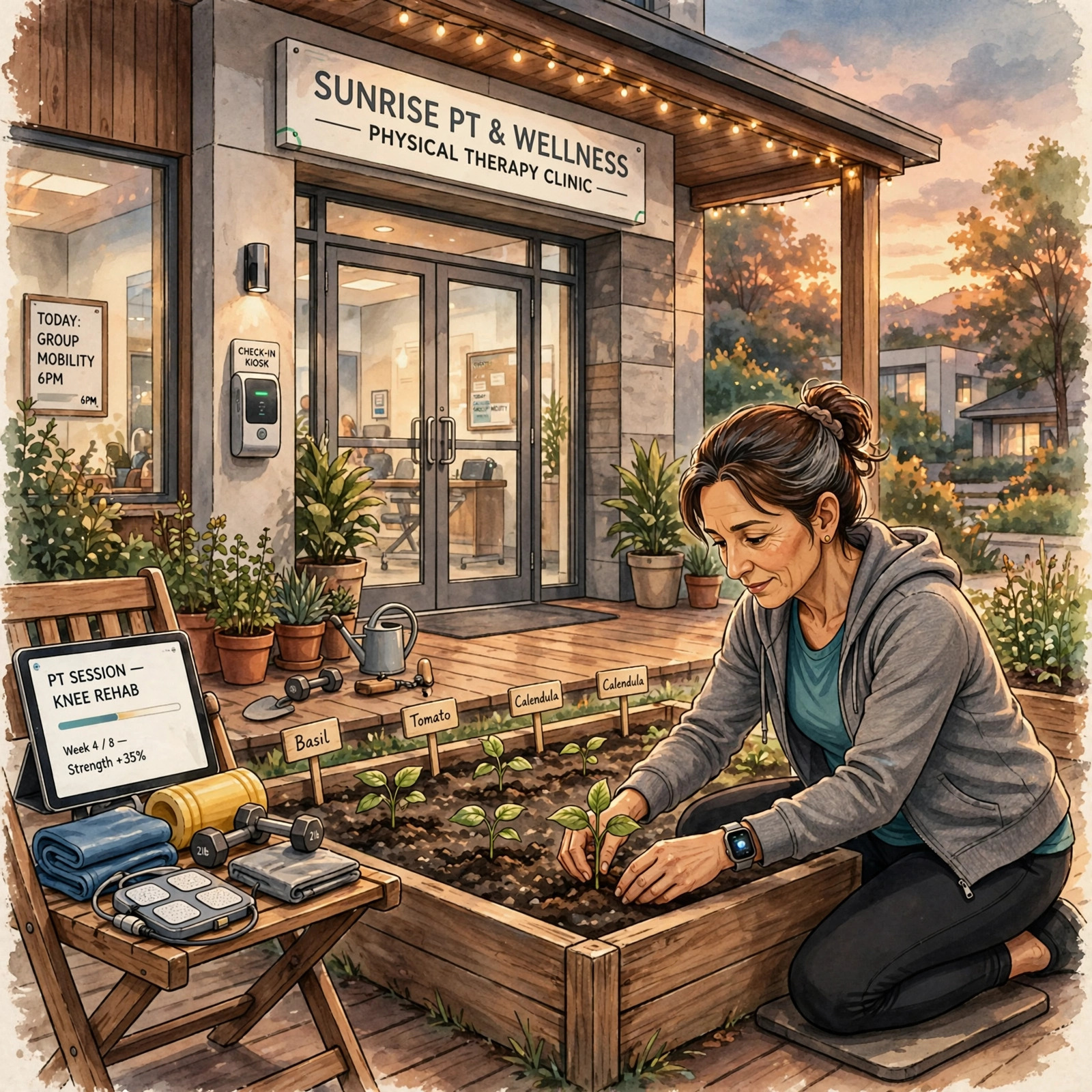
That evening, after work, Dara stood at the side of the house on Vireo Lane where the dirt by the downspout had been dead scrub for as long as she'd owned the place, the spot she'd never planted because planting meant kneeling and kneeling meant the system, the ice pack, the three days of paying for it. The brace from the first rehab weeks sat on the porch chair where she'd left it, along with the cane and the theraband and the crumpled packet of clinic paperwork she still hadn't filed in the drawer. Bills sat on the kitchen table where she'd left those too. All of it still there. All of it hers.
She had a flat of seedling tomatoes on the porch rail — six plants, four dollars apiece from the hardware store, the kind of small reckless purchase she hadn't made in twelve years.
She knelt. She went down onto both knees in the dirt by the downspout, felt the ground's cold through her jeans, felt the new cartilage take the whole easy ordinary weight of her, and she stayed down there, trowel in hand, and planted the first one.
Get notified when new stories drop

Jonas Veld
Jonas covers human-AI futures and engineer problem-solvers: protocols, trust, and tools that expand human capability.
Leave a comment
Comments