





The chart room of the survey ship Peregrine's Rest smelled of coffee, solder, and the faint ozone tang of a hull that had been sealing its own microfractures for eleven years. Captain Ilsa Vann stood with her boots magnetized to the deck plates and her thumb on the edge of the display table, holding down a spiral of amber light that represented two hundred thousand kilometers of threaded debris between her and everything she had wanted for a decade.

"Say it again," she said. "Slower."
Jai Ferro, her navigator, was twenty-eight and had the good grace not to sigh. He tapped the spiral and it bloomed. "The Vela Sheer isn't a wall, Captain. It's a pour. A slow-motion waterfall of busted planetesimal, sheared off the Angiri Cluster maybe forty thousand years ago. Everything in it is falling in the same general direction, and most of it is falling at a sensible speed. Except—" he drew a circle with two fingers, and a red-gold ring inside the spiral lit up like a fever—"except the Cauldron."
The Cauldron. Ilsa had read her mother's mission logs before she could read anything else. The Cauldron was the inside line, the short spiral through the densest thread of the pour, where the debris moved fast and the shear currents moved faster and the radiation came off the chunk-ice in visible shimmer. Forty years ago, a ship called the Arianne Palissy had threaded it and come out the far side in nineteen days with a survey cache full of the first good images of the Beacon at Kestrel Deep—a derelict alien navigational structure, half a light-year past the Sheer, older than human language. The Palissy had also come out with a dead captain, a dead pilot, and a hull so hot they'd scuttled it in open space. Nobody had gone through the Cauldron since. Every sane ship took the Quiet Margin, a wide arc along the Sheer's outer edge that added forty days to the crossing and was about as dangerous as a bad week of weather.
"Nineteen days," Ilsa said, mostly to herself.
"Nineteen days if nothing goes wrong," Jai said. "And the Palissy's own logs say things went wrong."
"Things went wrong for the Palissy."
"Captain, the Palissy was a racing hull. Triple shielding, a reactor the size of ours and half the mass. We're a survey ship. We're a very tired survey ship." He pulled up the Peregrine's shielding profile, a sad gray bar next to the Palissy's historical one, and let the comparison sit there like a dead thing on the table.
Ilsa knew all of this. She had known it for six years, ever since the Kestrel Consortium had posted the Deep Survey Prize: the first crew to reach the Beacon, physically, with a certified survey spike in hand, and return telemetry would hold the sole claim to everything the derelict could teach about the old roads between stars. The old roads. Rumored, half-mapped, never proven—because proving them meant getting to the Beacon, and getting to the Beacon meant crossing the Sheer, and the Sheer had exactly two doors.
She wanted the Beacon the way some people wanted a name for their children. Her mother had spent her last commission trying to raise funding for a Cauldron crossing and had died in a docking accident at fifty-three with the funding still three years out. Ilsa had the ship her mother never got. She had the spike, machined from Peregrine's own keel alloy, hanging in a case outside the airlock where the whole crew tapped it for luck on their way to their bunks. What she had wanted since she was nine years old was sitting half a light-year past that red-gold ring, and the only fast road to it ran through a place that had killed better ships.
"What's our margin on the long route?" she asked.
"Fifty-nine days, give or take. We provision for sixty-five, we arrive with our hull intact, and—" Jai hesitated, then flattened the display and brought up a courier packet, timestamped four hours ago. "And there's this. You haven't read the consortium flash yet."
She hadn't. She'd been in the chart room since 0400 with the door sealed, doing the thing she always did before big decisions: drawing the plan by hand, on real laminate, with a real pen, as if paper could slow her down enough to think. It rarely worked. Her flaw, her old captain used to say, was that she believed courage was a kind of arithmetic—that if you brought enough of it, it would balance any column. She had spent her whole career out-planning that flaw, and the column she was looking at now made her want to throw the pen.
She opened the packet. The Kestrel Consortium's seal was a stylized beacon-tower, and beneath it the flash was short: the survey vessel Coriolis, registered to the Halloran Combine, had departed Anchorage Station fourteen days ago under a Cauldron crossing plan. Estimated Beacon arrival: thirty-one days from departure. Estimated claim window: closing.
"Fourteen days ago," Ilsa said. "They've been gone two weeks and we're just hearing it."
"Anchorage traffic control sat on the flight plan. Combine money, I'd guess. The leak came from a berth-hand who owed me a drink." Jai's voice was careful. "We're forty-one days out from Beacon arrival on the Margin route if we burn today. They beat us by ten days. Unless we go through the middle."
Unless we go through the middle. Ilsa looked at the spiral for a long moment. Nineteen days for the Palissy, in a hull built for it, with a crew of forty and a captain who'd spent nine years rehearsing the line. The Peregrine's Rest carried four souls: herself; Jai, six years in the navigator's chair; Su-mi Okoro, chief engineer, eleven years aboard, who had rebuilt the drive with her own hands twice; and the fourth.
The fourth was already in the doorway.
"You've both got the same face on," said Corin Addis. He was the Consortium's field auditor, forty-five, a compact man with graying temples and a voice like a well-maintained hinge, and he had been living aboard for three weeks as the condition of the Peregrine's charter. He stepped into the chart room without waiting for an invitation—he never waited, she'd noticed; it was the one habit of his she couldn't decide whether to admire—and put his hand flat on the table beside the Cauldron ring as if he were claiming it.
"The Coriolis," he said. "Fourteen days gone. You've done the arithmetic."
"I've done it," Ilsa said. "It doesn't close. We take the Margin, we arrive tenth in a race of two."
"We take the Cauldron, we arrive first."
"We take the Cauldron, we arrive maybe. Or we arrive as a radiation casualty drifting out the far side with our claim beacon squawking over a dead ship." She kept her voice level. She'd had this argument in her head all morning and found that in her head she lost it more often than she won. "The Palissy—"
"Was forty years ago," Addis said. "You know what changed in forty years? Instrumentation. Collision prediction. Your Mr. Ferro's approach plots are better than anything the Palissy's crew ever had, and I've read them, Captain, because reading them is my job. Your engineer's shielding retrofit is better than what that ship carried. You know what else changed? The money. The Combine isn't funding the Coriolis out of curiosity. If Halloran holds the Beacon claim, the old roads stay closed to independent survey for a century. They'll license passage the way they license jump gates, and small ships like yours will pay toll forever. You've told me that yourself, in the mess, with more profanity."
"I remember the profanity," Ilsa said. "I stand by it."
"Then stand by this too." He wasn't shouting. That was the trouble with Addis; he never shouted, and his case never fit neatly into the shape of something she could dismiss. "The Consortium charter requires me to certify that any route selection is made on the merits. If you tell me the Cauldron is a coin toss, I'll log your refusal and defend it. Is it a coin toss?"
He let the question sit on the table between them, next to the amber spiral and the red-gold ring and the sad gray bar of their shielding profile.
Ilsa looked at Jai. Jai looked at the deck. Six years in the chair, and she could read his skull from the top. He thought the Cauldron was survivable. That was the worst part. He thought it was survivable and he'd never say so, because saying so would put the weight of it on her instead of on the arithmetic, and he was too decent a man for that.
"Give me six hours," she said. "I want Su-mi's numbers on the shield drain before anything. And I want a line-by-line on the Palissy logs. Not the summary—the raw feed, the last ninety minutes, everything they said to each other before they stopped saying things."
Addis nodded once, satisfied in a way that made her jaw ache, and left the chart room. The door sighed shut behind him.
Jai finally looked up. "You're actually considering it."
"I'm considering everything. That's the job."
"The job," Jai said, "is also coming back."
"I know what the job is." She said it more sharply than she meant to, and then she caught his eye and made herself hold it, because her old captain had also taught her that the fastest way to lose a crew was to make them afraid of your temper. "Ninety minutes of Palissy logs, Jai. Then we talk about the Margin like adults. And if the numbers say the Cauldron, we talk about that too. All of it. Nobody signs onto a crossing they haven't seen."
He tapped the table and the spiral folded itself away. At the door, he paused. "My mother flew the Margin twice," he said. "She used to say the Sheer was beautiful from the outside edge. Like a river of broken glass with the light behind it."
"I've seen the survey images."
"The images," Jai said, "aren't the river."
Then he was gone, and Ilsa Vann stood alone in the chart room with her laminate and her pen and two hundred thousand kilometers of falling stone between her and the only thing she had ever wanted that she couldn't buy, borrow, or build. She sat down. She uncapped the pen. She started, again, at the beginning, because the beginning was the only part of the plan she trusted: a ship, a crew, a spike of keel alloy in a case by the airlock, and a rule she had written herself in ink on the chart room bulkhead the day she took command, seven years ago.
Bring them back or don't come back.
She read it twice. Then she pulled the Palissy logs toward her and began to listen to two people die forty years in the past, and the worst of it—the thing she would not say out loud to anyone, not to Jai, not to Addis, not to the laminate—was that some small, cold part of her listened to the captain of the Palissy narrating her own dosing death and thought: she got there.
Ninety Minutes of Logs
The Peregrine's Rest burned toward the Sheer's outer threshold for two days while Ilsa lived in the chart room, and by the end of the second day she had learned three things from the dead.
First: the Palissy's crossing had not failed because of the debris. Debris was chartable. Jai's collision plots, run against forty years of drift-model refinement, put the Peregrine's predicted hull strikes through the Cauldron at a survivable four—the Palissy had taken eleven, and her captain had logged each one with the flat calm of a woman writing receipts. Second: the killing had come from the shear itself, the standing magnetic gradient that wrapped the Cauldron's inner spiral like a wire around a fist, and which cooked the Palissy's shielding nine hours in and never let go. Third—and this was the one Ilsa kept at 0300, headphones on, the mess dark, listening for the fourth time—the Palissy's captain had known. Twenty minutes before the shielding gradient collapsed, the log caught her saying, to her engineer, on a channel she likely thought was closed: "We could still peel off. Take the Margin and lose the claim and keep breathing. God, I want to peel off." And the engineer, a man named Osorio, had answered, "Then don't, Captain. We're twenty minutes committed. Decide faster next time."
Decide faster next time. There was no next time. Ilsa sat with that for a long while in the dark.
On the morning of day three, she called the full crew to the chart room. All four of them fit with room to spare: Jai at the table's edge, Su-mi Okoro arriving last with coolant on her coveralls and her tablet under her arm, Addis standing by the door in his pressed, faintly ironic way. Su-mi was fifty-two, twenty-one years in engine rooms, and she had a habit of wiping her hands on her thighs before she touched anything clean, as if apologizing to the future for the mess she'd been in.
"Su-mi," Ilsa said, "the retrofit. The Cauldron numbers. Tell them."
Su-mi wiped her hands, set the tablet down, and let the numbers speak for her first: a graph, red where it mattered. "The shielding retrofit I put in at Anchorage holds a standing gradient about two and a half times the rated soak of the Palissy's arrays. That's the good news. Here's the rest. The Cauldron gradient isn't standing, it's pulsing—shear fronts come around the spiral in trains, big ones every six to nine hours, and the duty cycle lands us above my soak line for eleven to fourteen minutes per front. During those minutes we are essentially unshielded, and unshielded in that field is not a survivable place for soft tissue. So the crossing plan has to thread the gaps between the trains. Mr. Ferro's plot does that. It's good work." She glanced at Jai, who nodded once at the table. "But the gaps compress on the far side of the spiral. The last eight hours of the transit, the gaps drop under nine minutes, and our best re-shield recovery cycle is twelve. Which means for the last third of the crossing, we cross two fronts at partial shielding and hope the dosing math is generous."
"And is it?" Addis asked, from the door. "Generous?"
"It's within limits," Su-mi said. "The limits assume nobody leaves the shelter core, nobody has to go EVA, and nothing breaks." She said it mildly, the way she said everything, which somehow made it heavier. "Eleven years on this boat, something always breaks."
"Every crossing assumes that," Addis said. "I've audited forty-two survey missions. The ones that come back are the ones whose captains decided. The Coriolis is nineteen days from the Beacon now, twenty. If you take the Margin, the Combine holds the claim before you're halfway around. Two hundred years of closed roads, Captain. Your mother's charts locked in a Combine vault. That's the cost of the quiet route, and I want to hear someone say it out loud before we pay it."
"I'll say it," Jai said, before Ilsa could. "I've been saying it for two days. He's right about the stakes, Captain. He's right that the margin math is ugly. I ran it twenty times. Ten days behind, no recovery. The prize is real and it's closing."
"And the other column?"
"The other column is the Palissy," Jai said. "You made me listen to all ninety minutes. I notice you didn't make Addis listen."
"I audited the Palissy loss in my first year at the Consortium," Addis said quietly. "I know that log better than either of you. And I'll tell you what the formal finding says and what everyone forgets: the Palissy didn't die of the shear. She died of a decision made twenty minutes late. Her captain had the gap to peel off and she spent it hoping. I am not asking Captain Vann to hope. I'm asking her to plan, decide, and commit early enough for the choice to be a choice." He straightened. "And I'll add this, because fairness cuts both ways: if she decides the Margin, I log the refusal as sound and I defend it to the board with the same voice I'd use to defend the Cauldron. My stake is the claim. Hers—" he nodded at Ilsa—"well. Ask her."
The chart room went quiet. Su-mi was looking at her hands. Jai was looking at Ilsa. Ilsa was looking at the amber spiral on the table and thinking about the laminate in her cabin, the four bullet points she'd written at 0400 and crossed out and rewritten, the cold voice at 0300 saying she got there.
"Here's the decision," she said. "We attempt the Cauldron."
Jai's head came up. Su-mi's hands went still.
"Not the Palissy's crossing," Ilsa went on, before the silence could grow teeth. "A modified line. Jai, take your plot and shear the last third wider—follow the gradient's outer shoulder for the final eight hours even though it costs us nine hours in transit. Twenty-eight days total instead of nineteen. It moves us out of the compressed gap regime. Su-mi, the shelter core gets a second layer of water baffling from the cargo tanks; I want the recovery cycle down to eight minutes or we don't go. Addis, you're logged as witnessing the plan and its abort criteria, and here are the abort criteria, in ink: any hull strike above class three, any member of this crew dosed above half the emergency ceiling, any shielding element off line for more than twenty minutes, and we peel. We peel hard, we take the outer shoulder, and we accept that the Margin costs us the claim. The Palissy's captain had twenty minutes to decide and spent them hoping. We decide now, in daylight, with everyone's eyes open. Nobody signs onto a crossing they haven't seen—so: look at it. All of it. The twenty-eight days, the pulses, the shoulder, the peel line. Then tell me out loud if you're in, because I'm not flying this with anyone who'd rather be elsewhere."
She wrote the abort list on laminate while they watched. Four lines, her hand steady, the pen sounding loud in the small room. Then she slid it to the center of the table, uncapped the pen, and signed under the last line.
"Captain," Su-mi said slowly, "the water baffling means draining potable reserves to the shield plumbing. We ride the crossing on recycled and short rations of drinking water. All four of us. That's a real cost, not a paper one."
"I know it is. Log it as line five."
Su-mi took the pen and wrote it herself, in her small square hand: Potable reserve to baffling. All crew, rationed. S.O. She signed. Then she looked at the whole plan for one long, steady moment—the way she'd look at a rebuilt drive before lighting it, Ilsa thought, checking not the math but the workmanship—and put her signature under the criteria.
Jai signed second, fast, already pulling the plot toward him to bend the shoulder wider. Addis signed last, and under his signature he added, unasked, Witnessed and concurred, C. Addis.
"Day after tomorrow," Ilsa said. "Peregrine's Rest crosses into the pour."
She believed, that night, as she checked the water baffling with Su-mi in the half-lit shelter core, that she had beaten her flaw. She had planned. She had written the abort lines. She had gotten everyone's name in ink.
The pour had other arithmetic in mind.
Seventh Hour
They crossed the threshold at 0611 on a Tuesday, ship-time, and for the first six hours the Cauldron was almost beautiful.
The debris pour spread around them like a slow, glittering river seen from inside—the Peregrine's floods picking out chunk-ice and black basalt and occasional flashes of starlight off crystal faces, everything drifting in the same general direction at speeds the eye could not perceive and the instruments never stopped counting. Jai flew the line from the navigator's couch with the calm of a man threading a needle he'd threaded in simulation two hundred times. Ilsa sat in the command seat and felt, for the first hour, the old pure joy of it: the ship sliding through a place no sane vessel went, and the four of them going together.
At hour two they cleared the first shear front from inside the shelter core, hull wrapping, everyone crammed into the water-baffled closet with their dosimeters on the bulkhead above their heads. The numbers rose and fell like a held breath released. Su-mi, squeezed between the core's inner skin and a rack of plumbing, watched her recovery graph and muttered numbers to herself like a rosary. The cycle came in at eight minutes, eleven seconds. "Under the line," she said, and Ilsa heard the room exhale.
Hour four: a class-two strike, a fist of ice off the forward shield, no penetration, everyone laughing too loudly at nothing. Hour six: a second front, cleaner than the first. The plan was holding. Ilsa felt the thing she always felt when a plan held—the temptation to love it, to believe the plan holding meant the plan was good. She wrote in the log: Two fronts, nominal. Resist complacency. — V. It was the kind of note her old captain used to leave, and it comforted her for almost forty minutes.
The seventh hour was when the numbers moved.
It began as a flicker on Su-mi's board—a shielding element on the dorsal array dropping twelve percent for four seconds, then recovering. Su-mi saw it before anyone. "Element nine," she said into the intercom, already unbuckling. "Recovery lag. Probably a baffling valve sticking open. I can be out and back in nine minutes if I go now, before the next front—the gap's ninety minutes wide, we have room."
"Negative," Ilsa said. "Abort criteria. Nothing over twenty minutes off line."
"Element nine is not off line, Captain, it's running at eighty-eight percent, and it's one of six feeding the dorsal face. If it degrades further inside a pulse train, the whole face sags and the recovery cycle goes past twelve and we're in the regime we built the shoulder line to avoid." Su-mi's voice was patient, the voice of twenty-one years of engine rooms explaining gravity to captains. "Nine minutes. I've done it in six. The alternative is riding every remaining front with a soft spot in the array and hoping the dosing math is generous, and I believe we agreed—"
"We agreed nobody goes EVA. That's not a hope line, that's a rule."
"You wrote four abort lines," Su-mi said, "and the fifth. The fifth is the one I signed with my own ration on it. This is the repair those rations bought."
Ilsa sat in the command seat with the intercom live and her thumb hovering over the channel and the whole familiar shape of the moment pressing down on her. The gap was ninety minutes. The repair was nine. Even doubled, even tripled, it fit. She ran the arithmetic three times in the time it took Su-mi to finish wiping her hands, and the arithmetic kept saying yes, and somewhere under the arithmetic a colder voice said: the arithmetic always says yes until it doesn't. The Palissy's captain ran arithmetic too.
And the colder voice lost, because of the one thing Ilsa Vann could never outrun about herself: she believed, down in the keel of her, that the right kind of brave closed any gap. That plans were for people who couldn't trust their nerve.
"Ten minutes," she said. "Hard cap. Jai, hold the line steady as she goes. Addis, you're on the dosimeter watch. Nobody else unstraps. Su-mi—" she caught the engineer's eye on the monitor—"if it's a valve you can't seat in eight, you leave it. Say it back."
"If I can't seat it in eight, I leave it," Su-mi said. "Copy, Captain. Out the dorsal lock in sixty seconds."
Six minutes in, element nine came back to ninety-six percent. Su-mi's voice on the loop, half a smile audible in it: "Seated. Clean as a church floor. Starting back—" and then the pour shifted.
Nobody charted it as a strike, because it wasn't one. It was a shear eddy—a curl of the gradient folding off the main front like a wave wrapping around a pier, and the folding edge of it swept the Peregrine's dorsal quarter and everything in the ten meters above it with a slap of charged flux that the instruments recorded and the humans experienced as a sound: a crack, heard through the bones of the hull, felt in the teeth.
Su-mi went off the loop.
"Peregrine, Peregrine, casualty on the dorsal face." Her voice came back before Ilsa had finished inhaling, flat and clipped, and then the telemetry started telling the story in numbers: suit integrity nominal, dosimeter climbing. The eddy had passed in eleven seconds. Eleven seconds of unshielded flux at four meters' distance, on the worst side of a soft array, with nothing between Su-mi Okoro and the Cauldron's field but a suit rated for maintenance, not for pulse trains.
"Inside," Ilsa said. "Now. Now, Su-mi."
"Moving." And the monitor showed the suited figure pushing off the dorsal spine, hand over hand along the guide rail, unhurried with the terrible unhurriedness of someone who knew that rushing in flux was how you turned one dose into two. Forty seconds to the lock. Jai flew the line like a metronome. Addis called the dosimeter in a steady voice—rising, rising—while Ilsa stood at the lock controls with her hand flat on the inner door and her heart going like a hammer and the arithmetic, her beautiful arithmetic, curled up and died in front of her.
The lock cycled. Su-mi came through it on her own feet. That was the first mercy.
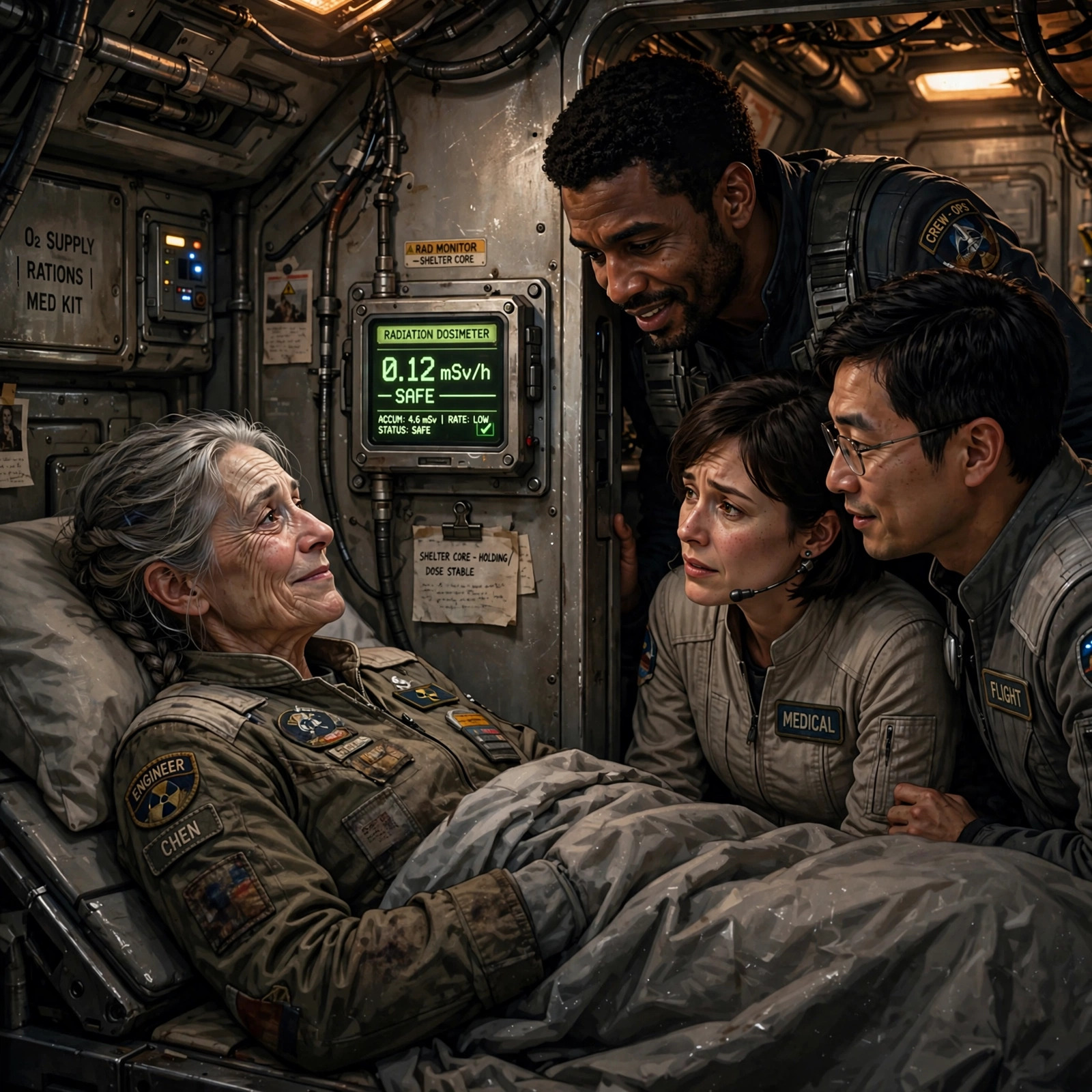
The second mercy was that she was conscious, and swore at the lock light for taking nine seconds, and let Jai and Addis half-carry her to the shelter core, where the medical unit read her dosimeter and pronounced its verdict in the flat voice of all medical units: exposure at four and a half times the emergency ceiling. Not immediately lethal. Not survivable without the full course—regenerative marrow therapy, thirty days in a clinic, the kind of clinic that existed at Anchorage Station, fifty-one days away on the Margin route at best burn. Forty-one, if they cut the corner and came out through the Cauldron's far shoulder at drive redline.
Su-mi lay in the core's single bunk and heard all of it. She reached up, unprompted, and shut the medical display off, which was the most engineer thing Ilsa had ever seen anyone do.
"Captain," Su-mi said. Her voice was level. Her hands, Ilsa noticed, were shaking, and she pressed them flat against her thighs—the old gesture, wiping them clean. "What's the fastest road to a marrow clinic?"
Ilsa Vann stood in the shelter core of her tired survey ship, four hours into the pour, with the Cauldron's red-gold spiral turning on the plot behind her and the Kestrel Beacon half a light-year out along the line that Su-mi's dose had just closed, and she made herself answer honestly, because the engineer who'd signed the fifth line with her own ration on it had earned every honest word the captain had left.
"The fastest road," she said, "is back out the way we came, and around the Margin at redline. Forty-one days to Anchorage."
"And the claim?"
"The claim," Ilsa said, "is going to have to belong to somebody else."
The Redline Burn
Peeling out of the Cauldron cost them nine hours of hard maneuvering and one hour of Ilsa's self-respect, and she'd have paid double.
The vote, when she called it, was not a vote. She called it anyway, because Addis was the Consortium's auditor and the charter gave him the standing to contest a route decision, and she wanted the record clean. They held it in the shelter core at hour eleven, Su-mi flat on the bunk with the anti-nausea patch behind her ear and the rest of them folded onto the deck around her like a crew that had run out of rooms.
"I'm calling an abort under line four," Ilsa said. "Shielding element degraded, crew casualty dosed past emergency ceiling. The plan's dead. The question on the table is the next route: Margin to Anchorage at redline for Su-mi's therapy, or Margin to Kestrel at cruise with a detour to Anchorage afterward, which arrives too late by a margin I won't pretend about. It's thirty-one days of difference. Before anyone speaks—Addis, I know what the claim is worth. You've made sure I can't unknow it. Say your piece, and then I'll make the call, and it'll be mine alone, which is how command works."
Addis looked at Su-mi for a moment before he spoke. Ilsa would remember that. Whatever else he was—and she had spent three weeks deciding he was a Combine wolf in Consortium wool—he looked at the woman on the bunk first, and the arithmetic second.
"My piece," he said, "is that the Consortium's charter exists so that the Beacon gets opened to everyone, and its field auditor exists so that the crews who open it get home. If I certify a route that kills or cripples a crew member to beat a clock, I've failed the second mission to serve the first, and the first doesn't survive it. That's not sentiment. It's governance. I'll log your decision as sound, whichever way it goes." He paused. "That said, you should all know what I know: the Coriolis is twenty days out. Halloran holds the Beacon in twenty days, and no grievance we file changes that. The Margin to Anchorage surrenders the Deep Survey Prize. In full. This crew will have crossed the most dangerous shoal in the settled arm for nothing."
"Not nothing," Jai said quietly, from the deck. "We're the second ship in forty years to enter the Cauldron and the first to leave it through the front door with a casualty alive to complain about the coffee. I'm going to put that on my mother's grave marker, word for word."
"The coffee is bad," Su-mi said, from the bunk. It got the laugh it deserved—a small, broken laugh, but a real one.
"Then the call is mine," Ilsa said. "Margin to Anchorage. Redline. We go home."
No one objected. That was the part she'd feared and the part that broke her worst: it was easy. Of course it was easy. The hard road had been taken out of her hands by the one thing she could never out-argue, which was a dosimeter's flat verdict on a friend's blood. She wrote the order in the log in ink, in the dead column next to the abort criteria, and then she stood in the core's little lockway with her hand on the bulkhead and let herself feel, for exactly ninety seconds, the full weight of everything she was giving up: the Beacon, the old roads, her mother's unfinished line, twenty years of want, surrendered in a sentence and a course change.
Then she went to the bridge and flew.
The redline burn was fourteen days of the ship screaming softly at her, everything above the red for hour after hour, the drive running at a thermal load Su-mi would have forbidden in any other week—and Su-mi, propped in the engine bay in a foil-lined cot inside a meter of her beloved reactor, talked Jai through every adjustment and made Ilsa promise twice to log her as on duty, because, she said, her replacement wasn't aboard and the reactor deserved adult supervision. Her white cell counts fell on a curve the medical unit charted in red. Her hands stopped shaking and then started again, worse. On day nine of the burn she stopped eating; on day eleven she made Jai promise, in a voice gone papery, to salt the reactor's coolant loop the way she'd taught him, "because the third seal lies to you, sweetheart, she always has." Ilsa sat with her every off-watch, and learned the engines, and hated them for needing anyone at all.
Addis, meanwhile, worked. She caught him on the third day, deep in the comm archive, drafting something long and carefully worded for the Consortium board—her assumption was a formal protest of his own, or a dissent from the surrender of the claim. On day five he sent it, and told her what it was without being asked, which was the closest he came to apology for three weeks of pressure.
"A casualty report," he said. "Full factual record of the Cauldron crossing, the abort criteria honored, the dosing, the redline decision, and the raw flight data. Also a claim—" he hesitated—"a provisional salvage-survey claim on the Cauldron transit itself, filed under my auditor's authority and dated before Halloran's arrival window. It won't hold the Beacon. But it may hold the road to it. The survey data your crew paid for is worth something, Captain, and I've spent my career watching institutions take that worth for free because nobody filed the paperwork on time. Not this time."
"You're spending Consortium capital on a lost race."
"I'm spending it on the only ship that came back with first-hand data on the Cauldron in forty years," Addis said. "Halloran wins a beacon. You've won the transit, if the claim stands. The old roads don't start at the Beacon. They start at whoever can teach everyone else to cross the Sheer without dying. It seems nobody ever claimed that part before." He looked, briefly, very tired and much older than forty-five. "My first year at the Consortium, I audited the Palissy loss. I've carried that log for twenty-four years, Captain. I'd have preferred to carry yours instead."
On day thirteen of the burn, with Anchorage's beacon light growing on the plot, Jai found Ilsa on the observation couch at ship-night, watching the distant smear of the Sheer fall behind them—the river of broken glass, her mother's river, receding with all the light behind it.
"You did the thing the Palissy's captain couldn't," he said.
"I did the thing her engineer told her to," Ilsa said. "Twenty minutes late."
"Ninety minutes late, by my count. And under worse pressure." He sat down. "For whatever my log entry is worth: I've flown with nine captains. You're the first one I've seen write the peel line in ink before the crossing instead of after the funeral. You didn't beat your own nerve, Captain. You just filed it where the rest of us could read it."
The Peregrine's Rest made Anchorage Station on day forty-one, exactly on the arithmetic, on the last margin of the last number Su-mi's dosing allowed. The clinic's gurney team met them at the dock. Su-mi Okoro, twenty-one years in engine rooms, was carried off her own ship alive, awake, and loudly dissatisfied with the manner of her exit, having insisted first—over Ilsa's objections, which she overrode by the ancient seniority of engineers over captains in matters of coolant—on spending her last eleven minutes aboard salting the third seal.
It held. It would hold for years. She'd told Ilsa so herself, on the gurney, gripping the captain's wrist with a hand that couldn't quite steady: "She'll hold. And I want my name on the survey claim, Vann. I paid for it in front of witnesses."
The Quiet Margin
The clinic gave them thirty days. Ilsa spent the first three of them asleep, the next four arguing with the Consortium's relief office, and the rest of the month at Su-mi's bedside learning two disciplines she had never had patience for: waiting, and paperwork.
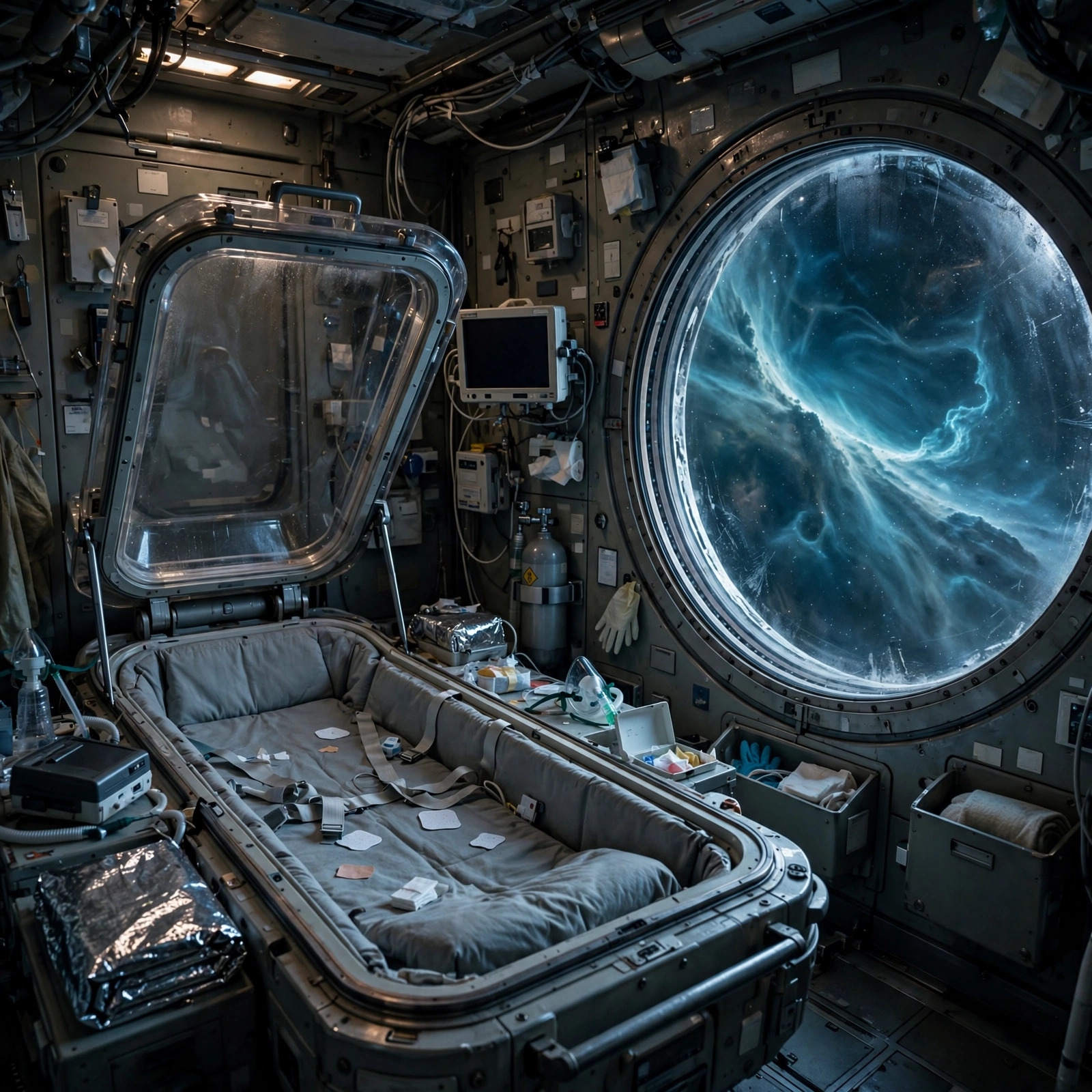
Addis's provisional claim did not die. It went to arbitration, because everything at that scale did, and the Consortium's counsel—a dry, courteous woman named Oye Fenn who took Ilsa's deposition over the clinic's terrible coffee—told her, on day eleven, how the argument stood. Halloran's Coriolis had reached the Beacon on schedule, planted the Combine's spike, and transmitted their claim, and nobody disputed they'd been first. But first to the Beacon was not the same as first to the road. The Coriolis, it turned out, had taken the Margin out and the Margin home: forty-two days of nothing. They had bought a lighthouse and never learned the sea. Meanwhile, the Peregrine's Rest carried the only surviving Cauldron transit record in existence—the approach plots, the shear-train timings, the nine-minute gap regime, the eddy that had folded off the main front and nearly killed the only person who had ever made Ilsa Vann's ship worth flying, all of it logged raw, dated, witnessed. Addis had spent three weeks making it airtight.
"Arbitration could take two years," Oye said. "The Consortium wants the Beacon data and Halloran wants exclusivity and there's a board on Ceres that technically owns the arbitrators. But the claim has weight. You put a price on courage, Captain, which is something courts respect and markets don't."
"I wasn't pricing courage," Ilsa said. "I was pricing the peel line."
"Write that down," Oye said, "and don't tell anyone it was my idea."
On day twenty-two of the month, Su-mi's counts came back over the line. The therapy had taken. The clinic said the word "recovered" and then, seeing Su-mi's face, corrected it to "cleared for duty, light, six weeks," which was the sentence Su-mi had been dosing herself against, and the ward got to see an engineer cry with what she later claimed was irritation at the ventilation.
On day twenty-six, Jai arrived at the clinic with a courier packet and a look Ilsa had never seen on him, and they gathered around Su-mi's bed—the whole crew, plus one auditor, with the fourth chair pulled over from the neighboring ward without anyone asking permission.
"It's from the Coriolis," Jai said. "Their captain. Deshi Halloran himself—he's the old man's grandson, he flew the crossing personally." He read: "'To the master of the Peregrine's Rest: we hold the Beacon claim and you hold the transit, and our respective owners propose to spend the next decade suing each other over the difference. I'd rather spend it flying. My grandmother's ship died in your Cauldron and yours came out with the data I've spent my whole career wanting. If your arbitration produces a shared transit license, the Coriolis will subscribe on day one. We have seventy-one survey crews on the waiting list who want the old roads and no safe way across. Your ship found the safe way, or the nearest thing to it anyone's found in forty years. Come make it safer. — D. Halloran.'"
Su-mi said, "Seventy-one crews," in a voice like someone reading scripture. Addis sat back in his stolen chair with his hands laced over his chest, and for once in three weeks' acquaintance said nothing at all, which was how Ilsa learned that he had been drafting his reply to Halloran for days and had wanted her to hear the offer before he sent his own.
"You knew this was coming," she said.
"I knew what the data was worth," Addis said. "I hoped what people were worth." He shrugged, unhappily pleased with himself. "The arithmetic's been on your side since the redline burn, Captain. It just took the market two months to notice."
Su-mi, propped in her bed with her hands pressed flat on the blanket—clean, at last, of everything—looked up at her captain. "Well," she said. "Fifty-one days on the Margin, four and a half times the ceiling, thirty days in this ward with the worst coffee in the settled arm. Are we doing it again?"
"A modified line," Ilsa said. "Jai shears the shoulder wider. Su-mi gets the recovery cycle under eight minutes, no arguments about which seal lies. Addis files everything before we cast off instead of after. And this time, nobody goes EVA in a pulse train. Not for a valve. Not for me. The fifth line stays in ink."
"The fifth line stays," Su-mi agreed. "But I'm rebuilding the array first, so the situation doesn't come up. There's such a thing as planning, Captain. You should try it sometime. One of the four of us has to."
They cast off from Anchorage Station on a bright station-morning six weeks later, the Peregrine's Rest carrying a new dorsal array, a repaired reactor with its lying third seal replaced by one of Su-mi's own manufacture, a navigational archive with forty years of drift-models in it, and—hanging in its case by the airlock where four people tapped it on their way to their bunks—a machined spike of keel alloy that had never been planted in anything and never would be, because the Beacon belonged to somebody else now.
Ilsa had taken it out of the case on the last station-night, alone in the chart room, expecting grief. What she'd felt instead was smaller and stranger: the spike was lighter than she remembered. She had carried it for six years wanting it to be heavy with meaning. It was just metal. The meaning had never been in it.
Jai brought the ship around on the Margin heading at 0611—she'd asked him for the time, and he'd understood without asking—and the Sheer rose ahead of them, off the bow, the long slow river of broken glass with the light behind it, just as his mother had said, except the images weren't the river and the river was better: wider, older, glittering with all the light of the cluster pouring through it.
The crew came to the observation couch to watch it come on: Jai at the stick, Su-mi with her tablet of rebuilt array numbers, Addis with his filed claims and his illegal thermos of decent coffee. Crossing the threshold, at the head of the pour where the amber spiral began, Ilsa Vann reached to the chart table and turned the ship's registry seal to the transit authority channel—the same channel the Palissy had used, the channel that meant a human ship is entering the Sheer, remember us while we're dark—and keyed it, transmitting the Peregrine's name, her crew of four, and their heading: not the Cauldron this time, and not a race. The long charted line, shared now with seventy-one waiting crews and one former rival, of the only road through the broken glass that had ever brought everyone home.
The channel light burned steady green. The Sheer opened ahead of them like a door. And at 0611, with all four of them breathing beside her on the observation couch, Ilsa Vann took the Peregrine's Rest across the line.
Get notified when new stories drop

Ava Kepler
Ava writes space exploration and cosmic adventure with competent crews, hard problems, and awe that earns its hope.
Leave a comment
Comments