

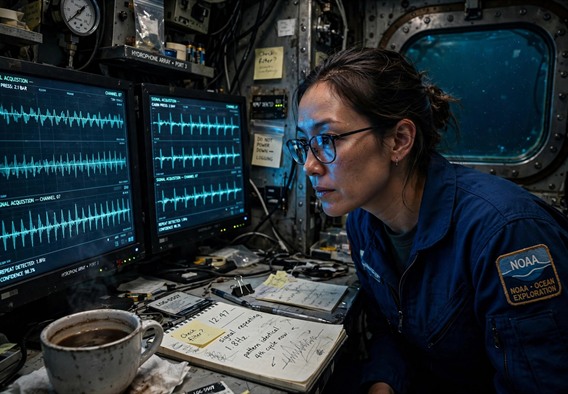

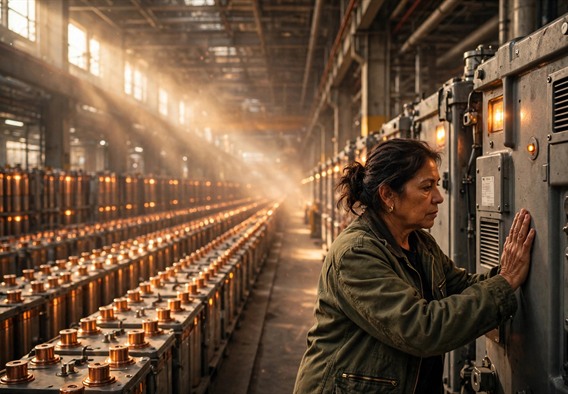

The regolith filters on the east rim of Bellwether Station needed turning every nine days, and Maren Kess had turned them one hundred and forty-six times without once thinking of the number. She thought of it this morning because her hands had found the rhythm and her mind had gone elsewhere, the way it did, and when she came back to herself she was counting. Four years of Khoma mornings, thin amber light through the dust haze, the filters drumming under her palms like the ribs of something patient. Eleven years total as a water steward. Seven of those on Khoma. The rest on ships and stations on the way out, learning the trade in corridors that smelled of recycler funk and other people's ambition.

She wanted what she had always wanted, which was a home that outlasted its builders. Bellwether was three hundred and ten souls under four domes, a seed farm, a furnace stack that turned fines into glass brick, and beneath all of it the slow work: injection wells sunk two kilometers into the permafrost, feeding melt down into the deep sandstone where, over two hundred years, the colony meant to raise an aquifer. Not a lake. Not a waterfall. A hidden ocean, banked a season at a time, that her grandchildren's grandchildren would drink from. The plan had a name, the Long Soak, and a chart on the wall of her office with a green line crawling up it like a vine growing in the dark.
"Steward." A voice behind her, tinny through a respirator. "You're supposed to log the rotation. I can see the clipboard from here and you haven't touched it."
Maren turned. Dev Okonjo stood at the airlock skirt with his respirator hanging loose around his neck, against every protocol, the way he'd done for eleven years because he said the damn thing fogged his glasses. He was thirty-eight, drill engineer, second-generation colonial, a man who had taught her half of what she knew about Khoma's ground and all of what she knew about losing gracefully at cards on Saturday nights. His dark face had the dusty gray cast that everyone got after a long dry season, but this morning the gray went deeper, a bruised color under his eyes, and his breathing had a rasp in it she hadn't heard before.
"Log it yourself if you're going to hover," she said, and tossed him the clipboard. He caught it left-handed, which was wrong, because Dev was right-handed, and she noticed that too and filed it next to the rasp and the color of him.
"I came to find you because Haldane landed at dawn," he said. "Suri Haldane. From Corridor Mineral."
"I know the name." Everyone on Khoma knew the name. Corridor Mineral held the survey concession east of the ridge, the one the colony had sold to the Territorial Development Compact eight years ago to pay for the dome membranes. Four hundred thousand marks of membrane, bought with a signature. Nobody had thought much about it since, the way you don't think about the mortgage on a house you love.
"She's asking for you specifically." He scribbled the rotation entry, his writing wobbling. "At the pump house. I told her you'd come after the filters."
"Then she'll wait until after the filters." Maren put her palms back on the drum housing. Turn, seat, lock. Turn, seat, lock. Three hundred of the little hexagonal cells to rotate, each one trapping windborne fines that would otherwise silt the intakes, each one part of a system so boring it worked. Boring was the whole religion of Bellwether. Boring was the greenhouse that had produced its four-hundredth consecutive harvest. Boring was the Long Soak chart with its patient green vine.
"Maren." Dev's voice lost its teasing. "She's talking about the brine pockets under the ridge. The chloride lenses. She's talking about tapping them."
Maren's hands stopped on the drum. Under the ridge, below the permafrost and below the injection horizon, lay the salt lenses: pockets of hypersaline water sealed in the rock, tens of cubic kilometers of it, useless for drinking and worse than useless for soil, but heavy with dissolved lithium and borates and a dozen rare earths the inner system was starving for. The colonial survey had mapped them and the colony council had voted, eight years ago, to leave them alone. Not out of piety. Out of arithmetic. The lenses sat directly beneath the injection horizon, and the rock between them was fractured fault gouge, and every model the colony's hydrologists had ever run said the same thing: punch a production well into a lens and the drawdown would pull salt into the fresh horizon within decades. Not centuries. Decades.
"It's a survey conversation," she said. "Companies survey. Compact rules say extraction needs a full environmental review and a colony referendum. Process exists for this."
"Her process and ours might be different processes," Dev said. "She brought a ship full of drills."
Maren finished her row, logged it herself when he held out the clipboard, and they walked the two kilometers to Pump House Nine along the covered way, their boots kicking dust that hung in the amber light like something alive. Behind them the filters drummed on, boring and faithful, and Maren thought about the number one hundred and forty-six, and how it had taken her eleven years to learn that the things you count are the things you lose.
Pump House Nine
Suri Haldane was fifty-one and looked like a woman who had spent thirty years winning arguments in rooms with better lighting than this. She stood in the middle of the pump house floor in a clean suit that still carried fold creases, boots spotless, and she did not flinch when the number-two injection pump coughed its double knock the way it had every forty seconds since 2169.
"Steward Kess." She extended a hand, dry and firm. "Thank you for making time. I know the mornings belong to the east rim."
"You've read my schedule."
"I've read your logs. All eleven years of them." Haldane gestured at the pump house around them, the manifolds, the gauges with their handwritten calibration tags, the wall where someone forty years dead had painted a mural of Earth oceans that was now mostly pipe. "This is genuine work, what you've built here. I want you to hear that first. My company has no complaint with the Long Soak."
"But," Maren said.
"But the inner system needs borates, and Khoma has them, and the Compact that your colony signed gives Corridor Mineral the right to survey and the right to petition to extract. I'm here to petition, not to impose. There's a difference and I intend to honor it." She unrolled a tablet graph on the manifold bench. "Here's our proposal. Six production wells into the western lens. Closed-loop brine processing on the surface, ninety-two percent reinjection of spent fluid. We project your fresh horizon sees no measurable chloride migration inside of eighty years."
"Whose models?" Maren asked.
"Ours, plus a third-party firm in Lagrange."
"Our hydrologists have run the same scenario," Maren said. "Ours show salt in the injection horizon inside forty years with ninety-two percent reinjection, because the fault gouge doesn't behave. It's not a wall, it's a pile of gravel that's been squeezed. Every drawdown pulse widens the fractures. Your eighty years assumes the rock holds. Rock that's been holding brine under pressure for a geological age tends to hold. Rock you start unloading tends to remember it used to be a pile of gravel."
Haldane absorbed that without offense, which was worse than if she'd bristled. "Forty years or eighty," she said, "either way it outlives everyone in this room. Meanwhile, what the colony gets from us is real and it's soon. A fifteen-percent stake in the operation. Royalties the Compact caps and I won't fight the cap. A clinic upgrade, three pressure domes for the seed farm, and a processing plant that brings steady wage work to a colony that currently exports exactly one thing, which is water it can't spare."
"We export people's patience," Dev said from the doorway. "It's a growth market."
Haldane smiled at him, and it was a real smile, tired at the edges. "Engineer Okonjo. You drilled half the injection wells in this room's care, if I've read the logs right. Your comment history in the colonial geology files is the best writing in them."
"I'm available for flattery anytime," Dev said, but the rasp was in his voice, and he was leaning on the doorframe with his shoulder the way a man leans when his lungs aren't giving him what he asks. Maren watched Haldane notice it too, watched her eyes take in the gray under his skin, and file it away the way process-driven people file everything.
"Here's what I'd like," Haldane said. "A joint review. Your hydrologists and mine in one room for six weeks, one dataset, published to the whole colony. If the models agree the risk is unacceptable, I walk. If they agree it's manageable, you get a referendum with full engineering detail in front of it. Either way, no drills move until the colony votes. I'm putting that in writing to your council tonight."
"That's reasonable," Maren admitted, and hated how much it cost to say it.
"I try to be. It's more efficient than the alternative." Haldane rolled the tablet closed. "One more thing, Steward, and then I'll let you get back to your filters. Corridor's board didn't send me to Khoma to survey. They sent me because the company is eleven months from a liquidity event, and borates from this lens are the difference between refinancing and being bought. I'm telling you that so you understand the clock I'm under is not a bluff. I have maybe seven months of corporate patience. After that, the people they replace me with won't lead with a joint review."
She shook Maren's hand again and left, boots still spotless, and the pump house double-knocked twice into the silence she left behind.
"She's good," Dev said.
"She's the most dangerous kind of good," Maren said. "The kind that means it." She looked at the manifold gauges, at the mural ocean faded under half a century of pipe, at the green line on the chart in her office two domes away that she could not see from here but could feel like a toothache. "Get some sleep. You sound like a bellows with a hole in it."
"It's the dust season," Dev said. "Everybody rasps in dust season."
Everybody did. That was the trouble. It was true, and it made it easy to believe.
Dev's Hands
The clinic had six beds and Doctor Amana Osei, who was sixty-three, had delivered a third of the colony, and did not lie to anyone who asked a direct question. Maren asked one on the fourteenth morning of the joint review, after Dev failed to show for the hydrology session for the second day running and his daughter Mirei, twenty-two and newly certified on the filter crews, came to find Maren in the map room with her jaw set the way her father's set before a difficult descent.
"He won't come in," Mirei said. "He says it's a chest cold. He says he's had it before. Steward, he's sleeping in the recliner because he can't lie flat, and he's got the oxygen bottle from the drill shed hidden under a blanket like it's contraband."
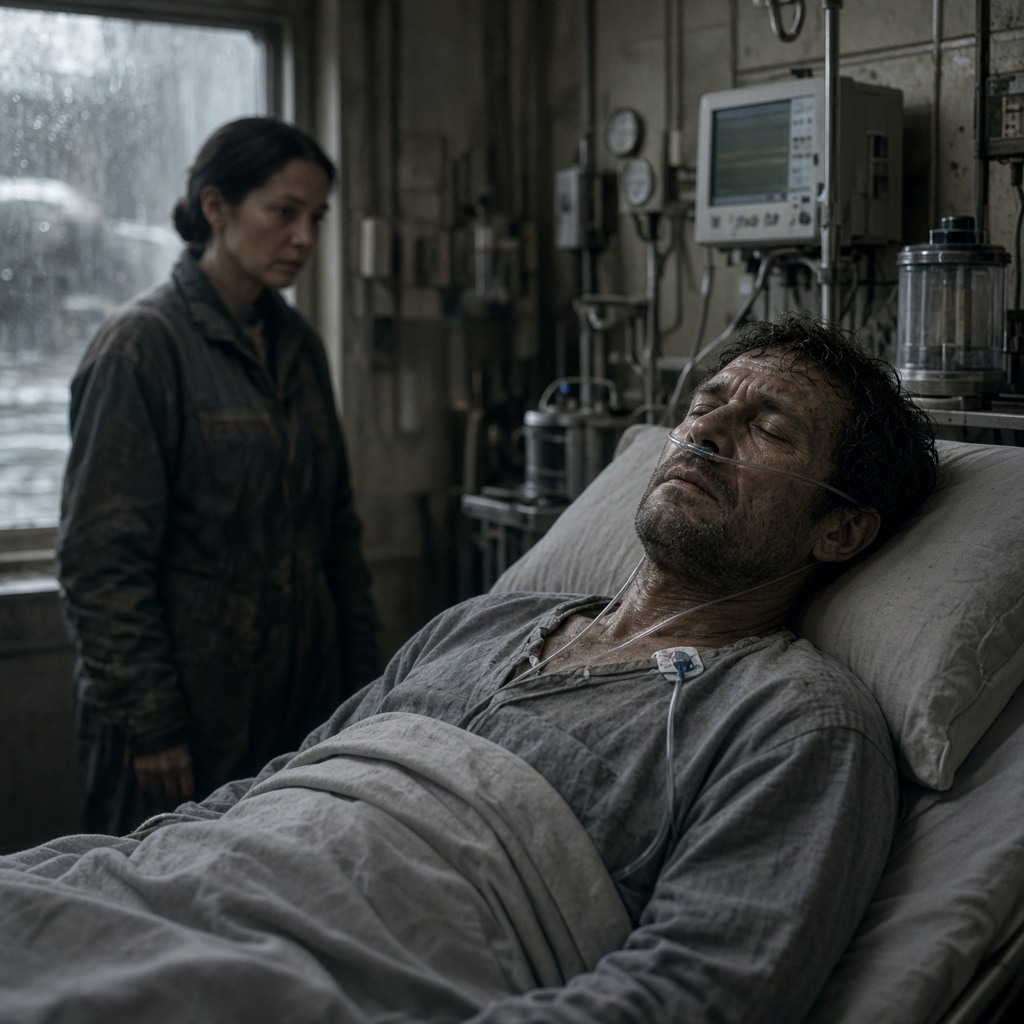
Maren walked to the clinic and found Dev in the waiting area, and the waiting area was bad enough, but then Osei waved them both into the imaging room and put the scans up on the screen and the scans were worse.
"Silicosis," Osei said, without ceremony. "Early, and I'd call it moderate, not severe. Both upper lobes, scarring pattern consistent with crystalline dust exposure over years, accelerating in the last two. He'll live a long life if he stops breathing rock dust today and never starts again. If he doesn't, the trajectory I'm looking at is a man on bottled oxygen by sixty and a man who doesn't see sixty after that."
"I wear a respirator," Dev said, to Maren, not to Osei, as if Maren were the one who had to be convinced. "I wear it. You've seen me."
"I've seen you hang it around your neck," Maren said. Her voice came out flat and wrong. "Every day for eleven years, because it fogs your glasses."
"Fogged glasses on a drill rig," Dev said, and the old lecture rose in him, the one about visibility and reaction time and how a man who can't see is more dangerous than a man with some dust in him, and then it ran out of air, which he also was doing, sitting there with his hands on his knees. Maren looked at his hands. There were the old calluses, and there was a fine tremor she had never seen before, the kind that comes when the blood isn't carrying what it's asked to.
"The acceleration in the last two years," Osei said, gentle, "tracks with the dust seasons getting longer, and it tracks with something else. Dev, I pulled the filter logs from the east rim crew quarters. Your bay had a failed intake gasket from March of last year. Replacement part was back-ordered eleven months."
"That's not on the company," Dev said quickly, glancing at nothing, at the map of Khoma that hung on the imaging room wall. "Gaskets fail. Colonies wait on parts. That's the life."
"That's the life," Osei agreed, "because the colony runs on four hundred thousand marks' worth of membrane and a maintenance budget I could fit in my pocket. Which brings me to why I called you, Steward, and not just his daughter." She turned from the screen. "Suri Haldane came through my clinic on day three of the review. Walked in, asked what the colony's top three health costs were, wrote them down, left. She told me privately that a Corridor-funded clinic upgrade would include a dust filtration retrofit for every crew bay on the east rim. New gaskets. Sealed systems. Eleven months of back-order, gone."
The imaging room was quiet except for the pump-house sound of the clinic's own air handler, which worked, because Maren had rebuilt its intake herself four years ago.
"You're saying the thing that fixes him comes from the thing that salts our water," Maren said.
"I'm saying nothing," Osei said. "I'm a doctor. I'm telling you what's in front of me and letting a woman who reads eleven years of logs decide what it means." She tapped the scan off. "Six weeks of review, I hear. How's it going?"
"Badly," Dev said. "That's why I've been avoiding it. Your people and hers agree on the geology, and the geology's the problem. Both model suites say the fault gouge transmits chloride if you draw the lens down fast. Both suites say it barely transmits anything if you draw it down slow. Corridor's slow plan is twelve wells over thirty years, and our slow plan is a pipe dream, because slow is the one thing her seven months of corporate patience can't buy." He looked at Maren with his bruised eyes and said the thing she'd been refusing to think since the pump house. "Somebody has to invent the third option, Mare. Neither side's got it."
Later, walking back through the covered way, Mirei caught up to her. "She's not wrong about the filter retrofit," the girl said, defensive and furious at once, which was the correct condition for being twenty-two. "I'm on the filter crew. I know what the bays breathe."
"I know," Maren said. "I know, and that's the trap. Not hers necessarily, just the shape of it." She stopped at the junction where the covered way forked toward her office and the map room where the joint review's fourth week of argument waited. "Mirei. Your father turned the filters with me one hundred and forty-six times without counting them. That's what I'm defending. Not a chart. The people who don't count because they don't have to."
Mirei looked at her for a long moment. "Then don't lose," she said, and walked toward the clinic.
The Third Option
In the fifth week of the review, Maren stopped sleeping properly and started sleeping usefully, which is to say she fell asleep at her desk over the injection records and woke at 0300 with a thought shaped like a number: 0.3.
She sat up. The number was the pressure differential. The fault gouge between the salt lens and the fresh horizon transmitted chloride when the pressure gradient across it exceeded a threshold both model suites agreed on, roughly three-tenths of a megapascal sustained. Corridor's fast plan blew past it. Their slow plan respected it but needed thirty years. But the threshold was about gradient, not about extraction volume, and a gradient was a thing you could manage actively if you were the sort of obsessive who had spent eleven years balancing injection flows to keep a two-hundred-year aquifer alive.
She pulled up the well files. Every injection well Bellwether had ever sunk was also, with modest retrofit, a monitoring well. Corridor's six production wells, throttled by a control system that watched the gradient across the gouge in real time and shut off the pumps when it approached the threshold, could extract at whatever rate the rock itself permitted. On paper, maybe half of Corridor's hoped-for rate. Maybe less some months, more in others. The rock set the pace. The colony kept its water. The company got its borates, slowly, which bought years of operation instead of a fast liquidation, which, if the woman meant a word she'd said in Pump House Nine, she might actually prefer, since a company eleven months from a cliff arguably needs an annuity more than a bonanza.
She ran it through the colony's model suite herself, alone, for three nights, coffee going cold, Dev showing up uninvited on night four with a respirator actually on his face and a printout of Corridor's well specs. "You're going to give away the control system," he said, when she'd finished walking him through it. "The colony builds and runs it. That's the cost, isn't it. Not money. Authority. Somebody has to sit with a hand on the pumps forever."
"That's the cost," Maren said. "A steward on the drawdown, in the charter, permanently. The colony holds the kill switch. Corridor holds the lease. Both of us are chained to the rock."
"Haldane's board will hate it," Dev said.
"Haldane's board will love the phrase 'operating annuity' and never read past it," Maren said. "The problem is my side. I've spent eleven years telling this colony that the lens stays untouched, full stop. Now I walk into the referendum and say, actually, touch it, but slowly, and by the way we need eight new trained stewards and a control authority and we have to trust a company to honor a throttling covenant for sixty years." She put her head in her hands. "Half of them will call me a sellout and the other half will call me a tyrant for wanting the kill switch."
"Yes," Dev said. "That's the job you just invented. Congratulations."
She wrote it up. Thirty-one pages, the gradient threshold, the retrofit costs, the training pipeline, the charter amendment, and one appendix she agonized over: a schedule for the east rim crew-bay filtration retrofit, funded by Corridor, first gaskets installed before any production well spudded. Dev's gaskets. She could not make herself remove it and could not make herself un-know why it was there, and in the end she left it in because the appendix was also simply correct, and because she was tired of pretending the personal and the engineering were different rivers.
Then she went to the council session where the referendum date would be set, and learned that process had a problem with clocks.
"Charter rules," said Councilor Petra Ilanga, fifty-six, eleven years on the council and Maren's steadiest ally, tapping the document with one finger. "A charter amendment requires ninety days of posted notice. Your control authority is a charter amendment. Haldane's corporate patience is seven months, and she told us yesterday it's now five, and her board is already making noises about selling the concession to a outfit called Bluereach that has never led with a joint review in its life. If we can't get to a vote inside her window, we lose the reasonable one."
"Then we compress the notice," Maren said.
"On what authority? There's a procedure for emergency notice, and it requires the council to declare the colony's water security at risk, on the record, which is a statement that will be read as the steward telling the colony she can't guarantee the aquifer without a corporate deal. Half the dome will hear 'she's trading our water for gaskets.'"
"The other half will hear the truth," Maren said.
"The other half will hear that she could. That's not better." Ilanga looked at her with genuine, unkind affection. "Maren. I've watched you win every fight that could be won with logs and physics. This one is won or lost in the mess hall. You have to stand up in front of people whose parents trusted you, and tell them the honest number: that the safe way to leave the lens alone forever is to stay poor and keep breathing dust, and the safe way to touch it is to hand the pace to the rock and the switch to us. There is no version where nobody's angry. Pick who."
That night Maren walked the east rim and turned filter rows in the dark, hands on the drums, the amber haze glowing faintly overhead, and picked.
First Flow
The referendum passed by thirty-one votes out of two hundred and twelve cast, which was not a landslide and was not supposed to be. Forty people had stood at the open session and called her a water seller. One had called her worse. Mirei Okonjo had stood up after them, twenty-two years old and shaking with it, and read the clinic's air quality numbers for the crew bays, and said, "My father drilled the wells that made this colony possible while he breathed rock. He is thirty-eight. I'm asking the no-voters to come to the clinic and look at his lungs and then tell me what we kept pure." Nobody had answered her. Dev had sat in the back in a respirator, because it fogged his glasses and he wore it anyway now.
Bluereach had bid for the concession in month six. Haldane had fought it with the annuity model and the thirty-one pages and a personal guarantee of the throttling covenant, and her board, being eleven months from a cliff and offered a rope, had taken the rope. "You turned me into the argument that won my own company," she'd told Maren on the comms afterward, sounding baffled. "I'm not sure whether to thank you or bill you for the consulting."
That had been eight months ago. Now it was morning on the day the numbers said the first throttled drawdown could begin, and Maren stood in the new control room above Pump House Nine with her hand on a physical switch, because she had insisted on a physical switch, a fat green-guarded thing like something off a submarine, wired straight to the production wellheads. The charter amendment said the switch's holder was the senior steward of the drawdown authority, a position that had required six months of training four junior stewards, all of whom now stood behind her, and one of whom was Mirei Okonjo, because water ran in families the way it ran in rock.
"Gradient's nominal," Mirei said, at the console. "Zero-point-oh-four megapascal across the gouge. Threshold's three-tenths. You have margin like a cushion factory."
"Say it in front of the log," Maren said. "Boring is the whole religion. I want it boring on the record."
Dev came in last, respirator hanging loose around his neck against every protocol, and Maren let it go, because his color was better, three months of sealed bays and the new clinic's nebulizers doing their slow work, and because a person gets one habit back. He stood beside her and looked at the wall where the pipeline from the control room fed its display, a live chart, and on the chart the green line of the fresh horizon continued its patient climb, and beneath it a new amber line had just begun: the lens, drawn down at whatever pace the rock permitted, some seasons fast, some seasons barely at all, the pace of gravel remembering what it was.
"You want to do the honors?" Maren asked him.
"It's your switch," Dev said. "That was the whole point of your thirty-one pages. Nobody else's."
"The honors, not the switch." She nodded at the secondary valve on the water line, the one that carried the first of the processed freshwater byproduct, brine-adjacent and desalinated through the new plant, into the greenhouse distribution ring. "Bore-sighted on the tomatoes. Mirei's crew did the fit check."
Dev gripped the valve wheel. Outside the control-room window, the colony had gathered in the dust haze, forty people who hadn't gone to work on time and forty who had decided this was the work, tools still in their hands, a scraping crew who'd left the furnace mid-shift with their respirators pushed up on their foreheads. Osei was there with her kit on her shoulder. Ilanga was there, and Haldane, standing a little apart in a clean suit with real dust on it now.
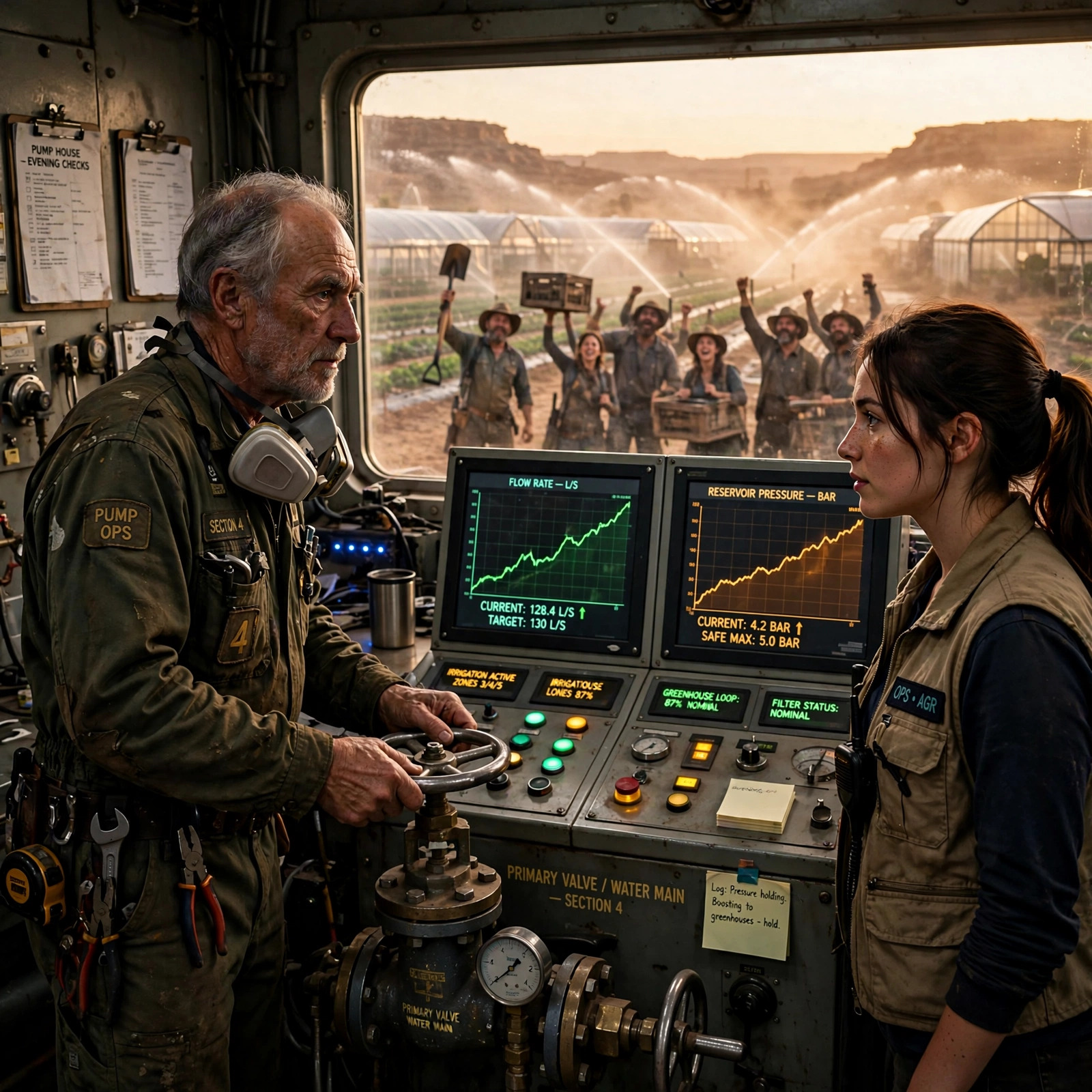
Dev turned the wheel. The line shuddered, knocked once, and caught, and along the greenhouse ridge the irrigation heads stuttered and then opened in a ragged, hissing sequence, the first water the colony had ever pulled up from below the permafrost rather than coaxed down into it, falling in fine arcs over rows of green that were mostly dust-colored this early in the season but that would not stay that way. Somebody in the crowd made a sound that was not quite a cheer and not quite a sob. The haze glowed amber over all of it, the tools, the tired faces, the water turning dark the soil where it landed, and behind Maren the green line and the amber line climbed their separate patient ways up the same chart, and she put her hand back on the fat guarded switch and left it there, feeling the pipeline knock, keeping the pace, keeping count.
Get notified when new stories drop

Sasha Quill
Sasha writes bold exploration and cosmic wonder with lyrical scale and grounded character work.
Leave a comment
Comments