

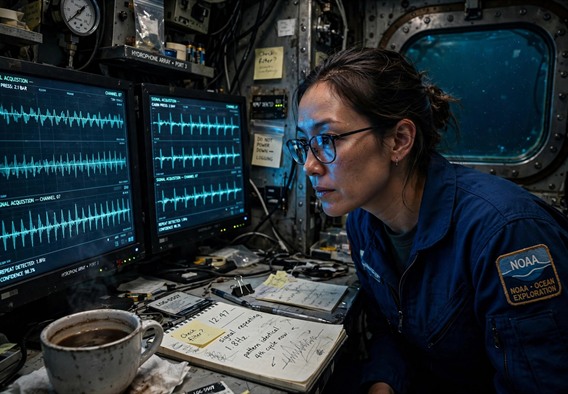

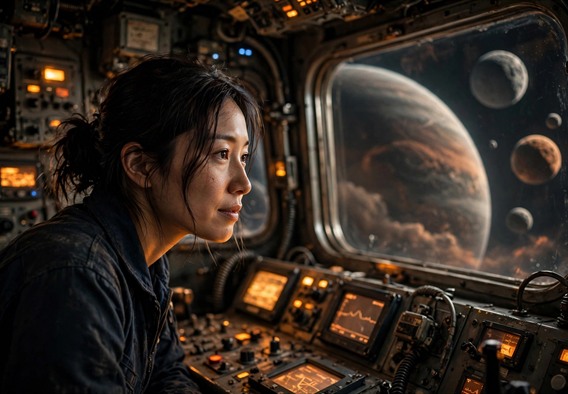
The moon came up over the horizon rim the way a held breath finally goes out: slow, gray-white, and then all at once there. Iris Okonkwo watched Little Harbor fill the lower half of Corvus Loop's forward display and felt the familiar tightening behind her ribs, the one that meant seventy-one days of transit and now we find out what we actually came for.

What they had come for, according to the mission packet, was ice. Boring, dutiful, survey-grade ice: a full map of the subsurface deposits on a moon nobody had ever bothered to visit, orbiting a gas giant nobody had ever bothered to name properly. Kestrel-9b. The b was an insult, she'd always thought, to a world with three centuries of weather in its clouds.
"Orbit insertion nominal," Renata Puente said from the helm bench. "Fuel remaining puts us at nineteen days of margin over the consumables line. That's the number I'll be defending for the rest of the window, so everybody memorize it."
"Nineteen days," Tam Voss said, not looking up from the geophysics console. "I heard it the first time. I'll hear it every day, I expect."
"You will," Renata said.
Iris smiled without letting it reach her voice. Six years of deep-system surveys had taught her that the chief mate's reciting of margins was not pessimism. It was liturgy. Renata had twelve years on survey hulls and had once brought a ship home after a primary tank rupture with nothing but the reserve, an aerobrake, and a crew that stopped speaking to her for a month and then never stopped. When Renata said nineteen days, the number was already load-bearing.
"Dev, how's the crawler?" Iris asked.
"Bored," Dev Acharya said from the engineering station. He had the kind of face that made everything sound like a confession. "I preheated the drill bus on approach. We can have the first core rig on the ice four hours after we're on station. Assuming the survey lead signs my overtime."
"Sign it."
"Done. I love this company."
The landing site was a plateau on the moon's sunward face, a bowl of ancient impact melt glazed with a hundred meters of water ice and a dusting of organics that the spectrometers insisted were uninteresting. That was fine. Iris had landed on uninteresting ice before. She had cored it, bagged it, logged it, shipped it, and watched the analysis come back saying, in the language of isotopes and grain sizes, nothing to see here, nobody's home, try the next moon.
Six years of that. Six years of routine, of watching the truly strange things in the survey feed get claimed by bigger programs with newer ships, of being the crew that arrived after the discovery and mapped the plumbing. She had a shelf of commendations for thoroughness. She wanted, with an ache she mostly kept off her face in front of the crew, one core that made somebody's hands shake.
Day seventy-one, hour nine, Little Harbor local. The crawler went down the ramp with all four of them aboard because nobody wanted to be the one left on the ship for the first hole. The ice under the treads didn't crunch; it rang, a high clean note that the cabin mics picked up and carried into the compartment like a struck glass.
"First site's two kilometers out," Iris said. "Tam, you get the ground-penetrating array. Dev, drill one. Renata, you're on watch and logging, and I know you hate it."
"I don't hate it," Renata said. "I'm good at it. There's a difference."
The plateau spread out around them under a sky that was mostly Kestrel-9b, the gas giant hanging there like a door someone had left open into a warmer room. Banded tan and cream, one small black eye of a storm rotating in the southern tropics. Tam kept tilting her head back to look at it and then catching herself and putting her eyes back on her screens.
"It's going to be in every photograph," Tam said. "Every single one. We're going to get so tired of that planet."
"Speak for yourself," Dev said.
Site one was a stake in the ice and a plume of chips. The drill came up with its first core at fourteen meters, and Iris handled it the way she'd handled a few hundred cores before: glove, sleeve, seal, label, into the sample rack. Tam ran the ground radar while Dev logged density, and the picture that assembled on the display was exactly what the orbital flybys had promised. Layered ice. A buried rubble horizon. A melt lens at forty meters that might once, a billion years ago, have been a puddle.
"Textbook," Tam said, and it sounded like a compliment and a shrug at the same time.
"Textbook," Iris agreed, and logged it, and felt the small deflation, and hated herself a little for the deflation, because thoroughness was the job and the job was worth doing. She drilled four more holes that day. Layered ice. Rubble. Textbook.
They worked the plateau for three days like that. The mission clock ran in the corner of every display, patient and indifferent: one hundred forty days total, seventy-one spent, sixty-nine remaining, and inside that sixty-nine, nineteen days of margin like a thin blue line drawn around everything they were allowed to attempt. Iris thought about the line more than she let on. Every traverse, every extra hole, every hour of drill time came out of it or out of the schedule, and the schedule was already carved to the hour by people on Meridian Station who had never watched a fuel gauge with their own eyes.
On the fourth day of surface work, at a site near the plateau's eastern scarp, the drill bit into something that changed the sound of itself. Iris had learned to listen to drills the way sailors listen to rigging. This was a shift from ringing to a kind of dense, wet quiet, and she brought the core up slowly, feeling the weight come onto the cable.
"That's heavy for the depth," Dev said, leaning over her shoulder.
"It's heavy for any depth."
The core came out dark. Not the dark of dust contamination, which was a familiar gray-brown, but a deep, glassy, almost bottle-green dark, and where the drill had cut it the surface was wet, actually wet, with a film that didn't sublime in the low pressure the way clean water ice would have. Tam crossed the crawler bay in three steps and had her loupe on it before Iris had finished sleeving the section.
"Clathrate?" Tam said. "That would be something."
"That would be a paragraph in a paper."
"A paragraph is something."
Iris ran the first assay herself. The mass spectrometer on the crawler was a good machine with a small ego; it had never once flagged a sample as anything more exciting than "consistent with regional baseline." She fed it a shaving of the dark ice, watched the plasma glow in the sample port, watched the isotope ladder build itself on the readout one careful mass at a time.
The deuterium column came up and Iris read it, and read it again, and put her hand flat on the console.
"Tam."
"What."
"Come look at this and tell me I'm tired."
Tam looked. The bay went quiet in the specific way that bays go quiet when someone reads a number twice. Even Renata, who treated all science readings with the affection of a customs officer, stood up from her watch station.
Deuterium fraction, forty times baseline. Not four times, which might have been fractionation in some odd reservoir. Not ten, which might have been a processing artifact in the spectrometer's intake line. Forty. Forty times the hydrogen isotope ratio of every core, every melt lens, every rubble horizon they had logged on this moon, in this system, in six years of Iris's career.
"Run it again," Tam said.
"I'm running it again."
She cut a second shaving from a different centimeter of the core, cleaned the intake port until her fingers aased in the cold, and fed it through. The plasma lit. The ladder built. The deuterium column climbed to the same impossible height and stood there, steady as a wall.
She ran it a third time with a sample from the bottom of the section, meters away from the first cut, and the number came back the same, and this time she didn't put her hand on the console. She stood there with the readout glowing on her face and felt her pulse in her throat, because there were only a few processes in the universe that could put heavy hydrogen into ice at that fraction, and not one of them was geological, and not one of them belonged on a dead moon orbiting a gas giant whose name didn't even have a proper ending.
"Forty times," Tam said, very quietly. "Iris. Forty."
"I can read." Her voice came out steadier than she expected. On the display, the mission clock ticked over: day seventy-four. Sixty-six days remaining in the window. Nineteen days of margin, still sitting there, still blue, still drawn around everything they were allowed to attempt.
Dev had come over from the drill and was reading the number upside down. "Is that the ratio? That can't be the ratio."
"It's the ratio," Iris said. "Three runs."
Renata's voice, from behind them, level as always: "Where did this core come from?"
Iris turned. Tam was already pulling the radar map, and the answer bloomed on the display before anyone had to say it: the eastern scarp, the site they'd drilled that morning, and beyond it, running away toward the far ridge of the plateau, a reflector horizon at depth that the ground-penetrating array had logged as rubble and that now, with the dark ice sitting in its rack ten meters behind Iris, looked like a seam of something very different, threading away from them into terrain they had no sites staked in, no hours budgeted for, no fuel assigned.
"The far ridge," Tam said. "That horizon runs all the way to the far ridge."
Nobody said anything for a moment. The gas giant hung in the crawler's small port, banded and patient, filling the sky over ice that had just stopped being boring.
Iris reached out and saved the assay file, twice, to two separate drives, the way she did with nothing, and the spectrometer's readout held its impossible number steady under her hand.
The mission room smelled like reheated grain and cold metal, the way it always did this far out, and Iris watched Renata Puente walk in with her slate already open, already organized, already knowing what the assay file was going to say before anyone showed it to her. That was the thing about Renata. Twelve years on survey ships had taught her to arrive at bad news early and sit down in front of it.
"Run it for me," Renata said, and she pulled a chair around backward and sat on it with her forearms on the backrest, which Iris had learned over six years meant the chief mate was not going anywhere until the numbers had been made to stand up and walk across the table in plain language.
Tam stood at the main display and did it without commentary, which was itself a kind of commentary. The radar section came up first: the eastern scarp, their six drilled sites, the reflector horizon running east-northeast like a vein under skin, out past every stake on the survey plan, up onto the far ridge of the plateau. Then the assay. The deuterium fraction, forty times baseline, in ice that had no business carrying it. Then the mission clock, in the corner, where it always was: day seventy-four. Sixty-six days remaining in the window.
"Say the far ridge is reachable," Renata said. "Say the horizon comes up where you think it does. Walk me to it and back."
"Three days out," Tam said. "The terrain between here and the scarp is flat, we've already ground-truthed four hundred klicks of it in the crawler. Past the scarp it climbs, but the grade stays under twelve percent most of the way. Call it three days out, three days back. Six days of traverse."
"Plus survey time," Iris said.
"Plus survey time, yes. Two days on-site would let us drill the horizon at three depths. One day gives us a single core and a prayer."
"Eight days," Renata said. "Eight days of the margin, gone. Out of nineteen."
Nobody argued the arithmetic, because it was arithmetic. Iris had run it herself twice during the hour between the third assay and this meeting, once on her slate and once on paper, as though the paper might catch an error the slate was hiding. It didn't. The margin was drawn in blue on every schedule aboard the Corvus Loop, and it existed for one reason: this system was seventy-one days from Meridian Station, seventy-one days from help, from resupply, from anything that wasn't the crew and what they'd brought. Nineteen days was what remained after the consumables were counted and the return burn was funded and the storm allowances were set aside. Nineteen days was the ship's entire permission to be surprised by anything.
An eight-day bite left eight days. Iris had been on vessels that came home on eight days of margin, and she had been on one that hadn't, and the difference between those two ships was a name she still couldn't say without her jaw tightening.
"The window for the decision is real but it isn't open long," she said. "We're on the plateau's spring. In eleven days the ridge route goes into thermal churn, the ice starts moving, and any traverse east of the scarp needs twice the fuel for half the distance. If we go, we go inside a week."
"If," Renata said.
"If."
Dev Acharya had been quiet in the corner with his own slate, which was unlike him, and Iris had already marked it. He turned the slate around now and the room's second display mirrored it: storm-watch, the feed from the long-range particle monitors, a plot of solar activity across the whole sky of Kestrel-9's local neighborhood.
"So here's my problem," Dev said. "There's a coronal region that rotated into view thirty hours ago, and it's angry. It's been throwing proton events at nothing in particular. The forecast models have it at thirty percent chance of an Earth-directed, sorry, a Meridian-directed ejecta inside five days, and that's the fast model. The slow model says it's nothing, it'll calm down, it always calms down."
"Which do you believe?" Renata asked.
"I believe the thirty percent, because the fast model has been right three of the last four times, and because I don't like the shape of the field lines." He rubbed his eyes. "If a particle storm hits while we're mid-traverse, we shelter. The crawler's shielded bay is rated for it. But we sit in a box for however long it lasts, burning nothing, and then we come out and we re-boost the crawler from the ship's reserve to make up the lost traverse time, and that comes off the same margin you're all counting."
"How much?" Iris asked.
"Depends on how long we sit and where. Half a day of shelter, trivial. A full day, it starts to hurt."
"So the honest number isn't eight days," Renata said. "The honest number is eight days if we're lucky and ten if we're not, and we're planning a traverse into the one piece of terrain on this moon we haven't surveyed, in front of a storm that has a three-in-ten chance of being real." She let that sit, then turned to Tam, and her voice lost a degree of its evenness, which from Renata was thunder. "Tell me what you think the horizon is. Not what you hope. What you think."
Tam took his time, and Iris watched him do it, hands in his pockets, looking at the radar section the way he looked at core samples, like it might change if he blinked.
"I think it's a reflector that's too continuous to be rubble and too deep to be a crater floor," Tam said. "I think the isotope ratio says there was water here that got fractionated by something that isn't the moon's own geology, because the moon doesn't have geology, it has cold. And I think that if we don't walk out to where that seam actually surfaces, we will spend the rest of our careers writing papers about a number we found once and couldn't explain."
"Or we spend eight days finding out it's a salt bed and a bad sensor," Renata said.
"The sensor ran clean three times."
"Sensors run clean and geology runs weird, you've told me that for nine years."
"This isn't geology. That's the whole point."
And there it was, laid out on the table the way it actually was, with no dressing on it. Iris looked at the mission clock and thought about the two drives in her pocket, the assay file saved twice, the way she saved nothing. Six years of deep-system surveys. Six years of ice that was exactly the ice it was supposed to be, cores that came up dry and ordinary, reports that read like inventories. She had joined the survey to stand in a room like this one with a number on the display that nobody had an explanation for, and now she was standing in it, and the price of staying in the room was printed in blue on the schedule.
"I'm not deciding on hope," she said. "Tam, if the horizon surfaces anywhere on the far ridge, where does it surface? Give me a site."
He pulled the ground-penetrating overlay forward and expanded the far ridge until it filled the display, and tapped a point on the northeastern shoulder where the reflector brightened and thinned. "Here. Where the seam rides up against the scarp face. If it's coming up anywhere, it's coming up there. Two hundred meters of overburden at the most."
"Two hundred meters," Dev said, whistling low. "That's deep drilling. The crawler's rig can do it, but the rig draws hard. We'd be running the drill and the crawler's heaters off the same bus. It's doable if the bus is healthy."
"Is it healthy?"
"It's healthy today."
Renata said, "Iris."
Just that. Iris looked up from the display and the chief mate was watching her with the flat, patient look of a person who had decided to lose this argument in advance and intended to lose it loudly enough that it would be on the record.
"You know what I'm going to say."
"Say it in the log," Iris said. "Say all of it."
Renata stood, took her slate off the backrest, and set it upright on the table, recording light on. Her voice came out level, the way it did in drills, the way it did in the two real emergencies Iris had seen her run.
"Formal objection, for the record. As chief mate I hold the consumables and the return budget. The margin is nineteen days. The proposed traverse to the far ridge costs six days round trip plus a survey window of two days, against a storm forecast with a thirty percent probability of a particle event that would add shelter time and a re-boost off the same reserve. The committed cost is eight days minimum and plausibly ten. That leaves this vessel eight to eleven days of slack for the remainder of a sixty-six-day window, in an unsurveyed operating area, seventy-one days out from Meridian Station. I do not believe the science return justifies cutting the margin in half, and I am stating that now so nobody has to wonder later what I thought." She stopped the recording, and her shoulders came down a fraction, and she added, off the record, quieter: "That's a clean objection, Iris. It deserves a clean answer."
"Here's mine," Iris said. "We've spent six years telling ourselves the margin exists so we can be careful. It doesn't. It exists so we can be brave exactly once, when the number on the screen is worth it. This one is worth it. I've read the ice my whole career, Renata, and I have never once seen it lie like this."
"And if it's a salt bed?"
"Then I'll have spent eight days and my reputation finding out it was a salt bed, and we'll come home on eight days of margin, and you'll get us home, because that's what you do." She pulled up the traverse plan, the one she'd been building in the margins of the hour before the meeting: route east past the scarp, camp one at the flat, camp two below the ridge shoulder, drill site on the northeastern face, departure inside five days to beat the thermal churn. Provisional, unsigned, the order field blinking at the bottom. "The window for this decision closes in six days and I'm not willing to spend five of them agreeing with each other."
Dev raised his slate. "Storm-watch stays live. Anything over class two and I call it, traverse or no traverse."
"Agreed. Renata, you hold the abort authority on consumables. If the margin touches ten days remaining, we turn around, no discussion, and I'll sign that too."
Renata looked at the plan on the display for a long moment, the route threading east across ice she had never once described as interesting, toward a ridge none of them had set foot on. "You'll give me the return-abort as a hard line. Not a suggestion."
"Hard line. Written in."
Renata nodded once, and that was the whole surrender, and everyone in the room knew it.
Iris put her hand on the order field and stopped, one last time, the way she had stopped in front of the spectrometer with the sample in the intake, checking nothing, just letting the moment be real before she spent it. Then she signed. The log took the order, timestamped it, flagged it against the objection already recorded above it, and posted the traverse plan to the ship's board where all four of them would see it every morning: provisional no longer.
"Camps pack tonight," she said. "We roll at first light."
They rolled at first light, and Little Harbor's first light was a slow gray bleed over the gas giant's shoulder, Kestrel-9b rising like a held breath on the eastern horizon. Iris rode in the navigator's couch and watched the scarp slide past on the display, the crawler's treads chewing a line of disturbed frost into a surface that had been still for something like four billion years. She kept catching herself listening for the spectrometer. It was back on the ship, humming to itself in the hold, holding its impossible number like a held card.
Sixty-one kilometers to the flat where they'd make camp one. The crawler made eleven an hour on good ice, and the ice out here was very good, which was to say it was boring, which was to say it was exactly what she'd spent six years learning to trust. She caught herself doing the arithmetic again: eleven an hour, sixty-one klicks, and if Dev's storm-watch held at class one, they'd make the flat with two hours of light to spare.
"Storm-watch," Renata said from the command couch, not looking up. "Say the number."
"Class one, holding," Dev said. "Proton flux is up a little from last night. Nothing you'd write home about."
"Everything out here is up a little from last night," Tam said. She had her sample case open on her knees, re-packing it for the third time, and Iris had decided not to say anything about it. "That's what a gas giant does to local space. It's a radio station the size of a planet and it never shuts up."
"It's not the gas giant I'm watching," Dev said. "It's the sun."
He said it flat, and Iris let it sit. The sun was three hours behind them in the sky, and it had been running quiet for weeks, and quiet was not the same as safe. Everyone on the crew knew that. Quiet was just the pause before the sentence.
The scarp went by. The light came up gold across the ice, and for a while it was genuinely beautiful, and Iris let it be beautiful without guilt. There was no version of this job where you got to see this and hadn't earned it. Then the flat opened ahead of them, a pan of wind-carved sastrugi running east, and Renata brought the crawler down onto it and the ride smoothed out and the hours started to pass the way hours pass when nothing is wrong.
At kilometer forty, Dev cleared his throat.
"Storm-watch," he said. "Say the number."
He said it to himself, the little ritual, and then he said it again, louder, and Iris was already turning because there was a specific flatness in his voice the second time.
"Class two," Dev said. "Flux climbing. Climbing fast. Iris, this is not a drill, it's climbing like it's got somewhere to be."
Renata's hands were on the board before he finished the sentence. "How fast?"
"It was class one forty minutes ago. It's class two point five and the proton count has tripled in the last ten minutes. I want the bay. I want the bay now."
"Bay it is." Renata slewed the crawler broadside to the wind, which on this moon meant nothing, because there was no wind, but the geometry mattered: the crawler's shielded bay was armored on one face, leaded composite and water jacketing, and she wanted that face toward the sun. "Everyone in. Tam, seal the sample case. Iris, log the timestamp."
Iris logged it. Day seventy-seven, oh-nine-forty local. She said it aloud as she typed it, because a log entry nobody hears is a log entry nobody checks, and Renata had taught her that a long time ago.
They went down into the bay through the narrow hatch, and Dev pulled it shut behind them and dogged the wheel, and the four of them stood in a space built for six, in the dark, until someone found the bay lights and the place revealed itself: benches, straps, the water jacket's curved wall sweating a little where the heaters fought it, a smell of ozone and cold plastic. The crawler's frame ticked above them as the temperature outside swung.
"How long?" Tam asked.
"Eleven hours, maybe twelve," Dev said, and then he was already moving, because the flux number was still climbing, and Iris watched him pull his tool roll out of the wall locker and go to the power bus panel without explaining. "The bus," he said, when he saw her watching. "The jacket's fine, the bay's fine, but the bus runs through the crawler's spine, and the spine's shielding is half what this wall is. If the flux spikes the way the curve says it's going to spike, the bus trips and everything trips with it. Heaters. Scrubbers. The works."
"So we ride it dark," Renata said.
"We ride it dark and cold, and the scrubbers don't run, and eleven hours of four people in a sealed can gets real interesting around hour six." He had the panel off already. "Or I sit next to the bus and keep it alive by hand when it trips. Manual reset. It trips, I reset it, it trips, I reset it."
"Next to the bus is next to the spine," Iris said.
"Next to the bus is next to the spine," Dev agreed. He clipped his dosimeter to his collar where he could see it, and that was the whole conversation, and nobody tried to have it again.
The storm arrived the way these things arrive, which was all at once. The bay's little monitor showed the outside flux go from a wall to a mountain, and the crawler's spine started taking hits that Iris could feel through the deck, faint clicks in the frame, and then the bus tripped for the first time and the lights went out and Dev reset them in the dark before anyone had finished inhaling.
"There," he said.
It tripped again nine minutes later. Then again four minutes after that. Then it started tripping in runs, and Dev pulled his bench over next to the open panel and sat there with his hand on the reset and his dosimeter on his collar, and the rest of them sat in the half-dark between trips and did what people do.
Tam talked about ice. She couldn't help it; Iris had known her nine years of shared postings and had never once seen her not do this under pressure, and by hour three Iris had stopped minding and started asking questions, because the alternative was counting clicks in the frame. Tam described the isotope fraction again, the number from the core, and how a deuterium fraction forty times baseline didn't happen in geologic ice, couldn't, the physics of fractionation didn't permit it, cold slows the separation and rock doesn't concentrate and time evens everything out. "Something put it there," she said. "Something recent or something deliberate, and I don't care which, I want to be there when we find out."
"If the margin lets us," Renata said.
"If the margin lets us."
Renata ran her consumables board in her head, out loud, quietly, mostly to herself: water, oxygen, calories, the return re-boost budgeted in fuel and not in air. Iris listened and did not interrupt. The numbers were the numbers. Around hour five the bus tripped three times inside ten minutes and Dev reset it three times and his dosimeter ticked up past what Iris wanted to look at, and she looked at it anyway.
"Dev."
"It's fine."
"Dev."
"It's fine, Iris. It's under. I'm watching it." He was watching it. He never took his eyes off the collar clip except to reset the bus. "Quarterly limit's the number they set so you've got slack in an emergency. This is an emergency. This is what the slack is for."
Hour six. The scrubbers ran because the bus ran, because Dev sat with his hand on the reset and made it run, and the air stayed breathable and the heaters held the bay at a livable cold, and outside the flux climbed and climbed and the frame clicked like something patient working at a lock. Renata made tea from the emergency rations packs, four cups of it, and passed Dev his without a word, and he drank it one-handed.
Hour eight. Hour nine. The trips came slower now, the storm's peak passing over them, and Tam had gone quiet and Renata had gone quiet and Iris sat with the traverse plan running behind her eyes, the whole route, the camps, the drill site on the northeastern face, the return window that had been built to survive one storm and was now going to have to survive this one. Fuel for the return re-boost. The re-boost was budgeted to the tenth of a cell, and the storm had made the crawler's heaters burn rich for eleven hours, and every rich hour came out of the same tank that was supposed to lift them off this moon and point them home.
She did the arithmetic and did not like the remainder and put it away until she could do it on a screen.
Hour ten. Hour eleven. The monitor's curve came down off the mountain like a tide going out. The clicks in the frame spaced themselves out, and then stopped, and the silence after was so complete that Tam said, "Is that—" and Dev said, "Yes," before she finished, and nobody moved for a minute, all four of them listening to the crawler's frame be quiet.
"Storm-watch," Renata said finally. "Say the number."
"Class two, falling. Falling fast." Dev unclipped the dosimeter from his collar and held it up to the light and read it, and Iris watched his face while he read it, and watched him decide to say the number anyway, because he was the one who'd taught them all that a number nobody hears is a number nobody checks.
"Eighty-six percent of quarterly," he said. "So I'm going to spend the next three months being very boring. No EVAs, no close work with the reactor, lots of standing behind walls."
"Dev—" Iris started.
"It was the bus or the scrubbers, and the scrubbers were the air, and I've grown real attached to the air." He was grinning, but it came out thin, and he knew it, and he put the dosimeter away in his shirt pocket with the care of a man filing something important. "Besides, now I've got the best story at Meridian Station for a year. Nobody tops a class two point five."
"Somebody will," Renata said.
"Not somebody I drink with."
They undogged the hatch and came up out of the bay blinking. The sky over Little Harbor had gone to a hard clean black, the storm's particle flux invisible the way it had always been invisible, the whole event already gone as if it had never happened, except for the dosimeter in Dev's pocket and the fuel that was no longer in the tank. The ice ran east under the risen stars, sastrugi silvered and still, and Iris followed Renata's arm out and up.
The ridge was there.
It had been a line on the survey plot and then a shape on the horizon, and now, eleven hours and a storm later, it stood up out of the plain like something that had been waiting for them, the northeastern face catching starlight on what looked like bare rock strata, dark bands in pale ice, all of it twenty kilometers out and exactly where the plan said it would be.
"Camps," Iris said. "We've lost the flat. We make camp where we sit and we make the time back tomorrow."
"The time comes out of the return margin," Renata said. It wasn't an objection. It was arithmetic, said out loud so it would be on the record, and Iris nodded and let it be on the record, and Renata set the crawler down where they stood and started the heaters burning rich to warm the cabin, and Iris stood in the open hatch with the cold on her face and watched the ridge.
"Well," Tam said beside her. "It kept."
"Kept what?"
"Still looks like it's hiding something." Tam's breath went out silver. "That's all."
Dev came up last, one hand on the hatch rim, his other hand flat against his shirt pocket where the dosimeter rode, and he looked at the ridge for a long moment and then at Iris.
"Eleven hours I'll never get back," he said. "Worth it if that thing's real."
"It's real," Iris said, and turned the crawler's floods onto the ice ahead, and the light ran out ahead of them across the plain toward the dark face of the ridge, and she thought she had never in six years seen anything on a survey screen look half so much like a held breath.
The ridge did not let them come to it gently. The last six kilometers ran uphill through broken slabs where the ice had been thrust and folded by something underneath it, and Renata took the crawler through in first gear at a walking pace while Tam rode with his face close to the plot screen, calling the fractures as they showed, and Iris sat in the jump seat with her eyes on the mass spectrometer's readout, which she had no reason to watch and could not stop watching. The deuterium fraction held at forty times baseline all the way up. If anything it climbed: forty-one, forty-one, forty-three, as though the ice under the crawler were sorting itself ahead of them, the heavy water lying deeper and deeper the closer they came to the dark strata of the northeastern face.
They reached the survey coordinates in the last hour of the nominal work shift, and Iris called it: no camp, straight to the site. Renata parked the crawler broadside to the ridge with the drill bay facing out, and the crew stood in the floodlights on a patch of churned snow and looked up.
"All right," Tam said. "That's not geology."
The northeastern face was a wall of ice and rock twelve meters high where the plain had been shoved upward into a fault scarp, and the dark bands they had seen from a distance were real: layers of near-black material, centimeters to half a meter thick, sandwiched between clean pale ice in a stack that ran up the whole face. In places the black layers had melted out at the surface and lay in talus at the base, soft and granular, and Tam went to his knees in the floodlight and pressed his bare glove to a fragment and lifted it and did not say anything else for a long time.
"Iris." He held it out. "Smell."
She took it. It was heavier than ice should be, and it had a smell, faint and cold and not like anything on the standard survey card: not sulfur, not organics as she knew them, something under all of that, mineral and clean. She held it under the flood and turned it. There were structures in the broken face of the fragment, fine laminations, evenly spaced, too regular for crystal habit and too irregular for cleavage, and she had six years of ice cores in her head and nothing in any of them looked like that.
"The spectrometer said subsurface," she said. "It's surfacing on its own."
"It's surfacing because the scarp's collapsing." Tam was already unloading the sample kit. "The layers are coming up from depth. Iris, these bands could be three, four hundred meters down where they're undisturbed. What we can reach from up here is the shredded edge of it."

"Then we drill."
"Then we drill." He said it like a man agreeing to something he wanted more than she did.
The drill lived in the crawler's aft bay, a coring rig on a tracked sledge that fed off the crawler's power bus through a hardened umbilical. It was Dev's rig in the sense that everything with a cable was Dev's rig, and Dev had gone straight to it as soon as they parked, before anything else, because he was the one who had spent the storm with his hand in the bus compartment holding a junction together while the flux was at its worst. He had told them on the way up, in the flat voice he used for things he did not want discussed, that he had re-seated everything and taped the junction and thought it was fine. Thought.
Now he stood in the bay with the umbilical in both hands and the test panel open, and he did not move for so long that Iris came to him.
"Talk to me, Dev."
"Give me a minute."
"You've had twenty minutes."
"Then give me one more." He pulled the test lead out, re-clipped it, ran the panel sequence again with his mouth slightly open, which was how he concentrated. The panel cycled, threw a fault, reset, threw the same fault. He did it four more times. The fault number did not change. He sat back on his heels and rubbed his face with the heel of one hand and said, to the panel rather than to her, "It's the junction I held. The bus is fine for the crawler — heaters, floods, drive, all fine, it's got redundancy. But the drill feed runs through the section I was holding, and the drill doesn't have redundancy, because the drill is a power hog and it needs a clean high-draw feed, and that section took the induction spike and the bus metal's fatigue-cracked along the whole run. It'll take amps for the low stuff. It will not take drill amps. It'll fail in the first ten minutes and then it'll fail for good."
"Can you bypass it?"
"I can bypass a junction. I can't bypass a cracked bus section, not out here, not without a bench and a fabricator and about three days." He looked up at her, and his hand drifted to the shirt pocket where the dosimeter rode. "I held it as long as I could. That's what I got for it."
Behind them, out on the snow, Tam's head came up from his sample trays.
Iris looked down the bay, past Dev, to the rack where the drill's power head sat in its cradle with the umbilical coiled beside it, all of it intact and all of it useless. Then she looked at the wall of ice, at the black layers stacked in it, at the thing that was forty-one to forty-three times baseline and rising, and she felt the shape of the problem assemble itself all at once, the way it did on the rare days when there was no way around a thing and she could stop looking for one.
"What would take drill amps," she said.
"A clean high-draw feed. Anything that isn't this bus."
"We're on a crawler with one bus and a ridge with no outlet. Name it, Dev."
Dev did not answer. Renata did, from the bay door, where she had been standing for how long Iris did not know.
"She knows," Renata said. "She's known since before she asked. She's making you say it."
"The reserve," Dev said quietly.
The reserve cell rode in the crawler's forward bay in a shock-mounted cradle, black and rectangular and stenciled in three places, and it was not crawler equipment and it was not drill equipment. It was the ship's cell. It had come down with them on the traverse because procedure said the abort contingency stayed with the party, not with the ship: if anything on the traverse went wrong enough that they had to abandon the crawler and launch the lander straight off the ice to rendezvous with Corvus Loop, the reserve cell was the power that would get the lander up and match them to the ship. It was fuel, and it was also a promise: the promise that no matter what they did out here, there was a door home that did not depend on anything else being intact. Nineteen days of margin had become eight after the traverse and the storm's re-boost. The reserve cell was not part of the eight. The reserve cell was the thing that made the eight survivable if the eight turned into six, or five, or a failed drive unit, or any of the forty ways a return leg could go wrong across seventy-one days of open space.
Renata came down the bay and put her hand flat on the cradle lid and left it there.
"You want this said clean, I'll say it clean, and then it's said and we're not circling it in the snow at midnight." Her voice was level, which was worse than loud. "If we burn the reserve in the drill, we drill. Fine. The cores come up, Tam gets his layers, the program gets its forty-to-one, and it's real, and it's worth real money and real careers, and I am not saying it isn't. What I'm saying is arithmetic. After the drill, this crawler goes back to the ship with no abort cell and a return margin of eight days against a burn window that the storm already ate into. We fly home nominal or we don't fly. There is no third option. If the main drive so much as hiccups on the return leg — one ignition delay, one course-correction we can't make — we're a survey ship with no reserve, and there's nobody out here to be our reserve for us. Meridian Station is seventy-one days away and nobody's expecting our telemetry to look strange until it's strange."
"I know what it means, Renata."
"Then I want one more thing on the record, because you signed the traverse order over my objection and that's done, and I'm not relitigating it." Renata took her hand off the cradle. "The cell's rated draw is triple what the drill needs at full load. It will run the rig. It will run the rig and half the floodlights and the heaters besides, and it will do it for days. That's not the problem. The problem is that once it's cabled into a drill on a ridge, it's a drill cell. Nobody flies home on a drill cell. So what I want on the record is that you know that, and you're doing it anyway, and that when you say 'commit the reserve,' what you're saying is 'commit the crew's door home.'" She looked at Dev, then at Tam, then back at Iris. "Say that."
The floodlights hummed. Somewhere under the ice, four hundred meters down, the black layers lay where they had lain for longer than anything Iris could usefully count, laminated and even and patient, doing whatever it was they had been doing all this time.
"I know what I'm saying," Iris said. "Log it with those words. 'Commit the crew's door home.' Then put my name under it, because it's mine, and nobody else stands under it."
"You'll stand under it alone," Renata said, "and the rest of us will stand out on the ice beside you. You understand I think you're right?" Iris stared at her. "You look at me like I'm the enemy. I filed the objection so that when it works, it works with the math done honestly. Somebody has to hold the honest numbers, and you're not that somebody tonight, Iris. You're the one holding the drill cable. Log it, Tam."
Tam had the log open already. He read the entry back — day eighty, 23:12 ship's time, decision to commit return-reserve fuel cell to coring operations at site seven, objection recorded by Chief Mate Puente, decision by Survey Lead Okonkwo — and Iris said "logged," and her own voice sounded far away, and she found she was holding the sample fragment Tam had handed her, the heavy black ice with its fine regular laminations, and she had not put it down since.
"It's four hundred meters to those layers," Tam said, into the silence after the log. "The drill can do it on that cell. It can't do it on anything else we have."
"I know."
"And it's four hundred meters." He turned the fragment over once. "If the isotope signature is real all the way down — if it's layered, if it repeats — then whatever laid it down was doing it on a schedule. In ice. On a moon with no weather worth the name. That's not chemistry, Iris. That's a record."
"Then let's read it," Dev said. He was already up, pulling his gloves tight, and there was something in his face Iris had not seen since the storm broke — the look of a man who had decided that the dose he'd taken was going to be worth it. He unlocked the forward bay and the cold poured in, and the reserve cell sat in its cradle with its three stencils and its shock mounts, heavier than ice should be.
"That's a two-person carry," Renata said.
"It's a four-person carry," Iris said. "Nobody carries our door home alone."
They broke the shock mounts one at a time, Dev on the release clips and Renata bracing the frame, and the cell came out of the cradle heavy and dead and indifferent, and they walked it down the ramp onto the snow of the ridge, all four of them, gloved hands on the lifting lugs, breath silvering in the floodlights — Iris at the forward-right lug with the cold biting her wrists, and the black ice of the wall rising over them, layer over layer, waiting to be read.
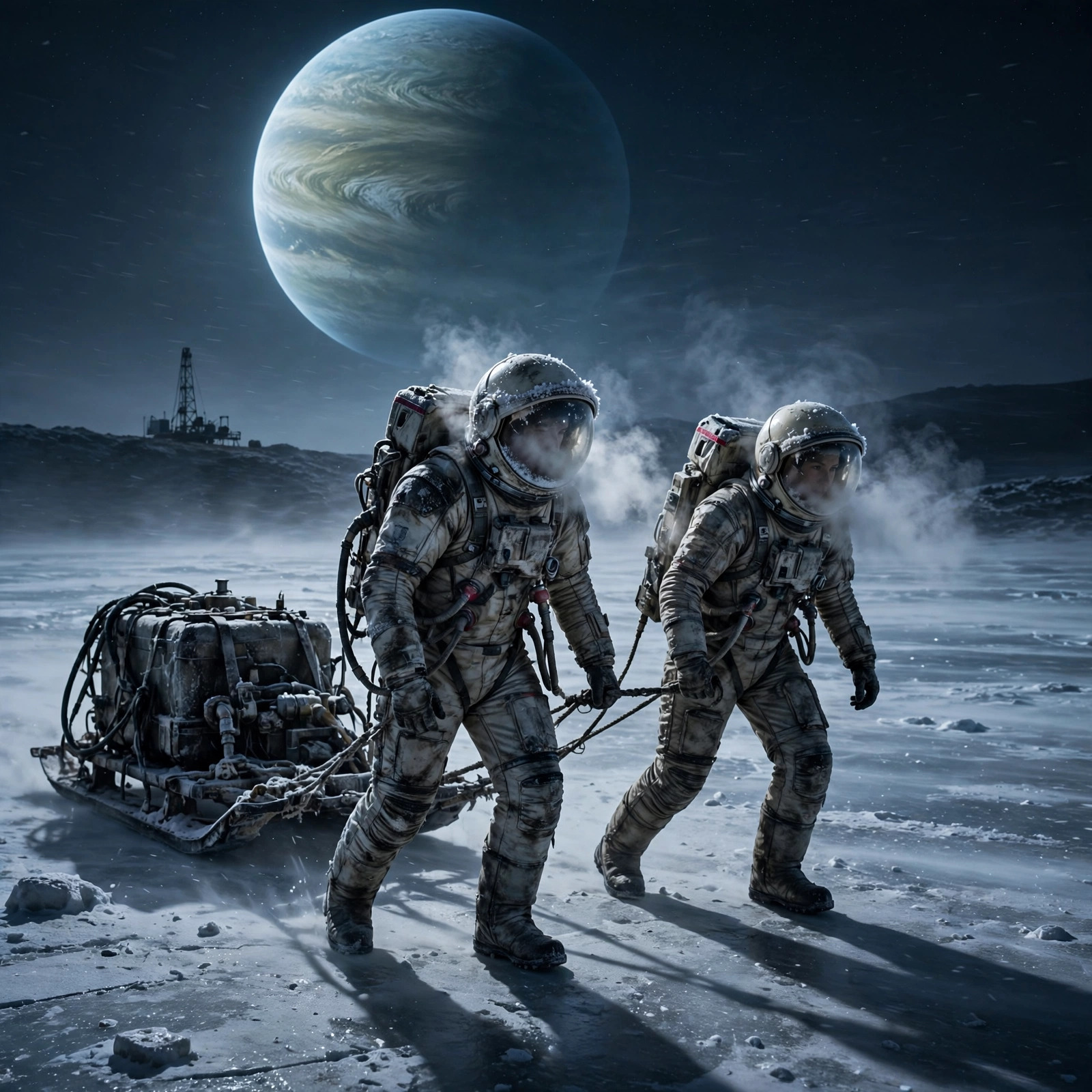
The cell rode heavy between them, and the ridge did not care. Four hundred meters of ice stood over their heads in the wall of the cut, banded black and gray, and Iris walked with her gloves locked on the forward-right lug and her breath tearing silver in the crawler's floods. The ground here was not snow. It was old firn, wind-carved into shallow troughs, and every third step one of them sank to the ankle and the other three took the weight without a word. Nobody had breath to spare for words. The cell weighed a hundred and ninety kilos dry, and it weighed more than that now, because it was the abort, and everyone carrying it knew exactly what it was they were carrying.
"Site's forty meters," Renata said, when the crawler's lights fell behind them and only their helmet lamps were left. "Call it forty. Swing left at the survey flag."
They swung left. The flag was a sliver of orange in the dark, and beyond it the drill rig stood where they'd parked it before the storm, low and patient on its outriggers, its feed cable coiled under a tarp that had iced itself to the frame. Dev let go of his lug long enough to crack the tarp free, and the sound of it went off the wall of the cut and came back twice.
The mounting cradle on the rig was built for the crawler's power packs, not for the ship's reserve, and for a bad minute it looked like it wouldn't take the cell at all. The bolt pattern was wrong. Two holes short. Renata stood over it with her lamp in her teeth and said nothing for a long time, and Iris knew what she was doing — she was doing the math on whether the cell could be secured well enough to be safe and badly enough to be fast, and whether she could say yes to both at once.
"Dev. Lashing kit in the aft locker?"
"There's a left in the aft locker."
"Bring it. We'll strap the frame and shim the feet." Renata pulled her lamp out of her teeth. "It'll hold. It won't hold pretty."
Iris stood back while they strapped it. That was the agreement, unspoken: her hands were the ones that would make the cable connection, so her hands stayed clean and dry and shook as little as they were going to shake. Tam crouched at the lip of the borehole with his hand lens and his fragment of laminated ice, and he did not look up once, not at the cell, not at Iris, not at the sky where the storm had been. He looked at the ice. He had been looking at the ice for six days and this was the last forty meters of a walk he'd been making since the readout first came up wrong.
The feed cable ends were keyed. She'd checked that three times on the traverse out, lying awake in the shelter bay with the schematic glowing on her forearm, and she checked it a fourth time now, on her knees on the firn, with Dev holding the lamp. Reserve-side, a heavy three-pin with a bayonet collar. Rig-side, a panel bus behind the housing plate. Four bolts. Her driver had ice in the shank and she had to knock it out against her boot twice.
"Talk to me," Renata said. She'd come around the rig and stood over her, and it was not a challenge. It was the chief mate asking for numbers she could log.
"Panel's live-side cold," Iris said. "Cell's isolated. Ground strap first, then bus, then collar. If the collar doesn't index I stop and we go home with what we have."
Renata nodded once. "Go."
The ground strap went on clean. The bus cable went on clean — heavy in her gloves, cold enough to stiffen her fingers through them — and the bayonet collar indexed on the second try with a click she felt in her wrist bones before she heard it. She sat back on her heels.
"Cell's in," she said, and her voice came out steadier than she'd earned. "Dev, interlocks."
"Interlocks green. Panel green." A pause. "Cell's got headroom like I've never seen on this rig. It doesn't even know it's working."
That was the door home, saying that. Iris let everyone hear it and nobody answered it.
The drill head went down on auto, and the first core came up at twenty meters and was ordinary — gray, glassy, the same boring hydrate ice they'd cored on nine other moons. Tam split it, sniffed the fresh face out of pure habit, and shook his head. At sixty meters the same. At a hundred and ten, the same, and the rig's power draw sat flat and easy and the cell gave it everything asked, and Iris stood at the panel and watched the depth counter and could not make her hands stay still in her pockets.
It was possible it was nothing. She'd held that thought at arm's length for six days, but here, with the meter ticking, it closed in. A contaminated readout. A sensor drift. A single weird layer laid down once, by some hydrothermal freak, and below it, three hundred meters of the same glassy nothing they'd cored everywhere else since Meridian. She had burned the abort for a maybe, and the maybe was still maybe, and Renata was ten steps away logging power figures with her back to her, and Iris could not even look at her.
"Hundred and forty," Dev said. "RPM's holding."
"Hundred and eighty," and the core came up and Tam split it under the floods and went still in a way that made both of them walk over.
"Dark band," he said. "Sharp. One centimeter, maybe less." He held the fresh face up. There it was — a hairline of black in the gray, straight as a rule. He got the portable spectrometer out of its case with his gloves in his teeth, and they stood around him while it thought, three helmet lamps and the rig's floods all burning on one man's kneeling back.
The number came up and Tam read it and did not say anything for long enough that Renata said, "Tam."
"Same fraction. Same as the surface sample." He turned the display around so they could see it themselves. "Deuterium enrichment, forty times baseline, plus or minus nothing I'd bet the ship on. In a one-centimeter layer at a hundred and eighty meters." He looked up at the wall of the cut behind them, the four hundred meters of banded ice rising over all their heads. "It's not one layer. Iris. It's down there too."
They took cores at two-twenty. Black band. At two-sixty. Black band. At three hundred, the drill's auto-sequence threw a fault — torque spike, hard refreeze at the head — and for eleven minutes it was genuinely in doubt, Dev flat on the firn with the housing plate off and his dosimeter riding his wrist where they could all see it, three weeks of his quarterly limit on it already, telling them the truth about what the storm had cost. He backed the head off a quarter meter, re-seated, and put it down again, and the rig took the bite.
"Coring," his voice said, half muffled in the housing. "Coring at three-forty. Going to depth."
The last core of the night came up at three-ninety, and it came up wet. Not fractured, not slushed — wet, a shine of melt on the fresh face before it could sublimate, and Tam caught it against his glove and swore softly and got the spectrometer on it before the shine was gone. The band was there, thicker, two centimeters, and above it and below it, fainter — the ghosts of earlier bands, a rhythm in the ice like growth rings, like tide lines, laid down in a moon with no weather and no tides worth the name.
"Layered," Tam said. "Repeating. Non-geologic spacing — I can say that now, I've got enough of them. Nothing chemical does this on a regular schedule." He looked at Iris across the core. "It's a record. Whatever laid it down came back. Over and over. Long enough to fill half this ridge."
Nobody said anything. The drill turned over gently behind them, chewing the tail of the run, and its floodlight burned down into the open borehole and lit the shaft walls from inside, four hundred meters of them, every band it had crossed picked out in the light like a page under a lamp.
Renata's voice came out low. "I want it on the log that I objected. And I want it on the log that I was wrong to."
"You weren't wrong," Iris said. "The numbers you held were honest. I made the call."
"Then the call's on the log twice." Renata looked at the open hole, at the wet core in Tam's hands, at the cell strapped in its ugly lashings on the rig frame, giving everything it had. "Eight days' margin. We burn home clean if nothing else goes. I'll fly it that way."
"You'll fly it that way," Iris said.
Dev got up off the firn, put the housing plate back, and came and stood on her left. Tam came and stood on her right with the core against his chest like something that had been lifted out of a well. And Iris crouched at the panel and put her bare glove on the feed cable, the live one, the one that ran from the door home to the drill, and felt the current through it, a small steady tremor, like water in a pipe, like something being carried.
The floodlight over the borehole burned steady. Nobody moved to switch it off.
Get notified when new stories drop

Ava Kepler
Ava writes space exploration and cosmic adventure with competent crews, hard problems, and awe that earns its hope.
Leave a comment
Comments