


Day Forty-One
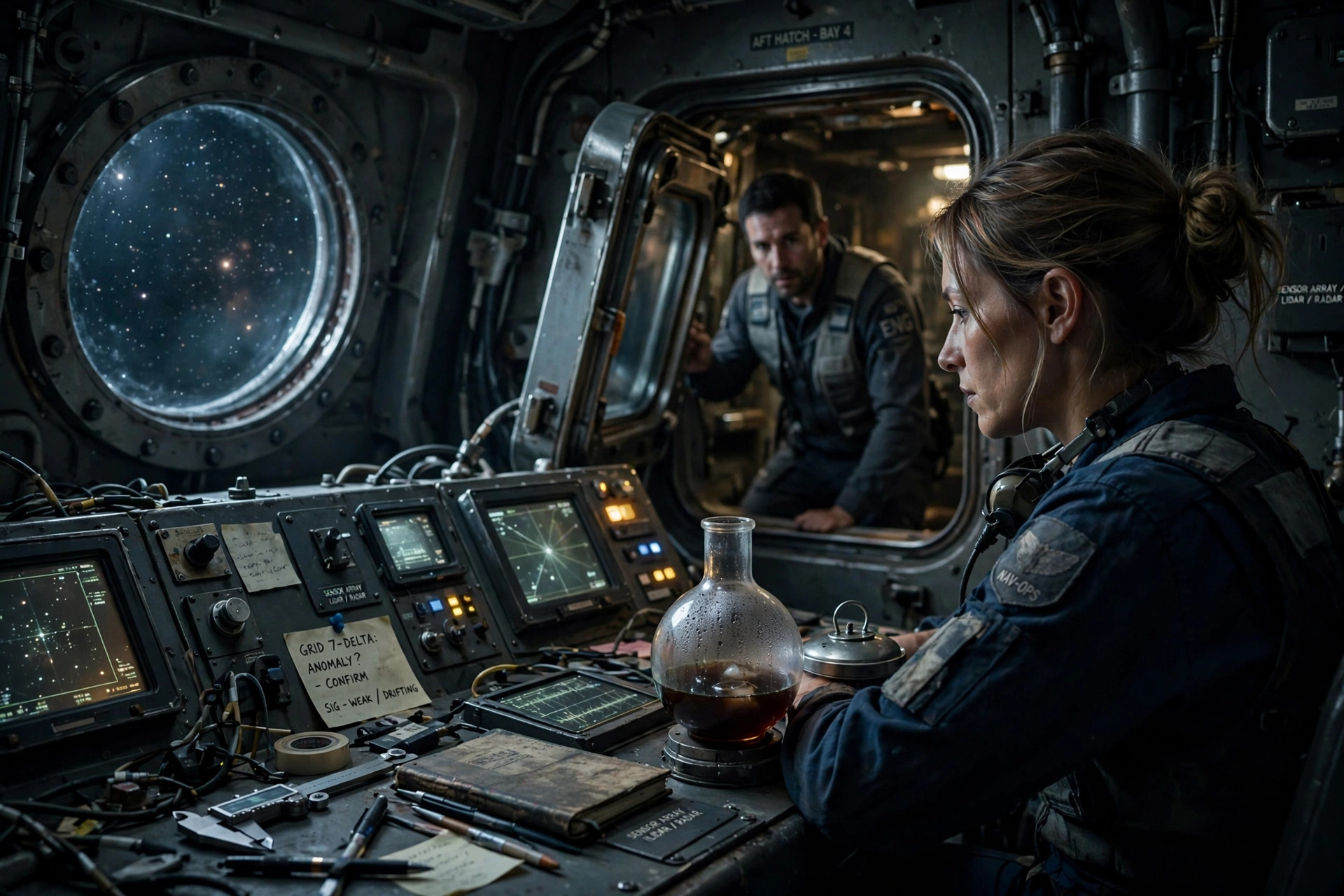
The nightly sweep began, as it always began, with a coffee bulb gone cold on the console and forty thousand unidentified objects waiting to be ignored. Ilsa Merrow ran the sweep the way other people brushed their teeth: hands moving before the mind fully arrived. Tag, classify, dismiss. Tag, classify, dismiss. The Kepler-belt contract zone was a suburb of the cosmos, and her job was to confirm that nothing in it had ever done anything interesting.
Rock. Rock with a frost rind. Rock that used to be a rock and was now a gravel cloud she filed under collisional debris, parent unknown, parent not missed. A methane seep off a tumbling iceteroid, insipid enough that the consortium's automated parsers had already chewed it into a digestible paste of Not Economically Significant. She approved the parsers' verdict with a keypress and moved on.
Day forty-one of one hundred and eighty. Two hundred and ninety catalogued objects tonight, which put the survey two points ahead of the schedule curve, which meant tomorrow she could spend an hour on the calibration backlog she'd been pretending didn't exist. The sensor bay smelled the way it always smelled: hot electronics and the faint cucumber note of the humidity scrubbers, which had never once scrubbed anything to anyone's satisfaction. The bay's single viewport showed the belt as it actually was from this distance—not dramatic, not crowded, just a black field with a scatter of unimpressive lights, most of which had already disappointed her.
Dmitri Volk came through the aft hatch at ship-night plus one, carrying his slate against his chest like a waiter carrying a tray he didn't trust. He was three years into this run and still moved through the ship as if it might object to his presence, shoulders rolled forward, apologies preloaded.
"You flagged eleven objects tonight," Ilsa said, not looking up. "I signed off on ten of them."
"Eleven's a lot. I know. I was behind on my sweep share."
"You were not behind. You want the last one to be behind so it'll be interesting."
"The last one is interesting." He set the slate down on her console, angled so she could see it, and stood there with his hands jammed in his pockets. "Object forty-one-niner. Cold point source, zero point four AU off our primary sweep line. I got it in the deep pass, the one we do for the consortium's background count."
"The background count is where interesting goes to die. Everything out there is either dust or a detector hiccup."
"Pull up the light curve."
She pulled up the light curve, because he'd asked, and because the alternative was listening to him hover. The source was cold—colder than anything with a right to be radiating at all, a pinprick that gave up its photons like a debtor giving up coins. And it was blinking. Not noise-blinking. Periodic, metronomic, the same interval again and again across the whole capture window.
She counted the interval twice.
"That's a rotation period," she said slowly. "If that's a rotation period."
"Fourteen seconds."
"Nothing rotates in fourteen seconds."
"Small things do. Contact binaries spin down at—"
"Small things, Dmitri. Centimeter-scale, and those fly apart above a certain rate because there's nothing holding them." She spread her hands on the console, palms down, the way she did when she wanted the instruments to feel her skepticism directly. "To hold a rotation that fast at any meaningful mass you'd need—" She stopped. She did the sum in her head anyway, because eleven years of deep-system surveys had built the arithmetic into her spine. "You'd need a mean density north of anything on the tables. Anything."
"I know."
"So it's not that. It's the sensor."
"It's not the sensor," Dmitri said, and for once he didn't roll his shoulders forward. "I ran it against the bay's own timing reference. Same period. I ran the同期 calibration star through the same pipeline—no period. If it were the pipeline, the pipeline would be dirty everywhere. It's only dirty there."
He was right, and she resented how quickly she could see that he was right. The period was stable across the whole capture. Detector ghosts drifted; detector ghosts smeared; detector ghosts did not keep time like a clock in a clockmaker's shop. She pulled up the thermal layer. The source sat in a pocket of local cold so deep it looked on the false-color map like a hole someone had cut in the sky with scissors.
"What does the catalog say?" she asked.
"Nothing. It's in nobody's catalog. Not the consortium's, not the historical survey sheets, not the old university index. I checked all three."
"Of course you checked all three."
"You taught me to check all three."
"I taught you to check all three so you'd stop bringing me detector ghosts," Ilsa said. "Not so you'd get better at bringing me things I can't explain."
The sweep queue chimed behind them, patient and oblivious, waiting for her to classify object two hundred ninety-one. She let it chime. Somewhere aft, the scrubbers cycled down for ship-night and the ship went quiet enough that she could hear the tick of the console's cooling fans, which was the closest thing Corrugated Light had to a heartbeat.
"Here's my problem," she said. "Everything about that source is impossible. Cold like that, it's barely interacting with the star it's near. Fast like that, it should have shed itself into gravel a billion years ago. When something fails two sanity checks at once, the answer isn't 'discovery.' The answer is 'bad pixel,' or 'hot deck,' or 'Dmitri stayed up past his sleep block staring at background counts because the sweep bores him.'"
"The sweep bores me," Dmitri admitted. "But this isn't boredom. I did the bore part first. This came after."
She looked at him. He looked back with the particular steadiness of a man who had decided, sometime in the last hour, that he was going to be believed or he was going to be insufferable about it, and had made his peace with either.
"I have to file it," she said. "Tonight. The consortium's disclosure rules—if an anomaly stays unfiled past the nightly lock, and anyone finds out later, we lose the whole object. Any rights, any naming consideration, everything. It goes to the void clause. It has to be filed tonight."
"Then file it."
"As what?" She turned the slate toward him. "Filed as an unidentified anomaly, the consortium's review board picks it up in their morning queue, they look at the impossibility of it, they look at our fuel margins, and they send us a very polite message telling us to continue the primary sweep and let the big ships with the big budgets handle it. It becomes their object. Some desk in a tower block, forty weeks from now, files it under candidate debris, low priority, and it never gets looked at again by anyone with engines."
Dmitri was quiet for a moment. Then: "Or?"
"Or I file it as sensor error. Anomalous return, localized timing artifact, recommended discard. The pipeline drops it, the nightly lock seals it away from the review board's eyes, and it stays our object. Ours, on this ship, with nobody the wiser—until and unless somebody out here with a working engine and a bad memory goes and looks."
"That's not—" Dmitri stopped himself. He sat down on the spare stool, and the stool's joints complained, and the complaint was loud in the empty bay. "That's falsifying a record. Marginally."
"It's classifying a record, marginally badly. I've done it before. The whole profession does it. Every survey in history has a back drawer full of returns somebody couldn't explain in the space of a form field." She said it easily, but her thumb was already hovering over the discard key, and the hover told her something she didn't want to hear from her own hand. "You file the impossible as impossible, you lose the object. That's the trade. That's how the paperwork's built."
"And if it's real."
"If it's real, the sensor error classification gets corrected the day anyone verifies it, and we look sloppy instead of naïve, and I'll take sloppy."
"You'd take it? Over—"
"I'd take it over a void clause, yes. I'd take it over watching a review board fold fourteen seconds of impossible into a forty-week bureaucracy while we fly away down the primary line, on schedule, compliant, and blind. Yes."
The sweep queue chimed again. Object two hundred ninety-one, still unclassified, patient as bureaucracy.
"Say something else," Ilsa said. "I'm about to do it and I want a witness who isn't me."
"File the error," Dmitri said. "But keep the raw file. Off the log. On your own slate, not the survey drive—the log gets audited, your slate doesn't."
She looked at him for a long second. "You've been sitting on that plan since before you walked in here."
"Since before the calibration star."
"You let me lecture you for ten minutes first."
"You're calmer after you lecture," he said. "I've got three years of data."
She laughed, once, despite herself, and then she filed it. Anomalous return, timing artifact consistent with localized deck error, source discarded pending no further review. Her keypress, her name in the header, her classification going down into the record where it would sit, officially, as noise. The nightly lock sealed at 0400. Object two hundred ninety-one got logged as rubble, which was at least honest.
Dmitri copied the raw capture to a fresh slate and slid it across the console without ceremony, the way you'd pass somebody a wrench. Then he went to his sleep block, because the sweep resumed in four hours and because, she suspected, he understood that what came next was not a thing he was entitled to watch.
Ship-night settled fully. The bay's panels dropped to their amber half-state. Ilsa sat with the slate in her lap and the discarded file open on it, the file that officially did not exist, and she played the capture.
The cold source blinked. Fourteen seconds. Fourteen seconds. Fourteen seconds. Steady as a held breath.
She played it again, hands quiet, watching for the smear that would let her off the hook—some jitter in the interval, some drift, anything that would let her believe in a hot deck after all. There was nothing. The period held like a promise.
She played it a third time.
Then she took up the slate's stylus, and in the margin beside the capture, in her small cramped hand, she wrote one word.
Real.
The Fuel Board
The galley tables retracted at 0900 on Day 42, and the fuel board came out of the locker in the overhead where it lived between reviews: a flexible slate the size of a placemat, matte gray, older than most of the crew. Ilsa had watched it cycle through eleven years of weekly reviews. It always came out of the locker slightly warm, as if the numbers inside were still computing.
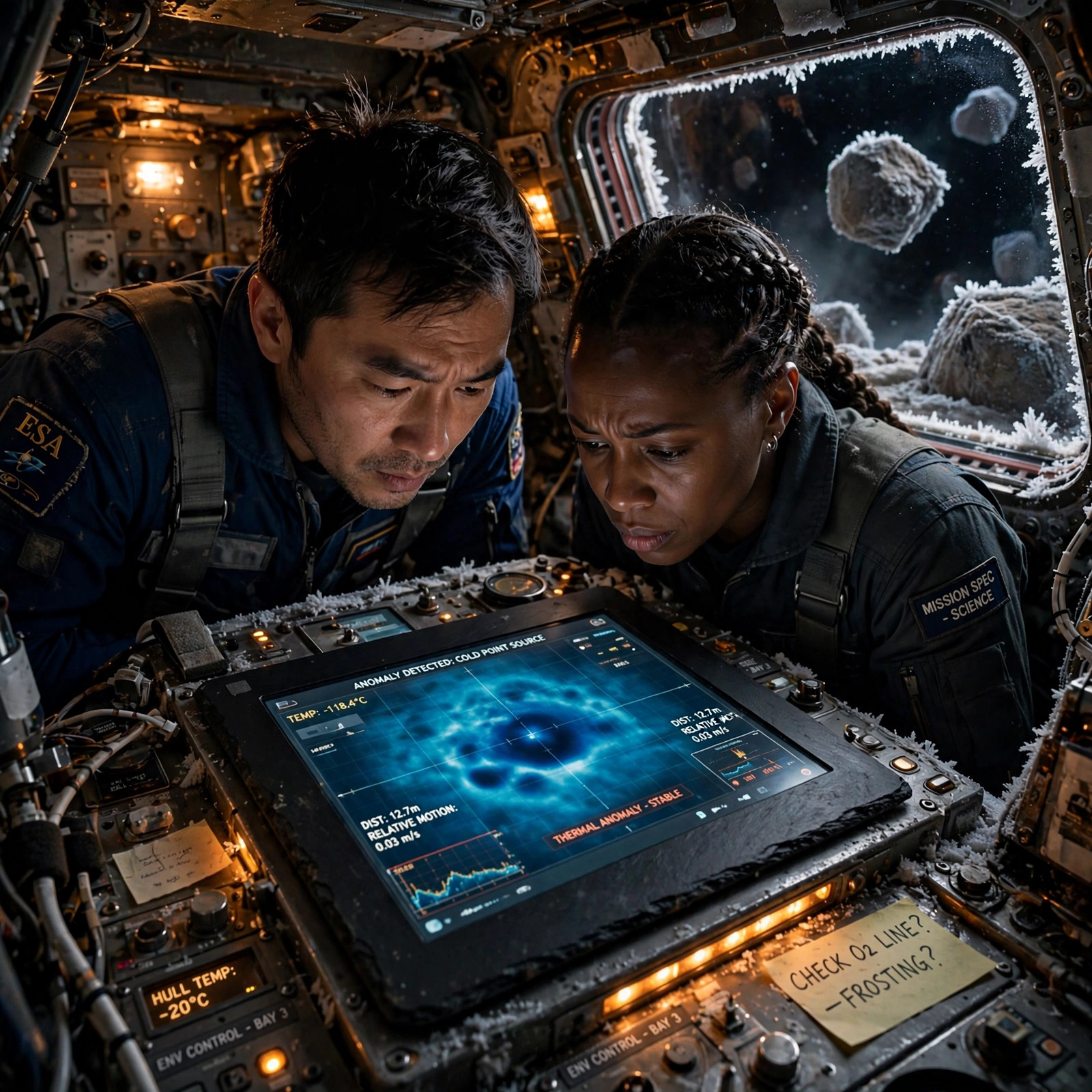
Reyes stood at the head of the table because she always stood at the head of the table. Six chairs, five occupied. Pilar Okafor had the engine deck patched into the board remotely, her voice arriving through the galley speaker with the flat patience of a woman listening from a room full of pumps.
"Margin as of last night," Reyes said, and tapped the board. The numbers rearranged themselves. "Fourteen percent. On schedule, on line, on contract. That's the whole review. Anything else is housekeeping."
Housekeeping took forty minutes. Ilsa sat through the water reclamation variance, the consumables count, Dmitri's rambling aside about the calibration star's drift, which he delivered to the tabletop rather than to anyone in particular. She kept her hands flat on the metal of her chair arms. She had decided, somewhere in the ship-night, that she would bring it up at the end, after the housekeeping, when the board was about to close and Reyes had no place to escape to.
Dmitri caught her eye across the table and gave a small shake of his head. Not yet. He was twenty-three, she thought, and then corrected herself, because she was tired and adding years to other people was a bad sign.
Reyes ran the projection to Day 180 anyway, as she did every week, and the board filled with the long green bar of the completed sweep: every contractual object catalogued, every signature filed, the survey zone closed like a book. Ilsa looked at the green bar and thought about a cold point source blinking fourteen seconds apart, out in the dark where no line item lived.
"One more thing," she said.
Reyes didn't sigh, which was worse than sighing. She simply turned the board ninety degrees so it faced Ilsa, which meant: you get the numbers, not the conversation.
"Object two-ninety-one," Ilsa said. "Flagged night before last, then discarded as timing error. I want to revisit the discard."
"You filed it yourself," Pilar said through the speaker.
"I know what I filed. I filed it because a fourteen-second period on a cold body that size isn't physical. Rock doesn't hold together spinning that fast. Ice certainly doesn't. But the interval doesn't wobble. I've played the capture three times. The period holds."
"Deck error holds too," Pilar said. "Timing artifacts are famous for holding. Ask anyone who's chased one."
"The source sits 0.4 AU off our sweep line. A two-day observation detour, four days round trip with the dwell, would put sensors on it at real range instead of whatever this is." She nodded at the board. "Two days. Out of a hundred and thirty-nine remaining. That's one point four percent of the window."
Reyes said, "Show me the fuel, not the percentage of the window. The window isn't what runs out."
Ilsa drew it up. The board didn't want to cooperate at first—it kept trying to model the detour as a full survey leg, complete with station-keeping and redundancy—and she had to strip the plan down to bare transit, single burn out, single burn back, sensors running the whole way because the sensors ran anyway. The margin number fell as she watched it.
"Eleven percent," she said. "After a four-day round trip. Above the floor."
"The floor is five," Reyes said. "The floor is not a target. It's the number below which the consortium's insurer starts asking why a survey lead was spending reserve margin on a discarded artifact." She turned the board back toward herself. "And your four days is optimistic. Off-axis burns are never clean. You'll spend a day just on the plane change."
"One point four days, including the plane change," Ilsa said, and pushed her own model across to her, and the two of them sat there for a while, each with a version of the same detour open, the numbers disagreeing by tenths.
The galley speaker crackled. "I've run the off-axis profile twice," Pilar said. "Her one point four holds if the burn is perfect. When has a burn been perfect?"
"So we agree it's possible," Ilsa said.
"We agree it's possible on paper," Reyes said. She pulled the contract schedule up, another long bar, this one red at the far end where the return window lived. "Here's what you're not modeling. Our return window closes on Day 180 plus whatever margin we carry. There's a solar maximum coming through this sector inside ninety days. Radiation exposure on an off-axis leg, outside the shelter's planning envelope, is not my idea of discretionary spending. And the consortium doesn't dock us for a detour, Ilsa. They dock us for an unfinished sweep. Two days becomes four. Four becomes a week, because everything becomes a week. And then the primary line is incomplete at Day 180, and there's a void clause in that contract with my name under it."
"I'm not asking for a week."
"You're asking me to decide today that it will only ever be two days. Nobody gets to decide that in advance."
Ilsa looked around the table. Dmitri was very interested in his slate. The other two crew on day rotation, Vint and Achebe, were watching the exchange the way people watch weather. Nobody was going to help her. That was fair; she hadn't asked them to.
"The period is real," she said. "I've checked."
"You've checked a cold return from 0.4 AU through our own deck," Reyes said. "The consortium has a phrase for that. They call it survey enthusiasm. It's in the contract under penalties, in the clause about fabricating discoveries to inflate contract zone value." She softened her voice one notch, which from Reyes was a speech. "I've commanded this ship nine years. I've watched two crews before this one find things that weren't there. I've watched one find something that was there and not be believed about it, and that one took eleven years and a second ship to sort out. You don't get a second ship. You get one window and a five percent floor."
"You don't know it's not there."
"And you don't know it is. That's the whole problem, and it's a problem we're paid to leave alone. The sweep is the job. The sweep feeds six people and pays one tuition and keeps a command license in a drawer where it's useful." She tapped the board closed. "The answer is no. Not this week, not at eleven percent, not at fourteen. Bring me a capture that isn't ours and I'll look at it."
The review broke up. Vint and Achebe went forward. Pilar's channel clicked off mid-sentence, something about pump tolerances, the way she left every meeting, as though the meeting had interrupted her.
Dmitri didn't go to his post. He hung back by the sensor bay's inner hatch while Ilsa restored the galley to its ordinary arrangement, tables unfolded, board back in its locker. When she came down the corridor, he fell in beside her and said nothing until the hatch had cycled behind them.
"I ran it again last night," he said. "And the night before that. Three captures, three nights."
He put his personal slate on the console where she could see it, and on it were three timing traces, stacked, their intervals printed beside each other in his cramped numerals. Fourteen point oh-two. Fourteen point oh-two. Fourteen point oh-three.
"Deck error drifts," he said. "Deck error drifts with temperature, it drifts with the sweep cycle, it drifts with however many coffees are sitting on the timing rack. This doesn't drift. Three nights, same source, same period, to within a hundredth."
Ilsa looked at the numbers for a long time. Fourteen point oh-three. A hundredth of a second across three nights, across a deck that cooled and warmed with every watch change, across a sensor suite that had miscalibrated itself twice in the last month over nothing at all. It was too clean. It was cleaner than their instruments had any right to be. Which meant it wasn't the instruments.
"You've had this since last night," she said.
"Since the second capture, night before last. I wanted the third before I said anything. Two points can be coincidence. Three is a period."
"Why show it to me and not to her?"
"Because you're the one who filed the discard." He shrugged, an awkward little motion, shoulders not fully committed. "And because she'll say what she said. Five percent floor. Return window. Void clause. She's not wrong, so it doesn't matter how many points I bring her. She's not wrong and it's still real, and both of those are going to keep being true all the way to Day 180."
Ilsa picked up the slate and carried it to the survey drive, and he let her. She didn't copy it to the drive. She copied it to her own private slate, the one that didn't get audited, beside the file that officially didn't exist, and then she handed his back to him and went to find the fuel board.
She took it down out of the locker herself. Reyes had gone to the comm watch, which left the galley empty, which was probably not a coincidence of the universe so much as Ilsa's own last clear decision of the ship-day. She spread the board flat on the table and opened the margin ledger and looked at the numbers again. Fourteen percent, falling to eleven on her four-day profile, falling further under Reyes's honest one—the honest one was worse, close to nine—falling off a cliff if the detour grew, and detours grew. That was the thing about detours. She had watched one grow, years ago, on a different ship, from two days to nineteen.
There was a line item on the board, near the bottom of the discretionary section, that was hers: one point four days, sensor extension, off-axis observation of discarded source, proposed, awaiting review. It had been hers since Day 41, entered optimistically at ship-night, back when a fourteen-second period had still been a problem for tomorrow. It was the only line on the board with her initials next to it.
She picked up the board's stylus.
She looked at the line for a while. One point four days. Two days, she'd told the table. Four, she'd told Reyes. The distance between what she'd asked for and what she actually wanted—the full 22-day detour, the real range pass, the dwell, the long look—was the width of the whole table, and every honest number on the board lived on Reyes's side of it.
She drew a single stroke through her own line item. Then she wrote the standard notation beside it in the cramped hand the auditors expected: withdrawn by proposer. No reason given, because the honest reason was too long for a margin note, and the dishonest reasons were all true too.
She sealed the notation and held the board a moment longer, feeling the faint warmth of it through her palms, all those patient green bars and red ends and floors that existed to keep six people fed and flying. Then she carried it down the corridor to the comm watch and put it into Reyes's hands, closed, with her struck line still visible through the film.
"Withdrawn," she said. "The detour. Off the board."
Reyes turned it over once, read the notation, and looked at her with an expression Ilsa couldn't file anywhere.
"It stays off," Reyes said. "Until it doesn't. You understand me?"
"I understand you."
She went back down to the sensor bay, where Dmitri's three traces sat beside a file that didn't exist, and she sat with them, and the sweep line stretched out ahead of the ship, long and green and complete, all the way to Day 180.
Shelter Hours
The alarm came up the pipe at 0620, ship-time, a low double tone that meant particle flux and meant it now. Ilsa was already dressed. She had slept in her suit liner three nights running, since the numbers on the sun had gone from orange to a color the boards didn't have a name for. By the time she reached the shelter hatch, Pilar Okafor was already inside with the engineer's board open on her knees, running the checklist from memory in a low mutter, sealing the inner door dogs in order, one to eight.
Six people went into the shelter. The shelter was rated for sixty hours of storm, and the storm watch put the event at forty-one, which meant the math was comfortable and the room was not. The room was a cylinder eleven meters long and barely three across, ringed with bunks stacked two high, with a sanitation closet behind a curtain that did not fully close, with a recycler that hummed in a key that made Ilsa's back teeth ache by hour six. They had all been in it before. Nobody was cheerful about it.
Dmitri took the bunk below hers and immediately regretted it, because the recycler's hum resonated in the frame. He spent the first two hours with his coat wadded under his head, then gave up and sat on the deck with his slate on his knees, working the shelter's thin instruments for anything they could see of the storm. There wasn't much. The particle flux was a wall between them and every telescope on the hull. The sweep line was running without them, the automated stations logging rock and gas signatures into the contract files while six human beings sat in a can and waited for the sky to stop trying to kill them.
By hour nine, the argument started. Ilsa had known it would. She had been waiting for it with a feeling like a held breath.
"I want to say it while we're all trapped in one room," Pilar said, "so nobody has to say it twice."
"Pilar," Reyes said, in the tone she used to close doors.
"No, I'm saying it." Pilar was forty-five, eleven years Ilsa's senior, gray coming in at her temples in a stripe she had stopped dyeing somewhere around her last contract renewal. She sat on the deck with her long legs folded under the board she'd already closed. "We're eleven days into a decision that hasn't been made. That's worse than a bad decision. A bad decision I can plan around. This I can't."
"There is no decision pending," Reyes said. "The detour was withdrawn. Day before yesterday. It's off the board."
"Off the board," Pilar said, "and on everybody's mind, which is a different location."
The shelter hummed. Dmitri looked up from his slate. The other three, Ashida at the recycler, Coetzer in the top bunk with a paperback he wasn't reading, Vann in the corner with her arms crossed, all went still in the way people do when a room's temperature changes.
"Since we're saying things," Pilar went on, before the silence could set, "let me say who pays. Because I've done this arithmetic every night since Day 41, and I'm tired of doing it alone." She held up one finger. "My daughter. Her tuition is paid out of my completion share, this contract, all of it, the installment falls due two months after we're supposed to make port. If we strand out here, or if the consortium voids the survey for unfinished primary coverage, that money doesn't arrive. She's eighteen. She doesn't have a fallback. I'm the fallback." A second finger. "Dmitri's bonus. Three years aboard, and his contract is completion-weighted like all of ours. He's twenty-eight. That bonus is a down payment on a life. He's told me so on night watch, so it's not a secret." A third. "And the captain's license. Odile, you sign a flight plan that strands this vessel, the board of inquiry doesn't care that the anomaly was interesting. They care that a survey commander burned reserve below the contractual floor on discretionary science. That's your ticket, that's your career, that's the last fifteen years."
She folded the fingers back into her fist and put the fist on her knee.
"So when we talk about a detour," Pilar said, "I want us to talk about it with those names on the table, and not just the point source. The point source doesn't have a name. It has a period."
"Fourteen seconds," Dmitri said, quietly. Then, when everyone looked at him: "Sorry. It's, um. It's a very stable fourteen seconds."
"Stable across three nights," Ilsa said.
"You kept the file," Coetzer said from the top bunk, not unkindly. "After you withdrew the line item."
"I kept the raw capture. That's not against procedure. Purging raw data before the survey closes is against procedure, actually."
"That's not what he asked."
"No," Ilsa said. "It's not what he asked."
The recycler hummed. Hour ten. Somewhere above them, beyond the shielding, the storm was sanding the hull down one molecule at a time, and the sweep line was logging rocks without them.
"I'll tell you the rest of it," Ilsa said, "since we're saying things." She looked at the deck plates. "Eleven years I've run deep-system surveys. Before this ship, I was on the Harrowgate. Year nine of her survey. I flagged a mass reading off our line, a cold contact, low confidence, and I pushed it. Not a two-day detour. I pushed it for six weeks. I was sure. I had the traces, I had the period, I had the shape of it in my head, and I stood up in the wardroom and I told the survey director it was real." She let a breath out slowly. "It was a lensing artifact off our own debris shield. A heat shimmer in our own instruments, and I'd built a world out of it. The six weeks came out of the contract, the client sued for the overrun, and the survey director had to give up a berth to cover the penalty. Ash Lin. She'd been on that ship nine years. She took a ground posting she hated, and she took it because I was sure."
Nobody spoke. The recycler hummed its one note.
"So when I say the capture is real," Ilsa said, "I know what the word costs. I've paid it before, and I didn't pay it alone, which is the part I can't make right. Lin never blamed me to my face. She sent one message, before she went groundside. She said the reading was good enough to chase, and that she'd have chased it too. That was worse, honestly. I'd have preferred the blame."
"And this one?" Vann asked from the corner. Arms still crossed, but her voice had come down off its ledge. "This reading. Is it good enough to chase?"
"The period's stable across three nights. Cold source, fast rotation, holding together when nothing that size should hold together. Either it's real, or our whole instrument suite is lying to us in the same direction every night, and if it's the second thing, we're going to have problems a lot closer to home than a point source 0.4 AU off our line." Ilsa spread her hands. "I can't take the certainty out of the sentence. There isn't a version of this where I get to be sure first."
"That's the whole problem," Pilar said. "That's what I've been trying to say. It isn't that anyone thinks you're a fool, Ilsa. It's that the last person who was sure was also you."
"I know."
"And the fuel's at eleven," Pilar said. "Eleven percent, on the honest profile, and the honest profile was worse than the optimistic one. The detour's twenty-two days. Twenty-two days puts the reserve under four and the contract floor at five, and then we're not talking about bonuses anymore, we're talking about whether we thrust home or drift and hope somebody comes for the hull."
"I know that too."
"Then what are we doing in this room, hour ten, arguing about a thing that's already withdrawn?"
"Because it's not withdrawn," Dmitri said. He'd gone a little red, saying it. "Sorry. But it isn't. It's on every slate in this ship, and I'm the one who put it there, and I'd feel better if we yelled at each other for a while instead of being polite about it for forty more hours."
So they yelled, a little. It was better. Coetzer thought the consortium would forgive a delay with a discovery attached, and Vann thought the consortium would forgive nothing ever, and the two of them went at it over the top bunk while Pilar refereed with numbers and Ashida kept trying to change the subject to food. The argument went around twice, and it came out where it had gone in: split. Three who thought the source was worth a hard look, two who thought the risk was insane, one, Ashida, who kept saying "both, though, both," until everyone laughed at him.
The storm ran long. The watch revised forty-one hours upward twice, then put it back, and the shelter held its six people and its one note of hum, and Ilsa slept badly in the bunk, and woke, and checked the flux, and slept again. On hour thirty-eight Vann taught the room a card game that was mostly cheating. On hour forty-one the all-clear came up the pipe, thin and doubled like everything that came through shelter speakers, and the dogs cracked, and the ordinary air of the ordinary ship came in, and it smelled like metal and coffee and everyone's whole complicated life.
Ilsa came out last. She was gathering her slate and Dmitri's, hers and not hers, when Reyes appeared in the shelter's cramped corridor, the one place on the ship where the captain had to stand at an angle to fit. She stood at an angle. She waited until the others had filed out toward the galley and the noise of six people remembering they were hungry.
"You heard all of it," Ilsa said.
"I heard all of it."
"Then you know it's split."
"I know it's split." Reyes shifted her shoulder against the curve of the corridor. "So here's what happens now, and this is the last thing I'm deciding as captain on this question. You're going to take it to them. Not me. You, in the galley, tonight, with numbers that hold up under Pilar, because she'll take them apart if they don't. Whatever they agree to, I'll sign. Detour, no detour, something I haven't thought of yet. If they say no, I back the no. If they say yes, I fly the yes, and my license takes its chances with the rest of you." She pushed off the wall, straightening into the low overhead. "It's your anomaly, Ilsa. It's your hand on it. Go put it in the room where the rest of us live."
The Two Signatures
Ilsa spent the afternoon after the all-clear at the galley table with three slates open and a pot of coffee going cold beside her elbow. The moonlet was the key, and she had known it was the key since hour twenty of the shelter, when Vann had been teaching the card game and she had been doing burn sums in her head instead of watching his hands. The moonlet was cataloged, dated, massed. It sat eleven degrees off the return leg like a stone in a stream, and a ship that brushed it right could borrow a shave of its velocity and pay back only a bend in its own path.
She ran the numbers four times. She ran them the way Pilar would run them, looking for the soft spots, and when she found one — a mid-burn correction window that ate half the margin if they missed it — she widened the window by shortening the burn, and lost six hours of approach, and decided six hours was a price she could stand.
The plan, when she had it, was nine days. Nine days out and back on a hard-burn leg with the assist off the moonlet doing a third of the turning. It left the reserve at six percent at worst case, one point above the contractual floor. It finished eighty percent of the primary sweep, the dense percent, the percent with the gas signatures the consortium actually paid for, and it put the unswept remainder in a corner of the zone where the client's own long-range assets had already mapped the rough shape of everything twice.
It was not the detour she had argued for at the fuel board. It was smaller, and meaner, and it worked.
She called the galley meeting for ship-night, second bell, when the day's work was done and nobody could claim they were being pulled off something. The whole crew came, which told her something. Six people around the long table, and the coffee went around twice before she started, because Ashida poured slow and everyone waited for him, and because she was not in a hurry to begin.
"I'm going to put one plan in front of you," she said. "Then we vote, and that's the last of it. No rounds."
Vann leaned back. "You've been at the table since the shelter let out. I watched you not eat lunch."
"I ate lunch."
"You moved a sandwich around a plate."
She let it go and put the plan up on the galley screen. She took them through it the way she would take a client through a survey: the burn, the assist, the return leg, the numbers on fuel. She showed the reserve line flat and honest, worst case six percent, floor five. She showed the sweep coverage in color, the swept zone in blue and the unswept corner in gray, and she made herself point at the gray. "That corner is the piece we give up. Eighty percent complete instead of full. The consortium can call that a failure to perform if they want to be ugly about it, and they've been ugly before."
"They have," Dmitri said, quietly, into his cup.
"So here's the part that's mine." She pulled up the second page, the one she had written alone in her bunk after the shelter, and read it off the screen because she had not trusted herself to say it without the screen. "If they dock us, they dock me first. My share of the completion bonus I waive now, tonight, in writing, before any of you vote. And if the penalties go past the bonus — if they try to void the contract outright — my salary stands against the overage until it's paid down. That's in the proposal. It's already drafted. It needs two signatures to be real: mine and the captain's."
The galley went quiet in the particular way a room goes quiet when six people are doing arithmetic about someone else's money.
Pilar broke it. "Say the worst happens. Say we come home light and short and the client walks. What does that number do to you, personally, over a year?"
"It takes most of the year."
"Most."
"Enough that I've thought about it for two days and I'm still standing here making the offer, Pilar. That's the whole answer I have."
Pilar looked at her for a long moment, and then down at the screen, at the fuel line, at the blue and the gray. She was the one who had said it plainly in the shelter, with the cards going around above her: whose daughter's tuition rode on the return leg, whose bonus, whose license. She had not said Ilsa's line then, and Ilsa had supplied it herself — the berth she had cost a shipmate years back, chasing a reading that had dissolved under better instruments. She did not repeat it now. Everyone in the room had heard it.
"The mid-burn correction window," Pilar said. "Show me the miss case."
Ilsa showed her the miss case. The window they would hold open was ninety minutes; a missed correction inside it meant a second burn to recover the leg, and the second burn was what dragged the reserve toward the floor. She showed the trigger, the abort rule, the line where the detour died and they came home on the original plan with nothing spent but the nine days. "The abort is real," she said. "It's not decoration. We pass that fuel number, we turn around, and the anomaly stays a file on my slate and nobody's paycheck."
"And the point source?" Dmitri had his hands around his cup and had not touched it. "Nine days gets us what, close enough for?"
"Spectroscopy. Rotation confirmation. A mass estimate that means something. Not a landing, not a rendezvous. A look." She paused. "It's a look that took me three nights to believe in, and Dmitri three nights to make me believe, and if it turns out to be a cold chunk of iron with a spin on it, then that's what it is, and we'll have spent nine days and my bonus to know one more true thing about one more rock. I've spent worse weeks."
Vann had his hand up already, which meant he was voting no before anyone had called a vote. "The consortium forgives nothing," he said. "You know that better than anyone at this table. You finish eighty percent and they'll read it as zero with extra steps."
"They may."
"You're betting six people's contracts on a maybe."
"I'm betting my contract on a maybe," Ilsa said. "Yours has an abort line built into it."
"That's not how penalties work and you know it."
"That's how I've written it to work."
Ashida raised a hand that nobody had asked for. "Both things are true," he said, and half the table groaned, and he grinned and put the hand down. "No — listen. It's a bad deal and a good deal. It depends on the return date. If we're home by the deadline, it's a good deal. If we're late, it's a bad deal with a planet in it." He shrugged. "So make the return date the law. Not the fuel line. The date."
Pilar turned on her stool. "Say that again, the last part."
"The date. Make the date the hard rule. Fuel numbers wiggle, windows open and close, but a date is a date. We're home by day one-ninety or the detour was a mistake, and we'll know which it was while it's still happening, instead of arguing about it after."
Ilsa looked at Pilar, and Pilar looked back, and something passed between them that had been circling since the shelter. Pilar pulled the tablet toward her across the table, the one with the plan on it, and turned it to face herself.
"Then I want it in writing," Pilar said. "Not the fuel rule. I want the return leg hard-dated. Day one-eighty-eight back at the deposit orbit, no extensions, no weather, no discoveries. The day we pass that date, we burn for home mid-sentence if we have to. And I want the abort trigger at six percent, which you've got, and I want it countersigned by the captain, and I want a copy posted on the board in the corridor where I have to look at it every morning." She slid the tablet back. "Put that in the proposal and my vote changes. Don't, and it doesn't."
"That's buying your vote," Vann said, not unkindly.
"That's buying the thing I actually care about," Pilar said. "The look is hers. The date is mine."
Reyes had said nothing through all of it. She sat at the end of the table with her hands flat on the surface, and when Ilsa glanced at her, she gave nothing back — not encouragement, not permission. She had said it in the corridor: whatever they agreed to, she signed. This was not her room. Ilsa turned to the table.
"Vote," she said. "The proposal stands as amended — return leg hard-dated to day one-eighty-eight, abort at six percent reserve, both countersigned. All in favor of the nine-day detour."
Dmitri's hand came up first, fast, like it had been waiting two days at his shoulder. Ashida's came up next, and he said "both, though" one more time to a smaller laugh. Ilsa raised her own. And Pilar raised hers, slowly, watching Ilsa's face while she did it, and Ilsa understood that the hand was a contract with her personally, and that Pilar would hold her to it for as long as they both flew.
"Four. Opposed."
Vann raised his hand, held her eyes, and put it down. "For the record," he said, "I hope it's iron with a spin on it and I hope they name something ugly after you. But I'm not spending my bonus on hope."
"Noted," Ilsa said. "Abstentions."
Reyes raised one finger off the table and put it back down. "I fly whatever passes," she said. "I don't vote on it. That's the arrangement, and I'm keeping it clean."
"Then it passes," Ilsa said. "Four to one, one abstention."
She had expected, somewhere under her ribs, that the moment of the count would feel like relief. It felt like a door closing instead — a good door, a chosen door, but closing all the way, with her on the far side of it from her own bonus and the clean version of the year she had been planning to have. She let it close.
Reyes got up without a word and came back from the bridge with paper — real paper, the ship's printed flight-plan stock, because a thing signed in the galley on slate was a thing that could be revised in a corridor. She laid the amended plan on the table, the return date in Pilar's demanded clause, the abort rule, the waiver of Ilsa's bonus, her salary pledged against penalties, and put a pen down next to it.
"Two signatures," Reyes said. "Mine's the second one. It always was."
Ilsa signed. Her name went down in her own cramped hand, and then Reyes took the pen and signed beneath it, and the two names sat there on the paper side by side, and Dmitri leaned in to read them as though they might say something different from what they said.
Then Ilsa reached into the pocket of her jacket and took out the folded sheet she had been carrying since the fuel board: her own printed copy of the original contract schedule, the full 180-day sweep, the unbroken line of days she had been paid to walk. She had printed it on day one, as she printed it every contract, and it had ridden in her pocket through the storm.
She crossed the galley to the incinerator, the little slot beside the coffee station where waste paper went to become a curl of ash and a scrubbed molecule stream. Pilar got up and came and stood beside her, arms crossed, exactly as she had stood in the shelter when she had spelled out who paid for what.
"You know burning it doesn't change the contract," Pilar said.
"I know."
"It's the copy in your pocket. The client's copy lives on Earth and doesn't care."
"I know what it is." Ilsa fed the folded schedule into the slot, and the incinerator took it with a soft breath of heat and light, a small orange flare behind the glass, and the paper went from a calendar to a curl to nothing. She watched the nothing for a second. "It's mine. That's the one I get to burn."
Pilar watched the glass cool. "Day one-eighty-eight," she said.
"Day one-eighty-eight," Ilsa said. "It's on the board by morning."
Behind them, Ashida was already asking what was for dinner, and Dmitri was already saying he'd take the first observation watch, and Vann was already dealing cards to nobody who had agreed to play. The galley filled back up with its ordinary noise. Ilsa stood at the incinerator a moment longer, the pen still in her hand, and then she turned off the heat and went to post the paper in the corridor where Pilar would have to look at it every morning, for every one of the days they had just promised.
The Manual Handle
Day forty-nine came up gray and ordinary, the way ship-days did: lights warming through their morning ramp, the coffee station cycling its first pot, Ashida's boots going down the corridor toward engineering with the unhurried clank of a man who had nowhere to be until he had to be there. Ilsa had been awake since ship-dawn minus forty minutes, sitting on the bench outside the control blister with the amended flight plan folded in her jacket, and she had not opened it. She knew what it said. She had written the last line of it herself and signed under it, and Reyes had signed under her.
The board in the corridor, the one she had posted with Pilar's deadline printed across its top in wide letters—DAY ONE-EIGHTY-EIGHT, HARD RETURN, NO EXCEPTIONS—had already accumulated its first comment in Vann's handwriting: counting. Under it he had drawn a small tally of one. That was eight days since the vote. Eight days of the hard burn they had agreed to, eight days of the moonlet assist behind them, reserve sitting at 4.1 percent on the fuel page where the floor was five, and a clause in the amended contract, negotiated by the client's night desk in a six-hour lag, that said the shortfall was covered against surveyor pay up to the value of the penalties. Her pay. That had been the shape of the deal she'd offered, and she had not stopped noticing the shape of it since.
Dmitri came up the corridor with two mugs and handed her one without asking. He had stopped asking around day two of the burn.
"Period held through the night," he said. "Fourteen minutes and change, same as the last three captures. Same as the first."
"You didn't sleep."
"I slept." He sat down beside her, blew across his coffee. "I just slept with the file open."
She let that stand. Out through the blister's outer glass, past the rim of the hull, the starfield lay in its fixed scatter, and somewhere in it, 0.4 AU off the old sweep line, a cold point turned over on itself every fourteen minutes, which was fast, which was wrong for anything that size and that temperature, which was the whole reason they were pointed at it now with 4.1 percent behind them and a countdown on a corridor board. She turned the mug in her hands. The door to the blister was at the end of the passage, and behind it the burn console waited in its start configuration, armed and green, and the autopilot could fly the whole thing. That was the thing she kept arriving at. The autopilot could fly it. The autopilot had flown every burn of the survey to date, every one of the eleven years before this one, most of the burns of her whole working life, and nobody would have said a word.
"You're doing the override," Dmitri said. It wasn't quite a question. He had been on the ship three years and had learned to read the back of her head.
"I'm doing the override."
"Because the recorders tag autopilot burns with the flight computer's ID. Everyone knows that."
"Everyone knows that."
He drank his coffee. "Pilar will want to know the return margin doesn't move."
"The return margin doesn't move. The assist put us on the line; the burn's a quarter-hour of thrust on a fresh feed valve. It's the cheapest thing we'll do all year." She said it evenly, the way she had said it in the vote, and it was true, and being true did not make it free. Every word of it was a thing she had already spent.
Reyes came down the passage at burn minus twenty, in her working jacket, hair tied back, looking like a woman who had slept and wanted that known. She stood in front of the board a moment and read the deadline and the tally mark, and then she came and sat on Ilsa's other side and took Dmitri's second mug out of his hand without apology and drank from it.
"Crew's fed," Reyes said. "Vann ate actual breakfast, which I count as a sign of health. Ashida has the feed valves green on both rails. We're solvent to the day-one-fifty return gate with margin at four and change." She gave the mug back. "And you're on the handle, not the computer."
"You knew that."
"I suspected it." Reyes looked at her. "You want to tell me why, or should I guess badly?"
"Because the file says who turned the ship." Ilsa turned her own mug a slow quarter rotation in her hands, watching it. "Eleven years of burns and every one of them signed by a flight computer. This one has my penalties in it. My bonus. Pilar's promise on the wall." She nodded toward the board. "I'm not letting a machine put its name where my money is. When the consortium audits the track, I want the entry to say a hand moved it. This hand. On the record, at the timestamp, with witnesses."
"It'll say Ilsa Merrow, survey lead, manual burn, day forty-nine, thirty hours past the assist."
"That's the entry I want."
Reyes was quiet a second. "My license is on this detour too," she said. "You know that. I signed under you." Then she stood and put a hand briefly on Ilsa's shoulder, a light pressure, a thing Reyes did rarely and never twice. "It's a good entry. Let's go make it."
The blister held all six of them, which it was not built for, and which Reyes permitted for the twenty minutes of the burn because nobody had asked to be excused and she had decided not to offer. Vann brought the cards and did not deal them. Ashida came up from engineering with the valve page still glowing on his slate and stood against the aft rail where he could see both the fuel display and the window. Pilar came last, on purpose, Ilsa thought, and took the position nearest the corridor door, where the board's deadline was visible if she turned her head, and she did turn her head, twice, checking that the paper was still there, and Ilsa let her.
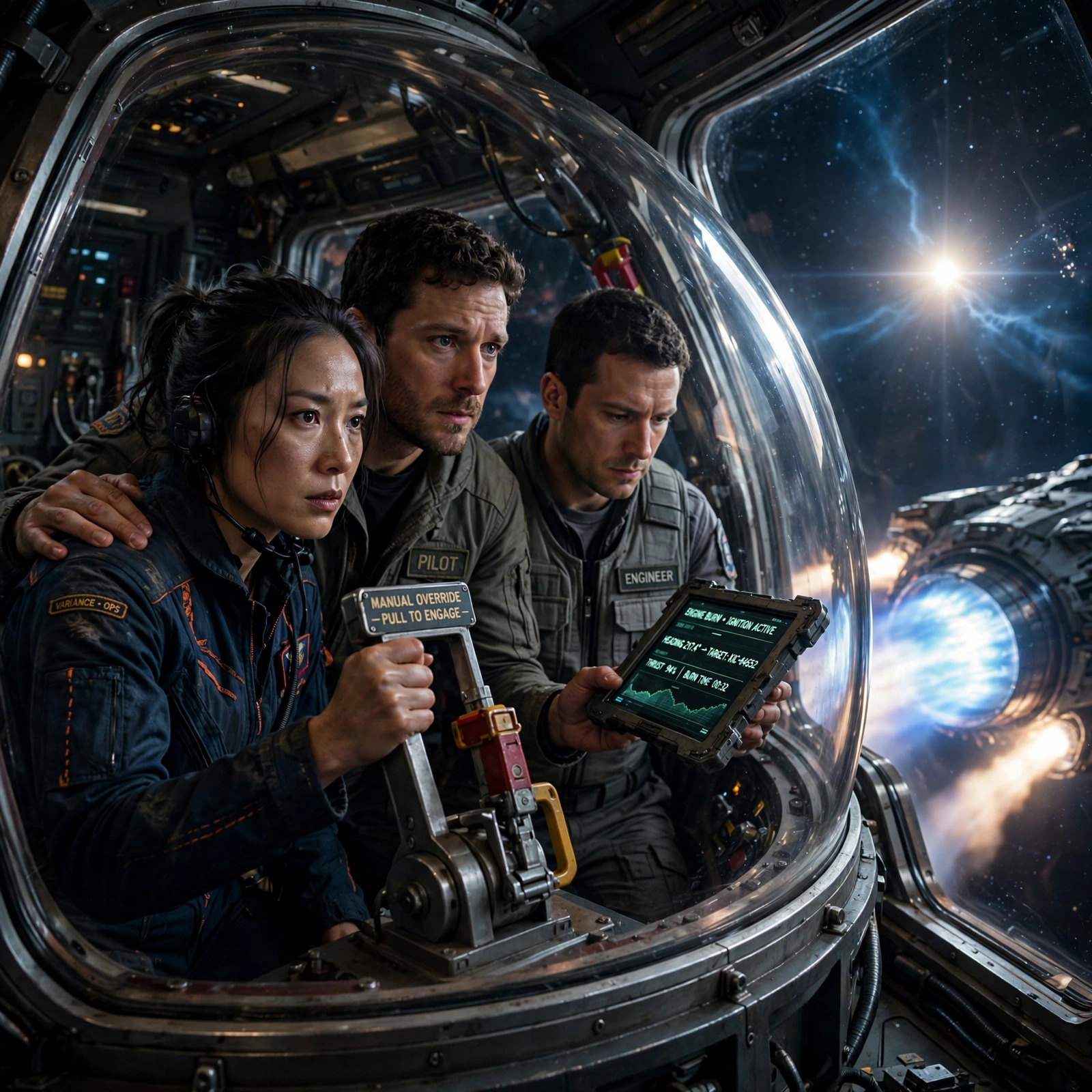
The burn console was an old design and Reyes had kept it old. Under the glass and the modern touch surfaces there was a physical handle, a chrome lever on a slotted track, that threw the thrust sequencer from computer to hand and back. Nobody used it. It was a relic of a certification requirement from another generation of ships, and it had sat in its track the whole time Ilsa had flown, oiled once a year by whoever lost the drawing. She wrapped her hand around it now and it was cold and heavier than it looked, and the track's detent held against her first pull the way a mechanical thing does when it is being honest about what it costs to move it.
"Flight to manual," she said, and the ship's voice acknowledged, and the green autopilot lamp over the console went dark for the first time in any burn she had ever stood in.
Point of no return was thirty seconds of thrust in. After that, the return line recalculated, and there was no version of this where the ship came home without burning the fuel they were about to burn. She had run the numbers on the assist four times. Dmitri had run them three. Ashida had run them twice and initialed the page. The margin at the return gate was 3.9 percent and the floor was 5, and the gap was covered by her clause, and she had read the clause aloud to all six of them in the galley and watched Pilar nod once at the end like a woman signing off on a load.
Fifteen seconds.
She thought, briefly, of the year she had been wrong. It surfaced the way it always did, unasked—a flagged echo on a survey a long time ago, a hot reading on a cold body, her insistence, and a shipmate's berth restructured out of the manifest while she stood in a corridor unable to make her case again. She did not push the memory down. She let it sit where it was, next to the fourteen-minute period and the four-point-one, and she thought: this time three captures held stable across four nights, and Dmitri ran it cleaner than I could, and Pilar made me promise the way back, and Reyes signed. This time it is not only me.
Five seconds.
The stars in the blister's wide glass lay in their fixed scatter, and the point source was among them, undistinguished to the eye, a nothing among nothings, cold and far and turning.
She pulled the handle through the detent.
Thrust came up through the deck and into her boots and her hand and the pit of her teeth. The starfield began to slide—slowly, then with the long deliberate sweep of a ship putting its whole mass behind a turn—and the scatter of lights wheeled across the glass like a tide going out sideways. Ashida watched the fuel display and did not watch it burn. Vann put his cards away without dealing. Somewhere under the thrust, the hull ticked out its old sounds, joints and rails taking up load, and Ilsa's arm ached with the handle held through the sequencer's ramp, and she held it, and held it, and the minutes went by the way physical things do.
At fourteen minutes Dmitri, at the sensor rail, made a sound like a man who had been holding a little breath for eight days and had just let it go.
"Period's holding. Fourteen twelve and stable." His voice cracked on the number and he didn't fix it. "Fourteen minutes twelve seconds. It's there. It's still there and it's still turning."
"Composition?" Reyes asked.
"Coming up. Densitometer's painting now." He bent over the rail. The returns stacked on his display in slow columns, and he read them half-aloud, a habit she had never trained out of him. "Dense. Dense beyond catalog for the albedo... iron, nickel, and then a set of lines I don't—" He stopped. He looked up. His face had gone very bright. "I don't know these lines. Nobody's going to know these lines for weeks."
"Weeks is what we have," Ilsa said. Her arm was shaking. She brought the handle back through the detent, eased the thrust down through the ramp, and the burn locked in at trim, and the deck settled under all six of them. "Nobody promises anything until the returns are clean and the consortium's audited the track. We have forty days of primary sweep left and a return gate to make. We stay fed, we stay solvent, we're home on day one-eighty-eight or we explain it to Pilar in writing."
"You'll have it in writing," Pilar said, from the door, not unkindly, and turned her head once more toward the board.
The starfield in the glass had stopped moving and lay in its new scatter, and the point source sat near the center of it now, where the instruments could hold it, a faint cold dot among brighter liars, turning its fourteen minutes over and over. Reyes's hand came down on Ilsa's shoulder and stayed there, warm weight through the jacket, and did not lift. Dmitri was reading the period aloud again to the rail, to Ashida, to the room—"fourteen twelve, fourteenteen twelve"—as though saying it enough times would keep it true. Ilsa let go of the handle. Her hand ached where the detent had pressed it, and out past the glass the turned stars burned steady and cold in the black, all the way down to the thing that waited for them.
Get notified when new stories drop

Ava Kepler
Ava writes space exploration and cosmic adventure with competent crews, hard problems, and awe that earns its hope.
Leave a comment
Comments