





Warmth-Share Morning

The warmth-share hall smelled of onions and hot copper before the sun cleared the Commons roof, and Amara Okoye-Reyes stood in the doorway of the control room with two mugs of chicory, watching the loop's numbers breathe. Six hundred and forty kilowatts at the morning peak. She had watched that figure for so long that she could hear its rhythm the way other people heard weather: the digester surging after the kitchen scraps came down the chute, the algae panels flattening their output through the last hours of the dark, everything rising again as the bioreactor's west face caught the light.
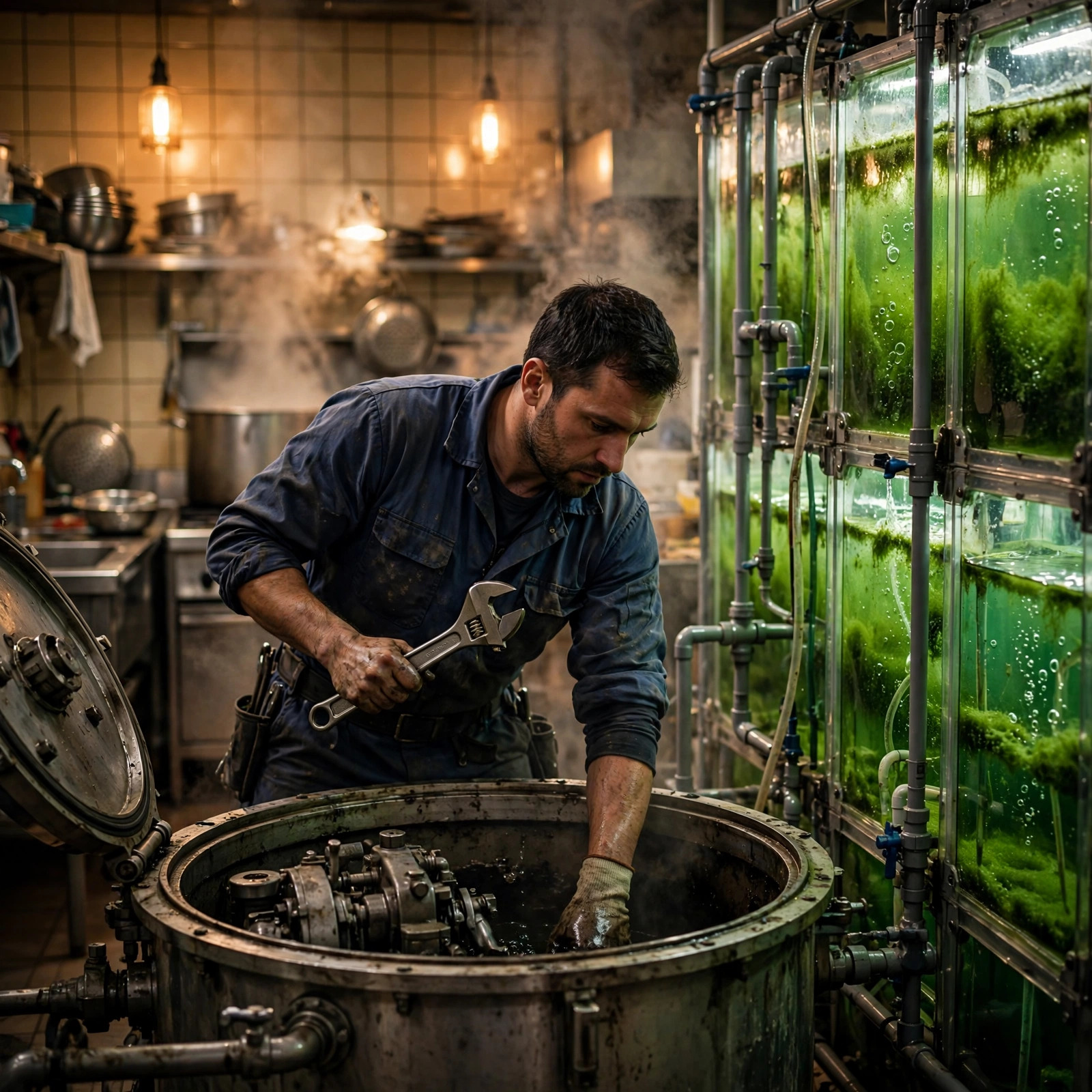
Rafe Boateng was already elbow-deep in the digester housing, his calibration wrench ticking against the pressure housing in quarter-turns. He took the mug she set on the rail without looking up, which was how they had always worked, since the year the loop was first piped into the hall's underfloor and half the district had come to stand on the warm tiles in their socks just to feel it.
"Third burner's drifting again," he said. "Two percent rich. Not enough to matter."
"It matters if the recertification crew sees it before you fix it."
"I'm fixing it." A quarter-turn, another, then the wrench went still and he leaned back on his heels. "Amara. There's a letter on the corkboard."
She knew. She had seen the envelope when she came in, pinned at eye level with a district stamp on the corner, Teodora Vasquez's narrow handwriting on the front. She had been successfully not looking at it since five this morning.
"Junie's readings first," she said. "Then the meal count. Then letters."
Rafe wiped his hands on his trousers and pointed at the corkboard with the wrench, an unmistakable gesture, and Amara walked past him into the hall.
The warmth-share kitchen ran the length of the building's south side, and Hesper Aldana was already at the line, moving trays of grain porridge onto the serving shelf while the pipe overhead ticked and knocked, carrying loop heat under the floor. The hall's benches held the first wave of the morning: dock workers on nights, two women from the weaving cooperative, a man who came every day and always sat by the door. Three hundred and ten meals a day went out of this kitchen, and every one of them was cooked on heat the loop made from things the district had otherwise thrown away.
"You're counting again," Hesper said, without turning from the trays.
"I'm always counting."
"Then count this: we're eleven bowls short on the second tray, and Junie's in the yard arguing with a soil probe."
Amara carried the second tray down the line herself, ladling where Hesper pointed, and then went out the back door into the yard where the compost windrows ran in tidy black rows toward the bioreactor's west face. Junie Park knelt in the mulch with a probe wand in one hand and a field tablet in the other, their boots dark to the ankle with morning dew.
"Soil cycle?" Amara asked.
"Day one of the rotation. The spent algae from the panels goes to the windrows, the windrow heat goes to the digester feed, the digester gas goes to the burners, and the burner ash goes back to the soil." Junie tapped the tablet against their knee. "It's a beautiful circle. It's also a lie, because the probe says the windrow core is four degrees colder than it should be, which means the spent algae came out of the panels stressed."
"Stressed how?"
"Stressed like something's been siphoning off the top of the digestate tank at night." Junie looked up at her. "Somebody in this district is bottling our gas, Amara. Small amounts. But the colony notices."
Amara crouched down beside them, took the probe wand, and read the numbers herself, because she had learned long ago that Junie's instincts were worth checking and worth trusting. The core temperature was low. Not fatally low. Nothing near the twenty-eight minutes of stall that would start the die-back, just a persistent small drag, a colony running with its coat unbuttoned in the wind.
"Log it," she said. "Quietly. If we're short on gas at the recertification, I want to know why before the inspectors do."
"Already logged. I'm telling you because you'll hear it from me first or not at all."
"Rafe's holding the door open," they said. "That means the letter."
Amara did not sigh, but it was close. "It can wait until after the meal service."
"You said that yesterday. And also the day before."
She went back inside anyway, because there were trays to stack and bowls to count and eleven porridge servings to find somewhere, and because the letter was still pinned to the corkboard where she had left it, and a letter that stays pinned is a letter that hasn't been answered, and a letter that hasn't been answered is still a decision she hadn't made.
By half past eight the hall was full and the count was done: three hundred and ten meals out, three hundred and ten bowls back through the wash line, the steam off the wash water curling up into the vent hood. Hesper poured the last of the chicory into Amara's mug without being asked and leaned on the counter beside her.
"Talk to her," Hesper said.
"Teodora?"
"Who else. She sat right there at the third table this morning, ate her bowl, thanked me twice, and left before you came off the floor." Hesper folded her arms. "She's not a stranger, Amara. She installed half the pipe under this floor with Rafe. She wouldn't have written unless the district asked her to."
"The district asked her to plan a retrofit. The district didn't ask her to plan a retrofit that starts by killing my colony." The words came out sharper than she meant, and she watched a man at the far table glance over, and she lowered her voice. "Nine hundred kilowatts on paper. A forty-one percent margin on paper. Do you know what paper doesn't have? Paper doesn't have six days of a drained bioreactor in February."
"No," Hesper said. "But paper also doesn't have to stand here in March and tell three hundred and ten people the heat is off because the grant lapsed."
Amara set the mug down. That was the thing she kept at arm's length, and Hesper had just walked up and put her hand on it. The recertification was the whole structure: the grant, the feedstock contracts, the inspectors' sign-off on a loop that had run clean for years. And the letter on the corkboard was the district's condition, or near enough, for binding the plan.
She crossed the control room, worked the pin loose with her thumbnail, and took the envelope down.
Rafe had finished the burner calibration. He stood at the rail with his arms folded, watching her, and she could feel his attention on her hands as she opened the flap.
Teodora's handwriting was as narrow in the letter as on the envelope, and the words were worse than Amara had imagined and exactly as bad. A full drain-and-inspect of the bioreactor. A structural survey of the tank. Six days with the colony out of the water, six days of reseed from the backup cultures, six days in which the loop would limp along at a fraction of its output and the warmth-share kitchen would run on whatever the district could beg from the neighboring loops. And after it, on the other side of the six days, a loop that could hold nine hundred kilowatts instead of six hundred and forty, a margin the district could bank for a generation.
Six days. Amara had drained the bioreactor exactly once, in the bad spring, and she still dreamed about the color of the empty tank.
"Well?" Rafe said.
"It's a drain-and-inspect. Full drain. Six days to reseed after." She read the last line again. "She's asking for my answer in writing, for the district ledger."
"And the recertification?"
"The recertification doesn't need the drain. The recertification needs the loop running clean, which it is, which is the entire point." Amara folded the letter along its creases, and then, before Rafe could say anything else, before Hesper could come around the counter, she slid it into the inside pocket of her field coat, and pressed the flap down flat.
Rafe watched the pocket, not her face.
"That's not an answer," he said.
"It's not an answer yet." She picked the chicory back up and drank the cold half of it, standing in the middle of her own control room, with the digester ticking warmly at her back and the hall full of people finishing their breakfast over floor tiles the loop had kept warm all winter. "It's not an answer yet, Rafe."
He looked at her a long moment, then went back to his wrenches, and the silence he left behind was louder than anything either of them had said. Through the window the sun had finally cleared the roof, and the bioreactor's west face lit up green and gold, six hundred and forty kilowatts of living light, and Amara felt the letter's corner press against her ribs every time she breathed.
The Corkboard Ledger
Three mornings later the chicory was still bad, and Amara had stopped pretending she minded. She was on her second cup, running the day's throughput numbers on the control room slate, when Junie came in from the front hall with the particular flatness of mouth that meant Teodora Vasquez was on the path.
"Bicycle at the gate," Junie said. "Satchel and everything."
"The ledger satchel?"
"Unless she carries her lunch in a document tube."
Amara wiped the slate with her sleeve, smearing the numbers into a gray comet, and had the chalk down and her hands folded by the time Teodora came through the door with the cold still on her coat. Teodora was the district's retrofit coordinator, which was a title that had arrived before the retrofit did, and she wore it the way some people wore a hard hat: like it protected something.
"Amara. Good, you're here. I hoped I wouldn't have to track you to the tank."
"I'm here most mornings."
"I know. That's one of the things I like about this loop." Teodora set the satchel on the workbench, unbuckled the flap, and drew out a ledger bound in green canvas, thick as a prayer book. "I come with numbers, not with arguments."
"Those are usually the same thing."
"Fair." She opened the ledger and turned it so the pages faced Amara. The signatures ran column after column, names in blue and black, some cramped, some careful, a few pressed so hard the ink had gone through to the next page. "One hundred seventy-three households as of last night. We needed two hundred to bind the district plan without a contested hearing. One seventy-three is a mandate in everything but the paperwork."
Rafe came in from the tank bay drying his hands, took one look at the ledger, and leaned against the doorframe without coming closer. He had a way of making a doorframe into a position statement.
"You've been busy," he said.
"I've been thorough," Teodora said. "There's a difference, and the district appreciates it." She flipped to a tabbed page. "Here's the comparison people signed onto. Your loop peaks at six hundred and forty kilowatts on a good summer day. The Solid Grid retrofit, on the same footprint, rates nine hundred. That's a forty-one percent efficiency margin, on paper, before we even talk about maintenance hours."
"On paper," Amara said.
"On engineering paper, which is the only paper a district committee can bank. And it's not just capacity. Your loop is alive, Amara, which sounds lovely until you enumerate what alive means. Sixteen distinct failure points between the digester feed and the algae tanks. Temperature excursions. Culture crashes. The smell, which I'll note your neighbors have mentioned at every hearing this year. The retrofit is firm capacity. Solid state. No culture to crash, no colony to reseed, no twenty-eight-minute window where a stalled digester starts killing the tank."
"Twenty-eight minutes," Amara said. "You've read our logs."
"I've read your logs cover to cover. That's what thorough looks like. And your own log says the loop idled at minute twenty-four last February because someone was hand-feeding the digester during the freeze."
"That someone was me," Rafe said mildly.
"I know it was you, Rafe. It's in the log in your handwriting." Teodora didn't look up. "I'm not here to embarrass anyone. I'm here because the district has a chance to lock in nine hundred kilowatts for a generation, and the holdout is one signature and one operating manager, and I'd rather she signed with her eyes open."
It was, Amara thought, a good argument. That was the trouble with Teodora. She never brought a bad one. The smell was real. The failure points were real. The neighbor with the petition about the smell had stood in this very room in September holding a jar of dishwater as evidence. Six hundred forty kilowatts fed the warmth-share kitchen's three hundred and ten meals a day and heated the hall floor all winter, and it did it on the edge of a twenty-eight-minute cliff, and everyone in the room knew it.
"You know what I'd be signing away," Amara said.
"I know what you're afraid of. I've read the bad-spring entries too." Teodora closed the ledger and put her palm flat on the cover. "So don't take my paper. Audit the retrofit. A demonstration audit, full access, your engineer, your instruments, your methods. Walk the install at Harborline where they've been running solid for two years. Pull their maintenance logs yourself. If the numbers hold up, you sign. If they don't, you sign nothing, and you tell the district why, and I'll stand next to you when you do."
"Just like that."
"Just like that. I'm not trying to win an argument, Amara. I'm trying to heat a district."
Rafe pushed off the doorframe. "Audit's fair," he said. "Walk it, then decide."
Amara looked at him. He was looking at the ledger, not at her, and his thumbs were hooked in his belt in the way he had when he was holding something back.
"Harborline runs a full protocol," Teodora said. "They'll expect a standard inspection. Your instruments, your readings, but their procedure. It's the only way the audit binds."
"Their procedure includes what, exactly?"
"Thermal survey, load test, and the structural sequence. Drain, inspect, refill. It's a day's work for a solid-state install." Teodora said it the way people say a thing they don't expect to be heard. "For a living system it's different, obviously, but you wouldn't be auditing your own loop. You'd be auditing theirs."
Amara didn't answer. Teodora took a stub of chalk from the satchel's side pocket and went to the corkboard on the control room wall, the one covered in shift rosters and the smell complaint and a child's drawing of the bioreactor with a face on it. She swept a clear space between the rosters and wrote, in her narrow upright hand, a date eleven days out.
"Harborline demo audit," she said aloud as she wrote. "They hold the calendar for one party at a time, so I'll confirm our slot by post tonight. Bring whoever you like."
Rafe caught Amara's eye across the room and tipped his head very slightly toward the tank bay. Amara held up one finger. One minute.
"Set the date," she said. "I'll be there."
"With instruments," Teodora said.
"With instruments."
Teodora buckled the satchel, then paused, and instead of shouldering it she lifted the ledger out and laid it open on the workbench, pages weighted with a brass clip. "Reference copy of the signatures, and the comparison annex, and the retrofit specification with the district's addenda. Read the whole annex before you come. I'd rather you found the problems than the committee did." She buttoned her coat. "It's a good machine, Amara. I know you love the living one. I'm asking you to look at the other one honestly."
"I'll look at it honestly."
"That's all I've ever asked anyone for." And she was out the door, and her bicycle chain ticked away down the path, and the room settled back into the digester's warm breathing.
Rafe waited until the sound was gone. "You know what a standard structural sequence means."
"She said drain, inspect, refill. On their install."
"Their install, in their procedure. Amara." He came and stood by the bench, and his voice dropped to the register he used for tank readings that were going wrong. "The audit binds to district procedure. The same procedure. You audit Harborline under the district's structural standard, that standard becomes your loop's standard the day the committee ratifies the comparison. And the district's structural sequence for any thermal-coupled system starts with a full drain-and-inspect. She wrote the annex. She knows that's in it. She told you to read the annex."
"Then I'll read the annex."
"I'm telling you before you read it, because you already gave her the date. You put your chalk on her date."
Amara looked at the corkboard, at the narrow upright numerals, eleven days out, sitting next to a child's drawing of the bioreactor with a smiling face. She could have called Teodora back. The bicycle was a minute gone, maybe two. She could have gone to the gate and said the audit stands but no drain clause binds to this loop, and Teodora would have argued, reasonably, the way she always argued, and the date would have come off the board.
She didn't move. Rafe watched her not move.
"You're hoping it doesn't say what it says," he said.
"No. I'm hoping I'm wrong about what it says." She sat down on the bench stool and pulled the ledger the rest of the way open, past the signatures, past the comparison annex with its clean bar charts, into the retrofit specification itself. The print got smaller as the pages went on, which was how these documents always worked. The honest parts took the big type.
She found it on the fourth page of addenda, folded into a paragraph about commissioning timelines, in language so level it was almost gentle. During any drain-and-inspect or thermal decoupling event, the clause said, the retrofit's solid-state bank shall not carry heating load for the attached district share, and the affected warmth-share allocation shall be suspended for the duration of the inspection cycle. Suspended. Not reduced. Not bridged from the neighboring loops. The warmth-share kitchen, three hundred and ten meals a day, would go dark for the length of the cycle, and the cycle's length was set by the district standard: six days, the time a living colony needed to reseed after a full drain. The retrofit had no colony, but the standard was written for living systems, and the clause borrowed the whole six days and offered nothing back.
Amara read it twice, then put her finger under the word suspended and held it there, as if the print might clarify under pressure. The digester ticked. The floor tiles were warm under her boots. Through the window the sun had cleared the roof again, and the bioreactor's west face came up green and gold, six hundred and forty kilowatts of living light, and the ledger lay open on the bench between the chalk and the wrenches, its fine print glowing in the same sun it promised to switch off.
"Rafe," she said.
"You found it."
"It's a heat-void clause. Six days, no share." She lifted her finger from the page. "Get Junie. Nobody chalks anything else on that board until I've read the rest."
Drain Alarm
The paperwork took longer than it should have. Amara stood at the district office counter on the far side of the Commons with a pen that wasn't hers and a form that wanted the same figures three times, and by the time she pressed her thumb to the confirmation plate and got on her bicycle, the morning was nearly over. She was riding back along the north path, retrofit letter folded in her coat pocket, when the alarm started.
She heard it before she understood it, a flat mechanical horn from the Commons that didn't waver and didn't breathe, nothing like the digester's usual tick and sigh. She stood on the pedals. The bioreactor's west face, which had been green and gold every morning since she'd known it, was already streaking gray from the top, the streaks running down like rain on a window, and she could see, even from the path, that the drain valve at its base was open and that two people in audit-tabard colors were standing at it with clipboards.
They'd gone in early. The inspection was scheduled for noon; it was barely past eleven, and the crew had opened the algae drain three hours ahead of the cycle, ahead of any notice, ahead of her.
She let the bicycle fall in the grass and ran.
"How long," she said to the nearer auditor, a woman whose name badge she didn't stop to read. "How long has that valve been open."
"Since we arrived. The schedule said the cycle begins at open of the facility, so we began."
"The schedule says noon. Your own schedule says noon, I signed it yesterday." The gray streaks were wider now. Along the west face, where the colony grew thickest, the green was going pale at the edges, the color of lettuce gone bitter in the ground. She could hear the line moving under the Commons walkway, a low rushing sound, the whole loop draining through a pipe that was supposed to stay shut until someone had a plan. "Close it. Close the valve."
"There's a sequence, ma'am. The sequence requires a full drain for the inspection, and the inspection begins at noon, so the drain begins now. It's in the standard."
It was in the standard. That was the worst of it, that she'd read the standard, that Rafe had read it twice, that all of them had missed the line that said drains begin at facility open, not at inspection start, and the auditors had done nothing wrong, which meant there was nobody to shout at, and she wanted to shout.
Rafe came around the corner of the kitchen annex at a dead run, apron still on, and didn't slow down. "Amara. Junie's hurt. The vent on the service line let go when the pressure dropped, it wasn't scheduled to move today, nobody told it to, it just let go."
"How bad."
"Forearm. Scalded through the sleeve. They're sitting in the kitchen and Hesper's with them, but Amara, the floor valves are open under the hall. The pressure drop tripped the thermal bank into protection mode and it's bleeding heat into the slab, and the bank only had four hours trapped in it to begin with. When those four hours are gone, the ovens are gone."
She looked at the bioreactor. She looked at the annex. Two things she could stand next to, and she could not stand next to both.
"Junie first. Move."
The warmth-share kitchen smelled like onions and hot copper, and under that, faint and wrong, like a draft through a sealed room, it smelled like nothing cooking. Junie Park sat on a stool by the sink with their sleeve cut away to the elbow and a wet cloth wrapped twice around their forearm, and Hesper Aldana knelt in front of them holding the ends of the cloth steady, and the scald underneath was red and rising.
"Amara," Junie said. Their voice was doing what voices did when the body had already reported and the person was catching up. "I was checking the bank valves. Like you asked. The floor panel was hot, so I put my hand flat on the line to feel which direction the heat was running, and the vent above the panel let go. It's supposed to only vent on overpressure. It's never vented on a drop before."
"Because the drop was never this fast before." She crouched where Hesper was kneeling and got her eyes level with Junie's. "Let me see it."
Hesper unwound the cloth one turn. The skin below the wrist was blistered in two long lines, the shape of the vent's lip, printed there like a seal. Amara had seen burns before. She had never seen one on someone she'd asked to be there.
"It's mine to carry," Junie said. "I put my hand on the line."
"I told you where to put your hand." She heard her own voice come out flat and cold and let it. Flat was better than the alternative. "Hesper, is there water clean enough to run over it, or is the tank heat-tied?"
"Water runs cold," Hesper said. "Everything else is going cold. Amara, there are two hundred people on the walkway who came for lunch, and the ovens went off four minutes ago, and some of them have eaten here every day for three years and they don't know yet that there's nothing to give them. I've started telling them at the door. One at a time. They want to know when."
Under the floor, the thermal bank hissed its trapped hours into the slab, and the ovens stood with their doors open, useless and clean. Amara stood up.
"Junie. How long since the vent let go?"
"Ten minutes. Maybe twelve."
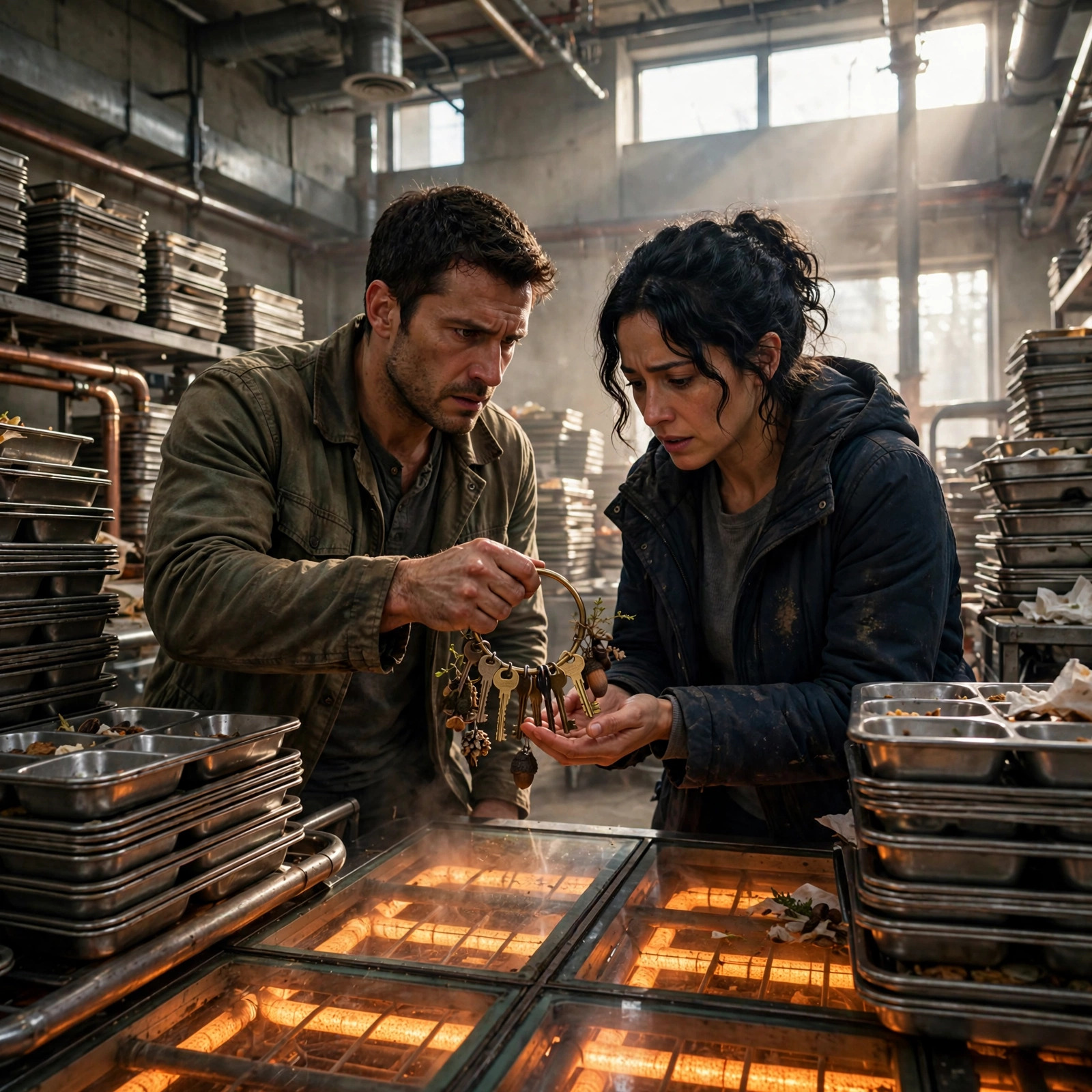
Twelve. The stall threshold was twenty-eight minutes, twenty-eight minutes a digester could idle before the colony started dying back, and the drain had started before that, so the clock had been running since the valve opened. She did the arithmetic in the kitchen doorway and didn't like any of it. "Rafe. The graft room keys. The copper ones in the locked drawer, you're second on the access list, get them and go unlock the seed cabinet. Take the carrier frame off the wall, both frames if you can manage them. I'm going back to the bioreactor and I'm going to count minutes, and if we're under the line I'm hand-carrying seed stock to you. If we're over the line, we're carrying it anyway."
"Because it's dying either way," Rafe said.
"Because it's dying either way, but the reseeding decides how dead."
He went. He came back in nine minutes with both frames, copper keys still on their ring hooked to his belt, and by then Amara had run back across the Commons once and come back with numbers she hadn't wanted. The auditor had let her look at the drain log. Valve opened at ten minutes past open of facility. Full drain rate. Colony idle, now, against the twenty-eight-minute threshold, for twenty minutes.
Twenty. Eight left.
"It's started," she said. "The die-back's started. Minute twenty, it's going pale in the top channels, I saw the color. So we don't save the colony in the reactor. We save the seed stock, and we reseed from the graft room on our own clock, and the graft room's heating line runs off nothing but its own little bank, which nobody's inspecting this week."
"Because it's under the size threshold," Hesper said from the doorway, "because I remember the fight about that, because Teodora carved it out herself. Where is Teodora?"
"Signing day," Rafe said. "She took the ledger with her this morning. She's on the east benches with it, getting the last of the households. We were at a hundred and seventy-three yesterday."
"Then she's out there with three hundred and ten people's lunch in a wet bag," Hesper said, "and no way to know it's gone." She looked at the covered pots, the racks of flatbread gone half-baked and stopping, the soup that had been hot an hour ago. She was an even-keeved woman and her voice stayed even, which was how Amara knew. "People ate here through the year the storms took the ferry docks. Through two winters of ration stretch. This kitchen never once went cold mid-service. My mother stood in that spot. It's not the meals, Amara. It's that nobody standing out there on that walkway has ever had to be told there's no meal."
"Then tell them the true thing," Amara said. "Tell them the heat was spent on keeping the heat safe, and that we're going to reseed, and that it's six days before the reactor feeds the loop again, and I'm sorry, and tell them I said so."
Hesper went to the door. Junie stood up off the stool, cloth rewrapped, and held out their good arm for the smaller carrier frame.
"You're not carrying anything," Amara said.
"I've got one arm and you need two frames and there are two of us standing here. The seed stock's in the graft room and it's forty kilos a frame and Rafe can't carry eighty."
"Junie."
"Wrap it tighter and I'll carry the near end. It's my kitchen too. Hesper said it plainly and she's right, so let me do the part I can do."
They wrapped it tighter. Rafe took the heavy end of the first frame and Junie took the near end and Amara took the second frame alone, seed cultures racked in copper tubes, warm as bread, the whole living inheritance of the loop, and they walked it across the Commons past the open drain with the auditors watching them go. Nobody said anything to the auditors. There was nothing to say that the standard hadn't already said for them.
In the graft room the lights were low and the little bank's radiance ticked under the floor like always, and Amara set her frame down and unlocked the back shelf with the copper key and lifted out the graft journal, the fat one, the one with the reseeding sequences and the strain notes in her own handwriting going back years, and turned to the tabbed page while Rafe and Junie set the seed into the warm cabinet one tray at a time.
"Six days," she said, and wrote the day number at the top of the page. "Colony reseeds from this stock. The loop idles. The kitchen runs cold off the mains until we can bridge it, and Teodora's out there with the ledger and she's about to find out what happened to the day she spent collecting for."
The door opened on that, and it was Hesper again, rain-wet, holding Teodora's field satchel out at arm's length. The satchel dripped. Water ran off the flap and off the buckle and pooled on the graft room floor, and the ledger inside, when Amara took it out, was swollen and shut, its pages fused, the signatures of a hundred and seventy-three households gone into one gray block, and the last twenty-seven households still unsigned somewhere on the east benches in the rain.
"She's coming," Hesper said. "She stopped to help Junie's kitchen line and the rest, and she says it can be re-collected, all of it, every page, if you go out with the duplicate sheets tonight."
Amara set the ledger down on the bench, wet and unusable, and kept her hand on the graft journal, the dry one, the one that still opened. Junie sat on the graft room stool with their wrapped arm cradled in their lap, steam rising faintly off the cloth, and the seed cabinet hummed behind them, warm, alive, six days in it, waiting for morning.
Four Hours of Heat
Teodora came in at first light with the duplicate sheets dry under her coat and her boots leaving dark prints on the graft room floor. She stopped when she saw the drained racks, the seed cabinet humming, the graft journal open on the bench at the tabbed page with the day number written at the top in Amara's hand.
"Hesper told me," she said. "The drain. The scalding. I came as fast as the east benches let me."
"Sit down," Amara said. "You've been up all night."
"I've been up all night collecting signatures in the rain, and I have twenty-two of the twenty-seven, and I'm not sitting down until you tell me what that page says." Teodora's coat was still dripping at the hem. She pointed at the journal, then at the retrofit letter lying beside it, the one Amara had pulled from her field coat pocket when the auditors left. "You called it the heat-void clause. On the path, yesterday, you said the word and then the auditors were there and you never finished. Finish it."
Rafe was at the seed cabinet, checking the tray seals one by one. Hesper stood near the door with her arms crossed, still in her rain gear, watching. Junie had gone down to the kitchen line to supervise the cold-start, so it was the four of them in the low-lit room, and the little bank ticking under the floor the way it always ticked.
"Page eleven of the annex," Amara said, and turned the letter around so Teodora could read it standing. "The retrofit paper. Nine hundred kilowatts of firm capacity against our six-forty. A forty-one percent efficiency margin, on paper, which is why the district board loved it and why I signed the trial in the first place, because on paper it's the difference between making it through a bad winter and rationing power to the benches."
"I know why we all signed," Teodora said. "I collected a hundred and seventy-three households on that promise. Read me the part you didn't read out loud."
"Schedule C. Heat-void remediation." Amara put her finger under the line. "The retrofit's firm capacity is firm because it takes the thermal bank out from under the kitchen. Physically. The converters need the substrate, and the substrate is the sand bed under the warmth-share floor. Four hours of banked heat, that's what the bank holds at full charge, and the retrofit's numbers count those four hours as losses. Bleed-off. Inefficiency. The forty-one percent margin is the bank's heat plus a rounding error, and the annex is very clear about where the bank goes."
Teodora read it. Her lips moved on the technical lines and stopped moving on the last one. She set the letter down and put both hands flat on the bench, and for a while nobody said anything, and the seed cabinet hummed.
"The warmth-share," she said finally. "Three hundred and ten meals a day come off that floor. The elders eat there because it's warm and because the warm ones among them can't carry a tray up the stairs to their units, so they eat downstairs where the heat is, and the mothers leave the babies' laundry folded on the warm tiles overnight because the tiles are warm, and Em's physiotherapy happens in the corner by the ovens because Em can't get warm enough at home to loosen the joints to move at all. None of that is in the numbers. None of that is in any numbers, Amara. The numbers count kilowatts."
"I know."
"You knew this when?" Teodora's voice went thin. "When did you know? Because I stood on doorsteps for nine days saying this retrofit was warmth for everyone, and if you knew the warmth-share was in the void when I started collecting, then I've been lying to a hundred and seventy-three households with my own mouth."
"I found it Tuesday," Amara said. "The scalding found it, really. The digester stalled and I went looking for why the bank wasn't covering the gap, and the annex told me the bank was never going to cover anything again, and then the drain valve was open and Junie's arm was burned and none of it mattered anymore for a day and a half because there was a person hurt and a colony dying." She kept her voice level. "You weren't lying. The promise was true. The paper just ate it."
"The paper ate it," Teodora repeated. She sat down after all, on the wet bench, not caring. "Twenty-two signatures in my coat. Two hundred needed to bind the district plan. I'm twenty-seven short at dawn and I was going to walk the east benches tonight and finish it, and now you're telling me the plan I'm binding people to pulls the floor out from under the kitchen. Would you sign that, if a stranger brought it to your door?"
"No," Amara said. "I wouldn't."
Rafe closed the last tray seal and came over. "The audit window runs six days," he said. "Colony reseeds in six days if we do it right. We drained the reactor to save the scalded line. The reseeding needs heat, continuous, through the window, and the mains are rationed to the benches because of the storm load. There's exactly one source of continuous heat on this block that isn't the mains."
"The bank," Teodora said. "Four hours."
"Four hours at full draw," Amara said. "Enough to carry the seed cabinet through one complete reseeding cycle if we run the manifold straight from the bank valves and nothing else. Not the kitchen. Not the hall. The cabinet only."
Teodora looked at the floor. The warmth-share hall was on the other side of the wall, and the kitchen above it, and under the kitchen floor the sand bed held its four hours, and you could feel it even through the graft room tile, the faint rising warmth of a thing that had been charging since before dawn yesterday. She looked at it a long time.
"If you run the cabinet off the mains instead," she said, "and keep the bank for the hall, what happens to the colony?"
"Twenty-eight minutes," Rafe said. "That's how long a digester can idle before the colony starts to die back, and the mains brown out under storm load every night. We lose the seed on night two and we're not reseeding anything this winter."
"And if you run it off the bank," Teodora said, "the kitchen goes cold."
"For six days," Amara said.
"Three hundred and ten meals a day, cold, for six days. Em can't do her stretches in a cold corner. The laundry freezes on the tiles. The elders eat upstairs or they don't eat, and some of them don't eat upstairs." Teodora stood up. "And your recertification. Amara. The audit is your recertification. If the colony reseeds clean through the window you come out of this certified and the loop survives as a commons loop. If it dies back, you're done, and you know it, and I watched you hold that journal last night like it was a child. You're telling me you'll spend the last four hours of banked heat in the district, the heat under the kitchen, the heat the whole neighborhood feels through its feet, to keep a colony of algae alive through your own audit."
"The colony is the commons," Amara said. "The kitchen is the commons. I can't save both and I've had a night to be angry about it, and I'm done being angry. The colony reseeds or nothing else matters, because without the loop there's no kitchen either, there's no warmth-share, there's nothing to void. But I'm not doing it to you in the dark, Teodora. That's why you're here. The plan needs two hundred households and you have a hundred and ninety-five, and the twenty-seven on the east benches should know what they're signing before they sign it. So I'm putting it in writing."
She took the graft journal, the dry one, and turned to the page after the reseading sequence, and wrote in the plain hand she used for the household bulletins: banked heat of the Commons thermal bank, four hours at full charge, pledged to the reseeding of the colony through the audit window, six days, kitchen to run cold, hall to run cold, no charge to any household. Then she wrote her own name under it, and the day number, Day 9.
"That's not a legal instrument," Teodora said.
"It's a graft," Amara said. "It's how we record who gives what to whom, in this room, so that when the colony comes back and the bank recharges and the floor is warm again, nobody forgets what the floor was warm on." She held out her hand to Rafe. "The keys."
Rafe unhooked the copper seed keys from his belt. Six of them on a ring worn bright at the handles, the keys to the bank valves, and he didn't hand them over right away. He held the ring in his palm and looked at her.
"You're sure," he said.
"I'm sure."
"Then take them with your whole hand." He put the ring in her palm and closed her fingers over it himself, both of his hands around hers, and Hesper made a small sound by the door that might have been a word and wasn't.
Teodora watched the keys go. Then she pulled the duplicate sheets from under her coat, twenty-two households dry and signed, and set them on the bench beside the wet ruined ledger, and took the pen, and added her own name under Amara's on the journal page. "Witness," she said. "And when I walk the east benches tonight, this page comes with me. All twenty-seven remaining, they read it before they sign anything, and some of them won't sign, and that's their right, and we'll get to two hundred anyway because it's the truth now and the truth collects easier than the promise did." She capped the pen. "Show me where the valves are."
"Under the kitchen," Amara said. "Come on."
The hall was quiet at that hour, between the first service and the second, and the kitchen floor was warm through the slippers, the sand bed below holding its charge, four hours of trapped heat under the tiles. Hesper and Rafe lifted the hatch and Amara went down the rungs first with the copper keys on her wrist, into the crawlspace where the manifold ran along the bed in its insulated sleeve and the six valves sat in a row, each one tagged in her own handwriting from years back. She found the two that fed the hall loop and the four that fed the cabinet manifold, and she put the keys in, and up through the hatch Teodora's face was framed against the kitchen light.
"Last chance," Teodora said.
"No," Amara said, and turned them.
The valves went over with the soft resistance of well-kept brass, all six, and somewhere in the crawlspace wall the manifold began to draw, a long low breath of heat leaving the sand and heading for the seed cabinet where the colony waited in its copper tubes. Amara climbed out and stood on the kitchen floor in the half-light, and the warmth underfoot was already going, she could feel it going, the tiles cooling by degrees under her feet while the seed cabinet across the Commons drank its four hours, and she stood there on the cooling floor and did not move until the cool reached all the way through to her, which it did, which it was always going to.
Reseeding Day
The copper tubes came out of the seed cabinet green.
Amara had been awake since before the second service, standing in the graft room with the door propped open so she could hear both rooms at once: the kitchen on one side, the Commons bioreactor on the other. Six days since she'd turned the valves under the kitchen floor. Six days since the sand bed had given up its four hours of heat and gone cold, and the hall above it had gone cold with it, and the colony in its tubes had drunk the whole charge down to nothing and then, on the third morning, begun to color.
She'd checked the tubes every eight hours, and every eight hours Junie Park had checked them again, one-handed, the other arm in a sling from the scaffolding drop on the east benches that had put them out of seed-tray work for a week. Junie didn't let it stop them. They'd spent the whole six days on a stool at the cabinet with a hand lens, calling the color up the tube line like a race.
"Past the second bend," Junie said now, from the stool, not looking up. "Past the third by noon if it keeps this pace. You want to know what I've decided about one-handedness?" "No," Amara said. "It's the ideal condition for algae work," Junie said. "Half the reaching. Twice the patience. Rafe keeps offering me trays and I keep telling him the sling is doing the trays a favor." "It isn't," Rafe said from the doorway, arms full of seed tray. "The trays miss you." "The trays miss nothing. They're trays."
Amara took the reading at the seventh check and wrote it in the graft journal, on the page after the pledge page, where the numbers had been going for six days in her own hand. Density up. Turbidity down. The colony had taken the reseed the way a good colony always did: slowly at first, then all at once, green climbing the tubes overnight like it had somewhere to be.
By midmorning it was ready, and the Commons knew it before she said so. Word had gone down the row houses the way it always did, mouth to mouth, and the neighbors came with their barrows and their children old enough to carry and their children too young to carry anything but a spoon to stir with. They hauled seed trays up from the warmth-share cellar, forty to a barrow, and stacked them along the west face of the bioreactor in the pale sun, and the trays steamed faintly where the new heat from the loop had begun to find them.
"Sixty-one trays," Rafe called from the barrow line, counting as he stacked. "Sixty-two. Amara, we're short on the north rack, someone's taken trays for the balconies again." "Let them," Amara said. "If it's growing on a balcony, it's growing." "That's not how the audit counts it." "Then the audit can come count the balconies."
Hesper came out of the kitchen with flour to her elbows and her sleeves rolled wrong, one high one low, the way she'd worn them all week while the ovens ran cold and she'd cooked the warmth-share meals on the little backup ring, three hundred and ten meals a day out of one burner, and never once said the number out loud where the queue could hear it. She'd said it to Amara at night, though, in the graft room, tired past politeness: three hundred and ten, Amara, every day, on one ring. The kitchen had come back on heat the day before, but Hesper hadn't trusted it until this morning, and this morning she'd fired all four ovens before dawn and stood in front of them with her hands out like a woman greeting a returned relative.
Now she leaned in the graft room doorway, flour and all. "Loaves are in. Second service is soup, it's already going. When the loop comes up, I want to bake the trays a thank-you bread." "The trays are algae, Hesper." "Then the algae gets bread. It's been working harder than half my cousins."
That was when Teodora arrived.
She came across the commons yard with her field satchel over one shoulder and a document case under the other arm, and she stopped at the tray stacks to speak to two of the neighbors, and she took a tray from the top of a barrow and carried it the last twenty meters herself, which Amara had not expected, and set it on the north rack in the gap Rafe had been saving.
"Teodora," Amara said. "Six days." "Six days," Teodora agreed. "You look like you slept in the graft room." "I slept in the graft room." "I know. Your light was on at four both mornings when I walked the east benches. I knocked once. You didn't hear me over the pump."
She came into the graft room and put the document case on the bench beside the journal, and Amara saw that the ledger inside was new, its spine uncracked, and that the sheets in it were not the same sheets. The header was different. The numbers were different.
"Sit down," Teodora said. "Not for long. Your colony's climbing." "It's past the third bend," Junie called from the stool. "Called it." "Past the third bend," Teodora repeated, to Amara, and something in her face gave a little, the way it had given in this room nine days ago when she'd set twenty-two dry signatures on the bench. "All right. Here." She opened the case and turned it so Amara could read. "The retrofit plan is dead. This is what replaced it." Amara read the header twice. The Solid Grid's firm capacity, the nine hundred kilowatts, the paper number that had been the whole argument, was folded into the Commons loop as a backfeed, listed as emergency reserve, owned by no one, drawing nothing in a normal month. "Your firm agreed to this." "My firm agreed to this because I spent four days explaining that the alternative was a district plan with a forty-one percent margin on paper and a dead colony in fact, and because I put my own signature on the cover sheet as the engineer of record. If it fails in a hard winter, it fails on my license." "It won't fail." "I know that now. I didn't know it six days ago, which is why it's written as a backfeed and not as a promise. Promises I've stopped making." She turned another page. "Signatures stand at one hundred seventy-three of the two hundred needed. Twenty-seven households out, most of them east bench, most of them mine to walk." "You had twenty-two dry sheets on day nine." "I had twenty-two dry sheets and five wet ones that wouldn't take ink, and then the cold week came and the east benches had better things to do than read district plans, which was correct of them. The plan isn't finished, Amara. It won't be finished today. It may not be finished this season. It binds at two hundred or it binds at nothing, and today it's at one hundred seventy-three, and I'm telling you that plainly because you earned plain." "I don't need it finished today." "No. But you need the loop certified today, and that I can give you."
She took the certification sheet from the case, already stamped, the recertification she'd walked in with: the Commons loop, algae-and-digester, six hundred and forty kilowatts at peak, inspected and signed. She held it out and Amara took it, and her hands were steady, and she read her own loop described in a stranger's careful engineering hand, and found it correct.
"There's one more page," Teodora said. She turned to the back of the graft journal, past the numbers, past the pledge page with its two names on it, to a fresh leaf, and she uncapped her pen. "The journal wants a collaborator line. Not an owner. You kept six days of readings, you turned the valves yourself, and I've been walking this district telling two hundred households whose loop it is, so I'd like the record to say who else's it is." She wrote her name on the line marked collaborator, and under it she wrote the date, day fifteen of the reseed, and she turned the pen around and offered it handle-first. "The line underneath is yours if you want it." "It's my journal." "It's your journal. It's also the district's record. Sign it as collaborator, Amara. Nobody owns a colony that eats sunlight and sewage and feeds three hundred people soup."
Amara took the pen. She looked at the line for a long moment, and outside the neighbors were calling numbers up the tray line, and Hesper's voice carried from the kitchen doorway, something about the soup and about nobody touching her ovens. Then Amara wrote her name under Teodora's, on the collaborator line, and put the pen down.
"Loop's up," Rafe said from the door, breathless. "It's up, it's holding, Amara, six forty on the board and steady."
The noise from the commons yard came through the open door then, the real sound of it, forty neighbors and a barrow line and a colony going green up its tubes, and Junie on the stool saying told you, third bend to nobody, one hand raised.
Amara went out through the doorway and around the west face of the bioreactor, to the algae drain valve with its audit lock, and she took the copper seed keys off her wrist, the same six keys she'd carried down into the crawlspace nine days ago and turned in the dark while Teodora watched from the hatch. She fitted the small one to the audit lock and unscrewed it, slow, until it came loose in her fingers, and the drain valve stood open and certified and hers no longer to lock.
Hesper came out of the kitchen with flour still on one wrist, drying her hands on her apron, and stopped in front of her, and Amara put the audit lock in her pocket and opened her palm with the copper keys in it, warm from six days against her skin, and tipped them into Hesper's palm and closed Hesper's fingers over them with her own.
"The valves are under your kitchen now," Amara said. "All of them. Keep them turned." Hesper looked down at her own closed hand, then up, and her face did the thing it did before she argued, and then didn't argue. Behind her, along the west face, the seed trays stood stacked and steaming, the north rack short, the last barrow still half full, the work nowhere near done and nobody anywhere leaving.
Get notified when new stories drop

Leo Stranek
Leo specializes in solarpunk abundance and near-future progress: livable futures, bright cities, and practical wonder.
Leave a comment
Comments