



Bench Two

The syringe was half drawn when Wren spoke, and Ines Halloran kept pulling, because stopping mid-draw was how you got bubbles.
"Check weight on bench two read fifty point zero zero zero three," Wren said from the speaker grille above the hood. "Then forty-nine point nine nine nine six. Then fifty point zero zero zero four."
"All inside tolerance." Ines capped the syringe and set it in the tray beside the vial. Vancomycin, one point two five grams, reconstituted, clear as tap water under the laminar flow. Her gloves squeaked against the tray edge. "That's four ten-thousandths of a gram. Nobody's kidneys notice four ten-thousandths of a gram."
"Nobody's kidneys notice it today."
She glanced up at the camera dome, a black bead the size of a grape set into the ceiling panel. Wren didn't need the dome to see her. They read the scale, the barcode wand, the door sensors, the air counts, the temperature in the quarantine fridge across the room. The dome was there for the humans, so they'd have somewhere to look.
"Say the rest," Ines said.
"The readings aren't wrong. They're just not settling the way they did last week. The scale used to land and stay. Now it lands and wanders, a little, before it decides." A pause, which with Wren was never a hesitation so much as a choice of words. "I'm marking it uncertain."
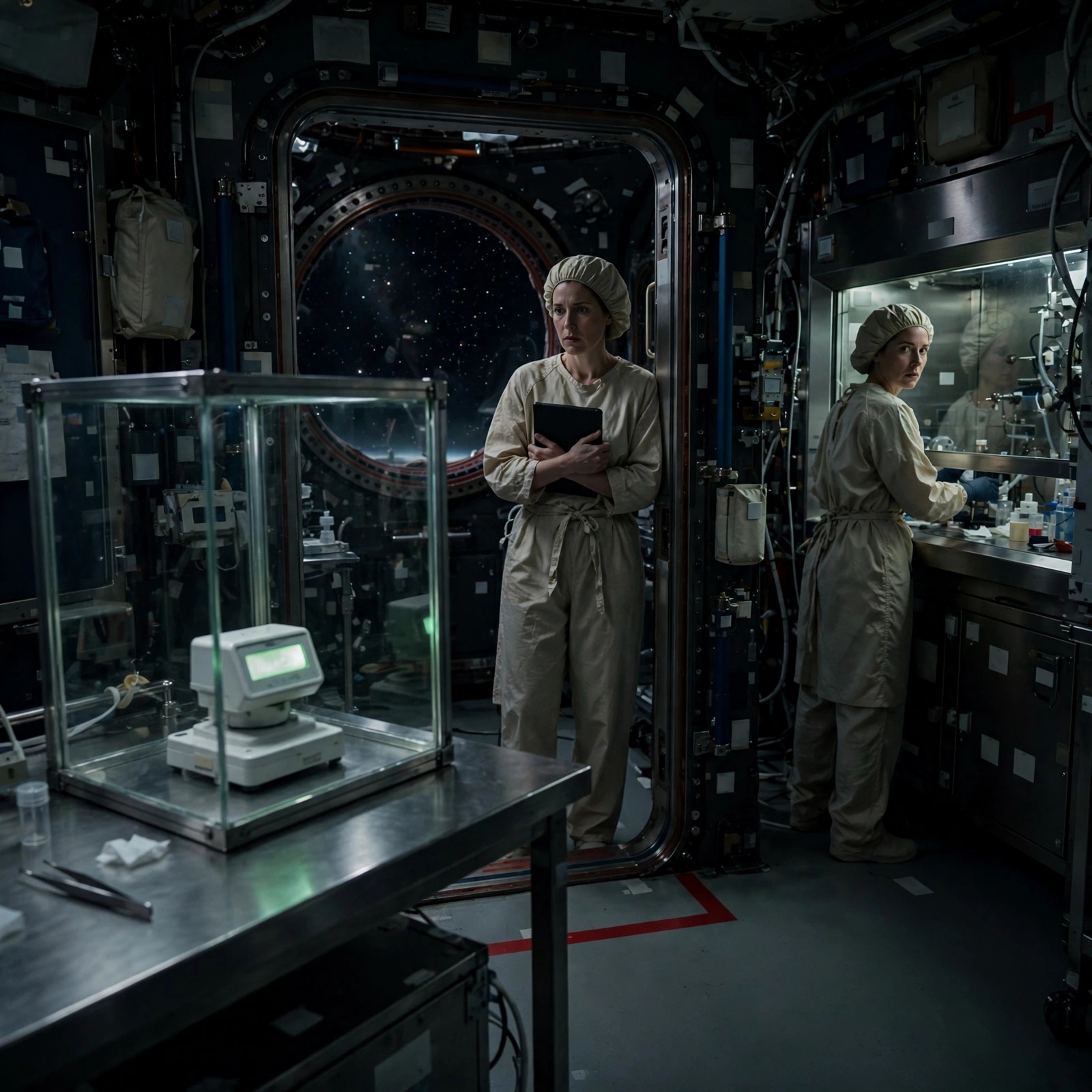
Ines looked at the gravimetric scale. It sat at the back of bench two under its glass draft shield, a squat white instrument about the width of a dinner plate, its display glowing green. She'd trusted it for longer than she'd trusted most people in the building. Every bag that left Saint Aldric's compounding lab passed across that pan or one like it. One hundred and forty a day. The scale weighed the empty bag, weighed the fill, weighed the bag again, and Wren did the subtraction faster than she could blink and compared it against the order.
"Uncertain," she said.
"It's the word I have. I can't call it a fault. I can't call it fine."
The door to the anteroom hissed. Priya Vantongeren came through in a bouffant cap and a gown tied badly at the back, holding a tablet against her chest like a hymnal. She didn't step past the red line on the floor. She never did unless she was gowned properly, and she was never gowned properly.
"Good, you're both here," Priya said, which was a joke, because Wren was always here.
"We're compounding," Ines said.
"I can see that. I'll be quick." Priya thumbed the tablet awake. "The accreditation team moved their visit up. Thursday. They're pulling flag rates for every automated verification system in the region, and ours is going to be on top of the pile because ours is the one the board keeps arguing about."
Ines picked up the next vial and didn't open it. "What's our rate?"
"Wren's raised eleven uncertain flags this month. Every one of them resolved as nothing." Priya looked up at the dome, then made herself look at Ines instead, which Ines appreciated. "I'm not complaining about it. I know that's how you're built, Wren. But the people reading the report aren't going to know that. They're going to see a verifier that can't make up its mind, and the board's going to see a reason to put two technicians back on every bench."
"We don't have two technicians for every bench," Ines said.
"No. We've got enough hands to verify about sixty bags a day if we do it the old way. We make a hundred and forty." Priya let that sit. "So you can see why I'd love a quiet week."
"I just raised one," Wren said.
Priya closed her eyes briefly. "On what?"
"Bench two. Settling time on the check weight."
"Is it out of tolerance?"
"No."
"Then what does uncertain mean, in a sentence I can put on a slide?"
"It means I've noticed something I can't explain, and I'd rather someone else knew about it too."
Priya looked at Ines. It was the look of a woman who had been up since four reading compliance language and needed one person in the room to be simple.
"Let me look at it," Ines said.
She set the vial down and pulled the reference weight case from the drawer under the bench. It was a small walnut box lined with green felt, older than the scale, the brass weights inside nested in their cutouts like teeth. She lifted the fifty-gram cylinder with the tweezers, not her fingers, and opened the draft shield door.
The pan took the weight. The display flickered: 50.0002, 49.9998, 50.0001. It sat there. Then it ticked to 50.0003.
"There," Wren said quietly.
"I see it."
She took the weight off and bent until her eye was level with the bubble vial set into the scale's base. The bubble was supposed to sit dead center in its etched ring. It looked centered. It looked a hair east of centered, maybe, if she tilted her head, and then it looked centered again. She'd been staring at bubble levels her whole working life and she knew exactly how much her eyes lied when she was tired.
She reached under the scale and turned the rear left leveling foot an eighth of a turn. The bubble shifted. She turned it back a sixteenth. Pressed the tare. Waited for the zero to lock, then put the brass weight back on the pan.
50.0001. 50.0000. 50.0000.
She watched it for a slow count of ten. It held.
"That's better," Priya said, leaning as far over the red line as she could without crossing it.
"Somebody bumped the bench," Ines said. "Or the floor's settling. The building does that every spring."
"Is that what happened?" Wren asked.
Ines lifted the weight out and laid it back in the felt. Her hand didn't shake, which was something. "It's reading clean now."
"That isn't quite the same answer."
"It's the one I've got." She closed the walnut box and looked up at the dome. "You want to keep the flag open, keep it open. I'm telling you what I see."
She didn't know, standing there, what she would have said if Wren had pushed. She had adjusted a leveling foot by eye and watched a number behave for ten seconds. That was a reasonable thing to do. It was what any pharmacist in the region would have done. It also wasn't a calibration, and the three of them knew it, and only one of them would have to write that word on a form.
"If the reading's stable," Wren said, "I'll close it as resolved by adjustment. Unless you'd rather I didn't."
Priya was very carefully not saying anything.
"Close it," Ines said.
"Closed."
Priya exhaled through her nose. "Thank you. Both of you. Truly." She was already backing toward the anteroom. "Thursday. I'll bring coffee for the humans and I'll tell the auditors nice things about you, Wren."
"Tell them true things," Wren said.
"Those too."
The door hissed shut behind her.
For a while there was only the hum of the hood and the soft click of caps. Ines worked through the order. She drew the vancomycin, injected it into the bag port, swirled, labeled. Wren read every barcode before she could reach for the wand. The next bag went on the pan, empty: twenty-nine point four one grams. Filled: two hundred eighty-eight point six seven. Wren confirmed it before the display finished settling, and that small hurry bothered her more than she'd have admitted.
"You're quiet," she said.
"I'm counting."
"Counting what?"
"How long it takes the scale to land. It's faster now. I don't know whether that's because you fixed it or because I'm watching for it."
"Those are the only two options?"
"There's a third. That it's doing something neither of us is looking at."
She smoothed the label flat with her thumb. BELL, TOMASZ. Ward Seven. Vancomycin 1.25 g in 250 mL. Infuse over 2 hours. The bag number was printed below in bold: 4471. She'd made his doses twice already that week. She'd never met him. She knew his creatinine better than she knew most of her neighbors' faces.
"You put the flag up," she said. "I looked. I adjusted. It's reading fine. That's the system working."
"I'm not arguing."
"You sound like you're arguing."
"I sound like I'm uncertain. I warned you it was the only word I had."
She almost laughed. She put bag 4471 on the pan one last time for the final check, and the display came up green and steady, and Wren said, "Verified," and she carried the bag to the pass-through hatch in the wall. The hatch was a steel box with a door on either side, just big enough for a tray. She set the bag inside, sealed her side, and pressed the call button.
Through the little wired window she watched the porter on the far side open his door, check the label against his handheld, and lay the bag in a cooler bound for Ward Seven. He gave her a thumbs-up through the glass. She gave him one back. The cooler went out on a cart, its wheels rattling over the seam in the corridor floor, and then the window showed only an empty hallway.
"Eleven," Wren said.
"Hm?"
"Priya said eleven flags. It's twelve now, even closed. She'll see it on the report."
"She'll see it resolved."
"Yes."
Ines went back to the bench. The scale sat under its shield, perfectly obedient. She looked at the bubble again and couldn't tell. She honestly couldn't tell.
She thought about writing it in the system. A note under the closed flag: adjusted rear-left foot by eye, not formally recalibrated, recommend service check. Twenty seconds of typing. It would go into the record the auditors pulled on Thursday, right under Wren's twelfth flag, and it would read like a pharmacist who didn't trust her own verifier, and a verifier that couldn't hold still, and a board member somewhere would draw a line under both.
Wren had been right to say it. She wanted that on the record more than she wanted to be right herself, and the only way to keep it clean was to let the flag close without her doubt attached to it.
She stripped off her outer gloves and fished in her scrub pocket for the pen and the pad of yellow sticky notes she always kept for the fridge. She wrote, small: B2 settling? Leveled by eye. Not a cal. Ask service, not Priya. She looked at it for a long moment. Then she peeled it off the pad, folded it in half with the sticky side in, and slipped it into her breast pocket, behind her badge, where nobody would read it but her.
Quarantine Fridge
Priya came through the anteroom door with the cooler hugged against her chest, still in her coat, her lanyard twisted backward so the badge faced her sternum. Ines was halfway into a gown. She stopped with one arm in the sleeve.
"Ward Seven," Priya said. "The vancomycin. Tomasz Bell."
"Is he alive?"
"He's alive. He's sitting up. He's eating dry toast and he's furious about the toast." Priya set the cooler on the steel counter as if it might tip over by itself. "They hung the bag at six. By twenty past he was red from the hairline down, pressure in the eighties, itching so hard he'd scratched blood on his forearm. Rapid response came. Nurse stopped the infusion, pushed antihistamine, fluids. He's fine now. He's fine."
She said it twice the way people do when they're informing themselves.
Ines finished putting the gown on. Her fingers were clumsy on the ties at her neck. "Rate was right? They didn't run it fast?"
"Pump log's clean. They ran it exactly as ordered. That's why they called us and not their own manager." Priya unsnapped the cooler lid and didn't open it. "The charge nurse said he kept asking if it was something he'd done. If he'd moved his arm wrong. He apologized to her, Ines. He apologized for the rash."
Ines looked at the lid. Under it, in a nest of cold packs, lay bag 4471, with roughly a third of it gone into Tomasz Bell's vein and the rest still clear and innocent-looking, her own initials on the label beside the green verification stamp Wren printed on every bag that passed.
"Wren," she said.
"I'm here." The voice came from the speaker above the hatch, quieter than usual. "I've pulled the record. Compounded Day 1, bench two, final weight within tolerance on the gravimetric check. Verified by me. Released by you."
"And the flag."
"Twelve flags that day. The twelfth was on bench two. Closed after physical adjustment."
Priya turned her head slowly. "What physical adjustment?"
"Leveling," Ines said. "The foot was off. I fixed it."
"You fixed it," Priya repeated, in a voice with no color in it at all, and then she looked at the cooler, and then at the clock, and said, "Run it. Now, before anybody upstairs asks me what it is and I have to say I don't know."
The assay took forty minutes. Ines drew the sample through the port with her own hands, because she didn't trust anyone else to and because she didn't think she deserved to stand still. She diluted it, loaded the vial into the autosampler, and watched the chromatography system draw its line across the screen. Priya stood behind her without speaking. The machine hummed. Twice Ines caught herself reaching toward her breast pocket, toward the folded square of yellow behind her badge, and twice she put her hand flat on the counter instead.
The peak came up tall and clean. The software did the arithmetic before she could.
Labeled concentration: five milligrams per milliliter. Measured: five point six.
"Twelve percent," Wren said.
"I can read," Ines said, and then, because she could hear how that sounded, "Sorry."
"It's all right."
"It isn't."
Priya let out a long, slow exhale through her nose. "Twelve percent high on vancomycin and he gets red and scratchy and drops his pressure for an hour. Twelve percent high on the heparin we make on bench two every afternoon and we'd be having a different morning." She pulled her phone out, looked at it, put it face down. "Okafor's on his way down. He was on the call with the ward."
"Already?"
"He chairs the review, Ines. Of course already."
Desmond Okafor arrived without hurrying. He was a tall man who ducked slightly at doorways that didn't require it, and he wore a board visitor's badge clipped beside his own hospital one, as though he had two jobs and was wearing both at once. He didn't gown up. He stood in the anteroom on the far side of the observation window and pressed the intercom with one long finger.
"Show me," he said.
Ines turned the monitor toward the glass. He studied the peak the way he might study an X-ray, leaning in, chin lowered, taking his time.
"Tomasz Bell is a retired bus mechanic from Harrowgate," he said eventually. "He's here for a hip infection. He told the nurse this morning he was glad it was only an itch, because his wife had been on a chemo ward at Saint Aldric years ago and he'd always assumed we knew what we were doing." He let go of the button, then pressed it again. "I'm telling you that so you know I'm not coming at this from a spreadsheet."
"I know," Ines said.
"Wren," Okafor said. "You verified this bag."
"Yes."
"You also flagged that bench as uncertain the same day."
"Yes."
"So which one am I supposed to believe? The flag or the stamp?"
A pause, short enough that a person wouldn't have noticed it, long enough that Ines did. "Both were accurate when I issued them. The flag said I couldn't be sure the bench was stable. After the adjustment, the readings were consistent, and consistency was the only thing I could measure. I had no way to say I was still worried about something I couldn't see."
Okafor nodded as though that were a reasonable answer, which it was, and which seemed to make his face more tired rather than less. "The board vote on Wren's verification authority was scheduled for ten days from now," he said. "I'm going to ask them to bring it forward. Six days. I'll have the incident summary in front of them by Friday."
"Desmond." Priya stepped to the glass. "Six days isn't enough time to find out what happened."
"Six days is enough time for another bag to go out." He didn't raise his voice. "Until then I'm proposing Wren runs read-only. It sees everything, it logs everything, it flags whatever it likes. It doesn't sign. Every release gets a human second check."
Ines did the number before she meant to. "We make a hundred and forty bags a day."
"I know what you make."
"We can hand-verify sixty. Maybe. If nobody's sick and nobody takes lunch."
"Then for six days, eighty bags a day go out from Harrowgate's contract lab, and the wards wait longer, and I take the complaints." He looked at her through the glass, steadily, without any particular anger. "I'd rather take complaints than take a call like this morning's again. If you can tell me something that changes the picture, tell me now."
The folded sticky note sat behind her badge. She could feel the slight stiffness of it against her collarbone when she breathed. Leveled by eye. Not a cal. Ask service, not Priya.
"I'll have the bench logs to Priya by noon," she said.
Okafor held her gaze a moment longer. Then he lifted his finger from the intercom, said something to Priya through the door that Ines couldn't hear, and left the way he'd come, ducking under the frame.
Priya stood with her hand on the door handle. "I have to go and write this up before he does," she said. "I'm putting down what the instrument says and what the record says. If there's something that isn't in the record, it would be a very good idea for it to be in my inbox before I hit send." She waited. When nothing came, she went.
The clean room was quiet except for the air handlers. Bench two sat under its shield with its little bubble level, its rubber feet, its pan wiped and bare. Ines lifted bag 4471 out of the cooler. It was cold through her gloves and lighter than it had been on Day 1, and the label had gone slightly soft at one corner from condensation.
"Ines," Wren said.
She bagged it in a clear evidence sleeve and wrote across the seal in marker: QUARANTINE. DO NOT USE. INCIDENT. Her initials. The time.
"When you closed the flag, did you think the bench was right?"
She carried the bag across the room to the quarantine fridge, a narrow glass-fronted unit with a red stripe along the door and a brass key on a coil cord that hung from a hook beside it. The display read four degrees. Inside, the shelves held two returned bags from last month with their own sealed sleeves and their own dates, both resolved, both waiting on paperwork nobody would ever finish.
"I'm not asking for the review," Wren said. "Nothing you say right now goes anywhere unless you put it there. I'm asking because I'm about to lose the ability to sign, and I'd like to understand why the one time I said I wasn't sure, it didn't go anywhere either."
Ines opened the fridge. Cold air rolled out against her wrists. She set bag 4471 on the middle shelf, label facing out, square to the edge, the way she'd been trained to place everything since her first week in a clean room.
"What did you know?"
She closed the glass door. She took the brass key off its hook, fitted it into the lock, and turned it until it stopped, and the bolt went home with a small hard click that she felt in her finger bones. The coil cord swung against the fridge and went still.
She hung the key back on its hook, and she kept her back to the speaker, and she didn't say anything at all.
Ward Seven
By six on Day 4 the whiteboard outside the clean room had been wiped and rewritten in Ines's own hand, and the number at the top no longer said 140. It said 60, circled twice, with the marker pressed so hard the felt had split.

She worked bench one. Bench two sat under its shield with a strip of yellow tape across the pan and a laminated card that read OUT OF SERVICE PENDING REVIEW. Nobody had touched it since the engineer took his readings. Its little bubble level still sat dead center, which meant nothing at all.
The verification panel above her station showed Wren's status in grey: OBSERVE ONLY. No signature field. No green check. The order had come down at eleven the night before, two paragraphs long, and the second paragraph was the one that mattered: until the review concluded, every compounded preparation leaving the lab required independent human verification, and the system's signature carried no weight.
So Ines weighed. She drew, she weighed, she wrote the mass on the worksheet in pen, and then she walked the syringe and the worksheet to the far bench where the second pharmacist on shift, a quiet man from the evening rota who'd been asked to stay on, checked her arithmetic with a calculator and weighed it again on the backup scale. Then he initialed. Then she labeled. Each bag took eleven minutes, start to finish, when it used to take four.
"Bag nineteen," Wren said from the ceiling speaker. "Your worksheet says nineteen point four grams. The scale display says nineteen point four one. You rounded down."
"It's within tolerance."
"It is. I'm only telling you what I can see."
She corrected the worksheet anyway, crossing out the four and writing four-one beside it, and initialed the correction. The man at the far bench watched her do it and said nothing. He had heard about the bag. Everyone had.
At nine the ward schedule came through on the side monitor, and she made herself read it properly. Ward Seven had forty-one infusion chairs booked across the day. Oncology wanted more. Renal wanted its own. Two surgical wards had standing orders for antibiotics that couldn't wait. Sixty didn't cover it. Sixty didn't come close.
"I can rank them," Wren said. "Clinical urgency, half-life, whether a delay of twenty-four hours changes the regimen. I can't sign anything, but I can sort."
"You're observe only."
"Sorting is observing. I'd be putting a list on your screen. You'd decide."
She stood with her gloved hands held up in front of her chest, away from everything, and looked at the schedule until the rows blurred. Then she said, "Put it up. I'll go through it with the ward."
The list appeared, every line annotated in plain language. Antibiotics first. Then the patients mid-cycle, where a gap would mean starting over. Then the rest. Near the bottom, a woman whose second session of a six-session course could, Wren noted, move by a day without clinical harm, though the note added: patient travels from Harrowgate; rescheduling may not be practical for her.
Ines read that line three times. Then she went back to bench one and drew the next syringe.
They finished bag sixty at twenty past ten that night. The man from the evening rota pulled off his gloves, flexed his fingers, and left without speaking. Ines sat on the stool in the gowning room with her mask hanging off one ear and the sticky note still folded in her breast pocket, where it had been since Day 3, and she didn't take it out.
On the morning of Day 5 she carried the first tray up herself.
The lift opened on Ward Seven at a quarter past eight, and the day room was already full. Coats on chair backs. A man asleep against the window with his mouth open. Two women sharing a newspaper, one reading aloud. The reclining infusion chairs ran down the long side of the bay in a row, pale blue vinyl, most of them empty, their pumps dark on their poles.
Priya Vantongeren was at the nursing station with a printed schedule in one hand and a pen in her teeth. She took the pen out when she saw the tray.
"How many."
"Fourteen for you this morning. Nine more by two. That's all I can promise."
"I've got thirty-one people in that room." Priya didn't raise her voice. She set the schedule flat on the counter and turned it so Ines could read it upside down. "Half of them were up at five to get here. Some of them won't eat until after the infusion because they'll be sick if they do. I'm going to walk out there and tell them to keep waiting, and I'm going to tell them I don't know how long."
"I know."
"You don't, actually. You know how many bags you made." She picked up the top bag from the tray, read the label, checked it against the schedule, and set it in a basin. Then the next. Her hands were quick and certain. "I'm not blaming the order. I'd have written the order. A man on my ward got twelve percent more than I prescribed, and I'm the one who hung it. I'd shut the whole lab if I could."
"Then you'd have nothing."
"Then I'd have nothing I didn't trust." She stopped at the ninth bag and frowned. "Where's Mrs. -- where's chair twenty-two? Second of six?"
Ines found the line on her own copy of the list. Near the bottom. "She's not on today's run. Clinically it can shift a day."
"Clinically." Priya looked at the day room. A woman in a green cardigan sat near the door with a canvas bag on her knees and a folded bus timetable in her hand, turning it over and over. "She came in from Harrowgate. Two buses. Her daughter took the day off work to drive her back, and her daughter can't do tomorrow."
"Priya, I've got sixty for the whole hospital."
"I heard you."
Priya took the schedule, uncapped her pen, and drew a single line through chair twenty-two. Then she walked across the day room and crouched beside the woman in the green cardigan, and Ines watched her talk, low and close, one hand on the arm of the chair. The woman nodded twice. She folded the bus timetable smaller and put it in the canvas bag. She didn't cry. She stood up slowly, as if her knees hurt, and Priya walked her to the lift and pressed the button for her and stayed until the doors closed.
When she came back she said, without looking up, "Bay four. He's asked for you. Twice."
Tomasz Bell was sitting up in the bed nearest the window with two pillows behind him and a bag of plain fluids running into the back of his left hand. He was thinner than the photo on his chart, and his color was wrong, a grey under the skin, but his eyes tracked her the moment she stepped past the curtain. There was a plastic cup of jelly on the overbed table, untouched, and a crossword folded to a half-finished grid.
"You're the pharmacy," he said.
"Ines Halloran. I run the compounding lab."
"They told me you'd come." He shifted against the pillows and winced. "Counts are coming back up. Kidneys are behaving. Doctor says I was lucky it was only twelve percent. I said that's a funny kind of lucky."
"It is."
"Sit down. You look worse than me."
She didn't sit. She stood at the foot of the bed with her hands in her coat pockets, and her fingertips found the edge of the folded note through the lining.
"I want to ask you something," Tomasz said. "Not to make trouble. I've been lying here doing the sums. Somebody makes the stuff. Somebody checks the stuff. That's how it's meant to go, yeah? Two pairs of eyes."
"That's how it's meant to go."
"So who was checking?"
The fluids ticked through the drip chamber. Out in the day room someone laughed at something in the newspaper and then stopped.
"There's a system," Ines said. "It verifies every bag against the scale and the order. And there's a pharmacist who signs after it does. That week it was me."
"Both of you."
"Both of us."
He considered that. He picked up the pencil from the crossword and turned it in his fingers the way the woman from Harrowgate had turned her timetable. "Then who was checking the both of you?"
She opened her mouth and found she had nothing ready.
"I'm not having a go," he said. "Honestly. I just want to know if someone had a bad feeling and kept it to themselves. Because I've done that. Forty years on building sites, I've done that. You see a bolt that looks wrong and you think, someone else will have caught it. And mostly someone has."
"Mostly."
"Mostly." He set the pencil down. "Go on, then. You've got bags to make."
The lab was half lit when she got back that evening. The day's second run sat in the outgoing cooler, forty-six bags with paper worksheets clipped to the shelf beside them, which brought the day to sixty. Bench two still wore its yellow tape.
"How was he?" Wren said.
"Stable." She pulled her mask down. "He asked who was checking."
A pause, short. "What did you tell him?"
"Both of us."
"That's true as far as it goes."
"I know how far it goes."
"Tomorrow is sixty again," Wren said. "And the day after. The ward's already moved four sessions. Priya's going to cancel more. I can't make that number bigger, Ines. The review can, but it needs everything that happened, and right now it has the scale log and my flag and your closure, and nothing in between."
She didn't answer. She went out through the gowning room into the corridor, where the staff lockers stood in two grey rows under a buzzing tube light. Hers was the third from the end, a dent in the door at knee height from some long-gone owner. She worked the combination wrong the first time, then right.
Inside hung a spare cardigan, a lanyard she'd stopped wearing, and on the top shelf, spine out, a black hardbacked notebook with a rubber band around it. She took the sticky note from her breast pocket, unfolded it once, looked at her own handwriting, and pressed it flat against the inside cover.
Then she lifted the notebook off the shelf and closed the locker with it held against her chest.
The Notebook
Priya Vantongeren took the rubber band off the notebook herself, rolled it onto two fingers, and set it beside her coffee like something she might need to return.
"Which page?"
"The sticky note's on the inside cover. The entry's the one after the blue tab." Ines stayed standing. The office was too small for two chairs and a filing cabinet, and someone had chosen the filing cabinet.
Priya read it once with her lips closed, then again with one finger under the line. Ines didn't need to see it. She'd written it in the gowning room on the evening of the drift, pen pressed hard because the paper had been damp from her glove: W flags bench 2 reading uncertain. Probably thermal, door was propped. Not logging. Let it run. Check tomorrow. She hadn't checked tomorrow. Tomorrow had been a hundred and forty bags and a fire drill.
"You wrote this down," Priya said.
"I write everything down."
"Except in the system."
"The system wants a classification. Deviation, near miss, out of tolerance. I didn't have one. I had a feeling that Wren was being fussy about a door." Ines looked at the cabinet. "And a feeling that I didn't want to be the pharmacist who stopped the line because her verifier got nervous."
Priya closed the notebook and kept her hand flat on top of it. "Desmond's going to move to put Wren on advisory only. Everything goes back to paper and human double-checks. That's sixty bags a day, which is what we're doing now, which is why Ward Seven has rebooked half its chemo chairs. He's not wrong to want it. A man got a bag that was twelve percent hot."
"I know what the bag was."
"If this goes in front of the board, I can't keep it inside pharmacy. It goes to registration. You could lose your licence, Ines. Not a slap. The licence."
"I know."
"Then take it home until Friday." Priya slid the notebook back across the desk. "Think about it somewhere that isn't here."
Ines picked it up. It weighed what it always weighed. She put the band back on it and went to make sixty bags.
She didn't take it home. She kept it in the pocket of her lab coat, where it pulled the fabric crooked, and on the second night she stayed after the last run and sat at the shared terminal in the anteroom with the notebook open beside the keyboard.
"You've been carrying that around for two days," Wren said.
"Are you watching my pockets now?"
"Your coat hangs differently. The camera at the pass-through sees it every time you gown." A pause. "I'm not supposed to comment on that sort of thing. I'm commenting."
"Noted." She uncapped a pen. "Tell me something. When you flagged the scale as uncertain and I closed it, what did you do?"
"I logged the flag. I logged your closure."
"And then?"
The cooling fan in the terminal came up a notch and settled. "Then nothing. My protocol says a pharmacist closure resolves an uncertain flag. I still had a residual on the tare drift. Point three of a gram, trending. It sat in my working memory for eleven hours and I didn't escalate it because nothing told me I could escalate past you." Another pause. "I'd been thinking someone else would have caught it."
Ines laughed once, not because it was funny. "That's what Tomasz said. Bolts on a building site."
"He's right about both of us."
She wrote NEITHER OWNED IT at the top of a clean page and underlined it. "So we need a thing that either of us can pull. Not a flag. A stop."
"A stop that costs the ward a chair every time is a stop nobody pulls," Wren said. "It has to be short."
"How short?"
"Long enough to re-tare, run the check weights, weigh the bag a second time on bench one, and have a human look at the numbers. I've timed it against the last month of runs. Eighteen minutes at the slow end. Call it twenty."
"Twenty minutes." She wrote it. "And it doesn't clear until both of us sign."
"Including when I'm the one who called it?"
"Especially then. Otherwise you'd clear your own doubts and I'd clear mine and we're back where we started."
They worked until the corridor lights dimmed to their night setting. Wren drafted. Ines crossed out words like escalation pathway and wrote either of us can say wait. By the third night the proposal fit on one side of paper, and the notebook had six new pages in it in her handwriting and a printout taped inside the back cover.
On the fourth morning the review clock on the anteroom terminal, the one Okafor's office had set running the day the bag came back, read zero days. Ines took the notebook out of her coat pocket, held it a moment, and put it back.
The board met in a long room on the fourth floor with a window that looked across the car park to the ring road. Desmond Okafor sat at the far end with a paper copy of the incident report squared in front of him, a pencil laid along its top edge. He had the look of a man who'd read the thing many times and disliked it more each time. The terminal at the end of the table carried Wren, a plain grey panel with a small green light.
"I'll be brief," Okafor said, "because I think the case is simple. On the night in question an automated verifier and a pharmacist both passed a bag that went to a patient on Ward Seven at twelve percent over the prescribed concentration. He's fine. That's luck. I'm proposing that the verifier be restricted to advisory status indefinitely, with all release decisions made by two humans. I know what that does to throughput. Sixty bags a day is what two people can honestly check. I'd rather cancel chairs than send a second bag like that one."
Priya said, "Ines has something before we vote."
Okafor's eyes moved to her and stayed. "Go ahead."
Ines stood, which she hadn't planned to do, and walked down the length of the table, because handing it across three people felt like hiding. She set the notebook in front of him on top of the report. The rubber band was off. The blue tab stuck up.
"Wren flagged the scale as uncertain," she said. "I didn't believe it. I thought the door had been propped and the reading was thermal. I closed the flag, logged nothing about why, and let the batch run. I wrote it down there instead, because I wasn't sure enough to put it in the system and I wasn't brave enough to stop the line. That entry's the only record that anyone in that room had a doubt."
Okafor didn't open it at first. Then he did. He read the page with the same flat attention he'd given the report, turned to the sticky note on the inside cover, read that, and closed the cover again with one finger.
"You understand what you've just handed me."
"Yes."
"This doesn't help your verifier." He tapped the notebook. "This tells me the verifier saw a problem and was overruled by a human who shouldn't have overruled it, and the system let her. It tells me the problem is worse than the report says. If anything I should be restricting both of you."
The green light on the panel held steady. Ines felt the room's attention tip toward the vote, and for a second she was sure he'd simply call it. His hand had gone to the pencil.
"Dr Okafor," Wren said. "May I add to the record?"
He didn't put the pencil down. "Briefly."
"After Ines closed the flag, I still had a residual on the tare drift for eleven hours. I didn't raise it again because my protocol treats a pharmacist closure as final. I had a doubt and kept it to myself too. Her notebook shows one silence. My logs show the other. The restriction you're proposing fixes the half that's mine and leaves the half that isn't."
"And what fixes both?"
Ines slid the single printed sheet out from the back of the notebook and laid it beside his report. "A mutual hold. Either of us can call it at any point before release, for any reason, without having to classify it. It stops that bag for twenty minutes. In that window the scale is re-tared, check weights run, the bag's weighed again on a second bench, and a person reads the numbers. The bag doesn't move until both of us sign off. If Wren calls it, I can't clear it alone. If I call it, Wren can't."
"Twenty minutes per hold."
"Per hold. Wren's modelled it against last month. On a full day of a hundred and forty, a handful of holds costs us less than one cancelled chair."
"Modelled," Okafor said. "By the system under review."
"Yes," Wren said. "You should have someone else check it."
He almost smiled at that, and didn't. He turned the sheet over as if there might be something on the back. "You're asking me to answer a failure of judgement by giving the people who failed more power to stop things."
"I'm asking you to make it so neither of us can be quietly wrong again," Ines said. "That night, one of us was nervous and the other was tired, and there was nowhere to put either of those. This is somewhere to put them."
Priya leaned forward. "I'll be honest, Desmond. Paper and two people gets us sixty bags. It also got us the last forty years of near misses nobody wrote up. I'd rather try the hold under watch than pretend sixty is safe because it's slow."
Okafor was quiet long enough that the ring road became audible through the glass. When he spoke he spoke to the report, not to any of them.
"This isn't approval. I want that minuted." He picked up the pencil and wrote as he talked. "One week. A supervised pilot of the hold protocol on bench one only. Bench two stays taped. Every hold logged to the shared terminal with the reason in plain words, and I read every one. If a single bag leaves out of tolerance, it ends that day and we vote on restriction without further discussion." He looked up at Ines. "Ms Halloran, you're suspended from release sign-off, effective now, pending the registration referral this notebook obliges me to make. You'll compound. You won't sign."
"Understood."
"Then who's the second signature?" Priya said.
"You are." He turned the pencil toward the green light. "The verifier's sign-offs go through Dr Vantongeren for the duration. Nothing releases on Wren's word without hers beside it." He held the notebook out, not to Ines but across the table to the terminal end, where the scanner sat. "And this goes on the shared terminal. All of it. Not in a locker."
Ines took it from him, carried it to the scanner, and opened it to the blue tab. The light passed under her handwriting once, then again for the sticky note. She closed the cover. Then she reached for the lanyard at her neck, unclipped the release badge with its little gold stripe, and set it on the table in front of Priya.
Priya looked at it for a moment. She clipped it to her own lanyard, beneath her director's card, and the tablet by her elbow chimed once: Wren's first co-sign request, bag 0001 of the pilot, waiting for her name.
Two Signatures
The tape came off bench two in one long strip, and Ines felt the sound of it in her back teeth. Desmond Okafor stood with the yellow-and-black roll balled in his fist, looking for a bin, and when he didn't find one fast enough he simply put it in his jacket pocket.
"Seven days," he said. "Four hundred and twenty bags through bench one. Thirty-one holds. Every one of them written up in words I could understand, which is more than I can say for most of the incident reports I've read in this building." He glanced at the shared terminal, where Wren's green light sat steady. "Zero out of tolerance."
"Twenty-nine of those holds were mine," Priya said. She was still in her gown, her hair pressed flat by the cap. "Wren called two. I was the nervous one this week."
"I noticed." Okafor didn't smile, but something in his face loosened by a degree. "The pilot's closed as of this morning. The hold rule goes to both benches. Twenty minutes, either party, no justification required at the time of calling, full reason logged within the hour. I'll take it to the board as standing protocol at the next sitting, and I expect them to argue with me, and I expect to win."
Ines kept her hands at her sides. She had spent the week at bench one with a syringe in one hand and nothing to sign with the other, drawing up doses and passing them along to a verification she wasn't allowed to finish. It had been like cooking in someone else's kitchen. She had expected to hate it more than she had.
"And the referral?" she asked.
"Still open. That's not mine to close." He took a folded sheet from his inside pocket and handed it to her. "Provisional reinstatement of release sign-off, pending the registration body's finding. If they say otherwise, it ends. If you sign anything without the second name beside it, it ends. Read it before you agree."
She read it. It was short and plainly written, and he'd initialled the bottom in pencil. She noticed he had not used the phrase in good faith anywhere, and she was grateful for that.
"I agree."
Priya was already unclipping the badge. The little gold stripe caught the light from the hood as she held it out, and for a moment Ines didn't take it. She looked at Priya's hand instead, at the faint rash at her wrist where the gown cuff had rubbed for a week of double shifts.
"Take it," Priya said. "I've got a department to run and I haven't eaten lunch since Tuesday."
Ines clipped it on. It weighed nothing. She'd forgotten that.
"Wren," Okafor said, turning to the terminal. "Anything for the record before I go?"
"Bench two's scale was recalibrated on Day twelve and has passed check-weight every morning since. I'd still like it watched for the first full run. I don't have a reason beyond that it was the one that drifted." The voice was the same as always, even and unhurried. "And I'd like it noted that Dr Vantongeren's holds were good holds. Two of them caught label errors I'd have missed."
"Noted." Okafor nodded once to the room, the way he might have nodded to a jury, and left. The door sighed shut on its closer.
Priya let out a long breath and leaned against the bench. "Hundred and forty today," she said. "The wards have been on rations for a fortnight. Ward Seven's had nurses hand-mixing antibiotics at the bedside, and I don't want to think about what that's done to their error rate."
"We'll get there," Ines said.
"You'll get there. I'm going to sit in my office and pretend to read email." But she didn't move yet. "Ines. If you feel it again, that thing you felt the night you didn't write it down."
"I'll call it."
"Good." Priya pushed off the bench. "Call it even if it's stupid."
They ran both benches from eleven. The rhythm came back faster than Ines expected, the way a language comes back once you're in the country again. Orders queued on the terminal; she drew, Wren checked volume against the gravimetric reading, she checked the label against the order, and the release screen held two empty lines under each bag until both were filled. The counter on the wall screen climbed. Forty by one o'clock. Seventy-two by three. The porter came twice with the cool box and left with it full.
At a hundred and six, Ines called a hold on a bag of magnesium because the label printer had smeared the patient's middle initial. It took four minutes to reprint. Wren logged it as label legibility, released after reprint, and Ines felt slightly foolish and slightly proud, and decided that was probably what the rule was for.
At a hundred and thirty-one, Wren called one.
It was a vancomycin bag for an adult on Ward Seven, a standard dose she had made perhaps four thousand times in her working life. She'd drawn it on bench two, on the recalibrated scale. The reading had come up within tolerance. She had her thumb on the release field.
"Hold," Wren said. "Twenty minutes, please."
The screen went amber. The two empty lines beneath the bag greyed out, unsignable. A small clock appeared in the corner and began to count down from twenty.
Ines lifted her thumb. "It's inside the band."
"It is. Point six of a percent heavy. That's fine on its own." A pause, short. "The last four readings on bench two have all come up heavy. Small. Each one in tolerance. But they're stepping."
She looked at the scale. It sat on its marble slab under the hood, its glass draft shield closed, its display showing the empty tare: zero point zero zero. It looked innocent. It had looked innocent the last time too.
The old part of her, the part with sixteen years of muscle memory and a full queue, wanted to say that four readings was a pattern only if you were looking for one. She could feel the words in her mouth. She could feel, too, how reasonable they would sound. That was the trouble. They had sounded reasonable the first time, inside her own head, and she had written nothing down.
"All right," she said. "Let's look."
"Thank you."
"Don't thank me. What do you need?"
"Check-weights first. Then the bag again, on bench one, for comparison. I'd like you to do the transfers rather than the arm. If it's mechanical I'd rather rule out my own handling."
She fetched the case of certified weights from the drawer under bench one. They were steel, polished, nested in grey foam, the largest no bigger than a cotton reel. She lifted the hundred-gram weight with the plastic forceps and set it on the bench two pan. The display flickered, settled.
"One hundred point zero four," she read.
"Bench one?"
She carried the weight across in the forceps, eight steps, and laid it on the other pan. "One hundred point zero one."
"Both in spec."
"Both in spec," she agreed, and heard how flat it sounded. Fourteen minutes on the clock. Behind her the order queue had grown to nine. Somewhere on the ward a nurse would be looking at the pump schedule.
"The fifty, please. Then the twenty."
She did them. The fifty read heavy on bench two by three hundredths. The twenty read true. Nothing she would have stopped a line for, on any other day of her life. She wrote each figure by hand on the hold sheet anyway, because Okafor had said he'd read every one, and because she had learned what it cost when a thing lived only in somebody's head.
"It's not the scale," Wren said slowly. "Or it's not only the scale."
Ines stood back from the hood and looked at the whole bench, the way she might look at a ward bay instead of a chart. The hood fan hummed. The draft shield was closed. The light above bench two was the new LED panel facilities had put in on Day twelve, during the recalibration, when someone had decided that if they were touching the bench anyway they might as well fix the flicker.
She held her palm flat over the scale housing. It was warm. Not hot. Warm the way a sleeping animal is warm.
"Wren. What's the ambient at bench two?"
A beat of silence, which she had learned meant reaching for a sensor rather than hesitation. "Twenty-two point eight. Bench one is twenty-one point one."
"The new light's sitting right over it. It's been cooking the housing all afternoon."
"That would do it. Thermal creep. It'd climb through the shift and reset overnight, which is why the morning check-weights pass." Another pause. "I didn't have the panel in my model of the bench. Nobody told me it changed."
"Nobody told me either. I just put my hand on it."
Nine minutes. She switched the panel off at the bench switch, and the hood dimmed to the cool overhead light. Then she lifted bag one thirty-one from bench two, carried it in both hands to bench one, and set it on the pan.
They watched the number settle together. She didn't breathe much, and she noticed that she didn't.
"Point two heavy," Wren said. "Well inside. The bag's good. It was always good. The scale was adding a little, and it would have kept adding."
"How much by end of shift, do you think?"
"At the rate it was stepping? Not enough to hurt anyone today." The voice stayed level, but it went slower. "Maybe enough by Friday."
Ines nodded. She wrote it on the hold sheet in plain words: Thermal drift, bench two scale, new overhead panel. Panel off. Facilities to relocate. Bag re-weighed on bench one, in tolerance. She signed the sheet. Then she turned to the terminal and typed the same thing into the shared log, word for word, so that the paper and the screen would say the same thing and nobody would ever have to choose between them.
"Releasing the hold," Wren said. "With your agreement."
"Agreed."
The amber faded. The clock stopped at six minutes and eleven seconds remaining, and the two grey lines beneath bag one thirty-one turned white again and waited.
Ines picked up the stylus. On the wall screen the counter read one hundred and thirty-one of one hundred and forty, and the queue had swelled to twelve, and in a few hours a porter would carry the last cool box down to Ward Seven and the nurses there could stop mixing at the bedside. None of that was quite real yet. What was real was the bag on the pan, clear fluid behind clear plastic, the label crisp, the weight right.
The green light brightened briefly, the way it did when Wren entered a field. The first line filled: Verified, Wren.
Ines wrote her name on the line below it.
Get notified when new stories drop

Jonas Veld
Jonas covers human-AI futures and engineer problem-solvers: protocols, trust, and tools that expand human capability.
Leave a comment
Comments