


Nine Hours Out
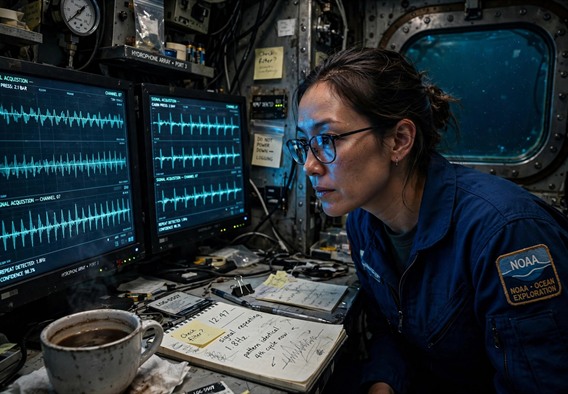
Naomi Okoye had the sensor mast swung wide, sweeping the Anvil Ring a strand at a time, when the numbers stopped behaving.
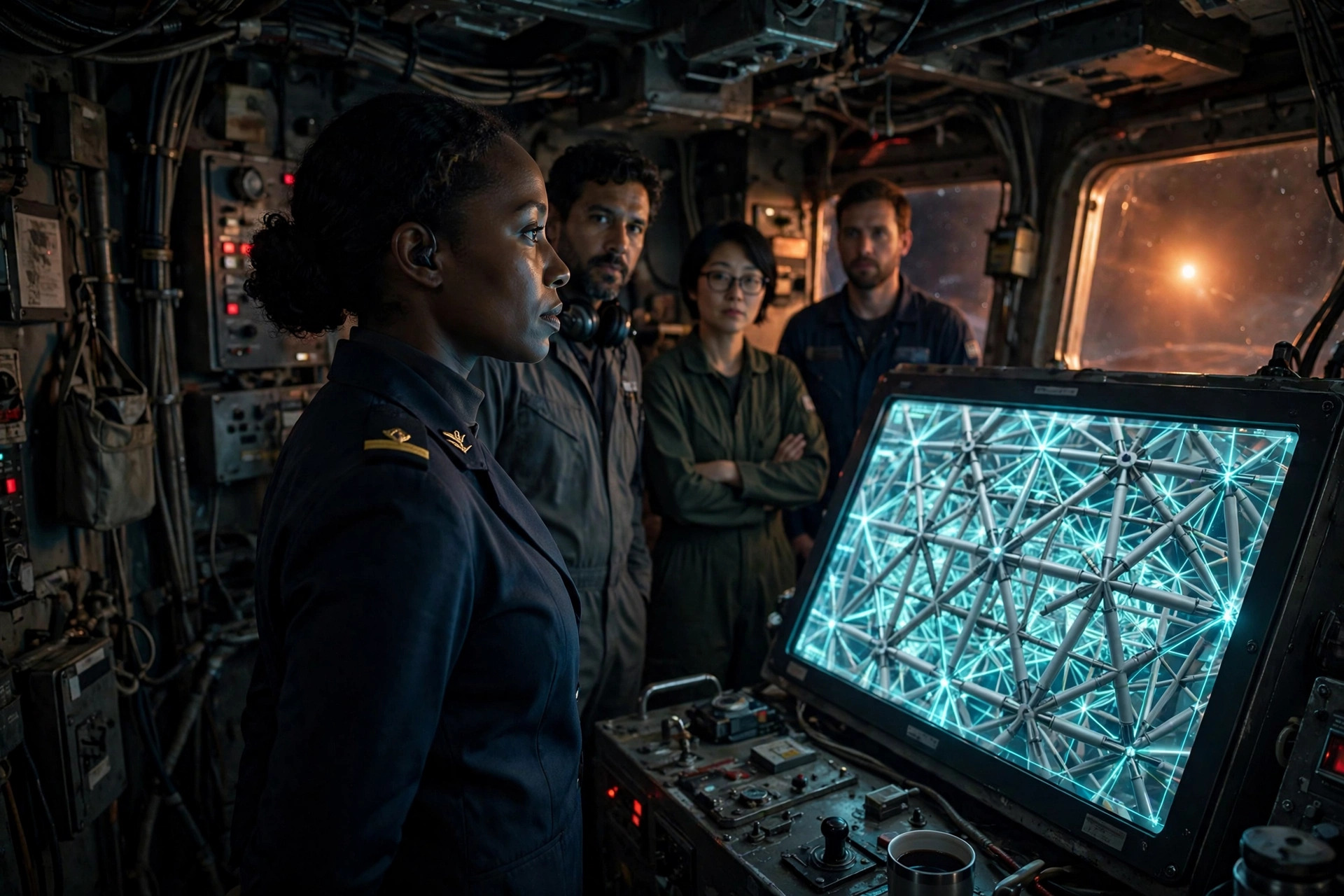
"Commander. You want to see this." She said it quietly, the way she said everything, and Odessa Vann crossed the Larkspur's cramped control deck anyway, because in eleven years of chasing this ring, quiet from Naomi Okoye had never once meant nothing.
The display showed a segment of the lattice, magnified until the individual struts resolved, gray threads crossing gray threads in a repeating pattern that any geologist would have called crystalline and any machinist would have called a mill run.
"Tolerance," Naomi said. She tapped the screen with one knuckle. "I ran it three times. Joint to joint, strut width to strut width, the variance is under one part in twenty thousand. Basalt columns, columnar jointing, even the best hex basalt on Earth runs sloppy compared to this. Nothing natural holds a tolerance. Nothing natural needs to."
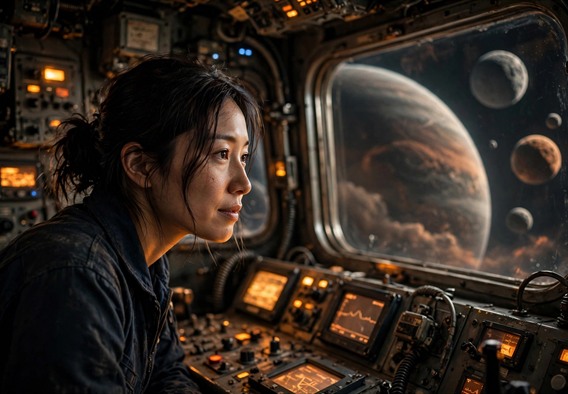
Odessa stood very still. Around her the Larkspur ticked and breathed, coolant cycling through the deck plates, the distant hum of the recycler keeping six days of margin in the tanks comfortable and unremarkable. Through the port, Eta Muros sat dim and orange at the center of everything, a coal of a star, and around it at two million kilometers the Anvil Ring went on and on, a closed hoop of engineered darkness that she had staked her whole career on being exactly that. Engineered.
For years she had been told she was seeing pattern in noise. Conference reviewers had used the word "apophenia" in her presence, some of them kindly, most not. Petra Lanz had signed on anyway, wrench tethered to her harness even in the galley, saying she liked ships that went somewhere strange. Dax Imre had signed on for the flight time. And now the evidence was sitting on a screen in the middle of nowhere, ninety-nine hours of light and thrust from anyone who could argue with it.
"Machined," Odessa said.
"Machined," Naomi agreed. "Unless the universe has started cutting metal for fun, that lattice was built."
From the nav bench, Dax let out a low whistle. He had his boots hooked under a stanchion and a plotting stylus behind his ear, and he looked, as he usually did, like a man who had already finished thinking about whatever everyone else was starting.
"So we're the first," he said. "First human beings to look at a made thing that isn't ours. You understand what that's worth back home. You understand what it's worth to be first to dock with it, touch it, put a nameplate on it."
He nodded toward the airlock, where the commemorative hull plate was welded to the outer skin, four names stamped into the alloy. Odessa had argued against the plate as vanity. Petra had welded it on during the outbound burn anyway, and Odessa had found, to her mild disgust, that she was glad.
"We're a survey ship," Odessa said. "We survey. We document, we transmit, we let the big drives come out on the next funding cycle."
"The next funding cycle is three years, Commander." Dax unhooked his boots and drifted to the plotting table, the big touch-slate where their course lived as a bright thread from here to home. "And the big drives will not be the first. We can be. There's a window here and it's small."
Petra pulled herself up from the engineering console, wrench swinging on its tether, and put her hand flat on the plotting table like she was calming a horse.
"Before anyone gets famous," she said, "let's talk about which thread we pull to get home. Because there are two, and only two, and one of them has a hole in it."
Odessa recognized the geography before Petra drew it, because she had drawn it herself a hundred times in the last month. The return leg to Ferros Station ran through a crowded stretch of debris shoals that pilots called the Kestrel Gap, a long, patient thread between two shelving walls of rock and ice, threading needle after needle. Safe, slow, mapped. The other option was the Halo Breach: a six-hundred-meter gap in a shattered halo of debris that arced near the direct line home. Slingshot through the breach, steal a gravity assist off the dense inner knot, and the Larkspur reached Ferros Station eleven hours sooner than the Gap thread allowed.
Eleven hours. First crew to make contact with alien construction, first to reach the Anvil Ring itself, and home with the proof while every other ship in the system was still fueling.
"The breach is unmapped," Petra said. "Say the rest of it, Dax. Say it out loud so it's in the log of this room, not just in your head. Nobody has flown it. The survey cubes that looked at the halo came back with the aperture clocking open and closed by a few meters, tidal flexing, resident debris crossing the lane. Six hundred meters sounds wide until it's breathing and there's a rock in the throat of it."
"It's breathing within tolerance," Dax said. "Three meters, four at peak, on a slow period. I've flown tighter windows into busier stations."
"You've flown them with mapped debris and a rescue tug twenty minutes out," Petra said. "Out here, who catches us?"
"Nobody," Odessa said. "That's the whole shape of it."
She pulled up the consumables board, because someone had to. Air, water, closed-loop margins: six days beyond the return burn, held for contingency. Propellant: four days of margin held for the home leg, and the commander's floor, the line she would not cross, was two. The Gap thread spent nothing extra. The breach slingshot spent a real piece of that margin, a deep burn to make the window, and if the aperture flexed wrong at the wrong minute, there was no second pass, no rescue, no answer from home in less than a day.
That was the arithmetic that never left her. Ferros Station sat nine light-hours behind them. Every message she sent crawled that distance for nine hours, got read, and the reply crawled back for nine more. Eighteen hours, round trip, before a single human being other than these three could say a word to her. No ruling was coming in time to matter. No committee, no director, no second opinion. Whatever happened out here, she decided it out here, alone with a machinist's tolerance on a screen and two pilots who wanted opposite things for reasons she respected equally.
"There's also this," Naomi said, mild as ever. "It doesn't matter which thread we fly. The proof doesn't get more true if we touch it first. The tolerance is in the data. The data transmits."
"The data transmits to a system that buried Odessa's last four papers in review," Dax said. "You want this confirmed by people who called it apophenia? Show up with hull plate photographs. Dock with it. Then it's not a claim, it's a fact with a ship parked on it."
He wasn't wrong. That was the exhausting part. Odessa had spent years learning exactly how slowly the truth traveled when it traveled as numbers only.
Petra watched her, arms folded, wrench hanging still. "Commander, I'll fly whatever you draw. But I want it said plainly first: the breach run buys eleven hours and spends our margin to do it. And I don't mean propellant alone."
Odessa looked at the ring for a while through the port. Two million kilometers of made thing, silent, patient, indifferent to whether anyone ever proved it existed. She thought about the reviewers. She thought about the first person, whoever they were, whoever they had been, who had cut the first strut of that lattice, and how long ago, and how the universe had kept the secret for them until a secondhand survey ship came creeping out with a stubborn commander and a crew of three.
She reached for the comm panel and keyed the long-range transmitter to Ferros Station, nine hours of dark in between.
"Larkspur to Ferros. Priority science packet follows. Sensor sweep of the Anvil Ring returns machined lattice structure, dimensional variance below one part in twenty thousand, consistent across sampled segments. Assessment: artificial origin, high confidence. Full data attached. Request confirmation and advisory on return routing. Be advised we will not receive any reply inside eighteen hours. Decisions on station resources and follow-up missions can wait for your answer. Our routing decision cannot. Vann, commanding."
She pressed send. The laser punched out into the dark at the speed of everything, and somewhere behind it, eighteen hours away, the argument about her would eventually begin. She felt the strangeness of it, sending her vindication into a void that would not speak back for a full day. The ring filled the port, and the message fled from it, and neither one cared.
"So it's real," Naomi said softly. "It's real and they'll know it's real."
"They'll know," Odessa said. "Nine hours from now, someone at Ferros reads it. Nine hours after that, we hear what they think. Meanwhile we still have to get home to be argued with."
Dax had gone quiet at the plotting table, which was never a good sign. When she turned, he had the chalk stylus out, the old physical one he insisted on for course work, and he was leaning across the slate where the bright home thread ran through the long patient Kestrel Gap. He drew, in three sure strokes, the alternate: the hook through the shattered halo, the tight line to the breathing aperture of the Halo Breach, the assist curve beyond it. Then he capped the chalk and left the line sitting there, unburned, unflyable, drawn in yellow on her own navigation bay like a dare left on a bar.
"It's just geometry," he said, holding her eyes. "A line on a table. It doesn't commit us to anything. But it's there now, and you can look at it for six days if you want."
Odessa looked at it, and the breach flexed in the chalk, open and patient, three meters of breathing written nowhere in the drawing at all.
The Steeper Well
The well took hold on Day 3, and it took hold wrong.
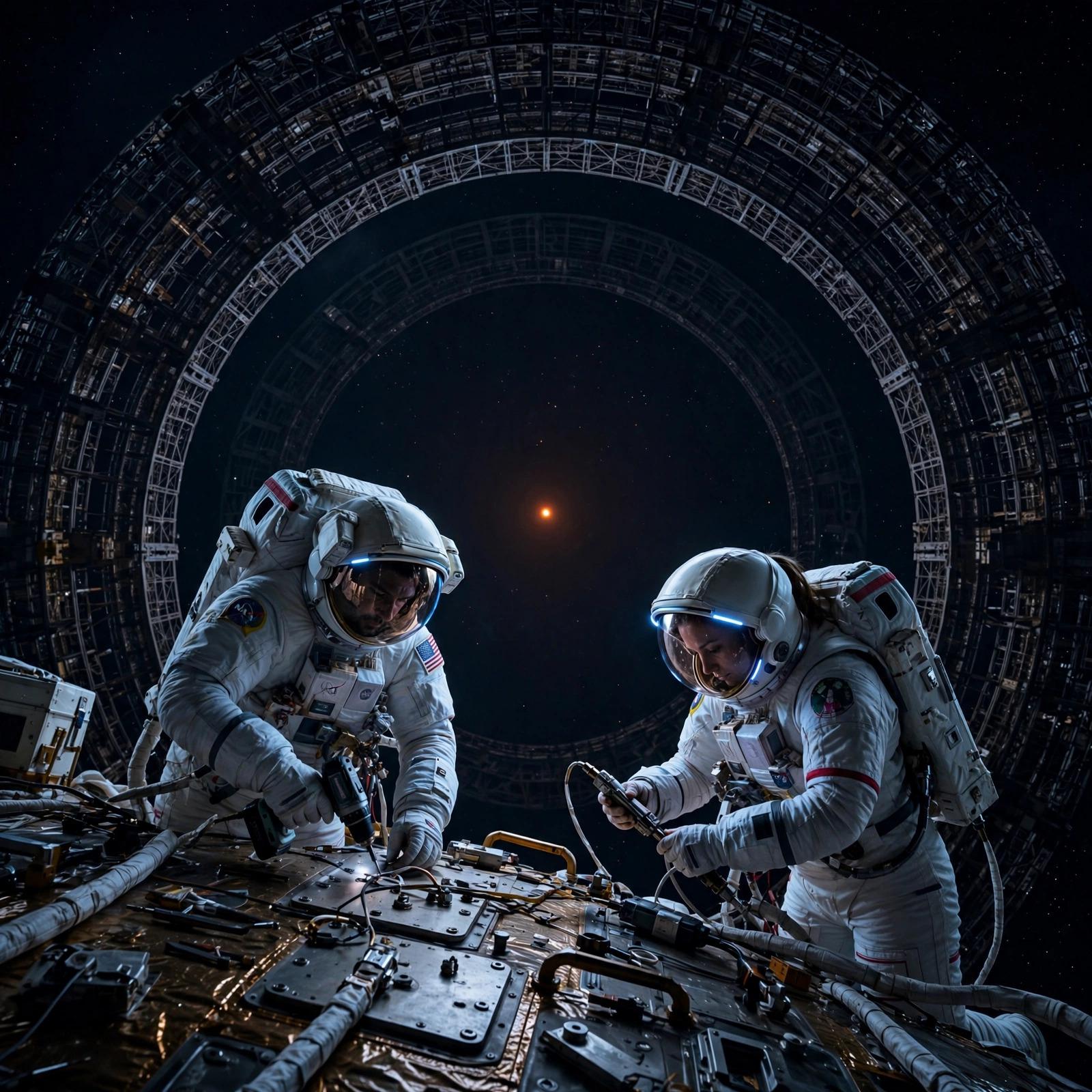
Odessa felt it before the instruments confessed it, a drift in the trim thrusters firing longer than the tables said they should, the Larkspur leaning into a pull that was supposed to be a polite tug from a ring of rubble and was instead something with shoulders. She sat forward in the command couch and watched the delta readout climb, and when the numbers finished being shy she did the subtraction twice on the slate and got the same ugly answer both times.
"The well is steeper than the chart," she said, keying the compartment to wake. "By about a fifth."
Dax came up from the aft gallery with a bulb of tea still in his hand. He didn't drink it. He read the slate over her shoulder, and she watched his thumb move down the burn schedule line by line, and when he reached the bottom he set the bulb in the retainer without looking at it, which was how she knew the arithmetic had already landed in him the same way.
"To hold the Gap schedule," he said, "we burn harder inbound. And the harder burn eats margin."
"It eats two kinds. The compressors run longer and hotter to feed the thrust, so we pull a day off the air and water reserve. And the burn itself takes a day of propellant out of the return allowance." She kept her voice flat, freight-handler flat. "Both of those are mine to spend, and I'm telling you I'm spending them, because the alternative is arriving at the Gap a full day late, and a day late puts our departure window into the ring's spring tides."
Petra's voice came up the ladder from engineering before her boots did. "Say the burn part again. One day out of return propellant."
"One day. Out of four."
"Floor is two," Petra said. "That's regulation, not preference."
"We'll be at three. Above the floor."
"Above the floor with a ring around us that throws rocks, and a home leg that's two years long." Petra reached the command level and stood there, harness still half-clipped, the wrench riding its tether against her hip. "Commander, I want it in the log that I stated the floor and you acknowledged it."
"It's already in the log. Petra, I'm not spending the floor. I'm spending the day I keep so I don't ever have to spend the floor."
That held Petra for a moment. Then she nodded once and went to check her compressors, because there was nothing else a honest engineer could do with an order she'd already lost.
Dax hadn't moved from the slate. "There's a way to spend neither," he said.
"Dax."
"I'm saying it once, straight, and then I'll fly whatever you fly." He pulled the chalk stylus from his sleeve and tapped the yellow line he'd drawn two days ago, still there, still unforgiven. "The Gap route costs us eleven hours more than the Breach even before this well steepened. Now the inbound burn is worse, and the Breach run doesn't care, because the Breach already assumed a hard gravity assist. It eats the well instead of fighting it. The steeper the well, the better the hook works."
"The steeper the well, the harder everything on the far side of that aperture hits us."
"Six hundred meters," Dax said. "Three meters of clearance a side, if you put her dead center. I can put her dead center. I've done tighter."
"You've done tighter in a ship with a repair bay behind you. If we misjudge the Breach, there's no behind us."
"If we misjudge the Gap, there's still no behind us. The Gap isn't safe. It's just familiar." He set the stylus down flat on the table, deliberate, the way a man puts a card face up. "Eleven hours is eleven hours. On a two-year leg it's nothing. But you're not spending eleven hours. You're spending a day of air and a day of propellant to avoid a door that's open."
"A door that flexes. Ferros surveyed it once, unmanned, and the probe came back dented."
"The probe flew it blind on a nine-hour lag. You'd have hands on the stick."
She looked at him and he looked back, and the ring turned beneath them both, patient, two million kilometers of machined lattice going around a dim star like a millstone that had outlived every hand that built it. She thought about the message still crawling home at the speed of everything, eighteen hours round trip to Ferros Station, no verdict on the Breach available inside a day, no verdict on anything. The choice sat where it always sat in the deep dark: on her desk, alone.
"Approved," she said. "The hard burn, holding the Gap schedule. Two-second pulse every forty for the next twenty hours, both of you on watch rotation. Dax, plot it."
"Plotting the Gap," Dax said, and there was nothing small in the way he said it, no edge, and that was somehow worse than an edge. He bent to the table and began the numbers, and she let the not-small thing pass unanswered because she had no answer for it that would survive his arithmetic.
Naomi was already in the rigging of her sensor mast when the burn began, sweeping the Anvil Ring in long mechanical arcs, and it was Naomi who found it, four hours into the first pulse train. Her voice came over the suit channel thin with static and something underneath the static.
"Commander. Hull survey at the aft cradle. You need to see this in person."
Odessa went aft along the spine and found Naomi braced at the cradle rail, her lamp aimed at a point low on the plating where the beacon buoy rode clamped in its scaffold. The light sat on a mark the length of her little finger, a gouge, bright-edged, the metal underneath it smeared and cold-flowed like butter struck with a knife.
"Not there yesterday," Naomi said. "I photographed this panel on Day 1. Nothing."
"Depth?"
"Shallow. Past the coating, into the first skin, stopped there. A few millimeters of luck." Naomi turned her wrist and the lamplight slid along the panel, and there was a second bright point, smaller, a chip the size of a grain of rice, a hand-span further aft. Then a third, near the welded flange of the hull plate where their four names were stamped, VANN, IMRE, LANZ, OKOYE, in the foundry's tidy punch, and the newest scar sat half a finger's width below Dax's name like something that had been aiming for it and missed.
Petra arrived, read the gouge the way she read everything, with her thumb. She pressed the pad of her glove into the smear beside it, not the wound itself. "Micrometeoroid, ring-source. It's debris. The Anvil Ring sheds, and we're close enough now that its shed crosses us."
"Its shed," Odessa said.
"Everything sheds. The question was always whether the Gap approach runs through the dense part of it. Now we know it runs through some of it." Petra unclipped her wrench, more out of habit than need, and hung it back. "It's cosmetic. I'll lay a doubler patch over the deep one at next rest. Two hours' work, no rush."
"No rush," Naomi repeated, but she photographed the nicks again from three angles, and her lamp stayed on the mark below Dax's name a while longer than the others.
Odessa filed it, and the filing mattered: the ring was not scenery. It was an active neighborhood, and they were the strangers parked in it. She carried that thought up the spine with her to the mid-deck and it sat beside her through the second pulse train, through the watch handover, through the night cycle that nobody aboard really trusted anymore with a burn running under the deck plates like a held note.
It was Day 4, middle of the sleep rotation, when the Larkspur told her the next thing. She was doing the water round herself, the small ritual of checking the reclamation loop by hand because instruments that mattered deserved eyes, and it was her own ears that caught it first, a tick at the edge of the pump noise, faint, arrhythmic, a sound like a whisper deciding whether to become a word.
She followed it along the line aft of the reclaim unit, lamp in her teeth, and found it at the second junction fitting: a hairline, a frost-line of seep, thinner than wire, wicking a bright bead of water out of the fitting and holding it trembling in the microgravity like a tiny lens. She watched the bead grow. One drop formed, let go of the line, and hung in the air in front of her, lit by her own lamp, containing a very small and entirely portable catastrophe.
Her procedure in that moment was clear and old. Wake Petra. Wake Naomi. Contain, sample, log, repair by the book at the next rest period, with the loop drained and the fitting replaced, everything prepared and nothing left to nerve. She had run this ship for two years that way, and the ship had come home every time because of it.
The burn pulsed under her boots. Petra had been on watch for nine hours and had a doubler patch waiting on her list already, and the line's own isolation valve sat two fittings forward, and the tape, the good grey emergency tape rated for pressure and cold, hung in its dispenser exactly where regulation said it must, within reach of her left hand.
Odessa caught the drop out of the air with a finger, pressed the bead back toward the crack, and pulled the tape.
She wound it six turns, tight, over the hairline, smoothing each wrap with her thumb until the seep stopped and the fitting wore its small grey bandage. Then she checked the wrap twice, logged the defect, marked the repair for Petra with proper parts, and stood in the hum of the burning ship with the tape end still tacky on her glove.
It was a small thing, the first thing on this trip she had fixed with nerve instead of preparation. She stood there a moment longer than the log required, listening to the pump run clean, and then she keyed the watch channel very quietly, so as not to wake anyone who didn't need waking yet.
"Vann to Petra. When you're up. Water line two, junction fitting, hairline, taped and holding. It'll keep till you can do it right."
Petra's Wrench
Petra went out at 0400 ship time because the tape was hers to replace and she would not let it stay another hour. Odessa watched her suit up through the inner lock window, checking her own hands on the checklist board, calling items in a low voice while Petra answered with the flat, clipped rhythm of a woman who had done this sixty times and resented every repeat question. The reclamation line ran aft along the Larkspur's spine, and the junction fitting sat two meters past the sensor mast's shadow, which meant Petra would work in the cold half of the hull, where the plating breathed frost and the lamp made a small yellow room in the dark.

"Pressure's good," Dax said from the winch station. "Tension's good. Tether's on the hard point, not the handrail, which I appreciate, because I've seen people do worse."
"You've seen me do worse," Petra said, and cycled the lock.
Naomi Okoye had the sensor console, and she had the ring on the main display, the whole impossible sweep of the Anvil Ring across a third of the sky, its far arc a pale band around the dim coal of Eta Muros. Nine light-hours out, Ferros Station could offer them nothing for eighteen hours after any question. Odessa had sent the daily report at midnight, a routine packet, and the answer would arrive sometime tomorrow, saying something about a water line and a patch, already obsolete. She thought about that while Petra clamped her boots to the spine rail and unrolled the tool wrap. Whatever happened out here, happened on their own authority. It always had, but the distance made it honest.
Petra peeled the grey tape off the fitting in one long spiral, inspected the hairline beneath with her lamp, and grunted. "Vann, this crack's grown since you wrapped it. Half again. You caught it late but you caught it right."
"It was holding," Odessa said. "That's what I asked of it."
"It was holding because the tape's better than the fitting." Petra fitted the doubler patch over the line, seated it, and took the wrench from its tether on her harness. The wrench was a stubby torque tool, old steel, worn silver at the grip, and it had been with Petra through every ship she'd crewed; she kept it tethered with a braided lanyard she'd made herself. She set it on the fitting's flats and leaned her weight into the turn.
That was when the hull pinged.
Odessa heard it through the structure before she heard it through the air: a small, flat, metallic knock, the sound of something arriving very fast and not much caring what it hit. On the external camera Petra jerked sideways, her boots slipping one clamp off the rail, and the telemetry strip on Odessa's board went from green to a hard, ugly amber.
Suit pressure falling. Left forearm.
"Petra."
"I know it." Petra's voice came through stripped and even, the voice she used for bad news. "Forearm. Something went through the outer layers. I've got the patch kit, I've got, hold on, hold on."
Odessa was already moving. The Larkspur's saddle of thrusters held four small quads for close maneuvering, flown by hand from the pilot's chair, and she dropped into that chair and strapped in without deciding to, the way her hands decided things in the old years before her mind caught up. "Dax, winch. Naomi, keep her suit numbers in your ear and call every ten seconds. Nobody talks over the calls."
"Copy winch," Dax said, and his hands went to the drum controls.
"Vann," Petra said, quieter, "don't come hot. If you crack the rail, I'm off the ship for good."
"I know my own quads."
"You've flown them twice."
"And I was gentle both times." Odessa fed the first puff into the saddle, and the Larkspur swung her nose toward the spine, stars shearing across the forward glass. On the camera Petra had gotten the forearm up into her lamp's light and was pressing the self-sealing wafer into the puncture with the flat of her palm, the wrench hanging off her harness by its lanyard, turning slowly beside her like a small moon. Air streamed from the wafer's edge as a fine, glittering thread, catching the lamp, freezing to a tail of crystals the moment it left the suit.
"Nine zero," Naomi said. "Three one over two nine. Falling."
"Wafer's not seating," Petra said. "The hole's ragged. It's, the edge of it's under the seam, I can't get flat pressure on it."
"Get on the tether and let Dax take your weight," Odessa said. "Work with both hands."
"If I let the wrench drift, it's gone."
"Petra."
"Tethering it. Tethering it." She snapped the lanyard short to her chest ring, hooked her arm through the spine rail, and braced. The air thread thinned. Then it didn't.
"Nine zero," Naomi said. "Two four over two two. Still falling."
Odessa put the ship alongside Petra with three touches, each one smaller than the last, until the hull stopped a meter off and hung there, and she was distantly aware that her mouth was dry and that the burn schedule chalked on the plotting table was, for these ninety seconds, worth nothing at all. She keyed the lock and pushed it open onto vacuum. "Dax, reel her to the lock. Slow."
The winch drum turned. Petra came along the line hand over hand with the drum taking up slack, and Odessa reached out at the lock mouth and got two fingers inside her harness strap and swung her in over the sill, and the outer door rolled shut behind them.
The wafer had gone grey at the center. Petra pulled the patch kit open with her teeth, cut a second wafer to a curve that matched the ragged edge, laid it over the first, and pressed until her arm shook. The thread of air stopped. In the sudden quiet they could hear the crystals sublimating off her sleeve, tiny ticks, like frost deciding to leave.
"Pressure's holding," Naomi said from the speaker. "Two one over one nine, stable."
Petra sat on the lock sill and laughed once, a short, cracked sound, more breath than voice. "Sixty EVAs," she said. "Sixty, and it's a grain of sand doing ninety thousand an hour that gets me."
"It hasn't gotten you," Odessa said.
"No." Petra looked at her forearm, at the double wafer, at the frost tail hanging off it like a bad decoration. "No. But here's the part you're not going to like, Commander. The suit's done. Both layers, the bladder too. I can seal the arm in gel and fly home, but I can't go back out. Which means the reclaim line is out there with tape on it and nobody left who can reach it."
Odessa looked at the patch kit, at the small remaining wafers, at the two people breathing in the lock with her. The reclaim loop fed the repressurization cycle. Every time the cabin lost air to an open lock or a bad day, they bought it back out of the loop's reserves, and the loop was the thing with the crack in it.
"We cycle the lock now and do a full repress," she said. "Full charge. The loop can't spare a partial."
Dax, in the doorway, had been doing arithmetic with his eyes closed. He opened them. "That's three days of margin. Odessa. Three. We're at five. That puts us at two."
"I can count."
"The floor for the return burn is two days of propellant and we're at three. Air's the same shape. Two days of anything is not a margin, it's a coincidence."
"The alternative is breathing forty percent for six days."
"I'm not saying no. I'm saying say it out loud so we all own it." He wasn't arguing; his voice was steady, almost gentle, and that was worse. "Say what we just bought."
Odessa put her hand flat on the lock sill. "We bought Petra's arm and everyone's lungs, and we paid three days. Now help me pressurize."
The cycle took eleven minutes. They sat through it in the lock, Petra with her forearm in the gel sleeve, Dax watching the cabin pressure climb on his slate, Naomi reading the numbers aloud from the console in a voice that had gone back to ordinary. When the air came up to full, warm and thick and tasting faintly of the reclaim loop's mineral tang, nobody spoke for a moment, because full pressure after a scare is one of the few luxuries that costs nothing.
Later, at the watch change, they gathered at the plotting table, the four of them, because the day's arithmetic belonged to all of them. Dax had re-chalked the board: the long safe line threading the Kestrel Gap, and beside it, the fast line, the one that cut through the Halo Breach, the unstable six-hundred-meter cut in the ring's debris field. Eleven hours saved, chalked in his neat drafting hand. Below it, the new number: two. Two days of air and water between them and home, if nothing else went wrong, and something had already gone wrong twice.
Petra stood at the table with her arm in the gel, the sleeve translucent, the double wafer visible inside like a fossil. She unclipped the wrench from her harness, lanyard and all, and laid it on the table's edge, right against the chalk of the fast line, the steel touching the line as if to hold it down.
"There," she said. "That's what the fast way costs. Put it on the chart. If we take the Breach, take my wrench with us, because I paid for the ticket."
Nobody laughed. Dax looked at the wrench for a long moment, then at the chalk line under it. Naomi reached out and turned the wrench a quarter turn, so its worn silver grip faced Odessa, the way you'd offer a tool to the person about to use it.
Odessa picked it up. It was heavier than it looked, and warm from Petra's harness, and it had a flat spot worn into the head from years of exactly this: somebody leaning their whole weight into a fitting that would not come loose any other way.
"Tomorrow I'll tell Ferros what we spent," she said. "Nine hours from now, they'll start to know."
The Long Gap
Day six began with Odessa erasing the fast line.
She did it before the watch change, alone at the plotting table, while the cabin fans ticked and Dax slept in the aft hammock with one foot hanging out into the aisle. She wiped the chalk rag across the Breach line in three long strokes, and the eleven hours went with it, and then she stood there breathing over a board that held only one course: the slow thread, forty-one hours through the Kestrel Gap, the long canyon of cleared space where some ancient machine had once cut a maintenance lane through its own ring.
Dax came forward with his boots half unlaced and stopped dead when he saw the board.
"You didn't wait for the reply from Ferros."
"Ferros can't rule on it," Odessa said. "Nine hours out, eighteen round trip. By the time they've read my message and answered, we're committed either way. It's mine to call." She set the rag down. "And I've called it."
Dax pulled himself into the copilot's couch and buckled the harness with the deliberate care of a man slowing himself down. "Then hear it once more. Once, and then I'll fly whatever you've chalked."
"Once."
"The Breach is six hundred meters wide. I've put ships through tighter with worse mass." He tapped his slate against his knee. "Eleven hours. That's not vanity, Odessa. Eleven hours is a day of air we don't have to spend threading a canyon nobody has ever flown. And it's more than that, and you know it is. First hull on the Anvil Ring. First human contact with anything built by hands that weren't ours. Whoever makes that approach writes the first page of the next hundred years. I've wanted that page since I was a boy building ring models out of soup lids. If we take the Gap, we arrive second. The Meridian is eleven hours behind us, and she's clean, she's fully fueled, and she'll take the Breach without a second thought because she can afford to."
"And if the Breach shears while she's inside it," Petra said from the galley bench, "she arrives nowhere, and we get to be first at the funeral."
"The Breach has held for every pass we've imaged," Dax said. "Four passes. Stable geometry."
"Four passes over six days," Naomi said quietly, not looking up from the console, where she had been running the debris drift models all night. "The drift rate inside the cut is accelerating. Day one, the corridor was seven hundred meters. This morning it's six hundred and eleven. It's closing, Dax. Slowly, but it's closing. I wouldn't take a cargo pallet through a corridor that's actively narrowing, let alone our home."
Dax looked at her, and then at Odessa, and Odessa watched him do the thing she had seen him do at two prior emergencies: recalculate in front of everyone, out loud, without shame.
"Say the drift is forty meters a day," he said. "It's not, but say it. Then by our arrival it's still five hundred and change. Wide enough."
"Wide enough if nothing is coming the other way through the debris field," Odessa said. "Wide enough if the ring doesn't shed. And here's the part you already know, so I'll only say it once. We have two days of reserve air and water. We have three days of propellant margin, and my floor as commander is two. If we thread the Gap, the extra burns cost us a day of margin, and we arrive home with exactly the floor under us and nothing else. If we take the Breach and it goes wrong, no one comes to get us. Ferros can't. Nobody's within a week of us. So the question isn't whether you can thread six hundred meters. I believe you can. The question is what happens if you're wrong, and the answer is everything, all at once, for all four of us."
She let that sit. The fans ticked. Somewhere aft, the reclaim loop gurgled and settled.
"The record," Dax said. It came out lower than he intended, she could hear him reining it. "Twenty-six years I've flown toward something like this."
"I know," Odessa said. "And I'm spending it. That's the size of the thing I'm asking you to swallow, so I won't pretend it's smaller. We go the long way, we arrive second, and all four of us arrive. If you want to hate me for the length of the Gap, hate me there. You'll have forty-one hours."
Dax unbuckled, drifted to the plotting table, and looked at the erased chalk for a long moment. Then he picked up Petra's wrench from where it still lay against the board's edge, weighed it in his palm, and set it back down on the table, deliberately, on the long line this time.
"Second place gets written down too," he said. "Fine. Get in your seats. If we're doing the Gap, we do it right, and nobody flies the Kestrel thread but me."
Nobody argued with that. Nobody would have dreamed of it.
The insertion burn came at hour four, and it was ugly, because the Gap's mouth was angled wrong for their approach and correcting for it meant spending propellant they had already promised to the far side. Odessa flew the burn herself, hands light on the sticks, calling the deltas, and watched the margin counter step down: three days of margin becoming two and a half, two and a half settling toward the floor. Dax sat beside her with his arms folded, letting her spend it, saying nothing, and somehow his silence was louder than the burn.
Then the mouth of the Gap swallowed them, and Dax took the sticks, and Odessa stopped being commander for a while and became ballast with eyes.
The ring's inner surface slid up the ports as they dropped into the lane, and it was not rock. That was the thing no image had prepared her for. It was machined. Channels ran along the canyon walls in perfectly spaced ranks, and the walls themselves were fitted, plate against plate, seams finer than a hair, and the scale of it kept defeating her eye: she would find a groove and think it a meter wide, and then a shadow would move through it, some maintenance remnant the size of a train, and she'd understand the groove was a hundred meters across and have to start her seeing over.
"Debris, two o'clock, low," Naomi said. "Drifting. Slow."
"I see her," Dax said. He was not the Dax of the galley bench, not the man with the soup-lid models in his voice. He was someone else entirely, someone the Larkspur had been carrying all along like freight. His hands moved in small, constant corrections, the thrusters chattering, and the ship went where he put her as if the two of them had agreed on it in advance.
A shard the size of a cargo container tumbled across the lane, end over end, patient as a planet. Dax rolled the Larkspur around it the way you'd pass a slow car on an old road, and Petra, watching from the jump seat with her arm still in the gel sleeve, said, "He's not even breathing hard."
"He is," Odessa said. "He's just doing it quietly."
Hour nine, a wall section shed. It came off the northern flank of the Gap with no warning at all, a fitted plate torn loose by some fatigue no instrument had flagged, and it swung out into the lane broadside, sixty meters of machined surface rotating once every seven seconds. Naomi had the track before Odessa finished inhaling. Dax did not ask for options. He put the Larkspur nose-down toward the lane floor, under the plate's arc, close enough that the ring's surface rose into every port at once, close enough that Odessa could see the tool marks, long parallel striations, the ghost of whatever had milled this canyon a million years before anything human had a word for milling. The plate passed above them with a shudder of displaced dust, and was gone behind.
"Margin," Odessa said, when her voice worked again.
"Floor," Dax said. "Two days. We're at the floor. The rest of the Gap is freehand."
Freehand meant the thrusters only, attitude and drift, no more delta to spend, and the lane narrowed ahead where the old maintenance lane kinked, and Dax flew the kink with the Larkspur's hull never more than a hundred meters from either wall, sometimes forty, once, briefly, close enough that the floodlit channel marks strobed across the cabin ceiling like a road at night. Nobody spoke for that stretch. Petra had the wrench in her lap, both hands around it, not as a tool but as something to hold.
Hour thirty-eight, the reserve ticked from one day to the margin they'd promised not to touch. Hour forty, the walls began to open. Hour forty-one, the Larkspur came out the far side of the Anvil Ring into open black, and the machined surface fell away astern slowly, filling the aft ports edge to edge, a wall of impossible order receding, and every soul aboard was still aboard, and the counters read two days of propellant margin, one day of air and water beyond the return burn, and nothing else.
Dax let go of the sticks. He sat looking at his own hands for a while.
"Second place," he said finally.
"Written down," Odessa said, and unstrapped, and put her hand flat on the console where the ring still glowed in the aft camera, and left it there.
The Buoy
Two days out from the Anvil Ring, coasting on a trajectory that would carry the Larkspur home along the wide, safe arc past the Kestrel Gap's mouth, Odessa Vann suited up, cycled the airlock, and stood on the hull with a cutting torch in her gloves.
The commemorative plate was welded just outboard of the lock, where the crew had put it on commissioning day with the whole station watching on the feed. It was thirty centimeters of polished alloy, stamped with the Larkspur's registry and four names in a neat column: hers first, because she was commander, and Dax and Petra and Naomi below. She had signed off on the order without thinking about it. That was the part she kept returning to now, hanging on the handholds with the torch warming in her grip. Not the plate. The not thinking.
"Odessa." Dax's voice in her helmet. "Talk to me before you cut. I'm looking at the same fit-out manifest you are."
"The buoy has a beacon mast, a power core good for forty years, and a mounting flat with nothing on it," she said. "We installed it in case somebody else ever needed a light at the Gap. Somebody else will. It should say something true."
"It's our plate."
"It's a plate with my name at the top of it. That's the problem."
Silence on the channel for a few seconds, which from Dax was a long time. Below her, dimmed to a coal by distance and filters, Eta Muros burned on, and the Anvil Ring hung around it, a circle of machined order two million kilometers across the void. Their cameras had mapped nine hundred kilometers of it in detail. Every scan, every image, every striation of the mill-marks, all of it sat in the Larkspur's core, still untransmitted. That was the other thing she had been not-thinking about for two days.
"Naomi," Odessa said. "Status on the data package."
"Sealed and ready," Naomi said. "Nine hours of transmission at full gain. I can start it whenever. The only header field I can't fill in is the claim register. Discovery credit. It wants a name or a crew designation."
"Leave it blank."
Another silence, this one crowded. She could hear Petra's breathing change on the shared channel.
"Commander," Petra said, "with respect. You don't have to give it away to make your point. You can claim it and still publish everything same-day. Nobody serious thinks less of the crew that threads the Gap and hands over the map."
"No, they don't," Odessa agreed. "And in nine years, some other crew comes through the Gap on our map, and every textbook says the Anvil Ring was claimed on Day 7 by Vann and crew, and the light at the mouth is named for us, and it's ours, ours, ours, all the way down. That's how it works. I know how it works. I've written three of those citations myself."
She braced her boots against the hull and brought the torch up to the plate's first weld point.
"Petra," she said, "I need the wrench after all. Suit port, starboard locker. It's the only striking tool that will take the stamp."
A pause. Then Petra's voice, slower. "The stamp."
"The plate gets welded to the buoy flat, face out. My name's on top. So I'm going to strike my own line through it. Over-stamp it flat. The crew's marks stay legible, mine stays under the bar. And then the buoy goes alight at the Gap mouth, and it's a navigation light for everyone who follows, not a monument to the first one through. That's what the plate says then. That's all it says."
She lit the torch. The first weld gave with a soft pop of vaporized metal, and a small bright bloom of sparks drifted off the hull and fell away toward the star, unslowed by any air, each one a tiny sun for a second and a half. She worked the second weld, then the third, and the plate came free into her gloves, warm on one edge. Thirty centimeters. It weighed almost nothing in her hands and had taken three years to earn.
She carried it aft along the handhold line to the cradle where the beacon buoy sat clamped in its launch rails, a drum-shaped machine the size of a small person, sensor mast folded, light dark. She laid the plate against the mounting flat, found it a handspan short of the flat's width, and clamped it centered anyway. Then she burned four new tack welds, one to each corner, clean and small, the way Petra had taught her in the station yard back when the Larkspur was only a keel and an argument.
She looked at the names for a while. Then she turned her helmet lamp on them full.
"Petra. Whenever you're ready."
The airlock cycled, and Petra Lanz came out along the line with her tethered wrench in one glove, moving with the unhurried economy of someone who had done ten thousand hours of hull work and had stopped performing any of them. She planted herself on the flat beside Odessa, braced, and set the wrench's heavy head against the stamped line of Odessa's name.
"Say when, Commander."
"When."
The strike went through Petra's shoulders and down the wrench and into the plate, and the letters of Odessa's name folded flat under the blow, struck over, the same way a mint corrects an error. Petra struck twice more along the line, evenly spaced, unhurried. When she drew back, the wrench head had left a broad bright scar straight across ODessa Vann, and below the bar, undamaged, the marks of Dax Imre, Petra Lanz, and Naomi Okoye still read clean in the lamplight.
Petra turned the wrench over and offered Odessa the handle. "Your hand should finish it," she said. "Mine only started it."
Odessa took it. She set the head at the last letter of her own name, checked her stance twice, and struck. The letter went down flat. She felt the impact travel up both arms and out through the suit, into the hull, into the ship, and she let it.
Then, because the plate deserved more than a scar, she took the torch back and burned a single new line beneath the crew's names, in letters she laid freehand, small and level:
LIGHT FOR ALL WHO FOLLOW.
The channel had been quiet through all of it. Now Dax came up, and not in argument.
"Buoy's got a primary set for station-keeping at the Gap mouth," he said. "I've been running the numbers since you started cutting. Release is clean from the aft rails on our current line. If we do it inside the hour, the core ignites on a flyby solution and we see the light catch from two hundred klicks. After that, it's on its own burn to station."
"Naomi," Odessa said. "The package. Send it as public data, no claim register. Credit line reads: transmitted by the Larkspur, on behalf of whoever's next."
Naomi's voice came back after a moment, and there was something in it that had not been there for two days. "Aye, Commander. Nine hours to Ferros Station at light. They'll know before we're a tenth of the way home. There are going to be questions."
"There are going to be ships," Odessa said. "That's better."
They brought the buoy out of the cradle on its rails, all four of them suited now, working the release harness in pairs, Dax and Petra on the forward clamps, Naomi and Odessa aft. The drum floated free of the Larkspur's shadow into full starlight, the plate on its flat, the scarred line and the clean names and the new letters all facing the Gap, which hung astern of them as a faint geometric bite out of the ring's distant circle.
Odessa took position at the manual release. There was an automated option; there always was. She had already logged her override, hours earlier, in the quiet: manual, commander's hand.
"Station-keeping solution green," Dax said. "Core is armed. Light will burn at full on ignition."
"Transmission starting," Naomi said. "First frame away. It's going out clean."
Petra moved up beside Odessa and set one glove on the release housing, not to take it, just to be there. "Forty years, that core," she said. "Longer than most of us get to be famous."
"That's the idea," Odessa said.
She pressed the release with her own hand.
The clamps let go with a shudder she felt through her boots, and the buoy drifted off the rails, slow and certain, its mast unfolding in three silent stages like something growing. At a hundred meters it lit. The light came up white-gold, then brighter, then to full navigation power, and it swung once through a wide arc as the mast stabilized, and the beam crossed the Larkspur's hull and came in through four visors at once, so that for a moment every face aboard was lit from the direction of the Gap, all four of them equally bright, equally far from home, equally named on a plate now flying away from them with one name struck through and three left standing and a line underneath that belonged to nobody and everybody.
The buoy's thruster flashed, a single clean pulse, and it began its long fall back toward the mouth of the Kestrel Gap, carrying its light to the place where the lane narrowed and the walls shed plates without warning, so that whoever came next would see, from far out, exactly where the hard part began.
Behind Odessa, in the lock, the transmission ran on, frame after frame, nine hours of light carrying the whole machined ring home to Ferros Station with no name on it anywhere. Dax watched the mast diminish. Petra stowed the wrench on her harness. Naomi counted frames in a low voice, steady as a clock, and nobody said anything at all, and no one aboard said Odessa's name.
The light swung its arc again, and held.
Get notified when new stories drop

Ava Kepler
Ava writes space exploration and cosmic adventure with competent crews, hard problems, and awe that earns its hope.
Leave a comment
Comments