





Morning Turn
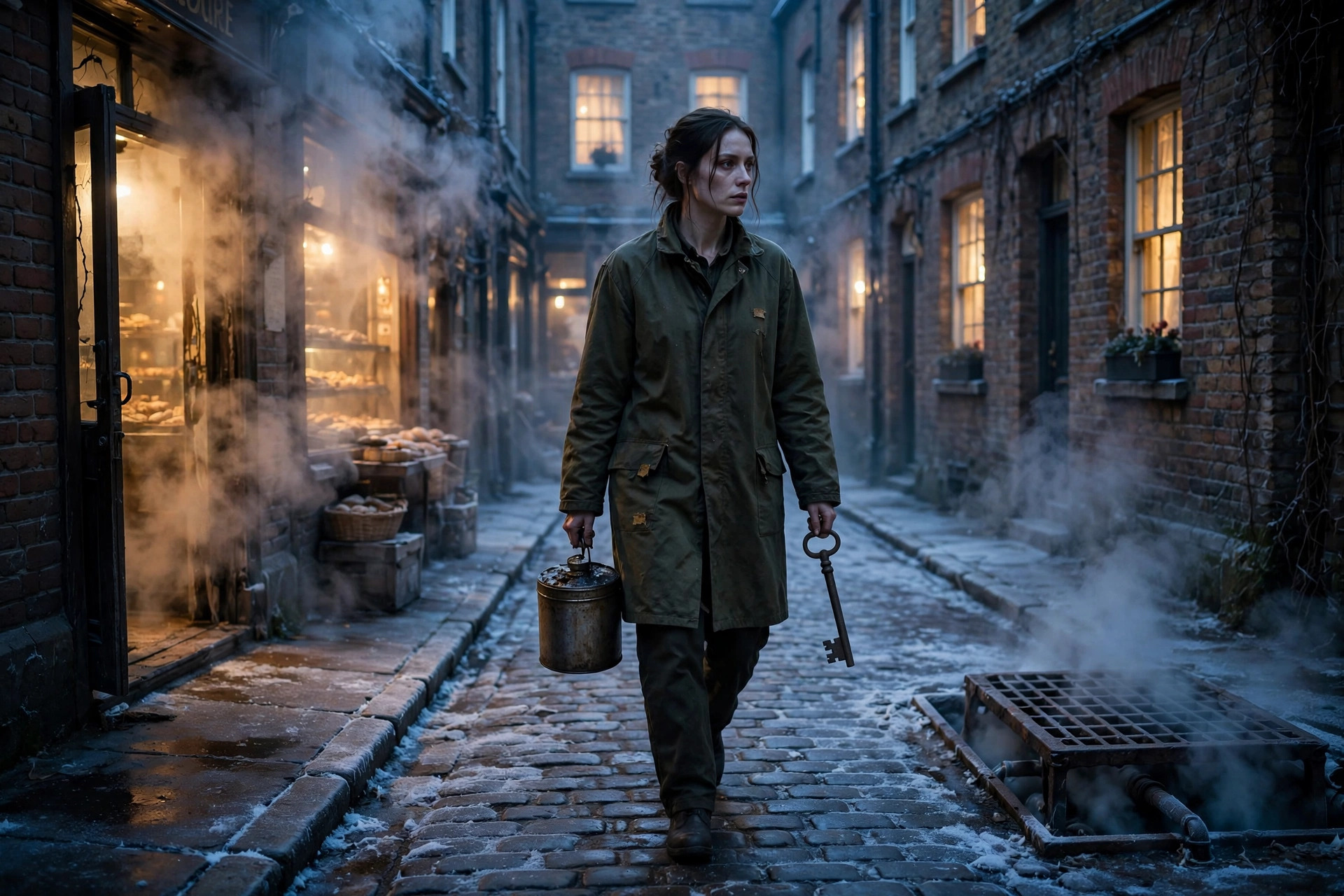
Petra Ndiaye came up Marrow Lane before the sun cleared the roofline, carrying the grease tin in one hand and the long-handled key to the plant room in the other, because the gate padlock had been sticking for a week and she did not trust the key to work if she waited until the digesters were already hot. The lane smelled of bread from the bakery's flue and of the cold mineral breath of the loop's return pipes, which ran under the paving from one end of the ward to the other like a buried river that never froze. Four hundred households drank their heat from that river. She had signed for every one of them, nine years of mornings, and the habit of counting them still ran in the back of her head while her hands did the work.
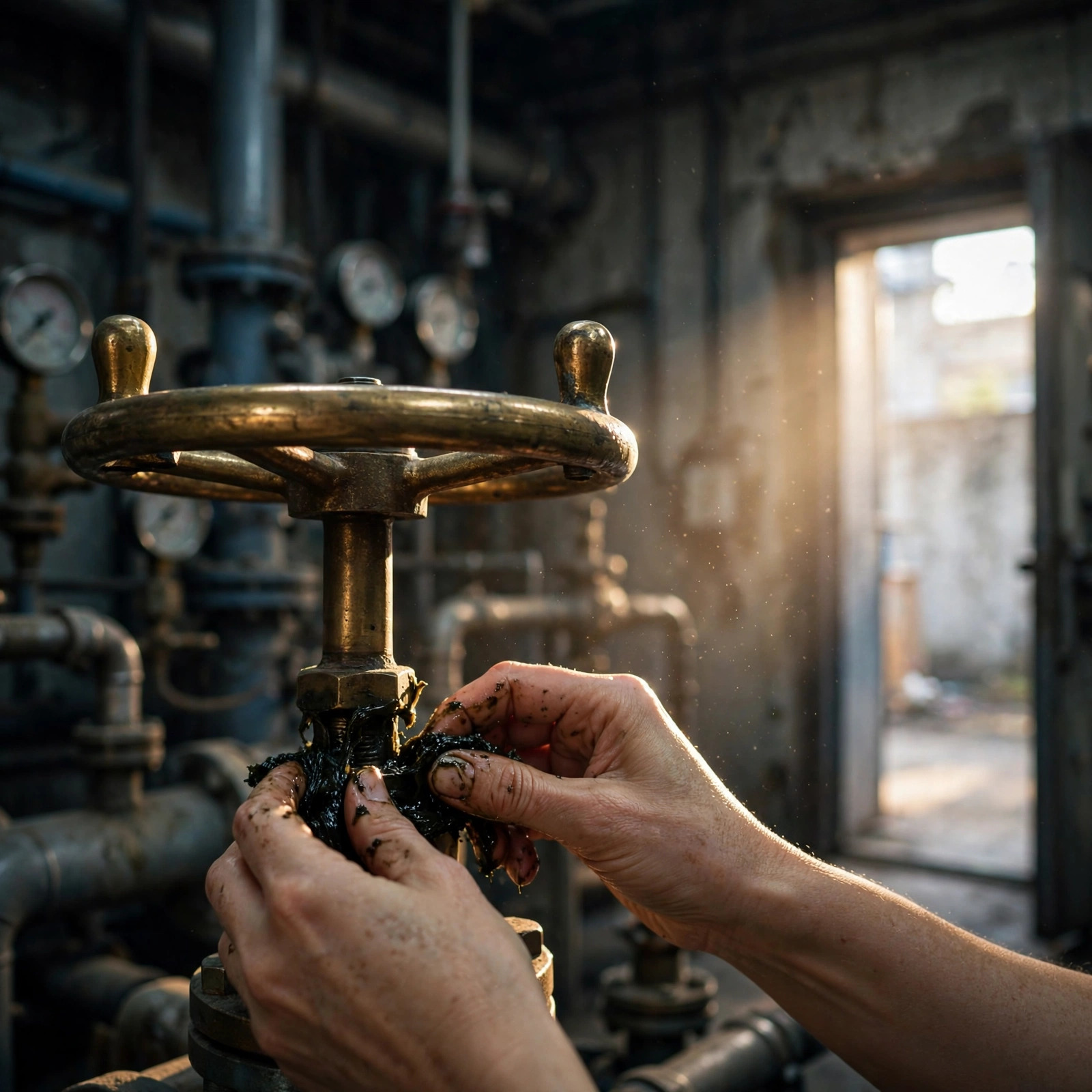
The plant room door complained and gave. Inside, the main return valve sat in its collar of brass where it always sat, hand-high on the loop's biggest pipe, its wheel worn bright at two points where palms had gripped it every day since before Petra took the steward post. The seals were sound. She wiped the stem with a rag, packed the groove with fresh grease from the tin, and leaned her weight into the wheel, a quarter turn out and a quarter turn back, feeling the mechanism slide through the grease instead of grinding against itself. That quarter turn each way, once a day, bled the trapped pressure back into the loop and kept the whole circuit honest. It could not be done from a desk. It had to be done by a hand that could feel the difference between sliding and grinding, and it had to be done every day, which was why the rota book lived on the gatehouse shelf with twenty-six names in it.
She signed her line in the book while she waited for the wheel to settle, then went back out into the yard.
Horace Delacroix was already at the Delacroix Digester Yard end of the commons, which everyone still called by his name although it had been the ward's for as long as Petra had worked it, because Horace had built half of it with his own mixer blades and his own stubborn schedule. He was standing on the loading platform with a pitchfork, working the morning's food waste out of the collection bins and into the first digester's feed throat. Six tonnes a week came through the yard, plate scrapings and market trim and the brewery's spent grain, and Horace fed it in the way a cook feeds a fire, in layers, watching the consistency, and every month he wrote out one hundred and eighty labor vouchers by hand for the neighbors who brought waste, turned compost, patched pipe, or stood the winter shifts. The vouchers were the ward's own currency, older than Petra's post, and Horace guarded the ledger for them like a bank manager who happened to smell faintly of mulch.
"Bins were heavy this morning," he said, without looking up. "Bakery's bin especially. They had a big day yesterday."
"Festival leftovers?"
"Festival bread, festival cabbage, festival everything." He drove the fork in and lifted. "Good carbon for the digesters. They'll run sweet today."
Petra leaned on the rail of the platform. Below them, the three digesters sat in their insulated jackets like enormous sleeping animals, warm to the touch, quietly converting the ward's leftovers into the gas that topped up the loop through the cold months. The loop gave heat and hot water to every household on the lane; the digesters fed the loop; the neighbors fed the digesters; and the whole circle turned on twenty-six pairs of hands and one man's handwriting. It was, Petra thought for the thousandth time, less like a machine and more like a choreography, and like any choreography it only worked if everyone showed up.
"Kwame's on the north run," she said. "There's a weeping joint at the old bakery corner. He took the sleeve kit at seven."
"That joint again." Horace shook his head. "Third time this year. He should re-seat it properly, not wrap it."
"He'll re-seat it when the sleeve cures. He told me the plan." She watched him work for a moment. "Fork's not balanced, Horace. The handle's cracked."
"It's held since spring."
"It held since spring because I taped it in spring."
He grumbled, but he set the fork down and fetched the second one from the rack, the one Petra had re-hafted in the winter, and they both pretended that was the end of it.
Kwame Boateng came back along the lane a little after eight, toolbag over his shoulder, sleeves pushed up, with the particular satisfaction of a man whose repair had actually taken. He was six years into the deputy's job and he still walked like the pipes belonged to him, which, in the sense that mattered, they did.
"Re-seated and sleeved," he reported. "It was weeping at the collar, not the joint. Somebody's been hanging a basket on the down-pipe again."
"The bakery's basket," Horace called from the platform. "Festival deliveries."
"Festival deliveries." Kwame said it the way a man says a word he intends to bill someone with. He dropped the toolbag on the bench by the gatehouse door. "Pressure held through the whole north run after. Petra, your valve turned clean this morning? I want to put the gauge on the return before the lunch load."
"Clean. Greased it before Horace was even on the platform."
"Then the loop's honest today." He said it with the finality of a man closing a ledger, and for a while the yard was just the sounds of work: Horace's fork in the feed throat, Kwame's spanner on the gauge fitting, the digesters' low continuous murmur under everything, like the commons itself breathing.
The neighbor arrived mid-morning, a woman from the cooperatives side of the lane, come with her bin as usual, and she stayed to talk while Horace weighed her contribution for the voucher stub. She was full of the ordinary news, the bakery's festival, a leaking roof on the tool library, and then, between one ordinary thing and the next, the thing that was not ordinary.
"There were city people at the tram stop yesterday," she said. "Surveyors, or that's what they said. Lanyards and clipboards. They asked me how the heat loop was operated." She laughed a little. "I told them: by hand, mostly. And one of them wrote that down like it was a problem. He used a phrase. Redundant manual operations. His exact words. My sister heard him say the same thing to the grocer."
Horace's fork paused in the feed throat, then resumed.
"Redundant," Kwame repeated, weighing the word. "That's a planning word. Nobody on this lane says redundant."
"Well, they were planners or surveyors. They had a map. They were marking things on it. The substations, the plant room, maybe." She shrugged. "I only mention it because it seemed odd, them writing down that it's all by hand. Like it was a fault. I said, it's by hand because hands are what we have, and there's always somebody's hand available. He wrote that down too."
Petra heard it, and something in her sat up. City people with maps, marking the plant room, using a phrase that came from a spreadsheet rather than a street. She had spent nine years answering to the ward, and she knew what it meant when someone from outside started describing the way her neighbors worked as a problem to be solved. The right move was to find out who they were. She had a number for the ward office in her phone. She could call before lunch and have a name by afternoon, and the not-knowing would be over by dinner.
But the morning was already half gone, and the list was not short. The gate padlock still wanted oiling. Kwame needed the gauge read off the return before the lunch load came on, and the north run wanted a walk to check his re-seated joint under pressure. The rota book had two signatures missing from the winter shift page, and if Petra did not chase them today they would be missing a month, the way things went missing in the book forever once you let them. The compost side had to be turned to the second bay, and Horace's knees had opinions about the second bay. There was bread from the bakery's festival surplus that would go to waste if nobody organized the share-out by two o'clock.
And the surveyors, whoever they were, had asked a question at a tram stop. Whatever they were planning, it had not arrived at Marrow Lane yet. When it arrived, it would arrive in writing, through the ward council, the way everything arrived, and there would be time enough then. Today had enough of today in it.
"City people love a map," she said, lightly, taking the woman's voucher stub from Horace and stamping it. "If they'd asked me, I'd have shown them the book. Twenty-six names, every turn signed for. Very orderly. Planners like orderly."
"You could call the office," Kwame said, reading her better than she liked. "Just to know who was asking."
"I could. And I'll put it on the list." She handed the stub across. "After the gauge, and the padlock, and the second bay."
"Your list has a bottom on it?"
"It has never once had a bottom on it, Kwame, and you know that, because you've been adding to it for six years."
He grinned and went to fetch the gauge, and the neighbor went home with her stub, and the morning closed over the remark the way water closes over a dropped coin: the surface whole again, the coin still on the bottom, shining where it lay.
They worked through the rest of the day in the ordinary order. Kwame read the return pressure, found it honest, and initialed the sheet. Petra oiled the gate padlock until the shackle swung sweet, walked the north run, and confirmed the bakery corner dry for the first time since spring. She and Horace turned the compost to the second bay together, because his knees and her shoulders added up to one able-bodied person between them, and they argued pleasantly about the bakery's bread share-out until they had it settled, two crates to the tool library and one to the seniors' floor above the laundry. She greased the valve a second time, a light touch, because the afternoon load ran hotter and the stem liked the extra film in summer. She signed the rota book again at the evening line, beside the morning signature, so the record showed a full day, and the twenty-six names sat there in their columns, all present, all accounted.
At dusk she locked the plant room, then the gatehouse, and stood a moment with the key in her hand before putting it back on its hook inside the door. The loop ticked under the paving, warm and steady, feeding four hundred households their evening heat and their supper water. Somewhere in the city there was a clipboard with Marrow Lane's name on it, and a planner's phrase, redundant manual operations, that did not know about the twenty-six names or the hundred and eighty vouchers or the quarter turn of a brass wheel that kept everything alive. It would keep until she knew more. It would have to.
Her phone sat in her pocket with the ward office number in it, uncalled. She took it out, looked at the screen, and put it away again. Tomorrow she would have a full day again, and the day after that, and the surveyors' question could wait in line behind the padlocks and the compost and the bread, the way everything waited on Marrow Lane, in the order the hands could reach.
She pocketed the key, checked the gate's latch twice, which was her habit, and walked home through the smell of supper rising from four hundred kitchens her neighbors kept warm.
Clean Loop Paper
Three days later the ward notices went up on the gatehouse board in the blue of the municipal printer, and Petra read the first line of them before she had her gloves on. AVERTON CLEAN LOOP: A CONSOLIDATION PROPOSAL FOR MARROW LANE WARD. Below it, in smaller type, the public comment window, and below that, the date of the hearing, and she did the arithmetic standing in the cold with one glove on and one in her teeth: twelve days.
She took the notice sheet down, folded it once, and carried it into the plant room, where Kwame was already at the pressure sheet with his pen behind his ear.
"They printed it," she said.
"I saw. There's copies at the laundry too. And the bakery has six." He didn't look up from the return gauge. "It's on the ward page as well. Full document. Model and everything."
"Model and everything," Petra repeated. She unfolded the sheet on the bench, smoothing it flat with the heel of her hand while the loop ticked its morning tick under the floor. She had read plenty of municipal paper in nine years of this work, tenders and grants and the endless compost weigh-in forms, and she knew the smell of them: confident, tidy, written by people who had never had to turn anything by hand at six in the morning. But this one was better printed than most, with charts, and the charts were beautiful. Heat losses shaded in red across the ward, and then the same ward shaded green under the proposal, and the green was labeled CONSOLIDATED MUNICIPAL OPERATION, and the red was labeled, in a smaller font, DISTRIBUTED ASSETS, LEGACY.
"Legacy," Kwame said, reading over her shoulder. He had the same habit of reading upside down that she did, one of the many things she had never taught him and never had to.
"That's us," she said. "We're the red."
He took the pen from behind his ear, looked at it as if it had suggested something, and put it back. "Twelve days," he said. "That's the clock?"
"That's the clock."
The morning needed them both before it needed anything else. There was the digester turn to check, and the north run walked, and the bakery corner inspected for the fourth day running, still dry, still holding, the sleeve Kwame had seated looking as though it had grown there. Petra greased the valve stem, a quarter turn of the wheel cracked and re-seated to spread the film, and signed the rota book at the morning line. But the folded paper sat in her back pocket the whole time with a weight out of all proportion to its four grams, and by mid-morning she told Kwame she was going to the council office, and he said, "Get the full annexes, not just the summary. The summary's where they hide the numbers," which was also something she had never taught him.
The Ward Council Chamber was open on public days, and the clerk's counter had a stack of the full documents, stapled, forty pages and more. The clerk, who was not there when Petra arrived and whose replacement did not know her, slid one across without comment. Petra carried it to the long table at the back, under the window, and had read as far as page nine when Ines Farrow came in.
Petra knew her by sight before she knew her name, from the ward assemblies where the planners sat in the second row with their lanyards. Farrow wore a gray coat over a gray jumper and carried a tablet in one hand and a cup of something in the other, and she crossed the chamber with the walk of a person who has somewhere to be but not urgently, which Petra, against her own intentions, found disarming.
"You're from Marrow Lane," Farrow said. Not a question. "The heat loop. Ndiaye, isn't it? The steward."
"Ndiaye. And the compost works, the tool library run-off heating, and the seniors' floor laundry line. All of it's one loop."
"I know. I've read your logs. They're the best-kept in Averton, for what it's worth, and it is worth something." Farrow set the cup down on the counter and sat across from her, uninvited but not rude. "I'd rather you heard this from me than from the notice board. Ask me anything."
Petra had prepared, on the walk over, a set of questions arranged from mild to sharp, and she abandoned them all and went straight to the sharp one. "Your green shading says consolidated municipal operation. Consolidated into what?"
"A plant. One automated heat recovery and storage plant at the Averton works, serving all four hundred households from a single node, with the Marrow Lane generation site wound down to standby." Farrow said it evenly, the way a person says a thing they have said at many tables. "It models eleven percent better on delivered efficiency and something like nine percent better on winter peak reserve. I can show you the runs. The model's in the annex, it's public." She turned the tablet toward Petra, and there was the ward in green again, in motion now, heat flowing to the consolidated node in patient rivers.
"And the turn rota?"
"Sorry?"
"The rota. Twenty-six people. They run the digesters, the loop turns, the daily valve. That's operations. Where do they sit in your model?"
Farrow looked at the tablet for a moment, then back. "The model holds operations as a service contract at the consolidated plant. Full automation at the node, a municipal maintenance schedule for the distribution side. What the, and I hope you'll take this in the spirit it's meant, the legacy manual operations were costing, those get recovered. That's most of your eleven percent."
"The legacy manual operations are twenty-six neighbors," Petra said. "And a hundred and eighty labor vouchers a month. Vouchers for repair work, credited through the commons. Your model recovers those as a saving, does it? Because on Marrow Lane that's Horace's income and half the motivation the loop runs on, and I'd like to see the line item."
For the first time Farrow's evenness moved, some small recalibration Petra couldn't read. "Vouchers aren't in the distribution model," she said. "That's a community finance instrument, different ledger. But the transition package would cover, there would be retraining, there's a placement schedule in section four."
"I've read section four. It covers plant operators. It doesn't cover a compost keeper of sixty-six, and it doesn't cover anyone who wants to keep working where they live, which is the whole reason any of them signed the rota." Petra kept her voice at the level she used for pressure readings, because she had learned years ago that the numbers spoke loudest when they weren't shouted. "The loop you're calling legacy has the lowest outage record in the ward. Nobody's file mentions that. Nobody's clipboard did either, when they came round asking about our redundant manual operations."
"Survey data," Farrow said, and had the grace to color slightly at it. "Standard instrument. I'm sorry, the wording is the city's, not mine. I wrote the consolidation case; I didn't write the questionnaire." She gathered the tablet back toward herself, and Petra saw her do the arithmetic every planner does, the quick sum of how much of the morning this will take, and decide it was worth taking. "Look. I'm not your enemy here. I model heat. Heat doesn't care about sentiment, and the physics of consolidation are real. Eleven percent is eleven percent. If you think the model's wrong about something, bring it to the hearing. Chair Reyes-Ishikawa takes public evidence, but she needs a working demonstration and a costed alternative, not an objection. Those are the rules she's bound by. She can't just vote no because it's unfriendly."
"I know the rules."
"Then you know the clock. Twelve days." Farrow stood, retrieved her cup, and paused with the courtesy of a person leaving a door open behind them. "Read annex C before you decide what I've done to you. That's all. I'd rather be argued with accurately."
Petra sat at the long table a while after Farrow had gone, with the stapled forty pages in front of her and the window light moving across them. Then she read the whole document, in order, the way she read pressure logs, not hunting for the wound in it but noting every line that didn't match the world she knew. The model was competent. That was the uncomfortable part. The flows were right, the load curves were plausibly hers, the physics were honest, and whoever had built it had done so with a copy of her own logs open beside them. The rota appeared nowhere. Not as a cost, not as a capacity, not as a line. Twenty-six people, four hundred households, six tonnes of food waste a week, a hundred and eighty vouchers a month, and none of it was in the document except as the word legacy, four times, each time in the same small font. She counted them.
Annex C was tables, long ones, and her eye slid twice off the accounting before she caught herself and went back and read it properly, because it was the part Farrow had pointed at, and Petra did not know yet what she would find there, only that she would find it with her own eyes or not at all.
By the time she left the chamber the light had gone long and the clock in her head had run all day. Twelve days. She stopped at the bakery, where the counter hands had the notice pinned behind the bread, and answered three neighbors' questions in the doorway with the document under her arm and no good short answer for any of them, and then she walked back to Marrow Lane as the evening load came on and the paving above the loop warmed under her boots.
Kwame was in the plant room, reading the return sheet by the gauge light. He looked up at the stapled pages and raised an eyebrow.
"It's worse than the summary," she said. "And it's better. It's a good model, Kwame. It just doesn't have any people in it."
He considered that. "Models never do."
"This one should. Twenty-six of them." She took her notebook from the shelf where it lived between the grease gun and the spare stems, the fat one with the cracked spine, and pulled the document's annexes toward her. "I'm not leaving the only copy of this in the council chamber where it can be reprinted without me. I'm copying annex C out by hand. All of it."
"All of it's forty pages."
"Annex C is nine. The rest I've read. I want the nine in my writing, where I can point at it." She sat on the upturned crate by the bench, found the page where the tables began, ruled herself a column in the notebook, and started at the first figure while Kwame went back to his sheet and the pumps kept the loop's evening hum going behind her, unchanged, unhurried, the way it had run every evening of her nine years, warm under four hundred kitchens and utterly unmentioned, so far, in green.
Her pen moved down the first table. At the end of the line she checked the figure against the print, twice, which was her habit, and copied the next.
The Seized Valve
The surveyors came on the ninth day, at the hour when the digesters were at their best and nobody official ever came. Petra was in the plant room with Kwame, bleeding a little air out of the return line at the top corner, when the gate buzzer went twice, which was the rota's signal for visitors with clipboards. She wiped her hands and went out through the yard. There were three of them, city lanyards, hard cases, and a folded map she had heard described at her neighbors' doorsteps nine days before.
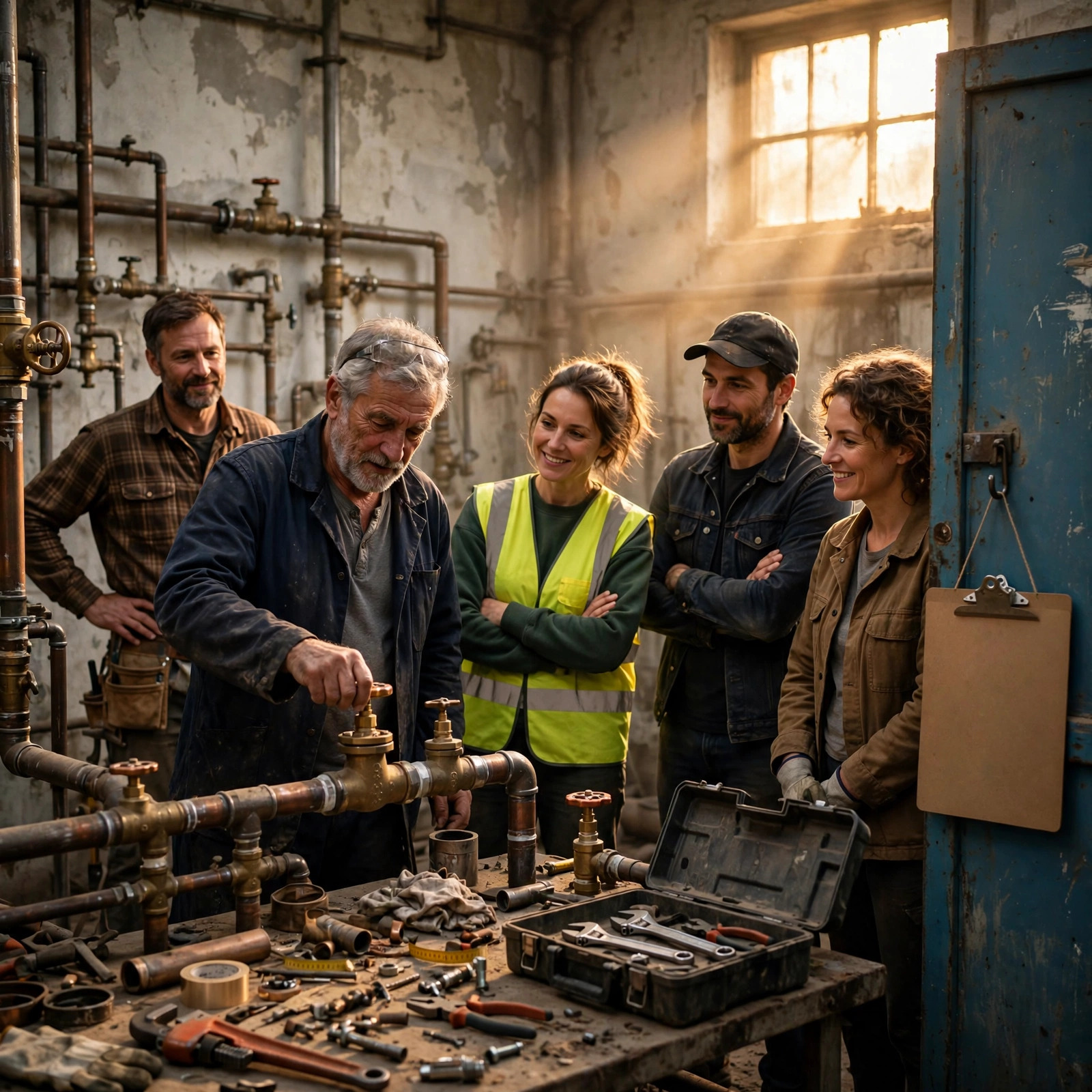
"Petra Ndiaye," she said. "I steward this loop. You didn't call ahead."
"Unannounced inspections are standard for consolidation reviews," the one in front said. She had a badge she turned toward Petra like a ticket. "We're here to verify the asset condition ahead of the Averton Clean Loop hearing. We'll need the plant room, the digester yard, and your operating records."
"The plant room is a working space," Petra said. "It turns a valve by hand every day. If you go in there, go in there like people who know that."
The surveyor wrote something down. Petra had already learned, over nine years, what it meant when the writing came before the answer.
"That's actually why we're here first," the surveyor said. "The manual return valve is flagged in the overlay model as a non-compliant single point of operation. Until the council votes, we're required to secure flagged components. It's a tag-and-hold. Standard."
Kwame had come out behind her, wiping his hands slowly on a rag that didn't need wiping. "Secure it how?"
"Lockout. The valve gets tagged and seized in the closed position, and operations transfer to the consolidated plant on a contingency basis."
"There is no consolidated plant," Petra said. "There's a drawing of one. The heat for four hundred households is moving through this room right now, through that valve, turned by hand, every morning, by people whose names are on a shelf in the gatehouse."
"The model accounts for the transfer," the surveyor said, and Petra understood, standing in her own yard in the smell of warm compost, that the model was going to be spoken about in the present tense from now on, as if it had already happened, as if the valve were already a memory. The surveyor's two colleagues were already walking toward the plant room with the hard cases.
"I'm coming with you," Petra said, and went in ahead of them, because the room was hers before it was anybody's evidence.
The main return valve was brass, older than her tenure, older probably than the surveyors, and it turned through its quarter arc twice a day with a sound like a satisfied animal. Petra had greased it herself on the first day of this whole business, and the morning before, and the morning before that. The surveyor with the hard case took out a steel collar, a tag on a wire, and a numbered seal, and fitted the collar around the valve stem while her colleague read the asset number aloud off the wall plate and the third one wrote it down. It took under four minutes. Petra had expected it to take longer, for something that ended a routine nine years long.
"If that valve stays closed," Kwame said, "loop pressure drops inside of three hours. After that, no heat, no hot water, four hundred kitchens. It's autumn. Evenings are cold."
"Contingency transfer," the surveyor said again, patient, like a person reading a label. "The consolidated plant at the Averton works will carry the load."
"The Averton works doesn't take this loop," Kwame said. "There's no tie-in. There's a page in a document that says there is."
The surveyor looked at Petra then, the first one to look at any of them all morning, and Petra saw that she was young for her clipboard and tired, and that none of it was hers either. "I tag what the filing flags," she said. "The filing flags this valve. If you believe the filing's wrong, the hearing's the place that's for. Three days from now. It's in the notice."
She spun the collar closed, threaded the seal through the tag wire, and crimped it with a tool from her case. The tag hung there, red, catching the gauge light. Then she turned the valve to its stop, hand over hand, and the stem moved for the last time under somebody else's fingers, and the loop, which had run under Marrow Lane Ward since before Petra had a key to the room, began the long slow drop that she could already feel through her boots as a thinning of the hum.
Within the hour, the gauges told the story she already knew. Return pressure slid first, then supply. Kwame stood at the board and called the numbers out flat, and Petra wrote them in the fat notebook next to the copied tables, because a number written down by the person who watched it fall was worth more at a hearing than a number in a filing. By early afternoon the drop had crossed the line where the loop could no longer push heat to the far ends. Four hundred households, and by evening, none of them with heat or hot water. She made herself write that too: 400 to 0, one afternoon.
The mesh went down with the load. The ward's little network ran on commons power, metered off the same budget the overlay wanted to swallow, and when the load shed came, the notice boards went dark and the neighborhood channels with them. Petra stood in the gatehouse with her tab in her hand, watching it fail to send, and then she did the thing her predecessor had taught her in her first winter, which was to stop being clever. She got the bicycle out of the gatehouse shed, and Kwame took the other one, and they split the ward between them with a paper map and a wax pencil, because the only way to tell four hundred households that the loop was down, and why, and for how long, was to go and tell them.
She rode the afternoon away doing it. Door to door, corner to corner, the bakery where the re-seated joint sat dry and pointless now in a cold pipe. People were angry in the ordinary way, which was bearable, and frightened in the quiet way, which was worse. She gave them the facts she had: valve seized, hearing in three days, bring your cold tap and your patience to the Bellhaven Commons Gatehouse if you want to sign the counter-proposal when it exists. An old woman on the top of the ward pressed a jar of pickled things into Petra's basket and wouldn't take it back.
She got back at dusk, and Horace was waiting at the gatehouse, sitting on the bench under the notice board with a paper in his hands.
He didn't stand up. Horace Delacroix, who ran the digester turns at the Delacroix Digester Yard like the pipes belonged to him, which in the sense that mattered they did, sat with his elbows on his knees and a single slip of paper held out flat between two fingers.
"They froze the vouchers," he said. "Came to the yard at noon. Issuance is suspended pending the overlay review. All 180, the whole month's book. Not just mine. Every turn, every repair credit, every neighbor who fixed a neighbor's radiator for vouchers instead of money. Frozen on paper, effective immediately."
"Horace," Petra said.
"It's a third of my income," he said. "I want to say that out loud, in front of you, so it's said somewhere official. I keep the digesters. Six tonnes of food waste a week, in through the gate, out through the loop as heat, for nine years, and the paper that pays me for it is frozen because a model in a chamber somewhere doesn't know I exist." He looked up at her. "I'm not asking you to fix it tonight. I'm asking you to carry it."
He held out the slip, and she took it. It was the frozen voucher issue notice, his name at the top, the month's line stamped SUSPENDED in red, and under the stamp, in the small print that nobody read, the words pending review of redundant manual operations. She folded it once and put it inside the fat notebook, against the copied tables, where the hearing would find it.
"The rota's stood down too," Kwame said from the doorway. "Nobody can log a turn with the loop seized and the book impounded. They took the rota book, Petra. Cited it as liability evidence. Twenty-six names, nine years of signatures, and they carried it off like it was a problem."
"Then it's evidence," Petra said. "Let them enter it. Every page helps us."
Horace pulled himself up off the bench. He was quiet about it, the way he was quiet about everything, and he looked once down Marrow Lane, where the windows were going dark early because the evening warmth wasn't coming up through the floors the way it had that morning, and where the surveyors' van had already gone.
"Ines Farrow came by the yard before the freeze," he said. "Walked the whole line with her clipboard. I asked her straight who turns the valve in her model. She said the plant does. I said, the plant's a drawing. She wrote something down and didn't answer me. You remember that, when you're in the chamber." He settled his coat on his shoulders. "I'm going home. It's cold, and I've got a hot water bottle and no hot water, and that's the kind of joke I'm reduced to."
He went out the gate and up the lane, a big man made smaller by the dark, carrying the day with him the way he carried the compost barrow, low and close, and Petra stood in the gatehouse light holding the notebook against her chest with his frozen slip inside it, and behind her in the plant room the seized valve sat tagged and still, and the loop under the ward was silent for the first night in her nine years.
Puller and Appendix
The puller arrived at midnight on the back of a cargo bicycle, borrowed from the machine shop two streets over, its jaws wrapped in a flour sack so they wouldn't ring against the plant room floor. Kwame wheeled it in and stood it against the wall beside the seized valve, and for a moment neither of them said anything, because the valve wore the surveyors' lockout collar like a verdict and neither of them had ever cut a municipal tag before.
"There's a fine," Kwame said. "Tampering with a tagged device. I looked it up on the bicycle, the old postings board at Bellhaven Commons Gatehouse still has the notice pinned. It's not nothing, Petra."
"Four hundred households," Petra said. She said it the way she'd said it to herself all evening, walking the cold rows of the digester yard, counting windows. "The fine is a number. The fine is a number we can argue at the hearing. Cold is not a number we can argue with."
"Then we argue with cold first." He pulled the flour sack off the jaws and set them against the collar's hasp, and Petra braced the valve body with both hands, and the two of them leaned into it together. The hasp gave on the third pull with a sound like a lock of hair snapping, and the collar dropped onto the concrete, and there it was: the brass, still wearing the tag, still scored where the collar had bitten into it during the freeze. Kwame turned the tag over once, read the reference number aloud, and Petra copied it into the fat notebook, because you didn't destroy evidence, you entered it.
The valve itself had seized worse than any winter turn she could remember. Nine years of greasing, twice a day when the cold came on, and one collar had done in a single night what a decade of weather hadn't. Kwame fitted the puller's jaws around the square of the spindle and worked it a quarter-turn at a time, and Petra stood at the pressure board with the lamp, calling the numbers as they crept. It took an hour and forty minutes to break the seizure, and when the spindle finally moved through a full turn, the score marks on the brass caught the lamplight, bright as new scratches on an old coin.
"Scored," Kwame said, running a thumb over it. "It'll hold. It'll hold, but it's not the valve it was yesterday morning."
"None of us are," Petra said, and opened the return.
The loop came back the way a held note comes back into a choir: not all at once, but street by street, riser by riser, the pressure board climbing out of the red in slow honest steps. They walked the bakery corner joint at two in the morning and found Kwame's sleeve from Day 1 still seated, still dry, and Petra signed the check against her own palm because the rota book sat impounded in the Ward Council Chamber and there was nowhere else to write her name. By four, the return lines were reading steady. By five, with the sky going grey over the Delacroix Digester Yard, the boards showed all four hundred households fed, heat and hot water moving under the ward again, and Kwame sat down on the plant room step with his coat open and his face shining and said, "I don't want to do that again for at least nine years."
Horace came through the gate at first light with a thermos and no jokes about hot water bottles. He'd seen the radiators ticking warm in his own kitchen and come straight down, and he stood in the plant room doorway looking at the freed valve, the dropped collar, the puller with its jaws still dressed in flour sacking, and he didn't touch any of it.
"You cut their tag," he said.
"We restored service," Petra said. "The tag's in the notebook, with the reference number. Let them fine me. Fines go on the record too."
Horace poured three cups from the thermos and handed them around, and it was tea, and it was hot, and that alone was worth remarking on, though nobody remarked on it. The digesters were waiting for him, six tonnes a week didn't pause for overlays, and he drank his cup standing, the way he did everything.
"Sit down, Horace," Petra said. "Before you go turn anything. I need you to hear a page."
She had the overlay out on the plant room bench, the published copy of the Averton Clean Loop, its cover showing the consolidated plant at the Averton works, the 11% and the 9% and the word legacy four times in the body of it. She'd read the model twice on Day 4 and gone to bed angry both times. What she hadn't read, because it came after the tables and the tables had been enough for her anger, was the appendix.
Appendix C ran to eleven pages of outage records, ward by ward, winter by winter. She'd skimmed the charts. It was the footnote under the fourth chart that stopped her, at half past five in the morning, with the tea going cold in her hand.
"Read that," she said, and turned the notebook so Horace could see the line she'd copied out in her own writing, because the appendix belonged to Farrow's document and the notebook belonged to the ward.
Horace read it, moving his lips. "Marrow Lane Ward records the lowest outage incidence in Averton across the survey period," he read, "attributable in part to sustained manual operations at the Bellhaven Commons heat-loop, including daily valve turns and resident repair response." He looked up. "That's her own paper."
"That's her own paper," Petra said. "Ines Farrow sat in a municipal office with twelve years of planning behind her, built a model that leaves out every one of the twenty-six names on that rota, calls us legacy four times, and then footnoted us as the reason the ward has the best record in the city. She didn't read her own appendix. Or she read it and didn't understand what she'd written."
"Which one's better for us?" Kwame asked.
"The second one," Horace said, before Petra could. "If she knew and hid it, she fights us. If she wrote it and never saw it, she's a planner who trusts models more than feet, and there's a cure for that. You show her the feet." He set his cup down on the bench. "You show her my feet, at the digester, at five in the morning, in February."
Petra cleared a space on the bench, and while Horace went out to run the digesters and Kwame rode the borrowed puller back to the machine shop before the shop opened, she wrote. The hearing was the day after tomorrow. One full day of daylight stood between this bench and the chamber, and Chair Reyes-Ishikawa would vote the draft as filed unless a working demonstration and a costed counterproposal landed on her table, and the demonstration was running under the ward right now, all four hundred households warm on a valve Kwame and Petra had freed by hand in the dark. That part wrote itself.
The costing nearly stopped her.
The rota was twenty-six people. The vouchers ran 180 a month. The counterproposal had to fund both, charter them into the loop's operations instead of leaving them as a line the next model could quietly delete, and the ward budget it would draw from was the same budget the overlay proposed to consolidate. Petra laid the budget sheets out and found, three lines down from the compost works allocation, her own steward stipend, protected, itemized, and safe. The overlay would have swept it up with everything else, but that wasn't the point. The point was that the money to charter the rota, to make the 180 vouchers a standing cost of the loop rather than a kindness, had to come from somewhere real, and the only somewhere she controlled was her own line.
She could redirect it. Not lose it, redirect it, move the stipend from her own pocket into the rota's charter, and take her pay the way Horace took his, in vouchers and in the work. She sat with that for a long time, tea cold, digesters turning out in the yard, and then she wrote the transfer in, in plain figures, and signed her name under it.
By noon the counterproposal was five pages: the freed valve and its scored brass as the demonstration, the appendix footnote quoted in full with its page number, the rota chartered at 26 turn-crew members, the 180 vouchers costed as loop operations, and her own stipend line moved to fund it. Horace came in from the yard, read the last page twice, and put his finger on the stipend line.
"That's your wage, Petra."
"That's my wage," she agreed. "And it's going to the hearing as a number on the right side of the page. Farrow's model says we're a cost. Let the chair see a steward who priced herself into the plan instead of out of it."
He was quiet, the way he was quiet, and then he said, "Carry it well," which from Horace was a long speech.
Kwame came back from the machine shop with the receipt for the puller and news that two streets had already put their radiators back on and someone had baked. There were rolls. There were rolls because there was heat, and Petra ate hers standing at the bench, and then she squared the five pages, and set them over her signed name on the cover sheet, and stapled through all of it twice, hard, the staple going in over her own name like a rivet.
She set her alarm for the hearing. One day of daylight left, then the chamber, then the chair. She put the fat notebook on top of the stapled pages, Horace's frozen slip still folded inside against the copied tables, and turned the lamp off, and the plant room hummed, warm, all four hundred households breathing through it.
The Rota Book
The Ward Council Chamber smelled of floor polish and cold coffee, and the rota book sat on the evidence table at the front, impounded, tagged, still smelling faintly of the plant room. Petra had spent the walk over deciding not to look at it, and then spent the first ten minutes looking at nothing else. Four years of mornings in that book. Horace's square initials. Kwame's slanted ones. Her own name, twice a day, nine years deep.
Chair Yolanda Reyes-Ishikawa called the session to order at ten, and the chamber settled. Forty neighbors had come in on bicycles from Marrow Lane Ward, more than the public benches held, and the overflow stood along the back wall in their work coats. Horace stood among them. He had put on a clean shirt and then, visibly, put a work coat over the clean shirt, as if to make clear which one was telling the truth.
Ines Farrow presented first, and she presented well. Petra had expected a bureaucrat and got something harder to dislike: a woman who had clearly been out to the Averton works at dawn, who quoted real numbers without notes, who believed what she was saying. The consolidated plant model ran on the chamber's display wall, all pale lines and clean gradients. Eleven percent better efficiency. Nine percent better winter peak reserve. A heat loop with no hands in it, drawn as a smooth closed curve.
"The Averton Clean Loop consolidates eleven fragmented legacy assets into one automated works," Farrow said. "It removes single points of human failure. It ends the ward's dependence on volunteer labor for a service four hundred households rely on for heat and hot water."
She said volunteer labor the way a person says a thing they believe is a kindness. Petra watched the public benches hear it as a door closing.
"Ms. Ndiaye." Reyes-Ishikawa turned over a page. "The chair notes a counterproposal was filed within the window, and that the filer requests a working demonstration. The record shows the main return valve at the Marrow Lane plant was freed from a municipal lockout collar two nights ago, restoring service. The chair also notes the collar was installed by surveyors acting under this overlay's review authority, and that the filer cut it off with a hydraulic puller." A pause, level. "Proceed. And explain the puller."
A ripple of something that wasn't quite laughter went down the back wall.
Petra stood. Her five stapled pages were in her hand, and she had rehearsed the first sentence so many times on the ride over that it came out almost calm.
"The puller cost the ward forty credits and I have the receipt. The demonstration is already done. On Day Nine your surveyors locked the manual return valve. By evening, four hundred households had no heat and no hot water, because the plant that actually runs Marrow Lane is not the one in that model. It's twenty-six people on a rota, one brass valve turned by hand every day, and a compost yard taking in six tonnes of food waste a week. The overlay doesn't consolidate that. It deletes it. It's not in the model. Not the rota. Not the one hundred eighty repair vouchers a month. Not a single name."
"The model reflects standard loop assets," Farrow said. "Volunteer inputs are variable. They can't be costed."
"They can. I costed them. Page three." Petra held the pages up, then set them on the evidence table beside the rota book, the two objects side by side, and the sight of them together did something to her voice that she decided not to fight. "And your own model costed us, Ms. Farrow. Appendix C, page fifty-one. You just put the answer in the back of the book."
Farrow blinked. "Appendix C is the outage incidence annex."
"It is." Petra turned to the chair. "With your leave, I'll have her read it."
Reyes-Ishikawa's mouth moved a quarter inch, which Petra had learned was how the chair smiled. "Read it, Ms. Farrow."
Farrow came down from the display wall. She took the pages, found the appendix, and Petra watched a planner read her own work at speed, watched her lips actually form the words, watched the speed stop.
"'Ward-level outage incidence, ten-year mean,'" Farrow read, and then slowly, "'lowest in Averton: Marrow Lane Ward, attributed to sustained manual oversight of return-side valving and digester turning under local rota.'" She looked up. Her face did a thing Petra recognized, because Petra had done it herself on Day Four at the council chamber's long table: the arithmetic of realizing you had already written the answer and never read it. "That's my attribution note. The source audit flagged the correlation and I... carried the footnote forward without reconciling it against the consolidation model."
"So the model calls us a cost," Petra said, "and your own annex calls us the reason the ward works. Both can't be filed."
The chamber got very quiet. Horace's arms were folded, and behind him a woman from the bicycle chain of the shutdown nights leaned toward her neighbor and said, not quietly, "Told you."
Farrow looked at the display wall behind her, at the smooth closed curve, for long enough that the curve started to look like what it was. Then she set the pages down.
"Chair, I'd like to amend my own filing before the vote."
Even Reyes-Ishikawa sat forward. "You understand what you're asking."
"I understand the model is incomplete. I built the efficiency case on a system with no people in it, and the annex in my own filing says the people are the system." Farrow turned to Petra, and there was no softness in it, which Petra respected more than she could have said. "Your counterproposal redirects the steward stipend line to fund the rota and vouchers. That's your wage."
"It is."
"You're proposing to pay yourself in the same vouchers as the turn crew."
"I'm proposing everyone who runs the loop gets paid like someone who runs the loop," Petra said. "The stipend line moves. It doesn't shrink. It funds twenty-six certified operators and one hundred eighty vouchers a month, costed as what they are, the working budget of the plant. Page four. And the manual valve stays, chartered, with a daily certified turn. Your automated works is a good idea for the trunk lines. It's a bad idea for the last hundred meters, and your annex already told you so."
Farrow read page four. The chamber let her. Somewhere in the quiet Horace unfolded his arms.
"Chair," Farrow said, "I move amendment one: the overlay funds the Marrow Lane commons plant, the certified rota, and the voucher line as standing costs of the loop, replacing the consolidation of those functions in the draft. Back-pay the frozen month. The manual return valve remains under community charter." She paused, and added, dry as a receipt, "I'll co-sign. It's my footnote."
Reyes-Ishikawa took the vote by roll, and it was not unanimous, and Petra was glad it wasn't, because the two no votes came from two councilors who asked real questions about winter peak reserve and got real answers, one from Farrow, about how the automated works would carry the trunk while the certified rota carried the ward. The amendment carried. The gavel came down on it like a nail going into wood.
Then the chair did a thing Petra hadn't expected. She lifted the rota book off the evidence table and walked it over herself.
"Impound is lifted," Reyes-Ishikawa said, handing it into Petra's hands. "The record notes the book was entered as evidence of liability and leaves as evidence of operation. Take it home. Nail it up somewhere the ward can see it."
"We already have the somewhere," Petra said.
By the time the chamber emptied, Horace had his back-pay slip in his hand and a new line on it besides: trainer of record, Delacroix Digester Yard, under the amended overlay, which meant the yard stayed his and the yard's knowledge stayed his to give away on purpose. He folded the slip the way he folded everything, once, precisely, and put it in the breast pocket under the work coat.
"Trainer," Kwame said, wheeling his bicycle beside him. "You're going to be insufferable."
"I've been insufferable for nine years," Horace said. "Now it's funded."
Farrow caught them at the chamber door. She had a pen in her hand and the amended overlay under her arm, and she looked, for the first time since Day One's rumor, like a person standing on the ground instead of on a model.
"The annex will need a full field survey," she said. "I'll want the rota's logs. Ten years of them." Then, to Petra, more quietly: "I put 'legacy' in that draft four times. I meant it as a compliment."
"I know," Petra said. "That was the worst part."
Farrow nodded once, accepted it, and left toward the Averton works, where somebody was presumably going to have to redraw a very clean curve.
The light was going amber when they rode back into Marrow Lane Ward, and the plant room was warm, and the mesh was up, and word had already run ahead of them down the streets, so there were neighbors at the door when Petra unlocked it. Kwame had cut the plate that afternoon, a hand-painted strip of sign steel, and Horace held it level against the wall beside the valve while Petra set the nails. THE DAILY TURN, the plate said, in Kwame's careful block letters. CERTIFIED UNDER COMMUNITY CHARTER. Then the rota book, four years of mornings, went up beside it on two nails, opened to a fresh page, and the first of the neighbors came in out of the amber light to sign it, and the second, and the third, and the queue went out the door.
Horace signed. Kwame signed. Petra stood in front of the scored brass valve, the one she had greased twice on Day One and cut free with a puller two nights ago, and put her hand on the wheel, and turned it.
It turned. The loop took the turn the way it had taken ten years of them, warm through the metal, out along the streets toward four hundred households. Behind her the signatures were still going onto the fresh page, pen-scratch and low voices, one at a time, and Petra stood with her palm flat on the brass and let the wheel settle, and did not move her hand for a while.
Get notified when new stories drop

Leo Stranek
Leo specializes in solarpunk abundance and near-future progress: livable futures, bright cities, and practical wonder.
Leave a comment
Comments