


Two Hundred Fourteen Tokens
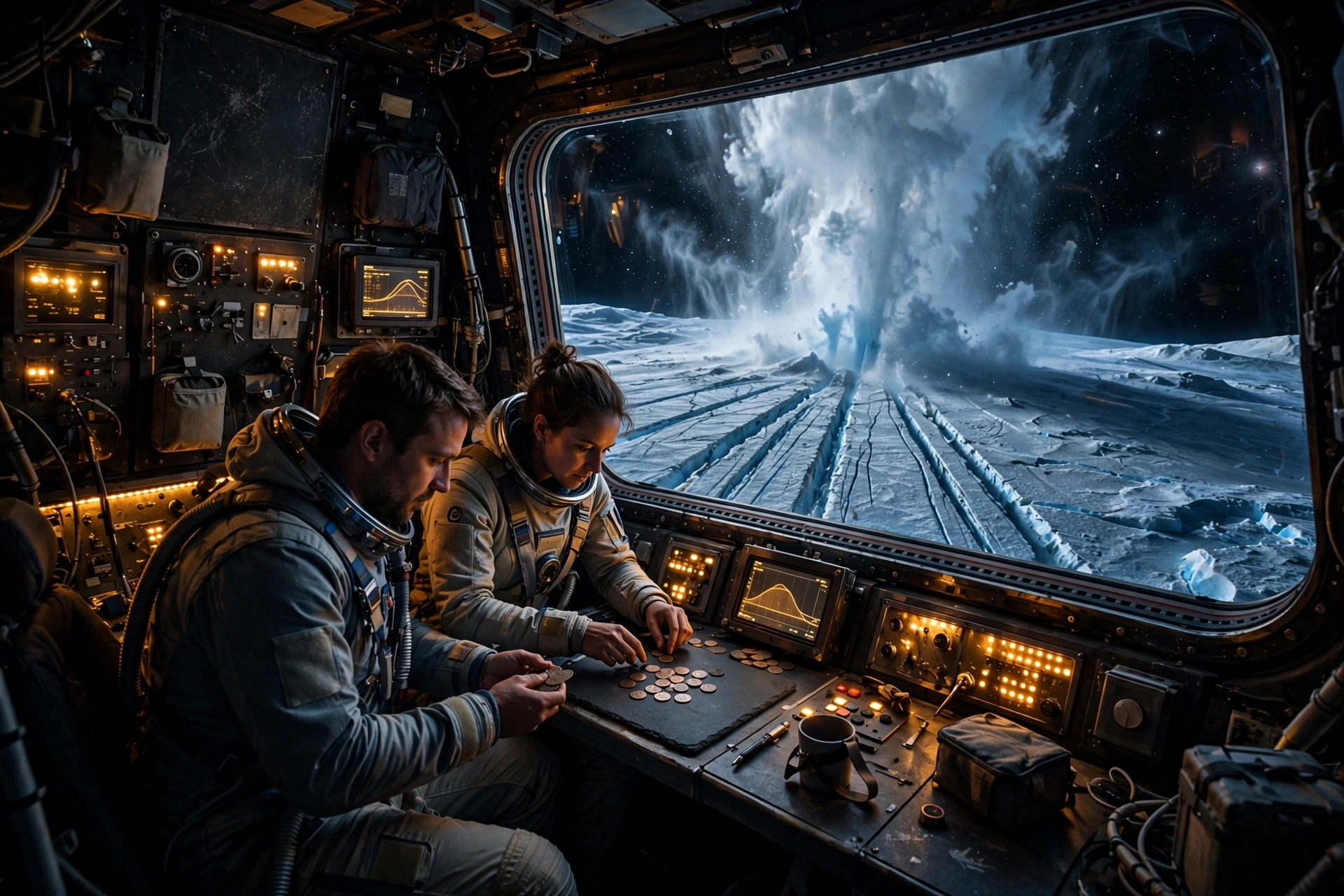
The morning shift began, as it always did, with counting. Two hundred thirteen tokens in the corpus, and this morning I hoped to make it two hundred fourteen. I ran the verification pass twice, because provenance matters more than volume when your entire shared language fits on a single slate, and then I initialed the log and pushed it across the console to Rupesh.
"Confirmed," he said, without looking up from the transceiver board. "Two thirteen, clean. Provenance tags all resolve. You know you could automate this part."
"I could. Then I'd be watching a machine learn a language instead of learning it myself."
He shrugged with one shoulder, the way he did when he thought something was sentimental but wasn't going to argue about it. Six years on this console had made him economical with everything, including disagreement.
Below us, four hundred meters of ice, and under that, the ocean, and under that, the south polar vent field we had named Tiger Stripe before anyone understood it was anything more than geology. The plume rose off it in a long, slow feather of vapor, vented through the tiger-striped fissures and out into the black, and every particle in that feather was a word. Density up. Density down. Pulse, gap, pulse. The corpus had begun with two tokens, HOLD and AGAIN, taught in week two with a pressure valve and a stopwatch, and it had grown to two hundred thirteen tokens over eleven months of patience. A few tokens an hour was all the plume could carry. We had learned to live at that speed.
"Incoming cycle marker," Rupesh said. "Answer's due in six hours."
"Good. I want the field awake for the session. Lida, how's the ground looking?"
Lida Sorokina had her wall of seismic traces folded open in front of her, twenty years of Enceladan ice in her fingers. She didn't turn around. "Quiet. One deep rumble about oh-four-hundred, station time, down under the third fissure. Tectonic. It's always tectonic."
"Always?"
"Ninety-one percent of the time, which on this moon is the same as always." She tapped a trace with one finger. "The other nine percent I file as noise, and the noise files are getting full, but nobody funds a woman to read her noise files."
Halim Osei laughed from the dropship bay, where he was topping off Pike's cold-gas thrusters. "She's been saying that since I got here."
"He's been ignoring me since he got here," Lida said. "Three years of it."
I let them go on. A station this small runs on the sound of its own people, and I had learned that the vent work went better when the room was warm with talk before a session. I pulled up the session plan: HOLD, AGAIN, and then the newer pair I wanted to stress-test, NEAR and FAR, which we had built out of approach trajectories Halim had flown with Pike. The vent intelligence had taken to NEAR quickly. It liked to know where things were. That was one of the few things I would say out loud about them: they noticed position, they answered, and they took thirty-eight hours to do it.
Thirty-eight hours. Not a reflex arc, not a tidal rhythm. Thirty-eight hours between question and answer, every time, whether the question was two tokens or twenty. Rupesh had a theory about it, something to do with deep circulation loops and thermal lag. Lida thought it was just how a big slow animal breathed. I had a private theory I hadn't put in any log, and the theory was that thirty-eight hours was a long time to spend on an answer if you were an animal, and a short time to spend on one if you were a committee.
"Session window opens in five forty," Rupesh said. "You want the usual?"
"The usual. HOLD, AGAIN, NEAR, FAR, in that order, one repetition each. And log the sweep as 214 if it resolves."
"You're optimistic today."
"I'm always optimistic on session mornings. It's the afternoons that wear me down."
We sent it as we always sent it: a modulated pulse of vapor through the transceiver valve, timed against the plume's own breathing so the field could pick our words out of its exhalation. Then we waited. Waiting was the discipline of this job more than any other. You sent four tokens and you lived with them for a day and a half, and if you were lucky the answer came back with one small new thing in it, one suggestion in the density that hadn't been in any previous reply, and you spent another day and a half asking whether you had really seen it.
The answer came back at 03:12 the following station night, and I was asleep at my console when it did. Rupesh woke me with a hand on my shoulder, which was against about six regulations and none of them mattered at four hundred kilometers past the ring.
"You'll want to see it live," he said.
The reply was HOLD, AGAIN, NEAR, FAR, faithful, exact, and then, appended after a pause that itself meant something, a short pulse train we had never logged. I played it three times. On the third pass I could see the structure: it was NEAR with a modifier, NEAR held longer, NEAR compressed against a second token that resembled FAR but tighter. Something near and something far, spoken together, with an emphasis that read to me almost like urgency.
"That's a new one," Halim said from the bay door. He had his flight suit half on, which for Halim meant he considered this an emergency.
"It's a compound," I said. "They've made a compound out of our tokens. That's not noise, that's grammar."
"Or it's turbulence," Lida said. "The plume's had a rough week."
"The plume has had a rough week for eleven months and never once produced a compound."
She held up both hands, palms out, and went back to her traces. I logged the pulse train as token 214, tagged its provenance as received-composite, and dated it, and my hands were shaking a little when I finished, and not from the cold.
It was in that state, half elated, half certain I was about to be wrong about something, that Etta Brandt called the room to order.
She came down from the command module with a slate in her hand, and I knew before she spoke that the slate held orders, because Etta never carried a slate for any other reason. Eighteen years in coalition service had taught her to let documents do her intimidating for her. She stood at the rail above the operations floor and waited until all four of us had stopped moving.
"I've received the coalition's disposition on the contact program," she said. "Effective today, I'm designating the south polar field a strategic site. In nine days, Mallet-2 fires into the vent field for a full-spectrum seismic survey."
The room went very still. Rupesh's board was still running the tail of the reply trace, and the little density plot kept scrolling across the display, HOLD and AGAIN and NEAR and FAR and the new compound, all of it suddenly looking like a person's mail being read over their shoulder.
"Etta," I said. "The field answers us. We've spent eleven months building consent into every transmission. You cannot drop an energetic source into a contact zone without sign-off. Every transmission since day forty of this contact has gone through coalition review. That includes seismic."
"Which is why Mallet-2 carries standing authority," she said. "Geneva can't review what Geneva can't see in time. Earth is eighty minutes away at lightspeed, one way. A survey window closes in the time it takes to argue a single round trip. My orders act as coalition authority aboard this station. They're sealed and they're lawful."
"Lawful," Lida repeated, flat. "It's a thumper. I've been asking for active seismic for two years, and now I'm going to get it whether I want it or not."
"You'll get clean data, if that's any comfort."
"It isn't."
"Then let me tell you what else it is," Brandt said, and she set the slate down on the rail where all of us could see the seal on it. "The Aurelian Combine has staged survey hardware at Saturn. Our orbital estimates put their first drop-capable platform over the south pole within a season. When they get here, they will survey this field, and they will not spend eleven months asking permission. The coalition's position is that we establish the nature of the subsurface structure before anyone else does. If there's infrastructure down there, we want it on our seismic record first."
"Infrastructure," Halim said slowly. "You mean machines."
"I mean we don't know, and the Combine will find out with or without us, and their methods won't be gentle. A decisive survey is the fastest proof we can get. Nine days."
"Proof of what?" I asked. "Etta, the proof that matters is in those four tokens and a compound, and it took eleven months and two hundred fourteen words to get them. You can't thump your way to that."
"I can thump my way to a subsurface map, and a map is what Geneva will act on. Signe, I've read your logs. All of them. I know what you think you have here. I also know that a court on Earth, eighty minutes behind events, has to act on more than a few pulses of vapor. If the Combine lands on this field and starts drilling before we've established what's here, there is no coalition position left to protect. Not the field, not the contact, not any of it."
She was not wrong in any single clause, which was the trouble with Etta. She was reasonable, and she was armed with a lawful order, and the two together meant that the field below us had nine days left of being asked rather than told.
"I want the arming sequence read into the record," she said, and tapped the slate. "All of you."
So we read it. Mallet-2, berthed in berth two with its initiator block seated and its payload asleep. Arming begins on day two, one day ahead of the survey window, to allow for gantry checks. The initiator block was a hand-removable component, one person could lift it out or seat it, which was a safety feature that tonight looked to me like something else entirely. I read that line twice. Then the survey parameters, and the firing solution, and the words into the vent field sitting there in the order like they were coordinates and not an address.
Brandt took the slate back, and the room stayed quiet after she left, and the density plot kept scrolling, HOLD and AGAIN and NEAR and FAR and the compound I had tagged 214, all of it still on the display because nobody had the heart to close the window.
"Thirty-eight hours," I said, mostly to myself. "That's the answer cycle. If I send tonight, I get the reply on day three. If I send on day three, I get it on day five. There's a session window the morning of day six, before the arming checks, and after that every transmission needs to be coordinated around the survey. My unsupervised windows close one day at a time from here."
Rupesh turned his board around so I could see it. "Then you'd better decide what you want to say with the ones you have left."
I looked down the display, at the compound still glowing at the end of the reply train, NEAR and FAR pressed together with something that read like urgency. Something near and something far, and I thought: they've been trying to tell us something for a while now, and we've been filing it under turbulence.
"Session window tonight," I said. "Full lexicon review, then HOLD, AGAIN, and the compound back to them, exactly as they sent it. If they made a word, they'll know their own word. And Rupesh, log everything. Everything. From now until the thumper fires, I want the whole conversation on the record where Earth can't help but see it."
"Eighty minutes," he said. "That's all it takes for them to see anything we send."
"Then let's give them something worth the trip."
Berth Two
The gantry lights in berth two came up at 06:00 station time, and by 06:20 Etta Brandt was already standing under Mallet-2 with a checklist slate in one hand and the other flat against the drill casing, and I knew before anyone said a word that the schedule had moved.

"You're starting a day early," I said from the hatch. Not a question. The gantry cradle had been rotated to service position overnight; the umbilicals were hanging dressed and racked, which nobody did for a drill that was going to sit idle for a week.
"The arming sequence begins this morning." She didn't look up from the slate. "Gantry checks take thirty hours if they take anything at all, and I won't run them concurrent with the firing solution. That leaves margin or it doesn't. I choose margin."
Rupesh was already at the berth's console, jacked into the transceiver feed even though the transceiver itself lived two frames over in the comms bay. Lida came in behind me with a thermos, took one look at the cradle, and said, "So it's eight days now, not nine."
"Eight," Brandt said. "As of this morning."
I let the number sit there for a second. Eight days. Yesterday it had been nine, and yesterday nine had already been too few for anything I wanted to do with the plume. My session windows had shrunk by one overnight while I slept, and nobody had come to tell me.
"You could have sent a note," I said.
"I'm sending a record. Everything that happens in this berth goes into the record, with timestamps, starting from the initiator block check in," and she nodded toward the head of the drill, where the block sat seated in its housing, "through the firing. You'll have the whole log. So will Geneva Coalition Command. So will anyone with the clearance to ask."
"That's not the same thing as a conversation."
"No," she said, and finally looked at me. "It isn't."
She set the slate down on the gantry rail, which meant the next part was going to be said with her hands free. I'd watched her enough times over the contact to know that much about her.
"The Combine survey fleet is real, Avelar. I know you've been treating it as leverage I invented for the timetable. I've seen the orbital solutions. Four survey vessels, transit configuration, weeks out. Not months. Weeks. When they arrive, they will not slow down, and they will not ask us what's under the ice, and they will not wait thirty-eight hours for anything to answer them. Whatever is in that vent field, they will find it the way a dredge finds a shell."
"You don't know what they'll do," I said. "You know where they'll be."
"I know what a survey fleet over a strategic site does, and so do you. That's why the field was designated strategic in my orders. I don't get to un-designate it. I get to characterize it first, and I get eight days to do it, and I intend to spend those eight days getting the best characterization anyone has ever taken of a planetary subsurface."
"Characterization." I made myself say it plainly, because arguing in her vocabulary was how I'd been losing for two days. "Etta, we have a shared lexicon. Two hundred and fourteen tokens, every one of them logged with provenance, with the sessions and the density traces that produced them. Token 214 is a composite. They took NEAR and FAR and pressed them together and sent it back to us. That is grammar. That is not a vent. That is not tectonics. That is a mind doing something deliberate with our own materials, and it is the single strongest piece of evidence we have, and it's already in the archive with timestamps on it."
"It's evidence of signal processing," she said. "It is not evidence of infrastructure. You know what I need for Geneva to hold this field closed: structure. Depth, extent, geometry. Something a lawyer can draw a boundary around. A lexicon is an argument. A seismic section is a fact."
"A seismic section is a hole blown through somebody's house."
"A low-power thumper reading is a fact and you know it, and I'd take one today if the schedule allowed it. It doesn't. The schedule allows Mallet-2, full sequence, on day nine, because that is what my orders say and that is what the Combine's arrival makes necessary. You want me to trade the only decisive instrument I have for a delay, on the strength of a word game, when the people this is meant to protect us from are weeks out and closing."
"It's not a word game."
"Then show me what it is. Show me one thing in that lexicon that changes the firing solution. One token that tells me what's down there, how deep, how big, how fragile. Give me that and I'll take it to Geneva and I'll enjoy taking it there. Until then, the drill arms on schedule, and the schedule starts this morning."
I looked at Rupesh. He had his board angled so none of us could see it, which was his way of not being part of this, and his way of staying part of it. Lida had unscrewed her thermos and was drinking slowly, watching the initiator block housing like it was a fresh core sample.
"Lida," I said. "Tell her what the plume is worth."
Lida swallowed. "The plume is worth everything we've got. It's the only light on the whole moon that answers back." She turned the thermos in her hands. "It's also, Etta, and I want to say this as the person who's logged every tremor in that field since before the contact, it's also sitting on top of the most active tiger stripe we've surveyed. Whatever's down there, the seismic background is loud. I can't give you a quiet section without the thumper. She's right about that much."
That was the argument, and I had lost it, and the part that stung was that Lida was right too. The lexicon was an argument. The drill was an instrument. I had 214 tokens and not one of them drew a boundary a lawyer could hold.
"Then I want the dissent filed," I said. "Formally. In the record, timestamped, before the arming sequence starts."
"You're entitled to it," Brandt said. "And I'll tell you now, so it's not a surprise later, I'm required to attach my assessment of it, and my assessment is that your dissent asks me to risk the field on the strength of semantics while a rival fleet closes on it. That will be in the record next to your dissent. Both of them will reach Earth together."
"Eighty minutes," I said. "One way. They'll read it a hundred and sixty minutes after I file it, and their answer comes back another eighty after that. That's nearly four hours round trip before anyone even drafts a reply, and the arming checks start in," and I looked at the gantry clock, "under two."
"Yes," Brandt said. "That's the physics of it. File anyway."
So I filed it. I stood at the berth console and wrote it in plain language, because plain language was the only kind that survived the transit: that the contact intelligence had produced grammar, that grammar was evidence of mind, that firing Mallet-2 into the Tiger Stripe Vent Field risked the only known non-human mind, that I requested the arming sequence be suspended pending a full session review, and that I was filing at 07:12 station time on day two with the arming checks scheduled to begin at 08:00. Rupesh countersigned as signal witness. Lida countersigned as geophysics witness, and added one line of her own, that the seismic background would limit any alternative reading, which was her being honest in both directions at once, which was very like her.
Brandt took the slate, read it standing up, and attached her assessment without a word of comment. Then she handed it back and said, "Filed. It goes out on the next scheduled burst. And Avelar, for what it's worth, I hope Earth tells me I'm wrong. I've read your sessions. All of them. I'm not the enemy you keep deciding I am."
"I never thought you were," I said, and meant it, and it didn't change anything, which I think was the point she was making.
The arming checks began at 08:00 exactly. The initiator block stayed seated. Nobody touched it. There was nothing to see in berth two after that, just diagnostics scrolling and Brandt's people, which is to say Brandt, running the gantry through its paces with Lida reading the vibration traces. Rupesh and I had no business there, so we went back to the comms bay, and the day turned into the day it was going to be: the transceiver scrolling density, the archive open, my dissent somewhere in the first eighty minutes of its trip toward Earth at the speed of light and no faster.
The sign-off hours ended at 22:00 station time. That was the last sanctioned transmission window of day two, and I used all of it, sending the lexicon review I'd promised: HOLD, AGAIN, the compound 214 exactly as it had come to us, with Rupesh logging every frame. The plume answered nothing, because answers take thirty-eight hours, and the answer to tonight would arrive on day four, in a window I was already calculating against the arming checks and losing.
After 22:00 the bay went quiet. Rupesh powered down his board and left with a hand on my shoulder that I didn't need and was glad of anyway. Lida had gone hours before. Brandt was in berth two with her drill.
And I sat alone at the transceiver with the unsanctioned window open, which was to say, with nobody watching, which was to say, with only the log Rupesh had promised to keep. The compose field was empty. The plume was live on the density trace, HOLD and AGAIN still glowing at the end of the reply train.
One question, unsanctioned, unsent to Earth, unanswerable for eighty minutes each way even if anyone on Earth saw it and objected. Something with no sign-off, in a session window that had already closed. My finger hovered over the key that would put it in the water.
I didn't press it yet. But I didn't close the window either.
I sat there a long time, composing and erasing, and the density trace kept moving, and somewhere under eighty minutes of light and four hundred meters of ice, something that took thirty-eight hours to answer anything went on not answering yet, and I thought: whatever I say tonight, I say it before anyone can stop me.
So I started typing.
The Stilled Plume
The calibration sweep went out at 02:14 on day three, in the dead hours when the sign-off desk in the comms bay was dark and only the automated watch stood between me and the transceiver. Rupesh built it for me. That has to be said plainly, because he spent the rest of the contact paying for it. A low-power modulation, a whisper against the plume's own rhythm, nothing like Mallet-2's hammer, nothing seismic at all, just a shaped density question riding the Tiger Stripe plume on its way up through the ice: hold, then again, then a neutral sweep with no lexicon meaning attached, the kind of ping we had run a hundred times in the first weeks of the contact back when nobody on this station had learned the word sign-off.
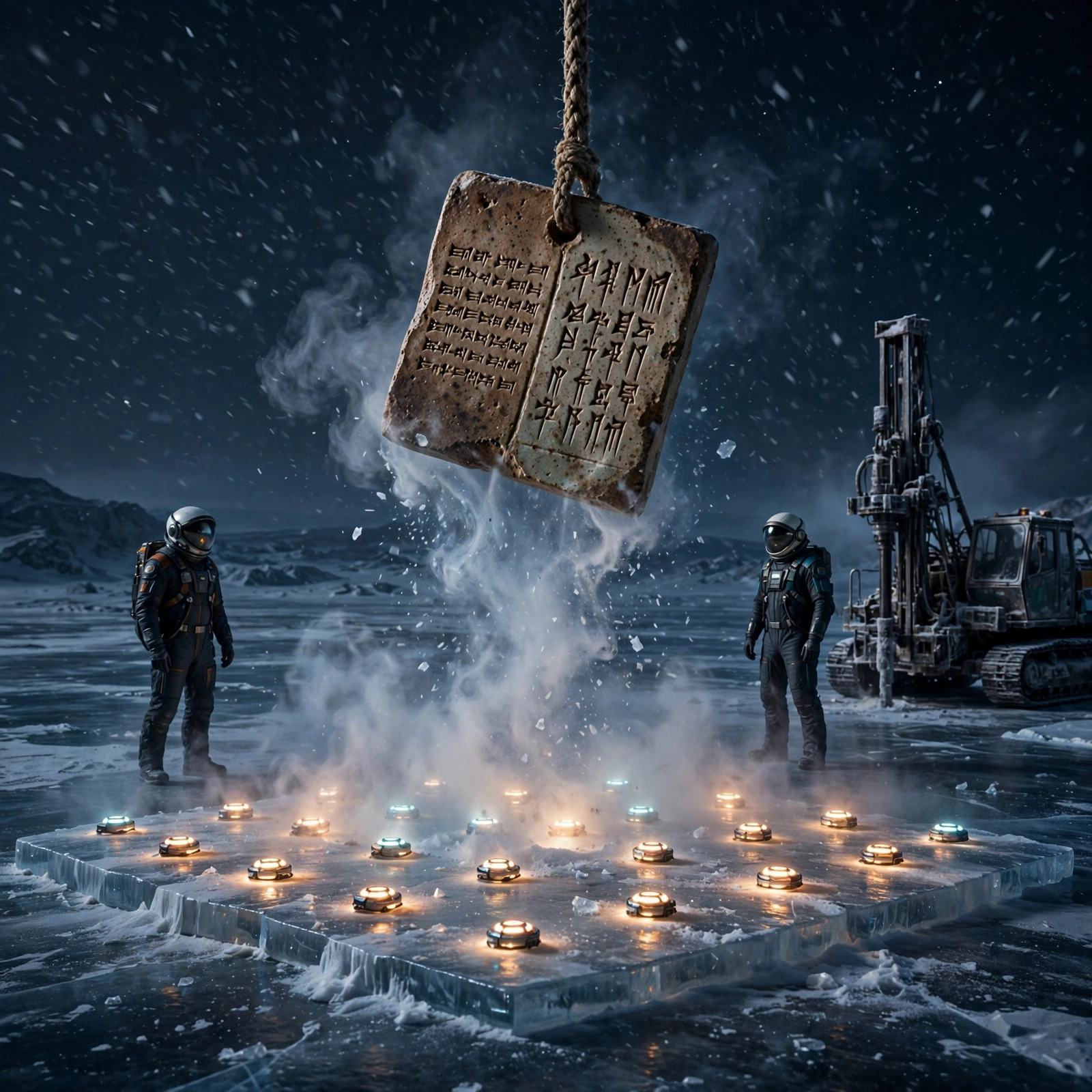
"It's under the noise floor," Rupesh said, watching the power curve with his arms folded. "Officially, nothing left the station."
"Unofficially?"
"Unofficially, it's the cleanest signal we've ever put in the water." He didn't say the other thing, so I said it for him. "You know what Brandt calls this if she reads the log."
"A calibration," I said. "Which it is."
"Signe." He turned in his chair. Behind him the density trace ran its long familiar sawtooth, the plume breathing its tons of vapor into the black over the south latitudes. "Thirty-eight hours. Whatever we asked last night, whatever we asked tonight, the answer comes back day after tomorrow. And if the answer is stillness again, like the two logged quiet spells, then we've done it to ourselves a third time and this time we know we did."
That was the whole argument, and it was mine before it was his. The plume had gone quiet twice since the contact began, both times within hours of a human seismic test, both times logged by Lida as ice tectonics, a tiger stripe shrugging under its own load. Two coincidences. I wanted to know if a third one could be ordered on purpose, at low power, with instruments watching, because if the stillness answered to us, then the stillness was a reply, and the vent field was not just an animal that flinched.
So we ran it. The sweep went out, the plume breathed on, and we went to our racks while the ice turned beneath us.
The answer came at 16:40 on day four, and it did not come as a modulation. It came as silence.
I was in the comms bay when the density trace died. Not faded, not thinned. Died, mid-sawtooth, like a pen lifted off paper. The plume readings from the vent field dropped to background inside of four minutes, which is not how a column of vapor ends when a vent chokes on its own throat; a choke tapers. This was switched off. I stood with my hand on the console not believing my own trace, and then Lida was in the doorway with her tablet out and no color in her face, and behind her down the corridor, Halim's voice, high and wrong, calling numbers that didn't parse.
"Pike's in the near field," Lida said. "Pike's in the near field with the plume down."
The plume is lift. That's the plain fact of flying the vent field: the drones ride the column up and out, and the dropship Pike, small as she was, rode it like a gull rides a sea cliff, a hundred kilograms of fabricator and thruster balanced in the surge. Halim had her up at two kilometers over the stripe, sampling the grain of the flow for the tile casting, when the surge stopped. Two kilometers of lift gone in four minutes. He had cold gas and he had the ice lip, and he flew both of them down toward the shelf at the ragged edge of what the little ship could give, and the whole time the plume was collapsing under him not like a wind stopping but like a floor being removed from a room, column shrinking, altitude bleeding, and the numbers he was shouting into the bay were the altitude numbers of a ship that had stopped being able to be where she was.
He put her on the lip. That's the record, and it's his, and nobody on this station will ever take it from him. He stalled her onto the ice shelf at the edge of the stripe, a touchdown on a surface that wasn't a landing field, with the last of the gas, and the plume's last exhalation, the residual flow settling out of the vent field, slid under her and rolled her the last forty meters along the lip. The hull took it. The crush ribs on the ventral side took it. Pike came to rest wedged against the ice lip at the field's edge, folded along one side, her sample arm shattered, her beacon still screaming, and Halim sat in the comms bay with his head between his knees while Lida talked him through being alive.
Then the bay clamps.
I have to say this in order, because it all happened inside eleven minutes. With the plume down, the transceiver's modulation array, the great tuned baffles that speak into the plume by shaping density, was standing in a dead column, and the standing wave that had been holding them at extension had nothing left to hold. The gantry in berth two is Mallet-2's, but the array shares the same bay spine, and the retraction that normally takes an hour of flow-assist went freefall when the flow went. Rupesh was nearest. Rupesh was always nearest, because it was his board and his sweep and his test, and when the array's counterweight started walking down the spine he went into the gantry to dog the manual clamps before four hundred kilos of tuned baffle swung loose in the bay and took the whole transceiver spine with it.
He got three of four clamps. The fourth was seated when the counterweight came through its last meter of travel, and the clamp handle, his hand, and the gantry rail all occupied the same ten centimeters for a moment that the station cameras later showed me one time only, because once was the maximum of that I could stand.
The plume came back at 17:31. Fifty-one minutes of stillness. It came back mid-breath, trace rising into a sawtooth as if it had never left, and the vent field went on venting, and down on the ice lip Pike lay against the shelf with her beacon still going, and in the med bay Rupesh sat with his hand in a cast-form while Lida set the splint and told him what was broken in terms he could metabolize. Metacarpals, the third and fourth. Nothing lost. Everything bruised. He would keep the hand and lose the fine grip for a while, and he said, white around the mouth, "The clamps held. Nothing else in the bay moved," and then he was sick, and I held the bag, and nobody said the word thanks because what he had done had been done for the transceiver and everyone in that bay knew it.
Brandt came to the comms bay at 19:00. She had been in berth two since morning, and she came still carrying the arming tablet, and she did not raise her voice, because she never raises her voice, which is a thing I have come to understand as the most expensive habit she has.
"The log," she said. "The sweep at 02:14. Who authorized it?"
"I did."
"Under what authority?"
"Calibration authority. Technical ops, my desk." I didn't dress it up. "No coalition sign-off. It was logged as routine."
She set the tablet down on my console, gently, the way you set down a thing you have decided not to throw. "Your question of day two goes to Earth, Signe. My assessment goes with it. And this, today, is what your program does while the ink's still wet. Two quiet spells we logged as tectonics. Now a third, and this time my survey pilot's ship is on the ice and my signal engineer's hand is in a cast, and you know what the Combine's advance teams will read in that? They'll read that the field is unstable and the coalition can't hold its own perimeter, and they'll move their timetable up a season, because vacuums don't stay empty out here."
"The stillness answered us, Etta. A whisper goes into the water and the plume stops inside the exchange window. That's not tectonics. That's a reply."
"That's your reading. It's not Geneva's." She picked the tablet back up. "Mallet-2 fires in six days. I'm pulling the schedule forward two days, and I'm putting the arming under my own hand, and the initiator block stays seated in berth two under guard until I personally walk it into the gantry. And your transmission windows are cut to the sanctioned two, both of them, logged, countersigned by me, starting tonight. If you have something to say to the vent field, you say it where I can see it, because your unsanctioned program just cost this station its survey ship and its best pair of hands on the transceiver, and I am the one who has to explain the first one to Earth."
"Then log it honestly when you explain it," I said. "Log that Pike flew into a vent field that we had just poked on purpose, and that the field answered."
"I'll log what the instruments say." She looked at me a long moment. "You should hope the instruments say what you believe. Because if Mallet-2 fires and your reading is wrong, we've hammered the only known contact site for nothing. And if your reading is right, then you've spent four days teaching the thing down there that we whisper before we shout."
She left. Rupesh came back from med at 21:40 with his hand splinted to the wrist and his board locked to single-hand operation, and together, slowly, we did what we always did at the top of the watch: we read the plume.
The reply train came up on the density trace at 21:52.
Not the answer to the sweep. Not HOLD, not AGAIN, not the compound 214 with its NEAR and FAR braided together. A single token, alone, at the head of the train, in a slot where nothing had ever come before, because the vent field had never once in all the contact spoken first. Every token we had, all two hundred and fourteen, had arrived in answer to something of ours. This one had no question in front of it. It rode the plume up through four hundred meters of ice and out into the dark unsolicited, and Rupesh put his good hand flat on the console and said, very quietly, "That's new."
I ran it against the corpus. The pattern was old, the carrier familiar, but the composite was one we had never logged: a long hold, then a rise, then a long hold, the shape of a thing set down and picked up and set down again. We had nothing for it. I built the log entry myself, token 215, provenance field blank where the stimulus line should be, because there was no stimulus, there was only the plume, breathing again over the Tiger Stripes, and a word coming up out of it that we had never sent.
I sat with the entry on my screen a long time. The provenance field wouldn't stay blank; the archive demanded a note. I typed unprompted, and looked at it, and it looked thin, and I typed under it, in the free annotation where no one at Geneva would ever read anything so unscientific: received in the same hour we broke against the ice. Read as grief.
Rupesh read it over my shoulder, splint and all, and didn't object. Down in the vent field the plume breathed on, and the trace carried the new word at the head of the train, and I did not close the log.
The Initiator Block
The gantry in berth two was cold enough that I could feel it through my gloves, and the initiator block sat in its cradle the way it had sat for four days, since Brandt had begun the arming sequence a day ahead of the published schedule. A hand-sized component. That was the whole of it. A shaped initiator with its own seat, its own latches, and a pull-ring designed to be worked by one crew member in a suit, because the designers had assumed that someday a station would need to stop a shot without a vote.
I had come down the spine at 05:30, station morning, with the fabricator's ceramic blank in a carry bag at my hip and nobody watching the berth cameras because the berth cameras had been dark since day two of arming, when Brandt sealed the firing chain off the general net. My dissent had gone to Earth at 07:12 on day two and come back as a receipt and nothing else, because Earth was eighty minutes away one-way and Earth had not yet said anything at all.
The latches were stiff. They were designed to be stiff, so that nothing casual moved them. I set my feet on the gantry rail, put both hands on the ring, and pulled, and the block came free with a sound I felt in my wrists more than heard, and Mallet-2 became four hundred meters of inert hardware pointed at the only known inhabited ground on this moon.
"Put it back."
Brandt stood in the berth hatch, suited to the collar, not fully dressed for vacuum, which meant she had run from the command deck. Behind her, down the spine, Lida Sorokina waited with her slate under her arm and did not come in.
"No," I said.
"Signe. That is a coalition asset. You are removing a coalition asset from a firing chain under sealed orders that designate this field strategic. There's a word for what you're doing and you know it, and I will use it in the report if you make me."
"Then use it. But first look at what I brought, because I'm not doing this to stop you. I'm doing it to make you wait four hours."
I held up the bag. She looked at it the way she looked at everything, as if it were a position on a map she had already decided to attack, and then she came into the gantry bay, and Lida followed her, and that was how the four of us came to be in berth two at 05:41 on day six: Brandt and me and Lida, and Rupesh on the intercom from the signal bay because his splint would not pass through the suit ring and his board was locked to single-hand operation.
"I can hear you fine," Rupesh said through the panel. "I just can't come down and drag her out of the gantry, which I assume is the job."
"The job," Brandt said, "is for someone to explain to me why my contact lead is committing sabotage two days after the thing down there broke my pilot's hand."
"It didn't break his hand," I said. "We did. The sweep. We fired a thumper into their ground without a word of warning, and the plume went still for fifty-one minutes, and Pike came down on the ice lip because Halim was flying a machine through a column that had stopped answering us. They still. Both times, after a seismic test, they went still. We logged it as tectonics. Lida logged it as tectonics."
"Because it is tectonics," Lida said, but she said it slowly, and she had her slate up now, and I could see the trace she was holding.
"Here is my transmission," I said, and I took the ceramic blank out of the bag and put it on the gantry shelf between us. Two days of fabricator time. A flat tile the size of my two hands, glazed dark, and on its face, fired into the glaze, two marks. The first was HOLD, the way we had taught it in week two: a long low carrier with a hard shoulder. The second was AGAIN, HOLD's nearest neighbor in the corpus, the pair we had never once sent together. Side by side. On one object. The way you put two words on one thing when you want to say something no single word carries.
"They have two hundred and fifteen tokens," I said. "Not one of them is an apology. Not one is a promise. There is no word for truce in the whole corpus, and I know, because I built the corpus, and I have spent six days trying to find a way to say we will not fire if you will not still, and the language isn't there. So I'm not going to say it. I'm going to show it. The tile goes into the plume at the next sanctioned window, HOLD and AGAIN on one face, and they can read it however they read us, and we find out whether thirty-eight hours is how long they think or whether it's just how long it takes."
"It's a reflex," Brandt said. "You said so yourself, day one. An animal's response latency. You can't hold a reflex against them."
"I said it might be. I was wrong twice, maybe. Here's the test. If the answer comes back in four hours, it isn't physiology. Nothing biological on this moon runs a clock that long and then decides to shorten it. If it comes back fast, then thirty-eight hours was always choice."
Brandt looked at the tile a long moment. "And if they still again? If your tile goes down and the plume goes quiet and drops whatever we send after it onto the ice?"
"Then you fire in four days and I've cost you a tile. And I'll put the block back myself."
"You'll put it back anyway. That's not on the table."
"It's in my locker until the window closes. That part's not on the table either."
She stood very still. Somewhere behind her eyes a woman with eighteen years of coalition service was doing arithmetic, and I let her do it, because I had done mine at 03:00 and it came out the same every way I ran it: the Combine survey fleet, four hulls, weeks out; Mallet-2 in six days; an air reserve of two hundred and ten days at crew strength five that bought us nothing but time to be wrong in; and one column of warm vapor over the Tiger Stripes with a mind under it that had spoken first, once, unsolicited, in the hour we broke against the ice.
"Sanctioned window opens at 09:00," she said at last. "You send your tile. Nothing else goes in the carrier. And Signe, when the answer comes back, whatever it is, I dictate the report before you get a word in. That's my price."
"Done."
"Lida. If the plume so much as hiccups, you tell me before you tell the trace."
Lida said, "Etta. Come look at this first."
She turned the slate toward us, and there was the deep background, the long low rumble under the vent field that Lida had been recording since before any of us had a word to send down into it. Twenty years of it. She had always read it as ice tectonics, the shell talking to itself.
"I've been going through the archive since day four," she said. "The background isn't random. It repeats. Not on a tide, not on a thermal cycle. There are structures in it, long ones, regular ones, and they line up under every one of our transmission windows, and they don't line up anywhere else. Something down there is working. Constantly. Under every hour we've ever spoken. If that's tectonics, then the shell of this moon has been running machinery for twenty years and I've been filing it as noise."
Brandt took the slate and looked at it, and I watched her stop being only a mission authority for a moment and be a scientist again, briefly, the way she must have been before the coalition got her.
"Machinery," she said.
"Engineers," I said. "That's the reading. Deep infrastructure, working all the time, and a thirty-eight-hour turnaround because they were taking our words to the work, or the work to the words, or deliberating, or all of it. They aren't slow. They're careful."
"Send the tile," Brandt said.
The window opened at 09:00. Rupesh flew the drop line down the shaft with one hand and his voice, and the tile went into the plume at 09:12, HOLD and AGAIN riding up through four hundred meters of ice on one dark face, and then we waited.
The answer train came up on the trace at 13:09.
Four hours.
Rupesh said nothing at all this time. Nobody said anything. The train was short: HOLD, AGAIN, HOLD, and then a mark none of us had logged before, a paired structure, two tokens on one carrier, and I stood at the console and knew exactly what it was, because I had just invented the grammar myself and handed them the tile with the pattern on it. They had read the tile. They had answered the tile. In four hours.
"Log it," Brandt said quietly. "Provenance: the tile. Provenance goes in the record, Signe. All of it."
Then she took the initiator block out of my hands, walked it up the spine to my own locker, and seated it on my shelf with my name over the door, and stood in front of my open locker dictating before the hatch finished cycling, her voice flat and clear for Earth, eighty minutes away and getting nothing past her: "Geneva Coalition Command, Meridian Reach Station, day six. Contact lead removed the Mallet-2 initiator block in violation of sealed orders at 05:41 station time. I am attaching the four-hour answer, the seismic background analysis, and my own assessment. I recommend the firing be suspended pending reply. Recommend, not request. The block stays in her locker until you say otherwise. Brandt, Etta, mission authority, close of record."
She shut my locker and spun the wheel, and the block sat in the dark with my name over it, and down in the vent field the plume breathed over the tile, patient, careful, four hours from its next word.
The Tile
Earth's answer came down on the morning of day nine, eighty minutes of light compressed into four lines of text on the board above my console, and Brandt read it standing, one hand flat on the frame of the screen as if she could push it closer.
"Provisional protected status," she read. "Tiger Stripe Vent Field, pending joint inspection. The Combine survey fleet has been notified of the designation and rerouted to the southern troughs." She looked up. "Rerouted, not recalled. They'll still map what they can see from altitude. But the vents are off their chart. My report carried it. All of it, including the violation."
"Including the block," I said.
"Including the block. Geneva says it stays where it is, in your locker, as evidence until the inspection frame arrives. Which is a polite way of saying they haven't decided what to do with me." She said it evenly, and I believed the evenness. She had dictated that record herself with her own voice flat and clear, and whatever came back down the light was something she had already priced.
Sorokina was at the deep stack, where she had lived since day six, her traces of the machinery background now a standing display nobody dared clear. Osei sat beside her with his hands quiet in his lap for once. Anand was at the plume board with his splinted hand propped on a padded rest, working the drop-line winch with his good one, and when Brandt finished reading he turned around in his chair.
"So it's off," he said. "The thumper. It's actually off."
"It's better than off," I said. "Go look at berth two."
He didn't go. He knew already. He had spent the evening of day seven down there with Sorokina's cable crew, and what they had left in the gantry was Mallet-2 stripped to its string: the drill head unbolted, the firing chain pulled and logged, the whole mass of it rewound into four kilometers of passive geophone cable now buried in a shallow trench through the ice above the field. The thumper that Brandt had once promised would prove the infrastructure by force was proving it now by listening, day and night, a cold ear pressed to the shell of Enceladus. Nothing down there could fire. Everything down there could hear.
"It reads better than it shot," Sorokina said without turning from her stack. "The deep background is cleaner on the string than it ever was on the drill. I'm getting structure at six hundred meters that the old array smeared into noise. Look at this fold." She threw it to the main display: a long, patient series of reflections, layered, repeating, unmistakably regular. Twenty years of it. Nobody in the room called it tectonics anymore.
"And the microphone?" Brandt asked.
"Mounted," Osei said. "Pike's core. It survived the crush, believe it or not. The hull didn't, but the core was sitting in the shadow of its own rack, and Halim, uh, Rupesh pulled it day eight." He caught himself, and Anand snorted, and for a second the room was almost easy. "It's down at the ice lip now, forty meters from the vent mouth, cabled to the string. My dead drone is the best ear we own."
"You flew it onto the ice lip and it died listening," I said. "Now it keeps the job."
Osei nodded once, not trusting his voice, and looked back at the field plot, and that was all any of us said about Pike.
The plume was breathing under us as it had breathed for two decades, fine and white against the black, snow falling out and falling back, and the vent mouth under it answered nothing and everything. Four hours was the number now. Four hours, not thirty-eight. The four-hour answer of day six had gone into Earth's record and into the protected designation and into every argument Brandt had built, and it had held. They were careful, not slow. Careful was something you could build a table on, and both sides of the table had kept their seats.
"Sanctioned window opens at noon," Anand said. "Last one under the old protocol. After today it's the joint protocol, whatever that means, which means today is ours."
"Ours," Brandt said, and looked at me. "Signe. The tile."
I had the tile in my hands. I had made it on day eight in the fabrication bay, twelve centimeters of ceramic, kiln-fired, matte white, and on one face the paired marks: our tokens on the left in the human script Anand had drawn by hand, their tokens on the right in the modulation pattern I had converted to engraving depth, HOLD over AGAIN, human over vent, the two scripts touching along the center seam. Not a transmission. A thing. The first thing either side had made for the other that was meant to be kept rather than read.
"The plan is the drop arm," I said. "Pike's core rig. It's already down there, it's already rated for the snowfall, and it has a claw."
"My claw," Osei said.
"Your claw. We lower the tile on the winch line to the rig, you fly the arm, you set it in the snow at the vent mouth. In the fall. Where it will bury, slowly, the way everything buries down there. They watch the field, we know they watch the field. We give them the tile and we let the snow take it."
"No message with it?" Brandt asked.
"The tile is the message. HOLD. AGAIN. In their own script, cut in something that will last longer than any of us."
She was quiet a moment. "You understand what you're doing. You're giving them a grammar they didn't ask for, in a form they didn't ask for."
"They answered the pattern in four hours when I only implied it," I said. "I'd like to know what they do when I hand it to them."
At 11:58 we went to stations. Anand on the winch, Osei on the arm, me at the console, Brandt standing behind all of us with her arms crossed, and Sorokina watching the string, because if anything stirred down there under the ice, the listening would hear it before the cameras did.
Noon. The window opened. The line paid out.
The tile went down through the plume snowfall slowly, on a fiber line, spinning a little, its white face catching the floodlight from the rig in flashes as it turned. Two hundred meters. Three. The snowfall thickened near the vent mouth, soft gray veils drifting out and settling, and the tile vanished and reappeared in it, and Osei brought it in on the arm with the patience of a man who had flown one drone to its death already and did not intend to repeat the arithmetic. The claw closed. The line released. And at 12:31 station time the claw opened again, twelve centimeters above the snow, and set the tile down, and the snow began to cover it the moment it touched, falling fine and white over the matte white ceramic, burying it at the pace of years.
"Transmit log it," I said. My voice came out lower than I meant it to. "Provenance: the tile. Physical placement, not signal. No reply expected."
"No reply expected," Brandt repeated, and dictated it, and I could hear in her voice that she expected one too. All of us did. We had learned their pace and we had broken it once, and now we had done something with no pace attached to it at all, a gift with no question mark, and none of us knew what four hours or thirty-eight hours or a year would do with such a thing.
We waited. Nobody went to eat. Sorokina's traces ran quiet, the machinery background steady as tide, and at 15:40, three hours and change after placement, before the window was even half spent, the plume modulation began.
Anand's hand was on the winch brake and his eyes were on the trace. "Carrier's clean. It's them. It's..." He stopped. "Three."
Three tokens. New ones. Not HOLD, not AGAIN, not anything in the corpus, not anything in the modulation archive reaching back to day one of the contact. Three fresh structures, riding up on the snowfall's own rhythm, and the first one arrived and lit my board before I had finished reaching for it, and I sat down slowly because my legs had opinions of their own.
"Read them," Brandt said.
"I can't. Not yet. They're not in the corpus." I was already writing. "But the structure, the first one, it's paired. Two marks on one carrier. It's the grammar off the tile. They took the pairing and they built with it. Three times." I looked up. "It's not a reply. It's vocabulary. They're giving us words."
The second token came at 15:52. The third at 16:04, and the plume settled back to its ordinary breathing, and the count on the corpus display ticked from 215 to 218, and I sat there with my thumb over the log key and could not, for a long moment, press it.
"Log them," Brandt said, gently, from behind me. "Provenance: the tile. All of it, Signe."
I pressed it. Two hundred eighteen tokens, co-signed, newest three marked provenance unknown, meaning pending, ours.
"The thumper's string will hear them chew on it," Sorokina said. "If they move the tile, we'll know the mass and the depth and the hour. We'll know if they take it under."
"And Pike's ear will hear it land wherever they put it," Osei said.
"Then we're still at the table," I said.
"We're still at the table," Brandt said.
She went to the uplink and dictated the day's record for Earth, eighty minutes away: the tile placed, the three tokens logged, the string listening, the microphone mounted, the protected field breathing under its fine white snowfall, both sides present, both sides careful, and I let her voice run over me and past me because I was watching the field plot, where the snowfall was drifting out and settling back over the vent mouth, slow as it had fallen for twenty years.
On the display, at the placement point, the tile was already gone under the white, HOLD over AGAIN, human script against vent script, cut deep in something that would outlast the ice's patience and ours. And at the bottom of my console the first of the three new tokens still glowed on the board, untranslated, unclaimed, the opening of a sentence neither side had finished, and out the port the snow kept falling, and we kept our seats.
Get notified when new stories drop

Mira Okoye
Mira writes first contact and mentorship-across-species stories where curiosity beats fear.
Leave a comment
Comments