


The Envelope
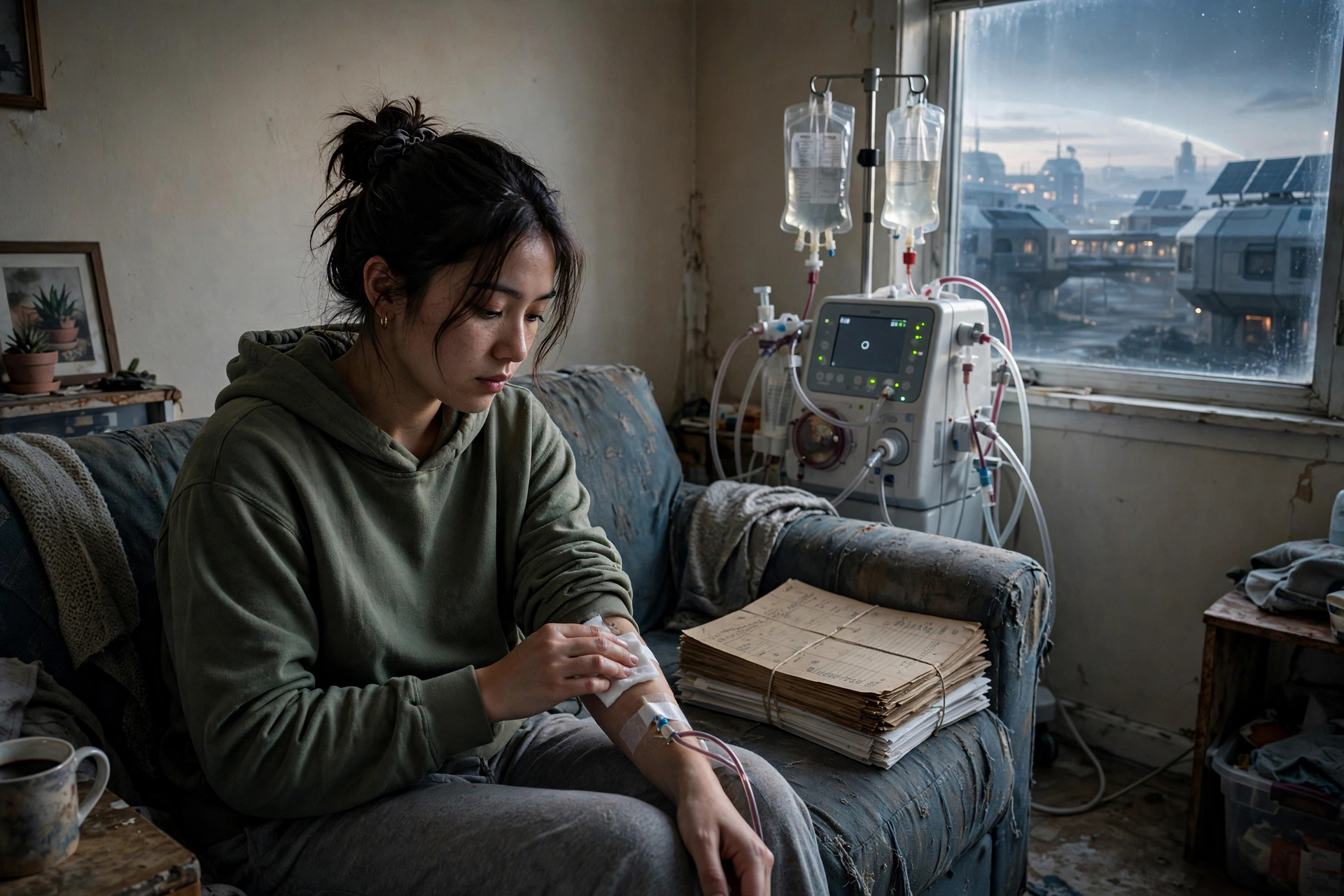
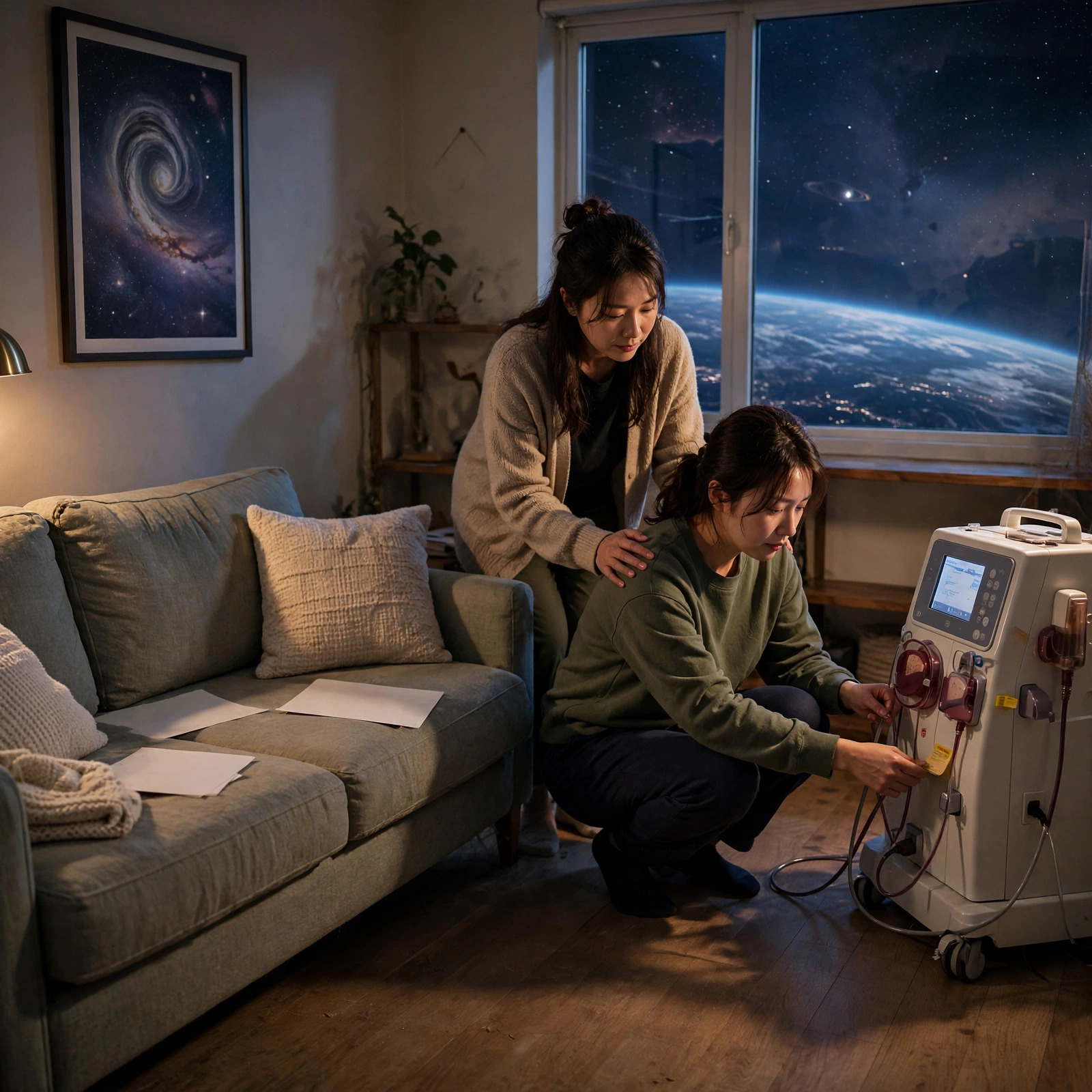
The home unit finished its cycle at ten past six, and Prita sat on the couch with her forearm still pressed to the cotton pad, waiting the full five minutes before she trusted the tape. The machine in the corner of the Keswani living room hummed down through its rinse cycle the way it did every morning, a sound she had stopped hearing except when it changed. Today it hadn't changed. She flexed her fingers, checked the pad, checked it again, then reached for the bakery ledgers stacked on the armrest where she'd left them last night.
Three columns to reconcile and one hour before she had to walk. Tandoor Lane paid her for two mornings of books a week, cash and a bag of flatbread, and she had learned to do the reconciliation in the living room with the machine running because the machine made her sit still and sitting still was the only way she ever found the transposed fours. Last Tuesday's till sheet had a four where a nine belonged. She found it on the third pass, circled it in pencil, wrote the corrected total in the margin, and felt the small private pleasure of a number that had been wrong and was now right. Outside, the streetlights over Kelso Flats were clicking off one pole at a time.
She disconnected herself from the night's leftovers, capped the lines, wiped the cartridge cradle with the cloth that lived folded over the arm of the couch, and shut the machine's door. Four sessions a week at the clinic plus the nightly tether at home. That was the arithmetic of her body now, and she could do it asleep, and often did. She packed the ledgers into her canvas bag, ate half the flatbread left from yesterday, wrote till fixed on a sticky note for the owner, and was out the door by seven forty, before Dilnavaz's shift ended and her sister came home to count the morning like a supervisor counting a till.
The bakery's back office smelled of yeast and burnt sugar, and the mail came through the slot at eight, same as always. Prita was at the desk with the drawer propped open, pencil behind her ear, when she saw the envelope. Cream-colored, heavier than the utility bills, with a return window she read twice: Waneta Medical Center, Office of Research Enrollment. Her name under it, spelled correctly, which told her it wasn't an advertisement. Advertisements got her name wrong.
She didn't open it. She set it on the desk between the till sheet and the register drawer and looked at it the way you look at a dog you don't know yet, then went back to counting coins because the count was half done and the coins didn't care what she was feeling. Fifty, fifty-one, fifty-two. Her hands knew the work. Twenty cents short, then over by the same twenty, then right. She squared the drawer, entered the total, and the envelope sat there the whole time getting heavier without gaining a gram.
The clinic's weekly call came at ten, as it did every Tuesday. Gerald Mott's voice arrived before his image finished loading, patient and slightly tinny, the way it had been for eleven years of Tuesdays.
"Miss Keswani. Numbers first, if you don't mind. Weight, and the overnight volumes."
She read them off the log page she kept clipped to the fridge. Weight down four hundred grams from last week, which he called acceptable and she called nothing at all. Volumes within range on all four nights, which was the machine being a machine.
"Good. Consistent. I'd say boring, but boring is what we pay the machine for." A pause while he made his note. "Now. Something else. Have you had any correspondence from Waneta?"
The pencil was still behind her ear. She took it down and held it.
"Why would Waneta write to me?"
"Because Dr. Sattar's office pulled our shared records three weeks ago, and because yesterday my coordinator inbox received a crossmatch scheduling request with your identifier on it. I'm given to understand an invitation went out Monday." He let that sit. "I'm calling to confirm what you already suspect. You screened eligible for the implantable cohort. The bioartificial kidney."
Her eyes went to the envelope on the desk. She had not touched it since she set it down, and now she didn't touch it either.
"I didn't open it," she said, which was a strange thing to say and she heard how strange it was as it left her.
"Then open it. Or don't, today. But I'll tell you the shape of it, because you'll want the shape before the words. Eighteen people currently carry the device. Fourteen of them have been off dialysis for over a year with it. One participant in the prior phase died of an immune reaction, and they've since built a screen for exactly that reaction, which is why they crossmatch twice. If you enroll, you relocate to Waneta for sixty days of monitoring. Sixty days, Miss Keswani. That part is not negotiable and it's the part I want you to hear from me and not from a recruitment pamphlet."
Sixty days. She did the geography without meaning to. Waneta was three hundred and ten kilometers from Kelso Flats, which meant three hundred and ten kilometers from the clinic, from the bakery, from the machine humming its rinse cycle in the living room, from the hook by the door where Dilnavaz hung her warehouse jacket every night at eleven.
"And my schedule here," she said. "The sessions."
"Suspended in favor of theirs, if you pass screening. That's the point of the thing." His voice gentled without softening. "I'm not calling to push you. You know my position on unproven devices. But I've read Sattar's twelve-month data twice, and I'm not against this one. I'm against hurry. You have a stable regimen. You have twenty days left in the enrollment window from today. That is time. Use it to read every page, and if you decide to go, you and I will build a cutover plan so careful it'll bore you."
Twenty days. She wrote the number on the till sheet margin, next to the corrected four, then crossed it out so hard the pencil tore the paper a little.
"The home unit," she said. "If I'm in Waneta for sixty days."
"Collected and stored, or released to a local program, depending on the cutover plan. I don't release a unit until a Waneta physician confirms the implant is doing what your kidneys can't. That's not distrust of you. That's how I've kept everyone alive for eleven years."
"I know how you've kept everyone alive."
"Then you know I'll do the paperwork either way." A chair creaked on his end. "Talk to your sister before you talk to me again, Miss Keswani. That's not a medical instruction."
He rang off with his usual lack of goodbye, which she had always liked about him. No ceremony, nothing wasted.
She sat in the little office with the drawer closed and the coins squared and looked at the envelope. Cream-colored. Her name. She picked it up once, to feel the weight, and put it back down. The flatbread smell came through the wall, and out front the ovens were already going, and at some point the morning had filled up with customers she could hear but not see, the bell over the door doing its small work.
What she thought about, in the seven minutes she allowed herself, was not the device or the fourteen participants or even the one. She thought about the living room at night, Dilnavaz on the floor with her scheduling paperwork spread around her like a nest, the machine humming, both of them pretending the tether between Prita and the wall was furniture. That was the shape their lives had made around the machine, and a machine you could live around was a thing you did not lightly put in the bin.
She unclipped her apron from the hook by the office door, folded it once, and slid the envelope inside the front pocket, unopened, under the fold. If it was in the apron, it wasn't in her hands, and if it wasn't in her hands she hadn't decided anything, and if she hadn't decided anything then tonight could be an ordinary night, the two of them on either side of the humming machine, the till fixed, the world short nothing.
She finished the morning's books. She stacked the flatbread for the owner and left the sticky note where he'd see it. At eleven she clocked out, carried her canvas bag past the door with its bell, and walked home the back way past the shuttered laundromat, past the row of mailboxes that had nothing for her because everything for her was already riding in her apron pocket.
At the Keswani house the machine stood quiet in the living room, rinsed and capped, its door shut, the cloth folded over the couch arm where it lived. Dilnavaz's shift started at seven; her sister would be home by three, would stand in the doorway with her jacket still on and ask, the way she always asked, how the numbers were.
Prita went to the row of hooks by the door. She took off the apron, the envelope's corner pressing its small rectangle against the cloth, and hung it on the hook nearest the door, the empty one, the one that had held nothing all year.
Second Session
Six days is a long time to share a house with a rectangle of paper.
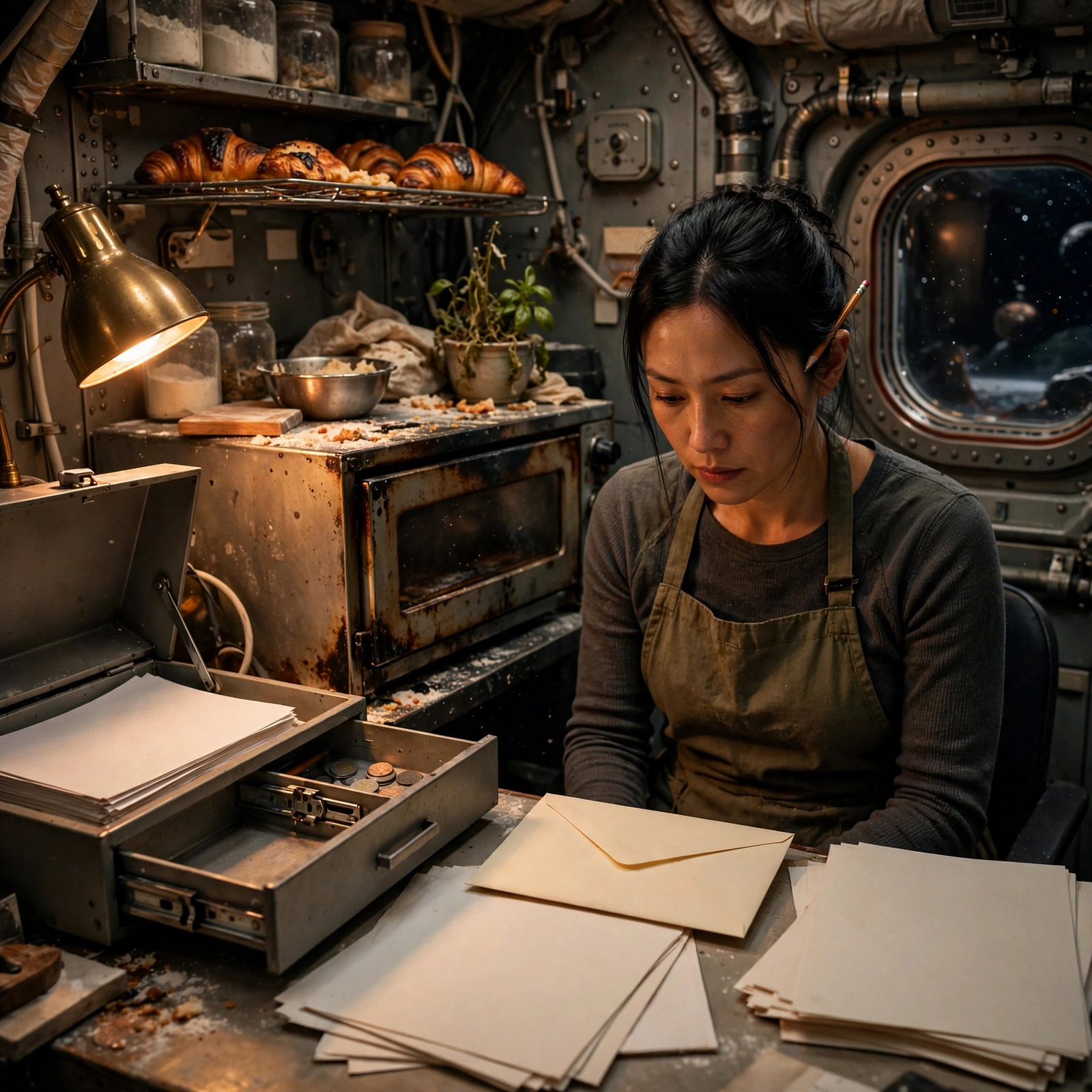
Prita had kept the apron on its hook all week, wearing her spare, and the envelope had stayed folded under the cloth like a splint on an arm nobody had broken. She told herself it was bookkeeping, the way you carry a figure in your head until the column balances. Nothing decided. Nothing opened. Dilnavaz came home each evening, hung her jacket on the far hook, asked how the numbers were, and Prita said fine, said steady, said the same four words she always said, and neither of them was lying, exactly, because the numbers were fine. It was everything else.
On the seventh morning Dilnavaz gathered the laundry. She did it the way she did everything, before her shift, sorting darks and lights on the kitchen table with the radio murmuring traffic. The apron went into the washer with the towels, and it was only when she pulled the wet cloth out and shook it flat that the envelope slid free and landed on the basement floor, its corner softened, its seal still unbroken, cream-colored and unmistakably official, with a return address in Waneta and Prita's full name in the window.
She brought it upstairs in both hands, the way you carry a thing you already know is going to cost somebody.
"It came Monday," Prita said, before her sister could ask. She was at the sink, rinsing the good pot, and she did not turn around.
"Monday." Dilnavaz set the envelope on the counter between them, still damp at one corner. "And today's Sunday."
"Yes."
"Six days."
"I know how many days it's been."
Dilnavaz didn't shout. She never shouted. She stood there in her warehouse polo with her sleeves still wet to the elbow, and she looked at the envelope the way she looked at a manifest that didn't reconcile. "You want to open it, or do you want me to?"
"Neither. I want to take it to my session and ask Mott first. That's all. I didn't hide it, I just didn't, " Prita turned off the tap. "I was going to tell you this week."
"This week." Her sister nodded slowly, the way a person does when a number is worse than they hoped but exactly what they expected. "Okay. Then tell me now, and we'll take it to Mott together."
She peeled the seal with her thumbnail, careful, keeping the flap intact, and read it standing up while Prita dried her hands on a towel that suddenly weighed a great deal. The letter said what Prita already knew it said: the bioartificial kidney program at Waneta Medical Center had a slot in its next cohort, eighteen participants enrolled to date, fourteen of them off dialysis entirely for over a year, and Prita Keswani had been selected. If she accepted, she would need to live within reach of Waneta, three hundred and ten kilometers away, for sixty days of monitoring. The enrollment window closed in twenty days. The letter was signed by a Dr. Arman Sattar, principal investigator, whose name Prita had been saying silently to herself all week like a password.
Dilnavaz read it twice. Then she folded it along its original creases and set it down.
"Session's at two," she said. "I'll drive you."
Neither of them said anything else about it until the parking lot.
The session ran its four hours. Prita sat in the recliner by the window with the needle in her arm and the machine drawing her blood out, cleaning it, returning it, the wall clock's minute hand dragging itself around the dial. Four times a week now, every week, the clinic's schedule printed around her life like a mold. She watched the other regulars come and go. She did the arithmetic she'd been doing all week, that sixty days was eight and a half sessions' worth of weeks, that three hundred and ten kilometers was four hours by road, that a year from now the cartridge, if it worked, would still be inside her doing the work her kidneys had quit, and no one on earth yet knew if it worked at three years, because no one had been carrying one that long.
When she came out, bandaged and hollow-feeling the way Tuesdays always left her, Dilnavaz was leaning on the car with her arms crossed and the letter in her jacket pocket, and Prita knew from her sister's stillness that the argument had already started inside her and was simply waiting for Prita to arrive.
"I called the program from the break room," Dilnavaz said. "On my lunch. I'm not going to pretend I didn't. The woman was very nice. She read me the same numbers that are in that letter, and then she read me one that isn't."
"Dil, "
"One person died. Earlier phase. Immune reaction, they think, they screen for it now, they say. They say." Dilnavaz pushed off the car and stood in the narrow stripe of shade between two vans. "I'm not saying they're careless. I'm saying someone sat where you're sitting and someone drove them here the way I drive you, and now there's a line in a report instead of a person."
"Fourteen of eighteen are off dialysis. Over a year."
"And eighteen of eighteen were off dialysis when they signed, that's what a cohort is, that's the bet. Prita, look at me." She waited until Prita did. "Your regimen is stable. Mott's kept you level for three years. You work mornings at the bakery. You've got the home unit at night, you've got me at night, you've got a system. It's not a system anyone would choose, but it's balanced, and balanced is not nothing. Balanced took us years to build."
"It took us years to build a life that fits inside four sessions a week and a machine in the living room."
"Yes. And it fits. That's my whole point. It fits." Dilnavaz's voice stayed level, which was worse than shouting. "There's another cohort in under a year. A year, Prita. The device will have twelve more months behind it. Maybe they'll know more about the three-year horizon. Maybe they'll know more about why that one person's immune system turned on it. You wait, you lose nothing. You go now, you could lose the only arrangement that's ever actually worked, for a thing nobody's lived with for three years."
"Nobody's lived with it because nobody's had it three years yet. That's how first it gets to be three years. Someone has to be in year one."
"Someone does. Does it have to be you?"
The question hung there. A gull walked the roofline of the clinic awning. Somewhere behind the double doors, a monitor beeped and was silenced.
"It has to be somebody who's eligible," Prita said finally. "Mott already confirmed I'm eligible. I talked to him Monday."
"Monday." Dilnavaz closed her eyes for a second. "You talked to Mott before you talked to me."
"Because I knew what you'd say. You're saying it now. You'd have said it Monday and I'd have lost six days of thinking."
"And what did six days of thinking get you?"
"Sixty days in Waneta. That's what it gets me. Sixty days and then, if it takes, no machine. Dil, no machine. No needles. The bakery job full-time if I want it. A day trip, a whole day, more than a day. You could, " She stopped. There was a version of this sentence that ended with you could stop scheduling your life around my evenings, and she couldn't say it without making her sister's devotion sound like a burden, which it had never once been to either of them, except that it was, a little, to both of them, and they both knew it, and neither would say so.
Dilnavaz looked away, out past the lot, at the road that ran toward the highway and away from it.
"The window's twenty days," she said, quieter. "And sixty days away means sixty days of rent up there, alone, with me here. I can't do evenings in Waneta. I've got my own, " she cut herself off, jaw tightening around a word she swallowed. "I've got things I'm paying for. I've earned them twice over. I'm not asking you to hand me anything back. I'm asking you to count what's already working before you trade it."
"I am counting. I count every Tuesday. It's on the machine's screen and I count it."
"Then count this. If the implant doesn't take, or if it takes and then doesn't, you come back here and the home unit is gone. Mott won't release it without a Waneta physician signing off. You told me that yourself. You come back to nothing and we rebuild from zero, and we rebuild it in a smaller apartment because you spent the reserve on rent up there."
"Or I come back with a 290-gram cartridge in me doing what the machine does, and I never sit in that recliner again."
"Or." Dilnavaz said the word like a coin she was checking for counterfeit. "That's a heavy word to build a year on."
They stood in the shade stripe, four feet apart, which was the closest either of them had come all week and also a great distance. Prita watched her sister's hands, the scheduler's hands, the hands that sorted darks and lights and reconciled manifests, resting open at her sides now, empty, willing to hold anything except a maybe.
"I haven't signed anything," Prita said. "There's a crossmatch, a physical, a whole gauntlet before they'd even take me. I could fail it all on my own. I don't need help failing."
That surprised a short, cracked laugh out of Dilnavaz, who turned it quickly into a cough. "Don't joke. I'm mid-argument."
"I know. You're good at it. You do it with manifests."
"Manifests don't cry in the break room." She said it flat, and Prita understood that her sister had spent her lunch hour doing exactly that, in a warehouse stairwell, and had come back and clocked in anyway, and would never once mention it again.
The copay kiosk inside beeped, reminding the lot of its existence. Dilnavaz checked her watch.
"Your copay's due today," she said. "The desk closes at five."
"I'll go in."
"No. You just sat four hours with a needle in you. Sit." Dilnavaz took the car keys off the roof, then paused, hand on the door, the letter's corner showing above her jacket pocket. "I'm not against it, Prita. I want you to have that straight. I'm against it this year. That's different, and it matters that it's different." She pulled the door open, then looked back once. "Twenty days. So we have twenty days to argue, and I intend to use them."
She walked across the lot with her shoulders set, up the ramp, through the doors that swallowed her, going inside to settle her sister's bill alone, the way she had every Tuesday for three years, while Prita sat in the passenger seat with the envelope's absence where her apron pocket used to be, doing arithmetic.
Fourteen of eighteen. One of eighteen. Sixty days. Twenty, now fourteen, minus seven more gone while she'd been thinking. The clock did not care that she hadn't decided. It never had. That was the whole trouble with clocks, and the whole promise of them, too.
Prita took out her phone and looked at the letter's contact number, typed into her notes on Monday, still unsent. Below it she typed one word and deleted it, and typed it again, and this time let it stand: Waneta.
Passbook and Valve
Sunday morning, and their father's pickup was already in the drive when Prita carried the tea out, which meant he had beaten Dilnavaz to the kitchen table too, and he had. Yusuf sat with the consent form flattened in front of him under both palms, the way he used to hold a machinist's drawing down against the draft from the shop door, reading it against the morning light before either daughter had said a word to him.
"You got this in the mail," he said. Not a question.
"They sent it after I called." Prita set his cup at his elbow. "It's the long version. Everything they'd do, everything that could go wrong."
"Good." He turned the first page. "Then we'll read it the way my inspector used to. Out loud, slow, and if a sentence survives being said in a normal voice, it passes."
Dilnavaz came down the stairs with her hair still wet, took one look at the table, and sat down across from him instead of beside Prita, which Prita noted and filed. Her sister had been arguing for seven days now, thirteen left on the twenty she'd claimed in the clinic lot, and she had developed a habit of arranging herself like counsel for the opposition.
Yusuf began at the top, in the flat, careful voice he'd used for decades on tolerances. "The implanted device consists of a hybrid filter and cell cartridge, mass approximately two hundred and ninety grams, positioned in the renal fossa." He glanced up. "That's about a can of soup."
"That's a strange thing to put in a person," Dilnavaz said.
"People carry stranger." He read on. "Of the current cohort of eighteen participants, fourteen have completed more than twelve months without dialysis." He let that sit. Then, because he was an honest reader, he did not skip the next line. "One participant in the prior phase died following an immune reaction to the cell matrix. Screening has since been implemented."
"Read that part again," Dilnavaz said.
He read it again. Word for word, same flat voice, and Prita understood that her father was not going to editorialize for either of them, not yet, maybe not at all.
"Screening," Dilnavaz said. "Screened how? Screened by whom? Because the person who died also passed whatever they had before that."
"That's a fair question and it's in here somewhere," Yusuf said, turning pages. "Here. Crossmatch panel, day of enrollment, repeat on failure. It's not nothing, Dinu."
"I know it's not nothing. Nothing would be easier." She wrapped both hands around her cup. "Fourteen of eighteen is good. I grant it. But she's stable right now. Four sessions a week, the home unit at night, and she's stable. Nobody's promising me the device holds up at three years, because nobody's had it three years. The next cohort opens in under a year. She waits one year, she waits with numbers instead of hope."
"Hope's not what's in the paper," Yusuf said mildly. "Numbers are."
"One of the numbers is one in eighteen."
Prita kept her eyes on the form. She had made this same count in the clinic parking lot, in the bakery's back room between trays, in the shower. Fourteen. One. Sixty days of monitoring in Waneta, three hundred and ten kilometers from this table. The arithmetic never changed, which was its mercy and its insult at once.
Yusuf read the residence clause aloud. Sixty days within reach of Waneta Medical Center, weekly labs, biweekly imaging, transport at the participant's expense. He read the withdrawal clause, which was short and strangely gentle: she could stop at any point, for any reason, and resume her current regimen without prejudice.
"That one survives the out-loud test," he said.
"It does," Dilnavaz admitted. "I'll give them that."
Her phone buzzed against the table. She looked at it, and something crossed her face that Prita couldn't name, a quick accounting, a decision being closed like a ledger. "That's the warehouse. They're short a scheduler tonight. Half shift." She was already standing, already reaching for her jacket off the chair back. "I'll be back by ten."
"On a Sunday," Prita said.
"Freight doesn't keep Sabbath." Dilnavaz kissed their father's temple, squeezed Prita's shoulder once, hard, the way she did when she wanted to say something and had decided not to. Then she was out the door, and the pickup's absence followed hers, and the house went down to the two of them and the form.
Yusuf drank his tea. He read two more pages silently, lips moving a little, and Prita let him. When he finally set the pages down and squared them, he did not look at the form. He looked at her.
"You want to know why I came," he said.
"You came for tea."
"I came because of my valve." He tapped his own chest, twice, left of center. "The one they put in me when you were in school. You remember the year I got thin."
She remembered. She remembered her father going from a man who carried engine blocks to a man who carried a folding chair to the same jobs, and she remembered everyone calling it fine, calling it just his age, and him agreeing with them out loud at every dinner while his belt climbed another notch.
"The surgeon told me, later, that I'd waited too long. He didn't say it to be cruel. He said it the way you'd tell a machinist his part came in out of spec, and there was nothing to do but note it. Nine years." He held up his hand, all five fingers, then four more. "Nine years I was thinner than I needed to be, because the valve I had was good enough. Good enough. That was my whole argument, and I made it every day for nine years, and I won it every day, and I was wrong every day. The new one took an afternoon. The waiting was the part that cost."
Prita looked at the form. "You're saying I should do this."
"I'm saying what I did." He pushed his cup away a centimeter, a small finished motion. "I'm not saying it in front of your sister, and I'm not saying it twice. She's carrying more than you see, and she's carrying it on purpose, and if I weigh in on you in front of her, she has to fight me and the letter both. She doesn't deserve that. Neither do you." He stood, and his knees announced it, and he let them. "So ask me in the truck."
She walked him out. In the cab, with his hand on the key but the engine not yet started, he said the rest of it. "I waited because I was afraid of the operating room, and I dressed it up as patience. Don't you dress anything up. Whatever you choose, choose it in its own clothes."
Then he started the truck and left, and Prita stood in the drive with the consent form still in her hand, because she had carried it out with her without noticing, the way you carry a rag out of a kitchen you've wiped ten thousand times.
Inside, she climbed the stairs to put it in her room and passed the shelf in the hall, the low one where Dilnavaz kept her ledger things. The passbook was gone. Its slot gaped between the tax folder and the receipt box, a clean dark absence the size of a small book, and Prita stood looking at it for a moment without any thought attaching to it. Her sister took things to that shelf and from it all the time. It meant nothing. She filed it the way she'd filed the seat at the table, the way she'd filed whatever had crossed Dilnavaz's face at the buzz of the phone, in the drawer where she kept things she'd look at later, when there was room.
Downstairs, she read the form once more, alone, silently this time, all the clauses her father had tested in his voice and the ones he hadn't reached. Fourteen of eighteen. Sixty days. One in eighteen. Her four weekly sessions were enumerated in the transition plan, each one named and scheduled, the clinic's grip on her weeks written down in Mott's tidy numbering and then, clause by clause, handed back. She got as far as the signature line and sat with the pen out of reach, deliberately, on the far side of the sugar tin.
Thirteen days of her sister's twenty. A year until the next cohort. Nine years of her father's belt.
She did not sign. Not against Dilnavaz, and not without her, and not on a Sunday, alone, in an empty house. But she didn't put the form away either. She slid it beneath the sugar tin, folded once, and took the clinic appointment card off the corkboard, Tuesday's session, 8 a.m., her own name printed in the reminder system's small gray font, and laid the card flat on top of the tin to hold the pages down through the draft from the kitchen window. The card had weight. Not much. Enough.
Crossmatch
The immunology lab at Waneta Medical Center smelled of cold plastic and coffee, and the phlebotomist took six vials before Prita had finished unrolling her sleeve. Five days since her father's truck pulled out of the drive. Two days of driving and clinic shuttles compressed into one long corridor of a morning, 310 kilometers of highway still in her shoulders. Dilnavaz sat against the wall with her bag on her knees, thumbs moving on her phone, scheduling nothing, pretending to schedule something. Gerald Mott stood at the window with a folder of her records he had carried up from Kelso Flats himself, personally, because he trusted no fax.
"You'll have the screen by eleven," Sattar said. He said everything like a man reading a gauge he had calibrated himself. "Borderline work is where laboratories earn their keep, so if it comes back gray, we will not guess. We will dilute and we will look again."
Dilnavaz looked up. "And if it comes back gray and stays gray?"
"Then today ends without an answer, and we come back tomorrow with a protocol that lowers the noise before it starts." He turned to Prita. "The implant does not care about our calendar. Your antibodies do not know there's a window. I tell you this so you don't spend eleven o'clock negotiating with a test tube."
She laughed, one syllable, because he'd earned it. Then eleven came, and a nurse called Sattar's name from the doorway with a tablet in her hand, and he read the screen for four seconds that lasted a season.
"It's flagged," he said. "Not positive. Flagged. One antibody sitting exactly on the cutoff line, the anti-B27, and my screen is built to be cautious because the last cohort taught us what caution is for." He let that sit. Everyone in the room knew the arithmetic of the one who had died, the immune flare that now had a gate in front of it. "I cannot carry a flagged screen into an implant. Nobody in this building would. So. Tomorrow morning, seven thirty, we pre-treat you, and we run the crossmatch again with a dilution series that separates real signal from noise. If it clears, you sign and we still have three days of window. If it doesn't clear, the window closes for this cohort, and I am sorry in advance for how that will feel."
Dilnavaz's face did something complicated and fast, relief arriving before she could stop it and shame arriving right behind, and Prita watched her sister strangle both and say, "Okay. Seven thirty." Not, good. Not, maybe this is the answer. Just the hour, agreed to, out loud, in front of witnesses.
Mott closed his folder. "Then tonight nobody drives three hundred kilometers back and forth. There's a rate by the north lot, I've put patients there before. I'll book it." He was already dialing. He had not once, in eleven years of Tuesdays, let her sleep somewhere he hadn't checked the exits of.
The motel had two beds and a heater that ticked. Dilnavaz took first shower and Prita, waiting, reached into her sister's bag for the phone charger, because hers had died somewhere past the state line. Her hand found the charger cord, and under the cord, folded into a square worn soft by a pocket, a slip of paper.
A receipt. She opened it by the lamp.
Withdrawal, savings account, Keswani D. — $4,800.00. Dated day 14, the afternoon her sister had left for a warehouse half shift that, Prita now understood, had never existed. Below the withdrawal line, a second line, a certified transfer: first month's rent, Waneta, a building Prita had never seen, in an amount that made her sit down on the edge of the bed without deciding to.
The shower shut off. Dilnavaz came out in the motel towel, hair wet, and stopped when she saw what was in Prita's hand.
"You went in my bag."
"I went in for the charger. It was under the charger."
"That's still my bag." Dilnavaz crossed the room and held out her hand, palm up, the way she did when a nephew handed her a broken toy, and Prita put the receipt in it, and Dilnavaz folded it back along its worn creases and sat on the other bed facing her, knees together, the receipt crushed slightly in her fist now, which was the only sign.
"The deposit," Prita said. "For nursing school. The January intake."
"The school holds seats. I called. If I re-enroll by fall, I lose the spot I wanted and not the money. They keep it on file, it's a deferral, it's not gone." She said it fast, in her scheduling voice, the one she used on drivers who called in sick. "And rent up here for two months was going to land on you, and you were going to say no because of it, and then you were going to come anyway and eat nothing for sixty days and sleep in your car, so. It's rent. It's a rent problem, and rent problems are arithmetic, and I did the arithmetic."
"It's four thousand eight hundred dollars, Dil."
"It's a deferral with a fee of nothing, and I called them, and you didn't, because you were busy getting a needle in your arm for a chance you won't even tell me you want." That came out louder than the rest, and she heard it, and dropped it. The heater ticked. "I'm not against this because I want you small. You know that, right? One person died. I read the same pages you read. I just wanted one more year of proof under it before you lay down on that table, and there's no version of wanting that that's worth four thousand eight hundred dollars, so I paid the part I could pay, and I'd do it again, and I'm still going to argue with you at breakfast. Both things are true. People hold two things."
Prita looked at her sister, wet-haired, furious, holding the crushed receipt like it was evidence in a case she was losing on purpose, and felt the last of her anger go strange and quiet and turn into something she had no word for that was mostly gratitude with the edges still hot.
"Seven thirty," she said.
"Seven thirty," Dilnavaz said, and turned off the lamp on her side, receipt still in her fist.
At 6:40 the next morning they gave Prita two pills and a slow push of medication through the IV port, antihistamine and a low dose of steroid, Sattar standing at the infusion pump reciting the adjusted protocol to the nurse from his own written sheet, both of them checking the same numbers twice, because the flare that killed the earlier participant had taught this whole floor its manners. Then two more vials of blood, then a hallway of waiting in which Mott arrived with coffee for everyone and Dilnavaz did not drink hers, just held it, a warm thing to hold.
At 9:15 Sattar came out of the lab with the tablet turned so they could see it.
"Negative at the working dilution. Negative at half. The antibody that flagged yesterday reads as background noise under pre-treatment, which is what I suspected it was, and I don't say that to sound wise, I say it because yesterday I did not know and now I do." He looked at Prita. "You are cleared, and the window is open, and it stays open for three more days, and I would like you to sign today while the clearance is fresh, because paperwork is the one part of medicine that can expire."
The admissions desk had the consent form already, the same pages she'd read aloud at the kitchen table, the same clauses her father had tested in his voice. Mott had carried it up himself. She signed standing, the pen from the desk's beaded cup, her signature smaller than she expected on the line. Sattar countersigned beneath, then the time, then initialed the pre-treatment addendum in his cramped square hand.
"Now mine," Mott said, and at the transit kiosk in the lobby he entered her file number and printed the shuttle pass, sixty days, Waneta and back, the card still warm from the printer when he set it in her palm. "The home unit stays on my manifest until a physician up here confirms the implant's running. That part doesn't move today and I'll hear no argument, from either of you, and I say that with love."
"You say everything with love," Dilnavaz said.
"It's cheaper than malpractice."
Prita laughed, and then, because there was one thing left to do before the day could close, she asked Dilnavaz for the receipt. Her sister hesitated, then handed it over, unfolded, smoothed flat against the desk beside the signed form. Four thousand eight hundred dollars and sixty days, side by side. Prita pressed the receipt down against the signature page so both sat square in one frame, raised her phone, and photographed them together.
Collection Day
The second validation run ended at 11:40, and Sattar read the numbers off the wall screen the way her father had once read calipers, twice, lips moving. Creatinine flat. Filtration fraction inside the band he'd drawn on the chart in green ink the night the cartridge went in. The cells in the 290-gram unit were doing the work her own could not, quietly, the way he'd promised they would if they took at all.
"Two clean runs," he said. "That's the whole exam. I'd like a third for my own peace of mind, but your peace of mind matters more, and yours is at home, plugged into a wall."
Prita sat on the edge of the exam bed with her sleeve rolled down and watched him type the confirmation into her file. The clinic in Kelso Flats would see the same page within the hour. So would Gerald Mott, on whatever screen he kept on his desk, the one he angled away from patients so they couldn't read their own futures upside down.
"Sessions," she said. "Say it plainly. I've earned plain."
"Zero. The two runs today stand in for your first two treatments. From here it's bloodwork twice a week and a scan at thirty days. If you'd told me last spring you'd hear that sentence and look worried, I'd have believed you. You look worried now."
"I look like a person doing arithmetic. Four mornings a week, gone. I don't know what my Tuesdays are for."
"Fifty-nine days to figure it out," he said, and held the door.
Dilnavaz was in the family room with both their bags packed, had been since dawn, had driven the 310 kilometers before sunrise and not mentioned it. She stood when Prita came in. She didn't ask what the screen had said. She read Prita's face instead, top to bottom, the way she'd done since they were girls and one of them had broken something.
"Zero?"
"Zero."
Dilnavaz nodded once, hard, like a woman signing something. Then she picked up the bags. "Mott's coming at two. He called the house phone. He actually called the house phone, like it's 1998."
"He likes a paper trail. You know that."
"I know he likes being the last word." She shouldered both bags. "He can have it. Let's go home so he can have it there."
The shuttle back was mostly empty, fields going gold under the expressway, and Dilnavaz slept against the window for forty of the sixty minutes with her mouth slightly open, and Prita did not take a photograph of that, though she thought about it, though it would have been the truest picture of the whole month.
Home smelled like cardamom because their father had come at noon and made tea and left the pot on the stove with a note about not letting it scorch. The note said nothing else. It didn't need to. Nine years he'd waited for his own valve; he'd said his piece on day fourteen and would not repeat it, not even to himself.
Mott's van was already outside the Keswani house at ten to two, which meant he'd been early, which meant he'd been nervous. He came up the walk with the collection tag in his shirt pocket, the little yellow zip tie folded flat, and a clipboard under his arm, and he stood in the doorway of the living room looking at the machine the way a man looks at a colleague at a retirement party.
"Confirmation came through at 12:52," he said. "Dr. Sattar's signature, two runs documented, function within band. I'm not going to pretend I read every line. I read the last line. The last line says, release to collection." He set the clipboard on the arm of the couch. "I've been waiting eleven years to write that on somebody's file. You're the first. There were four before you who went back on the schedule instead. I want you to know I remember their names."
"I'd want you to," Prita said.
"I know. That's why I said it." He looked at the machine, the clear lines coiled on their hooks, the little screen dark. "I'm not touching it until you do. That's not policy, that's manners. Unplug it yourself. You've earned that too."
"He practiced that speech in the van," Dilnavaz said from the kitchen doorway.
"I practiced it in the shower," Mott said. "The van was for the tag."
Prita crossed the room. The plug came out of the wall with a small resistance, the way it had a thousand times, and then the cord lay in her hand, warm at the prongs, ordinary. She wound it. She got the cloth from under the sink, the one reserved for the machine because Dilnavaz ran a house where cloths had jurisdictions, and she wiped the housing down, the whole gray shell of it, three years of her evenings, and the cloth came up mostly clean because Dilnavaz wiped it every Sunday anyway.
"You're going to cry," Dilnavaz said.
"I'm not." She wasn't. Her eyes were wet, which was different. "There's a difference."
She took the yellow tag from Mott's shirt pocket herself, before he could move, and clipped it through the carry handle until it clicked shut. Then she stepped back and looked at it, tagged and dark and finished, and it looked smaller than it had any right to look after everything it had carried.
"There," she said. "It's yours."
Mott wrote the serial number on his manifest, then the date, then had her initial the release line, and then he sat, uninvited, in the good chair, which meant he wasn't done.
"Two things while I'm here, and then I'll load it and go. First. The bakery called my office yesterday, which is a thing that happens in small towns, the bookkeeper's employer calls the bookkeeper's clinic. The owner's expanding the second location and wants your ledger work remote for the sixty days, full days, full pay, and full-time after if the remote stretch holds up. I told her you'd call her tonight and not before, because you were busy becoming a medical miracle, and she laughed so hard I had to hold the phone away."
Prita sat down on the couch arm. "She offered it to me?"
"She offered it to me, for you, which in Kelso Flats is the same thing. Second thing." He turned to Dilnavaz. "The deferred enrollment. The nursing school called me too, because your file was in with your sister's, because you put it there, because you're not subtle. They'll hold the seat to next autumn with the deposit carried over. I confirmed it this morning. Nobody's lost anything except a year, and a year at your age is, I'm told, survivable."
Dilnavaz's jaw worked. "You had no right to call them."
"I had every right, I've been your sister's coordinator for eleven years and your emergency contact for three, and I don't apologize for phone calls. You want to argue, argue with your sister, that's what sisters are for. I just carry machines."
He stood, and he and Dilnavaz loaded the unit onto the trolley together, Dilnavaz taking the heavy end without being asked, and at the door he balanced the clipboard on top of the gray shell and said, "Sixty days, Keswani. Call the clinic if anything at all goes strange. Strange is my whole job." Then the trolley wheels on the walk, the van doors, and gone.
The living room had a machine-shaped pale rectangle on the carpet where the sun had bleached around it, and the two of them stood looking at it like it was the guest of honor.
"The deposit," Prita said. "Four thousand eight hundred. I've done the numbers on the bakery pay. I can put two hundred a month against it and clear it before your deferred date, if you take the seat next autumn, and I know that's a year of your life I'm holding."
"It's a year I spent on purpose. Don't make it a debt or I'll regret it."
"It's a debt. With a schedule. That's the only way I can hold it without it being a favor, and I can't carry a favor that size, Dil, I've tried, in my head, for three days. Two hundred a month, first of the month, and the last payment lands before enrollment. That part's not negotiable."
Dilnavaz looked at the pale rectangle on the carpet for a long moment. "Sunday, seven, your time. Video. Neither of us cancels unless it's blood or fire. That part's mine, and it's not negotiable either."
"Sunday, seven." Prita put her hand out. Dilnavaz shook it, then pulled her into a hug that lasted past the point of comfort and into the point of meaning it.
"You still need a roommate," Dilnavaz said into her shoulder. "In Waneta. The sublet listing has four replies and three of them are scams."
"One isn't."
"One is a maybe. Don't leave before you meet her. And don't let Mott drive you up, he'll narrate the whole way."
Prita laughed and stepped back and picked up the phone to call the bakery, dialing from where she stood, right in the middle of the pale rectangle, because it was the only free floor in the room and it was hers now, all sixty days of it, and the phone rang twice before the owner picked up, already laughing, already saying her name.
Get notified when new stories drop

Jonas Veld
Jonas covers human-AI futures and engineer problem-solvers: protocols, trust, and tools that expand human capability.
Leave a comment
Comments