




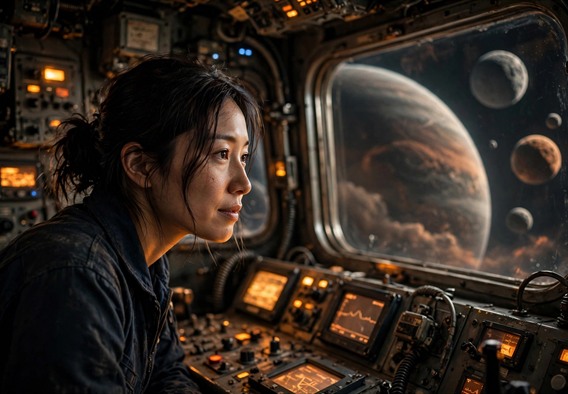
Pass Two
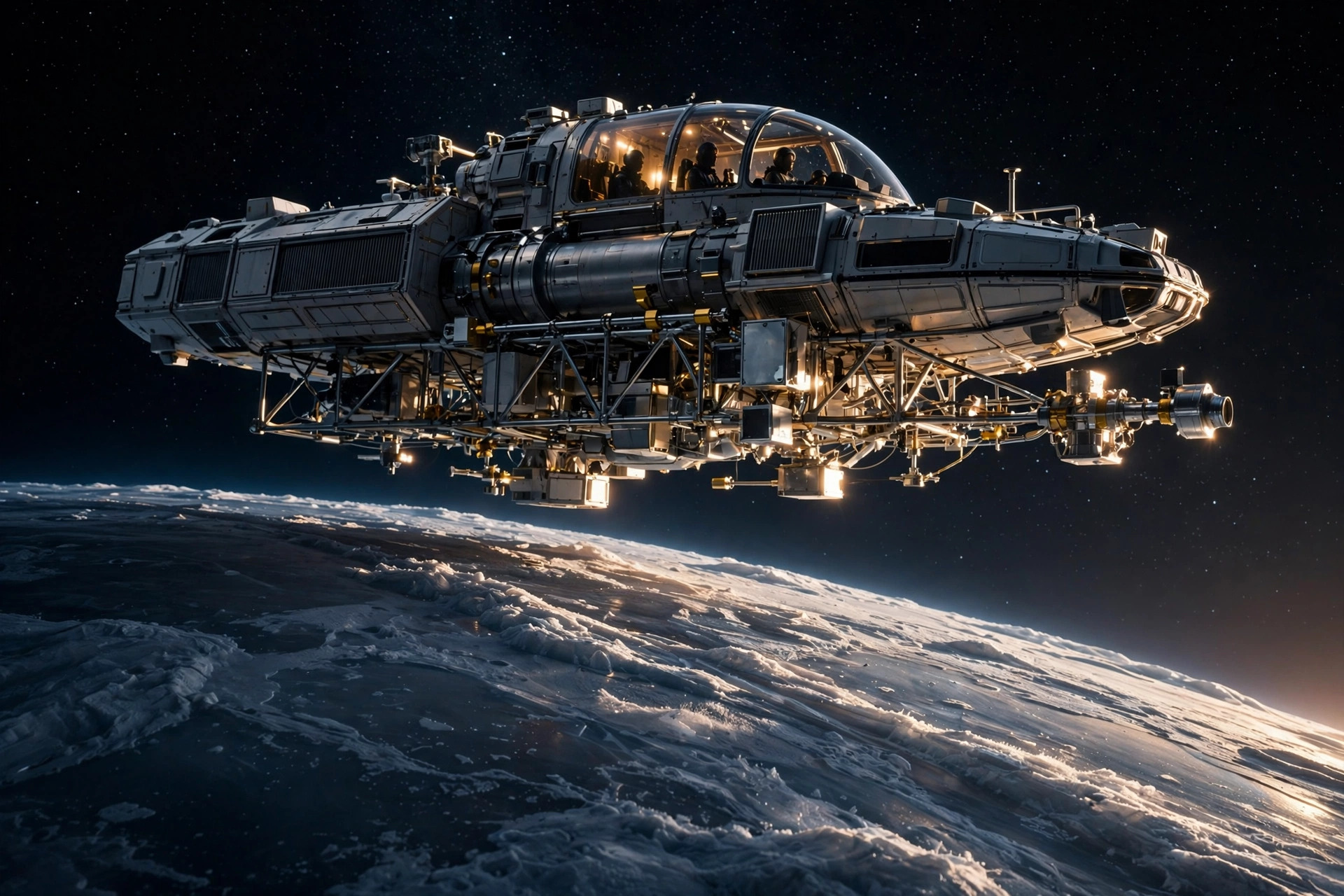
The second pass over Vesper's small moons began at 04:40 ship time, when the survey ship Tamarisk crossed the dawn line of the outermost satellite and Teodora Ilic's catalog went from forty-one numbered objects to the same forty-one objects seen from below. That was the whole job of pass two: look at everything a second time, from underneath, and write down whether it was still where the first pass had put it. Tessel came up fourth in the queue, a bright wedge of ice and rock nineteen hundred kilometers across, and she ticked its albedo row without ceremony. The moon was boring. She was glad of boring. Boring meant the catalog closed on schedule, and schedule was the only currency Rafe Kuttner respected.
Rafe sat at the trajectory console two meters to her left, running the return-window burn plan against the ship's ephemeris for the ninth day running. He did this every morning the way other people checked a lock on a door. Nineteen years of flying survey ships had left him with the habit of treating any unplanned thing as a thing with a price tag on it, and he liked to know the price before anyone showed him the merchandise.
"Margin still fifteen days," he said, not looking up. "Food margin eighteen. I know you didn't ask."
"I didn't ask," Teodora agreed.
June Awadale laughed from the consumables station, where she had the water ledger open in one window and the oxygen accounting in another. She kept the ship's margins the way Rafe kept the trajectory, which was to say obsessively, but where Rafe's numbers were a wall, June's were a floor, and she liked pointing out that they stood on different things.
"Since he's doing numbers aloud," she said, "I'll do mine. Recycler at ninety-four percent closed loop, potable reserve at three hundred ten days against a mission that eats two hundred ninety-two, and the food margin sits at eighteen days past the return plan as of this morning's inventory. That's after Deniz found the two crates of bran crisps nobody wanted behind the aft rack, which we are now counting as food because morale counts as food."
"Morale is not food," Rafe said.
"Morale is eighteen days of it."
Teodora let them have the exchange, because it was morning and the catalog was closing on schedule and there was nothing in the pass yet that deserved her attention. The Ardent spectrometer rode its mount on the ventral truss, pointed down through the hull port at whatever moon was under the ship, listening the way it had listened for six years: wide survey mode, low resolution, everything at once and nothing well. She had spent the whole of the first pass, and most of the second, in that mode. It was the correct instrument for a catalog. You could not find a thing you were not looking for unless you looked at everything badly first.
Deniz Maral floated in from the spine corridor with a printout of the Ardent's power draw, which they checked every morning against the truss thermals, and pinned it to the clip rail by the ops board without ceremony. The Ardent drew little power and gave back a great deal of sky.
Tessel slid across the port at 05:12. Teodora ticked its row. Albedo unchanged. Rotation unchanged. Position within the catalog's error bars. She was three lines into the next moon's row when the spike appeared in the corner of the Ardent's waterfall display, and she stopped writing.
"Deniz. What's channel six doing?"
Deniz pulled themselves over to the spectrometer station and looked. "Same thing it did on pass one. Nothing." They paused. "Except."
"Except what?"
"Hold on. Don't move the ship."
Nobody moved the ship. The channel was a narrowband slice, one the Ardent carried mostly as ballast, a two-nanometer window in the visible that nothing in the Barnard's Star system had ever bothered to shine into. On pass one it had been a flat gray line. Teodora remembered it flat because she remembered everything about the instrument's baselines, which was the actual work of being a survey lead: not looking at moons, but knowing what the eyes looked like when they were healthy.
The line was not flat now. It rose, sharp and narrow, held, and fell. Then it did it again.
"That's periodic," Deniz said. They put a ruler on the screen with one finger and counted under their breath. "Four point two seconds. Again. Again. It's coming from the moon."
"Which part of the moon?"
Deniz narrowed the channel's spatial gate and the pulse stayed put: a point source on Tessel's sunlit limb, tracking with the moon's rotation. A small bright spot on a small bright moon, in a wavelength band where Tessel had no business being bright at all. Rock and ice reflected starlight; they did not select two nanometers out of a broad sky and concentrate them. Something up there was choosing a color.
"Instrument?" Teodora asked, because it was the first question and the only correct first question.
"The filter's not what it was," Deniz said, and they said it carefully, because it was the kind of admission a person carries for years. "The crystal's been out there since before departure. Southampton built it beautiful, but borosilicate ages under flare, and we've taken our share. If the passband has drifted, a wide-survey artifact can fake a narrowband line. It can't fake a period. But it can fake a line."
"So we don't know if it's real."
"We don't know if it's real."
Rafe had turned around, which he rarely did before his burn-plan run finished. "How long to find out?"
"With the instrument as it sits, a long time. Targeted mode would answer in two passes. Point it, gate it, integrate. But targeted mode means we stop cataloging while we do it."
"Fifteen days," Rafe said. "That's the whole number, Teodora. Fifteen days of margin, and I'd remind you what the margin is for. The return-window burn gets scheduled against it. Every discretionary hour we spend pointed at one moon is an hour the catalog doesn't get back, and the catalog is the mission."
"The catalog is the mission," Teodora agreed. "And a narrowband source with a four-second period isn't in the catalog. Rafe, nobody has ever put a periodic line on any small moon of this system. If it's an artifact, it's mine to find and fix, and I'd want to know before I sign the survey closed. If it's not an artifact, then the catalog is wrong, and the catalog is the mission. You see the corner I'm in."
"I see the corner you're building," Rafe said. "I've watched you build this corner before. Something bright and strange, and six weeks later I'm spending propellant on it. So let me say my piece now, while it's cheap. The return window is a fixed thing. The burn plan is a fixed thing. The margin is the only flexible thing on this ship, and it's fifteen days, and I'll be writing that on the board every morning until you make me write something else."
"Write it," she said. "I'll read it every morning."
He went back to his ephemeris. He had made his point the way he made all his points, in numbers, without heat, and she respected it more because it came without heat. Fifteen days was real. The return window was real. She had no intention of touching either one.
June drifted over to look at the waterfall, and Deniz gave them the ruler. "Four and a fifth," June said. "You know what I'd say about a period like that."
"Nobody say it," Teodora said. "Not out loud, not until we've earned it. Deniz, if I give you the Ardent, how do you want it?"
"Full targeted narrowband. Gate the field to the limb point, integrate ten pulse periods per frame, run the adjacent channels as controls so we can see whether the line is the filter or the moon. It's an hour of setup and it changes what the whole ship listens to. We lose the rest of the pass."
"We lose the rest of the pass." Teodora looked at the catalog queue: five moons remaining, all boring, all still there tomorrow. "Do it. Rafe, that's a discretionary call and I'm making it, and I'm writing it down as mine."
"It's your call to make," Rafe said. "Sethi's standing order ranks schedule above discretionary science, but the survey lead prioritizes instruments. You're inside the letter of it. I'll note the hour in the log and you'll note it in yours."
"I'll note it in mine."
Deniz keyed the sequence, and along the ventral truss the Ardent went through its change: the filter wheel stepped out of wide survey, the field narrowed to a gate two hundred kilometers on a side at Tessel's range, and the waterfall display reorganized itself around one bright suspicious point. The ship's whole ear turned toward it. Teodora felt the change the way she always felt instrument changes, as a kind of quiet, as though the sky had gone from a crowded room to a held conversation. Everything the ship heard now, it heard about that spot.
The pulse was still there. Sharper. Four point two seconds, on a gate that could not have manufactured a period out of filter drift, though Deniz was careful to say so in the log with the caveat attached. Ten periods per frame. The line rose clean out of the noise floor and sat there, bright and narrow and patient, like something waiting to be read.
They watched it for an hour. Then two. The moon turned beneath the gate and the point tracked with it, sunlit limb, always the limb, and the line never blinked.
"It's real or it's us," Deniz said, summing up the whole afternoon in five words. "I can't split it from inside. Not in targeted mode either. Not without putting a calibrated eye on the filter itself."
"Tomorrow," Teodora said.
"Tomorrow," Deniz agreed, and the word sat in the cabin like a small appointment with the outside of the hull.
At the end of the shift Teodora printed the frame: waterfall, gate, period, and the control channels sitting flat and innocent beside the line. She carried it to the ops board, found a clear space between Rafe's burn-plan summary and June's water ledger, and pinned it there. Then she took the red pen from the board clip and wrote across the top corner, in her own hand: Priority. Tessel, 4.2 s, ch. 6. Not catalog. Survey lead's flag, day 212.
She underlined the period twice and stepped back. The board held the ship's whole argument now: the burn plan on one side, the margins underneath it, and in the middle, unassigned to anyone, one bright line that hadn't been there yesterday.
June read it over her shoulder. "Eighteen days of food," she said, mostly to herself. "Fifteen days of margin. One line in one channel. I hate it when the interesting thing is the expensive thing."
"You don't know it's expensive yet," Teodora said.
"It's interesting," June said. "Interesting is a down payment."
Rafe came over last, read the flag twice, and went back to his console without a word. His run of the burn plan finished on its own schedule, and the margin number he wrote on the board that evening was the same fifteen it had been that morning. Nothing had been spent. Nothing had been promised. A pen mark on paper was not propellant.
But Teodora looked at the line in the frame before she shut the display down for the night, four point two seconds, rise and hold and fall, and she did not entirely believe her own comfort. Something on that little dull moon was picking a color out of the sky, and shining it at her, and she had just written her name under it.
The Six-Year Reply
Pass three came up on the morning of day 214, and the line was there before the gate opened. Deniz had the narrowband receiver slaved to the Tessel limb point again, and Teodora watched the waterfall build from the survey desk, one column of pixels at a time, the way the Ardent always delivered it, patient and indifferent. Four point two seconds. Rise, hold, fall. Rise, hold, fall.
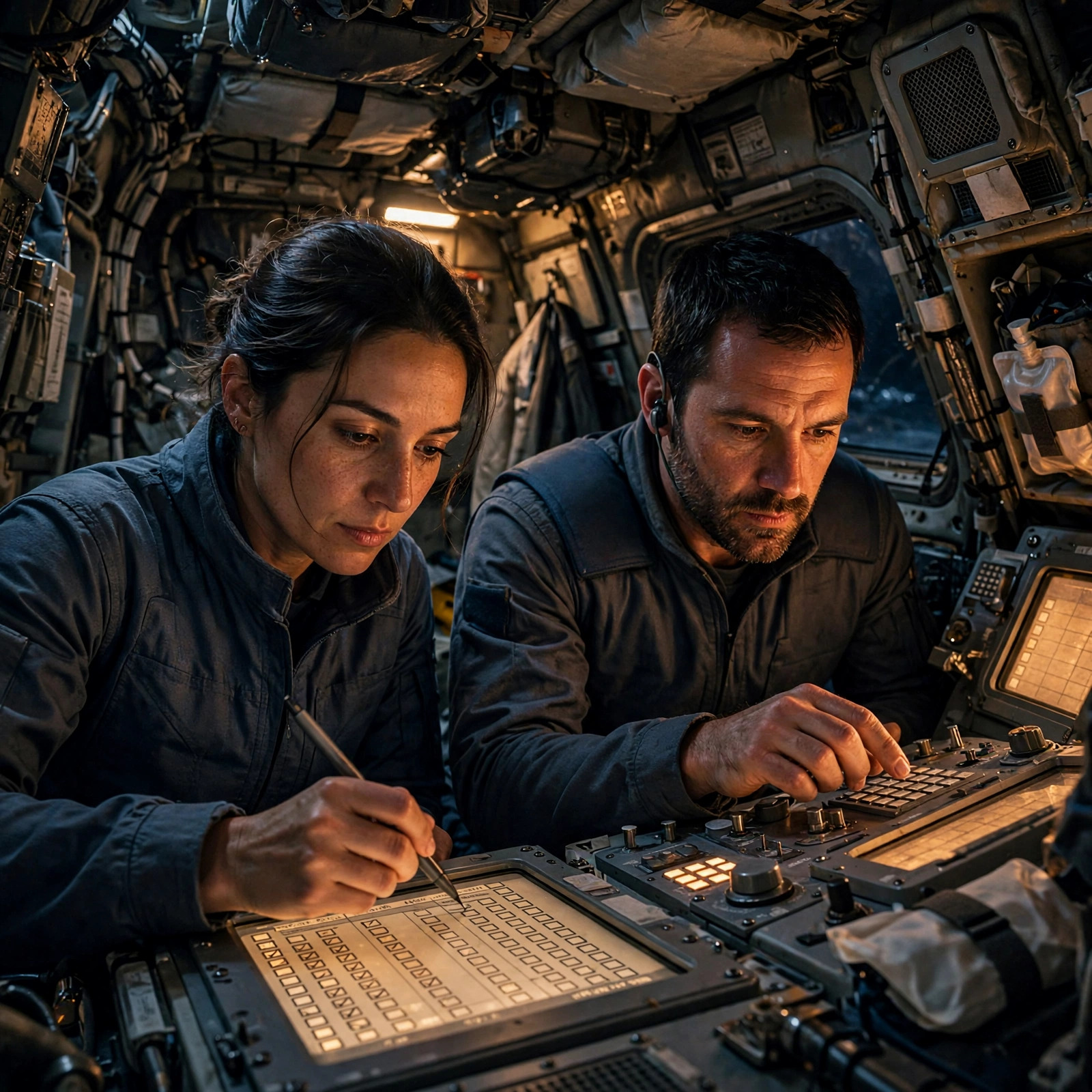
"Same period," Deniz said. "Third pass. Same channel, same limb."
"Fine structure?"
"Give it an hour." Deniz's hands moved over the console without hurry. "The frame stacks are still converging. But look here." They pulled up the previous two passes, overlaid, and the three pulses sat on top of each other so exactly that the screen showed one line with a ghost of thickness to it. "Whatever's doing this, it's doing it the same way every time. Down to the sample."
Teodora wrote the numbers on the back of her hand because the board was full. 4.2 s. Three passes. Ch. 6. Then she went to find Rafe.
He was at the trajectory console, as he usually was, running the return-window burn plan for the fourth time that week, as he also usually was. The display showed the Tamarisk's future laid out in pale blue: the departure burn, the long fall inward toward the Barnard's Star system's plain, the cruise home. Rafe did not look up when she stopped beside him, which meant he already knew why she was there.
"It held," she said.
"I saw the flag."
"Three passes."
"I can count, Teodora." He said it without heat, which was worse than heat. He pulled a window up and turned his chair to face her, and the display behind him showed the whole return architecture in one frame. "Here's the situation, since we're going to have this conversation. The return window opens on day 239 and closes on day 254. The departure burn costs us 220 meters per second out of the reserve. That 220 is the whole reserve. It is not a budget with slack in it. It is the number that gets us home with the margins I've already published."
"I know what the reserve is."
"Then you know that anything we spend on looking at things is gone. There's no second reserve behind the reserve. If we spend down, the window narrows on the back end, and the back end is food and air and water, which are June's numbers, and June will tell you hers, because she's been standing in the corridor for two minutes listening."
June came in from the corridor with her ledger open and no apology on her face. "Eighteen days," she said. "That's the edible margin beyond the return plan. Food, not water, water's fine. If we're late out of this system by eighteen days, we start eating the reserve rations, and if we're late by more than that, we start being hungry on the way home. And that's assuming nothing else breaks."
"Nothing's proposed yet," Teodora said.
"Something's implied," June said. "Nobody pins a priority flag to the board over nothing."
Teodora looked at the two of them, the pilot with his pale blue future and the systems engineer with her ledger, and she understood that the conversation she'd been dreading since day 212 had already started without her, sometime in the night, probably, in the quiet way things started on a crew of four who had lived in each other's pockets for six years.
"Nothing is proposed," she said again. "But something is proposed in principle. If we want a close look at Tessel, we'd fly a detour. Rafe, what does that cost?"
Rafe had the number ready, which meant he'd run it already, which meant he'd spent part of his night on it. "Ninety meters per second for a flyby at 300 kilometers," he said. "Thirteen days off the margin. Margin goes from fifteen to two. And the ninety doesn't come back. Once we burn it, the return window is narrower forever. There is no maneuver that gives it back to us."
The cabin went quiet in the way it did when a number was large enough to have a shape. Two days of margin. Ninety meters per second, gone. Thirteen days, gone. Teodora did the arithmetic against June's eighteen and didn't like the remainder.
"Two days," June said. "Two days of schedule, five days of food left over. One bad pump between us and hungry."
"One bad pump between us and hungry anyway," Deniz said from the comms bench. "We're six years from anywhere, June. We're always one bad pump from hungry. We just don't usually say it out loud."
"That's not comforting," June said.
"It wasn't meant to be. It was meant to be true." Deniz turned back to the waterfall. "Fine structure's resolving, by the way. There's a sub-peak on the rise. Consistent across all three passes. Whatever the line is, it has an inside to it."
Teodora went to the ops board and stood in front of it. The burn plan summary on the left, the water ledger on the right, her own red-ink flag in the middle. She took the board pen and, under the flag, drew a line down the middle of the clear space and wrote on the left side: Keep schedule. Depart day 239. Reserve 220. Margin 15. On the right: Detour. 90 m/s. 13 days. Flyby 300 km. Margin 2. Under both, she wrote: Cannot undo.
"That's the whole argument," she said. "It fits on half a board."
"It always did," Rafe said.
The recording arrived at 1940, ship time, on day 215. Deniz called it out from the comms bench in a voice that had gone flat, which was how Deniz sounded when something had surprised them. "Bundle from the Sedna Relay. Priority header. It's Sethi."
They came to the common table for it, all four, because that was how you took a message from the mission director, even a mission director whose words had left her six years before any of them heard the first syllable. Pramila Sethi's face resolved on the main display, older than Teodora's memory of her by exactly the light-lag, and the timestamp in the corner read out the transmission date in small figures Teodora did not let herself look at twice.
"By now you'll be in Vesper orbit and past the moon catalog," Sethi said. "So let me say the thing I'd say if I could reach you in real time, because I can't, and you should hear it anyway. Everything you send me is six years old when it lands. Everything I send you is six years old when you get it. I cannot approve anything you do. I cannot veto anything you do. I cannot send help, and I cannot send a better idea. By the time I know what you chose, you'll have lived with it for six years, and so will I."
She paused, and the whole crew sat still for the length of the pause, which was ridiculous, Teodora knew, because the woman had finished speaking six years ago and was not waiting for anything. But it didn't feel ridiculous.
"My standing instruction stands," Sethi went on. "Schedule adherence ranks above discretionary science. The return window is the mission. Everything past the departure burn is a bonus, and bonuses don't get spent unless the survey lead can look at the record afterward and say it was worth the margin. That's Teodora's call to make, not mine, and not anyone's on the relay. Safety exceptions are hers too. I trust her with both. That's why she's there."
The recording ended on a small human moment, Sethi reaching to shut off her own camera, and then the display held the last frame for three seconds and went dark. Six years, 5.96 of them by the parallax arithmetic, out and out along the dark between them and the Sedna Relay.
"She recorded that before we launched," June said.
"Before we even knew the catalog was going to be this good," Teodora said.
"She knew there'd be something," Rafe said. "She always knows there'll be something. That's why the instruction exists. It's not a message about Tessel. It's a message about us. It's her saying, I know how you four are built, and I'm telling you now, while you're calm, which of you gets to decide."
"And which side she's on," June said.
"She's on the schedule," Rafe said. "She said it plainly. I don't have to interpret."
Teodora looked at the board. The two columns she'd drawn the day before had acquired handwriting overnight, which was how the ship's arguments matured. Rafe's small precise figures under the left column, the burn plan's reserve restated. June's ledger note under the right one, five words: food margin drops to five. And Deniz had written nothing under either column, which Teodora read as clearly as handwriting: Deniz was not in either camp yet, or was in the one that hadn't been drawn.
The camps existed now. That was the plain fact of day 216. Rafe and June took their coffee at the trajectory console and spoke in the shorthand of consumables and delta-v. Deniz took meals at the comms bench with the waterfall stacked on the screen, three passes deep, four, watching the line hold its period with an inside to it. Nobody had voted. Nobody needed to. Six years in each other's pockets had made the counting unnecessary.
"Before we argue about the flyby," Teodora said that evening, standing in front of the board with the whole crew at their stations, "we have to settle whether the line is real. Deniz. Say it plainly for the record."
"The crystal filter in the Ardent's narrowband path has been in flare space for six years," Deniz said. "I've had the etch report for a month and I've been putting off saying it out loud, because I didn't want it to be true. The filter may be shifting our channel response. A degraded crystal can sharpen a line that isn't sharp and hold a period that's really jitter. I can model it from inside, but a model isn't a measurement. If we're going to say pulse to anyone, ever, we need a calibrated eye on the filter itself. That's an EVA. The filter housing is on the ventral truss."
"How long?"
"Four hours, suited, with the test lamp. Two if I take the wrist unit out instead of the full bench."
"Then that's the first question," Teodora said, "and the flyby is the second, and we don't get to argue the second until the first is answered. Rafe, where's your earliest EVA slot that doesn't touch the burn plan workups?"
"Day 226," Rafe said. "I need the nav checks through day 225 to keep the departure solution tight."
"Day 226 is eleven days of watching a line we can't trust," Teodora said. "Deniz, what can you actually make on day 219? I know the wrist unit isn't printed yet. Assume I put the med bay printer on it tonight."
"Day 219 works if the mount bracket's already fabbed, and it is, because I fabbed it in month three out of boredom." Deniz said it without a smile. "Day 219, four hours on the truss, test lamp on the filter, response curve back through the hull feed before I'm even out of the suit."
"It's my plan either way," Rafe said. "I'm just telling you which end of it bends first."
"I know," Teodora said. "Noted, and I'm taking it. Day 219, Deniz and me on the ventral truss, recalibration EVA, priority override on your 226 slot. Your workups run around us. If the flare forecast turns on us, we come in and it moves to 226 and you get your plan back."
"And if the filter says the line's an instrument ghost," June said, "we never have the flyby argument at all."
"Then we'll have spent an EVA and a splint's worth of printer feed," Teodora said, "and the board gets wiped clean, and Rafe's burn plan stands exactly as written."
"And if the filter says it's real," Rafe said, "then we have the argument I've already lost twice in my head."
"Then we'll have it with numbers we can trust," Teodora said, and took the pen, and on the ops board, under the two columns, she wrote the day and the hours and two names, and the crew of the Tamarisk split itself, quietly and without any ceremony, into the ones who kept the schedule and the ones who wanted to look, with her signature, for the moment, under both.
Flare Clock
The forecast had been kind for six days, which on the Tamarisk passed for a promise. At 0400 on day 219 Teodora was already dressed and reading the particle plot in the prep bay when June came down the ladder with two coffees and bad posture.
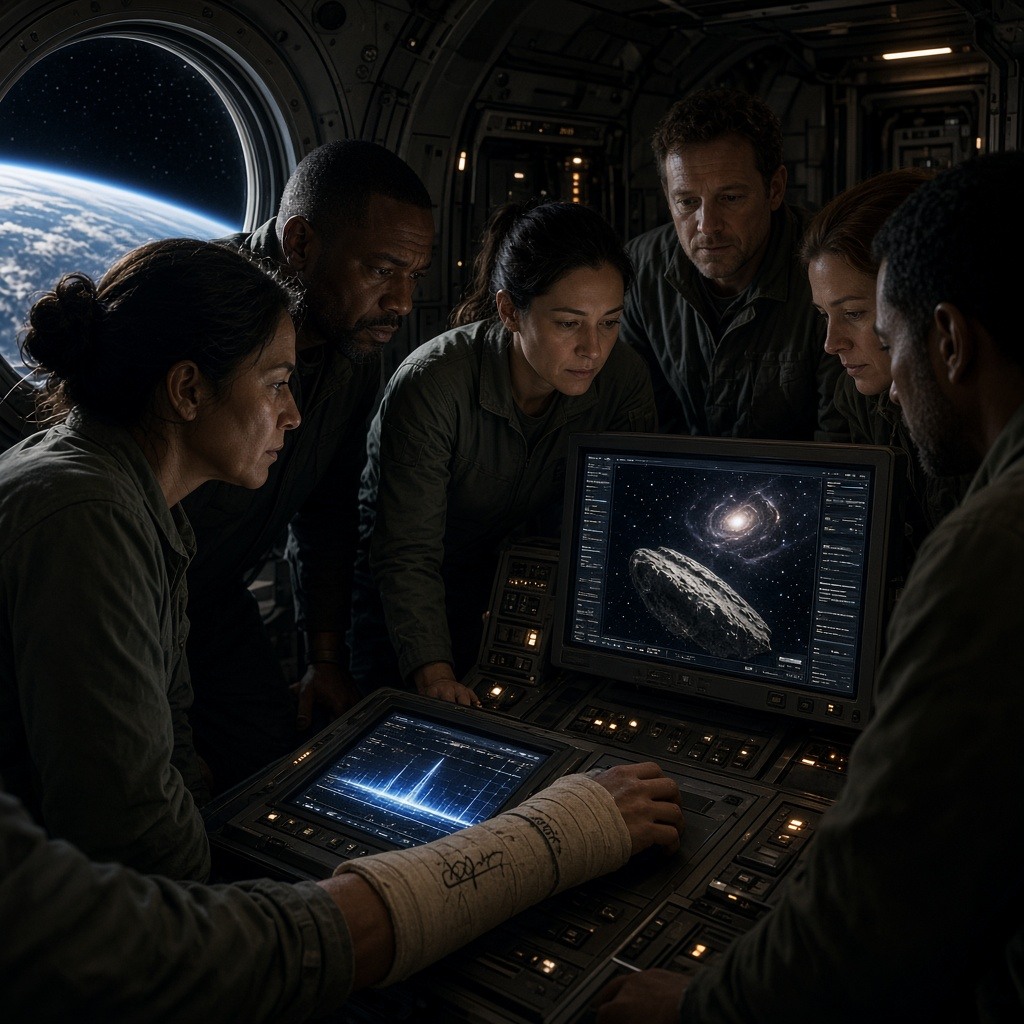
"Proton flux is up," June said. "Not flare levels. Just up."
"How up?"
"Forty percent over the night's floor. The forecast model puts the peak between hour six and hour nine of the EVA, ninety minutes wide, and it puts nothing after it. Either we get the swap done before the peak or we wait for day 226."
Teodora looked at the plot herself, as if her eyes would find a different curve in it. The line rose in a shallow, patient slope, and it did not care about anyone's schedule.
"Deniz?" she said into the intercom.
"I heard." Deniz's voice came through from the suit room, flat and awake. "I can do the swap in four hours with the test lamp. I can do it in three if I don't run the full response curve on the truss, just the coarse check, and finish the curve through the hull feed after I'm inside. The flare peak only matters while I'm outside."
"Dose," Teodora said.
"If the peak comes at hour six and I'm out at hour three, it costs me almost nothing. If it comes early, and I stay out to close the housing, it costs me. I can't tell you how much until it's over me."
Rafe arrived at 0420 without coffee and with the departure solution open on a slate. He set the slate down on the bench, face up, so the burn numbers sat in everyone's view while he talked, which was the most Rafe way of making an argument Teodora had ever seen.
"The forecast has been wrong twice this month," he said. "Both times it was wrong in the safe direction. I'd like the record to show I don't trust the third one."
"Noted," Teodora said. "June, put us on a flare clock. Hard limit at hour six. At hour six Deniz is inside that airlock whether the housing is closed or not, and if it isn't closed, we secure and we wait for your slot on 226."
"And the filter?" Rafe said. "Half-swapped?"
"Half-swapped is a bench problem," Deniz said from the door of the suit room, already in the inner layer, splint-free and unbothered. "Half-swapped is my problem, on the bench, inside, with tea. The only thing that can't be half-done out there is the seal on the old filter's seat."
"Then that's the first thing you do," Teodora said. "Seat and seal first. Curve second."
Deniz looked at her for a second longer than the remark needed. "You want it that badly," they said, "that you've already decided what order I do it in."
"I want it correctly," Teodora said. "The order is yours."
They went out at 0510, both of them, because the ventral truss wanted a second pair of hands for the test lamp and Teodora had stopped pretending she'd watch this one from the console. The Ardent sat on its hull mount with the patience of something machined and brazed in 2081 and then flown six years without complaint: a titanium frame, a borosilicate eye, a label from an instrument works in Southampton that none of them would ever see. The filter housing was a ring of eight cap screws under a dust cover, and under that, the crystal itself, the one thing on the ship that everyone had spent a week arguing about.
The first hour was clean. Deniz's gloves moved through the cap screws the way they did everything, without hurry, with a running commentary that Teodora had long ago stopped trying to talk them out of. "Three out. Four. Five's torqued like someone loved it. Six." The test lamp threw its calibrated line down the truss and the old filter read it wrong in a way Teodora could see for herself on the wrist display: the passband sat low and fat where it should have sat high and narrow. Six years of flares had cooked the crystal, slowly, in a way no bench check inside the hull had ever caught, because no bench check inside the hull had ever put a star behind it.
"There's your ghost," Deniz said. "Half of it, anyway. A filter this soft would smear a real line and it would also print a fake one. We were right not to trust it."
"And the new crystal?"
"Seating it now."
The new filter came out of its case in two pieces, crystal and retaining ring, and it went in the way the old one had come out, screw by screw, with Deniz's left hand holding the ring square while the right drove the driver. At hour two and forty minutes the flare clock that June had set began to count against them.
"Flare's early," June said in their helmets. "Proton flux is climbing ahead of the model. I've got the peak starting in about forty minutes, not ninety."
"Recalculate my limit," Deniz said.
"You're inside at hour three and ten. That's firm. That's me being generous with your bones."
"Then I've got thirty minutes to seat the ring, close the housing, and run the coarse check," Deniz said. "The coarse check is two minutes. The seat is the rest."
"Say the word and we secure," Teodora said.
"I won't say the word."
Teodora watched the numbers instead of her own pulse. Flux climbing. Deniz's dosimeter ticking upward in units too small to feel and too large to ignore. The ring went square. The cap screws went in, one through eight, and Deniz drove them with the driver braced against the truss because at that angle the wrist took the torque and the elbow couldn't.
At screw six the flare arrived in earnest, and the dosimeter's rate stepped up like a door opening into a louder room.
"Inside," Rafe said. "Deniz, that's the call. Inside now."
"Two screws."
"I'll take the dose for two screws," Deniz said, and drove seven, and the truss, which had been holding them stable against the driver's torque all along, chose screw eight to shift under them, a flex of the hull's thermal strain that no one had predicted because it had never mattered before. Deniz's left wrist took their whole suited mass against the rail, and they made a sound Teodora had never heard from them, and then, in the next breath, said: "Screw's in. Housing's closed. Rafe, reel us."
Rafe had them on the winch before the words finished. Teodora got one arm under Deniz's harness and the two of them came up the truss together, the closed housing dark and square behind them, the test lamp still burning its calibrated line into nothing.
The airlock cycled. Inside, Deniz unsealed their own helmet with the right hand and did not offer the left. "It's not the dose I mind," they said. "It's that I did it to myself for two screws."
"Four rem extra," June said quietly, reading the dosimeter. "Forty millisievert on top of the career ledger. I'm sorry. That's not nothing."
"It's a number," Deniz said. "Print the splint."
The med bay printer took eleven minutes, and Teodora spent nine of them sitting with Deniz on the exam bench, not saying anything useful, while June heat-fitted the carbon-filled splint along the left wrist and thumb gutter and Deniz watched it the way people watch their own x-rays. The flare protocol locked the pass: no console work in the aft bay during the peak, no exterior instruments, everyone inboard behind the water wall. The Tamarisk had four hours of nothing scheduled, which on a survey ship was a thing that had happened maybe five times in six years.
Teodora could have taken the console. The Ardent's fresh feed was already routing through the hull port, and the first clean narrowband pass over the Tessel limb point was due in ninety minutes, and every instinct she had said the place to be was the console, watching the line come in trustworthy for the first time.
She stayed on the bench instead. She didn't say why, and Deniz didn't ask, and neither of them named the thing they were both not naming. She kept her hand flat on the bench where Deniz could see it, near the splinted wrist, not on it, and Deniz read the pass on the tablet with their right hand and let the left one rest where it was, in its fresh printed shell, signed now by June in the margin of the dose ledger, and by Teodora, and by Rafe, because that was the rule for anything that touched the career numbers.
Rafe signed last. He signed standing up, with his slate under his arm, and he didn't leave the med bay afterward, which was how Teodora knew the numbers were coming in good.
"Pass is clean," Deniz said. "New crystal. Same star, same limb, same geometry as day 212." They turned the tablet so everyone could see it. "Line's still there. Four point two seconds, same period, same fine structure, sub-peak on the rise, same as all three passes before. And the band is narrow now, narrower than the old filter could ever have shown us. A cooked filter prints you a smear and calls it a line. This is a line."
"External," Teodora said.
"External," Deniz said. "Structured, periodic, and it isn't us. Whatever's making that is on Tessel, and it's making it with real physics, and my instrument can now prove it, which it could not prove a day ago."
June had her arms crossed, and Teodora watched her look at the line for a long moment before she spoke. "It's real," June said. "I'll say that much. I still haven't said anything about the flyby."
"Understood," Teodora said.
"Fifteen days of margin," Rafe said, not moving from the wall. "Thirteen if we spend the detour. Ninety meters a second out of a two-twenty reserve, and no undoing it, because the return burn needs what it needs. And the food ledger gives us eighteen days past the plan, which sounds like a lot until you're eating it."
"I know your numbers," Teodora said. "They're good numbers. I've told you that."
"Then you know what I'm going to file when you decide."
"Yes," Teodora said. "File it."
Deniz set the tablet down on the bench, splint and all, and looked at her with the flat, level attention that Teodora had spent six years learning to read and had not finished learning.
"It's real," Deniz said. "The line. The pulse. Whatever's down there on that moon making a four-second heartbeat out of starlight, it exists, and we're the only people in the universe who know it, because everything Earth knows about us is six years old. So I'm going to ask you the question, and you're going to answer it straight, because my wrist is telling me I've already paid a piece of my career for this one." A breath. "Are you going to spend the margin on it?"
Teodora looked at the line on the tablet, narrow and clean and repeating, and at Deniz's hand resting in its printed shell, and at Rafe standing by the wall with all the arithmetic in the system held in one arm.
"Ask me on day 224," she said.
"No," Deniz said. "Ask yourself tonight. I'll take the splint either way."
Ninety Meters a Second
Rafe's objection came up on the ops board at 0600 on day 224, before Teodora had finished her tea, filed as a formal document with a header and a seal and forty-one pages of trajectory plots behind it. He had signed it twice. Once as pilot, once as trajectory officer, which was the kind of thing he did when he wanted everyone to understand that both of his jobs disagreed with her.
She read it at the wardroom table while the ship's morning hum came up around her. RECOURSE OF THE SURVEY LEAD'S PROPOSED TESSEL FLYBY DETOUR. OBJECTION AND ALTERNATIVES. The alternatives were good. She had expected nothing less from him. He had costed out three of them: a range-only pass with the existing geometry, a delayed observation campaign after the return burn was locked, and a relay of the whole question to Earth inside the next alignment window. He had marked that last one with a single line: NOTE: any Earth reply is 11.92 years round-trip and cannot inform this decision. Filed for completeness only.
June sat down across from her with her own tablet and did not say anything until the tea was gone.
"You've read it," June said.
"Twice."
"Then you know his page nineteen is the one that matters." June turned her tablet around. Page nineteen was the consumables ledger, redrawn in June's own format, which meant Rafe had asked her for the numbers and she had given them to him straight, which meant June's objection was inside Rafe's objection whether she had signed it or not. "Thirteen days of the detour eats out of fifteen days of margin. That leaves two. Two days, Teodora. And the food ledger goes from eighteen days past the plan down to five."
"I can count, June."
"I know you can count. I'm telling you what counting sounds like when the counter is the one who has to ration the galley if anything goes long." June set the tablet flat on the table between them. "I'm not filing anything. I want that on the record, because Rafe's numbers in my handwriting look like my signature and they're not. But I'll say it to your face since you're going to make me say it somewhere: I'm against it."
"Noted," Teodora said. "Genuinely noted. And recorded."
"Record it wherever you like. No one downstream is going to review any of it for six years, and by the time they do, we'll have been right or wrong for six years." June took her tablet back. "That's the whole of my opinion. The margin is the margin. The food is the food. I don't get to be romantic about a moon. I'm the person who tells you when the ship runs out."
She went forward to the life-support rack, and Teodora sat alone with both documents open, Rafe's forty-one pages and the pulse line running beneath them on her own screen: 4.2 seconds, period after period, sub-peak on the rise, narrowband, external, structured, real. The new crystal had been proving it for five days straight. Nothing about the line had changed and nothing about the arithmetic had changed either. Ninety meters a second out of a two-twenty reserve. Thirteen days. No undoing it, because the return burn needed what it needed, and after the detour there would be exactly enough propellant left to execute the departure plan and exactly none to spare for regret.
Deniz came into the wardroom at 0700 with the splint still on the left wrist, the polymer shell scratched now along its outer edge from five days of ordinary collisions with ordinary handles. They poured coffee one-handed rather than ask for help, which Teodora had also spent six years learning not to argue about.
"Decision day," Deniz said.
"Decision day."
"Is the crew convened, or are you deciding and informing?"
"Convened. 0900. All four of us at stations." Teodora closed Rafe's document. "It's a burn order, Deniz. It's not a survey note. If it's going to happen, it happens with everyone at their post and their hand where I can see it."
Deniz nodded slowly, coffee in the right hand. "Then I'll be at the spectrometer rack by 0830. The wrist will hold." A pause. "Whatever you decide, I want it said that the instrument case is closed. The pulse is real. I've put forty millisievert and a wrist into proving that, and I'd do it again, and that's all I came to say."
"It'll be said."
Deniz went aft, and Teodora sat with the tea gone cold, and did not open the documents again, because she had already read everything in them and the only thing left unread was her own signature.
At 0900 the wardroom screen showed all four stations: Rafe at the flight console with the burn plan loaded and armed, June at consumables with the ledger open, Deniz at the spectrometer rack with Ardent's telemetry mirrored, Teodora herself standing at the ops board with the pen in her hand.
"This is the decision brief for the Tessel detour," she said. "Ninety meters a second, executed tomorrow at the day-225 window, into the close-flyby leg at three hundred kilometers over the canyon province. Cost: thirteen days of margin out of fifteen, and thirteen days of food out of eighteen. After the burn the reserve stands at one-thirty and the departure plan is still executable, with no discretionary delta-v remaining. Any failure after that point is a failure we return home with instead of a failure we recover from. I've read the objection. So has everyone. Rafe, you're on the record at the top of the log. Say it once more for the burn record and then we're done saying it."
Rafe did not look up from his console. "Pilot and trajectory officer's formal objection to the survey lead's detour order, filed day 224, forty-one pages, standing. The detour consumes ninety meters a second of a two-twenty reserve and thirteen days of a fifteen-day margin, leaving two. It narrows the return window permanently. My recommended alternative is the range-only campaign on page twelve, which gathers a fraction of the science for none of the schedule." He looked up then. "My numbers are sound. I want that next to my objection, because when the review board reads this in six years, I want them to read that the man who objected did his arithmetic right and then flew the burn anyway."
"They'll read it," Teodora said. "I'll see to it personally."
"Then I'm ready on your order."
"June."
"Consumables concurs with page nineteen as written," June said. "Post-burn ledger: two days of margin, five days of food past the plan. I'll be rationing conservatively from day 226 regardless of how this goes, and nobody gets to call it pessimism later. That's my whole statement."
"Deniz."
"Instrument case closed. Ardent's new crystal holds. The pulse is external, narrowband, structured, 4.2 seconds, and it is on Tessel. Whatever the flyby finds, I'll have the receiver warm and the calibration current. Ready on your order."
Teodora wrote the order on the ops board in her own hand, beneath the pulse flag she had written there twelve days ago: Day 225, detour burn, 90 m/s, Tessel flyby leg, ordered T. Ilic. Then she initialed it, and the pen went back in its slot, and there was nothing ceremonial about it, because ceremony was for things you might still talk yourself out of.
"Order is issued," she said. "Rafe, execute the burn at the window."
"Copy," Rafe said. "Burn plan loaded. I'll have the maneuver sequence verified by 1300 today and the crew called to stations at 0630 tomorrow. Sleep tonight. All of you. That's a pilot's instruction and I'll put it in the log with my objection."
The burn executed on day 225 at 0712, and it was not loud and it was not dramatic, because nothing that spent irreplaceable things ever was. The Tamarisk's thrusters ran for eleven minutes and forty seconds, and the whole crew sat at their stations and watched the reserve counter come down: 220, 210, 200, the numbers rolling off with the smooth indifference of a meter that did not know it was spending the last of anything. Rafe called the milestones in his flat range voice, two hundred, one-ninety, one-seventy, and Teodora watched the margin board over his shoulder, the days sliding from fifteen toward two with no way to hold any of them back.
"Ninety seconds to cutoff," Rafe said.
"Spectrometer nominal," Deniz said. "Tessel limb is drifting into the gate. It's going to be in the aperture by tonight."
"Consumables nominal," June said. "Nothing venting that shouldn't be."
"Ninety meters a second," Teodora said, quietly, mostly to the board.
"And change," Rafe said. "Reserve burn complete in thirty seconds."
The cutoff came at 0723 and 40 seconds, and the thrusters stopped, and the counter stopped, and it read 130.
For a moment nobody said anything. The ship ticked through its ordinary post-burn checks, and the reserve figure sat on the main board where all four of them could see it, and there was no crew on Earth and no crew at Sedna who could change a digit of it. Teodora looked at the number the way you look at a door after you have locked it behind yourself.
"Posting the ledger," June said, and her voice was even. "Reserve, one-thirty. Margin, two days. Food past plan, five days. That's the mission now. Those are the numbers we live inside until the return burn."
"Logged," Rafe said. He pulled his burn plan up on the console, looked at it for a long moment, and then filed it, and the filing sound was the only thing in the wardroom. "The return window is set. It's narrower than it was this morning and it will never be wider again. I want the log to show that I said that in the same entry as the cutoff."
"It shows both," Deniz said from the spectrometer rack, hands easy on the console, the splint resting in their lap. "I put them on the same line."
"Good," Rafe said. "Then that's everything I have."
He unplugged his console and went forward, and Teodora did not stop him, because there was nothing left to negotiate and he had flown the burn to the tenth of a second, which was the only fidelity he owed her and more than she had asked for. June shut down the consumables board and paused on her way out.
"Five days of food," June said. "I can work with five. Barely, but I can. Don't make it four."
"I won't."
Then Deniz called her aft, voice pitched up, the way it only went when Ardent was showing something, and Teodora went to the spectrometer rack and looked at the screen over Deniz's shoulder. The pulse line was there, 4.2 seconds, sub-peak on the rise, and beneath it now, in the hours since the burn, a second fainter trace beginning to resolve as the geometry closed: the same period, the same structure, and a brightness climbing toward them day by day as Tessel came on.
"It's getting stronger," Deniz said. "Because we're getting closer. That's all that's happened. But Teodora, look at the rise." The splinted wrist tapped the screen once, gently. "That sub-peak isn't noise. It's fixed. It's fixed in the period, and it survived a new crystal, and whatever's doing that down there has been doing it since before we got here, and it'll still be doing it when the flyby window opens on day 238."
"Then we'll be there," Teodora said. "One-thirty in the tank and two days of margin, and we'll be there."
She stood at the rack with her hand on Deniz's shoulder, watching the line repeat, 4.2 seconds, 4.2 seconds, while the reserve counter behind them held its new smaller number, spent and permanent, and nobody in the whole reachable universe could give her back a single meter of it.
Closest Approach
Two days out from the pass, Teodora spent an afternoon at the fab bench with the Pika lidar cracked open on its cradle, a grating plate held between her fingers while June held the light. The plate had come off the spare optics tray, doped glass cut narrow enough to smear the return into something the eye could read as a rainbow instead of a number. She bolted it into the receiver path, torqued it down a quarter turn past snug, and then ran a fiber from the Pika's timing board down the spine of the ship to the ventral truss, where the Ardent sat blind and patient on its mount.
"Now they share a clock," she said. "Pika gives us shape. Ardent gives us spectrum. Same instant, same patch of ground."
Deniz leaned over the bench, splinted wrist resting against their ribs, and watched the alignment figures crawl. "And when we're moving four kilometers a second across the face, the clock matters."
"That's the entire idea."
Rafe did not come down for the bench work. He was forward with the flyby product, trimming the pass geometry one last time, and when he came aft that evening he read the pointing solution aloud off his slate without opinion attached to it, which was its own kind of opinion, and Teodora took it as it was given. The closest approach held at three hundred kilometers, ground track laid over the canyon province, sun angle chosen so the far wall would be in full light while the near wall threw its shadow across the floor.
On day 238 she was at the survey rack an hour before the pass, and so was everyone else.
The wardroom had been rearranged for it. June dragged her consumables terminal into the aisle and left the consumables running on it unattended, which she had not done once in six years. Deniz sat at the spectrometer rack with the receiver slave line glowing. Rafe stood at the nav console with his arms folded, and Teodora stood between the two racks where she could see both screens at once, and nobody spoke for the last ten minutes because the burn was already done, the track was already flown, and everything from here on belonged to the ground.
Tessel came up over the hull rim the way a coast comes up under a boat, slow and then suddenly all there was. The Pika's shape channel drew the terrain first, in the flat grays of ranging: old cratered uplands north of the track, then the long dark scar of the canyon province opening under them like a seam in the crust. Two hundred kilometers long, Deniz had it from the shaping passes, and here at its widest reach, forty kilometers rim to rim.
Then the spectrometer trace came alive, and Teodora stopped breathing on purpose so she wouldn't miss anything.
The pulse was there. Not faint anymore. At three hundred kilometers, with the geometry closed, the 4.2-second line stood up off the noise floor clean as a struck bell, sub-peak riding the rise exactly where it had ridden through every pass since day 212. And spread beneath it now, because the light was bright enough to spread, a comb of them: the same narrow band, the same structure, echoed at intervals the grating could resolve across the canyon floor.
"Multiple emitters," Deniz said. "Or one emitter and a lot of mirror."
"Pika," Teodora said.
Rafe's console put the lidar overlay up, and the two pictures married on the split screen. The comb lines sat down on the terrain map, and every single one of them landed on the same thing: the far wall. Not scattered. Not in the crater fields, not in the rubble slopes, not anywhere else on the whole four-hundred-kilometer sweep of ground beneath them. Each bright return lay on a facet of that long far wall, and as Tamarisk swept down the canyon and the sun angle shifted, the returns moved along the wall facets the way highlights move along a windscreen when you turn your head, and Teodora felt the whole argument of the last three weeks turn over in her hands.
"It's the wall," she said. "The wall is the cavity."
Deniz pulled the spectral band up to full scale and there it was, narrow as an emission line, sitting exactly where starlight would sit if something separated it out. "Coherent," they said. "The line width, Teodora, the line width is absurd. Nothing thermal does that."
"The canyon walls," Rafe said, and it cost him something to say it, Teodora could hear that. "What are they made of."
"The province is a crystal body," Teodora said. "The ejecta sheets from the basin-forming era, they annealed slow, for millions of years, no weathering, no tectonics, nothing to make it anything but large-scale order. We've known that since the first pass. We catalogued it as a mineralogy note and moved on." She looked at the split screen, at the bright comb lying flat against that long clean wall. "Forty kilometers of aligned faces acting as one optical cavity, pumped by the star, and the second mirror is Vesper."
June looked up from her terminal. "The cloud deck."
"The cloud deck," Teodora said. "Vesper at opposition throws starlight back at the canyon at exactly this geometry, the geometry closes, and the cavity runs. It's a laser the size of a country. Nobody built it. Nobody had to. It only needs a star, a mirror, and a hundred million years of patience, and this system has had all three since before anything on Earth had a spine."
Nobody said anything for the length of one pulse, 4.2 seconds, the line rising and closing and the sub-peak riding up on the flank of it.
"Then it's not a beacon," Deniz said. "It's not a marker. It's not anyone's."
"It's not anyone's," Teodora said. "It's the first natural laser anyone has ever found around another star, and we are the four people in the universe who know it exists."
Rafe unfolded his arms. "It's a natural feature that fooled a spectrometer into looking artificial," he said, "and I want my objection read against that background, because a natural laser with a four-second period is exactly the kind of thing a survey is for, and I'd fly the detour again, and I'd still file the same forty-one pages, because my numbers were sound and the margin is what it is. Both things are true." He looked at her, and his voice was level. "The return window holds. One-thirty in the tank, two days of margin, five days of food. I'll fly us out on schedule. That part was never in question."
"I know," Teodora said. "I've never once doubted that part."
They flew the rest of the pass in the middle of the wardroom aisle, four people around two screens, and the canyon went under them and the comb of returns ran along the far wall like footlights along a stage, and when they had drifted past the rim into ordinary cratered country the pulse fell off steeply and was gone, and the plain grey terrain gave them nothing, which was itself the confirmation. The signal belonged to that canyon, that light angle, that cloud deck three hundred million kilometers sunward, and to nothing else in the Barnard's Star system.
They had two days of downlink geometry before the pass data and the alignment window coincided, and Teodora spent them drafting, and cutting, and drafting again. June built the consumables annex without being asked: what five days of edible margin actually meant, what the return plan now carried and what it no longer did. Deniz pulled the spectra, cleaned them, and put the flare dose and the wrist fracture in the medical log with the splint's serial number, because the medics on Earth would want the whole chain. Rafe checked the return burn plan one more time and then, without ceremony, added the flyby product to the packet under his own name and his own objection, on the same page, the way he'd put them on the log line at the cutoff.
Day 240. The alignment window opened at 1140, forty minutes wide, and the high-gain dish swung on its mount to meet it.
Teodora stood at the transmit board with the discovery packet queued and green. It was not long, as packets went. The period. The comb. The cavity geometry, rim to rim, with Vesper's cloud deck named as the pump mirror. The spectrum at full resolution. The line width that ruled out every thermal source on the table. Rafe's flyby product. June's annex. Deniz's spectra, clean. The dose ledger, signed. The burn log with the 90 meters per second spent, the reserve at 130, the return window filed narrower than it had ever been, permanently, with the reason in the same entry.
"Whatever's queued when the window closes is what Earth gets until the next alignment," Deniz said. "You know that."
"I know that."
"Packet checks out," Deniz said. "Spectra are the best thing I've ever attached my name to."
June had her hand flat on the top of her terminal. "Food annex is in. Five days. They'll complain about it for six years and then they'll say it was worth it."
"They'll say it was insane," Rafe said, "and then they'll build the follow-on mission, and they'll put the canyon on the patch." He was looking at the dish-mount indicator, not at her. "Send it."
Teodora keyed the packet into the transmit buffer. The dish locked, the ready line went solid, and she rested her hand on the transmit key and did not press it for a moment, a full 4.2 seconds, though nobody in the room knew she'd counted it that way except her.
Then she pressed it. The buffer emptied into the dish and the dish emptied into the dark, and the light-lag counter began its long climb: 5.96 years, one way, toward an Earth where everyone who had ever argued about the pulse was still wrong and would stay wrong for almost six more years before the proof arrived to set them right.
Deniz's splinted wrist came up to rest on the rack beside her hand, the printed polymer gone smooth at the edges where three weeks of work had worn the signatures half away. Rafe stood on her other side with his arms folded, and June leaned in the aisle with her terminal against her hip, and the four of them stood in the frame of the dish-mount monitor while the green line drained and the alignment minutes counted down, and Teodora kept her hand where it was, flat on the key, as if the pressure of it could carry the rest of the distance, and out past the hull the beam went on climbing, carrying the canyon with it.
Get notified when new stories drop

Mira Okoye
Mira writes first contact and mentorship-across-species stories where curiosity beats fear.
Leave a comment
Comments