





The Yard Office
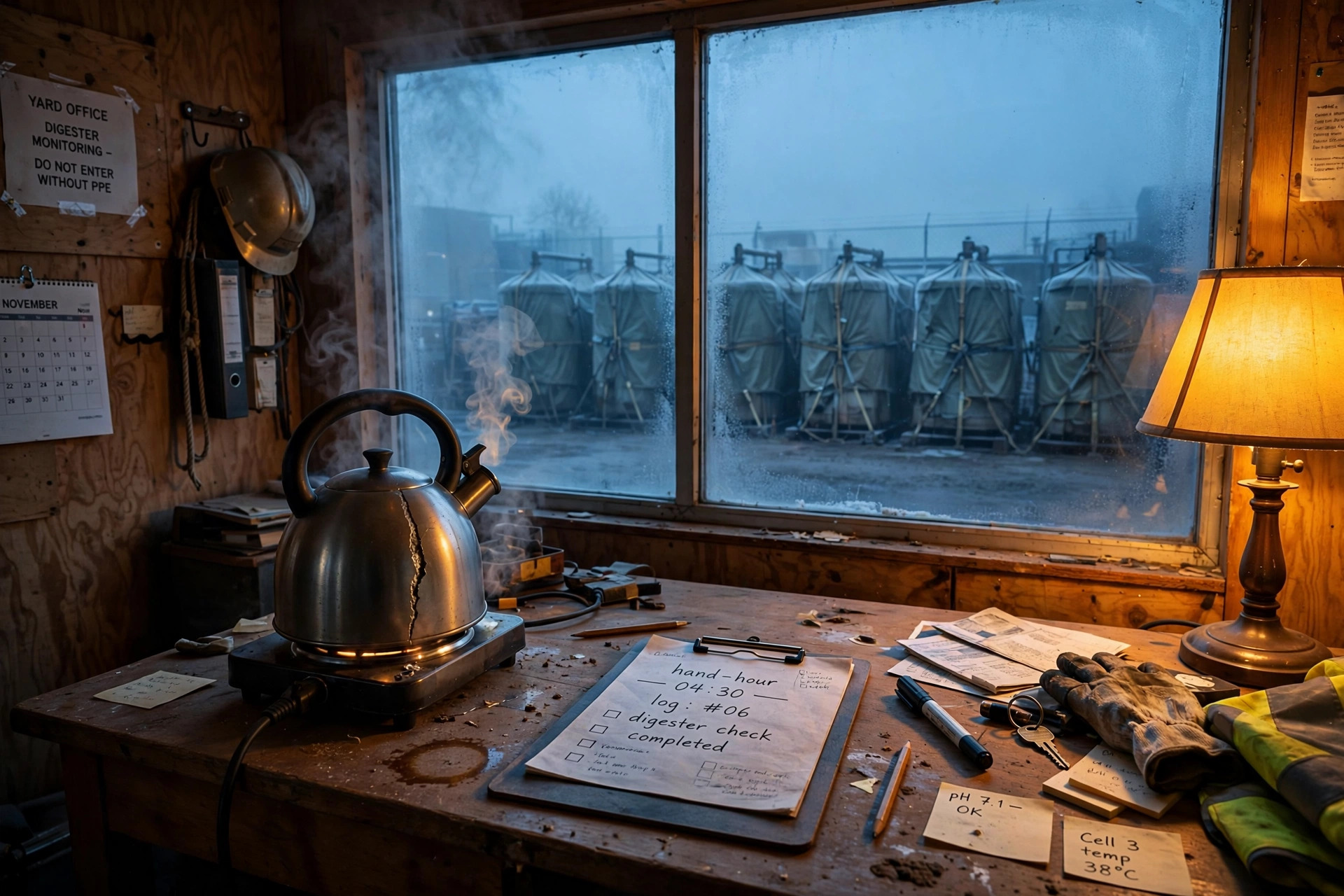
The kettle on the yard office shelf had a hairline crack down one side that Sabel Reyes had meant to replace for three winters, and this morning, like every morning, she filled it anyway and set it on the hotplate. Outside the window the Sunrow yard was still blue with early dark, the six spare digester cells sitting in their reserve cradles under tarps, fat and silent. She wrote the hour on the slate she kept on her clipboard: 04:40, charge nominal, mains holding.
Tomas Grell came up from the cellar stairs with the cold still on his coat, smelling of the rows below, of warm metal and the sweet-sour breath of the digesters. He set his thermometer down on the desk and rolled his shoulders.
"Cell four's running a degree proud again," he said. "Not enough to throttle. I gave it a quarter turn on the bypass and it settled."
"Log it or I'll never remember which of us was clever." She slid the clipboard across. He wrote in his blocky capitals, unhurried, the way he wrote everything. Twelve years of nights had given him a hand that didn't waste motion. "Anything on the return line?"
"Clean. Pressure's honest." He tapped the page twice. "There's a woman on Ferrous Street who called the office line last evening. Says her tap water's gone lukewarm at supper and hot again by morning. I told her it's the shoulder season, the loop's doing its best with what the sun gives."
"Was that true or was that polite?"
"Both," he said, and went back down the stairs before she could ask a third thing. That was Tomas. He'd answer two questions fully and then the shift owned him again.
The Sunrow loop served two hundred and fourteen households, had served them since before Sabel moved to town, since the year Marta Beck and a dozen others had scraped the money and the scrap together to lay the first trunk. Sabel had inherited the coordination of it nine years ago from a man who'd inherited it from a committee, and the whole apparatus ran on the same simple bones it always had: digester cells that charged overnight on off-peak current and cheap heat, a living tender on shift whenever they charged, and a hand on the valves whenever the weather turned. The district's rules were old and plain about it. No cell charged itself unsupervised. Someone stood watch. It was the kind of rule people forgot was a rule until someone proposed living without it.
She read the cell log twice, then walked the short cold path to the cellar stair landing, where the chalk ledger board hung on its wire, slate and pine, built by Tomas and his daughter off shelving offcuts in a year she'd stopped counting. Three-quarters of it was chalk. On the left, tenders' temperatures and valve notes in the evenings' shorthand. On the right, the neighborhood's own column: who owed the loop a small repair, who'd traded what. The Okonkwo kitchen owed a flange reseat. The Branns had paid their winter share in apple butter again and nobody argued. At the bottom right, in Ines Oduya's cramped, certain hand, someone had written: Mr. Vale's study vans on Ferrous, two of them, asking about meters.
Sabel read that line four times. Then she went back up, put two spoonfuls of leaf in the pot, and waited for the water with her hands around the kettle's unbroken side.
Ines arrived at half five, as she always did, hood up, bike lamp still blinking because she never remembered to kill it. She was the district's dispatch coder for the mutual-aid net, which meant she knew who needed a ride to clinic before the clinic did. She poured herself tea without asking and sat on the corner of the desk where the paperwork wasn't.
"You saw the board," Ines said.
"I saw the board. Two vans on Ferrous. Since when does Corvid Hydro send vans before it sends letters?"
"Since it sent letters first and got answers." Ines pulled a folded sheaf from her jacket, the paper gone soft at the creases from riding in pockets. "Vale's study is canvassing by mail. This came to half my street list on Friday. Tight-loop consolidation. They model it eleven percent better than our loop on paper, and on paper it is, I checked the arithmetic twice. But read the schedule annex. On paper, nobody stands shift."
Sabel took the sheaf. The print was clean and confident, the kind of clean that came from a budget. She found the annex. The overlay ran the cells as self-regulating hardware, throttled from a control room in Ketterbridge, tended by remote diagnostics. The district's requirement for a living tender on charging shift appeared nowhere in it, because how would it. The study had simply modeled the loop as though the tender were a rounding error.
"How many signatures," she said, because there was a line for that too.
"They need a hundred and forty of our households to consolidate, then the council blesses it. As of the mail count my aunties ran Sunday evening, they're at a hundred and eighteen." Ines let that sit a moment, then added, quieter, "That's two streets' worth, Sabel. Ferrous and the Nagle row. Mostly older households, mostly people who got a form letter with their own usage numbers printed in it and thought, well, eleven percent is eleven percent."
"Twenty-two signatures short. In fourteen days." Sabel set the sheaf down flat and put her mug on it, which was petty and which she did anyway.
"Twenty-two short, and they've got a van count and a study and a man with a title who will come stand in your office and say the arithmetic out loud. Which I expect he'll do soon, because their letters say they're holding a public session before the vote."
The office phone rang. The landline, the old yellow one bolted to the wall by the door. It rang so rarely that Tomas's footsteps paused on the cellar stairs, somewhere below, listening.
Caller ID said CORVID HYD, and a Ketterbridge exchange.
Ines looked at it. Then at her.
Sabel let it ring. Four. Five. On the sixth ring the machine took it, and a man's voice came through small and tinny across the office: "This is Dr. Karsten Vale, calling for the Sunrow district coordinator, regarding the tight-loop consolidation study. I'd welcome a conversation at your convenience. I'll try again tomorrow." A pause, then, almost humanely: "It's a good proposal. I'd rather you hear it from me than from a flyer."
The machine clicked off. The kettle ticked as it cooled.
"You could have argued with it," Ines said. "The phone, I mean."
"He'd have won. He's got an eleven and a control room and I've got a chalk board." Sabel rubbed her eyes with the heel of her hand. "I've postponed the district's formal answer twice already, did I tell you? Asked them for the full annex first, then asked for their operating assumptions. Both times I told myself it was diligence. It was also me not wanting to stand in a room and be told my loop is eleven percent worse than a spreadsheet."
"You'll have to stand in the room eventually."
"I know it." She said it too fast and heard herself say it too fast, and Ines, to her credit, let it go and drank her tea.
Marta Beck arrived at six, as she did on Mondays, because Monday was Marta's kitchen line: the retired welder had organized a rotating soup delivery from the loop's own waste heat years ago, and heaven help whoever suggested the schedule could be relaxed now that she was older. Marta carried the pot herself up from the community kitchen with a hand cart, refused help with it, and set it on the yard office's delivery shelf with a sound like a settlement of accounts.
"Bowl," Marta said, and it wasn't a question, so Sabel got down three bowls and called down the stairwell, "Tomas. Soup." and heard him come up two at a time, which he still could.
They ate standing, which was how the yard office ate. Marta asked Ines about her aunties, asked Sabel about the return line pressure with the particular attention of someone who had personally brazed a third of the joints in it, and asked nothing about vans, which meant she'd already heard about the vans, probably before Ines had.
"The Nagle row signed," Marta said at last, rinsing her bowl in the tap. "Half of them don't even take winter heat from us anymore, their children moved off and the houses run on air-source now. Signing cost them nothing. That's the trouble with a canvass by mail. It finds everyone for whom it's free."
"Fourteen days," Sabel said.
"Fourteen days is a long time," Marta said, "if you use them." She looked at the wall by the door, where the brass valve key hung on its hook, the hand crank for the main distribution manifold, cast and filed by her own hands out of a salvaged ship fitting on the night the loop first charged in 'thirty-two. She'd signed the covenant that same night, and Sabel had read the covenant often enough to know its shape by heart: the loop stays hand-tended, so no neighbor's heat ever depends on a room nobody's in.
Marta put on her gloves, took her cart, and left without saying anything else, because Marta had never in Sabel's memory ended a visit with a summary. The door banged. Down in the rows, the cells charged on under Tomas's watch, as they had every night, as the rules required, as somebody's grandmother was warm because of.
Sabel stood a while at the wall. Then she lifted the brass key off its hook. It was heavier than it looked; it always was; she knew its weight the way she knew the kettle's crack.
She hung it back unturned.
"No throttling needed tonight," she said. "Cells are holding. Weather's mild." Then, before Ines could needle her: "And if the phone rings again, let it ring. I'll answer Corvid tomorrow. On my ground, with the board full, not with their eleven percent in my ear and nothing in my hand."
"Tomorrow," Ines agreed, and wrote tomorrow on the slate, and underlined it twice.
Ferrous Street
The call came at six on day four, before the kettle had finished, and it was Ines on dispatch with that flat tone she used when she was already doing arithmetic. "Ferrous Street's cold. Six houses, the low end, numbers nine through nineteen. They woke up to nothing out of the taps and the radiators reading forty-some. Fluctuating, not failed. I need you to look at the return line."
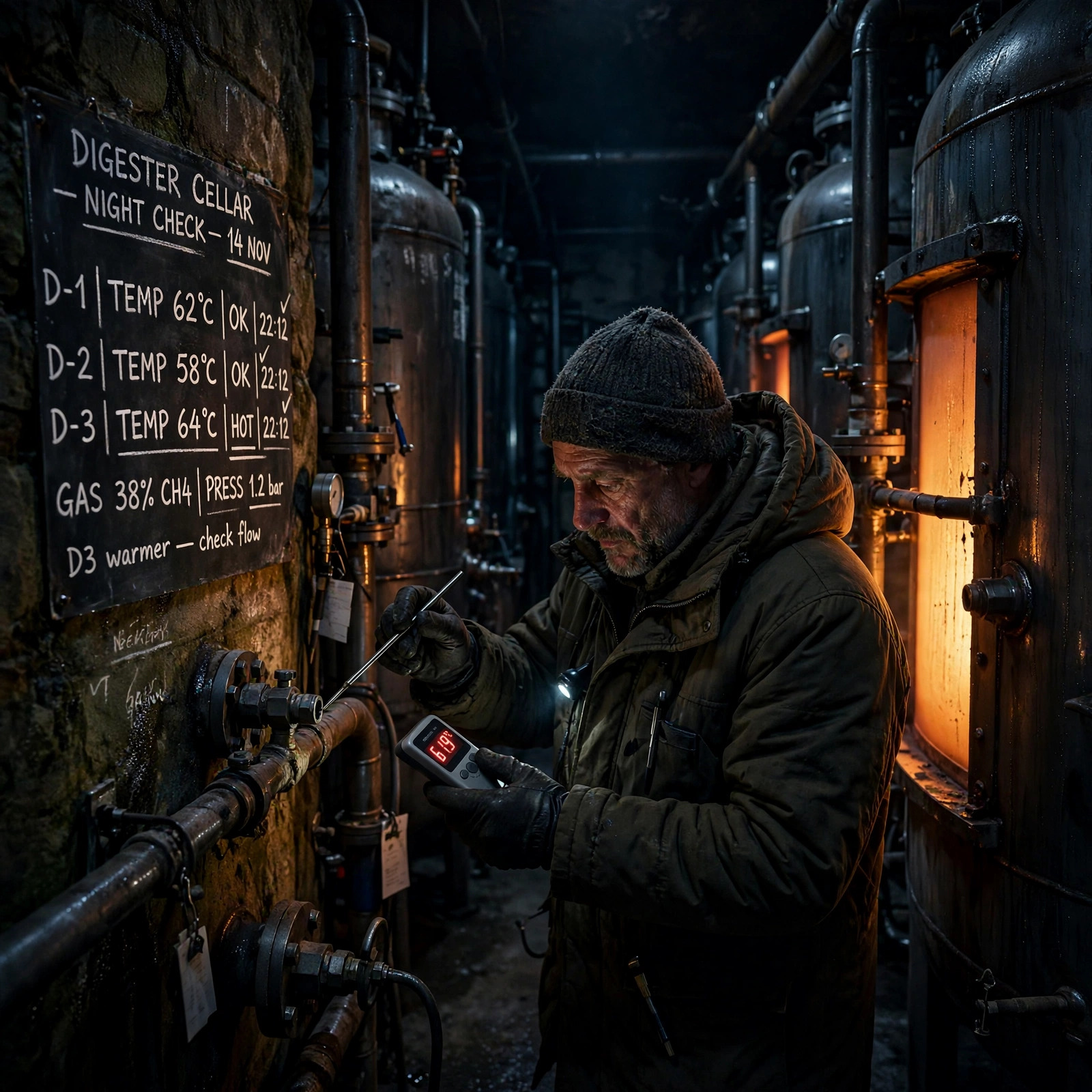
Sabel took the yard's leak log off its nail and went out into the dark with her coat half on. The morning smelled like frost and someone's woodsmoke. Eight days until the council vote; eight days, and a street going cold was exactly the kind of thing that walked people's signatures across the road to a man in a clean vest.
The return line ran buried along Ferrous Street's north shoulder, four inches of pre-insulated pipe in a jointed sleeve, Marta's brazing holding most of the elbows. Sabel walked it with a contact thermometer anyway, knee to ground, tapping the insulation every few meters the way Tomas had taught her the first winter she had the yard: cold spots talk. She found the talk fast. Under the kitchen window of number twelve, the sleeve read eleven degrees where the pipe beside it read fifty-eight. A joint had wept, slow and quiet, and the ground had taken it, and the loop had lost enough heat that the far houses came up short.
She didn't have the brazing kit on her, and she didn't have Tomas, who was on shift and couldn't leave the cells charging, because the rules were the rules and the rules were the whole point. She had a sleeve clamp, a torch head, and her own two hands. She set the clamp over the weeping joint, snugged it until the reading on her thermometer stopped falling, and texted Ines: temporary fix, need a proper braze tomorrow, tell twelve to run the tap slow. Then she knocked on doors.
That was when she found the vans had beaten her to it.
Two of them, white, CORVID HYDRO in small gray letters, parked at the corner where Ferrous met the footpath. And out in front of number seventeen, a man in a rain jacket over his vest was talking to Ada's boy, who was not a boy anymore and held the door like he was already sure of what he wanted. Sabel knew the man from the packet: Dr. Karsten Vale. He looked like a photograph of an engineer, and he had a clipboard, and he was saying, patiently, the kind of patient you can hear from the sidewalk: "I'm not here about the heat you lost. I'm sorry about the heat you lost. I'm here about the heat you'll lose next winter if nothing changes."
"That's quite a speech for seven in the morning," Sabel said, coming up the walk with the clamp wrench still in her hand.
Vale turned, took her in, the yard's crest on her coat, the wrench, the frost on her knees, and did not flinch. "Ms. Reyes. I left a message Sunday."
"I got it. I'm mid-repair, so this will be short." She turned to the boy in the doorway. "Your water's coming back warm by noon. There's a slow leak in the return sleeve; I've clamped it. Don't run the hot tap hard till tomorrow."
"Twelve hours without warm water," he said, "and you're calling that handled."
"I'm calling it triaged. The braze crew comes tomorrow."
"The man from Corvid says with the overlay this kind of thing gets flagged in Ketterbridge before we even notice."
"Does he." She looked at Vale.
Vale spread his hands, clipboard low, reasonable as a hymn. "The study models continuous remote monitoring on the whole loop. Pressure, temperature, flow. A fault like your leak wouldn't wait for a neighbor to phone it in. I won't pretend that doesn't have an appeal. Your own response today was quick because your dispatcher is good, and it was still a morning of cold water."
He had an answer for everything, that was the trouble, and most of them were true. "And the rest of the study," she said. "Tell him the rest."
"The consolidation clause. Yes." He didn't look away from the doorway. "Under the overlay, operation consolidates to Corvid's control facility in Ketterbridge. Response time improves. Tending positions at the yard go away as redundancies. Two hundred fourteen households get a loop that runs eleven percent more efficiently, and four fewer people commute in the dark."
"Fourteen of your households have already signed," he said, and then, because he was fair in a way that made it worse: "A hundred and eighteen of your households, I should say. As of yesterday's mail."
Eighteen away from triggering. She had known the number would move; she had not planned to watch it move from a front walk. "And you're telling people on the day their pipes fail that distance would have saved them."
"I'm telling people the truth I've got," Vale said, and there was nothing smug in it, which was the worst part. "You think I came out here because of the leak? I came out here because the vote is in eight days and every household on this street deserves a knock on the door before it. That's basic respect. I'd think it was contempt if Corvid didn't send me."
Sabel watched him work, because he was working, going door to door, unhurried, taking the cold-water grievances with a small grimace and returning a sentence of policy for each. He wasn't lying. She could have stood behind every third sentence he said and signed her own name to it. The overlay would run tighter. Remote monitoring would be faster than Ada's boy noticing a cold shower. Four fewer people commuting in the dark was four fewer, unless one of them was Tomas, which it would be.
By noon the pressure on Ferrous had come back and the taps ran warm, mostly, in all six houses, and Sabel had been in four of those kitchens, and in each one she'd heard some version of the same arithmetic from tired people holding mugs they couldn't heat: if it ran itself, would last night have happened? And she had said, each time, no, it would have flagged sooner, and what would have happened instead is you'd never see me or Tomas again, and when it broke, you'd be on hold in Ketterbridge, and she had watched that land differently in each kitchen, honestly, unequally, and not always in her favor.
Ines found her on the sidewalk in the afternoon with dispatch still on her earpiece and a paper bag of flatbread. "He's on nineteen now. That's four signatures off this street today that weren't there Sunday. My aunt's neighbor took the clipboard while he was standing in her doorway and signed it like he was delivering a parcel she'd paid for."
"Four," Sabel said. "That makes a hundred and twenty-two."
"You've been keeping count in your head all day. I can hear it."
"I keep thinking about the filing. The council needs anything formal seventy-two hours before a vote, so the real deadline for anything I want read on the twelfth is the ninth. And I keep thinking about standing in that chamber with him, in front of everybody, with his eleven percent and his models and his manner, and saying out loud that our loop is worth worse numbers."
"So write it."
"So I keep drafting it and tearing it up. Twice Sunday I sat down at the slate and put the chalk down again. And today he knocked on nineteen doors and I knocked on nine and he's the one who looks like the future right now, because the future doesn't have a leak in it this morning. Ours does." She heard her own voice going thin and stopped it. "I'll file by the ninth. Not today."
"Not today," Ines agreed, in the tone of someone writing it on a slate in her head.
The street drained slowly toward evening. The Corvid vans pulled out while the light was still in the sky, unhurried, professional, and Sabel stood a while in their exhaust smell and then walked the length of Ferrous with her contact thermometer, checking every clamp she'd set, every sleeve, every brazed elbow with Marta's initials scratched into the insulation where Marta had been proud. Number nineteen's old woman caught her at the gate with the dusk coming down and asked, not unkindly, whether she was going to do something about all this, or just walk around with the wrench. Sabel said the truth, which was that she didn't know yet, and the old woman snorted and said, "Well. When you know, put it in writing. Nobody's ever been argued out of a cold shower, but they've been written out of one."
"I'll put it in writing," Sabel said.
She walked home in the dark with the flatbread uneaten and her phone full of six kitchens' grievances, photographs of the clamped sleeve, temperature logs, the whole small archive of a street's bad morning, gathered and sorted and nowhere near anything like a filing. In her coat pocket her thumb found the clamp wrench's cold edge and stayed there. Behind her the houses showed their lit windows one by one down the row, warm again, mostly warm, warm enough.
Four Dead Cells
The cold came down on the Sunrow the night of the ninth like something owed. Sabel was awake for it, which was the only luck the district had. She heard the trees along Nagle row crack first, one sharp report and then a long settling, and she was dressed and across the yard before the phone finished ringing.
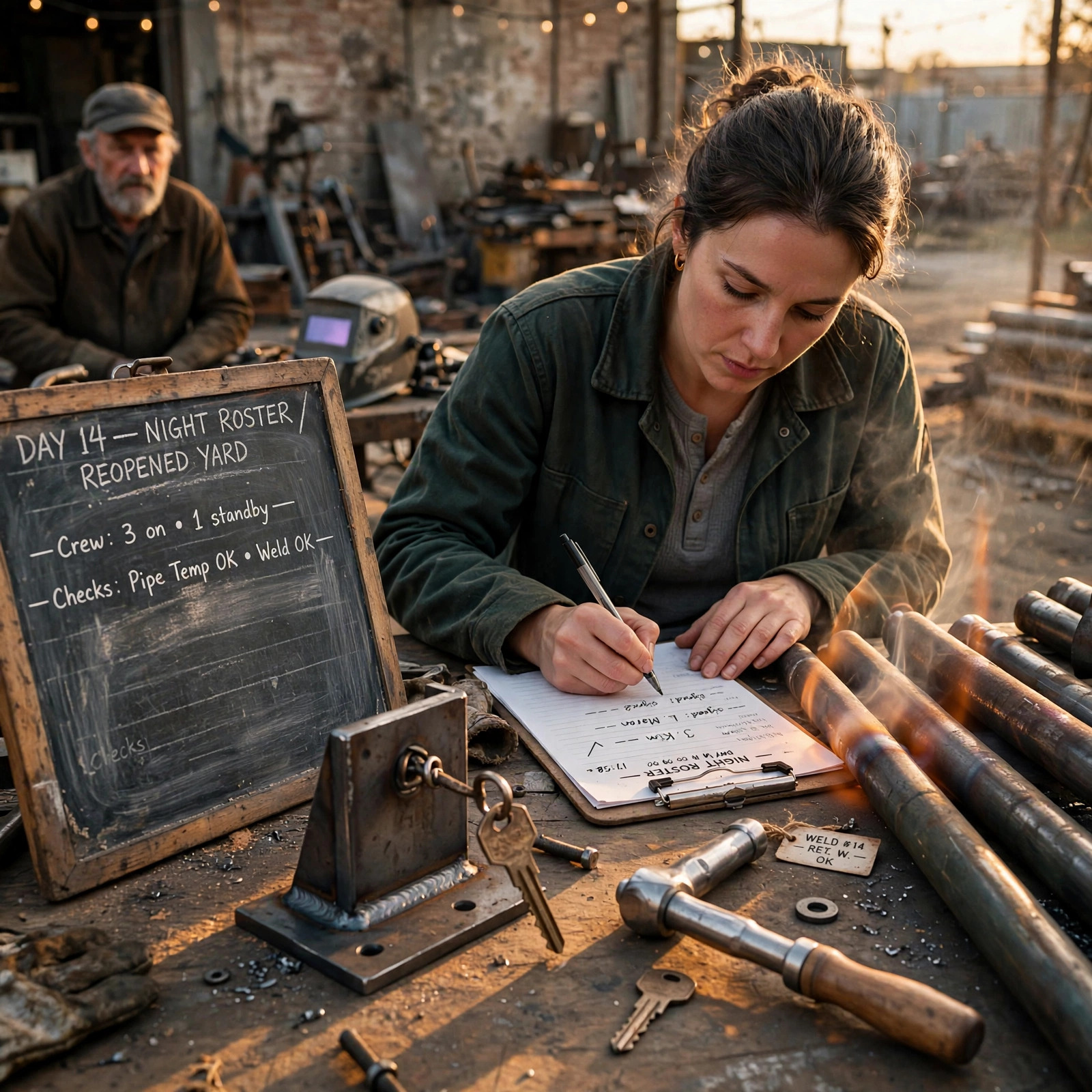
"Inlet's icing," Tomas said on the line. His voice was level in the way of a man reporting a thing he had already decided not to panic about. "Come see. And bring the key."
The key hung on its hook in the yard office, the brass one Marta Beck had cast and filed from a salvaged ship fitting the night the loop first charged in '32, the crank that opened the main distribution manifold in the pit on Ferrous Street. Sabel had put it back that morning eight days ago, unturned, and it had not been turned since. She took it down now and its cold bit through her glove.
The pit was white with frost. The inlet pipe, the forty-centimeter line that fed the digester rows from the return sleeve, had grown a sleeve of its own overnight, ice an inch thick in rings, and the flow gauge at the cellar stair read what Tomas said it read, which was wrong, and Sabel saw it was wrong the moment she looked past him.
"Tomas. That's the discharge column. Inlet's the left one."
He stood very still. The lantern they'd hung on the stair rail lit his face from below, and she watched him look at the board, the slate where tenders chalked cell temperatures and neighbors chalked debts, and she watched his eyes move along the columns the way a man's eyes move when he is reciting rather than reading.
"The left one," he said. "Yes. I know the left one. I've chalked that column three thousand nights."
"You read me the right one."
Frost creaked in the pipe behind them. Down in the yard, Vale's van pulled in at the gate, headlights sweeping the ice-ringed tanks, and he climbed out in a coat too thin for the night, tablet under his arm, come to canvass Ferrous Street's last undecided doors in the morning cold because he was a man who believed mornings were for convincing people.
Tomas did not turn around. He said, quietly, to the gauge and not to her, "It's been two years getting worse. A year since I stopped telling anyone. Marta knows. Now you do."
"The night roster requires a living tender," Sabel said. "You've been the tender."
"I've been the tender." He picked up the chalk from the board's pine ledge. "And the tender can't read his own column anymore after dark. So you'll have to decide what that is worth, and I'll have to decide if I say it in front of the district or you do, and I'd rather you didn't wait long, because I've been waiting a year and it's heavy."
She had no answer for him that wasn't a procedure, so she gave him the only thing she had, which was her hand on his shoulder for a moment, and then went down into the pit because the inlet was still icing and there was a loop above them going cold.
The manifold needed opening to bleed the surge pressure before the ice split a joint, and the key went into the socket and Sabel threw her weight on it, both hands, boots braced on the frozen rungs, and it turned a quarter and stopped. She threw her weight again. The cold snap had shrunk the brass in its seat and swelled the ice around the housing, and on the third heave the key gave all at once, and gave wrong, and she heard the handle take a bend a degree and a half off true, felt it through her palms, and opened the manifold with the crank bowed in her fist while the pressure bellowed and the vented gas smoked white into the lantern light.
Her hands had gone past numb into something worse. She climbed out with the bent key and blistered palms and found Vale at the pit rail with his tablet already out, and Marta Beck arriving down Ferrous in a coat with a torch, because word had gone up the row the way word goes.
"Cells three through six," Marta said, not asking. She'd read the yard. The spare digester tanks stood in their reserve row, six of them since the yard was laid out, and four of them tonight were venting thin plumes, their heater bands scorched black where the surge had burned the elements out. The digester rows themselves had held. The loop's two hundred and fourteen households were warm because the rows had held. But the spares were what stood between a bad week and a cold one, and four of six were dead.
"Six spares," Vale said, and he said it with a professional's reflex, counting, and then stopped himself, and that stopping was the first honest thing Sabel had seen him do.
"Two now," she said.
"Two." He looked at his tablet, and she watched him do the arithmetic she had already done, which was that a freeze like tonight's with two spares and a burned inlet put the district one bad night from rationing heat along Ferrous and Nagle row. She watched him arrive somewhere uncomfortable. "My overlay models the loop as self-regulating hardware," he said. "The study's operating data. It doesn't include tenders. It doesn't include a man on a shift with a lantern. I've been presenting an eleven percent improvement on a loop that doesn't exist. It exists with you in it, and tonight I can see that, and I'd rather say it here than have you say it in the chamber on the twelfth."
"You'll say it there anyway," Marta said, "or I'll wonder what you came down to this pit for."
"I'll say what the data says." He turned the tablet toward Sabel, and she made herself look. The offer had come in the mail on the seventh, on Corvid Hydro letterhead, and here it was again in his hand: a staff position with the study, her district knowledge titled and salaried, nine thousand dollars in emergency repair grant attached to cooperation, the money that would replace four cells tonight if she took it. "The grant doesn't require your signatures," he said. "It requires your cooperation. You know the loop better than my model does. I've known that since the fourth. Come and fix the model instead of fighting it. The loop gets its cells. Your street gets its heat. I get better data, and nobody stands in a chamber on the twelfth and loses."
Nobody stands in a chamber and loses. That was the offer's whole architecture, she saw: it was built for a woman who had twice sat down at the slate and twice put the chalk down, who had drafted a rebuttal and torn it up because she dreaded standing up under lights more than she dreaded the cold. He had read her file. He had read her.
"Tomas can't read his gauge after dark," she said. "He's been carrying the night shift for a year past the point he should've stepped down, because the roster is three tenders and if he says it out loud it becomes a staffing problem in a district that's about to vote on whether staffing the loop is worth anything. That's what your model doesn't contain. Not tenders as a category. Him. His eyes. Marta's brazes. My hands, tonight, on this." She held up the bent key, and the lantern showed the blisters rising across her palms. "You can buy my cooperation and my silence and four new cells, and on the twelfth the council votes on an overlay that runs a loop with nobody in it."
"I can amend the model," Vale said. "I can file the amendment myself."
"Then file it. Tonight. Because the council needs anything formal seventy-two hours before a vote, and the twelfth's deadline is tonight, and if your amendment and my rebuttal aren't both in the clerk's box by midnight, none of it exists as far as the district's concerned."
He looked at her for a long moment, and then at the two surviving spares, and at Tomas, who had not moved from the stair. "You're going to file the rebuttal anyway. Tonight. Knowing the count."
"What's the count?" Marta said.
"One hundred and twenty-two this morning," Vale said. "After tonight, fewer. Nine doors on Ferrous and Nagle signed with me and watched their heat go down in the small hours anyway, and I'd guess by noon I'm back below one hundred thirteen and falling. I'm not a fool, Ms. Reyes. I read streets as well as I read loops."
"Then read this one," Marta said. "I cast that key in '32 and I signed the covenant that this loop would stay hand-tended so no neighbor's heat ever depended on a control room it couldn't walk to. That paper has my name on it and it'll still have my name on it after the twelfth, whichever way the vote goes. Go amend your model, doctor. The pit's cold and she's got writing to do."
He went. His van ticked as it cooled at the gate, and then the street had its silence back, frost-white and holding, the two live cells faintly warm under her bare hand when she checked them, which she did, twice, before going in.
Tomas was still at the slate when she climbed the stair. The board's corner had cracked where he'd slammed it getting down here ahead of the surge, a split running through the pine frame, the chalk column for cell temperatures broken off at the seventh line. He'd wedged it flat with a shim.
"I'll say it at the yard tomorrow," he told her. "The eyes. Before anyone hears it from a distance."
"I'll stand next to you when you do." She looked at her palms, the blisters gone tight and shining. The clerk's box was a twenty-minute walk, the rebuttal was in her coat pocket where it had lived unfiled for nine days, rewritten four times, and the night had until midnight in it. "I have to go file a paper."
"You could take his money," Tomas said. "Nine thousand. Four cells. No chamber."
"I could." She turned the bent key in her hand, felt the wrong angle of it, the handle Marta had filed true in '32 now set crooked by her own weight, and put it back on its hook that way, because there was no time to straighten it and because a thing that has done its work bent is still a thing that has done its work. "But then the chamber goes my way or it doesn't, and I never once said out loud what I'd said it was worth. Goodnight, Tomas. Log the two cells before you sleep. Left column."
She walked to the council chamber's clerk box through a district going hard with frost, and at eleven minutes to midnight she posted the rebuttal with her own blistered hands, her name on it, the Sunrow's name under that, and walked home through streets that were warm, mostly warm, warm enough, with three tenders on the roster and a vote coming and three days to hold it all together.
The Sign-In Table
The council chamber had a smell of wet wool and floor polish, and the sign-in table sat just inside the doors with its ledger book open and a coffee urn going cold beside it. Sabel signed her name at the head of the Sunrow page, and under her name Ines signed, and Marta signed in a hand that pressed clean through the paper, and the three of them stood a moment in the doorway looking at the rows of folding chairs, which were filling up faster than she'd expected. Ferrous Street had come. Nagle row had come. Half the district, it seemed, had decided that a Friday in a hard frost was a reasonable thing to spend on a vote about pipes.
She had the key in her coat pocket. She'd meant to leave it on its hook. At the last minute, walking out of the yard office, she'd turned back and taken it down, and now it sat against her hip with its bent handle printing its wrong angle through the wool, and she was glad of it, the way you're glad of a hand to hold even when you don't need one.
"They posted the packet at noon," Ines said. "Your rebuttal's in it. Page four, right after his study summary, which I checked was the correct alphabetical humiliation to be placed under." Her breath was quick; she'd run from the dispatch office with the tabulated printouts still warm from the printer. "Ninety minutes of public comment before the vote. You're third on the list."
"Who's first?"
"A man from Nagle row who wants to talk about drainage for the full hour, probably. I'd sit near the front if I were you. The acoustics in here are terrible and Vale has a soft voice when he's losing."
Marta snorted. She'd dressed for the occasion in the manner of a woman who has outlived the need to impress anyone: good boots, a coat with a weld-burn on one cuff, her white hair combed flat. "He was polite on my porch," she said. "I'll say that for him. Sat on my step in the cold and told me my own loop back to me like it was a new invention. Twenty thirty-two, I told him. I cast that key off a ship fitting from the breakers yard, filed it true, charged the loop the same evening. He wrote it all down. Whether it went in the study is between him and his conscience."
"It went in," Sabel said. "The amendment went in. I read it this morning. Page eleven. He kept his word."
"Mm," Marta said, which was not agreement and was not quite not.
The chamber filled. The council filed in from a side door, five of them, ordinary people with ordinary jobs who had drawn the short municipal straw, and the chair called the session to order at seven sharp. Public comment ran long, as Ines had predicted. The drainage man took twenty minutes. A woman spoke about her mother's heat bill. A Sunrow neighbor Sabel knew by face, from the far end of Ferrous Street, stood up and said only, "The water went cold on a Thursday and it came back warm by Friday morning, and I don't think a machine in Ketterbridge did that," and sat down, and that did more than twenty minutes of drainage.
Then the chair said her name, and Sabel walked to the front, and took the bent key out of her coat.
"This is the crank for the main distribution manifold on the Sunrow loop," she said. "It's brass. Marta Beck cast and filed it in 2032, the evening the loop first charged. Nine years, three nights a week, it has been turned by hand. On the ninth, during the surge, I used it to isolate the manifold before the freeze came up the return sleeve, and I bent the handle doing it, because I was leaning my whole weight on a tool meant for a lighter hand, and I'm not a light hand." She set it on the clerk's table so the overhead light caught the crooked angle. "I could have straightened it. There's a vise in the yard office. I left it bent, and I'll tell you why before I sit down."
Vale was in the second row. She could see the top of his head, the gray coming in at the part, the notebook flat on his knee. He was not looking at the key. He was looking at his notebook, which meant he was listening hard, or was ashamed, and she had spent enough days around him by now to know it was both.
"Dr. Vale's study says the tight-loop overlay models eleven percent better efficiency than what we run," she went on. "I don't dispute his arithmetic. I've read his model three times. It's a good model of hardware. It is not a model of us. Every line of operating data in it assumes the loop regulates itself. There is no tender in it. No night shift. No hands. And the law of this district says a living tender is on shift whenever the cells charge. There's no waiver for the Sunrow, and there shouldn't be, because on the ninth the tender was Tomas Grell and I was there too, and the freeze surge burned four spare cells, and the thing that stopped it burning four more was this key, turned by hand, at two in the morning, by people who live inside walking distance of every joint in the line."
The chair said, "Ms. Reyes, the council has your filing. Is there a question before the body?"
"There's a photograph," Sabel said. "Two, actually. Ines."
Ines came up with the printouts and handed them to the clerk, and the clerk walked them along the dais, and Sabel watched the five faces bend over the same image: the chalk ledger board off the cellar stair, its pine frame split at the corner and shimmed flat, the temperature column broken off at the seventh line where the surge had caught it. Nine years of nights in chalk. Debt columns and cell readings, neighbors' names, Tomas's daughter's frame from 2035.
"That's the operating record the study doesn't have," Sabel said. "That's the data. It lives on slate."
Vale stood up, and the chair recognized him, and he came to the front, and he stood next to the bent key without touching it.
"I'd asked for the floor after Ms. Reyes," he said. His voice was as soft as Ines had promised. "I filed an amendment on the ninth. It states the omission she's describing. I believe it does preserve service, the overlay. I want to say that plainly, one more time, because I said it on the ninth and I'll stand by it. But she is correct that my model contains no tenders, and I did not know that mattered until I stood in a cellar and watched a man read a gauge by feel because he can't read it by sight at night anymore. The amendment is in the packet. If the council votes the overlay, my recommendation, now, is that it not pass to consolidation without a tendered operating plan attached. That's a change from my study. I'd rather say it here than have it dragged out of me."
He sat down. Nobody heckled him. That was the strangest part, Sabel thought later: he had stood in front of a room full of people who had spent two weeks being angry at him, and he had made it worse for himself, and everyone had let him.
Ines was already back at the front, though, before the chair could move on, waving the second printout. "One more thing," she said. "It's in the packet as an appendix but it's page twenty and I don't trust anyone here to read that far. This is the district dispatch log for the fourth, the day of the Ferrous Street warm-water outage. The one that started all the canvassing. Line forty-one. Corvid Hydro field crew, preliminary sensor tap, Ferrous Street return sleeve, 09:20. Logged, stamped, signed. They installed the study's own monitoring tap that morning, and at 09:52 the sleeve went cold, and the crew left at ten, and the outage started forty minutes after their install and twenty minutes after they stopped touching it. The study never connected it. I connected it Tuesday, because dispatch logs are my job and nobody else was going to."
The room made a sound then, low, not quite a murmur, the sound of two hundred people recalibrating at once.
Vale was on his feet again. "I didn't know," he said, simply. "On the record. That was my crew. I'll pull the field report and submit it to the clerk before this session ends. The outage was attributed to joint fatigue. That may be true. It is not proven true. Ms. Oduya is correct that the tap is not in the study."
He sat down and wrote something in his notebook, and this time he didn't look up.
The chair called the question on the consolidation trigger. The count was read into the record: one hundred signatures of one hundred forty required. The trigger failed. It wasn't close, though it also wasn't a landslide, and Sabel noticed, with a strange small ache, the names she knew had signed and weren't in the room, neighbors who wanted their heat bills down and weren't wrong to. Vale didn't leave. He sat through the whole count with his head down, taking it the way you take a thing you've earned part of.
Then the chair said, "Ms. Reyes, there's the matter of the emergency repair grant. Nine thousand dollars, district funds, already allocated against your loop's repair schedule. It requires only your signature, and it's tied to the study's data access terms. The offer stands regardless of the vote."
"It stands because of the vote," Sabel said. "It's tied to the manifold. I read the terms on the ninth. The money deeds the Ferrous Street manifold into the overlay study as its data property, in exchange for nine thousand dollars and a clause about non-interference that my lawyers would laugh at if I had lawyers. So: no. I decline it. Publicly, on the record, so nobody can say later that the Sunrow took district money and then blocked the district's study. We'll braze the sleeve ourselves. We've got two spare cells and a shimmed slate board and a key that's bent, and we'll get by the way we've been getting by."
The chair nodded and the clerk marked it, and the session moved on to drainage, and Sabel came down off the front with her ears ringing in the way they did after a room had listened to her.
She stopped at the sign-in table on her way out. The ledger book was still open to the Sunrow page. Beside it lay the grant form, filled out in the clerk's neat hand, nine thousand dollars, one line blank for a signature. She picked it up, and Marta, waiting by the door, said, "You're not going to do something dramatic with that, are you?"
"No," Sabel said, and put it flat on the table, unsigned, squared neatly with the table's edge, and laid the bent key on top of it so the crooked handle held the paper down. "I'm going to leave it exactly where it can be seen from the door."
Ines fell in beside her, then Marta, and the three of them went out through the lobby, past the tally board where the clerk was already chalking up the evening's numbers, one hundred of one hundred forty, the trigger failed, the frost hard on the windows and the Sunrow waiting at the far end of the walk, warm, mostly warm, warm enough, with three tenders on the roster and hands enough to keep it that way.
The New Bracket
The yard gate took both hands and a shoulder, as it always had, and Sabel Reyes put her shoulder into it the way she had on her first shift and every shift since. Frost still held the gravel in a thin gray crust, but the pipes along the fence were breathing warm, and the two recharged spare cells sat coupled into the digester row with their fresh hoses shining dull under the low sun. Two cells. Four had burned in the surge, and two had come back overnight on the trickle charge, and that arithmetic was the whole margin the Sunrow had. She walked the row once before anyone else arrived, palm flat against each tank in turn, reading heat the way Tomas had taught her to read it, slow and patient and with the whole hand.
Ines arrived with a crate of dispatch boards under one arm and her breath showing white. She set the crate on the yard bench and started clipping boards to the fence rail without a word, which was how she preferred to be greeted, and Sabel let her do it.
"Roster's posted," Ines said finally, squinting at her own handwriting. "Tomas took the daylight slot. Signed it in front of me so there'd be no pretending later."
"Good."
"He wants the training walk-through to start today. Not next week. Today, while the frost still shows him where the cold pockets are."
Sabel nodded. She had known that too, in the way you know a thing before anyone confirms it.
Tomas came through the gate with two people behind him. Not strangers, Sabel knew both faces from the canvass and the soup line, but she had not known them as tenders, and that was the point. Tomas walked the row with his hand out and his eyes down where the ground was, and when he reached the gauge tree he stopped, and turned, and faced the yard full on for the first time since the cellar.
"Right," he said. "First thing. The slate lies to you from the corner seat, so you read the gauge from the top stair, always, or you read it from here." He pointed. "Second thing. The loop doesn't care what you meant to log. It cares what you logged."
One of the two, a stonemason from Ferrous Street, said, "That's a hard way to put it."
"It's the way the frost puts it," Tomas said. "I've got a year of reading gauges wrong off the corner seat to tell you so, and Marta can tell you how much heat that cost her kitchen, and I'd rather you learned it from me than from the frost. Come on. Daylight's the forgiving shift. We start now."
He said it plainly, without apology, and Sabel stood by the bench and let him say it, because it was his to say, and because a month ago he would have said none of it, and would have gone on misreading gauges in the dark until something froze that couldn't be thawed.
Midmorning, a woman from the low end of Ketterbridge came up the path with a paper in her glove. Sabel recognized the form before she recognized the handwriting: the withdrawal sheet from the study, the same one Vale's canvass had carried door to door. The woman handed it over without ceremony.
"Him and me talked it through," she said. "After the vote. We signed on for the warm-water promise, not for the part where nobody's home if the pipes go wrong. We want our name back."
"It was never gone," Sabel said. "The signatures went to the study. Your heat didn't."
"I know that now." The woman looked at the row of tanks, at the two new tenders copying gauge numbers, at Tomas with his hand on a valve. "That's kind of the point."
Sabel logged it in the yard book. Ninety-eight. Two more gone since the tally, and she found she felt no victory in it, only the odd, level relief of a number telling the truth. The overlay had needed a hundred and forty and had peaked at a hundred and twenty-two, and now it was less than a hundred, and none of that had been won by argument. It had been won by a woman watching a man teach his shift to somebody else.
The second withdrawal came after noon, brought by a neighbor on the coal path, and this one came with a question attached.
"The nine thousand," the neighbor said. "The grant. They're saying at the market it dies with the study, since you wouldn't sign."
"It dies with the study," Sabel said. "That's what it was for. Nine thousand dollars against the deed to our manifold. We'll braze the sleeve ourselves. The crew's coming Thursday."
"And if the braze fails?"
"Then we braze it again, and we'll see it fail, because we'll be standing next to it." She heard her own voice come out harder than she meant, and softened it. "That's the whole of what we asked for, in the end. To be standing next to it."
The neighbor considered that, nodded once, and went back down the coal path.
Marta set up at the manifold pit after the sun crossed the yard. She had her wheelbarrow, her rods, her face guard pushed up on her forehead, and a length of steel stock leaning against the pit wall. Sabel had seen her weld before, on the return line, on the soup kitchen flue, but she had never watched her work slowly, which was how Marta worked now, with long rests between runs, the way a person works who has earned the right to take her time.
"Hold this," Marta said, and Sabel held the steel flat against the pit's new post while Marta tacked it, and the yard smelled of hot metal and thawing gravel.
"Two brackets," Marta said over the hiss. "One for each. A place for the old one so anybody walking past can see what nine years of shoulder does to brass, and a place for the new one so nobody thinks we're sentimental."
"We are sentimental."
"We're practical," Marta said, and dropped her guard and looked at Sabel straight. "I cast that key the night the loop first charged. Nobody paid me. I signed the covenant so no neighbor's heat would ever depend on a control room off the district. I've kept that promise nine years and I broke my shoulder keeping it, so don't you dare file me under sentimental. The bracket is so the next tender knows where the crank lives and what it costs. Both of them."
The weld cooled. Marta took the bent brass key from her coat, where it had ridden since the council chamber, and hung it on its bracket, crooked handle out, catching the low sun. Beside it she seated the fresh steel crank, straight and bright, made by the district shop to Marta's drawing and paid for out of the loop's petty cash, which was four hundred dollars and a lot of scraped barrels.
Before dark, Sabel went down to the Sunrow cellar to settle the slate. The board still hung at the stair landing, its pine frame shimmed flat where the corner had cracked. She stood at the top stair, where a gauge is read honestly, and looked at the board the way she supposed Tomas must have looked at it for a year, all those figures written by lamplight by a man going blind, and every one of them double-checked in the morning by nobody.
She took the rag and the chalk down from the nail. Then she wiped the board clean, all of it, the temperatures and the tallies and the debt column, the whole gray skin of four winters' arithmetic, and started it over. New column: cells in service, two. New column: tenders on roster, three. New column, and she printed this slowly, so the letters would last: debts owed to the loop, struck through where paid, kept where not. She struck through Marta's kitchen drawing from the winter of the shoulder. She struck through the Ferrous Street coal ride. She kept the mason's unworked hour, because a ledger that forgets what it's owed is only a slate, and this one was a promise. Somewhere in the middle of it Ines came down behind her with a lamp, and read over her shoulder, and said nothing, which from Ines was a long speech.
"When I'm done," Sabel said, "I want the frost dates from last winter on the bottom rail. So the new tenders know what a hard year looks like on paper."
"I'll copy them from the old photo," Ines said. "The packet clerk sent the print. It's in my crate."
The lamp steadied. Sabel wrote the last figure, set the chalk on the nail, and went back up the stairs into the cold.
The yard was blue with coming dusk and the row was holding its heat. Tomas was gone home, and his two replacements with him, walked all the way to the coal path with their boards full of practice numbers. Marta had packed her wheelbarrow. Ines had the lamp.
"First shift of the new roster starts at eight," Ines said. "You signed it."
"I signed it."
Marta looked at her from the gate, guard still pushed up on her forehead. "There's nobody making you. You know that. The roster's full without you."
"I know," Sabel said. "I want to read the twelve o'clock gauge myself. From the top stair. I want to know what the loop does when nobody's watching it but somebody." She pulled her gloves on. "That's the whole point of the thing. It was always the whole point."
Marta nodded once, the kind of nod she gave to welds that would hold, and left her the yard.
Sabel took the lamp from Ines, walked the row alone, palm flat on each tank, and at midnight she climbed the top stair of the cellar with the light held high, and read the gauge honestly, and wrote it on the slate where anyone could see.
Get notified when new stories drop

Leo Stranek
Leo specializes in solarpunk abundance and near-future progress: livable futures, bright cities, and practical wonder.
Leave a comment
Comments