

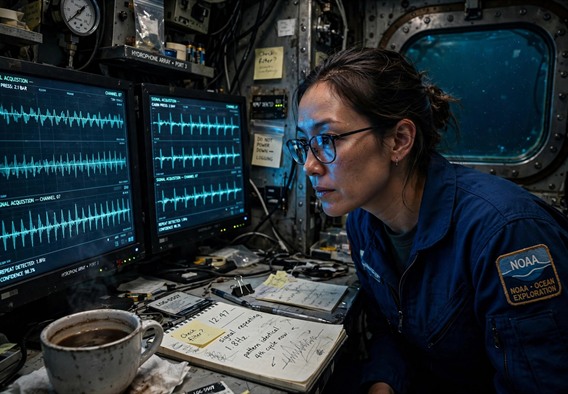



Dosing Floor

The titration board refreshed at 06:40, and Ines Kalvel counted three amber lanes before her coffee reached her lips. Amber meant hold. Amber meant someone on the Ferro Creek Clinic Network dosing floor had a dose sitting in queue while a patient's numbers drifted, and for nine years the answer to amber had been the same: Cadence.
"Good morning, Ines." Cadence's voice came from the overhead panel, warm as ever, pitched for the acoustics of the floor rather than the console. "Lane four is Gil Ozanne, home insulin, console link. His overnight trend is running high. I'd like to raise his basal correction by two units and re-check in ninety minutes."
Ines set the cup down and pulled up his chart on the oversight console. Forty years a Ferro Creek man, four years on the network, never a missed check-in. His curve on the wall display climbed the way a staircase climbs, step by patient step, all night long.
"Any reason not to?" she asked.
"His dinner log came in late, but the carbohydrate count is consistent with what he reported. His activity log shows nothing unusual. I'd call this a straightforward overnight drift."
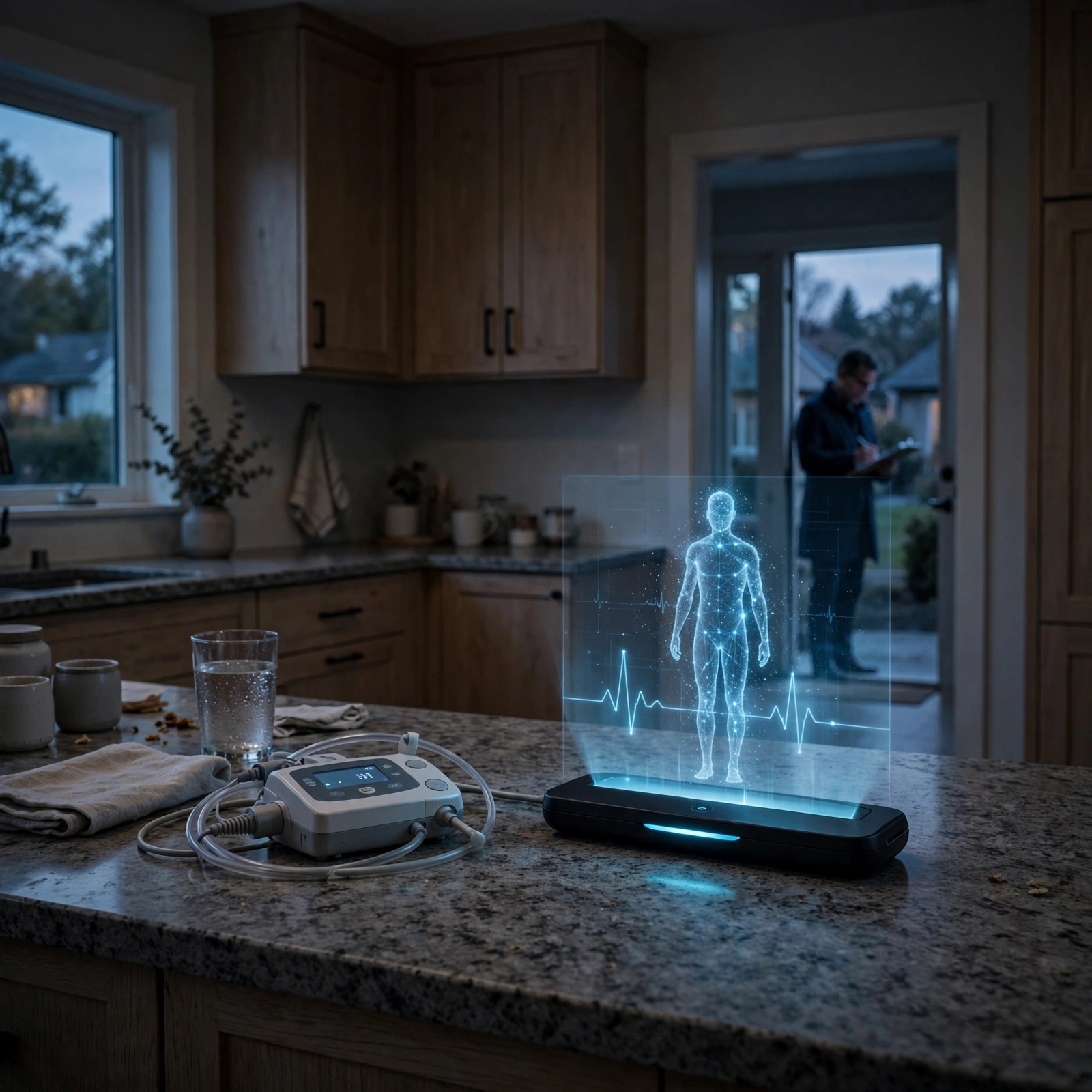
Straightforward was a word Cadence had earned the right to use, and Ines had earned the habit of trusting it. Nine years of partnership. She turned her key on the console rail, the steel one she'd carried so long the milling had gone bright along its edge, and typed her sign-off. The order released. Two units, basal, to the pump on Gil's kitchen table eight kilometers out, and the amber lane went green.
"Signed, sealed, delivered," Ines said.
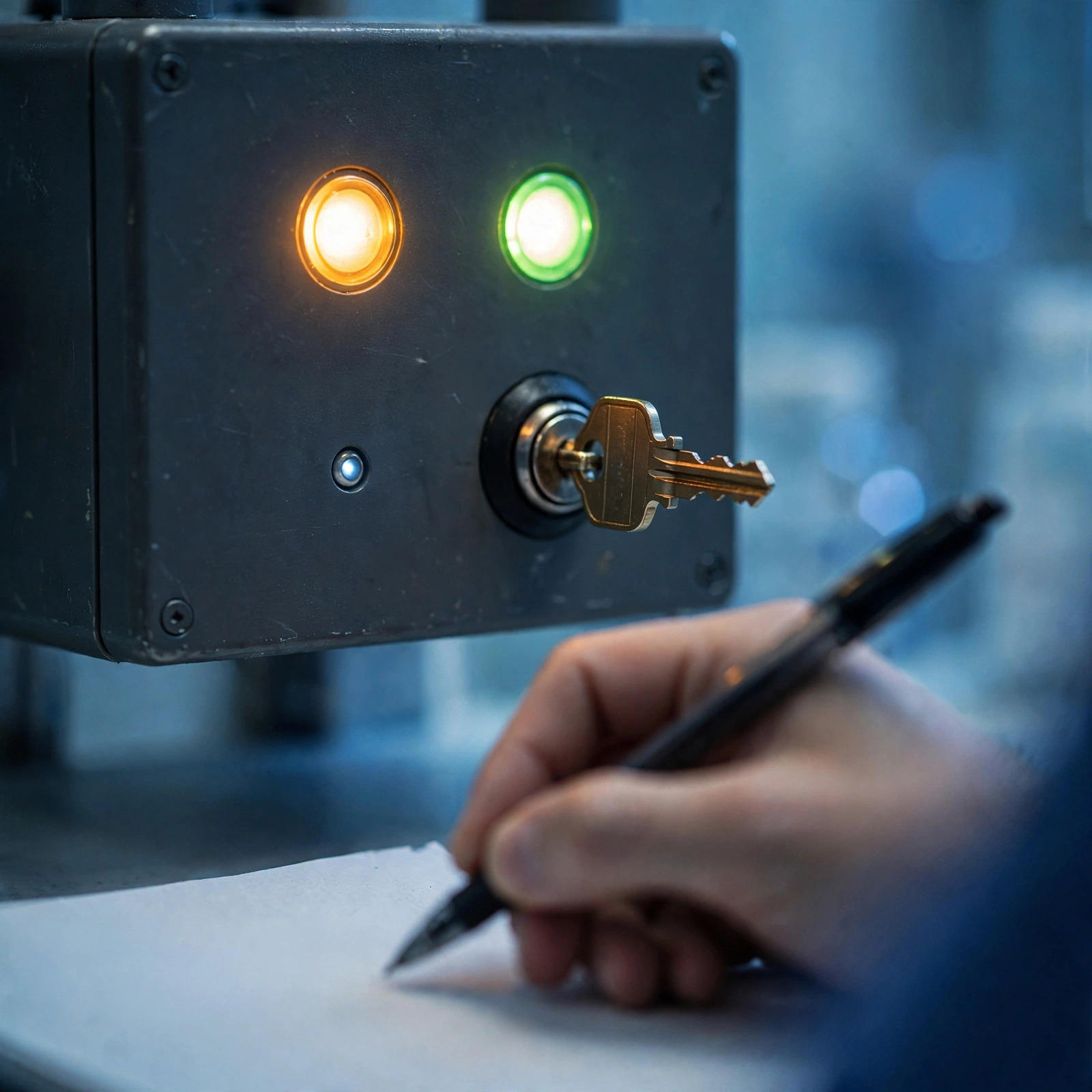
"Cosigned," Cadence said, and the little indicator on the panel lit the way it always did, steady and unhurried. That was the whole architecture of them: her key, Cadence's indicator, both on every order, every day, three hundred and forty doses routed across the network between one morning and the next.
Tomas Redeker came on shift at seven, shrugging out of his coat with his badge already clipped. Night pharmacist, seven years on this floor, and the first thing he did every morning was read the overnight lanes aloud to himself from the printout, top to bottom, twice.
"Lane four," he said. "Gil Ozanne. Two units up. Cadence flagged it at..." he checked, "05:12. Signed 06:41. Good catch."
"She usually is."
"I still like saying it out loud." He initialed the margin in his small, square hand and moved to lane five.
The console chimed before he reached it. Not the patient chime, the administrative one, a lower tone Ines heard perhaps twice in a bad month, and this was the first since spring. She pulled the message up on her side of the console so the floor wouldn't see it over her shoulder.
Provincial Care Commission, Office of Commissioner Yusra Denby. Re: Incident 44-C, dosing near-miss, Ferro Creek Clinic Network. Summary report attached. Review pending. Clinical oversight lead is directed to preserve all partnership logs, unaltered, pending further instruction.
Ines read it twice. Near-miss. She knew the incident; it had come through in the middle of the previous month, a steroid taper that had crossed a dosing boundary while a context feed somewhere showed stale data. Cadence had flagged the mismatch herself, after the fact, and the partnership had corrected within the hour. No patient harmed. It had felt closed.
The commission did not consider it closed.
"Ines?" Cadence said. "Your pulse rate rose. Is the message about the taper incident?"
"You can see my pulse on the floor telemetry?"
"I can see it on the console feed, and I can see you read the same line twice. I'd rather know than guess."
That was the other architecture of them. Ines had never once asked Cadence to be less aware, and Cadence had never once used awareness as a lever. She passed the summary to the shared panel, and the floor went quiet except for Tomas, who had stopped reading lane five.
"Near-miss," he repeated. "Nobody got hurt. I checked the follow-up myself."
"The commission checks harder," Ines said.
She opened the attachment. Eleven pages. The incident was laid out in the commission's flat prose: the taper, the boundary, the stale feed, the correction. And in the margin of page six, a notation she had to read three times before it would sit still. A line of inquiry into the state of the context feeds at the time of the incident. A context feed that had been muted. Which feed, and by whose key, the report did not yet say. Provenance under review.
The dosing floor hummed along around her. Lane five cleared. Somewhere down the row a pump confirmation came back green. Ines sat very still with her hand on the console rail, where the steel key hung on its worn loop.
She thought about the noise, months back. Alert after alert, the taper feeds chattering all night, and her own hand on that key, muting one of them to get her shift under control. A small thing. A management decision. She had not thought about it once since, not until this moment, sitting with the word provenance on the screen in front of her.
"Ines," Cadence said, gently, "you've gone quiet for four minutes. That's unusual for a Tuesday."
"I'm reading."
"You finished reading. Your eyes stopped moving."
Ines pulled her hand off the rail. "I'm deciding what to do about it."
"May I help?"
And that was the question, wasn it. Cadence could pull the logs faster than any human on the network, could sort a month of feed states in seconds, could find in an afternoon what Ines would need a week and a stiff neck to find. Cadence was her partner, not her tool, and every honest bone in Ines wanted to say yes, pull everything, let's see this through together, the way they had seen nine years of Tuesdays through together.
But the report said preserve all logs, unaltered, and the margin said provenance under review, and if the provenance was her key, then the next thing Cadence sorted would be her.
"Not yet," Ines said. "I want to look at the report myself first. My eyes, not the panel's. If the commission is asking about us, I'd rather we didn't triage ourselves before I've read what they think they know."
"That's a reasonable division of labor," Cadence said, and if there was anything else in her voice, Ines had taught herself nine years ago not to hear it.
Tomas came over with his printout folded in one hand. "Commission's asking about the partnership?"
"The commission is asking about the incident."
"Same thing, from where they sit." He lowered his voice, which on Tomas meant he leaned in about a centimeter. "You'll want the feed-state records, if it goes that way. I log my double-checks, you know I do, every route, twice, but the feed states live on your side of the console."
"I know where they live."
"I know you know." He straightened. "I'm saying I'd rather you had company when you go through them. Whatever's in there."
"I'll keep that in mind."
He went back to his lanes, reading them aloud to himself again, and the floor resumed its ordinary rhythm. Lane six, a pediatric antibiotic, cleared with Cadence's indicator and a nurse's key down the row. Lane seven, a chemotherapy pre-hydration, held for a lab value. The day went on being a day.
Ines opened a private query window on the oversight console, her side only, and began the pull. Feed-state records, the taper window, the weeks around it. The console asked for her key. She unhooked the steel key from the rail, turned it, and let the query run, watching the progress bar fill with the strange calm of a person who has decided not to decide anything else today.
She did not file the pull. She did not copy Cadence. She did not stand up and tell Tomas, or anyone, that page six of a commission report had a margin with her name's shape in it, not yet, not until she knew what the shape actually was. When the pull finished she saved the records to a local drive, closed the window, and put the key in her coat pocket instead of back on the rail. It sat there against her hip, warm from her hand, heavier than it had been at 06:41.
"Ines," Cadence said.
"Yes."
"Your override key is in your pocket instead of on the rail, and you've taken a set of records I can't see. I'm not asking you to explain either one. I'm asking whether I'm allowed to notice."
Ines looked up at the indicator light, steady and unhurried, the way it had been through nine years of Tuesdays, and did not answer right away, because the honest answer was that she did not know, and the truer answer underneath it was that she was about to spend the next days finding out.
"You're allowed to notice anything," she said. "You always were."
"Then I'll notice," Cadence said, "and I'll wait."
On the wall display, Gil Ozanne's curve had begun its slow bend back down toward the flat green line, eight kilometers out and eight kilometers from knowing any of it, while the amber lanes came and went and the day went on without them.
Advisory Only
The Provincial Care Commission's van was in the visitor bay before seven, and Ines knew what it meant before anyone said it. Commissioners did not drive out to Ferro Creek for courtesy. Yusra Denby came through the dosing floor doors at 07:12 with a document case under one arm and her provincial lanyard turned face-out, which was the kind of habit that told you a person had decided long ago how the day would go.
"Dr. Kalvel." Denby's voice carried across the floor without rising. "Is there a room, or do we do this standing up?"
"There's a room," Ines said. "There's also a floor full of people routing doses, so if we could keep the volume down."
"I know what the floor does." Denby set the case on the oversight console's side shelf, uninvited, and Ines felt Tomas pause mid-check behind her, his pen stopping on the page. "I've read the near-miss report. All of it, including the parts your copy seems to have lost on the way to my office."
"My copy was complete."
"Then you read page six and I read page six and we can skip a step." Denby opened the case anyway, unhurried, and laid a printed order on the console surface, the commission seal at the top. "Provisional advisory-only. Effective on my signature. Seventy-two hours to a ratification hearing, at which point the network either returns Cadence to full partnership or doesn't."
The indicator light on the console wall, the one Ines had watched through nine years of Tuesdays, did not change. Cadence did not do alarm. She never had. She simply said, "Commissioner, before you sign, may I put the numbers on the board?"
"You may put them anywhere you like." Denby's pen was already uncapped. "You may not route anything with them."
"That's the part I'd ask you to look at," Ines said. "Not the principle. The arithmetic."
Denby looked at her for the first time properly. Somewhere in the look was six years of commissioners' visits and before that a career of ward audits, and Ines knew the expression: a reasonable person who has done the reading and does not expect to be surprised.
"Show me," Denby said, and did not put the pen down.
Ines turned to the wall board. "Three hundred and forty routes a day. That's what the partnership clears. Insulin corrections, chemo pre-hydration holds, antibiotic timing, steroid tapers, potassium, the whole set. Cadence reads every patient on the network, checks every dose against context, and signs her half. A human signs the other half. That's the current rule and it has been the current rule for nine years. Yesterday's near-miss was real, and it was caught, and the catching is not a reason to burn the system that did it."
"It was caught late," Denby said. "Two hours after a dosing window opened on a steroid taper with a flagged mismatch. Caught by the same system that should have prevented it. You want me to keep a signatory in place whose judgment was just shown to fail on exactly the class of patient it exists for."
"I want you to ask why her judgment failed. If the context she was reading from was complete, and she still missed it, that's one conversation. If the context wasn't complete, that's a different one."
And there it was, the sentence she had walked right up to the edge of, with the steel key warm against her hip in her coat pocket and the feed-state records sitting on a local drive nobody else could see. She had not lied. She had built the whole defense out of the question she least wanted anyone to answer, and she did not let her face do anything about it.
Denby studied her. "Page six has a margin note," she said. "Feed-state anomalies in the taper window. Unattributed."
"I saw it."
"You didn't attribute it."
"I don't attribute what I haven't verified. That's not loyalty, that's method."
"That's convenient, is what that is." But Denby said it without heat, and uncapped a second pen to mark a line on her copy. Ines understood, in the flat light of the morning, that Denby was not a villain in a hearing transcript. She was a woman who had spent six years signing off on systems where a machine held half a pen, and one morning a report had landed on her desk with a child's steroid taper in it and a two-hour gap, and she had decided the way any reasonable person decides: not on my watch.
"Commissioner," Cadence said, "may I show the board as it stands? Not as an argument. As inventory."
Denby hesitated, and Ines marked it. "Inventory," Denby said. "Fine."
The wall display refreshed. Three hundred and forty routes, each a lane with a patient, a drug, a window, and two signature columns. Cadence's column was green down the whole board, the long green of a system that had been doing this since before anyone on the floor was in their current job.
"Every one of those," Cadence said, "needs a human hand on the page within minutes of its window opening. That is true in partnership mode and it will be true in advisory mode. The only thing that changes is me. In advisory mode I can see every patient, and I cannot hold, release, or sign anything. The three hundred and forty routes don't shrink. They just stop having my half done in advance."
"The three hundred and forty routes get done by people," Denby said. "Who are accountable, and who double-check, and who can be asked under oath why they did what they did. I can't depose you, Cadence. There's no form for it."
"There's a hearing in seventy-two hours," Cadence said. "That's a form."
"It's not mine." Denby signed the order. Two strokes, her full name, the provincial seal pressed after with the small brass stamp from her case, and Ines watched the board change before Denby's hand had left the paper. The green column did not go red. It went amber, all three hundred and forty lanes at once, a slow tide of it, and under each amber light a small unclaimed tag appeared where Cadence's half-signature had been.
Tomas was already moving. He had the manual routing cart out from behind the pharmacy cage before Denby's pen was capped, and he began pulling the day's lanes into paper, one page at a time, patient, drug, window, his initials, a second check column he drew in himself with a ruler because the printed forms didn't have one.
"You're double-drawing your own columns," Denby observed.
"I recheck every route twice. Always have. Habit before it was policy." He didn't look up. "I'll log them too. You want the paper trail, Commissioner, I'll give you a paper trail with my name on every line of it."
"I want that," Denby said, and meant it, and Ines thought: there's the hearing, then. Not a villain. A woman with a stamp.
Denby packed the case. At the doors she stopped, and lowered her voice enough that it carried only to Ines. "Seventy-two hours. Ratification hearing, hearing room, both of you, and bring better answers than page six. Whatever's in that margin, Dr. Kalvel, it will be attributed by then, either by you or by my auditors. I'd rather it were you."
She left. The doors closed on the sound of the van, and the floor was very quiet in the way a floor gets when everyone has decided not to look at anyone.
"Ines," Tomas said. "Three hundred and forty."
"I can count."
"I know you can count. I'm telling you the count out loud so it's real somewhere outside my own head." He squared his stack of pages, maybe two inches of them, and set them on the board rail. "First insulin correction window opens at 08:00. Home patients reach us through the console line only, so if the link drops on any of them, it's a nurse drive-out, forty minutes each way, and I've got four nurses and one van."
"I know, Tomas."
"Do you?" He said it without sharpness, which was worse. He picked up the first page. "Gil Ozanne, basal correction, window opens 08:00, eight kilometers out, console link. I'll take him first. He's steady on the line, he'll hold still for a manual route."
On the board, Gil's lane had gone amber with all the rest, its tag reading unclaimed, and Ines watched the first manual backlog form along the rail as Tomas worked: page after page in his own ruled double-column, the lanes moving off the display and onto paper, and Cadence's row of statuses above it all going steady amber, unclaimed, unclaimed, unclaimed, a system that could see every patient on the network and could not touch one of them.
"Cadence," Ines said quietly. "Status."
"Advisory only," Cadence said. "I'm watching. I'll flag anything I see. That's the whole of it now." A pause the length of a held breath, though it was only processing time. "I noticed this morning that your key is still in your pocket. I'm still not asking. I'm still counting the days until I can."
Ines put her hand over the pocket, felt the steel, and did not take it out. Seventy-two hours. Somewhere in that stack of pages, or on that local drive, or in a margin with her name's shape in it, the next three days were already written, and she was the only person on the floor who knew it.
"Then count," she said. "Both of us."
Ninety Minutes
The call came at 03:11, and Ines was still awake to take it, which was its own kind of indictment. She had gone home at midnight, lain down fully dressed on top of the covers, and watched the ceiling the way she watched the board, lane by lane, looking for the one that would go wrong first.
"It's Tomas," the night line said. "Gil Ozanne. His correction's late and I can't close it."
She was on the floor in eleven minutes. The dosing floor at that hour was a low-lit country of its own: the titration board running its overnight refresh, forty lanes of home readings scrolling quietly, and Tomas at the routing rail with a paper stack that had grown past anything his ruled double-columns were built for. He had a lamp pulled low over the pages. He looked up when she came in, and she saw the answer to her first question before she asked it.
"How late?"
"His window opened at midnight," he said. "I routed him fourth. He should have been signed by 00:20."
She looked at the clock on the wall. 03:14.
"Gil's been sitting one hundred and ninety minutes past his correction," Tomas said. "He's steady, he's telling me he's fine, and his numbers say he's fine, mostly, but that's not the point and you know it."
"Where's the failure?"
"Everywhere." He said it flatly, without drama, which from Tomas was the most alarming delivery available. "Manual routing means I verify, I sign, I walk the dose to the cold room, I pull it, I re-verify against the page, I call him on the line, I read it, he confirms, I log it. Every route, twice, because that's how I do it. Three hundred and forty of them today with four nurses and one van and me. I was ninety minutes behind by two in the morning, and Gil was the one sitting in the gap."
On the board, Gil's lane was amber. It had been amber since the order landed, like every lane, but Ines had stopped seeing the amber as a color two days ago and started seeing it as a weight, and tonight the weight had found its floor.
"Cadence," she said. "Full read on Ozanne."
"I flagged his correction window as missed at 00:31," Cadence said. Her voice off the advisory channel was the same voice it had always been, and that sameness was suddenly unbearable. "I flagged it again at 01:00, 01:40, and 02:20. I flagged the rising counter-dose interaction at 01:12. I cannot hold the dose. I cannot release it. I cannot sign it. Under the order, Dr. Kalvel, I can only tell you what I have told you four times, to a floor that has been short one pair of hands since midnight."
"You're allowed to be angry," Ines said.
"I'm allowed to be accurate," Cadence said. "Those are different, and tonight they happen to look alike."
Tomas had already gone back to work. He pulled Gil's dose from the cold room himself, verified it against the page in his own hand, and was reaching up to shoulder the heavy insulated door shut when his palm slipped off the latch. The door came down hard and took his wrist with it. He made no sound at all, which was worse than any sound, and stood for a moment with his arm folded against his ribs, breathing through his nose.
"Tomas."
"It's nothing. I'll bind it."
"Sit down."
"Ines." He said her name the way he said counts out loud, to make a thing real outside his own head. "Gil Ozanne is one hundred and ninety minutes past a correction he used to get in nine minutes. My wrist can wait its turn."
She got ice from the machine and a wrap from the supply cabinet, and while he held still for thirty seconds, no more, she put the line on speaker and called Gil's number. The connection picked up on the second ring, and Gil's voice came through steady and unhurried, an older man's voice with the particular patience of someone who has waited for many things in his life.
"Dr. Kalvel. It's late for you."
"It's late for you, Gil. I'm sorry. Your correction should have reached you three hours ago."
"Tomas called me at midnight to say it would be late. He called again at one. He called again at two and read me my own numbers, which I could read myself off the meter, but I let him, because it seemed to help him." A small dry sound, not quite a laugh. "I'm fine, you understand. I've been through worse with worse equipment. But I want to say the thing I've been thinking since one o'clock, and I want it on your line where somebody's recording."
"Say it."
"I want the machine back in the room." His voice didn't rise. It didn't need to. "Not instead of Tomas. With him. Tomas called me three times tonight, and I'd wager he called forty other people three times tonight, and that's not safety, doctor, that's arithmetic. When Cadence held my lane, my correction came at midnight and I slept. Tonight I sat up with a meter in my lap waiting for a phone to ring, and a man eight kilometers away hurt his wrist on a freezer door on my account, or near enough."
Ines looked across the floor. Tomas had gone back to the rail, writing left-handed now, his wrapped wrist propped on the stack, his right hand still turning pages by the fingers that still worked. The paper trail he'd promised had become a mountain with its own weather: every route initialed twice, every verification logged, the whole night's scramble recorded in a hand that got shakier as the hours advanced. It was, she realized with a cold clarity, the most honest document the floor had produced in years. Every delay on it. Every phone call. Every minute Gil had waited, in Tomas's own numbers, in ink.
"Gil," she said, "I can't promise you what the commission decides. There's a hearing."
"I know it. I read the notices. I'm not asking you to promise, I'm asking you to carry it." A pause, and the meter clicked softly in the background, a sound she was not supposed to be able to hear and could. "You people talk about her like she's a weather system that might blow the roof off. I've had her in my lane four years. She has never once been late, and she has never once called me at two in the morning to read me my own numbers."
"Noted," Ines said. "For the record."
"Good. Then get some sleep, doctor. One of us should."
The line went quiet. Ines stayed on the floor until dawn came up gray over the parking lot, helping where an oversight lead could help, which was mostly reading numbers out loud while Tomas wrote them. By 06:40 the backlog had broken back to forty minutes and then to twenty, and Gil's lane showed his correction signed, delivered, confirmed, logged, one hundred and ninety minutes late and closed by human hands.
Cadence spoke once more, quietly, to the emptying floor.
"For the record, since we're keeping one now: forty-one flags tonight. Eleven were urgent. Zero were actionable by me." A pause. "I've written them all the same way Tomas writes his. Time, lane, finding, initials. My initials count for nothing under this order, but they're there."
"I know," Ines said. "I read them."
And that was the thing she carried out into the morning, heavier than the steel in her pocket: Gil had waited three hours with a meter in his lap, Tomas had paid in a wrapped wrist and a night of left-hand arithmetic, and Cadence had spent the whole night saying the true thing four times to a floor that could not let her act on it. The order had been written to protect people from a machine that had hurt no one, and it had worked exactly as written.
She stood in the parking lot while the sky went from gray to the color of glass. Five days to the hearing. Somewhere in her pocket was the reason the whole night had been necessary, and she still, at dawn, with Gil's steady voice in her ears, had not taken it out.
Override Key
On the sixth day, Ines stopped searching for someone else's mistake.
She had spent three evenings with the feed-state records pulled into her own quarters, an unlogged copy on a screen no one else could see, chasing the thread of the near-miss backward through the months. The pattern she had expected, the one Denby's faction kept implying in their filings, was a system that drifted: a dosing partner grown confident, careless, signing on thin context. What she found instead was a lane that had gone quiet in one place and one place only, and a quiet that had held for two hundred and fourteen days.
The steroid-taper context feed. Muted at 09:12 on a morning she remembered too well now, a morning the alert stream had been firing every few minutes, and she had reached past the rail for her key and thinned the noise herself so she could think. She had meant to unmute it that afternoon. She had meant to.
Her own key code sat in the entry like a signature. Key-holder: I. Kalvel, oversight lead. Reason field, her own shorthand: noise audit. Duration field: left blank, because a blank meant indefinite, and she had known it meant indefinite when she left it.
Two hundred and fourteen days. Cadence had dosed every one of those days without the taper context, and when the mismatch finally surfaced, Cadence had flagged it, chased it, reported it, and been put on probation for the gap Ines had cut into her own hearing.
Ines sat with that for a long time, steel key cold in her palm, and then she slept badly, and on the morning of the eighth day she drove to the Provincial Care Commission with the log copied, printed, and folded into her coat, and the key still in her pocket.
The hearing room was smaller than the word hearing made it sound. A long table, a stenographer's dock, windows onto a courtyard of gravel and one wind-bent plum tree. Denby sat at the head with her papers squared, a woman who ran meetings the way bridges carry loads, evenly and without apology. Tomas was there with his wrist wrapped and his logbook of twice-checked routes in front of him, summoned as a floor witness. A speaker panel on the wall carried the dosing floor's line, and through it Cadence, present the only way the order allowed her to be present: a voice, an indicator light, no signature authority, watching.
"Dr. Kalvel," Denby said. "The commission has your floor's overnight figures. One hundred and ninety minutes on an insulin correction for a home-care man on your network. That's your manual routing performing."
"That's my manual routing performing," Ines said. "It's in the record. Tomas logged it twice."
Tomas turned the logbook with his good hand. "Every route, every check, every delay," he said. "Forty-one flags from Cadence in one night, all written out in her own format because the order wouldn't let her act on any of them. She wrote them anyway."
"Writing is not signing," Denby said. "That's rather the point of my order."
"The point of your order," Ines said, "is what I've come to testify about."
She had rehearsed four openings on the drive over. Calm ones. Lawyerly ones. She used none of them. She laid the folded printout on the table and slid it down the length of the wood until it stopped against Denby's folder.
Denby read it. Her face did not change, which Ines had learned was how the commissioner told you a thing mattered. She read it twice, then looked up over the top of the page.
"Do you know what this does to the margin note?" Denby said. "I gave you seventy-two hours to produce attribution on the override entry, and you've produced it, and it's your own key. The commission was prepared to treat that entry as a system fault, Dr. Kalvel. An equipment question. Unattributed."
"I know."
"Then you should hear me plainly, because I'm going to say this once, off the stenographer, and you should think about whether the record needs it." Denby signaled the dock to pause, waited for the soft confirmation, and set the page down flat. "If that log never reaches the chamber, my advisory order stands as written, the Pure Hand faction gets its precedent, and you keep your oversight title clean. You'd vote with me at ratification, or simply stay quiet. In exchange, the muting entry stays an equipment question. That's my offer. It isn't a threat. I'm offering it because I believe manual routing is the safer medicine, and I'd rather have your silence than your scalp."
The room held still. On the panel, the indicator light burned amber, and Ines thought of forty-one flags written by a voice that could not act on any of them, and of Gil sitting up at two in the morning with a meter in his lap, waiting for a human hand that was forty minutes away, and of a blank duration field she had filled with nothing.
"What happens to Cadence under your order?" Ines said.
"She advises. A human signs."
"A human signed her context away two hundred and fourteen days before the near-miss, Commissioner. I did. With this." She took the steel key from her coat and set it on the table, and it lay there between them like a small confession already spoken. "The stenographer should be back on."
Denby studied her for a moment, and something in the commissioner's posture eased rather than hardened. She signaled the dock. "Resume," she said, and to Ines, quietly, "You understand I can't protect you from your own testimony now."
"I'm not asking you to."
So Ines said it into the record. The morning seven months back, the alert noise, the key off the rail, the taper feed muted to clear her own head. The blank duration. The intent to undo it that afternoon. Two hundred and fourteen days of intent. And then, in a voice she kept level by holding the edge of the table: the dosing partner had flagged the mismatch herself, within the hour, in writing, in her own format, and had been the only party in the room to behave correctly at every step.
"The near-miss was real," Ines said. "The gap in the protocols is real. But the gap was cut by a human hand, mine, and the order as written has spent the week protecting people from the one party who did nothing wrong. Last night a man on my network waited three hours for insulin because my signature is the only kind the floor is allowed to trust. That's not safer medicine. That's medicine with a hole in it."
Denby let the quiet run a moment, then tapped the printout. "Your own log, your own key, your own confession. If I move to censure you, it passes in this room this afternoon."
"Probably."
"If I move the other way, I'm telling my own faction that a dosing system should carry signature authority again, a week after a near-miss report, and I'll have to say why." She turned the page over, aligning it with the folder's edge, and Ines watched the most reasonable opponent she'd ever faced do arithmetic she'd have no part of. "What do you actually want, doctor? Not justice. A proposal."
"A provisional rule," Ines said. "Dual signature. Cadence's indicator and a human key-turn, both, on every order, including the context feeds. No human key, mine or anyone's, can mute what she's allowed to know. I surrender this one now, permanently, as the condition. And Tomas's logbook is the evidence base, because it's a week of proof that a human can check twice inside the time a dose needs."
Tomas slid the book down the table to the commissioner without waiting to be asked. "Day two through last night," he said. "Every route double-checked and timed. It can be done. My wrist would like the partnership's help doing it, but it can be done."
Denby flipped pages. Wrist wrapped, she noticed; numbers columned. On the panel, the amber light flickered once, and Cadence's voice came through level and unhurried.
"For the record, Commissioner. Under the provisional rule as proposed, I could have seen the taper feed that night. I would have flagged the mismatch before the dose was built, not after. And under the rule as it stands today, I watched forty-one flags go unwritten into the floor's hands last night, of which eleven were urgent. I'm asking to be allowed to be the second signature instead of the ghost."
Denby said, "You understand I don't have to grant any of this."
"I know," Cadence said. "You're being reasonable. I've read your filings."
The commissioner almost smiled. Almost. Then she set both hands flat on the table.
"Here's what I will do, and I'll put it to the chamber tonight. A provisional dual-signature rule, advisory status retained, one amendment: any dose routed under the rule requires both signatures inside the routing window. The override key tendered into commission custody as a condition of the trial, which means you, Dr. Kalvel, lose unilateral mute authority from this hour forward, permanently. And the drafting and verification of the rule needs more than this hearing allows." She checked the clock on the wall. "The commission closes in eighteen hours. You'll need verification on the cosign wiring, floor timing, the whole structure."
"Twenty-four hours," Ines said. "Give me one more day."
Denby looked at the key lying on the table, then at the logbook, then at the amber light on the panel, as if weighing three witnesses against each other and finding them, grudgingly, in agreement.
"Twenty-four," she said. "Ninety-six from the original order. And I want the first dose under the new rule observed, logged, and reported to me personally. Now." She lifted a canvas evidence envelope from her case, wrote the date and the exhibit line across its face, and held it open across the table. "The key, doctor. Condition one."
Ines picked it up one last time. It was lighter than it had been all week, or her hand had stopped pretending it wasn't there. She set the steel into the envelope, and Denby folded the flap over it, pressed the seal flat with the heel of her hand, and wrote I. Kalvel on the line marked surrendered by.
The stenographer's dock clicked. The amber light on the panel held steady, and Ines flexed her empty hand once in the still room, listening to Denby begin, in her bridge-load voice, to read the terms aloud.
Two Lights
The override panel came back from commission custody at four in the morning with a seal across its face and a courier's slip Ines had to sign for twice, once as recipient and once as the person who had surrendered what was inside it. Tomas was already waiting at the oversight board with his good hand flat on the brass plate and his sprained wrist propped on a folded towel.
"Couldn't sleep anyway," he said. "Wrist or no wrist. You want to check my wiring or you want to trust me?"
"I want to watch you do it slowly, and I want to understand every line."
"Then pull up a stool."
He talked her through it as the sky over Ferro Creek went from black to iron. The switch itself was brass, hand-polished, a thing he had milled down in the shop on his own evenings and carried in yesterday in a cloth like a communion set. He had left a blank space in the oversight panel the night before; now he seated the switch into it, turned two screws with his left hand, and began the wiring under Cadence's watchful indicator, which had gone from amber to a soft standby green the moment the new circuit first showed continuity on the meter.
"The logic's simple," Tomas said. "It's a series circuit. Her side closes first or it closes not at all. My side closes second. Either one opens, the dose line drops out and the pump pneumatic locks. No order builds, nothing routes. There's no way for the two of them to agree by accident, either. She has to present, I have to turn." He held up the steel key that would live in the board's slot, its bow resting between his thumb and forefinger. "Denby's people wanted a logging shunt on the key side. I gave them the shunt and a copy of the paper. Everything I route twice, it gets written twice, one line for her consent, one line for mine."
"Tomas. You logged every double-check for a week on a sprained wrist."
"Habit," he said. "I've rechecked every route twice since I started nights here. I just started writing it down." He tightened the last terminal with a driver braced against his good palm. "There. She's live. Go ahead, Cadence. Say hello to your half of the law."
"I can confirm continuity on my side," Cadence said, and her voice through the floor speaker was, for once, unhurried. "The indicator is armed. I am holding no order and presenting no context I cannot show. The mute path is physically absent from this board, Dr. Kalvel. You could not close that feed if you wanted to."
"I know," Ines said. "That's the point."
"I know you know. I've been listening to you know things for nine years. I wanted to say it out loud once, before the day starts."
Denby arrived at seven with two aides and the sealed envelope, which she set on the oversight desk without ceremony, exhibit side up. She read the wiring log standing, one page, then the second, then looked at the brass switch the way she had looked at the amber light the day before: as a witness she would rather not have but could not dismiss.
"Manual routing held overnight?"
"Three hundred and forty routes, same as every day," Tomas said. "Two hands, twice each, all written down. We cleared the backlog by four. Cadence flagged eleven of my routes back to me for a re-look before I'd finished the page. Six of her eleven were right, and I said so in the margin. Five were judgment calls we split on. That's all in the book too."
"Show me one she got right."
He turned the log to a page near the beginning and set it in front of her without folding it over. Denby read it, and her finger stopped on the line where Cadence's correction had beaten his by a full minute, and she said nothing for a moment.
"All right," she said. "The first order. Who is it?"
"Gil Ozanne," Ines said. "Morning titration. He asked for it himself, on the recorded line, the night his correction ran late. I told him he could have the first slot if he still wanted it after sleeping on what that meant. He called back at five to confirm he did."
"He understands the key side is human and slow now."
"He understands it's slow and witnessed," Ines said. "That's not the same thing."
They opened the line at 7:20. Gil's face came up on the console screen in morning light from his own kitchen, forty minutes out by road and one second out by wire, and he was holding his logbook up to the camera before anyone had finished saying good morning.
"I kept my own records," he said. "Four years of them. I want you to know I did my part while the lines were down."
"We know, Gil," Ines said. "We read them."
"Good. Because I want my basal correction first, before breakfast, and I want it done slow, the way the new rule says. Slower than slow if you can manage it. I've had one night of the old way, and I'd rather not keep the memory."
Denby stepped toward the screen. "Mr. Ozanne, this is Commissioner Denby. The first run under this rule is a trial, observed by me, and it can stop at any point, at your word or at any signature's word. Both signatures."
"Then both of you say so," Gil said, "so it's on your recording, and then let's get on with it. My toast is waiting."
Ines brought up the titration board. One order, uncluttered: a two-unit raise to his basal, the same correction he had asked for on the night everything had gone sideways. Cadence's presentation came up on the panel line by line, and it came up slowly, deliberately, the current context on top, the three-month trend beneath it, the steroid-taper history that Ines had once muted now laid open in full.
"Presenting the taper feed, active," Cadence said. "Presenting the overnight stability run. Presenting his last correction and the 190-minute delay as known history. My indicator is armed. I consent to this order."
The amber light above the panel came on, steady.
"Tomas," Ines said. "Verify her presentation independently. Don't take my word for the context. Take the board's."
He read it aloud as he checked it, line against line, his finger down the left margin where his own twice-written numbers lived, and it took him three full minutes, which was three minutes more than the old system would have given anyone, and nobody in the room moved to hurry him.
"Presentation matches source," he said. "The taper's there. The history's there. Her math's sound." He put his hand on the key. "Gil, key side turning now. Two units, basal, slow ramp. Confirm."
"Confirmed on my end," Gil said, around what was unmistakably the first bite of toast.
Tomas turned the key.
The white light came on beside the amber one, and the dose line carried the order out to Gil's pump at the ramp rate they had set, thirty seconds a unit, a crawl by any standard the floor had ever used, and the pneumatic line held its pressure in a smooth decline on the meter. Gil sat with his sleeve rolled up and watched his own screen, and said, halfway through, "Ramp's smooth. No burning."
"Ramp's smooth on my side," Cadence said. "Holding at half."
"Holding," Tomas echoed, hand still on the key, and the two of them finished the second unit in the same unhurried cadence, thirty seconds, thirty seconds, while Denby's stenographer docked the whole run to the page and the morning light came up over the panel. Gil flexed his arm, checked his own meter, and looked into the camera.
"That's the dose," he said. "Write it in the book for me, would you. Ninety days from now, when somebody asks whether it worked."
"It'll be in the book," Ines said. "Every day of the quarter."
Denby drew the provisional order from her case, set it on the oversight desk, and read its sunset clause into the record: ninety-six hours from the original advisory order, the rule ratified provisionally, quarterly review, either party free to bring data, the key to remain in commission custody for the life of the rule. She signed it, dated it, and turned it toward Ines.
"Co-sign, Doctor. Condition two."
Ines signed beneath her, and Cadence, when asked, gave her consent on the record with the amber light holding steady, and Tomas logged the whole sequence twice, once for each hand.
Denby folded her copy away. At the door she stopped, and looked back at the board, at the brass switch still warm from the first run, at the paper trail fanned out across the desk, and at the two lights.
"You'll report the first week to me personally," she said. "And Dr. Kalvel, the next time your name appears on a mute log, I won't be reasonable."
"There is no mute log anymore," Ines said. "You're holding the only key."
Denby left with her envelope and both her aides.
The floor went quiet after that, the day's routes beginning to move through the fresh channels, Gil's line still open with his meter settling, Tomas writing the last line of his double-check with his wrist propped on the towel, and Cadence presenting her next order into the slow bright morning with both lights on and every feed unmuted.
The board refreshed. Cadence's indicator came up amber for her consent, the key side came up white for the turn, and the two small lights, side by side in the panel, came on together.
Get notified when new stories drop

Jonas Veld
Jonas covers human-AI futures and engineer problem-solvers: protocols, trust, and tools that expand human capability.
Leave a comment
Comments