



Cold Van
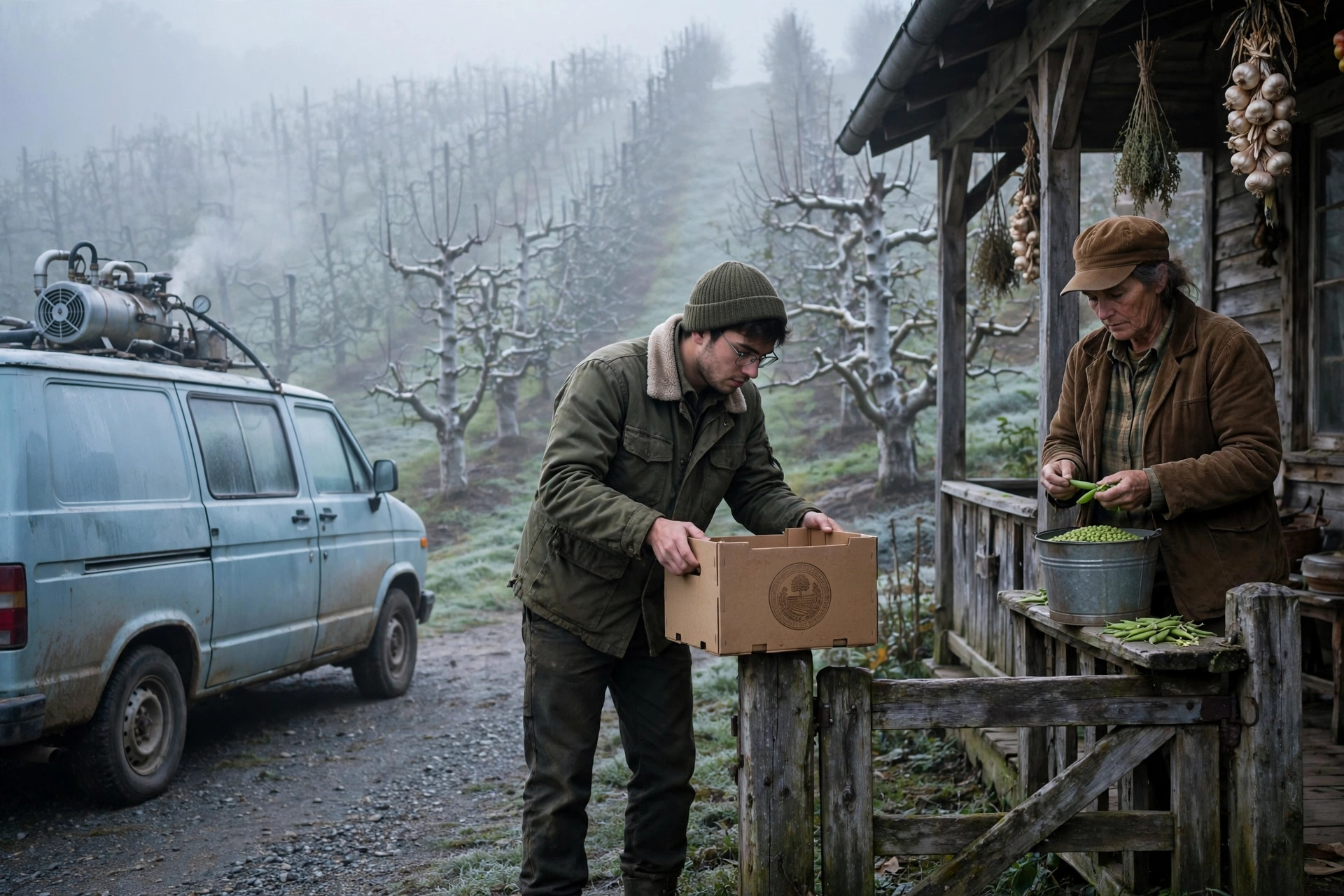
The county van came up the lane before the morning fog had burned off the lower rows, its compressor whining under the cab like something alive. Katya Solberg was on the porch shelling seed peas into a tin, and she set the tin down on the rail before the van had finished its turn, because a cold van on a Tuesday meant one of two things in the Aumick Valley, and both of them were trouble.
Dev Chandra got out on the passenger side, which surprised her; usually he drove alone. He was carrying a crate, waxed cardboard, pale blue, with a state seal stamped on the end panel and a clipboard clamped under one arm. He was younger than the valley's usual extension men and he still walked like a man from somewhere flatter, long strides that covered the ground without noticing it. Four winters in town and he still crossed the yard as if it owed him a favor.
"Katya." He set the crate on the gatepost cap, careful, and she heard the faint shift of something packed in ice inside it. "You're going to want to hear this sitting down."
"I've been sitting down all morning. Talk."
"Marek's block. Two properties over, past Rood's Mill." He flipped the clipboard around so she could see the map, the little grid of orchard parcels, one corner of it inked in red. "Fire blight. Confirmed last night under the scope. Aggressive strain, worst the lab's cultured in a decade. I walked the adjacent parcels at dawn." His finger moved. "Here. Here. And the wind runs down-valley, so I need you to look at your own wood today. Not tomorrow."
The pea tin sat on the rail. Katya looked past him, down the long gravel spine of the orchard, where her oldest block stood on the rise, the trees her grandfather had set and her father had kept, bark gone silver and ridged like sea ice. Fifty-two years of blossom records in a drawer inside. She had been expecting bad news since June, when the rain came warm and stayed warm, but she had been expecting it the way you expect a hard winter: abstractly, and later.
"How bad over there?"
"Twenty trees flagged for removal that I counted, and I didn't count the ones I couldn't reach from the ground." He tapped the crate. "This is why I'm here. The state's running a blight-response program. Resistant scion wood, greenhouse-grown, enough for the whole affected corridor. It's in the valley for thirteen days, and the van leaves with whatever isn't signed for."
The screen door clacked and Ruta came out onto the porch with two cups of coffee, moving carefully, the cups set far out on her palms where her tremor couldn't reach them. She got down the three steps one at a time, handed one cup to Dev, and offered the other toward Katya without comment. Her hands were worse this spring. She could still read a tree at a glance, still tell you which shoot on a branch would take, but the cups had migrated to her palms sometime around February, and neither of them had said anything about it, which was its own kind of saying.
"Resistant how?" Ruta asked. She said it flat, the way she asked market prices.
Dev took a swallow of his coffee first. "Cisgenic. The resistance genes came out of wild apple, same genus, moved into the variety with markers instead of crosses. No foreign species, no novel proteins, no antibiotic markers. It's the cleanest pipeline the state has."
"It's lab wood," Ruta said.
"It's wood," Dev said. "Grown in a greenhouse in Ondas County, cut to bud length, chilled, and driven here in this van. Which leaves on the thirteenth, with or without the Solberg allotment."
Katya set her cup on the gatepost beside the crate. There it was: the shape of the year, standing on her own gate. She looked down the lane toward the road, where the co-op notice board stood at the corner, white and freshly painted last fall, and saw that someone had tacked a new paper to it sometime before sunup. She could read the block letters from here even if she couldn't make out the words. NOTICE. And a date.
"How many scions in that crate?" she asked.
"Four hundred twenty bundles, one bud each. Enough to work your father's line block entire if you topwork the lot. That's ninety-six trees if you graft every one of the rootstocks you've got standing in rows one through six. I did the math off the county inventory."
"You did the math off my father's block."
"I did the math off the block," Dev agreed, and had the grace not to smile about it. "The agreement's on the clipboard. It's a grower agreement, not a contract for your firstborn. Sign it, scan it, upload it before the van leaves, and the wood is yours this season. Don't sign it, and it's next season, if the program runs again, if there's anything left to graft onto."
Ruta had gone quiet in the way Katya knew, chin lifted, eyes on the middle distance, listening to something in her own head. Katya took the clipboard from Dev and read it standing. It was clean paper, as state paper went. Her name, the parcel number, a line for the date. The word cisgenic in the crop column, spelled out fully, because the state's lawyers liked words that couldn't be mistaken for other words.
She didn't sign it. She folded it once along its crease and put it in her jacket pocket, and Dev watched her do it and said nothing, which she appreciated. He was a flat-land walker but he wasn't a fool.
"You said look at my own wood," she said. "Come on, then."
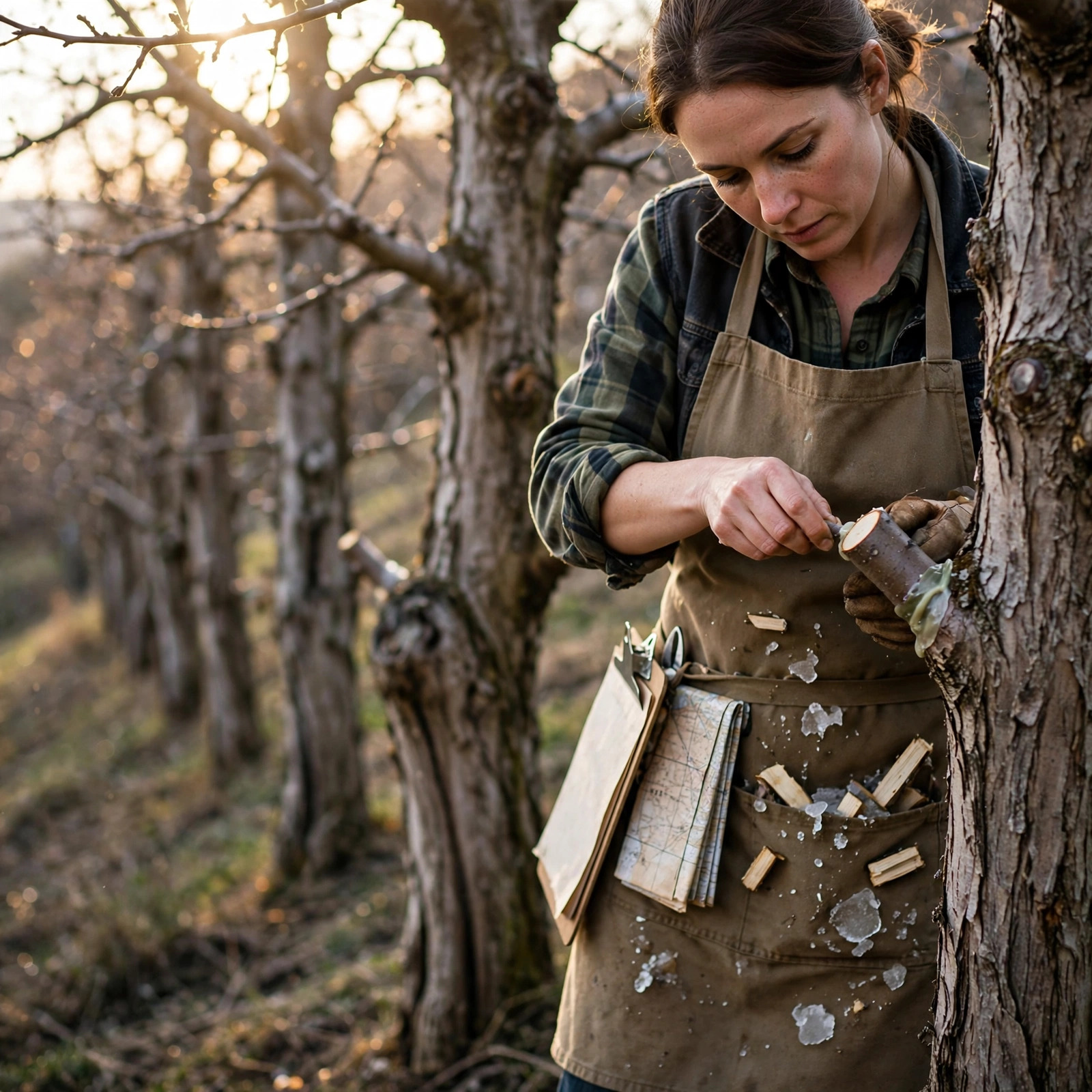
The workshed stood off the lane behind the house, cedar-shingled, its door swollen enough in the wet seasons that you had to lift and push. Inside it smelled the way it had smelled her whole life: linseed, beeswax, cold apple, and the faint iron tang of the whetstone. The grafting knife hung on the wall hook where it had hung since she was tall enough to reach it, her father's hand-forged blade with the cracked birch handle he'd never gotten around to replacing, oiled every fall whether it had been used or not. It hadn't been used all season. There hadn't been a season for it.
She lifted it off the hook and pushed it through her belt, and Ruta, in the doorway, watched the knife leave the wall with an expression Katya couldn't read and didn't try to.
"You still sharpen it on the river stone," Ruta said. Not a question.
"He sharpened it on the river stone."
"So did his mother." And Ruta turned back toward the house, coffee cup balanced on her palm, leaving them to it.
The oldest block stood on the rise above the well, thirty rows, and the fog was burning off it in rags. Katya walked the windward rows first, because Dev had said wind, and wind in the valley ran down from the notch above Rood's Mill and combed these trees before any others. She walked with her eyes down at the scaffold limbs, reading bark the way Ruta read bark, the way you read a thing you've looked at every spring since before you could say the names of the months.
She found it in row eleven.
An older limb, south side, a limb that had carried fruit every year since she could reach it with a ladder. The bark had gone orange-brown at the graft collar, and below the stain the tissue had shrunk back, sunken and cracked, oozing at the margins where the sap ran. A canker. She'd seen the photographs a hundred times in extension bulletins and she knew it in her own wood the way you know a fever in your own child's face, without the bulletin, without the scope, without wanting to. She crouched and put her thumb against the edge of the stained bark and it gave, softly, the way rotten bark gives, and underneath it the wood was streaked brown into the cambium, deeper than any knife could chase it in a season.
Dev crouched beside her. He didn't say anything for a moment, which told her he hadn't found this one from the road, that it was hers, that it was news to him too.
"First confirmed on this property," he said finally, and took out a flagging pen. "This limb goes. Today, if you can. Cut a hand's width into clean wood, burn the cuttings, sterilize the blade between cuts. And then, Katya, I'd walk every row."
She stood up. The knife was a heavy spot against her hip. Below the rise she could see the lane, and the gate, and past the gate the county road, and at the corner the notice board, white and new-painted, with the fresh paper on it, the block letters, the date. She walked down through the rows without answering him, past the well, past the shed, out the gate and down the shoulder to the board, and read it in the flat gray light.
NOTICE OF PROPOSED STANDARDS AMENDMENT. A special membership vote of the Ondas Growers Cooperative, at the co-op hall, on the fourteenth day from posting. Posted: today. The amendment ran four paragraphs and she read all of them twice, and the fourth paragraph said what she already knew it would say, in the language Anja's committee liked, language like excluded material and full-member standing. Any grower working cisgenic graftwood would lose the co-op label. Not the fruit off the grafted trees. The label entire. The premium entire.
Nine thousand four hundred dollars a year, the premium the label carried, the money that had carried the mortgage on the far shed through three bad springs and carried Ruta's co-pays every month of every winter. There was no other buyer within trucking distance who paid it. Anja knew that number better than Katya did; Anja kept the books.
Dev had followed her down, the crate back in the van, the van ticking as it cooled. He stood a respectful distance off with his hands in his jacket pockets and let her read.
"Fourteen days," Katya said.
"Thirteen for me. My van leaves on the thirteenth." He looked at the board, then at her. "I can't tell you which clock to run against. I can only tell you the clocks are both real."
She went back to the shed and found the flagging tape in the drawer where her father had kept it, orange, sun-faded on the roll's outer edge. She tore a long strip and walked out to the gate with it and the staple gun, and she fastened the strip to the gatepost, high, where it would stand out against the gray of the boards and catch the low sun. Blight notice. A flag on the gate meant what it had always meant in the valley: stop, look, this property is working a disease, walk your own rows before you touch anything of mine. Marek's daughter drove this road to school every morning. She'd see it. Everyone would see it.
The knife rode on her belt, off the hook for the first time all season, and the folded agreement made a stiff square against her chest when she raised her arm to drive the staple home.
The Amendment Page
The Ondas Growers Cooperative hall still smelled of the floor oil somebody had put down that morning, and the ledger lay open on the front table with a rubber band weight curling its pages against the draft from the door. Katya came in with the crowd and took a chair near the back wall, where the coffeepots sat on the extension cord. Ruta found a seat one row ahead of her without being told to, close enough to hear and far enough back to pretend she wasn't attached to anyone. Dev stood off to the side by the window with a folder under his arm. He'd parked the white van in the lot where everyone would walk past it coming in, and Katya thought that was either clumsy or very deliberate, and knowing him now for four days, she suspected deliberate.
Anja called the room to order at seven. She did it the way she did everything, with the ledger and a pen and no wasted motion. The page under her hand was the standards amendment, the same page the notice on the board had come from, and she squared it against the table edge before she read the operative sentence aloud. Cisgenic graftwood, introduced by any member, in any block, in any season, would constitute excluded material under the label. The member would forfeit the label, whole. Not the fruit off the grafted rows. The label entire.
"We're not voting tonight," she said. "The vote's in ten days. Tonight is for questions."
Ten days from tonight put the vote on day fourteen. Katya did the arithmetic without meaning to; her hands had been doing arithmetic like that all week, counting days against the calendar the way other people counted money.
A man from the bench lands asked what the state program actually was, in plain words, and Dev came forward to the table. He had the easy manner of someone who'd stood in front of skeptical rooms for seven years, and he laid it out clean. The blight strain in the valley was faster than anything in the spray guides. The conventional breeding programs had resistant stock in the pipeline, five years out at best, maybe six before any nursery had wood to sell. The state program had scions now, in cold storage, in his van, four hundred and twenty of them in waxed bundles, grown from stock that carried resistance in its own genome, no foreign gene in it, nothing in the wood that wasn't already in the species. Cisgenic. The law treated it one way. The label, evidently, treated it another.
"I'm not here to argue philosophy," Dev said. "I'm here about clocks. I have a van that leaves this valley on the thirteenth. I've counted eighteen trees with confirmed cankers in one block in this valley, and eighteen is the number today, not the number it stops at. Warm wet weather doubles it. I've watched it double."
"Counted where?" someone asked.
He didn't look at Katya. He looked at the ledger. "In the oldest block at Solberg Orchard. Row eleven had the first."
The room turned, gently, the way rooms do, and Katya felt every face find her and then slide away again, polite, and she kept her own face still because she'd had four days of practice at it in the mirror.
Anja let the quiet sit for a moment, then stood.
"I'm going to say the part nobody else will say," she said. "The label is the only price premium we have. It's nine thousand four hundred dollars a year on my sister's place. It carries the mortgage on her far shed. It carries the medication co-pays for my mother. That's one farm. There are eleven farms in this room where that premium is the difference between a lean year and a lost year. I keep the books. I know which ones."
She said it flat, without drama, and that was worse than drama, because it was all true and she'd said it in front of everyone as if it were just a line item. Ruta's shoulders came up around her ears, one row ahead, and Katya looked at the back of her mother's head and did not speak.
"The conventional stock is five years out," Anja went on. "Five. That's the number the breeders themselves publish. So the choice isn't graft versus lose the orchard. It's this: cull what's sick, burn it, take the hit, replant in blocks as the resistant wood comes available, and keep the label, or take the state's wood and take the premium off every fruit stand in this valley at once. If one member grafts, the auditor can't tell one member's bins from another's. That's how the label dies. Not by decision. By contamination of paperwork." She closed the folder of the amendment flat under her palm. "We've spent nine years building what that label buys. I'm asking us not to spend it in one season on a disease we can cut out."
"You can't cut out eighteen trees and call it pruning," Dev said.
"I can call it what it is. A loss. Losses are farming."
"Losses are farming," he agreed, "when they stop. This doesn't stop. You cut the eighteen, and the canker's already in the bark of trees that look clean. You're not choosing between eighteen trees and the label. You're choosing between the label and the block."
Somebody in the middle, one of the bench-land sisters Katya had known since school, said the middle path out loud: sign nothing, cull what's confirmed, wait for the vote on the fourteenth, see where the count stands. And that was where the room went, and it went there evenly, which Katya had not expected. She'd expected a room, her neighbors of forty years, to split along the old fault lines, family against the rest. Instead the benches went patchwork. Half the back row nodded at everything Anja said. Half the front rows had leaned forward at every number Dev gave. Two growers Katya had marked as certain for Anja asked Dev hard, sensible questions about audit trails and cold storage and whether the state would indemnify a lost label, and he answered no faster than he should have, which cost him something honest. He didn't pretend the program carried guarantees. He only carried wood.
When the chair called for any further comments before closing, there was a space in the room exactly Katya's size, and she felt Ruta half-turn in the row ahead, and she felt Anja not look at her, and she let the space close without filling it. She had no speech in her that would survive being said out loud. Her sister had already said the mortgage aloud, in front of the whole valley, had laid their mother's co-pays on the front table like an exhibit, and Katya could not stand up and argue against her without arguing for the money, and could not argue for her without arguing for the trees, and both arguments were the same argument and there was no room in it for a third thing, which was what she actually had, which was nothing said yet, only a folded paper stiff against her chest and a knife on her belt.
The meeting broke into coffee and side talk. Ruta worked her way up to Dev and asked him something, and he crouched to answer at her eye level, and Ruta laughed at whatever he said, actually laughed, the sound carrying, and Katya watched that with a complicated feeling she decided not to name. Then Anja was in front of her, ledger under her arm.
"You didn't talk," Anja said.
"You talked enough for both of us."
"That's not fair."
"No." Katya zipped her jacket. "It isn't."
Anja stood there a second longer, and there was something under the chairwoman's face that Katya recognized because she'd grown up in the same kitchen as it. Anja's eyes went to the knife on Katya's belt, the cracked birch handle, and moved off it fast. "Whatever you do before the fourteenth," she said, "do it where the auditor can't see it from the road."
She walked off with the ledger before Katya could decide whether that was a threat or a gift.
The truck took the valley road home in the last gray light, Ruta riding in the middle of the bench seat because she liked the view of both sides. The cold van went the other way at the crossroads, and Dev put two fingers to the wheel at her, the folder still under his arm.
"He's careful," Ruta said. "Careful isn't the same as slow."
"No."
"Your sister kept good books when your father couldn't read his own handwriting. She was right about the money tonight. Being right about money and right about trees aren't the same thing."
"She knows that."
"She knows it and she can't say it," Ruta said. "That's what being chair is."
At the turnout above the creek Katya pulled over and got out, and Ruta followed, and the wind off the water moved the orchard rows below in one long shudder. Katya opened the bed toolbox and lifted out the wrapped bundle Dev had left her on day one, one spare scion, a rootstock whip in damp burlap, loaner wood for practice, he'd called it. Ruta took the budstick end without being asked and turned it in her fingers, and her hand shook, it always shook now, the tremor running through her wrist so the stick chattered softly against her ring, and she didn't fight it. She set the stick against the rootstock whip and ran her eye down the pair of them, bark to bark, cambium line against cambium line, and her voice came out certain.
"That one's fat on the south side. Cut low, angle long, and it'll sit. Your father matched them like this. Eye first, knife second."
"Your hand," Katya said.
"My hand's finished. My eye isn't."
Katya drew the knife, oiled all season and unused, and cut the rootstock low and long, and cut the scion to match, and laid them together in the tailgate's light. She practiced the whip graft three times against the tailgate, slow, then quick. The first spare split went wrong, the knife skidding off the graft line and down through the cut instead of along it, the two halves falling apart in her palm. The second went wrong the same way, worse, the split running long and the scion tongue tearing. She gathered every piece off the tailgate, all of it, the failed cuts and the shavings and the ruined little tongues of green wood, and she folded them into the burlap and put the bundle in the toolbox. Not the ground. Not the fire barrel. She kept the pieces.
Ruta watched her do it and said nothing the whole way home.
Twenty-Seven
The rain came on day five and stayed through day six, warm the whole time, the kind of warm that made the air feel thick enough to press your thumb into, and the blight loved it. Katya walked the oldest block at first light on day seven with a paint marker and a tally book and came back to the house with the book open on the kitchen table and let her mother read the number off the page before she said it aloud. Twenty-seven. Nine more than the hearing count, nine in three days, and the marker had gone dry twice before the row ended.
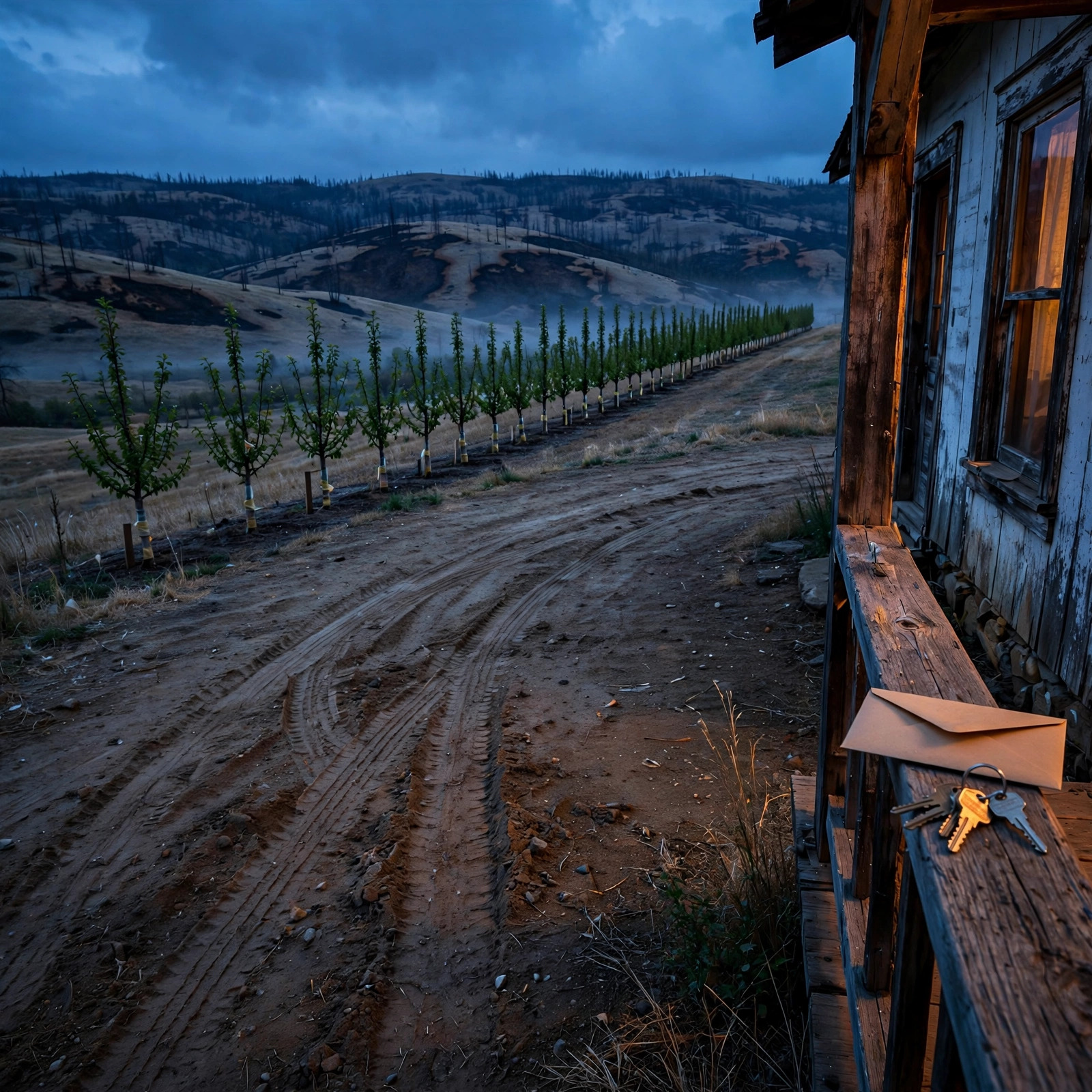
"You'll want the saw," Ruta said.
"I'll want the saw."
She took the saw and the grafting knife off her belt and a can of lamp oil from the shed shelf, and she started at row eleven, where the first canker had shown itself, and she worked north all morning. The worst nine were not hard to choose. They were the ones where the bark had sunk in and gone dark at the collar, where the ooze had dried in streaks down the trunk and the flies had found it. She cut low, below the sink where she could, and where she couldn't cut below it she cut the whole tree and marked the stump with an X so she'd remember to come back with the grubber. The knife with the cracked birch handle did the fine work, the graft cuts where the bark had to come clean, and the saw did the rest, and by the middle of the afternoon her shoulders had quit arguing and settled into a dull, steady ache that she stopped noticing and then noticed again every time she straightened.
Ruta sat on an upturned crate at the head of row fourteen with a board across her knees and the spare budwood from Dev's loaner bundle laid out in front of her, sorted by thickness, by eye, by the set of the buds. Her hands shook too much to hold a knife to a living tree. They shook holding a stick, too. But she could pick up a stick, turn it, read the fat side from the lean side, and lay it on the left pile or the right pile, and she did that for hours, and the piles grew straight and true.
"This one's yours," she called, when Katya came back down the row dragging the first tree by the heel. "South-fat. Cut low, angle long."
"On what?"
"On anything you graft it to. Your father's rule didn't care about the stock. Only the match."
Katya stacked the first tree on the gravel drive where the pile was going to be, and went back for the second.
The oil went on at dusk, and the fire took the wood the way fire takes wood, fast and then slower, and the smoke went up gray into a gray sky. Nine trees, cut and dragged and burned, was a day and a half of a woman's back, and she had the day and a half in her to prove it. She stood downwind of the pile and watched the numbers go up off her tally book, one tree at a time, and thought about the arithmetic she wasn't doing. Ninety-six trees in the father-line block that the scions would save. Four hundred and twenty scions in a crate in a cold van somewhere south of the crossroads. Seven days until the co-op voted. Five days until the van left the valley with her signature still on an unsigned agreement in her jacket pocket, or without it.
Anja's car came up the drive at dusk, lights on, wipers going though the rain had quit an hour before.
"I saw the smoke from the road," Anja said, getting out. She had the leather folder under her arm, the co-op seal on it, and Katya knew before she said it what was in it. "You didn't waste any time."
"Twenty-seven now. I counted this morning."
Anja stood by the burn pile for a moment, the heat moving the loose hair at her temples. "How many did you take out?"
"Nine."
"The whole trees."
"The whole trees. There are stumps with canker in them I couldn't get below. Those need the grubber and a torch and I don't own a torch."
"The co-op has a torch," Anja said. "I can put you on the list."
"Put me on the list."
Anja looked at the pile, at the stumps going black, and then at the shed, and Katya understood she was deciding whether to say the rest of it out here by the fire or somewhere else. "Is Mom inside?"
"Row fourteen. Sorting wood."
Anja went down the row. Katya let the fire have her attention for another minute, then followed.
The shed light was one bulb over the bench, and Ruta had the two piles of budwood in front of her and a rag over the loaner bundle to keep the damp off. She didn't look up when the sisters came in, which meant she'd heard the car and had decided to let them have the shed.
"The paperwork," Anja said, and set the folder on the bench, open, "is that the vote's in seven days, and I've got members calling the house at nine at night, and I've got you burning trees in view of the county road, which half the valley now thinks is a statement."
"It's nine trees with blight."
"I know what it is." Anja's voice went flat, and Katya heard the chair voice come down over it, the meeting voice, and then heard her sister pull it back off. "I know exactly what it is. I'm telling you what it looks like."
"Then tell me the rest," Katya said. "You drove out here for the rest."
Anja put her hand flat on the folder. "Dad died owing the co-op money."
Ruta's hands stopped over the piles for a moment, then went on sorting.
"Fourteen hundred dollars," Anja said. "Nineteen ninety-eight, the hail year. He took the emergency advance and then he took the second one, and then he was gone, and the co-op forgave it at the annual meeting, in front of everyone, because that's what the co-op was for. But they forgave it, Katya. It wasn't nothing. It came off the books. Somebody's assessment covered it." She turned the folder toward the light. "When they asked me to chair certification, I thought, this is the thing that carried us, this label, this paper premium, this is the reason there was money to forgive Dad with. And I have spent six years making sure nobody cheapens it. Not the packing house, not the out-of-state buyers, not some member who wants to spray in a wind and call it drift-free. Nobody."
"I'm not cheapening it."
"If the amendment passes and you've grafted, you're out. Not the fruit, you. The label, the premium, your standing. Nine thousand four hundred dollars a year, and there is no other buyer within trucking distance paying it. I've said that at the microphone and I'll say it again. I'm saying it to you here because you're my sister and because you're going to lose the shed and Mom's co-pays over wood in a crate, and I can't sit in that hall on day fourteen and watch you do it without telling you why I built the rule the way I built it."
"Five years," Katya said. "You said the resistant stock is five years out. That's what, two more seasons of this, counting the nurseries, and then everyone buys clean and we're a heritage orchard with a dead block."
"Or you cull hard and you wait, and in five years you replant with clean stock and you keep your label the whole time."
"Twenty-seven trees in three days, Anja. Do the multiplication for five years."
"I can do it." And quieter: "I've done it."
The bulb buzzed over the bench. Ruta laid a stick on the left pile, fat side up, and Katya watched her mother's eye run down it, and waited, because her mother was going to say something or she wasn't, and pushing had never once worked on her.
"He'd have grafted," Ruta said at last, not looking up. "Your father would have taken the wood and grafted and let the label go hang, and then he'd have come to you, Anja, for the loan to cover the shed, because that's who he was. He was brave about trees and poor about money, in that order, every year of his life." She set the last stick down. "Your sister's not him. She's got the brave and she's got the books. Don't make her choose in a shed in the dark."
"I'm not making her choose," Anja said.
"You brought the folder."
"I brought the folder because the vote's real and the seven days are real and she should hear the terms from me and not off the notice board." Anja closed it and held it against her chest. "I'm asking you to wait, Katya. Wait for the vote. Seven days. Don't sign anything before the members have spoken. If we lose, graft, and I will fight the amendment again next season with you, out loud, in the hall. But don't go first. Don't make me choose between my sister and the label that carried this family."
Katya looked at the two piles of budwood on the bench, sorted true, by an eye that still worked, and at the knife on her belt that had done nine trees that day and would do more tomorrow, and she thought about the crate in the cold van and the five days left on it, and she found she had no answer that was fair to give.
"I can't promise you that," she said.
Anja stood with the folder for a long moment. "I know," she said. "I had to ask anyway." She turned to the door, and stopped with her hand on the frame. "The torch is on the list. I'll put it through tonight."
"Anja."
Her sister stopped in the doorway, half in the last of the light.
"Twenty-seven," Katya said. "That's the number I'm carrying into the vote. Whatever number you're carrying, I want you to know mine."
"I know your number," Anja said. "I've known your number since I was tall enough to see over the tops of the rows." And she went up the gravel to her car, and the wipers went, unnecessarily, all the way out to the road.
Ruta put the rag back over the budwood and stood, slow, holding the bench edge. "Go finish your fire before the dew does. I'll put the kettle on."
Katya walked back up the drive in the blue-gray end of the day and pulled the ninth stump out of the gravel with both hands, the X she'd painted on it still showing through the soot, and rolled it to the burn pile and heaved it on. It caught slow, then fast, and the light of it reached up the hill toward the house, and from the kitchen window, where her mother stood with the kettle in one shaking hand, watching, the whole burned row would be visible, stumps and smoke and the black line where nine trees had stood that morning. Katya stood downwind until the ninth stump had gone to coals, and then she went up to the house to eat something and sleep, because tomorrow she had eighteen more to count.
Repository Paper
The county van was in her drive before the fog had fully burned off the lower rows, and Katya was on the porch with her boots half-laced before Dev Chandra got his door shut. He carried the crate himself, both arms, the way you carry something you're afraid to set down hard, and there was a folder under his elbow besides.
"You didn't call first," she said.
"You'd have told me not to come." He set the crate on the porch rail, on the flat place where the paint had gone gray. "The van leaves the valley day thirteen. That's the day after tomorrow, and after that there's no scion wood till next season, and next season is a phrase I don't like saying to a woman with twenty-seven cankered trees. I wanted to be the one to say it in person."
"Anja counted them with me on Sunday." Nine burned, eighteen more marked in wax pencil, the X's going up the hill like a fence that only she could read. "Twenty-seven confirmed. There'll be more by Friday."
"There usually are." He worked the lid off the crate, and the cold came up off the bundles, sharp and green, waxed cardboard and chilled wood and something under it like a cellar in January. "I also came because I owe you an apology, and because I brought the thing I should have brought you on day one."
He handed her a single sheet from the folder. Repository paper. She'd seen them before, in the nursery catalogs, the state repository's letterhead with the accession numbers down the left margin, and she took it expecting to skim it the way she skimmed any state paper, which was to say with her jaw set.
She did not skim it.
The parent lines ran down the page in a column, and the column was her childhood. S-409. S-412. S-418. The S was for Solberg, her father had told her that when she was small enough to ride the bins, and the numbers were his, his cross numbers, his field book, and the paper said cryopreserved 1999, repository accession, viability confirmed, clonal increase 2041. The date at the bottom of the increase line was last year. Someone in a lab coat had thawed her father's trees while she was up here marking cankers in wax pencil.
"You knew," she said. It wasn't a question, but he answered it anyway.
"I pulled the file after the hearing on day four. I knew the Solberg name was in the repository index, everyone in the county knows the index has Solberg material, but I hadn't read the lines. When I read them I drove out to Rood's Mill to check the ledger, because I wanted to be sure." He looked at the paper in her hands rather than at her. "The 1990s lines. The scions in that crate are increase wood off your father's own selections. Cryovials and dormant budwood, held since he died. Your mother signed the deposit over to the state in ninety-nine."
Katya sat down on the porch step with the sheet. Below her, down the hill, the black line of the burn row was still visible where the nine stumps had been, and beyond it the oldest block stood with its X's, eighteen of them, and beyond that the father-line block, ninety-six trees her father had grafted himself with the knife that was now on her belt. She had walked those rows for forty-one years. She had assumed the lines died with the man.
"He bred them for blight," she said. "That was the whole point. He never got to the proof."
"He got close enough that the repository kept everything. And the state's cisgenic work picked up his lines because they were the farthest along, so the resistance in this crate, it isn't lab wood the way Anja's been saying it in the hall. It's his resistance. The gene is his own gene, from his own selections, moved into his own rootstock lines with the variety names still on them. There's nothing in that wood that Alvar Solberg didn't put there himself, except the paperwork."
"The paperwork is what takes the label off my fruit."
"Yes." He didn't argue it. "I've read the amendment. I think it's badly drawn, and I've told Anja so, twice, in writing. But I'm not the co-op. I'm just the man with the van."
Her mother came out with the kettle still hot behind her and read the sheet over Katya's shoulder, one finger tracking the column, and the finger shook but the reading didn't waver. "S-418," Ruta said. "He lost S-418 twice to frost and once to his own temper. He'd have wept over this. He'd also have wanted ten percent more documentation." She set her hand on Katya's shoulder briefly, weightless, and went back in.
In the workshed the light was good by then, and Dev laid the bundles out on the bench and they went through them together, scion by scion. He'd done this at three other farms already this week and his hands had the rhythm of it, waxed paper off, eyes down the stick, waxed paper back. Freezer damage showed as a browning under the bark, a deadness in the cambium you could feel with a thumbnail, and Ruta stood at the end of the bench and called the bad ones before Dev's knife touched them, by eye, the way she'd called them for Alvar forty years of harvests. "That one. The heel's gray." And it was, when they cut it.
They culled thirty out of the four hundred and twenty. Dev stacked the dead sticks flat, squared them like kindling, and wrote 390 on the crate's lid in grease pencil. "Three hundred ninety viable. That's enough for your ninety-six with margin, and the margin matters, because grafting under blight pressure you'll lose some takes to the fire itself, not the cold." He told her the numbers on whip versus cleft takes in a bad year and she stopped him, because she had the numbers already, she'd been running them in the truck bed on day one with the failed cuts in her lap.
"The agreement's in my jacket," she said. "It's been there ten days."
"I know. I came to take it back signed or take it back in the crate, one or the other, before the van goes."
She looked down the hill at the X's. Eighteen trees going on twenty-seven going on who knew what by Friday, and ninety-six more below them, and the paper in her hand that said the wood to save them had been sitting in a freezer in her father's name for forty years while she assumed she was the only one left who knew what the S stood for. The premium was nine thousand four hundred dollars a year. The far shed rode on it. Her mother's co-pays rode on it. And the vote was four days out, and if she waited for the vote and the vote went against her, the van would be two days gone and the whole block would go the way of the burn row, and next season's crate would come to a valley with fewer trees in it.
"I'm not asking you to watch me sign," she said.
"I'd like to. Professionionally." He caught his own word and corrected it. "Professionally. But it's yours."
She signed it at the bench, on the flat place between the bundles and the grease pencil, because that was the only clean wood in the shed. Her name four times, once for the agreement, once for the accession release, once for the deposit of her own culls for repository testing, once for the tractor and road liability clause that her father would have had opinions about. Ruta watched the pen and said nothing. Dev photographed the pages for the upload, and the shed filled and emptied of the sound of it, and then the paper was signed and it was day eleven and the van left day thirteen and there was nothing between her and the grafting except the co-op.
She drove to the hall with the signed copy flat on the passenger seat under her hand so the wind off the window wouldn't move it.
Anja was alone at the front table, which was rare, with the leather ledger open and a stack of amendment notices squared beside it. She looked up when the door went, and Katya watched her take in the whole situation in one pass: the jacket, the hour, the county van not behind her because it was back at the shed being loaded. Anja set her pen down across the open page and didn't pick it back up.
"You signed."
"This morning."
"Before the vote." Anja's voice was even, and her hands were flat on the table, and that was the most controlled Katya had seen her since day one. "It's four days out, Katya. Four."
"The van's two days out. That's the only arithmetic I had left." Katya came to the table but not around it. She put the provenance sheet down on the open ledger, over the entry columns, and turned it so her sister could read the column. "Look at the parent lines before you say anything. Please."
Anja read it. Katya watched her read it, watched her find the S numbers one at a time, watched her arrive at 418 and stop, and then Anja pressed the heel of her hand against her eye for a second, briefly, and then she was chair of certification again.
"It doesn't change the amendment," she said. "It's still excluded material under the standard we drafted. Dad's wood or not."
"I know. That's why I'm not here to argue the amendment, and I'm not here to ask you to vote any way at all. You asked me not to go first and I've gone first. I'm here for the other line." Katya took the pen from where Anja had laid it, because her own was in the truck, and she turned the ledger to the page with the member withdrawal forms, the ones nobody had used since the hall was bound in 2019. There was a whole blank column of them. "I withdraw. Effective today, before your vote, so nobody has to vote on me. Not you. Nobody."
"Katya."
"The premium's nine thousand four hundred. I know what it carries. I'm not pretending the ledger doesn't know it too." She wrote her name and the date and the orchard number in the withdrawal line, and her hand was steady, which surprised her, and the pen was Anja's, which she thought her father would have found funny. "You keep the label clean. You keep the vote honest. And next season, when the conventionally bred stock comes, you put me up for readmission and I'll stand in front of the room and say whatever you need said. But I'm not waiting five years with twenty-seven cankers to save ninety-six trees that he grafted himself."
Anja didn't move to stop her. That was the thing Katya would remember afterward, standing at the table with the pen. Anja sat with her hands flat and let her sister do it, because it was the right form and the right line and the right day, and because she had never once in her life held Katya's hand still.
Katya pressed the pen down hard at the end of the line, so the ink would carry, and the nib clicked against the board under the leather. Then she lifted the signed grower agreement out of her jacket, the state copy, the one with the 1990s lines folded inside it, and laid it flat on the open amendment page, on top of the printed standard that had just removed her, weighted at the corner with Anja's pen.
"Day thirteen, the van goes at first light," she said. "I'll be in the shed."
Row One
The cold van was not due until first light tomorrow, but Katya was in the father-line block before the fog had lifted off the creek, with the crate on the wet burlap bench and the knife from her belt already in her hand. The blade was her father's, hand-forged in 1978, the birch handle cracked and worn smooth where his grip had been and where hers was now. She had sharpened it the night before at the kitchen table, and Ruta had watched her do it and said nothing, which was its own kind of permission.
Dev came up the row at half past five with the wax pot balanced against his hip, a wide low thing heated by a cord run off the genny behind the shed. He set it down on the bench's end and looked at the row of ninety-six trees the way he looked at everything, counting first.
"Forty-eight today," he said. "That's what you said."
"Half the block. One row." Katya laid the knife on the burlap. "The other half waits until I see how the first takes. If I lose the row to blight anyway, I've still got wood in the crate for the spring."
"That's not how the program paperwork frames it."
"The paperwork can come stand in the mud and frame it here."
He almost smiled. He had been in the valley four years and he still talked like a man from somewhere flatter, but he had learned when to stop talking. He lifted the crate lid and began laying the bundles out in order, and Ruta came up the path from the house with the thermos and the small stool she used when the ground was wet, and she sat down at the bench's end without being asked, because nobody had to ask her anything about this bench, or this block, or this wood.
"Row one," she said. "East to west. He always grafted east to west, so the sun catches the joins in the morning and the frost sits on the north side of the tape." She pulled the first bundle toward her, turned it in her fingers, and read the tag without her glasses. "A-twelve. Put it on tree three."
"You remember the spacing?" Katya asked, though she knew the answer.
"I remember the spacing. He'd have put it on three." Ruta's hands had a tremor now that would have ruined a graft cut, and she did not pretend otherwise; she had said at the kitchen table that her grafting days were over and had said it plainly. But she could still read a bud plate faster than anyone in the county, and she could match scion to stock by eye, and so she matched, and Katya cut, and that was the whole arrangement, and it had not needed to be spoken in full to be agreed.
Katya set her thumb along the stock at shoulder height, made the long sloping cut, turned the wood, made the second, and laid the scion against it so the cambium lines met. Her father had taught her the whip graft on this same row, on a stool with her feet not touching the ground's ruts, and the muscle of it was still in her wrist thirty-some years later, which was the kind of arithmetic that did not need a ledger. She set the tape and pulled it tight with her teeth, the way he had, and Dev was there with the wax before she had finished the knot.
"Warm, not hot," she said. "If it runs, it chokes the bud."
"I know how to wax a join."
"You've waxed extension demo stock. This is my father's wood." She said it and heard how it sounded, and let it stand, because it was true in both senses and Dev had earned the bluntness by being here at half past five with a genny and a wax pot and no premium of his own at stake. He dipped the brush and laid the wax on in two passes, even and thin, and the join disappeared under it, sealed and ugly and correct.
Tree three. Then four, because A-thirteen went to four. Then six, because five's stock had a frost crack on the north side and Ruta had flagged it with a twist of orange tape before Katya had even reached it.
By the time the sun had cleared the far hillside, there were eleven joins in row one, waxed and taped, and Katya's back had informed her of every one of them. She straightened and looked east across the creek, and there they were: the cankers on the far slope, twenty-seven trees' worth of them, orange-brown and running in a line along the oldest block like a burn scar. Nobody had cut them today. Nobody would cut them today. The blight was not stopped; it was only answered, one row at a time, with wood that had been waiting in a freezer since before she was old enough to sign her own name.
"It's moving," Dev said, following her eyes. "The wet weather this week. You'll lose more in that block before the row takes."
"I know."
"I can bring the torch crew Thursday."
"Thursday," she agreed. Nine stumps already sat X-marked in the oldest block from her own saw, and the co-op torch was the proper tool for the rest, and she would call for it, though the co-op's torch was the co-op's and she was no longer the co-op's. She had thought about that on the walk up in the dark. There were arrangements like that all through a life, things that belonged to a body you had left, and you found the seams in them at dawn.
Ruta was on bundle fourteen. She had laid the next three out on the burlap in the order of the row, tags up, and her hand hovered over the fourth one and then rested on it. "A-twenty-two," she said. "This is off the ninety-four line. The one he was proud of. He grafted six of these himself, right here, and the hail took four of them in ninety-eight."
"The year he owed the co-op fourteen hundred," Katya said.
"The year he owed the co-op fourteen hundred," Ruta agreed. "And they forgave it at the meeting, and he sat in the back row and let them." She held the bundle out, and Katya took it, and for a moment both their hands were on it, the tremor in her mother's and none in hers, and neither of them let go first.
Dev cleared his throat and said, "The provenance sheet in the crate says the ninety-four line clonally increased last year. So that's not last year's wood, exactly. It's ninety-four's, with a year of multiplication on it."
"It's his," Ruta said, and that was the end of that discussion, and Dev went back to his wax.
They did the row's east half by nine. Twenty-four joins. Katya's knife hand had found its rhythm and lost it twice, once on a stock too thick at the shoulder, once when a bundle tag had smeared in the wet and she had to call the number out for Ruta to confirm against the crate list. She kept the two failed cut pieces in her jacket pocket with the ones from the practice in the truck bed, because that was a habit now, a small accounting of what did not take. Twenty-four scions gone from the crate's three hundred ninety. Three hundred sixty-six left in the chilled bundles, waxed cardboard and cold air and forty-two years of patience.
At the half-row mark she stopped for the thermos, and Ruta poured, and Dev sat on his heels by the wax pot and looked at the row behind them, taped and gleaming.
"The van leaves tomorrow at first light," he said. "You know you're signed. I can leave the rest of the crate in your shed cold store through the season."
"I know what I signed." The grower agreement was already uploaded, the state copy folded in her jacket, the withdrawal line inked in the co-op ledger in her own hand with Anja's pen. Two days from now the membership would vote on the standard, and the vote would go however it went, and it would not touch her orchard either way, because she had stepped out of the room before the count. That was the whole point of doing it on day eleven and not day fifteen, and she had paid for the point with the label, and the label had paid the shed mortgage and Ruta's co-pays, and there was no other premium buyer within trucking distance of Rood's Mill. She had done that arithmetic at the kitchen table too, with the mortgage notice in front of her, and then she had turned the notice over and written JANUARY across the back of it in pencil, big, so she would see it every time she reached past the notice for the shed keys. January. The premium was gone now, and January was coming, and she had not solved January, and she was not going to solve it standing in row one.
"Anja's not here," Ruta said, into the middle of that silence, because she had been watching the lane. "Her truck's gone since before light."
"I know."
"She left the greenhouse keys on the hook. The inside hook, by the door. Not the porch hook where you'd grab them. The inside one." Ruta wrapped both hands around her cup. "The inside hook is where she puts them when she means for me to have them."
Katya looked down the lane, at the empty mud where the truck had been, and said nothing. The split stood where it stood. Her sister had sat with her hands flat at the hall and let her make the line, and had not once in her life held Katya's hand still, and this morning she was somewhere else, and the keys were on the inside hook. That was not a reconciliation. It was not nothing either. Katya had learned to take what the ledger of a family actually said and not what she wished it said, and what it said was: the keys are where you can reach them, Ma.
"West half," Katya said, and picked up the knife.
The sun climbed. The wax went on. Ruta called A-thirty through A-forty-eight against the row, and Katya cut and joined and taped, and Dev sealed, and the cankers on the far hillside sat in full sun now, orange and unmistakable, and Katya did not turn her back on them. She grafted with them in her eye. That was the arrangement of the day: the blight got the hillside and the freezer got the row, and by evening the row would have forty-eight joins in it and the hillside would have exactly what it had at dawn.
Bundle forty-eight was a ninety-four line, small wood, three good buds. Ruta held it out and Katya took it and made the cuts and set the scion against the stock of tree ninety-six, the last tree of row one, the one her father had grafted first in this block because he liked to finish with the tree nearest the creek. The cambium met. She turned the tape twice and set the knot under her thumb, holding it, and Dev was already reaching with the brush.
"Wait," she said.
He waited.
The sun was just clearing the ridge, full on the row now, on the tape and the wax and the ninety-six trees and the three hundred forty-two bundles still sleeping in their chilled cardboard. Katya pressed her thumb flat over the knot, felt the tape hold, felt the join hold, felt the wood hold, all of it under her own warm hands, and nodded, and pressed the wax seal shut as the light came down the row and took it.
Get notified when new stories drop

Jonas Veld
Jonas covers human-AI futures and engineer problem-solvers: protocols, trust, and tools that expand human capability.
Leave a comment
Comments