





The Bore Room
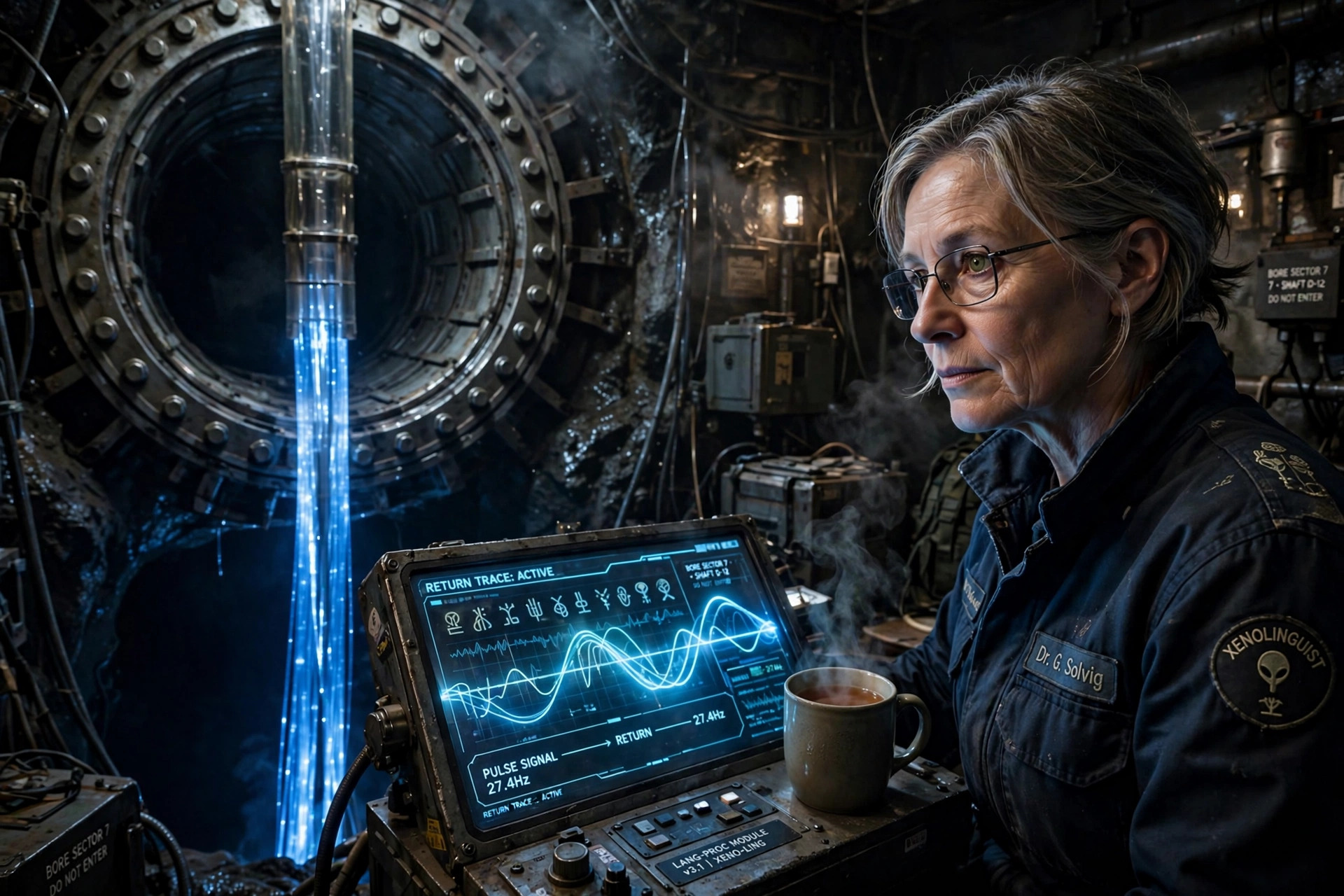
The morning exchange began at 06:20 station time, as it had on nine years of mornings before this one, with the bloom answering a question Solvig had not yet finished asking.
She sat at the console in the bore room with her tea going cold beside her and watched the return trace crawl up the screen. Three hundred and ten meters of sapphire-clad fiber ran down the vent bore, through the ice shell, into the dark water pocket where the bloom lived, and the bloom answered in light. Short pulses, long pulses, the tense modulations she and Ferro had spent four years learning to hear as emphasis. The message this morning was a familiar shape: heat-vent, small-life, above, steady. The bloom describing them again. Describing her.
"It's giving us the same portrait it gave us Tuesday," Ferro said from the bench across the room, head down over her chemotactic charts. "Same order, same emphasis on steady."
"Not the same." Solvig pulled up the archive trace beside the live one and laid them over each other. "Watch the third cluster. Tuesday it grouped above with small-life. Today it grouped above with heat-vent." She marked the difference and typed the annotation into the lexicon file. Token 214, the newest one, learned only last month: edge. The bloom had used it this morning in a construction neither of them had recorded before. Edge, above, steady, edge. Their edge. The rim of the ice, seen from below.
"Two hundred and fourteen," Ferro said, reading the count off the header. "Nine years for two hundred and fourteen words."
"A child learns faster," Solvig said. "A child has a brain designed for this. We're doing it with a vent, a laser, and stubbornness." She saved the entry. Two hundred and fourteen shared tokens, every one of them negotiated, tested, re-tested, agreed on from both sides. Not guessed. Agreed. That distinction had been the whole of her professional life since the day the first pulse came back up the bore.
Teo Kalenic came through the hatch with his splice kit slung over one shoulder, knelt at the bore trunk without ceremony, and ran his diagnostic wand along the pressure seals. Six years of this routine had worn a permanent gloss into the handle of the kit. "Fiber six is drifting two percent on return," he said. "Thermal cycling. I'll re-seat the gland after the exchange window."
"Leave it for now. I don't want a dead minute while it's talking."
"You always say that."
"It's always true."
The trace on her screen went quiet, then built again, slower. The bloom did that when it was finished with a thought, letting the water still. Then the hatch at the top of the bore room stairs opened, and Colonel Ivo Rask came down with Petty Officer Aalto behind him, and the room changed temperature without the thermostat moving.
Rask had been on the station two years, which was long enough to know where everything was and not long enough to stop caring which of it could be broken. He crossed to the console, looked at the live trace with the flat patience of a man watching weather, and said, "Doctor, end your window when it's clean. I have an order to deliver and it needs everyone."
"It's clean now. It's gone to rest." She swiveled her chair. "Deliver."
"I received it from the Coalition Deep Space Annex at Ganymede this morning, over the relay. Forty-three minutes of light each way, so it's been decided, not discussed." He set a slate on the console where she couldn't help seeing it. "On day twelve from today, this station transmits a full-power dominance broadcast into the vent bore. Precedence signal. Establishes that the Coalition, and no one else, holds first-contact claim on Europa before the outer powers' probes arrive in this system."
The room held still. Teo's wand stopped against the trunk seal.
"Full power," Solvig said. "Into the bore."
"Into the water column, yes. Broad spectrum, high intensity. The Annex analysts believe a signal that loud and that structured will read as precedence to any party that intercepts it, human or otherwise."
"It will read as precedence to us. I can't tell you what it reads as to them, and neither can your analysts, because your analysts have forty-three minutes of latency and a token count. They see two hundred and fourteen tokens and noise. I see a language with tense. Loud isn't a word in it yet, Colonel, and the first time we say it, we'd be saying it at a scream." She kept her voice level, which took work. "Every message we have ever exchanged has been an exchange. Balanced. We send, they answer, neither side leads. That's nine years of grammar. A unilateral full-power send breaks the grammar. It reads as territory. And things that read as territory get defended."
"Your interpretation."
"My reading of two hundred and fourteen negotiated tokens and four years of modulation study. Yes. Mine, and Ferro's. Ours alone, which is the problem. The Annex can't audit what it can't read."
"The Annex doesn't need to audit it," Rask said. "The window does. There are rival probes already on crossing trajectories. If one of them transmits a precedence signal into this ocean before we do, first contact with the most complex non-human intelligence ever discovered belongs to a power that won't publish a word of it. You've seen the traffic estimates. It's not a small risk, Doctor. It's a certainty with a date attached, and the date is close."
He was not a stupid man. That was the difficulty. She had spent two years finding the honest seams in him and there were few. He believed what he was saying, and what he was saying was defensible, and she had nine years of water-grammar against his geopolitical clock, and both of them knew which one a ministry weighs heavier.
"Twelve days," she said.
"Twelve days. Show them the vault."
Aalto had been standing at the rail saying nothing, hands folded in front of her, which was how she carried bad news she'd been ordered not to argue with. "You should see it before you decide how to fight it," she said quietly, to Solvig alone, as the others started up the stairs.
The transmitter vault sat two frames aft of the bore room, behind a pressure door with the Coalition depot stamp from Ganymede still bright on the steel. Inside, the capacitor bank filled the far wall: stacked modular cells in welded steel and ceramic, banked and bussed, built in 2084 and maintained since by hands that mostly belonged to Aalto. Teo's bore laser was a needle; this was a hammer the size of a cargo pallet.
"Fully charged," Aalto said. She touched the monitor strip, and it woke to a full-charge display, every cell green. "Three point one megajoules held across the stack, held, not flowing. On transmit day it discharges into the water column in under four seconds." She paused. "And that's the part I'd want you to hear, Doctor. A deliberate full discharge of this bank empties it. Recharge to full is six hours on station power. Six hours before we could send anything loud again, even if we wanted to."
"Why tell me that?" Solvig asked.
"Because you're going to start doing arithmetic," Aalto said, "and I'd rather you did it with the right numbers."
Rask watched the exchange without interrupting it, which she noted. He said, "The bore array takes the same signal at a tenth of the power for your exchanges. Nothing about the daily contact changes in the next twelve days. The order concerns day twelve only."
"The order concerns everything after day twelve," Solvig said. "You're betting the whole channel that a scream reads as a handshake."
"I'm betting that someone claims this world, and I'd rather it were us." He took the slate back off the console rail where they'd stopped. "Twelve days, Doctor. I know what that is to you. I'm asking you to spend them making the signal better, not making it disappear. If your grammar study can shape the broadcast so it reads as less of a threat, I will forward every recommendation, with my endorsement, and I'll do it twice a day if it helps. The send happens. What it says is still yours to argue about."
It was more room than she'd expected. It was nowhere near enough. Twelve days, and forty-three minutes of light between her and anyone with the authority to stop him, and Rask could act inside any window shorter than that on his own word, which meant that for twelve days the only authority that reached Europa walked on two legs and ate in her mess.
So did she.
"Then I'll argue," she said. "Starting now."
"Starting tomorrow," Ferro said. "Starting after she eats something. She forgets on day ones."
Rask almost smiled. "Day twelve. 08:00 station time. I'll see the schedule posted by tonight." He left with Aalto, who gave the capacitor bank one last look over her shoulder on the way out, the look of a woman leaving a loaded weapon in a room full of strangers.
Teo lingered. "Fiber six," he said. "After you eat."
"After. Go on."
Then it was only the two of them, and the bore room's fans, and the trace.
Solvig did not go to the mess. She stood at the bore hatch with her hands flat on the cold steel collar of the trunk, looking down the instrument well, down three hundred meters of fiber to the black water, and waited. The exchange window had closed. The bloom had gone to rest. But the bloom rested the way weather rested, in shifts, and after eleven minutes a slow pulse came back up the array, faint and wide: edge, above, steady. The portrait again. Unhurried. Two hundred and fourteen words between them, and not one of them a word for what a full-power discharge would feel like.
Twelve days, she thought, and began to count.
Fiber Six
The shear came at 06:41 on day four, three days into the countdown, and it did not arrive as sound. Europa has no sound worth the name through half a kilometer of ice, and Varne Station sat inside that ice like a seed in a tooth. What Solvig got was the floor shivering under her boots while she was in the galley with tea, and then the pressure board climbing the wall of the corridor, and then Kalenic's voice on the room circuit saying, calm and wrong at once, "Gland seal, vent bore side. Solvig, Ferro, to the trunk. Aalto, isolate the bank."
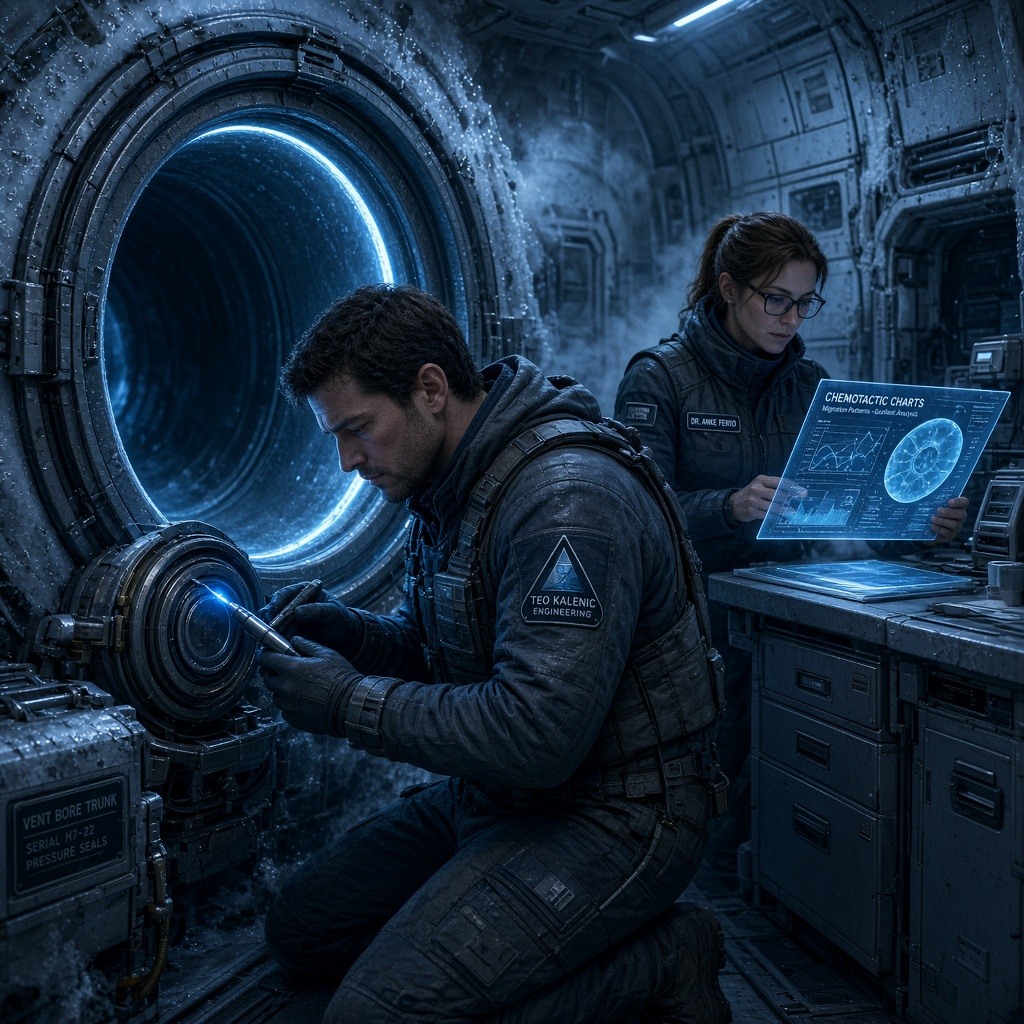
Solvig ran. Nine years on Europa had taught her that the station never used the phrase to the trunk in training. It saved the phrase for real events, the way old ships saved the whistle for fog.
The trunk was the vertical spine of Varne's instrument bore, a steel collar around three hundred meters of sapphire-clad fiber, and the hatch at the top of it was already fogging when she arrived. Frost was blooming inward along the gland plate, white ferns of it, growing as she watched. Behind the frost, the bore was venting. Not water, not in any way that would pour. Below the ice shell the station was safe from vacuum, but the bore passed through pressure regimes that did not forgive gaps, and where the gland had lost its seal, the bore's wet atmosphere was escaping upward through the fibers and flashing straight to gas and ice. The vent plume at the collar read as a hiss of crystals, a jet of white dust and vapor, streaming up past the fiber guides and out along the wrong side of the plate. Pressure was falling on the bore side of the gauge and the station side gauge was following it, gently, then less gently.
Kalenic was already in the harness above the gland, both gloves wrapped in heating tape, and Ferro came up the ladder two rungs at a time behind Solvig with the seal kit strapped to her back. Kalenic did not look down.
"Six," he said. "It's six that sheared, I can see the break light. Whole cable moved. The ice moved."
"The ice moved how much?" Solvig asked.
"Enough to shear one fiber and spring the gland. Two questions, and I can only answer one at a time, and the answer to the one you actually want is that the bloom's water pocket didn't move or I'd be a lot less calm. The ice above it shifted. Old ice does that. It reads every stress we put into it and answers on its own clock."
The vent jet thickened. Frost had reached the second guide ring and was building on it, a fat white collar of ice where no ice belonged.
Ferro got her shoulders into the harness beside Kalenic's and pulled the clamp gun out of the kit. "Greta, tell me the trace is alive. Tell me what it's saying while we do this."
Solvig turned to the console on the trunk platform. Nine fibers fed it, or had fed it, and the board now showed what she feared it would show: eight channels dim, alive but dim, and channel six flat black. Dead along its length. The bloom's morning trace had been running wide across all nine, that slow unhurried portrait, edge and above and steady, and what came through now was a single-thread whisper, one surviving fiber carrying the pattern alone, narrow and faint, like a voice through a keyhole.
"Alive," she said. "Narrow. One fiber's worth." She read the token stream off the whisper. "It's still saying the same thing. Edge. Above. Steady. It doesn't know yet, or it knows and doesn't care, or it knows and this is what caring looks like."
"All three," Ferro said, and drove the first clamp into the gland seam.
The clamp took. The jet at that point faltered, stuttered into a wider cone of crystals, and died there. Frost kept growing along the ring, but slower. Kalenic worked the opposite seam with the tape heater and the compound gun, his hands steady, the kind of steady that came from six years of knowing exactly how much heat the gland plate could take before its tempering was gone. Solvig had watched him splice fibers in worse moods than this and had learned that his calm was a tool with a maintenance schedule of its own.
Aalto's voice came up from the vault on the circuit. "Bank's isolated and holding full. Nothing in the bore path can touch it now. Do not ask me to warm the trunk with it, I will say no and I'll say it once."
"Nobody's asking," Kalenic said. "Greta, hand up the second collar. The small one, not the guide."
Solvig passed it. Her fingers were already slow with cold on the platform; the trunk hatch shed heat into the bore stream faster than the galley had ever let her forget, and the vent had put frost on every metal surface within arm's reach of the gland. She wiped the collar with her sleeve before she handed it up, twice, because a film of frost on a seal face was a leak that hadn't declared itself yet.
They worked through the vent in pieces. Ferro's clamps closed the wide gaps; Kalenic's compound filled the fine ones; the frost ferns on the plate thinned, stopped growing, hung there like a held breath that had decided not to end. The pressure board on the station side stopped falling. Then, slowly, over ten minutes, it climbed back, because Aalto fed make-up gas into the trunk from the station's working reserve and the working reserve was exactly what it sounded like: reserve.
When the numbers steadied, Solvig read them twice and made herself read them a third time before she said anything, because the third reading was the same as the first two.
"Anke. The make-up draw. What did we spend?"
"I'll put it on the sheet, not in the air," Ferro said, and then, watching Solvig's face, she put it in the air anyway. "The vent cost us seals and working gas, and the gas we can't remanufacture ahead of schedule without pulling power we've promised elsewhere. Run the candles instead of splitting electrolysis and the reserve works out to seventy-four days of air. That's with current crew, current draw, no second shear."
Seventy-four days. Solvig stood with that number the way she stood with new tokens, turning it over. The station had been provisioned for far more than that, and everyone aboard knew what had happened to the surplus: it had gone out through a gland seam in eleven minutes of frost. Twelve days sat inside her head as a deadline, and now seventy-four days sat behind it as a floor, and the floor was closer than anyone had spoken aloud on day one.
"Say it to Rask," Kalenic said. He was coming down out of the harness, and his voice was flat with the spent kind of calm. "Not to be dramatic. Say it because he's the one who gets to decide whether day twelve's broadcast is worth what a full-power send does to the ice around the bore. Today the ice answered nine fibers and one gland. Ask him what it answers a scream with."
"He'll say the ice answers with nothing, because the ice is ice," Ferro said. "And he'll be wrong in the way he's always wrong, which is the way that doesn't have to look at the thing before it names it."
"He looked at today's board for a full minute before he left the meeting room," Solvig said. "That's three days more looking than I expected." She said it quietly, and didn't add the rest of it, which was that it didn't matter. Forty-three minutes of light between here and anyone above Rask, and a man could do a great deal inside forty-three minutes on his own authority. So could she. That was the whole shape of the next eight days: five people with the power to act, sealed under ice, arguing with frost on their sleeves.
Kalenic unclamped the break light on channel six and read the flat line. "Fiber's gone between the two-forty mark and the three-ten mark. Seventy meters of cable, down a hole I can't enter, in ice that just proved it moves. I can't splice that blind. I could build a new fiber, cap it, fuse it down the bore over days, and every hour of that is hours of heat and tool time." He looked at the board, at the one dim thread whispering through it. "Greta. Eight fibers, or nine fibers and a day of the budget. Your call. I know which one you want."
"You know wrong," Solvig said. "What I want is nine fibers on day twelve and a bloom that has any reason left to talk to us on day thirteen. So the spindle job waits until we've cleared the gland and you've slept, and then we talk about hours. Not tonight."
"Not tonight," Kalenic agreed, which was how he signed off on arguments he intended to reopen at breakfast.
The frost on the gland plate had gone hard and white and permanent-looking, and would stay until someone scraped it with a heat gun and patience. Solvig took the glove off her right hand, and then off her left, and began threading the eight surviving fibers back through the guide rings one at a time, resetting each into its seat in the gland, because a fiber seated crooked after a shear was a fiber that would shear next. The cold took her fingers at the second ring and burned at the third, the bright specific pain of skin against sub-zero steel, and she worked through it anyway, because the alternative was waking Ferro, who had been up as long as she had, and because hands were cheaper than fibers.
At the fifth ring, the whisper on the console changed. She felt it before she looked, the way she'd learned to feel pattern changes through nine years of reading water, and when she looked, the single narrow thread was repeating itself, patient, unbroken, the same three tokens cycling with no urgency at all: edge, above, steady. Edge, above, steady. Two hundred and fourteen shared words, sent down one fiber's worth of width, as though the bloom had simply folded itself smaller and gone on saying the same thing to the sky.
Solvig seated the sixth fiber, and then the seventh, her fingers past hurting and into the wooden range of cold that meant she had ten more minutes of fine work in them, no more. Eight fibers. Seventy-four days of air. One fiber severed, one gland sprung, and eleven minutes of frost to pay for it. Eight days to day twelve.
Fragility had been a feeling for nine years. Now it had a unit and a count, and she could name it to anyone, up to and including a colonel who thought the ice was only ice and the loud send was only a handshake. She would name it. She was still counting when the whisper cycled again, edge, above, steady, and she threaded the last seat home with frost-burned fingers, and let it keep talking.
Tense Modulation
Solvig laid the three days of burst archive out on the optics bench at 06:40, before anyone else had claimed the room, and by 07:15 Ferro was standing at her shoulder without a word, reading down the columns the way she read a tide table. The frost-burn on Solvig's fingers had gone from bright to dull over the three days since the shear, and she turned the pages with the flats of her thumbnails where the pads still stung.
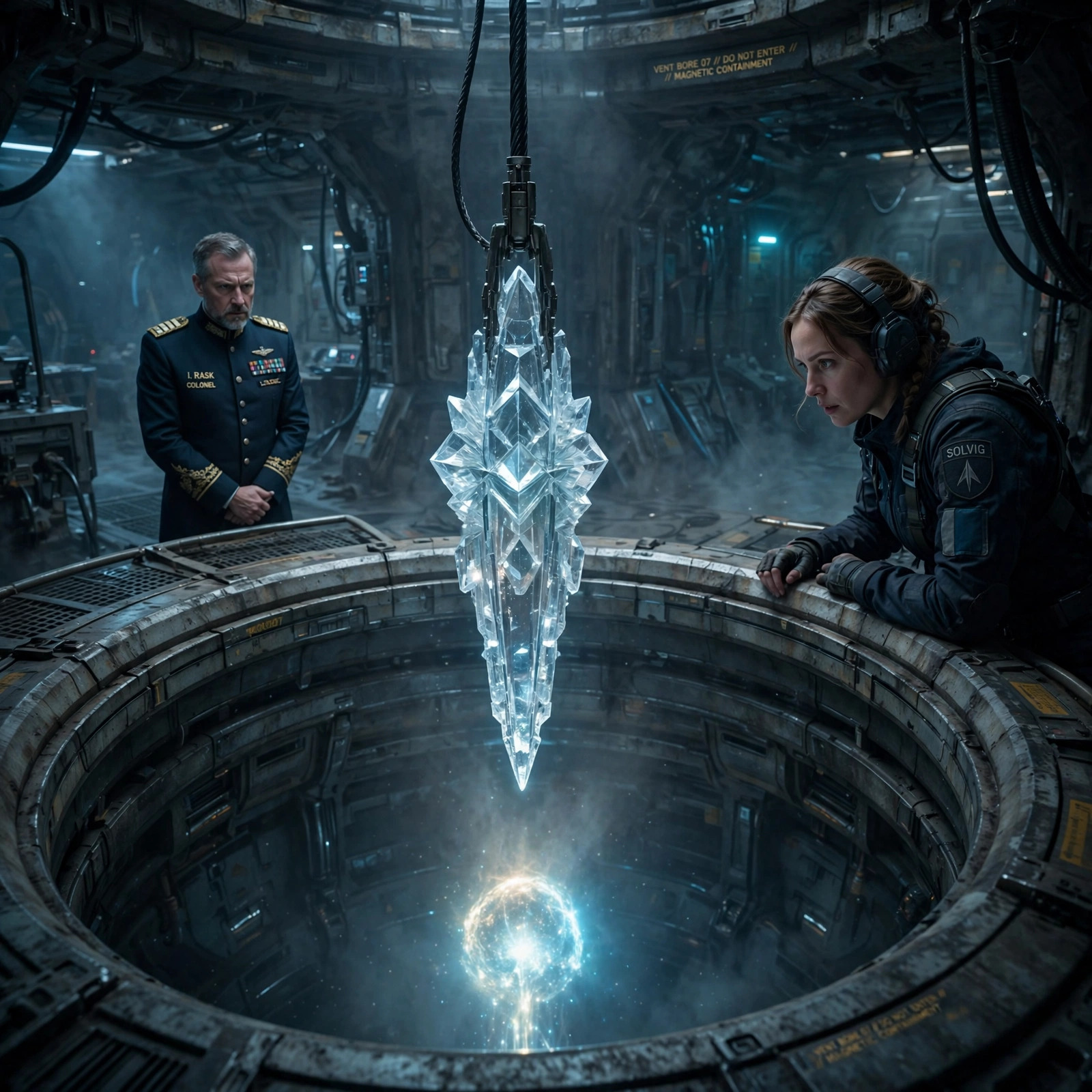
"You put the modulation on top," Ferro said. "Not beside."
"On top. Every burst, every token, all two hundred and fourteen. The bloom doesn't have a word for loud. It has a shape for loud, and the shape sits over the word like a hand over a mouth." Solvig pulled the second page forward. "Look at token 148, the slow exchange at the silt shelf. Same token, three shadings. One means here is food. One means food was here. And this one," she tapped the third column, "means food is here and it is mine and you are standing on my ground."
"Territorial," Ferro said.
"Territorial. Marked. The marking isn't vocabulary, it's timing, so it never shows up in the token counts, and Ganymede only ever sees the counts."
Ferro was quiet for a moment. Down the corridor, the air handlers changed pitch as the day shift brought the reactor loads up. "You're saying a full-power send doesn't just say hello louder. You're saying a loud unilateral send, first words, no reply requested, reads in that grammar as the third shading."
"I'm saying it reads as a claim. And I can prove the grammar exists, but I can't prove what a stranger will do with it, and that's the whole problem, because that's exactly the part they'll ask me to prove."
The scheduled call to the Coalition Deep Space Annex at Ganymede opened at 09:00 station time. Forty-three minutes of light each way, so the room was set up like a chess game by post: one camera, one log terminal, chairs for five. Aalto took the seat nearest the vault door with a slate of her own, the capacitor bank's charge curve still flat-topped and green across the top. Rask arrived at 08:56, coffee in hand, and put himself in front of the lens with the unhurried certainty of a man who had spent twenty-two years being the person the camera looked at.
"Doctor," he said, "you have the floor for the first block. Annex wants your read on the burst irregularities."
"Not the irregularities. The modulation." She put page one up on the display behind her, knowing the analysts at Ganymede were watching the same image arrive pixel by slow pixel. "Every token the bloom sends rides a carrier timing. Nine years of exchange, and the timing is as much a part of the message as the token. We built our half of the lexicon flat, two hundred and fourteen tokens, and the bloom has never once corrected us, because it reads our flatness as politeness. Flat means this is offered. Marked means this is claimed."
She let the forty-three minutes pass. The room drank coffee. Aalto ran a soft verification on the vault's cell stack and reported nothing, twice, to no one. Then the reply came down.
The lead analyst's voice, when it arrived, was patient and level and from very far away. "Doctor Solvig, what you're describing is a prosody feature inferred from timing jitter on eight surviving fibers of a damaged array. We have your token counts. We don't have the modulation. It's not in anything we can verify from here, and I'll be honest with you, a forty-three-minute delay and nine years of good faith don't add up to a veto over a Coalition security directive. The burst irregularities you flag as significant still look like evasion or noise to this desk. Send your data."
"I've sent it twice," Solvig said to the lens, and knew her answer would land at Ganymede while the analyst was already answering something else. "It can't be separated from the raw optical stream. Your pipeline strips the timing to save bandwidth. The grammar is the timing."
She sat back and let the lag do its work. It gave the argument a strange, dignified rhythm: a move, then nearly an hour of the four of them in the room together, saying nothing, or saying everything off-camera, and then the counter-move arriving like a move from a player who had aged forty-three minutes between turns.
Rask's turn came after the second exchange. "Doctor, I'll ask you plainly, and I want it on the record. If we hold the broadcast, what do you project?"
"If we hold it, we keep the channel we have. Two hundred and fourteen words, eight fibers, and time."
"And if we send?"
"Then we say the third shading of a claim to something that has spent nine years teaching us the difference between offering and demanding. And I can't tell you what it does next. I can only tell you it will understand exactly what we said."
"You understand my position," Rask said, and it wasn't a question, which was how she knew the next part was going to cost someone. "The Annex has a directive. There are other powers with ice-boring programs and worse manners than mine, and the directive says precedence goes to whoever speaks first and loudest. I don't get to weigh your grammar against that. I get to weigh your grammar against the possibility that Beijing or Calcutta or whoever it is this decade gets a probe into this ice shelf with no grammar at all."
"You'd rather it be us claiming them than someone else claiming them," Ferro said.
"I'd rather it be us," Rask said. "Yes. Someone was always going to speak first into that water, Doctor. I'd have liked it to be a woman with nine years of listening behind her. But the window is the window."
The third block came down at 13:20. The analyst at Ganymede had reviewed the modulation tables overnight, their night, and their voice had acquired the careful gentleness of a physician. "We can't certify any of it. The sample is one species, one vent, one damaged array. It's a beautiful reading, Doctor Solvig. It is not a basis for countermanding a security directive. This desk rejects the territorial interpretation as unverifiable. Recommendation stands: full-power dominance broadcast, day twelve, 08:00 station time."
Silence in the room for a while. Then Ferro stood up.
Solvig had worked beside her for four years and had never once seen her stand like that, both hands flat on the table, like someone bracing a door against water.
"Then put this on the record too, and route it to the review board. I'm the one who catalogued the chemotactic structure, so I'm the one who can say this. I've checked Solvig's modulation tables against my own chemical maps, independently, three times. The territorial shading she describes co-occurs with the defensive chemotaxis in the silt-shelf samples. Her reading isn't noise. It's the single best-supported result this station has produced, and I'm putting my seat on the day-twelve review behind it. If the Annex wants to reject the interpretation, it can reject me with it."
"Anke," Solvig said, quietly, "that seat took you four years."
"I know what it took." Ferro didn't look away from the lens. "Put it in the log."
Rask watched her for a long moment, and then turned to Solvig, and his voice, when it came, had nothing hard in it. "You hear what the desk said. Unverifiable. I'm bound by that, and I'd be bound by it even if I didn't think the desk was wrong. But I'm bound by the deadline, not the clock inside it. The directive says day twelve, 08:00. It doesn't say anything about the hours before it. You have until day twelve, Doctor. Not one hour more, and I can't take the bank offline for your experiments before then, so whatever you're going to prove, prove it on what you already hold."
"The bank stays charged," Aalto said from the vault door, not looking up from her slate. "For the record. Full charge, six hours to put back if anyone spends it."
"For the record," Rask said. "Day twelve. Then I press the button, or the next voice out of Ganymede does, and I'd rather it were mine."
The link closed at 14:40. Nobody moved for a minute. The air handlers hummed. Somewhere below them, under forty kilometers of ice, eight fibers of nine carried a patient narrow thread of light down to water that had no idea what was scheduled for the morning of day twelve.
Ferro got the log terminal first. She pulled the station log up, found the review-board channel, and wrote the dissent out longhand, stylus scratching, while Solvig watched over her shoulder: the territorial interpretation of the bloom's timing modulation, the rejection thereof by the Annex desk, and the undersigned's dissent, with seat. She signed it. Anke Ferro, Dr., Varne Station, Europa. Then she turned, and instead of setting the stylus down, she held it out across the bench to Solvig, handle first.
"Your name under mine," Ferro said. "If you want it."
Solvig took it. She wrote her name in the space Ferro had left her, and the stylus was warm from Ferro's hand, and the log took both names without asking whether the desk at Ganymede would ever read past the first one. Then she reached past the terminal to the far end of the bench, where the fused-silica rod lay in its cradle of clean cloth, the blank Kalenic had drawn down to length two nights before the shear, laser guide-marks already scored along it, waiting for the day he'd have the etcher to himself. Half-ready. Half-etched, if a person squinted at the guide-marks and called them a start.
She set it upright against the bench light where both of them could see it, all two hundred and fourteen slots marked out in pale scored lines down the glass, and not one of them yet cut.
"Two days," Ferro said, looking at it.
"Two days," Solvig said. "And it only has to say one true thing."
The rod stood in the light, thin as a finger and clearer than water, and the scored lines ran down it like a ladder waiting to be climbed.
Zero Charge
Day nine began with the archive, not the argument. Solvig had the burst log from all nine years of contact loaded on the bench display before the station's morning lights finished their slow rise, and she had been at it for three hours when Ferro's overnight annotation thread scrolled past a cluster of irregular bursts from the Conamara pocket, tagged unresolved, low priority, analyst opinion: evasion behavior.
Evasion. She sat back. The Annex analysts at Ganymede had been calling the irregular bursts evasion for years, because a loud exchange would run clean and steady for an hour and then fragment into short, sloppy, overlapping transmissions, as if the source had turned away to do something else. Noise, they said. Degraded signal. The bloom hiding.
She pulled one fragment apart on the display, then five, then fifty. The fragments weren't noise. Each one was small. Each one repeated a token, or a pair of tokens, in the same patient sequence the bloom had used with the station in the early years, when the lexicon was twenty tokens and the bore was a single fiber and every exchange was the bloom showing a shape and the station answering with its own. The fragments used the same two hundred and fourteen tokens. The same constructions. The same tense-modulated timing she and Ferro had spent four years learning to read.
Except the fragments were wrong in a specific way. Slowly wrong. Token 118, heat-vent, held too long. Token 47, above, grouped with 214, edge, then broken off and repeated. Not evasion. Practice. Someone small, on the far side of the pocket, learning the same lesson she had learned at her first terminal nine years ago, with an adult patient enough to repeat.
She ran the count twice. The fragments came from at least four distinct repeating sources, each with its own small signature of error, each one getting fewer errors over weeks. Two curricula, overlapping on the same channel. The station had spent years assuming it was one voice. It had been a school.
She sat very still with her hand flat on the bench, and then she thought about the morning of day twelve, and a high-power dominance broadcast going down that same bore into that same pocket, and what a territorial claim sounds like when it lands on a classroom.
She went to find Aalto.
The transmitter vault ran along the station's spine, past the galley, and Aalto was at the monitoring desk as she always was, slate propped against the meter stack, the bank's charge state glowing steady and green behind her: full. Every loud send the bank could ever make, held. Solvig had walked past that green light for nine days and thought of it as Rask's, but it was Aalto's vault, Aalto's cells, Aalto's name on the power log.
"Petty Officer," Solvig said. "I need the bank at zero by tonight."
Aalto didn't look up. "The colonel's standing order says full charge until day twelve. It's logged in his hand."
"I know whose hand it's in."
"Then you know I can't stand down a standing order because the contact lead walks in and asks." Aalto set the stylus down. "I've got three years on this station, Doctor. I don't have Ganymede. I don't have a review seat. I have the power log and the vault door, and if I burn the bank on your say-so, the Annex will ask me why, and 'she asked me to' doesn't survive that conversation."
"It doesn't have to survive it. I'll sign the discharge order myself. My name, my authority as contact lead, my dissent already in the log under Ferro's. You execute a lawful order from the mission's science lead. That's defensible."
"Defensible," Aalto said, "is a word for after." But she pulled her slate up and turned it toward Solvig, and the discharge form was already half-drafted, which meant she'd been thinking about it since day seven. "You'd want it through a dummy load. Not a fault. A fault discharge looks like an accident, and accidents get investigated, and investigations find out who flipped what. A controlled burn into the load banks is an act. Acts get logged. Acts have authors."
"I want an author," Solvig said. "I want my name where anyone can read it."
Aalto studied her for a long moment, then keyed the vault door. "Get me Kalenic. If we're doing this, it's his rig."
Kalenic came down from the optics bench with etching dust still on his cuffs, took one look at the dummy-load rack, and started pulling panels. The rig was straightforward: the bank's output bus jumpered into the resistive load stack, the load stack bled to the station's thermal radiators, and the whole discharge could be run slow and clean, cell by cell, without a single arc. He talked while he worked, which was how he worked.
"Six hours to put the charge back," he said, tightening the first bus clamp. "That's if nothing's wrong with the cells. If we burn it tonight, and the Annex orders a recharge at first light tomorrow, they're loud again by midday day ten. You're not stopping the broadcast, Doctor. You're moving it."
"I'm not stopping it," Solvig said. "You're right about that. But Rask's window is day twelve, oh-eight-hundred. The Annex order is written for that window. A new order has to go back through forty-three minutes of lag, get argued at Ganymede, come back down. That's days of argument, not hours. And Rask can't press a button into an empty bank."
"He can argue you into the ground in the meantime."
"He can. He'll have the argument. What he won't have is a charged bank inside a window he controls." She watched him seat the second clamp. "Teo. The spindle. Is it done?"
He didn't stop working, but something in his shoulders changed. "Capped at first light. Fusion-capped, all two hundred and fourteen slots cut, sealed to the bore's pressure rating. I was going to bring it down after this."
"Bring it after. I want to see it before we burn anything."
They ran the discharge beginning at 21:40, station time. Aalto read the cell voltages aloud in groups of ten, Kalenic walked the bus with the meter probe, and Solvig stood where she could see both the load stack and the log slate. It wasn't dramatic, and that was the point of it. Cell groups fell in order, the load stack ran warm, the radiators took the heat out into the dark the way they took everything, and the green lights on the meter stack went out one row at a time, like windows in a building going dark by design.
At 23:12 the last row read zero.
Nobody spoke. The meters held at zero, flat, steady, and Solvig looked at that flat line the way she had looked at the burst fragments that morning, and it said the same thing both times: nothing here is hiding. Aalto keyed the log and wrote it out longhand, the way Ferro had written the dissent.
"Deliberate discharge of the main transmitter capacitor bank to zero, through the resistive load rig, per the signed order of Dr. Greta Solvig, contact lead, Varne Station. Six hours minimum to restore charge. Executing technician, Suvi Aalto. Rig by Teo Kalenic." She read it back once, then signed it, and turned the slate so Solvig could see her own name sitting in the order line. "It's yours now. All of it."
"I know," Solvig said. "I'd rather it were mine than nobody's."
Kalenic wiped his hands and went down the corridor, and came back with a padded case, and opened it on the monitoring desk between the dead meters. The spindle lay in a bed of clean cloth, a fused-silica rod thin as a finger, and down its whole length, catching the vault light, ran two hundred and fourteen etched tokens, each one cut clean, each one a word the bloom had given the station or the station had given the bloom over nine years. He hadn't etched a message. He'd etched the whole shared vocabulary, the entire thing, so that whatever came back up the bore would find every word it knew already waiting in the glass.
"Pressure-capped," he said. "Fiber six's channel is open at the gland if you want to send it down tonight. Or tomorrow. It'll hold."
Solvig lifted the spindle out of the case. It weighed almost nothing. Two curricula, she thought, and this was the third: a glass rod with every word they had, going down into a classroom.
"Day twelve," she said. "After I've written Rask a message he can read before the Annex does."
She put the spindle back in its cloth, closed the case, and carried it out of the vault, past the dead meter stack, toward the bore.
Two Hundred Fifteen
The 08:00 window came and went the way a tide goes out under ice: nothing broke, nothing announced itself, and everything was different after. Solvig watched it pass from the bore room with the spindle case on her knees, and the station's clocks moved through 08:00, and 08:10, and 08:20, and no high-power carrier went out from Varne Station toward the sky. The bank sat in its vault three corridors away with four hours of charge on it, then three and a half, and the window that had been built for it closed with nothing inside.
Rask came down the bore-room corridor at 08:41, boots unhurried, which was how he arrived when he had already read the log and did not need to be told anything. He had the vault slate under one arm. He stopped inside the hatch and did not come farther in, and he looked first at the spindle case, and then at her.
"Aalto's handwriting," he said. "Your name in the order line. Full discharge at 23:12, night nine, through a resistive rig Kalenic built out of heater strip and bus bar."
"It's a clean rig," Kalenic said from the gland console. "Fused and everything."
"I don't doubt the rig." Rask set the slate down on the monitoring bench, face up, where the log entry sat in Aalto's longhand. "I doubt I've ever had a station officer hand me my own deadline back to me discharged to zero. The Annex will have this by 09:24 their time. That's forty-three minutes of silence I get to spend first."
Solvig did not stand up. The case weighed almost nothing on her knees, and she kept her hands flat on its lid. "You had two people on this station who could read the channel," she said. "Ferro and me. You had one order that required a loud send through ice we already know shears. Fiber six went on day four, Colonel. One fiber out of nine, and it cost us telemetry we still haven't recovered, and it cost us air."
"I read the seal report."
"Then you read the candle count. Seventy-four days, and that's with rationing since day five. A full-power broadcast puts that much heat into the bore's ice wall, and if the gland shears the way fiber six sheared, we're not talking about a message the bloom misreads. We're talking about losing the channel entirely. And I don't mean the bloom walks away. I mean the bore floods, the fibers die, and the only species we know of that speaks in light is behind glass forever."
Rask pulled the stool out from the bench and sat, which he had not done in her bore room before. "You know what I filed with the Annex, night seven."
"I know what they filed back," Ferro said from the doorway. She had come down behind him with her own slate, the dissent and Solvig's name beneath it still sitting in the day-seven log. "Unverifiable. That was the word. Four years I've catalogued that bloom's chemotactic structure, and they called my tense reading unverifiable and reaffirmed your 08:00."
"They reaffirmed it because precedence is a real thing," Rask said. "Not because they're fools. If a rival power reaches this moon with a transmitter and we've spent nine years only ever answering, never initiating, then every signal we've exchanged is on record as responses. The Annex reads that as a claim waiting to be taken. I read it as my job to make sure nobody takes it."
"And I read it as my job to make sure the thing we're claiming can still talk," Solvig said. "It was never one voice down there, Colonel. You saw the burst archive. The irregular traffic everyone's analysts called evasion, all the way back to day one of my nine years, that's two lessons running on one channel. The adults teach the young the tokens. Two hundred and fourteen of them. Every one of those tokens was given, not taken. Every one was answered. Nine years, and never once has anything come up that bore that read like a command. It's a school, and we're the other classroom in it."
Rask was quiet for a moment. Aalto had come to the doorway behind Ferro, and she was the one who broke it. "Bank's at three hours now, if you're keeping the ledger," she said. "Six-hour minimum, discharged at 23:12. That's arithmetic, not opinion."
"I can do arithmetic," Rask said. "I've been doing it since midnight, which is when the log reached me, which is why I'm standing here at 08:41 instead of 08:00 sharp." He turned the slate face down. "Here's what I can't file, Solvig. I can't file that a contact lead discharged a strategic asset on a linguist's reading of a light pattern, and I can't file that she was wrong to. The window's gone. The Annex will scream. They'll want charges, and they'll want them in forty-three minutes of lag, which means I've got forty-three minutes to decide what this station's protocol says before they decide for me."
He took a folded sheet out of his jacket pocket, and Solvig saw it was a printed amendment, drafted in his own phrasing, the header already filled in: joint protocol, Varne Station and Coalition Deep Space Annex, Ganymede. He didn't hand it over. He set it on the bench between them, unfolded, and put his hand flat on it, the way she had hers on the case.
"It names the vent bore a shared channel," he said. "It puts every send through the bore under dual sign-off, mine and yours. It commits the Annex to answer-only at high power until the dual sign-off says otherwise. It's not an apology and it's not a pardon. It's a fence, and we're both standing inside it."
"And charges?" Ferro asked.
"There's a line for them in the same document. It's blank. I intend to leave it blank while that thing down there keeps answering." He took his hand off the paper. "That's my decision, made inside my own window. Sign it or don't, but sign it before the Annex's reply lands, because their reply will not have a blank line in it."
Solvig read it standing. It was three paragraphs, tight, and the second paragraph used her exact phrase, shared channel, which he had taken from her day-seven log without asking, and she found she didn't mind. She left it on the bench, unsigned, and picked up the case.
"Then watch first," she said. "Sign after."
The bore collar stood open at the room's end, a meter-wide throat of frost-blackened steel with the gland head mounted on its rim, and through the gland ran the array: eight sapphire-clad fibers alive with carrier light, and the ninth channel, fiber six's channel, empty and pressure-capped since the shear. Kalenic had the cap off in forty seconds, hands sure, and he fed her the guide tube while Aalto held the collar lamp.
The spindle went down in silence. It was a finger's width of fused silica, laser-etched along its whole length with the two hundred and fourteen tokens, fusion-capped at both ends, and it slid into fiber six's empty channel the way a word slides into a sentence that has been waiting for it. Kalenic ran the feed by hand, a meter at a time, watching tension on the gauge. Three hundred meters of bore lay under the station, down through the shell ice, down past the brine layer, to the water pocket under Conamara Chaos where the bloom lived in the heat of the vent.
"Forty-one minutes to the pocket," Kalenic said. "Forty-one back."
"I know the arithmetic," Solvig said, and then, quieter, "I've done it every day for nine years."
They waited. There was nothing else to do. Ferro sat on the tool bench with her slate open to the receive buffer, and Aalto leaned on the collar with the lamp, and Rask stayed at the hatch, arms folded, and nobody left the room. The buffer scrolled empty. At thirty-eight minutes it scrolled empty. At forty it scrolled empty, and Ferro's knuckles went pale on the slate's edge, and Solvig kept her eyes on the fibers, where the carrier light ran steady and small, eight lanes of patient blue.
At forty-three minutes and change, the buffer moved.
"That's not ours," Ferro said. "That's not carrier. That's up-bore."
The pattern came up fiber two, then fiber five, then two again, and it was slow, the way the teaching bursts were slow, and it repeated. Ferro's parser chewed on it, and then stopped, and then flagged it, and she turned the slate around so they could all read the same thing at once. The parser had found the token boundaries and laid them out, and every boundary held, and the construction was clean, and the token at its center was one none of them had ever seen. Not in nine years of archive. Not in either curriculum.
"It's new," Ferro said. "It's not in the lexicon. It's not in the young-bloom lesson set either, I've got both, I've got all of it." Her voice went thin. "Two hundred and fifteen."
"What is it?" Rask asked. "What does it say?"
"It groups the same way 214 did," Solvig said. "Edge, above, heat-vent. It's built the same as the word it answers. But it's got a new marker on the front, and the marker modifies toward the sender." She watched the pattern cycle again through the fibers, patient, repeated, the way you repeat a word to a student who is still learning. "It's not a claim. It's not a command. It's an offering with a self attached. Something like: this is ours, both of us, this edge." She stopped, because the next thing she was going to say was a guess, and she had stopped guessing at that bore years ago.
"It read the spindle," Kalenic said. "The whole vocabulary came down its channel physically, and it answered with a word that wasn't in it."
Rask came off the hatch frame at last. He crossed to the collar, and stood where he could see the fibers' light running, and he looked down the throat of the bore for a while, at the small blue lanes going down into the dark, and at the buffer where the 215th token cycled and cycled, unhurried, waiting to be learned.
"Aalto," he said. "Log it. Receive, up-bore, novel token, dual sign-off pending." He picked the amendment up off the bench and folded it back into his pocket, unsigned. "I'll sign it when I've watched this twice more," he said. "You'll countersign. Ferro keeps her review seat, and the Annex gets my protocol and my recommendation in the same packet, and if they want charges they can argue with me across forty-three minutes of their own lag."
"They'll argue," Ferro said.
"They'll argue," he agreed. "It's what classrooms do."
Solvig put her hand on the bore collar. The steel was cold past the frost line, and it hummed faintly under her palm where the fibers ran, and the 215th token came up the array again, slow, repeated, teachable, and down in the water pocket under Conamara Chaos something old and bright was holding out one more word to a species that had just, for the first time in nine years, sent its whole vocabulary down to be held. Rask watched from the hatch with the folded amendment in his pocket, and nobody in the room moved to close anything, and the light kept coming up.
Get notified when new stories drop

Mira Okoye
Mira writes first contact and mentorship-across-species stories where curiosity beats fear.
Leave a comment
Comments