


Anvara's Shadow
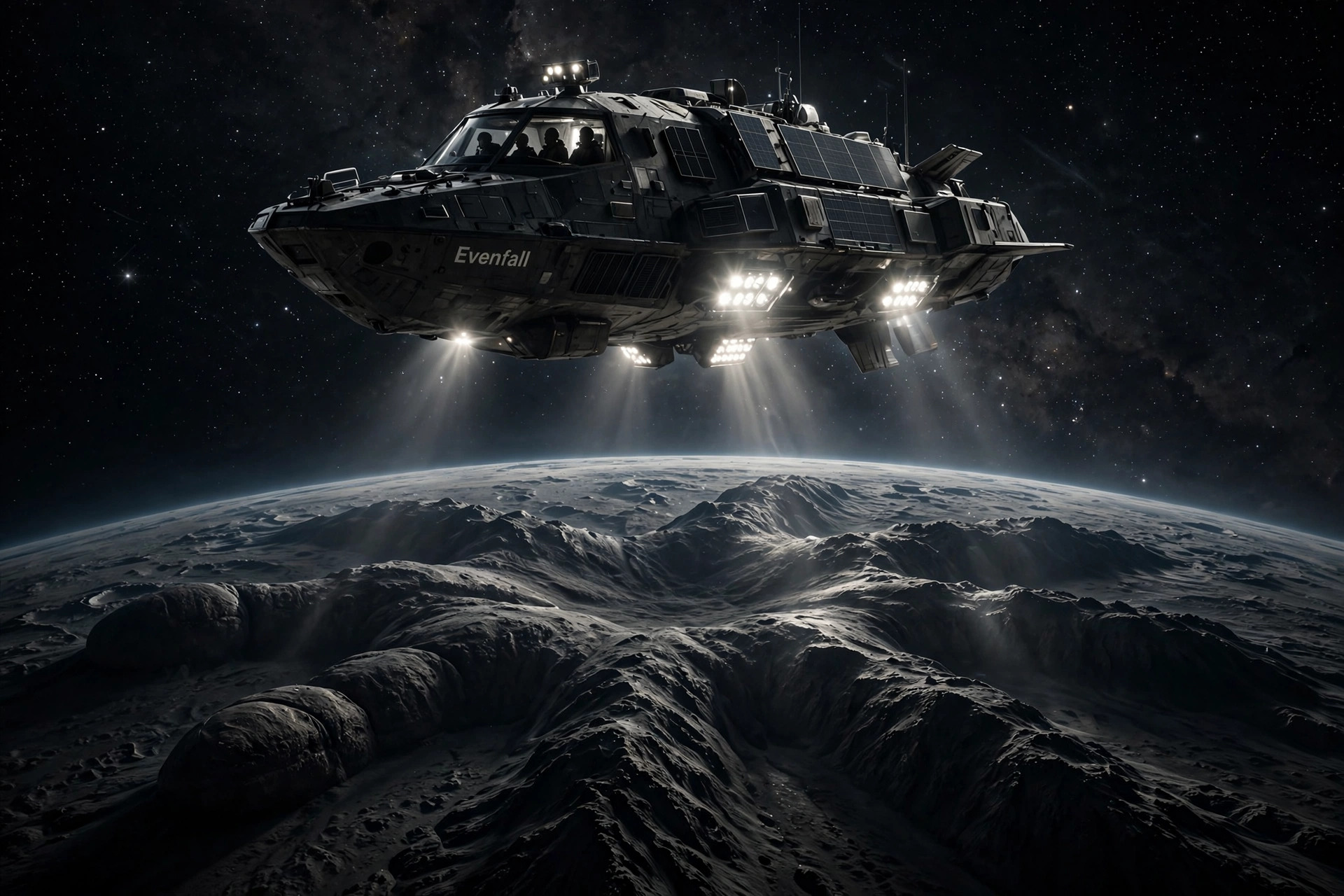
The Evenfall held station forty kilometers above Anvara's night side, and Odile Varga watched the shadow of the planetoid fill the forward scope like a held-out palm. She had spent eleven years chasing dark bodies, rocks that wandered the gaps between stars with no sun to answer to, and she had learned that they kept their secrets close. Anvara was keeping one now. The magnetometer had been singing since midnight, ship's time, a low insistent note under the deck plates.
"Still climbing," Anke Duarte said from the comms console. She had the raw trace flattened across her screen, the field lines drawn taut. "Induction signature's tripled since yesterday's pass. Captain, that's not crustal iron. That moves like salt water."
Odile let the words sit. A rogue body with a subsurface ocean would be the first ever confirmed, and every instrument aboard had been flown out from Var Point Station on the strength of a maybe. The anomaly was the maybe growing teeth.
"Run it against the tidal model," she said. "Twice. If there's a brine layer under that crust, I want the depth estimate before anyone gets excited in the log."
Boaz Ferreira was already excited out loud, which was his habit. He stood at the cargo rack with his inventory slate, ticking items with a stubby finger. "Doesn't matter what depth. If it's liquid, it's reachable. Forty centimeters of crust is all we cut through, that's the drill spec, and the straw's rated for better than that." He patted the rack. The hollow thermal drill lay strapped in its cradle, steel and ceramic liner, cold-soaked and ready, the long tube the crew called the straw because that was what it was, a pipe you pushed down and sucked a core through.
"Nothing gets reached until I say what we're reaching for," Odile said. "Finish the inventory."
"Straw's green," Ferreira said. "Brazed joints all holding. Duarte and Nawi did the refit at Var Point two years back, and I'd put their brazing up against anything machined fresh." He moved down the slate. "Claim beacon, sealed, keyed private, bridge strongbox. That's how it shipped and that's how it sits. Suit locker sealed. Consumables at margin plus six days of reserve, per the manifest."
Six days. Odile had fought for those six days at Var Point, had argued down the mission planners who wanted them spent on instrumentation instead, and she counted them the way other captains counted bullets. The reserve was the difference between an abort that ended in a warm bunk and an abort that ended in arithmetic nobody wanted to do.
Yun Nawi came up from the sim bay with her hair tied back and her boots still magged from the lower deck. She was the youngest of them and she flew like it, all economy, no theater. "Descent profile's loaded if we want it," she said. "But I'll say what I said at Var Point. This body doesn't hand out landing windows. There's a fast crossing that opens day four and a slow one that opens day twelve, and the difference between them is about all of our propellant margin."
"Day four," Iskander Bohm said.
He said it the way he said most things, quietly, from the observer's chair he'd claimed on day one, and Odile had learned in four days aboard that quiet was not the same as soft. Bohm was the Halcyon Trust's man, the underwriter's observer, forty-five years old and careful with every one of them. He didn't raise his voice. He didn't have to. The Trust's seal was on the hull.
"The plume vents day four," he said. "Your own survey says so. We fly the corridor while it's fresh, sample what comes up before it disperses, and we're home inside the reserve. The slow window means sitting on our hands for eight extra days, burning consumables, and landers have a way of failing on the waiting as often as on the flying. My people put a number on that. It isn't a kind number."
"Your people aren't aboard," Odile said.
"No," Bohm said. "They're four light-hours away at Var Point, and so is yours. Every decision on this rock gets made in this room. I'd rather make it with the window that's open."
Duarte looked up from her console. "He's right about the lag, Captain. Four hours one-way, eight round trip, and that's with the relay holding. If we ask Var Point anything that matters, the answer arrives after it's stopped mattering."
"I know the arithmetic," Odile said. "I logged it this morning."
She was still watching the scope when it happened. The terminator line crawled across Anvara's limb as the Evenfall tracked the body's slow rotation, and along that line, in a belt of shattered crust the survey had marked as a thermal feature, a point of white bloomed. Not a flash. Nothing so dramatic. Just a brightening, a smear of reflected starlight where none had been, and then a thread of haze standing up off the surface into the black, straight as a plumb line, fanning out at the top.
"Duarte," Odile said. "Starboard limb, one-six mark. Tell me that's what I think it is."
Duarte threw the scope feed to the main display and the whole bridge went quiet. The plume rose in the frame, grain by grain, a column of vapor and ice crystals climbing along a thermal crack in the crust, caught in the light of nothing but distant stars and the Evenfall's own floods. There was no sound out there and no wind to bend it. It rose and it spread and it fell back in a slow curtain, ice grains on ballistic arcs, glittering.
"Vents through a thermal crack," Duarte said, reading the spectrometer off her screen. "It's gas and ice grains. Vapor, brine ice, some salts. Nothing liquid makes it to altitude, not at this pressure. But if that ice refroze from liquid brine, Captain, the ocean's under it. That's the signature. That's it."
"That's a plume," Ferreira said. "A plume is a door."
"A plume is a hazard," Nawi said. "You fly a lander through a corridor of ice grains at closing speed, you're sandblasting the hull. It can be done. It's been done. The corridor's mappable, day four's computable. But I'll want sims before anybody commits my ship to it."
"Sims cost days," Bohm said. "Days cost margin."
"Margin costs lives," Ferreira said, mild as milk, and the two of them looked at each other across the bridge and didn't say anything else.
Odile let the plume climb on the display. Nine hundred kilometers, the early numbers said, a corridor of suspended ice along the vent, dense enough to sample and thin enough, maybe, to fly. Fresh brine ice lofted from a liquid layer no instrument had ever reached on a rogue body. If the crust core held refrozen brine at forty centimeters, the proof was in hand, ocean confirmed, first of its kind. If it didn't, if the plume ice was only surface frost thrown up by tidal flexing, then Anvara was just another cold rock and the Trust had spent a fortune on a shadow.
"Here's what we have," she said, and the bridge settled. "An induction anomaly consistent with a subsurface brine layer. A active thermal vent, confirmed, on the terminator. A plume of gas and ice rising along a mapped corridor, crossing its peak on mission day four. A fast landing window on day four and a slow one on day twelve, and six days of reserve that I am not spending to make anybody's schedule look brave."
"Captain," Bohm said, "the fast window is the whole reason the Trust funded a lander. The plume disperses. What it lofts on day four is gone by day twelve. If we want fresh brine ice from the corridor itself, we fly when the corridor is full."
"If we fly," Odile said. "You're asking me to commit a hot crossing burn with no abort worth the name, on day four, on the strength of a magnetometer and a pretty picture. That's not a decision. That's a wish."
"It's a decision that gets made by day three at the latest," Bohm said, "or the window makes it for you."
He was right about that, and he was reasonable about the rest, which was what made him tiring. She had flown with observers before who only counted money. Bohm counted lives too, she was fairly sure; he just weighed them on a different scale than hers.
"Then we spend the days we have," she said. "Duarte, continuous watch on the plume, spectrometry on every pass, and I want the ice grain flux along the corridor binned by altitude. Nawi, map the corridor, run your descent sims for both windows, and give me honest abort numbers, not encouraging ones. Ferreira, the straw and the suits get a full checkout, and I want the beacon's keying verified without breaking its seal. Bohm, you get everything the rest of us get, at the same time we get it."
"And the log?" Duarte asked.
"The log says what happened today." Odile pulled it up herself. Mission day one. 0412 ship's time. Thermal vent active on the terminator belt, plume confirmed rising, composition gas and brine ice, induction anomaly consistent with subsurface liquid. Survey corridor scheduled. No flythrough commitment pending mapping and descent simulation. She read it back once, put her name on it, and set it to transmit. Four hours later it would reach Var Point, and four hours after that any reply would arrive, and by then she would have made whatever had to be made on her own.
"Day four gets its decision on day three," she said. "When the sims say what the crossing costs."
"And if the sims say it costs everything?" Nawi asked.
"Then we'll talk about day twelve," Odile said, and turned back to the display, where Anvara's plume stood off the night side like a held-up hand, white against the shadow, still climbing.
The Flythrough Window
The corridor map finished rendering at 0307 ship's time on day three, and Odile Varga had been awake to watch every frame of it go up.
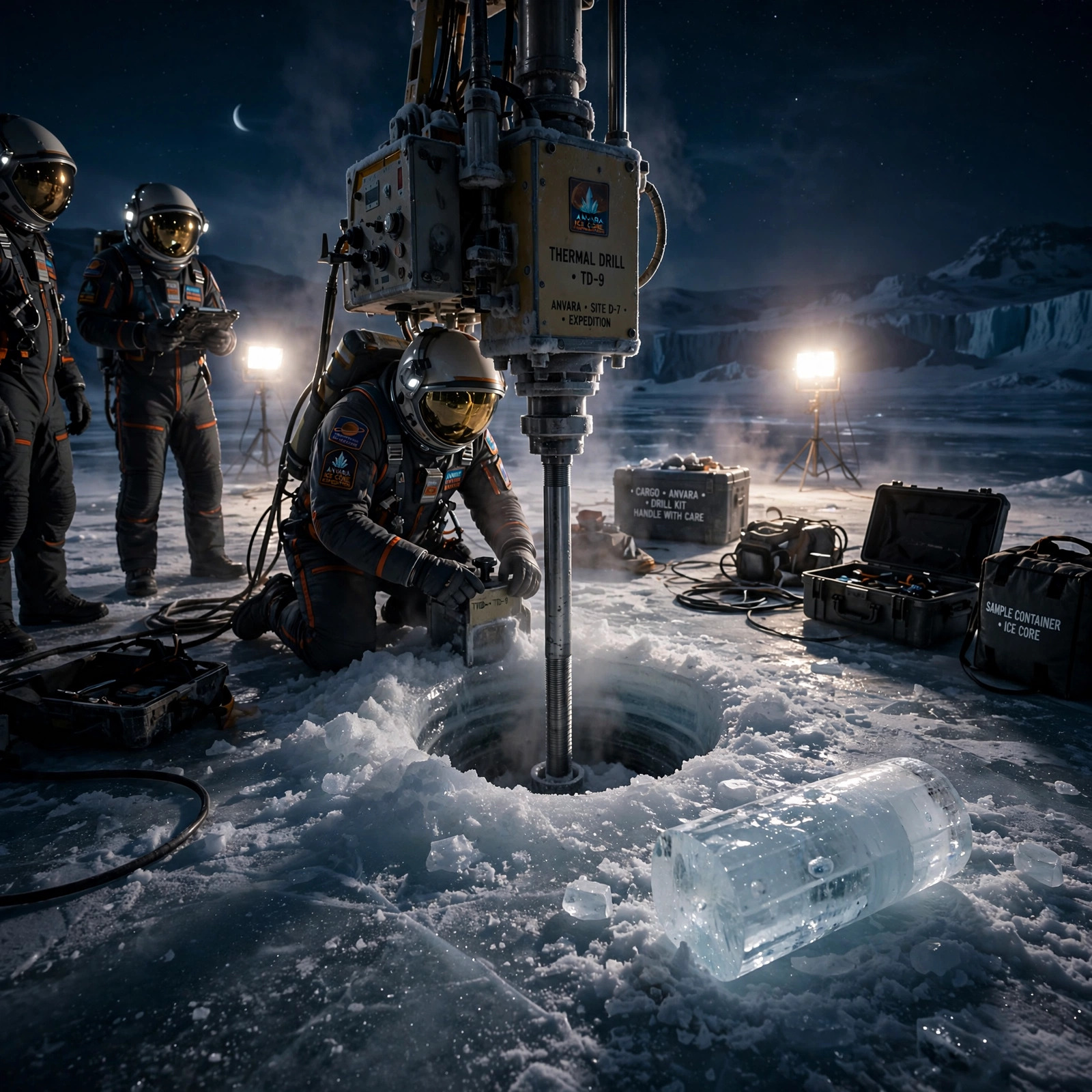
Nine hundred kilometers of vent. That was the number that sat in the middle of the display like a verdict. The thermal crack on Anvara's terminator belt breathed on a forty-hour cycle, and when it breathed, it threw gas and ice grains clear across a corridor nine hundred kilometers long and, at its widest, eleven across. Not water. Not at altitude. The spectrometry was unambiguous: vapor and brine ice, lofted and flash-frozen, the grains sorting themselves by mass along the corridor's spine the way a river sorts its sediment. Duarte had binned the grain flux by altitude on every pass for two days straight, and the bins made a picture so clean it looked drafted rather than measured.
"Composition holds," Duarte said, sliding the plots to the center screen. "Salt fraction in the grains is steady from top to bottom. Whatever feeds that crack is liquid under the crust, and the plume is carrying pieces of it up to where we can reach."
Which was the whole prize, and the whole trap. A rogue body with a subsurface ocean had never been proven. The induction anomaly said one thing; the magnetometer said another; but a core of refrozen brine ice pulled from the crust, forty centimeters down, where the plume's own fall-out had been reworked into the surface — that would be proof no review board on any world could argue with. And the corridor was full of fresh brine ice on day four, and empty of it by day twelve, when the slow window opened.
"Nawi," Odile said. "Give it to me straight."
Yun Nawi had been in the sim bay since 2200 the night before, and she looked it. She brought up the descent profile anyway, steady hands, flat voice.
"Two ways down. The slow window, day twelve, is a parking brake. We ride the terminator down over four hours, burn almost nothing, land with margin to spare on propellant and on power. Abort at any point costs under forty meters per second. If something breaks, we come home."
"And day four."
"Day four, we don't ride anything down. We shoot the corridor." Nawi put the trajectory on the screen, a single line drawn through the plume's heart, nose to tail. "The crack vents at 0440. The corridor's densest between forty and two hundred kilometers altitude for about ninety minutes. To sample it we cross through that band at speed, instruments open, then burn hard to shed velocity and settle onto the night side. The crossing burn is the problem. We go in hot, and the burn to come out of it has to happen on time, in one piece, or we don't come out of it."
"How thin," Odile said.
"Abort margin through the dense band is under six meters per second." Nawi let that sit. "That's not a course correction. That's noise in the telemetry. One grain strike on the wrong surface, one late ignition on the crossing burn, and the margin is gone before we know we needed it."
Duarte said, "Define late."
"Two seconds. The burn window is nine wide, and we need seven of them."
"Grain strikes at that speed," Ferreira's voice came over the intercom from the cargo bay; he had the straw half out of its rack and wasn't leaving it for this. "I can tell you now, anything that size hits like a hammer. Heat shield takes it. Windows don't."
Odile kept her eyes on the profile. "Crew module exposure through the band?"
"Tails forward, shield forward for the crossing," Nawi said. "But we fly the whole corridor nose-out to keep the instruments fed, so there's eleven minutes with the sensor pallet facing into the grain flow. The pallet's armored. The armor's rated for it. Rated," she added, "is a word simulators get to use and I don't."
Bohm had taken the observer's chair at the back of the bridge and had not interrupted once. That was unusual enough that Odile turned around.
"You've been quiet," she said.
"I've been reading your consumables." He held up his slate. "May I?"
"You're going to whether I say so."
"Six days of reserve," Bohm said. "Air, water, power margin, propellant reserve — six days past the planned spend, that's what the Trust bought and that's what you're carrying. I've had Duarte's numbers since day one, and I've run them three times myself. Here's what I keep getting. The slow window costs us eight days of waiting. Burn the reserve down to nothing and land on day twelve anyway, we land with no margin at all — or we start trimming the survey itself to buy it back. Day four costs propellant we have. Day twelve costs supplies we can't replace."
Duarte nodded without looking up from her own slate. "He's running it right. The reserve is six days, and holding for day twelve spends most of it before touchdown. We'd land alive. We'd land with nothing behind us."
"So the fast window is the safe one," Bohm said. "Not the comfortable one. I know how it sounds. But delta-v is a number we hold, and supplies are a clock that runs no matter what we decide. I'd rather ask Nawi for one hard burn than ask Duarte for air we don't have."
"You're asking Nawi for one hard burn with two seconds of room in it," Odile said.
"I'm asking you to weigh them honestly," Bohm said. "One risk we can see and one we can't. Every underwriter on Var Point would take the one we can see. Most of the captains I've flown with would too."
"Most of the captains you've flown with are alive," Nawi said, "which biases your sample."
Bohm spread his hands, and to his credit he almost smiled. "Noted."
Odile let the profile rotate on the screen for a moment, the corridor dense at its middle, the abort line running along the bottom of the band like a thread under a door. She thought about the forty-centimeter core. She thought about Ferreira's straw, brazed and cold-soaked and ready in its rack. She thought, briefly and with a discipline she made herself practice, about her own preference, which was for nerve, and about how many crews she had watched mistake that preference for judgment.
"Here's what I have," she said. "Bohm's right that the reserve is the real clock. Six days, and day twelve spends them. He's wrong that this makes day four safe. It makes day four expensive in a different currency, and Nawi's the only one here who knows the exchange rate, and she says it's thin."
"Under six," Nawi said. "And that's the number before anything goes wrong."
"So nothing goes wrong before we decide. We rehearse." Odile pulled the mission board up and started moving items. "Full abort drill. Nawi flies the corridor profile in the bay, live timeline, and I want the crossing burn commanded from the real console with the real delays in it, not the trainer's friendly ones. Ferreira, I want the pallet armor inspected grain by grain, and I want you in a suit for the drill, the rated one, full checkout on all four suits while we're at it."
"Rehearsal costs a day," Duarte said quietly. "It comes out of the reserve."
"It comes out of the reserve," Odile agreed, "and it's the cheapest thing I've heard offered all morning. If the drill is clean, day four is still on the table and we fly it knowing the margin is real. If it isn't clean, we've spent one day to find that out instead of spending the crew."
"And if it's clean?" Bohm said. "Do I have your commitment to the flythrough?"
"You have my commitment to decide." She set the drill on the board: day five, 0400, full abort rehearsal, all hands. "Day four vents at 0440. That's after the drill. We'll have the sim numbers and the real ones side by side, and I'll make the call with both in front of me and my name on the log."
"You're spending a reserve day to buy permission," Bohm said. Not heated. Almost gentle. "You've already decided to fly it. I'd rather you decided today and gave us the hours to prepare for the burn instead of the drill."
"Then you'd rather I wasn't the one deciding," Odile said. "The drill runs day five. The call gets made after. That's the order."
He looked at her for a long moment, and then he stood, and picked up his slate, and did the thing she was slowly learning was his version of surrender: he wrote it down. "Logged," he said. "Objecting."
"Both," she said. "That's why the log has columns."
He went aft toward the cargo bay, presumably to watch Ferreira work, which was his right and, she suspected, his idea of a good afternoon. Duarte followed with the consumables ledger to re-file the reserve spend. Nawi stayed.
"You want me to fly the drill honest," Nawi said. "Or you want me to fly it clean?"
"Honest. If the margin's real, I want to see it real. If it's not, I want to see that too, before it's my name on a burn with two seconds of room."
Nawi nodded once and went forward to the sim bay, and Odile was alone on the bridge with the map.
She pulled the corridor back up. Nine hundred kilometers of it, running off the terminator into the dark, the grain-density bins shading from pale at the edges to dense and bright along the spine, where the fresh brine ice rode up and out and fell back down to salt the crust with the thing no one had ever pulled out of a rogue body. Day four, the corridor would be full of it. Day twelve, it would be memory. In between sat a drill, a burn with two seconds of room, and a decision she had just told Bohm she hadn't made.
She reached over and keyed the log. Mission day three. 0431 ship's time. Corridor mapped, nine hundred kilometers, gas and brine ice, composition steady. Descent simulations complete: slow window abort margin nominal; day-four crossing burn abort margin under six meters per second. Full abort rehearsal ordered for day five, all hands, reserve spend authorized by the captain. Flythrough decision withheld pending rehearsal.
She read it back, put her name on it, and set it to transmit. Four hours to Var Point Station, four hours back, and no answer arriving that would land in time to matter. On the display, the corridor's bright spine ran on out of the terminator into the night, dense and patient, keeping its ninety minutes for whoever earned them.
The Cracked Visor
The low deck smelled of cold gas and burnt tape, which meant the rehearsal was running. Odile came down the ladder at 0910 ship's time and found the sled already live: rails greased, the straw mounted in its clamp at the nose, cables dressed along the spine of it, and Ferreira flat on his back underneath the arrest cradle with a torque driver in one hand and a rag in the other.
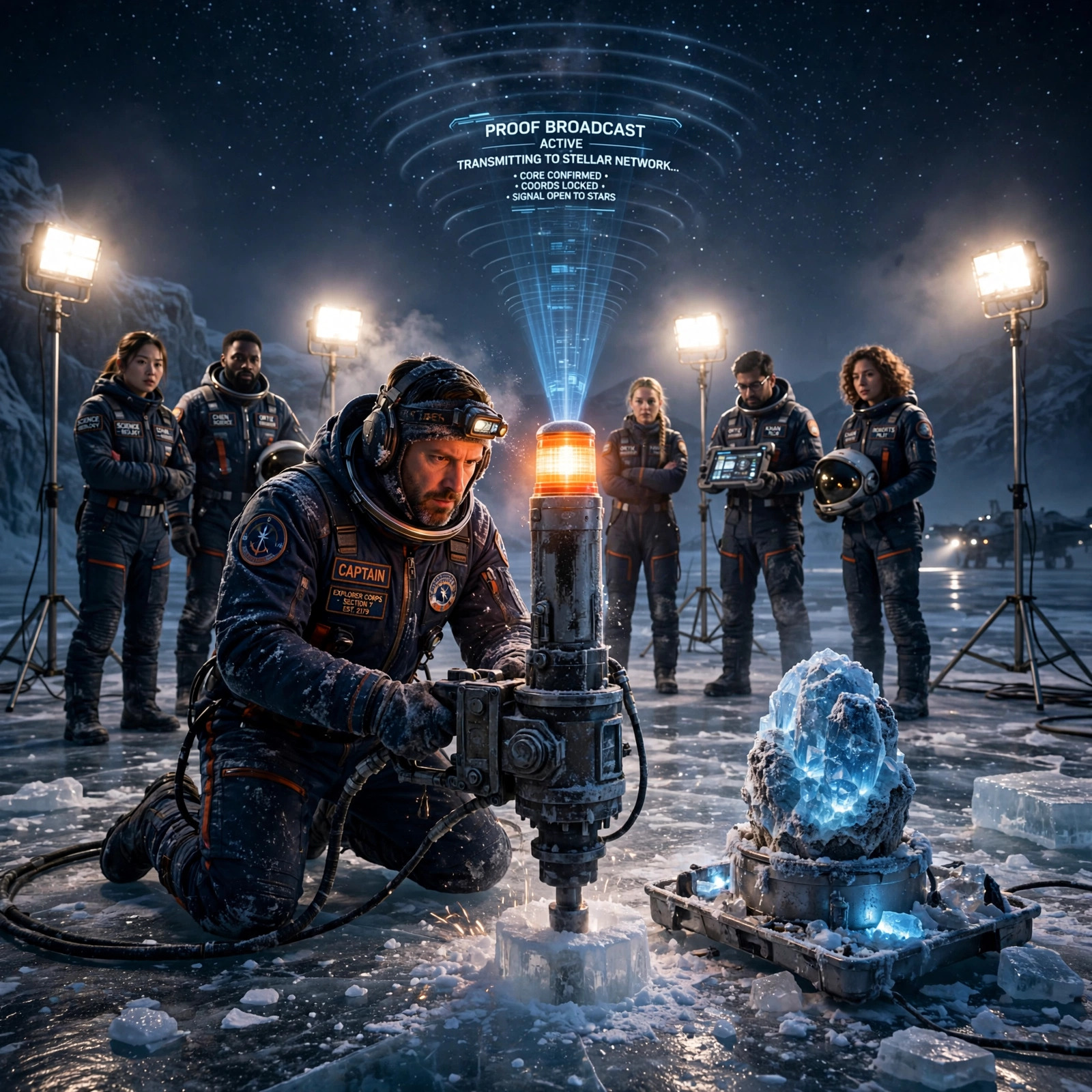
"Cold-gas lines hold at ninety bar," he said, to the underside of the deck. "I checked twice. It'll stop."
"It had better stop," Odile said. "That's the whole point of today."
The sled ran the length of the low deck, forty meters of rail with the arrest cradle at the far end and the tension bars drawn across it like the strings of an instrument nobody wanted to hear. The straw rode in its clamp at the nose, the hollow drill they would push forty centimeters into Anvara's crust to pull out the core, the one with the refrozen brine ice under it, if there was any brine ice to have. The sled was a stand-in. Today the sled was Anvara, and Nawi was going to fly a landing on it.
Nawi was already suited, helmet sealed, running her checks at the sled's throttle rail. Duarte sat at the telemetry bench with the reserve ledger open beside her. Bohm stood at the aft bulkhead with his slate and his stillness, which Odile had learned to read as attention.
"Rules first," Odile said. "Full abort profile. Real masses, real gas, real timing. Yun flies the descent burn on the sled, then flies the abort at the wall, and we find out whether the day-four margin is real or whether the sims flattered us. Nobody improvises. Nobody's clean. Honest."
"Honest," Nawi said through the helmet pickup. "Copy."
Ferreira rolled out from under the cradle and stood, wiping his hands. He was suited to the neck; his spare helmet sat on the rack by the airlock, visor down, ready for the second walk of the rehearsal, when he would pull the straw from the clamped core by hand the way he would on the surface. He looked at the cradle, then at the bars, then at Odile.
"If it doesn't stop in six meters," he said, "it doesn't stop in forty. Tell her that, Yun."
"I know the math," Nawi said.
"Say it anyway. Out loud. To the machine."
"Sled, you stop in six meters."
"Good. Now burn."
Nawi flew it the way she flew everything, unhurried, and the sled went down the rails with the straw shining at its nose and the gas hissing out of the thruster ports, and Odile watched the numbers on Duarte's bench run: velocity, distance to wall, margin. At the abort point Nawi threw the burn. The cold-gas valves cracked open. The arrest cradle came up fast. And the sled came in, and the cradle took it, and the tension bars took the load.
Three of them did. The fourth one let go.
It did not fail slowly. There was a crack like a hatch slamming and a shriek of metal and the bar came off its anchor with the whole arrest load still in it, end over end, and Ferreira was moving before Odile had finished hearing it, one arm across Nawi, his own helmeted head turned away, and the bar struck the suit rack where his spare helmet hung, struck the visor across its face and rang away down the deck, and the end of it came around and caught his bare hand above the glove line and opened it to the bone across the palm.
The sled stopped. Six meters, nearly to the centimeter. Nobody cared.
"Boaz!" Duarte was already moving. Odile was already moving. Nawi was out of her clamp and kneeling, and Ferreira sat up against the rail with his hand cradled against his chest, blood coming through his fingers in a slow bright line, and looked at the deck where the bar had come to rest against the far bulkhead.
"Tension bar," he said. His voice was level, which meant it was bad. "Number four. I checked it."
"I know you did," Odile said.
"I checked it twice."
"I know. Anke, the hand."
Duarte had the kit open on the deck. She cut the glove back with the little scissors, and Ferreira hissed once through his teeth and then held still and let her work. The gash ran from the base of his thumb across the palm, deep, clean-edged, the kind of thing a bar does when it has a whole arrest load behind it. She got the coagulant in, got the seal wrap on, got his hand into a rigid splint shaped like a half-fist.
"Nothing lost," she said. "Tendons are whole. It's meat and it's a mess and it'll hold a trigger in a week. Today it holds nothing."
"It doesn't need to hold anything today," Ferreira said.
"No. Today it needs to not bleed. Which it is managing."
It was then that Odile looked at the suit rack, and saw the helmet, and stopped.
The visor was cracked. Not starred, not fogged. Cracked, a single bright line running across the laminated face of it from the lower left corner up through the brow curve, twenty-six centimeters of it, a clean fracture in the polycarbonate with the laminate layers showing pale along its length. A helmet with a cracked visor does not hold pressure. A suit with no helmet holds nothing at all.
Bohm crossed the deck and stood over it. He did not touch it. He looked at it the way he looked at the corridor map, measuring.
"That's done," he said. "That suit's done. Which means the surface team is three."
"The surface team is four," Odile said, "and we're not on the surface yet."
"You know what I mean. He can't fly that helmet. You can't patch a pressure visor."
"You can bond one," Ferreira said from the deck, without getting up. "You can bond and clamp a crack across the brow line and pressure-test it to one and a half bar and it'll hold. It'll hold ugly, but it'll hold."
"It'll hold until it doesn't," Bohm said. He didn't raise his voice. He never raised his voice, which was the thing about him that wore on her most. "You want to put a bonded crack helmet on your drill operator and stand him next to a venting thermal feature. I've watched this man throw his arm across a pilot. I know what he is to this crew. That's exactly why he doesn't get to be the one thing aboard that isn't rated."
"The one thing," Duarte said quietly, not looking up from the wrap, "is currently splinted."
"Anke." Bohm's tone didn't change. "The hand's fine, we all heard you. The helmet isn't. Captain, you have a landing team of four and three rated suits and a corridor that closes in, what, Yun?"
"Day four," Nawi said. "The crossing burn window is nine seconds wide and I need seven of them. After day four, the corridor's just gas and the fresh ice is gone. Next good window is day twelve."
"And on day twelve," Bohm said, "you land slow, with margin, and you pull a core that's been sitting under a vent for eight more days, and you tell me it's the same ice. It isn't. You know it isn't. Salt fraction steady with altitude, you said it yourself, but fresh is fresh, and the claim my people are holding money against is the fresh one. Bench him. Fly Yun, Anke, and yourself, three suits, three seats, and take the corridor tomorrow."
It was reasonable. That was the trouble with Bohm; it always was. Three suits, three flyers, one day of margin, and a claim that needed day four more than it needed any one of them. Var Point was four hours away at the speed of light, four hours out and four hours back, and whatever the station said would arrive after the window had opened or shut. The call was hers. It had been hers since day one, and it would be hers standing right here on this deck with a cracked visor and a splinted hand and a reasonable man waiting for her answer.
She went and picked up the helmet.
It was lighter than it looked. The crack caught the deck lights along its length, pale where the laminate had separated. She carried it across to where Ferreira sat against the rail and held it out to him, visor up, both hands, the way you hand someone a decision.
"It's yours," she said. "You bonded the straw two years ago with Anke and you'll bond this tonight, and Duarte will pressure-test it to one and a half, and if it holds ugly then it holds. But you're the one whose face is behind it. So you tell me. Do you fly it patched, or do you sit?"
The deck was quiet. Nawi stood at the throttle rail. Duarte had stopped wrapping. Bohm's slate was down at his side.
"Bohm's not wrong," Ferreira said. He looked at the visor a long time, turning it once in the deck light to watch the crack run. "It'll hold ugly. And I'll fly it careful, and careful isn't what that hand needs for a week, so on day twelve I'd be pulling the straw with a hand that works. On day four I'd be pulling it with this one, if the corridor even lets you land, which is seven seconds of maybe." He looked up at her. "You're not asking me if the helmet holds. You're asking me if I do."
"I'm asking you to choose," Odile said. "That's all I've got to give you today."
He took the helmet. He turned it over in his splinted hand, careful, and set it on his knee with the crack facing up, and looked at it the way he looked at the straw before a pull.
"I fly," he said. "Bond it tonight. Test it twice. And I'll keep my head down in the plume, which is what the helmet's for anyway." He glanced at Bohm. "Log your objection."
"Already written," Bohm said, and it almost sounded like a laugh.
"Then we're short," Odile said, and said the rest of it out loud so it would be true. "One rated suit, four of us, and a corridor that closes tomorrow. And we burned a reserve day on the emergency thrusters when the bars went, so we're five days of margin down from six. Anke, file it. Yun, get the sled reset. Boaz, bar number four goes to Duarte's bench tonight and you go with it." She looked at the helmet on his knee, at the pale line running across its face. "We test at one and a half. And if it holds ugly, we fly ugly."
The Quiet Window
On the morning of day seven, the plume crossed the corridor without them.
Odile watched it from the bridge with her hands flat on the console, the way she would have watched a ship leave harbor without her. The vent stood open along the thermal crack, a gray column climbing forty kilometers before it sheared into grain and gas, and the corridor ran through it clean and empty and nine hundred kilometers long. No engine burn. No crossing heat. Nothing but the plume and the dark and the little moonless quiet of a rogue body with no sun to make a dawn of anything.
"Salt fraction's holding steady with altitude," Duarte said from the comms chair, reading the passives because there was nothing else to fly. "Same profile as the mapping run. Fresh brine ice all the way up the column."
"Fresh brine ice going to waste," Bohm said. He stood by the viewport with his slate in his hand, and he didn't raise his voice. He never raised it. "That's a sample nobody has ever pulled from a rogue body, streaming past us at corridor speed while we sit here and photograph it."
"We photographed it for three days," Odile said. "We mapped every meter of it. Yun's sims say the crossing burn gives us six meters a second of abort and needs seven. We rehearsed the abort and it broke a tension bar and cost us a reserve day and half of Boaz's palm. The window's closed, Iskander. It closed when the bar snapped."
"The window closes on day twelve," Bohm said. "You're choosing to let this one go by."
"I'm choosing to be alive on day twelve with a drill and a hand that works." She straightened. "Log it."
"Logged." He wrote on his slate, unhurried, and she watched his thumb move across it twice, and she thought nothing of it, because he had logged a version of the same objection every day since the mapping run.
She thought nothing of it until the afternoon, when she pulled the transmission record.
It was routine, part of her end-of-day read of the ship's housekeeping: consumables, thermal, radiators, the comms queue. The Evenfall carried a high-gain dish and a store-and-forward buffer, and every packet that left the hull went into the log with a timestamp, a bearing, and a size. Mission traffic went out on the survey channel, addressed to Var Point Station, four light-hours down the dark. The log was long, and she was reading it half-attentively, and then she read one line three times.
There were packets in the queue that were not addressed to Var Point.
She brought the filter up and the list got shorter and shorter and did not get clean. Six transmissions across four days, tight-beamed, high gain, bearing nearly perpendicular to the Var Point line. Small packets. Compressed. Encrypted with a Trust cipher, which the ship's own software identified helpfully, because the cipher was aboard, because the Trust had built half the ship. The first had gone on day three, an hour after the corridor map came off the processor. The last had gone that morning, twenty minutes before the plume crossed.
She sat with it for a moment. Then she keyed the bridge privacy lock and said, "Anke. Who else has high-gain access?"
Duarte looked up from the comms chair. "Bohm, for his sponsor reports. You. Me, for the medical uplink. That's the list."
"The medical uplink goes to Var Point."
"It does." Duarte had been eight years at this work, and her face did not need a moment to catch up. She turned her own console and pulled the bearings, and the two of them looked at them together, and the bearings all lay the same way, out of the ecliptic, toward nothing the mission had any business talking to.
"It's a relay," Duarte said quietly. "Trust relay buoy. There are three of them strung along the survey line. I've seen the passives on them. I didn't know they were live."
"They're live." Odile stood. "Keep this between us. I'll handle it."
She found Bohm in the mid-deck galley with a bulb of tea, and she put the slate on the table between them with the list showing, and she watched his face while he read his own traffic.
He didn't flinch. He set down the tea.
"Six packets," Odile said. "Day three through this morning. The plume coordinates, the salt profile, the corridor geometry. Everything the open channel was going to get, sent ahead of it, tight-beamed to a Trust buoy."
"Yes." He didn't reach for the slate. He left his hands where she could see them. "You'll want the reason."
"I want it before I decide what I do about it."
"Then sit down, Captain, because it's not a short one." He waited until she did. "The Halcyon Trust put up the money for this hull. Eleven years of my working life, I have watched claims get made and lost on who filed first, and I have watched good survey work get buried because somebody's underwriter got the coordinates an hour before the open channel did and filed on the strength of them. My people were promised a claim. In writing. Before we ever burned out here. When the plume came up that first day, I had two duties and I thought I could serve both, so I served the one that had no other servant aboard. I sent them what we found. So they could hold the claim. So the proof wouldn't get taken off our backs."
"Ahead of the open channel."
"Ahead of it. Yes." He met her eyes. "And I'll tell you the rest, since you'll find it anyway. I sent them the corridor numbers because I believed the day-four window was the only honest one. Six meters a second of abort, I know what that is. But I also know what our supplies are, and I believe waiting kills this mission. Five reserve days, a patched visor, a drill hand with stitches in it, and a landing window that needs everything to go right for eight more days. You burn two holding parking orbit for the slow window and you're at three. One bad pump, one more snapped bar, one scratch of bad luck, and we don't come home with anything. I've watched that happen twice. I wasn't going to stand on a bridge and watch it a third time without telling somebody whose whole livelihood is riding on it."
The galley fans turned. Somewhere below, Ferreira's bench made a small filing sound.
"So you leaked," Odile said.
"So I leaked. Six times. To people who own the paper on this hull." He turned the tea bulb once on the table, not drinking it. "I've been straight with you on every call since day one, and I'll tell you now what I'd tell them: I think you're wrong about the window. But you're not reckless with it, and Boaz isn't, and Yun isn't, and I've stopped telling myself you're going to kill us. That's the truth of it. The rest is a man keeping promises he made before he knew who he'd be keeping them with."
She believed him. That was the trouble. She had eleven years of reading sponsors and observers and stationmasters, and she believed him, and the belief didn't make the log line go away, but it changed what the line was. It wasn't greed. Greed she could have handled with a form and a reprimand and a sealed channel. This was a man with a loyalty she couldn't put in a form, pointed at the wrong place.
"Here's what happens," she said. "Nothing goes to Var Point about this. Not from me, not from Anke. You keep your post, you keep your seat at the table, and you keep your mouth shut about windows until day twelve is behind us. Because here's what I'm about to do to your leak."
She stood and went up to the bridge and he followed, and Duarte looked up at both of them and asked nothing.
Odile opened the strongbox. The beacon lay inside in its machined titanium casing, squat and heavy, its key plate showing a single amber light: armed, sealed, keyed private. A Halcyon Trust claim. Exclusive. First filing on a subsurface ocean under a rogue crust, if the core ever came up with brine ice in it. Worth whatever a thing like that was worth, which was more than the hull that carried it.
She took it out and set it on the console and turned the key plate to the second position, and the amber light went out and a green one came on.
Open channel. Survey stamp. Public filing, the moment it broadcast.
"Odile." Bohm's voice was even, but he'd come three steps onto the bridge without noticing it. "That claim is the Trust's. It's in the mission paper. You key that open and you're giving away…" he stopped, and started again, quieter. "You're giving away the only thing we came out here to own."
"I'm giving away the thing you already sent them," she said. "Six packets, Iskander. They've had the coordinates since day three. The only thing that key is worth now is the moment it stops being worth anything to anybody. I key it private and your people file on the strength of your leak and the proof belongs to whoever's fastest, and that's the whole ugly business you told me you got into this to stop. I key it open and the claim is nobody's and the proof is everybody's, and your six packets turn into six footnotes. That's my call. It was always my call. I'm making it."
She pressed the plate. The green light pulsed once, and the beacon's short-range transmitter woke, and the claim stamp went out into the room on the open survey channel: Notice of open survey filing, Rogue planetoid Anvara, subsurface ocean investigation pending, Evenfall survey, all parties.
Bohm looked at the beacon for a long moment. Then he sat down in the observer's seat, and put his slate face-down on the console, and rubbed his eyes with a thumb and finger.
"They'll have my post," he said.
"They'll have a filing that can't be exclusive, and a man who made it that way in a day instead of a year." She put the beacon back in the strongbox and shut the lid. "If we pull the core on day twelve, Iskander, your people's name is on the proof forever. Open. Every textbook. That's more than a claim and it's more than you were promised, and it's yours if you can get them to see it that way. I'll help you write it, if you want."
He didn't answer. That was fine. She hadn't needed him to.
"Anke," she said. "The burn plan for parking orbit. Two reserve days, holding station over the landing site until the slow window. That leaves us three."
Duarte had the notice already drafted. She'd drafted it while they argued, because eight years at comms teaches you what the captain's going to need before the captain does. She showed Odile the header: open survey channel, Var Point Station, mission day seven, notice of open filing and revised landing schedule, window day twelve.
"Send it," Odile said.
Duarte sent it. The dish swung, found its bearing down the long dark toward Var Point, and the packet went out at the speed of everything, four light-hours to home. Whatever answer came back would arrive while they slept, and it would arrive to a ship that had already decided.
Odile opened the mission log and wrote the line herself, longhand first, the way she did when a day was worth keeping straight: Day seven. Plume crossed unflown. Beacon keyed open. Parking burn scheduled for 0400, two reserve days, holding for day twelve.
Three days of margin left in the tanks. A corridor that would close and open again without them. A drill waiting to pull forty centimeters of crust, and under it, if the salt in the plume meant what she believed it meant, an ocean in the dark that had never once seen a sun.
"Day twelve," she said to the log, and to the bridge, and to the man sitting quiet in the observer's seat with his slate still face-down. "We go slow, and we go together, and we come home with it in our hands."
The Long Descent
Yun Nawi flew the slow window the way she'd flown it in the sims on day three, and the difference between the sims and the dark was only that the dark did not forgive twice. Odile sat in the left observation seat with her harness cinched to the last click and watched the pilot's hands move in small, patient strokes, spending delta-v the way a careful person spends a last currency. The Evenfall came down over the morning terminator of Anvara, if a world that had never once seen a sun could be said to have a morning, and the land beneath them unrolled in long ridges of black ice, cracked like a dry lakebed, lit gray-white by their own floods.
"Sixty kilometers," Yun said. "Descent rate holding. Four minutes to site."
"Copy," Duarte said from comms, and then, because she was Duarte: "Heart rates all green, for the record. All four of them."
Five of them, Odile thought. Bohm sat in the observer's seat with his slate face-down on his knee, same as he had for five days now, and his heart rate was as green as anyone's. She let it be.
The window had cost them two reserve days just to hold, and it would cost them nothing now but time. That was the whole bargain of it. The day-four corridor had been a knife edge, nine seconds wide, seven needed, and this was a door left open for the better part of an hour. Yun threaded them through it without drama, and the sled skids met the ice with a sound carried up through the hull and through Odile's boots, a long grinding settling, and then stillness. Real stillness. Twelve days of falling and holding and falling again, ended.
"Contact," Yun said. "We are down on Anvara."
Out the floods, the plain ran flat to a horizon set close by the smallness of the world. Somewhere south of them, beyond a ridge line they could not see from here, the crack that fed the plume ran for kilometers through the crust, and every forty hours it exhaled a corridor of vapor and brine ice nine hundred kilometers long, and they had let it pass over them unflown on day four, and it would pass again on day sixteen, and they would be gone by then, home with whatever they carried.
Or without it. She put that away too.
"Suit checks," Ferreira said over the local channel, and they stood one at a time in the narrow airlock bay while Duarte read the seals off her board. Nawi. Varga. Duarte. Bohm. And then Ferreira, last, in the helmet with the bonded patch, and Duarte read his numbers slower than the others', and Odile heard her not say anything about it, which was its own kind of care.
"Patch holding," Duarte said. "Rated for surface work. You know the line, Boaz."
"No dynamic tasks," Ferreira said. "No sled work, no tension bars, nothing that loads the visor. I know the line. I wrote the line." His right hand was bound from palm to wrist in a pressure wrap, the gash from day five sealed under it, and he flexed the fingers inside the wrap, one, two, three, four, watching them answer. "Hand works. That's all the drill needs."
They cycled out onto the ice in the order they'd rehearsed, and Odile's boots left the first prints any thing had ever left on this plain, and she made herself not look at them too long. The gravity was slight, a fraction of home, and every step went farther than it should have, and she let her body learn it on the walk out.
The drill site was a hundred meters from the sled, marked from orbit, on a flat between two long pressure ridges. Ferreira walked the flat with the straw broken down across his shoulders like a yoke, steel and ceramic liner, brazed at Var Point two years before any of them had known this world existed, and Yun walked beside him carrying the power leads with her gloves held wide of the ice. Odile carried the beacon. It rode in a padded sling against her chest, titanium casing, small as a loaf of bread, and heavier than its size, and she was aware of it the whole way out the way you're aware of a thing you have already decided to give away.
They set the straw's base plate on the flat and Ferreira leveled it by hand, on his knees, using the wrapped one as a weight and the good one as a gauge, and Yun brought the leads hot, and the drill turned over with a shudder Odile felt through her soles. Ice chips lifted from the bore in a slow, widening fan, catching the floodlight, hanging in the low gravity longer than chips had any right to. Ferreira watched the bore collar and fed the straw down a hand's width at a time, and called the depth out flat.
"Ten centimeters. Fifteen. Clean crust, dry, no brine at the collar."
"Copy dry," Duarte said, from the sled, where she sat on the board with the long relay ready and the dish aimed at a point in the sky where Var Point would not be for another hour.
Odile stood where she could see both the bore and Bohm. Bohm stood where he could see the bore. He had not spoken since the surface, and his hands were still at his sides, and when the straw passed twenty centimeters he said, quietly, on the local channel, "For the record. Whatever comes up, the Trust's filing stands open. I confirmed it this morning."
"I saw the packet," Odile said.
"It cost a man his post."
"It cost a man a title," she said. "He kept his name."
He didn't answer that either, and that was fine too.
"Thirty centimeters," Ferreira said. And then, a minute on: "Thirty-five. It's dark. Hold." The fan of chips changed at thirty-six, Odile saw it before he said it, the chips coming up no longer clear but dimmed, gray, and then he said: "We're in it. Thirty-eight. Refreeze. This is refreeze, look at the collar, that's brine ice coming up, that is salt ice, thirty-nine," and Yun bent close over the bore with her lamp, and Duarte left the sled for the first time and came across the flat at a lope that ate meters, and Bohm took two steps forward without seeming to decide to.
"Forty," Ferreira said. "Yun. Pull."
Yun Nawi took the straw in both hands and drew it up out of the crust in one long smooth stroke, and the core came with it, held in the ceramic liner, forty centimeters of Anvara, and she laid it out on the base plate in the floodlight where all of them could see it.
The top half was clear, black-clear, old crust. The bottom third was different, and the difference was the whole thing. Gray-white, dense, and where the floodlight went into it the core glittered with a grain no clean ice had. Ferreira put his good hand out over it and did not touch it. Then he took the scalpel from his kit, working it with the wrapped hand braced on his knee, and shaved a curl of the lower third, and held the curl up in the light, and the salt was visible in it as a fine bright dust, and he said one word on the local channel that Duarte would later decline to transcribe.
"Salt doesn't grow in a dry crust," Ferreira said. "Salt grows in water that froze after it was wet. This ice was liquid. Under us, some time that matters, this was liquid. It's an ocean. Captain, it's an ocean."
Yun's breath on the channel was audible, quick, twice, and then steadied. Duarte had her slate out already, filming the core where it lay. Bohm stood over it with his hands loose at his sides and his faceplate turned down at the ice, and after a while he said, "No one's ever pulled that off a rogue body."
"No one's ever pulled anything off a rogue body," Ferreira said. "We're the first people ever to be boring on one. Give us our due."
Yun laughed, short, and Odile felt it go through the channel.
Then there was only the thing left to do, and it was hers, and she had known since day seven that it would be done in this order, core first and then the beacon, so that the beacon would go into the ice beside the proof and not instead of it. She knelt at the edge of the site, set the casing down, and drove the spike home with three strokes of the mallet from the kit, and the black crust took it and held it upright, and it stood in the ice the way a fencepost stands, unlovely, and permanent.
"Duarte," she said. "Confirm key."
"Key confirmed," Duarte said. "Open survey channel. No exclusivity, no private claim, full filing, all four names and the Trust's beside them."
"Bohm," Odile said. "Say it for the log."
He was quiet a moment, with the windless cold of a whole world around them and nothing moving anywhere on it but five people and a machine. Then he said, "Halcyon Trust, Iskander Bohm, observer, concurs. Open filing. All names."
"Light it," Odile said.
Duarte sent the command from her slate, and the beacon lit, a small steady amber lamp in the titanium crown, and its first packet went out on the open frequency, and every station and every ship and every survey desk in the whole long dark of that system could read it as it went, and it said that on day twelve a crew had come down on Anvara and pulled forty centimeters of crust and found refrozen brine at the bottom, and that under the black plain, in the deep of a world that had never once seen a sun, there was water.
They stood around it, all five, in the floodlight, on the ice. Ferreira with his bound hand resting on the straw. Yun with the core lying before her boots, glittering. Duarte filming. Bohm with his slate face-down still, forgotten, in his other hand. And Odile looked at the lamp burning amber in the ice beside the bore, and did not say anything, because there was nothing left that needed her.
Get notified when new stories drop

Ava Kepler
Ava writes space exploration and cosmic adventure with competent crews, hard problems, and awe that earns its hope.
Leave a comment
Comments